
Showing 17 items matching "angel badge"
-
 Charlton Golden Grains Museum Inc
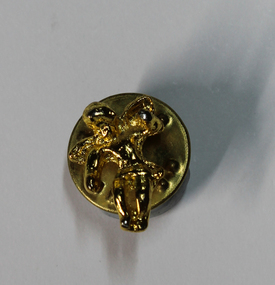
Badge - Gold coloured Angel
... ...Angel Badge...Josephine Ryan Lions Youth Exchange Charlton Lions Exchange 1989 Noreen Ryan Angel Badge Small gold angel on round gold plate. ...Josephine Ryan (a Charlton resident) was a Lions Youth Exchange Student to New York State in 1989.Small gold angel on round gold plate. The back has a stud.josephine ryan, lions youth exchange, charlton lions exchange 1989, noreen ryan, angel badge -
 Mission to Seafarers Victoria
Photograph - Digital photograph, copy, 1956-1958
... Black and white gloss print photograph made in studio depicting David Conolly in profile wearing naval uniform and cap and Flying Angel badge in lapel....David Conolly, Lay Reader, Mission to Seamen, Melbourne 1956-1958 David Conolly had a long standing connection with the Mission. david conolly lay readers mission to seafarers flinders street mission to seamen Hand written in black texta; David Conolly, Lay Reader, Mission to Seamen, Melbourne 1956-1958 Black and white gloss print photograph made in studio depicting David Conolly in profile wearing naval uniform and cap and Flying Angel badge in lapel. Photograph Digital photograph, copy ...David Conolly, Lay Reader, Mission to Seamen, Melbourne 1956-1958David Conolly had a long standing connection with the Mission.Black and white gloss print photograph made in studio depicting David Conolly in profile wearing naval uniform and cap and Flying Angel badge in lapel.Hand written in black texta; David Conolly, Lay Reader, Mission to Seamen, Melbourne 1956-1958david conolly, lay readers, mission to seafarers, flinders street, mission to seamen -
 Mission to Seafarers Victoria
Article, A Woman's Melbourne Letter
... The building, comprising chapel, and institute under the one red tiled roof, is grey stuccoed, with a small tower, from which flaunts the flag of 'The Flying Angel" - the badge of the guild. A visit to the institute makes one fully appreciate the boon the place must be to the voyage worn, weary, sailor. ...The building, comprising chapel, and institute under the one red tiled roof, is grey stuccoed, with a small tower, from which flaunts the flag of 'The Flying Angel" - the badge of the guild. A visit to the institute makes one fully appreciate the boon the place must be to the voyage worn, weary, sailor. ...A detailed description of the Mission and its activities written by a woman: Western Mail (Perth, WA : 1885 - 1954), Friday 13 December 1918, page 34 A WOMAN'S MELBOURNE LETTER. Melbourne, Dec. 4. There is an idea abroad, which as regards Melbourne, at any rate, is quite erroneous, that our sailors are not as well looked after as our soldiers, and that the noble men of the Mercantile Marine are much neglected ! For once, perhaps, my readers will pardon a letter dealing with only one subject, but the steady, unostentatious work done by the Ladies' Harbour Light Guild, in connection with the mission to seamen in Melbourne could not be adequately explained if dismissed in the usual short paragraph. Some of the most prominent names in Melbourne are associated with this guild and with the Mission Chaplain, and Mrs. Gurney Goldsmith, the members have made the Seamen's Institute a real home for those sailors of the Mercantile Marine, who touch our port. What we as a community owe to those men by their heroism in recent hostilities is certainly more understood by this band of enthusiastic workers than by the community generally. By using their unflagging energies, and influence on the sailor's behalf they endeavour to discharge a debt to which in some way or other we could and should all contribute. Even the most casual person can, if he thinks at all, sum up a few of the things our sailors - other than those belonging to our glorious navy - have done for us. On the spur of the moment we remember that those of the Mercantile Marine, are the men who manned our transports, who carried our wheat and wool, to oversea markets; who kept us in touch with our loved ones abroad; who kept the fires going in the furnaces of the great leviathans, bringing our wounded soldiers home again; who never flinched when self-sacrifice was demanded; who cared, with that tenderness, innate in all sailors, for the women and children, when the passenger ships were struck a dastardly blow by the wicked enemy; who, mocking death, gave up life with a heroism all the more heroic because it was always taken as a matter of course! Is it any wonder, then, that the members of the Ladies' Harbour Light Guild make it their business to provide a bright, homelike, spot in Melbourne, where the sailors are always certain of a cherry welcome ashore? The members of the guild are admirably drafted! The 360 non-workers each pay £1 1s. per annum. The workers, of whom there are between 700 and 800, donate 2s. 6d. and school members - it is confidently hoped that gradually all the schools will take an active interest in the mission - 1s. a year. The knights of the guild - as the men members are designated - are responsible for any sum they wish to name, from 5s. a year upwards. Everything is paid for out of these revenues, with the exception of a small grant from the Home Mission Fund - and such is the organisation, and management, that the entire concern is quite free from debt. The Seamen's Church and Institute, where the "Harbour Lights" gleam so brightly, is situated right in the midst of all the bustle and turmoil of the wharves, at the end of Flinders-street. The building, comprising chapel, and institute under the one red tiled roof, is grey stuccoed, with a small tower, from which flaunts the flag of 'The Flying Angel" - the badge of the guild. A visit to the institute makes one fully appreciate the boon the place must be to the voyage worn, weary, sailor. The atmosphere is eminently social in its best sense. While the architecture imparts an elegance, and quiet dignity which soothes by the very subtlety of its charm. With its comfortable furniture, its wealth of flowers, and the happy, wholesome, feminine influence which prevails everywhere, the quality which stands for the magic word "home" abounds. The Chaplain in the course of conversation said: -"We try to make this really a free club for sailors." But the habitues would probably tell you it was far more than that to them. The Institute is excellently appointed, and every little corner seems to have its particular history. It was built after the model of one of the old mission churches in California, and retains something of the old world attraction, while yet it combines all the advantages of modern, practical, conveniences. On entering the door the first thing, one notices is a huge compass, inlaid upon the floor, evidently to indicate one's proper bearings for it points due north - to the chapel! Only one other seamen's mission in the world boasts such a compass. As the sailor swings through the entrance he finds the office on his right, and there is, here, always a smiling face to welcome the shy, or timid, new comer. Quite a real post office is staffed by members of the guild, and all the letters received are listed alphabetically. Therefore, the expectant sailor has just to run his eye down the list, and he can immediately see whether there is a letter for him or not. If he is fortunate, he comes up to the member in charge, who unlocks the box, and produces the longed for missive. The boys are always encouraged to answer letters - and to write them. Often a few words about their mother, and their own home, will provoke a sleeping memory into activity. The writing room is well stocked with paper, envelopes, pens, and ink. The tables are so divided to ensure the utmost privacy, and through a calculated chain of circumstances, many an anxious mother receives a letter from her sailor lad, who, perhaps, might not have written but for these kindly inducements. The central hall - where social evenings are held every other night besides two special concerts a week - is inviting in the extreme. A handsome piano affords opportunity for those musically inclined. The tables are strewn with papers. The walls are bright with pictures, and here, and there, is a carved model, of a ship. One, of especial interest, is a model of "The Roon" carved, and presented by a French sailor. This German vessel will always be remembered in Australia. For it was across her bows that the first hostile shot was ever fired in Australian waters. In the corner is the canteen. It was fitted up entirely from the proceeds of a quotation calendar compiled by one of the members. The sailors may at any time, get a teapot of tea, or a tray of eatables, at a nominal cost. Before the canteen was in existence they had to go out for refreshments! - and sometimes they did not come back! Groups of sailors sit chatting at the tables. Half a dozen Swedes laugh and talk among themselves, for the simple reason they know no other language than their own. Several British sailors cluster about a dark-eyed Welsh lad - a perfect Celtic type - who, although only about twenty years of age, has been the victim of the Hun five times. Mines and torpedoes sank the ships he was in, either in the Channel or off the English coast, four times; and it is to his fifth experience, when the Inverness was wrecked, that everyone is eagerly listening. "We were in the boats eight days," he was saying, "I was pretty well mangled when they picked me up. The sufferings we endured were awful. At last we managed to reach Rapa, a Hawaiian island. The natives thought we were Germans, and came at us with spears. When they found we were British, they were awfully good to us. They even cried when we left, and the day before the rescue boat arrived they begged us to go into the hills and hide." At another table a Canadian lad - once a sailor - then a soldier, who trained at the Broadmeadows camp - was telling his experiences : - "The voyage which will always stick in my memory," he said, "was to a place which must be nameless. We left the United States not knowing whether we were bound, or what we were going to do. After some weeks we sighted a group of wonderfully beautiful islands, and we headed for the most remote and most lovely of them all. Then, and only then, we learned our mission from the skipper. We were taking their year's supply to a leprosy station! Oh no! I don't blame the skipper for not telling us ! Someone has to do these things, you know. A naval guard saw they didn't come near - and we all got sixty dollars extra. When the job was over we were quarantined on another island for two months, and one little chap - the baby of the crew, not eighteen - developed leprosy, and died before we left. Yes! I'll never forget that voyage, mates! Sometimes, I seem to see Leper's Island yet, with its lavish tropical vegetation and the gorgeous sunsets which stained all the water with blood. Then, too" - here the voice deepened - "there was an English girl - a leper - there. We heard she used to be an actress, and she contracted the disease somehow or other. She was always alone, and always watching us. In the distance we could see her come to the water's edge, and from there she would watch. Just watch . .. . watch . . .watch. ..." "Here come a couple of North Sea chaps," broke in an elderly man after pause. "One of them wounded, too, poor lad." It is not strange that all the sailors flock to the Institute. It is so comfortable, and essentially inviting, besides being full of human interest. The men's quarters comprise reading, writing and dressing rooms - hot and cold baths are always available - billiard room, and a special baggage room, where any sailor may leave his kit for as long as he likes. The payment of 3d. covers its complete insurance. Upstairs are the officers' quarters. These also have their own billiard room, writing and reading rooms, bath and dressing rooms. Just close are the apprentices' quarters - "The Half Deck," as popular parlance has it! The lads also have a billiard room of their own, and indulge in an easy armchair - amongst others - which was a donation from the Milverton School branch of the Guild. It is hoped by the committee to some day utilise the huge empty rooms, which run the length of the whole building. Their ultimate intention is to fit them up as cubicles, or "cabins," as they are to be called. They trust these "cabins" will be donated, either in memory, or in honour, of someone dear to the donor. Another forward movement soon to be put in hand, now that materials are available, is the establishment of "Norla Gymnasium." In a sailors' club such facility for exercise is absolutely essential. The men both need, and miss, exertion. As one boy, who had been backsliding, once said pathetically : -"If only there was something to do to get me into a good sweat, I would be all right." Soon such an one will be helped to swing from the trapese of the Norla Gymnasium into the right track! Sunday is always a fete day at the Institute, for 40 or 50 sailors generally come into tea. The up-to-date kitchen, which is fitted with every labour-saving appliance - all paid for out of working members' half crowns - is then a hive of animation, and methodical order. A formidable row of teapots await filling. Mrs. Goldsmith -, the chaplain's wife - rightly thinks it is far more homely to pour out the tea from a pot, than to serve it straight from the urns. So tea is poured out by a member, who sits at the head of a table gay with flowers, and chats to the guests. These latter are of all nationalities. But the French, the Spanish, Scandinavian, Norwegian - or any other sailor is equally welcome with the British. Two enthusiasts belonging to the Guild actually learnt Norwegian, so that men of this nation would have someone to talk to, and so be less lonely when they reached this, to them, foreign port ! The members of the Guild have their own private suite where they arrange the flow-err and do other necessary odds and ends undisturbed. No one appreciates flowers like a sailor, and the earliest and most beautiful may always be seen adorning the tables and rooms. Teas are served and lectures are held in the "Celia Little Hall," one of the most beautiful portions of the institute. It was erected by the chaplain in memory of his aunt from whom the hall takes its name. The Gothic windows open upon the cloisters, where, in the hot weather, the sailors enjoy their meals out of doors. The cloisters, indeed, form an exquisite spot. They are between a series of sweeping arches which lead to the chapel, and are sheltered by the open balcony of the chaplain's quarters. Grace of contour marks the architecture on every turn. Just around the corner is the chaplain's garden - a patch of green and colour, transformed from a desert waste, by a well-known woman horticulturist. The book room is a department especially valued by the sailors. There are two secretaries, one for home and the other for foreign literature. Books in French, English, Spanish, Scandinavian, Norwegian, and German may be found on the shelves. Each week about 36 convenient parcels of reading stuff are made up. These contain illustrated papers, books in various languages, and magazines. These parcels are eagerly accepted by the sailor with a long monotonous voyage before him. But complete as is every corner of the institute, no part is so well equipped as the memorial chapel erected by the Ladies' Harbour Light Guild, in memory of the officers and men, who have lost their lives during the war. St Peter's - for it is called after the sailor's patron saint - with its hallowed gentle dignity is a veritable sanctuary of peace, perhaps all the more so because it sprang out of war. The fittings are entirely of Australian wood. The pews, given in memory of some loved one by one of the members, are of Tasmanian hardwood. The reredos and altar chairs of carved blackwood. The rich carpet was provided by the members' magical half-crowns. Already this chapel holds memorials of peculiar historical interest. The altar lectern was given in memory of Commander Elwell, who, it will be remembered, was killed at Rabaul, in the early part of the war. The font commemorates two heroes - Nigel Hockley and Fred Hyde, who lost their lives at the hands of the Germans, although they survived the actual torpedoing of their ships, the Galgorn Castle off the coast of Ireland. The mother of one of them wrote out that her son had died as an Englishman should - fighting for the right. This noble sentiment is suitably paraphrased upon the inscription engraved upon the font. Practically every-hing enshrined in the chapel has its own sentimental value. The alms salver of beaten copper, studded with agate, is fragrant with the memory of a saintly woman.The eye of the sailor is caught and held by the pulpit, which is fashioned like a ship's hull and only a twist of rope guides the chaplain up the steps. For the last 13 years the Rev. A. Gurney Goldsmith, M.A., has acted as chaplain to the Seamen's Mission in Melbourne. Before that he and his wife worked in China. Mr Goldsmith visits all the boats and gets in touch personally with the sailor, over whom he has great influence. He is not only their chaplain and friend, but, amongst a wide range of other things, their banker besides. An exchange system exists between the various Missions, and the sailor who has "banked" his money with the chaplain, upon going away, receives a cheque which is cashed - minus exchange - by the chaplain of the next port. Mr. Goldsmith will tell you he has a soft spot in his heart for on old sailor he calls "Paddy." This ancient mariner has been wrecked ten times. It was a long time before the chaplain prevailed upon "Paddy" to partake of the spiritual and secular advantages afforded by the institute. He would not come, he said, until he could do so "with a good heart." Finally he frankly admitted that he had no "friends like those of 'the Flying Angel,' " and that he eventually proved his own "good heart" will be shown in this story. One day he came in to the chaplain and said bluffly, "Well, sir, I've been payin' off some old scores up Carlton way, an' I tells yer, plain, sir, not one of 'em would have seen a penny of their money but for the Mission." The Ladies' Harbour Light Guild has over thirty working suburban branches, and the excellent results achieved at the Institute now will no doubt be considerably augmented in the future. The practical actions of the members do more than anything else to convey the subtle meaning of the name of the Guild. To the visiting sailors the word "ladies" signifies the bread givers; "harbour" safety ; "lights" welcome; "guild" the welding of fraternity, and they one and all tell you the ideals thus embodied are unselfishly carried out by all the ladies who have banded together to care for the sailors' welfare.The article describes the Mission and the use of several spaces a year after its opening and gives details about the daily activities.Digital copy of an article published in the Western Mail on the 13th of December 1918. 717 flinders street, seamen's mission, norla dome, lhlg, reverend alfred gurney goldsmith, celia little room, garden, frederica godfrey -
 Mission to Seafarers Victoria
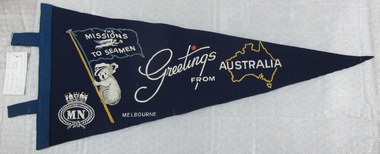
Flag - Pennant, The Missions to Seamen - Greetings From Australia, 1940-1949
... badges, tokens. One of them gave her this felt pennant. In 1949, the family moved back to Wonthaggi and June started year 5 over there. A number of souvenir gifts and small boxes were apparently available through the Mission To Seamen in the 1940s. This acquisition adds to the small collection of items from the period which could be used to form the core of an informative exhibition. Similar flags were made in other countries depicting an animal (kiwi bird in New Zealand, springbox in South Africa) and other Australian towns. pennant flags koala flying angel ...This pennant was donated to the Mission by June Muirhead (nee Richardson) who visited the Mission on two occasions: on the 13 November 2014 and then in 2016. She lived from age 3 to 8, with her parents, Cuthbert (Bert) Richardson and Jane (Jenny) Richardson, and her sister, Edna, in the Cottage at 717 Flinders Street. Her father, was the caretaker of the Flinders Street building between 1943-1949. . In 1943 her father was hired to work at the Mission as a caretaker. The family moved from Wonthaggi. When she lived in the Mission, she would sometimes sneak into the club to look at books and pictures. Some seafarers would give her badges, tokens. One of them gave her this felt pennant. In 1949, the family moved back to Wonthaggi and June started year 5 over there.A number of souvenir gifts and small boxes were apparently available through the Mission To Seamen in the 1940s. This acquisition adds to the small collection of items from the period which could be used to form the core of an informative exhibition. Similar flags were made in other countries depicting an animal (kiwi bird in New Zealand, springbox in South Africa) and other Australian towns.A triangular felted, dark blue pennant with printed cursive inscription and motifs including: the Mission to Seamen Flying Angel flag, an outline of Australia; a Koala wearing a captain's hat; an insignia emblem for the Merchant Navy. A looped cotton binding along left edge of the triangle to thread the flag on a stick or cord support. The printed inscription reads: Greetings from Australia.pennant, flags, koala, flying angel club, merchant navy, d. june muirhead, marketing, caretaker, cottage, bert richardson, june muirhead nee richardson, edna richardson, ww2 -
 Mission to Seafarers Victoria
Memorabilia - Framed badge, Classic Picture Framers, 2016
... The badges are a reminder of the dedication and hard work of women for the Mission. badges flying angel hlg Small white badge and a golden label below with information about it mounted on a black paper and framed in a square black frame Memorabilia Framed badge Classic Picture Framers ...Badges from the Harbour Lights Guild were found in a bag in the archives. 20 of them were framed as memorabilia to give to women of substance of the Mission as a token of appreciation. The number 2 was given to Linda Dessau, Governor of Victoria, in 2017. The number 16 was given to Uma Kothari after she brought back the trowel and during the opening of her exhibition in June 2019.The badges are a reminder of the dedication and hard work of women for the Mission.Small white badge and a golden label below with information about it mounted on a black paper and framed in a square black framebadges, flying angel, hlg -
 Mission to Seafarers Victoria
Badge, The Missions to Seamen: Honorary Worker
... badge...missions to seamen...honorary worker...flying angel...Small circular badge, lapiz lazuli blue enamel on metal, depicting the Flying Angel flag of the Missions to Seamen. ...Badge of Honorary Worker of the Mission. badge missions to seamen honorary worker flying angel Small circular badge, lapiz lazuli blue enamel on metal, depicting the Flying Angel flag of the Missions to Seamen. ...Badge of Honorary Worker of the Mission.Small circular badge, lapiz lazuli blue enamel on metal, depicting the Flying Angel flag of the Missions to Seamen. Around an inscription: Honorary Workerbadge, missions to seamen, honorary worker, flying angel -
 Mission to Seafarers Victoria
Badge, K. G. Luke, The Missions to Seamen, early to mid
... Round enamel badge with navy Flying Angel flag on a pale cream ( originally white?) ...LUKE MELB" stamped on back Round enamel badge with navy Flying Angel flag on a pale cream ( originally white?) ...The manufacturers K.G. Luke were a well known Melbourne Jeweller and manufacturer of badges buttons, silver and dec art objects for the home.Badge is visual representation of ongoing support and/or association with MTS. Round enamel badge with navy Flying Angel flag on a pale cream ( originally white?) background and "The Missions to Seamen" inscription. A pair of identical badges."K. G. LUKE MELB" stamped on backmission to seamen, enamel badges -
 Mission to Seafarers Victoria
Badge, The Mission to Seafarers, 21st Century
... badge...flying angel...Small cast-metal pinned badge in the shape of a flying flag, with inlaid blue enamelling, which bears the flying angel motif and words 'The Mission to Seafarers' ...See brief obit Ship to Shore Autumn 2017 p. 7 From the personal Collection of Mrs Pat Dann a former member of the Central MtSV and later with her husband Captain Keith Dann supported and founded the Hastings branch of the Mission to Seamen in the late 20th C. badge flying angel pat dann keith dann hastings mission to seafarers Fattorini 0121-236 1307 Small cast-metal pinned badge in the shape of a flying flag, with inlaid blue enamelling, which bears the flying angel motif and words 'The Mission to Seafarers' The Mission to Seafarers Badge Badge ...Identifies an MTS member and/or supporter. Worn by Captain Keith Dann a long standing member of MtS State Council, Victoria and subsequent founder of the Hastings branch of MTS. See brief obit Ship to Shore Autumn 2017 p. 7From the personal Collection of Mrs Pat Dann a former member of the Central MtSV and later with her husband Captain Keith Dann supported and founded the Hastings branch of the Mission to Seamen in the late 20th C. Small cast-metal pinned badge in the shape of a flying flag, with inlaid blue enamelling, which bears the flying angel motif and words 'The Mission to Seafarers' Fattorini 0121-236 1307badge, flying angel, pat dann, keith dann, hastings, mission to seafarers -
 Mission to Seafarers Victoria
Badge, The Missions to Seamen: Honorary Worker, 20th Century
... badge...flying angel...Small circular cast-metal pinned badge with inset image of a flying flag. The flag bears the flying angel motif and words 'The Mission to Seafarers', while around the border of the outside circle reads 'Honorary Member'. ...See brief obit Ship to Shore Autumn 2017 p. 7 badge flying angel honorary honorary worker Small circular cast-metal pinned badge with inset image of a flying flag. ...Identifies a MTS member and/or supporter, and signifies recognition of exemplary effort. Worn by Captain Keith Dann founder and co-ordinator of Hastings branch of MtS. See brief obit Ship To Shore , Autumn 2017 p7.From the personal Collection of Mrs Pat Dann a former member of the Central MtSV and later with her husband Captain Keith Dann supported and founded the Hastings branch of the Mission to Seamen in the late 20th C. See brief obit Ship to Shore Autumn 2017 p. 7Small circular cast-metal pinned badge with inset image of a flying flag. The flag bears the flying angel motif and words 'The Mission to Seafarers', while around the border of the outside circle reads 'Honorary Member'. Inlaid blue enamelling picks out the flag, motif and words. badge, flying angel, honorary, honorary worker -
 Mission to Seafarers Victoria
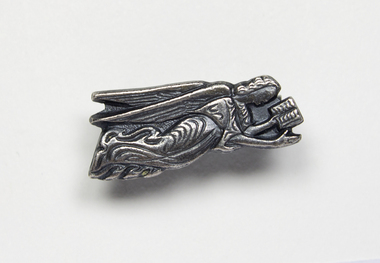
Badge, Flying Angel, Mid 20th Century
... badge...flying angel...Flying Angel Badge Badge ...This badge was once owned by Rosemary Dalling, wife of Reverend Alfred 'Bill' Dalling and then passed on to the Dann family - Information provided by Pat Dann ex Hastings Seafarers Centre. According to 'The Melbourne Anglican' website, Alfred Dalling worked: Mission to Seafarers, Sydney 1960 to 1962, Newcastle 1962 to 1968 and Melbourne 1968 to 1972; The badge depicts 'the angel of the revelation' a key symbol used by the earliest established services in the 19th C. of services to seafarers. An adapted and modernised symbol is still in use in the 21st century.Very small cast-metal pinned three dimensional representation of flying angel holding a book.badge, flying angel, rosemary dalling, rev'd bill dalling -
 Mission to Seafarers Victoria
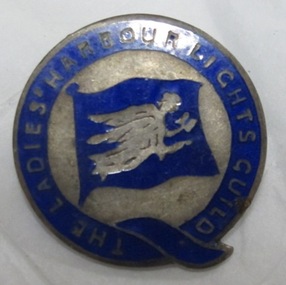
Badge, The Ladies' Harbour Lights Guild, 1917-1930
... Enamel badge with back fastening: The Ladies' Flying Angel Guild in the form of a blue enamel "Q" with the flying angel flag (see also notes on reverse)....Enamel badge with back fastening: The Ladies' Flying Angel Guild in the form of a blue enamel "Q" with the flying angel flag (see also notes on reverse). ...The Ladies' Harbour Lights Guild originally inspired by the Central Mission in England was established in Melbourne in 1906. The first secretary Miss Ethel Godfrey is known to have addressed and helped establish LHLG groups in Brisbane and Sydney circa 1918 to 1920 (see clipping MTS scrapbook 1906-1935). This badge therefore represents a link with LHLG groups elsewhere in Australia. The LHLG groups were vital in raising funds and maintaining facilities around Australia for seafarers. This badge is an early Queensland variation on the usual circular badge of the LHLG.Enamel badge with back fastening: The Ladies' Flying Angel Guild in the form of a blue enamel "Q" with the flying angel flag (see also notes on reverse).At the front: The Ladies' Harbour Lights Guild. On reverse stamped in upper case the word "SILVER" and initials "W.B." (possibly W.Blake?)badge, lhlg hostesses, ladies' harbour lights guild, queensland, brisbane, mission to seafarers, seafarers -
 Flagstaff Hill Maritime Museum and Village
Badge - Set of Badges, circa 1940s
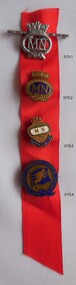
... badge...merchant navy...flying angel...The donor, Ada Barclay, was a member of the Flying Angel Club, Missions to Seamen (which is now Mission to Seafarers) in Townsville and Sydney. One of the badges connects her with the Ladies' Harbour Lights Guild in Queensland. ...The remaining badge has the words "The Ladies' Harbour Lights Guild" around the border on a blue background, and a blue flag in the centre on a gold background. The flag has a gold angelic...This set of badges is significant historically for its connection to the Merchant Navy organisation, the Ladies’ Harbour Lights Guild and the Flying Angels Club. ...The donor, Ada Barclay, was a member of the Flying Angel Club, Missions to Seamen (which is now Mission to Seafarers) in Townsville and Sydney. One of the badges connects her with the Ladies' Harbour Lights Guild in Queensland. The Sanctuary Window and other items at Flagstaff Hill Maritime Village are part of the St Nicholas Seamen’s Church Williamstown Collection. The window is dedicated to the seamen from the Merchant Navy and was organised by a group of women, some of whom were also in the Ladies’ Harbour Lights Guild, dedicated to the care of seafarers across the world. The Sanctuary Window above the altar in Flagstaff Hill Maritime Village's St Nicholas Seamen’s Church’ is titled "Christ Showing the Helmsman the Way". This round, stained glass window was originally installed in the St Nicholas Seamen's Church at 139 Nelson Place, Williamstown, Victoria. The window was donated to St Nicholas Seamen’s Church as a memorial to the members of the Merchant Navy whose lives were lost in the Second World War, 1939-1945. The donor was the Williamstown Lightkeepers Auxiliary, an independent ladies association working with the Williamstown Missions to Seamen. Some of the members of this Auxiliary were also members of the Ladies’ Harbour Lights Guild. This set of badges is significant historically for its connection to the Merchant Navy organisation, the Ladies’ Harbour Lights Guild and the Flying Angels Club. Through this connection, the badges are also connected to the history of the St Nicholas Mission to Seamen's Church in Williamstown, established in 1857 to cater for the physical, social, and spiritual needs of seafarers. It originated in Bristol, England when a Seamen's Mission was formed in 1837. The connection of this set of badges to the Ladies’ Harbour Lights Guild and what is now the Mission to Seafarers, highlights the strong historical and continuing community awareness of the life of people at sea, their dangers and hardships, and their need for physical, financial, spiritual and moral support. Set of four metal and enamel badges pinned in a vertical row to a red ribbon. Each badge is connected with seafarers. Three badges have a crown on the top of a circular badge, a wreath around the circle and the letters "MN" in the centre. One of these also has "Australia" below the circle. The remaining badge has the words "The Ladies' Harbour Lights Guild" around the border on a blue background, and a blue flag in the centre on a gold background. The flag has a gold angelic figure on it. The figure has wings and is holding a book. "MN" "AUSTRALIA". "THE LADIES' HARBOUR LIGHTS GUILD" Badge 02 - "ANGUS & COOTE / SYDNEY" Badge 04 "MANAFOLD / BRISBANE"flagstaff hill, warrnambool, shipwrecked coast, flagstaff hill maritime museum, maritime museum, shipwreck coast, flagstaff hill maritime village, great ocean road, religion, sailors rest, bethel sailors’ church, bethel floating church, ladies’ harbour lights guild, missions to seamen victoria, mission to seafarers, flying angel’s club, st nicholas seamen's church williamstown collection, mission to seamen williamstown, st nicholas seamen’s church flagstaff hill, 139 nelson place williamstown, anglican church, ethel godfrey, alice sibthorpe, pin badge, lapel badge, merchant navy, flying angel mission sydney, angus & coote sydney, manafold brisbane -
 Mission to Seafarers Victoria
Badge, The Missions to Seamen: Honorary Worker, circa 1960s
... badge as possibly dating back to the 1930s. Donated by Rosalea Greenwood The Ladies' Harbour Lights Guild was instrumental in securing funds to construct the current building at 717 Flinders Street. They were also dedicated volunteers who organised many social functions and events to offer visiting seafarers an opportunity to relax, have fun and socialise away from the ship. The LHLG which became known as the harbour Lights Guild after WW2 amalgamated with the Flying Angels ...The lapel badge was worn to signify membership of the Ladies' Harbour Lights Guild. This badge was issued to honorary workers. In the earliest days this status indicated the member as a 1 guinea subscriber to The Harbour Light Guild. "Worker" members subscribed just a shilling but were required to contribute time at the Mission with hosting and facility maintenance. The form of logo indicates this badge as possibly dating back to the 1930s. Donated by Rosalea GreenwoodThe Ladies' Harbour Lights Guild was instrumental in securing funds to construct the current building at 717 Flinders Street. They were also dedicated volunteers who organised many social functions and events to offer visiting seafarers an opportunity to relax, have fun and socialise away from the ship. The LHLG which became known as the harbour Lights Guild after WW2 amalgamated with the Flying Angels in the 1960s, therefore these badges are primarily of historical interest. Small round lapel badge denoting Ladies Harbour Lights Guild and its association with Mission to Seamen (Mission to Seafarers). The badge incorporates the logo flag of Mission to Seamen. This badge is for an "honorary worker".Gold lettering around the edge of the badge: "HONORARY WORKER" Gold lettering inside central Mission flag: "THE MISSION/TO SEAMEN" enamel, metal, volunteers, badges, social, functions, visits, lhlg, ladies harbour lights guild, mission to seamen, rosalea greenwood, father hatters, david greenwood, station officer, honorary worker, membership, mission to seafarers, seamen's mission, rats of tobruk, madang, papua new guniea, png, a.i.f. -
 Bendigo Military Museum
Poster - POSTER, FRAMED, 'KOKODA'
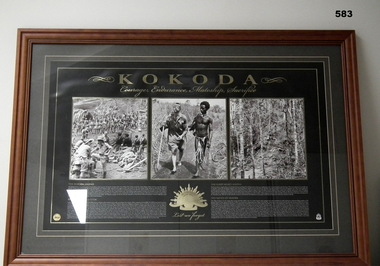
... Fuzzy Wuzzy Angel assisting a wounded soldier. View of the ascending track. Gold Rising Sun Badge below centre photo. ...Fuzzy Wuzzy Angel assisting a wounded soldier. View of the ascending track. Gold Rising Sun Badge below centre photo. printed information. ...Poster documents "Kokoda/Courage, Endurance, Mateship, Sacrifice" with headings " THE KOKODA LEGEND', THE KOKODA CAMPAIGN', THE FUZZY WUZZY ANGELS', THE BATTLE OF ISURAVA'. Poster - Gold and white print on black background, illustrated with three black and white photographs of scenes along the Kokoda Track, L-R Soldiers Resting. Fuzzy Wuzzy Angel assisting a wounded soldier. View of the ascending track. Gold Rising Sun Badge below centre photo. printed information. Frame - brown stain timber with decorative moulding. Dark grey with outline of cream colour cardboard mount. Glass front.photography-photographs, frame accessories, military history, ww2, kokoda -
Clunes Museum
Medal - WAR SERVICE MEDAL
... BADGES SISTER D. COUNDON A.I.F. ROUND MEDAL, THE GREAT WAR FOR CIVILISATION 1914-1919, IN A LAUREL WREATH, AN ANGEL ON REVERSE SIDE; ROYAL BLUE, LIGHT BLUE, GREEN, GOLD AND VERMILLION RIBBON. ...MEDAL BLONGED TO S/NURSE D. COUNDON, OF THE AUSTRALIAN NURSING SERVICE A.I.F 1914-1918 WAR; AN AUNT OF MISS MARY COUNDON OF CLUNES.ROUND MEDAL, THE GREAT WAR FOR CIVILISATION 1914-1919, IN A LAUREL WREATH, AN ANGEL ON REVERSE SIDE; ROYAL BLUE, LIGHT BLUE, GREEN, GOLD AND VERMILLION RIBBON.SISTER D. COUNDON A.I.F.local history, numismatic, medals, medals & badges -
 Vision Australia
Textile - Object, Melbourne University Student Union patch, 1930-35
... badge embroidered on the pocket. The logo on this patch is a version of the University of Melbourne coat of arms - with the angel Victory embroidered in white on a black background, offering her laurel wreath. ...badge embroidered on the pocket. The logo on this patch is a version of the University of Melbourne coat of arms - with the angel Victory embroidered in white on a black background, offering her laurel wreath. ...Hugh Jeffrey attended the Melbourne Conservatorium of Music at Melbourne University, graduating in 1940. This cloth patch would have formed the breast pocket of Mr Jeffrey's university blazer. The Melbourne University blazer is traditionally black with blue stripes, and organisations such as the Boat Club, Cricket Club or, in this case, the Student Union, would have their particular logo or badge embroidered on the pocket. The logo on this patch is a version of the University of Melbourne coat of arms - with the angel Victory embroidered in white on a black background, offering her laurel wreath. Unlike the official coat-of-arms, the stars of the Southern Cross are not included, nor is the Latin motto. 1 coloured cloth path with embroideryhugh jeffrey, university of melbourne -
 Kyneton Fire Brigade
Memorabilia - Trophy
... Silver column on bakerlite base topped with gold angel figure holding fire brigade badge with gold helmet and axe on red enamel backgroupd....BUFB Demo 1961 - Aggregate Trophy Part of Kyneton Fire Brigade trophy collection Kyneton Fire Brigade Country Fire Authority Trophy Fire Brigade Demonstrations BUFB Demo 1961 Aggregate trophy Silver column on bakerlite base topped with gold angel figure holding fire brigade badge with gold helmet and axe on red enamel backgroupd. ...BUFB Demo 1961 - Aggregate TrophyPart of Kyneton Fire Brigade trophy collection Silver column on bakerlite base topped with gold angel figure holding fire brigade badge with gold helmet and axe on red enamel backgroupd.BUFB Demo 1961 Aggregate trophykyneton fire brigade, country fire authority, trophy, fire brigade demonstrations
