
Showing 17 items matching "anglican churches -- melbourne (vic.)"
-
 Kew Historical Society Inc
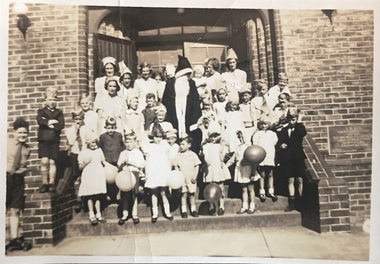
Photograph - St Hilary's Church Christmas Party, c.1932
... vic.)...st hilary's church -- kew...anglican churches -- melbourne...Anglican Church in Kew was established in 1888 on land granted to the congregation by the Dumaresq family. The brick building shown here replaced an earlier wooden structure. churches -- kew (vic.) st hilary's church -- kew anglican churches -- melbourne (vic.) ...St Hilary's Anglican Church in Kew was established in 1888 on land granted to the congregation by the Dumaresq family. The brick building shown here replaced an earlier wooden structure.Small black and white photographic positive, one of four, of a Christmas party for children at St Hilary's Church, 12 John Street, Kew. The children, surrounding an adult Santa Claus, are dressed in festive costumes and a number carry balloons. The foundation plaque is on the wall to the children's left. The photo was tentatively dated to 1932 by the donor. Inscribed verso: "St Hilary's Christmas Party ?1932"churches -- kew (vic.), st hilary's church -- kew, anglican churches -- melbourne (vic.) -
 Kew Historical Society Inc
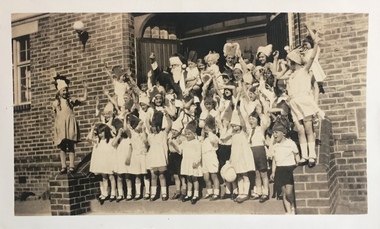
Photograph - St Hilary's Church Christmas Party, c.1932
... vic.)...st hilary's church -- kew...anglican churches -- melbourne...Anglican Church in Kew was established in 1888 on land granted to the congregation by the Dumaresq family. The brick building shown here replaced an earlier wooden structure. churches -- kew (vic.) st hilary's church -- kew anglican churches -- melbourne (vic.) ...St Hilary's Anglican Church in Kew was established in 1888 on land granted to the congregation by the Dumaresq family. The brick building shown here replaced an earlier wooden structure.Small black and white photographic positive, one of four, of a Christmas party for children at St Hilary's Church, 12 John Street, Kew. The children, surrounding an adult Santa Claus, are dressed in festive costumes and a number carry balloons. The foundation plaque is on the wall to the children's left. The photo was tentatively dated to 1932 by the donor. Inscribed verso: "St Hilary's Christmas Party ?1932"churches -- kew (vic.), st hilary's church -- kew, anglican churches -- melbourne (vic.) -
 Kew Historical Society Inc
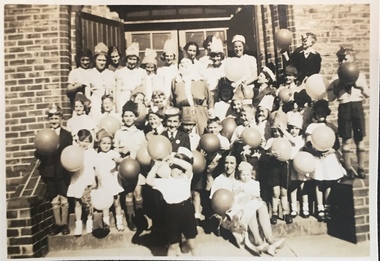
Photograph - St Hilary's Church Christmas Party, c.1932
... vic.)...st hilary's church -- kew...anglican churches -- melbourne...Anglican Church in Kew was established in 1888 on land granted to the congregation by the Dumaresq family. The brick building shown here replaced an earlier wooden structure. churches -- kew (vic.) st hilary's church -- kew anglican churches -- melbourne (vic.) ...St Hilary's Anglican Church in Kew was established in 1888 on land granted to the congregation by the Dumaresq family. The brick building shown here replaced an earlier wooden structure.Small black and white photographic positive, one of four, of a Christmas party for children at St Hilary's Church, 12 John Street, Kew. The children, surrounding an adult Santa Claus, are dressed in festive costumes and a number carry balloons. The photo was tentatively dated to 1932 by the donor. Inscribed verso: "St Hilary's Christmas Party ?1932"churches -- kew (vic.), st hilary's church -- kew, anglican churches -- melbourne (vic.) -
 Kew Historical Society Inc
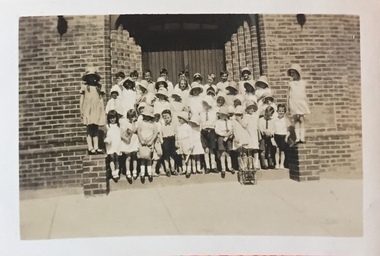
Photograph - St Hilary's Church Christmas Party, c.1932
... vic.)...st hilary's church -- kew...anglican churches -- melbourne...Anglican Church in Kew was established in 1888 on land granted to the congregation by the Dumaresq family. The brick building shown here replaced an earlier wooden structure. churches -- kew (vic.) st hilary's church -- kew anglican churches -- melbourne (vic.) ...St Hilary's Anglican Church in Kew was established in 1888 on land granted to the congregation by the Dumaresq family. The brick building shown here replaced an earlier wooden structure.Small black and white photographic positive, one of four, of a Christmas party for children at St Hilary's Church, 12 John Street, Kew. The children are formally dressed with most wearing hats. The photo was tentatively dated to 1932 by the donor. Inscribed verso: "1932 St Hilary's Christmas Party"churches -- kew (vic.), st hilary's church -- kew, anglican churches -- melbourne (vic.) -
 Eltham District Historical Society Inc
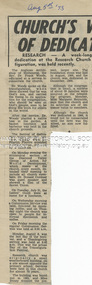
Newspaper - Newspaper article, Church's Weeklong Celebration of Dedication, 5 August 1973
... Anglican Archbishop of Melbourne...Church of the Transfiguration...Dedication ceremony...Diamond Valley Group of Action for World Development...Dr Donald Cordner...Dr Frank Woods...Ladies Guild...margaret reynolds...Miss Elizabeth Doney...Pilgrim Players...Research Church...Transfiguration Festival...Research (Vic...church was dedicated in December 1966. About 30 local families were involved in the rebuilding. Although dedicated in 1966, it could not be consecrated until the debt was paid off. See also 01588, 01591, 01592, 01593, 01594 Anglican Archbishop of Melbourne Church of the Transfiguration Dedication ceremony Diamond Valley Group of Action for World Development Dr Donald Cordner Dr Frank Woods Ladies Guild margaret reynolds Miss Elizabeth Doney Pilgrim Players Research Church Transfiguration Festival Research (Vic.) ...Weeklong celebration of the dedication / consecrtation of the Research Church of Transfiguration. Originally a small weatherbopard building, on a site almost opposite the primary school. Services were held in the church for almost 70 years. The building was burnt out in 1965 and Miss Elizabeth Doney donated a new larger site consisting of 3 house blocks on the east (high) side of Main Road. The foundation stone was laid in August 1966, and the church was dedicated in December 1966. About 30 local families were involved in the rebuilding. Although dedicated in 1966, it could not be consecrated until the debt was paid off. See also 01588, 01591, 01592, 01593, 01594anglican archbishop of melbourne, church of the transfiguration, dedication ceremony, diamond valley group of action for world development, dr donald cordner, dr frank woods, ladies guild, margaret reynolds, miss elizabeth doney, pilgrim players, research church, transfiguration festival, research (vic.) -
 Eltham District Historical Society Inc
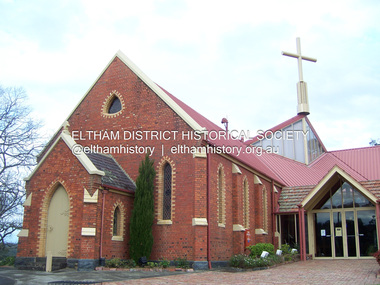
Photograph - Digital Photograph, Marguerite Marshall, St John's Anglican Church, Diamond Creek, 7 September 2008
... Melbourne Grammar School Council. Roy ‘Monty’ Vale was a state Liberal MP and was related to May Vale, a member of the Heidelberg School of Artists.4 In the early 21st century St John’s Anglican Church is one of the fastest growing congregations in Melbourne. References: St Johns Anglican Church complex, Sunday School and Parish Hall 61 Main Street DIAMOND CREEK, NILLUMBIK SHIRE. (2023, June 7). Retrieved from https://vhd.heritagecouncil.vic.gov.au/places/64023 Diamond Creek, VIC...Melbourne Grammar School Council. Roy ‘Monty’ Vale was a state Liberal MP and was related to May Vale, a member of the Heidelberg School of Artists.4 In the early 21st century St John’s Anglican Church is one of the fastest growing congregations in Melbourne. References: St Johns Anglican Church complex, Sunday School and Parish Hall 61 Main Street DIAMOND CREEK, NILLUMBIK SHIRE. (2023, June 7). Retrieved from https://vhd.heritagecouncil.vic.gov.au/places/64023 Diamond Creek, VIC ...The building was designed by Charles Maplestone of Heidelberg, son-in-law to Anthony Beale of St Helena. Maplestone was a prominent architect who came out to Australia with his family in 1852. The foundation stone was laid by Mrs Isabella Maplestone on 11th November 1867. The bricklayers for the church were George Stebbing, H Limmer, H Spicer and a Mr Timm while Thomas Day was the stonemason. Another three years were to pass before sufficient money could be raised for its completion. It was opened by Bishop Perry on 1st November, 1870. The church bell which hung under a tree for 50 years until it was incorporated in the parish hall was brought out from England and presented by Charles Orme. In 1916, the estate of George Martin Pizzey left sufficient money to build the red brick hall, which still stands today (2023) though in January 1969 the hall and bell tower were badly damaged by bushfire. Coincidentally the former home of benefactor, George Pizzey was destroyed in the same fire. Of particular significance are the interior and exterior of the church, the Sunday school and hall with emphasis on pre-World War I fabric (excluding the 1990s additions) and the three coloured glass windows currently suspended in the 1990s entry foyer. In 2011 further alterations were made to the front of the Church. The church is historically significant because it was the oldest public building in the former Diamond Valley Shire, is amongst the oldest buildings in the Shire of Nillumbik and is associated with the early settlement of the Diamond Creek district. The church is historically, socially and spiritually significant because it has been a place of worship for over 150 years and continues to be, an important meeting place in the Shire. The church is aesthetically significant for the three stained glass windows executed by the noted stained glass manufacturers, Ferguson & Urie, as well as the supporting coloured glass windows in the church. The Sunday school & parish hall is architecturally significant because the hall is a well executed and preserved example of the work of noted church architects, North & Williams. It is historically significant because it is connected with local parishioner and Melbourne industrialist, George Pizzey, who bequeathed funds for its construction. Covered under Heritage Overlay, Nillumbik Planning Scheme. National Estate Ntionl Trust of Australia (Victoria) Local significance Published: Nillumbik Now and Then / Marguerite Marshall 2008; photographs Alan King with Marguerite Marshall.; p85 St John’s Anglican Church stands like a beacon on the hill on Main Street, Diamond Creek. Today the church has a large congregation, but its early years were marked by a small congregation struggling to find enough money to survive. It was gold in Diamond Creek that resulted in the building of this National Trust registered property.1 This church is far removed from William Wilson’s humble barn (later the Bowling Green) where the first Anglican church services were conducted – probably the first in the district.2 In the mid 19th century services were infrequent as the Rev Francis Hales, travelling on horseback, also conducted services elsewhere, including at Heidelberg, Coburg, Kinglake, Arthurs Creek, St Andrews and Kangaroo Ground. In 1860 Diamond Creek came under the jurisdiction of the Eltham Parish. Until the mid 1860s the Diamond Creek settlement included only about 20 families who were struggling farmers. But this changed when gold was found in 1862. Then the township grew to 200 families, including miners, civil administration workers and shopkeepers. The resulting growth of Church of England adherents prompted them to petition the Government in 1866 for land to build a church. The area chosen, on which the original building still stands, was at the centre of the proposed township. Today church leaders believe that this conspicuous location is one of the reasons for its exceptional growth. Prominent architect Charles Maplestone designed the building as he did the Presbyterian Church at Kangaroo Ground. St John’s, which is still intact, was built in the Gothic Revival style with the traditional rectangular plan of a central nave and sanctuary at the end. It is typical of small churches built in Victoria at that time, with polychromatic hand-made bricks, a porch, diagonal buttresses and a slate roof.3 The church was officially opened by Lord Bishop Perry on November 1, 1870. But during the next 40 years, due to the varying fortunes of gold mining, the church struggled to remain viable. In 1909 it separated from the Eltham Parish to form a parish with Greensborough. Life became more difficult with the privations of World War One. Then disaster struck in 1915 when fire destroyed the Diamond Creek Gold Mine, wiping out the major livelihood of most parishioners. However the church’s morale was lifted in 1916, when it received a bequest to build the red brick hall, from late parishioner and prominent leather manufacturer, George Pizzey. As prosperity grew, in 1924 the congregation separated from Greensborough, but they rejoined in the 1930s Depression. In the 1950s the wider population soared, impacting on St John’s, and it became a separate parish, becoming responsible for six churches at St Andrews, Hazel Glen, Hurstbridge, St Helena and Yarrambat. As parishioner numbers outgrew the building, extensions were added in 1989 and then in 1993, blending in well with the original building. Church members have made a huge contribution to the local community. John Ryan was a Heidelberg Shire Councillor for 25 years from 1931, Mayor in 1939 and headed several local sporting and other organisations. His son Jock became a clergyman and a local historian heading the Nillumbik Historical Society. Another parishioner, Dr Ted Cordner, came to Diamond Creek in 1920. One of his sons Donald, who was a local doctor, won the Brownlow Medal, was President of the Melbourne Cricket Club and President of the Melbourne Grammar School Council. Roy ‘Monty’ Vale was a state Liberal MP and was related to May Vale, a member of the Heidelberg School of Artists.4 In the early 21st century St John’s Anglican Church is one of the fastest growing congregations in Melbourne. References: St Johns Anglican Church complex, Sunday School and Parish Hall 61 Main Street DIAMOND CREEK, NILLUMBIK SHIRE. (2023, June 7). Retrieved from https://vhd.heritagecouncil.vic.gov.au/places/64023 Diamond Creek, VIC. – St John’s Anglican (2023, June 7). Retrieved from https://www.churchhistories.net.au/church-catalog/diamond-creek-vic-st-johns-anglican This collection of almost 130 photos about places and people within the Shire of Nillumbik, an urban and rural municipality in Melbourne's north, contributes to an understanding of the history of the Shire. Published in 2008 immediately prior to the Black Saturday bushfires of February 7, 2009, it documents sites that were impacted, and in some cases destroyed by the fires. It includes photographs taken especially for the publication, creating a unique time capsule representing the Shire in the early 21st century. It remains the most recent comprehenesive publication devoted to the Shire's history connecting local residents to the past. nillumbik now and then (marshall-king) collection, st john's anglican church, diamond creek -
 Eltham District Historical Society Inc
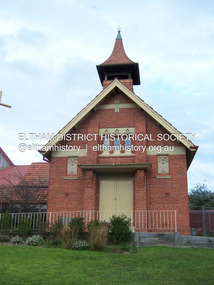
Photograph - Digital Photograph, Marguerite Marshall, Parish Hall, St John's Anglican Church, Diamond Creek, 7 September 2008
... church architects, North & Williams. It is historically significant because it is connected with local parishioner and Melbourne industrialist, George Pizzey, who bequeathed funds for its construction. Covered under Heritage Overlay, Nillumbik Planning Scheme. National Estate Ntionl Trust of Australia (Victoria) Local significance Published: Nillumbik Now and Then / Marguerite Marshall 2008; photographs Alan King with Marguerite Marshall.; p85 References: St Johns Anglican Church complex, Sunday School and Parish Hall 61 Main Street DIAMOND CREEK, NILLUMBIK SHIRE. (2023, June 7). Retrieved from https://vhd.heritagecouncil.vic.gov.au/places/64023 Diamond Creek, VIC...church architects, North & Williams. It is historically significant because it is connected with local parishioner and Melbourne industrialist, George Pizzey, who bequeathed funds for its construction. Covered under Heritage Overlay, Nillumbik Planning Scheme. National Estate Ntionl Trust of Australia (Victoria) Local significance Published: Nillumbik Now and Then / Marguerite Marshall 2008; photographs Alan King with Marguerite Marshall.; p85 References: St Johns Anglican Church complex, Sunday School and Parish Hall 61 Main Street DIAMOND CREEK, NILLUMBIK SHIRE. (2023, June 7). Retrieved from https://vhd.heritagecouncil.vic.gov.au/places/64023 Diamond Creek, VIC ...The building was designed by Charles Maplestone of Heidelberg, son-in-law to Anthony Beale of St Helena. Maplestone was a prominent architect who came out to Australia with his family in 1852. The foundation stone was laid by Mrs Isabella Maplestone on 11th November 1867. The bricklayers for the church were George Stebbing, H Limmer, H Spicer and a Mr Timm while Thomas Day was the stonemason. Another three years were to pass before sufficient money could be raised for its completion. It was opened by Bishop Perry on 1st November, 1870. The church bell which hung under a tree for 50 years until it was incorporated in the parish hall was brought out from England and presented by Charles Orme. In 1916, the estate of George Martin Pizzey left sufficient money to build the red brick hall, which still stands today (2023) though in January 1969 the hall and bell tower were badly damaged by bushfire. Coincidentally the former home of benefactor, George Pizzey was destroyed in the same fire. Of particular significance are the interior and exterior of the church, the Sunday school and hall with emphasis on pre-World War I fabric (excluding the 1990s additions) and the three coloured glass windows currently suspended in the 1990s entry foyer. In 2011 further alterations were made to the front of the Church. The church is historically significant because it was the oldest public building in the former Diamond Valley Shire, is amongst the oldest buildings in the Shire of Nillumbik and is associated with the early settlement of the Diamond Creek district. The church is historically, socially and spiritually significant because it has been a place of worship for over 150 years and continues to be, an important meeting place in the Shire. The church is aesthetically significant for the three stained glass windows executed by the noted stained glass manufacturers, Ferguson & Urie, as well as the supporting coloured glass windows in the church. The Sunday school & parish hall is architecturally significant because the hall is a well executed and preserved example of the work of noted church architects, North & Williams. It is historically significant because it is connected with local parishioner and Melbourne industrialist, George Pizzey, who bequeathed funds for its construction. Covered under Heritage Overlay, Nillumbik Planning Scheme. National Estate Ntionl Trust of Australia (Victoria) Local significance Published: Nillumbik Now and Then / Marguerite Marshall 2008; photographs Alan King with Marguerite Marshall.; p85 References: St Johns Anglican Church complex, Sunday School and Parish Hall 61 Main Street DIAMOND CREEK, NILLUMBIK SHIRE. (2023, June 7). Retrieved from https://vhd.heritagecouncil.vic.gov.au/places/64023 Diamond Creek, VIC. – St John’s Anglican (2023, June 7). Retrieved from https://www.churchhistories.net.au/church-catalog/diamond-creek-vic-st-johns-anglican This collection of almost 130 photos about places and people within the Shire of Nillumbik, an urban and rural municipality in Melbourne's north, contributes to an understanding of the history of the Shire. Published in 2008 immediately prior to the Black Saturday bushfires of February 7, 2009, it documents sites that were impacted, and in some cases destroyed by the fires. It includes photographs taken especially for the publication, creating a unique time capsule representing the Shire in the early 21st century. It remains the most recent comprehenesive publication devoted to the Shire's history connecting local residents to the past. nillumbik now and then (marshall-king) collection, st john's anglican church, diamond creek, parish hall -
 Port Melbourne Historical & Preservation Society
Photograph - Stained glass window, Holy Trinity Anglican Church, Port Melbourne, Jim Hillis, 1996
... Society subsequently located a home for the windows with a church in Richmond, Vic. religion - anglican (holy trinity) jim hillis Photo of stained glass window to left of altar, "Glory to God in the Highest". from set of nine colour photos of vacated interior of Holy Trinity Church Photograph Stained glass window, Holy Trinity Anglican Church, Port Melbourne Jim Hillis ...Photos taken by Jim Hillis prior to final sale of church, and donated to the PMH&PS. Society subsequently located a home for the windows with a church in Richmond, Vic.Photo of stained glass window to left of altar, "Glory to God in the Highest". from set of nine colour photos of vacated interior of Holy Trinity Churchreligion - anglican (holy trinity), jim hillis -
Port Melbourne Historical & Preservation Society
Photograph - Stained glass window, Holy Trinity Anglican Church, Port Melbourne, Jim Hillis, 1996
... Society subsequently located a home for the windows with a church in Richmond, Vic. religion - anglican (holy trinity) jim hillis Photo of stained glass window to right of altar, "Suffer little children to come unto me", from set of nine colour photos of vacated interior of Holy Trinity Church Photograph Stained glass window, Holy Trinity Anglican Church, Port Melbourne Jim Hillis ...Photos taken by Jim Hillis prior to final sale of church, and donated to the PMH&PS. Society subsequently located a home for the windows with a church in Richmond, Vic.Photo of stained glass window to right of altar, "Suffer little children to come unto me", from set of nine colour photos of vacated interior of Holy Trinity Churchreligion - anglican (holy trinity), jim hillis -
Port Melbourne Historical & Preservation Society
Photograph - Stained glass window, Holy Trinity Anglican Church, Port Melbourne, Jim Hillis, 1996
... Society subsequently located a home for the windows with a church in Richmond, Vic. religion - anglican (holy trinity) jim hillis Photo of stained glass window above altar, from set of nine colour photos of vacated interior of Holy Trinity Church Photograph Stained glass window, Holy Trinity Anglican Church, Port Melbourne Jim Hillis ...Photos taken by Jim Hillis prior to final sale of church, and donated to the PMH&PS. Society subsequently located a home for the windows with a church in Richmond, Vic.Photo of stained glass window above altar, from set of nine colour photos of vacated interior of Holy Trinity Churchreligion - anglican (holy trinity), jim hillis -
Port Melbourne Historical & Preservation Society
Photograph - Stained glass window, Holy Trinity Anglican Church, Port Melbourne, Jim Hillis, 1996
... Society subsequently located a home for the windows with a church in Richmond, Vic. religion - anglican (holy trinity) jim hillis Photo of stained glass window above altar, with dedication plaque --- from set of nine colour photos of vacated interior of Holy Trinity Church Photograph Stained glass window, Holy Trinity Anglican Church, Port Melbourne Jim Hillis ...Photos taken by Jim Hillis prior to final sale of church, and donated to the PMH&PS. Society subsequently located a home for the windows with a church in Richmond, Vic.Photo of stained glass window above altar, with dedication plaque --- from set of nine colour photos of vacated interior of Holy Trinity Churchreligion - anglican (holy trinity), jim hillis -
Port Melbourne Historical & Preservation Society
Photograph - Stained glass window, Holy Trinity Anglican Church, Port Melbourne, Jim Hillis, 1996
... Society subsequently located a home for the windows with a church in Richmond, Vic. religion - anglican (holy trinity) jim hillis Photo of backlit stained glass window to left of altar: 'Glory to God in the Highest' --- from set of nine colour photos of vacated interior of Holy Trinity Church Photograph Stained glass window, Holy Trinity Anglican Church, Port Melbourne Jim Hillis ...Photos taken by Jim Hillis prior to final sale of church, and donated to the PMH&PS. Society subsequently located a home for the windows with a church in Richmond, Vic.Photo of backlit stained glass window to left of altar: 'Glory to God in the Highest' --- from set of nine colour photos of vacated interior of Holy Trinity Churchreligion - anglican (holy trinity), jim hillis -
Port Melbourne Historical & Preservation Society
Photograph - Stained glass window, Holy Trinity Anglican Church, Port Melbourne, Jim Hillis, 1996
... Society subsequently located a home for the windows with a church in Richmond, Vic. religion - anglican (holy trinity) jim hillis Photo of backlit stained glass window to left of altar: 'Suffer little children to come unto me' -- from set of nine colour photos of vacated interior of Holy Trinity Church Photograph Stained glass window, Holy Trinity Anglican Church, Port Melbourne Jim Hillis ...Photos taken by Jim Hillis prior to final sale of church, and donated to the PMH&PS. Society subsequently located a home for the windows with a church in Richmond, Vic.Photo of backlit stained glass window to left of altar: 'Suffer little children to come unto me' -- from set of nine colour photos of vacated interior of Holy Trinity Churchreligion - anglican (holy trinity), jim hillis -
 Narre Warren and District Family History Group
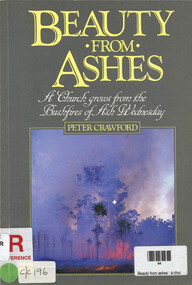
Book, Peter Crawford, Beauty from ashes : a church grows from the bushfires of Ash Wednesday, 1987
... vic.) Ash Wednesday bushfires 1983 The town of Cockatoo was destroyed by fire in 1983. This book tells the story of the building up of the parish of St. Luke's Anglican Church and the building of the Church in the four years following the fires. It is written by Peter Crawford who became the vicar of the Emerald-Cockatoo parish on the outskirts of Melbourne ...The town of Cockatoo was destroyed by fire in 1983. This book tells the story of the building up of the parish of St. Luke's Anglican Church and the building of the Church in the four years following the fires. It is written by Peter Crawford who became the vicar of the Emerald-Cockatoo parish on the outskirts of Melbourne.124 p. : maps ; 21 cm.non-fictionThe town of Cockatoo was destroyed by fire in 1983. This book tells the story of the building up of the parish of St. Luke's Anglican Church and the building of the Church in the four years following the fires. It is written by Peter Crawford who became the vicar of the Emerald-Cockatoo parish on the outskirts of Melbourne. cockatoo (vic.), ash wednesday bushfires 1983 -
 Uniting Church Archives - Synod of Victoria
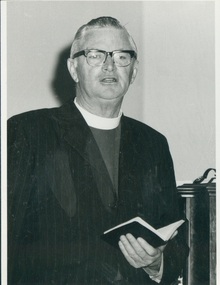
BW photo, Undated
... Melbourne, Vic, 27 June 1989). Anglican bishop, missionary. Stanway grew up in the Wimmera district of western Victoria, and left school when 14 years old. He found work in Melbourne, trained as an accountant, and at the age of 20, held a responsible position with a publishing company. This background, allied with an uncommon flair for figures and finance, was to stand him in good stead throughout his life. But he had little knowledge and no experience of the grace of God until 29 July 1928. At the Evening Service in the parish church...Melbourne, Vic, 27 June 1989). Anglican bishop, missionary. Stanway grew up in the Wimmera district of western Victoria, and left school when 14 years old. He found work in Melbourne, trained as an accountant, and at the age of 20, held a responsible position with a publishing company. This background, allied with an uncommon flair for figures and finance, was to stand him in good stead throughout his life. But he had little knowledge and no experience of the grace of God until 29 July 1928. At the Evening Service in the parish church ...STANWAY, ALFRED (b. 9 Sept 1908; d. Melbourne, Vic, 27 June 1989). Anglican bishop, missionary. Stanway grew up in the Wimmera district of western Victoria, and left school when 14 years old. He found work in Melbourne, trained as an accountant, and at the age of 20, held a responsible position with a publishing company. This background, allied with an uncommon flair for figures and finance, was to stand him in good stead throughout his life. But he had little knowledge and no experience of the grace of God until 29 July 1928. At the Evening Service in the parish church of Fairfield on 29 July, he heard the Rev C H Nash (q.v.) preach a sermon which led to his conversion. Within two years he made up his mind to become a missionary and began night studies in order to matriculate. He entered Ridley College in March 1932 to prepare for ordination undertaking week-end duties as a catechist at Deer Park and St Albans. He joined the CMS League of Youth, became chairman, and gathered a fine band of young people many of whom were to become missionaries. He was closely involved with the Belgrave Heights Convention (then at Upwey) and established a League of Youth camp on the site. All his energies were thrown into the task of building up its members in personal holiness and vigorous evangelism. Stanway was ordained in St Paul's Cathedral, Melbourne on St Thomas Day 1934 and was placed in charge of the Old Mission Church of St James and St John, Melbourne. The duties were light enough to allow him to enrol in the Melbourne Teachers College and to complete the Diploma in Teaching. On 26 January 1937, he sailed for Africa to become a missionary in the Anglican Diocese of Mombasa, which at that time embraced the whole of Kenya. He was sent to the hot coastal town of Kaloleni as principal of a Secondary Boys School. Before he left Melbourne, he had become engaged to Marjory Harrison: she followed him to Africa and their marriage took place in Mombasa Cathedral in June 1939. He remained at Kaloleni until 1944 when he was transferred to the inland station of Maseno where all his gifts were to be deployed as rural dean of Nyanza. His oversight of some 500 village churches as well as a widespread primary school system was so efficient that in 1948 he was appointed archdeacon of Kenya with his home and office in Nairobi. As secretary of the African Church Council and of the African Education Board, he was responsible for all African work in the diocese. His contacts with government ministers and public servants were of first class significance at the time when the cry of Uhuru and the demand for independence was travelling throughout the colonial world. On 2 Feb 1951, Alfred Stanway was consecrated in Westminster Abbey as the third Anglican Bp of Central Tanganyika. This Diocese was the special sphere of the CMS Australia, and he already knew most of the missionary personnel. He brought with him the understanding and experience of one who had fully shared the lot and problems of a district missionary, but he came to the diocese at a time when it had yet to recover from its losses in personnel and finance as a result of the war. His immediate task was to provide the impetus of fresh leadership and a long-term overall policy. His aim from-the outset was to build up a strong autonomous church with its own indigenous pastorate. With the whole-hearted confidence of the home base, he was able to enlist the service of new missionaries. He saw a great increase in the number of African clergy and he encouraged village evangelists to open new fields of work. Simple structures were built as new churches at the rate of two a week, week in and week out, year by year. He worked hard to meet the need for Christian literature, bookshops, adult literacy and theological training. He opened Bible schools for village evangelists and sent suitable clergy overseas for further studies. He encouraged initiative in others, helped them to find and use their talents, and gave them his unstinted confidence and support. Fresh finance was required for new ventures. This led him to travel widely in Germany and America, where he raised large funds for these projects. Mackay House was built in Dodoma as the central administrative base for the diocese, hospitals such as those at Mvumi and Hombolo were modernised or established, schools were built and upgraded. In keeping with his vision for ultimate leadership by African personnel, he consecrated Yohana Omari in 1955 as his assistant, he was the first national to become a bp in East Africa. Bp Stanway then set on foot the long and complicated process for the division of his sprawling diocese. In 1963, the diocese of Victoria Nyanza came into being; in 1965, that of Morogoro; in 1966, that of Western Tanganyika. Yet in 1971, his own diocese of Central Tanganyika, though greatly reduced in size, had more churches and more clergy than in its undivided state in 195 l. Stanway then played a leading part in the formation of the Province of Tanzania in 1970, with an African abp as metropolitan. A year later, after 35 years in East Africa and 20 years as bishop of Central Tanganyika, he resigned. His leadership and achievements throughout those years had placed him in the front rank as a great missionary statesman. Stanway had returned to Melbourne at the time when his resignation took effect in August 1971. His early love for Ridley College reasserted itself and he went into residence as deputy principal under the Rev Dr Leon Morris. He was put in charge of chapel worship and the pastoral oversight of the students. All his gifts and experience were called into play as he sought to guide and encourage those who were on the threshold of their ministry. The whole bent of his heart was to foster the spiritual life and missionary calling of those whose hearts the Lord had touched. It was during those years that his life-long zeal for the spread of the gospel through Christian literature had its ultimate flowering. It had begun in his Nairobi days with a small church bookstall, this had developed into a major book-shop in the heart of the city. Then in Dodoma he had established the Central Tanganyika Press in order to promote the publication and distribution of Christian literature at all levels. He had marked out Kevin Engel, trained him, and launched him on the international scene. Hence it was natural that in Melbourne he and Kevin Engel should found the Australian Christian Literature Society. But his time at Ridley College was not to last. Unknown to him, the Rev J R W Stott had put his name forward as that of a person who could head a new school of theology in the United States to provide a sound training for evangelical ordinands. Such a task would have been formidable enough for a younger man who had grown up in America. How could an Australian who had spent half his life in Africa hope to succeed in a venture of that kind in America? How could one who had been a missionary, not a theologian, found a new school to train men for ordination? Nevertheless he rose to the challenge. In Sept 1975, he and Mrs Stanway left Melbourne for Sewickly, an outer suburb of Pittsburg, with the promise of three years' service. He had to start from scratch. He found a house to live in, but there was no land for the school, no funds in hand, no staff yet appointed, no students, and no buildings. His drive, his infections enthusiasm, and his flair for practical enterprise carried the day. One by one, obstacles were overcome and support grew in volume and strength. Twelve months after his arrival, in Sept 1976, the Trinity Episcopal School for Ministry was opened with three staff members, seventeen students, and the goodwill of the whole American Episcopal Church to win. During the next two years, the school took shape and was firmly established. Bp Stanway left an indelible stamp on every aspect of its life and work, its spiritual tone and ideals, its financial and administrative principles. He had inspired widespread support among evangelical episcopalians and had imparted a strong sense of divine guidance and purpose. The council would gladly have extended his term in office beyond three years, but at 75 years of age he knew that his health had begun to fail. When he finally relinquished his office in Nov 1978, he could look back on those three years as the crown of his ministry. It is not too much to say that his name was even more highly honoured and revered in the Trinity School of Ministry than in his own dearly loved Africa. His return to Melbourne led to quiet retirement at Mount Waverley where he settled down to a long battle with the ever worsening effects of Parkinson's Disease. The slow loss of physical capacity and the ultimate failure in powers of speech were a great trial, but he never complained. His faith was summed up in his brief reply when he was asked why he had not prayed for healing: 'What God allows, I accept'. That acceptance was without reserve; his testimony was never brighter. His mental powers were undiminished and his spiritual concerns were as wide as ever. He kept in touch with CMS, he went to church, he met with missionaries, he led Bible studies in his home as long as he was able. Africa was always in his heart, news from Sewickly always gave him great pleasure. He had left a mark for God on three great continents and his death left sad but thankful hearts in them all. It was the close of a life in which he had felt that he could never do enough for God who had done so much for him. One of Bp Stanway's sayings was 'when the Holy Spirit takes hold of you, anything can happen'. So it was in his case. He was very human, with his full share of human foibles and frailties. He had a great zest for life and an endless fund of stories drawn from his own experience. He was himself the subject of many stories, some true, others legendary. His vibrant personality always seemed to fill the house where he was, his presence could not be overlooked. His own home was one in which Mrs Stanway had a paramount influence. She was a trained teacher, a skilled artist, a born hostess and a first-class linguist. They had no children of their own, but were devoted Godparents and always deeply interested in the children of missionaries. Home life allowed him to relax in a serene and contented atmosphere and to exercise his gifts for friendship and hospitality. He was always on the watch for souls, a person-to-person evangelist par excellence. He was a man of faith and prayer who dared to believe in the God of the impossible. His love for Africa, his total dedication as a missionary; his gifts as a soulwinner; his genius for finance; his shrewd practical initiatives, and his statesmanlike vision were outstanding characteristics. But great or small, all his gifts were laid out in the service of the gospel, and that service marked him out as one of the most remarkable Australian missionaries of his generation. M L Loane, Men to Remember (Sydney, 1987) Rev. Alfred Stanway is standing with open book in hand, dressed in clerical garb.Bishop Alfred Stanwaybishop alfred stanway -
 Kew Historical Society Inc
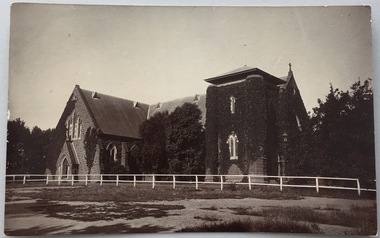
Postcard, Holy Trinity Church, 1905-1913
... Anglican Church is one of the parishes of the Diocese of Melbourne in the Anglican Church of Australia. Services of worship began in this building in March, 1863. The Vicarage was built in 1873, and both carry National Heritage classifications. The church contains many stained glass windows dating from the 19th century. holy trinity church -- kew (vic ...Holy Trinity Anglican Church is one of the parishes of the Diocese of Melbourne in the Anglican Church of Australia. Services of worship began in this building in March, 1863. The Vicarage was built in 1873, and both carry National Heritage classifications. The church contains many stained glass windows dating from the 19th century.Monochrome postcard showing the exterior of Holy Trinity Church, High Street, Kew. The western exterior of the church is viewed from High Street, Kew. The Church is surrounded by extensive vegetation, some later removed. The postcard predates 1913 when the tower was completed."Reg-No-KHS-411. Holy Trinity Church Kew - Prior to tower completion (1913)"holy trinity church -- kew (vic.), churches -- kew (vic.), postcards -- kew (vic.), postcards -- churches (vic.) -
 Kew Historical Society Inc
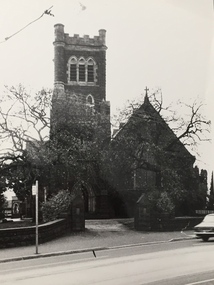
Photograph, Progress Press, Holy Trinity Church, High Street, c.1978
... Anglican Church is one of the parishes of the Diocese of Melbourne in the Anglican Church of Australia. Services of worship began in this building in March, 1863. The Vicarage was built in 1873, and both carry National Heritage classifications. The church contains many splendid stained glass windows dating from the 19th century. churches -- kew (vic ...Holy Trinity Anglican Church is one of the parishes of the Diocese of Melbourne in the Anglican Church of Australia. Services of worship began in this building in March, 1863. The Vicarage was built in 1873, and both carry National Heritage classifications. The church contains many splendid stained glass windows dating from the 19th century.Holy Trinity Church, High Street, Kew. Inscription on reverse: "KH-224. Holy Trinity COFE Kew. Entered to the Heritage Register 1978. Photo presented by Progress Press."churches -- kew (vic.), holy trinity church -- high street -- kew (vic.)
