
Showing 33 items matching "anzac house melbourne"
-
 Bendigo Historical Society Inc.
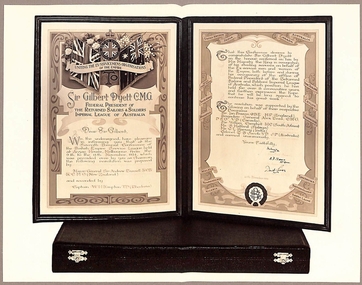
Photograph - IAN DYETT COLLECTION: Image of Presentation piece
... ...Anzac House Melbourne...IAN DYETT COLLECTION: Black and white Image of Presentation piece to Sir Gilbert Dyett as the Federal President of the Returned Sailors & Soldiers Imperial League of Australia for presiding over the Seventh Biennial Conference held at Anzac House Melbourne from the 9th to the 13th of November 1934. ...Australian Dictionary of Biography. https://adb.anu.edu.au/biography/dyett-sir-gilbert-joseph-cullen-6071 Gilbert Dyett Seventh Biennial Conference of the British Empire Service League Anzac House Melbourne IAN DYETT COLLECTION: Black and white Image of Presentation piece to Sir Gilbert Dyett as the Federal President of the Returned Sailors & Soldiers Imperial League of Australia for presiding over the Seventh Biennial Conference held at Anzac House Melbourne from the 9th to the 13th of November 1934. ...Sir Gilbert Joseph Cullen Dyett (1891-1964) was born in Bendigo, at the age of 14 he started working for J H Curnow Real Estate and Auction rooms. In March 1915 he was commissioned as Lieutenant in the 7th Battalion and was badly wounded at Lone Pine, Gallipoli. After the war he was prominent in many organizations including Anzac Remembrance Appeal, Ocean Road Trust, Returned Services League, Australian War Memorial, The British Empire Service League, Racecourse Licences Board of Victoria, Victoria Trotting and Racing Association (which was largely controlled by John Wren) He was caricatured as Captain Dwyer by Frank Hardy in his novel Power without Glory. HE was Knighted in 1934. Died in Fitzroy in1964 and is buried in Bendigo. Ref. Australian Dictionary of Biography. https://adb.anu.edu.au/biography/dyett-sir-gilbert-joseph-cullen-6071 IAN DYETT COLLECTION: Black and white Image of Presentation piece to Sir Gilbert Dyett as the Federal President of the Returned Sailors & Soldiers Imperial League of Australia for presiding over the Seventh Biennial Conference held at Anzac House Melbourne from the 9th to the 13th of November 1934. In two sections with black frames probably joined by hinges resting on a black case in which the piece may have kept. Decorations on the piece include the Union Jack and the Australian Flag. The photograph in is mounted on grey card.gilbert dyett, seventh biennial conference of the british empire service league, anzac house melbourne -
 Returned Nurses RSL Sub-branch
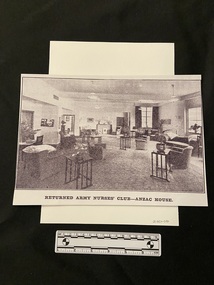
Photograph - Photocopy of a photograph, Returned Army Nurses' Club - ANZAC HOUSE
... ...ANZAC House (Melbourne)...Copy of a photo of inside the Returned Nurses' Club room at ANZAC House on Collins Street in Melbourne....Copy of a photo of inside the Returned Nurses' Club room at ANZAC House on Collins Street in Melbourne. Australian Nurses ANZAC House (Melbourne) Returned Army Nurses' Club Club rooms Black and white A4 photocopy of a photograph of a large room at ANZAC House with armchairs and small tables spread throughout. ...Copy of a photo of inside the Returned Nurses' Club room at ANZAC House on Collins Street in Melbourne.Black and white A4 photocopy of a photograph of a large room at ANZAC House with armchairs and small tables spread throughout.australian nurses, anzac house (melbourne), returned army nurses' club, club rooms -
 8th/13th Victorian Mounted Rifles Regimental Collection
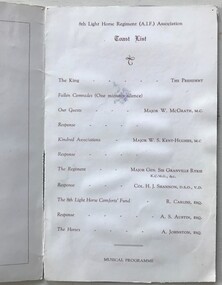
Programme - Annual reunion program
... Program for the 1933 Annual Reunion of the 8th Light Horse Regiment (AIF) Association held at Anzac House Melbourne. Program is glued to light card backing....Represents the ongoing camaraderie of soldiers from Victoria. reunion light horse Program for the 1933 Annual Reunion of the 8th Light Horse Regiment (AIF) Association held at Anzac House Melbourne. Program is glued to light card backing. ...The 8th Light Horse Regiment AIF was raised at Broadmeadows Victoria in September 1914 under the command of Lieutenant Colonel Alexander White and formed part of the 3rd Light Horse Brigade. The regiment served at Gallipoli where in a courageous but ill-fated charge at the Nek on 7 August 1915 it suffered horrendous casualties including Lieutenant Colonel White. Rebuilt in Egypt under the command of Lieutenant Colonel Leslie Maygar VC the regiment went on the serve throughout the Middle East Campaign. Colonel Maygar died of wounds at Beersheba when the regiment was attacked by enemy aircraft while waiting to follow up the successful charge of the 4th LH Brigade on 30 October 1917. The 8th Light Horse AIF was disbanded in 1919, but soon after re-raised as the 8th (Indi) Light Horse in the Citizen Military Forces, superseding 16th (Indi) Light Horse. It had its headquarters at Benalla with sub-units throughout the Upper Murray and Northeast Victoria. In December 1941, the regiment converted from horse to mechanised, initially as 8th Reconnaissance Battalion then in July 1942 it became 8th Cavalry Regiment and served in Northern Territory. As Japanese threat to the mainland declined the regiment was disbanded.Represents the ongoing camaraderie of soldiers from Victoria.Program for the 1933 Annual Reunion of the 8th Light Horse Regiment (AIF) Association held at Anzac House Melbourne. Program is glued to light card backing.reunion, light horse -
 Returned Nurses RSL Sub-branch
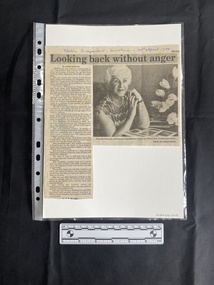
Newspaper - Newspaper clipping, [Western Independent], Looking back without anger, [19890425]
... Article is about the WWII recollections of Jean [Blair] Hardham, as she attended a reunion of war nurses at ANZAC House, Melbourne....Article is about the WWII recollections of Jean [Blair] Hardham, as she attended a reunion of war nurses at ANZAC House, Melbourne. World War 2 WWII WW2 Jean Blair Hardham 'Western Independent _ Sunshine - 25th April 1989' [blue ink, along top of paper] A newspaper clipping with a large title along the top, a large column of text on the left hand side and a large black and white photo of a seated older woman with a photo album. ...Article is about the WWII recollections of Jean [Blair] Hardham, as she attended a reunion of war nurses at ANZAC House, Melbourne.A newspaper clipping with a large title along the top, a large column of text on the left hand side and a large black and white photo of a seated older woman with a photo album.'Western Independent _ Sunshine - 25th April 1989' [blue ink, along top of paper]world war 2, wwii, ww2, jean blair hardham -
 Bendigo Military Museum
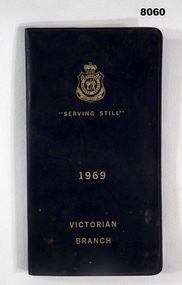
Accessory - DIARY, RSL VICTORIA 1969, Victorian RSL State Branch, C. late 1968
... Diary black plastic covers with gold text on front cover, top has the RSL logo followed by "Serving Still - 1969 - Victorian Branch", inside first page are details re Anzac House Melbourne, there are 28 pages of written text, page for members personal details, 4 blank pages for notes, the Calendar itself folds out for viewing and to enter notes, last page has a 12 month calendar. ...He served in WW2. brsl smirsl diary "Bert Pollard, phone 5433741" Diary black plastic covers with gold text on front cover, top has the RSL logo followed by "Serving Still - 1969 - Victorian Branch", inside first page are details re Anzac House Melbourne, there are 28 pages of written text, page for members personal details, 4 blank pages for notes, the Calendar itself folds out for viewing and to enter notes, last page has a 12 month calendar. ...The pages of written text cover everything the RSL does from welfare, commemorative, legal aid, membership, women's auxiliary and housing to name a few. Bert Pollard was an active RSL Member involved in Committee and the District Board. He served in WW2.Diary black plastic covers with gold text on front cover, top has the RSL logo followed by "Serving Still - 1969 - Victorian Branch", inside first page are details re Anzac House Melbourne, there are 28 pages of written text, page for members personal details, 4 blank pages for notes, the Calendar itself folds out for viewing and to enter notes, last page has a 12 month calendar. "Bert Pollard, phone 5433741"brsl, smirsl, diary -
 Returned Nurses RSL Sub-branch
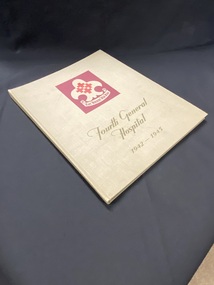
Book - Hardcover book, United States Army General Hospital, 4th, Fourth General Hospital: United States Army, 1942-1945 : a pictorial history, 1945
... 'Retirned Nurses Club / Anzac House / Collins St / Melbourne' [Handwritten in blue ink on the inside of the front cover] 'B87' [Handwritten in pencil in the top corner of the first page]...'Retirned Nurses Club / Anzac House / Collins St / Melbourne' [Handwritten in blue ink on the inside of the front cover] 'B87' [Handwritten in pencil in the top corner of the first page] Olive green hardcover book. ...A pictorial history of the Fourth General Hospital during the years 1942 - 1945.Olive green hardcover book. The cover has a maroon coloured rectangle template in the middle with the hospital symbol; the title appears below in a darker olive print.non-fictionA pictorial history of the Fourth General Hospital during the years 1942 - 1945.united states army general hospital 4th, world war 1939-1945, world war ii medical care australia, world war ii hospitals pictorial works, wwii, ww2 -
 Tramways/East Melbourne RSL Sub Branch - RSL Victoria Listing id: 27511
Audio - Oral history interview - Tim Woods, Tim Woods Vietnam Oral interview
... This digital oral history interview was conducted at Anzac House for Tramways/East Melbourne RSL Sub Branch on September 20, 2017 as part of the Veterans Heritage Project....Here, he recalls the anti-war sentiment and hostile public reception of troupes in the early 1970s despite Australia’s conscription policy – the National Service Scheme – which was eventually abolished in December 1972. veietnam era anti war sentiments national service scheme hostile public.conscription policy Tim Woods Vietnam Experiences This digital oral history interview was conducted at Anzac House for Tramways/East Melbourne RSL Sub Branch on September 20, 2017 as part of the Veterans Heritage Project. ...Tim Woods is a Vietnam veteran. Here, he recalls the anti-war sentiment and hostile public reception of troupes in the early 1970s despite Australia’s conscription policy – the National Service Scheme – which was eventually abolished in December 1972.This digital oral history interview was conducted at Anzac House for Tramways/East Melbourne RSL Sub Branch on September 20, 2017 as part of the Veterans Heritage Project.Tim Woods Vietnam Experiencesveietnam era, anti war sentiments, national service scheme, hostile public.conscription policy -
 Dandenong/Cranbourne RSL Sub Branch
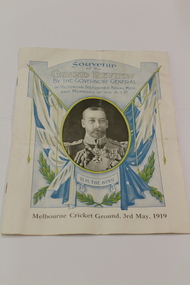
Souvenir - Souvenir of Grand Review at the MCG 3rd May 1919, Osboldstone & Co. Pty. Ltd, 1919
... On the rear shows Anzac House, Collins Street, Melbourne....On the rear shows Anzac House, Collins Street, Melbourne. Souvenir of the Grand Review By the Governor General of Victorian Returned Naval Men and Members of the Australian Imperial Forces (A.I.F.) held at the Melbourne Cricket Ground on the 3rd of May 1919. ...Original Souvenir booklet from 1919Souvenir of the Grand Review By the Governor General of Victorian Returned Naval Men and Members of the Australian Imperial Forces (A.I.F.) held at the Melbourne Cricket Ground on the 3rd of May 1919.Picture of His Majesty the King (George the Fifth).Photos of Our Heroes in the Making on page 2. Pictures of various politicians the Governor General on page 3. Pages 4 and 5 displays the colours of various units participating in the parade. Pictures of worldwide dignitaries on page 6.Page shows photographs of where Australia's Glorious deeds were done. On the rear shows Anzac House, Collins Street, Melbourne. -
 Warrnambool and District Historical Society Inc.
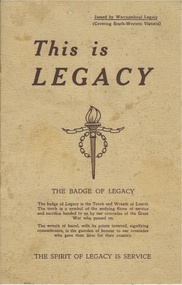
Work on paper - Booklet, This is Legacy, 1947
... The Melbourne group was established at Anzac House shortly after. Initially looking to the needs of returned soldiers, by 1925 they had included the care of deceased soldiers’ widows and children a task which continues to the present day. ...The Melbourne group was established at Anzac House shortly after. Initially looking to the needs of returned soldiers, by 1925 they had included the care of deceased soldiers’ widows and children a task which continues to the present day. ...Dark cream coloured soft card cover with brown text. Title is in larger text with the Legacy emblem in the centre of the front cover. The back cover has the poem, Flanders Field and the legacy response. Eight pages which has text and some photographs. A list of Warrnambool office bearers is on the inside back cover. non-fictionlegacy 1947, warrnambool history, warrnambool legacy -
 Melbourne Legacy
Document, Memories of a Happy Birthday Party, 1928
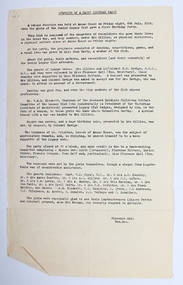
... house sending through the copy and original account of above from 17 March 1975 from Florence Moore the secretary of the ILLC. Another example of Stan Savige's close involvement with the work of Melbourne Legacy, and the large number of girls catered for by Legacy. girls' club girls' classes Stanley Savige 100years Covering letter and memoir signed 'Florence Moore Hon. Sec.' Three pages of correspondence. A Personal account recalling a function at ANZAC ...A comprehensive record of the first birthday party of Junior Legacy Girls Club, including the names of important guests. Lieutenant Colonel S.G. Savige DSO MC was guest of honour and cut the birthday cake. Typed account was from 6 May 1928. 00132.1) Copy of 'Memories of a Happy Birthday Party' but titled 'Legacy Girls' Party' 00132.2) Original account titled 'Memories of a Happy Birthday Party' 00132.3) Letter to Legacy house sending through the copy and original account of above from 17 March 1975 from Florence Moore the secretary of the ILLC.Another example of Stan Savige's close involvement with the work of Melbourne Legacy, and the large number of girls catered for by Legacy.Three pages of correspondence. A Personal account recalling a function at ANZAC house to celebrate the Legacy Girls Club’s first Birthday Party, plus a covering letter.Covering letter and memoir signed 'Florence Moore Hon. Sec.'girls' club, girls' classes, stanley savige, 100years -
 Melbourne Legacy
Memorabilia - Object, Legacy Torch, c.1980s
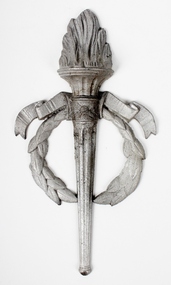
... One has been used on the Centenary of ANZAC Street Art Mural on the back of Legacy House, Melbourne. The badge of Legacy is the Torch and Wreath of Laurel. ...One has been used on the Centenary of ANZAC Street Art Mural on the back of Legacy House, Melbourne. The badge of Legacy is the Torch and Wreath of Laurel. ...Unknown. Assume produced for display or commemoration purposes. One has been used on the Centenary of ANZAC Street Art Mural on the back of Legacy House, Melbourne. The badge of Legacy is the Torch and Wreath of Laurel. The Torch signifies the undying flame of service and sacrifice of those who gave their lives for their country. The Wreath of Laurel is the symbol of our remembrance of them.The Legacy Torch created in metal. 'Logo' of Legacy ClubCast metal Legacy torch (two copies)torch, logos -
 Melbourne Legacy
Letter - Document, letter, (H1), 1923
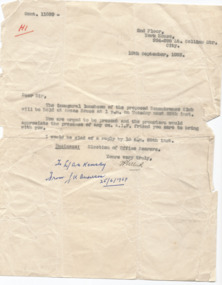
... Melbourne in September 1923. The text of the letter includes; 'The inaugural luncheon of the proposed Remembrance Club will be held at Anzac House at 1pm on Tuesday next 25th inst. ...Melbourne in September 1923. The text of the letter includes; 'The inaugural luncheon of the proposed Remembrance Club will be held at Anzac House at 1pm on Tuesday next 25th inst. ...A letter that was sent to potential members of a new club being formed in Melbourne in September 1923. The text of the letter includes; 'The inaugural luncheon of the proposed Remembrance Club will be held at Anzac House at 1pm on Tuesday next 25th inst. You are urged to be present and the promoters would appreciate the presence of any ex-AIF friend you care to bring with you.' The Remembrance Club in Melbourne later became Legacy. The notation H1 in red pen shows that it was part of the archive project that was trying to capture the history of Legacy. Hence the notation of being forwarded from Legatee Kemsley to Anderson in 1969.This is one of the first documents that pertain to the Remembrance Club - later becoming Legacy. File copy of a letter about the inaugural meeting of the Remembrance Club in Melbourne.Handwritten H1 in red pen. Signed 'JP Hiller'(?) in black ink. Notation added later 'To L/ AN Kemsley, from LK Anderson 25/6/1969' from when it was added to archive.history, remembrance club -
 Mt Dandenong & District Historical Society Inc.
Photograph, Billy Hughes at Sassafras
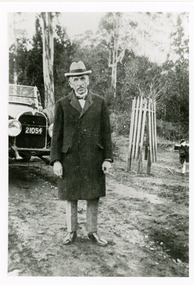
... house called Ty-Coed in Clarkmont Road. The Prince of Wales made an unofficial visit in 1920 and stayed with Billy Hughes in his holiday home. The Prince of Wales planted a tree in Anzac Avenue that had been officially opened on April 14th, 1920 by Captain Stanley Melbourne Bruce, who became Prime Minister after Billy Hughes....house called Ty-Coed in Clarkmont Road. The Prince of Wales made an unofficial visit in 1920 and stayed with Billy Hughes in his holiday home. The Prince of Wales planted a tree in Anzac Avenue that had been officially opened on April 14th, 1920 by Captain Stanley Melbourne Bruce, who became Prime Minister after Billy Hughes. billy hughes w m hughes sassafras prime minister Black and white photograph showing well dressed man standing in front of a car . ...Copy of a photograph of Mr W M (Billy) Hughes, the Australian Prime Minister from 1915 to 1923 in the Main Street of Sassafras. Billy Hughes had a holiday house called Ty-Coed in Clarkmont Road. The Prince of Wales made an unofficial visit in 1920 and stayed with Billy Hughes in his holiday home. The Prince of Wales planted a tree in Anzac Avenue that had been officially opened on April 14th, 1920 by Captain Stanley Melbourne Bruce, who became Prime Minister after Billy Hughes.Black and white photograph showing well dressed man standing in front of a car .billy hughes, w m hughes, sassafras, prime minister -
Charlton RSL Sub Branch
Programme - Souvenier of the Grand Military Review 1919, Program from The Grand Military Review at Melbourne Cricket Ground May 3rd, 1919. 4 Page colour and black and white
... ANZAC HOUSE. Laminated souvenier program Program from The Grand Military Review at Melbourne Cricket Ground May 3rd, 1919. 4 Page colour and black and white. ...Laminated souvenier programANZAC HOUSE. -
 Melbourne Legacy
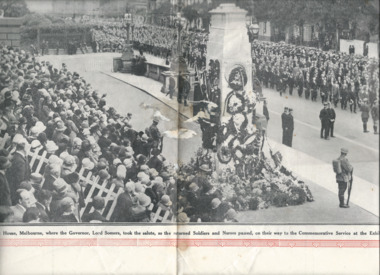
Newspaper - Document, article, 25,000 Returned Soldiers, Headed By Their Leader, Sir John Monash, Marched Past The Cenotaph On Anzac Day, 05/05/1928
... Title: '25,000 Returned Soldiers, Headed By Their Leader, Sir John Monash, Marched Past The Cenotaph On Anzac Day.' Caption: " Scene at Parliament House, Melbourne, where the Governor, Lord Somers, took the salute, as returned Soldiers and Nurses passed, on they way to the Commemorative Service at the Exhibition.'...House on Anzac day. A record of an Anzac Day ceremony at the old First World War memorial in Spring Street in 1928. Not many photos are available of the original memorial. The size of the march past (reported as 25,000 soldiers) points to the enormous number of Victorians who served in the First World War. anzac day wreath laying ceremony Title: '25,000 Returned Soldiers, Headed By Their Leader, Sir John Monash, Marched Past The Cenotaph On Anzac Day.' Caption: " Scene at Parliament House, Melbourne ...A newspaper photo of returned servicemen and nurses marching past the original First World War memorial during an Anzac Day march in 1928. It was published as a centre page spread on 5 May 1928 in the The Weekly Times. '25,000 Returned Soldiers, Headed By Their Leader, Sir John Monash, Marched Past The Cenotaph On Anzac Day.' A war memorial to the 1914-1918 war was originally erected in Spring Street outside the Victorian Parliament Building (at that time it was the being used by the Australian Federal Parliament, from 1901-1927 when it moved to Canberra). Anzac Day services were held at this memorial in the 1920s and early 1930s. Items were in an envelope with other photos and programmes from different items relating to the Shrine of Remembrance - including discussions on its location and design. Labelled 'Shrine of Remembrance S1 - S14' it was part of an old archive numbering system (S=Shrine), that showed there has been efforts in the past to collect, order and save items of Legacy's history. From articles in Trove: The temporary cenotaph was the original first world war memorial until the Shrine of Remembrance was dedicated in 1937. The cenotaph was a half size replica of the London Symbol of Remembrance in Whitehall. It was made from timber and plaster and was initially meant to only last for the 1926 Anzac day service and be removed. With annual upkeep it remained until at least 1934 when ex-service men proceeded from the incomplete Shrine to the cenotaph on the steps of Parliament House on Anzac day.A record of an Anzac Day ceremony at the old First World War memorial in Spring Street in 1928. Not many photos are available of the original memorial. The size of the march past (reported as 25,000 soldiers) points to the enormous number of Victorians who served in the First World War. Black and white newspaper article about ANZAC Day at the old First World War memorial in Spring Street in 1928.Title: '25,000 Returned Soldiers, Headed By Their Leader, Sir John Monash, Marched Past The Cenotaph On Anzac Day.' Caption: " Scene at Parliament House, Melbourne, where the Governor, Lord Somers, took the salute, as returned Soldiers and Nurses passed, on they way to the Commemorative Service at the Exhibition.'anzac day, wreath laying ceremony -
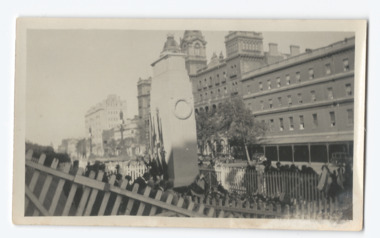 Melbourne Legacy
Photograph - Photo, Anzac Day, 1924
... Anzac day service and be removed. With annual upkeep it remained until at least 1934 when ex-service men proceeded from the incomplete Shrine to the cenotaph on the steps of Parliament House. An early Anzac day ceremony held at the cenotaph in Spring St, Melbourne ...The photo shows the cenotaph on the steps of Parliament House in Spring St after a wreath laying ceremony. There was a picket fence around the area which was erected for occasions (see the newspaper clipping from Anzac Day in 1928 copied from item no 01204). It is possible that the stamp on the reverse, '4 24', means April 1924, also see similar photos at 01203. From articles in Trove: The temporary cenotaph was the original first world war memorial until the Shrine of Remembrance was dedicated in 1937. The cenotaph was a half size replica of the London Symbol of Remembrance in Whitehall. It was made from timber and plaster and was initially meant to only last for the 1926 Anzac day service and be removed. With annual upkeep it remained until at least 1934 when ex-service men proceeded from the incomplete Shrine to the cenotaph on the steps of Parliament House.An early Anzac day ceremony held at the cenotaph in Spring St, Melbourne, before the Shrine of Remembrance was built.Black and white photo of the cenotaph in Spring St, Melbourne.Stamped '4 24' in blue ink and 'Printed by Harringtons' in black ink in a circle.anzac day, wreath laying ceremony -
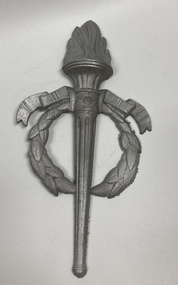 Melbourne Legacy
Memorabilia - Object, Legacy Torch, c 1980
... A similar one has been used on the Centenary of ANZAC Street Art Mural on the back of Legacy House, Melbourne. The torch that has a gold gilt colour has two screws in the back for attachment. ...A similar one has been used on the Centenary of ANZAC Street Art Mural on the back of Legacy House, Melbourne. The torch that has a gold gilt colour has two screws in the back for attachment. ...Possibly produced for display or commemoration purposes. There are 10 torches in sliver colour and one in gold gilt colour. Can be used for future projects where the torch symbol is required. A similar one has been used on the Centenary of ANZAC Street Art Mural on the back of Legacy House, Melbourne. The torch that has a gold gilt colour has two screws in the back for attachment. The badge of Legacy is the Torch and Wreath of Laurel. The Torch signifies the undying flame of service and sacrifice of those who gave their lives for their country. The Wreath of Laurel is the symbol of our remembrance of them.Multiple metal copies of the Legacy torch. Cast metal Legacy torch x 10 in silver colour and 1 in gold gilt colour.torch, logos -
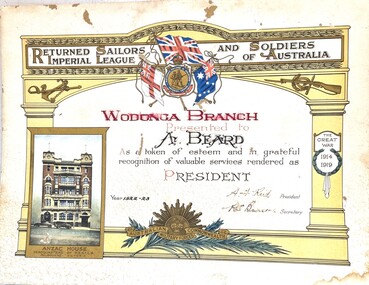 Wodonga & District Historical Society Inc
Certificate - Wodonga RSSILA Certificate of Appreciation
... An image of Anzac House, the headquarters of the R.S.S.I.L.A. in Melbourne is on the lower left hand side. ...An image of Anzac House, the headquarters of the R.S.S.I.L.A. in Melbourne is on the lower left hand side. ...The Returned Sailors' and Soldiers' Imperial League of Australia was formed in 1916 to support servicemen returning from World War 1. In 1940 its name was changed to Returned Sailors', Soldiers' and Airmen's Imperial League of Australia and again in 1966 to Returned Services League of Australia. Arthur Ernest Beard enlisted in the 10th Battalion in 1914 and was discharged as medically unfit in 1918. His service included three years and 115 days of overseas service. He was gassed during his war service, resulting in ongoing health issues. Beard received an incapacity pension. Despite his ill health, Arthur dedicated many years of service to the committee of the Returned Sailors' and Soldiers' Imperial League of Australia Wodonga branch. At various times he served as President and secretary. He was on the committee when the branch was lobbying for the construction of a Soldiers' Memorial and also a Soldiers' Memorial Hall for Wodonga. Arthur also participated in groups and community activities, including the Wodonga Boys’ Club, Wodonga Public Library Committee and the Wodonga and District Progress Association. Arthur died on 29 Jun 1940 in Wodonga, Victoria, aged 46 years. This certificate is significant as it recognises service to the Wodonga Branch of the RSSILAA coloured certificate on heavy card presented by the Wodonga Branch of the Returned Sailor and Soldiers Imperial League of Australia. It features an archway imprinted with the name of the RSSIL with the League emblem surrounded by the flags of England, Australia and the Royal Australian Navy. It is adorned with an anchor and rifle and the words "Great War 1914 - 1919. An image of Anzac House, the headquarters of the R.S.S.I.L.A. in Melbourne is on the lower left hand side. The words of appreciation are printed in the centre of the archway. The insignia of the Australian Commonwealth Military Forces is in the centre at the bottom. WODONGA BRANCH / Presented to A. BEARD As a token of esteem and in grateful recognition of valuable services rendered as PRESIDENT Year 1922 - 23 A. A. Reid President R. S. Benson Secretaryreturned sailors & soldiers imperial league, wodonga rssila -
 Melbourne Tram Museum
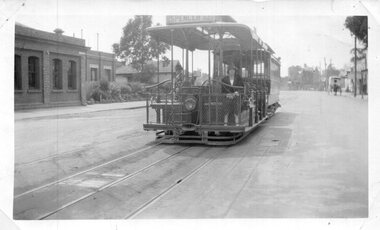
Photograph - Set of 4 Black & White Photograph/s, Don Schulz, mid 1920's
... Trams tramways Cable Trams Bridge Road Flinders St Richmond Depot Hawthorn Bridge tram 368 On rear in ink in each print, "Cable car Melbourne" and "286 Anzac Hy/Marion Rd Adelaide SA, collection of late Don Schultz" Series of four Black and White Photographs cable trams in Melbourne at the Bridge Road terminus or city during the mid 1920's/ .1 - Bridge road terminus with the car house or depot on the left hand side with the destination of Spencer St. .2 - Gripman possibly checking his watch with a depot worker? ...Series of four Black and White Photographs cable trams in Melbourne at the Bridge Road terminus or city during the mid 1920's/ .1 - Bridge road terminus with the car house or depot on the left hand side with the destination of Spencer St. .2 - Gripman possibly checking his watch with a depot worker? stepping off the tram. .3 - family stepping off the tram with cable trailer 368 in the view - Elizabeth St, near Flinders St? See Brian Weedon's notes re the photo and the trailer. .4 - As for .1 - with an X marked above the lady and a very large motor car passing. Printed on Kodak Paper. Adam Chandler advised by email 5/8/2020: " note there's a destination box fitted to the grip - from memory, these started to be used from the mid-1920s with the dummy and trailer repaints into the brown colour? That also looks to be either a 1925 or 26 Buick - the "moustache" shape at the top of the front radiator grille and the distinctly angled lower sash of the windscreen are further hints. Given the Richmond line closed in 1927 for conversion I'd say some time between 1924 and 29 June 1927." Also see image i5.pdf for further notes regarding the photographs and the Bridge Road tram depot building - use the original pdf file to read. Image i6, has had the "X" removed - done by Darren Hutchesson.On rear in ink in each print, "Cable car Melbourne" and "286 Anzac Hy/Marion Rd Adelaide SA, collection of late Don Schultz"trams, tramways, cable trams, bridge road, flinders st, richmond depot, hawthorn bridge, tram 368 -
![Booklet, [Barbara Williams (nee Haynes)], A brief record of the Australian Army Nursing Service : 1939-45, [1985?]](/media/collectors/64a5077bc83bd7b7b94f4211/items/6715caf46e218d3640ae25be/item-media/6715cd296e218d3640ae4c7f/item-fit-380x285.jpg?cb=6) Returned Nurses RSL Sub-branch
Returned Nurses RSL Sub-branchBooklet, [Barbara Williams (nee Haynes)], A brief record of the Australian Army Nursing Service : 1939-45, [1985?]
... 'TO A NEW FRIEND / GREETINGS / (2/7 AGH) / Barbara Williams / (NEE HAYNES) / RETURNED NURSES CLUB / RSL ANZAC HOUSE / 4 COLLINS Street / MELBOURNE 3000 / VICTORIA / AUSTRALIA' [on title page]...'TO A NEW FRIEND / GREETINGS / (2/7 AGH) / Barbara Williams / (NEE HAYNES) / RETURNED NURSES CLUB / RSL ANZAC HOUSE / 4 COLLINS Street / MELBOURNE 3000 / VICTORIA / AUSTRALIA' [on title page] Red and white coloured cover, stapled booklet. ...'Foreword / The Australian Army Nursing Service, 1939-45. / Compiled by VFX 47777 / This small volume represents a brief account of the work done by its members, at home, and abroad.'Red and white coloured cover, stapled booklet.non-fiction'Foreword / The Australian Army Nursing Service, 1939-45. / Compiled by VFX 47777 / This small volume represents a brief account of the work done by its members, at home, and abroad.'australian nurses, world war two, ww2, australia, australian army nursing service, aans -
 Returned Nurses RSL Sub-branch
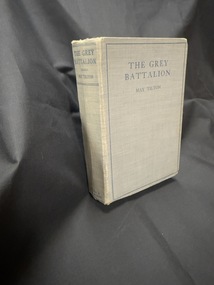
Book, May Tilton, The grey battalion, 1933
... 'B51' [handwritten in pencil top right hand corner first page] 'with best wishes / from the Author / May Tilton' [Handwritten in green/black ink on second page] 'Property of the / Returned Nurses / Club / Anzac House / 4 Collins St / Melbourne / 1975 / From Mrs Bea. ...'B51' [handwritten in pencil top right hand corner first page] 'with best wishes / from the Author / May Tilton' [Handwritten in green/black ink on second page] 'Property of the / Returned Nurses / Club / Anzac House / 4 Collins St / Melbourne / 1975 / From Mrs Bea. ...War reminiscences and recollections of May Tilton, an Australian Army Nursing Service Sister during World War One.Grey hardback book with blue writing on cover and spinenon-fictionWar reminiscences and recollections of May Tilton, an Australian Army Nursing Service Sister during World War One.world war one, wwi, ww1, australian army nursing service, australian nurses, may tilton -
 Returned Nurses RSL Sub-branch
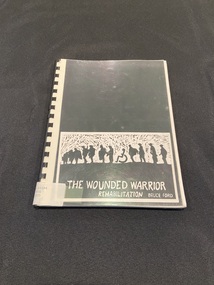
Book - Spiral bound book draft, Amphion Press, The wounded warrior and rehabilitation, [1986?]
... Melbourne. A hospital that has adapted over time and throughout two World Wars, polio outbreaks and up to its recent care of the elderly and victims of accidents, '940.41294 / FOR / MED' [handwritten in pencil inside the front cover] 'VICTORIAN BRANCH / LIBRARY / ANZAC HOUSE' [stamped in red ink on the title page] Spiral bound paperback booklet with a black plastic spine and a clear plastic protective sheet over the cover. ...This copy is a typed sample draft from a book that was later published under the same title. It traces the history of rehabilitation in the armed forces in Australia. This history included the establishment of the Caulfield Hospital in Melbourne. A hospital that has adapted over time and throughout two World Wars, polio outbreaks and up to its recent care of the elderly and victims of accidents,Spiral bound paperback booklet with a black plastic spine and a clear plastic protective sheet over the cover. The cover is black with a white rectangle template at the bottom of the page. Inside the template is a drawn black and white image of a line of silhouettes of wounded soldiers and the title printed below in white.non-fictionThis copy is a typed sample draft from a book that was later published under the same title. It traces the history of rehabilitation in the armed forces in Australia. This history included the establishment of the Caulfield Hospital in Melbourne. A hospital that has adapted over time and throughout two World Wars, polio outbreaks and up to its recent care of the elderly and victims of accidents,no.11 australian general hospital, caulfield rehabilitation hospital (vic.), military hospitals-australia-history, world war 1914-1918 medical care, world war 1939-1945 medical care, soldiers-medical care-australia, soldiers-rehabilitation-australia, rehabilitation, wounded soldiers -
 Returned Nurses RSL Sub-branch
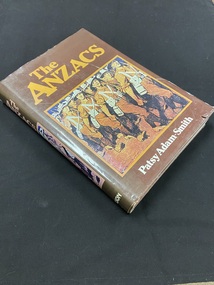
Book - Hardcover book, Patsy Adam-Smith, The ANZACS, 1982
... COLLINS ST / MELBOURNE' [Stamped in black ink on title page] 'VICTORIAN BRANCH / LIBRARY / ANZAC HOUSE' [Stamped in red ink on contents page] ...Anzacs remains unrivalled as the classic account of Australia's involvement in the First World War. [Penguin Books] 'PROPERTY OF VICTORIAN BRANCH R.S.L.' [Stamped in red ink on all three page edges when closed] '? D M RYAN / ? COLLINS ST / MELBOURNE' [Stamped in black ink on title page] 'VICTORIAN BRANCH / LIBRARY / ANZAC HOUSE ...Gallipoli was the final resting place for thousands of young Australians. Death struck so fast there was no time for escape or burial. And when Gallipoli was over there was the misery of the European Campaign. Patsy Adam-Smith read over 8000 diaries and letters to write her acclaimed best-seller about the First World War. These are the extraordinary experiences of ordinary men – and they strike to the heart. The Anzacs remains unrivalled as the classic account of Australia's involvement in the First World War. [Penguin Books]Brown hardcover book with a brown dust jacket. Both the front cover and spine of the dust jacket show the title and a brown and white drawn image of lines of soldiers marching in uniform.non-fiction Gallipoli was the final resting place for thousands of young Australians. Death struck so fast there was no time for escape or burial. And when Gallipoli was over there was the misery of the European Campaign. Patsy Adam-Smith read over 8000 diaries and letters to write her acclaimed best-seller about the First World War. These are the extraordinary experiences of ordinary men – and they strike to the heart. The Anzacs remains unrivalled as the classic account of Australia's involvement in the First World War. [Penguin Books]world war 1, ww1, wwi, world war one, australian and new zealand army corps, anzac, military campaigns, anzac day -
 Returned Nurses RSL Sub-branch
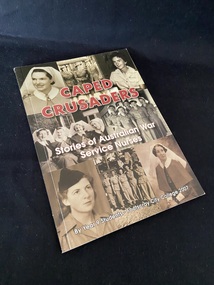
Book - Paperback book, Year 9 students - Footscray City College, Caped crusaders : stories of Australian war service nurses, 2007
... Australian Army Nurses Australian Army Nursing Service Stories of Australian War Service Nurses written by Year 9 students at Footscray City College in 2007, following research and interviews conducted at ANZAC House in Melbourne. Paperback book with black spine. ...Stories of Australian War Service Nurses written by Year 9 students at Footscray City College in 2007, following research and interviews conducted at ANZAC House in Melbourne.Paperback book with black spine. The cover shows eight photos of Australian War Nurses in black and white (four individual photos and four group photos). The title is overlaid in maroon lettering and the sub-heading and author details in white print.non-fictionStories of Australian War Service Nurses written by Year 9 students at Footscray City College in 2007, following research and interviews conducted at ANZAC House in Melbourne.australian army nurses, australian army nursing service -
 Returned Nurses RSL Sub-branch
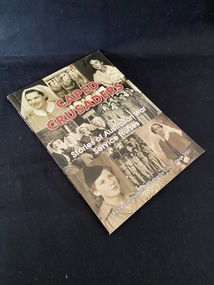
Book - Paperback book, Year 9 students - Footscray City College, Caped crusaders : stories of Australian war service nurses, 2007
... Australian Army Nurses Australian Army Nursing Service Stories of Australian War Service Nurses written by Year 9 students at Footscray City College in 2007, following research and interviews conducted at ANZAC House in Melbourne. Paperback book with black spine. ...Stories of Australian War Service Nurses written by Year 9 students at Footscray City College in 2007, following research and interviews conducted at ANZAC House in Melbourne.Paperback book with black spine. The cover shows eight photos of Australian War Nurses in black and white (four individual photos and four group photos). The title is overlaid in maroon lettering and the sub-heading and author details in white print.non-fictionStories of Australian War Service Nurses written by Year 9 students at Footscray City College in 2007, following research and interviews conducted at ANZAC House in Melbourne.australian army nurses, australian army nursing service -
 Returned Nurses RSL Sub-branch
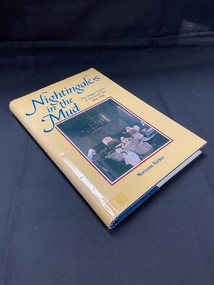
Book - Hardcover book, Marianne Barker, Nightingale in the mud : the Digger Sisters of the Great War 1914-1918, 1989
... [Stamped in purple ink on multiple pages] 'Returned Nurses Club / of Victoria / Anzac House 4 Collins St / Melbourne. / Donated by Mrs Effie De Rowen [?] ...[Stamped in purple ink on multiple pages] 'Returned Nurses Club / of Victoria / Anzac House 4 Collins St / Melbourne. / Donated by Mrs Effie De Rowen [?] ...'Draws on many first-hand and previously unpublished accounts of the work of Australian nurses in the Great War to tell an extraordinary story of courage and companionship under conditions of great hardship - in the mud of Flanders, among the cholera cases in India, on the hospital ships during the Gallipoli campaign, on Afghanistan border, in Vladivostok, in mosquito infested Macedonia, and in the Sinai Desert. - from inside dustjacket. Contents note: pt. 1. The Middle East -- 1. Enlistment -- 2. Egypt -- 3. Hospital ships -- 4. Lemnos -- 5. Malta -- 6. Palestine -- 7. Mesopotamia -- 8. India -- 9. Serbia and Salonika -- pt. 2. The Western Front -- 10. The Australian base hospitals in France -- 11. The casualty clearing stations -- 12. Transport in France -- 13. Home hospitals in England -- 14. Repatriation -- Epilogue -- Appendix: Roll of Nurses. - from Trove record.Blue hardcover book with a yellow dustjacket. The title is printed down the spine in blue text. The front cover shows an image of an oil painting of nurses tending the beds of the wounded, it is surrounded by a dark red border. Above the image the title is printed in blue, with 1914-1918 printed in smaller red print.non-fiction'Draws on many first-hand and previously unpublished accounts of the work of Australian nurses in the Great War to tell an extraordinary story of courage and companionship under conditions of great hardship - in the mud of Flanders, among the cholera cases in India, on the hospital ships during the Gallipoli campaign, on Afghanistan border, in Vladivostok, in mosquito infested Macedonia, and in the Sinai Desert. - from inside dustjacket. Contents note: pt. 1. The Middle East -- 1. Enlistment -- 2. Egypt -- 3. Hospital ships -- 4. Lemnos -- 5. Malta -- 6. Palestine -- 7. Mesopotamia -- 8. India -- 9. Serbia and Salonika -- pt. 2. The Western Front -- 10. The Australian base hospitals in France -- 11. The casualty clearing stations -- 12. Transport in France -- 13. Home hospitals in England -- 14. Repatriation -- Epilogue -- Appendix: Roll of Nurses. - from Trove record.history of nursing, world war one 1914-1918, ww1, wwi, nurses australia, great war nurses -
 City of Melbourne Libraries
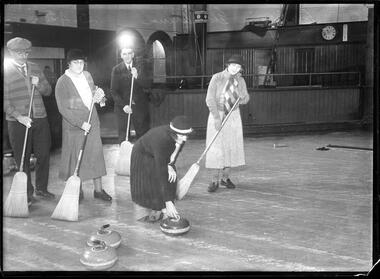
Photograph, Bull, Hugh Jones, 1897-1993, Curling at the Glaciarium, South Melbourne
... Melbourne to compete for the Silver Fern Trophy. They voyaged on the M.S. Wanganella and the crew nicknamed the curlers the “Ladies Hairdressers”. Australia won two tests and the third test was a draw. At the conclusion of the bonspiel, a secret, centuries old initiation was held at a “curlers’ court” at Anzac House...Melbourne to compete for the Silver Fern Trophy. They voyaged on the M.S. Wanganella and the crew nicknamed the curlers the “Ladies Hairdressers”. Australia won two tests and the third test was a draw. At the conclusion of the bonspiel, a secret, centuries old initiation was held at a “curlers’ court” at Anzac House ...Curling at the Glaciarium Mr A G Outhwaite, Mrs Lorna Moffatt-Pender and others, play a game of curling at Melbourne’s Glaciarium, c1933. “Game for Women who are “getting on”!” ran The Herald headline reporting that, “Mrs Moffatt-Pender finds curling a delightful game for the woman who is not quite as young as she was and wants something livelier than croquet. “There is no reason why women should not play up to 50 years of age. And there is always the domestic appeal of the broom which accompanies the curler on ice. Accuracy is the great thing in the game.” Arthur Grenby Outhwaite co-wrote popular “fairy” books, illustrated by his wife, Ida Rentoul Outhwaite. Featured in "Newsworthy: Melbourne in photographs 1933-1936" exhibition at East Melbourne Library, October to December 2023. Exhibition caption by project volunteer, Fiona Collyer. Photographer notations on slide: "Curling - Glaciarium B42" Description: Mr A G Outhwaite, Mrs Lorna Moffatt-Pender, Mrs S J Allen and two unidentified people play a game of curling at Melbourne Glaciarium. Research by project volunteer, Fiona Collyer: Mr Arthur Grenby Outhwaite was married to Ida Rentoul Outhwaite, who was regarded as Australia’s greatest children’s book illustrator and they, along with Ida’s sister Annie, collaborated on many books about fairies, elves and koalas. Ida designed four beautiful stained glass windows at St Marks Fitzroy, which are still there. Mrs Lorna Moffatt-Pender née Smith was married to Captain Iain Moffatt-Pender, a former Scottish Rugby Union international player and Seaforth Highlander in WWI, before he emigrated to Australia and became a wealthy sheep farmer. They were both keen curlers and participated in the NZ v Australia bonspiels at Melbourne Glaciarium in 1935. According to The Herald 9/4/1934, Mrs Moffatt-Pender wore fur-lined suede moccasins on the ice and found curling to be "a delightful game for the woman who is not quite as young as she was and wants something livelier than croquet. “There is no reason why women should not play up to 50 years of age. And there is always the domestic appeal of the broom which accompanies the curler on ice. There is a good sprinkling of women among curlers overseas. Accuracy is the great thing in the game.”" The Curling Club of Australia was formed in Melbourne in 1933 with Wimbledon Singles Champion 1907 and 1914, Sir Norman Brookes, the inaugural president. It disbanded in 1939. Curling was invented in Scotland in 1541, where the tradition is that the laird and the crofter are the same on the ice and after bonspiels (curling tournaments) everybody adjourn for a meal of beef and greens. Rocks of granite are sourced from the Scottish island of Ailsa Craig and weigh 20 kg each. Curling is similar to lawn bowls, but on ice. Two teams of four people each take turns to slide granite stones towards a target known as a house. The team with the most rocks closest to the centre of the house, scores points. Curling stones are delivered with a pre-determent rotation so that they curl as they travel – hence “curling”. Opposition teams can throw guards to block the house or take out the opponent’s stone. The sweeping is to gently warm the surface of the ice where the stone will glide, to extend the path of the stone. In 1934, an Australian team which included the Moffatt-Penders, travelled to New Zealand to compete in a bonspiel on frozen Idaburn Dam near Oturehua, Central Otago. New Zealand won. In June 1935, for the Melbourne Centenary, the New Zealand team came to Melbourne to compete for the Silver Fern Trophy. They voyaged on the M.S. Wanganella and the crew nicknamed the curlers the “Ladies Hairdressers”. Australia won two tests and the third test was a draw. At the conclusion of the bonspiel, a secret, centuries old initiation was held at a “curlers’ court” at Anzac House with seven Australian curlers initiated. Afterwards, a dinner was held at the Occidental Hotel (corner of Exhibition and Collins streets, demolished 1950s), where the haggis was carried in under an archway of curling brooms. The “Ode to the Haggis” was recited by “My Lord of the Court”, Captain Moffatt-Pender before he presented each New Zealand team member with a miniature curling stone as a souvenir of their visit. The Melbourne Glaciarium (also known as "The Glaci" or "The Glassy") opened in 1906 at 16 City Road, South Melbourne and was the third largest ice rink in the world at the time. There was seating for 2000 people which was heated with hot water pipes, and they could hire out 1500 pairs of skates. Up to 5000 people could attend hockey matches and ice sports carnivals at any one time. Patrons could watch films in summer or dance to the Glaciarium’s own orchestra conducted by Frank Bladen, who had played with the Pavlova and the Gilbert and Sullivan orchestras. In 1911 John Sousa, creator of the Sousaphone, and his band played a season of concerts. In 1924, the Glaciarium was turned into a makeshift film studio for filming of the interior scenes of "Jewelled Nights", starring Australian actress Louise Lovely, who had achieved success in Hollywood. The basketball and gymnastic competitions for the 1956 Melbourne Olympic Games were held there. Public skating sessions always finished with “Till we Meet Again”, a popular WWI song about the parting of a soldier and his sweetheart, written by Richard A Whiting and Raymond B Egan. The Glaciarium closed in 1959 and was demolished after a fire in 1963. References: WOMAN CURLER RETURNS (1934, April 9). The Herald (Melbourne, Vic. : 1861 - 1954), p. 14. Retrieved September 14, 2023, from http://nla.gov.au/nla.news-article243253779 CURLERS INITIATED (1935, June 24). The Argus (Melbourne, Vic. : 1848 - 1957), p. 4. Retrieved February 2, 2024, from http://nla.gov.au/nla.news-article12251790 Melbourne Glaciarium, Only Melbourne, https://www.onlymelbourne.com.au/melbourne-glaciarium Melbourne Glaciarium, Legends of Australian Ice, https://icelegendsaustralia.com/glaciariums.htmlPhotographer notations on slide: "Curling - Glaciarium B42".curling, 1930-1939, glaciarium, fires -
 Returned Nurses RSL Sub-branch
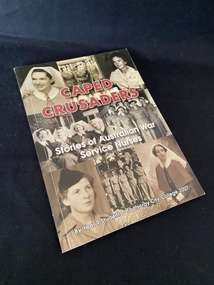
Book - Paperback book, Year 9 students - Footscray City College, Caped crusaders : stories of Australian war service nurses, 2007
... Australian Army Nurses Australian Army Nursing Service Stories of Australian War Service Nurses written by Year 9 students at Footscray City College in 2007, following research and interviews conducted at ANZAC House in Melbourne. Paperback book with black spine. ...Stories of Australian War Service Nurses written by Year 9 students at Footscray City College in 2007, following research and interviews conducted at ANZAC House in Melbourne.Paperback book with black spine. The cover shows eight photos of Australian War Nurses in black and white (four individual photos and four group photos). The title is overlaid in maroon lettering and the sub-heading and author details in white print.non-fictionStories of Australian War Service Nurses written by Year 9 students at Footscray City College in 2007, following research and interviews conducted at ANZAC House in Melbourne.australian army nurses, australian army nursing service -
 Returned Nurses RSL Sub-branch
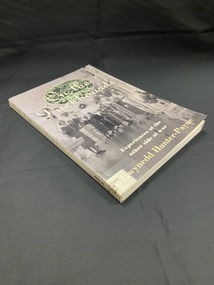
Book - Paperback book, Gwynedd Hunter-Payne, On the duckboards: experiences of the other side of war, 1995
... Melbourne, during the second world war. "Demand often outstripped facilities in the early days, and patients talk of camping on verandahs and using duckboards for walkways. However, the hospital rapidly developed into a bustling community of staff and patients." - from cover. 'PROPERTY OF ANZAC HOUSE ...The story of the Heidelberg Military Hospital in the outskirts of Melbourne, during the second world war. "Demand often outstripped facilities in the early days, and patients talk of camping on verandahs and using duckboards for walkways. However, the hospital rapidly developed into a bustling community of staff and patients." - from cover.Paperback book with white spine showing title and author and a white sticker at the bottom of the spine with dewey decimal number typed on it. The front cover displays a black and white image of nurses and patients standing in a hospital ward. At the top of the page behind the title is another image in an oval template of soldiers resting on the ground.non-fictionThe story of the Heidelberg Military Hospital in the outskirts of Melbourne, during the second world war. "Demand often outstripped facilities in the early days, and patients talk of camping on verandahs and using duckboards for walkways. However, the hospital rapidly developed into a bustling community of staff and patients." - from cover.world war two, wwii, world war 2, heidelberg military hospital, 115th australian general hospital, military hospitals -- victoria -- heidelberg -- history, 1939-1945 -- medical care -- australia -
 Returned Nurses RSL Sub-branch
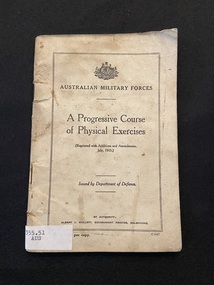
Booklet - Handbook, Department of Defence, A progressive course of physical exercies, 1915
... Australian Military Forces soldiers - physical activity military exercise military training marching 'VICTORIAN BRANCH / LIBRARY / ANZAC HOUSE' [stamped in red ink on second page] Small staple-bound booklet with a cream cover displaying a black double-line border on the front cover containing text printed in black. There is a white spine label attached to the base of the spine. A progressive course of physical exercies Booklet Handbook Department of Defence Albert J Mullett, Government printer, Melbourne ...Tables of exercises to assist instructors in the planning and application of daily physical training lessons for military personnel. This 1915 reprint includes additions and amendments including notes on marching and running training.Small staple-bound booklet with a cream cover displaying a black double-line border on the front cover containing text printed in black. There is a white spine label attached to the base of the spine.'VICTORIAN BRANCH / LIBRARY / ANZAC HOUSE' [stamped in red ink on second page]australian military forces, soldiers - physical activity, military exercise, military training, marching
