
Showing 11 items matching "approved manufacturer"
-
 Flagstaff Hill Maritime Museum and Village
Furniture - Chair, Harnisch & Co, 1876-1918
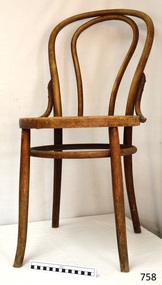
... ...k.u.k. approved manufacturer...It was a place for Council meetings, community events and entertainment, theatrical and musical. flagstaff hill warrnambool shipwrecked-coast flagstaff-hill flagstaff-hill-maritime-museum maritime-museum shipwreck-coast flagstaff-hill-maritime-village bentwood chair café chair restaurant chair thonet design chair neusohler fabrik fur nobel k.u.k. approved manufacturer hungry Harnisch & Co k.u.k. public hall chair Toc H Marks; pressed into rim under seat is "3", and "Crown [over] (N)", Paper label, cream with black print, on rim; Left side has Mark “N inside circle under crown”. ...The design of this pair (RN 758 & 759) is based on Thonet’s No. 18 chair, which was originally produced in 1876 by Thonet, and is still one of the best-selling designs for café and restaurant owners. It is elegant, sophisticated and durable. The label notes the design as “AUS MASSIV GEBOGENEM HOLZE vorm” which translates to “solid curved sandals shape”, a good description for the back of the chair. The chairs have marks, paper labels and symbols on them that show that the maker was Harnisch & Co., Neuschler (also called Banská Bystrica) Furniture Factory in Neuschol (Beszterczebanya), Hungary, privileged makers for the Imperial and Royal Austrian-Hungarian Empire 1867 – 1918. Bentwood chairs are made by a process of wetting wood in water, bending it into curved shapes, then allowing it to dry so that the shape becomes permanent. This process originated by Michael Thonet, who had been given the right to bend wood into desired curves by the Austrian Courts in 1842. In 1856 he was granted a 13 year patent to manufacture chairs and table legs of bent wood treated by steam or boiling water. In 1859 his company Gebruder Thonet produced his original design. Thonet’s early designs also featured hand carved or laminated wooden seats. His Model No. 14 produced in the 1850’s, was his most popular design. After Michael’s death in 1871 the family went on designing and producing chairs. The No. 18 chair was produced in 1876, one of a group of chars with back inserts consisting of curves and loops of bentwood. These bentwood chairs are believed to be associated with the either the original Warrnambool Town Hall or the Toc H Group in Warrnambool. The Warrnambool Town Hall played a significant role in the both the local government and the social events of local and district areas. It was a place for Council meetings, community events and entertainment, theatrical and musical.Chair, bentwood, 'French Bistro Chair' with a floral pattern carved in seat. Backrest has inverted U shape inside that extends to the seat. Supports on either side of backrest's base join to back of seat. Legs have a wooded bracing ring. Marks are embossed into rim under seat. Paper label, cream with black print, on rim; Right side of label has the symbol of Heraldic Shield. Text on label. Made by NEUSOHLER FABRIK FUR MOBEL, AUS MASSIV GEBOGENEM HOLZE, vorm. HARNISCH & Co, NEUSOHL (BESZTERCaZEBANYA) UNGARN ' Hand written under seat "T H" in black paint, "T H " in white chalk.Marks; pressed into rim under seat is "3", and "Crown [over] (N)", Paper label, cream with black print, on rim; Left side has Mark “N inside circle under crown”. Right side has symbol of Heraldic Shield. Text on label “Trade – K.u.K.- Mark / NEUSOHLER FABRIK FUR MOBEL/ AUS MASSIV GEBOGENEM HOLZE, vorm. HARNISCH&Co / NEUSOHL (BESZTERCaZEBANYA) UNGARN ' Hand written under seat "T H" in black paint, "T H " in white chalk. flagstaff hill, warrnambool, shipwrecked-coast, flagstaff-hill, flagstaff-hill-maritime-museum, maritime-museum, shipwreck-coast, flagstaff-hill-maritime-village, bentwood chair, café chair, restaurant chair, thonet design chair, neusohler fabrik fur nobel, k.u.k. approved manufacturer, hungry, harnisch & co, k.u.k., public hall chair, toc h -
 Flagstaff Hill Maritime Museum and Village
Furniture - Chair, Harnisch & Co, 1876-1918
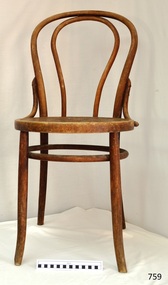
... ...approved manufacturer...Flagstaff Hill Flagstaff Hill Maritime Museum and Village Warrnambool Maritime Museum Maritime Village Great Ocean Road Shipwreck Coast bentwood chair café chair restaurant chair meeting hall chair thonet design chair harnisch & co k.u.k. neusohler fabrik fur nobel approved manufacturer NEUSOHL (BESZTERCaZEBANYA) UNGARN Marks; pressed into rim under seat is "3" and "4", and "Crown [over] N", Paper label, cream with black print, on rim; Left side has Mark “N inside circle under crown”. ...The design of this pair (RN 758 & 759) is based on Thonet’s No. 18 chair, which was originally produced in 1876 by Thonet, and is still one of the best-selling designs for café and restaurant owners. It is elegant, sophisticated and durable. The label notes the design as “AUS MASSIV GEBOGENEM HOLZE vorm” which translates to “solid curved sandals shape”, a good description for the back of the chair. The chairs have marks, paper labels and symbols on them that show that the maker was Harnisch & Co., Neuschler (also called Banská Bystrica) Furniture Factory in Neuschol (Beszterczebanya), Hungary, privileged makers for the Imperial and Royal Austrian-Hungarian Empire 1867 – 1918. Bentwood chairs are made by a process of wetting wood in water, bending it into curved shapes, then allowing it to dry so that the shape becomes permanent. This process originated by Michael Thonet, who had been given the right to bend wood into desired curves by the Austrian Courts in 1842. In 1856 he was granted a 13 year patent to manufacture chairs and table legs of bent wood treated by steam or boiling water. In 1859 his company Gebruder Thonet produced his original design. Thonet’s early designs also featured hand carved or laminated wooden seats. His Model No. 14 produced in the 1850’s, was his most popular design. After Michael’s death in 1871 the family went on designing and producing chairs. The No. 18 chair was produced in 1876, one of a group of chars with back inserts consisting of curves and loops of bentwood. The popularity of the Bentwood chair, even now, is due to its versatility and timeless quality. Its style, whether varnished or painted, suits any room in the house. The lightweight chairs are also popular for café and restaurant seating, as well as for public gatherings. They can be easily moved around and grouped in a variety of ways to suit any occasion.Chair, bentwood, 'French Bistro Chair' with pattern carved in seat. Backrest has inverted U shape inside that extends to the seat. Supports on eitherside of backrest's base join to back of seat. Legs have a wooded bracing ring. Marks; pressed into rim under seat. Paper label, cream with black print, on rim. Right side of label has symbol of Heraldic Shield. Text on label. Made by Harnisch & Co.Marks; pressed into rim under seat is "3" and "4", and "Crown [over] N", Paper label, cream with black print, on rim; Left side has Mark “N inside circle under crown”. Right side has symbol of Heraldic Shield. Text on label “Trade – K.u.K.- Mark / NEUSOHLER FABRIK FUR MOBEL/ AUS MASSIV GEBOGENEM HOLZE, vorm. HARNISCH & Co / NEUSOHL (BESZTERCaZEBANYA) UNGARN ' Hand written under seat "T H" in black paint, "T H " in white chalk. flagstaff hill, flagstaff hill maritime museum and village, warrnambool, maritime museum, maritime village, great ocean road, shipwreck coast, bentwood chair, café chair, restaurant chair, meeting hall chair, thonet design chair, harnisch & co, k.u.k., neusohler fabrik fur nobel, approved manufacturer, neusohl (besztercazebanya) ungarn -
 Flagstaff Hill Maritime Museum and Village
Domestic object - Stove, Cox and Rizzetti Stove Works, ca. 1918-1930s
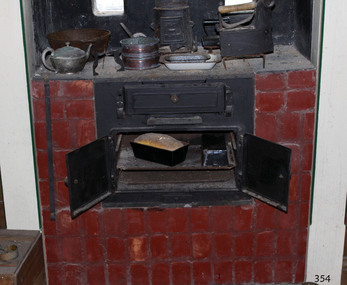
... manufacturer of Planet Stoves. This Planet No 3 stove is an uncommon example of cooking equipment used in kitchens in the early 20th century, as the firebox is above the oven rather than beside it. The cast iron combustion stove is significant as part of the evolution of domestic cooking. Previously cooking was mostly carried out in outdoors in open fires, and later in fireplaces indoors. Cast iron stoves are still used today and have additional features such as thermostats to monitor and maintain temperature, water heating pipes connected, and environmentally approved ...Cast iron stoves burn solid fuel such as wood or coal, and are used for cooking and warmth. The stoves have a firebox with a grate where the fuel is burned. The hot air flows through flues and baffles that heat the stove top and the oven. Before cast iron stoves were invented, cooking and heating were carried out in outdoor open fires, and later, in fireplaces inside the home. In 1642 the first cast iron stove was manufactured in Lynn, Massachusetts, where molten cast iron was poured into a sand mould to make rectangular plates that were then joined together to make a box. Benjamin Franklin invented the more efficient Pennsylvania stove in 1744, and this efficient design is still used today. After the mid-19th century cast iron stoves were produced with burners in different positions, giving varied temperatures, so a wide variety of foods could be cooked at the same time at the most suitable heat, from slow cooking to baking scones. In contemporary times people the new wood-burning stoves had to meet the anti-pollution standards now in place to protect our environment. By the 1920s gas cookers were being introduced for domestic use, and by the 1930s electric home cookers were being offered to householders. PLANET STOVES In August 1925 the firm Cox and Rizzetti, Stove Works, and also Sydney Road, South Melbourne, advertised in the Brunswick and Coburg Leader of November 11, 1925 as "formerly with Harnwell and Sons" and as "specialists in solid cast iron Planet stoves ... which merit an inspection from builders and householders". The firm continued in business and was mentioned as sponsors in the King Island News in 1971. Harnwell and Sons was listed in the Victorian Government Gazette of 1894. It is curious that the firm was mentioned in an article in the Sunrasia Daily of June 14, 1934 titled 'Planet Stoves' as a manufacturer of Planet Stoves. This Planet No 3 stove is an uncommon example of cooking equipment used in kitchens in the early 20th century, as the firebox is above the oven rather than beside it. The cast iron combustion stove is significant as part of the evolution of domestic cooking. Previously cooking was mostly carried out in outdoors in open fires, and later in fireplaces indoors. Cast iron stoves are still used today and have additional features such as thermostats to monitor and maintain temperature, water heating pipes connected, and environmentally approved anti-pollution fittings. Stove; a compact, blackened cast iron combustion cooker, installed within a fireplace and enclosed by bricks on both sides. The upright rectangular stove has a flat top with three round, removable cook plates and a flue connected at the back. The front has three doors with round knob handles; a swing-down firebox door above a sliding ashtray, and two side-hinged oven doors above a sliding opening. Inside on the side walls are two pairs of runners. Behind the pair of doors is an oven with two pairs of rails and two removable metal shelves. The stove has cast inscriptions on the chimney flue and on the front of the right hand side stove door. The model of the stove is The Planet No 3, made in Melbourne.Chimney flue, "[within rectangle] THE / PLANET" Stove door, "(within oval) PLANET / No 3"flagstaff hill, flagstaff hill maritime museum and village, warrnambool, maritime museum, maritime village, great ocean road, shipwreck coast, stove, cast iron stove, combustion stove, wood-burning stove, wood stove, wood oven, solid fuel stove, cooker, the planet, planet, planet no. 3, kitchen equipment, baking, domestic cooking, cooking equipment, food preparation, planet stove, planet cooker, cooking range, slow combustion stove, antique, range cooker, cox and rizzetti, harnwell and sons, melbourne manufacturer -
 Bendigo Military Museum
Manual - GOLD COLOUR SAMPLE BOX, c. 1993
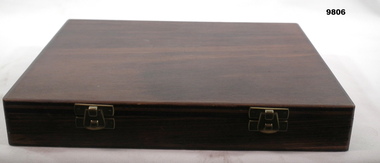
... The manufacturers were often local companies, where an example of a typical supplier is KG Luke who also manufactured the Brownlow Medal, the award given annnually to the Australlian Football League's best and fairest player. badges Military insignia Button Paper taped to inside lid - title 'SEALED SAMPLE 8455-03311' - a lengthy description of contents and box follows. Please refer ot photograoph for further details. Typed tag on cushion - 'Department of Defence/SEALED SAMPLE/Sealed sample Number 03311/Stock Number 8455/Description STANDARD OF GOLD COLOUR FOR INSIGNIA, BUTTONS AND BADGES (ANODISED) ALUMINIUM ALLOY 1150/APPROVED ...This box of sampled is typical of those issued to official manufacturers of military badges, insignia, and buttons to ensure the gold colour remained consistent. These badges were held by the Third Army Quality Assurance Unit (3AQAU). The manufacturers were often local companies, where an example of a typical supplier is KG Luke who also manufactured the Brownlow Medal, the award given annnually to the Australlian Football League's best and fairest player.A rectangular wooden box with a black velvet-like cushion in one side. cushion has 10 examples - 2 of each kind - of military insignia and buttons of two different shades of gold colour. Box opens on one long side and is hinged (4cm brass hinges with 3 screws in each side). Clasps on opposite long side, also of brass. Wood has been stained a dark brown. Base off box shows 14 brass staples. Corners of base show 2 nails, possibly brass. A typed sheet of paper is attached to the inside of lid, dating from 1993, explaining usage of samples. Paper tag affixed to cushion between samples - Department of Defence authenticating samples in box. Tag attached with fabric tape and secured using a lead seal.Paper taped to inside lid - title 'SEALED SAMPLE 8455-03311' - a lengthy description of contents and box follows. Please refer ot photograoph for further details. Typed tag on cushion - 'Department of Defence/SEALED SAMPLE/Sealed sample Number 03311/Stock Number 8455/Description STANDARD OF GOLD COLOUR FOR INSIGNIA, BUTTONS AND BADGES (ANODISED) ALUMINIUM ALLOY 1150/APPROVED. The supply is not to differ from this sealed sample except as endorsed on the back hereof./D Darby [signature] 29/06/1993 /EDE VFE SCDDG [stamped].' Reverse of tag (stamped in red within a thin lined border) - 'SEALED SAMPLE/NOT TO BE/DESTROYED OR/MUTILATED' badges, military insignia, button -
 Coal Creek Community Park & Museum
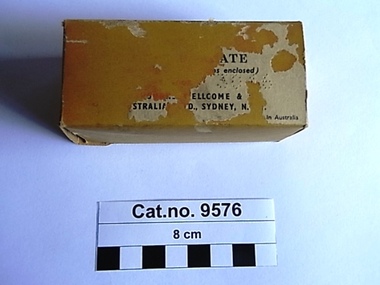
Box, cardboard, c.1937-1960
... Manufacturer, if other than the Wholesale Dealer - , Distinguishing Name of Stock Medicine : "Wellcome" Calcium Borogluconate, Approved Use or for the Treatment of : Milk Fever, hypocalcaemia. ...Manufacturer, if other than the Wholesale Dealer - , Distinguishing Name of Stock Medicine : "Wellcome" Calcium Borogluconate, Approved Use or for the Treatment of : Milk Fever, hypocalcaemia. milk fever hypocalcaemia subcutaneous Outer label '.....ATE .s enclosed)..........ELLCOME & .............STRALIA..D., SYDNEY, N....in Australia'. ...Trove : Advertised from 1937-1949 in various publications search under "Wellcome"' Calcium Borogluconate (yes with 2 'l's) . Victorian Government Gazette , no.2 Jan 5, 1960, page 16. List of Registered Stock Medicine. Registered Wholesale Dealer : Burroughs Wellcome and Co. (Aust) Ltd. Cressy Street, Rosebery New South Wales. Manufacturer, if other than the Wholesale Dealer - , Distinguishing Name of Stock Medicine : "Wellcome" Calcium Borogluconate, Approved Use or for the Treatment of : Milk Fever, hypocalcaemia. Rectangular faded pink cardboard box opening at both ends with the remnants of a paper label on one side, containing a folded paper leaflet and a cellophane bag containing white granules.Outer label '.....ATE .s enclosed)..........ELLCOME & .............STRALIA..D., SYDNEY, N....in Australia'. Impressed on one flap of box '132'. Printed leaflet (side one) Illustration of a unicorn, a thick black line under which text 'WELLCOME' brand CALCIUM BOROGLUCONATE (Vetinary)' followed by another thick black line. 'Calcium Borogluconate ia a stable , non-irritant calcium preparation for subcutaneous or intravenous injection in the treatment of milk fever and other forms of acute hypocalcaemia. It is available in the dry state as 'Wellcome' Calcium Borogluconate, a granular product in single dose containers of 2 1/2 oz. Milk Fever In the treatment of milk fever in cows, 21/2 oz. to 31/2 oz. of the granules should be injected subcutaneously at two or three points in the neck, with the usual aseptic precautions. The granules should be dissolved in 10 fl. oz. of boiling water, the solution allowed to boil for five minutes, then cooled to body temperature before administration. Repetition of the dose is very rarely necessary. Should a more rapid response be desired, the whole of the solution hay be given by slow intravenous injection; alternatively , the greater part of the solution may be injected by this route and the remainder given subcutaneously in the manner described above. A convenient apparatus for the controlled administration of large volumes of fluid (leaflet side two) is the 'Wellcome' Flutter Valve Injection Apparatus. Prophylaxis Recurrent attacks at successive parturitions may be prevented by giving calcium borogluconate immediately after calving and again about 20 hours later. Each dose should be from one or two ounces of 'Wellcome' Calcium Borogluconate, dissolved as directed above. Other Indications Certain other conditions have been found to respond readily to calcium borogluconate therapy. These include parturient hypocalcaemia or milk fever in ewes, parturient eclampsia in sows and bitches, so-called "staggers" in lactating dairy cattle suspected to be due to hypocalcaemia, and transit tetany in horses. The dosage for various species is generally within the ranges indicated below : horses and cattle 11/2 to 31/2 oz. Sheep, goats and pigs 1/2 oz. to 1 oz. Dogs 11/2 dr. to 3 dr. 'WELLCOME' brand CALCIUM BOROGLUCONATE A readily-soluble granular product issued in cartons of 21/2 oz.' Illustration of a unicorn, 'BURROUGHS WELLCOME & CO. (AUSTRALIA) LTD. (Incorporated in England) SYDNEY, N.S.W.' A black line 'ref.A5007g 54.1. 25' milk fever, hypocalcaemia, subcutaneous -
 Sunshine and District Historical Society Incorporated
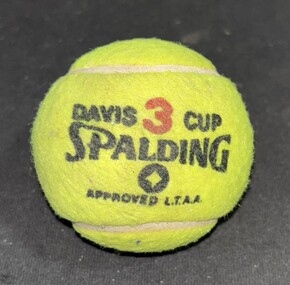
Leisure object - Spalding Davis Cup 3 Tennis Ball
... manufacturer of footballs used in Australian Rules football games. In the early 1990's the factory in Sunshine was demolished. It is not known if this ball was made in the Sunshine factory but does provide a memory of what was once manufactured in the Sunshine factory. Spalding Ballarat Road Sunshine North Tennis Spalding Davis 3 Cup 3 Approved ...The Spalding factory was located at the intersection of Ballarat Rd and McIntyre Rd in Sunshine (North East corner). The factory made sporting goods, and in 1972 Spalding acquired T. W. Sherrin Pty Ltd which was a major manufacturer of footballs used in Australian Rules football games. In the early 1990's the factory in Sunshine was demolished. It is not known if this ball was made in the Sunshine factory but does provide a memory of what was once manufactured in the Sunshine factory.Unused yellow tennis ballSpalding Davis 3 Cup 3 Approved L.T.A.A.spalding, ballarat road, sunshine north, tennis -
 Sunshine and District Historical Society Incorporated
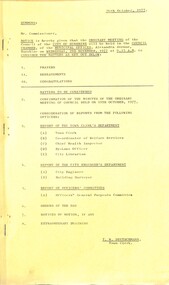
Administrative record - City of Sunshine - Commissioner Mr Alexander Alex George Gillon Collection 1976 - 1982 - Notice of ordinary meeting of the council of the City of Sunshine to be held on 2nd November 1977, City of Sunshine, 26th October 1977
... Notice of Ordinary Meeting of the Council of the City of Sunshine to be held on 2nd November 1977 Report of the Town Clerk's Department Report of the Town Clerk Purchase of Goods Preference to Local Manufacturer Loan Authority Railway Land Corner Devonshire Road and Alexandra Avenue Closure of Warrs Road to Through Traffic Appointment of Auditor Regionalisation of Refuge Disposal Proposed Legislation Land Acquisition Agreement Proposed Open Space Lot 23 Disraeli Street Approved of General Valuation Proposed Purchase of Sunshine Tip Approval of Overdraft Sanitary and Interest Abandonments for 1976/1977 Community Arts Officers' Discussion Day Outreach 77 Refund of Payments to Rosamond Bowling Club & Maribyrnong RSL Report of the Co-Ordinator of Welfare Services Emergency Relief Report of the Chief Health Inspector Application for Install of Gas Fired Dry Septic Tank Units Prosecution Proceedings Sunshine Magistrate Court Report of Weights & Measures Inspector Prosecution Proceedings Sunshine Magistrates Court Registration of Premises Petrol Station Complaint Municipal Refuse Composting Symposium 9th November 1977 Melbourne & Metropolitan Board of Works Pollution Report of the By-Laws Officer Fire Hazard Removal Tenders Season Snake Eradication Authorisations for Council Officers Report of the City Engineer Land Use Permit Application Flats 52B Forrest Street Land Use Permit Application Flats Lot 1 Monash Street North West Corner Cornwall Road Land Use Permit Application Stan Cash Sale and Distribution of Floor Coverings, Building's Hardware and Electrical Domestic Appliances and Furniture Corner Halstead Street and Ashley Street Land Use Permit Sky Sign Somerville Road Land Use Permit Application Subdivision and Detached Houses Albanvale Estate Land Use Permit Application Car Sales Yard Lots 8, 9, 10, 11, 12 & 13 Rosamond Road Land Use Permit Application Office and Warehouse Complex Fairbairn Road and Land Use Permit Application Subdivision Fairbairn Road Land Use Permit Application Addition to Existing Shopping Plaza Lot 4 St. ...Albans Road Princess Street Furlong Road Duke Street Sunshine North Mitchell Street Hampstead Road Andrew Street Sunshine Road Dempster Street Tottenham Bon Thomas Reserve Quinn Street Deer Park Neale Road Northumberland Road Willey Street Rufford Street Fourth Aveneue Skinner Reserve Churchill Avenue Braybrook Ainsworth Reserve Child Care Centre Deer Park Pre-School Centre Hendry Street Sunshine Tip Notice of Ordinary Meeting of the Council of the City of Sunshine to be held on 2nd November 1977 Report of the Town Clerk's Department Report of the Town Clerk Purchase of Goods Preference to Local Manufacturer Loan Authority Railway Land Corner Devonshire Road and Alexandra Avenue Closure of Warrs Road to Through Traffic Appointment of Auditor Regionalisation of Refuge Disposal Proposed Legislation Land Acquisition Agreement Proposed Open Space Lot 23 Disraeli Street Approved of General Valuation Proposed Purchase of Sunshine Tip Approval of Overdraft Sanitary and Interest Abandonments for 1976/1977 Community Arts Officers' Discussion Day Outreach 77 Refund of Payments to Rosamond Bowling Club & Maribyrnong RSL Report of the Co-Ordinator of Welfare Services Emergency Relief Report of the Chief Health Inspector Application for Install of Gas Fired Dry Septic Tank Units Prosecution Proceedings Sunshine Magistrate Court Report of Weights & Measures Inspector Prosecution Proceedings Sunshine Magistrates Court Registration of Premises Petrol Station Complaint Municipal Refuse Composting Symposium 9th November 1977 Melbourne & Metropolitan Board of Works Pollution Report of the By-Laws Officer Fire Hazard Removal Tenders Season Snake Eradication Authorisations for Council Officers Report of the City Engineer Land Use Permit Application Flats 52B Forrest Street Land Use Permit Application Flats Lot 1 Monash Street North West Corner Cornwall Road Land Use Permit Application Stan Cash Sale and Distribution of Floor Coverings, Building's Hardware and Electrical Domestic Appliances and Furniture Corner Halstead Street and Ashley Street Land Use Permit Sky Sign Somerville Road Land Use Permit Application Subdivision and Detached Houses Albanvale Estate Land Use Permit Application Car Sales Yard Lots 8, 9, 10, 11, 12 & 13 Rosamond Road Land Use Permit Application Office and Warehouse Complex Fairbairn Road and Land Use Permit Application Subdivision Fairbairn Road Land Use Permit Application Addition to Existing Shopping Plaza Lot 4 St. ...Notice of Ordinary Meeting of the Council of the City of Sunshine to be held on 2nd November 1977 Report of the Town Clerk's Department Report of the Town Clerk Purchase of Goods Preference to Local Manufacturer Loan Authority Railway Land Corner Devonshire Road and Alexandra Avenue Closure of Warrs Road to Through Traffic Appointment of Auditor Regionalisation of Refuge Disposal Proposed Legislation Land Acquisition Agreement Proposed Open Space Lot 23 Disraeli Street Approved of General Valuation Proposed Purchase of Sunshine Tip Approval of Overdraft Sanitary and Interest Abandonments for 1976/1977 Community Arts Officers' Discussion Day Outreach 77 Refund of Payments to Rosamond Bowling Club & Maribyrnong RSL Report of the Co-Ordinator of Welfare Services Emergency Relief Report of the Chief Health Inspector Application for Install of Gas Fired Dry Septic Tank Units Prosecution Proceedings Sunshine Magistrate Court Report of Weights & Measures Inspector Prosecution Proceedings Sunshine Magistrates Court Registration of Premises Petrol Station Complaint Municipal Refuse Composting Symposium 9th November 1977 Melbourne & Metropolitan Board of Works Pollution Report of the By-Laws Officer Fire Hazard Removal Tenders Season Snake Eradication Authorisations for Council Officers Report of the City Engineer Land Use Permit Application Flats 52B Forrest Street Land Use Permit Application Flats Lot 1 Monash Street North West Corner Cornwall Road Land Use Permit Application Stan Cash Sale and Distribution of Floor Coverings, Building's Hardware and Electrical Domestic Appliances and Furniture Corner Halstead Street and Ashley Street Land Use Permit Sky Sign Somerville Road Land Use Permit Application Subdivision and Detached Houses Albanvale Estate Land Use Permit Application Car Sales Yard Lots 8, 9, 10, 11, 12 & 13 Rosamond Road Land Use Permit Application Office and Warehouse Complex Fairbairn Road and Land Use Permit Application Subdivision Fairbairn Road Land Use Permit Application Addition to Existing Shopping Plaza Lot 4 St. Albans Road Adjacent to Existing Shopping Plaza Lot 3 Princess Street Land Use Permit Application Subdivision and Detached Houses Furlong Road Land Use Permit Application Addition of Sun Blind 323 Main Road West Land Use Permit Application Stan Cash Furniture and Carpet Sales and Buildings Hardware Corner Halstead Street and Ashley Street Land Use Permit Application Sky Sign Lot 1 Duke Street Land Use Permit Application Extension to Existing Office and Amenities Block Serving Fuel Oil Depot Lot 1 Duke Street Car Parking Hampstead Road near Mitchell Street Damage to Kerb & Channel and Road Payment Andrew Street Financial Assistance Restoration Works Easter Flooding Treasury of Victoria Joint Works Robinsons Road Reconstruction and Maintenance Country Roads Board Funded Project Outdoor Employees Christmas Holidays Break-up 1977 Sixteenth Municipal Superintendents' of Works Conference Statcon Signal Program Intersection of Ashley Street, Sunshine Road & Dempster Street Royal Victorian Institute of the Blind Work Experience Programs Bon Thomas Reserve Development National Safety Council of Australia Senior Management Local Government Authority National Safety Council of Australia Accident Control Course Royal Australian Insitiute Parks and Recreation Vicitorian Division Seminar Turf Wickets Half Cost Footpath and Kerb and Channel Neale Road Half Cost Footpath and Kerb and Channel Northumberland Road Neale Road Construction Tenders Car Parking Willey Street and Rufford Street Part Olny Private Street Scheme (Drainage) Steer Street Group Objection Variations to Contract Fourth Aveneue Furlong Road Estate Stages 1 & 2 Report of the Building Surveyor Uniform Building Regulations Draft Amendment Fency Lot 343 Anley Place Alteration to Grandstand Skinner Reserve Churchill Avenue Braybrook Dempster Park Cricket Pavilion Ainsworth Reserve Child Care Centre / Pavilion Glengala Road Sunshine West Deer Park Pre-School Centre Cash in Lieu Flats Lot 472 Hendry Street Sunshine West Orders of the Day Accounts Submitted for Payment 15th October 1977 & 16th October 1977 Confirmation of Loan with State Insurance city of sunshine, alexander "alex" george gillon, devonshire road, sunshine, warrs road, maribyrnong, disraeli street, st. albans, alexandra avenue, rosamond bowling club, rosamond road, maribyrnong rsl, raleigh road, forrest street, albion, monash street, cornwall road, stan cash, halstead street, ashley street, maidstone, somerville road, brooklyn, albanvale, fairbairn road, sunshine west, st. albans road, princess street, furlong road, duke street, sunshine north, mitchell street, hampstead road, andrew street, sunshine road, dempster street, tottenham, bon thomas reserve, quinn street, deer park, neale road, northumberland road, willey street, rufford street, fourth aveneue, skinner reserve, churchill avenue, braybrook, ainsworth reserve child care centre, deer park pre-school centre, hendry street, sunshine tip -
 Sunshine and District Historical Society Incorporated
Administrative record - City of Sunshine - Commissioner Mr Alexander Alex George Gillon Collection 1976 - 1982 - Minutes of the ordinary meeting of council held on 2nd November 1977, City of Sunshine, 2nd November 1977
... Minutes of the Ordinary Meeting of Council held on 2nd November 1977 Report of the Town Clerk's Department Report of the Town Clerk Purchase of Goods Preference to Local Manufacturer Loan Authority Railway Land Corner Devonshire Road and Alexandra Avenue Closure of Warrs Road to Through Traffic Appointment of Auditor Regionalisation of Refuge Disposal Proposed Legislation Land Acquisition Agreement Proposed Open Space Lot 23 Disraeli Street Approved of General Valuation Proposed Purchase of Sunshine Tip Approval of Overdraft Sanitary and Interest Abandonments for 1976/1977 Community Arts Officers' Discussion Day Outreach 77 Refund of Payments to Rosamond Bowling Club & Maribyrnong RSL Report of the Co-Ordinator of Welfare Services Emergency Relief Report of the Chief Health Inspector Application for Install of Gas Fired Dry Septic Tank Units Prosecution Proceedings Sunshine Magistrate Court Report of Weights & Measures Inspector Prosecution Proceedings Sunshine Magistrates Court Registration of Premises Petrol Station Complaint Municipal Refuse Composting Symposium 9th November 1977 Melbourne & Metropolitan Board of Works Pollution Report of the By-Laws Officer Fire Hazard Removal Tenders Season Snake Eradication Authorisations for Council Officers Report of the City Engineer Land Use Permit Application Flats 52B Forrest Street Land Use Permit Application Flats Lot 1 Monash Street North West Corner Cornwall Road Land Use Permit Application Stan Cash Sale and Distribution of Floor Coverings, Building's Hardware and Electrical Domestic Appliances and Furniture Corner Halstead Street and Ashley Street Land Use Permit Sky Sign Somerville Road Land Use Permit Application Subdivision and Detached Houses Albanvale Estate Land Use Permit Application Car Sales Yard Lots 8, 9, 10, 11, 12 & 13 Rosamond Road Land Use Permit Application Office and Warehouse Complex Fairbairn Road and Land Use Permit Application Subdivision Fairbairn Road Land Use Permit Application Addition to Existing Shopping Plaza Lot 4 St. ...Albans Road Princess Street Main Road West Duke Street Sunshine North Hampstead Road Mitchell Street Andrew Street Sunshine Road Dempster Street Tottenham Bon Thomas Reserve Quinn Street Deer Park Neale Road Northumberland Road Willey Street Rufford Street Fourth Aveneue Anley Place Skinner Reserve Churchill Avenue Braybrook Dempster Park Phoenix Street Ainsworth Reserve Child Care Centre Deer Park Pre-School Centre Hendry Street Minutes of the Ordinary Meeting of Council held on 2nd November 1977 Report of the Town Clerk's Department Report of the Town Clerk Purchase of Goods Preference to Local Manufacturer Loan Authority Railway Land Corner Devonshire Road and Alexandra Avenue Closure of Warrs Road to Through Traffic Appointment of Auditor Regionalisation of Refuge Disposal Proposed Legislation Land Acquisition Agreement Proposed Open Space Lot 23 Disraeli Street Approved of General Valuation Proposed Purchase of Sunshine Tip Approval of Overdraft Sanitary and Interest Abandonments for 1976/1977 Community Arts Officers' Discussion Day Outreach 77 Refund of Payments to Rosamond Bowling Club & Maribyrnong RSL Report of the Co-Ordinator of Welfare Services Emergency Relief Report of the Chief Health Inspector Application for Install of Gas Fired Dry Septic Tank Units Prosecution Proceedings Sunshine Magistrate Court Report of Weights & Measures Inspector Prosecution Proceedings Sunshine Magistrates Court Registration of Premises Petrol Station Complaint Municipal Refuse Composting Symposium 9th November 1977 Melbourne & Metropolitan Board of Works Pollution Report of the By-Laws Officer Fire Hazard Removal Tenders Season Snake Eradication Authorisations for Council Officers Report of the City Engineer Land Use Permit Application Flats 52B Forrest Street Land Use Permit Application Flats Lot 1 Monash Street North West Corner Cornwall Road Land Use Permit Application Stan Cash Sale and Distribution of Floor Coverings, Building's Hardware and Electrical Domestic Appliances and Furniture Corner Halstead Street and Ashley Street Land Use Permit Sky Sign Somerville Road Land Use Permit Application Subdivision and Detached Houses Albanvale Estate Land Use Permit Application Car Sales Yard Lots 8, 9, 10, 11, 12 & 13 Rosamond Road Land Use Permit Application Office and Warehouse Complex Fairbairn Road and Land Use Permit Application Subdivision Fairbairn Road Land Use Permit Application Addition to Existing Shopping Plaza Lot 4 St. ...Minutes of the Ordinary Meeting of Council held on 2nd November 1977 Report of the Town Clerk's Department Report of the Town Clerk Purchase of Goods Preference to Local Manufacturer Loan Authority Railway Land Corner Devonshire Road and Alexandra Avenue Closure of Warrs Road to Through Traffic Appointment of Auditor Regionalisation of Refuge Disposal Proposed Legislation Land Acquisition Agreement Proposed Open Space Lot 23 Disraeli Street Approved of General Valuation Proposed Purchase of Sunshine Tip Approval of Overdraft Sanitary and Interest Abandonments for 1976/1977 Community Arts Officers' Discussion Day Outreach 77 Refund of Payments to Rosamond Bowling Club & Maribyrnong RSL Report of the Co-Ordinator of Welfare Services Emergency Relief Report of the Chief Health Inspector Application for Install of Gas Fired Dry Septic Tank Units Prosecution Proceedings Sunshine Magistrate Court Report of Weights & Measures Inspector Prosecution Proceedings Sunshine Magistrates Court Registration of Premises Petrol Station Complaint Municipal Refuse Composting Symposium 9th November 1977 Melbourne & Metropolitan Board of Works Pollution Report of the By-Laws Officer Fire Hazard Removal Tenders Season Snake Eradication Authorisations for Council Officers Report of the City Engineer Land Use Permit Application Flats 52B Forrest Street Land Use Permit Application Flats Lot 1 Monash Street North West Corner Cornwall Road Land Use Permit Application Stan Cash Sale and Distribution of Floor Coverings, Building's Hardware and Electrical Domestic Appliances and Furniture Corner Halstead Street and Ashley Street Land Use Permit Sky Sign Somerville Road Land Use Permit Application Subdivision and Detached Houses Albanvale Estate Land Use Permit Application Car Sales Yard Lots 8, 9, 10, 11, 12 & 13 Rosamond Road Land Use Permit Application Office and Warehouse Complex Fairbairn Road and Land Use Permit Application Subdivision Fairbairn Road Land Use Permit Application Addition to Existing Shopping Plaza Lot 4 St. Albans Road Adjacent to Existing Shopping Plaza Lot 3 Princess Street Land Use Permit Application Subdivision and Detached Houses Furlong Road Land Use Permit Application Addition of Sun Blind 323 Main Road West Land Use Permit Application Stan Cash Furniture and Carpet Sales and Buildings Hardware Corner Halstead Street and Ashley Street Land Use Permit Application Sky Sign Lot 1 Duke Street Land Use Permit Application Extension to Existing Office and Amenities Block Serving Fuel Oil Depot Lot 1 Duke Street Car Parking Hampstead Road near Mitchell Street Damage to Kerb & Channel and Road Payment Andrew Street Financial Assistance Restoration Works Easter Flooding Treasury of Victoria Joint Works Robinsons Road Reconstruction and Maintenance Country Roads Board Funded Project Outdoor Employees Christmas Holidays Break-up 1977 Sixteenth Municipal Superintendents' of Works Conference Statcon Signal Program Intersection of Ashley Street, Sunshine Road & Dempster Street Royal Victorian Institute of the Blind Work Experience Programs Bon Thomas Reserve Development National Safety Council of Australia Senior Management Local Government Authority National Safety Council of Australia Accident Control Course Royal Australian Insitiute Parks and Recreation Vicitorian Division Seminar Turf Wickets Half Cost Footpath and Kerb and Channel Neale Road Half Cost Footpath and Kerb and Channel Northumberland Road Neale Road Construction Tenders Car Parking Willey Street and Rufford Street Part Olny Private Street Scheme (Drainage) Steer Street Group Objection Variations to Contract Fourth Aveneue Furlong Road Estate Stages 1 & 2 Report of the Building Surveyor Uniform Building Regulations Draft Amendment Fency Lot 343 Anley Place Alteration to Grandstand Skinner Reserve Churchill Avenue Braybrook Dempster Park Cricket Pavilion Ainsworth Reserve Child Care Centre / Pavilion Glengala Road Sunshine West Deer Park Pre-School Centre Cash in Lieu Flats Lot 472 Hendry Street Sunshine West Orders of the Day Accounts Submitted for Payment 15th October 1977 & 16th October 1977 Confirmation of Loan with State Insurance Extraordinary Business Financial Assistance for Persons Affected by the Recent S.E.C. Strike city of sunshine, alexander "alex" george gillon, devonshire road, alexandra avenue, sunshine, warrs road, maribyrnong, disraeli street, st. albans, maribyrnong rsl, rosamond road, raleigh road, forrest street, albion, monash street, cornwall road, stan cash, sunshine tip, halstead street, ashley street, maidstone, somerville road, brooklyn, albanvale, fairbairn road, sunshine west, st. albans road, princess street, main road west, duke street, sunshine north, hampstead road, mitchell street, andrew street, sunshine road, dempster street, tottenham, bon thomas reserve, quinn street, deer park, neale road, northumberland road, willey street, rufford street, fourth aveneue, anley place, skinner reserve, churchill avenue, braybrook, dempster park, phoenix street, ainsworth reserve child care centre, deer park pre-school centre, hendry street -
 Wodonga & District Historical Society Inc
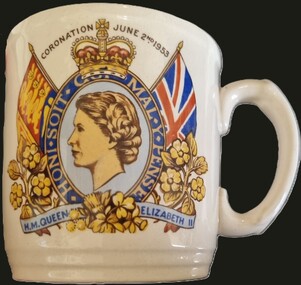
Souvenir - Mug for Coronation of Queen Elizabeth II, 1953
... by The British Pottery Manufacturers Federation and then circulated to approved Potters. ...The British Pottery Manufacturers Federation was founded in 1919 and continued to trade until early 1995 when the company was dissolved as a result of its activities becoming fully incorporated within the British Ceramic Confederation. The design for this mug was approved ...Queen Elizabeth II ascended the throne, at the age of 25, on the death of her father King George VI on the 6th February 1952. Elizabeth was crowned as the Queen of the United Kingdom and the other Commonwealth realms on June 2nd 1953 at Westminster Abbey. Preparations for the coronation took over a year, it was the first British coronation to be fully televised when cameras were allowed inside the Abbey for the first time and the event was estimated to have cost £1.57 million. The British Pottery Manufacturers Federation was founded in 1919 and continued to trade until early 1995 when the company was dissolved as a result of its activities becoming fully incorporated within the British Ceramic Confederation. The design for this mug was approved by The British Pottery Manufacturers Federation and then circulated to approved Potters. This item is significant because it records an important event in the British Royal Family, a vital part of the hereditary of many Wodonga residents. Queen Elizabeth became the official head of the Government of Australia at that time.Cream handled China mug with coloured transfer. The image includes a central oval image of a golden profile of the queen (without a crown) against a light blue background. It is surrounded by a dark blue band with gold edging. To the left is the Royal Standard and to the right is the Union Jack and English roses below. Above the central image is the royal crown and above this wording. At Top CORONATION JUNE 2nd 1953 The Latin wording HONI SOIT QUI MAL Y PENSE, contained in the dark blue oval band is the motto of the British chivalric Order of the Garter which means "shamed be whoever thinks ill of it" Beneath the image - H.M QUEEN ELIZABETH II The base of the mug shows a makers mark of the DESIGN mark.coronation of queen elizabeth ii, british royal family -
 Wodonga & District Historical Society Inc
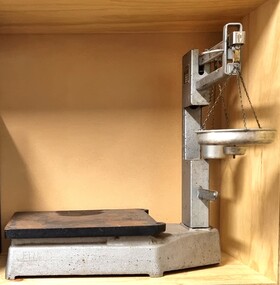
Functional object - Scales - J. Mann & Sons, Mercury Scale Co. Pty. Ltd, c1980
... approved on 13 February 1980. On 25 March 1988 approval to change the business name to A & D Mercury Pty Ltd was granted by the Australian National Standards Commission. J. Mann & Sons Mercury Scales Wodonga Businesses On Manufacturer's ...J. Mann and Sons was first established as a farm produce store in 1921. The range of products was extended in the 1930s and included groceries and hardware, as well as the first petrol bowser in Wodonga outside the store. After WWII, the premises were extended and the range of products continued to increase. In the 1960s the Mann Family opened a new supermarket in Wodonga, in addition to the hardware business, providing steel, plumbing and industrial supplies, and they employed over 100 people at one stage. With changes in the retail industry, the Mann Family sold the main hardware business to Bunnings and the steel and rural produce business to the Kelly brothers in 2006. Mercury Scales was founded in Thebarton, South Australia in 1946. The business experienced rapid growth, leading to its joining with A&D’s global organisation and evolving into A&D Mercury. IN 2023 A&D Weighing is an Australian leader in the supply of electronic weighing scales, balances, metal detectors, checkweighers and weighing systems. This model was approved on 13 February 1980. On 25 March 1988 approval to change the business name to A & D Mercury Pty Ltd was granted by the Australian National Standards Commission. A set of cast iron scales. The measurement on the balance arm is in kilograms. There are 2 trays suspended by chains. bas is fitted with a level indicator and four adjustable feet.On Manufacturer's plate: MERCURY SCALE CO. PTY. LTD. SCALE MANUFACTURERS THEBARTON, S. AUST. INSTRUMENT APPROVAL NUMBERS N.S.C 6/9A/109 M/C No. Q. 760253 CAP 101 kg MODEL No. 211 Cj. mann & sons, mercury scales, wodonga businesses -
 Emerald Museum & Nobelius Heritage Park
Document - Book, Bush House stock book, 1953, Unknown maker, 1950s
... APPROVED BY THE EDUCATION DEPARTMENT' A small, soft-cover stock book for Bush House. The outer covers are made from decorative navy blue and grey paper in a stony pattern. The front cover has a label from the book's manufacturer ...A small, soft-cover stock book for Bush House. The outer covers are made from decorative navy blue and grey paper in a stony pattern. The front cover has a label from the book's manufacturer on it. The book's pages are lined and un-numbered, and the majority of its pages are unused.Label on front cover: 'GORDON / EXERCISE BOOK Name: Stock at Bush House etc Grade: 1953. School:' Below this label, at the bottom of the front cover: 'APPROVED BY THE EDUCATION DEPARTMENT'documents, stock books, financial records
