
Showing 97 items matching "aptitude"
-
 Alfred Hospital Nurses League - Nursing History Collection
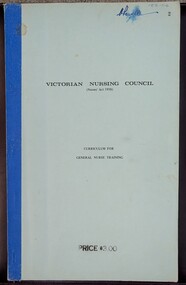
Manual - Curriculum Manual, Victorian Nursing Council, Victorian Nursing Council (Nurses' Act 1958) Curriculum for General Nurse Training, 1971
... The purpose of the curriculum was to help young persons with aptitude for nursing develop that apttude to the maximum, so they are able to perform the functions of newly graduated general nurses, as members of the teh team assisting the medical proffesion in meeting the health needs of the Australian society, and to help the develop develop personally and professionally, so that they may make their maximum contribution to society as individuals, citizans and nurses...The purpose of the curriculum was to help young persons with aptitude for nursing develop that apttude to the maximum, so they are able to perform the functions of newly graduated general nurses, as members of the teh team assisting the medical proffesion in meeting the health needs of the Australian society, and to help the develop develop personally and professionally, so that they may make their maximum contribution to society as individuals, citizans and nurses Of significance to the AHNL, as this curriculum was the basis for hospital training of nurses nurses nursing nurse training - Victoria At top right, previous catalogue number [handwritten in blue ink] N Sewell [handwritten blue ink] '2' [printed in black ink]. ...The purpose of the curriculum was to help young persons with aptitude for nursing develop that apttude to the maximum, so they are able to perform the functions of newly graduated general nurses, as members of the teh team assisting the medical proffesion in meeting the health needs of the Australian society, and to help the develop develop personally and professionally, so that they may make their maximum contribution to society as individuals, citizans and nursesOf significance to the AHNL, as this curriculum was the basis for hospital training of nursesStapled manual with pale blue cover and black print. Darker blue tape covers the staples and spine At top right, previous catalogue number [handwritten in blue ink] N Sewell [handwritten blue ink] '2' [printed in black ink]. At bottom of page 'PRICE $3.00' [stamped in black ink] nurses, nursing, nurse training - victoria -
 Federation University Historical Collection
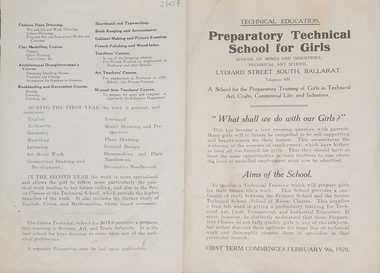
Booklet - Ephemera, Preparatory Technical School of Girls, c1919
... It must, however, be distinctly understood that these Preparatory Classes do not fully qualify girls in any of the subjects, but rather discover their aptitude for some line of technical work and thoroughly prepare the to specialise in that particular branch....It must, however, be distinctly understood that these Preparatory Classes do not fully qualify girls in any of the subjects, but rather discover their aptitude for some line of technical work and thoroughly prepare the to specialise in that particular branch. ...The aims of the School was "To provide a Technical Training which will prepare girls for their future life's work. This school provides a continuity of study between the Primary and Senior Technical School (School of Mines) classes. This supplies a long felt want in giving a preliminary training for Technical Art, Craft, Commercial, and Industrial Education. It must, however, be distinctly understood that these Preparatory Classes do not fully qualify girls in any of the subjects, but rather discover their aptitude for some line of technical work and thoroughly prepare the to specialise in that particular branch.Prospectus for girls technical education at the Ballarat School of Mines and the Ballarat Technical Art Schoolgirls education, ballarat technical girls' school, ballarat school of mines, ballarat technical art school, commercial, leatherwork, photography, ticket witing, wood carving, drawing, metal work, lithography, dressmaking, millinery, industrial design, scholarships, shorthand, typewriting, ceramics, bookbinding, french polishing, wood inlay -
 Federation University Historical Collection
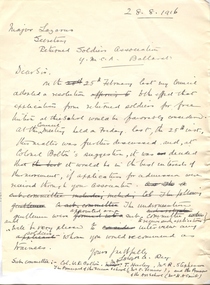
Document, Letter to Returned Soldiers' Association, 1916, 28/08/1916
... Operating from 1917 to 1922, this scheme offered trades-based training to a large number of returned soldiers, depending on aptitude and level of disability. Many returned soldiers were unprepared for the workforce after demobilisation because of war injuries, or lost study opportunity during the years of their service. ...Operating from 1917 to 1922, this scheme offered trades-based training to a large number of returned soldiers, depending on aptitude and level of disability. Many returned soldiers were unprepared for the workforce after demobilisation because of war injuries, or lost study opportunity during the years of their service. ...Ballarat Shool of Mines played an important role in training returned World War One servicemen via the Repatriation Vocational Training Scheme. Operating from 1917 to 1922, this scheme offered trades-based training to a large number of returned soldiers, depending on aptitude and level of disability. Many returned soldiers were unprepared for the workforce after demobilisation because of war injuries, or lost study opportunity during the years of their service. The Scheme was designed to give ex-servicemen the skills to find jobs, boost post-war economic recovery and add to social cohesion. It operated from 1917 to 1922. White paper with handwritten script in ink. The rough draft letter relates to free tuition for returned soldiers at the Ballarat School of Mines28.8.1916 Major Lazarus Secretary Returned Soldiers Association Y.M.C.A. Ballarat Dear Sir. On the 25th February last my Council adopted a resolution to the effect that application from returned soldiers for free tuition at this school would be favorably considered. At the Council meeting held on Friday last, the 25th inst., the matter was further discussed and, at Colonel Bolton's suggestion, it was decided that it would be in the best interests of the movement, if application for admission were received through your association. The undermentioned gentlemen were appointed as a sub-committee to receive such application and will be very pleased to interview any soldiers whom you would recommend as trainees. Yours faithfully Joseph A. Day Sub committee:- Col. W.K. Bolton, Mr T. Hurley. W.R. Stephenson, The Principal of the Science School (Mr E. Fenner), and the Principal of the Art School (Mr H.H. Smith)repatriation, repatriation vocational training scheme, ballarat school of mines, world war, world war 1, bolton, colonel bolton, w.k. bolton, joseph day, t. hurley, r. stephenson, fenner, h.h. smith, returned soldiers, returned soldiers association, balllarat ymca, major lazarus, world war one, repatriation -
 Alfred Hospital Nurses League - Nursing History Collection
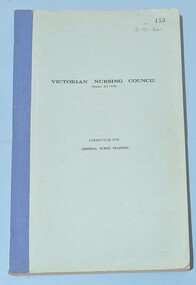
Manual - Curriculum Manual, Victorian Nursing Council, Victorian Nursing Council (Nurses' Act 1958) Curriculum for General Nurse Training, 1971
... The purpose of the curriculum was to help young persons with aptitude for nursing develop that apttude to the maximum, so they are able to perform the functions of newly graduated general nurses, as members of the teh team assisting the medical proffesion in meeting the health needs of the Australian society, and to help the develop develop personally and professionally, so that they may make their maximum contribution to society as individuals, citizans and nurses.The letter dated 19770921 was from the Victorian Nursing Council advising that this curriculum guide was no longer relevant and that Victorian schools of nursing were to develop their own curriculum content within the framework of the Nurses(geraneral nursing) Regulations 1972...The purpose of the curriculum was to help young persons with aptitude for nursing develop that apttude to the maximum, so they are able to perform the functions of newly graduated general nurses, as members of the teh team assisting the medical proffesion in meeting the health needs of the Australian society, and to help the develop develop personally and professionally, so that they may make their maximum contribution to society as individuals, citizans and nurses.The letter dated 19770921 was from the Victorian Nursing Council advising that this curriculum guide was no longer relevant and that Victorian schools of nursing were to develop their own curriculum content within the framework of the Nurses(geraneral nursing) Regulations 1972 Of significance to the AHNL, as this curriculum was the basis for hospital training of nurses nurses nursing nurse training - Victoria nursing education-Victoria Nursing education Victoria-History At top right of front cover the previous catalogue number and 'Box 1'is handwritten in [black ink] On title page 'Audrey Morwick' is handwritten [blue ink] Stapled manual with pale blue cover and black print. ...The purpose of the curriculum was to help young persons with aptitude for nursing develop that apttude to the maximum, so they are able to perform the functions of newly graduated general nurses, as members of the teh team assisting the medical proffesion in meeting the health needs of the Australian society, and to help the develop develop personally and professionally, so that they may make their maximum contribution to society as individuals, citizans and nurses.The letter dated 19770921 was from the Victorian Nursing Council advising that this curriculum guide was no longer relevant and that Victorian schools of nursing were to develop their own curriculum content within the framework of the Nurses(geraneral nursing) Regulations 1972Of significance to the AHNL, as this curriculum was the basis for hospital training of nursesStapled manual with pale blue cover and black print. Darker blue tape covers the staples and spine. Title is printed on front cover along with '153' at top right. A letter has been taped inside the front cover At top right of front cover the previous catalogue number and 'Box 1'is handwritten in [black ink] On title page 'Audrey Morwick' is handwritten [blue ink]nurses, nursing, nurse training - victoria, nursing education-victoria, nursing education victoria-history -
 Moorabbin Air Museum
Book - Pilot training, A Beginners Guide to Flying
... Aptitude...Pilot training Aptitude Costs Checks Engines Direction Flying controls Gyros Height Take off Landing Maps Navigation Private pilot's licence Radio Safety Theory of flight VOR & ADF Weather Overview of steps involved in learning to fly, circa 1969 - 1974 A Beginners Guide to Flying Book Pilot training ...Overview of steps involved in learning to fly, circa 1969 - 1974non-fictionOverview of steps involved in learning to fly, circa 1969 - 1974aptitude, costs, checks, engines, direction, flying controls, gyros, height, take off, landing, maps, navigation, private pilot's licence, radio, safety, theory of flight, vor & adf, weather -
 Ringwood and District Historical Society
Document, Ringwood High School - Form V Provisional Courses for 1968 - To parents of form IV Pupils -Document dated 8. 11. 67
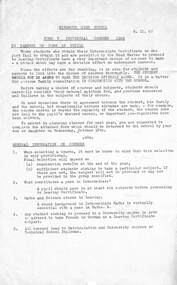
... Students should carefully consider their natural aptitude for, and previous successes and failures in the subjects of their choice. ...Students should carefully consider their natural aptitude for, and previous successes and failures in the subjects of their choice. ...Single sided foolscap typed circular on buff coloured paperNotice to parents of Form IV pupils regarding choices of subjects for the Leaving Certificate - Form V of 1968. The advice includes that the student should not be asked to make the decision entirely alone - It is a matter for serious family consultation in conjunction with the school. Students should carefully consider their natural aptitude for, and previous successes and failures in the subjects of their choice. Sometimes there are serious mistakes made, for example, the course chosen is beyond the capacity of the student, the course does not lead to the pupil's desired career, or important pre-requisites have been omitted. When selecting a course, it must be borne in mind that this selection is only provisional. Final selection will depend on examination results at the end of the year, and if there are sufficient students wishing to take a particular subject. Any student wishing to proceed to a University degree in Arts is advised to take French or German as a Leaving Certificate subject. -
 Northern District School of Nursing. Managed by Bendigo Historical Society Inc.
Booklet - Northern District School of Nursing Prospectus, 1950s
... Application involves submitting forms, certificates, an interview, an aptitude test, and a medical examination. A three-month probationary period follows initial acceptance. ...Application involves submitting forms, certificates, an interview, an aptitude test, and a medical examination. A three-month probationary period follows initial acceptance. ...Managed by a committee including hospital administrators, medical professionals, and nursing leaders from several regional hospitals. Associated with major hospitals in the Northern District, including Bendigo Base, Mildura Base, Castlemaine, Echuca, Swan Hill, St. Arnaud, and Kyneton District Hospitals. Provide high-quality theoretical and practical nursing training. Raise the standard of nursing education in the region. Maintain the highest principles of nursing practice. Applicants must be at least 17 years old and hold a Proficiency Certificate or higher educational qualification. Application involves submitting forms, certificates, an interview, an aptitude test, and a medical examination. A three-month probationary period follows initial acceptance. Preliminary Training School: Four-week introductory course covering basic nursing, anatomy, hygiene, and practical skills. Practical experience in various hospital departments, guided by senior staff. Study Block Plan: Includes several blocks of theoretical and practical instruction throughout the three-year program. Regular school exams and two state exams (First Professional and Final State) are required for progression and graduation. Nurses work a 40-hour week with at least one or two days off per week and three weeks of annual leave. Accommodation is provided in comfortable hostels with good facilities. Uniforms are supplied free; nurses provide their own shoes and stockings. Salaries and allowances are regulated, with deductions for board and free medical care. Additional Information Post-Graduate Opportunities. Senior positions require further experience and additional certificates (e.g., Midwifery, Infant Welfare).Diploma courses available in administration, teaching, and specialized nursing fields. Bursaries are available for advanced study.Career Prospects: Graduates can pursue roles in administration, teaching, ward and departmental leadership, district and visiting nursing, industrial and school nursing, and more. Opportunities exist both within hospitals and in community or specialized settings.FAQs and Practical Details. Minimal training costs (mainly exam fees and personal items).Living out allowances and travel expenses are covered. Four training intakes per year; waiting periods are short if qualifications are met. Northern District School of Nursing Prospectus - An A4 Booklet of 14 pages with a light cardboard cover. Logo on the front cover. Cambridge Press Bendigo. This item contains the following documents: 3791.1a The Prospectus PDF File 3791.1b Front Cover of the Prospectusnurse training, lister house, northern district school of nursing -
 Northern District School of Nursing. Managed by Bendigo Historical Society Inc.
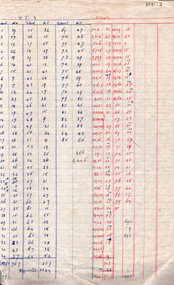
Administrative record - Northern District School of Nursing List of Preliminary Training School, 1950s
... Application involves submitting forms, certificates, an interview, an aptitude test, and a medical examination. A three-month probationary period follows initial acceptance. ...Application involves submitting forms, certificates, an interview, an aptitude test, and a medical examination. A three-month probationary period follows initial acceptance. ...Managed by a committee including hospital administrators, medical professionals, and nursing leaders from several regional hospitals. Associated with major hospitals in the Northern District, including Bendigo Base, Mildura Base, Castlemaine, Echuca, Swan Hill, St. Arnaud, and Kyneton District Hospitals. Provide high-quality theoretical and practical nursing training. Raise the standard of nursing education in the region. Maintain the highest principles of nursing practice. Applicants must be at least 17 years old and hold a Proficiency Certificate or higher educational qualification. Application involves submitting forms, certificates, an interview, an aptitude test, and a medical examination. A three-month probationary period follows initial acceptance. Preliminary Training School: Four-week introductory course covering basic nursing, anatomy, hygiene, and practical skills. Practical experience in various hospital departments, guided by senior staff. Study Block Plan: Includes several blocks of theoretical and practical instruction throughout the three-year program. Regular school exams and two state exams (First Professional and Final State) are required for progression and graduation. Nurses work a 40-hour week with at least one or two days off per week and three weeks of annual leave. Accommodation is provided in comfortable hostels with good facilities. Uniforms are supplied free; nurses provide their own shoes and stockings. Salaries and allowances are regulated, with deductions for board and free medical care. Additional Information Post-Graduate Opportunities. Senior positions require further experience and additional certificates (e.g., Midwifery, Infant Welfare).Diploma courses available in administration, teaching, and specialized nursing fields. Bursaries are available for advanced study.Career Prospects: Graduates can pursue roles in administration, teaching, ward and departmental leadership, district and visiting nursing, industrial and school nursing, and more. Opportunities exist both within hospitals and in community or specialized settings.FAQs and Practical Details. Minimal training costs (mainly exam fees and personal items).Living out allowances and travel expenses are covered. Four training intakes per year; waiting periods are short if qualifications are met.Northern District School of Nursing List of Preliminary Training School numbers per school; list of school numbers and final pass rates. This item contains the following documents: 3791.2a Spreadsheet of PTS Numbers from Schools 1 to 34nurse training, lister house, northern district school of nursing -
Northern District School of Nursing. Managed by Bendigo Historical Society Inc.
Administrative record - Northern District School of Nursing List of Teaching Staff, 1950s-1989
... Application involves submitting forms, certificates, an interview, an aptitude test, and a medical examination. A three-month probationary period follows initial acceptance. ...Application involves submitting forms, certificates, an interview, an aptitude test, and a medical examination. A three-month probationary period follows initial acceptance. ...Managed by a committee including hospital administrators, medical professionals, and nursing leaders from several regional hospitals. Associated with major hospitals in the Northern District, including Bendigo Base, Mildura Base, Castlemaine, Echuca, Swan Hill, St. Arnaud, and Kyneton District Hospitals. Provide high-quality theoretical and practical nursing training. Raise the standard of nursing education in the region. Maintain the highest principles of nursing practice. Applicants must be at least 17 years old and hold a Proficiency Certificate or higher educational qualification. Application involves submitting forms, certificates, an interview, an aptitude test, and a medical examination. A three-month probationary period follows initial acceptance. Preliminary Training School: Four-week introductory course covering basic nursing, anatomy, hygiene, and practical skills. Practical experience in various hospital departments, guided by senior staff. Study Block Plan: Includes several blocks of theoretical and practical instruction throughout the three-year program. Regular school exams and two state exams (First Professional and Final State) are required for progression and graduation. Nurses work a 40-hour week with at least one or two days off per week and three weeks of annual leave. Accommodation is provided in comfortable hostels with good facilities. Uniforms are supplied free; nurses provide their own shoes and stockings. Salaries and allowances are regulated, with deductions for board and free medical care. Additional Information Post-Graduate Opportunities. Senior positions require further experience and additional certificates (e.g., Midwifery, Infant Welfare).Diploma courses available in administration, teaching, and specialized nursing fields. Bursaries are available for advanced study.Career Prospects: Graduates can pursue roles in administration, teaching, ward and departmental leadership, district and visiting nursing, industrial and school nursing, and more. Opportunities exist both within hospitals and in community or specialized settings.FAQs and Practical Details. Minimal training costs (mainly exam fees and personal items).Living out allowances and travel expenses are covered. Four training intakes per year; waiting periods are short if qualifications are met.Northern District School of Nursing List of Teaching Staff - three pages This item contains the following documents: 3791.3a This document is a comprehensive listing of teaching staff and alumni associated with N.D.S.N. It includes the following key points: Lists numerous individuals, specifying their roles such as Deputy Dean, Acting Dean, Graduate, and other teaching or administrative positions. Some entries note if the individual is deceased or has moved to another location or institution. Provides home or work addresses for many staff and alumni, often including street, suburb, and sometimes postal codes.Years of Association. Many entries include years of graduation, employment, or tenure (e.g., 1960-64, 1974-75, 1953-54), indicating the period of their involvement with N.D.S.N.Additional Some entries mention further details such as subsequent career moves (e.g., went to England), university affiliations, or special notes like 'deceased.'Occasional references to related institutions or organizations (e.g., B.C.A.E., Central Gippsland Hospital).Document StructureThe information is organized in a tabular format, grouped by staff and alumni, and sometimes by role or year. 3791.3b Typed copy of above 3791.3c Typed copy of abovenurse training, lister house, northern district school of nursing, teaching staff -
Northern District School of Nursing. Managed by Bendigo Historical Society Inc.
Administrative record - Northern District School of Nursing List of Clerical, Domestic and Maintenance Staff, 1950s-1989
... Application involves submitting forms, certificates, an interview, an aptitude test, and a medical examination. A three-month probationary period follows initial acceptance. ...Application involves submitting forms, certificates, an interview, an aptitude test, and a medical examination. A three-month probationary period follows initial acceptance. ...Managed by a committee including hospital administrators, medical professionals, and nursing leaders from several regional hospitals. Associated with major hospitals in the Northern District, including Bendigo Base, Mildura Base, Castlemaine, Echuca, Swan Hill, St. Arnaud, and Kyneton District Hospitals. Provide high-quality theoretical and practical nursing training. Raise the standard of nursing education in the region. Maintain the highest principles of nursing practice. Applicants must be at least 17 years old and hold a Proficiency Certificate or higher educational qualification. Application involves submitting forms, certificates, an interview, an aptitude test, and a medical examination. A three-month probationary period follows initial acceptance. Preliminary Training School: Four-week introductory course covering basic nursing, anatomy, hygiene, and practical skills. Practical experience in various hospital departments, guided by senior staff. Study Block Plan: Includes several blocks of theoretical and practical instruction throughout the three-year program. Regular school exams and two state exams (First Professional and Final State) are required for progression and graduation. Nurses work a 40-hour week with at least one or two days off per week and three weeks of annual leave. Accommodation is provided in comfortable hostels with good facilities. Uniforms are supplied free; nurses provide their own shoes and stockings. Salaries and allowances are regulated, with deductions for board and free medical care. Additional Information Post-Graduate Opportunities. Senior positions require further experience and additional certificates (e.g., Midwifery, Infant Welfare).Diploma courses available in administration, teaching, and specialized nursing fields. Bursaries are available for advanced study.Career Prospects: Graduates can pursue roles in administration, teaching, ward and departmental leadership, district and visiting nursing, industrial and school nursing, and more. Opportunities exist both within hospitals and in community or specialized settings.FAQs and Practical Details. Minimal training costs (mainly exam fees and personal items).Living out allowances and travel expenses are covered. Four training intakes per year; waiting periods are short if qualifications are met.Northern District School of Nursing List of Clerical Staff - two pages, and List of Domestic and Maintenance Staff, three pages This item contains the following documents: 3791.4a This document is a comprehensive listing of clerical staff and alumni associated with N.D.S.N. The document provides names, addresses, and sometimes additional notes for a large group of people, including both staff and possibly members or affiliates. Many entries include full addresses, indicating the document's use for contact or organizational purposes. Some individuals are identified with specific roles, such as clerical staff, or are listed as being 'C/-N.D.S.N.' There are references to both current and possibly former members (e.g., 'deceased' noted for one individual). Most addresses are located in Bendigo and surrounding areas in Victoria, Australia, indicating a regional focus. 3791.4b This document is a comprehensive roster of domestic and maintenance staff, including both current employees and recent retirees as of early 1989. Staff Listings:Contains names, addresses, and roles of staff members.Includes both domestic (D) and maintenance (M) staff, as well as specialized roles such as night porters (N.P.), residence supervisors (R.S.), cooks, chefs, gardeners, and carpenters. Some entries note if the staff member is retired or deceased. Employment status is indicated (e.g., current, retired, deceased).Some entries include years of service or employment periods.Roles are sometimes abbreviated (e.g., D for Domestic, M for Maintenance, N.P. for Night Porter, H.K. for Housekeeper, Gdnr for Gardener). Most staff entries include home addresses, often with town or suburb and postal codes. Locations are primarily in Bendigo and surrounding areas. Some entries include family relationships or additional notes (e.g., "Like father").Occasional mention of staff studying or having moved to other locations.nurse training, lister house, northern district school of nursing, domestic and maintenance staff, clerical staff -
Northern District School of Nursing. Managed by Bendigo Historical Society Inc.
Administrative record - Northern District School of Nursing List of Students in Preliminary Training Schools (3-8), 1950-51
... Application involves submitting forms, certificates, an interview, an aptitude test, and a medical examination. A three-month probationary period follows initial acceptance. ...Application involves submitting forms, certificates, an interview, an aptitude test, and a medical examination. A three-month probationary period follows initial acceptance. ...Managed by a committee including hospital administrators, medical professionals, and nursing leaders from several regional hospitals. Associated with major hospitals in the Northern District, including Bendigo Base, Mildura Base, Castlemaine, Echuca, Swan Hill, St. Arnaud, and Kyneton District Hospitals. Provide high-quality theoretical and practical nursing training. Raise the standard of nursing education in the region. Maintain the highest principles of nursing practice. Applicants must be at least 17 years old and hold a Proficiency Certificate or higher educational qualification. Application involves submitting forms, certificates, an interview, an aptitude test, and a medical examination. A three-month probationary period follows initial acceptance. Preliminary Training School: Four-week introductory course covering basic nursing, anatomy, hygiene, and practical skills. Practical experience in various hospital departments, guided by senior staff. Study Block Plan: Includes several blocks of theoretical and practical instruction throughout the three-year program. Regular school exams and two state exams (First Professional and Final State) are required for progression and graduation. Nurses work a 40-hour week with at least one or two days off per week and three weeks of annual leave. Accommodation is provided in comfortable hostels with good facilities. Uniforms are supplied free; nurses provide their own shoes and stockings. Salaries and allowances are regulated, with deductions for board and free medical care. Additional Information Post-Graduate Opportunities. Senior positions require further experience and additional certificates (e.g., Midwifery, Infant Welfare).Diploma courses available in administration, teaching, and specialized nursing fields. Bursaries are available for advanced study.Career Prospects: Graduates can pursue roles in administration, teaching, ward and departmental leadership, district and visiting nursing, industrial and school nursing, and more. Opportunities exist both within hospitals and in community or specialized settings.FAQs and Practical Details. Minimal training costs (mainly exam fees and personal items).Living out allowances and travel expenses are covered. Four training intakes per year; waiting periods are short if qualifications are met.Northern District School of Nursing List of Students in Preliminary Training Schools (3-8) - two typed sheets This item contains the following document: 3791.5a This document is a roster listing individuals who attended various Preliminary Training Schools in between 1950 and 1951. The document records names, addresses, and training locations of attendees at several preliminary training schools.Training sessions are organized by date and location, covering multiple periods from July 1950 to July 1951. Sessions are grouped by date ranges. Each session lists the participants, their home addresses, and the training location (e.g., Bendigo, Mildura, Echuca, Castlemaine, Swan Hill). The roster includes a diverse group of individuals, mostly women, from various towns and regions in Victoria and some from Tasmania and New South Wales. Some addresses are marked as unknown or not available. Main training locations include Bendigo, Mildura, Echuca, Castlemaine, Swan Hill, and Castlemaine. Participants often traveled from different towns to attend these sessions.nurse training, lister house, list of students -
Northern District School of Nursing. Managed by Bendigo Historical Society Inc.
Administrative record - Northern District School of Nursing List of Students in Preliminary Training Schools (3-44), 1950-59
... Application involves submitting forms, certificates, an interview, an aptitude test, and a medical examination. A three-month probationary period follows initial acceptance. ...Application involves submitting forms, certificates, an interview, an aptitude test, and a medical examination. A three-month probationary period follows initial acceptance. ...Managed by a committee including hospital administrators, medical professionals, and nursing leaders from several regional hospitals. Associated with major hospitals in the Northern District, including Bendigo Base, Mildura Base, Castlemaine, Echuca, Swan Hill, St. Arnaud, and Kyneton District Hospitals. Provide high-quality theoretical and practical nursing training. Raise the standard of nursing education in the region. Maintain the highest principles of nursing practice. Applicants must be at least 17 years old and hold a Proficiency Certificate or higher educational qualification. Application involves submitting forms, certificates, an interview, an aptitude test, and a medical examination. A three-month probationary period follows initial acceptance. Preliminary Training School: Four-week introductory course covering basic nursing, anatomy, hygiene, and practical skills. Practical experience in various hospital departments, guided by senior staff. Study Block Plan: Includes several blocks of theoretical and practical instruction throughout the three-year program. Regular school exams and two state exams (First Professional and Final State) are required for progression and graduation. Nurses work a 40-hour week with at least one or two days off per week and three weeks of annual leave. Accommodation is provided in comfortable hostels with good facilities. Uniforms are supplied free; nurses provide their own shoes and stockings. Salaries and allowances are regulated, with deductions for board and free medical care. Additional Information Post-Graduate Opportunities. Senior positions require further experience and additional certificates (e.g., Midwifery, Infant Welfare).Diploma courses available in administration, teaching, and specialized nursing fields. Bursaries are available for advanced study.Career Prospects: Graduates can pursue roles in administration, teaching, ward and departmental leadership, district and visiting nursing, industrial and school nursing, and more. Opportunities exist both within hospitals and in community or specialized settings.FAQs and Practical Details. Minimal training costs (mainly exam fees and personal items).Living out allowances and travel expenses are covered. Four training intakes per year; waiting periods are short if qualifications are met.Northern District School of Nursing List of Students in Preliminary Training Schools (3-44) - 17 pages This item contains the following document: 3791.6a This document is a comprehensive record of students' attendance at Preliminary Training Schools from 1950 to 1959. It lists the names, addresses, and training dates for each student, organized by training session. The document serves as an attendance and registration log for students attending Preliminary Training Schools over several years. Each entry typically includes the student's full name, home address, and the location or region of their training. Training sessions are grouped by date, with each session listing all attendees. Covers training sessions from July 1950 through at least late 1959.Sessions are sequentially numbered and dated, showing the progression of training cohorts. The document is structured in tabular format, making it easy to reference individual students and their details. Students come from a wide range of towns and regions, including Bendigo, Mildura, Swan Hill, Castlemaine, Echuca, St. Arnaud, Kyneton, and others. Some addresses are listed as unknown or only partially available, indicating incomplete records for a few students. Some students have updated names (e.g., married names) or additional notes about their address or status. The document reflects the mobility and diversity of students entering training during this period.nurse training, lister house, list of students -
Northern District School of Nursing. Managed by Bendigo Historical Society Inc.
Administrative record - Northern District School of Nursing List of Students in Preliminary Training Schools (45-52), 1960-61
... Application involves submitting forms, certificates, an interview, an aptitude test, and a medical examination. A three-month probationary period follows initial acceptance. ...Application involves submitting forms, certificates, an interview, an aptitude test, and a medical examination. A three-month probationary period follows initial acceptance. ...Managed by a committee including hospital administrators, medical professionals, and nursing leaders from several regional hospitals. Associated with major hospitals in the Northern District, including Bendigo Base, Mildura Base, Castlemaine, Echuca, Swan Hill, St. Arnaud, and Kyneton District Hospitals. Provide high-quality theoretical and practical nursing training. Raise the standard of nursing education in the region. Maintain the highest principles of nursing practice. Applicants must be at least 17 years old and hold a Proficiency Certificate or higher educational qualification. Application involves submitting forms, certificates, an interview, an aptitude test, and a medical examination. A three-month probationary period follows initial acceptance. Preliminary Training School: Four-week introductory course covering basic nursing, anatomy, hygiene, and practical skills. Practical experience in various hospital departments, guided by senior staff. Study Block Plan: Includes several blocks of theoretical and practical instruction throughout the three-year program. Regular school exams and two state exams (First Professional and Final State) are required for progression and graduation. Nurses work a 40-hour week with at least one or two days off per week and three weeks of annual leave. Accommodation is provided in comfortable hostels with good facilities. Uniforms are supplied free; nurses provide their own shoes and stockings. Salaries and allowances are regulated, with deductions for board and free medical care. Additional Information Post-Graduate Opportunities. Senior positions require further experience and additional certificates (e.g., Midwifery, Infant Welfare).Diploma courses available in administration, teaching, and specialized nursing fields. Bursaries are available for advanced study.Career Prospects: Graduates can pursue roles in administration, teaching, ward and departmental leadership, district and visiting nursing, industrial and school nursing, and more. Opportunities exist both within hospitals and in community or specialized settings.FAQs and Practical Details. Minimal training costs (mainly exam fees and personal items).Living out allowances and travel expenses are covered. Four training intakes per year; waiting periods are short if qualifications are met.Northern District School of Nursing List of Students in Preliminary Training Schools (45-52) 3 pages This item contains the following document: 3791.7a This document provides a detailed record of participants in a series of Preliminary Training Schools held between February 1960 and October 1961. Multiple training schools were conducted, each identified by a number (e.g., 45, 46, 47, etc.) and specific dates. Sessions occurred regularly throughout 1960 and 1961. Each entry lists the participant's name, address, and the location or center they were associated with during training (e.g., Mildura, Bendigo, Castlemaine, Echuca, Swan Hill, St. Arnaud).Participants came from various towns and regions, including both urban and rural areas, and occasionally from outside Australia (e.g., Ipoh, Malaysia). Training centers were spread across several locations, with Mildura and Bendigo appearing most frequently as training sites. Other centers included Castlemaine, Echuca, Swan Hill, and St. Arnaud.nurse training, lister house, list of students -
Northern District School of Nursing. Managed by Bendigo Historical Society Inc.
Administrative record - Northern District School of Nursing List of Graduates (School 61-78), 1960s
... Application involves submitting forms, certificates, an interview, an aptitude test, and a medical examination. A three-month probationary period follows initial acceptance. ...Application involves submitting forms, certificates, an interview, an aptitude test, and a medical examination. A three-month probationary period follows initial acceptance. ...Managed by a committee including hospital administrators, medical professionals, and nursing leaders from several regional hospitals. Associated with major hospitals in the Northern District, including Bendigo Base, Mildura Base, Castlemaine, Echuca, Swan Hill, St. Arnaud, and Kyneton District Hospitals. Provide high-quality theoretical and practical nursing training. Raise the standard of nursing education in the region. Maintain the highest principles of nursing practice. Applicants must be at least 17 years old and hold a Proficiency Certificate or higher educational qualification. Application involves submitting forms, certificates, an interview, an aptitude test, and a medical examination. A three-month probationary period follows initial acceptance. Preliminary Training School: Four-week introductory course covering basic nursing, anatomy, hygiene, and practical skills. Practical experience in various hospital departments, guided by senior staff. Study Block Plan: Includes several blocks of theoretical and practical instruction throughout the three-year program. Regular school exams and two state exams (First Professional and Final State) are required for progression and graduation. Nurses work a 40-hour week with at least one or two days off per week and three weeks of annual leave. Accommodation is provided in comfortable hostels with good facilities. Uniforms are supplied free; nurses provide their own shoes and stockings. Salaries and allowances are regulated, with deductions for board and free medical care. Additional Information Post-Graduate Opportunities. Senior positions require further experience and additional certificates (e.g., Midwifery, Infant Welfare).Diploma courses available in administration, teaching, and specialized nursing fields. Bursaries are available for advanced study.Career Prospects: Graduates can pursue roles in administration, teaching, ward and departmental leadership, district and visiting nursing, industrial and school nursing, and more. Opportunities exist both within hospitals and in community or specialized settings.FAQs and Practical Details. Minimal training costs (mainly exam fees and personal items).Living out allowances and travel expenses are covered. Four training intakes per year; waiting periods are short if qualifications are met.Northern District School of Nursing List of Graduates (School 61-78), 15 pages This item contains the following documents: 3791.8a This document provides a list of graduates along with their allocated hospital for Schools 61 to 78 3791.8b This document provides a list of graduates (with married names and details) for school 77 (Contact the BHS for details)nurse training, lister house, list of graduates -
Northern District School of Nursing. Managed by Bendigo Historical Society Inc.
Administrative record - Northern District School of Nursing List of Students (Schools 80-82), 1970s
... Application involves submitting forms, certificates, an interview, an aptitude test, and a medical examination. A three-month probationary period follows initial acceptance. ...Application involves submitting forms, certificates, an interview, an aptitude test, and a medical examination. A three-month probationary period follows initial acceptance. ...Managed by a committee including hospital administrators, medical professionals, and nursing leaders from several regional hospitals. Associated with major hospitals in the Northern District, including Bendigo Base, Mildura Base, Castlemaine, Echuca, Swan Hill, St. Arnaud, and Kyneton District Hospitals. Provide high-quality theoretical and practical nursing training. Raise the standard of nursing education in the region. Maintain the highest principles of nursing practice. Applicants must be at least 17 years old and hold a Proficiency Certificate or higher educational qualification. Application involves submitting forms, certificates, an interview, an aptitude test, and a medical examination. A three-month probationary period follows initial acceptance. Preliminary Training School: Four-week introductory course covering basic nursing, anatomy, hygiene, and practical skills. Practical experience in various hospital departments, guided by senior staff. Study Block Plan: Includes several blocks of theoretical and practical instruction throughout the three-year program. Regular school exams and two state exams (First Professional and Final State) are required for progression and graduation. Nurses work a 40-hour week with at least one or two days off per week and three weeks of annual leave. Accommodation is provided in comfortable hostels with good facilities. Uniforms are supplied free; nurses provide their own shoes and stockings. Salaries and allowances are regulated, with deductions for board and free medical care. Additional Information Post-Graduate Opportunities. Senior positions require further experience and additional certificates (e.g., Midwifery, Infant Welfare).Diploma courses available in administration, teaching, and specialized nursing fields. Bursaries are available for advanced study.Career Prospects: Graduates can pursue roles in administration, teaching, ward and departmental leadership, district and visiting nursing, industrial and school nursing, and more. Opportunities exist both within hospitals and in community or specialized settings.FAQs and Practical Details. Minimal training costs (mainly exam fees and personal items).Living out allowances and travel expenses are covered. Four training intakes per year; waiting periods are short if qualifications are met.Northern District School of Nursing List of Students (Schools 80-82) This item contains the following documents: 3791.10a Hand-written document provides a list of students for Schools 80, 81 and 82. Also a list of students who undertook their School 82 exam in June 1976nurse training, lister house, list of students -
Northern District School of Nursing. Managed by Bendigo Historical Society Inc.
Administrative record - Northern District School of Nursing List of Students Final Exam List for School 83, 1976
... Application involves submitting forms, certificates, an interview, an aptitude test, and a medical examination. A three-month probationary period follows initial acceptance. ...Application involves submitting forms, certificates, an interview, an aptitude test, and a medical examination. A three-month probationary period follows initial acceptance. ...Managed by a committee including hospital administrators, medical professionals, and nursing leaders from several regional hospitals. Associated with major hospitals in the Northern District, including Bendigo Base, Mildura Base, Castlemaine, Echuca, Swan Hill, St. Arnaud, and Kyneton District Hospitals. Provide high-quality theoretical and practical nursing training. Raise the standard of nursing education in the region. Maintain the highest principles of nursing practice. Applicants must be at least 17 years old and hold a Proficiency Certificate or higher educational qualification. Application involves submitting forms, certificates, an interview, an aptitude test, and a medical examination. A three-month probationary period follows initial acceptance. Preliminary Training School: Four-week introductory course covering basic nursing, anatomy, hygiene, and practical skills. Practical experience in various hospital departments, guided by senior staff. Study Block Plan: Includes several blocks of theoretical and practical instruction throughout the three-year program. Regular school exams and two state exams (First Professional and Final State) are required for progression and graduation. Nurses work a 40-hour week with at least one or two days off per week and three weeks of annual leave. Accommodation is provided in comfortable hostels with good facilities. Uniforms are supplied free; nurses provide their own shoes and stockings. Salaries and allowances are regulated, with deductions for board and free medical care. Additional Information Post-Graduate Opportunities. Senior positions require further experience and additional certificates (e.g., Midwifery, Infant Welfare).Diploma courses available in administration, teaching, and specialized nursing fields. Bursaries are available for advanced study.Career Prospects: Graduates can pursue roles in administration, teaching, ward and departmental leadership, district and visiting nursing, industrial and school nursing, and more. Opportunities exist both within hospitals and in community or specialized settings.FAQs and Practical Details. Minimal training costs (mainly exam fees and personal items).Living out allowances and travel expenses are covered. Four training intakes per year; waiting periods are short if qualifications are met.Northern District School of Nursing List of Students Final Exam List for School 83 This item contains the following documents: 3791.11a Typed three page list of students that undertook their School 83 exam in December 1976nurse training, lister house, list of students -
Northern District School of Nursing. Managed by Bendigo Historical Society Inc.
Administrative record - Northern District School of Nursing List of Students for Schools 84 to 85, 1970s
... Application involves submitting forms, certificates, an interview, an aptitude test, and a medical examination. A three-month probationary period follows initial acceptance. ...Application involves submitting forms, certificates, an interview, an aptitude test, and a medical examination. A three-month probationary period follows initial acceptance. ...Managed by a committee including hospital administrators, medical professionals, and nursing leaders from several regional hospitals. Associated with major hospitals in the Northern District, including Bendigo Base, Mildura Base, Castlemaine, Echuca, Swan Hill, St. Arnaud, and Kyneton District Hospitals. Provide high-quality theoretical and practical nursing training. Raise the standard of nursing education in the region. Maintain the highest principles of nursing practice. Applicants must be at least 17 years old and hold a Proficiency Certificate or higher educational qualification. Application involves submitting forms, certificates, an interview, an aptitude test, and a medical examination. A three-month probationary period follows initial acceptance. Preliminary Training School: Four-week introductory course covering basic nursing, anatomy, hygiene, and practical skills. Practical experience in various hospital departments, guided by senior staff. Study Block Plan: Includes several blocks of theoretical and practical instruction throughout the three-year program. Regular school exams and two state exams (First Professional and Final State) are required for progression and graduation. Nurses work a 40-hour week with at least one or two days off per week and three weeks of annual leave. Accommodation is provided in comfortable hostels with good facilities. Uniforms are supplied free; nurses provide their own shoes and stockings. Salaries and allowances are regulated, with deductions for board and free medical care. Additional Information Post-Graduate Opportunities. Senior positions require further experience and additional certificates (e.g., Midwifery, Infant Welfare).Diploma courses available in administration, teaching, and specialized nursing fields. Bursaries are available for advanced study.Career Prospects: Graduates can pursue roles in administration, teaching, ward and departmental leadership, district and visiting nursing, industrial and school nursing, and more. Opportunities exist both within hospitals and in community or specialized settings.FAQs and Practical Details. Minimal training costs (mainly exam fees and personal items).Living out allowances and travel expenses are covered. Four training intakes per year; waiting periods are short if qualifications are met.Northern District School of Nursing List of Students for Schools 84 to 85 (4 pages) This item contains the following documents: 3791.12a Typed and handwritten lists of students from schools 84 to 85nurse training, lister house, list of students -
Northern District School of Nursing. Managed by Bendigo Historical Society Inc.
Administrative record - Northern District School of Nursing List of Students for Schools 86 to 88, 1970s
... Application involves submitting forms, certificates, an interview, an aptitude test, and a medical examination. A three-month probationary period follows initial acceptance. ...Application involves submitting forms, certificates, an interview, an aptitude test, and a medical examination. A three-month probationary period follows initial acceptance. ...Managed by a committee including hospital administrators, medical professionals, and nursing leaders from several regional hospitals. Associated with major hospitals in the Northern District, including Bendigo Base, Mildura Base, Castlemaine, Echuca, Swan Hill, St. Arnaud, and Kyneton District Hospitals. Provide high-quality theoretical and practical nursing training. Raise the standard of nursing education in the region. Maintain the highest principles of nursing practice. Applicants must be at least 17 years old and hold a Proficiency Certificate or higher educational qualification. Application involves submitting forms, certificates, an interview, an aptitude test, and a medical examination. A three-month probationary period follows initial acceptance. Preliminary Training School: Four-week introductory course covering basic nursing, anatomy, hygiene, and practical skills. Practical experience in various hospital departments, guided by senior staff. Study Block Plan: Includes several blocks of theoretical and practical instruction throughout the three-year program. Regular school exams and two state exams (First Professional and Final State) are required for progression and graduation. Nurses work a 40-hour week with at least one or two days off per week and three weeks of annual leave. Accommodation is provided in comfortable hostels with good facilities. Uniforms are supplied free; nurses provide their own shoes and stockings. Salaries and allowances are regulated, with deductions for board and free medical care. Additional Information Post-Graduate Opportunities. Senior positions require further experience and additional certificates (e.g., Midwifery, Infant Welfare).Diploma courses available in administration, teaching, and specialized nursing fields. Bursaries are available for advanced study.Career Prospects: Graduates can pursue roles in administration, teaching, ward and departmental leadership, district and visiting nursing, industrial and school nursing, and more. Opportunities exist both within hospitals and in community or specialized settings.FAQs and Practical Details. Minimal training costs (mainly exam fees and personal items).Living out allowances and travel expenses are covered. Four training intakes per year; waiting periods are short if qualifications are met.Northern District School of Nursing List of Students for Schools 86 to 88 This item contains the following documents: 3791.13a Typed and handwritten lists of students from schools 86 to 88 - Six typed pagesnurse training, lister house, list of students -
Northern District School of Nursing. Managed by Bendigo Historical Society Inc.
Administrative record - Northern District School of Nursing List of Students for Schools 89 to 90, 1970s
... Application involves submitting forms, certificates, an interview, an aptitude test, and a medical examination. A three-month probationary period follows initial acceptance. ...Application involves submitting forms, certificates, an interview, an aptitude test, and a medical examination. A three-month probationary period follows initial acceptance. ...Managed by a committee including hospital administrators, medical professionals, and nursing leaders from several regional hospitals. Associated with major hospitals in the Northern District, including Bendigo Base, Mildura Base, Castlemaine, Echuca, Swan Hill, St. Arnaud, and Kyneton District Hospitals. Provide high-quality theoretical and practical nursing training. Raise the standard of nursing education in the region. Maintain the highest principles of nursing practice. Applicants must be at least 17 years old and hold a Proficiency Certificate or higher educational qualification. Application involves submitting forms, certificates, an interview, an aptitude test, and a medical examination. A three-month probationary period follows initial acceptance. Preliminary Training School: Four-week introductory course covering basic nursing, anatomy, hygiene, and practical skills. Practical experience in various hospital departments, guided by senior staff. Study Block Plan: Includes several blocks of theoretical and practical instruction throughout the three-year program. Regular school exams and two state exams (First Professional and Final State) are required for progression and graduation. Nurses work a 40-hour week with at least one or two days off per week and three weeks of annual leave. Accommodation is provided in comfortable hostels with good facilities. Uniforms are supplied free; nurses provide their own shoes and stockings. Salaries and allowances are regulated, with deductions for board and free medical care. Additional Information Post-Graduate Opportunities. Senior positions require further experience and additional certificates (e.g., Midwifery, Infant Welfare).Diploma courses available in administration, teaching, and specialized nursing fields. Bursaries are available for advanced study.Career Prospects: Graduates can pursue roles in administration, teaching, ward and departmental leadership, district and visiting nursing, industrial and school nursing, and more. Opportunities exist both within hospitals and in community or specialized settings.FAQs and Practical Details. Minimal training costs (mainly exam fees and personal items).Living out allowances and travel expenses are covered. Four training intakes per year; waiting periods are short if qualifications are met.Northern District School of Nursing List of Students for Schools 89 to 90 This item contains the following documents: 3791.14a Typed and handwritten lists of students from schools 89 to 90 - four typed pagesnurse training, lister house, list of students -
 Northern District School of Nursing. Managed by Bendigo Historical Society Inc.
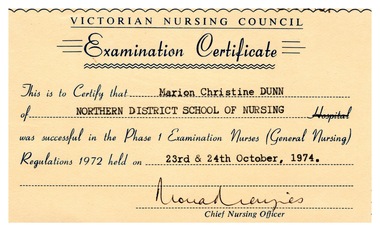
Administrative record - Northern District School of Nursing Progress Report for Nurse M. C. Dunn and other items pertaining to her exams, 1974
... Application involves submitting forms, certificates, an interview, an aptitude test, and a medical examination. A three-month probationary period follows initial acceptance. ...Application involves submitting forms, certificates, an interview, an aptitude test, and a medical examination. A three-month probationary period follows initial acceptance. ...Managed by a committee including hospital administrators, medical professionals, and nursing leaders from several regional hospitals. Associated with major hospitals in the Northern District, including Bendigo Base, Mildura Base, Castlemaine, Echuca, Swan Hill, St. Arnaud, and Kyneton District Hospitals. Provide high-quality theoretical and practical nursing training. Raise the standard of nursing education in the region. Maintain the highest principles of nursing practice. Applicants must be at least 17 years old and hold a Proficiency Certificate or higher educational qualification. Application involves submitting forms, certificates, an interview, an aptitude test, and a medical examination. A three-month probationary period follows initial acceptance. Preliminary Training School: Four-week introductory course covering basic nursing, anatomy, hygiene, and practical skills. Practical experience in various hospital departments, guided by senior staff. Study Block Plan: Includes several blocks of theoretical and practical instruction throughout the three-year program. Regular school exams and two state exams (First Professional and Final State) are required for progression and graduation. Nurses work a 40-hour week with at least one or two days off per week and three weeks of annual leave. Accommodation is provided in comfortable hostels with good facilities. Uniforms are supplied free; nurses provide their own shoes and stockings. Salaries and allowances are regulated, with deductions for board and free medical care. Additional Information Post-Graduate Opportunities. Senior positions require further experience and additional certificates (e.g., Midwifery, Infant Welfare).Diploma courses available in administration, teaching, and specialized nursing fields. Bursaries are available for advanced study.Career Prospects: Graduates can pursue roles in administration, teaching, ward and departmental leadership, district and visiting nursing, industrial and school nursing, and more. Opportunities exist both within hospitals and in community or specialized settings.FAQs and Practical Details. Minimal training costs (mainly exam fees and personal items).Living out allowances and travel expenses are covered. Four training intakes per year; waiting periods are short if qualifications are met.Northern District School of Nursing Progress Report for Nurse M. C. Dunn and other items pertaining to her exams. This item contains the following six documents: 3791.15a This document is a progress examination report for Nurse M.C. Dunn from the Northern District School of Nursing, summarizing her performance in the Phase 1 Progress Examination held in July 1974. Examination Results Outstanding Performance Passed both Anatomy & Physiology and General Nursing with distinction. Eligible to attend the First Year Study Block and required to sit for the First Professional State Examination in October 1974. Chemistry & Physics will be included in the upcoming examination, with no repeat lectures during the study block. Examiner's General Comments: Anatomy & PhysiologyMost questions were well answered, especially on tissue distribution, limb movement, and muscle functions.Areas needing revision: functions of the skin, diagrams (vertebra, kidney, leaf), function of chordae tendinae, factors maintaining venous return, difference between inspired and expired air, and formation/circulation of cerebrospinal fluid. Some gaps in knowledge about blood volume, urea formation, and water contamination. Generally strong answers on patient care, conversions between measurement systems, and infection prevention.Areas for improvement: dilution of lotions, suitable lotions for skin prep, definitions of pH and specific gravity of urine, and details on sterilization (especially destruction of spores). Good understanding of pressure sore prevention, patient bathing, and care of valuables, though some answers lacked detail or used outdated expressions. 3791.15b This document is a formal acceptance letter addressed to Marion from the Northern District School of Nursing. Marion has been accepted into the Preliminary Training School at the Northern District School of Nursing. Medical and Dental ApprovalHer medical and dental certificates have been reviewed and approved. Marion is scheduled to begin training on 4th February. She is expected to attend on Thursday, 31st January, 1974, prior to the official start. 3791.15c The Victorian Nursing Council's examination instructions for nursing candidates 3791.15d Invitation to a dinner to congratulate the 1973 pilot students in their examination successes 3791.15e Signature of Examiner Card Victorian Nursing Council 3791.15f Examination certificate from the Victorian Nursing Councilnurse training, lister house, marion dunn -
Northern District School of Nursing. Managed by Bendigo Historical Society Inc.
Administrative record - Northern District School of Nursing - Song for nurses, 1970s
... Application involves submitting forms, certificates, an interview, an aptitude test, and a medical examination. A three-month probationary period follows initial acceptance. ...Application involves submitting forms, certificates, an interview, an aptitude test, and a medical examination. A three-month probationary period follows initial acceptance. ...Managed by a committee including hospital administrators, medical professionals, and nursing leaders from several regional hospitals. Associated with major hospitals in the Northern District, including Bendigo Base, Mildura Base, Castlemaine, Echuca, Swan Hill, St. Arnaud, and Kyneton District Hospitals. Provide high-quality theoretical and practical nursing training. Raise the standard of nursing education in the region. Maintain the highest principles of nursing practice. Applicants must be at least 17 years old and hold a Proficiency Certificate or higher educational qualification. Application involves submitting forms, certificates, an interview, an aptitude test, and a medical examination. A three-month probationary period follows initial acceptance. Preliminary Training School: Four-week introductory course covering basic nursing, anatomy, hygiene, and practical skills. Practical experience in various hospital departments, guided by senior staff. Study Block Plan: Includes several blocks of theoretical and practical instruction throughout the three-year program. Regular school exams and two state exams (First Professional and Final State) are required for progression and graduation. Nurses work a 40-hour week with at least one or two days off per week and three weeks of annual leave. Accommodation is provided in comfortable hostels with good facilities. Uniforms are supplied free; nurses provide their own shoes and stockings. Salaries and allowances are regulated, with deductions for board and free medical care. Additional Information Post-Graduate Opportunities. Senior positions require further experience and additional certificates (e.g., Midwifery, Infant Welfare).Diploma courses available in administration, teaching, and specialized nursing fields. Bursaries are available for advanced study.Career Prospects: Graduates can pursue roles in administration, teaching, ward and departmental leadership, district and visiting nursing, industrial and school nursing, and more. Opportunities exist both within hospitals and in community or specialized settings.FAQs and Practical Details. Minimal training costs (mainly exam fees and personal items).Living out allowances and travel expenses are covered. Four training intakes per year; waiting periods are short if qualifications are met.Northern District School of Nursing - Song for nurses This item contains the following six documents: 3791.16a Two songs, "Take a Child" by Lynn Carter and "Nobody's Child" by Karen Young - origins unknownnurse training, lister house -
Northern District School of Nursing. Managed by Bendigo Historical Society Inc.
Administrative record - Northern District School of Nursing List of Students in Preliminary Training Schools (53-60), 1960s
... Application involves submitting forms, certificates, an interview, an aptitude test, and a medical examination. A three-month probationary period follows initial acceptance. ...Application involves submitting forms, certificates, an interview, an aptitude test, and a medical examination. A three-month probationary period follows initial acceptance. ...Managed by a committee including hospital administrators, medical professionals, and nursing leaders from several regional hospitals. Associated with major hospitals in the Northern District, including Bendigo Base, Mildura Base, Castlemaine, Echuca, Swan Hill, St. Arnaud, and Kyneton District Hospitals. Provide high-quality theoretical and practical nursing training. Raise the standard of nursing education in the region. Maintain the highest principles of nursing practice. Applicants must be at least 17 years old and hold a Proficiency Certificate or higher educational qualification. Application involves submitting forms, certificates, an interview, an aptitude test, and a medical examination. A three-month probationary period follows initial acceptance. Preliminary Training School: Four-week introductory course covering basic nursing, anatomy, hygiene, and practical skills. Practical experience in various hospital departments, guided by senior staff. Study Block Plan: Includes several blocks of theoretical and practical instruction throughout the three-year program. Regular school exams and two state exams (First Professional and Final State) are required for progression and graduation. Nurses work a 40-hour week with at least one or two days off per week and three weeks of annual leave. Accommodation is provided in comfortable hostels with good facilities. Uniforms are supplied free; nurses provide their own shoes and stockings. Salaries and allowances are regulated, with deductions for board and free medical care. Additional Information Post-Graduate Opportunities. Senior positions require further experience and additional certificates (e.g., Midwifery, Infant Welfare).Diploma courses available in administration, teaching, and specialized nursing fields. Bursaries are available for advanced study.Career Prospects: Graduates can pursue roles in administration, teaching, ward and departmental leadership, district and visiting nursing, industrial and school nursing, and more. Opportunities exist both within hospitals and in community or specialized settings.FAQs and Practical Details. Minimal training costs (mainly exam fees and personal items).Living out allowances and travel expenses are covered. Four training intakes per year; waiting periods are short if qualifications are met.Northern District School of Nursing List of Students in Preliminary Training Schools (53-60) 3 pages This item contains the following document: 3791.17a This document provides a detailed record of participants in a series of Preliminary Training Schools held in the 1960s, Schools 53 to 60. Multiple training schools were conducted, each identified by a number (e.g., 45, 46, 47, etc.) and specific dates. Sessions occurred regularly throughout the 1960s. Each entry lists the participant's name, address, and the location or center they were associated with during training (e.g., Mildura, Bendigo, Castlemaine, Echuca, Swan Hill, St. Arnaud).Participants came from various towns and regions, including both urban and rural areas, and occasionally from outside Australia (e.g., Ipoh, Malaysia). Training centers were spread across several locations, with Mildura and Bendigo appearing most frequently as training sites. Other centers included Castlemaine, Echuca, Swan Hill, and St. Arnaud.nurse training, lister house, list of students -
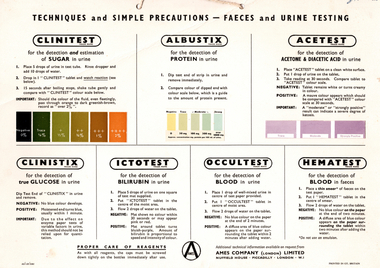 Northern District School of Nursing. Managed by Bendigo Historical Society Inc.
Tool - Northern District School of Nursing Graduates Association - Urine and Faeces Testing Chart, 1950s
... Application involves submitting forms, certificates, an interview, an aptitude test, and a medical examination. A three-month probationary period follows initial acceptance. ...Application involves submitting forms, certificates, an interview, an aptitude test, and a medical examination. A three-month probationary period follows initial acceptance. ...The Northern District School of Nursing in Victoria, Australia Graduates Association: History of the School Managed by a committee including hospital administrators, medical professionals, and nursing leaders from several regional hospitals. Associated with major hospitals in the Northern District, including Bendigo Base, Mildura Base, Castlemaine, Echuca, Swan Hill, St. Arnaud, and Kyneton District Hospitals. Provide high-quality theoretical and practical nursing training. Raise the standard of nursing education in the region. Maintain the highest principles of nursing practice. Applicants must be at least 17 years old and hold a Proficiency Certificate or higher educational qualification. Application involves submitting forms, certificates, an interview, an aptitude test, and a medical examination. A three-month probationary period follows initial acceptance. Preliminary Training School: Four-week introductory course covering basic nursing, anatomy, hygiene, and practical skills. Practical experience in various hospital departments, guided by senior staff. Study Block Plan: Includes several blocks of theoretical and practical instruction throughout the three-year program. Regular school exams and two state exams (First Professional and Final State) are required for progression and graduation. Nurses work a 40-hour week with at least one or two days off per week and three weeks of annual leave. Accommodation is provided in comfortable hostels with good facilities. Uniforms are supplied free; nurses provide their own shoes and stockings. Salaries and allowances are regulated, with deductions for board and free medical care. Additional Information Post-Graduate Opportunities. Senior positions require further experience and additional certificates (e.g., Midwifery, Infant Welfare).Diploma courses available in administration, teaching, and specialized nursing fields. Bursaries are available for advanced study.Career Prospects: Graduates can pursue roles in administration, teaching, ward and departmental leadership, district and visiting nursing, industrial and school nursing, and more. Opportunities existed both within hospitals and in community or specialized settings.FAQs and Practical Details. Minimal training costs (mainly exam fees and personal items).Living out allowances and travel expenses are covered. Four training intakes per year; waiting periods are short if qualifications are met.Northern District School of Nursing Graduates Association - Urine and Faeces Testing Chart - printed in Great Britain by AMES Company (London) Limited This item contains the following document: 3792.10a Northern District School of Nursing Graduates Association - Urine and Faeces Testing Chartnurse training, lister house, history, ames company pty ltd london -
Northern District School of Nursing. Managed by Bendigo Historical Society Inc.
Tool - Northern District School of Nursing Graduates Association - Combistik Urine Test strips, 1950s
... Application involves submitting forms, certificates, an interview, an aptitude test, and a medical examination. A three-month probationary period follows initial acceptance. ...Application involves submitting forms, certificates, an interview, an aptitude test, and a medical examination. A three-month probationary period follows initial acceptance. ...The Northern District School of Nursing in Victoria, Australia Graduates Association: History of the School Managed by a committee including hospital administrators, medical professionals, and nursing leaders from several regional hospitals. Associated with major hospitals in the Northern District, including Bendigo Base, Mildura Base, Castlemaine, Echuca, Swan Hill, St. Arnaud, and Kyneton District Hospitals. Provide high-quality theoretical and practical nursing training. Raise the standard of nursing education in the region. Maintain the highest principles of nursing practice. Applicants must be at least 17 years old and hold a Proficiency Certificate or higher educational qualification. Application involves submitting forms, certificates, an interview, an aptitude test, and a medical examination. A three-month probationary period follows initial acceptance. Preliminary Training School: Four-week introductory course covering basic nursing, anatomy, hygiene, and practical skills. Practical experience in various hospital departments, guided by senior staff. Study Block Plan: Includes several blocks of theoretical and practical instruction throughout the three-year program. Regular school exams and two state exams (First Professional and Final State) are required for progression and graduation. Nurses work a 40-hour week with at least one or two days off per week and three weeks of annual leave. Accommodation is provided in comfortable hostels with good facilities. Uniforms are supplied free; nurses provide their own shoes and stockings. Salaries and allowances are regulated, with deductions for board and free medical care. Additional Information Post-Graduate Opportunities. Senior positions require further experience and additional certificates (e.g., Midwifery, Infant Welfare).Diploma courses available in administration, teaching, and specialized nursing fields. Bursaries are available for advanced study.Career Prospects: Graduates can pursue roles in administration, teaching, ward and departmental leadership, district and visiting nursing, industrial and school nursing, and more. Opportunities existed both within hospitals and in community or specialized settings.FAQs and Practical Details. Minimal training costs (mainly exam fees and personal items).Living out allowances and travel expenses are covered. Four training intakes per year; waiting periods are short if qualifications are met.Northern District School of Nursing Graduates Association - Combistik Urine Test strips - instruction booklet - 4 pages by the Ames Compant 65 Queens Road Melbourne This item contains the following document: 3792.11a Northern District School of Nursing Graduates Association - Combistik Urine Test strips - coloured instruction booklet Here are the key points from the document on Combistix urine test strips: Clinical Importance of UrinalysisUrinalysis is often underestimated but provides valuable diagnostic information.Simple to perform, yet highly informative for detecting urinary and metabolic conditions.Combistix is a combination test strip that rapidly screens for glucose, protein, and pH in urine. The test requires only one dip and 10 seconds to deliver three results, with no need for urine pre-treatment. Suitable for routine hospital urinalysis and large-scale screening, even by non-specialists due to its simplicity. Helps optimize laboratory workflow by allowing ancillary staff to perform basic tests, freeing technologists for more complex tasks. Useful for diagnosing and managing urinary tract infections, metabolic conditions, and monitoring therapy (e.g., sulphonamide therapy, chemotherapy for genito-urinary infections). Glucose: Essential for diabetes screening and management; Combistix is specific for glucose and does not react to lactose, making it reliable during pregnancy. Proteinuria is a key indicator of renal abnormalities, vascular disease, or pre-eclampsia. Its absence is reassuring. The test is sensitive and can be performed accurately by inexperienced users. The strip has three color-coded, reagent-impregnated areas separated by barriers for clear results.Simple procedure: dip, wait 10 seconds, and compare colors to a chart. Packaged in air-tight bottles of 100 strips, available through standard medical supply channels. Combistix offers a fast, reliable, and easy-to-use method for routine urine screening, supporting both clinical diagnosis and efficient laboratory operations.nurse training, lister house, ames company, combistix -
Northern District School of Nursing. Managed by Bendigo Historical Society Inc.
Administrative record - Northern District School of Nursing Graduates Association - Roster list of nurses staff members, 1950s
... Application involves submitting forms, certificates, an interview, an aptitude test, and a medical examination. A three-month probationary period follows initial acceptance. ...Application involves submitting forms, certificates, an interview, an aptitude test, and a medical examination. A three-month probationary period follows initial acceptance. ...The Northern District School of Nursing in Victoria, Australia Graduates Association: History of the School Managed by a committee including hospital administrators, medical professionals, and nursing leaders from several regional hospitals. Associated with major hospitals in the Northern District, including Bendigo Base, Mildura Base, Castlemaine, Echuca, Swan Hill, St. Arnaud, and Kyneton District Hospitals. Provide high-quality theoretical and practical nursing training. Raise the standard of nursing education in the region. Maintain the highest principles of nursing practice. Applicants must be at least 17 years old and hold a Proficiency Certificate or higher educational qualification. Application involves submitting forms, certificates, an interview, an aptitude test, and a medical examination. A three-month probationary period follows initial acceptance. Preliminary Training School: Four-week introductory course covering basic nursing, anatomy, hygiene, and practical skills. Practical experience in various hospital departments, guided by senior staff. Study Block Plan: Includes several blocks of theoretical and practical instruction throughout the three-year program. Regular school exams and two state exams (First Professional and Final State) are required for progression and graduation. Nurses work a 40-hour week with at least one or two days off per week and three weeks of annual leave. Accommodation is provided in comfortable hostels with good facilities. Uniforms are supplied free; nurses provide their own shoes and stockings. Salaries and allowances are regulated, with deductions for board and free medical care. Additional Information Post-Graduate Opportunities. Senior positions require further experience and additional certificates (e.g., Midwifery, Infant Welfare).Diploma courses available in administration, teaching, and specialized nursing fields. Bursaries are available for advanced study.Career Prospects: Graduates can pursue roles in administration, teaching, ward and departmental leadership, district and visiting nursing, industrial and school nursing, and more. Opportunities existed both within hospitals and in community or specialized settings.FAQs and Practical Details. Minimal training costs (mainly exam fees and personal items).Living out allowances and travel expenses are covered. Four training intakes per year; waiting periods are short if qualifications are met.Northern District School of Nursing Graduates Association - Roster list of nurses staff members - 1 typed page This item contains the following document: 3792.12a This document is a roster listing nursing staff members who participated in Staff Nurse Courses (1 to 6). The document serves as a record of individuals enrolled in or associated with a nursing course, likely for training or employment purposes.nurse training, lister house, nursing staff -
Northern District School of Nursing. Managed by Bendigo Historical Society Inc.
Administrative record - Northern District School of Nursing Graduates Association - Certificate and Departure Letter, July 1989
... Application involves submitting forms, certificates, an interview, an aptitude test, and a medical examination. A three-month probationary period follows initial acceptance. ...Application involves submitting forms, certificates, an interview, an aptitude test, and a medical examination. A three-month probationary period follows initial acceptance. ...The Northern District School of Nursing in Victoria, Australia Graduates Association: History of the School Managed by a committee including hospital administrators, medical professionals, and nursing leaders from several regional hospitals. Associated with major hospitals in the Northern District, including Bendigo Base, Mildura Base, Castlemaine, Echuca, Swan Hill, St. Arnaud, and Kyneton District Hospitals. Provide high-quality theoretical and practical nursing training. Raise the standard of nursing education in the region. Maintain the highest principles of nursing practice. Applicants must be at least 17 years old and hold a Proficiency Certificate or higher educational qualification. Application involves submitting forms, certificates, an interview, an aptitude test, and a medical examination. A three-month probationary period follows initial acceptance. Preliminary Training School: Four-week introductory course covering basic nursing, anatomy, hygiene, and practical skills. Practical experience in various hospital departments, guided by senior staff. Study Block Plan: Includes several blocks of theoretical and practical instruction throughout the three-year program. Regular school exams and two state exams (First Professional and Final State) are required for progression and graduation. Nurses work a 40-hour week with at least one or two days off per week and three weeks of annual leave. Accommodation is provided in comfortable hostels with good facilities. Uniforms are supplied free; nurses provide their own shoes and stockings. Salaries and allowances are regulated, with deductions for board and free medical care. Additional Information Post-Graduate Opportunities. Senior positions require further experience and additional certificates (e.g., Midwifery, Infant Welfare).Diploma courses available in administration, teaching, and specialized nursing fields. Bursaries are available for advanced study.Career Prospects: Graduates can pursue roles in administration, teaching, ward and departmental leadership, district and visiting nursing, industrial and school nursing, and more. Opportunities existed both within hospitals and in community or specialized settings.FAQs and Practical Details. Minimal training costs (mainly exam fees and personal items).Living out allowances and travel expenses are covered. Four training intakes per year; waiting periods are short if qualifications are met.Northern District School of Nursing Graduates Association - Certificate and Departure Letter for Alison Pieper who was on the staff March 1950 to July 1989 This item contains the following documents: 3792.13a Certificate of Appreciation for Alison Pieper who was on the staff March 1950 to July 1989 3792.13b Letter re future employment and package details (Contact the BHS for Details)nurse training, lister house, alison pieper -
Northern District School of Nursing. Managed by Bendigo Historical Society Inc.
Administrative record - Northern District School of Nursing Graduates Association - Student Assignments, 1980s
... Application involves submitting forms, certificates, an interview, an aptitude test, and a medical examination. A three-month probationary period follows initial acceptance. ...Application involves submitting forms, certificates, an interview, an aptitude test, and a medical examination. A three-month probationary period follows initial acceptance. ...The Northern District School of Nursing in Victoria, Australia Graduates Association: History of the School Managed by a committee including hospital administrators, medical professionals, and nursing leaders from several regional hospitals. Associated with major hospitals in the Northern District, including Bendigo Base, Mildura Base, Castlemaine, Echuca, Swan Hill, St. Arnaud, and Kyneton District Hospitals. Provide high-quality theoretical and practical nursing training. Raise the standard of nursing education in the region. Maintain the highest principles of nursing practice. Applicants must be at least 17 years old and hold a Proficiency Certificate or higher educational qualification. Application involves submitting forms, certificates, an interview, an aptitude test, and a medical examination. A three-month probationary period follows initial acceptance. Preliminary Training School: Four-week introductory course covering basic nursing, anatomy, hygiene, and practical skills. Practical experience in various hospital departments, guided by senior staff. Study Block Plan: Includes several blocks of theoretical and practical instruction throughout the three-year program. Regular school exams and two state exams (First Professional and Final State) are required for progression and graduation. Nurses work a 40-hour week with at least one or two days off per week and three weeks of annual leave. Accommodation is provided in comfortable hostels with good facilities. Uniforms are supplied free; nurses provide their own shoes and stockings. Salaries and allowances are regulated, with deductions for board and free medical care. Additional Information Post-Graduate Opportunities. Senior positions require further experience and additional certificates (e.g., Midwifery, Infant Welfare).Diploma courses available in administration, teaching, and specialized nursing fields. Bursaries are available for advanced study.Career Prospects: Graduates can pursue roles in administration, teaching, ward and departmental leadership, district and visiting nursing, industrial and school nursing, and more. Opportunities existed both within hospitals and in community or specialized settings.FAQs and Practical Details. Minimal training costs (mainly exam fees and personal items).Living out allowances and travel expenses are covered. Four training intakes per year; waiting periods are short if qualifications are met.Northern District School of Nursing Graduates Association - Student Assignments This item contains the following documents: 3792.14a Assignment for Ophthalmics (Retinal Detachment) by Joan Meggs, School 87 3792.13b Assignment Case Study Opthamo;ogy Central Retinal Arteritis by Vicki thomasnurse training, lister house, assigments, joan meggs, vicki thomas -
Northern District School of Nursing. Managed by Bendigo Historical Society Inc.
Booklet - Northern District School of Nursing Graduates Association - 40th Birthday Reunion, 1990
... Application involves submitting forms, certificates, an interview, an aptitude test, and a medical examination. A three-month probationary period follows initial acceptance. ...Application involves submitting forms, certificates, an interview, an aptitude test, and a medical examination. A three-month probationary period follows initial acceptance. ...The Northern District School of Nursing in Victoria, Australia Graduates Association: History of the School Managed by a committee including hospital administrators, medical professionals, and nursing leaders from several regional hospitals. Associated with major hospitals in the Northern District, including Bendigo Base, Mildura Base, Castlemaine, Echuca, Swan Hill, St. Arnaud, and Kyneton District Hospitals. Provide high-quality theoretical and practical nursing training. Raise the standard of nursing education in the region. Maintain the highest principles of nursing practice. Applicants must be at least 17 years old and hold a Proficiency Certificate or higher educational qualification. Application involves submitting forms, certificates, an interview, an aptitude test, and a medical examination. A three-month probationary period follows initial acceptance. Preliminary Training School: Four-week introductory course covering basic nursing, anatomy, hygiene, and practical skills. Practical experience in various hospital departments, guided by senior staff. Study Block Plan: Includes several blocks of theoretical and practical instruction throughout the three-year program. Regular school exams and two state exams (First Professional and Final State) are required for progression and graduation. Nurses work a 40-hour week with at least one or two days off per week and three weeks of annual leave. Accommodation is provided in comfortable hostels with good facilities. Uniforms are supplied free; nurses provide their own shoes and stockings. Salaries and allowances are regulated, with deductions for board and free medical care. Additional Information Post-Graduate Opportunities. Senior positions require further experience and additional certificates (e.g., Midwifery, Infant Welfare).Diploma courses available in administration, teaching, and specialized nursing fields. Bursaries are available for advanced study.Career Prospects: Graduates can pursue roles in administration, teaching, ward and departmental leadership, district and visiting nursing, industrial and school nursing, and more. Opportunities existed both within hospitals and in community or specialized settings.FAQs and Practical Details. Minimal training costs (mainly exam fees and personal items).Living out allowances and travel expenses are covered. Four training intakes per year; waiting periods are short if qualifications are met.Northern District School of Nursing Graduates Association - 40th Birthday Reunion, National Hotel, Bendigo Sun 20th Oct 1990 This item contains the following documents: 3792.15a Four page A4 booklet with program The reunion took place on Saturday, October 20, 1990, at the National Hotel in Bendigo. The program included socializing, memorabilia displays, photographs, lunch, and a tour of Liseter House. The school began in 1950, with several intakes of students: School 1: March 22, 1950 – 39 studentsSchool 2: June 7, 1950 – 16 studentsSchool 3: July 26, 1950 – 13 studentsSchool 4: September 20, 1950 – 22 students. The document includes recollections of memorable moments, humorous incidents, and traditions from the school's early days (e.g., stories about "bansey water" and memorable quotes from tutors). There is a poem reflecting on the passage of 40 years and the enduring impact of the nursing school experience. Attendees were encouraged to bring and view old albums, photographs, and memorabilia.nurse training, lister house, 40th reunion -
Northern District School of Nursing. Managed by Bendigo Historical Society Inc.
Administrative record - Northern District School of Nursing Graduates Association - Apology Letter for Invitation to unveil Lister House Plaque, 23 April 1995
... Application involves submitting forms, certificates, an interview, an aptitude test, and a medical examination. A three-month probationary period follows initial acceptance. ...Application involves submitting forms, certificates, an interview, an aptitude test, and a medical examination. A three-month probationary period follows initial acceptance. ...The Northern District School of Nursing in Victoria, Australia Graduates Association: History of the School Managed by a committee including hospital administrators, medical professionals, and nursing leaders from several regional hospitals. Associated with major hospitals in the Northern District, including Bendigo Base, Mildura Base, Castlemaine, Echuca, Swan Hill, St. Arnaud, and Kyneton District Hospitals. Provide high-quality theoretical and practical nursing training. Raise the standard of nursing education in the region. Maintain the highest principles of nursing practice. Applicants must be at least 17 years old and hold a Proficiency Certificate or higher educational qualification. Application involves submitting forms, certificates, an interview, an aptitude test, and a medical examination. A three-month probationary period follows initial acceptance. Preliminary Training School: Four-week introductory course covering basic nursing, anatomy, hygiene, and practical skills. Practical experience in various hospital departments, guided by senior staff. Study Block Plan: Includes several blocks of theoretical and practical instruction throughout the three-year program. Regular school exams and two state exams (First Professional and Final State) are required for progression and graduation. Nurses work a 40-hour week with at least one or two days off per week and three weeks of annual leave. Accommodation is provided in comfortable hostels with good facilities. Uniforms are supplied free; nurses provide their own shoes and stockings. Salaries and allowances are regulated, with deductions for board and free medical care. Additional Information Post-Graduate Opportunities. Senior positions require further experience and additional certificates (e.g., Midwifery, Infant Welfare).Diploma courses available in administration, teaching, and specialized nursing fields. Bursaries are available for advanced study.Career Prospects: Graduates can pursue roles in administration, teaching, ward and departmental leadership, district and visiting nursing, industrial and school nursing, and more. Opportunities existed both within hospitals and in community or specialized settings.FAQs and Practical Details. Minimal training costs (mainly exam fees and personal items).Living out allowances and travel expenses are covered. Four training intakes per year; waiting periods are short if qualifications are met.Northern District School of Nursing Graduates Association - Apology Letter for Invitation to unveil Lister House Plaque; from Margot Scott to the Association President Joan O'Shea, 23 April 1995 This item contains the following documents: 3792.16a The hand written letter three page is an apology after being asked to unveil the Lister House plaque; and is critical of the recorded history of the school (Contact BHS for details) 3792.16b Sample of a plaque to be installed at Lister Housenurse training, lister house, lister house plaque, marot scott, joan o'shea -
Northern District School of Nursing. Managed by Bendigo Historical Society Inc.
Administrative record - Northern District School of Nursing Graduates Association - Latrobe University School of Health Sciences Students Award Ceremony, 3rd May 1995
... Application involves submitting forms, certificates, an interview, an aptitude test, and a medical examination. A three-month probationary period follows initial acceptance. ...Application involves submitting forms, certificates, an interview, an aptitude test, and a medical examination. A three-month probationary period follows initial acceptance. ...The Northern District School of Nursing in Victoria, Australia Graduates Association: History of the School Managed by a committee including hospital administrators, medical professionals, and nursing leaders from several regional hospitals. Associated with major hospitals in the Northern District, including Bendigo Base, Mildura Base, Castlemaine, Echuca, Swan Hill, St. Arnaud, and Kyneton District Hospitals. Provide high-quality theoretical and practical nursing training. Raise the standard of nursing education in the region. Maintain the highest principles of nursing practice. Applicants must be at least 17 years old and hold a Proficiency Certificate or higher educational qualification. Application involves submitting forms, certificates, an interview, an aptitude test, and a medical examination. A three-month probationary period follows initial acceptance. Preliminary Training School: Four-week introductory course covering basic nursing, anatomy, hygiene, and practical skills. Practical experience in various hospital departments, guided by senior staff. Study Block Plan: Includes several blocks of theoretical and practical instruction throughout the three-year program. Regular school exams and two state exams (First Professional and Final State) are required for progression and graduation. Nurses work a 40-hour week with at least one or two days off per week and three weeks of annual leave. Accommodation is provided in comfortable hostels with good facilities. Uniforms are supplied free; nurses provide their own shoes and stockings. Salaries and allowances are regulated, with deductions for board and free medical care. Additional Information Post-Graduate Opportunities. Senior positions require further experience and additional certificates (e.g., Midwifery, Infant Welfare).Diploma courses available in administration, teaching, and specialized nursing fields. Bursaries are available for advanced study.Career Prospects: Graduates can pursue roles in administration, teaching, ward and departmental leadership, district and visiting nursing, industrial and school nursing, and more. Opportunities existed both within hospitals and in community or specialized settings.FAQs and Practical Details. Minimal training costs (mainly exam fees and personal items).Living out allowances and travel expenses are covered. Four training intakes per year; waiting periods are short if qualifications are met.Northern District School of Nursing Graduates Association - Latrobe University School of Health Sciences Students Award Ceremony, 3rd May 1995 This item contains the following documents: 3792.17a Northern District School of Nursing Graduates Association - Latrobe University School of Health Sciences Students Award Ceremony program, includes the recipient of the Nursing Graduates Association Award. This document outlines the program for a student awards ceremony recognizing exceptional academic and clinical achievements among nursing students. The ceremony is organized by the School of Health Sciences and held on May 3, 1995.Attendees include award recipients, their families, sponsors, university staff, and special guests. Welcome and introductions by Ms Sue Ronaldson (Head, School of Health Sciences) and Dr Ian MacBean (Acting Dean, La Trobe University, Bendigo). Zonta Club: Heather Winderlich Award ($200): For outstanding academic achievement over three years (Recipient: Belinda Haw). Northern District School of Nursing Graduates Association Award ($100): For outstanding academic achievement in the third year (Recipient: Meagan Tharratt).Australian Medical Association – Bendigo Branch Book Prize ($80): For achievement in clinical nursing and theory (Recipient: Matthew Wall).Royal College of Nursing, Australia One year’s associate membership for outstanding academic and clinical performance (Recipient: Jocelyn Barklem). Mildura Private Hospital Scholarship ($1,000): For outstanding academic and clinical performance in the first and second years (Recipient: Katia Forbes).Bendigo and Region Psychiatric Services ($100 x 2 prizes): For academic performance in psychiatric nursing subjects in the third year (Recipients: Jacoba Hall, Kelly McEncroe).nurse training, lister house, lister house plaque, scholarsips, latrobe university
