


Historical information
The Northern District School of Nursing in Victoria, Australia Graduates Association:
History of the School
Managed by a committee including hospital administrators, medical professionals, and nursing leaders from several regional hospitals. Associated with major hospitals in the Northern District, including Bendigo Base, Mildura Base, Castlemaine, Echuca, Swan Hill, St. Arnaud, and Kyneton District Hospitals.
Provide high-quality theoretical and practical nursing training. Raise the standard of nursing education in the region. Maintain the highest principles of nursing practice. Applicants must be at least 17 years old and hold a Proficiency Certificate or higher educational qualification. Application involves submitting forms, certificates, an interview, an aptitude test, and a medical examination.
A three-month probationary period follows initial acceptance. Preliminary Training School: Four-week introductory course covering basic nursing, anatomy, hygiene, and practical skills. Practical experience in various hospital departments, guided by senior staff. Study Block Plan: Includes several blocks of theoretical and practical instruction throughout the three-year program.
Regular school exams and two state exams (First Professional and Final State) are required for progression and graduation. Nurses work a 40-hour week with at least one or two days off per week and three weeks of annual leave. Accommodation is provided in comfortable hostels with good facilities. Uniforms are supplied free; nurses provide their own shoes and stockings. Salaries and allowances are regulated, with deductions for board and free medical care.
Additional Information Post-Graduate Opportunities. Senior positions require further experience and additional certificates (e.g., Midwifery, Infant Welfare).Diploma courses available in administration, teaching, and specialized nursing fields. Bursaries are available for advanced study.Career Prospects: Graduates can pursue roles in administration, teaching, ward and departmental leadership, district and visiting nursing, industrial and school nursing, and more.
Opportunities existed both within hospitals and in community or specialized settings.FAQs and Practical Details. Minimal training costs (mainly exam fees and personal items).Living out allowances and travel expenses are covered. Four training intakes per year; waiting periods are short if qualifications are met.
Physical description
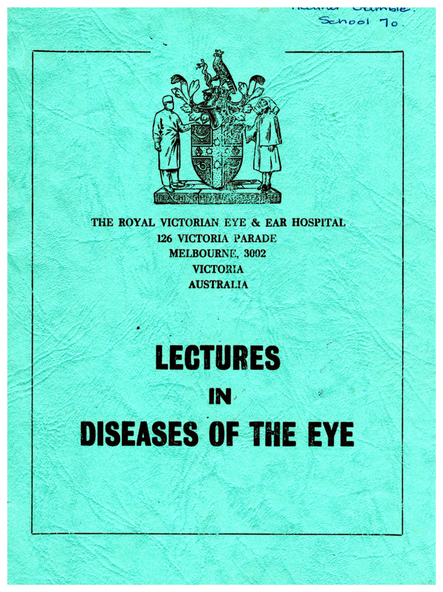
Northern District School of Nursing Graduates Association - Lectures in Diseases of the Eye Revised 1968 39 pages, owned by Heather Gamble School 70
This item contains the following documents:
3793.1a Lectures in Diseases of the Eye Revised 1968
3793.1b Front Cover and Contents Page
This document is a comprehensive educational guide for nurses at The Royal Victorian Eye and Ear Hospital, focusing on eye anatomy, diseases, examination techniques, and ophthalmic nursing practices. Detailed coverage of the orbit, eyeball, fibrous coat, uvea, retina, lids, lacrimal apparatus, and conjunctiva.
Explains the function of extra-ocular muscles and the mechanics of vision. Describes diseases affecting the orbit, cornea, sclera, uvea, retina, lids, lacrimal apparatus, and conjunctiva. Covers errors in the optical properties of the eye and their corrections.Includes information on glaucoma and diseases of the crystalline lens.
Outlines examination techniques for various eye structures.Provides tests for retinal function and assessment of binocular vision.Injuries and Surgical CareDiscusses types of eye injuries, including contusions, penetrating wounds, and burns. Details pre-operative, operative, and post-operative care for intra-ocular operations. Offers guidance on ophthalmic nursing techniques.Lists pharmaceuticals, accessories, instruments, and equipment used in eye surgery.
