
Showing 8 items matching "arm-guard"
-
 Coal Creek Community Park & Museum
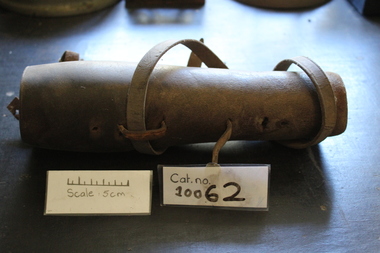
Clothing - Leather Arm Guard
... Leather Arm Guard...arm-guard...Clothing Leather Arm Guard ...Long brown leather object approx 30cm with two thin leather straps and buckles, currently rolled and appearing as a tube. arm-guard, bracer, leather sheath, protective clothing, early sporting equipment -
 Sunshine and District Historical Society Incorporated
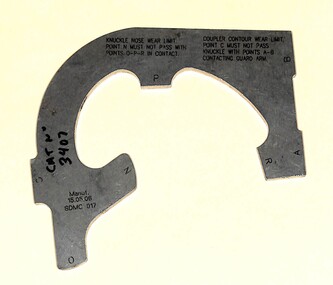
Tool - Knuckle Nose Wear Limit Gauge, 2006
... Knuckle Nose Weat Limit Point N Must Not Pass With Points O-P-RIn Contact Coupler Contour Wear Limit Point C Must Not Pass Knuckle With Points A-B Contacting Guard Arm Manuf. 15.5.06 SDMC 017...Knuckle Nose Weat Limit Point N Must Not Pass With Points O-P-RIn Contact Coupler Contour Wear Limit Point C Must Not Pass Knuckle With Points A-B Contacting Guard Arm Manuf. 15.5.06 SDMC 017 A metal go - no go limit guage Tool Knuckle Nose Wear Limit Gauge ...A metal go - no go limit guage Knuckle Nose Weat Limit Point N Must Not Pass With Points O-P-RIn Contact Coupler Contour Wear Limit Point C Must Not Pass Knuckle With Points A-B Contacting Guard Arm Manuf. 15.5.06 SDMC 017 -
 Tatura Irrigation & Wartime Camps Museum
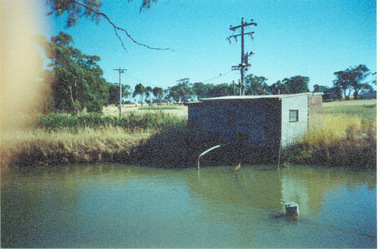
Folio, Camp 3
... guard at Camp 3. Photo taken 2001 by John Wepner of pump which supplied water to Camps 3 & 4 from No. 9 channel. Sketch of canoe made in camp from a sheep drinking trough by the Haering family. "From the Holy Land to the Home of the Kangaroo", by Hedwig Schnerring, translated by Peter Hornung, donor- Guenther Schnerring. "The Long Arm...guard at Camp 3. Photo taken 2001 by John Wepner of pump which supplied water to Camps 3 & 4 from No. 9 channel. Sketch of canoe made in camp from a sheep drinking trough by the Haering family. "From the Holy Land to the Home of the Kangaroo", by Hedwig Schnerring, translated by Peter Hornung, donor- Guenther Schnerring. "The Long Arm ...Material collected and donated Material relating to Camp 3 and the Internees from Palestine. Sketch map of Camp 3 Memorium to Dieter Ruff, former Head of the Temple Society. Photo of steam passenger train at Rushworth Station. Various group photos. Copy of sketch of hut by Winkler. "in the Internment Camp Tatura" by K.M. Pfander Copy of talk given to her former pupils by Gudrun Gollong, in 1978. Poem written in Camp by Annie Lorenz. Poem by unknown writer "Life's Daily Routine" Interview with Babette Kirsch. Copy of children's learning book in German. Photos of toys and craft made for Kaltenbach family. Copy of Kaltenbach barracks by Cesare Vagarini. Story of Wilhelm Kuebler. Photos of wooden boxes made for Sgt. Cubbin. Copy of letter in German confirming the death in Camp of the two Stuerzenhofecker children. Copy of records Theo Stoll. School records Waltraud Doster Copy of Marriage Certificate Vollmer/Zollinger, August 1946. Recollections of Private Ashworth, guard at Camp 3. Photo taken 2001 by John Wepner of pump which supplied water to Camps 3 & 4 from No. 9 channel. Sketch of canoe made in camp from a sheep drinking trough by the Haering family. "From the Holy Land to the Home of the Kangaroo", by Hedwig Schnerring, translated by Peter Hornung, donor- Guenther Schnerring. "The Long Arm of the Third Reich" by Christine Winter. Photocopied extract of Walter Odorich Stenner's diary account of the transportation from Haifa to Australia. Research - Tatura WW2 Internment Camp 3, Annie Leschen Copy of map showing pump sites for water for Camps 3 and 4 Copy (laser) of a painting donated by Frieder Vollmer, artist "D 1943"? Adalbert Stern, Sir Nicholas - Son of Dunera boy "Adalbert Stern Copies of photos (4) of 2 cakes of Lux soap with pictures of "Roll Call, Tatura 1941" on one side and "Lux Toilet Soap" on the other Newspaper Article from "The Age" 14/04/1999 re Vagarini Exhibition Camp 3Tatura Black 3 ring folder with printed matter and photos in plastic sleeves. documents, reports -
 Lakes Entrance Historical Society
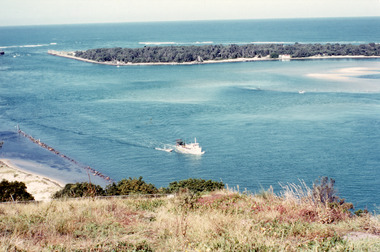
Photograph - The Entrance from Jemmys Point Lakes Entrance c1990, Fraser, Ian
... It shows a fishing boat with scallop dredge moving up the lake opposite the artificial entrance, grassy edge of Jemmy's Point in foreground above highway guard fence, rock groyne at entry to North Arm, sandy shallows at entry to Hopetoun Channel, scrub covered hummocks of south shore and Bass Strait in distance. ...It shows a fishing boat with scallop dredge moving up the lake opposite the artificial entrance, grassy edge of Jemmy's Point in foreground above highway guard fence, rock groyne at entry to North Arm, sandy shallows at entry to Hopetoun Channel, scrub covered hummocks of south shore and Bass Strait in distance. ...Colour photograph of the lake. It shows a fishing boat with scallop dredge moving up the lake opposite the artificial entrance, grassy edge of Jemmy's Point in foreground above highway guard fence, rock groyne at entry to North Arm, sandy shallows at entry to Hopetoun Channel, scrub covered hummocks of south shore and Bass Strait in distance. Lakes Entrance Victoria islands, waterways, topography -
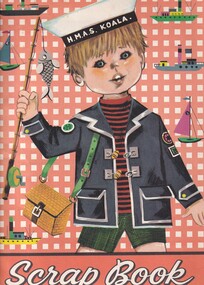 Carlton Football Club
Scrap Book, Dedicated to Carlton Player John Goold
... arm then flinging back and up dramatically. That was the thing about Ragsy (so named because he worked in the clothing, or 'rag' trade), he was always dramatic. He always ensured his ankle guards ...John Goold double Premiership Player A scrap Book dedicated to twice Premiership Player 1968 - 1970 John Goold Career : 1963 - 1970 Debut : Round 7, 1963 vs Footscray, aged 21 years, 338 days Carlton Player No. 754 Games : 108 Goals : 3 Last Game : Grand Final, 1970 vs Collingwood, aged 29 years, 90 days Guernsey No. 11 Height : 184 cm (6 ft ½ in.) Weight : 76 kg (12 stone, 0 lbs.) DOB : June 27, 1941 Premiership Player 1968, 1970 Carlton Hall of Fame All Australian 1966 A brilliant, flamboyant, two-time Premiership player for Carlton during the Barassi years in the ‘swingin’ sixties,’ John William Crosbie Goold became almost as famous for his dapper appearance off the field, as for his exploits on it. At the height of his football career, he was also a prominent ladies fashion designer – which led to him being dubbed ‘Mr Elegance’ by leading football commentator Lou Richards. Supporters and team-mates however, called him ‘Rags’ or ‘Ragsy,’ because of his involvement in the clothing, or ‘rag’ trade. Goold first came under notice as an outstanding junior athlete at Melbourne Grammar School. A true all-round sportsman, he shone at tennis, athletics, football and cricket. He was also a keen horseman who loved the game of polo and the rough and tumble of fox hunting. While at school he was a fervent Melbourne supporter, but strangely, never had much confidence in his football ability. “If I thought I was good enough, I would certainly have gone to Melbourne,” he said many years later. “But I honestly didn’t think I would ever amount to anything in this game. Cricket and tennis were the games that really interested me.’ However, after graduating from MGS, Goold went home to Healesville to star in the Bloods’ 1962 Yarra Valley Football Association Premiership team – an achievement that brought tempting offers from more than one VFL club. “Incentives were offered elsewhere,” he recalled, “but I gravitated to Carlton – partly because the deep blue of their guernsey attracted me, but mostly because of the good advice I got from people who even then were longsighted enough to predict that big things were ahead for this club.” The Blues were confident enough in Goold’s potential to offer him the guernsey number 11 previously worn with distinction by the likes of Jack Hale, Jim Knight, Ron Hines and Laurie Kerr, and his first senior game came in round 7, 1963 against Footscray at the Western Oval. He played on a half-forward flank alongside Brownlow Medallists Gordon Collis and John James on that Saturday afternoon, and kicked his first career goal in an 8-point win. Little did he know though, that it would be another six seasons before he would again experience the thrill of sending a football spinning between the big posts, because his future lay in defence. By his own admission, Goold struggled to find his feet in VFL football during his first two seasons, until the shock appointment of Ron Barassi as captain-coach of Carlton in 1965 began steering his career back on track. “I think you could say that 1965 was my first year of League football,” he said, “That’s the way I felt - that’s the way I reacted to Barassi.” Under Barassi, Goold rapidly developed into a superb running half-back flanker. Tenacious, and an often freakish high mark, he was unmistakable on the field thanks to his mane of dark hair, his loping running style and somewhat awkward kicking action. Furthermore, he had boundless courage. There is no doubt that he would have played many more games had he not been regularly pole-axed under the high ball – a fact he later freely admitted. “I was always getting knocked out,” he said, “and spent half my bloody time in hospital.” In the second half of 1965, an injury to centre half-back Gordon Collis forced Barassi to use Goold in the key defensive post. While it curtailed his rebounding instincts somewhat, ‘Ragsy’ rose to the challenge and rarely lowered his colours. Testament to his improvement, he finished third behind John Nicholls and Sergio Silvagni in Carlton’s 1965 Best and Fairest award, and followed up by being selected in the Victorian team for the 1966 Hobart Carnival. There, he had a superb series in which he was runner-up to West Australian Barry Cable in voting for the Tassie Medal, and capped it off by being named on a half-back flank in the All Australian team. Barassi’s influence at Carlton bore fruit in his third year, when the Blues returned to finals football at last. Richmond, Carlton, Geelong and Collingwood fought out the 1967 Premiership, and Ragsy Goold won the hearts of the Carlton faithful with two lion-hearted performances. Although Carlton was knocked out of contention by successive losses to Richmond and Geelong, Goold was tireless throughout both games, and it was obvious that he thrived on the added pressure of finals football. Precisely twelve months later, the bitter taste of those defeats was washed away when Barassi’s Blues edged out Essendon by 3 points in the 1968 Grand Final, and ended 21 years of despair at Princes Park. To win Carlton’s ninth VFL flag, the Blues had had to defeat the minor premier Bombers twice during the finals – and did so, thanks to a watertight defence led by Goold, and a dominant ruck division headed by John Nicholls. In round 5, 1969, Carlton hosted South Melbourne at Princes Park in a match significant for a number of reasons. As he regularly did, Ron Barassi swung his team around prior to the opening bounce, and Goold found himself in the unaccustomed role of ruck-rover. While the Blues set about establishing a good break on the scoreboard, Ragsy relished the freedom to kick two first half goals - his first majors for 78 games. Just before half-time however, he was flattened in a pack, concussed again, and replaced during the long break by Barry Gill. Alex Jesaulenko was substituted at the same time – by a shy, ambitious youngster named Bruce Doull, making his senior debut for Carlton in guernsey number 4. In September, 1969 the Navy Blues began their third straight finals campaign with an impressive 6-goal Semi Final win over Collingwood in front of more than 108,000 fans at the MCG. A fortnight later, Richmond stunned the flag favourites with a withering last quarter in the Grand Final, and knocked Carlton out of the Premiership race again at the last hurdle. Half-way through the year, Carlton's club doctor discovered that Goold had been playing with shin splints in both of his lower legs. The pain they caused was considerable, but Ragsy soldiered on and held down centre half-back throughout the season. John Goold’s VFL career at Carlton culminated in the fabled 1970 Grand Final triumph over Collingwood. What is not so well known is that Ragsy was only cleared to play in that game on the morning of the match. After narrowly losing to Collingwood in the second Semi Final, the Navy Blues destroyed St Kilda by 62 points in the Preliminary Final, and earned another shot at the Magpies in the decider. But one of Carlton’s problems was that Goold had been kicked on a shin against St Kilda, causing a burst blood vessel and serious swelling. Despite the best efforts of the club medical staff, Ragsy had only a slim chance of playing in the Grand Final right up until game day, when his worried coach reluctantly allowed him to take his place in the side. Later, Barassi justified his decision by saying that in his opinion, a less than fully fit Goold was still worth his place in the team. By half time in the Grand Final however, he was probably questioning that judgement - because Carlton had been totally outplayed, and trailed an impressive, cohesive Collingwood by 44 points. Therefore, Carlton’s magnificent comeback – orchestrated by Barassi, and sparked by the fairytale exploits of 19th man Ted Hopkins – is one of the greatest of all football stories. Against enormous odds, the Navy Blues fought their way back into the contest, and eventually, rolled over the top of the frantic Magpies to snatch victory by 10 points in the last few minutes of the match. Hopkins ended up with four goals, Barassi was hailed a genius, and Ragsy Goold was carted off to hospital immediately after the game to have further urgent treatment. While there, he decided that there was no better time to end his VFL career – especially because his burgeoning business interests were demanding more and more of his time. In the years after his football career ended, John Goold created a remarkably successful business empire. In 1971 he sold his fashion label and took up farming at Mortlake in western Victoria, where he coached the local football team for three seasons. Later, he formed a diversified pastoral company, and purchased a magnificent complex called Ballangeich Run at nearby Ellerslie. While his passion for farming and livestock grew, he began breeding top quality polo ponies, and represented Australia in international competition. During the 1997 and 1998 seasons, John's son Ed Goold played reserve grade football for Carlton. MEMORIES.... Ragsy Goold; the name stirs memories form my long ago childhood. Ragsy, with his unique kicking style, where he'd hold the ball (always a drop punt - in a time when the drop kick and the torpedo punt still reigned supreme) at the point of the ball, elbows bent and he'd lavishly drop the ball, his right arm then flinging back and up dramatically. That was the thing about Ragsy (so named because he worked in the clothing, or 'rag' trade), he was always dramatic. He always ensured his ankle guards and wrist guard were glowing white to match the great white CFC monogram he wore proudly on his chest, and with his long flowing locks, cut a dynamic figure through a young boy's mind. Ragsy was my idol. I loved his dashes from half back, his long accurate drop punts, most of all I loved his flair for the game. Ragsy played the game as an entertainer as well as a sportsman - he leapt high to punch or mark, and always seemed to have a bit of the thoroughbred about him - which is probably why after he retired, he took up fox chasing, polo, and riding his beloved thoroughbreds across the paddocks and over the fences of his property, I think he may have even represented Australia at the sport – really, that’s sort of how he played as a footballer. All sinewy muscle, long legs and famous leaps for the saving punch. Ragsy was part of the great backline that helped revive Carlton's fortunes. Legendary players Wes Lofts, Ian Collins, Kevin 'Racehorse' Hall, Vinnie Waite among them. All great teams have a great defence and the defence that Ragsy was an integral part of was no different. Where others provided the biffo, the muscle or the defensive pressure, Ragsy provided the dash, the flair, the sense of adventure that all great backlines must have. AND MORE.... I have had many favourite players while following the Blues, but there will always be a special spot for Ragsy Goold - running the lines, all long hair and flashing white guards. As a young man I moved to Carlton and began acting in a place called one-c-one. One night after a play, I was walking home. It was winter, and I was wearing my favouritte overcoat, a genuine ankle length tweed affair I had picked up in an Op Shop in Oakleigh for three dollars. As I strutted across Lygon Street, a deep male voice behind me called, 'hey laddie, how much for the overcoat?' I turned, and there was my childhood idol, Ragsy Goold, two beautiful women in tow, smiling and waiting for my answer. I loved that coat too much to part with it, even to Ragsy, so I shook my head - and he smiled, then walked off. I stood for a moment in the middle of the street shaking my head in disbelief. Ragsy bloody Goold had just offered to buy my overcoat! I knew at that point, as a young man of about twenty three, that life was going to be full of surprises and very entertaining - a bit like John ‘Ragsy’ Goold. ONE MORE.... A cold, wet day in the mid 1960's at the MCG and Victoria were playing South Australia (?) The ball that day was like a piece of soap, with players finding it impossible to mark. Just before half time a long kick sailed toward the mud heap that was the centre of the ground, and the pack rose to meet it. From this group of players an arm shot straight up, and the ball instantly came to a dead stop. The footy stuck in the player's palm as if the hand was coated in Tarzan's Grip. After all these years, it's the only recollection I have of that match, and that player was 'Mr. Elegance' John Goold. HUMOROUS HUNGRY.... Former opponent Richmond's Kevin Bartlett on Radio SEN in 2012 received a phone call from John. After the call Kevin told his listeners how "Mr Elegance" would always be dressed in a nice suit, shirt-tie and highly polished shoes. He then cracked a joke saying something like; "You know, John was so 'posh' that he used to play football wearing a cravat!" Milestones 50 Games: Round 15, 1967 vs Melbourne 100 Games: Round 13, 1970 vs Geelong Career Highlights 1965 - Percy Bentley Trophy - 3rd Best & Fairest 1966 - 5th Best & Fairest 1967 - Maurie Sankey Memorial Trophy - 4th Best & Fairest (on count back) 1968 - Premiership Player 1970 - 7th Best & Fairest 1970 - Premiership Player Foolscap Scrap Book -
 Royal District Nursing Service (now known as Bolton Clarke)
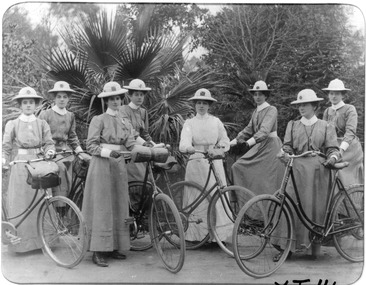
Photograph - Photograph, sepia, 1907
... At the bottom of the V of the frame a pedal is attached with a rotating arm on either side of the bicycle and on the right side the rotating arm is attached to a sprocket which has a chain running around it back to a smaller sprocket on the hub of the back wheel. The chain has a thin metal guard...At the bottom of the V of the frame a pedal is attached with a rotating arm on either side of the bicycle and on the right side the rotating arm is attached to a sprocket which has a chain running around it back to a smaller sprocket on the hub of the back wheel. The chain has a thin metal guard ...This photograph depicts the Sister-in-charge with a group of Melbourne District Nursing Society (MDNS,) Trained nurses, 'Nurses", with their bicycles, which were the first mode of transport purchased by MDNS in 1903. The bicycles enabled their Nurses to visit more patients over a wider area. They are identified as: L-R back row: Trained Nurses Taylor, Steele, Francis, Young. L-R front row: Isobel Curnow, Annie Roberts, Isabel Hawkes (Sister in Charge), Becker. Their uniforms were a grey cotton dress with white collar, cuffs and belt and their was a red Maltese cross on their pith helmets. They gave nursing care to the poor in the inner Melbourne and close surrounding areas (districts). On the 17th of February 1885, just 50 years after Melbourne was founded, a preliminary meeting of ladies and gentlemen who were anxious to form a society to provide "skilled nursing" for the sick poor in their own homes was held in Mrs William McCulloch’s home at Spring Street, Melbourne. At this meeting it was decided “that the association would be called the Melbourne District Nursing Society”, the first Society of its kind in Australia, and “that the special object of the Society shall be to secure skilled nursing for the sick poor in their own homes”. On the 16th of March a Committee was formed to “arrange for engaging one "duly qualified nurse”. On the 1st of May 1885 a Nurse, Mrs. Ferguson, was employed at £100 per annum, and a second Nurse, Mrs. Joanne Cannon, commenced six months later. In that era the term ‘Nurse’ was used even though they were ‘qualified’ i.e. ‘trained’ nurses. They worked in the now CBD, ie from Spencer Street to Spring Street and from Victoria Parade to Flinders Street. From its inception the Society was at the forefront of health care. They provided high quality Trained nursing care; educated their patients in the curing and prevention of disease; teaching the importance of cleanliness, fresh air and good nutrition, both by verbal instruction and demonstration, even supplying soup and milk when needed, as well as providing wood and coal in the winter. At that time they walked the streets and lane ways amid the slums of inner Melbourne carrying their nursing bag containing lotion, ointments, powders, liniment, bandages, dressings, a case of spirits, and the Nurse's own clean apron, soap and small towel. They supplied equipment on loan, such as earthenware hot water bottles, splints, urinals, bed pans, bed cradles, feeding mugs, and air-cushions as well as providing blankets and clean bed linen, and nightdresses as necessary. Trained midwives began home births in late 1893 taking midwifery bundles and providing clothes for the babe and mother as needed. As the work increased a third Trained nurse was employed but this was arduous work, particularly in the heat of summer and many Nurses only remained with the Society for several months. Permission to use bicycles was given to the Nurses in 1898 and the Society decided to purchase their own in 1903. A business man offered ‘new free wheel’ bicycles at £13 each which included maintenance for one year. Bells and wooden frames were added, at a cost of £5 per frame, so the Nurses could carry extra equipment. Nurses’ bags were strapped to the handlebars. Soup was made for those in need 2-3 times a week and if patients could not arrange to have it collected the soup was delivered by the Nurses on their bicycles. The use of bicycles caused a change in uniform, with white pith helmets, and veils covering them and tied under their chin, now being used. They provided high quality nursing care to a range of people, often in destitute situations, some lying on rags on the floor as they had no bed, others with just a bed and maybe a thin blanket, a chair and nothing else. Their ages ranged from babes, children, adults to the elderly. The Nurses gave medications as ordered by a Doctor, dressed wounds e.g. to the injured, and surgical cases, and to those with leg ulcers; attended to patients with ‘surgical ailments’ such as ‘hip disease’; gave care to those with acute illnesses such as bronchitis, pleurisy, pneumonia, measles, and scarlet fever, as well as those with chronic illnesses such as consumption (tuberculosis), heart disease, arthritis, cancer, debility, neuritis and paralysis. In 1913 a Nurse had her Board and residence, uniforms, bicycles and laundry expensive provided and was paid £50 a year for her first six months. At the end of a year her salary is increased by £5, and later she earns £60 a year. Over the years the nurses complained that their veils became wet in the rain and asked for a change of uniform but this did not occur until 1921. Bicycles continued to be used in inner areas until 1945. Sepia photograph of eight Melbourne District Nursing Society Trained nurses posing with their bicycles in a park; some are partly hidden. Nurse's uniforms consist of long grey dresses with white belts, cuffs and collars and white pith helmets with a Maltese cross in the centre. Oblong leather nursing bags of varying sizes are strapped to five of the bicycles. In the centre is Sister-in-charge – Mrs Hawkes (in white); to her left are 4 Nurses and to her right 3. L-R – Front row – Trained Nurses Curnow, Roberts, (Hawkes) and Becker. Back row – Nurses Taylor, Steele, Francis and Young. Trees and a palm are in the background. The bicycles have two large wire spoked wheels at either end of the black V shape bicycle frame; a rubber tyre runs around the outside of each wheel. The metal handlebars are a horizontal configuration and are attached with a central column into a black vertical column at the front of the V shape bicycle frame which has ‘fork shaped’ thin metal pierces running down either side of the wheel attaching the frame to the central hub of the wheel. The rear wheel is attached the same way to a central column at the rear of the frame which runs up to V shape solid seat. At the bottom of the V of the frame a pedal is attached with a rotating arm on either side of the bicycle and on the right side the rotating arm is attached to a sprocket which has a chain running around it back to a smaller sprocket on the hub of the back wheel. The chain has a thin metal guard over it. There are narrow thin metal mud guards running a short distance above the top of each wheel. melbourne district nursing society (1885-1957), bicycles, nurses, uniforms, mdns, mdns transport, rdns, royal district nursing service, trained nurse annie roberts, sister-in-charge isabel hawkes, trained nurse taylor, trained nurse steele, trained nurse francis, trained nurse young, trained nurse becker, trained nurse isobel curnow -
 Royal District Nursing Service (now known as Bolton Clarke)
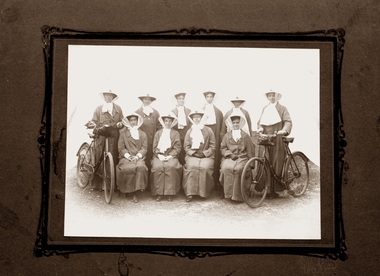
Photograph - Photograph, sepia, 1916
... At the bottom of the V of the frame a pedal is attached with a rotating arm on either side of the bicycle and on the right side the rotating arm is attached to a sprocket which has a chain running around it back to a smaller sprocket on the hub of the back wheel. The chain has a thin metal guard...At the bottom of the V of the frame a pedal is attached with a rotating arm on either side of the bicycle and on the right side the rotating arm is attached to a sprocket which has a chain running around it back to a smaller sprocket on the hub of the back wheel. The chain has a thin metal guard ...Matron Freeman and the MDNS Trained Nurses are wearing long grey coats and white pith helmets, which display a red Maltese cross.The Pith helmets are held on with a white veil. The two Bicycles with nursing bags attached to handlebars show the transport used by MDNS at that time.. Nurses - Back - L-R - O'Sullivan, Deans, Warren, Amess, Pat Lee and Jane with bicycle Front - L-R - Blanche Wilson, Matron Janie Freeman, Peake and Brown. In February 1885, 50 years after Melbourne was founded, it was recognized that nursing care was needed for the sick poor in inner Melbourne. The Melbourne District Nursing Society (MDNS) was founded with one Trained nurse (Nurse), and a second employed six months later. This was the first such service in Australia. They worked in the now CBD, ie from Spencer Street to Spring Street and from Victoria Parade to Flinders Street. From its inception the Society was at the forefront of health care. They provided high quality nursing care; educated their patients in the curing and prevention of disease; teaching the importance of cleanliness and good nutrition, both by verbal instruction and demonstration, even supplying soup and milk when needed. At that time they walked the streets and lane ways amid the slums of inner Melbourne carrying their nursing bag containing lotion ointments, powders, liniment, bandages, dressings, a case of spirits, and the Nurse's own clean apron. They loaned equipment, such as earthenware hot water bottles, splints, urinals, bed pans, bed cradles, feeding mugs, and air-cushions as well as providing clean bed linen and nightdresses as necessary. Trained Midwives began home births in August 1893 taking midwifery bundles and providing clothes for the babe as needed. This was arduous work, particularly in the heat of summer. Permission to use bicycles was given to the Nurses in 1898 and the Society decided to purchase their own in 1903. A business man offered ‘new free wheel’ bicycles at £13 each which included maintenance for one year. Bells and wooden frames were added, at a cost of £5 per frame, so the Nurses could carry extra equipment. Nurses’ bags were strapped to the handlebars. Soup was made for those in need 2-3 times a week and if patients could not arrange to have it collected the soup was delivered by the Nurses on their bicycles. The use of bicycles caused a change in uniform, with white pith helmets, and veils covering them and tied under their chin, now being used. In 1913 a Nurse had her Board and residence, uniforms, bicycles and laundry expensive provided and was paid £50 a year for her first six months. At the end of a year her salary is increased by £5, and later she earned £60 a year. Over the years the Nurses complained their veils became wet in the rain and asked for a change of uniform but this did not occur until 1921. Bicycles continued to be used in inner areas until 1945. From its inception the Society was at the forefront of health care and liaised with Doctors. They provided high quality nursing care to a range of people, often in destitute situations, some lying on rags on the floor as they had no bed, others with just a bed and maybe a thin blanket, a chair and nothing else. Their ages ranged from babes, children, adults to the elderly. The Nurses gave medications as ordered, dressed wounds e.g. to the injured, and surgical cases, and to those with leg ulcers; attended to patients with ‘surgical ailments’ such as ‘hip disease’; gave care to those with acute illnesses such as bronchitis, pleurisy, pneumonia, measles, and scarlet fever, as well as those with chronic illnesses such as consumption (tuberculosis), heart disease, arthritis, cancer, debility, neuritis and paralysis. They educated their patients, and their Carers, in the curing and prevention of disease; teaching the importance of hygiene, cleanliness, ventilation and good nutrition. They taught them, by verbal instruction and demonstration, how to make poultices, to make and apply bandages, apply medical appliances such as splints. Sepia photograph on brown card mount with 'Kirk Studio' on bottom right of the card. The photograph shows Matron Freeman and nine Melbourne District Nursing Society (MDNS) Trained nurses, (Nurses), with bicycles. The back row of six Nurses are standing and the Nurses either end are holding bicycles which have leather oblong nursing bags attached to the handlebars with two straps. The front row are seated. All are wearing the MDNS uniform of long dark coats and white helmets, with white scarves covering them and tied under their chins. A Maltese cross can be seen in the centre of the helmets. Both bicycles have two large wire spoked wheels at either end of the black V shape bicycle frame; a rubber tyre runs around the outside of each wheel. The metal handlebars are a horizontal configuration and are attached with a central column into a black vertical column at the front of the V shape bicycle frame which has 'fork shaped' thin metal pierces running down either side of the wheel attaching the frame to the central hub of the wheel. The rear wheel is attached the same way to a central column at the rear of the frame which runs up to V shape solid seat. At the bottom of the V of the frame a pedal is attached with a rotating arm on either side of the bicycle and on the right side the rotating arm is attached to a sprocket which has a chain running around it back to a smaller sprocket on the hub of the back wheel. The chain has a thin metal guard over it. There are narrow thin metal mud guards running a short distance above the top of each wheel. Photographer's embossed stamp mdns, melbourne district nursing society, mdns uniforms, mdns transport, mdns matron, rdns, royal district nursing service, nurse blanche wilson, nurse pat lee, nurse deans, nurse o'sullivan, nurse warren, nurse amess, nurse peak, nurse brown, matron janie freeman -
 Royal District Nursing Service (now known as Bolton Clarke)
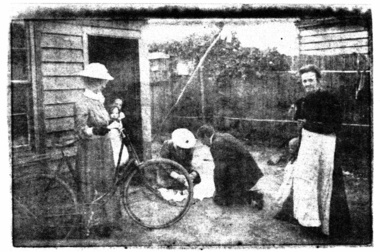
Photograph - Photograph, black and white, c.1905
... At the bottom of the V of the frame a pedal is attached with a rotating arm on either side of the bicycle and on the right side the rotating arm is attached to a sprocket which has a chain running around it back to a smaller sprocket on the hub of the back wheel. The chain has a thin metal guard...At the bottom of the V of the frame a pedal is attached with a rotating arm on either side of the bicycle and on the right side the rotating arm is attached to a sprocket which has a chain running around it back to a smaller sprocket on the hub of the back wheel. The chain has a thin metal guard ...This photograph shows Melbourne District Nursing Society (MDNS) Trained Nurses (known as 'Nurse' in those days) attending to a family in the early 1900s. It also shows their uniform which had a red Maltese cross in the centre of the pith helmet. The bicycle seen is the first mode of transport purchased by MDNS in 1903. The Nurse's bag is seen strapped to the handles of the bicycle. In February 1885, 50 years after Melbourne was founded, it was recognized that nursing care was needed for the sick poor in inner Melbourne. The Melbourne District Nursing Society (MDNS), the first District Nursing Society in Australia, was founded and the decision was made to only employ fully qualified nurses who had trained in a Hospital. In those days they were known as 'Nurse'. One Trained nurse, was employed in March, and a second employed six months later. They worked in the now CBD, ie from Spencer Street to Spring Street and from Victoria Parade to Flinders Street. From its inception the Society was at the forefront of health care and only attended patients seen by a Doctor. They provided high quality nursing care; educated their patients in the curing and prevention of disease; teaching the importance of cleanliness, ventilation and good nutrition, both by verbal instruction and demonstration, even supplying soup and milk when needed. At that time they walked the streets and lane ways amid the slums of inner Melbourne carrying their nursing bag containing lotion, ointments, powders, liniment, bandages, dressings, a case of spirits, and the Nurse's own clean apron, soap and small towel. They supplied equipment on loan, such as earthenware hot water bottles, splints, urinals, bed pans, bed cradles, feeding mugs, and air-cushions as well as providing blankets and clean bed linen, and nightdresses as necessary. Trained midwives began home births in late 1893 taking midwifery bundles and providing clothes for the babe and mother as needed. This was arduous work, particularly in the heat of summer. Permission to use bicycles was given to the Nurses in 1898 and the Society decided to purchase their own in 1903. A business man offered ‘new free wheel’ bicycles at £13 each which included maintenance for one year. Bells and wooden frames were added, at a cost of £5 per frame, so the Nurses could carry extra equipment. Nurses’ bags were strapped to the handlebars. Soup was made for those in need 2-3 times a week and if patients could not arrange to have it collected the soup was delivered by the Nurses on their bicycles. The use of bicycles caused a change in uniform, with white pith helmets, and veils covering them and tied under their chin, now being used. Over the years the Nurses complained their veils became wet in the rain and asked for a change of uniform but this did not occur until 1921. Bicycles continued to be used in inner areas until 1945. The Nurses provided high quality nursing care to a range of people often in destitute situations, some lying on rags on the floor as they had no bed, others with just a bed and maybe a thin blanket, a chair and nothing else. Their ages ranged from babes, children, adults to the elderly. The Nurses gave medications as ordered by a Doctor, dressed wounds e.g. to the injured, and surgical cases, and to those with leg ulcers; attended to patients with ‘surgical ailments’ such as ‘hip disease’; gave care to those with acute illnesses such as bronchitis, pleurisy, pneumonia, measles, and scarlet fever, as well as those with chronic illnesses such as consumption (tuberculosis), heart disease, arthritis, cancer, debility, neuritis and paralysis. The Nurses liaised with the person's Doctor. They educated their patients, and their Carers, in the curing and prevention of disease; teaching the importance of hygiene, cleanliness, ventilation and good nutrition. They taught them, by verbal instruction and demonstration, how to make poultices, to make and apply bandages, apply medical appliances such as splints; and the Nurses supplied milk, beef tea and cooked soup when needed. As the work increased a third Nurse was employed but this was arduous work, particularly in the heat of summer and many Nurses only remained with the Society for several months. Black and white photograph of two Melbourne District Nursing Society (MDNS) Trained nurses, 'Nurse', wearing their full length grey uniforms, with white collar, cuffs and belt, and white pith helmets with a Maltese cross applied. One Nurse is standing and holding her bicycle, while the other is kneeling and holding a small child. They are in the garden behind a horizontal weatherboard house. A man dressed in dark clothes is also kneeling beside the child. There is a child, dressed in white, in the doorway of the home, and a lady, dressed in a full length black dress and a white apron, is standing in front of the wooden fence in the garden. The bicycle has two large wire spoked wheels at either end of the black V shape bicycle frame; a rubber tyre runs around the outside of each wheel. The metal handlebars are a horizontal configuration and are attached with a central column into a black vertical column at the front of the V shape bicycle frame which has ‘fork shaped’ thin metal pierces running down either side of the wheel attaching the frame to the central hub of the wheel. The rear wheel is attached the same way to a central column at the rear of the frame which runs up to V shape solid seat. At the bottom of the V of the frame a pedal is attached with a rotating arm on either side of the bicycle and on the right side the rotating arm is attached to a sprocket which has a chain running around it back to a smaller sprocket on the hub of the back wheel. The chain has a thin metal guard over it. There are narrow thin metal mud guards running a short distance above the top of each wheel. melbourne district nursing society, mdns, mdns uniforms, mdns transport, rdns, royal district nursing service
