
Showing 119 items matching "army intelligence"
-
 4th/19th Prince of Wales's Light Horse Regiment Unit History Room
Document, School of Service Intelligence. Army Intelligence Wing. The Terrorist Armoury, March 1976
... School of Service Intelligence. Army Intelligence Wing. The Terrorist Armoury...School of Service Intelligence. Army Intelligence Wing. The Terrorist Armoury Document ...A light plastic loose leaf folder containing a review of offensive equipment used by terrorists and guerillas in all countries as an aid to observers in the identification of such equipment. Contains photos of such equipment.terrorist weapons -
 National Vietnam Veterans Museum (NVVM)
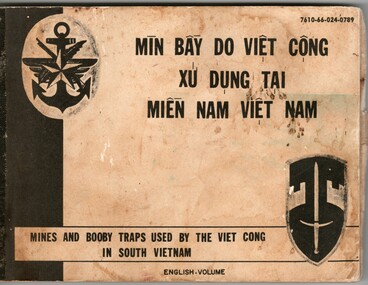
Booklet, Mines and Booby traps used by The Viet Cong, 1965
... McChristian (Brig Gen US Army) Intelligence Division....McChristian (Brig Gen US Army) Intelligence Division. ...Standard issue item used by Australian servicemen during the conflict in Vietnam.A discoloured booklet written in Vietnamese and English describing the mines & booby traps used by the Viet Cong. Front cover yellowed cardboard with shield with sword. Star on wings over anchor.booby traps, mines, viet cong, australian army -
 National Vietnam Veterans Museum (NVVM)
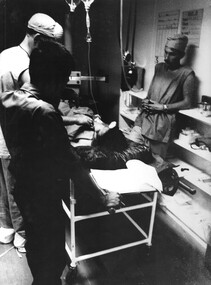
Photograph, Gibbons, Denis, Wounded VC Soldier
... South Vietnames Army Intelligence...A black and white photograph of Medics watched by a South Vietnamese Army Intelligence Officer, prepare a wounded enemy VietCong soldier for treatment in the triage at the 1st Australian Field Hospital, Vung Tau. ...Photograph 1st Australian Field Hospital Vung Tau VC Soldier Gibbons Collection Catalogue South Vietnames Army Intelligence Medics Wounded Viet Cong Soldier Denis Gibbons A black and white photograph of Medics watched by a South Vietnamese Army Intelligence Officer, prepare a wounded enemy VietCong soldier for treatment in the triage at the 1st Australian Field Hospital, Vung Tau. ...Denis Gibbons (1937 – 2011) Trained with the Australian Army, before travelling to Vietnam in January 1966, Denis stayed with the 1st Australian Task Force in Nui Dat working as a photographer. For almost five years Gibbons toured with nine Australian infantry battalions, posting compelling war images from within many combat zones before being flown out in late November 1970 after sustaining injuries. The images held within the National Vietnam Veterans Museum make up the Gibbons Collection. A black and white photograph of Medics watched by a South Vietnamese Army Intelligence Officer, prepare a wounded enemy VietCong soldier for treatment in the triage at the 1st Australian Field Hospital, Vung Tau. photograph, 1st australian field hospital, vung tau, vc soldier, gibbons collection catalogue, south vietnames army intelligence, medics, wounded viet cong soldier, denis gibbons -
 National Vietnam Veterans Museum (NVVM)
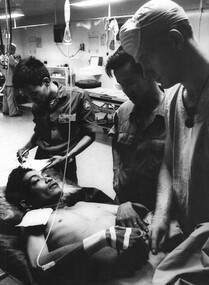
Photograph, Gibbons, Denis, Wounded VC 1
... South Vietnames Army Intelligence...They are watched by two South Vietnamese Army Intelligence officers....They are watched by two South Vietnamese Army Intelligence officers. Wounded VC 1 Photograph Gibbons, Denis ...Denis Gibbons (1937 – 2011) Trained with the Australian Army, before travelling to Vietnam in January 1966, Denis stayed with the 1st Australian Task Force in Nui Dat working as a photographer. For almost five years Gibbons toured with nine Australian infantry battalions, posting compelling war images from within many combat zones before being flown out in late November 1970 after sustaining injuries. The images held within the National Vietnam Veterans Museum make up the Gibbons Collection.A black and white photograph of a wounded VietCong soldier who is given some treatment by a medic, in triage, at the 1st Australian Field Hospital, Vung Tau, South Vietnam. They are watched by two South Vietnamese Army Intelligence officers.photograph, vietcong, 1st australian field hospital, vung tau, south vietnames army intelligence, gibbons collection catalogue, denis gibbons, photographer, vietnam war, wounded viet cong soldier, medic, triage -
 National Vietnam Veterans Museum (NVVM)
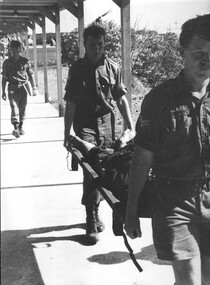
Photograph, Gibbons, Denis, Wounded VC Soldier
... South Vietnames Army Intelligence...A South Vietnamese army interpreter/intelligence officer is close by....A South Vietnamese army interpreter/intelligence officer is close by. Wounded VC Soldier Photograph Gibbons, Denis ...Denis Gibbons (1937 – 2011) Trained with the Australian Army, before travelling to Vietnam in January 1966, Denis stayed with the 1st Australian Task Force in Nui Dat working as a photographer. For almost five years Gibbons toured with nine Australian infantry battalions, posting compelling war images from within many combat zones before being flown out in late November 1970 after sustaining injuries. The images held within the National Vietnam Veterans Museum make up the Gibbons Collection. A black and white photograph of a wounded enemy VietCong soldier is being taken to the 1st Australian Field Hospital, Vung Tau, South Vietnam by two Corporal medics. A South Vietnamese army interpreter/intelligence officer is close by.photograph, 1st australian field hospital, vung tau, gibbons collection catalogue, viet cong, south vietnames army intelligence, medics, wounded viet cong soldier, denis gibbons -
Ballarat RSL Sub-Branch Inc.
Intelligence Report (copies) - "On Enemy Defences in the ALAMEIN SECTOR as at 21 Oct 42" (12pg)
... No 10 LIGHTFOOT belonged to Reginald Wyburn DAVIS - Army Intelligence...No 10 LIGHTFOOT belonged to Reginald Wyburn DAVIS - Army Intelligence Intelligence Report (copies) - "On Enemy Defences in the ALAMEIN SECTOR as at 21 Oct 42" (12pg) ...Includes maps, most secret info - 2/24 AUST INF BN O.O. No 10 LIGHTFOOT belonged to Reginald Wyburn DAVIS - Army Intelligencesecond world war (ww2), 1939 - 1945, literature, ballarat rsl, ballarat -
4th/19th Prince of Wales's Light Horse Regiment Unit History Room
Booklet, Army Training Memorandum (War) (Australia) No 27, 22 Nov 1943
... ...Army intelligence...One of a series produced during World War 2 Booklet Army intelligence World War 2 All paper stapled memorandum distributed to each officer containing notes on Japanese hand grenades and mines, Intelligence bulletins from operations on various fronts, methods of transporting equipment across rivers and points on unarmed combat. ...One of a series produced during World War 2All paper stapled memorandum distributed to each officer containing notes on Japanese hand grenades and mines, Intelligence bulletins from operations on various fronts, methods of transporting equipment across rivers and points on unarmed combat. booklet, army intelligence, world war 2 -
 National Vietnam Veterans Museum (NVVM)
Document, General Topography and Terrain Introduction, 1/06/1964 12:00:00 AM
... ...Army Intelligence Centre...Document South East Asia Army Intelligence Centre yellowing paper. Thirteen page typed document on the SE Asia generl topography and terrain General Topography and Terrain Introduction Document Document ...yellowing paper. Thirteen page typed document on the SE Asia generl topography and terraindocument, south east asia, army intelligence centre -
 National Vietnam Veterans Museum (NVVM)
Photograph, Gibbons, Denis, Wounded VC Soldier 2
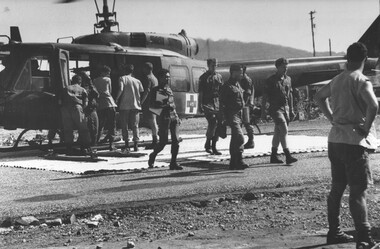
... South Vietnames Army Intelligence...Photograph 1st Australian Field Hospital Vung Tau Vampire Helicopter Pad Dustoff Viet Cong Gibbons Collection Catalogue Wounded Viet Cong Soldier Medics South Vietnames Army Intelligence Denis Gibbons A black and white photograph of 1st Australian Field Hospital, Vung Tau, Vampire Helicopter pad,, US Army Dustoff 45 casavac helicopter, delivers wounded VietCong, South Vietnamese Army Interpreter and medics en route to triage, background medics receive other wounded. ...Denis Gibbons (1937 – 2011) Trained with the Australian Army, before travelling to Vietnam in January 1966, Denis stayed with the 1st Australian Task Force in Nui Dat working as a photographer. For almost five years Gibbons toured with nine Australian infantry battalions, posting compelling war images from within many combat zones before being flown out in late November 1970 after sustaining injuries. The images held within the National Vietnam Veterans Museum make up the Gibbons Collection. A black and white photograph of 1st Australian Field Hospital, Vung Tau, Vampire Helicopter pad,, US Army Dustoff 45 casavac helicopter, delivers wounded VietCong, South Vietnamese Army Interpreter and medics en route to triage, background medics receive other wounded.photograph, 1st australian field hospital, vung tau, vampire helicopter pad, dustoff, viet cong, gibbons collection catalogue, wounded viet cong soldier, medics, south vietnames army intelligence, denis gibbons -
 National Vietnam Veterans Museum (NVVM)
Document, Restricted Intelligence Centre
... Yellowing paper Restricted 1: Army Intelligence Ctnre - Revolutionary Warfare - General. ...Document Restricted Intelligence Centre Yellowing paper Restricted 1: Army Intelligence Ctnre - Revolutionary Warfare - General. ...Yellowing paper Restricted 1: Army Intelligence Ctnre - Revolutionary Warfare - General. Six pages marked Index 2: Intelligence Centre - Topographical Interpretation Vegetation in S.E Asia - eight pagesdocument, restricted intelligence centre -
 National Vietnam Veterans Museum (NVVM)
Document, Language Familiarisation Study Vietnamese
... US logistic systems Army Intelligence Centre. Helpful expressions in Vietnamese from Army Forces Language School...US logistic systems Army Intelligence Centre. Helpful expressions in Vietnamese from Army Forces Language School Language Familiarisation Study Vietnamese Document Document ...Various typed sheets of language study Vienamese translation for English. Dated 27-07-1964. US logistic systems Army Intelligence Centre. Helpful expressions in Vietnamese from Army Forces Language Schoolvietnam -
 National Vietnam Veterans Museum (NVVM)
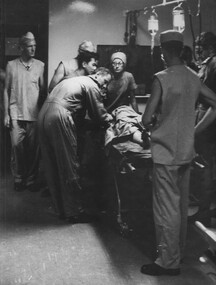
Photograph, Gibbons, Denis, Prep for Surgery 4
... They are preparing a VietCong prisoner for surgery under the watchful eye of a South Vietnamese Army Intelligence Officer....They are preparing a VietCong prisoner for surgery under the watchful eye of a South Vietnamese Army Intelligence Officer. Prep for Surgery 4 Photograph Gibbons, Denis ...Denis Gibbons (1937 – 2011) Trained with the Australian Army, before travelling to Vietnam in January 1966, Denis stayed with the 1st Australian Task Force in Nui Dat working as a photographer. For almost five years Gibbons toured with nine Australian infantry battalions, posting compelling war images from within many combat zones before being flown out in late November 1970 after sustaining injuries. The images held within the National Vietnam Veterans Museum make up the Gibbons Collection. A black and white photograph of Sister June Minchow and medics in the triage at the 1st Australian Field Hospital, Vung Tau, South Vietnam. They are preparing a VietCong prisoner for surgery under the watchful eye of a South Vietnamese Army Intelligence Officer.photograph, 1st australian field hospital, vung tau, capt june minchow, south vietnamese intelligence officer, arvn, viet cong, gibbons collection catalogue, denis gibbons, photographer, vietnam war, medics, viet cong prisoner -
 National Vietnam Veterans Museum (NVVM)
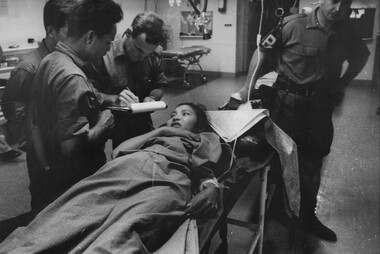
Photograph, Gibbons, Denis, Female VC Prisoner
... A black and white photograph of - In the triage at the 1st Australian Field Hospital, Vung Tau, South vietnam, watched by an Australian Military Policeman, two South Vietnamese Army Intelligence Officers question an enemy female VietCong prisoner while an Australian officer signs a document.... Officer Triage Female Viet Cong Prisoner Denis Gibbons A black and white photograph of - In the triage at the 1st Australian Field Hospital, Vung Tau, South vietnam, watched by an Australian Military Policeman, two South Vietnamese Army Intelligence Officers question an enemy female VietCong prisoner while an Australian officer signs a document. ...Denis Gibbons (1937 – 2011) Trained with the Australian Army, before travelling to Vietnam in January 1966, Denis stayed with the 1st Australian Task Force in Nui Dat working as a photographer. For almost five years Gibbons toured with nine Australian infantry battalions, posting compelling war images from within many combat zones before being flown out in late November 1970 after sustaining injuries. The images held within the National Vietnam Veterans Museum make up the Gibbons Collection. A black and white photograph of - In the triage at the 1st Australian Field Hospital, Vung Tau, South vietnam, watched by an Australian Military Policeman, two South Vietnamese Army Intelligence Officers question an enemy female VietCong prisoner while an Australian officer signs a document.photograph, 1st australian field hospital, vung tau, military police, viet cong, gibbons collection catalogue, south vietnamese intelligence officer, triage, female viet cong prisoner, denis gibbons -
 National Vietnam Veterans Museum (NVVM)
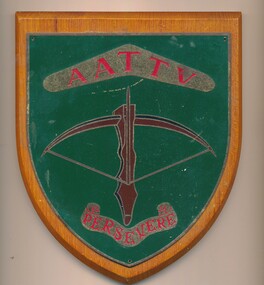
Plaque - AATTV Plaque
... This item was donated by Sgt JL Bramston, Army Intelligence Corps, who served in Detachment, 547 Signal Troop, Vietnam 1967-68....This item was donated by Sgt JL Bramston, Army Intelligence Corps, who served in Detachment, 547 Signal Troop, Vietnam 1967-68. ...This item was donated by Sgt JL Bramston, Army Intelligence Corps, who served in Detachment, 547 Signal Troop, Vietnam 1967-68.Shield-shaped wooden plaque with a large metal plate attached depicting a brown crossbow beneath a boomerang.AATTV Persevereaattv, persevere, bramston -
 National Vietnam Veterans Museum (NVVM)
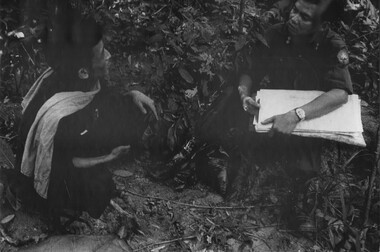
Photograph, Gibbons, Denis, Interograting A Patient
... A black and white photograph of a captured VietCong patient from one of the wards at the K76A NVA/VC Hospital, by elements of 6 RAR/NZ (ANZAC), during Operation Marsden, is closely questioned by a South Vietnamese Army Intelligence Officer. the enemy prisoner gave a great deal of information.... Officer Wounded Viet Cong Soldier 6 RAR/NZ (ANZAC) Enemy Prisoner Denis Gibbons A black and white photograph of a captured VietCong patient from one of the wards at the K76A NVA/VC Hospital, by elements of 6 RAR/NZ (ANZAC), during Operation Marsden, is closely questioned by a South Vietnamese Army Intelligence Officer. the enemy prisoner gave a great deal of information. ...Denis Gibbons (1937 – 2011) Trained with the Australian Army, before travelling to Vietnam in January 1966, Denis stayed with the 1st Australian Task Force in Nui Dat working as a photographer. For almost five years Gibbons toured with nine Australian infantry battalions, posting compelling war images from within many combat zones before being flown out in late November 1970 after sustaining injuries. The images held within the National Vietnam Veterans Museum make up the Gibbons Collection. A black and white photograph of a captured VietCong patient from one of the wards at the K76A NVA/VC Hospital, by elements of 6 RAR/NZ (ANZAC), during Operation Marsden, is closely questioned by a South Vietnamese Army Intelligence Officer. the enemy prisoner gave a great deal of information.photograph, 6 rar/nz, k76a hospital, operation marsden, gibbons collection catalogue, south vietnamese intelligence officer, wounded viet cong soldier, 6 rar/nz (anzac), enemy prisoner, denis gibbons -
Tatura Irrigation & Wartime Camps Museum
Book, The Tatura Secret Radio, 1997
... Army Intelligence knew there was a secret radio operating in Tatura No.1 Camp. ...Army Intelligence knew there was a secret radio operating in Tatura No.1 Camp. ...Army Intelligence knew there was a secret radio operating in Tatura No.1 Camp. The inmates were getting the war news direct from Germany. They had to have a strong shortwave receiver, but where was it?White soft cover book with an entrance made with barb wire. The front cover depicts a man with headphones on. A map of Victoria and short history of the book on the back cover. B/W photos, with a map of Tatura No 1 camp.Reg. No. 1870.1 signed "With Best Wishes Laura Nilsen"the tatura secret radio, nilsen h, nilsen l, glover i, camp 1, tatura, ww2 camp 1, books, history, local -
Tatura Irrigation & Wartime Camps Museum
Magazine, Wild Life, July 1947
... Original articles was translated from German by Captain Llewellyn Seal, of Army Intelligence and is about bearded lizards. Page 245....Original articles was translated from German by Captain Llewellyn Seal, of Army Intelligence and is about bearded lizards. Page 245. adolf wilke my prison companions camp 13 murchison pow camps australian nature magazine bearded lizards captain llewellyn seal Wilke Soft covered magazine stapled at spine, has black and white illustrations throughout. ...Australian nature magazine featuring articles written by POW Adolf Wilke about bearded lizards. This is the second part of "My Prison Companions" (part 1 C7684) Adolf was a POW at Camp 13 Murchison. Original articles was translated from German by Captain Llewellyn Seal, of Army Intelligence and is about bearded lizards. Page 245.Soft covered magazine stapled at spine, has black and white illustrations throughout. Front cover features bird on tree limbs with seed in its beak. Orange splash on birds wings. Title is also in orange. Vol 9 no 7. Wilkeadolf wilke, my prison companions, camp 13 murchison, pow camps, australian nature magazine, bearded lizards, captain llewellyn seal -
 Tatura Irrigation & Wartime Camps Museum
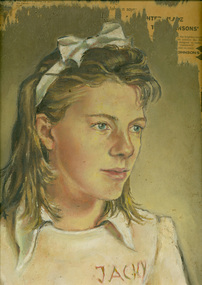
Painting - Portrait - Oil Painting, Jacky, 1946
... Jacqui Seal was the daughter of the Australian Army Intelligence Officer in Camp 13, Captain Stanley L. ...Jacqui Seal was the daughter of the Australian Army Intelligence Officer in Camp 13, Captain Stanley L. ...Jacqui Seal was the daughter of the Australian Army Intelligence Officer in Camp 13, Captain Stanley L. Seal. and sometimes visited her father in camp. Mueller asked to paint Jacky her father agreed, and Mueller presented the final work to her.|Jacqui did not like the portrait and pasted newspaper over it, since partially removed.Portrait of a young girl with bow in her hair and the name "Jacky" on her jumper. Portrait on brown paper in plain varnished wooden frame. Partially covered by newspaper.M. Mueller 1946.tatura, camp 13, manfred mueller, german pow, seal -
Tatura Irrigation & Wartime Camps Museum
Container - Box - Tooth Powder, 1940's
... Orange/red square plastic tooth powder dispenser box with matching lid. 3x stickers on bottom as follows : Tooth Powder. 396617 EVERETT = Army Number. Intelligence Branch...SA. embossed inside of base Orange/red square plastic tooth powder dispenser box with matching lid. 3x stickers on bottom as follows : Tooth Powder. 396617 EVERETT = Army Number. Intelligence Branch Container Box - Tooth Powder ...The Red Cross gave parcels to the German prisoners. This was part of one of those parcelsOrange/red square plastic tooth powder dispenser box with matching lid. 3x stickers on bottom as follows : Tooth Powder. 396617 EVERETT = Army Number. Intelligence BranchRosodont embossed on outside of base, AMA BERGMANN, A.H.A.B, WALDHEIM. SA. embossed inside of basebox, tooth powder, towart g, awas, camp 13, tatura, ww2 camp 13, toilet, requisites, bathroom -
Tatura Irrigation & Wartime Camps Museum
Photograph, Dhurringile Escape, 2001
... .|800- Plan of Dhurringile with room allocation of POW's 858- Army Garrison. 1762- Intelligence Reports. Newspaper articles in top drawer of plan cabinet.....|800- Plan of Dhurringile with room allocation of POW's 858- Army Garrison. 1762- Intelligence Reports. Newspaper articles in top drawer of plan cabinet. ...Dhurringile Escape through Tunnel. Detmers; Bertram; Grotz; Jas; Kernstock; Folter; Jung; Plattfaut; Jansen; Menge; Kissel; Raasch; Eberle; Somann; Mader; Blomberg; Koch; Sommer; Rodszies; Schmidt. 2 Articles. Further references in folders: 1829- sketch of camp 13 tunnel.|800- Plan of Dhurringile with room allocation of POW's 858- Army Garrison. 1762- Intelligence Reports. Newspaper articles in top drawer of plan cabinet.detmers, bertram, grotz, jas, kernstock, folter, plattfaut, jansen, menge, kissel, raasch, eberle, somann, mader, blomberg, koch, sommer, rodszies, schmidt, room allocation -
Tatura Irrigation & Wartime Camps Museum
Documents- Archives, Kuhne, 1946
... Copies of archival documents obtained from AWM, specifically Australian Army war diaries / intelligence summaries pertaining to Murchison POW group (Camp 13). ...Records show, amongst other things, troop (garrison) movements, routine orders, outcomes of disciplinary proceedings. camp 13 murchison prisoner of war camps internee camps world war ii garrison Copies of archival documents obtained from AWM, specifically Australian Army war diaries / intelligence summaries pertaining to Murchison POW group (Camp 13). ...Donor is daughter of a member of Australian armed forces who served during WW2, and was member of garrison at Camp 13 after the war, in 1946. Donor was researching her father's service & obtained at her expense copies of these archives held by the AWM, related to daily activities in the camp during the time that her father was posted at Murchison. Records show, amongst other things, troop (garrison) movements, routine orders, outcomes of disciplinary proceedings. Copies of archival documents obtained from AWM, specifically Australian Army war diaries / intelligence summaries pertaining to Murchison POW group (Camp 13). For periods: 1. Jan-Mar 1946; 2. April-May 1946; 3. Jun-July 1946. Printed A4 pages. 3 separately bound parts. Series number: AWM52; Control Symbol: 8/7/40. Part 1 (Jan-Mar) - 110 pages. Part 2 (April-May) - 171 pages. Part 3 (June-July) - 99 pages. camp 13, murchison, prisoner of war camps, internee camps, world war ii, garrison -
 Ballarat Clarendon College
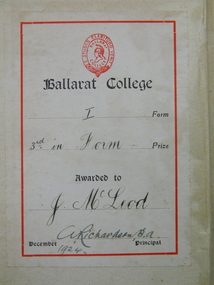
Book, The watches of the trails
... intelligence team. During the war he met Mary Monica Carrol Bateman, a lietenant in the 2/4th Army General Hospital at a dinner party in Brisbane. ...intelligence team. During the war he met Mary Monica Carrol Bateman, a lietenant in the 2/4th Army General Hospital at a dinner party in Brisbane. ...John Anning MacLeod John was born in Ballarat as the second generation of Ballarat MacLeod’s, with his grandfather arriving in Geelong on the Hornet in 1857 as an 11 year old child with his 60 year old father John and mother Mary aged 37 years and 5 brothers and one sister. He grew up on the corner of Drummond Street and Mair Streets, opposite what became St John of God hospital, at his parents house of Dunvegan. John entered Ballarat College as a junior student in 1923. He received 3rd in Form prizes in both 1924 and 1925. His sister Margaret, attended Clarendon Ladies College. The household employed a chauffeur, a cook, a gardener and a ladies maid to care for them. In the 1930’s his father lost his fortune in the collapse of the jute future’s market so the staff were dismissed and he left Ballarat to go to Geelong College as a boarder. He was an officer in the Geelong College cadet corps and joined the Army as a private and rose to the permanent rank of Major after meritorious performance in the intelligence area of operations. He served in North Africa, in Palestine, Egypt, Moratai, the Philippines, Java and New Guinea. He was awarded his Military MBE by King George VI for exceptional devotion to duty and for brilliant coordination work amongst the allied intelligence team. During the war he met Mary Monica Carrol Bateman, a lietenant in the 2/4th Army General Hospital at a dinner party in Brisbane. The couple had four children, Hamish John Torquil born in 1945, Rory Hugh Alexander born in 1947 and twins Ian Donald and Katriona Margaret born in 1948. After the Second World War he worked for Lumley’s Insurance Brokers in London for a couple of years to follow up his accountancy training and then returned to Ballarat due to his father’s failing health and took over the management of John MacLeod and Co, Wholesale grocers and Merchants in Lydiard Street, Ballarat. The business had been started by his great grandfather and they produced the famous Sirdar brand of products and a special tea blend called Afternoon Cup. There was a spice mill in nearby Market Street and there they roasted peanuts, coffee and ground spices for packaging and distribution to the small corner shops who were the mainstay of commercial grocery. In the 1950’s John MacLeod and Co merged with James McKay and Sons to form McKay MacLeod Pty Ltd., wholesale tobacco, wine and spirits and grocery merchants who also manufactured the Sunny South brand of sweet mustard pickles, brewed vinegar and tomato sauce. He introduced the semi-automated system for extensions and financial records on the Bradma plates that saved staff the problems of sorting out the calculations for sales tax, miscellaneous charges etc. that greatly sped up the transactions at the checkout points. A new warehouse and office complex was built in Mair Street east up near Humffray Street, with the manufacturing factory on the opposite side of the street. They had a shop in St Arnaud and one in Geelong which was the local wholesaler for supplying to the corner shops of the greater Geelong area. With the development of supermarkets the demise of the corner store began and so the sales profiles began to diminish. He unsuccessfully stood for Liberal Party pre-selection for the seat of Ballarat in 1948 and served on the Liberal state finance and executive team for many years before resigning over the issue of conscripts being sent to Vietnam. He was instrumental in leading a group of Ballarat academics in opposition to the Vietnam war and publicly resigned from the Liberal Party over their foreign policy. John MacLeod saw the writing on the wall of the business in the early 1970’s and suggested that the firm restructured with focusing on tobacco, wine and spirits. His partners did not agree and so he sold out and retired to Barwon Heads. After a few years of golfing and surfing he became frustrated and joined SCORE, the Service Corp of Retired Executives. In this role he worked for ten years in the Geelong area solving accounting problems for Geelong small businesses and so helped Beaumont’s bakery back onto its feet. He worked gentlemen’s hours of 10 am to 3 pm which allowed him to have time for a round of 9 holes on the golf course at the end of the day and to have a surf before breakfast. He fully retired at the age of 65 and had ten years of voluminous reading of local library books before dying of burns at the age of 75. His war record has been documented in other archives at the College. He was a member of the Naval and Military Club and of the Barwon Heads Golf Club. He had good crafting skills and built a series of steam driven boats for his four children that used to be sailed at home on Lake Wendouree, Lake Learmonth and on the sheltered waters of the Barwon River. The boats are now being restored to operational order to be sailed by his great grandson Grayson Girardi. Red cloth bound book with title printed in gold lettering on spine, embossed publisher's mark centre of front cover and school crest in gold relief on front cover; book plate inside front cover. Book plate inside front cover: School crest / Ballarat College / I form / 3rd in form Prize / Awarded to / J MacLeod / December 1924 A Richardson B A Principaljohn-macleod, ballarat-college, book-prize, 1924 -
 Ballarat Clarendon College
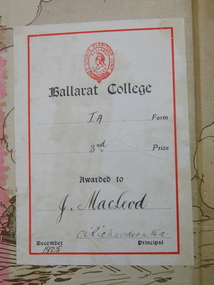
Book, The school across the road
... intelligence team. During the war he met Mary Monica Carrol Bateman, a lietenant in the 2/4th Army General Hospital at a dinner party in Brisbane. ...intelligence team. During the war he met Mary Monica Carrol Bateman, a lietenant in the 2/4th Army General Hospital at a dinner party in Brisbane. ...John Anning MacLeod John was born in Ballarat as the second generation of Ballarat MacLeod’s, with his grandfather arriving in Geelong on the Hornet in 1857 as an 11 year old child with his 60 year old father John and mother Mary aged 37 years and 5 brothers and one sister. He grew up on the corner of Drummond Street and Mair Streets, opposite what became St John of God hospital, at his parents house of Dunvegan. John entered Ballarat College as a junior student in 1923. He received 3rd in Form prizes in both 1924 and 1925. His sister Margaret, attended Clarendon Ladies College. The household employed a chauffeur, a cook, a gardener and a ladies maid to care for them. In the 1930’s his father lost his fortune in the collapse of the jute future’s market so the staff were dismissed and he left Ballarat to go to Geelong College as a boarder. He was an officer in the Geelong College cadet corps and joined the Army as a private and rose to the permanent rank of Major after meritorious performance in the intelligence area of operations. He served in North Africa, in Palestine, Egypt, Moratai, the Philippines, Java and New Guinea. He was awarded his Military MBE by King George VI for exceptional devotion to duty and for brilliant coordination work amongst the allied intelligence team. During the war he met Mary Monica Carrol Bateman, a lietenant in the 2/4th Army General Hospital at a dinner party in Brisbane. The couple had four children, Hamish John Torquil born in 1945, Rory Hugh Alexander born in 1947 and twins Ian Donald and Katriona Margaret born in 1948. After the Second World War he worked for Lumley’s Insurance Brokers in London for a couple of years to follow up his accountancy training and then returned to Ballarat due to his father’s failing health and took over the management of John MacLeod and Co, Wholesale grocers and Merchants in Lydiard Street, Ballarat. The business had been started by his great grandfather and they produced the famous Sirdar brand of products and a special tea blend called Afternoon Cup. There was a spice mill in nearby Market Street and there they roasted peanuts, coffee and ground spices for packaging and distribution to the small corner shops who were the mainstay of commercial grocery. In the 1950’s John MacLeod and Co merged with James McKay and Sons to form McKay MacLeod Pty Ltd., wholesale tobacco, wine and spirits and grocery merchants who also manufactured the Sunny South brand of sweet mustard pickles, brewed vinegar and tomato sauce. He introduced the semi-automated system for extensions and financial records on the Bradma plates that saved staff the problems of sorting out the calculations for sales tax, miscellaneous charges etc. that greatly sped up the transactions at the checkout points. A new warehouse and office complex was built in Mair Street east up near Humffray Street, with the manufacturing factory on the opposite side of the street. They had a shop in St Arnaud and one in Geelong which was the local wholesaler for supplying to the corner shops of the greater Geelong area. With the development of supermarkets the demise of the corner store began and so the sales profiles began to diminish. He unsuccessfully stood for Liberal Party pre-selection for the seat of Ballarat in 1948 and served on the Liberal state finance and executive team for many years before resigning over the issue of conscripts being sent to Vietnam. He was instrumental in leading a group of Ballarat academics in opposition to the Vietnam war and publicly resigned from the Liberal Party over their foreign policy. John MacLeod saw the writing on the wall of the business in the early 1970’s and suggested that the firm restructured with focusing on tobacco, wine and spirits. His partners did not agree and so he sold out and retired to Barwon Heads. After a few years of golfing and surfing he became frustrated and joined SCORE, the Service Corp of Retired Executives. In this role he worked for ten years in the Geelong area solving accounting problems for Geelong small businesses and so helped Beaumont’s bakery back onto its feet. He worked gentlemen’s hours of 10 am to 3 pm which allowed him to have time for a round of 9 holes on the golf course at the end of the day and to have a surf before breakfast. He fully retired at the age of 65 and had ten years of voluminous reading of local library books before dying of burns at the age of 75. His war record has been documented in other archives at the College. He was a member of the Naval and Military Club and of the Barwon Heads Golf Club. He had good crafting skills and built a series of steam driven boats for his four children that used to be sailed at home on Lake Wendouree, Lake Learmonth and on the sheltered waters of the Barwon River. The boats are now being restored to operational order to be sailed by his great grandson Grayson Girardi. john-macleod, ballarat-college, 1925, book-prize -
 Australian Commando Association - Victoria
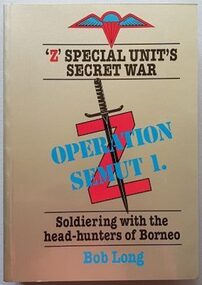
Book, Z Special Units' Secret War- Operations SEMUT 1, 1989
... intelligence and conduct guerrilla warfare. The best known of these missions were Operation Jaywick and Operation RIMAU, both of which involved raids on Japanese shipping in Singapore Harbour; the latter of which resulted in the deaths of twenty-three commandos either in action or by execution after capture. Although the unit was disbanded after the war, many of the training techniques and operational procedures employed were later used during the formation of other Australian Army...intelligence and conduct guerrilla warfare. The best known of these missions were Operation Jaywick and Operation RIMAU, both of which involved raids on Japanese shipping in Singapore Harbour; the latter of which resulted in the deaths of twenty-three commandos either in action or by execution after capture. Although the unit was disbanded after the war, many of the training techniques and operational procedures employed were later used during the formation of other Australian Army ...An account of the operations of The Allied Intelligence Bureau (AIB) better known as ‘Z’ Special Unit. Now a scarce and highly sought after title. The author’s personal experiences with Australian Special Forces (Services Reconnaissance Department) which involved guerrilla soldiering with the head-hunters of Japanese held Borneo during World War 2. Z Special Unit an administrative support unit of (also known as Special Operations Australia (SOA) or the Services Reconnaissance Department (SRD)) was a joint Allied special forces unit formed during the Second World War to operate behind Japanese lines in South East Asia. Predominantly Australian, SRD was a specialist reconnaissance and sabotage unit that included British, Dutch, New Zealand, Timorese and Indonesian members, predominantly operating on Borneo and the islands of the former Netherlands East Indies. The unit carried out a total of 81 covert operations in the South West Pacific theatre, with parties inserted by parachute or submarine to provide intelligence and conduct guerrilla warfare. The best known of these missions were Operation Jaywick and Operation RIMAU, both of which involved raids on Japanese shipping in Singapore Harbour; the latter of which resulted in the deaths of twenty-three commandos either in action or by execution after capture. Although the unit was disbanded after the war, many of the training techniques and operational procedures employed were later used during the formation of other Australian Army special forces units and they remain a model for guerrilla operations to this day.Hard Cover with Dust Jacket – 608 pagesInscribed by author-Bob Long AK223 SEMUT 1 Borneo 1945 -
 Australian Commando Association - Victoria
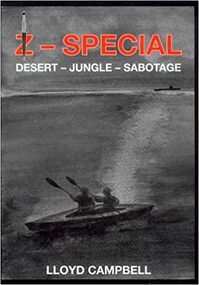
Book, Z Special- Desert-Jungle- Sabotage
... intelligence and conduct guerrilla warfare. The best known of these missions were Operation Jaywick and Operation Rimau, both of which involved raids on Japanese shipping in Singapore Harbour; the latter of which resulted in the deaths of 23 commandos either in action or by execution after capture. Although the unit was disbanded after the war, many of the training techniques and operational procedures employed were later used during the formation of other Australian Army...intelligence and conduct guerrilla warfare. The best known of these missions were Operation Jaywick and Operation Rimau, both of which involved raids on Japanese shipping in Singapore Harbour; the latter of which resulted in the deaths of 23 commandos either in action or by execution after capture. Although the unit was disbanded after the war, many of the training techniques and operational procedures employed were later used during the formation of other Australian Army ...When Lloyd Campbell joined the AIF, he was underage and went to the Middle East with 2/17 Battalion. Later in New Guinea he made a major career change and volunteered for an unknown unit and special operations. What he had joined was the SRD – known as Z-Special Unit. Z Special Unit—also known as Special Operations Executive (SOE), Special Operations Australia (SOA) or the Services Reconnaissance Department (SRD)—was a joint Allied special forces unit formed during the Second World War to operate behind Japanese lines in South East Asia. Predominantly Australian, Z Special Unit was a specialist reconnaissance and sabotage unit that included British, Dutch, New Zealand, Timorese and Indonesian members, predominantly operating on Borneo and the islands of the former Netherlands East Indies. The unit carried out a total of 81 covert operations in the South West Pacific theatre, with parties inserted by parachute or submarine to provide intelligence and conduct guerrilla warfare. The best known of these missions were Operation Jaywick and Operation Rimau, both of which involved raids on Japanese shipping in Singapore Harbour; the latter of which resulted in the deaths of 23 commandos either in action or by execution after capture. Although the unit was disbanded after the war, many of the training techniques and operational procedures employed were later used during the formation of other Australian Army special forces units and they remain a model for guerrilla operations to this day. pp. 274, illusts, maps ww2, the australian special operations, special forces, z special unit -
 Australian Commando Association - Victoria
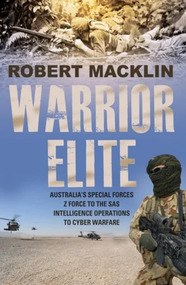
Book, Warrior Elite
... intelligence agencies. Both thoroughly researched and colourfully written, Warrior Elite will attract the reader of action memoirs as well as those interested in broader military history and espionage. australian special forces australian army commandos military history Warrior Elite Book ...Warrior Elite is a unique and compelling account of Australia's special forces and intelligence operations - ranging from the early special forces of World War II to the establishment and development of the SAS and Commando Regiments as the elite fighters of today, and from the Australian Security Intelligence Service to the Australian Signals Directorate and ASIO. It is an authoritative, gripping and thoroughly up-to-date account of both the history and current state of our special forces and intelligence bodies - and gives a unique glimpse into the warfare of the future. Our future. Robert Macklin has conducted dozens of exclusive interviews and uncovered incredible, daring and sometimes heartbreaking stories of the elite troops that guard our nation and engage in secret operations around the world. He has had significant cooperation from numerous sources within the special forces and the various intelligence agencies. Both thoroughly researched and colourfully written, Warrior Elite will attract the reader of action memoirs as well as those interested in broader military history and espionage. australian special forces, australian army, commandos, military history -
 Bendigo Military Museum
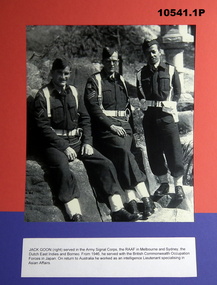
Photograph - AUSTRALIAN CHINESE SERVICEMEN, WW2, Bendigo & District RSL Club, WW2
... Army Signal Corps, the RAAF in Melbourne and Sydney, the Dutch East Indies and Borneo. from 1946, he served with the British Commonwealth Occupation Forces in Japan. On return to Australia he worked as an intelligence..."JACK GOON - Served in the Army Signal Corps, the RAAF in Melbourne and Sydney, the Dutch East Indies and Borneo. from 1946, he served with the British Commonwealth Occupation Forces in Japan. On return to Australia he worked as an intelligence ...Australian Chinese Servicemen from WW2 photographs. Exhibition held at the Bendigo & District R.S...L. post 2010.1.2.3. Photographs - on photographic paper, enlarged black and white portraits. Mount - red and blue colour cardboard, double mount with top area containing the photograph, lower area printed information. 1. Three servicemen wearing RAAF uniform - group photograph. 2. Two servicemen wearing AIF uniforms. 3. Serviceman wearing AIF uniform.Printed information - black ink print. 1. "JACK GOON - Served in the Army Signal Corps, the RAAF in Melbourne and Sydney, the Dutch East Indies and Borneo. from 1946, he served with the British Commonwealth Occupation Forces in Japan. On return to Australia he worked as an intelligence Lieutenant specialising in Asian Affairs. 2. "HIAH" Family - The Hiah Family served in both World Wars. HAROLD VICTOR HIAH (right) served with the first AIF in WW1. His son, HAROLD KEITH HIAH, joined the signal Corps of the second AIF in World War 2. His brother VICTOR and GEORGE also served. 3. Early 1940's portrait of GEORGE HIAH, brother of HAROLD VICTOR HIAH.photographs', chinese, ww2 -
 Bendigo Military Museum
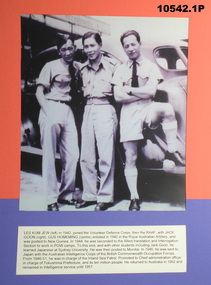
Photograph - AUSTRALIAN CHINESE SERVICEMEN/WOMEN, WW2, Bendigo & District RSL Club, Unknown
... Intelligence service until 1957. 2. EUNICE LEONG (top left) worked from 1940 as a wireless operator for the Army in Melbourne, Sydney and Alice Springs, and as a signals instructor at Bonegilla. ...Intelligence service until 1957. 2. EUNICE LEONG (top left) worked from 1940 as a wireless operator for the Army in Melbourne, Sydney and Alice Springs, and as a signals instructor at Bonegilla. ...Australian Chinese Servicemen from WW2 photographs - Exhibition held at the Bendigo & District RSL, post 2010.1.2.3. Photographs on photographic paper, enlarged black and white portraits. Mount - red and blue colour cardboard, double mount with top area containing the photograph, lower area printed information. 1. Three servicemen in informal group. 2. Two servicewomen, one serviceman and a civilian - group portrait. 3. Five servicemen and one service woman in uniform - collection of small portraits.Printed information - black ink print. 1. LES KUM JEW (left)- in 1942, joined the Volunteer Defence Corps, then the RAAF, with JACK GOON (right). GUS HOMEMING (centre) enlisted in 1942 in the Royal Australian Artillery, and was posted to New Guinea. In 1944, he was seconded to the Allied translation and Interrogation Section to work in POW camps. To this end, and with other students including Jack Goon, he learned Japanese at Sydney University. He was then posted to Morotai. In 1946, he was sent to Japan with the Australian Intelligence Corps of the British Commonwealth Occupation Forces. From 1946-51, he was in charge of the Inland Sea Patrol. Promoted to Chief Administration Officer in charge of Tokushima Prefecture and its ten million people. He returned to Australia in 1952 and remained in Intelligence service until 1957. 2. EUNICE LEONG (top left) worked from 1940 as a wireless operator for the Army in Melbourne, Sydney and Alice Springs, and as a signals instructor at Bonegilla. Her sister, VALDA (top right) worked as a radar plotter with the WAAAF, and her brother MAX (bottom right) went with the British Commonwealth Occupation Forces to Japan after the War. 3. PETER MOO (top right) served with the Australian Army in the Northern Territory, his brother FRANK MOO (top centre) served with the Australian Imperial Force in Rabaul and Bougainville, Frank's children CLARENCE MOO (top right) served with the Royal Australian Engineers and then transferred to the Royal Australian Air Force HARRY MOO (bottom left) served with the Royal Australian Air Force's 31 Beaufighter Squadron in Darwin and Morotai, MAVIS MOO (bottom centre) served with the Australian Army Medical Women's Service and ARTHUR MOO (bottom right) served with the Australian Army and later the Royal Australian Air Force. photographs, chinese/australians, ww2 -
 Bendigo Military Museum
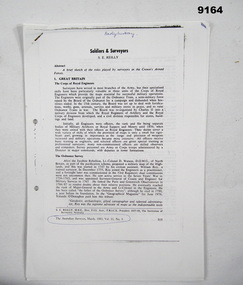
Administrative record - Soldiers and Surveyors by SE Rilley - Roles of Crown's Armed Forces UK and Australia, The Institution of Surveyors, Australia, Mar 1983
... Intelligence Corps in 1907, a survey section within the Australian Engineers 1910 and eventually the Australian Survey Corps in 1915. This is a very detailed description of the personnel involved and the formation of the Australian Survey Corps, later the title "Royal" was granted in 1948 to become the Royal Australian Survey Corps. Royal Australian Survey Corps RASvy Fortuna Army ...This is a photocopy of an original article written by SE Reilly titled "Soldier Surveyors" that was then republished in the Australian Surveyor March 1983 Vol 31 No. 5 pages 315 - 326. The Author was Capt SE Riley MBE Hon FIS Aust, FRICS, President of the Institution of Surveyors, Australia 1957-1959. Includes Histories of both UK and Australian Mapping Agencies. This document records in detail with Names, the contribution of Officers of the Crown in the early stages of the settlement of Australia. Starting in 1787 their contributions were significant with most occupying positions as State Surveyors General and eventually contributing to the formation of the Australian Intelligence Corps in 1907, a survey section within the Australian Engineers 1910 and eventually the Australian Survey Corps in 1915. This is a very detailed description of the personnel involved and the formation of the Australian Survey Corps, later the title "Royal" was granted in 1948 to become the Royal Australian Survey Corps.Eleven A4 photocopied pages of typed text extracted from the Australian Surveyor March 1983 Vol 31 No. 5 pages 315 - 326royal australian survey corps, rasvy, fortuna, army survey regiment, army svy regt, asr -
 Bendigo Military Museum
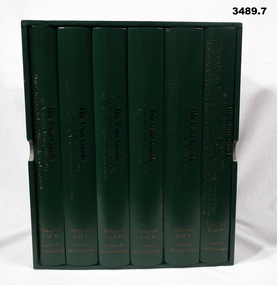
Book - BOOKS, BOXED SET, Graham R McKenzie - Smith, The Unit Guide, 2018
... Intelligence Units. 605 pages. .4) Volume 3 of 6. Artillery, Air Defence and Engineer Units. 626 pages. .5) Volume 4 of 6. Medical and Signal Units. Box of 6 books. The Unit Guide / The Australian Army...Intelligence Units. 605 pages. .4) Volume 3 of 6. Artillery, Air Defence and Engineer Units. 626 pages. .5) Volume 4 of 6. Medical and Signal Units. Box of 6 books. The Unit Guide / The Australian Army ....1) Box open, cardboard, dark green buckram, white paper lining, gold print on sides. .2) - .7) Hard cover book, cardboard, dark green buckram with gold print on front cover & spine. Pages are plain, cut, white, black print, black & white illustrations. .2) Volume 1 of 6. Unit & Location Indexes / Bibliography, Orders of Battle. 483 pages. .3) Volume 2 of 6. Headquarters, Infantry, Cavalry / Armoured & Intelligence Units. 605 pages. .4) Volume 3 of 6. Artillery, Air Defence and Engineer Units. 626 pages. .5) Volume 4 of 6. Medical and Signal Units. Box of 6 books. The Unit Guide / The Australian Army / 1939 - 1945. 654 pages .6) Volume 5 of 6. Aust Army Service Corps, Aust Army Ordnance Corps and Aust Electrical & Mechanical Engineer Units. 706 pages. .7) Volume 6 of 6. Womens Services / Volunteer Defence Corps / War Graves, Survey, Labour, Salvage / Military Policing / Recruiting & Training / Dental, Bath & Laundry / Veterinary & Animal / Movements & Transit / Pay, Records & Printing, Postal / Amenities & Canteens Units. 568 pages. books- military history, unit guide
