
Showing 111 items matching "arrival time"
-
 University of Melbourne, Burnley Campus Archives
Administration, Department of Agriculture, Staff Time Books, 1955-1972
... ...arrival time...Register with columns for name, arrival time, explanation for late arrival or early departure, departure time. 1. 22.02.1955-12.06.1956. 2. 28.10.1959-15.06.1962 also roneod copy of advertisement for a male horticultural assistant. 3. 26.04.1963-07.12.1965. 4. 28.04.1971-28.11.1972...staff arrival time departure time late arrival early departure administration Register with columns for name, arrival time, explanation for late arrival or early departure, departure time. 1. 22.02.1955-12.06.1956. 2. 28.10.1959-15.06.1962 also roneod copy of advertisement for a male horticultural assistant. 3. 26.04.1963-07.12.1965. 4. 28.04.1971-28.11.1972 Staff Time Books Administration Department of Agriculture ...staff, arrival time, departure time, late arrival, early departure, administration -
Melbourne Tram Museum
Document - Press Release, Yarra Trams, "TramTracker: Real-time tram arrival information on routes 57 and 59", late 2006
... "TramTracker: Real-time tram arrival information on routes 57 and 59"...Two A4 photocopied sheets, draft press or media release - undated - titled "TramTracker: Real-time tram arrival information on routes 57 and 59". ...Two A4 photocopied sheets, draft press or media release - undated - titled "TramTracker: Real-time tram arrival information on routes 57 and 59". ...Two A4 photocopied sheets, draft press or media release - undated - titled "TramTracker: Real-time tram arrival information on routes 57 and 59". Gives details of the proposal, initially a telephone service to advise passengers of the tram arrival estimate at a nominated stop by voice or SMS. Gives details of the working of the service, quotes the Yarra Tram CEO, Dennis Cliche. Has the Yarra Trams logo on the bottom left hand corner. Reg Item 843.4, Dec 2006 issue of Tramlines notes the service being launched.Along the top is a hand written note from Simone about the project.trams, tramways, tramtracker, yarra trams, tram stops, press release -
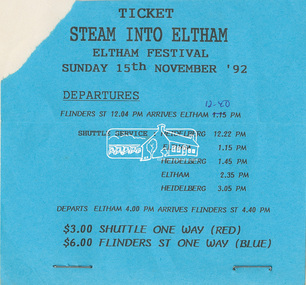 Eltham District Historical Society Inc
Ticket, Steam train ride ticket, Flinders Street One Way, Eltham Festival, 15 November 1992, 1992
... Arrival time at Eltham updated from 1.15pm to 12.40 in blue ink...Eltham District Historical Society Inc 728 Main Rd Eltham melbourne 1992, Diana and Peter Bassett-Smith Collection, Eltham Festival, Steam Train Arrival time at Eltham updated from 1.15pm to 12.40 in blue ink Printed on blue paper; one corner torn off Steam train ride ticket, Flinders Street One Way, Eltham Festival, 15 November 1992 Ticket ...Printed on blue paper; one corner torn offArrival time at Eltham updated from 1.15pm to 12.40 in blue ink1992, diana and peter bassett-smith collection, eltham festival, steam train -
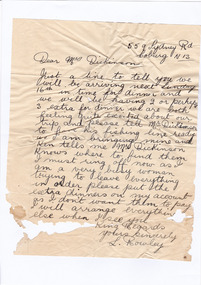 Marysville & District Historical Society
Letter (item) - Hand written letter, L. Rowley, Unknown
... A digital copy of a hand written letter confirming the time of arrival of guests to Marysville House. Marysville House was built in the late 1920s by Arthur Dickinson....A digital copy of a hand written letter confirming the time of arrival of guests to Marysville House....Marysville & District Historical Society 39 Darwin Street Marysville yarra-valley-and-the-dandenong-ranges A digital copy of a hand written letter confirming the time of arrival of guests to Marysville House. Marysville House was built in the late 1920s by Arthur Dickinson. ...A digital copy of a hand written letter confirming the time of arrival of guests to Marysville House. Marysville House was built in the late 1920s by Arthur Dickinson.A digital copy of a hand written letter confirming the time of arrival of guests to Marysville House. Marysville House was built in the late 1920s by Arthur Dickinson.marysville, victoria, australia, marysville house, arthur james dickinson, grace dickinson, arnold spooner, eileen marie spooner, eileen marie dickinson, grace sweetland, eric dowdle, elsie may denton, elsie may dickinson, peter dickinson, linda dickinson, 2009 black saturday bushfires, letter, l. rowley -
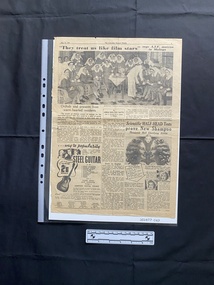 Returned Nurses RSL Sub-branch
Newspaper - Newspaper clipping, The Australian Women's Weekly, Orchids and presents from warm-hearted residents, 19410510
... Article describing the early experiences of Australian Imperial Forces (AIF) nurses in Malaya, including their arrival, leisure time activities and thoughts on the local people, climate and landscape. ...Article describing the early experiences of Australian Imperial Forces (AIF) nurses in Malaya, including their arrival, leisure time activities and thoughts on the local people, climate and landscape. ...Article describing the early experiences of Australian Imperial Forces (AIF) nurses in Malaya, including their arrival, leisure time activities and thoughts on the local people, climate and landscape. Quotes from unnamed nurses and Matron Olive Dorothy Paschke.A large newspaper page featuring a large black and white group photo above a related story and ads. The photo shows a large group of women in nurses' uniforms standing and seated, with three others dressed all in white amongst them.wwii, ww2, world war two, malaya, aif nurses -
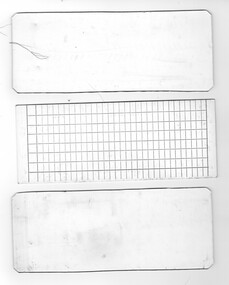 Melbourne Tram Museum
Functional object - Inspectors table holder, Melbourne & Metropolitan Tramways Board (MMTB), 1960's to 1980's
... Normally the card would be used to note the suburban terminus departure time, city arrival time, their monitoring point, eg a junction, and other major points. ...Normally the card would be used to note the suburban terminus departure time, city arrival time, their monitoring point, eg a junction, and other major points. ...Tramway Inspectors table holder - two sheets of Perspex with a ruled card between them held with an elastic or rubber band. Use by Inspectors to hold headway cards which they hand wrote out to suit themselves and their method of monitoring services. Inspector's would use a soft pencil on the Perspex sheet to mark off the services as they past their monitoring point. Normally the card would be used to note the suburban terminus departure time, city arrival time, their monitoring point, eg a junction, and other major points. They could also record crew change overs for meals and with other trams on them and what runs their next did. (Advice from Peter Winspur 24-3-2016) Five additional blank copies of the cards from a donation of Kevin Tierney added 5/8/2016. Addition blank card from donation of Gavin Young added 22/12/2020.trams, tramways, mmtb, timetables, buses, trams, inspectors -
 Greensborough Historical Society
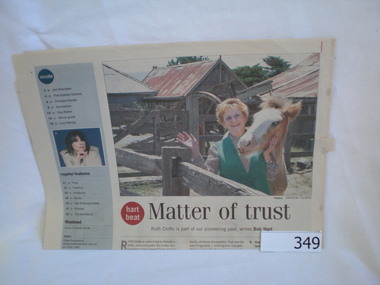
Newspaper clipping, Matter of Trust, 24/01/2004
... Details the history of Gulf Station Yarra Glen and the Bell family from their time of arrival in Victoria in 1839....Greensborough Historical Society 34A Glenauburn Road Lower Plenty Lower Plenty melbourne Details the history of Gulf Station Yarra Glen and the Bell family from their time of arrival in Victoria in 1839. Origins of a pioneering family with some links to Greensborough. gulf station charles la trobe william bell ruth crofts bell family happy hollow Newspaper article on the Gulf Station Yarra Glen and the Bell family. ...Details the history of Gulf Station Yarra Glen and the Bell family from their time of arrival in Victoria in 1839.Origins of a pioneering family with some links to Greensborough.Newspaper article on the Gulf Station Yarra Glen and the Bell family. Includes text and photograph of Ruth Crofts.gulf station, charles la trobe, william bell, ruth crofts, bell family, happy hollow -
 Clunes Museum
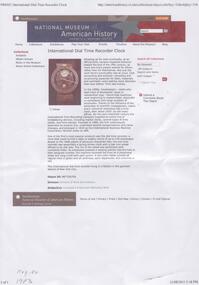
Functional object - TIME CLOCK, International Business Machines Pty. Ltd, 1924
... A LEVER WITH PUNCH LIKE DEVICE TO RECORD TIME OF ARRIVAL AND DEPARTURE OF EMPLOYEES. A DOUBLE ROW OF HOLES ROUND THE EDGE OF A WHEEL NUMBERED 1 - 100, BEING EMPLOYEES NUMBERS. ...A LEVER WITH PUNCH LIKE DEVICE TO RECORD TIME OF ARRIVAL AND DEPARTURE OF EMPLOYEES. A DOUBLE ROW OF HOLES ROUND THE EDGE OF A WHEEL NUMBERED 1 - 100, BEING EMPLOYEES NUMBERS. ...THIS TIME CLOCK WAS USED IN THE INTERKNIT HOSIERY CO. KNITTING MILL FROM 1946 - 1977 TO RECORD EMPLOYEES TIME SHEET WHICH IS PLACED IN THE GLASS FRONTED CUPBOARD BEHIND BEHIND AND WHEEL.BROWN VARNISHED CUPBOARD WITH TIME CLOCK ON FRONT. A LEVER WITH PUNCH LIKE DEVICE TO RECORD TIME OF ARRIVAL AND DEPARTURE OF EMPLOYEES. A DOUBLE ROW OF HOLES ROUND THE EDGE OF A WHEEL NUMBERED 1 - 100, BEING EMPLOYEES NUMBERS. INTERNATIONAL BUSINESS MACHINES (IBM) TIME RECORDING CLOCK.local history, horology, chronometers, knitting mill interknit hosiery co. -
 Melbourne Tram Museum
Pamphlet, Yarra Trams, "Free TramTracker", Apr. 2013
... Pamphlet, DL, printed on gloss card, titled "TramTracker" - Yarra Trams real time tram arrival information. Has the TramTRACKER logo (dog) foldout at the top of the card when folded into half. ...Melbourne Tram Museum 8 Wallen Road Hawthorn melbourne Trams tramways Yarra Trams TramTracker Tram Stops Operations Computer Systems Pamphlet, DL, printed on gloss card, titled "TramTracker" - Yarra Trams real time tram arrival information. Has the TramTRACKER logo (dog) foldout at the top of the card when folded into half. ...Pamphlet, DL, printed on gloss card, titled "TramTracker" - Yarra Trams real time tram arrival information. Has the TramTRACKER logo (dog) foldout at the top of the card when folded into half. Provides instructions how to use it on the iPhone, Android and other smartphones. and computer systems. Advises passengers where to find the TramTRACKER ID for each stop. .1 - Hangingtrams, tramways, yarra trams, tramtracker, tram stops, operations, computer systems -
 Bendigo Historical Society Inc.
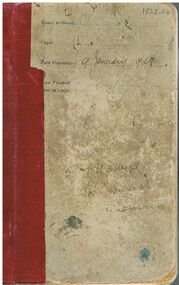
Book - BADHAM COLLECTION: VICTORIAN RAILWAYS NOTE BOOK DATED 9.1.1928
... Number and Class of Vehicles, Tonnage Contents, Total Description of Loading from Station to Station, Time of arrival and departure, Loco shunting, Van goods, Blocked by signals, other causes. ...Number and Class of Vehicles, Tonnage Contents, Total Description of Loading from Station to Station, Time of arrival and departure, Loco shunting, Van goods, Blocked by signals, other causes. ...VICTORIAN RAILWAYS small note book, hard cover with purple binding dated 9.1.1928. Each page details the Name of the Driver, Fireman, Van man and State of weather. Number and Class of Vehicles, Tonnage Contents, Total Description of Loading from Station to Station, Time of arrival and departure, Loco shunting, Van goods, Blocked by signals, other causes. Inside cover steam train instructions from T.B Molomby, General Supt, of Transportation. Reference is David Badham.document, memo, railway, victorian railways small note book, hard cover, t.b molomby, general supt, of transportation -
 Bendigo Historical Society Inc.
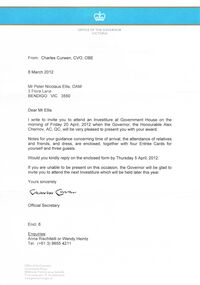
Document - PETER ELLIS COLLECTION: LETTER TO PETER ELLIS FROM CHARLES CURWEN
... Notes for your guidance concerning time of arrival, the attendance of relatives and friends, and dress, are enclosed, together with four Entrée cards for yourself and three guests. ...Notes for your guidance concerning time of arrival, the attendance of relatives and friends, and dress, are enclosed, together with four Entrée cards for yourself and three guests. ...Letter written to Peter Ellis from Charles Curwen, CVO, OBE. Office of the Governor Victoria. Dated 8 March 2012. Mr Peter Nicolaus Ellis, OAM 3 Flora Lane Bendigo Vic 3550. Dear Mr Ellis I write to invite you to attend an Investiture at Government House on the morning of Friday 20 April, 2012 when the Governor, the Honourable Alex Chernov, AC, QC, will be very pleased to present you with your award. Notes for your guidance concerning time of arrival, the attendance of relatives and friends, and dress, are enclosed, together with four Entrée cards for yourself and three guests. Would you kindly reply on the enclosed form by Thursday 5 April, 2012. If you are unable to be present on this occasion, the Governor will be glad to invite you to attend the next Investiture which will be held later this year. Yours sincerely Charles Curwen Official Secretary Encl.6 Enquiries: Anna Rischitelli or Wendy Heintz Tel. (+61 3) 9655 4211 Office of the Governor Government House Melbourne Victoria 3004 Australia T +61 3 9655 4211 F +61 3 9650 9050 www.governor.vic.gov.auperson, individual, peter ellis oam -
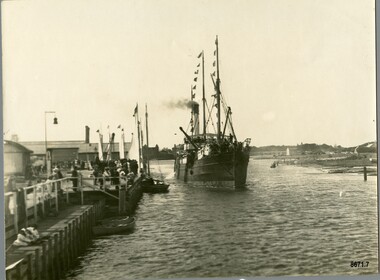 Flagstaff Hill Maritime Museum and Village
Photograph - S. S. Casino, Early 19th century
... Casino said "owned by Port Fairy interests, she was an integral part of the town's development ... for a long time, her arrival in Port Fairy was an event, the townspeople going down to the wharf to see her come in". ...Casino said "owned by Port Fairy interests, she was an integral part of the town's development ... for a long time, her arrival in Port Fairy was an event, the townspeople going down to the wharf to see her come in". ...This photograph was one of ten photographs donated to Flagstaff Hill Maritime Museum and Village by Fred Trewartha. Frederick John Fox Trewartha (Fred) was a well-known Warrnambool businessman. He was born in Beeac near Geelong in 1920 and came to Warrnambool with his family as a very young child. He was apprenticed to his father John, as a saddler and later opened his own shop on Raglan Parade. He then moved into working with tarpaulins and canvases for the trucking industry. Fred was keenly interested in photography (and was a member of the Warrnambool Cine Club), yachting and boat building. He kept his yacht moored at Port Fairy for many years and participated in sailing events locally and interstate. He also built boats with his sons. He had the opportunity to meet many older sailors and it's thought this photo (and others in the set) may have been given to him by one of these men. Fred Trewartha died in 2016 in Warrnambool. The S.S. Casino was a passenger and freight steamer built in Dundee, Scotland, in 1882 for the Newcastle and Hunter River Steam Navigation Company of N.S.W. She weighed 425 tons gross with a length of 160.4 feet, beam of 24.1 feet and a depth of 10.2 feet. She had saloon accommodation for 35 people, a fore cabin for 25 more people, and she carried 300 tons of cargo. While on her delivery journey on May 30th 1882, the S.S. Casino called in at the Port of Warrnambool for coal, narrowly escaping going ashore in gale force winds due to the quick action of the pilot. At that time, still at anchor, she impressed the directors of the Belfast and Koroit Steam Navigation Company so much that they bought her immediately; she was ideal for trade along the West Coast of Victoria. (The Belfast and Koroit Steam Navigation Company was first managed by Messers. Saltau and Osburne and after the passing of Mr. Osburne, by produce merchants Messers H. Sautau and Sons, who had a hay and corn store and shipping agency on the corner of Liebig and Koroit Streets in Warrnambool. ) The S.S. Casino became “the most famous steamer to operate in Victorian waters along the West Coast” by author Jack Loney. Captain Boyd was her first Master, followed by Captain Chapman, who stayed with her from 1890 until 1924. Captain W. Robertson followed for a short term, and then Captain Middleton then took command from 1925 - 1932. An article published on Monday 11th June 1932 in The Sun News Pictorial (Melbourne) giving a detailed history of S. S. Casino said "owned by Port Fairy interests, she was an integral part of the town's development ... for a long time, her arrival in Port Fairy was an event, the townspeople going down to the wharf to see her come in". It also said "Except when the weather was bad, the Casino hugged the coast on her trips and passengers obtained wonderful views of the sandstone terraces and caves. A little time ago every member of her regular crew except one, was a Scotsman." This particular photograph of the S.S. Casino shows it decorated with numerous flags in "holiday rigging". During the years between 1884 and 1915, the Casino would take locals and holiday makers on excursions around the Port Fairy Bay. Local towns such as Terang, Penshurst and Mortlake held their Picnic Days in Port Fairy and excursions on the Casino would be available for them and in 1906 Terang and District Schools held an excursion to Port Fairy (where the Casino was organised to provide a series of trips around the Bay.) In 1916 new regulations introduced by the Marine Board requiring the Casino to carry enough lifebelts for every passenger on board, prevented the steamer from making trips around the Bay on excursion days. The S.S. Casino had several mishaps during her life. One was on 3rd January 1898 when she collided with the S.S. Flinders in Apollo Bay with minor damage. Another was on 24th October 1924 when she grounded on a reef at Point Hawdon near Grey River and most of her cargo (of Christmas goods) had to be dumped into the sea. Then in February 1929 she was ‘holed’ when she struck a submerged object as she entered Lady Bay, Warrnambool. In the years following the turn of the century, the S.S. Casino remained the only regular trader with normal passenger accommodation along the West Coast. From 1882 she had made at least 2,500 voyages on the one run. On the morning of 10th July 1932, after attempting to berth at Apollo Bay jetty in heavy seas, Captain Middleton decided to take her out into the bay and wait until the seas abated. It was not realised that the anchor used to steady her as she manoeuvred to her berth had pierced her hull. She put about and headed for the beach but sank. Captain Middleton and nine others lost their lives; nine people were rescued including the two female passengers. Captain Middleton had been in charge of the S.S. Casino for seven years. He was the first ship’s Master to lose his life in a shipwreck in the West Coast trade. In June 1932, the directors of the Belfast and Koroit Steam Navigation Company had proposed to celebrate the completion of fifty years of trading by the steamer Casino in August, but tragically the Casino was wrecked only one month later (and "was only one month off completing its fifty years of valuable service between Melbourne and Portland.") Flagstaff Hill’s collection has a photograph of a portrait of Captain Chapman, a ship model of the S.S. Casino that shows both forms of power under which she sailed, steam and sail. The ship is painted green and flies three flags. The inscription across the case of the ship model, incorrectly dated, tells the sad story of the wreck of the ship and the loss of lives on July 10th 1932 at Apollo Bay. A print in the Collection shows S.S. Casino underway in the heavy sea off Point Lonsdale, another two photographs show her at the Port of Warrnambool, leaving from the Breakwater in Lady Bay and another identifies the S.S. Casino as a ship from the Belfast and Koroit Steam Navigation Company. (Belfast is the original name for the township of Port Fairy).This photograph is significant because of its association with the coastal trader S.S. Casino and its significance to trade along Victoria's West Coast in the late 19th and early 20th centuries. The wreck of the S.S. Casino is considered an important part of Victorian and Australian cultural heritage and as such has been declared and protected as an Historic Shipwreck under State and Commonwealth Law in the Commonwealth Historic Shipwrecks Act (1976).A black and white photograph showing a small steamer with decorative flags on both masts, coming into up a river towards a pier where a small crowd is waiting. The pier on the left of the photograph has several buildings and a bell on it. Three small boats are tied up to the dock. Low lying land with several buildings scattered on it can be seen on the right hand side. On the back of the photograph are handwritten labels. One is printed in dark blue ink and one is written in cursive writing in biro. There is also the number 6944 stamped in the centre of the photograph.Back - Donors name, address and telephone number 6944 "CASINO IN HOLIDAY RIG" "at Port Fairy"flagstaff hill maritime museum and village, warrnambool, great ocean road, shipwreck coast, s. s. casino, steamer casino, casino, port fairy, captain chapman, belfast and koroit steam navigation company, saltau and osburne, captain middleton, apollo bay, apollo bay shipwreck, lady bay -
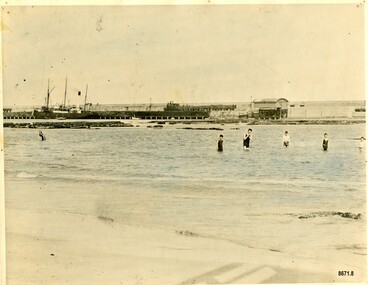 Flagstaff Hill Maritime Museum and Village
Photograph - Vessel S. S. Casino in Lady Bay Warrnambool, 1920's - 1930's
... Casino said "owned by Port Fairy interests, she was an integral part of the town's development ... for a long time, her arrival in Port Fairy was an event, the townspeople going down to the wharf to see her come in". ...Casino said "owned by Port Fairy interests, she was an integral part of the town's development ... for a long time, her arrival in Port Fairy was an event, the townspeople going down to the wharf to see her come in". ...This photograph was one of ten photographs donated to Flagstaff Hill Maritime Museum and Village by Fred Trewartha. Frederick John Fox Trewartha (Fred) was a well-known Warrnambool businessman. He was born in Beeac near Geelong in 1920 and came to Warrnambool with his family as a very young child. He was apprenticed to his father John, as a saddler and later opened his own shop on Raglan Parade. He then moved into working with tarpaulins and canvases for the trucking industry. Fred was keenly interested in photography (and was a member of the Warrnambool Cine Club), yachting and boat building. He kept his yacht moored at Port Fairy for many years and participated in sailing events locally and interstate. He also built boats with his sons. He had the opportunity to meet many older sailors and it's thought this photo (and others in the set) may have been given to him by one of these men. Fred Trewartha died in 2016 in Warrnambool. Warrnambool by the 1920's and 1930's had become a popular holiday destination with visitors arriving by steamer and train. It was during these decades that a "Surf Bathers Association" began in Warrnambool in response to the growing popularity of local sea bathing. They worked with the local council to develop a "Beach Improvement Fund" and a comprehensive plan of "Beach Improvement" which included erecting and maintaining beach boxes, building a kiosk, improving paths and roads to the beach, planting marram grass on the sand dunes, building new enclosures for vehicles and horses and generally making the beach more attractive for visitors and townspeople. The 1930's was also an era when free "Herald" Learn-to-Swim classes were being held throughout Victoria. In 1931 it was reported in "The Age" newspaper that "over the past week in Warrnambool, 250 pupils had passed through the hands of the local life saving club swimming instructors". The Port of Warrnambool - In the early years the Port of Warrnambool was a busy port. Steamships and sailing ships were frequent visitors to the port. Steam navigation companies were plentiful, carrying passengers and freighting cargo such as coal, timber, food, livestock, furniture, hardware and haberdashery between Melbourne and the ports along the southwest coast of Victoria, including Warrnambool. The carts would take their loads into the township for distribution. The Breakwater was built (using 32 ton blocks of concrete) between 1874 and 1890 to provide ships with greater protection from the Southern Ocean. The Lifeboat and Rocket House - The coastline of South West Victoria has had over 600 shipwrecks and many lost lives; even in Warrnambool’s Lady Bay there were around 16 known shipwrecks between 1850 and 1905, with eight lives lost. In 1859 the first Government-built lifeboat arrived at Warrnambool Harbour and a shed was soon built to house it, followed in 1864 by a rocket house to safely store the Rocket Rescue equipment. In 1878 the buildings were moved to the Breakwater area, and in 1910 the new Lifeboat Warrnambool arrived with its ‘self-righting’ design. For almost one hundred years the lifeboat and rocket crews, mostly local volunteers, trained regularly to maintain and improve their skills, summoned when needed by alarms, gunshots, ringing bells and foghorns. Some became local heroes but all served an important role. By the end of the 1950s the lifeboat and rescue equipment had become obsolete. The S.S. Casino was a passenger and freight steamer built in Dundee, Scotland, in 1882 for the Newcastle and Hunter River Steam Navigation Company of N.S.W. She weighed 425 tons gross with a length of 160.4 feet, beam of 24.1 feet and a depth of 10.2 feet. She had saloon accommodation for 35 people, a fore cabin for 25 more people, and she carried 300 tons of cargo. While on her delivery journey on May 30th 1882, the S.S. Casino called in at the Port of Warrnambool for coal, narrowly escaping going ashore in gale force winds due to the quick action of the pilot. At that time, still at anchor, she impressed the directors of the Belfast and Koroit Steam Navigation Company so much that they bought her immediately; she was ideal for trade along the West Coast of Victoria. (The Belfast and Koroit Steam Navigation Company was first managed by Messers. Saltau and Osburne and after the passing of Mr. Osburne, by produce merchants Messers H. Sautau and Sons, who had a hay and corn store and shipping agency on the corner of Liebig and Koroit Streets in Warrnambool. ) The S.S. Casino became “the most famous steamer to operate in Victorian waters along the West Coast” by author Jack Loney. Captain Boyd was her first Master, followed by Captain Chapman, who stayed with her from 1890 until 1924. Captain W. Robertson followed for a short term, and then Captain Middleton then took command from 1925 - 1932. An article published on Monday 11th June 1932 in The Sun News Pictorial (Melbourne) giving a detailed history of S. S. Casino said "owned by Port Fairy interests, she was an integral part of the town's development ... for a long time, her arrival in Port Fairy was an event, the townspeople going down to the wharf to see her come in". It also said "Except when the weather was bad, the Casino hugged the coast on her trips and passengers obtained wonderful views of the sandstone terraces and caves. A little time ago every member of her regular crew except one, was a Scotsman." The S.S. Casino had several mishaps during her life. One was on 3rd January 1898 when she collided with the S.S. Flinders in Apollo Bay with minor damage. Another was on 24th October 1924 when she grounded on a reef at Point Hawdon near Grey River and most of her cargo (of Christmas goods) had to be dumped into the sea. Then in February 1929 she was ‘holed’ when she struck a submerged object as she entered Lady Bay, Warrnambool. In the years following the turn of the century, the S.S. Casino remained the only regular trader with normal passenger accommodation along the West Coast. From 1882 she had made at least 2,500 voyages on the one run. On the morning of 10th July 1932, after attempting to berth at Apollo Bay jetty in heavy seas, Captain Middleton decided to take her out into the bay and wait until the seas abated. It was not realised that the anchor used to steady her as she manoeuvred to her berth had pierced her hull. She put about and headed for the beach but sank. Captain Middleton and nine others lost their lives; nine people were rescued including the two female passengers. Captain Middleton had been in charge of the S.S. Casino for seven years. He was the first ship’s Master to lose his life in a shipwreck in the West Coast trade. In June 1932, the directors of the Belfast and Koroit Steam Navigation Company had proposed to celebrate the completion of fifty years of trading by the steamer Casino in August, but tragically the Casino was wrecked only one month later (and "was only one month off completing its fifty years of valuable service between Melbourne and Portland.") Flagstaff Hill’s collection has a photograph of a portrait of Captain Chapman, a ship model of the S.S. Casino that shows both forms of power under which she sailed, steam and sail. The ship is painted green and flies three flags. The inscription across the case of the ship model, incorrectly dated, tells the sad story of the wreck of the ship and the loss of lives on July 10th 1932 at Apollo Bay. A print in the Collection shows S.S. Casino underway in the heavy sea off Point Lonsdale, another two photographs show her at the Port of Warrnambool, leaving from the Breakwater in Lady Bay and another identifies the S.S. Casino as a ship from the Belfast and Koroit Steam Navigation Company. (Belfast is the original name for the township of Port Fairy).This photograph is significant because of its association with the coastal trader S.S. Casino and its significance to trade along Victoria's West Coast in the late 19th and early 20th centuries. The wreck of the S.S. Casino is considered an important part of Victorian and Australian cultural heritage and as such has been declared and protected as an Historic Shipwreck under State and Commonwealth Law in the Commonwealth Historic Shipwrecks Act (1976). It is also significant as it shows the early years of tourism in Warrnambool and the important role the beach played in the lives of residents and visitors.A black and white photograph (with colour tinting) showing Lady Bay in Warrnambool with the Breakwater in the background. The S. S. Casino is moored at the Breakwater and the lifeboat shed and a coal train can be seen on the Breakwater. Six swimmers are standing in the water. On the back of the photograph are the donor's name and telephone number (written in black biro) and the name of the S. S. Casino and its tonnage written in blue ink. A blurred number has been stamped on plus a "M' written in pencil.Donor's name, address and phone number / "S. S. Casino" / "500 TONS" / "REG" "- - - 09 " (blurred numbers) / "M"warrnambool, great ocean road, shipwreck coast, lady bay, breakwater, fred trewartha, frederick john fox trewartha, surf bathers association, sea bathing, swimming, warrnambool beach, beach improvement fund, port of warrnambool, steamships, lifeboat house, rocket house, lifeboat crew, s. s. casino, belfast and koroit steam navigation company, saltau and osburne, captain middleton, apollo bay, apollo bay shipwreck -
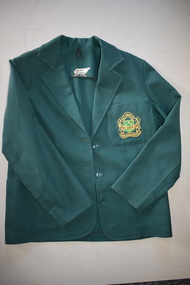 Warrnambool and District Historical Society Inc.
Textile - Artefact : Textile, St Ann's College Blazer, C1980's
... arrival, and the first school was opened that same year. It was initially known as St Mary's and had both day and boarding scholars. When the chapel was built in 1888, the name was changed to St Ann's. It operated as both primary and secondary education until 1974 and in 1991 it amalgamated with nearby St Joseph's CBC and became co-educational operating as Emmanuel College. At that time...arrival, and the first school was opened that same year. It was initially known as St Mary's and had both day and boarding scholars. When the chapel was built in 1888, the name was changed to St Ann's. It operated as both primary and secondary education until 1974 and in 1991 it amalgamated with nearby St Joseph's CBC and became co-educational operating as Emmanuel College. At that time ...St Ann's college history dates back to 1872 with the arrival in Warrnambool of eight Sisters Of Mercy from Ireland. They purchased Wyton House, which was the former home of Mr William Ardlie, soon after their arrival, and the first school was opened that same year. It was initially known as St Mary's and had both day and boarding scholars. When the chapel was built in 1888, the name was changed to St Ann's. It operated as both primary and secondary education until 1974 and in 1991 it amalgamated with nearby St Joseph's CBC and became co-educational operating as Emmanuel College. At that time the uniform changed from the familiar green with yellow to navy blue and maroon. The motto translate as Work conquers all. This blazer belonged to one of the last students to attend both St Ann's College and Emmanuel College and was Vice Captain of Emmanuel College in Year 12. IAn item which would have many local memories and connections with large numbers of children attending the school in close to 150 years of education in Warrnambool.Bottle green woollen school blazer with three green buttons and three pockets . The school monogram is sewn on the top left pocket. It is stitched in yellow with school motto in black. Lighter green stitching in the background. Name tag glued at back.Monogram has St Ann's Warrnambool, Omnia Vincit Labor. Jacinta Murphy is on the name tag.st ann's college warrnambool, emmanuel college, warrnambool, wyton house, sister of mercy warrnambool -
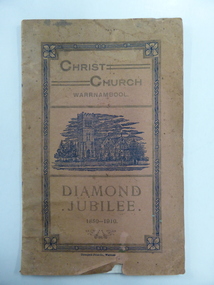 Warrnambool and District Historical Society Inc.
Booklet - Christ Church Warrnambool, Christ Church Warrnambool Diamond Jubilee 1850-1910, 1910
... arrival of the first minister, the Rev. Peter Beamish. He served in the Warrnambool district until 1895. The foundation stone of Christ Church was laid in 1855 and the church was consecrated in 1862. A tower was erected in 1881. At the time...arrival of the first minister, the Rev. Peter Beamish. He served in the Warrnambool district until 1895. The foundation stone of Christ Church was laid in 1855 and the church was consecrated in 1862. A tower was erected in 1881. At the time ...This booklet was produced for the Diamond Jubilee of Christ Church, Warrnambool in 1910. The Anglican Church was established in Warrnambool in 1850 with the arrival of the first minister, the Rev. Peter Beamish. He served in the Warrnambool district until 1895. The foundation stone of Christ Church was laid in 1855 and the church was consecrated in 1862. A tower was erected in 1881. At the time of the Diamond Jubilee the Anglican Minister in Warrnambool was Archdeacon Peacock. This booklet is of interest because it is a memento of the 1910 Diamond Jubilee celebrations at Christ Church, Warrnambool. This is a soft cover booklet of 24 pages. The cover is brownish orange in colour with a sepia image of Christ Church, Warrnambool on the front with gold lettering within an ornate border in sepia tonings. The booklet contains several black and white photographs, the programme of events for the Diamond Jubilee in 1910 and historical information on the church and its ministers. The printed material in the booklet is contained within a red-lined border. The booklet has been stapled but the staples have been removed. The front cover is stained and torn at the bottom edge. christ church warrnambool, warrnambool, christ church, diamond jubilee christ church -
 Warrnambool and District Historical Society Inc.
Book, Welsh Bible, 1864
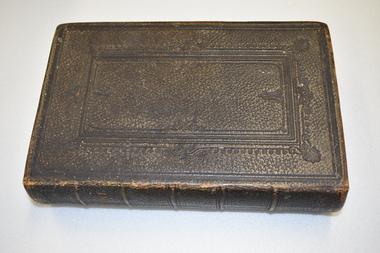
... The date of the Bible 1864 fits with their arrival in Australia in 1865. The Morgan family have been connected to Allansford from that time. ...The date of the Bible 1864 fits with their arrival in Australia in 1865. The Morgan family have been connected to Allansford from that time. ...As written in the note inserted in the front of the bible ,"This Welsh Bible was brought to Australia by John Morgan and his wife Sarah in 1865. With baby daughter Mary, they settled at Allansford, where John took up land "Acme" farm. Their other children Margaret, Jane, Evan, Lewis and Elizabeth were born there." The Memorial card provides the additional information that Sarah Morgan died July 30th 1906 at the age of 68. The date of the Bible 1864 fits with their arrival in Australia in 1865. The Morgan family have been connected to Allansford from that time. This bible has significance social and historical significance as the Bible was common in many family homes. This one written in Welsh shows the connection between the origins of the Morgan family and their new country. It is well provenanced and is well connected to the district.Dark brown leather cover over card.The pages are edged in gold and the front and and back covers have a rectangular scrolled design . The pages are not numbered.There is an envelope inside the front cover with a George Hose docket for threshing wheat, barley and oats and an In Memoriam card for Sarah Morgan who dies July 30th 1906. There is also a handwritten note with the owners details and a navy ribbon which may have been attached at one time.There are no inscriptions on the bible itself but the handwritten card reads, " This Welsh Bible was brought to Australia by John Morgan and his wife Sarah in 1865. With baby daughter Mary, they settled at Allansford, where John took up land"Acme" farm. Their other children Margaret, Jane, Evan, Lewis and Elizabeth were born there. There is also an envelope dated 2004 and addressed to Mr Bill Morgan 6 Vera St Iluka NSW 2466. Watkins Binder label inside the back cover.allansford, welsh bible, morgan family, sarah and john morgan -
 Warrnambool and District Historical Society Inc.
Booklet, A band of gypsies: employees of Niel Black & Co in the pre-goldrush era: a work in progress
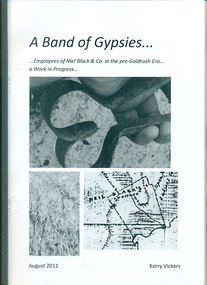
... The employees' names, birthplace, arrival date, marriage partner/s, other employers are tabulated. An overview of Black's properties and conditions of the time is also included....The employees' names, birthplace, arrival date, marriage partner/s, other employers are tabulated. An overview of Black's properties and conditions of the time is also included. ...Niel Black was an early settler in the Western District of Victoria who held large tracts of land including Glenormiston and The Sisters estates. Black was responsible for bringing many employees to the area. The employees' names, birthplace, arrival date, marriage partner/s, other employers are tabulated. An overview of Black's properties and conditions of the time is also included.This booklet documents those who came to the Western District to work for Niel Black prior to the goldrushes of the 1850s.In-house booklet with plastic sleeve outer cover, with black & white images of sheep shears, wool and a map of the Black property. All text is in black.emigration, employment, family history, early victorian squatters, niel black -
 Warrnambool and District Historical Society Inc.
Booklet, Grand Centenary process, 1947
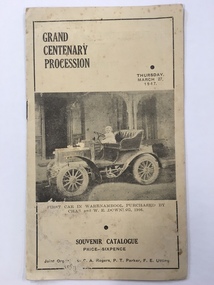
... arrival of the first European settlers in the town. The 1947 celebrations included a Grand Procession which was estimated to have been watched by 20,000 people. A similar number saw the bonfire and fireworks display in Albert Park the same evening. The celebrations lasted a week and included a choral thanksgiving festival in the Botanic Gardens, a massed band display and a ‘Warrnambool Can Make It’ exhibition of local manufactures. The well-known historian and Town Clerk at the time...arrival of the first European settlers in the town. The 1947 celebrations included a Grand Procession which was estimated to have been watched by 20,000 people. A similar number saw the bonfire and fireworks display in Albert Park the same evening. The celebrations lasted a week and included a choral thanksgiving festival in the Botanic Gardens, a massed band display and a ‘Warrnambool Can Make It’ exhibition of local manufactures. The well-known historian and Town Clerk at the time ...This is a program of the Centenary Procession that took place in Warrnambool in 1947 to celebrate the 100th anniversary of the city’s founding in 1847. It was originally intended to celebrate the 100th anniversary in 1940 but these celebrations were postponed because of World War Two. In 1947 centenary celebrations were held but on a less lavish style. 1947 was a more appropriate year as 1847 was the year of the first land sales for Warrnambool and the arrival of the first European settlers in the town. The 1947 celebrations included a Grand Procession which was estimated to have been watched by 20,000 people. A similar number saw the bonfire and fireworks display in Albert Park the same evening. The celebrations lasted a week and included a choral thanksgiving festival in the Botanic Gardens, a massed band display and a ‘Warrnambool Can Make It’ exhibition of local manufactures. The well-known historian and Town Clerk at the time, Henri Worland took a prominent role in the organizing of the celebrations. This little booklet is of considerable importance because it contains a short description of the floats and the names of those connected with the various floats of the Warrnambool Centenary Procession of 1947. It not only gives us a better idea of what and who were in the procession but it now enables us to better label the many photographs we have of this procession and to identify the people in the photographs. The program is a valuable source of information for historians. It also is a good example of the type of celebratory procession that was popular 70 years ago. This is a paper program of the Warrnambool 1947 Centenary procession. It has four pages and a buff-coloured cover. The front cover has a sepia-toned photograph of the first car purchased in Warrnambool (1906) and on the back cover there is an advertisement for Lane’s Bus Services. The inside front cover has an advertisement for Guyett and Sons Furniture Store and there are other advertisements throughout the pages. The printed text on buff-coloured paper gives details of the 29 floats in the ‘Mechanized’ Section and of the 27 floats in the ‘Back to the Horse Pageant’ Section. The pages were stapled but the staples have been removed. There has been some silverfish damage. Front Cover: ‘Grand Centenary Procession, Thursday, March 27, 1947, Souvenir Catalogue, Price Sixpence, Joint Organisers, C.A.Rogers, P.T.Parker, F.E.Utting’. warrnambool centenary, 1947 henri worland -
 Warrnambool and District Historical Society Inc.
Legal record - Letter Book, G.S. Mackay, Circa 1920
... S Mackay was prominent in legal, civic and religious life in Warrnambool almost from the time of his arrival in 1893 until his death in 1926. ...This book contains private letters which G. S. Mackay wrote to his daughter, Meta? and his aunt in the 1920’s. G. S. Mackay was born in Sutherlandshire Scotland in 1850. He qualified as a solicitor and came to Australia in 1884 and later to Warrnambool in 1893. He served as a Warrnambool City Councillor and also held a number of important positions within the Presbyterian Church. He was one of the earliest and strongest supporters of the Warrnambool High School. Many of the letters within this book are to his daughter who studied medicine in Glasgow in the early 1900’s. G. S Mackay was prominent in legal, civic and religious life in Warrnambool almost from the time of his arrival in 1893 until his death in 1926. Many of these letters are of a religious nature and as such display that aspect and personal thoughts of Mr Mackay’s personal life. Dark green fabric cover with light brown suede spine and cover edges. Hard cover. Green patterned paper inside front and back covers. Alphabetical index at front. Pale fine yellow pages numbered up to 502. L. ****Queen Douglas, Newpark West Calder, MidLothian 14 miles from Edin’h Ry Stn Newpark. Meta Selby The Calouda(?) Club 35 St Georges Square London S.W.1 warrnambool, g.s. mackay letter book, solicitor, g. s mackay councillor. -
 Kiewa Valley Historical Society
Photograph Tawonga Hotel, Tawonga Hotel Circa 1940s - 1950s, circa 1940s to 1950s
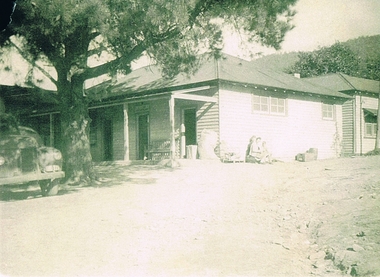
... time restrictions were in place. "In transit" clients were given some leniency when staying in small country hotels as strict liquor laws This photograph presents a window to a life in the 1940s to 1950s, of a small town in the Kiewa Valley. It covers a period when the local hotel or "pub" was the meeting point for local men and women to talk about local events and life in general. It was also a point where "locals' had the first opportunity to meet new arrivals ...This photograph shows the "lay back" atmosphere enjoyed in a small country town in the 1940s to the 1950s. Two women and a young boy basking in the warmth of the sun. The unsealed drive way and cars parked close to the entrance was typical of small towns during this period. Open doors and shady trees provided sufficient cooling for most sunny days. The wooden barrel next to the outside wall shows that storage space within the hotel was limited and that metal aluminium barrels had not been in existence. This photograph was taken at a time when children and women had limited access to the major drinking and entertainment facilities within a hotel(pub). Legal drinking age was for patrons 21 years and older and no strict dress codes where applied. The hotel bar was not open on Sundays (God fearing) and opening time restrictions were in place. "In transit" clients were given some leniency when staying in small country hotels as strict liquor laws This photograph presents a window to a life in the 1940s to 1950s, of a small town in the Kiewa Valley. It covers a period when the local hotel or "pub" was the meeting point for local men and women to talk about local events and life in general. It was also a point where "locals' had the first opportunity to meet new arrivals and converse with tourists and "through traffic". The importance of "face to face" verbal communication was a critical part of community life and interaction. The hotel(pub) was in this period the hub of small communities, and together with local churches provided the essential structure for a balanced existence in rural Australia.Black and white photo of Tawonga Hotel. This photo is in itself a photo of a photo and as such lacks fine detail. This reproduction is on "Kodak XtraLife II paper ""outback" hotels, pubs, rural short stay accommodation, tawonga hotel -
 Orbost & District Historical Society
film wallets, Early 20th century
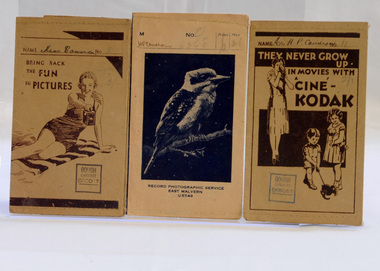
... They are colourful reminders of a time period when people eagerly awaited the arrival of their processed prints. ...These photograph wallets were use in the first half of the 20th century when films were sent away to be processed. Kodak used these packaging items to promote their brand. Images of women were very popular on these wallets, with the ‘Kodak Girl’ positioned by Kodak as an important mascot or symbol to suggest the ease and accessibility of photography to the masses – a symbol which drew on traditional understandings of gender roles.They are colourful reminders of a time period when people eagerly awaited the arrival of their processed prints. The most striking examples date from the 1930s and demonstrate how Kodak used these packaging items to promote their brand. . (ref.KODAK HERITAGE COLLECTION newsletter) Three envelopes for holding photographs. They are cardboard envelopes with sewn edges. They have advertising for Kodak film, prices of printing. On 1504.2 - Record Photographical Service East Malvern U5549.Hanwritten in ink: 1504.1 -Miss Cameron 1504.2-H.P. Cameron 1504.3 Mr H.P. Cameron 1504.1 and 1504.3 stamped Gough Chemist Orbostphotography kodak -
 Orbost & District Historical Society
dentist's chair, approx. 1860's - 1890's
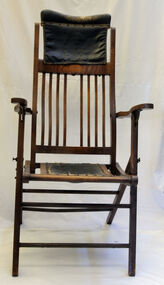
... Until the arrival of 'specialist' dentists in the mid-nineteenth century, dental care was provided by the medical profession and druggists, who were eventually registered under two British Acts, the Colonial Medical Act (1858) and the Colonial Dentists Act (1878). Many isolated communities had problems gaining access to dentists, and were often served by dentists on a part-time...Orbost & District Historical Society Ruskin Street Orbost gippsland Until the arrival of 'specialist' dentists in the mid-nineteenth century, dental care was provided by the medical profession and druggists, who were eventually registered under two British Acts, the Colonial Medical Act (1858) and the Colonial Dentists Act (1878). Many isolated communities had problems gaining access to dentists, and were often served by dentists on a part-time ...Until the arrival of 'specialist' dentists in the mid-nineteenth century, dental care was provided by the medical profession and druggists, who were eventually registered under two British Acts, the Colonial Medical Act (1858) and the Colonial Dentists Act (1878). Many isolated communities had problems gaining access to dentists, and were often served by dentists on a part-time basis, mainly providing extraction and denture servicesThis item is an example of early dentistry equipment.Portable dentist's chair from around 1900's. Leather headrest and seat, wood frame, with metal bolts to allow chair to recline.chair furniture-commercial dentistry -
 Flagstaff Hill Maritime Museum and Village
Textile - Tapestry, Mary O'Brien, Gerda Shanley, Judith Stewart, Beryl Conlan (crafts people), 1988
... The tapestry introduces the seafaring theme of Flagstaff Hill Maritime Museum and Village, and illustrates a timeline of events dating back to the arrival of Europeans in the Warrnambool area. It begins with the settlement of the area by Europeans and travels back in time as you walk further into the gallery, depicting shipwrecks along the coast, whaling in the area, early exploration by Europeans James Grant and Nicholas Baudin, back to the indigenous settlement of the area, represented by middens and indigenous symbols. ...The tapestry introduces the seafaring theme of Flagstaff Hill Maritime Museum and Village, and illustrates a timeline of events dating back to the arrival of Europeans in the Warrnambool area. It begins with the settlement of the area by Europeans and travels back in time as you walk further into the gallery, depicting shipwrecks along the coast, whaling in the area, early exploration by Europeans James Grant and Nicholas Baudin, back to the indigenous settlement of the area, represented by middens and indigenous symbols. ...This creative tapestry, woven in 1988, documents a thousand years of Warrnambool history. It hangs in the Great Circle Gallery at Flagstaff Hill and complements the theme of the display. Three local women, with the help of Museum staff, researched and designed the tapestry, which was woven in 1988 from wool and cotton. It is ten meters long and seventy centimetres high. The beautiful creation took seven months to create. The tapestry introduces the seafaring theme of Flagstaff Hill Maritime Museum and Village, and illustrates a timeline of events dating back to the arrival of Europeans in the Warrnambool area. It begins with the settlement of the area by Europeans and travels back in time as you walk further into the gallery, depicting shipwrecks along the coast, whaling in the area, early exploration by Europeans James Grant and Nicholas Baudin, back to the indigenous settlement of the area, represented by middens and indigenous symbols. Interestingly, before being hung in the gallery, the tapestry was originally hung with the intention of being framed from right to left. All materials in the cotton and wool tapestry, including dyed wool, were prepared for a cost of $33,000. The project was supported by local philanthropic groups.The tapestry is a hand worked creation by local women. It shows a visual display of a thousand years of Warrnambool's history, connecting the land and sea to people and events.Tapestry of the early history of the Warrnambool area, rectangular in shape. Materials include cotton and wool, some of the wool being hand-dyed. Handmade in 1988 by local women.A plaque accompanies the Tapestry "Flagstaff Hill Maritime Tapestry / 1989 / Tapestry: Woven Cotton and Wool / Mary O'Brien Gerda Shanley / Judith Stewart Beryl Conlan"flagstaff hill, flagstaff hill maritime museum and village, warrnambool, maritime museum, maritime village, great ocean road, shipwreck coast, tapestry, warrnambool history, warrnambool textiles, wall hanging, weave, south west victoria history, south west victoria timeline, indigenous people, early settlement, whaling, james grant, nicholas baudin, cotton, wool, dyed yarn, handmade, hand-dyed yarn -
 Eltham District Historical Society Inc
Audio - Audio Recording, Katherine Sheedy, Interview: Russell Yeoman, 25 March 2024
... Russell discussed his arrival in Eltham in the 1960s, working as an engineering and then town planner for the shire, changes in Eltham over time including from a town planning perspective, the unique character of Eltham and challenges this led to, the book Pioneers & Painters, forming the Shire of Eltham Historical Society, the Local History Centre, and what is unique about Eltham....Russell discussed his arrival in Eltham in the 1960s, working as an engineering and then town planner for the shire, changes in Eltham over time including from a town planning perspective, the unique character of Eltham and challenges this led to, the book Pioneers & Painters, forming the Shire of Eltham Historical Society, the Local History Centre, and what is unique about Eltham. ...NILLUMBIK SHIRE COUNCIL ORAL HISTORY PROJECT Interview: Russell Yeoman Date: Monday 25 March 2024 Place of Interview: Russell’s home in Eltham Interviewer: Katherine Sheedy; Way Back When Consulting Historians In 2023 Nillumbik Shire Council agreed to support two Oral History projects associated with local history groups within the shire. One project was training sessions for group members on undertaking oral history recordings, which occurred in November 2023. The other project involved a professional historian recording two selected history group members, which occurred in March 2024. The interviews were undertaken by Katherine Sheedy of Way Back When Consulting Historians. Russell Yeoman, a life member of the Eltham District Historical Society, first came to Eltham in 1964 when he was employed in Engineering and later as a Town Planner with the former Shire of Eltham. Following Council amalgamation and the establishment of the new Shire of Nillumbik (December 1994), Russell carried over to Nillumbik for a brief period. Russell was a founding member of the Shire of Eltham Historical Society in 1967 which following Council amalgamation was renamed the Eltham District Historical Society. Russell is the Society Secretary and has held that volunteer position for more than 55 years. Russell discussed his arrival in Eltham in the 1960s, working as an engineering and then town planner for the shire, changes in Eltham over time including from a town planning perspective, the unique character of Eltham and challenges this led to, the book Pioneers & Painters, forming the Shire of Eltham Historical Society, the Local History Centre, and what is unique about Eltham.audio recording, eltham, eltham district historical society, oral history, russell yeoman -
 Eltham District Historical Society Inc
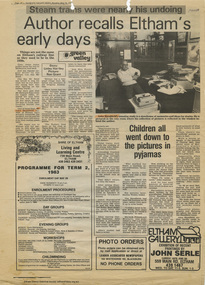
Folder, John Handfield
... arrival in 1919 and departure in 1928. With a postscript that John Handfield returned in 1961 to a house designed by friend Robin Boyd and built 1961. At the time...arrival in 1919 and departure in 1928. With a postscript that John Handfield returned in 1961 to a house designed by friend Robin Boyd and built 1961. At the time ...1. News clipping: Author recalls Eltham's early days; story by Linley Hartley, photo by Ron Grant; Diamond Valley News, Thursday, May 24, 1983, p26 (On reverse side, p25, "A pot for every purpose" about potter Joan Armfield with references to artis Davd Armfield) 2. Three pages typed copy of John Handfield's original letter to Blanche Shallard (of the Shire of Eltham Historical Society), 16 May 1989 detailing the Handfield family's life in Eltham and various personalities between their arrival in 1919 and departure in 1928. With a postscript that John Handfield returned in 1961 to a house designed by friend Robin Boyd and built 1961. At the time of the letter John and Esta Handfield had been the only owners. 3. Note from John Handfield to Ron Smith about a proposed talk (to the Historical Society?) to tell the story about the writing of Friends and Brothers. Proposed title of talk "You Never Know What's Around The Corner" plus several copies of book reviews • Photocopy of news clipping; The rector who created a vision; Review by Bishop Holland; Newcastle Morning Herald, c.1980 - Book review of FRIENDS AND BROTHERS, The Life of Father Tucker, Founder of the Brotherhood of St Laurence and Community Aid Abroad, by John Handfield, Hyland House Publishing Pty Ltd • Photocopy of news clipping; The clergyman whose monuments continue to do good; Review by Geoffrey Hutton; Publication unknown, c.1980 - Book review of FRIENDS AND BROTHERS, The Life of Father Tucker, Founder of the Brotherhood of St Laurence and Community Aid Abroad, by John Handfield, Hyland House Publishing Pty Ltd • Photocopy of news clipping; Helper of the defeated; Review by Sandy Murray; Publication unknown, c.1980 - Book review of FRIENDS AND BROTHERS, The Life of Father Tucker, Founder of the Brotherhood of St Laurence and Community Aid Abroad, by John Handfield, Hyland House Publishing Pty Ltd • Photocopy of news clipping; Friends and Brothers by John Handfield; Review by Bishop James Grant; Publication unknown, c.1980 - Book review of FRIENDS AND BROTHERS, The Life of Father Tucker, Founder of the Brotherhood of St Laurence and Community Aid Abroad, by John Handfield, Hyland House Publishing Pty Ltd • Photocopy of news clipping; Off and running on his third career by Stuart Sayers; Writers & Readers, The Age, Saturday 17 January 1981 • Photocopy of news clipping; Determined to succeed; Review by Roy Cassin; The West Australian, n.d. - Book review of FRIENDS AND BROTHERS, The Life of Father Tucker, Founder of the Brotherhood of St Laurence and Community Aid Abroad, by John Handfield, Hyland House Publishing Pty LtdFolder of information on John Handfield, author, Elthamjohn handfield, joan armfield, david armfield, handfield family, eltham, 16 homestead road, handfield house, anne hunniford, dave lyon, esta handfield, mechanics insitute, mr bond, rechabite hall, robin boyd, rutter family, bishop reginald stephen, clem christesen, desmond annear, dr kent hughes, ethel boake, handfield street, john harcourt, kooringoorama, lady longstaff, nina christesen, peter street, shillinglaw farm, sir john longstaff, stanhope, yarra braes, a. copeland, alf baker, baker's cottage, ballakian, belackian, beulah alice rutter, bill withers, bird brothers cash grocer and fruiterer, blacksmith, burgoyne grocery store, butcher, david rutter, donald rutter, e. copeland, edward gadd, ernest james andrew, fanny withers (nee flinn), hubert rutter, jack baker, jack ryan, june rutter, margery withers, newsagency, oakley, ronnie baker, silver street bridge, tessie baker, walter withers, burke and wills, father g k tucker, frederick oliver handfield, friends and brothers (book), muriel elizabeth handfield (nee cochran), ss victoria, st laurence and community aid abroad, stanhope house, theodore louis hopton handfield, book review -
 The Beechworth Burke Museum
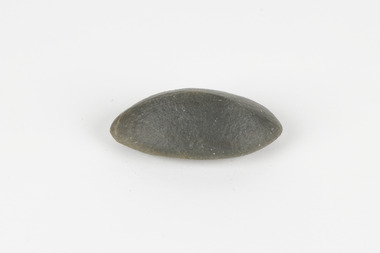
Geological specimen - Ventifact (wind- or ice-shaped) pebble
... The survey was conducted by Alfred Richard Cecil Selwyn from his arrival in December 1852 until his resignation in 1869and during this time he trained many notable geologists, e.g. ...Ventifacts are sand-blasted rocks that are typically faceted and often display parallel grooves carved by wind-blown sand. They are useful indicators of wind direction and strength in environments such as deserts, mountains, and coastal areas because they are usually not hidden by later sediment, soil or vegetation cover. In Antarctica ventifaction is strongly related to the composition or type of rock. Ventifacts are important because they provide evidence for abraders such as sand, dust or snow and ice crystals, and offer a unique understanding of past wind processes that are effective in the reconstruction of past wind flow conditions and can provides clues to weather and climate changes in the past. Interestingly ventifacts have also been found on the surface of Mars. They were a threat to the NASA rover due to the sharp angles of the facets, created by the Martian wind over the course of millions of years. These Martian ventifacts act like weathervanes for past wind and weather patterns on the red planet in a similar manner to those found on earth.The Geological Survey of Victoria was instigated in response to the Victorian Gold Rush which began around 1851 in the Beechworth, Castlemaine, Daylesford, Bendigo and Ballarat areas. The survey was conducted by Alfred Richard Cecil Selwyn from his arrival in December 1852 until his resignation in 1869and during this time he trained many notable geologists, e.g. Aplin, Wilkinson, Daintree, who went on to other State survey senior positions. This specimen was among those donated to the Burke Museum in 1868.A hand-sized solid mineral specimen in shades of dark and light browns with light lines visible in all configurations and a groove on configuration 2.light lines visible in all configurations and a groove on configuration 2burke museum, beechworth, geological, geological specimen, ventifact, antarctic region, antarctic, alfred richard cecil selwyn, alfred selwyn, wind direction, wind strength, abraders, wind flow, climate change, reconstruction of wind flow conditions, weather change, mars -
 Phillip Island and District Historical Society Inc.
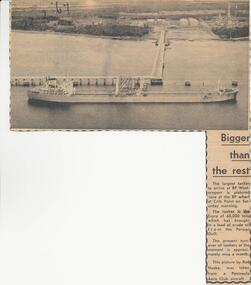
Newspaper clippings, 22/02/1967
... Phillip Island and District Historical Society Inc. phillip-island-and-the-bass-coast Collection of newspaper clippers in scrap book dated 1960 - 1973 local history newspapers westernport oil installation arrival of tanker "esyra" Crib Point Jean Jamieson Article re the tanker, "Esyra" arriving at Crib Point refinery with Persian Gulf oil. The largest tanker to arrive at that time ...Collection of newspaper clippers in scrap book dated 1960 - 1973Article re the tanker, "Esyra" arriving at Crib Point refinery with Persian Gulf oil. The largest tanker to arrive at that time. Aerial photo of the tanker at Crib Point Jetty.local history, newspapers, westernport oil installation, arrival of tanker "esyra", crib point, jean jamieson -
 Mission to Seafarers Victoria
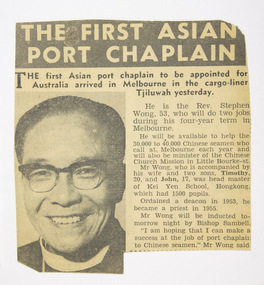
Article - Newspaper Clipping, The First Asian Port Chaplain, 1963
... arrival in Melbourne by Bishop Sambell. The family arrived on the cargo -liner "Tjiluwah". Rev'd Stephen Wong was the first Asian Port Chaplain appointed and worked at the Mission part-time form 1963-1968. ...Appointed to both the Mission to Seamen and the Chinese Church Mission in Little Bourke St Rev'd Wong and his family commenced his appointment at the Mission in 1963. A former head of the 1500 student Kei yen school , Hong Kong he was accompanied by his wife and two sons Timothy and John. Ordained a Deacon in 1953 he became a priest in 1955 and was inducted on arrival in Melbourne by Bishop Sambell. The family arrived on the cargo -liner "Tjiluwah".Rev'd Stephen Wong was the first Asian Port Chaplain appointed and worked at the Mission part-time form 1963-1968. He played an important role in raising awareness among asian seamen and was perhaps the inspiration behind the first Mission brochures to be printed in Chinese characters. Undated / unsourced news clipping featuring head shot photograph of Rev'd Stephen Wong and description of new role at the Mission and was minister of the Chinese church in little Bourke St.stephen wong, timothy wong, padre stephen wong, hong kong -
 Mission to Seafarers Victoria
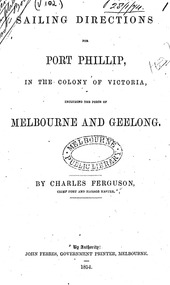
Booklet - Manual, Sailing directions for Port Phillip, in the colony of Victoria including the ports of Melbourne and Geelong, 1854
... There were at that time, according to the returns, no fewer than 54 vessels, registering 26,785 tons, in Hobson’s Bay alone. The crews on arrival...There were at that time, according to the returns, no fewer than 54 vessels, registering 26,785 tons, in Hobson’s Bay alone. The crews on arrival ...Captain Charles Ferguson was born in Scotland in 1813. He was the Master of the "Rajah" from 1838 to 1850 on voyages from England to Australia and vice versa. He became the First Chief Harbour Master for the port of Melbourne in 1852 after being the first Harbour Master and Water Police Officer in Geelong for 12 months. On the 5th of April 1841, the Rajah sailed with James Donovan M.D. as Surgeon Superintendent, and the Rajah sailed from Woolwich with 180 female convicts. The Rajah arrived on the 19th of July in Hobart, with 179 females (one died during the voyage) and 10 children. Miss Kezia Elizabeth Hayter was the matron on board. On page 28 of the "Sailing directions for Port Phillip, in the colony of Victoria including the ports of Melbourne and Geelong", a mention is made of the Mariner's Hospital and Floating Church soon to be established. There were discussions to built the hospital in Williamstown but instead the Government decided to build it in Melbourne. The Harbour Master and a commiittee decided to use the water police hulk, Emily, left unsold in 1856, to create a floating church: the Bethel was open in July 1857 with Reverend Kerr Johnston as Chaplain. Latrobe wrote a letter to Captain Cole in 1869, a few months after learning his death : "To Captain George Ward Cole † [from a draft in another’s hand] Clapham House, Lewes, Sussex, January 28th, 1869. My dear Captain Cole, Last mail will have taken out the sad intelligence of the death of our excellent old friend, Captain Ferguson. This will have been a terrible blow to his children and to his friends in the colony, who may have held reason to expect his early return to his home, with a not unreasonable prospect of ultimate restoration to health and activity. In the course of last October I went up to town with one of my children, mainly with the purpose of finding my way to Pinner, where he and Mrs. Ferguson were staying with an intimate friend. I found him in excellent health and spirits, and enjoying the prospect of a speeding resumption of the service to which he had devoted his best days, and upon the furtherance of which his entire energy was still directed. A week or two later Captain and Mrs. Ferguson went to Dover for change of air, and being still under the impression received from the advisers by whom they had been guided during their residence at a hydropathic establishment at Matlock, felt encouraged to plan almost immediate return to the colony by the Jerusalem early in December. However, certain misgivings in the mind of a medical gentleman, then in England, under whose care Captain Ferguson had at one time placed himself in Williamtown, led them to consider it judicious before departure to take the advice of some surgeon of eminence in London. Accordingly they came up to town at the close of November. The first London practitioners they consulted shook their heads, and advised consultation with Sir Wm. Ferguson. The result was that amputation, without loss of time, was pronounced necessary. The rest is soon told. He received the painful intelligence with calmness and full resignation to God's will, and underwent the operation at King's College Hospital with exemplary firmness and Courage on the 28th of November. Perfect success seemingly attended it, and there seemed, humanly speaking, to be every prospect of a prompt cure and early convalescence; everything seemed in his favour. A few days later, however, all was clouded by symptoms of hospital fever (pyoe æm ia). This resisted all control, and finally carried him off on the 27th of December, just one month after the operation. He had lived a Christian life, and his death was the peaceful and resigned death of a Christian. It was a melancholy satisfaction to me to be able to join a few friends in following his remains to their resting place in one of the outlying London cemeteries on the last day of the year. You know Mrs Ferguson well, and will be prepared to hear me say that her whole conduct and demeanour throughout this period of suspense and bitter trial has been worthy of her high character and steadfast principle. Come what will, and happen what may, I have the fullest conviction that neither the widow nor the children will be forsaken, however doubtful and clouded the future may appear, in consequence of the irreparable loss which, they have sustained. And now, dear Captain Cole, it is possible that you may already have heard all this from other sources, but I have dictated it to you under strong impulse, for I feel assured that there is no member of the community in which you live who will more sincerely deplore the loss of Captain Ferguson on private grounds; at the same time that there is no one who, from long acquaintance with his official character and services, will be in a better position to estimate their real value or the loss which the colony has sustained. The circumstances in which Captain Ferguson's family are left not only demands the utmost display of sympathy and interest on the part of friends, but may call for decided and prompt action; therefore I cannot rest satisfied without discharging what I consider my duty, and seeking to strengthen your hands as far as I may in bringing the character of his long services before the existing colonial authorities. Of his private career previous to his entering the service of the Colonial Government in 1851 nothing need be said. Captain Ferguson was appointed as the Harbour Master at Geelong in April, 1851 – a few months before the separation of the colony from New South Wales. He there did excellent service in a variety of ways calculated to advance the interests of the port, and to introduce www.latrobesociety.org.au 27 order, where, from circumstances, but little order had hitherto prevailed. His was the first appointment of this class in that locality. The separation of the colony from New South Wales took place in the month of July following. Shortly after, the late Captain Bunbury resigned the Harbour Mastership of Port Phillip. Captain Ferguson was at once (February, 1852) appointed to succeed him, and from that time performed all duties of Chief Harbour Master of the colony. The previous year (May 1851) the first gold discoveries in New South Wales had taken place, and in the month of August those of our colony followed. At the time of Captain Ferguson’s taking charge of the Port of Melbourne their influence had begun to be fully felt, and in no department more seriously than in that of the Harbour Master. This is no place for statistical details, but they must bear me out in reminding you of a few facts connected with our late friend’s career. At the time of separation that department comprised only 30 individuals of all ranks, and when he took charge the number was much reduced. There were at that time, according to the returns, no fewer than 54 vessels, registering 26,785 tons, in Hobson’s Bay alone. The crews on arrival numbered 1,235 men. Of this number only 463 remained on board, 500 having deserted, and the rest having been discharged by arrangement or pure necessity. For the first six months after Captain Ferguson’s assumption of office as Harbour Master the duties of Police Magistrate and Chief of the Water Police were superadded, and how much labour they involved may be surmised from the fact that from 1st of April to the 31st July, 1852, four months only, no less than 236 marine cases were brought before the bench at Williamstown - sometimes as many as 30 in a day. A year later (March 1853) the returns show that the number of vessels in the harbour in Hobson’s Bay alone were 91, tonnage 43,754; and passing on to the still later returns of May, 1853, two years after Captain Ferguson’s assumption of office, we find from the records that the number of ships in port had increased to 129; tonnage, 63,292; crew on board on arrival, 2872, and at the date of report, 1628; the amount of desertions at that time having, however, proportionally diminished, in consequence of the abatement of the gold fever, caused by the non-success attendant upon the labours of thousands at the goldfields. The above numbers take no account of the large number of vessels and amount of tonnage lying at the wharves at Melbourne or elsewhere. From these figures alone it may be judged what must have been a struggle in which the Chief Harbour Master was engaged from the very outset to secure order, and answer the innumerable calls on every branch of his department, at the same time that there was for many months an almost complete impossibility of securing subordinate agency, such as boatmen, pilots, and police, at any price. But I may bear witness to the untiring diligence, energy, and self-devotion with which Captain Ferguson grappled with the difficulties of his position, and the seemingly insurmountable obstacles which stood in his way. Ashore and afloat he was always ready, showing the same directness of purpose, intelligence, and forgetfulness of self. He shunned no responsibility, and turned his hand from no work, whether within or beyond the ordinary scope of his duty, which the hard necessity of the times forced the Government to bring under his notice. Already in 1852, when the overflowing of our gaol and stockade rendered the adoption of other methods of restraint absolutely necessary, and addition to the existing buildings could not be thought of, it was Captain Ferguson who first suggested the employment of hulks; and it was with his personal assistance and supervision, and under his unflagging energy, that the three first of these – the Success, the President, and the Sacramento – were purchased, fitted up, and made available for the purpose in view, and the rules and regulations for the employment and safety of the men afloat and ashore prescribed and carried out. He carried the same energy into every branch of his department, and his influence was soon apparent. His subordinates of every class became actuated by his spirit. As time moved on, the range of his duties, both ordinary and extraordinary, increased. In the formation of the quarantine station at the heads, in the management if not the erection of lighthouses, sailing directions, port and wharf regulations, buoys, signal stations, www.latrobesociety.org.au 28 steam dredging &c., he was the main and most active agent. The whole pilot establishment and regulations, men, and vessels, were under his charge; and when I left the colony in May, 1854, the entire range of ports outside Port Phillip Heads from Point Lonsdale to Portland, as well as that of Geelong had felt the influence of his intelligent supervision and care. The entire department of Chief Harbour Master, which I have numbered at the period of separation about thirty individuals, then numbered 230. The character of Captain Ferguson’s unbroken service during the fourteen years which have elapsed since I left the colony must be well known to the Government and the people he has served so long and so faithfully. I confine myself to recalling to mind those earlier, and what must have been the hardest and most difficult, period – none can know how difficult but those who were in that fierce struggle for the maintenance of order under so many disadvantages; and on this subject I have spoken advisedly and with reason, for I may truly say he worked under my own eye. I had sincere regard for the man, and just pride in the qualities of his heart, head, and hand. Whatever mistakes may have been made by the Government of the colony in those hard and difficult times (and I am quite ready to admit that there were many, especially if the past is to be judged by the light of the present), I never have hesitated in believing that, in appointing Captain Ferguson to the office he has so long filled, it was the right man in the right place. I shall be heartily rejoiced to find that the Government and inhabitants of the colony admit that this has been the case, and to learn that they have not forgotten the strong claims of one who has served them so long and so faithfully, and who, removed by God’s providence, so to say, in the maturity of his powers, has left a widow and young family behind him. I have done, I leave you to make use of this communication, or any portion of it, which you may think judicious and called for. There may be among Ferguson’s friends those who may not be sorry to be reminded of facts. By-the-bye, I may mention as a proof how completely Captain Ferguson’s mind was engrossed by devotion to his public duty, that while in Dover, only ten days before the operation, he took an opportunity to drag himself up into the lantern of the S. Foreland Lighthouse, and made a most careful scrutiny of the whole apparatus and arrangement, with a view of the adoption of any hint for the perfection of those under his charge in the colony. And now, goodbye. I trust this will find you in good health, and in comparative vigour. Believe me ever, dear Captain Cole, Yours very truly, C. J. La Trobe"The attempt for a floating church was made as early as 1853 following similar examples in London like the Seamen's Hospital. Captain Ferguson was instrumental in the foundation of the Bethel Church.Digital copies of the 37 pages ; 22 cm.1854, hobsons bay, geelong, melbourne, williamstown, sandridge, mariner's hospital, floating church, seamen's hospital, captain charles ferguson (1813-1868), kezia elizabeth hayter (1818-1885), rajah quilt, prison hulks, water police, harbour master, harbor master, gaols -
 Mission to Seafarers Victoria
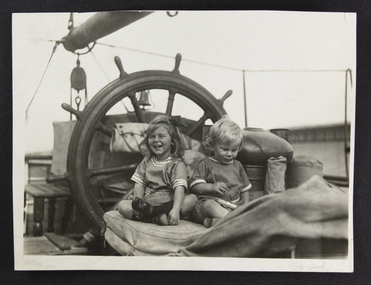
Photograph - Photograph, Black and white, 1918
... arrival in St John, New Brunswick, Canada, she succumbed in November 1918 after spending a week in the Parks Hospital. Herbert Aviss was left with 2 toddlers and a 3 month old baby. He went back to England with his children in March 1919 on passenger ship, accompanied by a nurse. Martin Frampton and his wife were in New York at the time...arrival in St John, New Brunswick, Canada, she succumbed in November 1918 after spending a week in the Parks Hospital. Herbert Aviss was left with 2 toddlers and a 3 month old baby. He went back to England with his children in March 1919 on passenger ship, accompanied by a nurse. Martin Frampton and his wife were in New York at the time ...The LHLG newsletter of 1918 features this image and notes that they accompanied their shipmaster father Captain Aviss, of the Barque Inverneill who with his wife Catherine Florence Aviss, travelling through dangerous European waters, brought the family of three children to visit Melbourne. The two children featured are Margaret and Ronald, born at sea in 1915. Their young sister, Ruth Neil, was also born at sea on the 27 August 1918. The family re-united with a first meeting for the children and grandparents, Captain and Mrs Frampton, who "had lost two ships to enemy submarines and were now on their third". The family participated in "a happy Communion service in our chapel , in which the parents and grandparents joined this formed the keystone of their visit to Melbourne". Unfortunately the young Mrs Aviss contracted the Spanish influenza on their arrival in St John, New Brunswick, Canada, she succumbed in November 1918 after spending a week in the Parks Hospital. Herbert Aviss was left with 2 toddlers and a 3 month old baby. He went back to England with his children in March 1919 on passenger ship, accompanied by a nurse. Martin Frampton and his wife were in New York at the time, but they probably learnt about Catherine's death in the local newspaper. A memorial plaque in her name unveiled in the chapel at the Mission in April 1919. The parents and grandparents left their names and signatures in the visitor book (0149) on the 28 April 1918.One of the rare stories of seafarer visits illustrated with a photograph of the children of a family accustomed to life aboard ship. The impact of influenza also affected this family and others are recorded amongst the supporters of the Mission and reflects the widespread impact that the epidemic of the post WW1 period had on people, Mission activities and restrictions affecting public events. Both Framptons and Aviss are noted in the annals of the Cape Horne society.Small monochrome photograph of two small children, a girl and a boy posed in front of the ship's wheel of a sailing vesselshipboard life, seafarer families, martin frampton, elizabeth frampton, herbert aviss, children, catherine florence aviss nee frampton, wwi, world war one, great war, first world war, german, submarine, u boat, torpedo, spanish influenza, flu, pandemic, st john, new brunswick, sea mites, wheel, boy, girl, margaret aviss, ronald aviss, ruth aviss, ruth neill aviss, ruth neill paterson nee aviss (1918-2017), ronald aviss (1915-1996)
