
Showing 41 items matching "asian women"
-
 Returned Nurses RSL Sub-branch
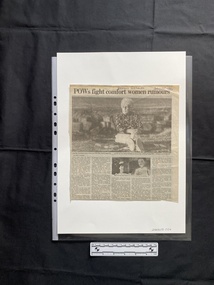
Newspaper - Newspaper clipping, [Weekened Australian], POWs fight comfort women rumours, [July 25 1992]
... ...Asian women...WWII World war two WW2 Sir William Webb Japanese Government Asian women Korea Palembang Sumatra Vyner Brooke Radji Beach Vivian Bullwinkel Melbourne 'WEEKEND AUSTRALIAN. ...For more than forty five years former Australian army nurses who were held as prisoners of war (POW) by the Japanese during World War 2 have battle rumour, insinuation and innuendo. An angry Mrs Wilma Young (nee Oram) is speaking out as a recent report on how an attempt had been made to force eight Australian nurses to become prostitutes or 'comfort girls' has been published by a leading Japanese newspaper, the Asahi. A large newspaper clipping featuring a large black and white photo with a smaller photo beneath and five columns of text. The large photo is of an older woman sitting on the ground, the smmaler photo isof the same woman when she was younger.'WEEKEND AUSTRALIAN. July 25 1992' [blue ink, along top right]wwii, world war two, ww2, sir william webb, japanese government, asian women, korea, palembang, sumatra, vyner brooke, radji beach, vivian bullwinkel, melbourne -
 Sunshine and District Historical Society Incorporated
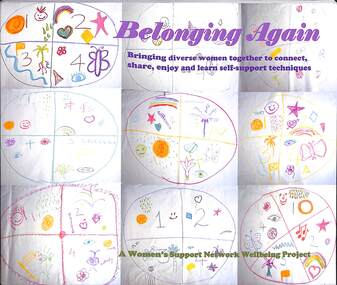
Book - Belonging Again, 2022
... Women... Asian...|Brimbank has significantly lower proportion of residents who were willing to help each other|During Covid-19 lockdowns, Brimbank residents reported feeling more stressed from trying to juggle demands of work, children, house duties, remote learning and finances Women Asian Belonging Again. Bringing diverse women together to connect, share,enjoy and learn self-supporting techniques. ...A soft covered bookwomen, asian -
 Musculoskeletal Health Australia (now held by the Glen Eira Historical Society)
Photograph - Group photo, Circa late 1990s to circa early 2000s
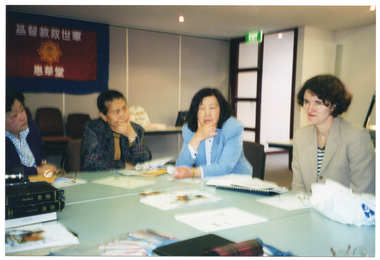
... In this photo, a female leader from an unidentified Asian community is speaking to a group of Asian women while the AFV's Liz Bongetti looks on....women seated at a group of tables pushed together. On the tables is some printed material, such as brochures, books, and booklets. Hanging on the wall is a large banner with a heading and sub-heading above and below a logo. The characters are in an Asian...In this photo, a female leader from an unidentified Asian community is speaking to a group of Asian women while the AFV's Liz Bongetti looks on. arthritis foundation of victoria afv culturally and linguistically diverse cald languages other than english lote migrant communities asian community leaders leaflets brochures fact sheets banner C1990s C2000s COL photo of several women seated at a group of tables pushed together. ...To increase its reach to Culturally And Linguistically Diverse Communities (CALD), the Arthritis Foundation of Victoria (AFV) created leaflets, brochures, and fact sheets in lanuguages other than English. In this photo, a female leader from an unidentified Asian community is speaking to a group of Asian women while the AFV's Liz Bongetti looks on.COL photo of several women seated at a group of tables pushed together. On the tables is some printed material, such as brochures, books, and booklets. Hanging on the wall is a large banner with a heading and sub-heading above and below a logo. The characters are in an Asian language. According to Google Translate, the characters are in the Chinese language. In the heading, they spell out the words "Christian Salvation Army", and "Huihuatang" in the sub-heading.arthritis foundation of victoria, afv, culturally and linguistically diverse, cald, languages other than english, lote, migrant communities, asian, community leaders, leaflets, brochures, fact sheets, banner, c1990s, c2000s -
 Musculoskeletal Health Australia (now held by the Glen Eira Historical Society)
Photograph - Group photo, Circa late 1990s to circa early 2000s
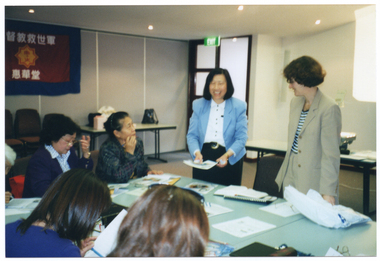
... In this photo, the AFV's Liz Bongetti and a female leader from an unidentified Asian community present a group of Asian women with some printed materials on arthritis....women standing is holding some printed material in her hands. Hanging on the wall is a large banner with a heading and sub-heading above and below a logo. The characters are in an Asian...In this photo, the AFV's Liz Bongetti and a female leader from an unidentified Asian community present a group of Asian women with some printed materials on arthritis. arthritis foundation of victoria afv culturally and linguistically diverse cald languages other than english lote migrant communities asian community leaders leaflets brochures fact sheets banner C1990s C2000s COL photo of two women standing at some tables in a hall, while several other women are seated at the table. ...To increase its reach to Culturally And Linguistically Diverse Communities (CALD), the Arthritis Foundation of Victoria (AFV) created leaflets, brochures, and fact sheets in lanuguages other than English. In this photo, the AFV's Liz Bongetti and a female leader from an unidentified Asian community present a group of Asian women with some printed materials on arthritis.COL photo of two women standing at some tables in a hall, while several other women are seated at the table. One of the women standing is holding some printed material in her hands. Hanging on the wall is a large banner with a heading and sub-heading above and below a logo. The characters are in an Asian language. According to Google Translate, the characters are in the Chinese language. In the heading, they spell out the words "Christian Salvation Army", and “Huihuatang" in the sub-heading.arthritis foundation of victoria, afv, culturally and linguistically diverse, cald, languages other than english, lote, migrant communities, asian, community leaders, leaflets, brochures, fact sheets, banner, c1990s, c2000s -
 Bendigo Military Museum
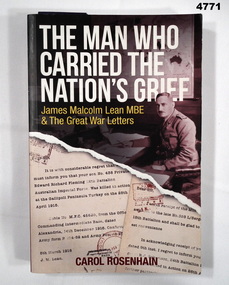
Book - BOOK of Correspondence of WW1, Big Sky Publishing Pty Ltd, "The Man Who Carried the Nation's Grief", 2016
... women working on typewriters. 440 pages, cut, plain, white paper. Illustrated black and white photographs. "The Man Who Carried the Nation's Grief" Book BOOK of Correspondence of WW1 Big Sky Publishing Pty Ltd Asia Pacific Offset Ltd ROSENHAIN Carol ...Collection of lettters from distressed families during WW1 to "Base Records" and the correspondence in reply signed by J.M. Lean.Soft cover book. Soft cover, cardboard: white, yellow and black print on front, spine and back. Front cover, background illustration montage of portrait photograph of a soldier in uniform and 2 typewritten letters in sepia tones. Back cover: sepia tones, photograph of a number of women working on typewriters. 440 pages, cut, plain, white paper. Illustrated black and white photographs.Collection of lettters from distressed families during WW1 to "Base Records" and the correspondence in reply signed by J.M. Lean.books, ww1, correspondence, biography -
 Kiewa Valley Historical Society
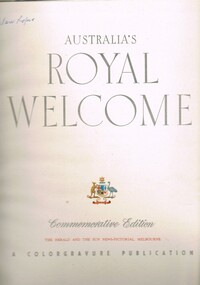
Book - Non Fiction History, Australia's Royal Welcome 1954, circa 1954
... women's organisations 2. to attend a Children's Display. She also visited Government House and visited Country Victoria on the Royal train from 24th Feb - 9th March. The Kiewa Valley and all the rural areas in the region were still very much tied to the "mother land" and trade between Britain and Australia was very strong. Trade with Asian ...This publication covers the mid 1900s and relates to a period where the majority of the Australian population was engrossed with the Queen of Australia, even though her Highness did not reside on this continent. The period covered was before the great immigration insurgence from Europe.The Labour Party's "White Australian" policy was a hinderance and a barrier towards the Asian and African prospective immigrants. The motto Queen and Country was still very ingrained in the rural population. This period in Australian domestic self reliance, brought about the growing strength and very active trade union movement and their staunch support for the Tariff protection against a growing swell of imported goods. This self reliance psyche was essentially a by product of World War II, and the isolation felt by the Australian People. The Queen (royalty) was the binding force holding the British Empire together which was emphasised with her popularity when touring Australia Queen Elizabeth's visited the MCG twice in 1954 1. to attend an assembly of ex-servicemen and women's organisations 2. to attend a Children's Display. She also visited Government House and visited Country Victoria on the Royal train from 24th Feb - 9th March.The Kiewa Valley and all the rural areas in the region were still very much tied to the "mother land" and trade between Britain and Australia was very strong. Trade with Asian manufacturers was minimal and needed the late 1900s to see both the trade and immigration barriers fall. This book was produced during a time when the majority of Australians looked more to England for trade and companionship. The agricultural trade with England and Europe was very high and the motto of the time was "Australia grows on the sheep's back". Late 1900's saw the motto "Australia grows on the miner's back" The Queen was still very popular then which was emphasised by the large crowds which greeted her on tour. Residents of Mt Beauty including Cubs, Brownies, Scouts and Guides travelled to Benalla to see the Queen. Clare Roper was a founding member of the KVHS and attended a garden party at Buckingham Palace representing the local CWA. She has purchased this book and therefore giving this a close historical significance connection, it has good provenance and interpretive capacity. This hard(blue coloured) covered book contains thirty six double sided pages. Both the first and last pages (inside cover included) has the royal crest of Australia (kangaroo and emu) balancing the individual six states crests ,united under the royal crown. The first six double pages, each portraying a coloured free hand sketches of various Australian scenery enclosing the Queen's day by day and State by State itinerary. There are 115 black and white photographs and 25 coloured photographs contained in this book.Third page has free hand penned signature "Clare Roper"1954 royal tour, queen elizabeth ii monarchy, british empire in the 1900s, god save the queen. -
 Federation University Historical Collection
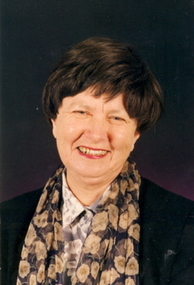
Article - Article - Women, University of Ballarat: Women of Note; Carolyn Blackman, Lecturer in Chinese Language, c1992 - 1999
... Asian Studies Unit, University of Ballarat. Prior to this Carolyn was a broadcaster in Chinese at Radio Australia. She moved to Singapore in 1968 and worked in broadcasts of Radio Singapura. She was also a foreign correspondent in Taiwan. In 1976 Carolyn Blackman set up Chinese language and studies at Melbourne Grammar School. Carolyn was appointed Director of the Centre for International Business at UB, and served on the Victorian Executive of the Australia China Business Council. Ballarat and Queen's Anglican Grammar School have The Carolyn Blackman Award for International Understanding which is presented each year. women ...Carolyn Blackman took up an appointment to teach Chinese at the University of Ballarat (UB) c1992. During her time at UB she developed, coordinated and taught Chinese language and associated Asian studies. She was the Director of Asian Studies Unit, University of Ballarat. Prior to this Carolyn was a broadcaster in Chinese at Radio Australia. She moved to Singapore in 1968 and worked in broadcasts of Radio Singapura. She was also a foreign correspondent in Taiwan. In 1976 Carolyn Blackman set up Chinese language and studies at Melbourne Grammar School. Carolyn was appointed Director of the Centre for International Business at UB, and served on the Victorian Executive of the Australia China Business Council. Ballarat and Queen's Anglican Grammar School have The Carolyn Blackman Award for International Understanding which is presented each year.women of note, carolyn blackman, university of ballarat, c1992 - 1999, chinese language, teacher, asian studies, director of asian studies unit, broadcaster chinese, radio australia, singapore, foreign correspondent, taiwan, chinese studies at melbourne grammar, international business at ub, australia china business council, ballarat and queen's grammar school, carolyn blackman award, international understanding -
 Federation University Historical Collection
Book - Book - Scrapbook, Ballarat School of MInes: Scrapbook of Newspaper Cuttings, Book 76, October 1996 to January 1997
... asia...self-styled award winners...women...The papers concerned are The Courier, Ballarat, The Australian, The Age and other region papers over the period of 25 October 1996 to 16 January 1997 teaching positions advertised pre-employment courses courses available enrolment for smb courses certificate in work education course students with disabilities smb founder's day brian mclennan kerrie cross bill gribble dennis olmstead susanne mckenzie sue labbett frank kitchen david nicholson max palmer mobile training facility farm machinery course murray cook phillip kinnersly performing arts "heat" and "heat 2" smb ceramics exhibition smb tafe college offer police recruitment testing tafe teachers in pay strike australian education union organiser eric sinkis derek van der bom ballarat uni smb launch writing course'smb seek part of $200m funds smb council demands explanation on axing bill gribble smb council president aboriginal art on display deanne jakiel ballarat academy of performing arts rich cultural heritage steinway gift to academy amy young smb subjects on internet the brewery complex farewell to long serving staff frank hurley pat hope bob morrell smb expands into ararat and asia self-styled award winners women in building industry janet bruce in course for females education ministers visit ballarat senator amanda vanstone phil honeywood victorian minister pam davies president smb council $145500 to smb edgar bartrop scholarship to jayson ryder Book with yellow cover, front, spiral bound. ...Collection of newspaper articles related to Ballarat School Of Mines.They cover activities and advertisements for staff. The papers concerned are The Courier, Ballarat, The Australian, The Age and other region papers over the period of 25 October 1996 to 16 January 1997Book with yellow cover, front, spiral bound. teaching positions advertised, pre-employment courses, courses available, enrolment for smb courses, certificate in work education course, students with disabilities, smb founder's day, brian mclennan, kerrie cross, bill gribble, dennis olmstead, susanne mckenzie, sue labbett, frank kitchen, david nicholson, max palmer, mobile training facility, farm machinery course, murray cook, phillip kinnersly, performing arts "heat" and "heat 2", smb ceramics exhibition, smb tafe college offer police recruitment testing, tafe teachers in pay strike, australian education union organiser eric sinkis, derek van der bom, ballarat uni smb launch writing course'smb seek part of $200m funds, smb council demands explanation on axing, bill gribble smb council president, aboriginal art on display, deanne jakiel, ballarat academy of performing arts, rich cultural heritage, steinway gift to academy, amy young, smb subjects on internet, the brewery complex, farewell to long serving staff, frank hurley, pat hope, bob morrell, smb expands into ararat and asia, self-styled award winners, women in building industry, janet bruce in course for females, education ministers visit ballarat, senator amanda vanstone, phil honeywood victorian minister, pam davies president smb council, $145500 to smb, edgar bartrop scholarship to jayson ryder -
Federation University Historical Collection
Book - Book - Scrapbook, Ballarat School of MInes: Scrapbook of Newspaper Cuttings, Book 77, January 1997 to April 1997
... The papers concerned are The Courier, Ballarat, The Australian, The Age and other region papers over the period of 18 January 1997 to 3 April 1997. teaching positions advertised pre-employment courses courses available enrolment for smb courses more adults attending courses brace upgrades $40000 smb the brewery complex john howard - prime minister visits ballarat opens brewery complex bill prior and fr martin hislop jeanette lowe - laurinda scholton - josephine birch sherryl anderson - robin boyd - peter morey $1.5m tafe campus start deb's fun approach to fitness richard de fegely overseas students papua new guinea western samoa phillippines thailand "dante's peak" director roger donaldson school's back - officially farming apprentices help fire victims karl britt and ian miller smb women's course 21 years on ballarat faces higher cost for water australian college of education awards smb $500000 debt paid by government video link with sister city melting pot of cultures at smb concert will aid academy pianist roger woodward roger donaldson - smb to hollywood bruce widdop lecturer bapa farm machinery repairs course asian student drive Book with yellow cover, front, spiral bound. ...Collection of newspaper articles related to Ballarat School Of Mines.They cover activities and advertisements for staff. The papers concerned are The Courier, Ballarat, The Australian, The Age and other region papers over the period of 18 January 1997 to 3 April 1997. Book with yellow cover, front, spiral bound. teaching positions advertised, pre-employment courses, courses available, enrolment for smb courses, more adults attending courses, brace upgrades, $40000, smb the brewery complex, john howard - prime minister, visits ballarat, opens brewery complex, bill prior and fr martin hislop, jeanette lowe - laurinda scholton - josephine birch, sherryl anderson - robin boyd - peter morey, $1.5m tafe campus start, deb's fun approach to fitness, richard de fegely, overseas students, papua new guinea, western samoa, phillippines, thailand, "dante's peak" director roger donaldson, school's back - officially, farming apprentices help fire victims, karl britt and ian miller, smb women's course 21 years on, ballarat faces higher cost for water, australian college of education awards, smb $500000 debt paid by government, video link with sister city, melting pot of cultures at smb, concert will aid academy, pianist roger woodward, roger donaldson - smb to hollywood, bruce widdop lecturer bapa, farm machinery repairs course, asian student drive -
Federation University Historical Collection
Book - Book - Scrapbook, Ballarat College of Advanced Education: Scrapbook of newspaper cutting, Book 15; January 1985 to August 1985
... The cuttings cover the period from 31 January 1985 to 22 August 1985. . employment advertisements application for enrolment outline of courses computing for engineers $24000for course new residential college for bcae sandy blythe's will to succeed aboriginal students at bcae beer of distinction geoffrey lowe wins award karen bibby jack barker new chair of australian council of directore and principals of cae peter pearson - teacher with class education method observations kenneth wullf european wasp menace fitness test for rowers "zigger zagger" production bcae to study ballarat volunteers ballarat photographic project world student games sharon stewart stephen moneghetti ian anderson r w richards obituary miles coverdale to head apprenticeship group dr murray gillan women as engineers ballarat asian links tertiary fees nursing's new era three course in nursing hospital-based training to end bill hitchins computer-swap to boost library jacki straude's exhibition louise tomlinson aids seminar at bcae statistic in map form accommodation to double bcae staff union branch death of allan sonsee naturalist brett robinson student union president inustry-bcae research bid engineering award winners mark davies grant mcghie pamela dethridge e j tippettretires tribute to antarctic explorer barry jones civil engineering award anthony sperber bush will be surveyed professor michael birt elizabeth miles national safety council trophy technology and old gold mines women in education still a 'privilege' ian moore - dean of education mining firm's prizes last intake of nursing students ballarat base hospital peter blizzard selkirk sculpture brick sculpture keating's budget Book with yellow cover, front. ...Newspaper cuttings relating to Ballarat College of Advanced Education. These are from various newspapers and include The Age, Ballarat Courier, The Australian, The Herald. The cuttings cover the period from 31 January 1985 to 22 August 1985. . Book with yellow cover, front. Spiral bound.employment advertisements, application for enrolment, outline of courses, computing for engineers, $24000for course, new residential college for bcae, sandy blythe's will to succeed, aboriginal students at bcae, beer of distinction, geoffrey lowe wins award, karen bibby, jack barker, new chair of australian council of directore and principals of cae, peter pearson - teacher with class, education method observations, kenneth wullf, european wasp menace, fitness test for rowers, "zigger zagger" production, bcae to study ballarat volunteers, ballarat photographic project, world student games, sharon stewart, stephen moneghetti, ian anderson, r w richards obituary, miles coverdale to head apprenticeship group, dr murray gillan, women as engineers, ballarat asian links, tertiary fees, nursing's new era, three course in nursing, hospital-based training to end, bill hitchins, computer-swap to boost library, jacki straude's exhibition, louise tomlinson, aids seminar at bcae, statistic in map form, accommodation to double, bcae staff union branch, death of allan sonsee, naturalist, brett robinson, student union president, inustry-bcae research bid, engineering award winners, mark davies, grant mcghie, pamela dethridge, e j tippettretires, tribute to antarctic explorer, barry jones, civil engineering award, anthony sperber, bush will be surveyed, professor michael birt, elizabeth miles, national safety council trophy, technology and old gold mines, women in education still a 'privilege', ian moore - dean of education, mining firm's prizes, last intake of nursing students, ballarat base hospital, peter blizzard, selkirk sculpture, brick sculpture, keating's budget -
 Mission to Seafarers Victoria
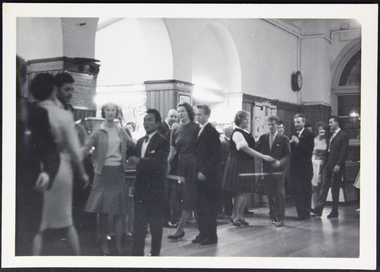
Photograph - Photograph, Black and White, Bill Doyle (Reverend C.J. Eldridge-Doyle), c. 1952
... In the past there have been many dances, concerts and other social events that have been designed to cater for visiting seafarers canteen clock ladies floorboards women dance couples seafarers suits bar flying-angel-club mission-to-seafarers-melbourne arched-doorways lhlg flying angel club central club plaque jukebox mission to seafarers seamen's mission seamen sailors dancing events social asian flinders street melbourne Pen on reverse of photograph: "5" enclosed in a circle. ...Mission to Seafarers regularly held social events as both a means of fundraising for the continuation of the organisation's work and providing social activities for visiting seafarers. On many Saturday nights there would be dances, concerts or other social events. This photograph depicts one such event.The Mission to Seafarers as an organisation is dedicated to not only providing spiritual and practical support to seafarers, but has long found it important to provide social opportunities as well. In the past there have been many dances, concerts and other social events that have been designed to cater for visiting seafarersSmall black and white photograph of a group of people in the main hall (Flying Angel Club) of the Mission to Seafarers Melbourne. Some are dancing and some are standing together. The photograph is taken from an angle that has the bar (canteen) in the background.Pen on reverse of photograph: "5" enclosed in a circle.canteen, clock, ladies, floorboards, women, dance, couples, seafarers, suits, bar, flying-angel-club, mission-to-seafarers-melbourne, arched-doorways, lhlg, flying angel club, central club, plaque, jukebox, mission to seafarers, seamen's mission, seamen, sailors, dancing, events, social, asian, flinders street, melbourne -
 Mission to Seafarers Victoria
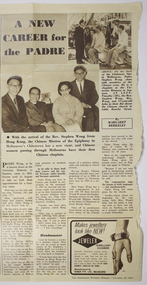
Article - Newspaper Clipping, The Australian Women's Weekly, A New Career For The Padre, 20 November 1963
... Five columns article illustrated with two photographs of Reverend Wong with his family and the Reverend with asian sailors published on page 84 of the Australian Women's Weekly, 20 November 1963...In the 1960s due to containerisation, the Mission adapted to be able to better respond the need of the changing origins of the crews. reverend stephen wong john wong timothy wong hong kong china chinese asian margaret berkeley 1963 Five columns article illustrated with two photographs of Reverend Wong with his family and the Reverend with asian sailors published on page 84 of the Australian Women's Weekly, 20 November 1963 A New Career For The Padre Article Newspaper Clipping The Australian Women's Weekly Margaret Berkeley ...Padre Wong was the first Asian chaplain.In the 1960s due to containerisation, the Mission adapted to be able to better respond the need of the changing origins of the crews.Five columns article illustrated with two photographs of Reverend Wong with his family and the Reverend with asian sailors published on page 84 of the Australian Women's Weekly, 20 November 1963reverend stephen wong, john wong, timothy wong, hong kong, china, chinese, asian, margaret berkeley, 1963 -
 Monbulk RSL Sub Branch
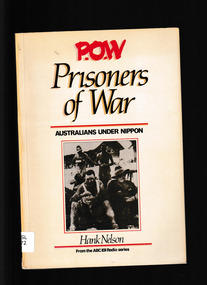
Book, Australian Broadcasting Corporation, P.O.W. : prisoners of war, 1985
... Asia, Formosa, Korea, Manchuria and Japan itself. They were captives within lands and cultures and to experiences alien to those known to all other Australians. At the end of the war in August 1945, 14315 servicemen and thirty service women ...Within three months of the Japanese entering World War II on December 8, 1941 over 22 000 Australians had become prisoners-of-war. They went into camps in Timor, Ambon, New Britain, Java, Sumatra, Borneo, Singapore and Malaya, and a few were scattered to other points in what was briefly part of the Japanese empire. Later most of the prisoners were to be shifted further north into South-east Asia, Formosa, Korea, Manchuria and Japan itself. They were captives within lands and cultures and to experiences alien to those known to all other Australians. At the end of the war in August 1945, 14315 servicemen and thirty service women were alive to put on new, loose-fitting uniforms and go home. One in three of the prisoners had died. That is, nearly half of the deaths suffered by Australians in the war in the Pacific were among men and women who had surrendered. Another 8174 Australians had been captured in the fighting in Europe, the Middle East and North Africa: but of these men only 265 died as a result of wounds, disease or execution.By any quantitative measure the imprisonment of so many Australians is a major event in Australian history. For many soldiers it was living --and dying --in captivity which made World War II different from that of World War I. But the prisoners have received no permanent place in Australian history. Their story is not immediately recalled on celebratory occasions. In a general history of the nation in which a chapter is given to the war the prisoners might be mentioned in a sentence, or part of a sentence. Where the horror, stoicism and gallantry of Gallipoli have become part of a common tradition shared by all Australians, the ex-prisoners are granted just the horror. The public may be sympathetic; but the horror is for the prisoners alone. To make another comparison: in five months of fighting on the Kokoda Trail in 1942 the Australians lost 625 dead, less than the number who died on Ambon. Yet the events on Ambon are unknown to most Australians. There were no reporters or cameramen on Ambon and, for the 309 who defended Ambon's Laha airfield, no survivors. How many of them died in battle or died as prisoners will never be known. But there are more than just practical reasons why the record of the prisoners of war is so slight and uneven in the general knowledge of Australians. They have not tried to find out. No historian has written a book to cover the range of camps and experiences, and only in specialist medical publications has anyone investigated the impact of prison life on subsequent physical and mental health. The complexity of the experience and its impact on particular lives have not been expressed in a way to give them significance for other Australians.Index, bib, ill, maps, p.224.Within three months of the Japanese entering World War II on December 8, 1941 over 22 000 Australians had become prisoners-of-war. They went into camps in Timor, Ambon, New Britain, Java, Sumatra, Borneo, Singapore and Malaya, and a few were scattered to other points in what was briefly part of the Japanese empire. Later most of the prisoners were to be shifted further north into South-east Asia, Formosa, Korea, Manchuria and Japan itself. They were captives within lands and cultures and to experiences alien to those known to all other Australians. At the end of the war in August 1945, 14315 servicemen and thirty service women were alive to put on new, loose-fitting uniforms and go home. One in three of the prisoners had died. That is, nearly half of the deaths suffered by Australians in the war in the Pacific were among men and women who had surrendered. Another 8174 Australians had been captured in the fighting in Europe, the Middle East and North Africa: but of these men only 265 died as a result of wounds, disease or execution.By any quantitative measure the imprisonment of so many Australians is a major event in Australian history. For many soldiers it was living --and dying --in captivity which made World War II different from that of World War I. But the prisoners have received no permanent place in Australian history. Their story is not immediately recalled on celebratory occasions. In a general history of the nation in which a chapter is given to the war the prisoners might be mentioned in a sentence, or part of a sentence. Where the horror, stoicism and gallantry of Gallipoli have become part of a common tradition shared by all Australians, the ex-prisoners are granted just the horror. The public may be sympathetic; but the horror is for the prisoners alone. To make another comparison: in five months of fighting on the Kokoda Trail in 1942 the Australians lost 625 dead, less than the number who died on Ambon. Yet the events on Ambon are unknown to most Australians. There were no reporters or cameramen on Ambon and, for the 309 who defended Ambon's Laha airfield, no survivors. How many of them died in battle or died as prisoners will never be known. But there are more than just practical reasons why the record of the prisoners of war is so slight and uneven in the general knowledge of Australians. They have not tried to find out. No historian has written a book to cover the range of camps and experiences, and only in specialist medical publications has anyone investigated the impact of prison life on subsequent physical and mental health. The complexity of the experience and its impact on particular lives have not been expressed in a way to give them significance for other Australians.world war 1939 – 1945 - prisons and prisoners – japanese, world war 1939-1945 - personal narrativies - australia -
 Women's Art Register
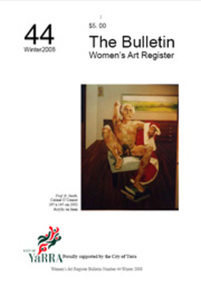
Women's Art Register Bulletin, Women's Art Register, Women's Art Register Bulletin number 44
... . - The Majura Women’s Group Project Kerry-Anne Cousins 26 Arts Residencies in Asia 2009 6 From Mao to Now Denise Keele-Bedford 10 I call myself an artist. .... - The Majura Women’s Group Project Kerry-Anne Cousins 26 Arts Residencies in Asia 2009 6 From Mao to Now Denise Keele-Bedford 10 I call myself an artist. ...28 page Magazine photocopy in black and white with following contents where the first figure is the page number and this is followed by the article title then the author. #44 19 2 Heads are Better than 1 Judy Bourke 22 A Dark and Merry Dance - Mona Ryder Ingrid Hoffmann Arts Writer 28 Advertising rates 17 Artist Statement Dragica Milunovic 7 Art for Community Enjoyment. - The Majura Women’s Group Project Kerry-Anne Cousins 26 Arts Residencies in Asia 2009 6 From Mao to Now Denise Keele-Bedford 10 I call myself an artist. Carmel O’Connor 14 Josie Telfer - Nine Waves Richard Perry 18 Nature and Change Ev Hales carmel o'connor, judy bourke, ingrid hoffmann, mona ryder, dragica milunovic, kerry-anne cousins, denise keele-bedford, josie telfer, ev hales, margaret gurney, anna glynn, lea kannar, janet goodchild chuffley, desiree radi-mansbridge, sayraphim lothian, noela stratford, sasha grishin, annette vincent, women's art library london, annette iggledon, gail stiffe, althea greenan -
 City of Moorabbin Historical Society (Operating the Box Cottage Museum)
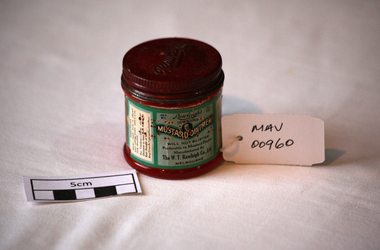
Manufactured Glass, jar of Mustard Ointment 'Rawleigh's;, mid 20thC
... Asia. From Japan came camphor and menthol for making medicines. From Tavenui, the Garden Island of Fiji, came the food grade coconut oil for Rawleigh's gold medal winning Coconut Oil Soap. Rawleigh products are still only available from Rawleigh men and women...Asia. From Japan came camphor and menthol for making medicines. From Tavenui, the Garden Island of Fiji, came the food grade coconut oil for Rawleigh's gold medal winning Coconut Oil Soap. Rawleigh products are still only available from Rawleigh men and women ...WT Rawleigh (1870-1952) Freeport USA began in 1889 the direct selling method to sell his products, travelling around on horse and cart in the early days from house to house selling his medicines and other lines. Rawleigh's wide range of products includes: Medicinal, Nutritional, Gourmet, Homecare, Personal Care, Animal & Plant Care Since 1889, millions of families around the world have learned to rely upon and keep Rawleigh's reliable medicines and other products on hand ready for emergencies to relieve sickness, pains, injuries and for their daily needs. By 1920, young Rawleigh had built the biggest manufacturing organisation in the world. Mr Floyd George Rawleigh who was the son of David Rawleigh, W.T.Rawleigh's brother, came to Australia, with Mr Jackson, in 1931 and set up the Rawleighs Company Business . Generations of Australians, Canadians and Americans grew up waiting for The Rawleigh Man to arrive at their front door with his sample case of goodies to add spice to their life and to heal their ailments. In World War II, most Australian soldiers posted overseas carried a tin of Rawleigh Antiseptic Salve in their kits to treat wounds and ward off infection The Rawleigh Man brought to family front doors the best materials money could buy from around the world: spices from Sumatra, Java, China, India, Africa, the West Indies; black pepper from the island of Ponapai; lemon and orange oils from California and Sicily and Vanilla from Madagascar and Java; high grade coffee beans from the Andes. Most of the herbs, roots, barks and buds used in making cough medicines and tonics came from Europe, India, Ceylon, China, North America, the West Indies, Jamaica, Honduras and Asia. From Japan came camphor and menthol for making medicines. From Tavenui, the Garden Island of Fiji, came the food grade coconut oil for Rawleigh's gold medal winning Coconut Oil Soap. Rawleigh products are still only available from Rawleigh men and women who carry on the time-honoured tradition of the Rawleigh company to give individuals a go at developing their own business supplying products to people in their homes. Only now they are also doing it in cyberspace. A clear glass jar with a metal screw lid containing Mustard Ointment made by W.T. Rawleigh Co. Ltd. .Melbourne Lid ; Rawleigh’s Front ; Rawleigh’s / Net WT. / 1 ½ oz / COMPOUND / MUSTARD OINTMENT / WILL NOT BLISTER /preferable to Mustard Plaster / MNUFACTURED BY / The W, T. Rawleigh Co Ltd / MELBOURNE. / Left side ; DIRECTIONS …….. , / Right side ; Useful pharmacy, medicines, mustard ointment, w.t. rawleigh company ltd., hospitals, nursing, containers, moorabbin, bentleigh, cheltenham, melbourne, respiratory diseases -
 Federation University Historical Collection
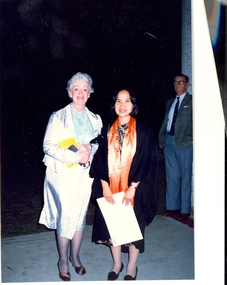
Photograph - Photograph - Colour, Thelma Rungkat and Neneng Komarich
... women .1) Thelma Rungkat with Graduate Diploma of Librarianship students Ninis A. Damataru and Neneng Komareah at the graduates Farewell dinner for Graduate Diploma of Librarianship students, 1987 .2) Thelma Rungkat with Graduate Diploma of Librarianship students Sri Wahyuni Soeriptito and Tetty Sartika at the South East Asian Librarian Congress, Jakarta, Indonesia, 1990 .3) Thelma Rungkat and Graduate Librarianship Graduate Neneng Komarich at Ballarat College of Advanced Education Graduation, 1988 .4) Tim Reddan, lecturer in Information Management receives a farewell gift from Thelma Rungkat at the first annual dinner of Ballarat Librarianship Graduates' Association, 1990 .5) Mrs Shiell, Andrew Shiell and Keith Davison (Senior Lecturer in Librarianship) taken at Tim Reddan's Farewell Thelma Rungkat and Neneng Komarich Photograph Photograph - Colour ...Thelma Rungkat was Head of the Librarianship Department at Ballarat College of Advanced Education, and by 1990 she was Head of Information Management. Keith Davidson retired from his role as Senior Lecturer in Librarianship at Ballarat College of Advanced Education in 1988..1) Thelma Rungkat with Graduate Diploma of Librarianship students Ninis A. Damataru and Neneng Komareah at the graduates Farewell dinner for Graduate Diploma of Librarianship students, 1987 .2) Thelma Rungkat with Graduate Diploma of Librarianship students Sri Wahyuni Soeriptito and Tetty Sartika at the South East Asian Librarian Congress, Jakarta, Indonesia, 1990 .3) Thelma Rungkat and Graduate Librarianship Graduate Neneng Komarich at Ballarat College of Advanced Education Graduation, 1988 .4) Tim Reddan, lecturer in Information Management receives a farewell gift from Thelma Rungkat at the first annual dinner of Ballarat Librarianship Graduates' Association, 1990 .5) Mrs Shiell, Andrew Shiell and Keith Davison (Senior Lecturer in Librarianship) taken at Tim Reddan's Farewellthelma rungkat, keith davidson, tim reddan, librarianship, library, libriarian, univerrsity women -
 Ithacan Historical Society
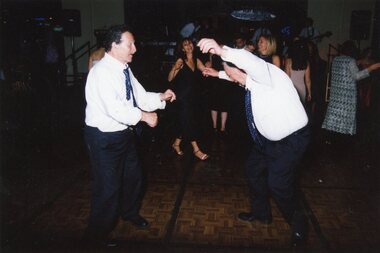
Photograph, Dancing the Zembekiko, c1990s
... women. It is often danced solo, has no formal steps and is an improvised movement that expresses the feelings of the individual dancing. Its origin is in Asia ...The two men dancing at an Ithacan ball are Bill Benias and John Tsalikis. TThe men are dancing a 'Zembekiko' traditionally danced by men, although now danced by men and women. It is often danced solo, has no formal steps and is an improvised movement that expresses the feelings of the individual dancing. Its origin is in Asia Minor, the former home of displaced Greeks. Greek dancing is an important part of Greek culture with various traditional dances from the different regions of Greece. Traditional Greek dancing is enjoyed by young and old at social functions.A coloured photograph of two men doing Greek dancing at a social. -
 City of Melbourne Libraries
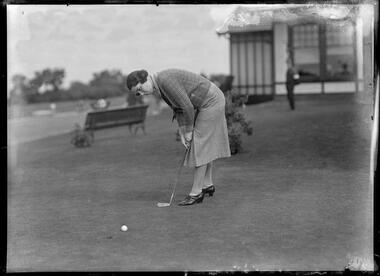
Photograph, Bull, Hugh Jones, 1897-1993, Miss Betty Nankivell
... Betty lived and worked in many South East Asian countries, including 10 years of private practise in Kuala Lumpur, before retiring in 1970 to live in Melbourne. Photographer notations on slide: "Vic Women's Golf Ch'ship B98" Published: The Age 3 September 1935 p. 7 Published title: "EXCITING GOLF DUEL." ...Betty lived and worked in many South East Asian countries, including 10 years of private practise in Kuala Lumpur, before retiring in 1970 to live in Melbourne. Photographer notations on slide: "Vic Women's Golf Ch'ship B98" Published: The Age 3 September 1935 p. 7 Published title: "EXCITING GOLF DUEL." ...Dr Elizabeth “Betty” Nankivell (1907-2003), later Mrs Forward, graduated in 1937 from Melbourne University with a degree in medicine. She worked at Queen Victoria and Royal Adelaide Hospitals. During WWII, she practised medicine in Morwell, and in 1945 joined the Royal Australian Army Medical Corp (R.A.A.M.C.). Betty lived and worked in many South East Asian countries, including 10 years of private practise in Kuala Lumpur, before retiring in 1970 to live in Melbourne. Photographer notations on slide: "Vic Women's Golf Ch'ship B98" Published: The Age 3 September 1935 p. 7 Published title: "EXCITING GOLF DUEL." Published caption: MISS B. NANKIVELL, whose victory over Miss Pam Barton was the outstanding feature of the play in the Australian Championship yesterday. Trove article identifier: http://nla.gov.au/nla.news-article203852987 Description: Action shot of golfer Betty Nankivell putting on golf course. She wears a checked cardigan, straight skirt, stockings, heeled shoes and a tie, no hat. The clubhouse structure is blurred in the background. Research by project volunteer, Fiona Collyer: Dr Elizabeth “Betty” Nankivell, Mrs Forward Betty Nankivell (1907 – 2003) was a champion Victorian golfer and medical doctor. She competed in the Australian Women’s Golf Championship at Royal Melbourne in 1935 against the visiting British Team. She eliminated 18 year old British champion Pam Barton, but was defeated by the eventual winner of the tournament, Mrs J B Walker in the semi finals. In 1938, Betty won the SA Golf Championships at Kooyonga SA. Betty graduated from Melbourne University with a degree in medicine in 1937 and worked at Queen Victoria Hospital and at Royal Adelaide Hospital as R.M.O. (Resident Medical Officer). During the war years, Betty practised medicine in Morwell, Victoria, and in 1945 joined the R.A.A.M.C. (Royal Australian Army Medical Corp) for the Malaya Medical Service. In 1946, she married Alan Forward OBE, a Colonel in the British Army and later the Commissioner of Road Transport in Malaya, and lived and worked in many S E Asian countries including 10 years in private practice in Kuala Lumpur. Betty continued to play golf throughout her life, retiring in 1970, and died in Melbourne in 2003. Sources: Melbourne University: Journal of the University of Melbourne Medical Society: vol. 2, no. 1Photographer notations on slide: "Miss Nankivell B98".golf, women golfers, royal melbourne golf club -
 City of Melbourne Libraries
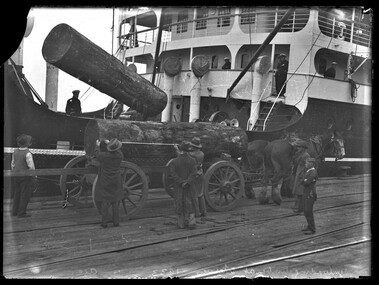
Photograph (item), Bull, Hugh Jones, 1897-1993, Unloading timber at Victoria Dock, 1933
... Asian destinations. As World War II approached, Taiping continued predominantly working the trade routes between China and Australia, until December 1941, when she evacuated women and children from Hong Kong to Manila just before Japanese forces overran the region. ...Asian destinations. As World War II approached, Taiping continued predominantly working the trade routes between China and Australia, until December 1941, when she evacuated women and children from Hong Kong to Manila just before Japanese forces overran the region. ...Photographer notations on slide: "Unloading Timber at Wharves 1933 Age B5" Published: Age (Melbourne, Vic.: 1854- ), Tuesday 15 August 1933 MAHOGANY FROM MANILA. (1933, August 15). The Age (Melbourne, Vic. : 1854 - 1954), p. 11. Retrieved January 16, 2026, from http://nla.gov.au/nla.news-article204377024 Published title: MAHOGANY FROM MANILA Published Caption: Age Tue 15 Aug 1933 Caption: Unloading Mahogany Logs brought from Manila, Philippine Islands, by the steamer Taiping, which berthed yesterday at Victoria Dock. The vessel discharged twenty logs, each weighing three tons, the first shipment of this type of timber landed in Melbourne. Research by Project Volunteer, Louise McKenzie: This photograph in many ways epitomises Melbourne in the 1930s. It is a time of enormous growth, development and change. But before delving into that, the photo itself is very powerful. The huge mahogany logs being unloaded appear to be so heavy that the ship itself seems to list to port as they are craned over the side. They are being levered into a cart to which two large and sturdy Clydesdale horses are hitched. In contrast to the traditional horses, the wharf is crisscrossed with modern railway tracks. Unloading is both mechanical and manual, and the scene is one of intense interest to a young boy bystander. The ship appears to be squat and solid, but the whole image also gives a feeling of movement and intensity. The mahogany being delivered to Melbourne would be intended for high quality furniture. In the 1930s Australia actually had a growing timber industry, but much of the eucalyptus wood was being utilised for mass produced furniture, and much of this furniture would then have had a veneer applied to it. The fact that it was economic to import this timber from the “Philippine Islands” – not a traditional trading market for Australia – reflects a Victorian economy that was strong enough to support a growing demand for good quality furniture Mahogany was described as a classic, strong hardwood, often used for dark opulent furniture. In the 1930s the importation of timber from Manila (Philippines) to Australia was a notable trade, particularly in Philippine Lauan (often referred to as Philippine Mahogany), which was used as a cheaper alternative to other hardwoods. 1930s furniture, dominated by the art deco style, used a mix of luxurious exotic woods like mahogany, macassar and ebony for high-end pieces, often veneered over less expensive woods such as walnut, birch and poplar, and with plywood, chrome and lacquer also popular for more practical, streamlined designs during the Depression era. By the mid 1930s timber mills were being relocated away from the immediate dock area, but the fact that these logs were being transported by horse-drawn cart implies that the load would not have had to be taken too far for milling. 1885 the Melbourne Harbour Trust Commissioners had decided that land in or near the city was far too valuable to be used as timber yards. Furthermore, large stacks of timber posed a fire risk. The Trust asked the Victorian Government to reserve a site on the east side of the Yarra River opposite Yarraville and Spotswood. Here, in 1889, the Trust began building six jetties and a wharf specifically for the landing of timber. Clydesdale horses were initially brought to Victoria from Tasmania in the 1830s, and with the 1850s gold rush they were imported direct from Scotland. Melbourne was from its earliest years an important centre of horse-breeding from both imported and colonial-bred stock, providing the well-built draught horse for pulling heavily loaded wagons, the harness horse for delivery work and drawing coaches, and the saddle-horse used for riding. Stud breeding facilities were advertised from the early 1840s. By the 1870s the horse export trade was thriving, and the Port of Melbourne was the country's busiest exporter of horses to Indian, Asian and New Zealand markets. Kirk's Melbourne Horse and Carriage Bazaar in Bourke Street first advertised for business in 1840, and by the 1850s Bourke Street West was famed for its horse bazaars and saleyards. The Victorian Clydesdale Horse Society reports that Clydesdale working horses were a vital part of Melbourne's infrastructure and agricultural industry in the 1930s, when they reached the peak of their popularity despite the increasing competition from mechanization. Their main roles and usage at this time were: • City Delivery: Clydesdales were a common sight for metropolitan deliveries, particularly for breweries (such as Carlton & United Breweries), milk runs, and bread deliveries. • Industrial Work: They were heavily used for hauling cargo at the docks, in construction, and at specialized sites like the Truganina Explosives Reserve, where they pulled wagons. • Agriculture: In surrounding rural areas, they were the primary power source for ploughing and agricultural machinery. • Specialization: By the 1930s, the Clydesdale was smaller and more compact than the Shire or Percheron breeds, making them ideal for navigation in urban environments. After the 1930s their numbers decreased due to the onset of WWI and mechanisation. Wartime petrol rationing led to a brief revival for the working horse, as suburban tradesmen, now used to motor delivery, took their old jinkers out of mothballs. By 1947, however, only 1.5% of city traffic was horse-drawn. In 1952 the large horse cartage company A. Kellet Pty Ltd sold its 250 horses and converted its Richmond stables to storage. In the 1950s at Station and Princes piers, wharf labourers refused to work with the six draught horses still being used to haul trolleys and which were soon superseded by the fork lift, semi-trailer and mobile crane. Where carefully trained horses had once shunted trains in city goods yards, a few hundred a week were now being killed at the abattoirs for pet and human consumption. The last MCC dray horse was withdrawn from service in 1958, but some of the few remaining working animals are used by the mounted police for crowd control at demonstrations and football games. The death knell had also sounded for the associated trades of farrier, saddler and blacksmith. Our photo, therefore, showing the wharf with both the haulage Clydesdales and the rail lines, is a strong visual summary of the social and economic changes experienced in Victoria in the 1930s and on towards the 1950s. Our photo is located at Victoria Dock (also known as Victoria Harbour) which is still an active component of Melbourne’s port system. In 1892 the West Melbourne Dock (later Victoria Dock) was opened, downstream and immediately west of the Spencer Street railway shunting yards. It contained a swing basin for ships, replacing the one which had been provided on the south side of the river, later to be the Duke and Orr dry dock, west of the Charles Grimes Bridge. Further west was the South Wharf along the river bank. The history of Victoria Dock is extremely well described by Ashley Smith in his 2 March 2022 article in Docklands News, and its accompanying aerial photo of the Dock taken in 1934. He writes: "In the early 1930s Victoria Dock was one of the biggest sites for trade and export in Melbourne. A constant queue of ships sailed in, unloaded their cargo, recharged and reloaded, then left for the next port. Around the time this photo was taken (found in a 1934 photo book), the trapezium-shaped basin had been through some changes since its construction in the 1890s. The 497-metre-long Central Pier, finished in 1919, now featured six sheds to house the ever-increasing volume of cargo. The entrance had also been widened in the 1920s to allow better access. Some of the berths featured three-ton jib electric cranes to help with loading cargo and a rail network connected to the State Railway service. By the time construction was completed, the dock was 39 hectares and hailed as the second-largest dock in the world (behind Cavendish Dock, Barrow-in-Furness). To further save costs, excavations were dug to a more reasonable seven metres below low water, instead of British engineer Sir John Coode’s recommended 8.3 metres. Even then, the costs were still around £900,000. It was envisaged, with the extra wharfage, that around thirty 90-metre ships could berth inside. On March 22, 1892, Victoria Dock was opened by Victoria’s Governor, the Earl of Hopetoun (later Australia’s first Governor-General) who opened the sluice to let the Yarra in. It took six days to fill the basin with The Leader newspaper estimating that it would take another six months to completely fill (March 26, 1892). In the end, it took nearly a year before the first ship was allowed to enter on February 20, 1893, when the steamer Hubbuck sailed in to unload 1200 tonnes of cargo in 15 hours. The Argus (February 23, 1893) reported that the ship’s captain, J. R. Brodie, called the Yarra “better than the Thames”, and compared Victoria Dock favourably to the Albert Dock (Liverpool)." This would be a good time to move our focus on to the Taiping, which is the transporter of these giant mahogany logs. The Taiping was a steel-hulled, single-screw passenger-cargo Chinese steamer, which today has the dubious legacy of being involved in a collision headlined as “The Chinese Titanic”. It was constructed by the Hong Kong and Shampoa Dock Company at its facility in Hong Kong, with completion in 1926 for service under the Australia Oriental Line. Her gross register tonnage measured 4,324 tons, reflecting her design for inter-island and coastal trade routes, accommodating both passengers and freight. She operated routes connecting Australian ports with East Asian destinations. As World War II approached, Taiping continued predominantly working the trade routes between China and Australia, until December 1941, when she evacuated women and children from Hong Kong to Manila just before Japanese forces overran the region. She then safely reached Australia despite enemy air raids. Taiping was then requisitioned by the Royal Navy and repurposed as a victualling stores issuing ship for the Eastern Fleet, supporting logistical needs in the Pacific and Indian oceans. Returned to the Australian Oriental Line in 1947, she underwent refitting and by mid-1948 was chartered to the Shanghai Shipping Company, and modified for greater passenger accommodation – approximately 500 passengers. In 1948/49 the Chinese Civil War took place. The Taiping departed Shanghai on 26 January 1949 as one of the final vessels evacuating civilians from to Keelung Harbour in Taiwan. Reports indicate that the Taiping carried double the rated capacity of passengers i.e. 1000. The ship carried families, military personnel, civilians, carrying personal belongings, gold and valuables in hope of resettlement in Nationalist Taiwan. It also held heavy cargo in the form of silver and gold bullion loaded by the Central Bank of China. Because of the risk of patrols, and to conserve fuel, the Captain took the ship away from the usual open-sea passage, and instead navigated along the coast. He also extinguished navigation lights to avoid detection. Shortly after midnight on 27 January 1949 the Taiping collided with the smaller cargo steamer Chien Yuan in the East China Sea near the Zhoushan Archipelago. The Chien Yuan was also operating in darkness. The subsequent collision was catastrophic. The Chien Yuan sank with in 5 minutes, with the loss of 72 of its 74 crew. The Taiping sustained severe structural compromise from the broadside strike and initially remained afloat, then made a swift descent into the freezing water, with no attempt at an organised evacuation. No formal recovery process was instigated, however a distress signal went out. 32 survivors were picked up by the Australian destroyer HMAS Warramunga (on patrol nearby), a passing US vessel found 2 more, and local Zhoushan fishermen retrieved others. In the end, only 37 people survived. The event is remembered as a poignant moment in the mass migration to Taiwan, with families tragically separated. A memorial to the disaster exists at the Keelung Harbour naval base on Taiwan. With its total of over 1,500 deaths, it constituted one of the worst peacetime maritime losses. It is sometimes referred to as the “Oriental Titanic” because of the similarly large loss of life and speed of demise with the RMS Titanic in 1912. A fictional depiction of this event appears in the John Woo movies “The Crossing (Part 1) (2014), and The Crossing II (2015), known in Chinese as “Taiping Wheel”. The narrative weaves a story around pre-disaster romances and wartime turmoil among passengers, culminating in the ship’s rapid sinking. “The production, a high-budget Sino-Taiwanese-Hong Kong co-effort, portrays the event as a microcosm of the 1940s Sino-Japanese and civil war legacies, though critics noted the melodramatic style prioritizing spectacle over historical precision.” In conclusion, it is nice to return to our photo, and observe the people involved in this moment. The dockworkers are, so typical of the 1930s, dressed in what looks to us like formal clothing – dark suits or coats, white shirts, and black hats. I am particularly drawn to the young boy, bare-headed, arms crossed, and so intent on the unloading process. He too is wearing a white shirt, black trousers and jacket, and black shoes. This is 1933 Melbourne – but the haircut he is sporting is now very “hipster” and modern in 2026 Melbourne. References: MAHOGANY FROM MANILA. (1933, August 15). The Age (Melbourne, Vic. : 1854 - 1954), p. 11. Retrieved January 30, 2026, from http://nla.gov.au/nla.news-article204377024 Wikipedia, Taiping steamer, https://en.wikipedia.org/wiki/Taiping_(steamer) Wikipedia, Victoria Dock, https://en.wikipedia.org/wiki/Victoria_Dock_(Melbourne) Docklands News, Ashley Smith, 2 Mar 2022, https://www.docklandsnews.com.au/victoria-dock/ Living Histories: Heritage Council of Victoria, Jill Barnard, 2008, Jetties and Piers, https://livinghistories.net.au/wp-content/uploads/2015/11/Jetties-ONL-intro_Part-1.pdf eMelbourne, Wharves and Docks, https://www.emelbourne.net.au/biogs/EM01612b.htm Australian Academy of Technological Sciences – Harvesting Wood, https://www.austehc.unimelb.edu.au/tia/225.html Old Treasury Building, On the Water – The Docks, https://tinyurl.com/3wkbk66m Old Treasury Building, On The Road, https://tinyurl.com/dw44yr3t Port of Melbourne, Victorian Places, https://www.victorianplaces.com.au/port-of-melbourne Docklands Heritage Study - Environmental History, https://mvga-prod-files.s3.ap-southeast-4.amazonaws.com/public/2024-05/docklands-heritage-review-thematic-environmental-history-1991.pdf eMelbourne, Horses, https://www.emelbourne.net.au/biogs/EM00723b.htm Victorian Clydesdale Horse Society, https://www.clydesdalesvic.org.au/history The Crossing, https://letterboxd.com/film/the-crossing-i/Photographer notations on slide: "Unloading Timber at Wharves 1933 Age B5"ships, shipping, timber industry, shipwrecks, horses, docks, wharves, 1930-1939, wars, docklands -
Bendigo Historical Society Inc.
Document - The Victorian Country Volleyball Council (VCVC) Australian Volleyball Federation (AVF) Reports, 1975-80
... This item contains Correspondence of the Council in 1979 and 1980 and reports from the Australian Volleyball Federation; it include. the following documents: 11171.20a AVF 2nd Oceania Championships New Zealand - National Coach required 1976 11171.20b AVF 2nd Oceania Championships New Zealand - Team Managers required 1976 11171.20c AVF Newsletter 7/75 11171.20d AVF Newsletter 6/75 11171.20e AVF Info sheet 1st Asian Volleyball Championships Aug 1975 11171.20f AVF Statements June 1977 11171.20g AVF Order form for Volleyball publications 11171.20h Notice for Australian Championships Mar-Apr 1975 Albert Park 11171.20i First Asian Volleyball Championships Guidelines 11171.20j AVF By-laws 11171.20k AVF Record Secretary's Report 1976-77 and Executive Meeting Jan 1977 11171.20l AVF Constitution and By-laws 11171.20m AVF Statements 1977 to 1978 11171.20n AVF notices of Rule interpretation from international 11171.20o Executive Meeting Minutes Nov 1979 11171.20p Executive Meeting Minutes June 1980 11171.20q General assembly, Bahrain Report Dec 1979 11171.20r AVF Executive Meeting Feb 1979 11171.20s AVF Executive Meeting March 1979 11171.20t AVF Planning Seminar Feb 1980 11171.20u AVF Discussion Paper by John Ostermweyer, National Executive Director, April 1980 11171.20v Report on australian Tour of Japan National Women's team April 1980 11171.20w Referees Commission Newsletter Jan 1980 11171.20x General Newsletter 1980 11171.20y Bahrain General Assembly Report Dec 1979 11171.20z AVF General Meeting 1980...In 2023, the Commission handed the organisation of the Championships back to VVI, who with paid staff, were better equipped to manage the event. victorian country volleyball council vcvc victorian amateur volleyball association volleyball victoria This item contains Correspondence of the Council in 1979 and 1980 and reports from the Australian Volleyball Federation; it include. the following documents: 11171.20a AVF 2nd Oceania Championships New Zealand - National Coach required 1976 11171.20b AVF 2nd Oceania Championships New Zealand - Team Managers required 1976 11171.20c AVF Newsletter 7/75 11171.20d AVF Newsletter 6/75 11171.20e AVF Info sheet 1st Asian Volleyball Championships Aug 1975 11171.20f AVF Statements June 1977 11171.20g AVF Order form for Volleyball publications 11171.20h Notice for Australian Championships Mar-Apr 1975 Albert Park 11171.20i First Asian Volleyball Championships Guidelines 11171.20j AVF By-laws 11171.20k AVF Record Secretary's Report 1976-77 and Executive Meeting Jan 1977 11171.20l AVF Constitution and By-laws 11171.20m AVF Statements 1977 to 1978 11171.20n AVF notices of Rule interpretation from international 11171.20o Executive Meeting Minutes Nov 1979 11171.20p Executive Meeting Minutes June 1980 11171.20q General assembly, Bahrain Report Dec 1979 11171.20r AVF Executive Meeting Feb 1979 11171.20s AVF Executive Meeting March 1979 11171.20t AVF Planning Seminar Feb 1980 11171.20u AVF Discussion Paper by John Ostermweyer, National Executive Director, April 1980 11171.20v Report on australian Tour of Japan National Women's team April 1980 11171.20w Referees Commission Newsletter Jan 1980 11171.20x General Newsletter 1980 11171.20y Bahrain General Assembly Report Dec 1979 11171.20z AVF General Meeting 1980 Document The Victorian Country Volleyball Council (VCVC) Australian Volleyball Federation (AVF) Reports. ...Volleyball has been played in regional Victoria since the early-1960’s. During those early days, most competitions, like the founders of our great sport, were run by, or in conjunction with, the YMCA. Competitions were running at the Ballarat School of Mines and the YMCA’s of Bendigo, Geelong and Warrnambool. In August 1966, an invitation was extended by the Victorian Amateur Volleyball Association to play in the first State-wide event at Monash University. Geelong and Bendigo accepted the invitation with Melbourne represented by Sisu. For Bendigo players at least, this was the first exposure to ‘international rules’, which prevented upward scoops with open hands, introduced an action called a ‘dig’ and seemed to penalise most overhead actions using the fingers as ‘double hits’! Over the next few years, the sport expanded through the YMCA movement with weekly competitions starting up in Ararat, Warrnambool and Latrobe Valley. The Victorian Regional Council of YMCA’s proposed the first Victorian YMCA Championship in Warrnambool on 30th March 1968 with an entry fee of $4.00 per team. The sport continued to grow with additional regional associations affiliating with the Victorian Amateur Volleyball Association (now VVI) who provided the coaching and refereeing assistance needed to raise the standard of play. In 1970, the YMCA Championships started to give way to the Victorian Country Championships with the first ever event held in Bendigo. In 1973, a re-organisation of the VAVA saw the proposal to create separate Victorian Country and Metropolitan Volleyball Councils. The VCVC was established in 1974 and took over the organisation of the Victorian Country Championships. For the next 10-12 years, the Country Championships grew in stature with the inclusion of two divisions for open men and women and junior divisions for boys and girls. Representative teams successfully contested Australian Country Championships between Victoria, South Australia and New South Wales on several occasions. In October 1985, the VCVC voluntarily wound up the Council and handed the responsibility for the Country Championships back to Volleyball Victoria, who by that time had full-time State Executive and Coaching Directors. Since that time, the Long Weekend in June has continued to be the date of the major annual volleyball event for most regional associations, even though in 1986 the Junior Country Championships were wound up in favour of state and national schools events. A number of regional associations have ceased to exist, as have a number of regional tournaments. Regional leagues were created in both the Gippsland and Central, North-West regions, with Gippsland the only one to survive. Some associations have successfully competed in the State League competitions at various times. Following the experience gained by a number of regional administrators working on the Sydney Olympic Games, a proposal to revamp the Victorian Country Championship was put to VVI in early 2002. Later that year, the Volleyball Victoria Country Championships Commission was formed to implement the recommendations of the review and take control of the event into the future. These championships now provide regional players and officials an opportunity to participate in a consistently well-managed event, using many international protocols and a high standard of presentation. Without doubt, this event now ranks as one of the best volleyball events in Australia. Source: 2022 Country Championship regulations The management of the Country Championships by the Victorian Country Championship Commission certainly achieved the objective of raising the standard of presentation, and delivering a consistently high quality event. However, the demands on Host Associations began to take their toll, with several Associations declining the opportunity to host the event due to the high workload. Similarly, the workload of the volunteer Commissioners also took its toll, with the Commission unable to fill casual vacancies. In 2023, the Commission handed the organisation of the Championships back to VVI, who with paid staff, were better equipped to manage the event.This item contains Correspondence of the Council in 1979 and 1980 and reports from the Australian Volleyball Federation; it include. the following documents: 11171.20a AVF 2nd Oceania Championships New Zealand - National Coach required 1976 11171.20b AVF 2nd Oceania Championships New Zealand - Team Managers required 1976 11171.20c AVF Newsletter 7/75 11171.20d AVF Newsletter 6/75 11171.20e AVF Info sheet 1st Asian Volleyball Championships Aug 1975 11171.20f AVF Statements June 1977 11171.20g AVF Order form for Volleyball publications 11171.20h Notice for Australian Championships Mar-Apr 1975 Albert Park 11171.20i First Asian Volleyball Championships Guidelines 11171.20j AVF By-laws 11171.20k AVF Record Secretary's Report 1976-77 and Executive Meeting Jan 1977 11171.20l AVF Constitution and By-laws 11171.20m AVF Statements 1977 to 1978 11171.20n AVF notices of Rule interpretation from international 11171.20o Executive Meeting Minutes Nov 1979 11171.20p Executive Meeting Minutes June 1980 11171.20q General assembly, Bahrain Report Dec 1979 11171.20r AVF Executive Meeting Feb 1979 11171.20s AVF Executive Meeting March 1979 11171.20t AVF Planning Seminar Feb 1980 11171.20u AVF Discussion Paper by John Ostermweyer, National Executive Director, April 1980 11171.20v Report on australian Tour of Japan National Women's team April 1980 11171.20w Referees Commission Newsletter Jan 1980 11171.20x General Newsletter 1980 11171.20y Bahrain General Assembly Report Dec 1979 11171.20z AVF General Meeting 1980victorian country volleyball council, vcvc, victorian amateur volleyball association, volleyball victoria -
 Chiltern Athenaeum Trust
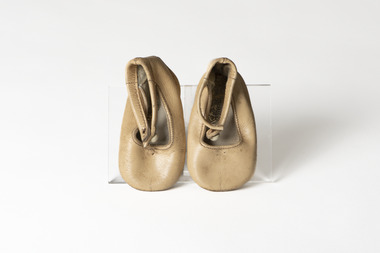
Footwear - Baby shoes
... Asia. Their brand is centred around timeless elegance and quality, which this pair of baby shoes is in keeping with. The Mary Jane shoe was popularised in the early 20th century as a shoe for children regardless of gender. They began to be known as Mary Jane's because of the character of Mary Jane in the Mary Jane and Buster Brown comics, a series of advertisements by the Brown Shoe Company in the USA. They remain a classic style for women...Asia. Their brand is centred around timeless elegance and quality, which this pair of baby shoes is in keeping with. The Mary Jane shoe was popularised in the early 20th century as a shoe for children regardless of gender. They began to be known as Mary Jane's because of the character of Mary Jane in the Mary Jane and Buster Brown comics, a series of advertisements by the Brown Shoe Company in the USA. They remain a classic style for women ...These baby shoes show evidence of once having an additional embellishment on the toe, such as a bow, flower or pom pom. The label written into the bottom of the shoe indicates that it was made by Everbest. Everbest is a shoe company that was established in 1979 in Singapore and primarily sells in South East Asia. Their brand is centred around timeless elegance and quality, which this pair of baby shoes is in keeping with. The Mary Jane shoe was popularised in the early 20th century as a shoe for children regardless of gender. They began to be known as Mary Jane's because of the character of Mary Jane in the Mary Jane and Buster Brown comics, a series of advertisements by the Brown Shoe Company in the USA. They remain a classic style for women and children.These shoes are a record of a small part of the social history of Chiltern, as well as show the continuing popularity of this style of shoe through time. They are also a record that a product of a Singaporean company that primary sells in other countries in South East Asia was able to travel all the way to regional Victoria and be present in the collection of the Chiltern Athenaeum.Pair of pink leather mary jane style baby shoes with gold metallic label on inner soleInner Sole: Lesley Everbest / Baby Shoe / Size 0baby shoe, leather shoe, everbest, leather, shoe, baby clothes, leatherworking, singapore, chiltern, chiltern athenaeum, chiltern athenaeum museum, chiltern athenaeum collection -
 National Vietnam Veterans Museum (NVVM)
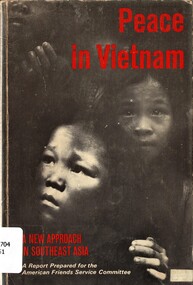
Book, American Friends Service Committee, Peace in Vietnam:A New Approach in Southeast Asia
... National Vietnam Veterans Museum (NVVM) 25 Veterans Drive Newhaven phillip-island-and-the-bass-coast Vietnam - Foreign relations - United States United States - Foreign relations - Vietnam South South East Asia Communist You Americans don't understand. You are making beggars of our children, prostitutes of our women, and Communists of our men. ...You Americans don't understand. You are making beggars of our children, prostitutes of our women, and Communists of our men. These words were uttered by a young Vietanese teacher.You Americans don't understand. You are making beggars of our children, prostitutes of our women, and Communists of our men. These words were uttered by a young Vietanese teacher.vietnam - foreign relations - united states, united states - foreign relations - vietnam, south, south east asia, communist -
 Brighton Historical Society
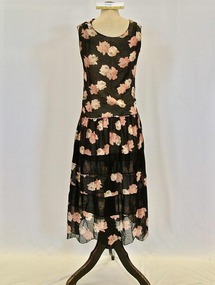
Dress, late 1920s
... In Parliament, she was a vocal advocate for women and families and supported building a stronger relationship between Australia and Asia. ...In Parliament, she was a vocal advocate for women and families and supported building a stronger relationship between Australia and Asia. ...Worn by Dame Marie Breen DBE OBE, Federal Senator for Victoria and Brighton resident. A passionate member (and founder) of many community organisations and charities, Marie Freda Breen (nee Chamberlin, 1902-1993) had her first experience of public life when her husband Robert became Mayor of Brighton in 1940. She became involved in the fledgeling Liberal Party, and Robert encouraged her to run for office. Marie because Victoria's first female Federal Senator in 1962. In Parliament, she was a vocal advocate for women and families and supported building a stronger relationship between Australia and Asia. In 1965 she became the first woman to chair a Senate committee. Marie retired from politics in 1968, after Robert was badly injured in a car accident. He died shortly after and she re-dedicated herself to community service, raising funds for UNICEF and serving on the Victorian Consultative Committee on Social Development and the Australian Advisory Council of Elders. In 1959 she was appointed an Officer of the British Empire for her work in the role of State President of the National Council of Women (Victoria) and in 1979 she was appointed Dame Commander of the Order of the British Empire. Marie and Robert had three daughters, one of whom, Jeannette Patrick, was the Liberal Member for Brighton (1976-1985) and Parliamentary Secretary of the Liberal Party, (1979-82).Sleeveless black cotton voile dress printed with large cream and apricot coloured roses. Dropped waist; bias-cut triangular draping applied to back neck; two horizontal bands of black voile inserted into skirt.dame marie breen, 1920s, liberal party of australia, australian senate, politics, robert breen -
 Uniting Church Archives - Synod of Victoria
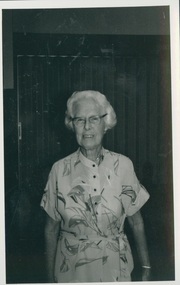
Photograph, Undated c.1970s
... President of the Presbyterian Women's Association (P.W.A.) 1966 - 1969. Representative to the East Asian Christian Conference. ...President of the Presbyterian Women's Association (P.W.A.) 1966 - 1969. Representative to the East Asian Christian Conference. ...Mrs Jean Yule O.A.M. was editor of the "Women in the Church" column of the Australian Presbyterian Life newspaper 1960 - 1975. Member of the Presbyterian Church Freedom from Hunger Victorian committee. President of the Presbyterian Women's Association (P.W.A.) 1966 - 1969. Representative to the East Asian Christian Conference. Presbyterian Church Elder; field officer World Christian Action 1974.B & W gloss, waist length photograph of Mrs Jean Yule.mrs jean yule, presbyterian, presbyterian life, freedom from hunger, p.w.a., writer -
 Federation University Art Collection
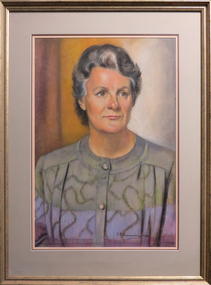
Painting - Artwork - Drawing, 'Professor Shirley Randell,' 1989 by Geoffrey Mainwaring, 1989
... Shirley Randell is a long-time activist for gender equality and women's empowerment in education, employment, public service and civil society in Australia, the Pacific, Asia and Africa. ...Shirley Randell is a long-time activist for gender equality and women's empowerment in education, employment, public service and civil society in Australia, the Pacific, Asia and Africa. ...Geoffrey MAINWARING (29 October 1912-13 April 2000) Born Adelaide South Australia Geoffrey Mainwaring studied at the South Australian School of Arts and Crafts before becoming an art teacher at Thebarton Technical School (1928-36). Mainwaring was adept at depicting a variety of subjects, from landscapes to portraits, and was very competent using a variety of media, including pencil, oils, and watercolour. He was a confident draftsperson, and completed many sensitively rendered portraits that give an insight into the character of the sitter. In June 1941 Geoffrey Mainwaring (SX13471) joined the 2nd Australian Imperial Force, and after five months was transferred to the Engineers and employed as a Sergeant-Instructor, specialising in demolitions. In late 1942, he was sent to New Guinea as an Australian army artist on probation. On 27 May 1947, Mainwaring was discharged from the Army, having served for five and a half years. He was appointed as an artist on a civilian basis until his paintings were completed in March 1948. In 1949 he was appointed Head of the Art School at the Ballarat School of Mines (now Federation University Australia). He continued to paint commissioned portraits for the Australian War Memorial until the late 1950s. Geoffrey Mainwaring died at Ballarat in April 2000. This item is part of the Federation University Art Collection. The Art Collection features over 2000 works and was listed as a 'Ballarat Treasure' in 2007.A framed and triple mounted pastel portrait of Professor Shirley Randell. Shirley Randell is a long-time activist for gender equality and women's empowerment in education, employment, public service and civil society in Australia, the Pacific, Asia and Africa. She was the first female dean at Ballarat College of Advanced Education (later Federation University Australia). Her appointment as Dean of Academic Affairs made her the first woman to hold a senior management position at the college. In 2019 Shirley Randell is a Member of the Order of Australia, having received the Officer of the Order (AO) award in 2010 for her services to international relations through education, public sector, institutional reform and economic empowerment of women in Australia, the Pacific, Asia and Africa. She is a member of many important boards and committees including the Australian Government Women’s Alliance – Economic Security for Women and the indigo foundation. An Ambassador of Dignity Ltd, the Australian Centre for Leadership for Women, Women’s International Cricket League/FairBreak and The International Alliance for Women, Shirley Randell is also a member of the Independent Scholars Association of Australia Council, Graduate Women International Projects Committee, and sits on the several editorial boards including the BioMedical-Central Women’s Health Journal. Gift of Professor Shirley Kaye Randell, AO, PhD, Hon.DLitt, FACE, FAICD, FIML, first woman in the Executive Team of the Ballarat College of Advanced Education as Dean of Academic Affairs, 1989- 1990signature bottom right - "G. R. Mainwaring 1989."art, artwork, available, geoff mainwaring, geoffrey mainwaring, mainwarring, pastel, drawing, portrait, portraiture, woman, professor shirley randell, ballarat, g. r. mainwaring, shirley randell -
 National Wool Museum
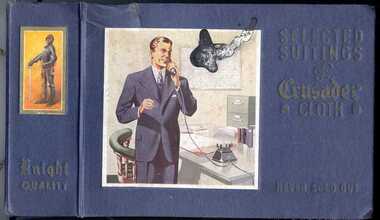
Sample Book, "Selected Suitings of Crusader Cloth" sample book
... women often acquired these books from tailors when the fabrics were no longer available. They made use of the fabric sample pieces to make quilts. The Australian Woollen Mills was an example of a woollen mill which went into worsted production making good quality English-type suiting. They were very successful until the 1960's when the oversupply of worsted fabrics from Europe and Asia...women often acquired these books from tailors when the fabrics were no longer available. They made use of the fabric sample pieces to make quilts. The Australian Woollen Mills was an example of a woollen mill which went into worsted production making good quality English-type suiting. They were very successful until the 1960's when the oversupply of worsted fabrics from Europe and Asia ...This book dates from the 1940s and was part of the Running Stitch collection of quilts, probably because it was common for women to acquire these books from travelling salesmen. This sample book is an example of the type made by textile mills and given to tailors to sell fabric for made to measure suits. With little money to spare during the austere years of the war, women often acquired these books from tailors when the fabrics were no longer available. They made use of the fabric sample pieces to make quilts. The Australian Woollen Mills was an example of a woollen mill which went into worsted production making good quality English-type suiting. They were very successful until the 1960's when the oversupply of worsted fabrics from Europe and Asia led to the decline of the industry in this country. This book was displayed in the Running Stitch exhibition "Wool Quilts Old and New" of 1985 where it was catalogue entry number 40.Australian Woollen Mills Crusader fabric sample book, c.1940sKnight / QUALITY SELECTED / SUITINGS / of / Crusader / CLOTH / NEVER SOLD OUT Crusader / CLOTH / Makes the best suits "Crusader" / WORSTEDaustralian woollen mills pty ltd running stitch group, cloth - worsted, running stitch collection -
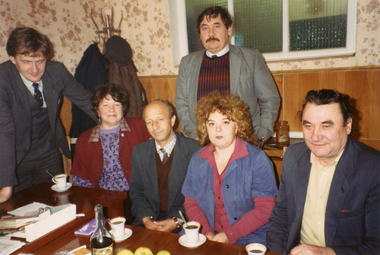 National Wool Museum
Photograph - Chernihiv Worsted and Cloth Mill, Ukraine, 1990s
... Asia. Stuart Ascough International Wool Secretariat Topmaking career wool industry training technical advice mills Ukraine Textile industry Chernihov Image depicting four men and two women seated and standing around a table with coffee cups. ...This image shows the team from the topmaking section at the Chernihiv Worsted and Cloth Mill in the Ukraine. Part of a collection of books, manuals, photographs, letters and clothing relating to the working life of Stuart Ascough. Stuart's career in the wool industry spanned over 43 years from 1960 to 2003 in various roles including Topmaking Plant Manager at Courtaulds Ltd. in Spennymore, U.K., Operations Manager at Port Phillip Mills in Williamstown Victoria, Marketing Executive, Early Stage Wool Processing at the International Wool Secretariat Melbourne, Australia and General Manager of Victoria Wool Processors Pty. Ltd. in Laverton North, Victoria. Throughout his career Stuart travelled extensively, and in the 1990s worked at many topmaking mills in China on quality improvement projects. He also provided technical advice and training at mills in India, Ukraine, Lithuania, Kyrgyzstan, Russia, Latvia, Byelorussia and other parts of Europe and Asia.Image depicting four men and two women seated and standing around a table with coffee cups.stuart ascough, international wool secretariat, topmaking, career, wool industry, training, technical advice, mills, ukraine, textile industry, chernihov -
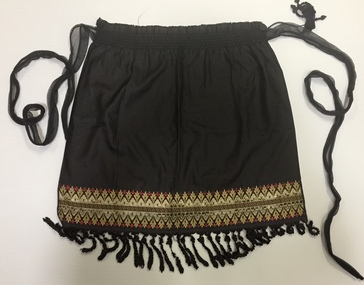 Kew Historical Society Inc
Clothing - Cotton apron embroidered with gold and red silk thread, 1960s
... While the collection includes some examples of international fashion, most items were handmade or purchased in Melbourne. clothing - women's aprons protective wear fashion design fashion -- 1960s Black hostess apron created from a black silk southeast asian textile featuring a stylised woven band of red, black and gold silk. ...The Fashion & Design collection of Kew Historical Society includes examples of women’s, men’s, children’s and infants' clothing from the 18th, 19th and 20th centuries. While the collection includes some examples of international fashion, most items were handmade or purchased in Melbourne.Black hostess apron created from a black silk southeast asian textile featuring a stylised woven band of red, black and gold silk. The fabric is gathered at the waist. The strap includes a black silk tassel. clothing - women's, aprons, protective wear, fashion design, fashion -- 1960s -
Kew Historical Society Inc
Journal, The Kewriosity Sheet Vol.4 No.12 : August 1983
... Asian Evangelical Fellowship) / p4. Parkinson's Disease Association / p4. Hyde Park Fellowship (Hyde Park Uniting Church) / p4. Kew drop-In Centre - holiday program (Sacred Heart Church) / p4. Back by popular demand (Kew Garden Club) / p4. Native planet Group / p4. Daytime Garden Club / p4. Camberwell Film Society / p4. Women's ...R.A.A.V. Action Program 1983 (Rheumatism and Arthritis Association of Victoria) / p1. Kew Library / p1. Council Immunisations (Rubella) / p1. Save the Children Fund / p1. Scrabble / p1. Can you spare some time for your neighbours? (Volunteering; Meals on Wheels) / p1. Meet the editor of "Gardening News" / p1. Correction (Recycling) / p2. Community Centre??? (Kew Swimming Pool; Kew Depot; North Ward Action Group) / p2. Kew Rotaract / p2. Uniting Church East Kew (calendar of events) / p2. S.C.F. fundraising morning (Save the Children Fund) / p2. Kew Recreation Program: Term III - 1983 [short courses] / p2. Kew in that other Depression (Great Depression; 1930s) / Barbara Giles p3. Kew Philharmonic Society / p3. Kew Historical Society / p3. Unique cards: feature views of Kew (Gregary Chase designer) / p3. Look out for funding! (Family and Community Services Program; F.A.C.S.) / p4. "An Asian experience" (The Asian Evangelical Fellowship) / p4. Parkinson's Disease Association / p4. Hyde Park Fellowship (Hyde Park Uniting Church) / p4. Kew drop-In Centre - holiday program (Sacred Heart Church) / p4. Back by popular demand (Kew Garden Club) / p4. Native planet Group / p4. Daytime Garden Club / p4. Camberwell Film Society / p4. Women's Discussion Group / p4.The Kewriosity Sheet (1979-83) was first published in the City of Kew (Victoria) in June 1979 as a two-sided 'community newssheet'. It aimed to: 'share news about Kew happenings and Kew people, and to exchange ideas about living in Kew'. Later issues gradually evolved into a 4-page, quarto sized publication. The Kewriosity Sheet was superseded by the Kew Council publication 'Kewriosity' (1983-1994).non-fiction R.A.A.V. Action Program 1983 (Rheumatism and Arthritis Association of Victoria) / p1. Kew Library / p1. Council Immunisations (Rubella) / p1. Save the Children Fund / p1. Scrabble / p1. Can you spare some time for your neighbours? (Volunteering; Meals on Wheels) / p1. Meet the editor of "Gardening News" / p1. Correction (Recycling) / p2. Community Centre??? (Kew Swimming Pool; Kew Depot; North Ward Action Group) / p2. Kew Rotaract / p2. Uniting Church East Kew (calendar of events) / p2. S.C.F. fundraising morning (Save the Children Fund) / p2. Kew Recreation Program: Term III - 1983 [short courses] / p2. Kew in that other Depression (Great Depression; 1930s) / Barbara Giles p3. Kew Philharmonic Society / p3. Kew Historical Society / p3. Unique cards: feature views of Kew (Gregary Chase designer) / p3. Look out for funding! (Family and Community Services Program; F.A.C.S.) / p4. "An Asian experience" (The Asian Evangelical Fellowship) / p4. Parkinson's Disease Association / p4. Hyde Park Fellowship (Hyde Park Uniting Church) / p4. Kew drop-In Centre - holiday program (Sacred Heart Church) / p4. Back by popular demand (Kew Garden Club) / p4. Native planet Group / p4. Daytime Garden Club / p4. Camberwell Film Society / p4. Women's Discussion Group / p4. community publications --- kew (vic.), the kewriosity sheet, newsletters - kew (vic.) -
 Wyndham Art Gallery (Wyndham City Council)
Photograph, Sunil Gupta, The New Pre-Raphaelites #7, 2008
... women and men in India. In making this body of work I used well known references to “western” art history since it has gained a certain international recognition. And this same western tradition had already incorporated elements of Aboriginal, African, and Asian art within it. ...Sunil Gupta is a British/Canadian citizen, (b. New Delhi 1953) MA (RCA) PhD (Westminster) who lives in London and has been involved with independent photography as a critical practice for many years focusing on race, migration and queer issues. A retrospective was shown at The Photographers’ Gallery, London (2020/21) and The Image Center, Toronto. He is a Professorial Fellow at UCA, Farnham. His latest book is “We Were Here: Sexuality, Photography, and Cultural Difference, Selected Writings by Sunil Gupta”, Aperture New York 2022. His work is in many private and public collections including; the Tokyo Museum of Photography, Philadelphia Museum of Art, Royal Ontario Museum, Tate, Metropolitan Museum of Art and the Museum of Modern Art. His work is represented by Hales Gallery (New York, London), Materià Gallery (Rome), Stephen Bulger Gallery (Toronto) and Vadehra Art Gallery (New Delhi).Part of Queer PHOTO (Midsumm x PHOTO 2024) photography, british photography, queer photography, race, migration, portrait
