
Showing 46 items matching "atmospheric "
-
 Federation University Historical Collection
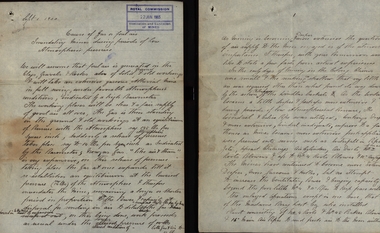
Document, Report on Cause of Gas or foul air innundating mines during periods of low atmospheric pressure
... Report on Cause of Gas or foul air innundating mines during periods of low atmospheric pressure ...Hand written report on Cause of Gas or foul air innundating mines during periods of low atmospheric pressure....Report on Cause of Gas or foul air innundating mines during periods of low atmospheric pressure Document ...In 1905 Richard Squire was manager of the West Berry Consols at Allendale, and developed an improved system of mine ventilation, which was supported in "The Age."[4] He was successful in combating and remedying the gas and ventilation troubles of the Deep Mines of Creswick and Allendale Districts after all had failed.Hand written report on Cause of Gas or foul air innundating mines during periods of low atmospheric pressure.Royal commission stamp to right hand corner dated 22 Jun 1903richard squire, report, cause of gas or foul air innundating mines during periods of low atmospheric pressure, royal commission, ventilation and sanitation of mines -
 Mission to Seafarers Victoria
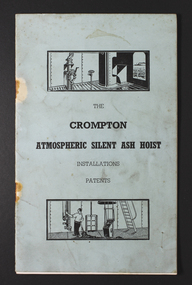
Manual, Crompton Atmospheric Silent Ash Hoist Installation Patents
... Crompton Atmospheric Silent Ash Hoist Installation Patents...Pale blue soft cover commercially printed manual or handbook relating to patents for Crompton Atmospheric Silent Ash Hoists. Features small diagram of figure pulling on a chain and view of ship silhouette on horizon seen through a porthole....Crompton Atmospheric Silent Ash Hoist Installation Patents Manual Manual ...Relates to management by engine room firemen of Ash and soot and clinker in the engine room of a steam ship. Hoists were used to discharge accumulated ash at the end of shifts. Mariner Duncan had a particular regard for the Mission to Seafarers. This plate for display on a commissioned new table at the MTSV chapel acknowledges his bequest and the material donated. Collectively the G W Duncan material includes: photographs, professional data memorabilia and written and commercially printed resources. The memorabilia relates to his career at sea and in particular the role of an engineer, including a handwritten manual of notes and references relating to the mechanical and engineering aspects and areas of responsibility for maintenance. Pale blue soft cover commercially printed manual or handbook relating to patents for Crompton Atmospheric Silent Ash Hoists. Features small diagram of figure pulling on a chain and view of ship silhouette on horizon seen through a porthole.see attached imageship engines, ship maintenance, ash hoists, coal, clinker, george winfield duncan (1922-2017), ship engineer, s.s. athenic -
 University of Melbourne, Burnley Campus Archives
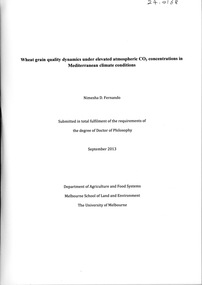
Book - PhD Thesis, Nimesha D Fernando, Wheat Grain Quality Dynamics Under Elevated Atmospheric CO2 Concentrations in Mediterranean Climate Conditions, 2013
... Wheat Grain Quality Dynamics Under Elevated Atmospheric CO2 Concentrations in Mediterranean Climate Conditions...Chapter 4 Intra-Specific Variation of Wheat Grain Quality in Response to Elevated [CO2] scanned Wheat Grain Quality Dynamics Under Elevated Atmospheric CO2 Concentrations in Mediterranean Climate Conditions Book PhD Thesis Nimesha D Fernando ...phd thesis, agricultural science, wheat -
 Dandenong/Cranbourne RSL Sub Branch
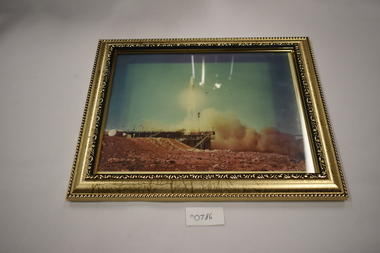
Photograph - Colour Photograph, Woomera Blue Streak
... Blue Streak was an Upper Atmospheric Research Vehicle dated 1965....Blue Streak was an Upper Atmospheric Research Vehicle dated 1965. Woomera Blue Streak Photograph Colour Photograph ...Framed Photograph depicting "Woomera Blue Streak". Blue Streak was an Upper Atmospheric Research Vehicle dated 1965. -
 Department of Energy, Environment and Climate Action
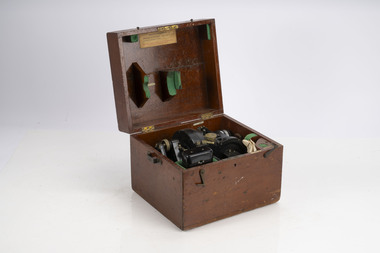
Balloon Theodolite 1943
... Theodolite used to measure the rate of rising helium balloons The rate of rise is used in atmospheric calculations such as upper winds and determining inversion layers...The horizontal movement is due to the winds blowing the balloon around at the altitudes that the balloon is traveling through Forests Commission Victoria (FCV) Bushfire Weather Theodolite used to measure the rate of rising helium balloons The rate of rise is used in atmospheric calculations such as upper winds and determining inversion layers Balloon Theodolite 1943 ...Used to measure the rate of rise of helium balloons The telescope is mounted on two movable axes. One axis (vertical) rotates to change elevation, the other (horizontal) azimuth. There are vernier scales and in some cases micrometres that give precise readouts of the relative position of the telescope to each axis. The instrument is set up so that it is level and it is pointed towards true north with both scales reading 0 degrees exactly. A balloon is released in front of the theodolite. It is sighted at timed intervals (usually one minute apart) and the position of the theodolite's telescope (azimuth and elevation) is recorded. It can chart the direction and velocity of winds at various altitudes The rate of ascent of a balloon is mostly dependant on the balloon's drag and its "free lift" (the vertical pull of the balloon). There is some degree of control over these these factors, and as a result, it possible to know approximately how high our balloon will be at any given time after its release. Given a known height and an angular direction (read off the theodolite) to the balloon, a fix is made of the horizontal movement component of the balloon's travel as it moves through different altitudes. The horizontal movement is due to the winds blowing the balloon around at the altitudes that the balloon is traveling throughTheodolite used to measure the rate of rising helium balloons The rate of rise is used in atmospheric calculations such as upper winds and determining inversion layersforests commission victoria (fcv), bushfire, weather -
 The Ed Muirhead Physics Museum
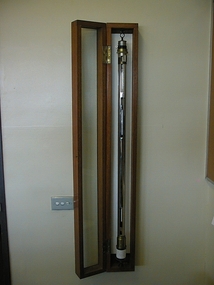
Wild-Fuess Barometer
... Wild-Fuess cylindrical Barometer used to measure atmospheric pressure and constructed predominantly of chrome and brass. ...Wild-Fuess cylindrical Barometer used to measure atmospheric pressure and constructed predominantly of chrome and brass. ...“Wild-Feuss Barometer - Leppin and Masche - Instructions for Assembling”, 1942. Paper : “A Stand Barometer of New Design” by Laby, 1924. Related to object 2.Wild-Fuess cylindrical Barometer used to measure atmospheric pressure and constructed predominantly of chrome and brass. Contained in specially made barometer case (Reg No.2).Engraved near top “LEPPIN & MASCHE, BERLIN NO. 856”. On label near base “Please lower the mercury level after use in order to keep the interior of the glass clean round “zero”.leppin & masche, scientific instruments, barometer, wild-fuess, leppin and masche -
 St Kilda Historical Society
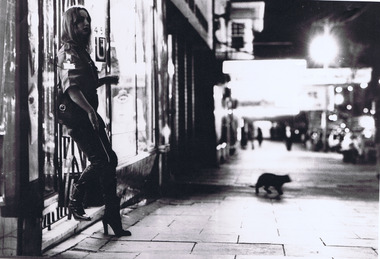
Photograph - Street scene, Fitzroy St, St Kilda
... Woman and cat in front of shops night scene atmospheric...Woman and cat in front of shops night scene atmospheric Fitzroy Street black and white photograph copy Fitzroy St, St Kilda Photograph Street scene The Age newspaper ...Woman and cat in front of shops night scene atmosphericblack and white photograph copyfitzroy street -
 Glenelg Shire Council Cultural Collection
Functional object - Barograph, n.d
... This instrument is also used to make a continuous recording of atmospheric pressure....This instrument is also used to make a continuous recording of atmospheric pressure. Port of Portland maritime barograph Wooden case, glass sided (front and ends). ...Port of Portland Collection A barograph is a barometer that records the barometric pressure over time in graphical form. This instrument is also used to make a continuous recording of atmospheric pressure.Wooden case, glass sided (front and ends). Steel handle on top (brass plated) used from circa 1950's.port of portland, maritime, barograph -
 Kew Historical Society Inc
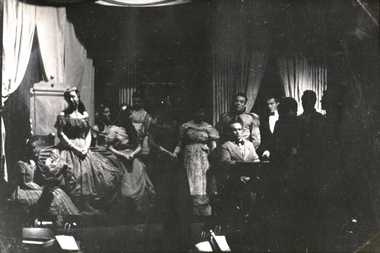
Photograph, The "Q" Theatre Guild, Gay Rosalinda, 1960
... Atmospheric photograph of performers in the "Q" Theatre Guild's performance of Gay Rosalinda, an arrangement of Johann Strauss' Die Fledermaus. ...The records also act as a history of arts activities in the Kew Recreation Hall and later in the Kew City Hall as entertainment and community arts and music precincts. performing arts -- kew (vic.) scrapbooks marion tilley collection 'q' theatre guild musical comedy -- melbourne -- victoria kew city hall -- cotham road -- kew (vic.) Atmospheric photograph of performers in the "Q" Theatre Guild's performance of Gay Rosalinda, an arrangement of Johann Strauss' Die Fledermaus. ...The "Q" Theatre Guild was formed out of the Kew Light Opera Company in 1957. It marked the transition of the company that had initially been directed by Lance Nicholls to one directed by Beatrice Oakley. It continued to perform in the Kew Recreation Hall, but, with its demolition in 1960, and the opening of the new Kew City Hall in Cotham Road, moved its productions to that venue. Productions of the "Q" Theatre Guild included The Geisha (1957), Maritana (1958), They All Do It (1959), Blossom Time (1959), Love's A Luxury (1959), There And Back & The Bohemian Girl (1960), Die Fledermaus (1960), Gay Rosalinda (1961), The Land Of Smiles (1961), Kisses For A Kid & Hansel And Gretel (1961), Die Fledermaus (1962), Monsieur Beaucaire (1964), Macbeath or The Beggar's Opera, and So To Bed.The scrapbook of annotated photographs, programmes, and newspaper reviews of which this item is a part was assembled by Marion Tilley, wardrobe mistress for, and performer in, productions by the Kew Light Opera Company and the "Q" Theatre Guild. It is significant as a remarkably complete document of theatre performances in Kew, Victoria during the 1950s and 1960s. The scrapbook, and the items individually catalogued within it, have artistic and aesthetic significance within the history of performing arts in Victoria in the middle of the 20th Century. They have social significance in that they reveal socio-cultural values and preoccupations during the period. The records also act as a history of arts activities in the Kew Recreation Hall and later in the Kew City Hall as entertainment and community arts and music precincts.Atmospheric photograph of performers in the "Q" Theatre Guild's performance of Gay Rosalinda, an arrangement of Johann Strauss' Die Fledermaus. The performance took place in the new Kew City Hall, with scenery created by Robert Jewell and Claud Ward. Costumes were designed and made by Marion Tilley. performing arts -- kew (vic.), scrapbooks, marion tilley collection, 'q' theatre guild, musical comedy -- melbourne -- victoria, kew city hall -- cotham road -- kew (vic.) -
 Nillumbik Shire Council
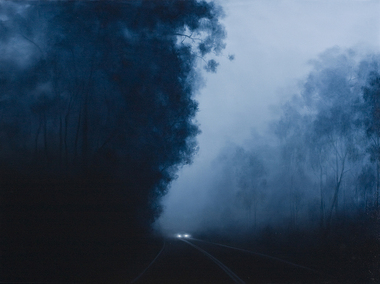
Painting: Camilla TADICH, Camilla Tadich, 6.23am Kangaroo Ground, 2009
... Tadich spends time observing night time phenomena, the light from the moon, street lights and other sources; atmospheric states, fog and dampness and the nature of surfaces, vegetation, road, vehicles and buildings. ...Tadich spends time observing night time phenomena, the light from the moon, street lights and other sources; atmospheric states, fog and dampness and the nature of surfaces, vegetation, road, vehicles and buildings. ...Tadich spends time observing night time phenomena, the light from the moon, street lights and other sources; atmospheric states, fog and dampness and the nature of surfaces, vegetation, road, vehicles and buildings. She uses photographs and sketches before settling on the final idea for a work.This painting is typical of Tadich's recent work. She continues her exploration of the Australian landscape (most often the local, Nillumbik Shire). It is 'a dramatic interplay between narrative, landscape and the binaries of light/dark and the known/unknown of local landscape. The swathes of darkness within the work(s) pose questions about our inscribed fears and tensions, both cultural and existential'. (catalogue, 'Silent Space' Ex. 2006) Tadich's early experiences of fireworks, simple fireworks and bonfire in the surrounding bush of her outer Melbourne home, caught her imagination. She was inspired to investigate the issues surrounding nights in the bush. In this painting the narrative is ambiguous, the pinpricks of light, in this case from the car headlights provide a critical element. We can distinguish familiar features, a road, trees and a car that suggest human presence. However, what is going on is unclear. The resulting tension can leave us unsure, unsettled and anxious.Oil on canvascamilla tadich, nillumbik shire council, kangaroo ground -
 Warrnambool and District Historical Society Inc.
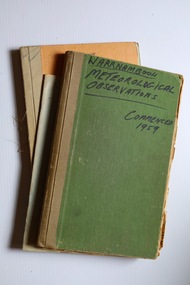
Administrative record (collection) - Warrnambool Meteorological Observations, Meteorological Observations, 1950s, 1960s, 1970s, 1980s
... The daily readings include those for atmospheric pressure, temperature, wind, cloud, rain and visibility.They have been compiled for the Bureau of Meteorology, at that time in the Department of Science in the State of Victoria. ...The daily readings include those for atmospheric pressure, temperature, wind, cloud, rain and visibility.They have been compiled for the Bureau of Meteorology, at that time in the Department of Science in the State of Victoria. ...Official Recording of Warrnambool Meteorological ObservationsTwo bound ledgers and one paperback exercise book and a folder of correspondencewarrnambool weatherwarrnambool weather -
 Nillumbik Shire Council
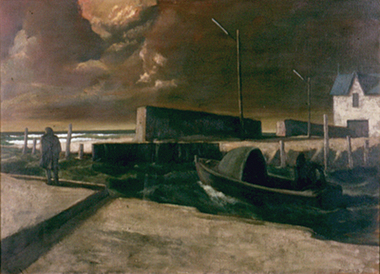
Painting: Rick AMOR (b.1948, Melb. AUS), Rick Amor, Out to Sea, 1993
... ...atmospheric...The work is representative of Amor's style and interest in seascapes as subject matter. amor seascape painting personal boat dramatic atmospheric ekphrasis 2015 dunmoochin In red paint, lower right, signed 'RICK AMOR '93' Oil on linen, seascape painting. ...Rick Amor was a good friend of three times Archibald Prize winner Clifton Pugh, living and working at Pugh's artist colony Dunmoochin, (Cottles Bridge) during the 1980-1990s. Amor made frequent outdoor painting trips with Pugh. His studies of Williamstown and areas around the port fuelled a period of sustained painting in his studio at Dunmoochin. Amor is an artist of national significance who had lived locally in Dunmoochin (Cottles Bridge) during the time of this work's making. This painting was exhibited/entered into the 1993 Shire of Eltham Art Awards. The work is representative of Amor's style and interest in seascapes as subject matter. Oil on linen, seascape painting. A solitary and motionless male figure in an overcoat stands at the edge of a dock/jetty with his hands in his pockets looking out to sea with his back towards the viewer. A motorised boat is moored close by and a white house with a blue roof can be seen in the distance. The figure is engulfed by the landscape and a resounding sense of desolation. A storm is brewing; the mood forecast by dark, heavy and thick ominous clouds, alternately darkening with the approach of night, a polluted haze and rough seas. In red paint, lower right, signed 'RICK AMOR '93'amor, seascape, painting, personal, boat, dramatic, atmospheric, ekphrasis 2015, dunmoochin -
 Glenelg Shire Council Cultural Collection
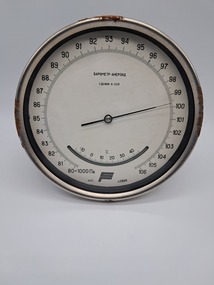
Instrument - Ships Barometer
... Aneroid barometers have a circular display face much like a clock that indicates the current atmospheric pressure. Part of a collection of objects belonging to Robert Hodgson. ...Aneroid barometers have a circular display face much like a clock that indicates the current atmospheric pressure. Part of a collection of objects belonging to Robert Hodgson. ...Since the mid-1600s, barometers have been a useful tool for boaters to measure air pressure in order to predict weather changes out on the sea. A change in pressure causes the dial's indicator hand to move. Aneroid barometers have a circular display face much like a clock that indicates the current atmospheric pressure. Part of a collection of objects belonging to Robert Hodgson. He was a fisherman and part of Shore Line Engineering.A circular white round face with black numbers around the edge starting at 80 and going up in 1 number increments to 106. Language is in Russian. A thermometer is on the face of the lower half starting at -10 degrees Celsius and up to 40 degrees Celsius going up in 10 number increments. A glass panelsits above the whit face and it is held together by a metal edge. The back of the barometer is black bakelite. -
 Sunbury Family History and Heritage Society Inc.
Photograph, Sunbury Gun
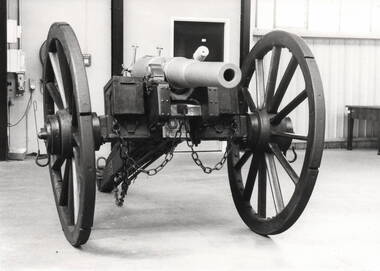
... In March 1982, the weathered Sunbury Gun was restored and housed in an atmospherically controlled glass case and displayed again in the triangular site opposite the Memorial Hall along with the War Memorial and the Starkie fountain....In March 1982, the weathered Sunbury Gun was restored and housed in an atmospherically controlled glass case and displayed again in the triangular site opposite the Memorial Hall along with the War Memorial and the Starkie fountain. ...The Sunbury Gun was originally donated to the Shire of Bulla by the Clarke family. For many years it stood at the intersection of Barkly, Stawell and Macedon Streets. Over the years it became very dilapidated and as traffic along Macedon Street gradually increased it was decided to refresh and relocate it to a triangular site opposite the Memorial Hall in 1970. In March 1982, the weathered Sunbury Gun was restored and housed in an atmospherically controlled glass case and displayed again in the triangular site opposite the Memorial Hall along with the War Memorial and the Starkie fountain.A non-digital black and white photograph of a gun in a large building.sunbury gun, memorial hall, clarke family, stawell street, barkly street -
 Geoffrey Kaye Museum of Anaesthetic History
Equipment - Stopcock, Hewitt, George Barth & Co. Ltd, c. 1895
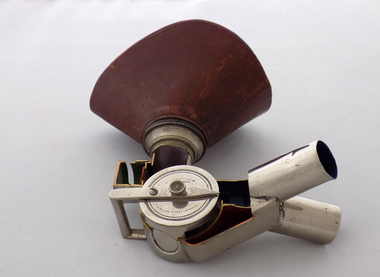
... The latter is thus so diluted by atmospheric nitrogen as to be incapable of producing anaesthesia except by asphyxiation. ...The latter is thus so diluted by atmospheric nitrogen as to be incapable of producing anaesthesia except by asphyxiation. ...When Hewitt introduced his regulating stopcock in 1887, attempts were made to dilute the nitrous oxide with air and so obviate the element of asphyxiation. The method was to be seen in London, mainly in dentistry and minor surgery, so late as 1930. It was not very successful. To give even 10% of oxygen (which is not enough) the gas-mixture must contain 55% of air and 45% of nitrous oxide. The latter is thus so diluted by atmospheric nitrogen as to be incapable of producing anaesthesia except by asphyxiation. "Gas-air" was confined to analgesia, for example in midwifery. (Source: Penn catalogue)Brown leather facemask attached to metal inhaler and stopcock device that has been sectioned to reveal its inner workings. The various exposed channels have been painted either green, red, blue or purple.Engraved into side of stopcock: HEWITT'S / N20-02 / 1895 / G. Kaye sect. 1952. •Stamped into other side of stopcock: [indecipherable] BARTH & CO. / SOLE MAKERS / 54. POLAND STREET LONDON.W.frederic hewitt, stopcock, nitrous oxide, oxygen, gas-air -
University of Melbourne, Burnley Campus Archives
Book - Register, Register of Meterological Observations, 1951-1959
... Handwritten entries atmospheric pressure, temperature, wind, cloud, rain, visibility and daily remarks. ...Handwritten entries atmospheric pressure, temperature, wind, cloud, rain, visibility and daily remarks. ...Staff of the Burnley Gardens regularly took extensive readings at the meteorological station and recorded comments. Red cardboard bound lined register. Handwritten entries for twice each day 9am and 3pm 1/1/1951 - 31/7/1959. The high percentage of days the recorded excluded Sundays, and latterly 3 days to whole weeks where readings were not taken. Header written as Burnley Gardens Victoria, with the header being changed to 'taken at Burnley Horticultural College' from June 1958. Book utilised in full. Handwritten entries atmospheric pressure, temperature, wind, cloud, rain, visibility and daily remarks. Different reporters shown by handwriting differences, and no monthly remarks made.Inside cover in blue handwriting - Mr Weisser Ext.26. Inside rear cover Field Book of Meteorological Observations (C.M.B. b/4 (1957) Form F/67. Register is full of handwritten readings.meteolorogy, observations, daily records -
Moorabbin Air Museum
Document - Wamira A10 Documents and drawings
... ATB B3-4 Box X85 A10 Wamira GAF Report on position of flutter analysis Wing electrics A10-J81-024 Flap – detail design document Trainer program undercarriage Wing static test 20.11.85 Strain gauge results Box 3 Wing static test deflections 22.1..85 Wing static test 7.11.85 Program to estimate loading effects due to continuous atmospheric turbulence GAF report on position of flutter analysis Wing static test 20.11.85 Strain gauge results Box 2 Mock up photos 3.9.84 Aeroelastic Design Philosophy ...ATB B3-4 Box X85 A10 Wamira GAF Report on position of flutter analysis Wing electrics A10-J81-024 Flap – detail design document Trainer program undercarriage Wing static test 20.11.85 Strain gauge results Box 3 Wing static test deflections 22.1..85 Wing static test 7.11.85 Program to estimate loading effects due to continuous atmospheric turbulence GAF report on position of flutter analysis Wing static test 20.11.85 Strain gauge results Box 2 Mock up photos 3.9.84 Aeroelastic Design Philosophy Document Wamira A10 Documents and drawings ... -
 Federation University Historical Collection
Mining Lamp, E. Thomas and Williams Ltd, Welsh Mining Lamp
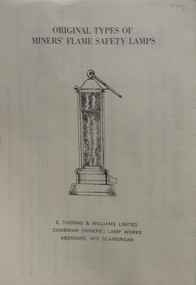
... It ensures the burning of a protected flame in the presence of explosive gas, by regulating the necessary supply of atmospheric air, and by allowing the products of combustion to pass through without igniting the gaseous atmosphere. ...It ensures the burning of a protected flame in the presence of explosive gas, by regulating the necessary supply of atmospheric air, and by allowing the products of combustion to pass through without igniting the gaseous atmosphere. ...This lamp is typical of lamps used in Welsh Coal Mines. It was purchased from the supplier around mid 1995. The Welsh Miners’ Lamps were ingeniously designed over 180 years ago to alert coal miners to danger. It ensures the burning of a protected flame in the presence of explosive gas, by regulating the necessary supply of atmospheric air, and by allowing the products of combustion to pass through without igniting the gaseous atmosphere. If the atmosphere is so heavily charged that noxious gas enters the lamp, its presence will be indicated by a change in the length and color of the flame, and (unless there are exceptional circumstances), the miner has sufficient warning to secure his safety. (http://www.welshminerslamps.com/info_lamp_personaluse.shtml, accessed 06/05/2015) E. Thomas & Williams, Ltd. mining lamps have been in continuous production since 1860. Cambrian Lamps are approved for use in coal mines where methan gas and oxygem deficinecy are hazards.Solid Brass traditional miners Flame Safety Lamp with Copper Chimney. The base of this lamp is tooled from solid brass because brass does not spark when it hits rock and is therefore the safest metal to use underground. The lamp burns lamp oil (kerosene). R. Thomas and Williams Ltd Makers Aberdare Wales Cambrian No 152897mining lamp, miner's lamp, thomas and williams, wales, welsh, welsh miners lamp, mining, cambrian lampworks, miners flame safety lamps -
 Nillumbik Shire Council
Sculpture, Ghost, 2012
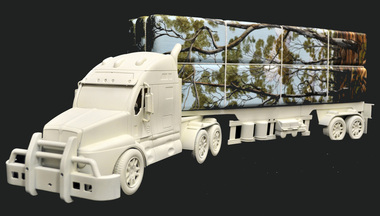
... Arriving in Australia in 1831, Glover adapted his picturesque style and luminous technique to his new surrounds, creating naturalistic and atmospheric paintings of Australian nature, settler life, and Aboriginal culture. ...Arriving in Australia in 1831, Glover adapted his picturesque style and luminous technique to his new surrounds, creating naturalistic and atmospheric paintings of Australian nature, settler life, and Aboriginal culture. ...The (logging) truck carries a representation of John Glover’s painted landscapes, which Cox has painted on a solid block of wood. John Glover is one of Australia’s most celebrated colonial landscape painters. Born in England, he was a highly successful water-colourist and painter of landscapes in the tradition of French artist Claude Lorrain. Arriving in Australia in 1831, Glover adapted his picturesque style and luminous technique to his new surrounds, creating naturalistic and atmospheric paintings of Australian nature, settler life, and Aboriginal culture. Working out of doors, Glover developed an understanding of the unfamiliar Australian landscape, especially the twisting forms of native eucalyptus trees. His direct experience of nature, as both pioneer settler and painter, resulted in a new approach using a subtle palette of olive greens, ochres, misty greys and intense blues, and layered glazes of mauve, grey and gold, to portray Australian light and atmosphere. Dale Cox continues the ongoing preoccupation and tradition of landscape painting in the Nillumbik area and our impact on the environment in a contemporary way. The truck creates a playful nexus between painting (representational landscape) and sculpture, purposely bluring boundaries across these traditionally distinct disciplines. ‘Ghost’ seeks to convey the idea that when we remove something significant from a location, like the landscape itself, the remaining ‘place’ changes to become a new ‘place’. This may seem self-evident until we think more deeply about location and landscape. The white truck is a ghost, an ethereal, transient being that spirits away an entire place, forever removed from itself, and forever changed. Logging wild trees can never be like harvesting a ‘crop’. Logging removes a landscape, and changes a place forever. The ‘packaging’ of this painted landscape highlights the anomaly between commodity and our environment. Dale Cox was a local artist and this work was highly commended at the 2012 Nillumbik Prize. White plastic toy (logging) truck with a landscape painting on a wooden block. The landscape painting is reminiscent of paintings by colonial artist John Glover. N/Alandscape, truck, sculpture, environment, john glover, colonial, painting, ghost, nillumbik prize -
 Puffing Billy Railway
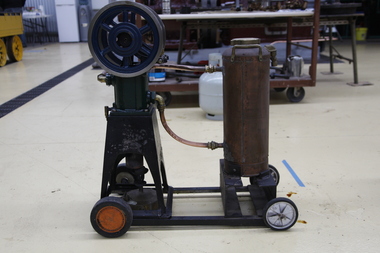
Heinrici Hot Air Motor, 1900s
... Heinricis use air at atmospheric pressure for their working fluid, but for higher specific output (power for size) and better efficiency, modern Stirling cycle engines use pressurised gas- air, nitrogen, helium or hydrogen....Heinricis use air at atmospheric pressure for their working fluid, but for higher specific output (power for size) and better efficiency, modern Stirling cycle engines use pressurised gas- air, nitrogen, helium or hydrogen. ...Louis Heinrici, Germany, circa 1900 a small Stirling type hot air engine in which a body of air is worked constantly, being alternately heated and cooled during each revolution of the crankshaft. Heinrici hot air engines are of the valveless, closed cycle type, generally called Stirling cycle engines, after Robert Stirling, the Scottish Presbyterian minister who pioneered their development in the early 1800's. They operate by alternately heating and cooling a quantity of air, called the working fluid, contained in the engine's internal spaces. Heat is applied externally and passes through the cylinder wall, heating the working fluid, which is then expanded against a piston to do mechanical work. After heating and expanding, the working fluid is moved to a cool space where it cools and contracts before being returned to the hot space for the cycle to repeat. It has a displacer (just a loose piston), below and in the same cylinder as the power piston to which it is connected via cranks and linkages so as to lead by 90degrees of crankshaft angle. The displacer space and the piston space are connected by the annular gap around the loose fitting displacer so that the working fluid moves between these spaces and changes volume by the appropriate ratio as the engine rotates. Because they have no valves and experience no sudden pressure changes, Stirling engines are noted for quietness and reliability. Heinricis use air at atmospheric pressure for their working fluid, but for higher specific output (power for size) and better efficiency, modern Stirling cycle engines use pressurised gas- air, nitrogen, helium or hydrogen.Historic - Hot Air Engine - MotorHot Air Motor made of Steel with two drive wheels. a small Stirling type hot air engine in which a body of air is worked constantly, being alternately heated and cooled during each revolution of the crankshaft. Heinrici Motorheinrici hot air motor, puffing billy -
 Federation University Art Collection
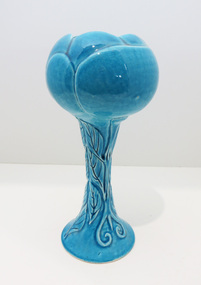
Ceramic - Artwork- Ceramic, Blue Goblet by John O'Loughlin
... Experimentation with a variety of temperatures, firing methods and atmospheric conditions has produced a broad tonal and textural palette. ...Experimentation with a variety of temperatures, firing methods and atmospheric conditions has produced a broad tonal and textural palette. ...John O'LOUGHLIN Born Snowtown, South Australia In 1980 John O'Loughlin's life changed when he started wheel throwing ceramic vessels. During this time he discarded the superfluous and unnecessary clutter collected on the journey of life, yet retaining the essence of what mattered to him. John O’Loughlin's later artworks engages with the way in which organised religion, specifically the Catholic Church, deals with the translation of the spiritual into the material. Informed by his extensive travels and studies, O’Loughlin’s ceramics reference the reliquaries and church artefacts that connect the life of this world with that of faith in another world. Completing undergeduate and post graduate works at Federation University John O'Loughlin's honours thesis was entitled "Ways and Means of Meaning, The Use of Symbol and Surface as Expressive Media in Ceramic Sculpture". The University provided a serious ceramic studio equipped with all the research tools for advanced ceramic exploration. Access to raw materials and a variety of kilns combined with excellent lecturers, mentors and technicians inspired, motivated and challenged him to push his accumulating knowledge to higher levels. O'Loughlin's working method in the studio is one of quiet, determined interaction with clay, idea and content. Experimentation with a variety of temperatures, firing methods and atmospheric conditions has produced a broad tonal and textural palette. He has worked with various clay bodies overlaid with coloured oxides, slips and engobes as the foundation for many of his works. O'Loughlin ufilised raised surfaces from old cemetery tombstones using the impressed forms and textures in his constructions. This research led him to the use of dry engobes to create a sense of antiquity, with crusty and distressed surfaces that resemble objects neglected in the oceans. These objects seem covered with the accretions and accumulations of history when re-discovered and brought to the surface as miraculous objects of mystery and magic. (https://www.thefreelibrary.com/John+O%27Loughlin%3A+a+man+re-invented.-a0216897107, accessed 12 September 2020) in 2007 John completer a Masters at the University of Ballarat. This item is part of the Federation University Art Collection. The Art Collection features over 2000 works and was listed as a 'Ballarat Treasure' in 2007.Botanical inspired wheel thrown goblet with decorative incised leaves on stem and flower head shaped cup. Glazed 'JOL' on bottom.art, artwork, goblet, botanical, ceramic, john o'loughlan, alumni -
 Federation University Art Collection
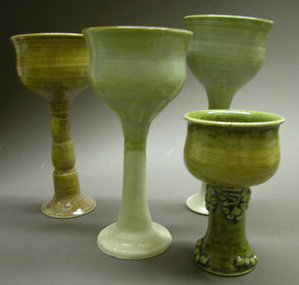
Ceramic - Artwork - Ceramics, Set of Four Goblets by John O'Loughlin
... Experimentation with a variety of temperatures, firing methods and atmospheric conditions has produced a broad tonal and textural palette. ...Experimentation with a variety of temperatures, firing methods and atmospheric conditions has produced a broad tonal and textural palette. ...John O'LOUGHLIN Born Snowtown, South Australia In 1980 John O'Loughlin's life changed when he started wheel throwing ceramic vessels. During this time he discarded the superfluous and unnecessary clutter collected on the journey of life, yet retaining the essence of what mattered to him. John O’Loughlin's later artworks, such as 'Reliquary No. 20' engages with the way in which organised religion, specifically the Catholic Church, deals with the translation of the spiritual into the material. Informed by his extensive travels and studies, O’Loughlin’s ceramics reference the reliquaries and church artefacts that connect the life of this world with that of faith in another world. Completing undergeduate and post graduate works at Federation University John O'Loughlin's honours thesis was entitled "Ways and Means of Meaning, The Use of Symbol and Surface as Expressive Media in Ceramic Sculpture". The University provided a serious ceramic studio equipped with all the research tools for advanced ceramic exploration. Access to raw materials and a variety of kilns combined with excellent lecturers, mentors and technicians inspired, motivated and challenged him to push his accumulating knowledge to higher levels. O'Loughlin's working method in the studio is one of quiet, determined interaction with clay, idea and content. Experimentation with a variety of temperatures, firing methods and atmospheric conditions has produced a broad tonal and textural palette. He has worked with various clay bodies overlaid with coloured oxides, slips and engobes as the foundation for many of his works. O'Loughlin ufilised raised surfaces from old cemetery tombstones using the impressed forms and textures in his constructions. This research led him to the use of dry engobes to create a sense of antiquity, with crusty and distressed surfaces that resemble objects neglected in the oceans. These objects seem covered with the accretions and accumulations of history when re-discovered and brought to the surface as miraculous objects of mystery and magic. (https://www.thefreelibrary.com/John+O%27Loughlin%3A+a+man+re-invented.-a0216897107, accessed 12 September 2020) This item is part of the Federation University Art Collection. The Art Collection features over 2000 works and was listed as a 'Ballarat Treasure' in 2007.Four wheel thrown goblets, two with decorative stems. art, artwork, john o'loughlin, ceramics, goblets -
 Federation University Art Collection
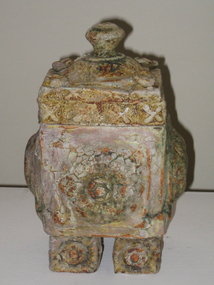
Ceramic - Artwork - Ceramics, 'Reliquary No. 20' by John O'Loughlin, 2007
... Experimentation with a variety of temperatures, firing methods and atmospheric conditions has produced a broad tonal and textural palette. ...Experimentation with a variety of temperatures, firing methods and atmospheric conditions has produced a broad tonal and textural palette. ...John O'LOUGHLIN Born Snowtown, South Australia In 1980 John O'Loughlin's life changed when he started wheel throwing ceramic vessels. During this time he discarded the superfluous and unnecessary clutter collected on the journey of life, yet retaining the essence of what mattered to him. John O’Loughlin's later artworks, such as 'Reliquary No. 20' engages with the way in which organised religion, specifically the Catholic Church, deals with the translation of the spiritual into the material. Informed by his extensive travels and studies, O’Loughlin’s ceramics reference the reliquaries and church artefacts that connect the life of this world with that of faith in another world. Completing undergeduate and post graduate works at Federation University John O'Loughlin's honours thesis was entitled "Ways and Means of Meaning, The Use of Symbol and Surface as Expressive Media in Ceramic Sculpture". The University provided a serious ceramic studio equipped with all the research tools for advanced ceramic exploration. Access to raw materials and a variety of kilns combined with excellent lecturers, mentors and technicians inspired, motivated and challenged him to push his accumulating knowledge to higher levels. O'Loughlin's working method in the studio is one of quiet, determined interaction with clay, idea and content. Experimentation with a variety of temperatures, firing methods and atmospheric conditions has produced a broad tonal and textural palette. He has worked with various clay bodies overlaid with coloured oxides, slips and engobes as the foundation for many of his works. O'Loughlin ufilised raised surfaces from old cemetery tombstones using the impressed forms and textures in his constructions. This research led him to the use of dry engobes to create a sense of antiquity, with crusty and distressed surfaces that resemble objects neglected in the oceans. These objects seem covered with the accretions and accumulations of history when re-discovered and brought to the surface as miraculous objects of mystery and magic. (https://www.thefreelibrary.com/John+O%27Loughlin%3A+a+man+re-invented.-a0216897107, accessed 12 September 2020) This item is part of the Federation University Art Collection. The Art Collection features over 2000 works and was listed as a 'Ballarat Treasure' in 2007.Lidded ceramic form.art, artwork, john o'loughlan, ceramics, available, available ceramics -
 Federation University Art Collection
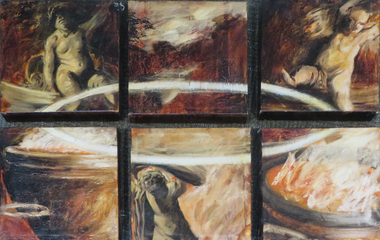
Painting - Artwork, 'Ring of the Nibellings' by David Noonan, 1989
... This approach was used to produce his 2018 atmospheric film 'A dark and quiet place'. Noonan is interested in combining art and traditional craft techniques. ...This approach was used to produce his 2018 atmospheric film 'A dark and quiet place'. Noonan is interested in combining art and traditional craft techniques. ...David NOONAN (1969- ) Born Ballarat, Victoria. Lives and works Melbourne, Victoria and London, United Kingdom. Leaving secondary school as soon as he could, David Noonan enrolled in a Visual Art Course at the Ballarat School of Mines. He described this time as 'an inspiring time, with every art form covered and treated with passion and rigour.' He studied ceramics, photography, painting and knew that he had to be an artist. (https://art150.unimelb.edu.au/articles/david-noonan-making-art-in-a-dark-and-quiet-place, accessed 17 January 2020). Between 1987 and 1989 David Noonan completed a Bachelor of Fine Art at Ballarat University College, Victoria, Australia (Now Federation University Australia). He undertook Post Graduate Studies at the Victorian College of the Arts, Melbourne in 1991 and 1992. Since 2005 he has been based in London with his work featuring in a number of major international exhibitions of contemporary art, including 'Altermodern', the 2009 Tate Triennial at Tate Britain, London. Producing works in a range of media including painting, photography, film, print-making, collage and sculpture David Noonan's work often evoke the subconscious realm through their fragmented imagery, allusive qualities and complex layering of historical and cultural references. Animals, actors and masked figures are recurring motifs that imbue his works with a magical atmosphere that is suggestive of childhood memories or half-forgotten dreams. ( produced works in a range of media including painting, photography, film, print-making, collage and sculpture. His works often evoke the subconscious realm through their fragmented imagery, allusive qualities and complex layering of historical and cultural references. (https://www.ngv.vic.gov.au/essay/david-noonan-untitled/, accessed 17 January 2020) David Noonan has become known for large-scale monochromatic collages on linen comprised of fabrics which are torn, folded, cut, stitched and combined with silkscreened images. This approach was used to produce his 2018 atmospheric film 'A dark and quiet place'. Noonan is interested in combining art and traditional craft techniques. (https://artgalleryofballarat.com.au/gallery_exhibitions/david-noonan-stagecraft/, accessed 17 January 2020) This item is part of the Federation University Art Collection. The Art Collection features over 2000 works and was listed as a 'Ballarat Treasure' in 2007. Six stretched canvases making up the work 'Ring of the Nibellings'. art, artwork, david noonan, oil on canvas, alumni -
 Federation University Art Collection
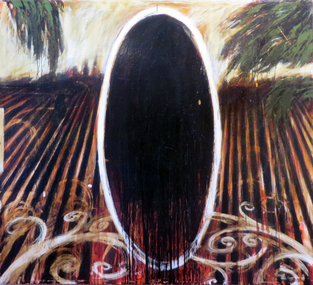
Painting, 'Through a Dark Glass Darkly' by David Noonan, c1989
... This approach was used to produce his 2018 atmospheric film 'A dark and quiet place'. Noonan is interested in combining art and traditional craft techniques. ...This approach was used to produce his 2018 atmospheric film 'A dark and quiet place'. Noonan is interested in combining art and traditional craft techniques. ...David NOONAN (1969- ) Born Ballarat, Victoria. Lives and works Melbourne, Victoria and London, United Kingdom. Leaving secondary school as soon as he could, David Noonan enrolled in a Visual Art Course at the Ballarat School of Mines. He described this time as 'an inspiring time, with every art form covered and treated with passion and rigour.' He studied ceramics, photography, painting and knew that he had to be an artist. (https://art150.unimelb.edu.au/articles/david-noonan-making-art-in-a-dark-and-quiet-place, accessed 17 January 2020). Between 1987 and 1989 David Noonan completed a Bachelor of Fine Art at Ballarat University College, Victoria, Australia (Now Federation University Australia). He undertook Post Graduate Studies at the Victorian College of the Arts, Melbourne in 1991 and 1992. Since 2005 he has been based in London with his work featuring in a number of major international exhibitions of contemporary art, including 'Altermodern', the 2009 Tate Triennial at Tate Britain, London. Producing works in a range of media including painting, photography, film, print-making, collage and sculpture David Noonan's work often evoke the subconscious realm through their fragmented imagery, allusive qualities and complex layering of historical and cultural references. Animals, actors and masked figures are recurring motifs that imbue his works with a magical atmosphere that is suggestive of childhood memories or half-forgotten dreams. ( produced works in a range of media including painting, photography, film, print-making, collage and sculpture. His works often evoke the subconscious realm through their fragmented imagery, allusive qualities and complex layering of historical and cultural references. (https://www.ngv.vic.gov.au/essay/david-noonan-untitled/, accessed 17 January 2020) David Noonan has become known for large-scale monochromatic collages on linen comprised of fabrics which are torn, folded, cut, stitched and combined with silkscreened images. This approach was used to produce his 2018 atmospheric film 'A dark and quiet place'. Noonan is interested in combining art and traditional craft techniques. (https://artgalleryofballarat.com.au/gallery_exhibitions/david-noonan-stagecraft/, accessed 17 January 2020) This item is part of the Federation University Art Collection. The Art Collection features over 2000 works and was listed as a 'Ballarat Treasure' in 2007.A large painting on canvas. art, artwork, david noonan, noonan, alumni, oil on canvas, available -
 Flagstaff Hill Maritime Museum and Village
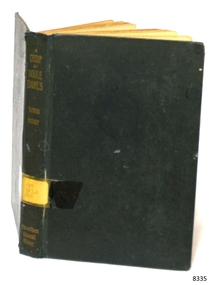
Book - Fictional Stories, Thomas Hardy, A Group of Noble Dames, 1894
... He used this deeply atmospheric rural backdrop to chart how the encroaching modern industrial world was destroying old agrarian traditions. ...He used this deeply atmospheric rural backdrop to chart how the encroaching modern industrial world was destroying old agrarian traditions. ...The subject novel A Group of Noble Dames is a collection of ten historical short stories bound together by a classic frame narrative. The premise is that to escape the boredom of a rainy day, ten male members of the "Wessex Field and Antiquarian Club" gather together. To pass the time, each member including a local historian, an old surgeon, a rural dean, and a churchwarden takes a turn telling a scandalous, tragic, or ironic tale about a high-born lady from the local aristocracy of the 17th and 18th centuries. Unlike Hardy's deeply somber major novels, he categorized these stories as "Romances and Fantasies." However, they still contain classic Hardyan cynicism.A Group of Noble Dames Author: Thomas Hardy Publisher: Macmillan And Co Date: 1894 Further Information: Olive hardcover and spine with spine lettering in gold. The spine has a Library label with inscription.non-fictionThe subject novel A Group of Noble Dames is a collection of ten historical short stories bound together by a classic frame narrative. The premise is that to escape the boredom of a rainy day, ten male members of the "Wessex Field and Antiquarian Club" gather together. To pass the time, each member including a local historian, an old surgeon, a rural dean, and a churchwarden takes a turn telling a scandalous, tragic, or ironic tale about a high-born lady from the local aristocracy of the 17th and 18th centuries. Unlike Hardy's deeply somber major novels, he categorized these stories as "Romances and Fantasies." However, they still contain classic Hardyan cynicism.flagstaff hill, warrnambool, shipwrecked coast, flagstaff hill maritime museum, maritime museum, shipwreck coast, flagstaff hill maritime village, great ocean road, book, pattison collection, warrnambool library, warrnambool mechanics’ institute, ralph eric pattison, corangamite regional library service, warrnambool city librarian, mechanics’ institute library, victorian library board, warrnambool books and records, warrnambool children’s library, a group of noble dames, thomas hardy -
 Bendigo Military Museum
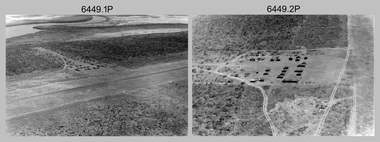
Photograph - RA Svy Project C4 Aerodist Operation, Eastern Arnhem Land, NT, 1967
... Unidentified survey operations base, L to R: unidentified technician. .11) - Unidentified technician reading two survey altimeters to compute corrections to the measured distances for atmospheric refraction and to compute the sea level distances from the slope distances aircraft to the ground stations. .12) - Photo, black & white, 1967. ...Unidentified survey operations base, L to R: unidentified technician. .11) - Unidentified technician reading two survey altimeters to compute corrections to the measured distances for atmospheric refraction and to compute the sea level distances from the slope distances aircraft to the ground stations. .12) - Photo, black & white, 1967. ...This is a set of 30 photographs of Royal Australian Survey Corps (RA Svy) personnel from Central Comd Fd Svy Unit (Adelaide) on Aerodist survey operation - Project C4 in Eastern Arnhem Land, Northern Territory in 1967. Photos of personnel were taken either at the operations base at Numbulwar or the main base at Gove (Nhulunbuy). RA Svy conducted nineteen Aerodist operations for 12 years from 1964 to 1975. Aerodist MRC2 was a tellurometer-based system adapted for aircraft to accurately measure distances between non-intervisible ground survey stations, using the aircraft as an intermediate station. Lower order geodetic results could be achieved by survey network trilateration. The measured distances between stations formed survey networks from which each station’s latitude and longitude was computed. Aerodist MRC2 was RA Svy’s major horizontal control survey tool for mainly medium scale topographic mapping (scale 1:100,000 Class A being spatially accurate to within 50 metres) in PNG, northern NT, north-west WA, Kalimantan Barat (West) Indonesia, Sumatra Indonesia, Gulf of Carpentaria and Cape York, QLD. In 1967, the Aerodist MRC2 Master equipment was installed in the aircraft featured in this set of photos, Executive Air Services’ (Essendon VIC) Grand Aero Commander VH-EXX. It was the same aircraft type and company contracted to Division of National Mapping for Aerodist MRC2 surveys. From July to October 1967 the aircraft was attached to Central Comd Fd Svy Unit (Adelaide - Major Don Ridge) on Project C4 eastern-Arnhem Land NT, where 317 Aerodist lines measuring 17,300 line miles were successfully completed. This was the most productive Aerodist project thus far. The most common helicopter used by RA Svy up to 1972 was the civilian Bell 47G-2 and the Sioux Light Observation Helicopters (LOH), the Australian Army’s equivalent featured in this photo set. These light observation helicopters had a limiting load carrying capacity of up to about 500 pounds. By comparison, one Aerodist team including two people weighed up to 1,500 pounds. Source: Royal Australian Survey Corps – Aerodist Years 1964-1975 by Peter Jensen. Refer to Item 9061.26P for more photos taken during this Aerodist survey operation.This is a set of 30 photographs of Royal Australian Survey Corps (RA Svy) personnel on Aerodist survey operations in Eastern Arnhem Land, Northern Territory in 1967. The photographs are on 35mm negative film and scanned at 96 dpi. They are part of the Army Survey Regiment’s Collection. .1) to .4) - black & white, 20th August 1967, Project C4 Aerodist Operations Base - Numbulwar, NT. .5) - Photo, black & white, 1967. Probable wrecked Indonesian fishing vessel. .6) to .8) - Photo, black & white, 1967. Unidentified survey operations base, L to R: unidentified personnel. .9) - Photo, black & white, 1967. Unidentified survey operations base, unidentified soldier driving a Haflinger 4x4 Light utility vehicle. .10) - Photo, black & white, 1967. Unidentified survey operations base, L to R: unidentified technician. .11) - Unidentified technician reading two survey altimeters to compute corrections to the measured distances for atmospheric refraction and to compute the sea level distances from the slope distances aircraft to the ground stations. .12) - Photo, black & white, 1967. Survey operations base, L to R: unidentified (x3), W01 Pat Wood BEM, unidentified. .13) to .16) - Photo, black & white, 1967. Unidentified personnel operating remote Aerodist MRC2 ground instruments. .17) to .18) - Photo, black & white, 1967. Unknown RA Svy office location. .19) to .20) - Photo, black & white, 1967. Aerodist MRC2 Master equipment. .21) to .22) - Photo, black & white, 1967. Aero Commander VH-EXX probably at Gove, NT, Central Comd Fd Svy Unit (Adelaide) – OC Major Don Ridge. .23) to .25) - Photo, black & white, 1967. Aero Commander VH-EXX probably at Gove, NT. Unidentified personnel. .26) - Photo, black & white, 1967. Aero Commander VH-EXX probably at Gove, NT. Aerodist antenna pods are visible on the aircraft. .27) to .29) - Photo, black & white, 1967. Australian Army Sioux Light Observation Helicopter (LOH) probably at Gove, NT. .30) - Photo, black & white, 1967. Panelled U337 survey station, visible as a white cross on aerial identification photo..1P to .2P – date and location on edge of film negative. .5P to .28P – no annotations .29P - annotated in white ‘RW-JEP Gove NT’ .30P - annotated in white ‘U337 Spool No1 Jun67’royal australian survey corps, rasvy, army survey regiment, army svy regt, fortuna, asr, aerodist, surveying, central comd fd svy unit -
 Flagstaff Hill Maritime Museum and Village
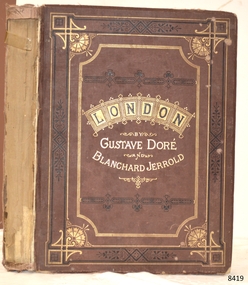
Book - Illustrated Reference Book/Social History, Louis Auguste Gustave Doré et al, London a Pilgrimage, 1872
... His style was defined by chiaroscuro—the dramatic contrast between light and dark—which gave his work a haunting, atmospheric, and highly theatrical quality. In the late 1860s, Doré expanded into London, opening the highly lucrative "Doré Gallery" on New Bond Street, which drew massive crowds for decades. ...His style was defined by chiaroscuro—the dramatic contrast between light and dark—which gave his work a haunting, atmospheric, and highly theatrical quality. In the late 1860s, Doré expanded into London, opening the highly lucrative "Doré Gallery" on New Bond Street, which drew massive crowds for decades. ...London A Pilgrimage (1872) is one of the most celebrated, visually striking, and socially important illustrated books of the 19th century; as such, the work is a highly desirable piece of publishing history. The book offers a comprehensive, episodic portrait of Victorian London at the height of the British Empire. The prominent French artist Gustave Doré and English journalist William Blanchard Jerrold shared a fascination with urban life, combining their talents to create one of the 19th century's greatest collaborative works. They spent days exploring the metropolis together to capture the stark dualities of the city. Rather than focusing solely on the grand landmarks of the wealthy, the book famously juxtaposes the "sunlight and shadows" of London life. When Jerrold suggested a massive, joint exploration of London in 1869, it brought together two perfect skill sets: Jerrold provided the investigative journalistic grit and intimate knowledge of London’s social strata, while Doré provided the haunting, cinematic visual poetry through his illustrations.Hard cover book, London a Pilgrimage Author: William Blanchard Jerrold Publisher: Grant & Co, 74-78 Turnmill St. London. EC. Date: 1872 Morocco Olive hardcover with a damaged spine, lettering in gold with a title in a surrounded with a decorative panel. non-fictionLondon A Pilgrimage (1872) is one of the most celebrated, visually striking, and socially important illustrated books of the 19th century; as such, the work is a highly desirable piece of publishing history. The book offers a comprehensive, episodic portrait of Victorian London at the height of the British Empire. The prominent French artist Gustave Doré and English journalist William Blanchard Jerrold shared a fascination with urban life, combining their talents to create one of the 19th century's greatest collaborative works. They spent days exploring the metropolis together to capture the stark dualities of the city. Rather than focusing solely on the grand landmarks of the wealthy, the book famously juxtaposes the "sunlight and shadows" of London life. When Jerrold suggested a massive, joint exploration of London in 1869, it brought together two perfect skill sets: Jerrold provided the investigative journalistic grit and intimate knowledge of London’s social strata, while Doré provided the haunting, cinematic visual poetry through his illustrations.flagstaff hil, warrnambool, flagstaff hill maritime museum, maritime museum, shipwreck coast, flagstaff hill maritime village, great ocean road, book, pattison collection, warrnambool library, warrnambool mechanics’ institute, ralph eric pattison, corangamite regional library service, warrnambool city librarian, mechanics’ institute library, victorian library board, warrnambool books and records, warrnambool children’s library -
 City of Melbourne Libraries
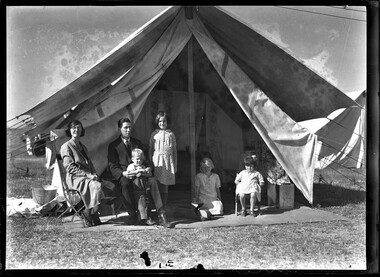
Photograph, Bull, Hugh Jones, 1897-1993, Seventh Day Adventists Camp at Hampton: E. Gane + family
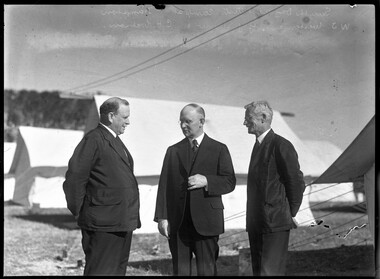
... Water hazards, sand bunkers, running streams, ancestral castles, moats and a cunning drawbridge have each been devised to test the skill of players, while the walls and ceiling have been "atmospherically" treated to convey an exterior effect”. ...Water hazards, sand bunkers, running streams, ancestral castles, moats and a cunning drawbridge have each been devised to test the skill of players, while the walls and ceiling have been "atmospherically" treated to convey an exterior effect”. ...Photographer notations on slide: Seventh Day Adventists Camp. E Gane + family Published: 28 December 1933 Published title: SEVENTH DAY ADVENTISTS. Published caption: “I. — The Annual Camp of the Seventh Day Adventists in Highett-road, Hampton, comprising more than 250 tents and accommodating over a thousand persons. II. —W. J. Westerman (vice-president of Australasian) and Pastor G. G. Stewart (president of Victoria), conversing with Pastor C. H. Watson (world president of the Seventh Day Adventists).- III.— Evangelist E. R. Gane and family.” SEVENTH DAY ADVENTISTS. (1933, December 28). The Age (Melbourne, Vic. : 1854 - 1954), p. 9. Retrieved August 1, 2025, from http://nla.gov.au/nla.news-article203356427 Research by project volunteer, Fiona Collyer: In December 1933, evangelist Mr E.R. Gane and his family gather outside their tent during the ten day Seventh Day Adventist Conference held in Highett Road, Hampton. Description: A woman, man and four small children sit and stand in front of a tent. One child plays with a toy train. In December 1933, delegates from all over Victoria and beyond travelled to Melbourne for the annual Seventh Day Adventists Conference of Victoria, held over ten days on a vacant allotment at Highett Road Hampton. A canvas town of 250 tents for over 1000 campers was created along with large marquees for lectures, devotional services and kitchens. Many daily visitors also attended the lectures and services. The principal speaker was Victorian born world president of the Seventh Day Adventists, Pastor Charles H. Watson (1877-1962), who travelled from Washington DC for the event. The Highett Street campers attended a busy schedule of bible readings, devotional services and health lectures during the ten days of the camp. Lecture subjects included- “Among the Head Hunters of the Solomon Islands”, “ Looking Through the Prophetic Telescope into 1934”, “Soul Surgery”, “Viewing the Celestial Land Through the Prophetic Telescope”and “The Four Horsemen of the Apocalypse”. The Seventh Day Adventist religion was established in the USA in 1863. One of its co-founders was American Ellen G. White whose writings are regarded as divinely inspired and are still adhered to today. Ellen preached on the “Eight Laws of Health”- Nutrition, exercise, water, sunshine, temperance, air, rest and trust in God. Adventists regard their bodies as holy temples and avoid food deemed by the Bible as unclean. They eat a mainly plant based diet with no caffeinated beverages and abstain from alcohol and tobacco. They believe in the observance of Saturday, the seventh day of the week in the Christian (Gregorian) and Hebrew calendars as the sabbath and the literal and imminent second coming of Jesus Christ. New converts are baptised by immersion in water. The Adventists opened the Warburton Sanitarium in 1910 as a health retreat, integrating their holistic health philosophy of physical, mental and spiritual well being. It was a resort in the hills “among picturesque mountain scenery…surrounded by tall forests and deep fern gullies…” where highly strung Melburians could alleviate their digestive maladies, stress and jaded nerves as “…worn down nervous systems mend quickly in this peaceful environment…invigorating air and an abundance of home-grown fruit, vegetables, fresh eggs, milk, and cream help to build healthy bodies”. The resort also offered hydrotherapy, massage and electrical treatments. An advertisement in The Argus- 1 December 1947 assured readers- “EVERYTHING SUNNY AGAIN." “That's how you'll feel when you say farewell to Warburton Sanitarium and Hospital after spending a holiday here. Victoria's Hydro is famous far and wide for wonders worked with sufferers from nervous and digestive disorders. Wholesome food, perfectly cooked; splendid air, regulated exercise, sweet natural sleep; these quickly correct faulty digestion, restore vitality, bring back that sunny optimism natural to healthy people. Massage and curative baths under medical supervision…” Later, after further building work, it became the Warburton Hospital with medical, casualty and obstetrics wards as well as offering strategies to stop smoking, lose weight and for stress management. The hospital ceased operation in 2001. Ellen G. White wrote “God sent me to Australia” and in 1891, accompanied by her son William C. White she arrived in Australia to start a Bible school, spread her health philosophy and for missionary work. At first health food products were imported from America, but it soon became apparent that due to the expense and the food becoming stale over the long journey, that local manufacturing was necessary. In 1898 William secured the services of American Adventist baker Edward C. Halsey, who had worked at Dr Kellogg’s Battle Creek (“Cereal City”), Sanitarium, Michigan, USA. They rented the St George’s bakery in Northcote, Melbourne, producing the first ready to eat breakfast cereal Granola, Caramel Cereal, and peanut butter. The fledgling company relocated to larger premises in Cooranbong, NSW soon after. The Sanitarium Health Food Company opened a factory in Warburton in 1925, manufacturing Granose Biscuits, Cerix Puffed Wheat, San-Bran, Bixies malted wheat flakes, Betta peanut butter, Marmite, “Kwic-Bru - A delicious health “coffee” made from choicest cereals and free from drugs that affect the heart and nerves” In 1928, Sanitarium bought out Grain Products Limited who were manufacturing a sweet cereal biscuit called Weet-Bix which soon became Australia’s favourite breakfast cereal. The Warburton factory closed in 1997, with manufacturing shifting interstate. Sanitarium breakfast cereal boxes offered free collectable cards inside and children could buy albums from grocers for sixpence and mount the cards. Subjects of the albums included- “Aboriginal Tribes, Legends, Customs”, “Australia- Yesterday and Today”, “Marvels of the Great Barrier Reef”, “Advance Australia- a Pageant of the Years”. In 1902 the Adventist’s opened the “Pure Food Vegetarian Cafe” in Sydney (In 1907 the name was changed to “Sanitarium Health Food Cafe”), Eating vegetarian food was definitely a curiosity. “Cristina” reviewed the cafe for The Australasian-27 October 1906. Topics For The Block. “Feeling somewhat like a criminal, and hoping to escape detection, I stealthily made my way into a vegetarian restaurant the other day... If my friends happened to catch me walking in there, I should henceforth be considered a crank, a faddist, and little short of a lunatic! Whom did I find within, seated with the air of habitués at the small tables, but heaps of my friends. They had all this while been pursuing their vegetarian way, layin' low and sayin' nuffin'. Flesh-eaters, now that the Sydney summer has set in apparently in good earnest, are beginning to wonder if the vegetarians are not wiser in their day and generation. Roast beef, hot cornea beef, ragouts, and meat curries, the very thought of them makes one feel hot. Frosted lemon pudding, stewed fruits, wheatmeal rolls, and tomatoes sound nice when you look at their names on the vegetarian menu. Such weird messes are served, square, unintelligible blocks of some brown substance, a few bites of which form a full and satisfying meal. Cold nut foods, granose, nuttose, and jam protose, bromose, with jelly and various "ose" sandwiches, impossible for the unbeliever to diagnose, are put before you. You drink malted nut broth, you eat gluten sticks, stewed beans, lentil patties, with vegetable sauce, any or all of which are distinctly nourishing and filling at the price. A mock (decidedly mock) veal cutlet or a red lentil roast is sufficient lunch, it appears, for anyone. Thus, "you obtain the best working results from your machinery with the least possible expenditure..." In December 1906 the Adventists branched out to Melbourne, opening the Sanitarium Health Food Cafe at 289 Collins Street next to the Royal Bank building. (corner Collins and Elizabeth Streets, demolished in 1939). Their motto was “Quality and Purity”. “Cynthia” of The Leader “Social Circle” column reviewed the cafe in 9 March 1907- “Hundreds of people have a feeling of positive affection for a diet that will be satisfying, appetising and nourishing, without having meat for its backbone. It will come as news that we have in Melbourne a cafe where you can really enjoy yourself without eating anything in the way of meat. Cream, custard, cheese and the like are not cold shouldered out of the menu, and the housewife in search of new dishes will find here ever so much in the way of suggestions. Nuts figure conspicuously in the menu, and lentil and walnut cutlets may be instanced among the delicacies. Beans are cooked in quite alluring fashion, while creamed parsnips are excellent. For sandwiches you could hardly desire anything more appetising than granosi biscuits, and nut cheese. The combination is suggestive of school lunches, and nut meat might well be employed as a variant. A visit to the cafe itself — it is next the Royal Bank in Collins-street — will surprise anyone used to the average vegetarian restaurant. Every thing is fresh, fragrant, and thoroughly modern… It is run, in connection with that curious people the Seventh Day Adventists.” However, “Adele” writing for the Evelyn Observer and Bourke East Record -13 December 1907 had a different experience- CITY RESTAURANTS. “There is no glamour from the outside. We enter the dining room at six and secure a seat at a small table, for this night we are going to dine on vegetables. Some people pride themselves on being vegetarians, and devote a great deal of their spare cash and energy to disseminating vegetarian principles. I shall not in a hurry forget the dinner we tried to get through at this vegetarian restaurant. There was put before us plate after plate of vegetables not soaked, but sodden with water, not an atom of flavouring or dressing; no attempt was made to give the slightest piquancy to potato, cabbage, turnip or carrot. I beg pardon, I am unjust, there were two caterpillars in the cabbage. It is astonishing how persistently ordinary cooks spoil vegetables in the process of cooking and how little they understand the value of vegetables on a menu.” From the extensive menu of 1924, you could order cream of green pea soup, followed by nut meat with Yorkshire pudding, egg timbales, stewed brown lentils, savoury rissoles with piquant sauce. Among the dessert offerings were creamed sago, steamed figs and walnut drops. Washed down with fermented wine and to finish, “Frucerea”, a coffee substitute essence made from fruit and cereal. A four course meal of soup, entree, vegetables and sweets cost 1/6 in 1924. Proving that plant-based food was not just a novelty, 67,000 meals were served at the cafe in 1918, rising to 73,000 in 1921. Later the Sanitarium Cafe moved to 293 Little Collins Street, (opposite Royal Arcade) sharing the building with The Lilliput Golf Course, a miniature golf course of 18 holes. The course was a replica of the fashionable Lido Course in France and was open daily from 10am to midnight with a green fee of one shilling. It featured goldfish, waterfalls and dance music. Lilliput boasted that they were “Melbourne’s coolest indoor course” Miniature golf (mini, minnie, midget, miget, Tom Thumb, Wee golf, putt-putt, pigmy, peewee, crazy golf, obstacle golf) swept the globe in the 1930s, starting in the USA, then Europe. The courses provided affordable recreation during uncertainty at the start of the Great Depression. The craze arrived in Sydney September 1930 with the first mini golf course opening in the basement of the State Theatre. It featured a replica Sydney Harbour Bridge and attracted over 1000 players a day at one shilling per game. The miniature golf bug hit Melbourne hard in 1930-31 with nearly 200 courses springing up in the CBD and suburbs within a few months. The first miniature golf course to open in Melbourne was on 4 October 1930 in the basement of recently built art deco style Wentworth House at 203 Collins Street, designed by architect Cedric Heise Ballantyne, (also designed Regent Theatre, Plaza Ballroom, Athenaeum Club, National Theatre, St Kilda, built in 1930, demolished in 1974 for the City Square) It was managed by J. C. Williamson who advertised for a “Girl Spruiker” who “Must be Young, Attractive Personality, and Able to Talk to the Public” to work at the course. The Age 26 September 1930 reported - “The Wentworth House management have spared no expense in preparing the links. Water hazards, sand bunkers, running streams, ancestral castles, moats and a cunning drawbridge have each been devised to test the skill of players, while the walls and ceiling have been "atmospherically" treated to convey an exterior effect”. Even Melbourne City Council jumped on the bandwagon, leasing the lower hall of Melbourne Town Hall to colourful car dealer and racehorse owner Mr A. G. Barlow for £43 per week for the “Kit Kat Tiny Golf Course”, opening on 11 December 1930. (Turf identity, Mr Alexander George Barlow, (1880-1937) who raced under the nom de course “A. G. Vauxhall”, owned filly Frances Tressady, who in 1923 won the Victoria Derby and Oaks Stakes double and came fifth in the Melbourne Cup. The “Frances Tressady Stakes” is held each March at Flemington Racecourse in honour of the horse, the last filly to win the Derby. Barlow was the proprietor of Barlow Brothers Pty Ltd car dealership at 442 Elizabeth Street, Melbourne. He played 14 games for Carlton Football Club (VFL) on the half-forward line from 1901-1903). Patrons could vie for The Herald Miniature Golf Championship Cup, a gold cup worth £7/7, in an eight week long competition. Sports newspaper The Sporting Globe also offered a Cup and prize money. Many courses offered prizes of theatre tickets, cash and cigarettes. Myer’s department store, hoping to cash in on the fad, advertised in Melbourne’s newspapers that their Sports Department could design and equip complete miniature golf courses using “Fairway” imitation turf at 4/6 a yard. Newspaper cartoonists loved to lampoon the fad. Both Percy Leason, cartoonist for society magazine Table Talk and Syd Miller of Smith’s Weekly depicted “real” golfers causing havoc on a mini golf course, showing that being a “real” golf player was no advantage to playing miniature golf. But bust often follows boom. With such rapid market saturation, expensive novel hazards, waning interest, long opening hours, often to midnight, and price cutting of game fees from one shilling to sixpence and then to threepence amongst some courses, the bubble was bound to burst. The Sporting Globe columnist J.M.Dillon on 20 May 1931 lamented- £100,000 LOST Failure of ‘Minnie’ Golf. “Miniature golf might have provided fun and jokes for thousands of people in Australia, but there were many for whom it panned out a tragedy. It is likely that the dead losses of those who attempted to make money out of the game in Australia were in the vicinity of £100,000. …For a while there was hardly a spare block of land, or a possible “site” in the shape of a hall, or a showroom, in Sydney and Melbourne, that some one was not after to set upon it a “minnie links.” Big amusement firms and private individuals anxious to make money began to run courses. Practically every individual who touched the game had his finger’s financially burnt. …From the approximately £60,000 invested in Melbourne alone, there must have been £25,000 lost. …There are now dozens of courses going to ruin, and many more that the owners would be happy to give away if the takers would remove from them obligations of leases, &c…” The lease on the “Kit Kat Tiny Golf Club” at the Melbourne Town Hall expired on 30 April 1931, with Mr Barlow losing £798 on the venture. The hazards and fittings, which cost £400 and included a large replica of the Town Hall, now worthless. Due to declining patronage, the Little Collins Street cafe closed in 1938, although the adjacent shop continued to sell Sanitarium products. In New Zealand, the first Sanitarium factory opened in Christchurch in 1900, with the company later opening factories in Palmerston North and Auckland. The Adventists opened vegetarian cafes, firstly at 37 Taranaki Street Wellington in 1906, followed by cafes in Auckland, Christchurch and Dunedin. Weet-Bix is also New Zealand’s favourite cereal- there the jingle is “Kiwi kids are Weet-Bix kids.” In 1955, the Australian Women’s Weekly ran an illustrated, full colour advertisement featuring New Zealand born Edmund Hillary (later Sir) 1919-2008, who, along with Sherpa Tenzing Norgay, was the first climber to reach the summit of Mount Everest on 29 March 1953. The Australian Women’s Weekly, 30 March, 1955- “WEET-BIX carried by Hillary on Himalayan adventure! c/- N.Z. Alpine Club Inc., Dunedin, New Zealand. The Manager, Sanitarium Health Food Company, Christchurch, N.Z. Dear Sir. …Weet-Bix was chosen at my special request as I had always felt that some easily prepared form of breakfast was essential to the primitive conditions of high camps. Weet-Bix fulfilled its task very well indeed. We usually had them with hot milk (powdered) and sugar, and even when we were unable to eat anything else, we usually managed to have a little Weet-Bix . . . I regard them as a great success and expect they will be more widely used in the Himalayas in future. Yours faithfully, (Signed) E.P. Hillary. Sanitarium Marmite - motto- “Too much spoils the flavour”- is as beloved with Kiwis as Vegemite is with Australians. In 1966, a fire gutted the Christchurch Marmite factory causing a nation wide shortage. Once the factory was rebuilt, Sanitarium relaunched the yeasty extract in reusable glass tumblers with printed designs such as yachts, New Zealand birds and vintage cars. These popular collectibles can still be found in the kitchen cupboards of many New Zealand baches (holiday homes). After the devastating 2011 earthquake in Christchurch damaged the Marmite factory causing shortages and panic buying, a “Marmageddon” was declared with jars of the “black gold” advertised online for up to NZ$800. Consumers were advised to spread their Marmite sparingly until production resumed. (The Christchurch plant reportedly produces around 640,000kg of Marmite per year). Sanitarium Health and Wellbeing Company is exempt from paying company income tax on their profits due to their ownership by a religious organisation. Although not a compulsory rule for salvation, Adventists are encouraged to pay a tithe of 10% of their income to the church to support the ministry in God’s work. Nowadays, there are over 25 million members of the Seventh Day Adventists Church in 200 countries. ITEMS OF INTEREST (1933, December 22). The Argus (Melbourne, Vic. : 1848 - 1957), p. 8. Retrieved July 21, 2025, from http://nla.gov.au/nla.news-article11723188 SEVENTH DAY ADVENTISTS. (1933, December 28). The Age (Melbourne, Vic. : 1854 - 1954), p. 9. Retrieved July 1, 2025, from http://nla.gov.au/nla.news-article203356427 EVANGELISTS' CAMP (1933, December 20). The Herald (Melbourne, Vic. : 1861 - 1954), p. 30. Retrieved July 1, 2025, from http://nla.gov.au/nla.news-article243213209 Master Butchers Have A Time Pilots FOR School Air Race Charity Golf At Riversdale (1931, May 1). The Sun News-Pictorial (Melbourne, Vic. : 1922 - 1954; 1956), p. 14-15. Retrieved September 4, 2025, from http://nla.gov.au/nla.news-article276159136 2000 ADVENTISTS UNDER CANVAS (1933, December 27). The Herald (Melbourne, Vic. : 1861 - 1954), p. 17. Retrieved July 1, 2025, from http://nla.gov.au/nla.news-article243223698 TOPICS FOR THE BLOCK. (1906, October 27). The Australasian (Melbourne, Vic. : 1864 - 1946), p. 45. Retrieved August 30, 2025, from http://nla.gov.au/nla.news-article139178204 https://en.wikipedia.org/wiki/Seventh-day_Adventist_Church https://www.sanitarium.com/au/about/sanitarium-story/profits-for- ENTERTAINMENT AT MENZIES'. (1906, December 6). Punch (Melbourne, Vic. : 1900 - 1918; 1925), p. 26. Retrieved August 3, 2025, from http://nla.gov.au/nla.news-article175380296 https://encyclopedia.adventist.org/article?id=9HN0&highlight=Conference SOCIAL CIRCLE (1907, March 9). Leader (Melbourne, Vic. : 1862 - 1918, 1935), p. 41. Retrieved August 3, 2025, from http://nla.gov.au/nla.news-article196649677 CITY RESTAURANTS. (1907, December 13). Evelyn Observer and Bourke East Record (Vic. : 1902 - 1917), p. 1 (MORNING.). Retrieved August 3, 2025, from http://nla.gov.au/nla.news-article61133109 Advertising (1924, May 6). The Sun News-Pictorial (Melbourne, Vic. : 1922 - 1954; 1956), p. 9. Retrieved August 3, 2025, from http://nla.gov.au/nla.news-article274271406 1930, December 5). The Herald (Melbourne, Vic. : 1861 - 1954), p. 14. Retrieved August 5, 2025, from http://nla.gov.au/nla.news-page26374135 Thousands Are Still Playing Miniature Golf (1931, January 2). The Herald (Melbourne, Vic. : 1861 - 1954), p. 11. Retrieved August 8, 2025, from http://nla.gov.au/nla.news-article242880087 MINIATURE GOLF. (1930, October 16). The Argus (Melbourne, Vic. : 1848 - 1957), p. 10. Retrieved August 8, 2025, from http://nla.gov.au/nla.news-article4209280 THE REAL GOLFER WHO FORGOT HIMSELF ON THE MINIATURE GOLF COURSE (1930, November 13). Table Talk (Melbourne, Vic. : 1885 - 1939), p. 13. Retrieved August 8, 2025, from http://nla.gov.au/nla.news-article146706596 Advertising (1930, December 5). The Herald (Melbourne, Vic. : 1861 - 1954), p. 14. Retrieved August 8, 2025, from http://nla.gov.au/nla.news-article242761991 Advertising (1931, January 9). The Herald (Melbourne, Vic. : 1861 - 1954), p. 12. Retrieved August 8, 2025, from http://nla.gov.au/nla.news-article242887972 1955, March 30). The Australian Women's Weekly (1933 - 1982), p. 38. Retrieved August 9, 2025, from http://nla.gov.au/nla.news-page4812489 £100,000 LOST (1931, May 20). Sporting Globe (Melbourne, Vic. : 1922 - 1954), p. 1 (Edition1). Retrieved August 14, 2025, from http://nla.gov.au/nla.news-article183023946 1930, December 5). The Herald (Melbourne, Vic. : 1861 - 1954), p. 14. Retrieved August 15, 2025, from http://nla.gov.au/nla.news-page26374135 Advertising (1931, January 23). The Herald (Melbourne, Vic. : 1861 - 1954), p. 14. Retrieved August 15, 2025, from http://nla.gov.au/nla.news-article242887795 MINIATURE GOLF. (1931, February 5). The Dandenong Journal (Vic. : 1927 - 1954), p. 6. Retrieved August 16, 2025, from http://nla.gov.au/nla.news-article201082526 Still Time To Enter Midge (1931, January 16). The Herald (Melbourne, Vic. : 1861 - 1954), p. 12. Retrieved August 16, 2025, from http://nla.gov.au/nla.news-article242888830 WIT OF THE WEEK (1930, October 23). Table Talk (Melbourne, Vic. : 1885 - 1939), p. 23. Retrieved August 29, 2025, from http://nla.gov.au/nla.news-article146455050 Advertising (1930, October 2). Table Talk (Melbourne, Vic. : 1885 - 1939), p. 16. Retrieved August 18, 2025, from http://nla.gov.au/nla.news-article146454620 MIDGET GOLF LINKS. (1930, September 26). The Age (Melbourne, Vic. : 1854 - 1954), p. 6. Retrieved August 18, 2025, from http://nla.gov.au/nla.news-article202235074 https://www.smh.com.au/national/fairfax-archive-mini-golf-20131125-2y608.html TURF NOTES (1923, November 6). The Ballarat Star (Vic. : 1865 - 1924), p. 6. Retrieved September 3, 2025, from http://nla.gov.au/nla.news-article213855201 Advertising (1930, October 4). The Herald (Melbourne, Vic. : 1861 - 1954), p. 10. Retrieved October 14, 2025, from http://nla.gov.au/nla.news-article242937272 LAUGHTER AND TEARS. (1930, November 15). Smith's Weekly (Sydney, NSW : 1919 - 1950), p. 21. Retrieved September 9, 2025, from http://nla.gov.au/nla.news-article234426874 Advertising (1947, December 1). The Argus (Melbourne, Vic. : 1848 - 1957), p. 5. Retrieved September 15, 2025, from http://nla.gov.au/nla.news-article22523355Photographer notations on slide: "Seventh Day Adventists Camp. E Gane + family".religion, health food, mini golf, 1930-1939, tents, churches, camps -
 City of Melbourne Libraries
Photograph, Bull, Hugh Jones, 1897-1993, Seventh Day Adventists Camp at Hampton: W.J. Westerman, G.G. Stewart & C.H. Watson
... Water hazards, sand bunkers, running streams, ancestral castles, moats and a cunning drawbridge have each been devised to test the skill of players, while the walls and ceiling have been "atmospherically" treated to convey an exterior effect”. ...Water hazards, sand bunkers, running streams, ancestral castles, moats and a cunning drawbridge have each been devised to test the skill of players, while the walls and ceiling have been "atmospherically" treated to convey an exterior effect”. ...Photographer notations on slide: Seventh Day Adventists Camp at Hampton W.J. Westerman, G.G. Stewart & C.H. Watson Published: 28 December 1933 Published title: SEVENTH DAY ADVENTISTS. Published caption: “I. — The Annual Camp of the Seventh Day Adventists in Highett-road, Hampton, comprising more than 250 tents and accommodating over a thousand persons. II. —W. J. Westerman (vice-president of Australasian) and Pastor G. G. Stewart (president of Victoria), conversing with Pastor C. H. Watson (world president of the Seventh Day Adventists).- III.— Evangelist E. R. Gane and family.” SEVENTH DAY ADVENTISTS. (1933, December 28). The Age (Melbourne, Vic. : 1854 - 1954), p. 9. Retrieved August 1, 2025, from http://nla.gov.au/nla.news-article203356427 Research by project volunteer, Fiona Collyer: In December 1933, the annual Seventh Day Adventists Conference of Victoria was held, with over a 1000 participants camping for ten days at Highett Road Hampton. Pastor Charles H. Watson, world president of the Seventh Day Adventists, Walter J. Westerman, vice-president of Australasian and Pastor George G. Stewart, president of Victoria attended. Interestingly, The Age newspaper modified the original photo in their publication, placing the three men close to each other. Description: Three middle aged men dressed in suits converse in front of tents. In December 1933, delegates from all over Victoria and beyond travelled to Melbourne for the annual Seventh Day Adventists Conference of Victoria, held over ten days on a vacant allotment at Highett Road Hampton. A canvas town of 250 tents for over 1000 campers was created along with large marquees for lectures, devotional services and kitchens. Many daily visitors also attended the lectures and services. The principal speaker was Victorian born world president of the Seventh Day Adventists, Pastor Charles H. Watson (1877-1962), who travelled from Washington DC for the event. The Highett Street campers attended a busy schedule of bible readings, devotional services and health lectures during the ten days of the camp. Lecture subjects included- “Among the Head Hunters of the Solomon Islands”, “ Looking Through the Prophetic Telescope into 1934”, “Soul Surgery”, “Viewing the Celestial Land Through the Prophetic Telescope”and “The Four Horsemen of the Apocalypse”. The Seventh Day Adventist religion was established in the USA in 1863. One of its co-founders was American Ellen G. White whose writings are regarded as divinely inspired and are still adhered to today. Ellen preached on the “Eight Laws of Health”- Nutrition, exercise, water, sunshine, temperance, air, rest and trust in God. Adventists regard their bodies as holy temples and avoid food deemed by the Bible as unclean. They eat a mainly plant based diet with no caffeinated beverages and abstain from alcohol and tobacco. They believe in the observance of Saturday, the seventh day of the week in the Christian (Gregorian) and Hebrew calendars as the sabbath and the literal and imminent second coming of Jesus Christ. New converts are baptised by immersion in water. The Adventists opened the Warburton Sanitarium in 1910 as a health retreat, integrating their holistic health philosophy of physical, mental and spiritual well being. It was a resort in the hills “among picturesque mountain scenery…surrounded by tall forests and deep fern gullies…” where highly strung Melburians could alleviate their digestive maladies, stress and jaded nerves as “…worn down nervous systems mend quickly in this peaceful environment…invigorating air and an abundance of home-grown fruit, vegetables, fresh eggs, milk, and cream help to build healthy bodies”. The resort also offered hydrotherapy, massage and electrical treatments. An advertisement in The Argus- 1 December 1947 assured readers- “EVERYTHING SUNNY AGAIN." “That's how you'll feel when you say farewell to Warburton Sanitarium and Hospital after spending a holiday here. Victoria's Hydro is famous far and wide for wonders worked with sufferers from nervous and digestive disorders. Wholesome food, perfectly cooked; splendid air, regulated exercise, sweet natural sleep; these quickly correct faulty digestion, restore vitality, bring back that sunny optimism natural to healthy people. Massage and curative baths under medical supervision…” Later, after further building work, it became the Warburton Hospital with medical, casualty and obstetrics wards as well as offering strategies to stop smoking, lose weight and for stress management. The hospital ceased operation in 2001. Ellen G. White wrote “God sent me to Australia” and in 1891, accompanied by her son William C. White she arrived in Australia to start a Bible school, spread her health philosophy and for missionary work. At first health food products were imported from America, but it soon became apparent that due to the expense and the food becoming stale over the long journey, that local manufacturing was necessary. In 1898 William secured the services of American Adventist baker Edward C. Halsey, who had worked at Dr Kellogg’s Battle Creek (“Cereal City”), Sanitarium, Michigan, USA. They rented the St George’s bakery in Northcote, Melbourne, producing the first ready to eat breakfast cereal Granola, Caramel Cereal, and peanut butter. The fledgling company relocated to larger premises in Cooranbong, NSW soon after. The Sanitarium Health Food Company opened a factory in Warburton in 1925, manufacturing Granose Biscuits, Cerix Puffed Wheat, San-Bran, Bixies malted wheat flakes, Betta peanut butter, Marmite, “Kwic-Bru - A delicious health “coffee” made from choicest cereals and free from drugs that affect the heart and nerves” In 1928, Sanitarium bought out Grain Products Limited who were manufacturing a sweet cereal biscuit called Weet-Bix which soon became Australia’s favourite breakfast cereal. The Warburton factory closed in 1997, with manufacturing shifting interstate. Sanitarium breakfast cereal boxes offered free collectable cards inside and children could buy albums from grocers for sixpence and mount the cards. Subjects of the albums included- “Aboriginal Tribes, Legends, Customs”, “Australia- Yesterday and Today”, “Marvels of the Great Barrier Reef”, “Advance Australia- a Pageant of the Years”. In 1902 the Adventist’s opened the “Pure Food Vegetarian Cafe” in Sydney (In 1907 the name was changed to “Sanitarium Health Food Cafe”), Eating vegetarian food was definitely a curiosity. “Cristina” reviewed the cafe for The Australasian-27 October 1906. Topics For The Block. “Feeling somewhat like a criminal, and hoping to escape detection, I stealthily made my way into a vegetarian restaurant the other day... If my friends happened to catch me walking in there, I should henceforth be considered a crank, a faddist, and little short of a lunatic! Whom did I find within, seated with the air of habitués at the small tables, but heaps of my friends. They had all this while been pursuing their vegetarian way, layin' low and sayin' nuffin'. Flesh-eaters, now that the Sydney summer has set in apparently in good earnest, are beginning to wonder if the vegetarians are not wiser in their day and generation. Roast beef, hot cornea beef, ragouts, and meat curries, the very thought of them makes one feel hot. Frosted lemon pudding, stewed fruits, wheatmeal rolls, and tomatoes sound nice when you look at their names on the vegetarian menu. Such weird messes are served, square, unintelligible blocks of some brown substance, a few bites of which form a full and satisfying meal. Cold nut foods, granose, nuttose, and jam protose, bromose, with jelly and various "ose" sandwiches, impossible for the unbeliever to diagnose, are put before you. You drink malted nut broth, you eat gluten sticks, stewed beans, lentil patties, with vegetable sauce, any or all of which are distinctly nourishing and filling at the price. A mock (decidedly mock) veal cutlet or a red lentil roast is sufficient lunch, it appears, for anyone. Thus, "you obtain the best working results from your machinery with the least possible expenditure..." In December 1906 the Adventists branched out to Melbourne, opening the Sanitarium Health Food Cafe at 289 Collins Street next to the Royal Bank building. (corner Collins and Elizabeth Streets, demolished in 1939). Their motto was “Quality and Purity”. “Cynthia” of The Leader “Social Circle” column reviewed the cafe in 9 March 1907- “Hundreds of people have a feeling of positive affection for a diet that will be satisfying, appetising and nourishing, without having meat for its backbone. It will come as news that we have in Melbourne a cafe where you can really enjoy yourself without eating anything in the way of meat. Cream, custard, cheese and the like are not cold shouldered out of the menu, and the housewife in search of new dishes will find here ever so much in the way of suggestions. Nuts figure conspicuously in the menu, and lentil and walnut cutlets may be instanced among the delicacies. Beans are cooked in quite alluring fashion, while creamed parsnips are excellent. For sandwiches you could hardly desire anything more appetising than granosi biscuits, and nut cheese. The combination is suggestive of school lunches, and nut meat might well be employed as a variant. A visit to the cafe itself — it is next the Royal Bank in Collins-street — will surprise anyone used to the average vegetarian restaurant. Every thing is fresh, fragrant, and thoroughly modern… It is run, in connection with that curious people the Seventh Day Adventists.” However, “Adele” writing for the Evelyn Observer and Bourke East Record -13 December 1907 had a different experience- CITY RESTAURANTS. “There is no glamour from the outside. We enter the dining room at six and secure a seat at a small table, for this night we are going to dine on vegetables. Some people pride themselves on being vegetarians, and devote a great deal of their spare cash and energy to disseminating vegetarian principles. I shall not in a hurry forget the dinner we tried to get through at this vegetarian restaurant. There was put before us plate after plate of vegetables not soaked, but sodden with water, not an atom of flavouring or dressing; no attempt was made to give the slightest piquancy to potato, cabbage, turnip or carrot. I beg pardon, I am unjust, there were two caterpillars in the cabbage. It is astonishing how persistently ordinary cooks spoil vegetables in the process of cooking and how little they understand the value of vegetables on a menu.” From the extensive menu of 1924, you could order cream of green pea soup, followed by nut meat with Yorkshire pudding, egg timbales, stewed brown lentils, savoury rissoles with piquant sauce. Among the dessert offerings were creamed sago, steamed figs and walnut drops. Washed down with fermented wine and to finish, “Frucerea”, a coffee substitute essence made from fruit and cereal. A four course meal of soup, entree, vegetables and sweets cost 1/6 in 1924. Proving that plant-based food was not just a novelty, 67,000 meals were served at the cafe in 1918, rising to 73,000 in 1921. Later the Sanitarium Cafe moved to 293 Little Collins Street, (opposite Royal Arcade) sharing the building with The Lilliput Golf Course, a miniature golf course of 18 holes. The course was a replica of the fashionable Lido Course in France and was open daily from 10am to midnight with a green fee of one shilling. It featured goldfish, waterfalls and dance music. Lilliput boasted that they were “Melbourne’s coolest indoor course” Miniature golf (mini, minnie, midget, miget, Tom Thumb, Wee golf, putt-putt, pigmy, peewee, crazy golf, obstacle golf) swept the globe in the 1930s, starting in the USA, then Europe. The courses provided affordable recreation during uncertainty at the start of the Great Depression. The craze arrived in Sydney September 1930 with the first mini golf course opening in the basement of the State Theatre. It featured a replica Sydney Harbour Bridge and attracted over 1000 players a day at one shilling per game. The miniature golf bug hit Melbourne hard in 1930-31 with nearly 200 courses springing up in the CBD and suburbs within a few months. The first miniature golf course to open in Melbourne was on 4 October 1930 in the basement of recently built art deco style Wentworth House at 203 Collins Street, designed by architect Cedric Heise Ballantyne, (also designed Regent Theatre, Plaza Ballroom, Athenaeum Club, National Theatre, St Kilda, built in 1930, demolished in 1974 for the City Square) It was managed by J. C. Williamson who advertised for a “Girl Spruiker” who “Must be Young, Attractive Personality, and Able to Talk to the Public” to work at the course. The Age 26 September 1930 reported - “The Wentworth House management have spared no expense in preparing the links. Water hazards, sand bunkers, running streams, ancestral castles, moats and a cunning drawbridge have each been devised to test the skill of players, while the walls and ceiling have been "atmospherically" treated to convey an exterior effect”. Even Melbourne City Council jumped on the bandwagon, leasing the lower hall of Melbourne Town Hall to colourful car dealer and racehorse owner Mr A. G. Barlow for £43 per week for the “Kit Kat Tiny Golf Course”, opening on 11 December 1930. (Turf identity, Mr Alexander George Barlow, (1880-1937) who raced under the nom de course “A. G. Vauxhall”, owned filly Frances Tressady, who in 1923 won the Victoria Derby and Oaks Stakes double and came fifth in the Melbourne Cup. The “Frances Tressady Stakes” is held each March at Flemington Racecourse in honour of the horse, the last filly to win the Derby. Barlow was the proprietor of Barlow Brothers Pty Ltd car dealership at 442 Elizabeth Street, Melbourne. He played 14 games for Carlton Football Club (VFL) on the half-forward line from 1901-1903). Patrons could vie for The Herald Miniature Golf Championship Cup, a gold cup worth £7/7, in an eight week long competition. Sports newspaper The Sporting Globe also offered a Cup and prize money. Many courses offered prizes of theatre tickets, cash and cigarettes. Myer’s department store, hoping to cash in on the fad, advertised in Melbourne’s newspapers that their Sports Department could design and equip complete miniature golf courses using “Fairway” imitation turf at 4/6 a yard. Newspaper cartoonists loved to lampoon the fad. Both Percy Leason, cartoonist for society magazine Table Talk and Syd Miller of Smith’s Weekly depicted “real” golfers causing havoc on a mini golf course, showing that being a “real” golf player was no advantage to playing miniature golf. But bust often follows boom. With such rapid market saturation, expensive novel hazards, waning interest, long opening hours, often to midnight, and price cutting of game fees from one shilling to sixpence and then to threepence amongst some courses, the bubble was bound to burst. The Sporting Globe columnist J.M.Dillon on 20 May 1931 lamented- £100,000 LOST Failure of ‘Minnie’ Golf. “Miniature golf might have provided fun and jokes for thousands of people in Australia, but there were many for whom it panned out a tragedy. It is likely that the dead losses of those who attempted to make money out of the game in Australia were in the vicinity of £100,000. …For a while there was hardly a spare block of land, or a possible “site” in the shape of a hall, or a showroom, in Sydney and Melbourne, that some one was not after to set upon it a “minnie links.” Big amusement firms and private individuals anxious to make money began to run courses. Practically every individual who touched the game had his finger’s financially burnt. …From the approximately £60,000 invested in Melbourne alone, there must have been £25,000 lost. …There are now dozens of courses going to ruin, and many more that the owners would be happy to give away if the takers would remove from them obligations of leases, &c…” The lease on the “Kit Kat Tiny Golf Club” at the Melbourne Town Hall expired on 30 April 1931, with Mr Barlow losing £798 on the venture. The hazards and fittings, which cost £400 and included a large replica of the Town Hall, now worthless. Due to declining patronage, the Little Collins Street cafe closed in 1938, although the adjacent shop continued to sell Sanitarium products. In New Zealand, the first Sanitarium factory opened in Christchurch in 1900, with the company later opening factories in Palmerston North and Auckland. The Adventists opened vegetarian cafes, firstly at 37 Taranaki Street Wellington in 1906, followed by cafes in Auckland, Christchurch and Dunedin. Weet-Bix is also New Zealand’s favourite cereal- there the jingle is “Kiwi kids are Weet-Bix kids.” In 1955, the Australian Women’s Weekly ran an illustrated, full colour advertisement featuring New Zealand born Edmund Hillary (later Sir) 1919-2008, who, along with Sherpa Tenzing Norgay, was the first climber to reach the summit of Mount Everest on 29 March 1953. The Australian Women’s Weekly, 30 March, 1955- “WEET-BIX carried by Hillary on Himalayan adventure! c/- N.Z. Alpine Club Inc., Dunedin, New Zealand. The Manager, Sanitarium Health Food Company, Christchurch, N.Z. Dear Sir. …Weet-Bix was chosen at my special request as I had always felt that some easily prepared form of breakfast was essential to the primitive conditions of high camps. Weet-Bix fulfilled its task very well indeed. We usually had them with hot milk (powdered) and sugar, and even when we were unable to eat anything else, we usually managed to have a little Weet-Bix . . . I regard them as a great success and expect they will be more widely used in the Himalayas in future. Yours faithfully, (Signed) E.P. Hillary. Sanitarium Marmite - motto- “Too much spoils the flavour”- is as beloved with Kiwis as Vegemite is with Australians. In 1966, a fire gutted the Christchurch Marmite factory causing a nation wide shortage. Once the factory was rebuilt, Sanitarium relaunched the yeasty extract in reusable glass tumblers with printed designs such as yachts, New Zealand birds and vintage cars. These popular collectibles can still be found in the kitchen cupboards of many New Zealand baches (holiday homes). After the devastating 2011 earthquake in Christchurch damaged the Marmite factory causing shortages and panic buying, a “Marmageddon” was declared with jars of the “black gold” advertised online for up to NZ$800. Consumers were advised to spread their Marmite sparingly until production resumed. (The Christchurch plant reportedly produces around 640,000kg of Marmite per year). Sanitarium Health and Wellbeing Company is exempt from paying company income tax on their profits due to their ownership by a religious organisation. Although not a compulsory rule for salvation, Adventists are encouraged to pay a tithe of 10% of their income to the church to support the ministry in God’s work. Nowadays, there are over 25 million members of the Seventh Day Adventists Church in 200 countries. ITEMS OF INTEREST (1933, December 22). The Argus (Melbourne, Vic. : 1848 - 1957), p. 8. Retrieved July 21, 2025, from http://nla.gov.au/nla.news-article11723188 SEVENTH DAY ADVENTISTS. (1933, December 28). The Age (Melbourne, Vic. : 1854 - 1954), p. 9. Retrieved July 1, 2025, from http://nla.gov.au/nla.news-article203356427 EVANGELISTS' CAMP (1933, December 20). The Herald (Melbourne, Vic. : 1861 - 1954), p. 30. Retrieved July 1, 2025, from http://nla.gov.au/nla.news-article243213209 Master Butchers Have A Time Pilots FOR School Air Race Charity Golf At Riversdale (1931, May 1). The Sun News-Pictorial (Melbourne, Vic. : 1922 - 1954; 1956), p. 14-15. Retrieved September 4, 2025, from http://nla.gov.au/nla.news-article276159136 2000 ADVENTISTS UNDER CANVAS (1933, December 27). The Herald (Melbourne, Vic. : 1861 - 1954), p. 17. Retrieved July 1, 2025, from http://nla.gov.au/nla.news-article243223698 TOPICS FOR THE BLOCK. (1906, October 27). The Australasian (Melbourne, Vic. : 1864 - 1946), p. 45. Retrieved August 30, 2025, from http://nla.gov.au/nla.news-article139178204 https://en.wikipedia.org/wiki/Seventh-day_Adventist_Church https://www.sanitarium.com/au/about/sanitarium-story/profits-for- ENTERTAINMENT AT MENZIES'. (1906, December 6). Punch (Melbourne, Vic. : 1900 - 1918; 1925), p. 26. Retrieved August 3, 2025, from http://nla.gov.au/nla.news-article175380296 https://encyclopedia.adventist.org/article?id=9HN0&highlight=Conference SOCIAL CIRCLE (1907, March 9). Leader (Melbourne, Vic. : 1862 - 1918, 1935), p. 41. Retrieved August 3, 2025, from http://nla.gov.au/nla.news-article196649677 CITY RESTAURANTS. (1907, December 13). Evelyn Observer and Bourke East Record (Vic. : 1902 - 1917), p. 1 (MORNING.). Retrieved August 3, 2025, from http://nla.gov.au/nla.news-article61133109 Advertising (1924, May 6). The Sun News-Pictorial (Melbourne, Vic. : 1922 - 1954; 1956), p. 9. Retrieved August 3, 2025, from http://nla.gov.au/nla.news-article274271406 1930, December 5). The Herald (Melbourne, Vic. : 1861 - 1954), p. 14. Retrieved August 5, 2025, from http://nla.gov.au/nla.news-page26374135 Thousands Are Still Playing Miniature Golf (1931, January 2). The Herald (Melbourne, Vic. : 1861 - 1954), p. 11. Retrieved August 8, 2025, from http://nla.gov.au/nla.news-article242880087 MINIATURE GOLF. (1930, October 16). The Argus (Melbourne, Vic. : 1848 - 1957), p. 10. Retrieved August 8, 2025, from http://nla.gov.au/nla.news-article4209280 THE REAL GOLFER WHO FORGOT HIMSELF ON THE MINIATURE GOLF COURSE (1930, November 13). Table Talk (Melbourne, Vic. : 1885 - 1939), p. 13. Retrieved August 8, 2025, from http://nla.gov.au/nla.news-article146706596 Advertising (1930, December 5). The Herald (Melbourne, Vic. : 1861 - 1954), p. 14. Retrieved August 8, 2025, from http://nla.gov.au/nla.news-article242761991 Advertising (1931, January 9). The Herald (Melbourne, Vic. : 1861 - 1954), p. 12. Retrieved August 8, 2025, from http://nla.gov.au/nla.news-article242887972 1955, March 30). The Australian Women's Weekly (1933 - 1982), p. 38. Retrieved August 9, 2025, from http://nla.gov.au/nla.news-page4812489 £100,000 LOST (1931, May 20). Sporting Globe (Melbourne, Vic. : 1922 - 1954), p. 1 (Edition1). Retrieved August 14, 2025, from http://nla.gov.au/nla.news-article183023946 1930, December 5). The Herald (Melbourne, Vic. : 1861 - 1954), p. 14. Retrieved August 15, 2025, from http://nla.gov.au/nla.news-page26374135 Advertising (1931, January 23). The Herald (Melbourne, Vic. : 1861 - 1954), p. 14. Retrieved August 15, 2025, from http://nla.gov.au/nla.news-article242887795 MINIATURE GOLF. (1931, February 5). The Dandenong Journal (Vic. : 1927 - 1954), p. 6. Retrieved August 16, 2025, from http://nla.gov.au/nla.news-article201082526 Still Time To Enter Midge (1931, January 16). The Herald (Melbourne, Vic. : 1861 - 1954), p. 12. Retrieved August 16, 2025, from http://nla.gov.au/nla.news-article242888830 WIT OF THE WEEK (1930, October 23). Table Talk (Melbourne, Vic. : 1885 - 1939), p. 23. Retrieved August 29, 2025, from http://nla.gov.au/nla.news-article146455050 Advertising (1930, October 2). Table Talk (Melbourne, Vic. : 1885 - 1939), p. 16. Retrieved August 18, 2025, from http://nla.gov.au/nla.news-article146454620 MIDGET GOLF LINKS. (1930, September 26). The Age (Melbourne, Vic. : 1854 - 1954), p. 6. Retrieved August 18, 2025, from http://nla.gov.au/nla.news-article202235074 https://www.smh.com.au/national/fairfax-archive-mini-golf-20131125-2y608.html TURF NOTES (1923, November 6). The Ballarat Star (Vic. : 1865 - 1924), p. 6. Retrieved September 3, 2025, from http://nla.gov.au/nla.news-article213855201 Advertising (1930, October 4). The Herald (Melbourne, Vic. : 1861 - 1954), p. 10. Retrieved October 14, 2025, from http://nla.gov.au/nla.news-article242937272 LAUGHTER AND TEARS. (1930, November 15). Smith's Weekly (Sydney, NSW : 1919 - 1950), p. 21. Retrieved September 9, 2025, from http://nla.gov.au/nla.news-article234426874 Advertising (1947, December 1). The Argus (Melbourne, Vic. : 1848 - 1957), p. 5. Retrieved September 15, 2025, from http://nla.gov.au/nla.news-article22523355Photographer notations on slide: "Seventh Day Adventists Camp at Hampton W.J. Westerman, G.G. Stewart & C.H. Watson".religion, health food, mini golf, 1930-1939, tents, churches, camps
