
Showing 13 items matching "attempted murder"
-
 Victoria Police Museum
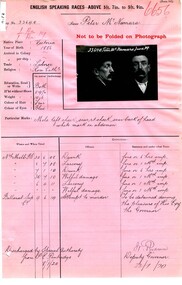
Police record (Peter McNamara), 23 January 1920
... ...attempted murder...In April 1914 he was charged with attempting to murder Sarah Bass, a housemaid at the Mount Bute steep station. ...In April 1914 he was charged with attempting to murder Sarah Bass, a housemaid at the Mount Bute steep station. ...Peter McNamara had committed numerous offences such as stealing, whilst drunk. In April 1914 he was charged with attempting to murder Sarah Bass, a housemaid at the Mount Bute steep station. He was found not guilty due to insanity caused by alcoholismPrison record for Peter McNamara, prisoner registered number 33640, giving details of the prisoner, his crimes and the dates and places of his trials.english speaking prisoner, peter mcnamara, drunk, larceny, attempted murder -
 Victoria Police Museum
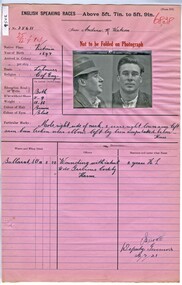
Prison record (Andrew Watson), 22 July 1921
... ...attempted murder...Andrew Reeves was charged in June 1920 with attempting to murder Gertrude Clara Sexton by shooting her and then attempting to commit suicide by shooting himself. ...Andrew Reeves was charged in June 1920 with attempting to murder Gertrude Clara Sexton by shooting her and then attempting to commit suicide by shooting himself. ...Andrew Reeves was charged in June 1920 with attempting to murder Gertrude Clara Sexton by shooting her and then attempting to commit suicide by shooting himself. Watson was a partner in Mr Sexton's farm at Turriff in the Mallee. Watson and Mrs Sexton were planning to run away together. Prison record for Andrew R. Watson, prisoner registered number 35611, giving details of the prisoner, his crimes and the dates and places of his trials.english speaking prisoner, andrew reeves watson, wounding with intent, attempted murder -
 Bendigo Historical Society Inc.
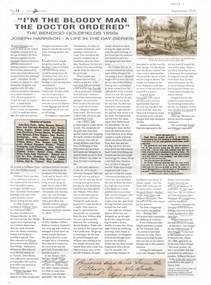
Newspaper - Newspaper article re Joseph Harrison - A Life in the Day Series, "I'm the Bloody Man The Doctor Ordered" The Bendigo Goldfields 1850s, Joseph Harrison - A Life in the Day (Series)
... Charged with attempted murder. He died 29 September 1854. https://convictrecords.com.au/convicts/harrison/joseph/112064...Charged with attempted murder. He died 29 September 1854. https://convictrecords.com.au/convicts/harrison/joseph/112064 Williams Town (Port Phillip) Kilmore Bendigo Creek Sandhurst) Back Creek William Harrison Margaret Barrett Matthew Welsh Peter Parram Anne Hayes Sergeant James Simmonds Police Magistrate Lachlan McLachlan Ellen Robinson (nee Langam) Tasmasine Harrison John Duggan (Corky Jack). ...Joseph Harrison, born York UK Born: 1st Jan 1810, convict sentenced seven years hard labour, transported to Van Diemen's Land - Tasmania. Ticket of Leave August 1837. Arrived Williams Town (Port Phillip). 1840 worked as waterman. Married Margaret Barrett, relocated to Kilmore. Travelled to Bendigo Creek January 1853. By July 1853 had threatened to kill wife and eldest son William. Charged with attempted murder. He died 29 September 1854. https://convictrecords.com.au/convicts/harrison/joseph/112064Newspaper article from The Bendigo Monthly September 2020 Page 12, Includes copies of photographs and other newspaper articles within the story. Story of Joseph Harrison, convict on goldfields. Other place names and persons mentioned in article - Williams Town (Port Phillip), Kilmore, Bendigo Creek Sandhurst), Back Creek; William Harrison, Margaret Barrett, Matthew Welsh, Peter Parram, Anne Hayes, Sergeant James Simmonds, Police Magistrate Lachlan McLachlan, Ellen Robinson (nee Langam), Tasmasine Harrison, John Duggan (Corky Jack).williams town (port phillip), kilmore, bendigo creek sandhurst), back creek, william harrison, margaret barrett, matthew welsh, peter parram, anne hayes, sergeant james simmonds, police magistrate lachlan mclachlan, ellen robinson (nee langam), tasmasine harrison, john duggan (corky jack). -
 City of Greater Bendigo - Civic Collection
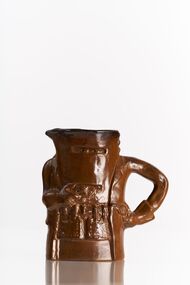
Artwork, other - Bendigo Pottery Toby Jug, Bendigo Pottery, Ned Kelly, c 1977
... A violent confrontation with a policeman occurred at the Kelly family's home in 1878, and Kelly was indicted for his attempted murder. Fleeing to the bush, Kelly vowed to avenge his mother, who was imprisoned for her role in the incident. ...A violent confrontation with a policeman occurred at the Kelly family's home in 1878, and Kelly was indicted for his attempted murder. Fleeing to the bush, Kelly vowed to avenge his mother, who was imprisoned for her role in the incident. ...Established by George Guthrie in 1857 (about 5km north of its current site) and then again seven years later in 1864 after it initially closed, Bendigo Pottery remains one of the most influential and longest running Pottery’s in Australia. Over the years the Pottery has contributed to the growth and development of the district through both its products including building products, table ware and decorative and commemorative war as well as artistically, being responsible for training and supporting many potters locally. The City of Greater Bendigo has had a long history of partnering with Bendigo Pottery and the Civic Collection holds a number of important items within its collection. Ned Kelly is one of Australia's most iconic outlaws. Kelly was born and raised in rural Victoria, the third of eight children to Irish parents. His father, a transported convict, died in 1866, leaving Kelly, then aged 12, as the eldest male of the household. The Kelly's were a poor selector family who saw themselves as downtrodden by the squattocracy and as victims of persecution by the Victoria Police. While a teenager, Kelly was arrested for associating with bushranger Harry Power and served two prison terms for a variety of offences, the longest stretch being from 1871 to 1874. He later joined the "Greta Mob", a group of bush larrikins known for stock theft. A violent confrontation with a policeman occurred at the Kelly family's home in 1878, and Kelly was indicted for his attempted murder. Fleeing to the bush, Kelly vowed to avenge his mother, who was imprisoned for her role in the incident. After he, his brother Dan, and associates Joe Byrne and Steve Hart shot dead three policemen, the government of Victoria proclaimed them outlaws. Kelly died aged 25 at Melbourne Goal after being captured by Police in Glenrowan and sentenced to death. (Source Wikipedia).Brown glazed slip cast jug. Includes details which are iconic to the image of Ned Kelly including face and body armour pistol and gloves. Ned's left arm forms the handle.Verso; NED KELLY / Bendigo Pottery Epsom (stamp) Underside; Bendigo Pottery / Limited / Edition Series / 879 / 3000 / Australiacity of greater bendigo tourism, bendigo pottery -
 Eltham District Historical Society Inc
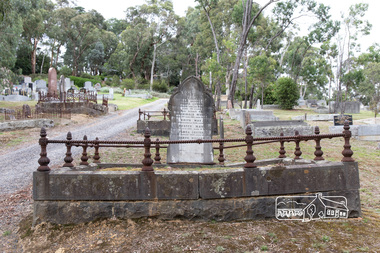
Photograph, Peter Pidgeon, Grave of Myles Archibald Lyons and children, Eltham Cemetery, Victoria, 5 April 2021
... At Eltham, his arrests ranged from minor instances of theft, vandalism and larrikinism to serious cases of manslaughter, murder and attempted suicide. He even tracked down and arrested two Norwegian seamen charged with desertion from their vessel. ...At Eltham, his arrests ranged from minor instances of theft, vandalism and larrikinism to serious cases of manslaughter, murder and attempted suicide. He even tracked down and arrested two Norwegian seamen charged with desertion from their vessel. ...In 1872 Senior Constable Myles Lyons replaced Peter Lawlor at Eltham Police Station. Earlier in his career, he had taken part in a search (one of many) for missing explorers Burke and Wills. At Eltham, his arrests ranged from minor instances of theft, vandalism and larrikinism to serious cases of manslaughter, murder and attempted suicide. He even tracked down and arrested two Norwegian seamen charged with desertion from their vessel. While conveying a prisoner from Eltham to Melbourne in 1886, he was attacked by the prisoner en route. It seems that much of the local news in the Evelyn Observer was provided by Eltham Shire Secretary C.S. Wingrove. In 1878, Eltham residents held an “Indignation Meeting” at the Evelyn Hotel, complaining that the reporting had denigrated Lyons’ conduct and had stigmatised the character of Eltham’s inhabitants. They passed a resolution castigating Wingrove and supporting Lyons. Wingrove claimed to have been misconstrued. But in 1887 the Evelyn Observer carried a long ranting vitriolic editorial. It complained about inadequate policing generally, then attacked Lyons personally, saying that (although efficient in the past) he had now become incompetent and needed to be replaced by a younger more energetic man. Myles Lyons retired due to ill health in 1889 but remained in Eltham until his death in 1899. He is buried in Eltham Cemetery with his wife Flora and five of their children. Four sons moved to Western Australia where two were killed in unconnected railway accidents. In Loving Memory of Myles Archibald Beloved Husband of Flora Lyons Who Departed This Life 19th August 1899 Also their beloved Children Archibald Myles Who died 28th June 1865, aged 18 months Edith May Died 9th November, 1884, aged 1 year Hester May Died 17th July, 1887, Aged 14 months Flora Louisa Died 19th August, 1889, aged 14 years Joseph William Died 1st August, 1904, aged 27 yearsBorn Digitaleltham cemetery, gravestones, archibald myles lyons, edith may lyons, flora louisa lyons, flora lyons, hester may lyons, joseph william lyons, myles archibald lyons -
 Eltham District Historical Society Inc
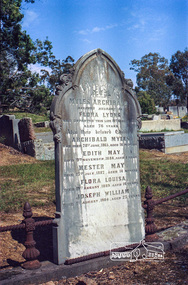
Negative - Photograph, Harry Gilham, Grave of Myles Archibald Lyons and children, Eltham Cemetery, Victoria, Sep 2009
... At Eltham, his arrests ranged from minor instances of theft, vandalism and larrikinism to serious cases of manslaughter, murder and attempted suicide. He even tracked down and arrested two Norwegian seamen charged with desertion from their vessel. ...At Eltham, his arrests ranged from minor instances of theft, vandalism and larrikinism to serious cases of manslaughter, murder and attempted suicide. He even tracked down and arrested two Norwegian seamen charged with desertion from their vessel. ...In 1872 Senior Constable Myles Lyons replaced Peter Lawlor at Eltham Police Station. Earlier in his career, he had taken part in a search (one of many) for missing explorers Burke and Wills. At Eltham, his arrests ranged from minor instances of theft, vandalism and larrikinism to serious cases of manslaughter, murder and attempted suicide. He even tracked down and arrested two Norwegian seamen charged with desertion from their vessel. While conveying a prisoner from Eltham to Melbourne in 1886, he was attacked by the prisoner en route. It seems that much of the local news in the Evelyn Observer was provided by Eltham Shire Secretary C.S. Wingrove. In 1878, Eltham residents held an “Indignation Meeting” at the Evelyn Hotel, complaining that the reporting had denigrated Lyons’ conduct and had stigmatised the character of Eltham’s inhabitants. They passed a resolution castigating Wingrove and supporting Lyons. Wingrove claimed to have been misconstrued. But in 1887 the Evelyn Observer carried a long ranting vitriolic editorial. It complained about inadequate policing generally, then attacked Lyons personally, saying that (although efficient in the past) he had now become incompetent and needed to be replaced by a younger more energetic man. Myles Lyons retired due to ill health in 1889 but remained in Eltham until his death in 1899. He is buried in Eltham Cemetery with his wife Flora and five of their children. Four sons moved to Western Australia where two were killed in unconnected railway accidents. In Loving Memory of Myles Archibald Beloved Husband of Flora Lyons Who Departed This Life 19th August 1899 Also their beloved Children Archibald Myles Myles died at age 75 on the same day as his 14 year old daughter, Flora Louise. Who died 28th June 1865, aged 18 months Edith May Died 9th November, 1884, aged 1 year Hester May Died 17th July, 1887, Aged 14 months Flora Louisa Died 19th August, 1889, aged 14 years Joseph William Died 1st August, 1904, aged 27 yearsRoll of 35mm colour negative film, 6 stripsKodak GC 400-9eltham cemetery, gravestones, edith may lyons, flora louisa lyons, flora lyons, hester may lyons, joseph william lyons, myles archibald lyons, police, archibald myles lyons -
 Bendigo Historical Society Inc.
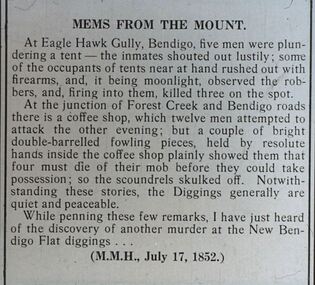
Slide - DIGGERS & MINING. THE DIGGING - THE DIGGERS, c1850s
... At the junction of Forest Creek and Bendigo roads there is a coffee shop, which twelve men attempted to attack the other evening; but a couple of bright double-barrelled fowling pieces, held by the resolute hands inside the coffee shop plainly showed them that possession; so the scoundrels skulled of. Not with-standing these stories, the Diggers generally are quiet and peaceable. While penning these few remarks, I have just heard of the discovery of another murder...At the junction of Forest Creek and Bendigo roads there is a coffee shop, which twelve men attempted to attack the other evening; but a couple of bright double-barrelled fowling pieces, held by the resolute hands inside the coffee shop plainly showed them that possession; so the scoundrels skulled of. Not with-standing these stories, the Diggers generally are quiet and peaceable. While penning these few remarks, I have just heard of the discovery of another murder ...Diggers & Mining. The Digging - The Diggers. Slide; An article titled 'Mems From The Mount' At Eagle Hawk Gully, Bendigo, five men were plundering a tent - the inmates shouted out lustily; some of the occupants of tent near at hand rushed out with firearms, and it being moonlight, observed the robbers, and, firing into them, killed three on the spot. At the junction of Forest Creek and Bendigo roads there is a coffee shop, which twelve men attempted to attack the other evening; but a couple of bright double-barrelled fowling pieces, held by the resolute hands inside the coffee shop plainly showed them that possession; so the scoundrels skulled of. Not with-standing these stories, the Diggers generally are quiet and peaceable. While penning these few remarks, I have just heard of the discovery of another murder at the New Bendigo Flat Diggings. (M.M.H., July 17, 1852) Markings: -- 994.LIF:6. Used as a teaching aid.hanimounteducation, tertiary, goldfields -
 Victoria Police Museum
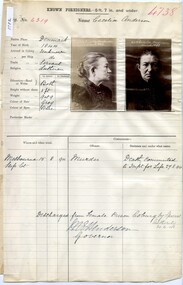
Prison record (Cecelia Anderson), 30 June 1903
... attempting to kill herself. Fraser had been a long term resident in a boarding house run by Mrs Anderson and had borrowed money from her. He subsequently moved to Melbourne and married a widow, Mrs Leahy. Mrs Anderson followed him to Melbourne and kept demanding that he repay the money owing. She was sentenced to death which was commuted to life imprisonment, but she was released in June 1903 foreign prisoner danish female prisoner cecilia anderson murder ...Cecilia Anderson was accused of shooting John Fraser at the Souther Cross Hotel in Melbourne in June 1894 and then attempting to kill herself. Fraser had been a long term resident in a boarding house run by Mrs Anderson and had borrowed money from her. He subsequently moved to Melbourne and married a widow, Mrs Leahy. Mrs Anderson followed him to Melbourne and kept demanding that he repay the money owing. She was sentenced to death which was commuted to life imprisonment, but she was released in June 1903Prison record for Cecilia Anderson, prisoner registered number 6319, giving details of the prisoner, her crimes and the dates and places of her trials.foreign prisoner, danish, female prisoner, cecilia anderson, murder -
 City of Ballarat
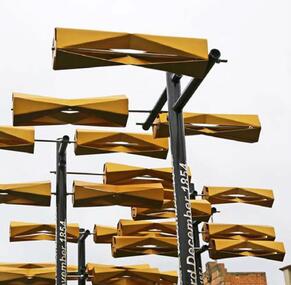
Artwork, other - Public Artwork, Aaron Robinson et al, Flow by Holly Grace and Aaron Robinson, 2014
... attempt to increase income./ August/ Hotham is acclaimed during his visit to the Ballarat goldfield./ 13th September? Hotham orders twice-weekly licence hunts to further increase revenue./ September – October/ Miners are experiencing problems – no shafts bottomed on the Eureka Lead for five weeks./ 7th October/ James Scobie is murdered outside the Eureka Hotel. ...attempt to increase income./ August/ Hotham is acclaimed during his visit to the Ballarat goldfield./ 13th September? Hotham orders twice-weekly licence hunts to further increase revenue./ September – October/ Miners are experiencing problems – no shafts bottomed on the Eureka Lead for five weeks./ 7th October/ James Scobie is murdered outside the Eureka Hotel. ...Water is key to a thriving community and it is through the representation of water Flow enlivens the space at Bakery Hill. Historically ‘water races’ ran through the valleys of the Greater Ballarat area unearthing the minerals that forged prosperity and wealth. This water still flows today unearthing new possibilities for the community. Possibilities focusing on sustainability, ecology, health and prosperity. Flowing over the site a series of kinetic turbines flutter in the wind creating a contemporary water race. The interactive elements offer visual stimulation enticing people to connect with the artwork and in turn the surrounding spaces. Bakery Hill has great historical significance. It’s connection to the Eureka Stockade and the series of events that were to unfold during the 1850’s was to become the turning point in Australian political history. The placement of each turbine is to mirror a point of history in the timeline of events that occurred during the Eureka Stockade. The Water Race is a symbol of possibilities, the ones created by history and those of modern society. It is a visual timeline that can be read by traversing the site. The connecting turbines that flow and turn in sync are a representation of time passing and the interconnectedness of history with the community that surrounds it. The gateway to Bridge Mall is framed through the placement of each turbine allowing the sense of prosperity and wealth to flow through to the surrounding community. This gateway also references the significance of Bakery Hill reinvigorating the historical site by reconnecting it back to its town centre. The artwork is of aesthetic and historical significance to the people of BallaratTwelve steel turbines set on poles with dates attached and a large bronze 'timeline' plaqueFLOW/ Plotting the motion of Wind, Water, History and Time/ by Holly Grace and Aaron Robinson/ This site has great historical significance. It’s connection to the Eureka Stockade and the series of events that unfolded in the 1850’s was to become the turning point in Australian history. The placement of each turbine within this artwork mirrors a point of history in the events that led up to the Eureka Stockade. It is a visual timeline that can be read by traversing the site. The connecting turbines that flow and turn in sync are a representation of time passing. They are a symbol of the community’s connection to their history. 1851 June James Esmond makes the first discovery of gold in Victoria at Clunes./ 1st July The Port Phillip District separates from New South Wales and becomes the Colony of Victoria. It is still subject to British rule./ August Gold is discovered at Buninyong and at Golden Point, Ballarat. Lt-Governor La Trobe introduces the Gold Licence system in an attempt to reduce the colony’s debt./ 20th September First gold licences issued in Ballarat. / 1852 August/ Eureka Lead discovered on the Ballarat goldfields. December Charles La Trobe resigns as Lt-Governor but he is not relieved until 1854/ July – December/ Unrest builds on the various goldfields with protest meetings held in Bendigo and Castlemaine. Bendigo’s Red Ribbon Movement is active on the goldfields and the Bendigo Petition is presented to Lt-Governor./ December/ Charles Hotham is appointed Lt-Governor/ 1854 March/ A bill to extend the Elective Franchise is passed by the Legislative Council and sent to London for the assent of the British Parliament. 22nd June/ Lt-Governor Sir Charles Hotham arrives in Victoria. The colony faces mounting debt and Hotham orders weekly licence hunts in an attempt to increase income./ August/ Hotham is acclaimed during his visit to the Ballarat goldfield./ 13th September? Hotham orders twice-weekly licence hunts to further increase revenue./ September – October/ Miners are experiencing problems – no shafts bottomed on the Eureka Lead for five weeks./ 7th October/ James Scobie is murdered outside the Eureka Hotel. Many diggers believe that publican James Bentley is responsible./ 9th October/ At Scobie’s inquest, Bentley is acquitted, despite strong evidence of his guilt./ 10th October/ Father Smythe’s servant is beaten up by authorities and falsely arrested for not holding a licence./ 15th October/ Mass meeting of miners on Bakery Hill. Catholic miners meet after Mass. // 17th October/ A meeting of up to 10,000 Diggers is held near the Eureka Hotel to protest against Bentley’s acquittal. The meeting results in the burning of the hotel. Three diggers, Westerby, Fletcher and McIntyre, are arrested. Hotham dispatches 400 soldiers to Ballarat. 22nd October/ Another large meeting is held to address grievances. The Catholics send their leaders, Hayes, Kennedy and Manning to meet Rede. The Government Camp is under siege 11th November/ A public meeting on Bakery Hill results in the formal establishment of the Ballarat Reform League and adoption of the League’s proposals./ 21st November/ The enquiry into the Bentley affair is published. It recommends the dismissal of the judge and the establishment of a Royal Commission. 23rd November/ Westerby, Fletcher and McIntyre are convicted of burning the hotel. The Ballarat Reform League demands their release. 27th November/ A deputation from The Ballarat Reform League, including Humffray, Black and Kennedy, meet with Hotham to demand the release of the three prisoners. Hotham does not believe the diggers have the right to “demand anything”, Rede requests reinforcements in Ballarat. 28th November/ Miners attack the troop reinforcements and wagons passing near the Eureka diggings. A drummer boy is seriously wounded. 29th November/ A “Monster Meeting” attended by more than 10,000 diggers is held on Bakery Hill. The Southern Cross flag is flown for the first time. Peter Lalor addresses the miners and a number of diggers burn their licences. 30th November/ A licence hunt occurs in the morning at the order of Commissioner Rede. Another meeting of radical miners is held on Bakery Hill. Peter Lalor becomes leader of the diggers and calls for volunteers. Many diggers wear an oath to defend their rights and liberties under the Southern Cross flag. A number of diggers move to the Eureka Lead and start to erect a stockade. 3rd December In the early hours of Sunday morning 296 soldiers and police led by Captain Thomas proceed from the Government Camp to the Eureka Lead and attack the Stockade. 22 diggers and 7 military are officially listed as being killed. Many others are wounded. Approximately 120 diggers are arrested and marched to the Government Camp. 4th December/ Funeral of some of the fallen diggers and soldiers. Martial Law is proclaimed in Ballarat. Henry Seekamp, editor of the Ballarat Times is charged with seditious libel. 6th December/ Major General Sir Robert Nickle, commander-in-chief of the military forces in the Australian colonies, arrives in Ballarat. 9th December/ General Nickle repeals martial law. 14th December/ The Gold Fields Commission sits for the first time. 18th December/ The first Ballarat sitting of the Gold Fields Commission is held at Bath’s Hotel. 1855 23rd January/ Henry Seekamp is found guilt of sedition and sentenced to three months in prison. 22nd February/ The Eureka trials starts in Melbourne. February to March/ 13 prisoners are tried and acquitted amid great public rejoicing. 27th March Report of the Royal Commission recommends miners’ rights and significant reforms. 10th November/ Peter Lalor and John Basson Humffray are nominated for seats in the legislative Council. 31st December Sir Charles Hotham dies before his resignation takes effect. flow, aaron robinson, holly grace, public art, eureka stockade, bakery hill -
 Returned Nurses RSL Sub-branch
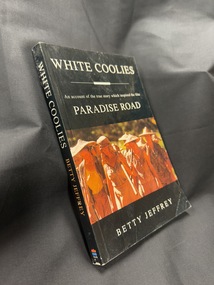
Book, Betty Jeffrey (1908-2000), White Coolies : An account of the true story which inspired the film Paradise Road, 1997
... murdered and the remaining thirty-two taken prisoner. White Coolies is the engrossing record kept by one of the sisters, Betty Jeffrey, during the more than three gruelling years of imprisonment that followed. It is an amazing story of survival amid deprivation and the harshest of conditions. The women's ingenious and entertaining attempts ...'In 1942 a group of sixty-five Australian Army nursing sisters was evacuated from Malaya a few days before the fall of Singapore. Two days later their ship was bombed and sunk by the Japanese. Of the fifty-thre survivors who scrambled ashore, twenty-one were murdered and the remaining thirty-two taken prisoner. White Coolies is the engrossing record kept by one of the sisters, Betty Jeffrey, during the more than three gruelling years of imprisonment that followed. It is an amazing story of survival amid deprivation and the harshest of conditions. The women's ingenious and entertaining attempts ot make their lot more tolerable, and their comradeship as they suffered so much anguish, display their incredible endurance and strength in the face of adversity.' Back cover of bookBlack paperback book with white and orange writing on cover and spine and colour photograph on front covernon-fiction'In 1942 a group of sixty-five Australian Army nursing sisters was evacuated from Malaya a few days before the fall of Singapore. Two days later their ship was bombed and sunk by the Japanese. Of the fifty-thre survivors who scrambled ashore, twenty-one were murdered and the remaining thirty-two taken prisoner. White Coolies is the engrossing record kept by one of the sisters, Betty Jeffrey, during the more than three gruelling years of imprisonment that followed. It is an amazing story of survival amid deprivation and the harshest of conditions. The women's ingenious and entertaining attempts ot make their lot more tolerable, and their comradeship as they suffered so much anguish, display their incredible endurance and strength in the face of adversity.' Back cover of bookworld war two, wwii, ww2, australian army nurses, agnes betty jeffrey, betty jeffrey, paradise road, bangka island -
 Linton Mechanics Institute and Free Library Collection
Book - Novel, Hansen, Robert P, Trouble comes double, 1955
... Hansen The story follows a private investigator who gets pulled into a web of violence and murder while attempting to uncover the killer of his colleague. ...The story follows a private investigator who gets pulled into a web of violence and murder while attempting to uncover the killer of his colleague.191p.; dark blue cover with author and title embossed in gold on spine; green sticker on front cover 'The Melbourne Athenaeum Library and Reading Room'fictionThe story follows a private investigator who gets pulled into a web of violence and murder while attempting to uncover the killer of his colleague.fiction, mystery, crime, a museum street thriller, robert p. hansen -
 Linton Mechanics Institute and Free Library Collection
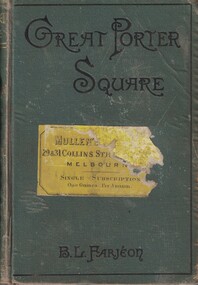
Book - Novel, Farjeon, B. L, Great Porter Square : a mystery in three volumes. Volume III, 1885
... murder of a man in Great Porter Square. The main character, Becky, and her ally, a young girl named Fanny, take on the roles of amateur detectives as they gather clues and attempt to unveil the truth behind the murder and its implications for their own lives. ...The narrative unfolds around the secrets and intrigues surrounding the murder of a man in Great Porter Square. The main character, Becky, and her ally, a young girl named Fanny, take on the roles of amateur detectives as they gather clues and attempt to unveil the truth behind the murder and its implications for their own lives. The beginning of the novel introduces Becky’s cunning plan involving Fanny, whom she has tasked with spying on Richard Manx, a mysterious lodger in their shared house. As events unfold, Becky learns that Richard is not only elusive but possesses details about past events that deeply concern her. Their interactions reveal a web of deceit associated with Mrs. Lydia Holdfast, a widow tied to the victim, and connections to a hidden will that could dramatically alter familial fortunes.292p. ; green cover with title and author embossed in black on the front cover and in gold on the spinefictionThe narrative unfolds around the secrets and intrigues surrounding the murder of a man in Great Porter Square. The main character, Becky, and her ally, a young girl named Fanny, take on the roles of amateur detectives as they gather clues and attempt to unveil the truth behind the murder and its implications for their own lives. The beginning of the novel introduces Becky’s cunning plan involving Fanny, whom she has tasked with spying on Richard Manx, a mysterious lodger in their shared house. As events unfold, Becky learns that Richard is not only elusive but possesses details about past events that deeply concern her. Their interactions reveal a web of deceit associated with Mrs. Lydia Holdfast, a widow tied to the victim, and connections to a hidden will that could dramatically alter familial fortunes. fiction, crime, mystery, b. l. farjeon -
 Returned Nurses RSL Sub-branch
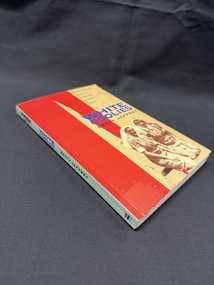
Book - Illustrated paperback book, Betty Jeffrey (1908-2000), White Coolies : Australian nurses behind enemy lines, 1993
... murdered and the remainder taken prisoner. This engrossing record was kept by one of the surviving sisters, Betty Jeffrey, during the three-and-a-half gruelling years of imprisonment that followed. It is a grim story of deprivation and harsh conditions, but its darkness is relieved by the humorous incidents that somehow helped the women to preserve their sanity. Their ingenious and entertaining attempts ...In 1942 a group of Australian Army nursing sisters was evacuated from Malaya a few days before the fall of Singapore. Two days later their ship was bombed and sunk by the Japanese. Of the fifty-three survivors who scrambled ashore, twenty-one were murdered and the remainder taken prisoner. This engrossing record was kept by one of the surviving sisters, Betty Jeffrey, during the three-and-a-half gruelling years of imprisonment that followed. It is a grim story of deprivation and harsh conditions, but its darkness is relieved by the humorous incidents that somehow helped the women to preserve their sanity. Their ingenious and entertaining attempts to make their lot more tolerable, and their comradeship as they faced so much anguish leave the reader with enormous admiration for their endurance and strength. (Back cover)A paperback book with a blue spine, red and tan cover with a sepia photograph of two women in nurses uniforms. Writing on cover and spine is in black, blue and white.fictionIn 1942 a group of Australian Army nursing sisters was evacuated from Malaya a few days before the fall of Singapore. Two days later their ship was bombed and sunk by the Japanese. Of the fifty-three survivors who scrambled ashore, twenty-one were murdered and the remainder taken prisoner. This engrossing record was kept by one of the surviving sisters, Betty Jeffrey, during the three-and-a-half gruelling years of imprisonment that followed. It is a grim story of deprivation and harsh conditions, but its darkness is relieved by the humorous incidents that somehow helped the women to preserve their sanity. Their ingenious and entertaining attempts to make their lot more tolerable, and their comradeship as they faced so much anguish leave the reader with enormous admiration for their endurance and strength. (Back cover)nursing in warfare, world war two, wwii, ww2, malaya, pacific theatre, japanese pow, agnes betty jeffrey, betty jeffrey, bangka island, vyner brooke
