
Showing 310 items matching "australia at war booklet"
-
 Bendigo Historical Society Inc.
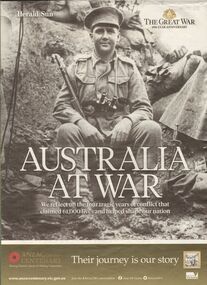
Newspaper - ANZAC COLLECTION: HERALD SUN BOOKLET ' AUSTRALIA AT WAR'
... ANZAC COLLECTION: HERALD SUN BOOKLET ' AUSTRALIA AT WAR'......australia at war booklet...Herald Sun newspaper booklet titled ' Australia at War' a reflection the four tragic years of conflict that claimed 61,000 lives and helped shape our nation' Image of soldiers on front, holding gun, with binoculars around neck....MILITARY World war 1 australia at war booklet Herald Sun Herald Sun newspaper booklet titled ' Australia at War' a reflection the four tragic years of conflict that claimed 61,000 lives and helped shape our nation' Image of soldiers on front, holding gun, with binoculars around neck. ...Herald Sun newspaper booklet titled ' Australia at War' a reflection the four tragic years of conflict that claimed 61,000 lives and helped shape our nation' Image of soldiers on front, holding gun, with binoculars around neck.Herald Sunmilitary, world war 1, australia at war booklet -
 Bendigo Historical Society Inc.
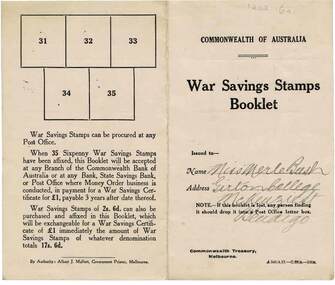
Document - BUSH COLLECTION: WAR SAVINGS STAMPS BOOKLET, Ca 1939-1945
... Commonwealth of Australia War Savings stamps booklet issued to 'Miss Merle Bush, Girton College, Bendigo'. ...Mullett, Government Printer Commonwealth of Australia War Savings stamps booklet issued to 'Miss Merle Bush, Girton College, Bendigo'. ...Commonwealth of Australia War Savings stamps booklet issued to 'Miss Merle Bush, Girton College, Bendigo'. Three (3) stamps stuck in book (6d.)Albert J. Mullett, Government Printerperson, individual, bush collection - personal -
 Federation University Historical Collection
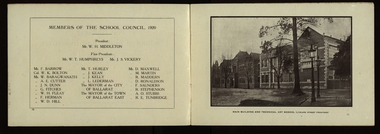
Booklet, The Ballarat School of Mines and Industries 1870-1920 Jubilee Booklet, 1920 (estimated)
... war service school council baragwanath gold mining mining laboratory plaster cast R.W. Richards anniversary jubilee White stapled booklet - landscape format - 20pp + soft covers with blue writing. Includes an historical sketch of the Ballarat School of Mines. Contains images of the school from around 1920. The history outlined in the booklet follows: 'Ballarat has helped to influence the life and destinies of Australia ...The first school of Mines in Australia was established at Ballarat in 1870. At the time of its jubilee (1930) the following people were members of the School Council: W.H. Middleton (President), W.T. Humphreys (VP), J.S. Vickery (VP), F. Barrow, Col. W.K. Bolton, William Baragwanath, A.E. Cutter, J.N. Dunn, G. Fitches, W.H. Fleay, F. Herman. W.D. Hill, T. Hurley, K. Kean. J. Kelly, L. Lederman, Mayor of Ballarat, Mayour of Ballarat East, D. Maxwell, M. Martin, R. Maddern, D. Ronaldson, F. Saunders, R. Stephenson, A.O. Stubbs, R.E. Tunbridge. The School Staff in 1920 comprised: Herbert H. Smith, Walter Rowbotham, Reginald L. Cutter, M.C. Young, Hilda Wardle, M. Wiliamson, P.S. Richards, L.H. Archibald, J. Woods, Ken Moss, W. Kenneth, Mrs McIlvena. B. Robinson, S. Rowe, E. Hope-Jones, Miss Abrams, L.St.G.P. Austin, Alfred Mica Smith, J.R. Pound, Herbert R. Murphy, N.H. Junner, Maurice Copland, L.H. Archibald, E.J.A. McConnon, Newton King, D.m. Hull, T.R. Gordon, John M. Sutherland, T.K. Jebb, Dick Richards, C. Tonkin, A.W. Steane, J. Paterson, H.W. Malin, R.V. Maddison, S.M. Mayo, F.A. King, W.H. Steane, T.R. Gordon, T.A. Williams, H. Waldron, G. Black, E.J. McConnon, R.V. Duncan. R. Cutter, E.G. Vawdrey, Hilda WardleWhite stapled booklet - landscape format - 20pp + soft covers with blue writing. Includes an historical sketch of the Ballarat School of Mines. Contains images of the school from around 1920. The history outlined in the booklet follows: 'Ballarat has helped to influence the life and destinies of Australia in many ways, the recital of which would perhaps prove tedious to the citizens of less favoured localities! However, it can be said, without much fear of contradiction, that only less known thought Australia than its fame as a gold field is the reputation won for it by its school of Mines, ... Ballarat was still quite a new place when the School was founded, but a very propserous and popular place all the same, with a go-ahead lot of citizens brim full of the spirit of enterprise which seemsto animate mining populations generally. Money was plentiful, and they launched out into ventures, which later, were to develop and take the place of the gold mines, while what is more to the point, they understood the value of education. the old digging days were passing away. So far as Ballarat itself was concerned the day of the cradle and tin dish had already passed into an antiquity "as dead and distant as the age of the Tubal Caon," said dir redmond Barry on declaring the School open. Mining had become a serious business, and the mining engineer, the metallurgist, and the geologist had become a power in the land. In these circumstances the suggestions to found a School of Mines met with ready acceptance. The late Mr James M. Bickett had the honor of bringing forward the proposition at a meeting of the Ballarat Mining Board in October, 1869. it was agreed to, and the Government, having been approached for assistance, granted a lease of the old Supreme Court buildings at a nominal reantal. A modest sum, including 100 pounds from the Borough Council of Ballarat West, was subscribed by a number of sympathisers, and on the 26th October, 1870, the inaugural address was delivered by Sir Redmond Barry, the first President of the School. Classes were commenced on the 23rd January, 1871. The students at first were mostly adults. They were chiefly men emloyed at the mines, who had the wisdom and energy to devote their spare time to study, and, though their attendance was somewhat irregular, they made very good progress. Old prints which have been preserved show them at work at furnaces, big bearded men of the old-fashioned type of miner. It is interesting to note that among those who gave evidence and encouragement was Sir Roderick Murchison, who many years before had advised Cornish miners to emigrate to Australia to search for gold, and who in 1848 was in possession of gold ore sent from this country. Sir Roderick sent a parcel of books for the library, and gave useful advice as to the curriculum which should be adopted. The Museum, which now contains a most valuable collection of minerals, was one of the first things attended to, and the reports presented to the Council from time to time speak of additions being made from all parts of the world. New equipment was constantly being added to the School, a good deal of assay work was done, and some specimens were sent from the East Indies for examination as far back as 1873. By this time there was a difficulty in providing accomodation for the students who wished to enrol, and the number of instructors had grown from two to four. In 1882 the first building was being erected on what was then part of the gaol reserve. A little more than ten years afterwards a buildnig formerly serving as a Methodist Church was absorbed, while later on, the demand for accomodation increasing, the attack upon the gaol was renewed. The School continued to grow in reputation and size, and became the science centre of the district, and in 1889 a learge new building was opened by Sir Alexander Peacock. Students came from over seas as well as from all the States of Australia, and after going through their courses they took with them the name and fame of the old School to all parts of the globe. School of Mines boys have played a great part in developing the mining fields of Western Australia, South Australia, and africa, while old students who have made a name in their profession are constantly dropping in to see how the old place is getting along. It was not to be expected, however, that the Ballarat School would be left without rivals, its very success inspiring competition. Mining Schools were started in other parts of Australia, and, at the same time, Victoria ceased to hold first place as a mining state. On the other hand there was a great advance in manufacturing, and the demand for technicaly trained men became a great and as insistent as ever it had been for trained mining men. The Council was quick to adapt the school to the new conditions, and the result is seen in the institution, which is one of Ballarat's proudest possession. Instruction is given in all branches of technical work, and the classes are filled with students who are building up for Ballarat a reputation as an industrial centre, which promises to equal that which it formerly held as a mining town. Owing to its bracing climate, its abundant opportunities for recreations, and its accessibilty, Ballarat as a city is an ideal place for educational purposed, and is yearly becoming more and more appreciated throughout the State. The chairman of one of Ballarat's biggests industries claims that the workman can do twice the day's work here that he can do in Melbourne. he was a little enthusiastic over it, perhaps, but it is a well-known fact that the healthy and invigourating Ballarat climate is conducive to both physical and mental activity, and the records of the School provide ample proof of it. One of the most interesting and successful branches of the School of Mines and Industries - if the name be enlarged with the enlargement of its scope - is the Technical Art School. "The City of Statues" has from its earliest days been a stronghold of art. Art schools have flourised here, and in 1905 the Education Department came to the conclusion that the best thing to do with them was to place them under the management of the School of Mines Council. A magnificent new Technical Art School was built at a cost of some 12,000 pounds on the site of the old Supreme Court building, and was formally opened on the 23rd July, 1915. The results have not only been justified but surpassed all anticipations. The most comprehensive list of subjects is taught, and this list is constantly added to. Students have flocked to the art School, which may be said to occupy a unique position in Australia, and its record of success is really astonishing. Its students supply art teachers for the newer schools that are being built, and many occupy leading positinos in important business houses. So well is its reputation known that orders are constantly being received, not only from Victoria, but from other States, for honor boards and challenge shields to be designed and made. The most recent addition to the School of Mines and Industries is the Junior Technical School, for which a new building is now being erected on a portion of the gaol site, transferred to the School of Mines Counci by the Government. At the present moment temporary quarters are being occupied. Some students after passing through the Junior School go straight to employment, continuing perhaps to attend the evening trade classes, while others move on to the senior School. In a review of the work of the School of Mines mention must be made of a series of industrial research carried out under supervision of the Principal. One in particular, regarding the suitability of the local ores for the manufacture of pigments attracted much attention, while the experiemtns on the manufacture of white potery from Victorian clayes were considered of sufficient importance by the Federal Advisory Council of Science and Industry to warrant the appointment of a special investigator. The results of these have been most encouraging, and may have far-reaching consequences. The vocational training of returned soldiers also should not be overlooked. The work was taken in hand from the first, before the Repatriation Department gave assistance, and now with the help of the department of the School has become one of the largest vocational training centres in Victoria outside of Melbourne. The soldiers, trained in a variety of occupations, have made remarkable progress, and already considerable numbers have found employment in local workshops and factories. To sum up, the School is divided into the following departments, each well staffed and equipped: - The School of Mines, science, and Engineering; the Techncial Art School, the Boys' Junior Technical School, the Girl's Preparatory Technical Classes, Trade Classes, and the Commercial School. The school of Mines, science and Engineering, comprises the following branches: - Mining, Metallurgy, Geology, Electrical Engineering, Civil Engineering, Mechanical Engineering, Applied Chemistry, and Pharmacy. Battery treatments, Cyanide Testing, Smelting, Assays, and Clay Testing from a regular part of the School's work. Students gaining qualifications obtain concession in their courses at the university, should they proceed there to continue their studies. The technical Art school curriculum includes training in all branches of pictorial and applied art, an Architectural Diploma Course, a Draughtman's Course, technical Art teachers' Course, Photography,Ticket Writing, Art Metal Work, Woodcarving, Needlework, and Leather work. The Trade Classes give instruction in Telephone Mechanics, telegraphy, Carpentry, Cabinet Making, Plumbing, Blacksmithing, Fitting, Electric Wiring, and Printing. Numerous Scholarships are offered every year, and altogether students will find few places to equal the Ballarat School of Mines and Industries as a training place for their life's work. One of the first in the continent to be established, its Jubilee finds it still in the front rank, keeping pace with the times, and offering to the youths of this country the means of taking advantage of Australia's teeming opportunities. william, battery, smith, herbert, drawing from the antique, ballarat school of mines botanical gardens, ballarat school of mines, redmond barry, alfred mica smith, james bickett, museum, dick richards, ballarat junior technical school, s m b, ballarat school of mines and industries, ballarat technical art school, model mine, james m bickett, j m bickett, roderick murchison, vocational training rooms, wesley church, methodist church, alexander peacock, lathes, repatriation, repatriatin department, war service, school council, baragwanath, gold mining, mining laboratory, plaster cast, r.w. richards, anniversary, jubilee -
 Federation University Historical Collection
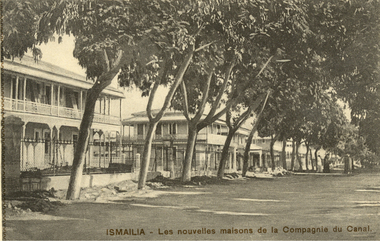
Postcard - black and white, Ismailia - les nouvelles maisons de la Compagnie de Canal, c1917, c1915
... It would have been part of a booklet available during World War One. chatham-holmes family collection ismailia egypt world war one world war Ascot A black and white postcard showing a row of double storey housed behind a row of trees. This card was purchased by an Australian ...Ismalia is a city in north-eastern Egypt. It would have been part of a booklet available during World War One. A black and white postcard showing a row of double storey housed behind a row of trees. This card was purchased by an Australian soldier, probably Henry Smerdon Holmes, during World War One. chatham-holmes family collection, ismailia, egypt, world war one, world war, ascot -
 Flagstaff Hill Maritime Museum and Village
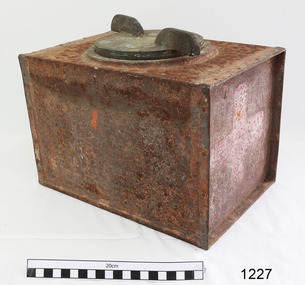
Equipment - Survival Kit, c. 1943
... War II to aid the safety and survival of seafarers. warrnambool flagstaff-hill flagstaff-hill-maritime-museum shipwreck-coast survival kit commonwealth of australia sun-flash distress signal mirror survival advice book military supplies emergency kit survival kit. White painted label on pouch 'MIRROR". Paper instructions on back of mirror headed "_ _ FSON SUN-FLASH DISTRESS, SIGNAL DEVICE". Printed on waterproof cover "ADVICE BOOKS". Survival kit, 1973. Rectangular metal box with round screw top lid that has wing handles with a red cross on both ends of box (one end is heavily rusted). Contents of box includes booklet ...Emergency survival kit made safe and watertightThe kit represents equipment used around the time of World War II to aid the safety and survival of seafarers.Survival kit, 1973. Rectangular metal box with round screw top lid that has wing handles with a red cross on both ends of box (one end is heavily rusted). Contents of box includes booklet 1943 "Advice to Those in Lifeboats and Rafts of Merchant Ships" and one rectangular piece of water resistant paper with "Advice-books" written on it (separated from booklet), cylindrical stainless steel container with wire handle, cotton bandage. Also inside, one Sun-flash Distress Signal Mirror (instructions adhered to back) with padded pouch, labelled "MIRROR" in white paint, and a card inside pouch, adhering to insides. Metal is corroding.White painted label on pouch 'MIRROR". Paper instructions on back of mirror headed "_ _ FSON SUN-FLASH DISTRESS, SIGNAL DEVICE". Printed on waterproof cover "ADVICE BOOKS". warrnambool, flagstaff-hill, flagstaff-hill-maritime-museum, shipwreck-coast, survival kit, commonwealth of australia, sun-flash distress signal mirror, survival advice book, military supplies, emergency kit, survival kit. -
 Mission to Seafarers Victoria
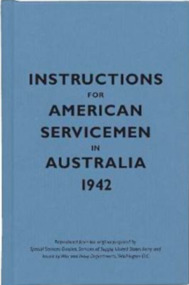
Book - Pocket book, Special Service Devision, Service of Supply, United States Army, Instructions for American Servicemen in Australia 1942, 2007
... Australia, preparing to fight the Pacific war. By 1943, there were 250,000 Americans stationed in Melbourne, Sydney and Brisbane. The booklet...Australia, preparing to fight the Pacific war. By 1943, there were 250,000 Americans stationed in Melbourne, Sydney and Brisbane. The booklet ...In 1942, the United States issued Instructions for American Servicemen in Australia as a quick guide to Australia's people, politics, history and culture for Americans stationed there during the Second World War. It was one of several similar sets of instructions put together by the US government to help its soldiers, sailors and airmen adjust to life abroad.Pocket size book of blue colour ix, [54] p. : ill., mapsnon-fictionIn 1942, the United States issued Instructions for American Servicemen in Australia as a quick guide to Australia's people, politics, history and culture for Americans stationed there during the Second World War. It was one of several similar sets of instructions put together by the US government to help its soldiers, sailors and airmen adjust to life abroad. 1942, american soldiers, australia -
 Mission to Seafarers Victoria
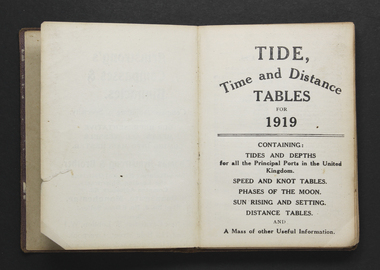
Booklet, Tide, Time and Distance Table for 1919, 1918
... Arthus Oswld Dixon was an Officer on several ships, serving in the Merchant Navy and the Royal Australian Navy during First World War. arthur oswald dixon tides sea seafarers crew sailors seamen officers royal australian navy ran wwi first world war great war liverpool red cliffs belonging to Arthur Oswald Dixon Dark coloured cloth bound commercially printed book of tide tables. Tide, Time and Distance Table for 1919 Booklet ...Arthus Oswld Dixon was an Officer on several ships, serving in the Merchant Navy and the Royal Australian Navy during First World War.Dark coloured cloth bound commercially printed book of tide tables.belonging to Arthur Oswald Dixonarthur oswald dixon, tides, sea, seafarers, crew, sailors, seamen, officers, royal australian navy, ran, wwi, first world war, great war, liverpool, red cliffs -
 Frankston RSL Sub Branch
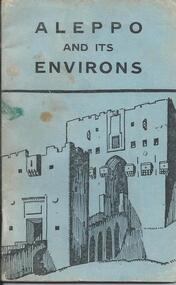
Souvenir Guidebook, Aleppo and its Environs
... This booklet was sent to an Australian family by a local citizen befriended by an Australia soldier serving in Syria during World War 2. ...souvenir ww2 world war 2 syria aleppo blundell printed title "Aleppo and its Environs" A pocket size booklet with a series of articles about Aleppo, Syria. This booklet was sent to an Australian ...A pocket size booklet with a series of articles about Aleppo, Syria. This booklet was sent to an Australian family by a local citizen befriended by an Australia soldier serving in Syria during World War 2. The book inner cover is marked "To Val with best wishes from Bert?? Aleppo 1-2-47". The Foreword explains that during the period 1943-44 large numbers of servicemen were visiting the area hence the need for this document.printed title "Aleppo and its Environs"souvenir, ww2, world war 2, syria, aleppo, blundell -
 Frankston RSL Sub Branch
Card
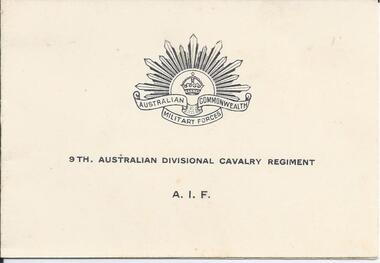
... Christmas card sent to a family in Australia by Australian Army serviceman, Noel Blundell who served in Syria during World war 2. The card is in the form of a booklet consisting of the cover and one double page insert. ...Christmas card sent to a family in Australia by Australian Army serviceman, Noel Blundell who served in Syria during World war 2. The card is in the form of a booklet consisting of the cover and one double page insert. ...Christmas card sent to a family in Australia by Australian Army serviceman, Noel Blundell who served in Syria during World war 2. The card is in the form of a booklet consisting of the cover and one double page insert. The card front cover has the Australian 'Rising Sun' badge and the words "9th Australian Divisional Cavalry Regiment" and "A. I. F.". The centre pages have an illustration of a village scene on the left page and the words "A Merry Christmas And A Happy New Year" printed on the right page. The serviceman has written "To Alice From Noel" beneath the Christmas message. At the bottom of this page are the words "MIDDLE EAST" and "DECEMBER 1941". The rear cover page has an illustration of two camels, one leading the other.christmas, middle east, 2nd aif, army, aif, ww2, world war 2, syria, blundell, noel blundell, 9th australian division -
 Federation University Historical Collection
Booklet, The Ballarat School of Mines and Industries 1870-1920 Jubilee Booklet, 1920 (estimated)
... war service school council baragwanath gold mining mining laboratory plaster cast R.W. Richards anniversary jubilee White stapled booklet - landscape format - 20pp + soft covers with blue writing. Includes an historical sketch of the Ballarat School of Mines. Contains images of the school from around 1920. The history outlined in the booklet follows: 'Ballarat has helped to influence the life and destinies of Australia ...The first school of Mines in Australia was established at Ballarat in 1870. At the time of its jubilee (1930) the following people were members of the School Council: W.H. Middleton (President), W.T. Humphreys (VP), J.S. Vickery (VP), F. Barrow, Col. W.K. Bolton, William Baragwanath, A.E. Cutter, J.N. Dunn, G. Fitches, W.H. Fleay, F. Herman. W.D. Hill, T. Hurley, K. Kean. J. Kelly, L. Lederman, Mayor of Ballarat, Mayour of Ballarat East, D. Maxwell, M. Martin, R. Maddern, D. Ronaldson, F. Saunders, R. Stephenson, A.O. Stubbs, R.E. Tunbridge. The School Staff in 1920 comprised: Herbert H. Smith, Walter Rowbotham, Reginald L. Cutter, M.C. Young, Hilda Wardle, M. Wiliamson, P.S. Richards, L.H. Archibald, J. Woods, Ken Moss, W. Kenneth, Mrs McIlvena. B. Robinson, S. Rowe, E. Hope-Jones, Miss Abrams, L.St.G.P. Austin, Alfred Mica Smith, J.R. Pound, Herbert R. Murphy, N.H. Junner, Maurice Copland, L.H. Archibald, E.J.A. McConnon, Newton King, D.m. Hull, T.R. Gordon, John M. Sutherland, T.K. Jebb, Dick Richards, C. Tonkin, A.W. Steane, J. Paterson, H.W. Malin, R.V. Maddison, S.M. Mayo, F.A. King, W.H. Steane, T.R. Gordon, T.A. Williams, H. Waldron, G. Black, E.J. McConnon, R.V. Duncan. R. Cutter, E.G. Vawdrey, Hilda WardleWhite stapled booklet - landscape format - 20pp + soft covers with blue writing. Includes an historical sketch of the Ballarat School of Mines. Contains images of the school from around 1920. The history outlined in the booklet follows: 'Ballarat has helped to influence the life and destinies of Australia in many ways, the recital of which would perhaps prove tedious to the citizens of less favoured localities! However, it can be said, without much fear of contradiction, that only less known thought Australia than its fame as a gold field is the reputation won for it by its school of Mines, ... Ballarat was still quite a new place when the School was founded, but a very propserous and popular place all the same, with a go-ahead lot of citizens brim full of the spirit of enterprise which seemsto animate mining populations generally. Money was plentiful, and they launched out into ventures, which later, were to develop and take the place of the gold mines, while what is more to the point, they understood the value of education. the old digging days were passing away. So far as Ballarat itself was concerned the day of the cradle and tin dish had already passed into an antiquity "as dead and distant as the age of the Tubal Caon," said dir redmond Barry on declaring the School open. Mining had become a serious business, and the mining engineer, the metallurgist, and the geologist had become a power in the land. In these circumstances the suggestions to found a School of Mines met with ready acceptance. The late Mr James M. Bickett had the honor of bringing forward the proposition at a meeting of the Ballarat Mining Board in October, 1869. it was agreed to, and the Government, having been approached for assistance, granted a lease of the old Supreme Court buildings at a nominal reantal. A modest sum, including 100 pounds from the Borough Council of Ballarat West, was subscribed by a number of sympathisers, and on the 26th October, 1870, the inaugural address was delivered by Sir Redmond Barry, the first President of the School. Classes were commenced on the 23rd January, 1871. The students at first were mostly adults. They were chiefly men emloyed at the mines, who had the wisdom and energy to devote their spare time to study, and, though their attendance was somewhat irregular, they made very good progress. Old prints which have been preserved show them at work at furnaces, big bearded men of the old-fashioned type of miner. It is interesting to note that among those who gave evidence and encouragement was Sir Roderick Murchison, who many years before had advised Cornish miners to emigrate to Australia to search for gold, and who in 1848 was in possession of gold ore sent from this country. Sir Roderick sent a parcel of books for the library, and gave useful advice as to the curriculum which should be adopted. The Museum, which now contains a most valuable collection of minerals, was one of the first things attended to, and the reports presented to the Council from time to time speak of additions being made from all parts of the world. New equipment was constantly being added to the School, a good deal of assay work was done, and some specimens were sent from the East Indies for examination as far back as 1873. By this time there was a difficulty in providing accomodation for the students who wished to enrol, and the number of instructors had grown from two to four. In 1882 the first building was being erected on what was then part of the gaol reserve. A little more than ten years afterwards a buildnig formerly serving as a Methodist Church was absorbed, while later on, the demand for accomodation increasing, the attack upon the gaol was renewed. The School continued to grow in reputation and size, and became the science centre of the district, and in 1889 a learge new building was opened by Sir Alexander Peacock. Students came from over seas as well as from all the States of Australia, and after going through their courses they took with them the name and fame of the old School to all parts of the globe. School of Mines boys have played a great part in developing the mining fields of Western Australia, South Australia, and africa, while old students who have made a name in their profession are constantly dropping in to see how the old place is getting along. It was not to be expected, however, that the Ballarat School would be left without rivals, its very success inspiring competition. Mining Schools were started in other parts of Australia, and, at the same time, Victoria ceased to hold first place as a mining state. On the other hand there was a great advance in manufacturing, and the demand for technicaly trained men became a great and as insistent as ever it had been for trained mining men. The Council was quick to adapt the school to the new conditions, and the result is seen in the institution, which is one of Ballarat's proudest possession. Instruction is given in all branches of technical work, and the classes are filled with students who are building up for Ballarat a reputation as an industrial centre, which promises to equal that which it formerly held as a mining town. Owing to its bracing climate, its abundant opportunities for recreations, and its accessibilty, Ballarat as a city is an ideal place for educational purposed, and is yearly becoming more and more appreciated throughout the State. The chairman of one of Ballarat's biggests industries claims that the workman can do twice the day's work here that he can do in Melbourne. he was a little enthusiastic over it, perhaps, but it is a well-known fact that the healthy and invigourating Ballarat climate is conducive to both physical and mental activity, and the records of the School provide ample proof of it. One of the most interesting and successful branches of the School of Mines and Industries - if the name be enlarged with the enlargement of its scope - is the Technical Art School. "The City of Statues" has from its earliest days been a stronghold of art. Art schools have flourised here, and in 1905 the Education Department came to the conclusion that the best thing to do with them was to place them under the management of the School of Mines Council. A magnificent new Technical Art School was built at a cost of some 12,000 pounds on the site of the old Supreme Court building, and was formally opened on the 23rd July, 1915. The results have not only been justified but surpassed all anticipations. The most comprehensive list of subjects is taught, and this list is constantly added to. Students have flocked to the art School, which may be said to occupy a unique position in Australia, and its record of success is really astonishing. Its students supply art teachers for the newer schools that are being built, and many occupy leading positinos in important business houses. So well is its reputation known that orders are constantly being received, not only from Victoria, but from other States, for honor boards and challenge shields to be designed and made. The most recent addition to the School of Mines and Industries is the Junior Technical School, for which a new building is now being erected on a portion of the gaol site, transferred to the School of Mines Counci by the Government. At the present moment temporary quarters are being occupied. Some students after passing through the Junior School go straight to employment, continuing perhaps to attend the evening trade classes, while others move on to the senior School. In a review of the work of the School of Mines mention must be made of a series of industrial research carried out under supervision of the Principal. One in particular, regarding the suitability of the local ores for the manufacture of pigments attracted much attention, while the experiemtns on the manufacture of white potery from Victorian clayes were considered of sufficient importance by the Federal Advisory Council of Science and Industry to warrant the appointment of a special investigator. The results of these have been most encouraging, and may have far-reaching consequences. The vocational training of returned soldiers also should not be overlooked. The work was taken in hand from the first, before the Repatriation Department gave assistance, and now with the help of the department of the School has become one of the largest vocational training centres in Victoria outside of Melbourne. The soldiers, trained in a variety of occupations, have made remarkable progress, and already considerable numbers have found employment in local workshops and factories. To sum up, the School is divided into the following departments, each well staffed and equipped: - The School of Mines, science, and Engineering; the Techncial Art School, the Boys' Junior Technical School, the Girl's Preparatory Technical Classes, Trade Classes, and the Commercial School. The school of Mines, science and Engineering, comprises the following branches: - Mining, Metallurgy, Geology, Electrical Engineering, Civil Engineering, Mechanical Engineering, Applied Chemistry, and Pharmacy. Battery treatments, Cyanide Testing, Smelting, Assays, and Clay Testing from a regular part of the School's work. Students gaining qualifications obtain concession in their courses at the university, should they proceed there to continue their studies. The technical Art school curriculum includes training in all branches of pictorial and applied art, an Architectural Diploma Course, a Draughtman's Course, technical Art teachers' Course, Photography,Ticket Writing, Art Metal Work, Woodcarving, Needlework, and Leather work. The Trade Classes give instruction in Telephone Mechanics, telegraphy, Carpentry, Cabinet Making, Plumbing, Blacksmithing, Fitting, Electric Wiring, and Printing. Numerous Scholarships are offered every year, and altogether students will find few places to equal the Ballarat School of Mines and Industries as a training place for their life's work. One of the first in the continent to be established, its Jubilee finds it still in the front rank, keeping pace with the times, and offering to the youths of this country the means of taking advantage of Australia's teeming opportunities. william, battery, smith, herbert, drawing from the antique, ballarat school of mines botanical gardens, ballarat school of mines, redmond barry, alfred mica smith, james bickett, museum, dick richards, ballarat junior technical school, s m b, ballarat school of mines and industries, ballarat technical art school, model mine, james m bickett, j m bickett, roderick murchison, vocational training rooms, wesley church, methodist church, alexander peacock, lathes, repatriation, repatriatin department, war service, school council, baragwanath, gold mining, mining laboratory, plaster cast, r.w. richards, anniversary, jubilee -
 Nhill Aviation Heritage Centre
Booklet - Instruction book, Instructions for American Servicemen in Australia 1942, 2006
... Reproduction of original print booklet reproduction instruction booklet american Instructions for American Servicemen in Australia 1942, Reproduce from the original prepared by Special Service Division, Services of Supply, United States Army and issued by War Departments Washington D.C. ...Reproduction of original printSmall hardback, blue in colour, black print and sketch ilistrations, 54 pagesInstructions for American Servicemen in Australia 1942, Reproduce from the original prepared by Special Service Division, Services of Supply, United States Army and issued by War Departments Washington D.C. Bodlein Library, University of Oxford.booklet, reproduction, instruction booklet, american -
Federation University Historical Collection
Booklet, Report of the Sixteenth Meeting of the Federal Council of the Boilermakers' Society if Australia, 1952, 1952
... Sixteenth meeting of the Federal Council of Boilermakers' Society of Australia federal council of boilermakers' society of australia boilermakers a. barty s. willis s. wookey world peace opposition to war recall of troops from korea cessation of immigration schuman plan coal mining award industrial deafness unions Small buff soft covered booklet of 41 pages relating to the Federal Council of Boilermakers' Society of Australia meeting at at the Railway Institute, Perth, Western Australia. ...Sixteenth meeting of the Federal Council of Boilermakers' Society of AustraliaSmall buff soft covered booklet of 41 pages relating to the Federal Council of Boilermakers' Society of Australia meeting at at the Railway Institute, Perth, Western Australia.federal council of boilermakers' society of australia, boilermakers, a. barty, s. willis, s. wookey, world peace, opposition to war, recall of troops from korea, cessation of immigration, schuman plan, coal mining award, industrial deafness, unions -
Federation University Historical Collection
Booklet, Commemoration of the 75th Anniversary of the Fall of Singapore and the service and sacrfice of all Australian Prisioners of War, 2017
... The Australian Ex-Prisioners of War Memorial is located in Ballarat Fall of Singapore World War Two anniversary 75th anniversary Australian Prisoners of War Program for a service held at The Australian Ex-Prisioners of War Memorial in Ballarat Small boooklet with khaki cover and photographs throughout from the war and the fall of Singapore 1942 Commemoration of the 75th Anniversary of the Fall of Singapore and the service and sacrfice of all Australian Prisioners of War Booklet ...Program for a service held at The Australian Ex-Prisioners of War Memorial in BallaratSmall boooklet with khaki cover and photographs throughout from the war and the fall of Singapore 1942non-fictionProgram for a service held at The Australian Ex-Prisioners of War Memorial in Ballaratfall of singapore, world war two, anniversary, 75th anniversary, australian prisoners of war -
Federation University Historical Collection
Booklet, Ballarat School of Mines Annual Report, 1901, 1901
... At the height of its world wide fame the annual report states: 'That the public recognises and appreciates the importance of the School, is evident by the large additions to the class rolls - (many of the students have come long distances, from England, India, South Africa, new South Wales, Queensland, West Australia, South Australia and Tasmania,) which give ample proof, if such were necessary, of the wide spread reputation of the School.' ballarat school of mines andrew anderson thomas bath alfred gresham johnston boer war rhenoster kop south africa richard maddern isaiah pearce salariesmining laboratory metallurgical laboratory wynne tables tregurtha tables halley's percussioina tables wilfley concentrator spitzkasten jig linkenback table chilian mill amalgamator model agitation plant slime vats alfred mica smith william gurr thomas hart museum fees mining plant model mine allendale excursion daylesford excursion botanical excursion geological excursion melbourne excursion itonworkers' association 8 page booklet relating to the Ballarat School of Mines in the year 1901. ...In 1901 Andrew Anderson was President of the Ballarat School of Mines. At the height of its world wide fame the annual report states: 'That the public recognises and appreciates the importance of the School, is evident by the large additions to the class rolls - (many of the students have come long distances, from England, India, South Africa, new South Wales, Queensland, West Australia, South Australia and Tasmania,) which give ample proof, if such were necessary, of the wide spread reputation of the School.'8 page booklet relating to the Ballarat School of Mines in the year 1901. It includes information on: Alfred Johnston's death during the Boer War, Thomas Bath's bequest to the Ballarat School of Mines, resignation of Theophilus Williams from the School Council, appointment of Richard Maddern and Isaiah Pearce to the School Council, Associateship courses, New mining metallurgical laboratory and a statement of receipts and expenditure ballarat school of mines, andrew anderson, thomas bath, alfred gresham johnston, boer war, rhenoster kop, south africa, richard maddern, isaiah pearce, salariesmining laboratory, metallurgical laboratory, wynne tables, tregurtha tables, halley's percussioina tables, wilfley concentrator, spitzkasten, jig, linkenback table, chilian mill, amalgamator, model agitation plant, slime vats, alfred mica smith, william gurr, thomas hart, museum, fees, mining plant, model mine, allendale excursion, daylesford excursion, botanical excursion, geological excursion, melbourne excursion, itonworkers' association -
 Federation University Historical Collection
Booklet - Programme, Souvenir Programme of the Visit of Fodens Motor Works Band, 1945
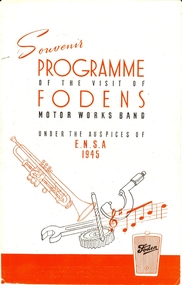
... Australia. frank wright foden diesel fodens motor works band brass band centaur tank foden steam wagon A printed souvenir programme which details the history and successes of the brass band set up at the Fodens Motor Body Works in 1900. On the back cover is a photograph and details of the band personnel and the Managing Director of the company. Also shown are two photographs, one of the 1902 Foden Steam Wagon and one of the World War 2 Centaur Tank which had been built by the company. Souvenir Programme of the Visit of Fodens Motor Works Band Booklet ...Frank Wright was a renown resident of Smeaton, where he was born. He lived at Laura Villa, and attended Smeaton State School. His father William was a gold miner and his mother's name was Sarah. Their family won many singing and instrumental awards. Frank was tutored by Percy Code and was awarded a gold medal for the highest marks in the ALCM examinations in the British Colonies at the age of seventeen years. He became the Australian Open Cornet Champion by the age of eighteen. A year later, Frank conducted the City of Ballarat Band, and later the Ballarat Soldiers’ Memorial Band. He formed the Frank Wright Frisco Band and Frank Wright and his Coliseum Orchestra. These bands won many South Street awards, and Frank as conductor won many awards in the Australian Band Championship contest. In 1933 Frank Wright sailed to England to conduct the famous St Hilda’s Band and was later appointed Musical Director of the London County Council (the GLC or Greater London Council), where he organized many amazing concerts in most of the 150 parks, in and around the London district. He was also responsible for some of London’s major concerts at Kenwood, the Crystal Palace and Holland Park. He was made Professor of Brass and Military Band Scoring and conducted at the Guildhall of Music and Drama. Frank was often invited to adjudicate Brass Band Championships around Europe, in Australia, including South Street and in New Zealand. The Frank Wright Medal at the Royal South Street competition is awarded to an individual recognized as making an outstanding contribution to brass music in Australia.A printed souvenir programme which details the history and successes of the brass band set up at the Fodens Motor Body Works in 1900. On the back cover is a photograph and details of the band personnel and the Managing Director of the company. Also shown are two photographs, one of the 1902 Foden Steam Wagon and one of the World War 2 Centaur Tank which had been built by the company.frank wright, foden diesel, fodens motor works band, brass band, centaur tank, foden steam wagon -
 Lara RSL Sub Branch
Booklet, ANZAC
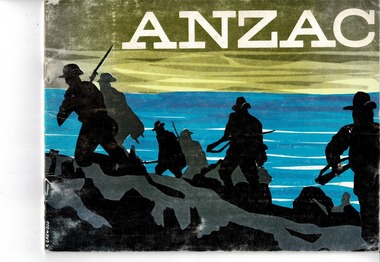
... Australian and New Zealand soldiers formed part of the allied expedition that set out to capture the Gallipoli peninsula. These became known as Anzacs and the pride they took in that name continues to this day. This booklet gives a brief rundown on the history of the ANZACS. The Anzacs were courageous and although the Gallipoli campaign failed in its military objectives, the Australian and New Zealand actions during the campaign left us all a powerful legacy. Booklet, Anzac, World War ...On the 25th of April 1915, Australian and New Zealand soldiers formed part of the allied expedition that set out to capture the Gallipoli peninsula. These became known as Anzacs and the pride they took in that name continues to this day. This booklet gives a brief rundown on the history of the ANZACS.The Anzacs were courageous and although the Gallipoli campaign failed in its military objectives, the Australian and New Zealand actions during the campaign left us all a powerful legacy. Rectangular shaped Booklet.ANZACbooklet, anzac, world war one, lara r.s.l. -
 Lara RSL Sub Branch
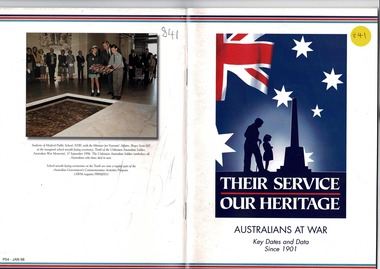
Booklet "Their service Our Heritage", Booklet produced by Department of Vetran's affairs, Canberra A.C.T. "Their service Our Heritage" -Australians at War, Circ 01/1998
... Booklet produced by Department of Vetran's affairs, Canberra A.C.T. "Their service Our Heritage" -Australians at War....Paper booklet A5 in size produced by Department of Vetran's affairs, Canberra A.C.T. "Their service Our Heritage" -Australians at War - key dates and data since 1901. ...Cover is made up with artistic impression of the Australian Flag and a symbolized father and Daughter standing at the war memorial. Booklet titled Their Service Our Heritage - Australians at War - Key Dates and Data Since 1901. ...Booklet produced by Department of Vetran's affairs, Canberra A.C.T. "Their service Our Heritage" -Australians at War. ...Booklet produced by Department of Vetran's affairs, Canberra A.C.T. "Their service Our Heritage" -Australians at War.This small booklet , produced under Their Service - Our Heritage highlights how the course of Australia's military history is unextricably intertwwined with our development as a nation.Paper booklet A5 in size produced by Department of Vetran's affairs, Canberra A.C.T. "Their service Our Heritage" -Australians at War - key dates and data since 1901. Contains 60 pages covered by laminated cardboard cover. Included is a page from a note pad from HMAS Junee Association.Cover is made up with artistic impression of the Australian Flag and a symbolized father and Daughter standing at the war memorial. Booklet titled Their Service Our Heritage - Australians at War - Key Dates and Data Since 1901. Included is a page from a note pad from HMAS Junee Association.their service our heritage, produced by derartment of vetran affairs -
 Lara RSL Sub Branch
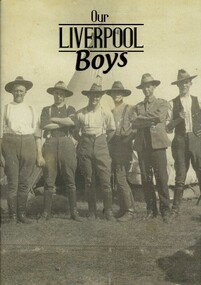
Booklet x 5, Our Liverpool Boys, Approx 2014
... Our Liverpool Boys is a publication that celebrates Liverpool's connection to Australia's military history by sharing biograpgies of a number of soldiers who were born and/or bred in Liverpool and served in the Great War. Our Liverpool Boys Booklet ...100 years of ANZACOur Liverpool Boys is a publication that celebrates Liverpool's connection to Australia's military history by sharing biograpgies of a number of soldiers who were born and/or bred in Liverpool and served in the Great War.Message by Ned Mannoun Mayor of Liverpool City. -
 Lara RSL Sub Branch
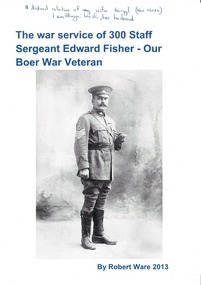
Booklet, The war service of Sergeant Edward Fisher
... Australian colonies offered troops for the war in South Africa. Australians served in contingents raised by the six colonies or, from 1900, by the new Australian Commonwealth. booklet, ww1, boer war, lara r.s.l. sergeant edward fisher. ...As part of the British Empire,the Australian colonies offered troops for the war in South Africa. Australians served in contingents raised by the six colonies or, from 1900, by the new Australian Commonwealth.Rectangular shaped booklet showing Sergeant Edward Fisher.The war service of 300 Staff Sergeant Edward Fisher - Our Boar War Veteran.booklet, ww1, boer war, lara r.s.l. sergeant edward fisher. -
 Lara RSL Sub Branch
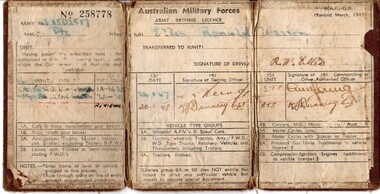
Drivers Licence, Australian Military Forces Army Driving Licence
... australian military forces army private ellis ww2 wwii world war two second world war No. 258778 Army No. V?SOL517 Rank: Private Name in full: Ellis, Ronald Warren Unit: Transferred to (unit): Having passed the prescribed tests ... authorised to drive... types of ... vehicles within the Commonwealth of Australia and Territories. Signature of Driver: Brown canvas booklet ...Cpl. Ronald Warren Ellis, EM (VX502517) was born in Brunswick in 1927. His family moved to Lara when he was young, and his schooling took place at the Lara State School. After finishing his education, Ron took up employment at Sims Coopers in Corio. Ron was enlisted in the second AIF at Melbourne, and posted to the 3rd Recruit Training Battalion at Greta west of Newcastle, NSW. After 3 months training, he was sent to the Service Corps Training Centre for driver and maintenance training in Ingleburn, south of Sydney. When this course was completed, Ron was posted to the Australian Army Service Corps as a driver motor vehicle with the 2nd AIF. Rons service with the AIF lasted 425 days, when he was then transferred to the Interim Army for a further 309 days. The duration of his service was in NSW. Ron was discharged from the Army in Melbourne on the 4th of May 1948. In 1957, Ron enlisted in the CMF and served with 22nd Construction Squadron for 17 years with the last 5 as a Corporal, and was awarded the Efficiency Medal for long service and good conduct.Brown canvas booklet that is folded into three. Licence gives details of Army number, name, rank and type of vehicle that is able to be driven. Licence has been issued to Private Ronald Warren Ellis on 24/01/1948. No. 258778 Army No. V?SOL517 Rank: Private Name in full: Ellis, Ronald Warren Unit: Transferred to (unit): Having passed the prescribed tests ... authorised to drive... types of ... vehicles within the Commonwealth of Australia and Territories. Signature of Driver: drivers licence, australian military forces, army, private, ellis, ww2, wwii, world war two, second world war -
 Lara RSL Sub Branch
Booklet, Practical Calculations for the A.T.C, first edition 1942
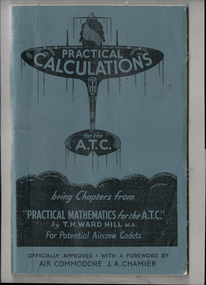
... Used for training pilots during World War 2 Used by Air Training Corps to train Aircrew Cadets in Geometry during World War 2 pratical calculations atc air training corps world war 2 ww2 pratical mathematics t.h. ward hill air commodore j.a. chamier air force australian air force royal australian air force geometry 1942 george g. harrap & co. ltd Front cover of an aeroplane flying above clouds with following words: Practical Calculations for the A.T.C. being Chapters from "Practical Mathematics for the A.T.C." by T.H. Ward Hill M.A. for potential Aircrew Cadets. Officially approved with a foreward by Air Commodore J.A.Chamier On inside cover is written in pencil: A.T.C. 1942-43 R. Ellis 69 Rennie Street Lara. Blue cloth covered book of 80 pages Practical Calculations for the A.T.C. Booklet ...Used for training pilots during World War 2Used by Air Training Corps to train Aircrew Cadets in Geometry during World War 2Blue cloth covered book of 80 pagesFront cover of an aeroplane flying above clouds with following words: Practical Calculations for the A.T.C. being Chapters from "Practical Mathematics for the A.T.C." by T.H. Ward Hill M.A. for potential Aircrew Cadets. Officially approved with a foreward by Air Commodore J.A.Chamier On inside cover is written in pencil: A.T.C. 1942-43 R. Ellis 69 Rennie Street Lara.pratical calculations, atc, air training corps, world war 2, ww2, pratical mathematics, t.h. ward hill, air commodore j.a. chamier, air force, australian air force, royal australian air force, geometry, 1942, george g. harrap & co. ltd -
 Lara RSL Sub Branch
Personal Records, Soldier Pay Book, First World War
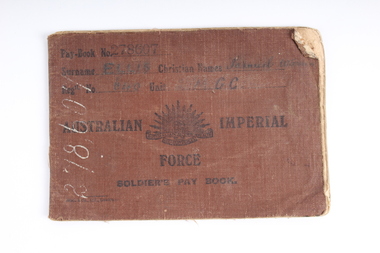
... Pay Book Of World War One Soldier of Samuel Warren Ellis 1918 Contains Pay details ( Earnings and Other Credits )period 1917 to 1918 Next of Kin, Medical and Training Courses Completed Pay Book 278607 Surname Ellis Christian Names Samuel Warren Reg No 640 Unit Australian Imperial Force Rising Sun Badge Brown Booklet Length 154mm W106mm Soldier Pay Book Personal Records ...Pay Book Of World War One Soldier of Samuel Warren Ellis 1918 Contains Pay details ( Earnings and Other Credits )period 1917 to 1918 Next of Kin, Medical and Training Courses Completed Brown Booklet Length 154mm W106mmPay Book 278607 Surname Ellis Christian Names Samuel Warren Reg No 640 Unit Australian Imperial Force Rising Sun Badge -
 Lara RSL Sub Branch
Personal Records, Soldier Pay Book, First World War
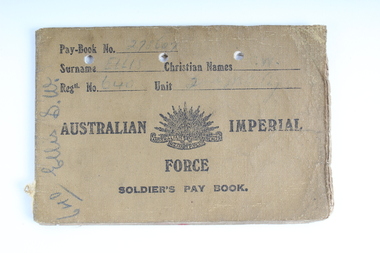
... Pay Book Of World War One Soldier of Samuel Warren Ellis Contains Pay details ( Earnings and Other Credits )period 1916 to 1917 Next of Kin, Medical and Training Courses Completed soldier's pay book world war one australian imperial forces lara rsl Pay Book 278607 Surname Ellis Christian Names Samuel Warren Reg No 640 Unit Australian Imperial Force Rising Sun Badge Khaki Booklet Length 154mm W106mm Soldier Pay Book Personal Records ...Pay Book Of World War One Soldier of Samuel Warren Ellis Contains Pay details ( Earnings and Other Credits )period 1916 to 1917 Next of Kin, Medical and Training Courses Completed Khaki Booklet Length 154mm W106mmPay Book 278607 Surname Ellis Christian Names Samuel Warren Reg No 640 Unit Australian Imperial Force Rising Sun Badgesoldier's pay book world war one australian imperial forces lara rsl -
 Lara RSL Sub Branch
Personal Records, Soldier Pay Book, First World War
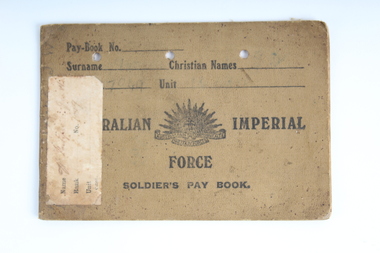
... Pay Book Of World War One Soldier of Mc Intyre 1918 Contains Pay details ( Earnings and Other Credits )period 1916 Next of Kin, Medical and Training Courses Completed soldier pay book world war one james mc intyre 7049 Pay Book 20291 Surname Mc Intyre Christian Names James W Reg No 7049 Unit Australian Imperial Force Rising Sun Badge Khaki Booklet Length 154mm W106mm Soldier Pay Book Personal Records ...Pay Book Of World War One Soldier of Mc Intyre 1918 Contains Pay details ( Earnings and Other Credits )period 1916 Next of Kin, Medical and Training Courses Completed Khaki Booklet Length 154mm W106mmPay Book 20291 Surname Mc Intyre Christian Names James W Reg No 7049 Unit Australian Imperial Force Rising Sun Badgesoldier pay book world war one james mc intyre 7049 -
 Lara RSL Sub Branch
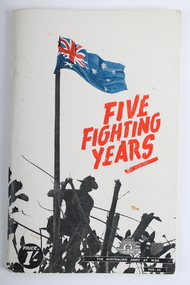
Booklet, Victorian Railway Printing Works, Five Fighting Years
... Australian Military Forces in many countries since the outbreak of war on September 3, 1939 book.the australian army at war. lara, r.s.l. Five Fighting Years. The Australian Army at War,1939-44 Small white book,rectangular in shape with the Australian flag and red writing on the front.Made from cardboard and paper. Five Fighting Years. Booklet ...The purpose of this publication is to provide a brief but comprehensive summary of the service that has been given by the Australian Military Forces in many countries since the outbreak of war on September 3, 1939Small white book,rectangular in shape with the Australian flag and red writing on the front.Made from cardboard and paper.Five Fighting Years. The Australian Army at War,1939-44book.the australian army at war. lara, r.s.l. -
 Lara RSL Sub Branch
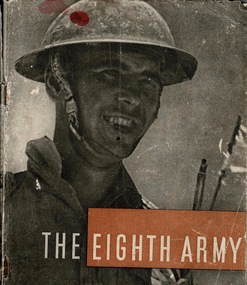
Book, The Eigth Army, Post 1943
... War pictorial accounts of the battles in North Africa. The army was made up of men from England, Scotland, Australia, New Zealand and India eighth army north africa alamain tobruk 1941 - 1943 106 page booklet with picture of soldier in battle gear on front and 1/6 in bottom right hand corner The Eigth Army Book ...Eighth Army September 1941 to January 1943 Prepared for the War Office by the Ministry of Information The Army at War pictorial accounts of the battles in North Africa. The army was made up of men from England, Scotland, Australia, New Zealand and India106 page booklet with picture of soldier in battle gear on front and 1/6 in bottom right hand cornereighth army, north africa, alamain, tobruk, 1941 - 1943 -
 Lara RSL Sub Branch
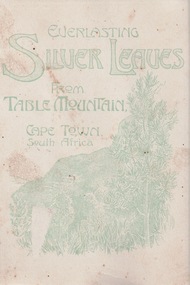
Picture Postcard Booklet, Cape Town South Africa
... Jim McIntyre picked this card up while on leave in Cape Town, South Africa A card sent home to family from WW1 Anzac serving in the AIF silver leaves table mountain cape town south africa ww1 world war 1 australian army aif mcintyre strand street On cover (see image) is written Everlasting Silver Leaves from Table Mountain Cape Town South Africa On second page (see image) is a photo of Strand Street, Cape Town On third page (see image) are three leaves with a picture of flowers, a hand and sign 'Remember Me' On back page (see image) is writing - Cape Town 12/1/17 To Florrie From Jim Cape Town South Africa Picture Postcard Booklet. ...This card is part of the McIntyre collection from three sons, J.L. McIntyre (founding member of Lara RSL Sub Branch WW1; J. W. McIntyre WW1 and T.G. McIntyre WW2. Jim McIntyre picked this card up while on leave in Cape Town, South AfricaA card sent home to family from WW1 Anzac serving in the AIFOn cover (see image) is written Everlasting Silver Leaves from Table Mountain Cape Town South Africa On second page (see image) is a photo of Strand Street, Cape Town On third page (see image) are three leaves with a picture of flowers, a hand and sign 'Remember Me' On back page (see image) is writing - Cape Town 12/1/17 To Florrie From Jim silver leaves, table mountain, cape town, south africa, ww1, world war 1, australian army, aif, mcintyre, strand street -
 Lara RSL Sub Branch
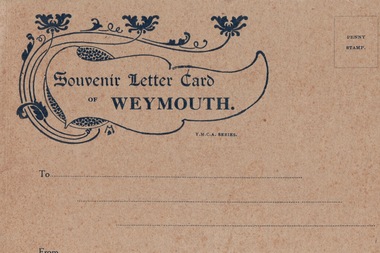
Postcards Booklet, Souvenir Letter Card of Weymouth
... Australian cities and states. A World War 1 Letter Card sent home by Australian troops repatriated in Weymouth, UK containing images of Weymouth and a picture of the Australian Base Camp. ymca uk australian base camp world war 1 ww1 aif army australian army westham littemoor weymouth melcombe regis cemetery anzac Front cover (see image) Souvenir Letter Card of Weymouth Inside are eight pictures of the Weymouth area including the YMCA Hut - Australian Base Camp Souvenir Letter Card of Weymouth Postcards Booklet ...Following the landing of Australian & New Zealand troops, the Anzacs, at Gallipoli on 25th April 1915, casualties mounted rapidly and were initially transported to their base in Egypt, which was soon unable to cope, with wounded being sent to England. Here the troops found that there was no Australian base to which they could report once they had been discharged from hospital; what was needed urgently was a base in England where troops could be sent to convalesce. So on 31st May 1915 a command depot was set up at Monte Video House in Chickerell, some two miles from Weymouth. Weymouth then became the Australian Imperial Forces (AIF) Command Depot No.2 which accommodated those men not expected to be fit for duty within six months, therefore, most of the Diggers repatriated as a result of wounds or sickness passed through Weymouth. During the years 1915-1919 over 120,000 Australian and New Zealand troops passed through Weymouth. In Spring & Summer, Weymouth Esplanade would be full of Anzac soldiers in wheelchairs, being wheeled along by their more able mates. The first contingent of 200 wounded men arrived in the first week of June 1915, and two weeks later a group of local ladies organised a cream tea for the newcomers, followed by a concert party 'The Frolics' at the camp. So began the close connection that was to grow between the soldiers and the villagers of Chickerell. The ANZAC Memorial on Weymouth seafront commemorates the Australian and New Zealand troops who were accommodated in three camps in the town during WW1: Monte Video, Westham and Littlemoor. In Weymouth and Melcombe Regis Cemetery there are about eighty-six graves of those Anzacs who were never to return to their homelands. Also in memory of these troops, there a number of roads close to the camps named after Australian cities and states.A World War 1 Letter Card sent home by Australian troops repatriated in Weymouth, UK containing images of Weymouth and a picture of the Australian Base Camp.Front cover (see image) Souvenir Letter Card of Weymouth Inside are eight pictures of the Weymouth area including the YMCA Hut - Australian Base Campymca, uk, australian base camp, world war 1, ww1, aif, army, australian army, westham, littemoor, weymouth, melcombe regis cemetery, anzac -
Lara RSL Sub Branch
Booklet, A Passing Cheer for the Aussies of the Second World War, 1942
... War song lyrics that were written at various times, during 1941 and printed as separate leaflets which were given by the writer, as a token of welcome, to visiting Australian on Active Service A Passing Cheer for the Aussies of the Second World War paper booklet of war tune lyrics A Passing Cheer for the Aussies of the Second World War Booklet . ...War song lyrics that were written at various times, during 1941 and printed as separate leaflets which were given by the writer, as a token of welcome, to visiting Australian on Active ServiceA Passing Cheer for the Aussies of the Second World War paper booklet of war tune lyrics -
 Lara RSL Sub Branch
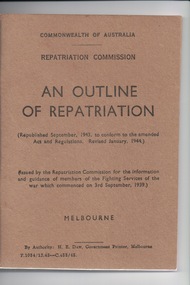
Booklet, Government Printer, An Outline of Repatriation
... Printed for Australian Infantry personnel during World War 2 to help with repatriation on return to Australia Used by World War 2 service personnel to assist with repatriation on return from active service to Australia. commonwealth of australia repatriation commission world war 2 ww2 repatriation aif australian infantry forces melbourne government printer navy army air force On the front Cover from top to bottom: Commonwealth of Australia; Repatriation Commission; AN OUTLINE OF REPATRIATION; (Republished September, 1943, to conform to the amended Acts and Regulation, Revised January, 1941); (Issued by the Repatriation Commission for the information and guidance of members of the Fighting Services of the war which commenced on 3rd September, 1939); Melbourne; By Authority: H.E. Daw, Government Printer, Melbourne T.1034/12.43-C.454/45 See images for content on front and rear covers. A booklet ...Printed for Australian Infantry personnel during World War 2 to help with repatriation on return to AustraliaUsed by World War 2 service personnel to assist with repatriation on return from active service to Australia.A booklet coloured khaki with a cover made from light cardboard and 64 pages made from paper.On the front Cover from top to bottom: Commonwealth of Australia; Repatriation Commission; AN OUTLINE OF REPATRIATION; (Republished September, 1943, to conform to the amended Acts and Regulation, Revised January, 1941); (Issued by the Repatriation Commission for the information and guidance of members of the Fighting Services of the war which commenced on 3rd September, 1939); Melbourne; By Authority: H.E. Daw, Government Printer, Melbourne T.1034/12.43-C.454/45 See images for content on front and rear covers.commonwealth of australia, repatriation commission, world war 2, ww2, repatriation, aif, australian infantry forces, melbourne, government printer, navy, army, air force
