
Showing 61 items matching "australian and new zealand troops"
-
 Monbulk RSL Sub Branch
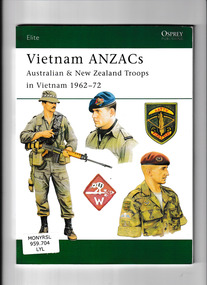
Book, Osprey, Vietnam ANZACs : Australian & New Zealand troops in Vietnam 1962-72, 2004
... Vietnam ANZACs : Australian & New Zealand troops in Vietnam 1962-72...Vietnam ANZACs : Australian & New Zealand troops in Vietnam 1962-72 Book Osprey Kevin Lyles ...The activities, uniforms and eqi]equipment of New Zealand and Australian troops in Vietnam are described in this short book.Ill, p.64.non-fictionThe activities, uniforms and eqi]equipment of New Zealand and Australian troops in Vietnam are described in this short book.vietnam war 1961-1975 – australian involvement, vietnam war 1961-1975 – new zealand involvement -
 National Vietnam Veterans Museum (NVVM)
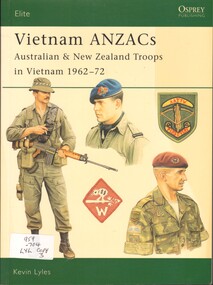
Book, Lyles, Kevin, Vietnam Anzacs: Australian & New Zealand Troops in Vietnam 1962-72 (Copy 3)
... Vietnam Anzacs: Australian & New Zealand Troops in Vietnam 1962-72 (Copy 3)...Australia. Army. Australian and New Zealand Army Corps New Zealand. ...The Australian and New Zealand part in the Vietnam War is sometimes overlooked, but it is generally accepted that the 'Diggers' and 'Kiwis' were among the most effective and professional troops involved.The Australian and New Zealand part in the Vietnam War is sometimes overlooked, but it is generally accepted that the 'Diggers' and 'Kiwis' were among the most effective and professional troops involved. australia. army. australian and new zealand army corps, new zealand. army -
 National Vietnam Veterans Museum (NVVM)
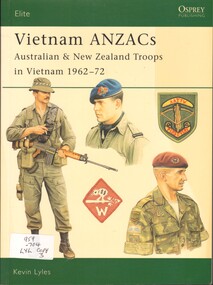
Book, Lyles, Kevin, Vietnam Anzacs: Australian & New Zealand troops in Vietnam 1962-72 (Copy 2)
... Vietnam Anzacs: Australian & New Zealand troops in Vietnam 1962-72 (Copy 2)...Australia. Army. Australian and New Zealand Army Corps New Zealand. ...The Australian and New Zealand part in the Vietnam War is sometimes overlooked, but it is generally accepted that the 'Diggers' and 'Kiwis' were among the most effective and professional troops involved.The Australian and New Zealand part in the Vietnam War is sometimes overlooked, but it is generally accepted that the 'Diggers' and 'Kiwis' were among the most effective and professional troops involved. australia. army. australian and new zealand army corps, new zealand. army -
 National Vietnam Veterans Museum (NVVM)
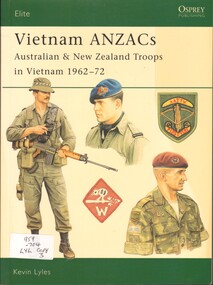
Book, Lyles, Kevin, Vietnam Anzacs: Australian & New Zealand troops in Vietnam 1962-1972 (Copy 1)
... Vietnam Anzacs: Australian & New Zealand troops in Vietnam 1962-1972 (Copy 1)...Australia. Army. Australian and New Zealand Army Corps. ...The Australian and New Zealand part in the Vietnam War is sometimes overlooked, but it is generally accepted that the 'Diggers' and 'Kiwis' were among the most effective and professional troops involved.The Australian and New Zealand part in the Vietnam War is sometimes overlooked, but it is generally accepted that the 'Diggers' and 'Kiwis' were among the most effective and professional troops involved. australia. army. australian and new zealand army corps., vietnam war, 1961-1975 - participation, australian, anzac -
 Bendigo Military Museum
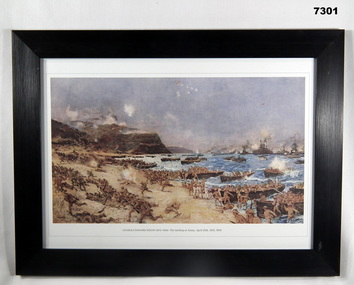
Print - PRINT, FRAMED WW1, Reader's Digest (Australia) Pty Limited, 2015
... Copy of an oil painting, depicting colour, the dawn landing of Australian and New Zealand troops at Anzac Cove. ...Copy of an oil painting, depicting colour, the dawn landing of Australian and New Zealand troops at Anzac Cove. ...From information Book - "Readers Digest/Gallipoli/ 25th April 1915 - 9th January 1916/ Centenary Commemorative Prints". Collection of 20 prints. Refer Cat No. 7300. Framed print. Print - colour print on paper. Copy of an oil painting, depicting colour, the dawn landing of Australian and New Zealand troops at Anzac Cove. Frame - black plastic framing with glass front and MDF board backing with adhered black paper.Details below print - in black ink. "CHARLES EDWARD DIXON (1872-1934). The Landing at Anzac. April 25th 1915". 1915. Successful British Maritime Painter.framed accessories, prints, ww1, gallipoli, centenary -
 St Kilda Historical Society
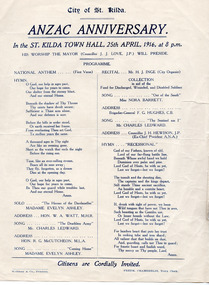
Ephemera - Special event program, City of St Kilda ANZAC Anniversary, 1916
... First anniversary of the landing of Australian and New Zealand troops at Gallipoli on 25 April 1915. ...First anniversary of the landing of Australian and New Zealand troops at Gallipoli on 25 April 1915. ...First anniversary of the landing of Australian and New Zealand troops at Gallipoli on 25 April 1915. Event organised by the City of St Kilda; presided over by the Mayor.Single sheet of white paper that has discoloured with age, folded, printed in dark bluewwi, world war i, anzac day, 1916 -
 Whitehorse Historical Society Inc.
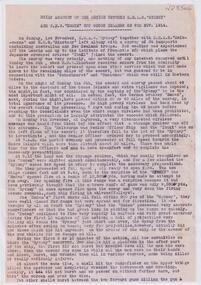
Document, WW1 H.M.A.S. "Sydney" encounter with S.M.S. "Emden"
... "Sydney" was escorting 34 ships containing the WW1 contingent of Australian and New Zealand troops when the "Sydney" was diverted to encounter the "Emden" off Cocos Islands and successfully destroyed it in 1 hour and 40 minutes..."Sydney" was escorting 34 ships containing the WW1 contingent of Australian and New Zealand troops when the "Sydney" was diverted to encounter the "Emden" off Cocos Islands and successfully destroyed it in 1 hour and 40 minutes H.M.A.S. ...Brief account of the action between H.M.A.S. "Sydney" and S.M.S. "Emden" off Cocos Islands on 9th Nov 1914A4 printed both sidesnon-fictionBrief account of the action between H.M.A.S. "Sydney" and S.M.S. "Emden" off Cocos Islands on 9th Nov 1914h.m.a.s. "sydney", s.m.s. "emden", world war 1914 - 1918 -
 Galen Catholic College
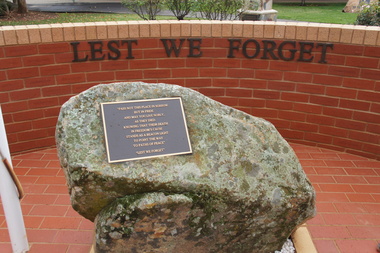
ANZAC Memorial Stone, 2015
... 2015 was the 100th anniversary of the Gallipoli Campaign, when Australian and New Zealand troops landed at Gallipoli in Turkey, during World War One. ...2015 was the 100th anniversary of the Gallipoli Campaign, when Australian and New Zealand troops landed at Gallipoli in Turkey, during World War One. ...2015 was the 100th anniversary of the Gallipoli Campaign, when Australian and New Zealand troops landed at Gallipoli in Turkey, during World War One. Galen Catholic College erected the ANZAC Memorial Stone to mark this anniversary. This sequence of photos records the procession from Galen's stadium to the laying of the wreath and the hoisting of the flags at the stone.galen catholic college, galen college, anzac day, anzac service, memorial stone, wreath, ex-servicemen, 2015, 100th anniversary of the gallipoli campaign -
 Dandenong/Cranbourne RSL Sub Branch
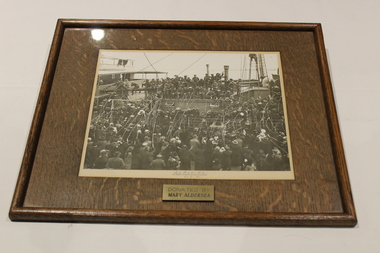
Photograph - Framed photograph, Circa early 1900s
... AYESHIRE was part of the second Convoy of Australian and New Zealand Troops December 1914. 7,763 gross tons. 140.2 x 17.9 metres. ...AYESHIRE was part of the second Convoy of Australian and New Zealand Troops December 1914. 7,763 gross tons. 140.2 x 17.9 metres. ...AYESHIRE was part of the second Convoy of Australian and New Zealand Troops December 1914. 7,763 gross tons. 140.2 x 17.9 metres. Cargo steamship (refrigerated) built by Hawthorn Leslie, Hebburn for Elderslie SS Company Ltd, Glasgow 1902. Twin screw, triple expansion engine making 13 knots, 1910 owned by the Scottish Shire Line Ltd, London and registered at Glasgow.Wooden framed sepia photograph of Servicemen aboard ship being farewelled by family and friends.The vessel pictured is the HMAT Ayrshire. She saw service during WW1 between1914 and 1918. Inscribed "Ayrshire" 3-7-16. -
 Warrnambool and District Historical Society Inc.
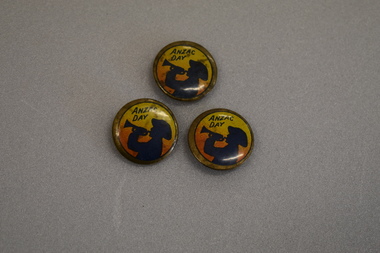
Badges, Anzac Day
... ANZAC Day is an important national holiday in Australia commemorating the landing of Australian and New Zealand troops on Gallipoli on 25th April 1915. ...ANZAC Day is an important national holiday in Australia commemorating the landing of Australian and New Zealand troops on Gallipoli on 25th April 1915. ...These badges were produced in World War One in Australia to raise funds for the war effort. ANZAC Day is an important national holiday in Australia commemorating the landing of Australian and New Zealand troops on Gallipoli on 25th April 1915. The national day was instituted on 25th April 1916 and badges such as these would have been sold on the anniversary of the landing day. Badges were sold on trams, buses, at railway stations, other public buildings and at rallies held on or about ANZAC Day. These badges are a significant reminder of the many fund raising activities held in Australia to raise funds for the war effort.Three circular slightly concave metal badges featuring the profile of an Australian soldier in a slouch hat blowing a bugle. The background depicts sunrise in yellow and orange colours and text. The outer edge is gold coloured . The reverse has a metal clip.ANZAC DAYanzac day, badges -
 Lara RSL Sub Branch
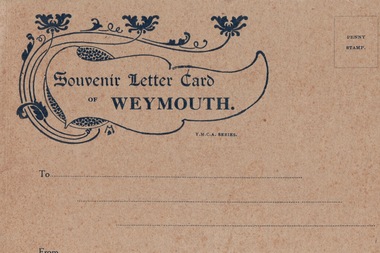
Postcards Booklet, Souvenir Letter Card of Weymouth
... During the years 1915-1919 over 120,000 Australian and New Zealand troops passed through Weymouth. ...During the years 1915-1919 over 120,000 Australian and New Zealand troops passed through Weymouth. ...Following the landing of Australian & New Zealand troops, the Anzacs, at Gallipoli on 25th April 1915, casualties mounted rapidly and were initially transported to their base in Egypt, which was soon unable to cope, with wounded being sent to England. Here the troops found that there was no Australian base to which they could report once they had been discharged from hospital; what was needed urgently was a base in England where troops could be sent to convalesce. So on 31st May 1915 a command depot was set up at Monte Video House in Chickerell, some two miles from Weymouth. Weymouth then became the Australian Imperial Forces (AIF) Command Depot No.2 which accommodated those men not expected to be fit for duty within six months, therefore, most of the Diggers repatriated as a result of wounds or sickness passed through Weymouth. During the years 1915-1919 over 120,000 Australian and New Zealand troops passed through Weymouth. In Spring & Summer, Weymouth Esplanade would be full of Anzac soldiers in wheelchairs, being wheeled along by their more able mates. The first contingent of 200 wounded men arrived in the first week of June 1915, and two weeks later a group of local ladies organised a cream tea for the newcomers, followed by a concert party 'The Frolics' at the camp. So began the close connection that was to grow between the soldiers and the villagers of Chickerell. The ANZAC Memorial on Weymouth seafront commemorates the Australian and New Zealand troops who were accommodated in three camps in the town during WW1: Monte Video, Westham and Littlemoor. In Weymouth and Melcombe Regis Cemetery there are about eighty-six graves of those Anzacs who were never to return to their homelands. Also in memory of these troops, there a number of roads close to the camps named after Australian cities and states.A World War 1 Letter Card sent home by Australian troops repatriated in Weymouth, UK containing images of Weymouth and a picture of the Australian Base Camp.Front cover (see image) Souvenir Letter Card of Weymouth Inside are eight pictures of the Weymouth area including the YMCA Hut - Australian Base Campymca, uk, australian base camp, world war 1, ww1, aif, army, australian army, westham, littemoor, weymouth, melcombe regis cemetery, anzac -
 Lilydale RSL Sub Branch
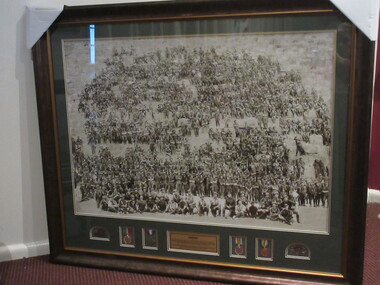
Photograph - Framed colourised version of the original photograph Titled ANZAC, ANZAC, Original photograph dated 10 January 1915
... The Ascanius formed part of a convoy of 38 Troopships carrying approximately 35,000 Australian and New Zealand troops and reached the Port of Alexandria Egypt on 2nd December 1914. ...The Ascanius formed part of a convoy of 38 Troopships carrying approximately 35,000 Australian and New Zealand troops and reached the Port of Alexandria Egypt on 2nd December 1914. ...Photograph of all the original Officers and men of the 11th. Battalion 3rd Brigade AIF. The group of over 685 soldiers are spread out over the side of the Great Pyramid of Khufu Cheops near Mina Camp.Framed colourised version of Original photograph titled ANZAC with inscribed plate describing the Scene. Inscribed Plate reads - "The 11th Battalion, Australian Infantry Force was raised at Black Boy Hill in Western Australia on 17th August 1914. Following a period of training of just two weeks, the Battalion embarked at Freemantle on the HMAT Ascanius on 2nd November 1914. The Ascanius formed part of a convoy of 38 Troopships carrying approximately 35,000 Australian and New Zealand troops and reached the Port of Alexandria Egypt on 2nd December 1914. After arriving in Egypt, the Battalion camped and trained at Mena, ten miles from Cairo, at the foot of the Great Pyramid Cheops. On 10th January 1915, prior to leaving Egypt a photograph of more than 800 original Officers and Men of the Battalion was taken at the Great Pyramid of Cheops on the 28th February 1915." -
 Montmorency–Eltham RSL Sub Branch
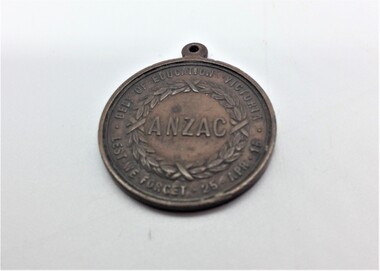
Medal - Medallion, ANZAC, Victorian Department of Education 1916, 1916
... The medallion was sold to Victorian school children at commemorations of the landing of the of the Australian and New Zealand troops arriving on the Gallipoli Peninsula in 1915. ...The medallion was sold to Victorian school children at commemorations of the landing of the of the Australian and New Zealand troops arriving on the Gallipoli Peninsula in 1915. ...The ANZAC Day medallion was issued for sale in 1916. The medallion was struck by the Education Department of Victoria for school children in 1916, to commemorate the first anniversary of the ANZAC Forces landing at Gallipoli on 25 April 1915. An article in the ARGUS newspaper, written at the time, stated that the medallions were issued for sale for the price of sixpence. Although 175,000 medallions were made, this proved insufficient for demand. The medallion was sold to Victorian school children at commemorations of the landing of the of the Australian and New Zealand troops arriving on the Gallipoli Peninsula in 1915. The medallion was also distributed to the public on ANZAC Button Day for one shilling. Circular medal with an eyelet at the top for attaching loop holding ribbon (loop and ribbon missing). Obverse ... head of King George V facing left Reverse ... wreath surrounding inscription (see below) The edge of the medallion is plain. Obverse ... FOR KING AND COUNTRY 1916 Reverse ... ANZAC (surrounded by wreath) DEPT. OF EDUCATION VICTORIA LEST WE FORGET 25 APR 15 (around circumference)anzac day, commemoration, school children, 1916 anzac medallion, ww2 -
 8th/13th Victorian Mounted Rifles Regimental Collection
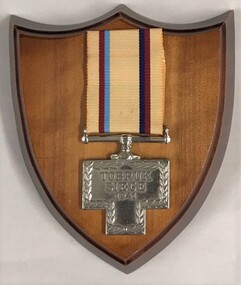
Medal - Tobruk
... The Tobruk Siege Medal known as the "T" medal was issued to Australian, British, Indian, New Zealand & Polish troops who were in action during the Siege of Tobruk between April & December 1941. ...The Tobruk Siege Medal known as the "T" medal was issued to Australian, British, Indian, New Zealand & Polish troops who were in action during the Siege of Tobruk between April & December 1941. ...The Tobruk Siege Medal known as the "T" medal was issued to Australian, British, Indian, New Zealand & Polish troops who were in action during the Siege of Tobruk between April & December 1941. The Tobruk Siege Medal is an unofficial award issued by the "Rats of Tobruk" Association in 1977.Heart shaped wooden plaque with Tobruk medal attached tobruk, seige, world war two, wwii -
 Mentone Grammar School
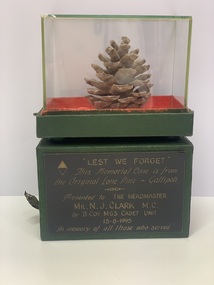
Archive, Memorial Cone from the original Lone Pine, Gallipoli, 1916
... The Battle of Lone Pine was fought between Australian and New Zealand Army Corps (ANZAC) and Ottoman Empire forces during the Gallipoli Campaign of the First World War, between 6 and 10 August 1915. ...The Battle of Lone Pine was fought between Australian and New Zealand Army Corps (ANZAC) and Ottoman Empire forces during the Gallipoli Campaign of the First World War, between 6 and 10 August 1915. ...Memorial cone from the original 'Lone Pine' at Gallipoli, presented to Headmaster Neville Clarke by B Company, Mentone Grammar Cadet Unit, 15th August 1995 in memory of those who served. The Battle of Lone Pine was fought between Australian and New Zealand Army Corps (ANZAC) and Ottoman Empire forces during the Gallipoli Campaign of the First World War, between 6 and 10 August 1915. The battle was part of a diversionary attack to draw Ottoman attention away from the main assaults being conducted by British, Indian and New Zealand troops around Sari Bair, Chunuk Bair and Hill 971, which became known as the August Offensive. -
 Dandenong/Cranbourne RSL Sub Branch
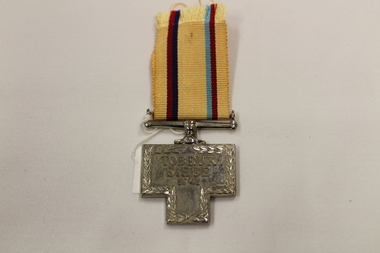
Medal - Tobruk Siege Medal, 1941
... The Tobruk Siege medal - known as the "T'' Medal was issued to Australian, British, Indian, New Zealand and Polish troops who saw action at Tobruk. ...The Tobruk Siege medal - known as the "T'' Medal was issued to Australian, British, Indian, New Zealand and Polish troops who saw action at Tobruk. ...The Tobruk Siege medal - known as the "T'' Medal was issued to Australian, British, Indian, New Zealand and Polish troops who saw action at Tobruk. The siege lasted for 242 days from April to December 1941. The medal was commissioned and issued by the Rats of Tobruk Association in 1977. Control of the Port of Tobruk was of great importance to not only North Africa but to the entire war. T shaped Silver Medal with Tobruk Seige 1941. The ribbon is khaki with light blue and maroon stripes. The medal is issued by the Rats of Tobruk Association. That makes it un-official. It is however recognised. M. Davis (recipient) on reverse of medal. Obverse side Tobruk Siege 1941. -
 Melbourne Legacy
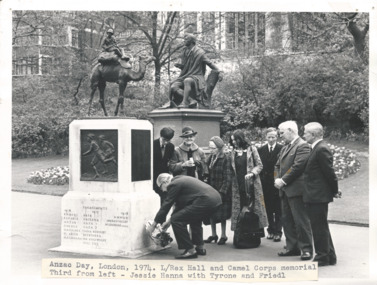
Photograph - Photo, Anzac Day London 1974, 1974
... The Corps was composed of 50% Australian, New Zealand troops and 50% British-English, Scottish, Welsh and Indians." ...The Corps was composed of 50% Australian, New Zealand troops and 50% British-English, Scottish, Welsh and Indians." ...A photo of a wreath laying ceremony on Anzac day in Thames Embankment Gardens, Charing Cross, London in 1974 from a Comradeship album. The label identifies Legatee Rex Hall. The handwritten inscription on the back says: "In Thames Embankment Gardens, out___ by members of the Corps 1920. Placing the wreath on Anzac Day 1974. From Left - Tyrone, grandson of Pat Hanna, Mrs Dorothy Roberts, Jessie Pat's widow, Friedl, Pat's granddaughter, ___ ___ Pattie, Pat's daughter. The Imperial Camel Corps fought in every battle in Sinai and Palestine and had 1600 battle casualties of which about 300 names are engraved here. The Corps was composed of 50% Australian, New Zealand troops and 50% British-English, Scottish, Welsh and Indians." The Comradeship committee gathered photos of events and compiled them in a Comradeship photo album for Legatees to look through. This photo and several others (see 01029 - 01032) of Anzac services in London are part of a photo album of Comradeship activities (from 1930 to 1977) see items 01027 to 01036. The Comradeship photo album was put together by the Comradeship committee and records events that Legatees did and places they lived or visited. Some appear to be trips to visit other Legatees living overseas and social occasions held in different places. It shows the bond that Legatees have with each other.Black and white photo of Anzac Day in London in 1974.Label pasted on the front: Anzac Day London 1974. L/Rex Hall and Camel Corps memorial / Third from left - Jessie Hand and Tyrone and Friedl. On the back handwritten description and stamped in grey ink 'J.A.Ballard photography / London'anzac day, comradeship -
 Warrnambool and District Historical Society Inc.
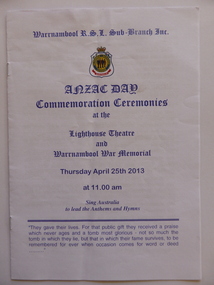
Document, ANZAC day commemoration services 2015, 2009,2012, 2013
... Anzac Day, 25th April, has been a public holiday in Australia since 1927 and at first commemorated the Australian and New Zealand Army Corps troops who landed on the Gallipoli peninsula, in Turkish Thrace, the European section of Turkey, on 25th April 1915 and engaged in battle with the troops from the Ottoman Empire in World War One. ...Anzac Day, 25th April, has been a public holiday in Australia since 1927 and at first commemorated the Australian and New Zealand Army Corps troops who landed on the Gallipoli peninsula, in Turkish Thrace, the European section of Turkey, on 25th April 1915 and engaged in battle with the troops from the Ottoman Empire in World War One. ...These are programs for the commemoration ceremonies held in Warrnambool in recent years. Anzac Day, 25th April, has been a public holiday in Australia since 1927 and at first commemorated the Australian and New Zealand Army Corps troops who landed on the Gallipoli peninsula, in Turkish Thrace, the European section of Turkey, on 25th April 1915 and engaged in battle with the troops from the Ottoman Empire in World War One. Today Anzac Day commemorates all Australian and allied troops who fought for their country in world conflicts. The programs reflect the deep reverence Australians have for both Anzac Day and those who fought for us. These programs are of some interest as they represent the type of commemoration that takes place in Warrnambool each year on Anzac Day. The local people, like most others in Australia, hold Anzac Day as an important, if not the most important, national day. These three programs are for commemoration ceremonies in Warrnambool for Anzac Day, 2009, 2012 and 2013. Two of them are two A4 white sheets of paper folded in two to make 4 pages printed back to back and the other is a larger folded cream-coloured sheet containing four printed pages. The pages contain colour photographs of the Warrnambool War Memorial, printed material and an image of the Returned Services League of Australia badge on the front page. anzac day, warrnambool war museum -
 Royal Melbourne Yacht Squadron
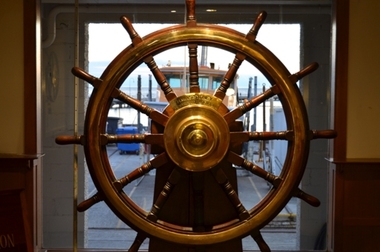
Memorabilia - Wheel of HMAS Sydney, Early 20th Century
... On 1 November 1914, led by the flagship SS Orvieto, a large convoy of 28 Australian and 10 New Zealand transports escorted by the Light Cruisers HMAS Melbourne, HMAS Sydney, HMS Minotaur and the Japanese ship Ibuki, departed King George Sound, Albany Western Australia with a large contingent of Australian and New Zealand troops bound for Egypt, to become the original Anzac’s. ...On 1 November 1914, led by the flagship SS Orvieto, a large convoy of 28 Australian and 10 New Zealand transports escorted by the Light Cruisers HMAS Melbourne, HMAS Sydney, HMS Minotaur and the Japanese ship Ibuki, departed King George Sound, Albany Western Australia with a large contingent of Australian and New Zealand troops bound for Egypt, to become the original Anzac’s. ...THE WHEEL OF HMAS SYDNEY COMMEMORATING AUSTRALIA’S FIRST NAVAL ENGAGEMENT The historic wheel of HMAS Sydney commemorates the Royal Australian Navy’s first ship- to- ship naval engagement. It was purchased early in 1930 and later presented to the Royal St Kilda Yacht Club (now Royal Melbourne Yacht Squadron) by then Commodore Joe White, following HMAS Sydney being broken up at Cockatoo Dock, Sydney. On 1 November 1914, led by the flagship SS Orvieto, a large convoy of 28 Australian and 10 New Zealand transports escorted by the Light Cruisers HMAS Melbourne, HMAS Sydney, HMS Minotaur and the Japanese ship Ibuki, departed King George Sound, Albany Western Australia with a large contingent of Australian and New Zealand troops bound for Egypt, to become the original Anzac’s. As the convoy steamed northwest across the Indian Ocean, leaving Cocos-Keeling Islands well to the westward, Captain Karl von Muller in the German Light Cruiser Emden of 3,600 tons, after having wrought much havoc to allied shipping in the Indian Ocean, ignorant of the convoys presence, had in mind to destroy the Cocos Island Cable Station on Direction Island. In the early hours of the morning of Monday the 9 November, he anchored “Emden” off Direction Island to send a landing party ashore, In the meantime the Cable Station had sent out a Morse Code message ‘Strange ship approaching’, this was followed soon after by a ‘S.O.S.’ These messages were picked up by ships in the convoy and at 7.00 a.m., Captain J.C. Glossop of the 5,400 ton HMAS Sydney was directed to leave the convoy and proceed at full speed for Cocos Islands. Two hours later Cocos Island was on the horizon. Captain von Muller, with the boarding party ashore to destroy the Cable station, steamed out to intercept the intruder. Captain Glossop decided to close in to 9,500 yards ( 8686.8m) before delivering his first salvo. Emden on the other hand, opened fire at 10,500 yards (9601m), its ten, 4.1 inch (104mm) guns firing 38 pound (17.24 kg ) shells, some of which scored near misses. Emden was hit repeatedly by HMAS Sydney’s eight, 6 inch (152.4mm) guns firing 100 pound (45.36kg ) shells. Within two hours Captain von Muller had decided to run the badly damaged Emden aground on North Keeling Island. Captain Glossop then broke off the engagement to speed off to intercept Emden’s collier, “Buresk”, seen lurking in the distance, soon to overtake her. A boarding party from HMAS Sydney was too late to prevent Buresk from being scuttled but able to rescue her crew. Returning to finish off Emden, HMAS Sydney was again met by heavy gunfire. Sydney scored a number of direct hits to Emden and only after having suffered 134 killed and 65 wounded, did Captain von Muller finally decide to lower his Naval Ensign. He was among those captured and was allowed to retain his Naval sword. In the engagements HMAS Sydney only suffered four direct hits, 4 killed and 12 wounded. J.H.(Bert) Ferris Extremely significant as part of Australia's Naval and Military history.Ships wheel, timber, mounted on a timber plinth, wheel of ship first HMAS Sydney.Plaque notifying that wheel donated by Commodore Joe White 1930ww1, sydney, german, hmas, raider, emden, cocos keeling, islands, hmas sydney, wheel -
 Melbourne Legacy
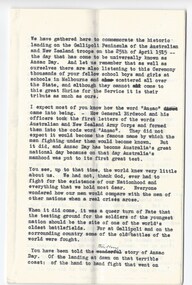
Document - Speech, ANZAC Commemoration Ceremony for Students
... The text says: 'We have gathered here too commemorate the historic landing on the Gallipoli Peninsula of the Australian and New Zealand troops on the 25th of April 1915 - the day that has come to be universally known as Anzac Day. . . ...The text says: 'We have gathered here too commemorate the historic landing on the Gallipoli Peninsula of the Australian and New Zealand troops on the 25th of April 1915 - the day that has come to be universally known as Anzac Day. . . ...A copy of an Anzac Day Address at the Anzac Commemoration Ceremony for Students, the year is unknown but it is presumably the address given by the President of Legacy. It seems to be one of the earlier ceremonies. It was stored with documents about the building of the Shrine and another speech from the 1939 service. The presenter had probably served in World War 1 so was very close to the events he was talking about. The ceremony provides a valuable opportunity for students to gain an appreciation of the Anzac spirit, the significance of the Shrine and the meaning of Anzac Day. The ceremony is usually attended by representatives from schools throughout the state and the Governor of Victoria. The text says: 'We have gathered here too commemorate the historic landing on the Gallipoli Peninsula of the Australian and New Zealand troops on the 25th of April 1915 - the day that has come to be universally known as Anzac Day. . . I expect most of you know how the word 'Anzac' came into being. How General Birdwood and his officers took the first letters of the words Australian and New Zealand Army Corps and formed them into the code word "Anzac". They did not expect it would become the famous name by which the men fighting under them would become known. But it did, and Anzac Day has become Australia's greatest national day because on that day Australia's manhood was put to its first great test. You see up to that that time, the world knew very little about us. We had not, thank God, ever had to fight for the existence of our Nationhood and everything we hold most dear. Everyone wondered how our men would compare with the men of other nations when a real crises arose. . . . You have been told there thrilling story of Anzac Day. Of the landing at dawn on that terrible coast: the hand to hand fighting that went on continuously all that day and through the days and nights that followed. How the Anzacs - outnumbered, exhausted and tortured by thirst held on, and how during the terrible nine months that ensued all the efforts of a brave enemy to dislodge them failed. Such was their gallantry that a British Officer described the Australian soldier as "The bravest thing God ever made". What a wonderful tribute that was; and how proud we should be of the men who earned it. . . . These men carried on all the traditions of the Anzacs and made a wonderful name for Australia and New Zealand in France, in Belgium, in Egypt and Palestine and in all the theatres of war in which they served. And this great Shrine was build by the people of Victoria, not in any boastful sense of Victory, not in any attempt to glorify war - which is a horrible, dreadful thing, but in memory of those thousands of Victorian sailors and soldiers who so loved their country that they laid down their lives in her service. . . All of them were brave, but do not think that a soldier who is brave need alway be a great warrior. I hope when you have passed through the Shrine you will go and see a little bronze statue near the road yonder. A statue of a man leading a donkey which carries a wounded comrade. You will see the soldier leading the donkey carries no weapons. Yet he was a hero indeed, for he saved the lives of scores of his comrades at Anzac by carrying wounded from the battle to safety and the hospital. And in the end he too gave his life for his friends. . . Let us all try to help each other in peace as they did in war. Instead of divisions, let us have unity. If we think of no one but ourselves we shall not achieve anything nor shall we deserve to. Let those of you who are strong help those who are not so strong - all through life - like John Simpson, the man with the donkey did. Be proud of your country and do nothing to dishonour it. If you get an order from one in authority, obey it, even if you do not understand it.A good solider always obeys his orders. If he did not, he may bring disaster and cause harm to his fellow soldiers. Remember that those thousands of men died so that we could still live here in freedom. A country is judged by its citizens. Let us be worthy of those great citizens who have left us the legacy of their fame and devotion to duty. And when you file through the Shrine and look down on the Rock of Remembrance, read the inscription on it, "Greater Love Hath No Man", remember those wonderful words written in the greatest book in the world nearly two thousand years ago, "Greater love hath no man than this, that a man lay down his life for his friend."A record of a ceremony at the Shrine for school students. The text of the speech is significant in that it was written by a man who had served in World War 1 and knew first hand what it meant to be part of the first Anzacs. White quarto paper x 4 pages with black type of a speech at one of the Annual Anzac Commemoration Service for Students.Handwritten in blue pen 'Shrine, Children's Service'anzac commemoration for students, wreath laying ceremony, speech -
 Greensborough Historical Society
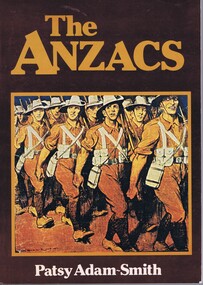
Book, Patsy Adam-Smith, The Anzacs, by Patsy Adam-Smith, 1978
... History of the participation of Australian troops in the Gallipoli campaign of World War 1 gallipoli world war 1 The Anzacs comprised the Australian and New Zealand Army Corps. 372 p., black & white illustrations The Anzacs, by Patsy Adam-Smith Book Book Patsy Adam-Smith Thomas Nelson (Australia) Limited ...The Anzacs comprised the Australian and New Zealand Army Corps.372 p., black & white illustrationsnon-fictionThe Anzacs comprised the Australian and New Zealand Army Corps.gallipoli, world war 1 -
 Lara RSL Sub Branch
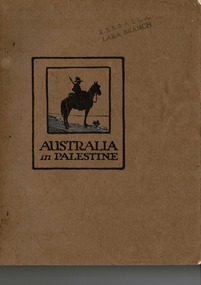
Book, Australia in Palestine, 1919
... ...Australian Army...A soldier's book produced almost entirely by soldiers in the field under active service conditions to send to their friends in Australia and abroad. Australian Lighthorse men is a type peculiar his own and has no counterpart in h is NZ brother. ...A soldier's book produced almost entirely by soldiers in the field under active service conditions to send to their friends in Australia and abroad. Australian Lighthorse men is a type peculiar his own and has no counterpart in h is NZ brother. His fearlessness, initiative and endurance, and his adaptability to almost any task, are due to the adventurous life he leads in his own country where he has been accustomed to long hours in the saddle, day and night, and to facing danger of all sorts from his earliest youth.Brown front and back hardcover with dark brown text 'Australia in Palestine' with a light horseman framed in centre of front cover. The spine is green with text Australia in Palestine, Angus and Robertson bottom of spine. Evidence of water on front cover. Silverfish have eaten top right hand corner of first two pages. Farm scene in four boxes with AR in the lower corner of each square. Inside front and back covers are illustrations of a camel train and came corps in the desert with the rising sun in the background with a mountain. There is a grave and white cross in their foreground right lower corner Illustrations, photographs, poems, short stories, Centre foldout of the Battle for Richon Le Zion and Battle of Beersheba and after the Battle of Bir El Abed To the memory of fallen comrades. Pen mark inside W. Mathews Larabattle of beersheba, battle of richon ze zion, battle of bir er abd, camel corps, lighthorse, slush light, sir h.g. chauvel, mounted division at kantara, medical services, signal engineers, katia oasis, new zealand mounted troops, sir edmund h allenby, walers story, 5th lighthorse, romani, ww1, world war 1, australian army -
 Lara RSL Sub Branch
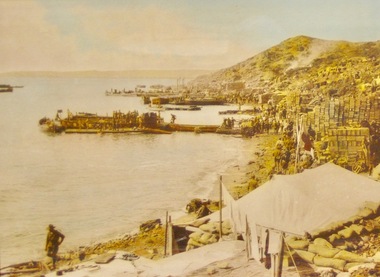
Framed Photograph of Anzac cove, Anzac Cove 1915
... and Australian Division and the Australian 1st Division. ...Following the landing at Anzac Cove, the beach became the main base for the Australian and New Zealand troops for the eight months of the Gallipoli campaign. world war 1,gallipoli,anzac cove,lara r.s.l. ww1 Rectangular shaped glass covered picture frame showing Anzac Cove. ...Gallipoli Campaign 1915-6[edit] The first objective for soldiers coming ashore in enemy-held territory was to establish a beachhead, that is a safe section of beach protected from enemy attack where supplies and extra troops could be safely brought ashore. Anzac Cove was always within 1 kilometre (3,300 ft) of the front-line, well within the range of Turkish artillery though spurs from the high ground of Plugge's Plateau, which rose above Arıburnu, provided some protection. General William Birdwood, commander of Anzac, made his headquarters in a gully overlooking the cove, as did the commanders of the New Zealand and Australian Division and the Australian 1st Division. It was on 29 April that General Birdwood recommended that the original landing site between the two headlands be known as "Anzac Cove" and that the surrounding, hitherto nameless, area occupied by his corps be known as "Anzac". Anzac Cove is a small cove on the Gallipoli peninsula in Turkey. It became famous as the site of World War I landing of the ANZACs (Australian and New Zealand Army Corps) on 25 April 1915. The cove is 600 metres (2,000 ft) long, bounded by the headlands of Arıburnu to the north and Little Arıburnu, known as Hell Spit, to the south. Following the landing at Anzac Cove, the beach became the main base for the Australian and New Zealand troops for the eight months of the Gallipoli campaign. Rectangular shaped glass covered picture frame showing Anzac Cove.world war 1,gallipoli,anzac cove,lara r.s.l. ww1 -
 Flagstaff Hill Maritime Museum and Village
Book - Craft book, Norma Benporath, Tatting, circa 1940's
... In 1997, Norma was inducted into the "Order of Australia" for "Service to the craft of tatting as a designer and through the international publication of her patterns"....This item is an excellent example of the needle work being enjoyed by women in the 1940's in Australia and the skills of the Australian designer, Norma Benporath. ...Tatting is a form of knotted lace making using thread and a small shuttle. Twisted threads are tied around or through small, pointed shuttles that can be made of bone, mother of pearl, tortoise shell, steel or plastic. This produces a stable, strong lace using simple knots of two half hitches to make rings and chains embellished with picots. The origins of tatting are not clear but early versions of decorative knotting were used by the Egyptians on their ceremonial dress. Tatting also has elements of fishermen's net making techniques and the decorative knotting that was practiced by aristocratic women from the 15th century. Tatting, as we know it today, emerged in the first half of the 19th century. The new availability of mercerised thread from 1835 encouraged a burgeoning of lace crafts of all sorts. It was known in Italy as "occhi" and in France as "la frivolite". Tatting looks fragile but is both strong and durable. An article in a column named "Wives and Daughters" published in the Star newspaper in May 1910 describes the durability of tatting lace - "there is edging and insertion still in existence that have outworn two sets of pillow slips." In the 19th century and well into the 20th century, tatting was used like crochet and knitted lace for decorative edgings, collars, doilies, tray cloths etc. At first, different tatting patterns were passed along by word of mouth from person to person, however in time, patterns regularly appeared in newspapers and magazines well into the 1950's. This book has photographs and detailed instructions for a wide range of tatted edgings and insertions suitable for household linens such as towels, doilies and tablecloths as well as patterns for whole mats. Stanley E. Mullen (a businessman) developed Semco Pty Ltd which began as a Melbourne based importation company in 1907. The first three letters of Semco's name were his initials. In 1915 it began manufacturing women's apparel, whitework and transfer patterns. In 1924 the company moved to Black Rock, Victoria and continued to produce an extensive range of needlework patterns and handcraft instruction booklets, threads etc. up until the late 1970's. Semco had a staff that included many young women. It was noted by E.J. Trait (editor of the local newspaper "Standard News") that the firm provided them with good working conditions and the correct rate of pay for women in a time of war - the starting rate for 15 year olds, mainly girls at Semco was 25 shillings per week. During World War 2, Manpower Regulations could be used to coerce workers to move into jobs that supported the war effort, but Trait argued that being employed at Semco could make this unlikely as the firm made some goods essential for the war effort. He even suggested that women be encouraged to produce needlework items (and play a part in the war effort) by sending them as presents, to the troops up north. He also heaped praise on the Semco workplace - noting that no Saturday work was the norm, allowing employees to shop and have "hair-do's" before enjoying a relaxing weekend! Semco also had a female cricket side in the women's Saturday association. After the war the firm stayed in production until the early 1990's when it was taken over by Coates-Paton Pty Ltd. Norma Benporath (1900 - 1998) was an expert in tatting techniques and taught and published extensively on the subject. She was born in New Zealand with impaired sight but cataract surgery restored 50% vision to one eye. She was inspired to learn tatting whilst watching her aunt tat and being told that tatting did not require as much sharp vision as embroidery. She quickly learnt to design her own patterns and published over 1000 tatted lace patterns between 1929 and 1952. She became a regular contributor to magazines (such as Home Beautiful) and newspapers across Australia. Her designs were also published in New Zealand, South Africa as well as the U.K. and U.S.A. When Semco, a thread manufacturer, noticed a rise in the sale of fine crochet threads, they realized they had an untapped market to explore. Norma designed a collection of tatting patterns for Semco that were used to help promote their threads. Norma also worked with Semco to produce a line of threads and shuttles specifically suited to tatting. In 1997, Norma was inducted into the "Order of Australia" for "Service to the craft of tatting as a designer and through the international publication of her patterns".This item is an excellent example of the needle work being enjoyed by women in the 1940's in Australia and the skills of the Australian designer, Norma Benporath. It is also an example of the trend that emerged for craft companies such as Semco to publish pattern books in order to advertise their own materials.A 32 page soft cover instruction book with green front and back covers showing two tatted doily designs. The book includes black and white photographs and written patterns by Norma Benporath.Front cover - "TATTING" "For / EXPERTS/ and / BEGINNERS" "By/Semco" "SEMCO INSTRUCTION BOOK" "No. 16" "WITH ILLUSTRATIONS AND INSTRUCTIONS" "9" Back cover - "FOR INSTRUCTIONS FOR WORKING SEE PAGE 22" "Published by Semco Pty. Ltd." "BLACK ROCK, 29, VIC"flagstaff hill maritime museum and village, warrnambool, great ocean road, tatting, tatting instruction book, tatting patterns, tatting shuttle, semco, semco pty ltd, norma benporath, needlework, handcrafts, household linen, craftwork -
 City of Moorabbin Historical Society (Operating the Box Cottage Museum)
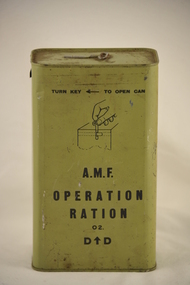
Container - World War 1939-45 Ration pack, c1940
... New Zealand. University of Otago (B.Sc., N.Z., 1914; M.Sc. Hons, 1915; M.B., Ch.B., 1923) 1916-18 Hicks served as a non-commissioned officer in the New Zealand Expeditionary Force and he assisted Professor J. K. H. Inglis in the synthesis and production of Chloramine-T for use against meningitis among the troops...Container World War 1939-45 Ration pack Department of Defence Commonwealth of Australia ...AMF Operational Ration This ration pack was developed by Sir Stanton Hicks. It contained three meals, each waterproofed (a vital consideration for the tropics), which offered a balanced selection of meat, vegetables, fruit and vitamin supplements. Before the development of this ration pack, Australian soldiers were supplied with quantities of preserved food that were difficult for a man to carry and divide, and which often did not provide a nourishing diet. Sir Cedric Stanton Hicks (1892-1976), university professor and army catering officer, was born on 2 June 1892 at Mosgiel, New Zealand. University of Otago (B.Sc., N.Z., 1914; M.Sc. Hons, 1915; M.B., Ch.B., 1923) 1916-18 Hicks served as a non-commissioned officer in the New Zealand Expeditionary Force and he assisted Professor J. K. H. Inglis in the synthesis and production of Chloramine-T for use against meningitis among the troops. Hicks was appointed government analyst in 1918. On a Fellowship 1923, he travelled to England and studied at Trinity College, Cambridge (Ph.D., 1926) and caried out research in Switzerland, Germany and the United States of America. 1927 he was appointed to the new chair of physiology and pharmacology at Adelaide University, which he was to hold until 1957. During the Depression he studied the dietary patterns of five hundred families receiving relief. 1940 Hicks was appointed temporary captain, Australian Military Forces, and performed part-time duty as catering supervisor. Moved to Melbourne as chief inspector of catering, he began a campaign for applying scientific principles to the feeding of troops. 1943 the Australian Army Catering Corps was formed. Hicks altered the basis of the allowance for military rations from a monetary to a nutrient entitlement, improved the pay and promotion opportunities of cooks, established schools of cooking and catering, devised new methods for preparing food, supported the service's adoption of the Wiles steam-cooker, and designed jungle-patrol, emergency and air-drop rations. His 'Who Called the Cook a Bastard?' (Sydney, 1972) gave an account of his experiences in military catering.Men from most families in the City of Moorabbin area served in the Australian Military Forces during World War 2.A tin container , khaki colour, used for the storage of a food ration item for a soldier serving in the Australian Military Forces World War 11.TURN KEY ← TO OPEN CAN / diagram of key / A.M.F. / OPERATION/ RATION/ 02 / D↑Dworld war 11, australian military forces, sir cedric stanton hicks, army catering corps, soldier rations, food supplys, australian diggers, food preservation -
 Geelong RSL Sub Branch
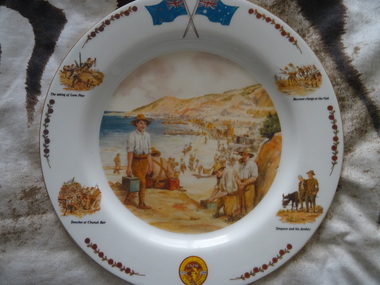
Plate, 1990
... Plate Benz Ceramics Australia ...This Plate was commissioned by the RSL of Australia to9 commemorate the Diamond Jubilee of the ANZAC Troops Landing at Gallipoli on 25 April 1915.The item is an original, theIssue Number is 562A round plate, cream colour, a picture of Gallipoli Peninsula in the centre and smaller pictures round the ende of the plate. The flags of Australia and New Zealand at the top of the plate.on the front of the plate 1915 to 1990, Landing at Gallipoli on 25 April 1915. On the back of the plate - This limited edition collector's plate was commissioned by the Returned and Services League of Australia to commemorate the Diamond Jubilee of the ANZAC Troops landing at Gallipoli on the 25 April 1915. Signature of Brigadier A B Garland AM (RL) Issue Number 562 gallipoli, diamond jubilee plate -
 The Beechworth Burke Museum
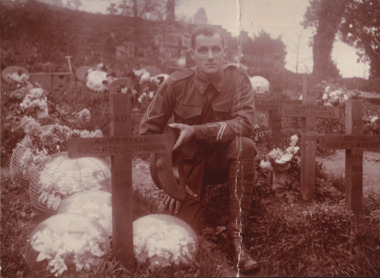
Photograph
... Australia’s involvement in the First World War began when the Australian government established the Australian Imperial Force (AIF) in August 1914. ...Taken on an unknown date, depicted is a portrait of a young, unidentified male soldier kneeling beside a grave in a cemetery. He is dressed in an Australian military uniform. The cemetery pictured is the Arnos Vale Cemetery in Bristol, United Kingdom. There are multiple crosses marking graves in this photograph, all marked in memory of different soldiers who fought with the Australian Imperial Force (AIF) during World War I. It is believed that the soldier who is kneeling was also part of the Australian Imperial Force. This can be inferred by the chevron rank insignia visible on the uniform. The placement of this insignia on the sleeve of the right arm suggests that this soldier was either a Warrant Officer or a Non-Commissioned Officer (NCO). Another signifier of the Australian Imperial Force uniform are the three inverted chevron stripes positioned on the lower part of the left sleeve, near the wrist. These are called Good Conduct Stripes and were worn by Warrant Officers and NCOs. This patch consisted of a single chevron stripe for each year of military service meeting certain requirements of good conduct. Additionally, the man in this photograph is also wearing a 'Rising Sun' collar badge on his coat. Australia, unlike most other Commonwealth countries, did not adopt metal regimental badges during the First World War. All units were issued with the Australian Army General Service Badge, better known as the 'Rising Sun’ badge. This insignia is almost always identified with the Australian Imperial Force. Furthermore, the grave that this unidentified soldier is kneeling next to is the resting place of Private John James (J. J.) Simpson. He was born in Stanley, Victoria in 1883. He enlisted in the Australian Imperial Force in Melbourne, Victoria on 12 July, 1915, with the service number 4909. John James Simpson was then posted to the 60th Company Depot at Seymour for military recruit training. John James Simpson was reported wounded in action in France on 19 July, 1916. He was admitted to 13th General Hospital, France with gunshot wounds to his legs. From Boulogne, France, he traveled to the United Kingdom aboard the Hospital Ship 'St. Denis' for medical care. Upon arrival, he was admitted to 2nd Southern General Hospital, Bristol, England on 27 July, 1916. John James Simpson passed away from his wounds on 1 August, 1916. He was 33 years old.The record is historically significant due to its connection to World War I. This conflict is integral to Australian culture as it was the single greatest loss of life and the greatest repatriation of casualties in the country's history. Australia’s involvement in the First World War began when the Australian government established the Australian Imperial Force (AIF) in August 1914. Immediately, men were recruited to serve the British Empire in the Middle East and on the Western Front. The first significant Australian action of the war was the Australian Naval and Military Expeditionary Force’s (ANMEF) landing on Rabaul on 11 September 1914. The ANMEF took possession of German New Guinea at Toma on 17 September 1914 and of the neighbouring islands of the Bismarck Archipelago in October 1914. On 25 April 1915, members of the AIF landed on Gallipoli in Turkey with troops from New Zealand, Britain, and France. This specific event holds very strong significance within Australian history. The record has strong research potential. This is due to the ongoing public and scholarly interest in war, history, and especially the ANZAC legend, which is commemorated annually on 25 April, known as ANZAC Day.Sepia rectangular photograph printed on matte photographic paper mounted on card.Obverse: A.I.F. / AUSTRALIA / 441, PTE.T. / T (?) / 26B (?) / 6.1.17 / (?) / LANGTON RD. / ST. ANNES PK. / BRISTOL / A.I.F. / AUSTRALIA. / 708, GNR B.L.CRAWFORD. / FR / 5 D.A.C. / 13.2.17 / A.I.F. / AUSTRALIA. / 4481, P (?) D.MORRIS. / (?) / 31.12.(?) / A.I.F. / AUSTRALIA. / 4909, PTE J.J.SIMPSON. / 608(?) / 1.8.16 / Winchester / LANGTON RD. / ST. ANNES PK / BRISTOL / Reverse: 2641 /military album, military, war, world war i, wwi, australian imperial force, aif, j. j. simpson, uniform, cemetery -
 Greensborough Historical Society
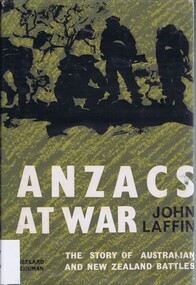
Book, ANZACS at War: the story of Australian and New Zealand Battles. by John Laffin, 1965_
... This books details various actions in which ANZAC troops were engaged from the Boer War to World War II anzacs australian army boer war world war i world war ii 224p., black and white photographs, maps. Hard cover book with dust jacket. Dust jacket illustration of shadows of soldiers on green background, title in white writing. ANZACS at War: the story of Australian and New Zealand ...This books details various actions in which ANZAC troops were engaged from the Boer War to World War II224p., black and white photographs, maps. Hard cover book with dust jacket. Dust jacket illustration of shadows of soldiers on green background, title in white writing.anzacs, australian army, boer war, world war i, world war ii -
 Orbost & District Historical Society
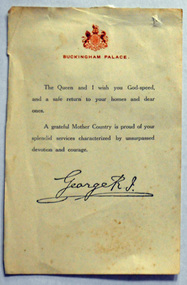
letter/certificate, George V, after WW1
... Additional information : These certificates were given to Dominion and Empire troops from Canada, New Zealand, Australia & etc., who had survived the Great War as it was then known. ...Additional information : These certificates were given to Dominion and Empire troops from Canada, New Zealand, Australia & etc., who had survived the Great War as it was then known. ...The RI stands for Rex Imperator. This letter / certificate was given to Don Dunoon (father of Lynn Brown) who served in World War 1. He later came to Orbost and married into the Lynn family - Mary Ellen Lynn. This certificate was given to all servicemen who survived the war. A World War I demobilization certicate / letter from Buckingham Palace to those who served in the Great War. At the head of the letter is the royal coat of arms and 'Buckingham Palace' letterhead in red printed ink. The text reads: 'The Queen and I wish you God-speed, and a safe return to your homes and dear ones. A grateful mother country is proud of your splendid services characterized by unsurpassed devotion and courage' Below is the ink printed signature of King George V - 'George R. I.' Additional information : These certificates were given to Dominion and Empire troops from Canada, New Zealand, Australia & etc., who had survived the Great War as it was then known. These documents were an Empire issue, not an issue for British service persons. R I is short for Rex Imperator which is Latin for King & Emperor. The document was sent to Colonial, Empire & Dominion troops only. This personal document gives an insight into the human element of World War 1 ensuring that those who were part of the Orbost community and died while playing a vital role during this time are remembered.A certicate / letter from Buckingham Palace to those who served in W W 11. At the top is the royal coat of arms and Buckingham Palace in red print. Print is black and it is signed by "George R.I."ww1 georgev dunoon-don -
 Queenscliffe Maritime Museum
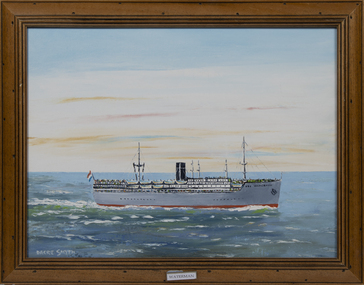
Painting - MV Waterman, Dacre Smyth
... Their war time duties were short lived as they were soon sold to the Dutch Government for the use as troop transport ships and Migrant ship to the United States, Canada, Australia and New Zealand. These three ships were built toward the end of World War II, and were part of the new larger improved version of the famed “Liberty” ships. ...Their war time duties were short lived as they were soon sold to the Dutch Government for the use as troop transport ships and Migrant ship to the United States, Canada, Australia and New Zealand. These three ships were built toward the end of World War II, and were part of the new larger improved version of the famed “Liberty” ships. ...Three Victory Class ships, S.S. Cranston Victory, S.S. Costa Rica Victory and the S.S. La Grande Victory, were built for the “United War Shipping Administration” as troop and cargo ships. Their war time duties were short lived as they were soon sold to the Dutch Government for the use as troop transport ships and Migrant ship to the United States, Canada, Australia and New Zealand. These three ships were built toward the end of World War II, and were part of the new larger improved version of the famed “Liberty” ships. Each ship had strengthened hulls for them to go into the war zone, but by the time they were completed the war was coming to an end. There were ninety seven Victory troop transport ships built, each able to transport up to 1600 troops. Unlike the Liberty ships, all accommodation was fully ventilated and heated. There was the usual meagre style troop bunks, a hospital, galleys, washrooms and even a several public rooms. The first of the trio, S.S. Cranston Victory (Zuiderkruis) was built by the Oregon Shipbuilding Yard in Portland; Oregon was launched on May 5, 1944. The second of the series, S.S. Costa Rica Victory (Groote Beer) was built by Permanente Metals Co, Richmond California and launched on June 17, 1944. The last of the three was the S.S. La Grande Victory (Waterman), which like her sister S.S. Cranston Victory, was built by the Oregon Shipbuilding Yard in Portland, Oregon and launched on January 16, 1945.In November 1951, the third of the trio, La Grande Victory, renamed Waterman, was completed and at 9,176-tons, commenced her first voyage to Australia.A framed oil painting of the migrant ship MV WatermanWatermanmv waterman, liberty ships, migrant ships
