
Showing 22 items matching "australian army band melbourne"
-
 Greensborough Historical Society
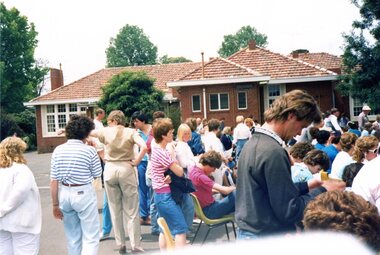
Photograph - Photographs, Carolyn Haas, Army Band annual Christmas party at Janefield 08/12/1987, 08/12/1987
... ...Australian Army Band Melbourne...Army Band. The photographs show students, staff and parents as well as performers. janefield janefield special school Australian Army Band Melbourne 26 colour photographs. ...26 photographs of the annual Christmas concert and Christmas party at Janefield, with entertainment from the Army Band. The photographs show students, staff and parents as well as performers.26 colour photographs. Incudes negatives.janefield, janefield special school, australian army band melbourne -
 Bendigo Military Museum
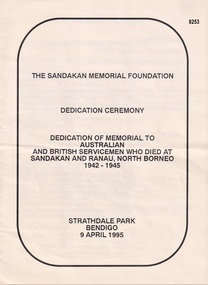
Pamphlet - SANDAKAN MEMORIAL 1995, C. 1995
... Australian Army. Laying of the wreaths, Wreath Marshalls supplied by Bendigo RSL Sub Branch, Australian Army Band Melbourne. ...Australian Army. Laying of the wreaths, Wreath Marshalls supplied by Bendigo RSL Sub Branch, Australian Army Band Melbourne. ...This service was to dedicate a Memorial to Australian & British Servicemen who died at Sandakan and Ranau, North Borneo 1942 - 1945. It was unveiled at Strathdale Park Bendigo on 9.4.1995. The Official Party were; Mr Peter Ross Edwards AM, Chief Commissioner The City of Greater Bendigo, Mr J.S. Millner AM, Chairman The Sandakan Memorial Foundation. The Requiem was read by Father John Brendan Rogers OFM. Unveiling the Memorial by, Mr Peter Ross Edwards AM. Dedication of the Memorial by; Father John Brendan Rogers OFM, Chaplain 8th Division Sandakan and Kuching, Chaplain Gary Kenney, Australian Army. Laying of the wreaths, Wreath Marshalls supplied by Bendigo RSL Sub Branch, Australian Army Band Melbourne. The ODE was read by; President Bendigo RSL Mr Cliff Clohesy. The Catalflaque Party was supplied by; Army School of Survey Regiment Bendigo.Pamphlet off white colour, A4 folded making 8 pages total, all print in black, one staple central holding together.On the front, "The Sandakan Memorial Foundation, Strathdale Park Bendigo 9 April 1995"brsl, smirsl, sandakan, strathdale -
 Shepparton RSL Sub Branch
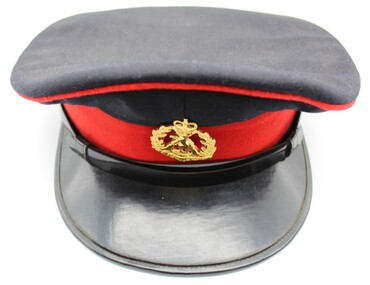
Uniform, Hat, Emerco
... royal australian regiment rar army uniform Sticker reads “6 7/8”, and manufacturer’s label reads “MELBOURNE 36 1218/EMERCO/REG TRADE MARK/THIS IS YOUR GUARANTEE FOR QUALITY/MADE IN AUSTRALIA”. Badge reads “DUTY FIRST/ROYAL AUSTRALIAN REGIMENT”. Navy-black coloured peaked cap with red piping trim along peak. Red felt band ...Navy-black coloured peaked cap with red piping trim along peak. Red felt band encircles the band. Black patent leather chin strap is held in place with two gold buttons on either side, each depicting a crown above the map of Australia. Gold badge in centre depicts kangaroo in front of crossed rifles underneath a crown with oak leaves forming an arch eitehr side. Interior brim is green with black patent leather trim; brown leather sweatband with holes for air cirulation, tied at back with cream silk bow. Top of hat is covered with plastic layer, underneath which is the manufacturer’s label and a sticker for size.Sticker reads “6 7/8”, and manufacturer’s label reads “MELBOURNE 36 1218/EMERCO/REG TRADE MARK/THIS IS YOUR GUARANTEE FOR QUALITY/MADE IN AUSTRALIA”. Badge reads “DUTY FIRST/ROYAL AUSTRALIAN REGIMENT”.royal australian regiment, rar, army, uniform -
 Geelong RSL Sub Branch
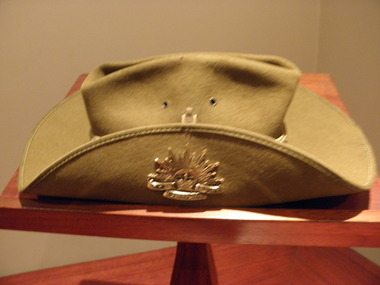
Hat, Slouch, Mid 20th Century
... Australian Army issue slouch hat issued to all members of the Australian Army owned by a person by the name of Phipps. australian army slouch rising sun phipps fayrefield Hand written on leather band inside the hat: PHIPPS Embossed into leather band: MADE BY/"FAYREFIELD"/MELBOURNE/6 5/8/19[indecipherable] Post World War 2 Australian Army Hat pinned into the slouch position. ...Australian Army issue slouch hat issued to all members of the Australian Army owned by a person by the name of Phipps.Post World War 2 Australian Army Hat pinned into the slouch position. The pinned brim has a Rising Sun Badge attached by two metal pins. Hat Band is cotton and rouched. It also has a leather chin strap. Hand written on leather band inside the hat: PHIPPS Embossed into leather band: MADE BY/"FAYREFIELD"/MELBOURNE/6 5/8/19[indecipherable]australian army slouch rising sun phipps fayrefield -
 Bendigo Military Museum
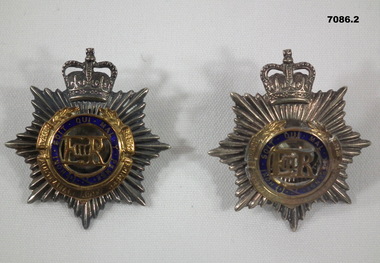
Badge - BADGE, HAT, ARMY, Stokes Melbourne
... AUSTRALIAN ARMY SERVICE CORPS" Printed in gold on blue enamel circle "MONI, SOIT, QUI. MAL. Y.PENSE" Stamped at back: “STOKES, MELB” Two RAASC Officer's metal hat badges. The badges are of bi-metal construction using silver and brass coloured metals. The silver metal background features a Queen's Crown and a seven pointed star. Centre piece is brass coloured and features a Royal Cypher encircled by a blue enameled band. On the back of 1, are two pins and brass fastening clips. 2. has two loops on two threaded rods for fastening. Both brass coloured centerpieces' are loose. Badge BADGE, HAT, ARMY Stokes Melbourne ...Part of the Kevin John Herdman, No.397661, collection. Refer Cat No 5492P for service details.Two RAASC Officer's metal hat badges. The badges are of bi-metal construction using silver and brass coloured metals. The silver metal background features a Queen's Crown and a seven pointed star. Centre piece is brass coloured and features a Royal Cypher encircled by a blue enameled band. On the back of 1, are two pins and brass fastening clips. 2. has two loops on two threaded rods for fastening. Both brass coloured centerpieces' are loose.Stamped on brass centrepiece "ROYAL AUSTRALIAN ARMY SERVICE CORPS" Printed in gold on blue enamel circle "MONI, SOIT, QUI. MAL. Y.PENSE" Stamped at back: “STOKES, MELB”badge, uniform, royal australian army service corps, kevin john herdman -
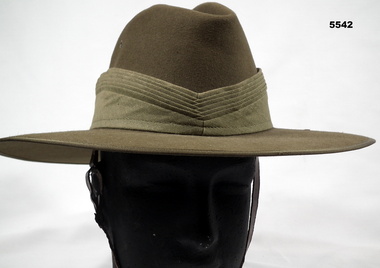 Bendigo Military Museum
Headwear - SLOUCH HAT, Fayrefield, 1965
... Army headwear slouch hat Leo Reoch Cohn Stamped on sweat band in white: 'MADE BY "FEYREFIELD" MELBOURNE, 7, 1965'. Australian ...Part of the Leo Reoch Cohn Collection. See Catalogue No. 5527.2 for his service record.Australian Army khaki felt slouch hat with a light khaki cotton seven-pleat fabric puggaree. Four holes in the side of the crown for ventilation. Brass clip and hook on the left-hand side of the hat for pinning up the left brim. Brown leather sweat band and chin strap.Stamped on sweat band in white: 'MADE BY "FEYREFIELD" MELBOURNE, 7, 1965'.army headwear, slouch hat, leo reoch cohn -
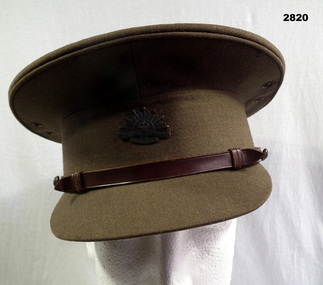 Bendigo Military Museum
Headwear - CAP, PEAKED, WW2 onwards
... uniforms - army costume - male - headwear Passchendaele barracks trust peak cap In gold print on inside band: "Wilkes Todhunter Pty Ltd Military Outfitters Melbourne Victoria" Khaki felt outer covering, flat top with peaked front, tan leather front strap attached at sizes with black buttons. Black "Australian ...Khaki felt outer covering, flat top with peaked front, tan leather front strap attached at sizes with black buttons. Black "Australian Commonwealth Military Force" badge on front, light tan lining inside with light tan leather inside band, Two ventilation holes each side under top.In gold print on inside band: "Wilkes Todhunter Pty Ltd Military Outfitters Melbourne Victoria" uniforms - army, costume - male - headwear, passchendaele barracks trust, peak cap -
 4th/19th Prince of Wales's Light Horse Regiment Unit History Room
Australian Army Public Relations, 5/11/1977
... Photograph 4/19 PWLH Band Army Public Relations Photo YOR 77 NR 3MD 5 Nov 77 Black & white photograph of the 4/19 PWLH Band being inspected by (?) after a performance. The photo was taken outside the South Melbourne football ground in November 1977 Australian Army Public Relations ...Black & white photograph of the 4/19 PWLH Band being inspected by (?) after a performance. The photo was taken outside the South Melbourne football ground in November 1977Army Public Relations Photo YOR 77 NR 3MD 5 Nov 77photograph, 4/19 pwlh band -
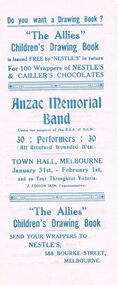 Bendigo Historical Society Inc.
Document - LYDIA CHANCELLOR COLLECTION; ANZAC MEMORIAL BAND PROGRAMME
... Australian Army ANZAC Memorial Band bands A white programme with blue print. On the front are the words ' Do you want a Drawing Book? 'The Allies' Children's Drawing Book is issued Free by 'Nestles' in return for 100 wrappers of Nestles & Cailler's Chocolates. ANZAC MEMORIAL BAND (under the auspices of the R.S.A. 0f N.S.W.) 30 Performers : 30 ( All returned wounded men). TOWN HALL, MELBOURNE ...A white programme with blue print. On the front are the words ' Do you want a Drawing Book? 'The Allies' Children's Drawing Book is issued Free by 'Nestles' in return for 100 wrappers of Nestles & Cailler's Chocolates. ANZAC MEMORIAL BAND (under the auspices of the R.S.A. 0f N.S.W.) 30 Performers : 30 ( All returned wounded men). TOWN HALL, MELBOURNE January 31st, - February 1st., and on Tour throughout Victoria. J. Edison Ikin. Representative. 'The Allies' Children's Drawing Book. Send your wrappers to NESTLE'S 588 Bourke Street, Melbourne.' On the inside is the poem 'How Anzac was Named,' an advertisement for Bellmaine Bros. printers Melbourne and the programme itself. On the back are the words for ' The Toast! For ANZAC Day by C.H. Souter. C. 1940s -50s.program, music, anzac day, lydia chancellor, collection, event, music, entertainment, concert, australian army, anzac memorial band, bands -
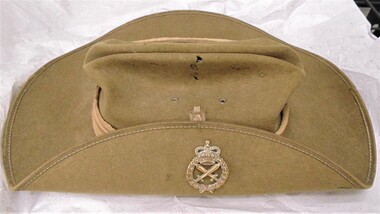 National Vietnam Veterans Museum (NVVM)
Headwear - Hat, slouch, Provost, 1966
... Australian Army Provost Corps, while on patrol in 1968. James Archbold 1968 Provost Vung Tau Archbold slouch Fayrefield Melbourne 6 7/8 1966. Khaki felt slouch hat with a leather band ...Worn on duty at Vung Tau, Vietnam, by Corporal J S Archbold, Royal Australian Army Provost Corps, while on patrol in 1968.Khaki felt slouch hat with a leather band on the inside and a leather chin strap. A material band around the outer part of the hat (puggaree) with a metal badge attached to the brim with the brass Provost Corps emblem.Fayrefield Melbourne 6 7/8 1966.james archbold, 1968, provost, vung tau, archbold, slouch -
Eltham District Historical Society Inc
Document - Folder, Shade, Ernest Albert
... Band and Eltham Orchestra. The Shire of Eltham provided a detailed submission in support of a nomination for an Order of Australia award. Contents Letters Honours Secretariat, Canberra, 2 August 1991 and 19 November 1991, seeking more information to support a nomination for Ernest Albert Shade to receive an award. Submission from Shire of Eltham to Honours Secretariat, Canberra,2 January 1992, nominating Ernest Albert Shade for an Order of Australia award. Ernest Albert Shade Salvation Army Melbourne ...Ernest Albert Shade was involved with many musical groups, especially the Shire of Eltham Concert Band, Eltham Youth Concert Band and Eltham Orchestra. The Shire of Eltham provided a detailed submission in support of a nomination for an Order of Australia award. Contents Letters Honours Secretariat, Canberra, 2 August 1991 and 19 November 1991, seeking more information to support a nomination for Ernest Albert Shade to receive an award. Submission from Shire of Eltham to Honours Secretariat, Canberra,2 January 1992, nominating Ernest Albert Shade for an Order of Australia award.Newspaper clippings, A4 photocopies, etcernest albert shade, salvation army, melbourne conservatorium of music, thomas white, professor kenneth hunt, melbourne university rifles military band, city of preston orchestra, preston symphony orchestra, preston and northcote community hospital, helping hand agency, q theatre guild, geelong musical comedy company, peninsula light opera companies, lyric light opera company, cheltenham light opera company, geelong light opera society, donald cant, darebin players, shire of eltham concert band, eltham youth concert band, victoria bands league, beatrix shade, geelong amateur musical association, samaritan players, bank of new south wales entertainment group, lewis coleman, harrold burrows, john hales, david sadedin, eltham orchestra, society for growing australian plants, janice dadd, eltham historical society, ron blyth, valma brundell, warren fordham, eltham community centre, eltham high school, eltham concert band, eltham phoenix club, nathan warhaft, joyce warhaft, gideon warhaft, sally warhaft, eltham community festival, fred balaam, neville shade, beatrice chapple, beatrice shade nee chapple, frederick shade, ronald shade, libby shade, michael shade, janet shade, bruce mcbrien, a b horsley, ruth weaver -
Tatura Irrigation & Wartime Camps Museum
Instrument - Cornet, Brass Cornet
... Band. The Treaty of Versailles forbade Germany from having more than a 10,000 man army thus creating a flood of unwanted instruments with no one having cash to buy them. With the deportation in August 1941 by the British Mandate of most Templers from Palestine to Australia, one of the young bachelors, Gustav Reichert, obtained permission to bring these instruments to Tatura. This he did and, in Camp 3, a band was reformed to entertain members of both internees and often, Camp Authorities. Gustav enjoyed playing the double brass with the Melbourne...Band. The Treaty of Versailles forbade Germany from having more than a 10,000 man army thus creating a flood of unwanted instruments with no one having cash to buy them. With the deportation in August 1941 by the British Mandate of most Templers from Palestine to Australia, one of the young bachelors, Gustav Reichert, obtained permission to bring these instruments to Tatura. This he did and, in Camp 3, a band was reformed to entertain members of both internees and often, Camp Authorities. Gustav enjoyed playing the double brass with the Melbourne ...After WW1 the Wilhelma Templer village bought ex WW1 German Armed Forces Brass instruments for their own Brass Band. The Treaty of Versailles forbade Germany from having more than a 10,000 man army thus creating a flood of unwanted instruments with no one having cash to buy them. With the deportation in August 1941 by the British Mandate of most Templers from Palestine to Australia, one of the young bachelors, Gustav Reichert, obtained permission to bring these instruments to Tatura. This he did and, in Camp 3, a band was reformed to entertain members of both internees and often, Camp Authorities. Gustav enjoyed playing the double brass with the Melbourne Templer Brass Band in the 1960-1970's. The above instruments have semi-rotary valves, as traditionally French Horns do, unlike most Anglosaxon bands, where piston valves are used almost exclusively. Yet in German the name Piston is commonly used for cornet. Though battered, these instruments are all still serviceable for their intended use, some more so than others. Their canvas carry bags offered little protection. The group comprised 1 double bass, 1 Euphonium, 1 valve bass trombone, all in C, 3 baritones in Bb (German tenor horns), 3 cornets in Bb, 1 soprano cornet in Eb, in all 11 instruments. Some of the got "lost".Brass cornet with a canvas carry bag.brass instruments, wilhelma templer village, camp 3 band, gustav reichert -
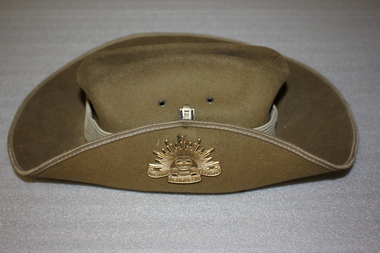 Wangaratta RSL Sub Branch
Headwear - Army Slouch Hat, Fayrefield of Melbourne
... Australian fighting man during World War One and continued to be worn throughout World War Two. Its use since that time has made it a national symbol. army slouch hat Slouch Hat - made of fur felt with an 8 fold hat band (puggaree) it has the blue/gold unit badge on the band denoting the 8th Light Horse brigade with a leather chin strap. The right hand side is held by a brass rising sun badge. Headwear Army Slouch Hat Fayrefield of Melbourne ...History has it that the origins of the Slouch Hat began with the Victorian Mounted Rifles; a hat of similar design had been worn in South Africa by the Cape Mounted Rifles for many years before 1885. The design of the Victorian Mounted Rifle hat originated from headgear of native police in Burma where Lieutenant-Colonel Tom Price had recognised its value. The Victorian hat was an ordinary bush felt hat turned up on the right side. The intention of turning up the right side of the hat was to ensure it would not be caught during the drill movement of “shoulder arms” from “order arms”. The Slouch Hat became standard issue headdress in 1903 and its brim position was mostly standardised. The slouch hat became a famous symbol of the Australian fighting man during World War One and continued to be worn throughout World War Two. Its use since that time has made it a national symbol.Slouch Hat - made of fur felt with an 8 fold hat band (puggaree) it has the blue/gold unit badge on the band denoting the 8th Light Horse brigade with a leather chin strap. The right hand side is held by a brass rising sun badge.army, slouch hat -
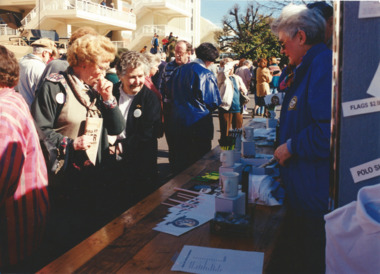 Melbourne Legacy
Photograph, Back to Caulfield 1995, 1995
... Australia Remembers" Back to Caulfield Commemorative Race Day held on August 12th. It was a special day which incorporated a wide range of activities, including a display of military vehicles, a flyover, a parachute jump by the Red Berets, military bands, and displays of memorabilia when the racecourse was used as an army camp. An official ceremony also included the presentation of a Legacy 'Lone Pine' (a descendant of the Gallipoli 'Lone Pine') by the President of the Melbourne...Australia Remembers" Back to Caulfield Commemorative Race Day held on August 12th. It was a special day which incorporated a wide range of activities, including a display of military vehicles, a flyover, a parachute jump by the Red Berets, military bands, and displays of memorabilia when the racecourse was used as an army camp. An official ceremony also included the presentation of a Legacy 'Lone Pine' (a descendant of the Gallipoli 'Lone Pine') by the President of the Melbourne ...For many years Legacy had a "Back to Caulfield Race Day" for Legatees, widows and their families. 1995 was the 50th anniversary of the end of World War 2 and the race day was part of the "Australia Remembers" commemorations. Also a Legacy 'Lone Pine' was planted. The article in the Answer says: "Over 800 members of the Legacy family (past and present) reunite at the "Australia Remembers" Back to Caulfield Commemorative Race Day held on August 12th. It was a special day which incorporated a wide range of activities, including a display of military vehicles, a flyover, a parachute jump by the Red Berets, military bands, and displays of memorabilia when the racecourse was used as an army camp. An official ceremony also included the presentation of a Legacy 'Lone Pine' (a descendant of the Gallipoli 'Lone Pine') by the President of the Melbourne Legacy, Legatee David Millie, which was very warmly received by the Chairman of the V.A.T.C., Mr Peter Lawrence.Legacy retains a tie with Caulfield racecourse as it was once an army camp and staging post of young men going overseas to war and now it is the site of a lone pine. The annual gathering at Caulfield racecourse was an event that gets the Legacy family together.Colour photo x 3 of an event at Caulfield racecourse, and an article in The Answer.Printed on the back film number 786 No. 7A and No. 19A. Film number 787 No. 9A.events, wreath laying ceremony, answer -
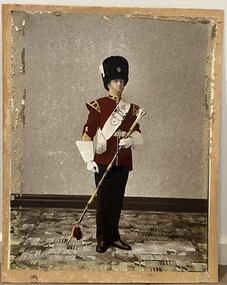 The 5th/6th Battalion Royal Victoria Regiment Historical Collection
Photograph - Framed Photograph: Drum Major 6th Battalion, the Royal Melbourne Regiment c.1936-1960, Drum Major 6th Battalion, the Royal Melbourne Regiment c.1936-1960
... Drum Major 6th Battalion The Royal Melbourne Regiment Australian Army Australian Army Band 5/6 RVR 5th/6th Battalion RMR Royal Victoria Regiment Australian Army Full Dress Uniform Drum Major 6th Battalion, the Royal Melbourne Regiment c.1936-1960. ...The image shows the Drum Major of the 6th Battalion, the Royal Melbourne Regiment between 1936-1960. He wears the uniform of the regiment which is similar to that of the Royal Fusiliers, with whom the 6th Battalion was affiliated. The Royal Melbourne Regiment was amalgamated into the Royal Victoria Regiment in 1960. RP5/6-00811-1 is the original coloured photograph printed on card (now fragile). RP5/6-00811-2 is a print of the digitally restored image what has been framed. Drum Major 6th Battalion, the Royal Melbourne Regiment c.1936-1960. drum major, 6th battalion, the royal melbourne regiment, australian army, australian army band, 5/6 rvr, 5th/6th battalion, rmr, royal victoria regiment, australian army full dress uniform -
 Woodend RSL
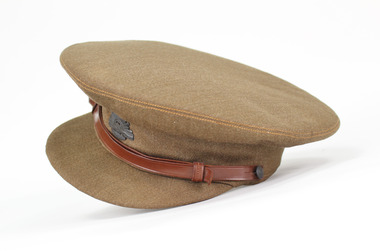
Headwear - Military Peak Cap, Possibly 1942. May be associated with jacket bearing 10/12/1943 as date of manufacture
... australian, forces, headwear, commonwealth. 'THE MYER STORE FOR MEN MILITARY TAILORS MELBOURNE & ADELAIDE' on inner band in gold. Hand written initials H, and what appears to be D N (area has tears and insect damage) visible on lining behind visor. Initials in black marker. Military peak cap, dark green. Brown leather chinstrap, attached by buttons on either side of visor with lettering 'AUSTRALIAN MILITARY FORCES' and Australian army ...Presumably World War II based on comparison with silimar items. Initials inside cap may be associated with item to jacket, initialled with Lt. H. Dixon, VI. 7290.This item has historical signifigance as a an example of Australian military uniform dating presemably to World War II. Military peak cap, dark green. Brown leather chinstrap, attached by buttons on either side of visor with lettering 'AUSTRALIAN MILITARY FORCES' and Australian army insignia. Top of cap has double row of top stitching in dark yellow thread. Metal rimmed air holes (two) on each side under top of cap. Inner band made of brown leather embossed or printed with maker inscription. Rear of inner band has a row of rectangles punched through leather .50 mm in length, 22 in total, threaded through with gold coloured ribbon, tied together at centre back. Inner cap lining made of pale gold fabric, with diamond shaped liner/swear shield attached and topstitched in gold thread. Bronze coloured badge above visor with lettering Australian Commonwealth Military Forces.'THE MYER STORE FOR MEN MILITARY TAILORS MELBOURNE & ADELAIDE' on inner band in gold. Hand written initials H, and what appears to be D N (area has tears and insect damage) visible on lining behind visor. Initials in black marker. military, war, fashion, uniform, head, style, fabric, textile, cap, hat, visor, peak, outfit, myer, tailor, australian, forces, headwear, commonwealth. -
 Melbourne Legacy
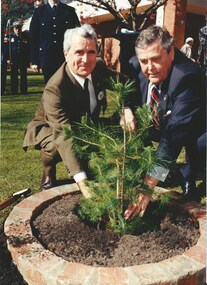
Photograph, Back to Caulfield 1995, 1995
... Australia Remembers" Back to Caulfield Commemorative Race Day held on August 12th. It was a special day which incorporated a wide range of activities, including a display of military vehicles, a flyover, a parachute jump by the Red Berets, military bands, and displays of memorabilia when the racecourse was used as an army camp. An official ceremony also included the presentation of a Legacy 'Lone Pine' (a descendant of the Gallipoli 'Lone Pine') by the President of the Melbourne...Australia Remembers" Back to Caulfield Commemorative Race Day held on August 12th. It was a special day which incorporated a wide range of activities, including a display of military vehicles, a flyover, a parachute jump by the Red Berets, military bands, and displays of memorabilia when the racecourse was used as an army camp. An official ceremony also included the presentation of a Legacy 'Lone Pine' (a descendant of the Gallipoli 'Lone Pine') by the President of the Melbourne ...For many years Legacy had a "Back to Caulfield Race Day" for Legatees, widows and their families. 1995 was the 50th anniversary of the end of World War 2 and the race day was part of the "Australia Remembers" commemorations. Also a Legacy 'Lone Pine' was planted. The article in the Answer says: "Over 800 members of the Legacy family (past and present) reunite at the "Australia Remembers" Back to Caulfield Commemorative Race Day held on August 12th. It was a special day which incorporated a wide range of activities, including a display of military vehicles, a flyover, a parachute jump by the Red Berets, military bands, and displays of memorabilia when the racecourse was used as an army camp. An official ceremony also included the presentation of a Legacy 'Lone Pine' (a descendant of the Gallipoli 'Lone Pine') by the President of the Melbourne Legacy, Legatee David Millie, which was very warmly received by the Chairman of the V.A.T.C., Mr Peter Lawrence. " Official guest was the Premier of Victoria Jeff Kennett who is seen being greeted as he arrives. And photos of the planting of the 'Lone Pine'. See also photos at 01003 and 01092 and 01093. Legacy is helping to keep the memory of the Gallipoli "Lone Pine" alive - its spirit living on today. Presentations are made to schools, ex-service organisations and interested bodies by Legacy Clubs in the hope that they will be cherished as a symbol of nationhood and of its just pride, devotion, courage, selflessness and sense of service to others.Legacy retains a tie with Caulfield racecourse as it was once an army camp and staging post of young men going overseas to war and now it is the site of a lone pine. The annual gathering at Caulfield racecourse was an event that gets the Legacy family together.Colour photo x 8 of an event at Caulfield racecourse, and an article in The Answer.Printed on the back film number 783, 786, 787, various frame numbersanswer, events, lone pine, wreath laying ceremony -
 Melbourne Legacy
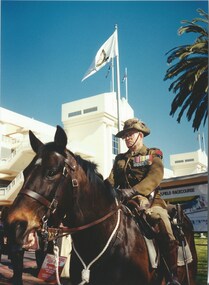
Photograph, Back to Caulfield 1995, 1995
... Australia Remembers" Back to Caulfield Commemorative Race Day held on August 12th. It was a special day which incorporated a wide range of activities, including a display of military vehicles, a flyover, a parachute jump by the Red Berets, military bands, and displays of memorabilia when the racecourse was used as an army camp. An official ceremony also included the presentation of a Legacy 'Lone Pine' (a descendant of the Gallipoli 'Lone Pine') by the President of the Melbourne...Australia Remembers" Back to Caulfield Commemorative Race Day held on August 12th. It was a special day which incorporated a wide range of activities, including a display of military vehicles, a flyover, a parachute jump by the Red Berets, military bands, and displays of memorabilia when the racecourse was used as an army camp. An official ceremony also included the presentation of a Legacy 'Lone Pine' (a descendant of the Gallipoli 'Lone Pine') by the President of the Melbourne ...For many years Legacy had a "Back to Caulfield Race Day" for Legatees, widows and their families. 1995 was the 50th anniversary of the end of World War 2 and the race day was part of the "Australia Remembers" commemorations. Also a Legacy 'Lone Pine' was planted. The article in the Answer says: "Over 800 members of the Legacy family (past and present) reunite at the "Australia Remembers" Back to Caulfield Commemorative Race Day held on August 12th. It was a special day which incorporated a wide range of activities, including a display of military vehicles, a flyover, a parachute jump by the Red Berets, military bands, and displays of memorabilia when the racecourse was used as an army camp. An official ceremony also included the presentation of a Legacy 'Lone Pine' (a descendant of the Gallipoli 'Lone Pine') by the President of the Melbourne Legacy, Legatee David Millie, which was very warmly received by the Chairman of the V.A.T.C., Mr Peter Lawrence. Official guest was the Premier of Victoria Jeff Kennett Photos include the military vehicles, the stalls, and some of the racing. See also photos at 01003 and 01091 and 01093.Legacy retains a tie with Caulfield racecourse as it was once an army camp and staging post of young men going overseas to war and now it is the site of a lone pine. The annual gathering at Caulfield racecourse was an event that gets the Legacy family together.Colour photo x 14 of an event at Caulfield racecourse, and an article in The Answer.Printed on the back film number 783, 786, 787, various frame numbers.answer, events, horses, tanks, drummers, fly past -
 Melbourne Legacy
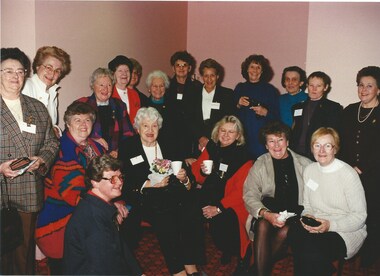
Photograph, Back to Caulfield 1995, 1995
... Australia Remembers" Back to Caulfield Commemorative Race Day held on August 12th. It was a special day which incorporated a wide range of activities, including a display of military vehicles, a flyover, a parachute jump by the Red Berets, military bands, and displays of memorabilia when the racecourse was used as an army camp. An official ceremony also included the presentation of a Legacy 'Lone Pine' (a descendant of the Gallipoli 'Lone Pine') by the President of the Melbourne...Australia Remembers" Back to Caulfield Commemorative Race Day held on August 12th. It was a special day which incorporated a wide range of activities, including a display of military vehicles, a flyover, a parachute jump by the Red Berets, military bands, and displays of memorabilia when the racecourse was used as an army camp. An official ceremony also included the presentation of a Legacy 'Lone Pine' (a descendant of the Gallipoli 'Lone Pine') by the President of the Melbourne ...For many years Legacy had a "Back to Caulfield Race Day" for Legatees, widows and their families. 1995 was the 50th anniversary of the end of World War 2 and the race day was part of the "Australia Remembers" commemorations. Also a Legacy 'Lone Pine' was planted. The article in the Answer says: "Over 800 members of the Legacy family (past and present) reunite at the "Australia Remembers" Back to Caulfield Commemorative Race Day held on August 12th. It was a special day which incorporated a wide range of activities, including a display of military vehicles, a flyover, a parachute jump by the Red Berets, military bands, and displays of memorabilia when the racecourse was used as an army camp. An official ceremony also included the presentation of a Legacy 'Lone Pine' (a descendant of the Gallipoli 'Lone Pine') by the President of the Melbourne Legacy, Legatee David Millie, which was very warmly received by the Chairman of the V.A.T.C., Mr Peter Lawrence. Official guest was the Premier of Victoria Jeff Kennett Photos include groups of Legacy Widows and dependents enjoying the day. Onename tag is legible - Kate Brettoner. See also photos at 01003 and 01091 and 01092.Legacy retains a tie with Caulfield racecourse as it was once an army camp and staging post of young men going overseas to war and now it is the site of a lone pine. The annual gathering at Caulfield racecourse was an event that gets the Legacy family together.Colour photo x 12 of an event at Caulfield racecourse, and an article in The Answer.Printed on the back film number 783, 786, 787, various frame numbers.answer, events -
 Melbourne Legacy
Photograph, Back to Caulfield 1995, 1995
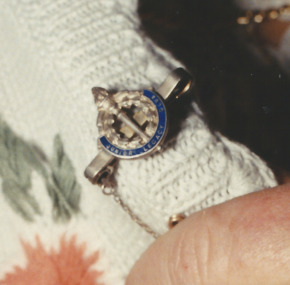
... Australia Remembers" Back to Caulfield Commemorative Race Day held on August 12th. It was a special day which incorporated a wide range of activities, including a display of military vehicles, a flyover, a parachute jump by the Red Berets, military bands, and displays of memorabilia when the racecourse was used as an army camp. An official ceremony also included the presentation of a Legacy 'Lone Pine' (a descendant of the Gallipoli 'Lone Pine') by the President of the Melbourne...Australia Remembers" Back to Caulfield Commemorative Race Day held on August 12th. It was a special day which incorporated a wide range of activities, including a display of military vehicles, a flyover, a parachute jump by the Red Berets, military bands, and displays of memorabilia when the racecourse was used as an army camp. An official ceremony also included the presentation of a Legacy 'Lone Pine' (a descendant of the Gallipoli 'Lone Pine') by the President of the Melbourne ...For many years Legacy had a "Back to Caulfield Race Day" for Legatees, widows and their families. 1995 was the 50th anniversary of the end of World War 2 and the race day was part of the "Australia Remembers" commemorations. Also a Legacy 'Lone Pine' was planted. The article in the Answer says: "Over 800 members of the Legacy family (past and present) reunite at the "Australia Remembers" Back to Caulfield Commemorative Race Day held on August 12th. It was a special day which incorporated a wide range of activities, including a display of military vehicles, a flyover, a parachute jump by the Red Berets, military bands, and displays of memorabilia when the racecourse was used as an army camp. An official ceremony also included the presentation of a Legacy 'Lone Pine' (a descendant of the Gallipoli 'Lone Pine') by the President of the Melbourne Legacy, Legatee David Millie, which was very warmly received by the Chairman of the V.A.T.C., Mr Peter Lawrence. These photos show President David Millie and Legacy widow Rosie Ellis (Bell) and a close up of her Junior Legacy badge, perhaps she had originally been an Junior Legatee. He is shown pointing her badge out to other people gathered around. See also photos at 01003 and 01091, 01092 and 01093.This is a good image of a Junior Legacy badge. Legacy retains a tie with Caulfield racecourse as it was once an army camp and staging post of young men going overseas to war and now it is the site of a lone pine. The annual gathering at Caulfield racecourse was an event that gets the Legacy family together.Colour photo x 4 of a Junior Legacy badge and an event at Caulfield racecourse, and an article in The Answer.Printed on the back film number 788, various frame numbers.answer, events -
 Melbourne Legacy
Photograph, Major-General Sir John Gellibrand K.C.B.,D.S.O. & Bar, 194
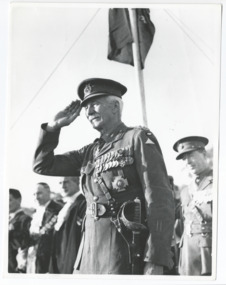
... Australian Army officer in the First World War, Chief Commissioner of the Victoria Police from 1920 to 1922, and a member of the Australian House of Representatives, representing the Tasmanian Division of Denison for the Nationalist Party from 1925 to 1928. Concerned about the plight of fellow ex-servicemen, whose businesses were often failing, Gellibrand banded together with like-minded individuals to form the Hobart Remembrance Club. This organisation aimed to support ex-servicemen by providing employment and support for their businesses. The Hobart Club inspired the formation of Legacy Australia in Melbourne...Australian Army officer in the First World War, Chief Commissioner of the Victoria Police from 1920 to 1922, and a member of the Australian House of Representatives, representing the Tasmanian Division of Denison for the Nationalist Party from 1925 to 1928. Concerned about the plight of fellow ex-servicemen, whose businesses were often failing, Gellibrand banded together with like-minded individuals to form the Hobart Remembrance Club. This organisation aimed to support ex-servicemen by providing employment and support for their businesses. The Hobart Club inspired the formation of Legacy Australia in Melbourne ...Photograph of General Sir John Gellibrand and L/- Stan Savige (at far right) at an unknown event that appears to be also attended by a mayor. From Wikipedia: Major General Sir John Gellibrand, KCB, DSO & Bar (5 December 1872 – 3 June 1945) was a senior Australian Army officer in the First World War, Chief Commissioner of the Victoria Police from 1920 to 1922, and a member of the Australian House of Representatives, representing the Tasmanian Division of Denison for the Nationalist Party from 1925 to 1928. Concerned about the plight of fellow ex-servicemen, whose businesses were often failing, Gellibrand banded together with like-minded individuals to form the Hobart Remembrance Club. This organisation aimed to support ex-servicemen by providing employment and support for their businesses. The Hobart Club inspired the formation of Legacy Australia in Melbourne, which over time became a national movement, expanding its scope to the care of ex-servicemen's widows and their families. Sir John Gellibrand is considered to have influenced Stanley Savige to commence the process to form Legacy in September 1923. Melbourne was the first Legacy club to form.Black and white photo of General Sir John Gellibrand.Handwritten on the reverse: 'General Sir John Gellibrand. SGS at rear' in blue pen. Also '545' in pencil. Stamped with copyright of The Leader in red ink, and 'Property of Melbourne Legacy. Please return this correspondence to Executive Officer' in purple ink.sir john gellibrand, remembrance club -
 City of Melbourne Libraries
Photograph, Bull, Hugh Jones, 1897-1993, Boy bandsmen
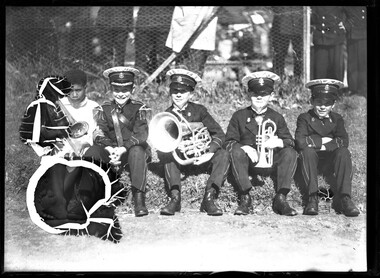
... Melbourne from its infancy in March 1854 up to today. A well researched blog by Jeremy de Korte dated February 28, 2024 – Band Blasts from the Past – Anecdotes, Stories and Personalities, notes: Orphanage bands in Australia were a copy of practices in England where the teaching of music in boys’ institutions was commonplace (Sheldon, 2009). There was, however, a major difference to the outcomes of this musical education between the two countries. Boys who were trained as musicians in English institutions readily found themselves recruited into the bands of the British Army...Melbourne from its infancy in March 1854 up to today. A well researched blog by Jeremy de Korte dated February 28, 2024 – Band Blasts from the Past – Anecdotes, Stories and Personalities, notes: Orphanage bands in Australia were a copy of practices in England where the teaching of music in boys’ institutions was commonplace (Sheldon, 2009). There was, however, a major difference to the outcomes of this musical education between the two countries. Boys who were trained as musicians in English institutions readily found themselves recruited into the bands of the British Army ...Published: 7 Dec 1934 Published title: A FIJIAN TROMBONIST. Published caption: Although the young Fijian here for the Eucharistic Congress had no uniform, he did not feel out of it with the members of St. Vincent de Paul’s Band at the Sacre Coeur, East Malvern, this week. Trove article identifier: http://nla.gov.au/nla.news-article205071643 Description: A young Fijian boy sits with young members of the St Vincent de Paul’s Band, all seated on the grass in sunshine. The three young band members are jauntily dressed in braided hats, long pants and smart dark jackets, white shirts, dark bow tie, and dark long trousers and boots. One holds a French horn, one a trumpet. In contrast, the young Fijian boy is shoeless, hatless, and dressed in white – a white shirt, and possibly a white “skirt” as observed to be worn by Fijian policemen in their home country at that time. He carries a trombone, which perhaps belongs to the young band member sitting beside him. Research by project volunteer, Louise McKenzie: A photo in the Argus on the previous day shows “two Papuans, Aloysius and Bernard, … talking to Archbishop O’Shea of Wellington (N.Z.).” In a turn of phrase which would be far from acceptable today, the caption notes that the juxtaposition of the dark skinned boys and the white skinned Archbishop makes “A picturesque Contrast”. The photo is also staged in a way that has the two dark skinned boys (wearing white shirts and white “skirts”, and no hats), standing, looking down on the Archbishop in his elaborate clothing and headcovering. The Age caption advises that they are at Sacre Coeur, East Melbourne. The reason for the event – a garden party – was held as part of the National Eucharistic Congress which took place in Melbourne from Sunday 2 – Sunday 9 December 1934. An initiative of the Roman Catholic Church, it was their contribution to Melbourne’s Centenary Celebrations. At this garden party the Papal Legate, Cardinal MacRory, accompanied by dignatories including the Papal Chamberlain, met Old Girls of Sacre Coeur Convent. The Cardinal’s sister was at one time Mother Superior of this Convent. The featuring of Fijian and Papuan boys in these articles reflected the diverse nature of Catholic Church representatives worldwide who attended the Eucharistic Congress which featured as part of Melbourne’s Centenary celebrations. Notable visitors to the Congress included the Papal Legate, His Excellence Cardinal MacRory, several Monsignors from Rome, the Archbishop of Liverpool representing England, Scotland and Wales, together with representatives from New Zealand, China, South Africa, Ireland, the Islands of the Pacific, India, Malta, USA, and of course from across Australia. St Vincent de Paul “Our History” advises that the Society was founded in France in 1833 by a group of dedicated Catholics who put their faith into action to support the poor in their community. The “Vinnies” website “1854 onwards” sets out milestones of the Society’s close involvement with Melbourne from its infancy in March 1854 up to today. A well researched blog by Jeremy de Korte dated February 28, 2024 – Band Blasts from the Past – Anecdotes, Stories and Personalities, notes: Orphanage bands in Australia were a copy of practices in England where the teaching of music in boys’ institutions was commonplace (Sheldon, 2009). There was, however, a major difference to the outcomes of this musical education between the two countries. Boys who were trained as musicians in English institutions readily found themselves recruited into the bands of the British Army and Navy (Sheldon, 2009). Whereas the musicians that graduated from the Orphanage bands in Australia found themselves positions in the wider band movement. … We know that Orphanage bands in Australia have had a long and distinguished history, as well as enviable reputations. The St. Augustine’s Band from Geelong is probably the most famous of them all, and it is mentioned that by 1898 they were already putting the call out for a new set of instruments (“ST. AUGUSTINE’S ORPHANAGE BAND.,” 1898). St. Augustine’s went on to win many competitions at South Street in Ballarat and toured extensively – in one instance, in 1906 they won the A Grade Championships at South Street (Royal South Street Society, 1906). The band at St. Vincent’s de Paul in Melbourne was no less famous than their counterpart in Geelong and in 1921 they gained the services of Mr. Leslie Hoffman, a graduate of the St. Augustine’s Band, as their conductor (“St. Vincent’s Bandmaster,” 1921). This slide is quite badly damaged, reminding us of the fragility of this photographic form. The colour is washed out across most of the slide, and the left of the slide is badly degraded as if the photographic solution hasn’t quite taken. But the culprits are most likely time and mode of storage. References: A FIJIAN TROMBONIST--SUITE FOR DOLL'S HOUSE--LUNCH TIME AT THE SPORTS--A FULL SLIDE. (1934, December 7). The Age (Melbourne, Vic. : 1854 - 1954), p. 3. Retrieved April 9, 2024, from http://nla.gov.au/nla.news-article205071643 "INTERSTATE TENNIS -- EUCHARISTIC GARDEN PARTY" The Argus (Melbourne, Vic. : 1848 - 1957) 6 December 1934: 9. Web. 9 Apr 2024 Photographer notations on slide: "Boy bandsmen B61".1930-1939, bands, catholic church
