
Showing 136 items matching "australian army imperial force"
-
 Wodonga & District Historical Society Inc
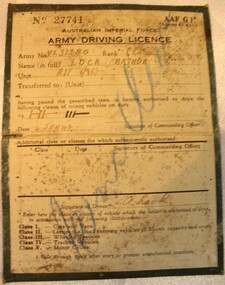
Document - Australian Imperial Force - Army Driving Licence, 1943
... Australian Imperial Force - Army Driving Licence...Australian Imperial Force - Army Driving Licence... An Australian Imperial Force - Army Driving Licence No. 27741 issued to Arthur Lock on 4 January 1943....Australian Imperial Force - Army Driving Licence Document Australian Imperial Force - Army Driving Licence ...This is one fo 2 Australian Army Driver Licences issuued to Private Arthur Lock (VX31240} during his service on the 2/23rd Batalion from 17 Jun 1940 until 26 Sep 1945. Arthur's service in Tobruk, El Alamein, New Guinea and Tarakan.Significance This item is part of a collection of items owned by Arthur Lock, a member of the 2/23rd Battalion, an all-volunteer Second Australian Imperial Force which served as part of the garrison during the Siege of Tobruk, then at El Alamein, New Guinea and Borneo. It has particular local significance as the battalion was know as "Albury's Own" because a large majority of the battalion's initial intake of volunteers came from the Albury–Wodonga region. An Australian Imperial Force - Army Driving Licence No. 27741 issued to Arthur Lock on 4 January 1943.world war 11, rats of tobruk, tobruk -
 Wodonga & District Historical Society Inc
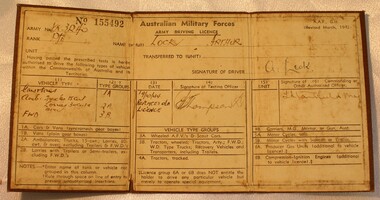
Document - Australian Imperial Force - Army Driving Licence Issued 1944
... Australian Imperial Force - Army Driving Licence Issued 1944... Australian Imperial Force - Army Driving Licence Issued 1944...An Australian Imperial Force - Army Driving Licence No. 155492 issued to Arthur Lock on 19 October 1944...In top right courner A.A.F., G11 An Australian Imperial Force - Army Driving Licence No. 155492 issued to Arthur Lock on 19 October 1944 Australian Imperial Force - Army Driving Licence Issued 1944 Document Australian Imperial Force - Army Driving Licence Issued 1944 ...This is one fo 2 Australian Army Driver Licences issuued to Private Arthur Lock (VX31240} during his service on the 2/23rd Batalion from 17 Jun 1940 until 26 Sep 1945. Arthur's service in Tobruk, El Alamein, New Guinea and Tarakan.An Australian Imperial Force - Army Driving Licence No. 155492 issued to Arthur Lock on 19 October 1944non-fictionThis is one fo 2 Australian Army Driver Licences issuued to Private Arthur Lock (VX31240} during his service on the 2/23rd Batalion from 17 Jun 1940 until 26 Sep 1945. Arthur's service in Tobruk, El Alamein, New Guinea and Tarakan.world war 11, rats of tobruk, tobruk, tarakan -
 Monbulk RSL Sub Branch
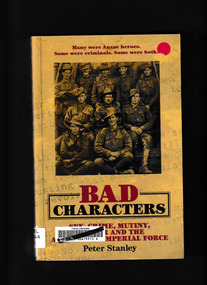
Book, Peter Stanley, Bad characters : sex, crime, mutiny, murder and the Australian Imperial Force, 2011
... australian army - imperial force - 1914-1921 - history...australian army - imperial force - 1914-1921 - history australian army - military deserters - 1914-1921 Australia's long-standing love affair with the Diggers has blinded us to the dark side of the Anzac legend. ...Australia's long-standing love affair with the Diggers has blinded us to the dark side of the Anzac legend. This book tells the story of the Australian soldiers in the Great War who were not heroes, soldiers who committed offences and crimes, those who deserted, robbed and murdered their comrades and more.Index, bibliography, notes, ill, p.287.non-fictionAustralia's long-standing love affair with the Diggers has blinded us to the dark side of the Anzac legend. This book tells the story of the Australian soldiers in the Great War who were not heroes, soldiers who committed offences and crimes, those who deserted, robbed and murdered their comrades and more.australian army - imperial force - 1914-1921 - history, australian army - military deserters - 1914-1921 -
 Returned Nurses RSL Sub-branch
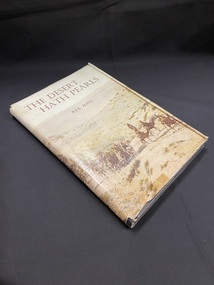
Book - Hardcover book, Rex Hall, The desert hath pearls, 1975
... ...Australian Army Imperial Force...Rex Hall Australian Army Imperial Force Military history World War 1 World War 2 WWI WWII WW1 WW2 Colonel Hall commanded a Light Horse Regiment and an Infantry Battalion in World war II and was a Staff Captain and Acting Brigade Major in World War I. ...Colonel Hall commanded a Light Horse Regiment and an Infantry Battalion in World war II and was a Staff Captain and Acting Brigade Major in World War I. He was also involved in community service with Legacy for over fifty years. 'My early life -- World War I -- Gallipoli and all that -- The desert campaign -- The Holy Land beckons -- Over the border -- Life with the camels -- The battles that went wrong -- Marking time -- The battle of Beersheba -- Jerusalem liberated -- Transjordania -- The land of the crusaders -- Syria and peace -- Homeward bound -- Coronation of King George VI -- World War II -- Civilian pursuits -- Sentimental Journey -- The glory that is England -- London calls -- On the continent.' - from Trove recordBlack hardcover book with a dustjacket. Sepia coloured image of men riding a large group of camels through the desert wraps around the front and spine of the book. The title is printed in brown text across the top of the image and down the spine, over the image.non-fictionColonel Hall commanded a Light Horse Regiment and an Infantry Battalion in World war II and was a Staff Captain and Acting Brigade Major in World War I. He was also involved in community service with Legacy for over fifty years. 'My early life -- World War I -- Gallipoli and all that -- The desert campaign -- The Holy Land beckons -- Over the border -- Life with the camels -- The battles that went wrong -- Marking time -- The battle of Beersheba -- Jerusalem liberated -- Transjordania -- The land of the crusaders -- Syria and peace -- Homeward bound -- Coronation of King George VI -- World War II -- Civilian pursuits -- Sentimental Journey -- The glory that is England -- London calls -- On the continent.' - from Trove recordrex hall, australian army imperial force, military history, world war 1, world war 2, wwi, wwii, ww1, ww2 -
 Lilydale RSL Sub Branch
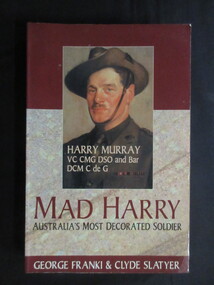
Book, George Franki & Clyde Slatyer, MAD HARRY, AUSTRALIA'S MOST DECORATED SOLDIER, 2003
... Australian Army...Australian Imperial Force (1914-1921)...Australian Army Australian Imperial Force (1914-1921) World War 1914-1918 MAD HARRY, AUSTRALIA'S MOST DECORATED SOLDIER Book George Franki & Clyde Slatyer Kangaroo Press Pty Ltd Griffin Press Pty Ltd. ...non-fictionharry murray vc cmg dso & bar dcm c de g., australian army, australian imperial force (1914-1921), world war 1914-1918 -
 Returned Nurses RSL Sub-branch
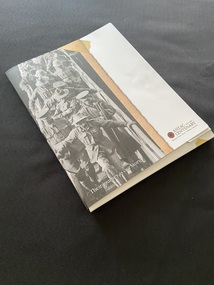
Book - Government publication, Victorian State Government, ANZAC centenary : 2014-2018 sharing Victoria's stories & making connections : their journey is our story, 2014
... Australia. Australian Army. Australian Imperial Force (1914-1921)...Australian Army. Australian Imperial Force (1914-1921) World War 1914-1918 -- Australia -- Victoria -- Centennial celebrations Soldiers -- Australia -- Victoria -- History 1914-1918 -- Participation Australian -- Anniversaries Soldiers -- Victoria -- History Army Nurses--Australia--History Women in War Folio contains: Community resource guide (18 pages) -- World War one history (42 pages) -- Victoria's world war one legacy (31 pages) -- Victorian government veterans' affairs grants (1 folded sheet) A collection of material published by the Victorian State Government to commemorate the ANZAC Centenary. ...Folio contains: Community resource guide (18 pages) -- World War one history (42 pages) -- Victoria's world war one legacy (31 pages) -- Victorian government veterans' affairs grants (1 folded sheet) A collection of material published by the Victorian State Government to commemorate the ANZAC Centenary. It includes pages on women in war and Australian nurses.Cardboard folio with an image of soldiers disembarking a ship across the back, spine and front cover. Inside are three booklets and a brochure.non-fictionFolio contains: Community resource guide (18 pages) -- World War one history (42 pages) -- Victoria's world war one legacy (31 pages) -- Victorian government veterans' affairs grants (1 folded sheet) A collection of material published by the Victorian State Government to commemorate the ANZAC Centenary. It includes pages on women in war and Australian nurses.australia. australian army. australian imperial force (1914-1921), world war, 1914-1918 -- australia -- victoria -- centennial celebrations, soldiers -- australia -- victoria -- history, 1914-1918 -- participation, australian -- anniversaries, soldiers -- victoria -- history, army nurses--australia--history, women in war -
 Returned Nurses RSL Sub-branch
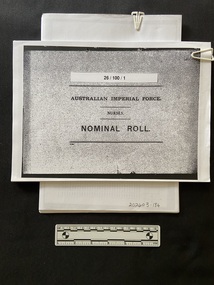
Document - Photocopy of official document, Australian Imperial Force, base records office, Australian Imperial Force, Nurses, Nominal Roll, unknown
... Army Nurses...Australian Imperial Forces...World War 1914-1918...Australia. Australian Army. Australian Imperial Force...[from Australian War Memorial] Army Nurses Australian Imperial Forces World War 1914-1918 Australia. Australian Army. Australian Imperial Force ...Nominal Roll of Nurses who embarked From Australian ports for overseas service in World War I. Some, who embarked at short notice as "civillians" and were enrolled whilst at sea seem to have been omitted. 'Each roll includes the dates of embarkation, the port embarked from and the ship concerned. Personal information is provided in column format under the following headings: regimental number, name, rank, age, trade or calling, married or single, address, next of kin and address, religion, date of joining, rate of pay, remarks.' [from Australian War Memorial]Black and white photocopy in landscape orientation of 48 pages of nominal roll table. The front page is a mottled background with a white rectangle in the top centre that reads 26/100/1. The title is printed below that text box in black print.army nurses, australian imperial forces, world war 1914-1918, australia. australian army. australian imperial force (1914-1921), australian nurses, wwi, ww1 -
 Returned Nurses RSL Sub-branch
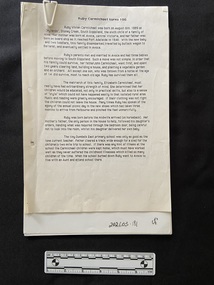
Document - Photocopy of a collection of documents and photographs, Australian Imperial Force, base records office, Ruby Vivien Carmichael, unknown
... Army Nurses...Australian Imperial Forces...World War 1914-1918...Australia. Australian Army. Australian Imperial Force...Australian Army Nursing Service (AANS) nurse, Ruby Vivian Carmichael, who served during the First World War. It includes a copy of her army record, a short story that was published in the "Leongatha Star" newspaper and copies of ten photographs. Army Nurses Australian Imperial Forces World War 1914-1918 Australia. Australian Army. Australian Imperial Force ...A biographical collection of papers and photographs relating to Australian Army Nursing Service (AANS) nurse, Ruby Vivian Carmichael, who served during the First World War. It includes a copy of her army record, a short story that was published in the "Leongatha Star" newspaper and copies of ten photographs.A collection of black and white typed and photocopied documents and pages of photographs.army nurses, australian imperial forces, world war 1914-1918, australia. australian army. australian imperial force (1914-1921), australian nurses, wwi, ww1, ships - hospital, hospitals - camp, ww1 living conditions, wedding ceremonies, solonika, karoola hospital ship -
 Returned Nurses RSL Sub-branch
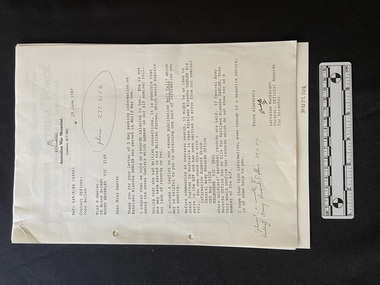
Document - Photocopy of correspondence, Australian War Memorial et al, 1987
... Imperial Forces...World War 1914-1918...Australia. Australian Army. Australian Imperial Force (1914-1921)...The Australian War Memorial record acknowledges her service in Queen Alexandra's Imperial Military Nursing Service (QAIMNS). Australian Imperial Forces World War 1914-1918 Australia. Australian Army. Australian Imperial Force ...Correspondence between the Gawler family and the Australian War Memorial regarding Kathleen Blanche Gawler's service during World War One. The Australian War Memorial record acknowledges her service in Queen Alexandra's Imperial Military Nursing Service (QAIMNS).Six photocopied pages of typed correspondence and AIF service records.'phone:277.2173' [Handwritten and circled in black ink above the main body of the letter on the first page] 'phoned & wrote to / Central Army Records Office 29.6,87' [Handwritten in black ink at the bottom of the first page]australian imperial forces, world war 1914-1918, australia. australian army. australian imperial force (1914-1921), australian nurses, wwi, ww1, kathleen gawler, kathleen blanche gawler, queen alexandra's imperial military nuring service -
 The Beechworth Burke Museum
Postcard
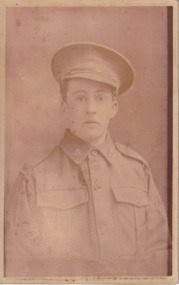
... australian army...australian imperial force...Australian military uniform. It is believed that this soldier was part of The Australian Imperial Force during World War I. This can be inferred by the 'Rising Sun' collar badge on his coat. Australia, unlike most other Commonwealth countries, did not adopt metal regimental badges during the First World War. All units were issued with the Australian Army...This is due to the ongoing public and scholarly interest in war, history, and especially the ANZAC legend, which is commemorated annually on 25 April, known as ANZAC Day. military album wwi world war i australian army australian imperial force aif uniform postcard portrait Reverse: BMM2640.2 / POST CARD / Write here for Inland Postage only / The Address to be written here Sepia rectangular postcard printed on card. ...Taken on an unknown date, depicted is a portrait of a young, unidentified male soldier. He is dressed in an Australian military uniform. It is believed that this soldier was part of The Australian Imperial Force during World War I. This can be inferred by the 'Rising Sun' collar badge on his coat. Australia, unlike most other Commonwealth countries, did not adopt metal regimental badges during the First World War. All units were issued with the Australian Army General Service Badge, better known as the 'Rising Sun’ badge. This insignia is almost always identified with the Australian Imperial Force.The record is historically significant due to its connection to World War I. This conflict is integral to Australian culture as it was the single greatest loss of life and the greatest repatriation of casualties in the country's history. Australia’s involvement in the First World War began when the Australian government established the Australian Imperial Force (AIF) in August 1914. Immediately, men were recruited to serve the British Empire in the Middle East and on the Western Front. The first significant Australian action of the war was the Australian Naval and Military Expeditionary Force’s (ANMEF) landing on Rabaul on 11 September 1914. The ANMEF took possession of German New Guinea at Toma on 17 September 1914 and of the neighbouring islands of the Bismarck Archipelago in October 1914. On 25 April 1915, members of the AIF landed on Gallipoli in Turkey with troops from New Zealand, Britain, and France. This specific event holds very strong significance within Australian history. The record has strong research potential. This is due to the ongoing public and scholarly interest in war, history, and especially the ANZAC legend, which is commemorated annually on 25 April, known as ANZAC Day.Sepia rectangular postcard printed on card.Reverse: BMM2640.2 / POST CARD / Write here for Inland Postage only / The Address to be written heremilitary album, wwi, world war i, australian army, australian imperial force, aif, uniform, postcard, portrait -
 The Beechworth Burke Museum
Postcard
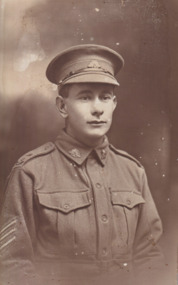
... australian army...australian imperial force...All units were issued with the Australian Army General Service Badge, better known as the 'Rising Sun’ badge. This insignia is almost always identified with the Australian Imperial Force....This is due to the ongoing public and scholarly interest in war, history, and especially the ANZAC legend, which is commemorated annually on 25 April, known as ANZAC Day. military album wwi world war i postcard australian army australian imperial force aif sergeant warrant officer non-commissioned officer portrait Reverse: CARD / JAS.C.CRADDEN, / 182 PITT ST, SYDNEY. / Cecil Johnson / BMM2640.1 / Sepia rectangular postcard printed on card. ...Taken on an unknown date, depicted is a portrait of a young, unidentified male soldier. He is dressed in an Australian military uniform. It is believed that this soldier was part of The Australian Imperial Force during World War I. This can be inferred by the chevron rank insignia visible on the uniform. The placement of this insignia on the sleeve of the right arm suggests that this soldier was either a Warrant Officer or a Non-Commissioned Officer (NCO). Specifically, the number of chevron stripes - here, there are three - are believed to signify a Sergeant ranking. The man in this photograph is also wearing a 'Rising Sun' collar badge on his coat. Australia, unlike most other Commonwealth countries, did not adopt metal regimental badges during the First World War. All units were issued with the Australian Army General Service Badge, better known as the 'Rising Sun’ badge. This insignia is almost always identified with the Australian Imperial Force.The record is historically significant due to its connection to World War I. This conflict is integral to Australian culture as it was the single greatest loss of life and the greatest repatriation of casualties in the country's history. Australia’s involvement in the First World War began when the Australian government established the Australian Imperial Force (AIF) in August 1914. Immediately, men were recruited to serve the British Empire in the Middle East and on the Western Front. The first significant Australian action of the war was the Australian Naval and Military Expeditionary Force’s (ANMEF) landing on Rabaul on 11 September 1914. The ANMEF took possession of German New Guinea at Toma on 17 September 1914 and of the neighbouring islands of the Bismarck Archipelago in October 1914. On 25 April 1915, members of the AIF landed on Gallipoli in Turkey with troops from New Zealand, Britain, and France. This specific event holds very strong significance within Australian history. The record has strong research potential. This is due to the ongoing public and scholarly interest in war, history, and especially the ANZAC legend, which is commemorated annually on 25 April, known as ANZAC Day.Sepia rectangular postcard printed on card.Reverse: CARD / JAS.C.CRADDEN, / 182 PITT ST, SYDNEY. / Cecil Johnson / BMM2640.1 /military album, wwi, world war i, postcard, australian army, australian imperial force, aif, sergeant, warrant officer, non-commissioned officer, portrait -
 Surrey Hills Historical Society Collection
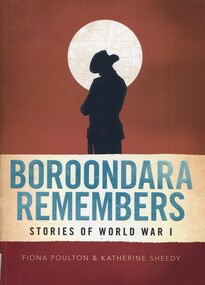
Book, Boroondara Remembers : Stories of World War 1, 2015
... australian army...australain imperial force...It is a story of great loss, pain and struggle, but also a community that came together to provide strength and support to each other in dark and uncertain times. australian army australain imperial force world war 1914-1918 casualties world war 1914-1918 recruiting enlistments etc world war 1914-1918 participation world war 1914-1918 social aspects world war 1914-1918 biography This is the story of how the people of Boroondara experienced World War 1. ...This is the story of how the people of Boroondara experienced World War 1. It is a story of great loss, pain and struggle, but also a community that came together to provide strength and support to each other in dark and uncertain times.This is the story of how the people of Boroondara experienced World War 1. It is a story of great loss, pain and struggle, but also a community that came together to provide strength and support to each other in dark and uncertain times.australian army, australain imperial force, world war 1914-1918 casualties, world war 1914-1918 recruiting enlistments etc, world war 1914-1918 participation, world war 1914-1918 social aspects, world war 1914-1918 biography -
 Stawell RSL Sub Branch War Museum
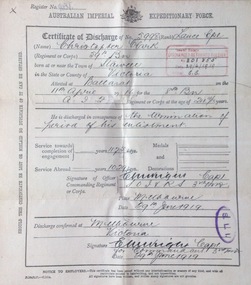
Certificate of Discharge, Australian Military Forces, Document, June 1919
... Each soldier had one of these forms filled out on Discharge from the army. WW1 Australian Imperial Expeditionary Force Certificate of Discharge No 5998 Christopher Clark 59th Battalion Born in Stawell...WW1 Australian Imperial Expeditionary Force Certificate of Discharge of Soldier No 5998 Christopher Clark Australian Imperial Expeditionary Force WW1,59th Battalion Christopher Clark was born in Stawell on 25th December 1892 and was brought up on the family farm in Callawdda and worked in the district and then in Queensland where he obtained an engine drivers licence and drove the sugar trains then worked on the steam boiler engines in the sugar mills. When the First World War started he came back to Stawell and enlisted in the army...Each soldier had one of these forms filled out on Discharge from the army. WW1 Australian Imperial Expeditionary Force Certificate of Discharge No 5998 Christopher Clark 59th Battalion Born in Stawell Christopher was a WW1 Serviceman from Stawell ww1 serviceman soldiers military stawell Form is filled out for soldier Christopher Clark WW1 Australian Imperial Expeditionary Force Certificate of Discharge of Soldier No 5998 Christopher Clark Australian Imperial Expeditionary Force WW1,59th Battalion Christopher Clark was born in Stawell on 25th December 1892 and was brought up on the family farm in Callawdda and worked in the district and then in Queensland where he obtained an engine drivers licence and drove the sugar trains then worked on the steam boiler engines in the sugar mills. ...Each soldier had one of these forms filled out on Discharge from the army. WW1 Australian Imperial Expeditionary Force Certificate of Discharge No 5998 Christopher Clark 59th Battalion Born in StawellChristopher was a WW1 Serviceman from Stawell WW1 Australian Imperial Expeditionary Force Certificate of Discharge of Soldier No 5998 Christopher Clark Australian Imperial Expeditionary Force WW1,59th Battalion Christopher Clark was born in Stawell on 25th December 1892 and was brought up on the family farm in Callawdda and worked in the district and then in Queensland where he obtained an engine drivers licence and drove the sugar trains then worked on the steam boiler engines in the sugar mills. When the First World War started he came back to Stawell and enlisted in the army on 11/4/1916. He was sent to France in the 59th Battalion. He was in the army 1175 days, serving 1029 days abroad. During his service he was promoted to Lance Corporal. Details from his daughter Ruth Clark of Ararat December 2017.Form is filled out for soldier Christopher Clarkww1, serviceman, soldiers, military, stawell -
 Federation University Historical Collection
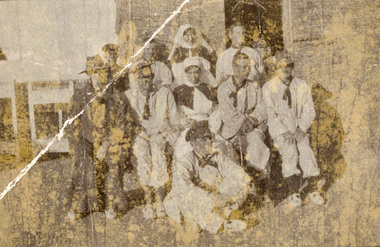
Photograph - postcard, S. Gordon Spittle, Australians at the World War One Suez Hospital, January 1916, c 07 January 1916
... Australian Imperial Force based in Egypt at the time. Nurse Kirkham is Laurie Hemsley Kirkham She was admitted to the Suez Public Hospital (Abbassia) post 06 January 1916. She left Australia with a group of South Australian nurses. Egypt was a major base for the AIF from December 1914. A number of campaigns were fought in this theatre. There were two campaigns involving the AIF. Note that not all the fighting was actually geographically in Egypt. (http://www.aif.adfa.edu.au:8888/about3.html) The Nurse Kirkam mentioned by the writer is probably Sarah Alice Kirkham, Staff Nurse with the Australian Army...Australian Imperial Force based in Egypt at the time. Nurse Kirkham is Laurie Hemsley Kirkham She was admitted to the Suez Public Hospital (Abbassia) post 06 January 1916. She left Australia with a group of South Australian nurses. Egypt was a major base for the AIF from December 1914. A number of campaigns were fought in this theatre. There were two campaigns involving the AIF. Note that not all the fighting was actually geographically in Egypt. (http://www.aif.adfa.edu.au:8888/about3.html) The Nurse Kirkam mentioned by the writer is probably Sarah Alice Kirkham, Staff Nurse with the Australian Army ...This photograph was with a number of others associated with Harry Holmes of Ascot, Victoria. The postcard was written on by Harry Holmes who was a member of the Australian Imperial Force based in Egypt at the time. Nurse Kirkham is Laurie Hemsley Kirkham She was admitted to the Suez Public Hospital (Abbassia) post 06 January 1916. She left Australia with a group of South Australian nurses. Egypt was a major base for the AIF from December 1914. A number of campaigns were fought in this theatre. There were two campaigns involving the AIF. Note that not all the fighting was actually geographically in Egypt. (http://www.aif.adfa.edu.au:8888/about3.html) The Nurse Kirkam mentioned by the writer is probably Sarah Alice Kirkham, Staff Nurse with the Australian Army Nursing Service. Nurse Kirkham was from North Perth, Western Australia. She was posted to the Auxiliary Hospital, Egypt on 09 November 1915 leaving for France on 23 June 1916. Samuel Gordon Spittle (8005) enlisted into the AIF on 17 July 1915, a member of the 18th Australian Army Service Corps (AASC). He left Alexandria on 15 June 1916 disembarking at Marseilles 24 June 1916. Harry Holmes was discharged from a hospital in Egypt on 15 August 1919. He was awarded the Military Medal promulgated on 11 December 1919. (NAA: B2455, Spittle Samuel Gordon) Not only does this photograph portray life in Egypt during World War War, it highlights the role played by members of the Australian Army Nursing Service in both professional and social activities in the theatre of war.Two Australian nurses and a number of Australian soldiers in Hospital Uniform pose for a photograph in Egypt during World War One. Verso: "A little group of Australians at Suez Hospital Joe F[awcett] & I [Gordon Spittle] are standing in the back row with Nurse Kirkham standing between, she is on the short side so stood on a box. Gordon S."chatham family archive, chatham, holmes, world war, world war 1, world war i, world war one, france, gordon spittle, kirkham, suez, egypt, samuel gordon spittle, joe fawcett, laurie kirkham, nurse kirkham, suez hospital, laurie helmsley kirkham, l.a. kirkham, harry holmes, nurses, ascot -
 Federation University Historical Collection
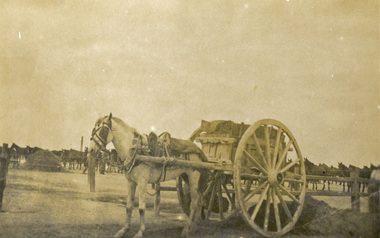
Postcard - Sepia, A Horse and Cart Carry Manure at Metras Camp, c1916
... Australian Imperial Force based in Egypt at the time. Egypt was a major base for the AIF from December 1914. A number of campaigns were fought in this theatre. There were two campaigns involving the AIF. Note that not all the fighting was actually geographically in Egypt. (http://www.aif.adfa.edu.au:8888/about3.html) Chatham family Archive Chatham Holmes World War World War 1 world War I World war One Egypt Ascot .1) verso - 'Taken at Metras Camp' .2) verso - 'A native horse and cart carting manure at horse lines.' Two postcards showing Australian army ...The photograph is associated with Harry Holmes who was a member of the Australian Imperial Force based in Egypt at the time. Egypt was a major base for the AIF from December 1914. A number of campaigns were fought in this theatre. There were two campaigns involving the AIF. Note that not all the fighting was actually geographically in Egypt. (http://www.aif.adfa.edu.au:8888/about3.html)Two postcards showing Australian army camp at Metras Camp, Egypt .1) A soldier sits on a horse in front of a cart. Lines of horses are in the background behind a post and rail fence. .2 A horse is hitched to a manure cart at Metras Camp, Egypt. Lines of horses are in the background. .1) verso - 'Taken at Metras Camp' .2) verso - 'A native horse and cart carting manure at horse lines.'chatham family archive, chatham, holmes, world war, world war 1, world war i, world war one, egypt, ascot -
 Federation University Historical Collection
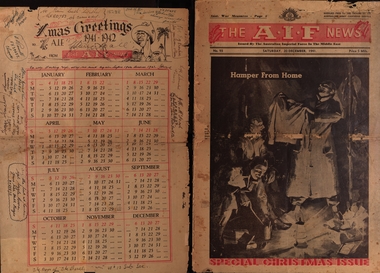
Newspaper - Twenty page issue December 1941 No. 93, Societe Orientale de Publicite, The A.I.F. News Special Christmas Issue 1941, December 1941
... Imperial Force...World War 2...Australian Army Canteens Service...General Blamey...World War 2 - Pacific War...World War 2 - Phillipine Islands...General D Macarthur...Emergency Plans WW2 Australia....= The Australian Imperial Force and this newspaper was supplied free to the troops of the Australian Army Canteens Service. ...Army Number. The A.I.F. News Christmas Edition 1941 Australian Imperial Force World War 2 Australian Army Canteens Service General Blamey World War 2 - Pacific War World War 2 - Phillipine Islands General D Macarthur Emergency Plans WW2 Australia Secret Weapons WW2 Western Desert WW2 Australian Imperial Force - Western Desert WW2 Civil Aviation Post WW2 Air Services Australia Lord Gowrie Governor General Lord Gowrie Prime Minister John Curtain Minister For the Army - Mr Forde Cartoons 1941 Women-in WW2 Xmas Greetings Calendar 1941-1942 Cairo 1941 Palestine 1941 Western Desert 1941 Advertisements 1941 Middle East 1941 The last page is a calendar for 1942 with personal inscriptions and greetings of servicemen. ...The A.I.F.= The Australian Imperial Force and this newspaper was supplied free to the troops of the Australian Army Canteens Service. This issue is dated Saturday 22nd December 1941. It includes advertisments for businesses in Cairo and Alexandria; Egypt, Palestine and Syria. Page 2 includes a poem titled "This Holy Night" by Pte C.M. Walker; two sonnets by Rupert Brooke; a poem, "Waiting Dreams" by Pilot Officer J.A. Henderson RAAF and a poem by Lieut. David McNicoll AIF Abroad Air Mail - Palestine. Page 3 includes a message from General Sir Thomas Blamey, an article on the part women would increasingly play as a consequence of the emergency war policy; an advertisment for tobacco specially packed for overseas forces. Page 4 includes an article on Australian coastal cities being ready for raids. Page 5 includes an article about the Commonwealth of the Philippines and their defense which until 1946 lay with America. General D Macarthur was the Commander In Chief in the Philippines. Germany's "secret Weapon" legend. Page 6 includes "Dancing Dan's Christmas"; "Bluey and Curley" comic strip. Page 7 includes article "Rommel's Armoured Might Lies Strewn Over Libyan Sands" Page 8 includes an article: "All In Fun" - a revue - has begun a tour of Australian camps in Palestine and Syria. Page 9 includes articles "War Will Revolutionise Air Services In Australia"; a list - Greek Awards To AIF Officers and a cartoon by George Aria titled 'Jonah '. Pages 10&11 "Christmas 1941" - messages from prominent people: Mr Winston Churchill; The Govenor General (Lord Gorrie); The Prime Minister (Mr Curtin); Mininster for the Army (Mr Forde). Also photos of army operations and traditional family Christmas time. Page 12 &13 Articles regarding sport under the heading 'Australian Sporting Digest'. Page 14 A story - "The Gift of the Magi" - an O Henry Christmas Story. Also a greeting from Myer's of Melbourne and Adelaide to all Myer Men in the AIF Page 15 An article where General Blamey reassures Australia about its capability of defence. Page 16 A description of a battle by Australian sloop "Parramatta" with HMAS "Auckland" against enemy planes whilst they were escorting a merchant ship with a cargo of petrol during the Battle of Tobruk Page 17 & 18 Pages under the title 'ACK-I-FOOFS' (Articles submitted by soldiers: The real Rat of Tobruk - a rat trained by L/Cpl Jack Kneeshaw which he named "Goebbels"; poems and cartoons. Page 19 "Women of War" - photos of women at work filling in for men who have gone to war. Page 20 Xmas Greetings 1942-1942 - a 1942 Calendar signed by 14 members of the AIF, some with messages and including their Army Number. Twenty pages of news supplied free to the troops by the Australian Army Canteens Service.The last page is a calendar for 1942 with personal inscriptions and greetings of servicemen. Some inscriptions have I.D. Numbers ( VX35435 W. Johnston; QX20753 of Carmody ; VX40449 ; VX39637 N. Powell; VX32054 Blue Ernistson?; N?X23234 W.Cummins; VXthe a.i.f. news christmas edition 1941, australian imperial force, world war 2, australian army canteens service, general blamey, world war 2 - pacific war, world war 2 - phillipine islands, general d macarthur, emergency plans ww2 australia, secret weapons ww2, western desert ww2, australian imperial force - western desert ww2, civil aviation post ww2, air services australia, lord gowrie, governor general lord gowrie, prime minister john curtain, minister for the army - mr forde, cartoons 1941, women-in ww2, xmas greetings calendar 1941-1942, cairo 1941, palestine 1941, western desert 1941, advertisements 1941, middle east 1941 -
 Lara RSL Sub Branch
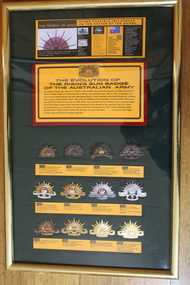
The Evolution of the Rising Sun Badge of the Australian Army, Captain D'arcy.2004, 2004
... Australian Imperial Force in both World Wars, the 'Rising Sun' badge has become an integral part of the digger tradition. The distinctive shape of the badge, worn on the upturned side of a slouch hat, is commonly identified with the spirit of Anzac. Gives a brief rundown on the Evolution of Rising Sun Badge with 12 examples and explanatory notes Glass covered Rectangular Picture Frame showing the Evolution of the Rising Sun Badge of the Australian Army. ...The origins of the rising sun badge are disputed. Rising sun designs had appeared on early Australian colonial coins and military insignia decades before the federation of the Australian colonies in 1901, and may have represented the image of Australia as 'a young nation' and a 'new Britannia'.[2] As early as the 1820s, the symbol of a 'rising sun' was used by various progressive organisations, loosely characterised under the banner "Advance Australia". The rising sun crest used in the New South Wales colonial and State crests was taken from the crest used on the first Advance Australia Arms, circa 1821, and consistently since then.[3] The oldest known example is the 'Advance Australia' coat of arms. The 'Advance Australia Arms' (named because of the motto inscription) became widely used in New South Wales and the neighbouring colonies by private corporations and individuals. Although they never had any official status, they formed the basis for several official coats of arms, including the New South Wales coat of arms. The representation below was reputedly painted for Thomas Silk, the son of the captain of the Prince of Orange, a convict ship that visited Sydney in 1821. The symbol struck a chord with the pre-federation population and many examples still exist on colonial architecture.[4] Proudly worn by soldiers of the 1st and 2nd Australian Imperial Force in both World Wars, the 'Rising Sun' badge has become an integral part of the digger tradition. The distinctive shape of the badge, worn on the upturned side of a slouch hat, is commonly identified with the spirit of Anzac.Glass covered Rectangular Picture Frame showing the Evolution of the Rising Sun Badge of the Australian Army.Gives a brief rundown on the Evolution of Rising Sun Badge with 12 examples and explanatory notes -
 Lara RSL Sub Branch
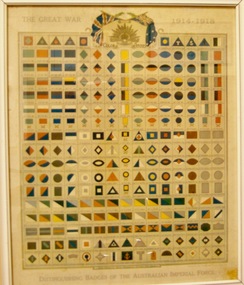
Distinguishing Badges of the Australian Forces, The Great War-1914/18 colour patches
... The Australian army's system of colour patches arose from the need to solve an immediate problem. When the first Australian Imperial Force (AIF) set off for the Middle East in 1914, the only badge it wore was on headgear and jacket collars: the Australian "Rising Sun" emblem, inscribed with the words "Australian Commonwealth Military Forces" (ACMF). ...The Australian army's system of colour patches arose from the need to solve an immediate problem. When the first Australian Imperial Force (AIF) set off for the Middle East in 1914, the only badge it wore was on headgear and jacket collars: the Australian "Rising Sun" emblem, inscribed with the words "Australian Commonwealth Military Forces" (ACMF). ...The Australian army's system of colour patches arose from the need to solve an immediate problem. When the first Australian Imperial Force (AIF) set off for the Middle East in 1914, the only badge it wore was on headgear and jacket collars: the Australian "Rising Sun" emblem, inscribed with the words "Australian Commonwealth Military Forces" (ACMF). Nothing distinguished one regiment from another. Divisional Order No. 81(A) Administration was issued at Mena, Egypt, on 8 March 1915 to overcome the problem:After the First World War the use of colour patches continued in the Citizens Military Forces (CMF), also known as militia. The CMF were reorganised into a divisional structure similar to that of the AIF. Units were generally renamed to provide a direct numerical association with AIF units raised from the same states and districts. Through their identification with AIF units came the authority for militia units to wear the colour patches of their associated AIF units; other colour patches were approved for units outside the AIF association.Rectangular shaped glass covered Picture Frame showing colour patches and badges of the Australian Imperial Forces.THE GREAT WAR-1914/18 Distinguishing Badges and Patches of the Australian Forces.ww1, the great war, middle east 1914/18, lara r.s.l., colour patches -
 Lara RSL Sub Branch
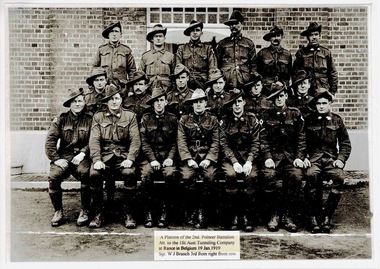
Photograph, A Platoon of the 2nd, Pioneer Battalion Att. to the 1St.Aust. Tunneling Company at Rance in Belgium 19 Jan 1919
... Australian infantry and light engineer unit raised for service during the First World War as part of the all volunteer Australian Imperial Force. Formed in Egypt in March 1916, the battalion subsequently served on the Western Front in France and Belgium, after being transferred to the European battlefields shortly after its establishment. army, rance belgium,australian army, lara r.s.l. ! ...The 2nd Pioneer Battalion was an Australian infantry and light engineer unit raised for service during the First World War as part of the all volunteer Australian Imperial Force. Formed in Egypt in March 1916, the battalion subsequently served on the Western Front in France and Belgium, after being transferred to the European battlefields shortly after its establishment. Rectangular shaped black and white Photograph.A Platoon of the 2nd, Pioneer Battalion Att. to the 1St.Aust. Tunnelling Company at Rance in Belgium 19 Jan 1919 Sgt. W J Branch 3rd from right front row. army, rance belgium,australian army, lara r.s.l., !st.australian tunnelling company, 2nd pioneer battalion. -
 Lara RSL Sub Branch
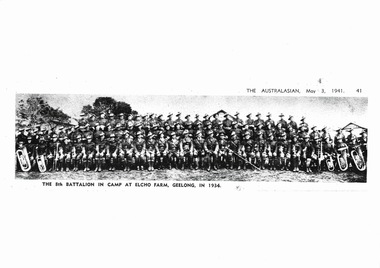
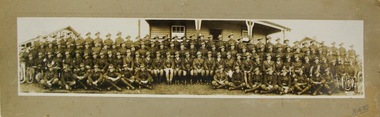
Photograph, THE 8TH BATTALION IN CAMP AT ELCHO FARM, GEELONG IN 1934, 1934
... Australian Army. Initially raised in 1914 for the First Australian Imperial Force during the First World War the battalion was completely recruited from Victoria and formed part of the 2nd Brigade, 1st Division. ...Australian Army. Initially raised in 1914 for the First Australian Imperial Force during the First World War the battalion was completely recruited from Victoria and formed part of the 2nd Brigade, 1st Division. ...The 8th Battalion was an infantry battalion of the Australian Army. Initially raised in 1914 for the First Australian Imperial Force during the First World War the battalion was completely recruited from Victoria and formed part of the 2nd Brigade, 1st Division. During the war it fought at Gallipoli and in France and Belgium on the Western Front. It was disbanded in 1919, before being re-raised as a Militia battalion in 1921. During the Second World War the 8th Battalion was used primarily as a garrison unit before taking part in the Bougainville campaign late in the war. It was disbanded again in 1946 during the demobilisation process, although it was reformed again in 1948 when it was amalgamated with the 7th Battalion. Today, its honours and traditions are perpetuated by the 8th/7th Battalion, Royal Victoria Regiment.Rectangular shaped black and white photograph.THE AUSTRALIAN, May 3, 1941. THE 8TH BATTALION IN CAMP AT ELCHO FARM, GELONG IN 1934. 8th battalion, ww1, australian infantry, lara r.s.l. -
 Lara RSL Sub Branch
Photograph Elcho Farm, 1934
... Australian Army. Initially raised in 1914 for the First Australian Imperial Force during the First World War the battalion was completely recruited from Victoria and formed part of the 2nd Brigade, 1st Division. ...Australian Army. Initially raised in 1914 for the First Australian Imperial Force during the First World War the battalion was completely recruited from Victoria and formed part of the 2nd Brigade, 1st Division. ...The 8th Battalion was an infantry battalion of the Australian Army. Initially raised in 1914 for the First Australian Imperial Force during the First World War the battalion was completely recruited from Victoria and formed part of the 2nd Brigade, 1st Division. During the war it fought at Gallipoli and in France and Belgium on the Western Front. It was disbanded in 1919, before being re-raised as a Militia battalion in 1921.Rectangular Black and White Photograph mounted on Grey CardboardFront H. WaL? George Crawford Elcho Farm Lara 1936-1937elcho farm lara 1936 1937 photo george crawford -
 Lara RSL Sub Branch
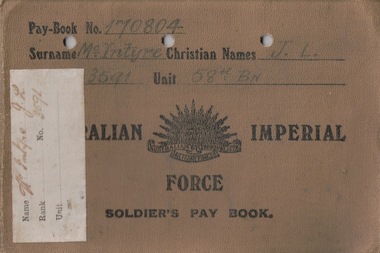
Personal Records, Paybook, J.L.McIntyre
... They are also significant as research materials, allowing researchers to track McIntyre's war experience. paybook military army wwi world war one first world war mcintyre rsl lara Book 1: Pay Book No. 170804 Surname McIntyre Christian Names J.L. 3591 Unit 58th Bn Australian Imperial Force Soldier's Pay Book. ...These paybooks were carried by John Lachlan McIntyre while on active service during the First World War. The books cover the period November 1915 to July 1919. Every soldier carried a paybook, and made an entry each time they were paid. Paybooks enable researchers to track the dates and places that a soldier served. These paybooks are associated with JL McIntyre, a founding member of Lara RSL. The books are highly personal objects carried with him every day, and would have formed a key element of his wartime experience. They are also significant as research materials, allowing researchers to track McIntyre's war experience. 2 Small khaki paybooks. One is landscape with a rising sun badge and text on the front. The other is portrait with a cloth cover and text. Each book has tables inside tracking dates and locations of payments made to JL McIntyre while on service. Book 1: Pay Book No. 170804 Surname McIntyre Christian Names J.L. 3591 Unit 58th Bn Australian Imperial Force Soldier's Pay Book. Book 2: JL McIntyre Soldier's Pay Book, For Use On Active Service 3591paybook, military, army, wwi, world war one, first world war, mcintyre, rsl, lara -
 Lara RSL Sub Branch
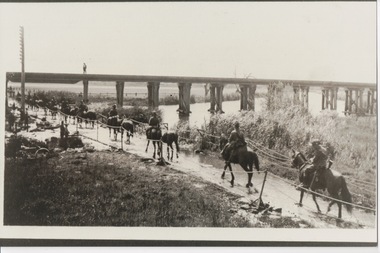
Photograph, Set 4 photographs. and others for Torquay Light Horse camp, 1940
... Australia joined the war against Germany, there were 23 Light Horse regiments of militia volunteers. Many men from these units joined the Light Horse regiments of the Australian Imperial Force (AIF). Men were given remounts (if not using their own horses) – army...Australia joined the war against Germany, there were 23 Light Horse regiments of militia volunteers. Many men from these units joined the Light Horse regiments of the Australian Imperial Force (AIF). Men were given remounts (if not using their own horses) – army ...These images capture for all time Light Horsemen travelling through Geelong on their way to camp at Torquay for the last Group meeting in Australia . information following - details obtained from .........https://torquayhistory.com/light-horse-brigade/ On Australia Day, 1997, Sir John Young unveiled this plaque on Point Danger, Torquay. Torquay history, Light Horse Training Camp, WW2 Plaque at Pt. Danger Note----- (See images to view plaque) The plaque identifies a significant event in Torquay’s history and the sentiments of ‘change’ for the Light Horse Brigade – from horses to machines. In 1940 the four Light Horse Regiments (4th, 8th, 13th and 20th), some 5000 Light Horse and 2000 horses camped and trained at Torquay. Three other regiments, formerly mounted on horses, were also at Torquay ‘mounted’ on privately owned trucks and cars. Division troops included Artillery, Engineers, Signals, Field Ambulance and other branches of the Army necessary to enable a Division to function. It wasn’t just the sheer numbers of men coming to this little town that made the event significant, it was also the fact that the men of the Light Horse were dramatic, almost glamorous figures and it is easy to see their exploits as some splendid adventure. Horses have played a special role in the story of Australia. They were the only means of transport across this huge country, so it was necessary for everyone to have the ability to ride a horse. When war broke out in 1899 between Britain and the Boers of South Africa (“Boer” was Dutch for “farmer”) Australia sent troops to fight. At first Britain was wary of using untried, unprofessional colonial cavalrymen but soon saw that the slouch-hatted Australian “bushmen” were a match for the fast-moving and unconventional mounted commandos of the Boers. The Australians proved themselves to be expert rough-riding horsemen and good shots. Bush life had hardened them to go for long periods with little food and water. They also showed remarkable ability to find their way in a strange country and use its features for cover, in both attack and defence. By 1914, when Australia joined the war against Germany, there were 23 Light Horse regiments of militia volunteers. Many men from these units joined the Light Horse regiments of the Australian Imperial Force (AIF). Men were given remounts (if not using their own horses) – army horses bought by Commonwealth purchasing officers from graziers and breeders. These were called “walers” because they were a New South Wales stockhorse type – strong, great-hearted animals with the strains of the thoroughbred and semi-draught to give them speed, strength and stamina. On 1st November, 1914, Australia’s First Infantry Division and the first four Light Horse regiments sailed for England in a fleet of transport ships. The first of the Light Horse arrived at Gallipoli in May without their horses. Back with their horses after Gallipoli, they were formidable combatants across the Sinai and Palestine. Some British commanders observed that the light horseman moved with a “lazy, slouching gait, like that of a sleepy tiger” but described how the promise of battle “changes that careless gait, into a live athletic swing that takes him over the ground much quicker than other troops”. They had Light Horse, Torquay, training campdeveloped a reputation as formidable infantrymen. The Turks called them “the White Ghurkas” – a reference to their deadly skill with the bayonet. The Arabs called them “The Kings of the Feathers”. The plume had originally been a battle honour of the Queensland Mounted Infantry for their work in the shearer’s strike of 1891. During WW1 it was adopted by almost all the Light Horse Regiments. It was the proud badge of the light horseman. The most famous of their battles was the attack on Beersheba- the charge of the 4th Light Horse Brigade. Mounted infantrymen and their superb walers had carried out one of the most successful cavalry charges in history – against what seemed impossible odds. They surprised the Turks by charging cavalry-style, when they would normally have ridden close to an objective then dismounted to fight. The fall of Beersheba swung the battle tide against the Turks in Palestine; and changed the history of the Middle East. While 19 men from the Surf Coast Shire served with the 4th Light Horse over the course of WW1, only four were involved in the charge of Beersheba- John GAYLARD, Philip QUINN.(Winchelsea); Wallace FINDLAY (Anglesea); Harry TRIGG (Bambra). After the war, Light Horse units played a key role in the Australian Government’s compulsory military training programme. The Citizen Military Forces (C.M.F.) thrived on the glamour of the wartime Light Horse tradition, ignoring the possibility that motor vehicles would soon replace the horses. When training was no longer compulsory, the C.M.F. regiments declined and horses became more of a luxury during the 1930s depression years of poverty and unemployment. Some regiments were motorised. Then, in 1939, Australia joined Britain in another world war. Training was increased for the militia at both home bases and regional training camps. The camp at Torquay in 1940, commanded by Major General Rankin, was at Divisional strength. By the end of the camp some felt that the Division was ready for active service. Gradually, over the next four years, the Australian Light Horse units were mounted on wheels and tracks and the horses were retired. Six men enlisted at the Torquay camp and another 57 men and women enlisted at Torquay for service in WW2. Those who served in the Militia provided valuable Officers and NCOs and men for the armed services during the war. Each infantry division of the 2nd AIF had a Light Horse regiment attached to it. But the day of the Australian mounted soldier hadn’t quite passed. During World War II, Australia’s 6th Cavalry Regiment formed a mounted unit they called “The Kelly Gang” which did valuable scouting work. In New Guinea, a mounted Light Horse Troop did patrol duty and helped carry supplies. Some fully equipped walers were flown into Borneo for reconnaissance in rugged mountain country. But by the end of the war, in 1945, the horse had disappeared from the Australian Army. References: Australian Light Horse Association www.lighthorse.org.au National Australia Archives Australian War Memorial Surf Coast Shire WW1 memorials www.togethertheyserved.com The Light horse- a Cavalry under Canvas Light Horse, Training Camp, Torquay, WW2 Late in 1939 it was decided to set up a Lighthorse training camp in Torquay to train both men and horses for the battles of the Second World War. Horses, men and equipment came on special trains from all over Victoria and NSW, and as you would expect horseman came from areas such as Omeo and Sale, the Wimmera and the Western District. They arrived at the Geelong racecourse for watering in the Barwon River and then were ridden across the ford at the breakwater and began their 11 mile trek to Torquay. Light Horse, Training Camp, Torquay, WW2 Tent city By the end of January 1940 the camp at Torquay accommodated some 5000 men and 2500 horses of the Second Cavalry Division. The rows of horses, tents and huts near Blackgate Road were quite a sight. While the cavalrymen engaged in exercises on the land and on the beaches, many of the troops took over the Torquay School for special training of men and officers. Mr Bob Pettit local farmer and Councillor for the Barrabool Shire, wrote about the Light horse in the Surf Coast Community News in 1985 saying “They used to travel about the district riding four abreast in one long convoy. To my annoyance they went through my property and shut all the gates behind them. I had certain gates open to let stock in to the water holes and it would take me three -quarters of an hour to follow the horsemen up and put all the gates right again” he continued “the men from the Light Horse were here when the fire went through in March 1940. He recalled an incident when early one morning, as some one blew the bugle, a soldier putting a white sheet on the line frightened the horses. They panicked and ran off in all directions. Six went over the cliff near Bird Rock, five were never found, and the rest were gathered up after nearly a fortnight in the bush around Addiscott and Anglesea" Light Horse, Training Camp, Torquay, WW2, Geelong Parade Geelong parade The training camp culminated in a parade through the streets of Geelong on March 12th 1940. The salute was given at the Town Hall and the troops continued on a route to the You Yang’s for a training exercise. Note-----(see media section for photograph) The Camp was abandoned in mid 1940 as it was deemed unsuitable for training during winter and the cost of a permanent camp could not be justified if it could not be used all year. Historic.......Rare,,,Interpretive.Sepia photographs.set of four ....post card size ....Horses &LighthorsemenNo 1, Lighthorsemen Regiment Geelong 1940......No 2 Light Horse at Breakwater Geelong 1938 to 1940....No 3 Light Horse at Breakwater Geelong 1938 to 1940.....No 4 Light Horse crossing Breakwater camped at Geelong Showgrounds. These markings are on reverse of photographs.light horsemengeelong 1940., world war 2 -
 Lara RSL Sub Branch
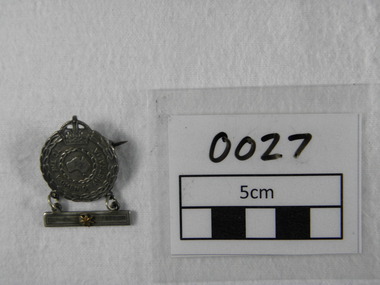
Badge, Angus and Coote, To The Woman of Australia Badge, 1942
... In the Second World War there was only one badge issued to the nearest female relative of members of the RAN, the Australian Imperial Force (including members of the Australian Army Nursing Service), and the Royal Australian Air Force on active service abroad. ...In the Second World War there was only one badge issued to the nearest female relative of members of the RAN, the Australian Imperial Force (including members of the Australian Army Nursing Service), and the Royal Australian Air Force on active service abroad. ...In the Second World War there was only one badge issued to the nearest female relative of members of the RAN, the Australian Imperial Force (including members of the Australian Army Nursing Service), and the Royal Australian Air Force on active service abroad. Stars displayed on a bar suspended below the badge represented the number of relatives involved in the war effort. Authority for the issue of the badge in the Second World War was issued under AIF Order 200 dated 14 February 1941.Metal badge with crown on top & bar underneath with 1 star.'TO THE WOMAN OF AUSTRALIA'. Map of Australia in centre of wreath. On reverse side issued by the Commonwealth Government. No 'A100853' world war two, royal australian air force, australian imperial force, australian army nursing service -
 Lara RSL Sub Branch
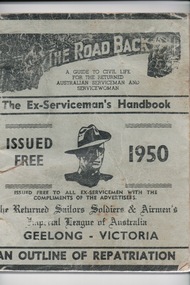
Handbook, W.A.Cooney, The Road Back, 1947/1950
... army...navy...air force...returned sailor's, soldier's and airmen's imperial league of australia...This booklet for returned service personnel from World War 2 living in the Geelong Region is og local district significance as a part of the history of Geelong. the road back the ex-serviceman's handbook world war 2 ww2 australian aif australian serviceman australian servicewoman rss&aila army navy air force returned sailor's, soldier's and airmen's imperial league of australia rsl The Road Back The Ex-Serviceman's Handbook Geelong. ...The handbook was distributed to all ex-servicemen on return from WW2 in the Geelong area and was a guide to civil life.This booklet for returned service personnel from World War 2 living in the Geelong Region is og local district significance as a part of the history of Geelong.The Road Back -two of The Ex-Serviceman's Handbooks,1947/ 1950 Geelong Issued Free.One is Light green in colour with black writingThe Road Back The Ex-Serviceman's Handbook Geelong.the road back, the ex-serviceman's handbook, world war 2, ww2, australian aif, australian serviceman, australian servicewoman, rss&aila, army, navy, air force, returned sailor's, soldier's and airmen's imperial league of australia, rsl -
 Federation University Historical Collection
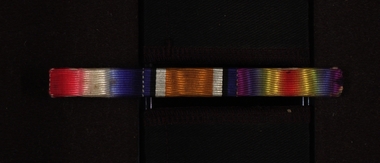
Service Medal Colour Bar, Chatham-Holmes Collection: Lance Corporal Horace Pickford's WW1 Army Coloured Ribbon Bar, c2020
... Horace Pickford was Mary Elizabeth Chatham's ( nee Holmes) mother's bother Horace Pickford Service number 2882 Rank Lance Corporal Unit 58th Australian Infantry Battalion Service Australian Imperial Force Conflict/Operation First World War, 1914-1918 Award Distinguished Conduct Medal chatham-holmes collection army numismatics colour bar Horace Pickford WW1 clunes A service ribbon bar, or small ribbon mounted on a small metal bar equiopped with an attachig device, which is issued for wear in place of a medal when it is not appropriate to wear the actual medal. ...Horace Pickford was Mary Elizabeth Chatham's ( nee Holmes) mother's bother Horace Pickford Service number 2882 Rank Lance Corporal Unit 58th Australian Infantry Battalion Service Australian Imperial Force Conflict/Operation First World War, 1914-1918 Award Distinguished Conduct Medal A service ribbon bar, or small ribbon mounted on a small metal bar equiopped with an attachig device, which is issued for wear in place of a medal when it is not appropriate to wear the actual medal. This service medal belonged to Horace Pickford.chatham-holmes collection, army, numismatics, colour bar, horace pickford, ww1, clunes -
 Flagstaff Hill Maritime Museum and Village
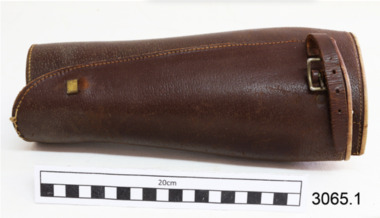
Clothing - Leather Leggings, 1899 to 1920
... Australia still relied upon mounted military units as these were more mobile than infantry and could travel faster over long distances. Light Horse brigades in the Australian Imperial Force (AIF) mostly contained recruits who served in the Light Horse regiments of the Citizen Forces. Many young men from rural areas of Australia volunteered for the Light Horse regiments. They had to pass a riding test to join, this test was easier for men from the bush because horses were still the main method of transport on farms and in country towns. The army...Australia still relied upon mounted military units as these were more mobile than infantry and could travel faster over long distances. Light Horse brigades in the Australian Imperial Force (AIF) mostly contained recruits who served in the Light Horse regiments of the Citizen Forces. Many young men from rural areas of Australia volunteered for the Light Horse regiments. They had to pass a riding test to join, this test was easier for men from the bush because horses were still the main method of transport on farms and in country towns. The army ...The subject leather leggings are associated with mounted troops known as the Australian Light Horse that served in the South African War from 1899 to 1902. After the war, Britain wanted to use fewer mounted troops and restructured its force around a style of combat that needed more infantry. But the defence of Australia still relied upon mounted military units as these were more mobile than infantry and could travel faster over long distances. Light Horse brigades in the Australian Imperial Force (AIF) mostly contained recruits who served in the Light Horse regiments of the Citizen Forces. Many young men from rural areas of Australia volunteered for the Light Horse regiments. They had to pass a riding test to join, this test was easier for men from the bush because horses were still the main method of transport on farms and in country towns. The army did not officially accept First Australians into the AIF until May 1917 when enlistment standards were relaxed to include 'half-castes' with a parent of European origin. Indigenous soldiers served as valuable members of the Light Horse and many possessed excellent horse handling skills and specialist tracking knowledge.The subject items are part of the uniform for the Light Horse Units that served in the Australian army from 1899 until 1918. These leggings were worn by soldiers on horseback and are significant as they represent a noteworthy time in Australia's early military history. It was a time when many young men gave their lives during the South African and First World Wars in the defence of the then British Empire as part of the Imperial Forces that were gathered from many British-controlled Colonial countries.A pair of two Leather Leggings used by Mounted Australian soldiers during the first world war. The leggings are dark tan in colour with stitching to attach buckles and fastener straps. The strap buckles are made of brass and the leather legging straps are of same leather as leggings. Noneflagstaff hill, warrnambool, flagstaff hill maritime museum, shipwreck coast, flagstaff hill maritime village, great ocean road, leggings, leather leggings, protective leggings, protective clothing, australian mounted light horse units, military equipment -
 City of Moorabbin Historical Society (Operating the Box Cottage Museum)
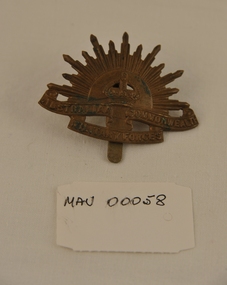
Uniform - World War 1 1914-1918, Hat Badge Rising Sun, c1914
... Australian Imperial Force in both World Wars, the 'Rising Sun' badge has become an integral part of the digger tradition. The distinctive shape of the badge, worn on the upturned side of a slouch hat, is commonly identified with the spirit of ANZAC formed at the Gallipoli landings 1915 There are seven patterns of the Rising Sun. 1902 - 1991. The Rising Sun has evolved over time and today Australian Army...Australian Imperial Force in both World Wars, the 'Rising Sun' badge has become an integral part of the digger tradition. The distinctive shape of the badge, worn on the upturned side of a slouch hat, is commonly identified with the spirit of ANZAC formed at the Gallipoli landings 1915 There are seven patterns of the Rising Sun. 1902 - 1991. The Rising Sun has evolved over time and today Australian Army ...Proudly worn by soldiers of the 1st and 2nd Australian Imperial Force in both World Wars, the 'Rising Sun' badge has become an integral part of the digger tradition. The distinctive shape of the badge, worn on the upturned side of a slouch hat, is commonly identified with the spirit of ANZAC formed at the Gallipoli landings 1915 There are seven patterns of the Rising Sun. 1902 - 1991. The Rising Sun has evolved over time and today Australian Army soldiers wear the seventh pattern Rising Sun. The Third Pattern Rising Sun Badge. May 1904 The third pattern Rising Sun badge carried a scroll inscribed with the words ‘Australian Commonwealth Military Forces’ and was worn throughout both World Wars. There were, however, a number of variations of the badge; a special version was struck for the coronation of King Edward VII in 1902 and there were badges of the Commonwealth Horse and the Australian Instructional Corps, each with its respective title on the scrolls. This pattern badge formed the template for all subsequent General Service badges. The most widely accepted version of the origin of this badge is the one that attributes the selection of its design, c1902, to a British Officer, Major General Sir Edward Hutton, the newly appointed Commander-in-Chief of the Australian Forces. Hutton had earlier received as a gift from Brigadier General Joseph Gordon, a military acquaintance of long standing, a ‘Trophy-of-Arms’ composed of mounted cut and thrust swords and triangular Martini-Henry bayonets that were arranged in a semi-circle around the Crown. To General Hutton, the shield was symbolic of the cooperation between the naval and military forces of the Empire. This Third Pattern Rising Sun Badge.- May 1904 - was worn on the Slouch hats of soldiers serving in the Australian Commonwealth Military Forces during World War 1 1914-1918World War1 1914-1918, soldier’s, rising sun hat badge, made of oxidised copperRising Sun with central Crown AUSTRALIAN COMMONWEALTH / MILITARY FORCES australian military uniforms, military insignia, badges, city of moorabbin, bentleigh, cheltenham, major general sir edward hutton, anzac, gallipoli, australian imperial forces, ww1 1914-1918 -
 City of Moorabbin Historical Society (Operating the Box Cottage Museum)
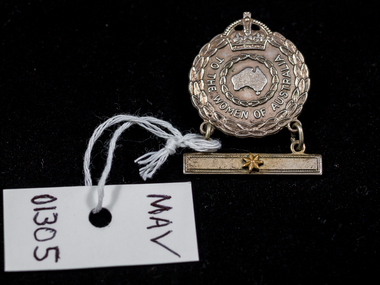
WW2 Medal for Women relatives of serving soldiers, 1942
... For active service abroad during the Second World War, a single badge was issued to the nearest female relative of members of the RAN, the Australian Imperial Force (including members of the Australian Army Nursing Service), and the Royal Australian Air Force. ...For active service abroad during the Second World War, a single badge was issued to the nearest female relative of members of the RAN, the Australian Imperial Force (including members of the Australian Army Nursing Service), and the Royal Australian Air Force. ...Female Relative Badges were issued to the nearest female relative (usually wives or mothers) of those who engaged in active service overseas during the First and Second World Wars. For active service abroad during the Second World War, a single badge was issued to the nearest female relative of members of the RAN, the Australian Imperial Force (including members of the Australian Army Nursing Service), and the Royal Australian Air Force. Stars displayed on a bar suspended below the badge represented the number of relatives involved in the war effort. Authority for the issue of the badge was given under AIF Order 200,14 February 1941. This medal was given to Veronica ( White ) Roper in 1942 because her husband Alfred William Roper was a member of the Australian Army Signals Corp serving in New Guinea. Emma Olymphia Roper of Balaclava/ Ripponlea would also have received a medal like this with 4 four stars because her 4 sons were serving in the Australian Army 1939-45 This Military Medal was given to the wives and mothers of Australian Soldiers serving during World War 2 1939-1945Silver medal, engraved wreath of leaves, crown and map of Australia and pin clasp on back . A bar with one star is suspendedAround medal : For the Women of Australia Back : Issued by the / C'wealth Govt. / A 135699 / Angus & Coote / 1942 Bar : star/ asteriskworld war 1939-1945, military medals, roper alfred william , roper veronica, moore joan catherine, roper arthur leopold, roper emma olymphia, war memorials, bentleigh, city of moorabbin, totally and permanently invalid, returned service league, victoria barracks, department of defence australia, -
 City of Moorabbin Historical Society (Operating the Box Cottage Museum)
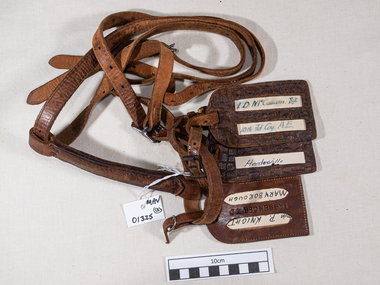
Leather, luggage straps and labels c1916, 20thC
... Australian Army. Originally formed in 1912 as a Militia formation, the brigade was re-raised in 1916 as part of the expansion of the Australian Imperial Force following the end of the Gallipoli campaign. ...Australian Army. Originally formed in 1912 as a Militia formation, the brigade was re-raised in 1916 as part of the expansion of the Australian Imperial Force following the end of the Gallipoli campaign. ...Leather straps were commonly used to secure cases and other forms of luggage when traveling. The labels enabled easy identification when collecting luggage from transport carriages, coaches, buses and trains. 10th Field Company, Australian Engineers WW1 1914-18. The 10th Brigade was an infantry brigade of the Australian Army. Originally formed in 1912 as a Militia formation, the brigade was re-raised in 1916 as part of the expansion of the Australian Imperial Force following the end of the Gallipoli campaign. It subsequently saw service on the Western Front in France and Belgium during the First World War. After the war it was disbanded but was re-raised in 1921 as a part-time formation based in the state of Victoria. During the Second World War the brigade was used in a garrison role in Australia before being disbanded in 1942.These leather straps and labels were attached to the luggage of an Australian soldier during early 20th C who may have been a resident or relative of a resident in City of MoorabbinLeather luggage straps with metal buckles and 3 luggage address labels attached.Label 1 - L.D.McCallum Sgt / 10th Fd Coy AE Label 2 - Healesville Label 3 - Maryborough leather, straps, belts, luggage labels, tools, saddles, wallets, personal effects, horses, drays, world war 1 1914 -18, world war 2 1939-45, army, 1st aif, military, 10th field company australian engineers, western front, france, belgium,
