
Showing 257 items matching "australian defences forces"
-
 Ballarat RSL Sub-Branch Inc.
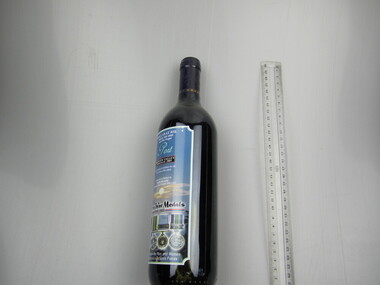
Port (Unopened Bottle) - "ANZAC Day 2009 Ballarat RSL Korea War Medals 1950-1953"
... A tribute to the Men and Women of Australia's Defence Forces...Ballarat RSL Sub-Branch Inc. 330 Heinz Lane Invermay Park goldfields Collectables Ballarat RSL Ballarat A tribute to the Men and Women of Australia's Defence Forces Port (Unopened Bottle) - "ANZAC Day 2009 Ballarat RSL Korea War Medals 1950-1953" ...A tribute to the Men and Women of Australia's Defence Forcescollectables, ballarat rsl, ballarat -
 Returned Nurses RSL Sub-branch
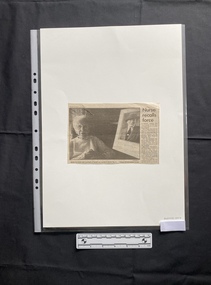
Newspaper - newspaper clipping, Regional News, Nurse recalls force, April 20 1993
... ...Australian Defences Forces...WWII World war two WW2 Australian Defences Forces Sunbury Broadmedows Camp Hospital Springvale Anzac Day A small newspaper clipping with one column of text and a large black and white photo of an older woman sitting next to a younger photo of her in nurse's uniform. ...Mrs Ivy Clyne, 94, was a nursing sister at the Heidelberg Repatriation Hospital and the Bendigo Base Hospital during World War Two. A small newspaper clipping with one column of text and a large black and white photo of an older woman sitting next to a younger photo of her in nurse's uniform.wwii, world war two, ww2, australian defences forces, sunbury, broadmedows camp hospital, springvale, anzac day -
 Frankston RSL Sub Branch
Uniform, Trouser
... Australian Defence Forces uniform worn by Australian personnel in Afghanistan. ...Frankston RSL Sub Branch 183 Cranbourne Road Frankston mornington-peninsula australian army uniform desert camouflague camouflague afghanistan Australian Defence Forces uniform worn by Australian personnel in Afghanistan. ...Australian Defence Forces uniform worn by Australian personnel in Afghanistan. This uniform is the 'Desert Camouflague' type and is a pair of long trousers. australian, army, uniform, desert camouflague, camouflague, afghanistan -
Frankston RSL Sub Branch
Uniform, Shirt
... Australian Defence Forces uniform worn by Australian personnel in Afghanistan. ...Frankston RSL Sub Branch 183 Cranbourne Road Frankston mornington-peninsula Australian Defence Forces uniform worn by Australian personnel in Afghanistan. ...Australian Defence Forces uniform worn by Australian personnel in Afghanistan. This uniform is the 'Desert Camouflague' type and is a shirt with long sleeves. -
 Flagstaff Hill Maritime Museum and Village
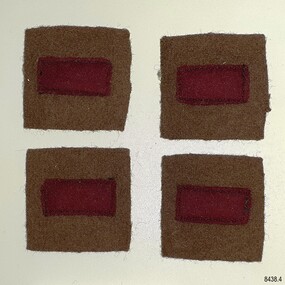
Badge - Australian Military cloth patch, Army Medical Corps, 108 Australian General Hospital, 1939-1945
... The badges date to the Second World War era, when Dr Angus was a Surgeon Captain for the Australian Defence Forces in the Army Medical Corps, 108 Australian General Hospital and 106 Australian General Hospital, stationed in Ballarat, Victoria, and in Bonegilla, N.S.W. ...Insignia of the Australian Defence Forces, Army Medical Corps, 108 Australian General Hospital, WWII era. ...Insignia of the Australian Defence Forces, Army Medical Corps, 108 Australian General Hospital, WWII era. ...The four cloth patches belonged to Dr William Roy Angus and are now part of Flagstaff Hill’s comprehensive W.R. Angus Collection, donated by the family of Dr W R Angus (1901-1970), surgeon and oculist. The badges date to the Second World War era, when Dr Angus was a Surgeon Captain for the Australian Defence Forces in the Army Medical Corps, 108 Australian General Hospital and 106 Australian General Hospital, stationed in Ballarat, Victoria, and in Bonegilla, N.S.W. He completed his service just before the end of the war due to suffering from a heart attack. In World War I the troops of the Australian Military Forces staked coloured flags of various shapes and colours in the ground where they camped to identify their units. These flag codes were quickly recognised. The system worked so well that miniature flags were called colour patches. They became part of the uniform, to be worn on both sleeves just below the shoulder. The system was slightly modified for use in the Second World War. The W.R. Angus Collection: - The W.R. Angus Collection includes historical medical equipment, surgical instruments and material belonging to Dr Edward Ryan and Dr Thomas Francis Ryan, (both of Nhill, Victoria) and Dr Angus’ own belongings. The Collection’s history spans the medical practices of the two Doctors Ryan, from 1885-1926 plus that of Dr Angus, up until 1969. It includes historical medical and surgical equipment and instruments from the doctors Edward and Thomas Ryan of Nhill, Victoria. Dr Angus married Gladys in 1927 at Ballarat, the nearest big city to Nhill where he began as a Medical Assistant. He was also Acting House surgeon at the Nhill hospital where their two daughters were born. During World War II He served as a Military Doctor in the Australian Defence Forces. Dr Angus and his family moved to Warrnambool in 1939, where Dr Angus operated his own medical practice. He later added the part-time Port Medical Officer responsibility and was the last person appointed to that position. Both Dr Angus and his wife were very involved in the local community, including the planning stages of the new Flagstaff Hill and the layout of the gardens there. Dr Angus passed away in March 1970.Dr W R Angus (1901-1970), surgeon and oculist, collected a range of military objects including those he personally used during his time as Surgeon Captain in the Australian Defence Forces in World War II. The objects allow insight into military life in the early-to-mid 20th century. The W.R. Angus Collection is significant for still being located at the site it is connected with, Doctor Angus being the last Port Medical Officer in Warrnambool. The Collection includes historical medical objects that date back to the late 1800s.Badges; set of four cloth patches, red rectangles on brown squares. Insignia of the Australian Defence Forces, Army Medical Corps, 108 Australian General Hospital, WWII era. Dr W R Angus owned the cloth patches that are now part of the W. R. Angus Collection.flagstaff hill, warrnambool, maritime village, maritime museum, shipwreck coast, great ocean road, flagstaff hill maritime museum and village, dr w r angus, w.r. angus collection, australian army, surgeon captain, ballarat, bonegilla, badge, insignia, badge collection, world war 2, second world war, australian defence forces, army medical corps, 108 australian general hospital, great war, military uniform, 106 australian general hospital, 1939-1945 -
 Flagstaff Hill Maritime Museum and Village
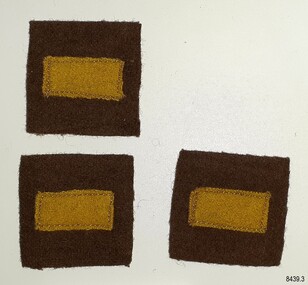
Badge - Australian Military cloth patch, Army Medical Corps, 106 Australian General Hospital, 1939-1945
... The badges date to the Second World War era, when Dr Angus was a Surgeon Captain for the Australian Defence Forces in the Army Medical Corps, 108 Australian General Hospital and 106 Australian General Hospital, stationed in Ballarat, Victoria, and in Bonegilla, N.S.W. ...Insignia of the Australian Defence Forces, Army Medical Corps, 106 Australian General Hospital, WII era. ...Insignia of the Australian Defence Forces, Army Medical Corps, 106 Australian General Hospital, WII era. ...The three cloth patches belonged to Dr William Roy Angus and are now part of Flagstaff Hill’s comprehensive W.R. Angus Collection, donated by the family of Dr W R Angus (1901-1970), surgeon and oculist. The badges date to the Second World War era, when Dr Angus was a Surgeon Captain for the Australian Defence Forces in the Army Medical Corps, 108 Australian General Hospital and 106 Australian General Hospital, stationed in Ballarat, Victoria, and in Bonegilla, N.S.W. He completed his service just before the end of the war due to suffering from a heart attack. In World War I the troops of the Australian Military Forces staked coloured flags of various shapes and colours in the ground where they camped to identify their units. These flag codes were quickly recognised. The system worked so well that miniature flags were called colour patches. They became part of the uniform, to be worn on both sleeves just below the shoulder. The system was slightly modified for use in the Second World War. The W.R. Angus Collection: - The W.R. Angus Collection includes historical medical equipment, surgical instruments and material belonging to Dr Edward Ryan and Dr Thomas Francis Ryan, (both of Nhill, Victoria) and Dr Angus’ own belongings. The Collection’s history spans the medical practices of the two Doctors Ryan, from 1885-1926 plus that of Dr Angus, up until 1969. It includes historical medical and surgical equipment and instruments from the doctors Edward and Thomas Ryan of Nhill, Victoria. Dr Angus married Gladys in 1927 at Ballarat, the nearest big city to Nhill where he began as a Medical Assistant. He was also Acting House surgeon at the Nhill hospital where their two daughters were born. During World War II He served as a Military Doctor in the Australian Defence Forces. Dr Angus and his family moved to Warrnambool in 1939, where Dr Angus operated his own medical practice. He later added the part-time Port Medical Officer responsibility and was the last person appointed to that position. Both Dr Angus and his wife were very involved in the local community, including the planning stages of the new Flagstaff Hill and the layout of the gardens there. Dr Angus passed away in March 1970.Dr W R Angus (1901-1970), surgeon and oculist, collected a range of military objects including those he personally used during his time as Surgeon Captain in the Australian Defence Forces in World War II. The objects allow insight into military life in the early-to-mid 20th century. The W.R. Angus Collection is significant for still being located at the site it is connected with, Doctor Angus being the last Port Medical Officer in Warrnambool. The Collection includes historical medical objects that date back to the late 1800s.Badges; set of three cloth patches, yellow rectangles on brown squares. Insignia of the Australian Defence Forces, Army Medical Corps, 106 Australian General Hospital, WII era. Dr W R Angus owned the cloth patches that are now part of the W. R. Angus Collection.flagstaff hill, warrnambool, maritime village, maritime museum, shipwreck coast, great ocean road, flagstaff hill maritime museum and village, dr w r angus, w.r. angus collection, australian army, surgeon captain, ballarat, bonegilla, badge, insignia, world war 1, 1914-1918, badge collection, world war 2, second world war, australian defence forces, army medical corps, 108 australian general hospital, great war, military uniform, 106 australian general hospital -
Frankston RSL Sub Branch
Uniform, Flying Jacket
... Standard Australian Defence Forces issue, lightweight flying jacket, khaki in colour. ...Frankston RSL Sub Branch 183 Cranbourne Road Frankston mornington-peninsula Standard Australian Defence Forces issue, lightweight flying jacket, khaki in colour. ...Standard Australian Defence Forces issue, lightweight flying jacket, khaki in colour. Made of woven Nylon, nomex lined and treated with fire retardant chemical. -
Frankston RSL Sub Branch
Compass
... Type Mark 3 black plated prismatic compass, standard issue to Australian Defence Forces personnel during the Vietnam conflict. ...Frankston RSL Sub Branch 183 Cranbourne Road Frankston mornington-peninsula Type Mark 3 black plated prismatic compass, standard issue to Australian Defence Forces personnel during the Vietnam conflict. ...Type Mark 3 black plated prismatic compass, standard issue to Australian Defence Forces personnel during the Vietnam conflict. This compass is complete with a leather pouch. Refer item 00002.1 and 00002.2 -
Frankston RSL Sub Branch
Gaiters, Webbing
... In general use by the Australian Defence Forces...Frankston RSL Sub Branch 183 Cranbourne Road Frankston mornington-peninsula In general use by the Australian Defence Forces vietnam army gaiters Size 4 (R and L) C.J.Martin Pty. ...In general use by the Australian Defence ForcesA new pair of Australian Army canvas gaiters painted black. Inside both is a manufacturers stamping in white ink. Each gaiter has a pair of buckles and straps on the side and a buckle and leather strap at the bottom that is fitted under the sole of the boot. On the inside bottom of both gaiters is a single metal tab and double bracket for the tab to slide into. http://cas.awm.gov.au/item/REL31609Size 4 (R and L) C.J.Martin Pty. Ltd 1967vietnam, army, gaiters -
 Ithacan Historical Society
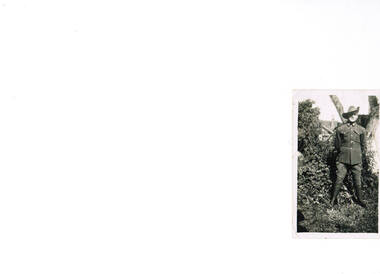
Photograph, WWII Australian soldier, 1940s
... During World War II many Australian born and naturalised Ithacan men joined the Australian defence forces....Ithacan Historical Society Ithaca House 329 Elizabeth Street Melbourne melbourne During World War II many Australian born and naturalised Ithacan men joined the Australian defence forces. Only naturalised Greek men were allowed to join the regular defence forces during World War 2. ...During World War II many Australian born and naturalised Ithacan men joined the Australian defence forces.A black and white photograph of a man in military uniform standing in a garden.Stamped on the back in black: 1 544armed forces, world war 2 -
 Wodonga & District Historical Society Inc
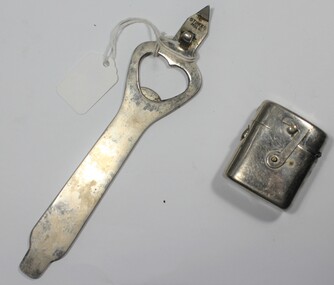
Memorabilia - Rat of Tobruk Arthur Lock's bottle opener and lighter
... These items were part of standard supplies and personal items issued to members of the Australian Defence Forces during World War 2....Wodonga & District Historical Society Inc Hut 97, Bonegilla Migrant Experience, 132 Bonegilla Road Bonegilla the-murray These items were part of standard supplies and personal items issued to members of the Australian Defence Forces during World War 2. This item is part of a collection of items owned by Arthur Lock, a member of the 2/23rd Battalion, an all-volunteer Second Australian Imperial Force which served as part of the garrison during the Siege of Tobruk, then at El Alamein, New Guinea and Borneo. ...These items were part of standard supplies and personal items issued to members of the Australian Defence Forces during World War 2.This item is part of a collection of items owned by Arthur Lock, a member of the 2/23rd Battalion, an all-volunteer Second Australian Imperial Force which served as part of the garrison during the Siege of Tobruk, then at El Alamein, New Guinea and Borneo. It has particular local significance as the battalion was know as "Albury's Own" because a large majority of the battalion's initial intake of volunteers came from the Albury–Wodonga region. A metal can/bottle opener and cigarette lighter. On Opener "STOKES /MELB"world war 11, rats of tobruk, tobruk -
 Greensborough Historical Society
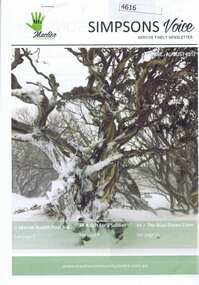
Newsletter, Simpsons Voice: Service Family Newsletter. June-August 2017, 01/06/2017
... Mactier Community Centre is a support organisation for members of the Australian Defence Forces and their families. This newsletter is aimed at families of servicemen posted to Simpson Barracks in Watsonia....Greensborough Historical Society 34A Glenauburn Road Lower Plenty Lower Plenty melbourne Mactier Community Centre is a support organisation for members of the Australian Defence Forces and their families. This newsletter is aimed at families of servicemen posted to Simpson Barracks in Watsonia. simpson barracks 24 pages, colour illus. ...Mactier Community Centre is a support organisation for members of the Australian Defence Forces and their families. This newsletter is aimed at families of servicemen posted to Simpson Barracks in Watsonia.24 pages, colour illus.simpson barracks -
 St Kilda Historical Society
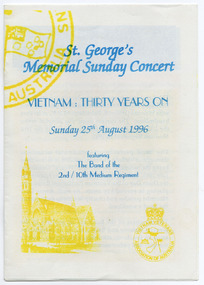
Ephemera - Program, St George's Memorial Sunday Concert 'Vietnam: Thirty Years On', 1996
... Program for a concert on 25 August 1996 at St George's Uniting Church, East St Kilda, in remembrance of Australian Defence Forces who served in Vietnam...St Kilda Historical Society St Kilda Branch Library 150 Carlisle Street St Kilda melbourne Program for a concert on 25 August 1996 at St George's Uniting Church, East St Kilda, in remembrance of Australian Defence Forces who served in Vietnam St George's East St Kilda Uniting Church 2/10 Medium Regiment Band Multi page brochure of folded white paper printed in blue and yellow. ...Program for a concert on 25 August 1996 at St George's Uniting Church, East St Kilda, in remembrance of Australian Defence Forces who served in VietnamMulti page brochure of folded white paper printed in blue and yellow.st george's east st kilda uniting church, 2/10 medium regiment band -
Frankston RSL Sub Branch
Kit, Spare Parts, 1942
... Spare parts kit for the Lamps Signalling Daylight used by the Australian defence forces during World War 2. A small dark green painted metal container with a hinging lid which contains parts and instructions, including three spare lamp bulbs. ...Frankston RSL Sub Branch 183 Cranbourne Road Frankston mornington-peninsula The container lid has the following inscription: "LAMPS SIGNALLING DAYLIGHT BOX SPARE PARTS MKII" and "PMG 1942" Spare parts kit for the Lamps Signalling Daylight used by the Australian defence forces during World War 2. A small dark green painted metal container with a hinging lid which contains parts and instructions, including three spare lamp bulbs. ...Spare parts kit for the Lamps Signalling Daylight used by the Australian defence forces during World War 2. A small dark green painted metal container with a hinging lid which contains parts and instructions, including three spare lamp bulbs. Within the container there is a smaller tinplate container with a lid which has electrical contacts and connectors. Refer item 00417The container lid has the following inscription: "LAMPS SIGNALLING DAYLIGHT BOX SPARE PARTS MKII" and "PMG 1942" -
 Melbourne Legacy
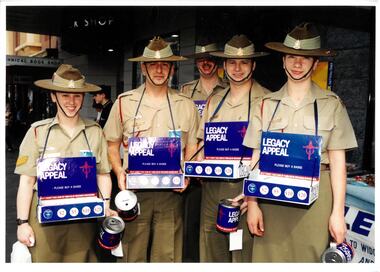
Photograph, Legacy Appeal 1999, 1999
... The students from Ivanhoe Grammar helped sell badges and members of the Australian Defence Forces. The photo of the school boys featured in a newsletter in October 1999....The students from Ivanhoe Grammar helped sell badges and members of the Australian Defence Forces. The photo of the school boys featured in a newsletter in October 1999. ...Two groups of badge sellers outside Legacy House for Badge Week in September. The students from Ivanhoe Grammar helped sell badges and members of the Australian Defence Forces. The photo of the school boys featured in a newsletter in October 1999.A record of fundraising for Badge Week.Colour photo x 2 of badge sellers outside Legacy House.00509.1 has P3 in pencil plus printing on the back "legacy appeal, fundraising, badge week, army, adf -
 Melbourne Legacy
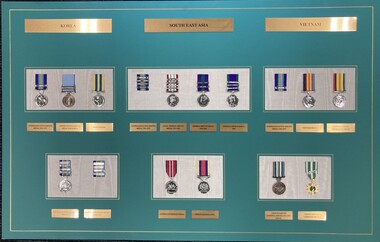
Medal, Korea / South East Asia / Vietnam Medals
... One of a series of four boards of mounted replica medals of the Australian Defence Forces. This board shows medals pertaining to conflicts including Korea and Vietnam. ...Melbourne Legacy 293 Swanston Street Melbourne melbourne One of a series of four boards of mounted replica medals of the Australian Defence Forces. This board shows medals pertaining to conflicts including Korea and Vietnam. ...One of a series of four boards of mounted replica medals of the Australian Defence Forces. This board shows medals pertaining to conflicts including Korea and Vietnam. The boards were on display in the Melbourne Legacy Foyer cabinets until June 2017.A record that Legacy holds some war memorabilia as Legatees were once solely returned servicemen.Replica medals from several conflicts mounted on silk inserts into green boards plus additional ribbons and bars.Title inscribed in brass plaques say: Korea, Australian Active Service Medal 1945-1975, United Nations Service Medal for Korea, Korea Medal South East Asia, Australian Active Service Medal 1945-1975, Naval General Service Medal 1915-1962, General Service Medal 1918-1962, General Service Medal 1962. Vietnam, Australian Active Service Medal 1945-1975, Vietnam Medal, Vietnam Logistic and Support Medal. Australian Service Medal 1945-1975 Australian Service Medal 1945-1975. Australian Defence Medal, Pingat Jasa Malaysia. Anniversary of National Service 1951-1975 Medal, South Vietnam Campaign Medal.medals, vietnam war, korean war, national service -
 Orbost & District Historical Society
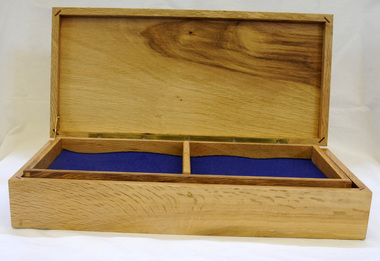
wooden box, McLean, Don, Just prior to January 2010
... The lid is single hinged. the front panel displays a radiating pattern in the grain of the oak wood that resembles the rising sun badge of the Australian Defence Forces. Two brass pins are symbols of Australian military regalia. ...The lid is single hinged. the front panel displays a radiating pattern in the grain of the oak wood that resembles the rising sun badge of the Australian Defence Forces. Two brass pins are symbols of Australian military regalia. ...This box was crafted from a portion of one of the original oak trees in the Jarrahmond WW11 Avenue of Honour.The Avenue was planted in 1955 and linked the farms of the two servicemen from Jarrahmond who lost their lives in WWII. It consisted of English Oaks interspersed with flowering peaches and cherries. Wood for the box was collected in the early 1990's by Stan Weatherall following a windstorm. Stan had the timber rough-sawn into planks by local sawmiller Max Reynolds. The timber was stored for a number of years before being given to Don McLean.A hand-made oak box. The inside base is lined in green felt. The lid is single hinged. the front panel displays a radiating pattern in the grain of the oak wood that resembles the rising sun badge of the Australian Defence Forces. Two brass pins are symbols of Australian military regalia. Inside the box is an envelope with information and letters on the manufacture of the box and presentation to Orbost. The information concerns the Jarrahmond School and the Avenue of Honour.handcraft oak jarrahmond-avenue-of-honour container -
 Bendigo Military Museum
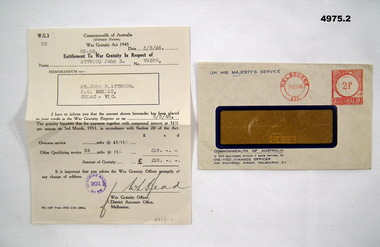
Financial record - ENTITLEMENT DOCUMENT WAR GRATUITY FOR ATTWOOD JOHN R V5920, Australian Army, c1939-1945
... Plain sheet of white paper from Commonwealth of Australia (Defence Forces). Printed with black ink. ...Plain sheet of white paper from Commonwealth of Australia (Defence Forces). Printed with black ink. This shows how many days Attwood served overseas and how many days for other qualifying service (24 months @ 15/-). 2. ...See Paybooks Cat 4967.21. Plain sheet of white paper from Commonwealth of Australia (Defence Forces). Printed with black ink. This shows how many days Attwood served overseas and how many days for other qualifying service (24 months @ 15/-). 2. Commonwealth Government Envelope, has a window with a rubber stamp for 2 1/2p, Franked Melbourne 7 May 45. On the rear is a wartime note - "Gossip is Sabotage".Rubber stamp - checking staff 3rd M.D. 201ww2, gratuity payments, documents -
 National Vietnam Veterans Museum (NVVM)
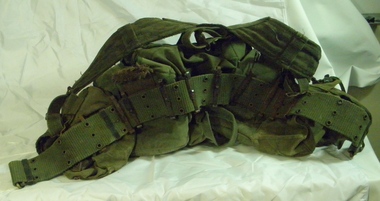
Functional object - Webbing, basic, Circa early 1960's
... Basic webbing was used by Australian Defence forces during the Vietnam War era (1962 - 1975) to carry personal equipment such as ammunition, water, basic rations, shelter usually on short duration operations such as patrols. ...National Vietnam Veterans Museum (NVVM) 25 Veterans Drive Newhaven phillip-island-and-the-bass-coast Basic webbing was used by Australian Defence forces during the Vietnam War era (1962 - 1975) to carry personal equipment such as ammunition, water, basic rations, shelter usually on short duration operations such as patrols. ...Basic webbing was used by Australian Defence forces during the Vietnam War era (1962 - 1975) to carry personal equipment such as ammunition, water, basic rations, shelter usually on short duration operations such as patrols. Basic webbing was a classic and iconic item of equipment universally used by servicemen in Vietnam.Army basic webbing set. Jungle green colour and made of canvas. Consisting of a webbing belt, 2 ammunition pouches, 1 water bottle cover, a shoulder harness and a patrol bag.The name 'A Kelly' on the front and the name 'Ceskus. 6102716 on the back.basic webbing, vietnam war, military equipment, webbing -
 Melbourne Legacy
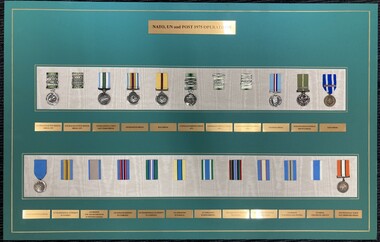
Medal, NATO, UN and Post 1975 Operations Medals, c2000
... One of a series of four boards of mounted replica medals of the Australian Defence Forces. This board shows medals pertaining to conflicts and operations post 1975 including those supporting the United Nations in several countries. ...Melbourne Legacy 293 Swanston Street Melbourne melbourne One of a series of four boards of mounted replica medals of the Australian Defence Forces. This board shows medals pertaining to conflicts and operations post 1975 including those supporting the United Nations in several countries. ...One of a series of four boards of mounted replica medals of the Australian Defence Forces. This board shows medals pertaining to conflicts and operations post 1975 including those supporting the United Nations in several countries. The boards were on display in the Melbourne Legacy Foyer cabinets until June 2017.A record that Legacy holds some war memorabilia as Legatees were once solely returned servicemen.Replica medals, ribbons and bars from several conflicts and operations post 1975 mounted on silk inserts into green boards plus additional ribbons and bars.Title inscribed in brass plaques say: Australian Active Service Medal 1975, Australian Active Service Medal 1975, International Force East Timor Medal, Afghanistan Medal, Iraq Medal, Australian Service Medal 1975, Australian Service Medal 1975, Australian Service Medal 1975, Rhodesia Medal, Humanitarian Overseas Service Medal, NATO Medal. UN Headquarters Medal, UN Transitional Authority in Namibia, UN Mission for the referendum in Western Sahara, UN Advance Mission in Cambodia. UN Transitional Authority in Cambodia, UN Operation in Somalia, UN operation in Mozambique, UN Assistance in Rwanda, UN Assistance in East Timor, UN Mission in Ethiopia and Eritrea, UN Medal for Special Service and Multinational Force and Observers Medal.medals, united nations -
 Ithacan Historical Society
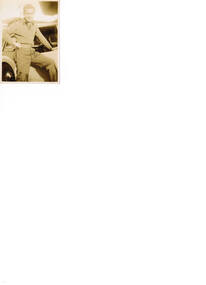
Photograph, Michael Black, soldier, 1942
... During WWII young Ithacan Greek men living in Australia enlisted with the Australian Defence Forces in various capacities. Michael was president of the Ithacan Philanthropic Society from 1981 - 1985. ...During WWII young Ithacan Greek men living in Australia enlisted with the Australian Defence Forces in various capacities. Michael was president of the Ithacan Philanthropic Society from 1981 - 1985. ...Michael Black (Mavrokefalos) is the soldier photographed leaning against the car. During WWII young Ithacan Greek men living in Australia enlisted with the Australian Defence Forces in various capacities. Michael was president of the Ithacan Philanthropic Society from 1981 - 1985. He was married to Vicki Black (nee Raftopoulos). Young Ithacan born men who were unnaturalised were recruited into the Civilian Military Forces as 'Allied Aliens' and served the war effort on the home front. Naturalised Ithacans saw active service.A black and white photograph of a man dressed in army trousers, webbed belt and jumper standing beside a motor vehicle.world war 2 -
 Ithacan Historical Society
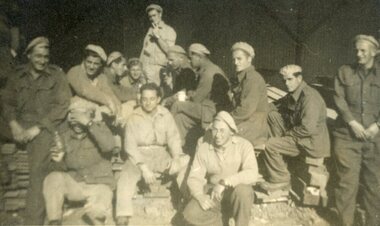
Photograph, WW2 Australian Defence Forces - Allied Aliens, 1940s
... Many young men, both Ithacan born and Australian born of Ithacan descent joined the Australian Defence Forces in various capacities during World War 2. ...Ithacan Historical Society Ithaca House 329 Elizabeth Street Melbourne melbourne Many young men, both Ithacan born and Australian born of Ithacan descent joined the Australian Defence Forces in various capacities during World War 2. ...Many young men, both Ithacan born and Australian born of Ithacan descent joined the Australian Defence Forces in various capacities during World War 2. Pictured is a group of army recruits to the Civilian Military Forces with a young Stathi Raftopoulos seated in the centre - he is the only one not wearing a cap.Ithacans who were not naturalised were recruited to the Civilian Military Forces as 'Allied Aliens'.A black and white photograph of thirteen men inn army uniform sitting and relaxing in a shed. -
 Warrnambool and District Historical Society Inc.
Pith Helmet, Royal Australian Navy, 1930s
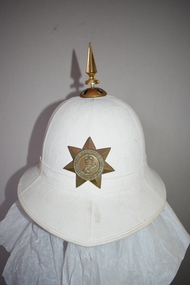
... Australian Navy in the early to mid 20th century. The Commonwealth Naval Forces were formed after Federation in 1901 and became known as the Royal Australian Navy in 1911. Pith helmets are now used only in the Australian Defence...Australian Navy in the early to mid 20th century. The Commonwealth Naval Forces were formed after Federation in 1901 and became known as the Royal Australian Navy in 1911. Pith helmets are now used only in the Australian Defence ...This helmet has been used by a member of the Royal Australian Navy in the early to mid 20th century. The Commonwealth Naval Forces were formed after Federation in 1901 and became known as the Royal Australian Navy in 1911. Pith helmets are now used only in the Australian Defence Forces for ceremonial purposes. No information is available on A.B. Pollock.This helmet is retained for display purposes.This helmet is made of white material with a six-segmented crown and a peak and back covering. In the centre of the crown is a dome with three breathing holes. On top of the dome is an ornamental gold-coloured metal finial. The edge of the crown has a band of white fabric and in the centre of this is a metal badge with a crown, anchor and seven stars and the wording ‘Royal Australian Navy’. Inside, the helmet has a leather rim with an adjustable leather string with brass clips (one missing). Inside, the breathing holes are made of brass and the metal rotates to open or close the holes. Inside also are the size of the helmet, the owner’s name and some other indecipherable information Royal Australian Navy A.B.Pollock 6⅞ vintage headwear, royal australian navy, history of warrnambool -
 Bendigo Military Museum
Document - Defence Compulsory Acquisition of "Fortuna" and adjoining properties 1942-1953, Australian Army, Department of the Interior, 19 May 1942 - 20 Jan 1953
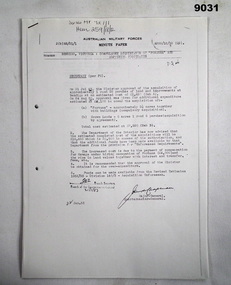
... Australian Military Forces. Documents dated 1942-1953. This was very important as this land and buildings were used as the home of the Army Survey Regiment from 1942 until 1996 and housed the Australian Defence Forces Mapping capability during WWII and beyond....Australian Military Forces. Documents dated 1942-1953. This was very important as this land and buildings were used as the home of the Army Survey Regiment from 1942 until 1996 and housed the Australian Defence Forces Mapping capability during WWII and beyond. ...Numerous A4 photocopies of Minutes, letters and memorandums pertaining to the compulsory acquisition of the Bendigo property known as "Fortuna" and adjoining properties by the Australian Military Forces. Documents dated 1942-1953. This was very important as this land and buildings were used as the home of the Army Survey Regiment from 1942 until 1996 and housed the Australian Defence Forces Mapping capability during WWII and beyond.22 x unnumbered page A4 Defence Minute stapled top LH Corner, black and white photocopies of the original Minute.Numerous hand written signatures and handwritten small notesroyal australian survey corps, rasvy, fortuna, army survey regiment, army svy regt, asr -
 Bendigo Military Museum
Document - Royal Australian Survey Corps - Review of Civil Recognition of Defence Force Training, ACTAID PTY LTD, June 1993
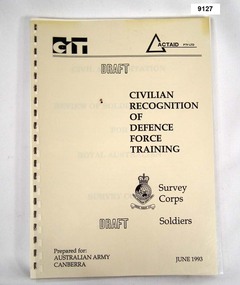
... Acccredation Guidelines. 3. Australian Defence Forces Training Systems. 4. Matching ADF Training Systems Against Criteria for Accreditation. 5. ...Acccredation Guidelines. 3. Australian Defence Forces Training Systems. 4. Matching ADF Training Systems Against Criteria for Accreditation. 5. ...The purpose of this document is to establish and recommendthe civilian equivalence of the RASvy trades. The following chapters are Executive Summary of Trades. 1. The Background and the Assesment Team. 2. Acccredation Guidelines. 3. Australian Defence Forces Training Systems. 4. Matching ADF Training Systems Against Criteria for Accreditation. 5. Army Careers and Courses. 6.RASvy Corps - Soldiers trades and special courses.71 Numbered and unnumbered pages with clear plastic front and Black plastic rear cover.rasvy, fortuna, army svy regt, royal australian survey corps, army survey regiment -
 Ithacan Historical Society
Photograph, John and Dennis Black, 1954
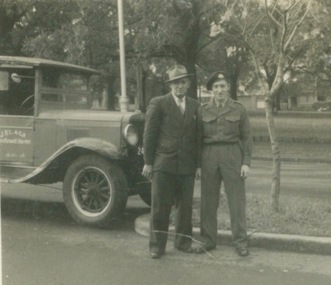
... John Black is photographed with his son Dennis, who is wearing the uniform of the Australian Defence Forces as the photograph was taken in 1954, he may have been doing National Service at the time. ...Ithacan Historical Society Ithaca House 329 Elizabeth Street Melbourne melbourne John Black is photographed with his son Dennis, who is wearing the uniform of the Australian Defence Forces as the photograph was taken in 1954, he may have been doing National Service at the time. ...John Black is photographed with his son Dennis, who is wearing the uniform of the Australian Defence Forces as the photograph was taken in 1954, he may have been doing National Service at the time. From 1951 to 1959, all young 18 year old men were required to do compulsory National Service. They did 176 days of recruit training followed by 5 years of military service as a reservist.A non-digital scanned black and white photograph of two men, one dressed in Australian Army uniform, are standing beside a Chevrolet truck, which is parked in a suburban street. john black, dennis black, national service, ithaca -
 Melbourne Legacy
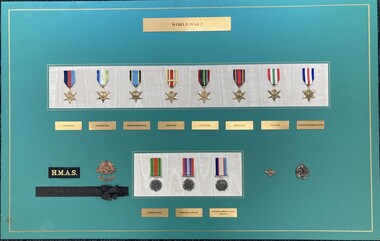
Medal, World War 2, c2000
... One of a series of four boards of mounted replica medals of the Australian Defence Forces. This board shows medals pertaining to World War 2. ...Melbourne Legacy 293 Swanston Street Melbourne melbourne One of a series of four boards of mounted replica medals of the Australian Defence Forces. This board shows medals pertaining to World War 2. ...One of a series of four boards of mounted replica medals of the Australian Defence Forces. This board shows medals pertaining to World War 2. Replicas include different campaign stars and the Defence Medal and Active Service Medal. There is a cloth patch embroidered 'H.M.A.S.' and cap band from HMAS Sydney. The Rising Sun badge and badges for Return from Active Service and a RAAF emblem. The text reproduced at the base accompanied the WW1 memorial plaques. The boards were on display in the Melbourne Legacy Foyer cabinets until June 2017.A record that Legacy holds some war memorabilia as Legatees were once solely returned servicemen.Replica medals from World War 2 mounted on silk inserts into green boards plus additional badges and cap band.Title inscribed in brass plaques say World War 2, 1939-1945 Star, Atlantic Star, Air Crew Europe Star, Africa Star, Pacific Star, Burma Star, Italy Star, France and Germany Star, Defence Medal, War Medal 1939-1945, and Australia Service Medal 1939-1945. Cloth badge embroidered 'H.M.A.S.' and a black cap band embossed 'H.M.A.S. Sydney'.medals, world war two -
 4th/19th Prince of Wales's Light Horse Regiment Unit History Room
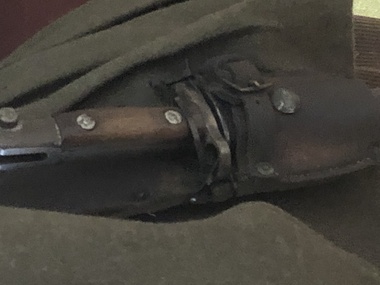
Weapon - Bayonet, Scabbard and Pattern 1892 Bayonet Frog, Bayonet, Scabbard and Pattern 1892 Bayonet Frog on Sam Brown Belt on Jack's mannequin
... This type of bayonet was used by infantry Rifle Regiments of the British Army and by Infantry Battalions of the Australian State Defence Forces in the 1890's; then by some infantry battalions of the Australian Army especially in a ceremonial role...4th/19th Prince of Wales's Light Horse Regiment Unit History Room 4/19 PWLH Regiment, Building 78 Simpson Barracks Macleod melbourne This type of bayonet was used by infantry Rifle Regiments of the British Army and by Infantry Battalions of the Australian State Defence Forces in the 1890's; then by some infantry battalions of the Australian Army especially in a ceremonial role There is no record found of this type bayonet frog in use by 4th/17th/19th Light Horse Regiments. ...This type of bayonet was used by infantry Rifle Regiments of the British Army and by Infantry Battalions of the Australian State Defence Forces in the 1890's; then by some infantry battalions of the Australian Army especially in a ceremonial roleThere is no record found of this type bayonet frog in use by 4th/17th/19th Light Horse Regiments. Use by VMR (the colonial predecessor to 4th/17th/19th Light Horse Regiments) is unlikely. Bayonet, Scabbard and Pattern 1892 Bayonet Frog on Sam Brown Belt on Jack's mannequin. Bayonet frog made of 'buff' leather, and stained brown on the front. Hand stitched with reinforcing tin plated copper rivetsold hand writing illegiblebayonet frog 1892 1888 buff leather, bayonet and scabbard of usual materials, -
 Melbourne Legacy
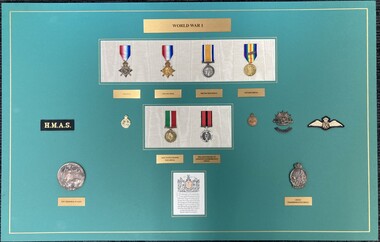
Medal, World War 1
... One of a series of four boards of mounted replica medals of the Australian Defence Forces. This board shows medals pertaining to World War 1. ...Melbourne Legacy 293 Swanston Street Melbourne melbourne One of a series of four boards of mounted replica medals of the Australian Defence Forces. This board shows medals pertaining to World War 1. ...One of a series of four boards of mounted replica medals of the Australian Defence Forces. This board shows medals pertaining to World War 1. Replicas include the 1914 Star, 1914-1915 Star, British War Medal, Victory Medal, Mercantile Marine War Medal, 80th Anniversary of Armistice Remembrance Medal. Also a WW1 Memorial Plaque and Anzac Commemorative Medal. There is a cloth patch embroidered 'H.M.A.S.' and one with embroidered Air Force wings from the Australian Flying Corps. The text reproduced at the base accompanied the WW1 memorial plaques. The boards were on display in the Melbourne Legacy Foyer cabinets until June 2017.A record that Legacy holds some war memorabilia as Legatees were once solely returned servicemen.Replica medals from World War 1 mounted on silk inserts into green boards plus additional badges and medallions.Title inscribed in brass plaques say World War 1, 1914 Star, 1914-1915 Star, British War Medal, Victory Medal, Mercantile Marine War Medal, 80th Anniversary of Armistice Remembrance Medal, WW1 Memorial Plaque and Anzac Commemorative Medal. Cloth badge embroidered 'H.M.A.S.' and one 'AFC'.world war one, medals -
National Vietnam Veterans Museum (NVVM)
Medal, Anniversary of National Service 1951-1972, 2001
... Emblem on front represents the Australian defence forces with the crossed swords of the Army at the forefront. ...Emblem on front represents the Australian defence forces with the crossed swords of the Army at the forefront. ...Bronze Anniversary of national Service medal and miniature on striped ribbons: central yellow and blue stripes ( Australia's national colours of the era), white, green, and pale blue stripes ( represent Navy, Army Air Force) ochre edge for the soil of Australia. Emblem on front represents the Australian defence forces with the crossed swords of the Army at the forefront. Around the outer edge are the words "ANNIVERSARY OF NATIONAL SERVICE 1951-1972". The reverse side has a stylised cog with the Southern Cross Stars over it to represent the cooperation between the machinery of the armed forces and the people of Australia. These medals were introduced in 2001. Accompanied by covering letter addressed to NE Swainston and dated '4 May 2011', the set is completed by the original hard black plastic box in white card slipcase.'3801127 N E Swainston' engraved around bottom edge of large medal.medal, national service - australia
