
Showing 117 items matching "australian fashion - 1970s"
-
 Kew Historical Society Inc
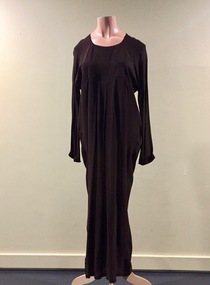
Clothing - Long Brown Crepe Evening Dress, Bow + Arrow, 1990s
... ...australian fashion - 1970s...Australian and/or international fashion designers. The McIntyre Collection is significant historically and artistically as it includes examples of design that demonstrate changing tastes in fashion over an 80-year period. The collection is also significant in that it includes the work of a large number of Melbourne designers from the 1960s to the 1990s. bow + arrow evening wear evening dresses australian fashion - 1970s mcintyre collection annie mcintyre Label: BOW + ARROW Long sleeve brown crepe day dress with matching belt of a contrasting colour. ...The Fashion & Design collection of the Kew Historical Society includes examples of women’s, men’s, children’s and infants’ clothing from the 18th, 19th and 20th centuries. Items in the collection were largely produced for, or purchased by women in Melbourne, and includes examples of outerwear, protective wear, nightwear, underwear and costume accessories. This dress, made by Bow+Arrow, and donated by Annie McIntyre, is part of the McIntyre Collection.The McIntyre Collection of clothing and clothing accessories forms one of the largest single donations to our Fashion & Design collection. It includes clothing and clothing accessories worn by four women in the Cohen and McIntyre families across three generations. The items worn by Melbourne architect, and Kew resident, Dione McIntyre date from the 1960s and 1970s, and include evening wear, day wear, hats and shoes. As Dione McIntyre often accompanied her husband, fellow architect Peter McIntyre, to formal events, there are a number of pieces of evening wear among the items. The McIntyre Collection also includes items worn by women of an earlier generation: by Lilian Cohen, Dione McIntyre's mother, and by her mother-in-law, the wife of the architect Robert McIntyre. At the other end of the chronological spectrum are a number of outfits belonging to, worn and donated by Annie McIntyre. These include outfits created by notable late 20th century Australian and/or international fashion designers. The McIntyre Collection is significant historically and artistically as it includes examples of design that demonstrate changing tastes in fashion over an 80-year period. The collection is also significant in that it includes the work of a large number of Melbourne designers from the 1960s to the 1990s. Long sleeve brown crepe day dress with matching belt of a contrasting colour. The round necked dress has a high waist and soft pleated skirtLabel: BOW + ARROWbow + arrow, evening wear, evening dresses, australian fashion - 1970s, mcintyre collection, annie mcintyre -
 Kew Historical Society Inc
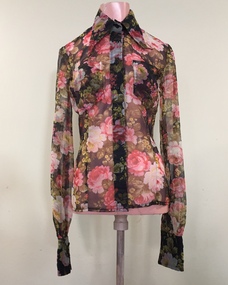
Clothing - Floral Polyester Blouse, 1970s
... ...australian fashion - 1970s...Australian and/or international fashion designers. The McIntyre Collection is significant historically and artistically as it includes examples of design that demonstrate changing tastes in fashion over an 80-year period. The collection is also significant in that it includes the work of a large number of Melbourne designers from the 1960s to the 1990s. women's clothing blouses mcintyre collection australian fashion - 1970s Multicoloured long sleeve fitted floral polyester shirt. ...The Fashion & Design collection of the Kew Historical Society includes examples of women’s, men’s, children’s and infants’ clothing from the 18th, 19th and 20th centuries. Items in the collection were largely produced for, or purchased by women in Melbourne, and includes examples of outerwear, protective wear, nightwear, underwear and costume accessories. This blouse is one of a number of items donated to the Fashion Collection by Dione McIntyre.The McIntyre Collection of clothing and clothing accessories forms one of the largest single donations to our Fashion & Design collection. It includes clothing and clothing accessories worn by four women in the Cohen and McIntyre families across three generations. The items worn by Melbourne architect, and Kew resident, Dione McIntyre date from the 1960s and 1970s, and include evening wear, day wear, hats and shoes. As Dione McIntyre often accompanied her husband, fellow architect Peter McIntyre, to formal events, there are a number of pieces of evening wear among the items. The McIntyre Collection also includes items worn by women of an earlier generation: by Lilian Cohen, Dione McIntyre's mother, and by her mother-in-law, the wife of the architect Robert McIntyre. At the other end of the chronological spectrum are a number of outfits belonging to, worn and donated by Annie McIntyre. These include outfits created by notable late 20th century Australian and/or international fashion designers. The McIntyre Collection is significant historically and artistically as it includes examples of design that demonstrate changing tastes in fashion over an 80-year period. The collection is also significant in that it includes the work of a large number of Melbourne designers from the 1960s to the 1990s. Multicoloured long sleeve fitted floral polyester shirt. The fabric design includes pink roses and chrysanthemums contrasted with yellow leaves and small yellow flowers. The cuffed sleeves are extended to allow them to be bunched when worn.women's clothing, blouses, mcintyre collection, australian fashion - 1970s -
 Kew Historical Society Inc
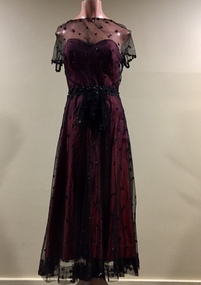
Clothing - Silk Taffeta & Lace Cocktail Dress, c.1960
... ...australian fashion - 1970s...This cocktail dress is one of a number of items donated to the Fashion Collection by Marion Blatchley. women's clothing australian fashion - 1970s cocktail dresses Plum coloured silk taffeta underdress with a black sequinned overdress and belt. ...The Fashion & Design collection of the Kew Historical Society includes examples of women’s, men’s, children’s and infants’ clothing from the 18th, 19th and 20th centuries. Items in the collection were largely produced for, or purchased by women in Melbourne, and includes examples of outerwear, protective wear, nightwear, underwear and costume accessories. This cocktail dress is one of a number of items donated to the Fashion Collection by Marion Blatchley.Plum coloured silk taffeta underdress with a black sequinned overdress and belt.women's clothing, australian fashion - 1970s, cocktail dresses -
 Kew Historical Society Inc
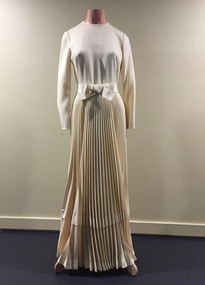
Clothing - Evening Dress, Simona Couture, 1970s
... ...australian fashion - 1970s...Australian and/or international fashion designers. The McIntyre Collection is significant historically and artistically as it includes examples of design that demonstrate changing tastes in fashion over an 80-year period. The collection is also significant in that it includes the work of a large number of Melbourne designers from the 1960s to the 1990s. mcintyre collection evening wear women's clothing australian fashion - 1970s simona couture Label: Simona Couture Cream coloured long sleeve evening gown with cross-grain same colour trim and belt. ...Evening dress owned and donated by Kew architect, and Life Member of the Kew Historical Society, Dione McIntyre. The dress was created by the Sydney company Simona Couture, founded 1963 by Inge Fonagy. Inge Fonagy trained in Switzerland and migrated to Australia in 1950. The chief designer of the company from the late 1960s was her son, John Recek. The fashion house won a number of awards including: David Jones' Supreme Award for Fashion Excellence (1972); David Jones Award for High Grade Fashion (1972); and David Jones Award for Pret-a-porter (1973),The McIntyre Collection of clothing and clothing accessories forms one of the largest single donations to our Fashion & Design collection. It includes clothing and clothing accessories worn by four women in the Cohen and McIntyre families across three generations. The items worn by Melbourne architect, and Kew resident, Dione McIntyre date from the 1960s and 1970s, and include evening wear, day wear, hats and shoes. As Dione McIntyre often accompanied her husband, fellow architect Peter McIntyre, to formal events, there are a number of pieces of evening wear among the items. The McIntyre Collection also includes items worn by women of an earlier generation: by Lilian Cohen, Dione McIntyre's mother, and by her mother-in-law, the wife of the architect Robert McIntyre. At the other end of the chronological spectrum are a number of outfits belonging to, worn and donated by Annie McIntyre. These include outfits created by notable late 20th century Australian and/or international fashion designers. The McIntyre Collection is significant historically and artistically as it includes examples of design that demonstrate changing tastes in fashion over an 80-year period. The collection is also significant in that it includes the work of a large number of Melbourne designers from the 1960s to the 1990s. Cream coloured long sleeve evening gown with cross-grain same colour trim and belt. The skirt features heat-treated sunray pleats.Label: Simona Couturemcintyre collection, evening wear, women's clothing, australian fashion - 1970s, simona couture -
 Kew Historical Society Inc
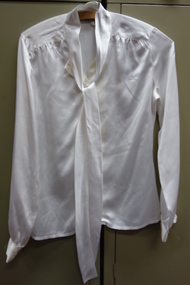
Clothing - White Satin Polyester Blouse, Den Bru, 1970s
... ...australian fashion -- 1970s...Items in the collection were largely produced for, or purchased by women in Melbourne, and includes examples of outerwear, protective wear, nightwear, underwear and costume accessories. den bru women's clothing australian fashion -- 1970s blouses Label: Den Bru Faux satin white polyester long sleeved blouse with attached scarf at neck. ...The Fashion & Design collection of the Kew Historical Society includes examples of women’s, men’s, children’s and infants’ clothing from the 18th, 19th and 20th centuries. Items in the collection were largely produced for, or purchased by women in Melbourne, and includes examples of outerwear, protective wear, nightwear, underwear and costume accessories.Faux satin white polyester long sleeved blouse with attached scarf at neck.Label: Den Bruden bru, women's clothing, australian fashion -- 1970s, blouses -
 Kew Historical Society Inc
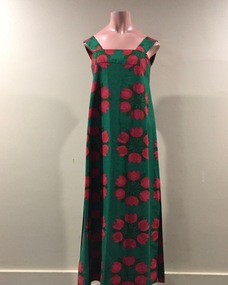
Clothing - Green Cotton Summer Dress with Pink Tulip Pattern, Allen Gaye, 1970s
... ...australian fashion - 1970s...Australian and/or international fashion designers. The McIntyre Collection is significant historically and artistically as it includes examples of design that demonstrate changing tastes in fashion over an 80-year period. The collection is also significant in that it includes the work of a large number of Melbourne designers from the 1960s to the 1990s. allen gaye women's clothing australian fashion - 1970s mcintyre collection day wear Label: Allen Gaye Long dark green sun dress with a pink tulip pattern. ...The Fashion & Design collection of the Kew Historical Society includes examples of women’s, men’s, children’s and infants’ clothing from the 18th, 19th and 20th centuries. Items in the collection were largely produced for, or purchased by women in Melbourne, and includes examples of outerwear, protective wear, nightwear, underwear and costume accessories. This dress is one of a number of items donated to the Fashion Collection by Dione McIntyre.The McIntyre Collection of clothing and clothing accessories forms one of the largest single donations to our Fashion & Design collection. It includes clothing and clothing accessories worn by four women in the Cohen and McIntyre families across three generations. The items worn by Melbourne architect, and Kew resident, Dione McIntyre date from the 1960s and 1970s, and include evening wear, day wear, hats and shoes. As Dione McIntyre often accompanied her husband, fellow architect Peter McIntyre, to formal events, there are a number of pieces of evening wear among the items. The McIntyre Collection also includes items worn by women of an earlier generation: by Lilian Cohen, Dione McIntyre's mother, and by her mother-in-law, the wife of the architect Robert McIntyre. At the other end of the chronological spectrum are a number of outfits belonging to, worn and donated by Annie McIntyre. These include outfits created by notable late 20th century Australian and/or international fashion designers. The McIntyre Collection is significant historically and artistically as it includes examples of design that demonstrate changing tastes in fashion over an 80-year period. The collection is also significant in that it includes the work of a large number of Melbourne designers from the 1960s to the 1990s. Long dark green sun dress with a pink tulip pattern.Label: Allen Gayeallen gaye, women's clothing, australian fashion - 1970s, mcintyre collection, day wear -
 Kew Historical Society Inc
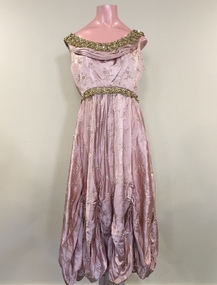
Clothing - Beaded and Sequinned Pink Satin Cocktail Dress, 1950s
... ...australian fashion - 1970s...This cocktail dress is one of a number of items donated to the collection by Rosemary-Vaughan Smith. women's clothing australian fashion - 1970s evening wear cocktail dresses rosemary vaughan-smith Pale pink satin embroidered evening dress with ruched hem and heavy gold braid. ...The Fashion & Design collection of the Kew Historical Society includes examples of women’s, men’s, children’s and infants’ clothing from the 18th, 19th and 20th centuries. Items in the collection were largely produced for, or purchased by women in Melbourne, and includes examples of outerwear, protective wear, nightwear, underwear and costume accessories. This cocktail dress is one of a number of items donated to the collection by Rosemary-Vaughan Smith.Pale pink satin embroidered evening dress with ruched hem and heavy gold braid.women's clothing, australian fashion - 1970s, evening wear, cocktail dresses, rosemary vaughan-smith -
 Kew Historical Society Inc
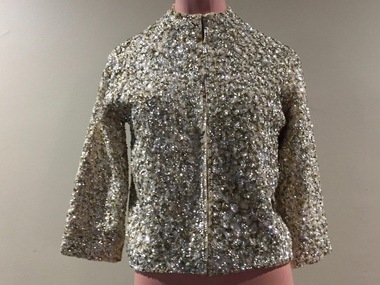
Clothing - Gold Satin & Sequin Evening Jacket, 1970s
... australian fashion -- 1970s...Items in the collection were largely produced for, or purchased by women in Melbourne, and includes examples of outerwear, protective wear, nightwear, underwear and costume accessories.This sequinned evening jacket is one of a number of items donated to the collection by Rosemary Vaughan-Smith. australian fashion -- 1970s evening wear evening jackets rosemary vaughan-smith Evening jacket heavily embroidered with gold sequins. ...The Fashion & Design collection of the Kew Historical Society includes examples of women’s, men’s, children’s and infants’ clothing from the 18th, 19th and 20th centuries. Items in the collection were largely produced for, or purchased by women in Melbourne, and includes examples of outerwear, protective wear, nightwear, underwear and costume accessories.This sequinned evening jacket is one of a number of items donated to the collection by Rosemary Vaughan-Smith.Evening jacket heavily embroidered with gold sequins.australian fashion -- 1970s, evening wear, evening jackets, rosemary vaughan-smith -
 Kew Historical Society Inc
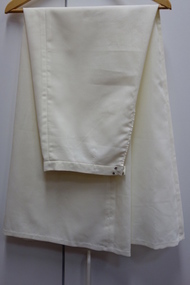
Clothing - A-Line, Cream Cotton Skirt, 1970s
... australian fashion -- 1970s...Australian and/or international fashion designers. The McIntyre Collection is significant historically and artistically as it includes examples of design that demonstrate changing tastes in fashion over an 80-year period. The collection is also significant in that it includes the work of a large number of Melbourne designers from the 1960s to the 1980s. australian fashion -- 1970s a-line skirts mcintyre collection dione mcintyre Long A-line cream coloured skirt. ...The Fashion & Design collection of the Kew Historical Society includes examples of women’s, men’s, children’s and infants’ clothing from the 18th, 19th and 20th centuries. Items in the collection were largely produced for, or purchased by women in Melbourne, and includes examples of outerwear, protective wear, nightwear, underwear and costume accessories. This skirt is one of a number of items donated to the Fashion Collection by Dione McIntyre.The McIntyre Collection of clothing and clothing accessories forms one of the largest single donations to our Fashion & Design collection. It includes clothing and clothing accessories worn by four women in the Cohen and McIntyre families across three generations. The items worn by Melbourne architect, and Kew resident, Dione McIntyre date from the 1960s and 1970s, and include evening wear, day wear, hats and shoes. As Dione McIntyre often accompanied her husband, fellow architect Peter McIntyre, to formal events, there are a number of pieces of evening wear among the items. The McIntyre Collection also includes items worn by women of an earlier generation: by Lilian Cohen, Dione McIntyre's mother, and by her mother-in-law, the wife of the architect Robert McIntyre. At the other end of the chronological spectrum are a number of outfits belonging to, worn and donated by Annie McIntyre. These include outfits created by notable late 20th century Australian and/or international fashion designers. The McIntyre Collection is significant historically and artistically as it includes examples of design that demonstrate changing tastes in fashion over an 80-year period. The collection is also significant in that it includes the work of a large number of Melbourne designers from the 1960s to the 1980s. Long A-line cream coloured skirt.australian fashion -- 1970s, a-line skirts, mcintyre collection, dione mcintyre -
 Kew Historical Society Inc
Archive (Sub-series) - Subject File, Grace James et al, JAMES, Grace, 2006
... australian fashion - 1960s...australian fashion - 1970s...Typically files will contain primary and secondary sources. dressmakers - surrey hills (vic) grace james australian fashion - 1960s australian fashion - 1970s women's clothing Archive file containing a letter from Grace James (2006) recording the clothing she made since the 1960s for her daughter Ceri, at the time of the donation of the collection to the Society. ...Various partiesReference, Research, InformationSecondary Values (KHS Imposed Order)Subject file containing a letter from Grace James (2006) recording the clothing she made since the 1960s for her daughter Ceri, at the time of the donation of the collection to the Society. The letter records Grace James’ address as 4/1 Belmont Street, Surrey Hills VIC 3127. The list with the letter itemises the 14 items of clothing made by Grace James. The envelope in which the letter was sent also includes a description of three other items dating from the first half of the 20th century, which had been owned by relatives of Mrs James. There is a newspaper article/clipping in the files about her 90th birthday at Camberwell Green.dressmakers - surrey hills (vic), grace james, australian fashion - 1960s, australian fashion - 1970s, women's clothingdressmakers - surrey hills (vic), grace james, australian fashion - 1960s, australian fashion - 1970s, women's clothing -
 Kew Historical Society Inc
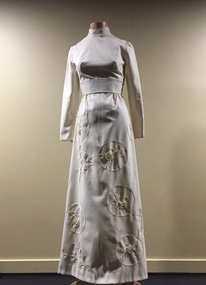
Clothing - Cream Silk Evening Dress, 1970s
... ...australian fashion - 1970s...Australian and/or international fashion designers. The McIntyre Collection is significant historically and artistically as it includes examples of design that demonstrate changing tastes in fashion over an 80-year period. The collection is also significant in that it includes the work of a large number of Melbourne designers from the 1960s to the 1990s. mcintyre collection women's clothing evening wear australian fashion - 1970s evening dresses dione mcintyre Cream silk evening dress with applied ribbon and flowers. ...The Fashion & Design collection of the Kew Historical Society includes examples of women’s, men’s, children’s and infants’ clothing from the 18th, 19th and 20th centuries. Items in the collection were largely produced for, or purchased by women in Melbourne, and includes examples of outerwear, protective wear, nightwear, underwear and costume accessories. The dress was owned and worn by Kew resident, Dione McIntyre.The McIntyre Collection of clothing and clothing accessories forms one of the largest single donations to our Fashion & Design collection. It includes clothing and clothing accessories worn by four women in the Cohen and McIntyre families across three generations. The items worn by Melbourne architect, and Kew resident, Dione McIntyre date from the 1960s and 1970s, and include evening wear, day wear, hats and shoes. As Dione McIntyre often accompanied her husband, fellow architect Peter McIntyre, to formal events, there are a number of pieces of evening wear among the items. The McIntyre Collection also includes items worn by women of an earlier generation: by Lilian Cohen, Dione McIntyre's mother, and by her mother-in-law, the wife of the architect Robert McIntyre. At the other end of the chronological spectrum are a number of outfits belonging to, worn and donated by Annie McIntyre. These include outfits created by notable late 20th century Australian and/or international fashion designers. The McIntyre Collection is significant historically and artistically as it includes examples of design that demonstrate changing tastes in fashion over an 80-year period. The collection is also significant in that it includes the work of a large number of Melbourne designers from the 1960s to the 1990s.Cream silk evening dress with applied ribbon and flowers. The dress has a high round neck and buttoned sleeves and cuffs. It has a zip at the back with hooks and eyes at the neck.mcintyre collection, women's clothing, evening wear, australian fashion - 1970s, evening dresses, dione mcintyre -
 Kew Historical Society Inc
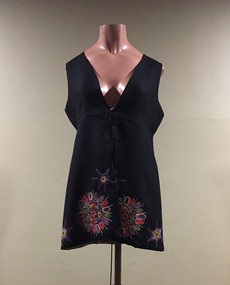
Clothing, Embroidered Black Vest, 1970s
... ...australian fashion - 1970s...Items in the collection were largely produced for, or purchased by women in Melbourne, and includes examples of outerwear, protective wear, nightwear, underwear and costume accessories. women's clothing australian fashion - 1970s vests Black wool vest with a lace up front. ...The Fashion & Design collection of the Kew Historical Society includes examples of women’s, men’s, children’s and infants’ clothing from the 18th, 19th and 20th centuries. Items in the collection were largely produced for, or purchased by women in Melbourne, and includes examples of outerwear, protective wear, nightwear, underwear and costume accessories.Black wool vest with a lace up front. The vest is heavily embroidered in an abstract multicoloured floral motifs. It is lined with a fine olive green silk. women's clothing, australian fashion - 1970s, vests -
 Kew Historical Society Inc
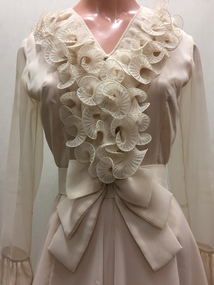
Clothing - Silk Organza Wedding Dress, Oggi Fashion House, 1971
... ...australian fashion - 1970s...Items in the collection were largely produced for, or purchased by women in Melbourne, and includes examples of outerwear, protective wear, nightwear, underwear and costume accessories. oggi - 103-105 collins street - melbourne (vic) women's clothing wedding dresses janet (brock) walker australian fashion - 1970s Wedding dress, purchased by Janet Elizabeth Brock in December 1971 from Oggi of Collins Street. ...Fashion by Oggi, as the sign above the door proclaimed, was located at the Paris End of Collins Street, on the south side, virtually opposite Lilian Weightman’s Le Louvre boutique. Janet Brock, who at the time was working in the Central Business District of Melbourne, had stopped to admire a mauve version of the dress that was displayed in the window, and, on making inquiries from the proprietress, ordered a made-to-measure cream-coloured copy. Her marriage occurred shortly after the death of her father, and took place on 18 December 1971 at the Kew Presbyterian Church in Cotham Road, where the Rev. Peter Mackie was the celebrant. The Fashion & Design collection of the Kew Historical Society includes examples of women’s, men’s, children’s and infants’ clothing from the 18th, 19th and 20th centuries. Items in the collection were largely produced for, or purchased by women in Melbourne, and includes examples of outerwear, protective wear, nightwear, underwear and costume accessories.Wedding dress, purchased by Janet Elizabeth Brock in December 1971 from Oggi of Collins Street. The wedding dress, reaching just below the knee, is lined in silk with a double outer layer of organza. The striking decoration of the monochromatic cream dress is achieved through the use of wide ruffled organza frills at the neck, on the sleeves and at the flared hem of the dress. The dress has a discrete v-neckline with small, self-covered buttons at centre front. At the back, the dress is closed with a nylon zip. In addition to the elaborate stiffened frills, the dress features a wide fabric belt with a double bow, worn at the front. oggi - 103-105 collins street - melbourne (vic), women's clothing, wedding dresses, janet (brock) walker, australian fashion - 1970s -
 Kew Historical Society Inc
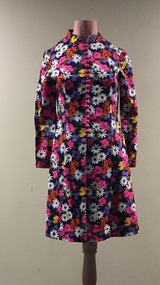
Coat dress, Kenneth Pirrie, 1967-8
... ...australian fashion - 1970s...It highlights the local domestic and commercial history of Kew and greater Melbourne, recording what the fashion-conscious public actually bought, wore, and preserved during a period of massive industry transformation kenneth pirrie women's clothing australian fashion - 1970s mcintyre collection day wear coat dresses Label: Kenneth Pirrie An A-line, knee-length woman’s garment designed to function as a standalone dress or light structured coat. ...This garment reflects the apex of the Australian "Youthquake" movement between 1967 and 1968. During this tight window, international mod influences from London's Carnaby Street fused heavily with local Australian manufacturing. Melbourne emerged as the absolute epicenter of the nation's revolutionary ready-to-wear "rag trade," led by visionary young designers who rebelled against traditional haute couture. Kenneth Pirrie, starting his label in 1959, became a crucial vanguard of this shift. By 1967, Pirrie was heavily commissioning his own exclusive textile prints—capitalizing on newly popularized, easy-to-launder synthetic crepes, crimplenes, and lightweight blends that mirrored the fast-paced, modern lifestyles of younger working women. The high collar and structured button-front design seen here explicitly capture the brief design transition where military tailoring elements met bright, counter-culture psychedelia.This coat dress stands as a stellar, physically intact index of mid-century Australian fashion innovation. It documents a pivotal socio-cultural era when locally manufactured ready-to-wear labels successfully captured and redirected global youth subcultures specifically for the domestic market. The piece demonstrates the high-caliber printmaking and structured garment construction that earned Kenneth Pirrie national acclaim. It provides an excellent material baseline of the late-1960s shift away from structural, monochromatic mod toward organic, vivid flower-power palettes. The dress, owned by Melbourne architect, Dione McIntyre, possesses exceptional local provenance. It highlights the local domestic and commercial history of Kew and greater Melbourne, recording what the fashion-conscious public actually bought, wore, and preserved during a period of massive industry transformationAn A-line, knee-length woman’s garment designed to function as a standalone dress or light structured coat. The piece is constructed from a dark base fabric featuring a densely populated, screen-printed psychedelic floral motif. The pattern exhibits stylized white, pink, magenta, and purple blossoms with golden-yellow centers, typifying the iconic "flower power" aesthetic of the late sixties. The garment features a structured, high Nehru collar closing directly down a central front-button placket. It has tailored, long inset sleeves terminating in clean cuffs, a fitted torso that gently flares outward from the hips into a minimalist A-line skirt, and an overall sharp, geometric silhouette.Label: Kenneth Pirriekenneth pirrie, women's clothing, australian fashion - 1970s, mcintyre collection, day wear, coat dresses -
 Kew Historical Society Inc
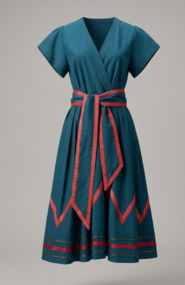
Clothing - A-Line Wrap Day Dress with Graphic Contrast Trim, Prue Acton, 1976–81
... ...Australian fashion -- Melbourne -- 1970s...Prue Acton Australian fashion -- Melbourne -- 1970s Dresses Label 1: "Prue Acton" Label 2: "Size 14 ..." ...Prue Acton launched her label in Melbourne in 1963. Initially celebrated for capturing the youthful energy of the 1960s "Youthquake" movement, her brand underwent a significant maturity shift during the late 1970s and early 1980s. As her original teenage and twenty-something clientele entered the professional workforce, Acton transitioned her designs from playful boutique mini-dresses into sophisticated, structured, and upscale ready-to-wear pieces. This wrap day dress perfectly exemplifies that evolutionary step. It offers practical utility for the contemporary working woman while maintaining the high-impact visual flair she was known for. This specific garment reflects her obsession with pure, interacting hues. The combination of saturated teal against coral-red and gold metallic trimmings is a masterclass in complementary color dynamics. Instead of relying on traditional printed patterns, she used the structural trim itself to dictate the architecture of the dress. The wrap dress style allowed for physical ease in warmer climates, while the sharp graphic lines gave it an assertive presence. A midi-length day dress in deep teal featuring a wrapped crossover V-neckline, short fluttering tulip sleeves, and a defined waist. The dress is accompanied by a wide, matching self-tie fabric belt. The garment features striking, avant-garde contrast borders in coral-red and gold metallic ribbon. This graphic trim accents the length of the belt, forms a bold, geometric zig-zag pattern around the lower hips, and finishes in parallel horizontal bands directly above the hemline. While the tailored cotton construction echoes late-1970s daywear, the hyper-saturated colorblock palette and bold geometric patterns strongly align with Prue Acton's transition into the vibrant, structured aesthetics of the early 1980s.Label 1: "Prue Acton" Label 2: "Size 14 ..."prue acton, australian fashion -- melbourne -- 1970s, dresses -
 Kew Historical Society Inc
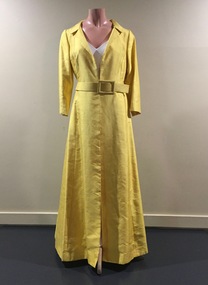
Yellow Maxi Coat Dress, Jinoel of Melbourne, 1968-72
... Australian fashion...Melbourne designers...1970s...Australian fashion Melbourne designers 1970s fashion Maxi dresses Coatdresses Corduroy Jinoel Flinders Lane Dione McIntyre Label: Jinoel of Melbourne A structured, full-length maxi-length evening coat dress made from heavy, vibrant yellow silk. ...Jinoel of Melbourne was a highly successful Australian fashion house launched by Jill and Noel Kemmelfield in 1957. Eleven years later the designers won the [Melbourne] Gown of the Year award. Jill and Noel Kemmelfield were later to launch Marty and Martine, their mid-market labels. They closed their business in the 1980s. The evening coat was owned, worn and donated by Dione McIntyre.This garment is a representative example of high-end Australian boutique fashion from the late 1960s to early 1970s, designed by the prominent Melbourne fashion house Jinoel. Known for sourcing luxury textiles and tailoring sophisticated silhouettes for the contemporary Australian woman, this piece highlights the transition from late-1960s tailored structure into early-1970s dramatic maxi lengths. The use of a bold fabric reflects Melbourne's mid-century cosmopolitan fashion identity and boutique manufacturing era.A structured, full-length maxi-length evening coat dress made from heavy, vibrant yellow silk. The garment features long, slightly tapered three-quarter sleeves and a deep V-neckline framed by a broad notched lapel collar. It features a continuous column closure running down the center front. The waist is defined by a wide, self-fabric matching belt with a prominent rectangular covered buckle, flaring out slightly to a structured, sweeping A-line skirt.Label: Jinoel of Melbourneaustralian fashion, melbourne designers, 1970s fashion, maxi dresses, coatdresses, corduroy, jinoel, flinders lane, dione mcintyre -
 RMIT Design Archives
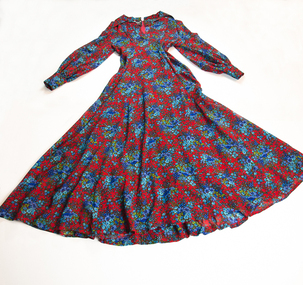
Textile - Woman's dress, Norma Tullo, Garment Designer, Shirley Lyle, Textile Designer, Woman's Dress
... Ann Carew, 2020 The dress is historically significant as a dress designed by Norma Tullo, a leading fashion designer of the 1960s and 1970s. During this period the Australian Wool Industry strove to promote wool, and to develop light woollen fabrics to compete with new synthetic fibres such as rayon. ...This light woollen evening dress is made from Peppinella, a new fabric Norma Tullo introduced into her range in 1973. The fabric was used exclusively by Tullo, and came from the wool of Peppin Merino (first introduced into Australia in 1858 by the Peppin brothers). According to the papers of the day Tullo’s 1973 winter collection featured ‘St. Trinian’s styles to garments dripping lace, in bold plain colours to floral prints.” Shirley Lyle designed the floral fabric. Norma Tullo (1935-2019) was one of the leading fashion designers of her time, establishing her label in 1956. After establishing a business the Old Metropole Arcade in Melbourne in 1956, with three sewing machines, Tullo's ready to wear fashions for young women became sought after, and her business flourished. In 1966 the Japanese department store chain Isetan Co Ltd began to mass-produce her garments for their stores across Japan. Tullo closed her label in 1977, and later worked for Fletcher Jones. Ann Carew, 2020The dress is historically significant as a dress designed by Norma Tullo, a leading fashion designer of the 1960s and 1970s. During this period the Australian Wool Industry strove to promote wool, and to develop light woollen fabrics to compete with new synthetic fibres such as rayon. The garment is historically significant for the use of a merino wool showcasing its versatility for dress fabrics. Full length woman's dress with full skirt and long sleeves, collared with open neck and pleat work on bodice. Material is predominately red with a repeated pattern featuring posie of blue and mauve flowers.Inscribed, black label on back neck left of zip, 'TULLO/IN/PEPPINELLA/AUSTRALIA MERINO WOOL'; Inscribed, white satin label on back neck right of zip, 'DRY CLEAN ONLY'; Inscribed, white satin label underneath above label, 'SIZE 12/To Fit Bust 34"/To Fit Waistwool, rmit design archives, rmit university, woman's dress, textile design, australian fashion -
 National Wool Museum
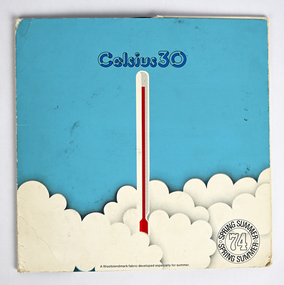
Booklet - Celsius 30, Spring Summer Fabric Samples, Australian Wool Corporation, 1974
... 1970s Fashion Front [printed]: Celsius 30 / SPRING SUMMER / 74 / SPRING SUMMER / A Woolblendmark fabric developed especially for summer. Card folder featuring pale blue and white clouds and sky motifs, with a thermometer on the cover. Folder holds eleven circular black cards, eight have wool fabric samples attached. Booklet Celsius 30, Spring Summer Fabric Samples Australian ...Part of a collection of books, fabric samples and documents from the working life of Ray Smith. Ray began his career at the age of 15, working at the Albion Woollen Mills in Geelong in 1953. Over the next five decades, Ray furthered his education in textile design, weaving design, knitting and later computer aided design, including qualifications from Gordon Textile College, City and Guilds of London Institute, The Textile Institute, Melbourne Institute of Textiles and Royal Melbourne Institute of Technology (RMIT). After ten years at Albion Woollen Mills, Ray went on to hold fabric design positions at Prestige Fabrics and Yarra Falls, working up to management roles in both the Weaving and Fabric Design Divisions, and then as Product Development Manager at Yarra Falls until 2000. Ray shares some career highlights below: In 1977 and 1978 I won the Wool Corporation’s Celsius 30 Awards as Yarra Falls Designer. (See photos attached.) These awards came with study trips to the major Textile Centres and Trade Fairs around the world. This was proven to be beneficial and Yarra Falls sent me overseas every year for the next 22 years. On stopovers in Hong Kong we appointed an agent and took part in Textile Trade Fairs at Interstoff Asia and exhibited designs in 1991, 92, 93, 94. I created a pattern book for a chain of shops called “Kwun KeeTailors” for their customers to select our fabrics to be made up into suits for the tourists. I also had several trips to New York to try to export to America with some success. I was commissioned by the Melbourne College of Textiles to write a Woven Textile Design Course to be taught under the outreach program. This was eventually translated into Spanish to be used by developing textile industries in South America.Card folder featuring pale blue and white clouds and sky motifs, with a thermometer on the cover. Folder holds eleven circular black cards, eight have wool fabric samples attached.Front [printed]: Celsius 30 / SPRING SUMMER / 74 / SPRING SUMMER / A Woolblendmark fabric developed especially for summer.ray smith, yarra falls, mills, textile design, fabric design, product development, wool corporation, fabric samples, 1970s fashion -
 National Wool Museum
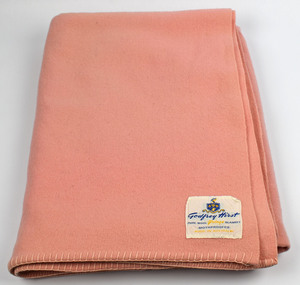
Textile - Blanket, Godfrey Hirst, 1950s
... It showed how particular colours were in fashion in the early decades, based mostly around depths of pastel pinks, mints, lemons and baby blues with brighter colours arriving in the 1960s then the browns and oranges in heavier tones in the 1970s. Note from collector- "For more than 100 years blankets were made all over Australia ...Note from collector: I would stack plain blankets of the same base colour and arrange them by shade to make up a colour palette. It showed how particular colours were in fashion in the early decades, based mostly around depths of pastel pinks, mints, lemons and baby blues with brighter colours arriving in the 1960s then the browns and oranges in heavier tones in the 1970s. Note from collector- "For more than 100 years blankets were made all over Australia in over 100 woollen mills. My aim, is to preserve 100 examples of these wonderful pieces of history. Ten years ago I started collecting the iconic Onkaparinga travel rugs, so that on movie nights at home there would be plenty to go around. Everyone had their favourite; even the cat had his own – a small red tartan one. Keeping an eye out for those travel rugs at op-shops and markets, collectable stores and bazaars, led to noticing vintage blankets. I'd never really thought about them before or paid much attention though of course I had grown up with them at my grandmother's. When I discovered my first Laconia cream blanket with blue stripes, my eyes just went gaga. Well that was it, I was hooked and since then over 500 blankets have passed through my hands. These common, everyday items, found in all households for so many decades, were traditional engagement gifts. Pairs were prized wedding presents turning into family heirlooms. They were fashionable dressers of beds, givers of warmth, bestowers of security and reliability. The comfort found in these objects resonates with almost all of us; we grew up with them ourselves or fondly recall them in a grandparent’s home. There is no modern replacement with the integrity of these old blankets, many of them now older than most of us. They are romantic, sensible, special, familiar, nostalgic and nothing else feels so appropriate in so many situations. No offense to the great Aussie doona, but from hippie to hipster, at a music festival, picnic, campsite or couch, a vintage blanket is something coveted by all. This industry that employed tens of thousands and must have been such a huge contributor to the economy is almost completely lost now. Blanket Fever is an ode to everything that came before: the land, the sheep, the shearers, the hands, the mills, the weavers, the designers, the distributors, the department stores. To the grandparents that gave them, the people that received them, the families that kept them; thank you. I’m passionate about my collection of Australian blankets manufactured in mostly Victoria, South Australia and Tasmania from the 1930s to the end of the 1960s. The collection has blankets from each of these four decades representing the styles and fashions of their time and includes dated advertisements which help determine the eras the blankets are from." Queen Sized, dusty pink blanketGodfrey Hirst/Pure Wool Pelage Blanket/Mothproofed/Made in Australiawool, blanket, blanket fever, godfrey hirst, geelong -
 National Wool Museum
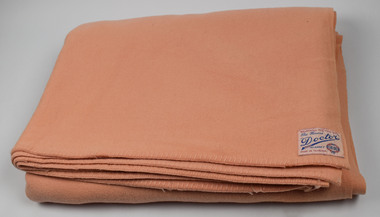
Textile - Blanket, Kelsall and Kemp, 1950s
... It showed how particular colours were in fashion in the early decades, based mostly around depths of pastel pinks, mints, lemons and baby blues with brighter colours arriving in the 1960s then the browns and oranges in heavier tones in the 1970s. Collector's note: "For more than 100 years blankets were made all over Australia ...Collector says: "I would stack plain blankets of the same base colour and arrange them by shade to make up a colour palette. It showed how particular colours were in fashion in the early decades, based mostly around depths of pastel pinks, mints, lemons and baby blues with brighter colours arriving in the 1960s then the browns and oranges in heavier tones in the 1970s.Collector's note: "For more than 100 years blankets were made all over Australia in over 100 woollen mills. My aim, is to preserve 100 examples of these wonderful pieces of history. Ten years ago I started collecting the iconic Onkaparinga travel rugs, so that on movie nights at home there would be plenty to go around. Everyone had their favourite; even the cat had his own – a small red tartan one. Keeping an eye out for those travel rugs at op-shops and markets, collectable stores and bazaars, led to noticing vintage blankets. I'd never really thought about them before or paid much attention though of course I had grown up with them at my grandmother's. When I discovered my first Laconia cream blanket with blue stripes, my eyes just went gaga. Well that was it, I was hooked and since then over 500 blankets have passed through my hands. These common, everyday items, found in all households for so many decades, were traditional engagement gifts. Pairs were prized wedding presents turning into family heirlooms. They were fashionable dressers of beds, givers of warmth, bestowers of security and reliability. The comfort found in these objects resonates with almost all of us; we grew up with them ourselves or fondly recall them in a grandparent’s home. There is no modern replacement with the integrity of these old blankets, many of them now older than most of us. They are romantic, sensible, special, familiar, nostalgic and nothing else feels so appropriate in so many situations. No offense to the great Aussie doona, but from hippie to hipster, at a music festival, picnic, campsite or couch, a vintage blanket is something coveted by all. This industry that employed tens of thousands and must have been such a huge contributor to the economy is almost completely lost now. Blanket Fever is an ode to everything that came before: the land, the sheep, the shearers, the hands, the mills, the weavers, the designers, the distributors, the department stores. To the grandparents that gave them, the people that received them, the families that kept them; thank you. I’m passionate about my collection of Australian blankets manufactured in mostly Victoria, South Australia and Tasmania from the 1930s to the end of the 1960s. The collection has blankets from each of these four decades representing the styles and fashions of their time and includes dated advertisements which help determine the eras the blankets are from."Queen sized blanket, soft pastel pinkWarranted 100% Pure Wool/The Famous "Doctor" Regd/Blanket Made in Tasmania/in Emblem "K&K" (first K mirror image)/Regdwool, blanket, blanket fever, the famous doctor, kelsall and kemp, tasmania -
 National Alpine Museum of Australia
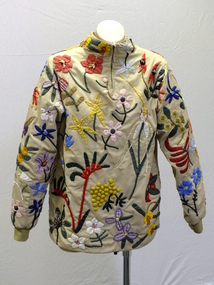
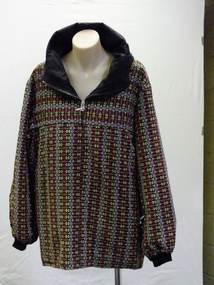
Ski Jacket, About 1967
... Australian Wool Board and the Fur Traders Association, participating in numerous fashion shows and awards run by these groups. In the late 1960s she became involved with the Melbourne Branch of the Fashion Group Inc, a worldwide non-commercial association of women involved in the fashion industry. Rosalie continued to design and manufacture fashionable but functional ski wear until the late 1970s...Australian Wool Board and the Fur Traders Association, participating in numerous fashion shows and awards run by these groups. In the late 1960s she became involved with the Melbourne Branch of the Fashion Group Inc, a worldwide non-commercial association of women involved in the fashion industry. Rosalie continued to design and manufacture fashionable but functional ski wear until the late 1970s ...This jacket and cap were designed by Rosalie 'Rosa' Kiessling about 1967. They formed part of the Fashion Group Inc's Walkabout Tour of the USA in 1967 which aimed to promote Australian fashion design in America. German by birth Rosalie, grew up skiing and ice skating, studied fashion design in Munich and worked designing women’s ski wear and lingerie before migrating to Australia via New Zealand in 1939 with her husband. As skiing increased in popularity following the end of WWII, Rosalie’s business grew reaching its peak during the 1960s. Though it was never large; at most she employed three staff. Her designs featured in the pages of Australian Vogue, Flair and the Women’s Weekly throughout the 1960s and received coverage from newspapers in Australia, New Zealand the United States. Rosalie was closely involved with the Swiss Club of Victoria, the Australian Wool Board and the Fur Traders Association, participating in numerous fashion shows and awards run by these groups. In the late 1960s she became involved with the Melbourne Branch of the Fashion Group Inc, a worldwide non-commercial association of women involved in the fashion industry. Rosalie continued to design and manufacture fashionable but functional ski wear until the late 1970s, although increasing imports from large overseas manufactures and constant new innovations in fabric technology made it difficult for her to compete in a relatively small industry. This ski jacket and cap illustrate Rosalie Kiessling's emphasis on practical glamour. She was the first Australian ski wear manufacturer to bring high fashion to ski wear design; which though common in the boutiques of St Mortiz, Chamonix and St Anton was new to Australia. The use of an Australian wildflower motif and of these pieces in the Fashion Group's Walkabout Tour also speak to her involvement in and promotion of the Australian fashion industry during the 1960s.Ski jacket and matching cap appliqued with Australian wildflowers.Noneskiing, ski clothing, fashion design, australian fashion, australian flora -
 National Alpine Museum of Australia
Ski Jacket, 1970s
... 1970s through to the 1990s. The Kiessling family skied at Mt Buller and are members of Omega Ski Lodge. German by birth Rosalie, grew up skiing and ice skating, studied fashion design in Munich and worked designing women’s ski wear and lingerie before migrating to Australia via New Zealand in 1939 with her husband. ...1970s through to the 1990s. The Kiessling family skied at Mt Buller and are members of Omega Ski Lodge. German by birth Rosalie, grew up skiing and ice skating, studied fashion design in Munich and worked designing women’s ski wear and lingerie before migrating to Australia via New Zealand in 1939 with her husband. ...Reversible ski jacket made by Rosalie Kiessling, 1970s. Used by Rosalie's son and daughter-in-law, from the 1970s through to the 1990s. The Kiessling family skied at Mt Buller and are members of Omega Ski Lodge. German by birth Rosalie, grew up skiing and ice skating, studied fashion design in Munich and worked designing women’s ski wear and lingerie before migrating to Australia via New Zealand in 1939 with her husband. As skiing increased in popularity following the end of WWII, Rosalie’s business grew reaching its peak during the 1960s. Though it was never large; at most she employed three staff. Rosalie continued to design and manufacture fashionable but functional ski wear until the late 1970s, although increasing imports from large overseas manufactures and constant new innovations in fabric technology made it difficult for her to compete in a relatively small industry. Reversible ski jacket with side zip pockets and full zip front. One side of the jacket is black fabric, while the other is black checked with a yellow and red weave. Rosalie Kiessling sportswear Melbourne / All cottonskiing, ski clothing, fashion design -
 National Wool Museum
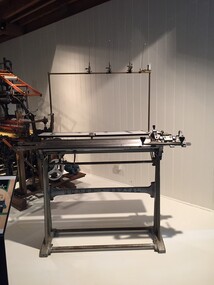
Machine - Knitting Machine, Coppo, 1960s
... Australian knitting trade including ES Poratt and Alpin Manufacturing. The owner’s role progressed from a piece worker to a wool garment designer and she won many Wool Industry Awards in the 1970s and 1980s. Her high quality of work using and her individual custom designs were spoken about by many of her customers and she had a very large private clientele. She designed and knitted fully fashioned...Australian knitting trade including ES Poratt and Alpin Manufacturing. The owner’s role progressed from a piece worker to a wool garment designer and she won many Wool Industry Awards in the 1970s and 1980s. Her high quality of work using and her individual custom designs were spoken about by many of her customers and she had a very large private clientele. She designed and knitted fully fashioned ...The knitting machine is a recently designed instrument, especially when it is compared with its ancient counterpart, the loom. It enables the creation of many metres of fabric very quickly. A knitting machine is composed of a series of needles which mimic the process of manual knitting. The mechanism engages numerous mechanical elements simultaneously and enables the creation of many metres of fabric very quickly. In addition, a knitting machine can be setup to produce unique bolts of fabric. The density of the fabric may be modified and a knitting machine can produce double-faced effects. A doubled-faced effect creates colour combinations through the introduction of an additional colour to the knitting pattern. This knitting machine is a Coppo brand. It contains over five hundred needles and was produced in the 1960s. It is a representation of the best available in the world at that time. Originating from Italy, it was designed for commercial use. Through both precision and capacity, Italian artisans were seen to be the best in the world of textiles and knitwear. Through emigration, globalisation and the regularly available quantities of wool, Australia came to compete on this stage. The owner of this particular machine migrated from Italy in 1959. When she did, she brought with her a Dubied knitting machine. She later replaced it with this Coppo. When in Australia the owner began work as a piece worker, knitting jumpers and worked for some of the iconic names in the Australian knitting trade including ES Poratt and Alpin Manufacturing. The owner’s role progressed from a piece worker to a wool garment designer and she won many Wool Industry Awards in the 1970s and 1980s. Her high quality of work using and her individual custom designs were spoken about by many of her customers and she had a very large private clientele. She designed and knitted fully fashioned tailored jumpers for people for around 30 years.Knitting table sits on a stand with wide metal legs. Legs contain lettering 'COPPO torino'. Legs are connected via three thin metal poles as well as a metal band and the bed of knitting table at top. The connecting metal band has the lettering 'SUPER - COPTAL' attached. The Knitting table itself contains two beds and a bench at the rear. Attached to the bench is a thin metal structure for the elevation of yarn. It has four crane esk structures above on this metal structure. The bench is covered in a pale grey laminate in the imitation of wood. Attached to the knitting bed is a sliding contraptions containing two handles at the front followed by a complex semi-circle sliding mechanism used to move the knitting mechanism front and back.Left Stand. Lettering: Coppo Torino Right Stand. Lettering: Coppo Torino Centre Stand. Lettering SUPER - COPTALcoppo, knitting machine, design, italy, wool, business, migrants -
 Brighton Historical Society
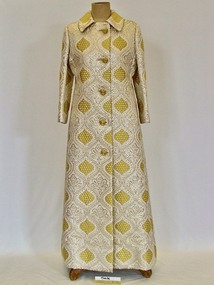
Coat, c.1970
... fashion label and boutique established in 1969 by Lithuanian-born Terry Oertel and French-born Odile Moktar. Terry's sister Arija Austin was also a designer; in partnership with Erna Vilks she established the high-end Tu Boutique in South Yarra in 1963. The two sisters came to Australia as teenagers after World War II. coat brocade 1970s ...Jot was an exclusive Toorak fashion label and boutique established in 1969 by Lithuanian-born Terry Oertel and French-born Odile Moktar. Terry's sister Arija Austin was also a designer; in partnership with Erna Vilks she established the high-end Tu Boutique in South Yarra in 1963. The two sisters came to Australia as teenagers after World War II.Maxi coat in cream, yellow and metallic gold ogival patterned brocade. Fastens with five large metallic gold corded domed buttons. Lined with ivory silk taffeta.Label, woven black on white acetate, centre back neck: jot / TOORAKcoat, brocade, 1970s fashion, melbourne designers, melbourne fashion, jot, terry oertel, odile moktar, toorak -
 Brighton Historical Society
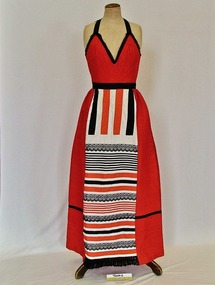
Dress, 1975
... Australia Medal in 1984. She was added to the Victorian Honour Roll of Women in 2001. mexico international women's conference 1970s fashion georgia charuhas feminism mary owen Label, woven black on white acetate, centre back: Disenado con carino por / GEORGIA CHARUHAS / HECHO / EN MEXICO Label, woven black on white acetate, centre back: Gerorgia's / BOUTIQUE LAS MARIPOSAS / Designer: / Georgia Charuhas / MERIDA YUCATAN, MEXICO Red, white and black cotton halter neck dress with rows of pin tucking on the bodice and applied horizontal strips of red and black cotton and black lace to the skirt. ...Mary Owen OAM (1921-2017) purchased this dress in 1975 in Mexico while attending the first World Conference on Women and wore it to the reception there. A dedicated feminist, unionist and activist, she was a vocal campaigner for the empowerment of women, particularly in the fight for equal pay. Mary's involvement in activism began in 1966 when she joined the staff of the Association of Architects, Engineers & Draughtsmen (AAESDA), where she was responsible for advertising, layout and proofreading editorial for its journal 'Blueprint'. Her contact with the union awoke an interest in women's rights in the workplace, and in 1969 after she joined Dr Bertram Wainer's Progressive Reform Party, which advocated for legalised abortion. She joined the Women's Electoral Lobby in 1972 and remained an active member for over forty-three years, representing the WEL on many government committees. She was a founding co-coordinator of the Working Women's Centre Melbourne from 1975 until 1986, a founding member of EMILY's List Australia, an early member of the Melbourne Press Club and an early supporter of the Australian Women's Archives Project. An annual Mary Owen Dinner was held in her honour for twenty years from 1986 until 2007, which brought together hundreds of women each year. Mary was awarded the Queen's Silver Jubilee Medal in 1977 and the Order of Australia Medal in 1984. She was added to the Victorian Honour Roll of Women in 2001.Red, white and black cotton halter neck dress with rows of pin tucking on the bodice and applied horizontal strips of red and black cotton and black lace to the skirt. Label, woven black on white acetate, centre back: Disenado con carino por / GEORGIA CHARUHAS / HECHO / EN MEXICO Label, woven black on white acetate, centre back: Gerorgia's / BOUTIQUE LAS MARIPOSAS / Designer: / Georgia Charuhas / MERIDA YUCATAN, MEXICOmexico, international women's conference, 1970s fashion, georgia charuhas, feminism, mary owen -
 Brighton Historical Society
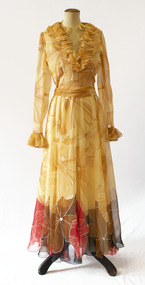
Dress, Evening dress, 1970s
... fashion designer and a longtime Brighton resident. She established her eponymous label and became well-known for her elegant and feminine designs. She dressed some of Australia's best known women, including Lady Sonia McMahon and Dame Pattie Menzies, and was also known for her boutiques in Melbourne (the last store closed in 1991). She retired in 1999, aged 80. di reidie vintage clothing melbourne designers elvie hill 1970s ...This item is part of the Di Reidie collection. Diane Reidie was a much loved volunteer and President of Brighton Historical Society from 1999 until 2016. Originally from New Zealand, Di and her family lived in Male Street, Brighton for many years. A vibrant and energetic person with a zest for life and a gift for bringing people together, Di was a friend to many in the Bayside community and active in local community organisations. Her tireless work as President of BHS saw her named Bayside Citizen of the Year in 2008. As a seller and collector of vintage clothing, she was passionate about fashion history; one of her many enduring contributions to BHS was her extensive work in preserving, developing and promoting the Society's costume collection. In 2018-19, Di donated more than one hundred items from her personal vintage clothing collection to the Society. The collection, which includes clothing, hats, handbags and shoes from local and international designers, is representative of Di's wide-ranging interests, colourful personality, creativity, humour and love of fashion and travel. Di purchased this dress as a vintage item. Elvie Hill (1917-2018) was a Melbourne fashion designer and a longtime Brighton resident. She established her eponymous label and became well-known for her elegant and feminine designs. She dressed some of Australia's best known women, including Lady Sonia McMahon and Dame Pattie Menzies, and was also known for her boutiques in Melbourne (the last store closed in 1991). She retired in 1999, aged 80.Long-sleeved silk chiffon evening dress with yellow/gold floral print and brown, red and black border at hem. Ruffled neckline and cuffs. Snap fastenings at cuffs and zip at back. Matching silk chiffon sash.Label, inside collar, black on white: "ELVIE HILL / OF MELBOURNE" Label inside seam: "SIZE 10 / TO FIT / Bust 80cm"di reidie, vintage clothing, melbourne designers, elvie hill, 1970s -
 Kew Historical Society Inc
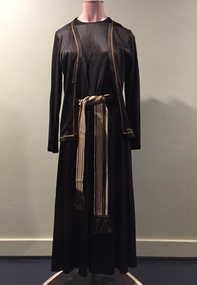
Clothing - Long Brown Dress with Braids & Matching Jacket, Grace James, 1972
... The items have additional significance due to information about the purpose of the creation and the date when it was constructed. grace james women's clothing australian fashion 1969-1988 dressmakers - surrey hills (vic) fashion -- 1970s fashion design Three piece brown outfit comprising a long dress, a separate bodice and a belt of scarf. ...Grace James, the creator of the items in the Grace James collection, designed and created costumes over a 19 year period (1969-1988) for her daughter Ceri. The collection of clothing ranges from evening wear to knitted garments. All the items display exemplary dressmaking skills. The designs are of the period and reflect evolving fashions of the time. Some items are copies of published designs whereas others are original creations. The collection was donated in 2006.While most of the items in the Fashion & Design Collection of the Kew Historical Society are commercially designed items of clothing, there are also items made by home dressmakers. Many of these exhibit outstanding design knowledge and technical skills. A large and important group of these items of women's clothing is contained in the Grace James collection of outfits created for the dressmaker's daughter. The items have additional significance due to information about the purpose of the creation and the date when it was constructed.Three piece brown outfit comprising a long dress, a separate bodice and a belt of scarf. The outfit is made of a synthetic fabric. The long plain brown dress has been designed with a matching bodice that features a tan trim; the wide belt/scarf is striped. Brown silk purse with brass fittingsgrace james, women's clothing, australian fashion 1969-1988, dressmakers - surrey hills (vic), fashion -- 1970s, fashion design -
Kew Historical Society Inc
Headwear - Brown Fur Hat, 1950s
... fashion and design collection is comprised of costumes, hats, shoes and personal accessories. Many of these items were purchased or handmade in Victoria; some locally in Kew. The extensive hat collection comprises items dating from the 1860s to the 1970s. Most of the hats in the collection were created by milliners for women. There are however a number of early and important men’s hats in the collection. The headwear collection is particularly significant in that it includes the work of notable Australian...fashion and design collection is comprised of costumes, hats, shoes and personal accessories. Many of these items were purchased or handmade in Victoria; some locally in Kew. The extensive hat collection comprises items dating from the 1860s to the 1970s. Most of the hats in the collection were created by milliners for women. There are however a number of early and important men’s hats in the collection. The headwear collection is particularly significant in that it includes the work of notable Australian ...The Kew Historical Society’s fashion and design collection is comprised of costumes, hats, shoes and personal accessories. Many of these items were purchased or handmade in Victoria; some locally in Kew. The extensive hat collection comprises items dating from the 1860s to the 1970s. Most of the hats in the collection were created by milliners for women. There are however a number of early and important men’s hats in the collection. The headwear collection is particularly significant in that it includes the work of notable Australian and international milliners.Brown fur hatfashion & design collection - kew historical society, furs, costume accessories, hats -
 Kew Historical Society Inc
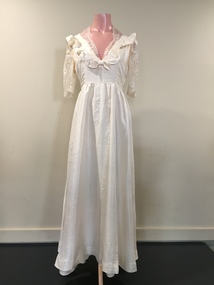
Clothing - Cream Silk Taffeta & Lace Bridesmaid's Dress, Grace James, 1969-1975
... The items have additional significance due to information about the purpose of the creation and the date when it was constructed. australian fashion grace james collection bridesmaid's dresses grace james fashion design fashion -- 1970s Full-length cream silk taffeta bridesmaid’s dress. ...Grace James, the creator of the items in the Grace James collection, designed and created costumes over a 19 year period (1969-1988) for her daughter Ceri. The collection of clothing ranges from evening wear to knitted garments. All the items display exemplary dressmaking skills. The designs are of the period and reflect evolving fashions of the time. Some items are copies of published designs whereas others are original creations. The collection was donated in 2006.While most of the items in the Fashion & Design Collection of the Kew Historical Society are commercially designed items of clothing, there are also items made by home dressmakers. Many of these exhibit outstanding design knowledge and technical skills. A large and important group of these items of women's clothing is contained in the Grace James collection of outfits created for the dressmaker's daughter. The items have additional significance due to information about the purpose of the creation and the date when it was constructed.Full-length cream silk taffeta bridesmaid’s dress. Same colour lace on the upper bodice and sleeves. australian fashion, grace james collection, bridesmaid's dresses, grace james, fashion design, fashion -- 1970s -
 Melbourne Legacy
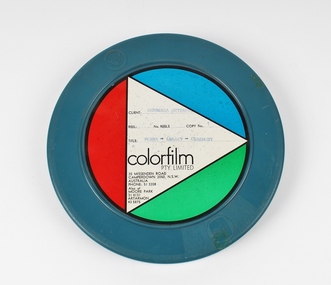
Film, 43rd Annual Conference of Legacy Clubs: Ceremony of Remembrance, 1971
... Australian War Memorial 1971, addressed by Legatee Rev. Cyril Reeve in a stirring fashion. This film has been digitised to preserve its content. Melbourne Legacy gratefully acknowledges the support of the Victorian Government and Public Record Office Victoria for making this possible. Commercially made, sound and faded colour, gone to red 8.09 mins. Production CTC-TV Canberra. The solemn religious ceremony is typical of the 1970s ...A film of the 43rd Annual Conference of Legacy Clubs ceremony at the Australian War Memorial 1971, addressed by Legatee Rev. Cyril Reeve in a stirring fashion. This film has been digitised to preserve its content. Melbourne Legacy gratefully acknowledges the support of the Victorian Government and Public Record Office Victoria for making this possible. Commercially made, sound and faded colour, gone to red 8.09 mins. Production CTC-TV Canberra. The solemn religious ceremony is typical of the 1970s and the film exemplifies the respectful attitudes of the times towards fallen comrades.Blue plastic cannister with large sticker on lid. Fitted blue plastic reel inside, 16mm film, 400 feet. Sticker on lid is as follows: CLIENT: CANBERRA ENTERPRISES / REEL: No. REELS: Copy No. 1 TITLE: FORMA - LEGACY - CEREMONY / colourfilm PTY. Limited / 35 MISSENDEN ROAD / CAMPERDOWN 2050, N.S.W. / AUSTRALIA / PHONE: 51 3208 Also at MOORE PARK / 31 4131 / ARTARMON / 43 5875conference, legatee event
