
Showing 225 items matching "australian grasses"
-
 University of Melbourne, Burnley Campus Archives
Book, Fred Turner, Australian Grasses and Pasture Plants, 1921
... Australian Grasses and Pasture Plants...Olive Mellor (nee Holttum) graduated 1911 and was staff between 1914-1920, which she donated her collection of books to the Library. olive mellor (nee holttum) staff female students Australian Grasses and Pasture Plants Book Fred Turner Whitcombe & Tombs Ltd. ...Olive Mellor (nee Holttum) graduated 1911 and was staff between 1914-1920, which she donated her collection of books to the Library.olive mellor (nee holttum), staff, female students -
University of Melbourne, Burnley Campus Archives
Book, CSIRO, Standardized Plant Names, CSIRO 1967, 1953
... ...Australian grasses..."A Revised List of Standard Common Names for the More Important Australian Grasses, Other Pasture Plants, and Weeds. ..."A Revised List of Standard Common Names for the More Important Australian Grasses, Other Pasture Plants, and Weeds. ...CSIRO periodical with light cardboard cover - 132 Pages in two parts beginning with a section on how to use the index - an index of Botanical names and an index of Common names. Botanical Names Index: Botanical Name, Approved Botanical name, Standard Common Name. Common Names Index: Common Name, Standard Common Name, Scientific Name. Bulletin No. 272 Commonwealth Scientific and Industrial Research Organization, Australia Melbourne 1953. "A Revised List of Standard Common Names for the More Important Australian Grasses, Other Pasture Plants, and Weeds. (Superseded Bulletin No. 156). On back cover RECENT BULLETINS list 245-271Insert paper marker - a torn exam paper used to note ARCOTHECA CALENDULA and ECHIUM LYCOPSIS from an unknown user (in blue ink handwriting)plant names, scientific names, csiro, australian plants, bulletin, standard common names, 1967, standardized plant names, australian grasses, pasture plants, weeds -
 City of Moorabbin Historical Society (Operating the Box Cottage Museum)
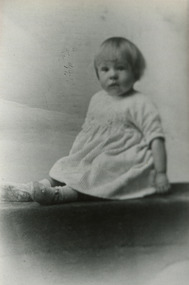
Photographs x 2 B/W, Stefanie & William Rietman c1920, c1920
... ...australian native grasses...After August’s death in 1951, his family continued the business ‘Rietman’s Landscaping Ltd.’, at Highett and Carrum. rietmann august rietman august rietmann frieda rietman frieda stonnington city town hall war memorials world war 1 1914-1918 rietman stefanie rennick stefanie francis stefanie rietman william rietman ray mountford paul malvern city town hall box cottage museum ormond box william box elizabeth joyce park ormond rietman's landscaping pty ltd bay road highett macrobertson pty ltd coleraine soldier memorial 1921 resin jewellery australian native grasses schools education craftwork pottery ceramics ormond state school Hand written names Photographs x 2 Black & White, of Stefanie Amilie Rietman, and William Henry Rietman c 1920 at Ormond Australia Photographs x 2 B/W, Stefanie & William Rietman c1920 Amateur photographer ...Stefanie and William Rietman were the children of August and Frieda Rietmann. Stefanie became a school teacher and designed and made resin jewellery, Later she established a Native grass garden in Joyce park, Ormond, William joined August's business and after his death continued the development of Rietman's Landscaping and pottery firm . His son Ray also continued the family business in Bay Road Highett and the Carrum. August Rietman 1877-1951 and his wife Frieda 1878-1942 leased the Cottage in 1917 and raised 2 children Stefanie 1918-2006, and William 1920– 1997. August was a Monumental Mason / Potter / Sculptor and he was employed at Corbens Ltd Clifton Hill, to make the War Memorials for many towns post WW1. August purchased the property 1935,and established a pressed concrete business using the cottage as a workshop and storeroom After August died in 1951, William, his son, continued to work in the business from the site until the land was sold to Lewis Co. Ltd Timber Merchants in 1970. Rietman's Landscaping Ltd moved to Bay Road Highett 1953 and later to Carrum. The Rietman family is an example of the diverse nationalities that lived and worked productively in Moorabbin Shire 1871–1933 , the City of Moorabbin 1934-1994 and continues today in the Cities of Glen Eira, Kingston, Bayside, and Monash. August, a sculptor and stone mason, was employed by Corben Pty Ltd Clifton Hill to carve WW1 Memorials before establishing his own successful masonry business in the Box Cottage during the latter 1920s. After becoming interested in pressed cement casting, he took on apprentices (1930s Depression) and among his products were garden furniture, pots and also street lamp standards, some of which were installed in St Kilda Road. After August’s death in 1951, his family continued the business ‘Rietman’s Landscaping Ltd.’, at Highett and Carrum.Photographs x 2 Black & White, of Stefanie Amilie Rietman, and William Henry Rietman c 1920 at Ormond AustraliaHand written namesrietmann august, rietman august, rietmann frieda, rietman frieda, stonnington city town hall, war memorials, world war 1 1914-1918, rietman stefanie, rennick stefanie, francis stefanie, rietman william, rietman ray, mountford paul, malvern city town hall, box cottage museum ormond, box william, box elizabeth, joyce park ormond, rietman's landscaping pty ltd, bay road highett, macrobertson pty ltd, coleraine soldier memorial 1921, resin jewellery, australian native grasses, schools, education, craftwork, pottery, ceramics, ormond state school -
 City of Moorabbin Historical Society (Operating the Box Cottage Museum)
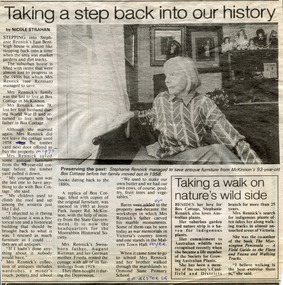
Photograph, B/W Stefanie Rennick nee Rietman c1999; Newspaper clipping 1996, 1996, 1999
... ...australian native grasses...After August’s death in 1951, his family continued the business ‘Rietman’s Landscaping Ltd.’, at Highett and resin jewellery australian native grasses schools education craftwork pottery ceramics ormond state school rietmann august rietman august rietmann frieda rietman frieda stonnington city town hall war memorials world war 1 1914-1918 rietman stefanie rennick stefanie francis stefanie rietman william rietman ray montford paul malvern city town hall box cottage museum ormond box william box elizabeth joyce park ormond rietman's landscaping pty ltd bay road highett macrobertson pty ltd coleraine soldier memorial 1921 box cottage ormond a) printed article b) handwritten information a) Newspaper clipping, Moorabbin Standard 17/9/1996 Stefanie Rennick ( nee Rietman) by N. ...August Rietmann (1877-1951) of Lustdorf ,Switzerland, married Maria Frieda Oesschlager (1878-1942) of Baden Baden, in Germany on 6/8/1910 8/8/1915 August and his wife Frieda migrated to Melbourne, Victoria, Australia sailing on the Steam Ship ‘Osterley’ from Marseilles to Melbourne They leased Box Cottage, Ormond in 1917 and raised two children, Stefanie (1918 -2006) and William (1920- 1997). 1935 August purchased the property and the family used the Cottage during the day and slept in the Front House. August was a monumental mason, potter and sculptor, and was employed at Corbens Ltd Clifton Hill, to carve war memorials in Victoria post WW1 c 1915-1922. During the 1920's August set up his own business in pressed cement making pot plants, columns,paving slabs and lampstands. His son William joined the business and and the family continued to use the site after August died in 1951. Rietmann Landscaping Ltd moved to Bay Road Highett in 1953 and later to Carrum. The land, containing the Box Cottage, was sold to Lewis Timber Pty Ltd in 1970 and Mr Lewis proposed that Moorabbin City Council should preserve the heritage Cottage. Stefanie Rietman, grew up living in Box Cottage until 1935 when she began a Teaching career. Stefanie married Alan Francis 1941 but he was killed in WW2 Air operations over Germany 1944. Two sons were born 1942, 1944. Stefanie returned to live at the cottage until 1958. She married Herbert Rennick 1946 and two sons were born 1947, 1952. Stefanie also established a native grasses garden in Joyce Park, and designed and made resin jewellery. Stefanie died 2006 In 1984 the Cottage was dismantled and reconstructed in the adjacent Joyce Park. The Rietman family is an example of the diverse nationalities that lived and worked productively in Moorabbin Shire 1871–1933 , the City of Moorabbin 1934-1994 and continues today in the Cities of Glen Eira, Kingston, Bayside, and Monash. Stefanie was a talented artist , school teacher, and jewellery designer and raised 4 sons. August, a sculptor and stone mason, was employed by Corben Pty Ltd Clifton Hill to carve WW1 Memorials before establishing his own successful masonry business in the Box Cottage during the latter 1920s. After becoming interested in pressed cement casting, he took on apprentices (1930s Depression) and among his products were garden furniture, pots and also street lamp standards, some of which were installed in St Kilda Road. After August’s death in 1951, his family continued the business ‘Rietman’s Landscaping Ltd.’, at Highett and a) Newspaper clipping, Moorabbin Standard 17/9/1996 Stefanie Rennick ( nee Rietman) by N. Strahan b) Photograph Black & White, Stefanie Rennick ( nee Rietman) 1999a) printed article b) handwritten informationresin jewellery, australian native grasses, schools, education, craftwork, pottery, ceramics, ormond state school, rietmann august, rietman august, rietmann frieda, rietman frieda, stonnington city town hall, war memorials, world war 1 1914-1918, rietman stefanie, rennick stefanie, francis stefanie, rietman william, rietman ray, montford paul, malvern city town hall, box cottage museum ormond, box william, box elizabeth, joyce park ormond, rietman's landscaping pty ltd, bay road highett, macrobertson pty ltd, coleraine soldier memorial 1921, box cottage ormond -
 Warrnambool Art Gallery
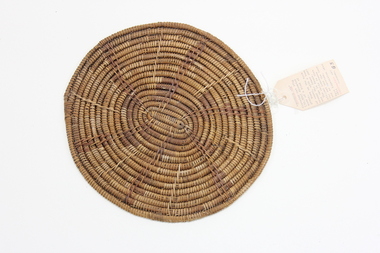
Pooneed-ke (child carrier), c. 1890-1920
... A flat circular mat made from native Australian grasses. Indigenous Australians would use this as a baby-carrier on the back. ...She was a supporter of women's suffrage and also the first woman editor of The Age. aboriginal indigenous child carrier mat native grasses reverend andrew rule osborn annie osborn women mothers A flat circular mat made from native Australian grasses. Indigenous Australians would use this as a baby-carrier on the back. ...This mat was donated to the Museum by the Rev. Andrew Rule Osborn. Reverend Osborn donated several artefacts including Aboriginal artefacts, Zulu and Pacific Islander objects. The Reverend came over from Tasmania to serve here in Warrnambool. His wife Annie was a fantastic author and wrote children's literature which was serialised in the newspapers. She was a supporter of women's suffrage and also the first woman editor of The Age.A flat circular mat made from native Australian grasses. Indigenous Australians would use this as a baby-carrier on the back. One band would be placed around the lower back and mat and two higher up. The child would be placed between the back and the mat. It was also sometimes used as a sun shade or something to sit on. It is a spiral form with grasses woven around to bind it together.aboriginal, indigenous, child carrier, mat, native grasses, reverend andrew rule osborn, annie osborn, women, mothers -
 Bendigo Historical Society Inc.
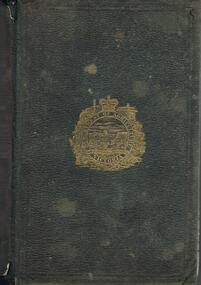
Book - DEPARTMENT OF AGRICULTURE SECOND ANNUAL REPORT 1874
... Smith, Strathfieldsaye' Includes information on agricultural education, Australian grasses, diseases among stock, orange culture, wood boring beetles, apples meteorology of Victoria, worm diseased in sheep, sericulture, white eyebrowed woodswallow, flax, vines and wine industry, fencing and impounding. ...Smith, Strathfieldsaye' Includes information on agricultural education, Australian grasses, diseases among stock, orange culture, wood boring beetles, apples meteorology of Victoria, worm diseased in sheep, sericulture, white eyebrowed woodswallow, flax, vines and wine industry, fencing and impounding. ...Dark green cover, embossed on front 'Department of Agriculture Victoria' enclosed in circular design. Report to the Minister of Lands and Agriculture, 1874 on the proceedings of the Department, 363 pages. Written on front page in black ink "Mr. H.P. Smith, Strathfieldsaye' Includes information on agricultural education, Australian grasses, diseases among stock, orange culture, wood boring beetles, apples meteorology of Victoria, worm diseased in sheep, sericulture, white eyebrowed woodswallow, flax, vines and wine industry, fencing and impounding. Contains information about Strathfieldsaye vigneron Messrs Bruhn and T Strachan of Axedale. Extensive meteorological data for 1873 included; Sandhurst data described in depth.Mr. H. P. Smith Strathfieldsaye in pen on the first three pagesgovernment, state, department of agriculture -
 Mont De Lancey
Glass
... Featuring John Macmillan, Australia Helsinki finalist 1952. Grass originally used for Greig's honey....Featuring John Macmillan, Australia Helsinki finalist 1952. Grass originally used for Greig's honey. ...1956 Olympic games glass. Olympic pageant. Featuring John Macmillan, Australia Helsinki finalist 1952. Grass originally used for Greig's honey.glasses, drinking glasses -
 Federation University Historical Collection
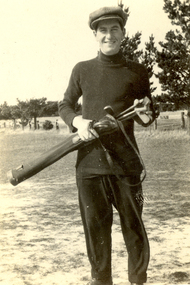
Photograph - Black and White, Oliver Peacock, Frank Wright at the Ballarat Gold Links, 1921, 29/4/21
... The Frank Wright Medal at the Royal South Street competition is awarded to an individual recognized as making an outstanding contribution to brass music in Australia. frank wright ballarat ballarat golf links cornet conductor Witten in pen on the back - Frank Wright, Ballarat Golf Links, 29/4/21, Oliver Peacock Black and white photograph of a man in a dark polo neck jumper and trousers wearing a cap and holding a set of golf clubs in a golf bag. The man is standing on patchy grass ...Frank Wright was a renown resident of Smeaton, where he was born. He lived at Laura Villa, and attended Smeaton State School. His father William was a gold miner and his mother's name was Sarah. Their family won many singing and instrumental awards. Frank was tutored by Percy Code and was awarded a gold medal for the highest marks in the ALCM examinations in the British Colonies at the age of seventeen years. He became the Australian Open Cornet Champion by the age of eighteen. A year later, Frank conducted the City of Ballarat Band, and later the Ballarat Soldiers’ Memorial Band. He formed the Frank Wright Frisco Band and Frank Wright and his Coliseum Orchestra. These bands won many South Street awards, and Frank as conductor won many awards in the Australian Band Championship contest. In 1933 Frank Wright sailed to England to conduct the famous St Hilda’s Band and was later appointed Musical Director of the London County Council, where he organized many amazing concerts in parks, in and around the London district. He was made Professor of Brass and Military Band Scoring and conducted at the Guildhall of Music and Drama. Frank was often invited to adjudicate Brass Band Championships around Europe, in Australia, including South Street and in New Zealand. The Frank Wright Medal at the Royal South Street competition is awarded to an individual recognized as making an outstanding contribution to brass music in Australia.Black and white photograph of a man in a dark polo neck jumper and trousers wearing a cap and holding a set of golf clubs in a golf bag. The man is standing on patchy grass with a fence, paddock and trees in the background. The place is the Ballarat Golf Links.Witten in pen on the back - Frank Wright, Ballarat Golf Links, 29/4/21, Oliver Peacockfrank wright, ballarat, ballarat golf links, cornet, conductor -
 Federation University Historical Collection
Photograph - Photograph - Black and White, Indian Scout Motorbike, 1924, 1/1/1924
... The Frank Wright Medal at the Royal South Street competition is awarded to an individual recognized as making an outstanding contribution to brass music in Australia. frank wright cornet conductor ballarat laura villa smeaton indian motorbike motorbike motorcycle transport Written in ink on back - My Indian Scout. Taken in front of "laura Villa", Smeaton. 1/1/24 Black and white photograph of a motorbike standing on the grass outside a picket fence. ...Frank Wright was a renown resident of Smeaton, where he was born. He lived at Laura Villa, and attended Smeaton State School. His father William was a gold miner and his mother's name was Sarah. Their family won many singing and instrumental awards. Frank was tutored by Percy Code and was awarded a gold medal for the highest marks in the ALCM examinations in the British Colonies at the age of seventeen years. He became the Australian Open Cornet Champion by the age of eighteen. A year later, Frank conducted the City of Ballarat Band, and later the Ballarat Soldiers’ Memorial Band. He formed the Frank Wright Frisco Band and Frank Wright and his Coliseum Orchestra. These bands won many South Street awards, and Frank as conductor won many awards in the Australian Band Championship contest. In 1933 Frank Wright sailed to England to conduct the famous St Hilda’s Band and was later appointed Musical Director of the London County Council, where he organized many amazing concerts in parks, in and around the London district. He was made Professor of Brass and Military Band Scoring and conducted at the Guildhall of Music and Drama. Frank was often invited to adjudicate Brass Band Championships around Europe, in Australia, including South Street and in New Zealand. The Frank Wright Medal at the Royal South Street competition is awarded to an individual recognized as making an outstanding contribution to brass music in Australia.Black and white photograph of a motorbike standing on the grass outside a picket fence. The bike belonged to Frank Wright and the place was "Laura Villa".Written in ink on back - My Indian Scout. Taken in front of "laura Villa", Smeaton. 1/1/24frank wright, cornet, conductor, ballarat, laura villa, smeaton, indian motorbike, motorbike, motorcycle, transport -
 Federation University Historical Collection
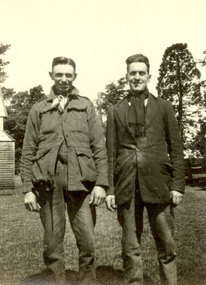
Photograph - Black and White, Brit Archibald, Frank Wright and Roy Archibald, 1922, 23/11/1922
... The Frank Wright Medal at the Royal South Street competition is awarded to an individual recognized as making an outstanding contribution to brass music in Australia. frank wright cornet conductor ballarat roy archibald brit archibald newlyn Written in pen on back - Roy Archibald 21, Frank Wright 21, Taken, while on a couple of days visit to Newlyn, by Brit Archibald, 23/11/22 Black and white photograph of two men standing on a grassed area at Newlyn, with trees in the background and the edge of a building on the left side. ...Frank Wright was a renown resident of Smeaton, where he was born. He lived at Laura Villa, and attended Smeaton State School. His father William was a gold miner and his mother's name was Sarah. Their family won many singing and instrumental awards. Frank was tutored by Percy Code and was awarded a gold medal for the highest marks in the ALCM examinations in the British Colonies at the age of seventeen years. He became the Australian Open Cornet Champion by the age of eighteen. A year later, Frank conducted the City of Ballarat Band, and later the Ballarat Soldiers’ Memorial Band. He formed the Frank Wright Frisco Band and Frank Wright and his Coliseum Orchestra. These bands won many South Street awards, and Frank as conductor won many awards in the Australian Band Championship contest. In 1933 Frank Wright sailed to England to conduct the famous St Hilda’s Band and was later appointed Musical Director of the London County Council, where he organized many amazing concerts in parks, in and around the London district. He was made Professor of Brass and Military Band Scoring and conducted at the Guildhall of Music and Drama. Frank was often invited to adjudicate Brass Band Championships around Europe, in Australia, including South Street and in New Zealand. The Frank Wright Medal at the Royal South Street competition is awarded to an individual recognized as making an outstanding contribution to brass music in Australia.Black and white photograph of two men standing on a grassed area at Newlyn, with trees in the background and the edge of a building on the left side. They are both dressed in long pants, jackets and scarves. The men are Roy Archibald and Frank WrightWritten in pen on back - Roy Archibald 21, Frank Wright 21, Taken, while on a couple of days visit to Newlyn, by Brit Archibald, 23/11/22frank wright, cornet, conductor, ballarat, roy archibald, brit archibald, newlyn -
 Federation University Historical Collection
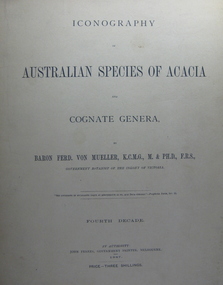
Book, Baron Ferdinand Von Mueller, Iconography of Australian Species of Acacia and Cognate Genera by Ferdinand Von Mueller
... grasses of interest and use to agriculturalists and graziers generally' to SMB over many years. Ferdinand von Mueller's entry on the University of Ballarat Honour Roll can be found at http://www.ballarat.edu.au/curator/honour-roll/honourroll_von_mueller.shtml botany ferdinand von mueller von mueller botanic illustrations government botanist acacia Large format, brown, soft covered books with beautiful line drawings. Set contains 6 of 13 parts, Part 1 covers the fourth decade, Part 2 the fifth decade, Part 3 the eight decade, Part 4 the ninth decade, Part 5 the tenth decade and Part 6 the eleventh decade. Iconography of Australian ...Ferdinand von Mueller was an examiner of botany at the Ballarat School of Mines (SMB) between 1880 and 1888. During that era he was active in donating related items to the School. When the Ballarat School of Mines Council agreed to introduce pharmacy and botany classes in 1879, it was apparent students would require access to botanical specimens in order to further their studies. Council members, who were inspired by the work of Baron Ferdinand von Mueller, authorised development of an area along the School's northern boundary, fronting Lydiard Street South, and oversaw the establishment of the new Botanical Gardens. Baron von Mueller took a practical role the development of SMB's Botanical Gardens from the beginning. He became a generous benefactor who 'donated collections of seeds and leguminous fodder plants, including valued grasses of interest and use to agriculturalists and graziers generally' to SMB over many years. Ferdinand von Mueller's entry on the University of Ballarat Honour Roll can be found at http://www.ballarat.edu.au/curator/honour-roll/honourroll_von_mueller.shtml Large format, brown, soft covered books with beautiful line drawings. Set contains 6 of 13 parts, Part 1 covers the fourth decade, Part 2 the fifth decade, Part 3 the eight decade, Part 4 the ninth decade, Part 5 the tenth decade and Part 6 the eleventh decade.botany, ferdinand von mueller, von mueller, botanic illustrations, government botanist, acacia -
 Federation University Historical Collection
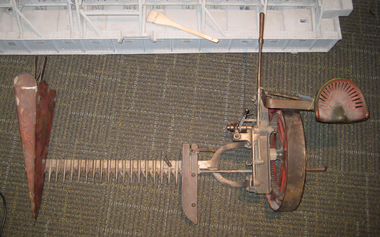
Model, Model of the Munro Reaper, 1887
... Australian manufacture and production. Levers raise the height of the cutter, disengaging the drive from the blades. The moveable blades under the fixed ‘fingers’. An eccentric rod changes circular motion to linear back and forth of the blades. Such a machine is now known as a mower for cutting grass...Australian manufacture and production. Levers raise the height of the cutter, disengaging the drive from the blades. The moveable blades under the fixed ‘fingers’. An eccentric rod changes circular motion to linear back and forth of the blades. Such a machine is now known as a mower for cutting grass ...An example of good invention in an era of innovation in Australian manufacture and production. Levers raise the height of the cutter, disengaging the drive from the blades. The moveable blades under the fixed ‘fingers’. An eccentric rod changes circular motion to linear back and forth of the blades. Such a machine is now known as a mower for cutting grass for hay, and other grasses for storing as sheaves. 'Gift for Museum - The School of Mnes committee has accepted the offer from mr H.B. Munro, of Elsternwick, of a model reaping machine made in 1887 when the Munro machinery business was in operation in Alfredton. The model, which has won gold medals at various exhibitions, is to be placed in thr school museum. (Ballarat Courier 22 April 1932) Metal model with red paint detail in sectionsM263ballarat school of mines, ballarat school of mines museum, munro machinery, model, munro reaper -
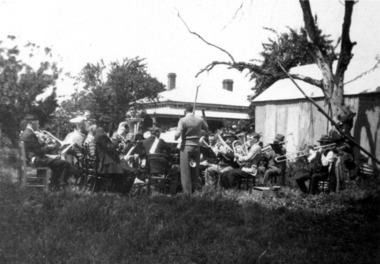 Federation University Historical Collection
Photograph, Ballarat Soldiers' Memorial Band, 10/1930
... Ballarat Soldiers' Memorial Band rehearsing 'en plein air' at Tanunda, South Australia. .1) black and white photograph of a group of seated men each with a musical instrument. The conductor is standing in the middle of the group. They are situated on the grass...Band at rehearsal, Tanunda S.A, Oct 1930 Ballarat Soldiers' Memorial Band rehearsing 'en plein air' at Tanunda, South Australia. .1) black and white photograph of a group of seated men each with a musical instrument. The conductor is standing in the middle of the group. They are situated on the grass ...Ballarat Soldiers' Memorial Band rehearsing 'en plein air' at Tanunda, South Australia. .1) black and white photograph of a group of seated men each with a musical instrument. The conductor is standing in the middle of the group. They are situated on the grass, with a shed, house and trees in the background. The group is the Ballarat Soldier's Memorial Band and the conductor is Frank Wright. .2) black and white photograph of a group of seated men each with a musical instrument. The conductor is standing in the middle of the group. They are situated on the grass, with a shed, house and trees in the background. A girl is running out of the right hand side of the picture.The group is the Ballarat Soldier's Memorial Band and the conductor is Frank Wright.Written in pencil on the back .1) Ballarat S.M. Band at rehearsal, Tanunda S.A, 1930 .2) Ballarat S.M. Band at rehearsal, Tanunda S.A, Oct 1930ballarat, tanunda, ballarat soldiers' memorial band, brass band -
 Federation University Historical Collection
Postcard, Picnic in the Auckland district, New Zealand, 1910
... Australia. frank wright mrs w wright cane pram picnic new zealand Front face of photograph written in white - "Snaps.", Auch.1R.R.10, R34; in pen - 0, X and a crossed 0. On the back - Printed - New Zealand Post Card; Hand written - Mrs W.Wright (Marked with a X) snapped during a 6 months holiday in New Zealand 1910. Mrs C. Cane marked with a 0, Mrs W.G. Wright (jn) marked with a crossed 0 A sepia photograph showing a group of women and two children seated on the grass ...Frank Wright was a renown resident of Smeaton, where he was born. He lived at Laura Villa, and attended Smeaton State School. His father William was a gold miner and his mother's name was Sarah. Their family won many singing and instrumental awards. Frank was tutored by Percy Code and became the Australian Open Cornet Champion by the age of eighteen. A year later, Frank conducted the City of Ballarat Band, and later the Ballarat Soldiers’ Memorial Band. He formed the Frank Wright Frisco Band and Frank Wright and his Coliseum Orchestra. These bands won many South Street awards, and Frank as conductor won many awards in the Australian Band Championship contest. In 1933 Frank Wright sailed to England to conduct the famous St Hilda’s Band and was later appointed Musical Director of the London County Council, where he organized many amazing concerts in parks, in and around the London district. He was made Professor of Brass and Military Band Scoring and conducted at the Guildhall of Music and Drama. Frank was often invited to adjudicate Brass Band Championships around Europe, in Australia, including South Street and in New Zealand. The Frank Wright Medal at the Royal South Street competition is awarded to an individual recognized as making an outstanding contribution to brass music in Australia.A sepia photograph showing a group of women and two children seated on the grass with picnic baskets open. Two wicker prams are behind the group. The three women named are Mrs W. Wright, Mrs C. Cane and Mrs W.G. WrightFront face of photograph written in white - "Snaps.", Auch.1R.R.10, R34; in pen - 0, X and a crossed 0. On the back - Printed - New Zealand Post Card; Hand written - Mrs W.Wright (Marked with a X) snapped during a 6 months holiday in New Zealand 1910. Mrs C. Cane marked with a 0, Mrs W.G. Wright (jn) marked with a crossed 0frank wright, mrs w wright, cane, pram, picnic, new zealand -
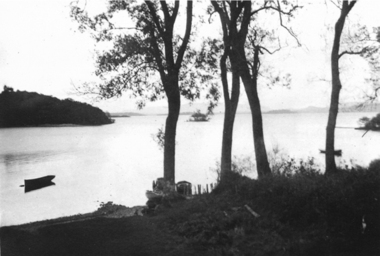 Federation University Historical Collection
Photograph - black and white, Frank Wright at Loch Lomond, 1933, 1933
... Australia. He died on 16 November 1970. frank wright loch lomond musician composer Written in pencil on the reverse side of the photograph is 1). "Frank Wright at Loch Lomond 1933" 2). Loch Lomond 1933 1). A black and white photograph of a man dressed in a suit, overcoat and hat, standing on a wooden pier over a stretch of water which is Loch Lomond. There are mountains to be seen in the distance. The man is Frank Wright. 2). Black and white photograph of a lake. In the foreground is a grassed ...Frank Wright was a renoun resident of Smeaton, where he was born on 2 August 1901. He lived at Laura Villa, and attended Smeaton State School. His father William was a gold miner and his mother's name was Sarah. Their family won many singing and instrumental awards. Frank was tutored by Percy Code and was awarded a gold medal for the highest marks in the ALCM examinations in the British Colonies at the age of seventeen years. He became the Australian Open Cornet Champion by the age of eighteen. A year later, Frank conducted the City of Ballarat Band, and later the Ballarat Soldiers’ Memorial Band. He formed the Frank Wright Frisco Band and Frank Wright and his Coliseum Orchestra. These bands won many South Street awards, and Frank as conductor won many awards in the Australian Band Championship contest. In 1933 Frank Wright sailed to England to conduct the famous St Hilda’s Band and was later appointed Musical Director of the London County Council, where he organized many amazing concerts in parks, in and around the London district. He was made Professor of Brass and Military Band Scoring and conducted at the Guildhall of Music and Drama. Frank was often invited to adjudicate Brass Band Championships around Europe, in Australia, including South Street and in New Zealand. The Frank Wright Medal at the Royal South Street competition is awarded to an individual recognized as making an outstanding contribution to brass music in Australia. He died on 16 November 1970.1). A black and white photograph of a man dressed in a suit, overcoat and hat, standing on a wooden pier over a stretch of water which is Loch Lomond. There are mountains to be seen in the distance. The man is Frank Wright. 2). Black and white photograph of a lake. In the foreground is a grassed area with four trees. a small boat is at anchor just offshore. The place is Loch Lomond.Written in pencil on the reverse side of the photograph is 1). "Frank Wright at Loch Lomond 1933" 2). Loch Lomond 1933frank wright, loch lomond, musician, composer -
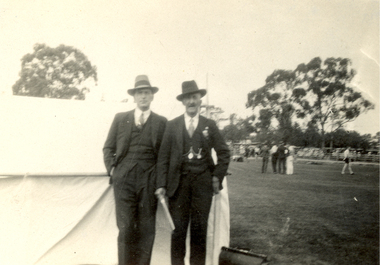 Federation University Historical Collection
Photograph - Black and White, Frank Wright and friend at a sporting event, 1930's?
... The Frank Wright Medal at the Royal South Street competition is awarded to an individual recognized as making an outstanding contribution to brass music in Australia. frank wright brass band conductor gladstone bag Black and white photograph of two men dressed in three piece suits, one with a fob chain and watch and both wearing hats. They are standing in front of a white tent and a Gladstone bag is on the ground beside the older man on the right. In the background, which is a fenced area of grass ...Frank Wright was a renown resident of Smeaton, where he was born on 2 August 1901. He lived at Laura Villa, and attended Smeaton State School. His father William was a gold miner and his mother's name was Sarah. Their family won many singing and instrumental awards. Frank was tutored by Percy Code and was awarded a gold medal for the highest marks in the ALCM examinations in the British Colonies at the age of seventeen years. He became the Australian Open Cornet Champion by the age of eighteen. A year later, Frank conducted the City of Ballarat Band, and later the Ballarat Soldiers’ Memorial Band. He formed the Frank Wright Frisco Band and Frank Wright and his Coliseum Orchestra. These bands won many South Street awards, and Frank as conductor won many awards in the Australian Band Championship contest. In 1933 Frank Wright sailed to England to conduct the famous St Hilda’s Band and was later appointed Musical Director of the London County Council, where he organized many amazing concerts in parks, in and around the London district. He was made Professor of Brass and Military Band Scoring and conducted at the Guildhall of Music and Drama. Frank was often invited to adjudicate Brass Band Championships around Europe, in Australia, including South Street and in New Zealand. The Frank Wright Medal at the Royal South Street competition is awarded to an individual recognized as making an outstanding contribution to brass music in Australia.Black and white photograph of two men dressed in three piece suits, one with a fob chain and watch and both wearing hats. They are standing in front of a white tent and a Gladstone bag is on the ground beside the older man on the right. In the background, which is a fenced area of grass, a group of men are standing in a group and another man off to the right appears to be a competitor in some sporting event. The younger man to the left is Frank Wright.frank wright, brass band, conductor, gladstone bag -
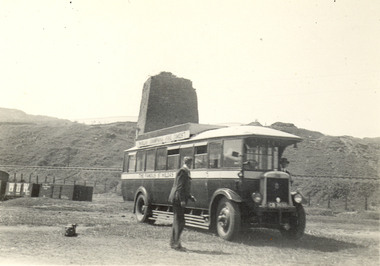 Federation University Historical Collection
Photograph - Black and White, Frank Wright, St Hilda's Band bus at Llanelly, Wales, 29/5/1934
... The Frank Wright Medal at the Royal South Street competition is awarded to an individual recognized as making an outstanding contribution to brass music in Australia. frank wright 1930's bus welsh tower st hilda's band sthilda's band bus Written in pencil on back - Llanelly, Wales, 29/5/34 Black and white photograph of an early 1930's bus parked on the grass in the foreground, with a man standing on the hidden steps of the bus and another man walking in front. ...Frank Wright was a renown resident of Smeaton, where he was born on 2 August 1901. He lived at Laura Villa, and attended Smeaton State School. His father William was a gold miner and his mother's name was Sarah. Their family won many singing and instrumental awards. Frank was tutored by Percy Code and was awarded a gold medal for the highest marks in the ALCM examinations in the British Colonies at the age of seventeen years. He became the Australian Open Cornet Champion by the age of eighteen. A year later, Frank conducted the City of Ballarat Band, and later the Ballarat Soldiers’ Memorial Band. He formed the Frank Wright Frisco Band and Frank Wright and his Coliseum Orchestra. These bands won many South Street awards, and Frank as conductor won many awards in the Australian Band Championship contest. In 1933 Frank Wright sailed to England to conduct the famous St Hilda’s Band and was later appointed Musical Director of the London County Council, where he organized many amazing concerts in parks, in and around the London district. He was made Professor of Brass and Military Band Scoring and conducted at the Guildhall of Music and Drama. Frank was often invited to adjudicate Brass Band Championships around Europe, in Australia, including South Street and in New Zealand. The Frank Wright Medal at the Royal South Street competition is awarded to an individual recognized as making an outstanding contribution to brass music in Australia.Black and white photograph of an early 1930's bus parked on the grass in the foreground, with a man standing on the hidden steps of the bus and another man walking in front. In the middle distance rail lines can be seen on an embankment rising behind a post and wire fence and in the background a tower rises on the closest hill. The bus is the St Hilda's Band bus and the place is Llanelly in Wales.Written in pencil on back - Llanelly, Wales, 29/5/34frank wright, 1930's bus, welsh tower, st hilda's band, sthilda's band bus -
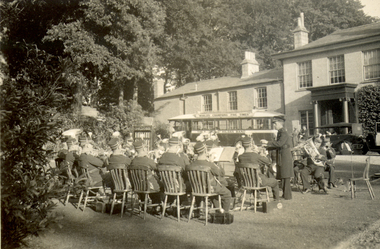 Federation University Historical Collection
Photograph - Black and White, St. Hilda's Band at Lostwithiel, 1934
... The Frank Wright Medal at the Royal South Street competition is awarded to an individual recognized as making an outstanding contribution to brass music in Australia. frank wright brass band st hilda's band lostwithiel vintage bus Written in pencil on the back - St Hilda's (F.W, Conductor), Lostwithiel. 1934 Black and white photograph of a brass band seated on spindle backed, wooden chairs performing on a grassed area, surrounded on the left by large leafy trees and at the back by a two storied building. ...Frank Wright was a renown resident of Smeaton, where he was born on 2 August 1901. He lived at Laura Villa, and attended Smeaton State School. His father William was a gold miner and his mother's name was Sarah. Their family won many singing and instrumental awards. Frank was tutored by Percy Code and was awarded a gold medal for the highest marks in the ALCM examinations in the British Colonies at the age of seventeen years. He became the Australian Open Cornet Champion by the age of eighteen. A year later, Frank conducted the City of Ballarat Band, and later the Ballarat Soldiers’ Memorial Band. He formed the Frank Wright Frisco Band and Frank Wright and his Coliseum Orchestra. These bands won many South Street awards, and Frank as conductor won many awards in the Australian Band Championship contest. In 1933 Frank Wright sailed to England to conduct the famous St Hilda’s Band and was later appointed Musical Director of the London County Council, where he organized many amazing concerts in parks, in and around the London district. He was made Professor of Brass and Military Band Scoring and conducted at the Guildhall of Music and Drama. Frank was often invited to adjudicate Brass Band Championships around Europe, in Australia, including South Street and in New Zealand. The Frank Wright Medal at the Royal South Street competition is awarded to an individual recognized as making an outstanding contribution to brass music in Australia.Black and white photograph of a brass band seated on spindle backed, wooden chairs performing on a grassed area, surrounded on the left by large leafy trees and at the back by a two storied building. Parked in front of the building are a vintage car and an early 1930's bus. The band is St. Hilda's Band with Frank Wright as the conductor. The place is Lostwithiel.Written in pencil on the back - St Hilda's (F.W, Conductor), Lostwithiel. 1934frank wright, brass band, st hilda's band, lostwithiel, vintage bus -
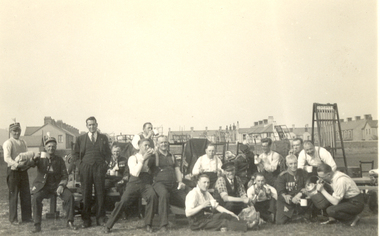 Federation University Historical Collection
Photograph - Black and White, St Hilda's Band having tea at Neath, Wales, 1934, 4/6/1934
... Australia. frank wright st hilda's band neath brass band conductor Written in pencil on the back - St. Hilda's band having tea at Neath, Wales, 4-6-34 Black and white photograph of a group of men relaxing with a cup of tea. Some are dressed in a band uniform whilst others have removed their jackets. They are sitting and standing on a grassed ...Frank Wright was a renown resident of Smeaton, where he was born on 2 August 1901. He lived at Laura Villa, and attended Smeaton State School. His father William was a gold miner and his mother's name was Sarah. Their family won many singing and instrumental awards. Frank was tutored by Percy Code and was awarded a gold medal for the highest marks in the ALCM examinations in the British Colonies at the age of seventeen years. He became the Australian Open Cornet Champion by the age of eighteen. A year later, Frank conducted the City of Ballarat Band, and later the Ballarat Soldiers’ Memorial Band. He formed the Frank Wright Frisco Band and Frank Wright and his Coliseum Orchestra. These bands won many South Street awards, and Frank as conductor won many awards in the Australian Band Championship contest. In 1933 Frank Wright sailed to England to conduct the famous St Hilda’s Band and was later appointed Musical Director of the London County Council, where he organized many amazing concerts in parks, in and around the London district. He was made Professor of Brass and Military Band Scoring and conducted at the Guildhall of Music and Drama. Frank was often invited to adjudicate Brass Band Championships around Europe, in Australia, including South Street and in New Zealand. The Frank Wright Medal at the Royal South Street competition is awarded to an individual recognized as making an outstanding contribution to brass music in Australia.Black and white photograph of a group of men relaxing with a cup of tea. Some are dressed in a band uniform whilst others have removed their jackets. They are sitting and standing on a grassed area, perhaps a village green. Behind them are a group of houses. The men are the St. Hilda's Band with Frank Wright, the conductor standing, dressed in a suit with his hands in his pockets.Written in pencil on the back - St. Hilda's band having tea at Neath, Wales, 4-6-34frank wright, st hilda's band, neath, brass band, conductor -
 Federation University Historical Collection
Photograph - Black and White, St. Hilda's Band at Cardiff, Wales, 9/6/1934
... The Frank Wright Medal at the Royal South Street competition is awarded to an individual recognized as making an outstanding contribution to brass music in Australia. frank wright st hilda's band brass band conductor cardiff Written in pencil on the back - St Hilda's, Frank Wright Conductor, Cardiff (Wales), 9-6-34 Black and white photograph of a group of men dressed in a band uniform seated on a variety of wooden chairs, playing their instruments. They are seated in a grassed ...Frank Wright was a renown resident of Smeaton, where he was born on 2 August 1901. He lived at Laura Villa, and attended Smeaton State School. His father William was a gold miner and his mother's name was Sarah. Their family won many singing and instrumental awards. Frank was tutored by Percy Code and was awarded a gold medal for the highest marks in the ALCM examinations in the British Colonies at the age of seventeen years. He became the Australian Open Cornet Champion by the age of eighteen. A year later, Frank conducted the City of Ballarat Band, and later the Ballarat Soldiers’ Memorial Band. He formed the Frank Wright Frisco Band and Frank Wright and his Coliseum Orchestra. These bands won many South Street awards, and Frank as conductor won many awards in the Australian Band Championship contest. In 1933 Frank Wright sailed to England to conduct the famous St Hilda’s Band and was later appointed Musical Director of the London County Council, where he organized many amazing concerts in parks, in and around the London district. He was made Professor of Brass and Military Band Scoring and conducted at the Guildhall of Music and Drama. Frank was often invited to adjudicate Brass Band Championships around Europe, in Australia, including South Street and in New Zealand. The Frank Wright Medal at the Royal South Street competition is awarded to an individual recognized as making an outstanding contribution to brass music in Australia.Black and white photograph of a group of men dressed in a band uniform seated on a variety of wooden chairs, playing their instruments. They are seated in a grassed area with a stadium on the left and other large buildings in the background. The men are the St. Hilda's Band with Frank Wright as the conductor. The place is Cardiff, Wales.Written in pencil on the back - St Hilda's, Frank Wright Conductor, Cardiff (Wales), 9-6-34frank wright, st hilda's band, brass band, conductor, cardiff -
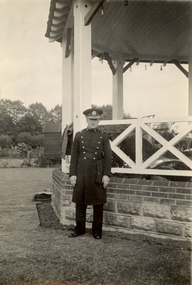 Federation University Historical Collection
Photograph - Photograph - Black and White, Frank Wright standing in front of a bandstand at Staines, Middlesex, 22/5/1934
... The Frank Wright Medal at the Royal South Street competition is awarded to an individual recognized as making an outstanding contribution to brass music in Australia. frank wright brass band conductor bandstand staines Written in pencil on the back - Frank Wright 32, Conductor St Hilda's, Staines, 22/5/34 Black and white photograph of a man dressed in a band uniform standing on the grass in front of a raised bandstand. ...Frank Wright was a renown resident of Smeaton, where he was born on 2 August 1901. He lived at Laura Villa, and attended Smeaton State School. His father William was a gold miner and his mother's name was Sarah. Their family won many singing and instrumental awards. Frank was tutored by Percy Code and was awarded a gold medal for the highest marks in the ALCM examinations in the British Colonies at the age of seventeen years. He became the Australian Open Cornet Champion by the age of eighteen. A year later, Frank conducted the City of Ballarat Band, and later the Ballarat Soldiers’ Memorial Band. He formed the Frank Wright Frisco Band and Frank Wright and his Coliseum Orchestra. These bands won many South Street awards, and Frank as conductor won many awards in the Australian Band Championship contest. In 1933 Frank Wright sailed to England to conduct the famous St Hilda’s Band and was later appointed Musical Director of the London County Council, where he organized many amazing concerts in parks, in and around the London district. He was made Professor of Brass and Military Band Scoring and conducted at the Guildhall of Music and Drama. Frank was often invited to adjudicate Brass Band Championships around Europe, in Australia, including South Street and in New Zealand. The Frank Wright Medal at the Royal South Street competition is awarded to an individual recognized as making an outstanding contribution to brass music in Australia.Black and white photograph of a man dressed in a band uniform standing on the grass in front of a raised bandstand. The bandstand has a stone and brick base, a white railed balustrade, white timber support columns and a roof. In the back ground is a garden, timber building and trees. The man is Frank Wright and he is dressed is the St. Hilda's band uniform.Written in pencil on the back - Frank Wright 32, Conductor St Hilda's, Staines, 22/5/34frank wright, brass band, conductor, bandstand, staines -
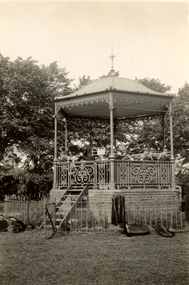 Federation University Historical Collection
Photograph - Black and White, St Hilda's Band at Windsor, 24/5/1934
... The Frank Wright Medal at the Royal South Street competition is awarded to an individual recognized as making an outstanding contribution to brass music in Australia. frank wright conductor brass band st hilda's band windsor bandstand wrought iron lacework Written in pencil on the back - St. Hilda's, Frank Wright Conductor, Windsor, 24/5/34 Black and white photograph of an ornate bandstand built on a grassed area and set high with seven wooden steps leading up to the platform. ...Frank Wright was a renown resident of Smeaton, where he was born on 2 August 1901. He lived at Laura Villa, and attended Smeaton State School. His father William was a gold miner and his mother's name was Sarah. Their family won many singing and instrumental awards. Frank was tutored by Percy Code and was awarded a gold medal for the highest marks in the ALCM examinations in the British Colonies at the age of seventeen years. He became the Australian Open Cornet Champion by the age of eighteen. A year later, Frank conducted the City of Ballarat Band, and later the Ballarat Soldiers’ Memorial Band. He formed the Frank Wright Frisco Band and Frank Wright and his Coliseum Orchestra. These bands won many South Street awards, and Frank as conductor won many awards in the Australian Band Championship contest. In 1933 Frank Wright sailed to England to conduct the famous St Hilda’s Band and was later appointed Musical Director of the London County Council, where he organized many amazing concerts in parks, in and around the London district. He was made Professor of Brass and Military Band Scoring and conducted at the Guildhall of Music and Drama. Frank was often invited to adjudicate Brass Band Championships around Europe, in Australia, including South Street and in New Zealand. The Frank Wright Medal at the Royal South Street competition is awarded to an individual recognized as making an outstanding contribution to brass music in Australia.Black and white photograph of an ornate bandstand built on a grassed area and set high with seven wooden steps leading up to the platform. Under the domed roof, wrought iron lacework extends between the six supporting columns and an ornate, waist-high lacework balustrade encloses the space. At ground level, the bandstand is enclosed by a fence and in the background are leafy trees. Within the bandstand a brass band can be seen performing. The band is the St. Hilda's Band with Frank Wright as its conductor. The place is Windsor.Written in pencil on the back - St. Hilda's, Frank Wright Conductor, Windsor, 24/5/34frank wright, conductor, brass band, st hilda's band, windsor, bandstand, wrought iron lacework -
 Federation University Historical Collection
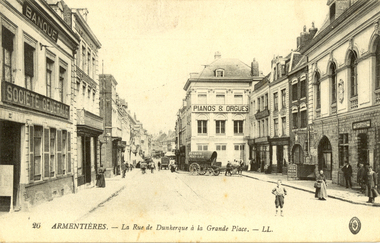
Postcard - Black and White, La Rue de Dunkerque a la grand Place, Armentiers, c1916, c1917
... I have just been out watching the German anti-aircraft Guns shelling our Aeroplanes. it is a very lucky shot that brings one down. i have seen a little bit of the World since I left australia, And I must say I like france better than egypt. The country at present is looking very nice, it being Spring time, The grass is about 6 foot high, and nothing on it to eat it as most of the people have cleared out from around here. ...I have just been out watching the German anti-aircraft Guns shelling our Aeroplanes. it is a very lucky shot that brings one down. i have seen a little bit of the World since I left australia, And I must say I like france better than egypt. The country at present is looking very nice, it being Spring time, The grass is about 6 foot high, and nothing on it to eat it as most of the people have cleared out from around here. ...Holmes Family WW1 memorabiliaA number of people stand in a street surrounded by double storey architecture.Verso: "Dear Willie, I promised to drop you a line, so he goes. Well at present I am in france having -a-go-at the Germans, and so far out Battery is getting on alright. But I must say the Germans greet us know and again with a few shells, and I can assure you they are no friends of mine. I have just been out watching the German anti-aircraft Guns shelling our Aeroplanes. it is a very lucky shot that brings one down. i have seen a little bit of the World since I left australia, And I must say I like france better than egypt. The country at present is looking very nice, it being Spring time, The grass is about 6 foot high, and nothing on it to eat it as most of the people have cleared out from around here. I have not seen anything of Harry over this way as yet. Perhaps he is still in Egypt. Well Willie now about taking another cow to Clunes. Ay What. The name on the front of this card should be familiar to you in the War news. Well Willie Au revoir for present. remember me to all. Your fond cousin, Ron W." chatham-holmes family collection, armentieres, world war one, postcard, clunes, france -
 Federation University Historical Collection
Photograph - Black and White, V. Holt, City of Ballarat Band on March on the Exhibition Ground, Brisbane, 1923, Easter 1923
... Australia. He died in England in 1970 at the age of 69. frank wright vernon holt city of ballarat band brisbane exhibition ground brass band Written in pen on back - The City of Ballarat Band (winners A & B grade quickstep) On March exhibition ground, Brisane Easter, 1923 (V. Hall) Black and white photograph of a large grassed ...Frank Wright was a renown resident of Smeaton, where he was born on 2 August 1901. He lived at Laura Villa, and attended Smeaton State School. His father William was a gold miner and his mother's name was Sarah. Their family won many singing and instrumental awards. Frank was tutored by Percy Code and was awarded a gold medal for the highest marks in the ALCM examinations in the British Colonies at the age of seventeen years. He became the Australian Open Cornet Champion by the age of eighteen. A year later, Frank conducted the City of Ballarat Band, and later the Ballarat Soldiers’ Memorial Band. He formed the Frank Wright Frisco Band and Frank Wright and his Coliseum Orchestra. These bands won many South Street awards, and Frank as conductor won many awards in the Australian Band Championship contest. In 1933 Frank Wright sailed to England to conduct the famous St Hilda’s Band and was later appointed Musical Director of the London County Council, where he organized many amazing concerts in parks, in and around the London district. He was made Professor of Brass and Military Band Scoring and conducted at the Guildhall of Music and Drama. Frank was often invited to adjudicate Brass Band Championships around Europe, in Australia, including South Street and in New Zealand. The Frank Wright Medal at the Royal South Street competition is awarded to an individual recognized as making an outstanding contribution to brass music in Australia. He died in England in 1970 at the age of 69.Black and white photograph of a large grassed oval surrounded by a picket fence. There are stands with spectators on both sides of the oval. In the centre is a group of men in band uniform, marching and playing their brass instruments.The place is the Brisbane Exhibition Ground and the group is the City of Ballarat Band.Written in pen on back - The City of Ballarat Band (winners A & B grade quickstep) On March exhibition ground, Brisane Easter, 1923 (V. Hall)frank wright, vernon holt, city of ballarat band, brisbane exhibition ground, brass band -
 The Beechworth Burke Museum
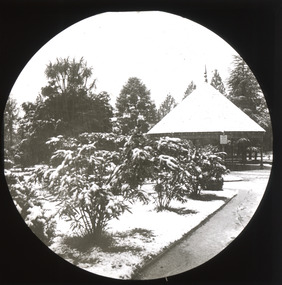
Photograph - Lantern Slide, c1900
... Australia's Federation. The pathway leading to a circular rotunda or covered seating area with a steep conical roof is lined with shrubs set in grass verges that appear to be covered with snow. ...Australia's Federation. The pathway leading to a circular rotunda or covered seating area with a steep conical roof is lined with shrubs set in grass verges that appear to be covered with snow. ...This image shows a pathway in the gardens adjacent to Beechworth's Town Hall at the beginning of the Twentieth Century, around the time of Australia's Federation. The pathway leading to a circular rotunda or covered seating area with a steep conical roof is lined with shrubs set in grass verges that appear to be covered with snow. It is unknown whether the snowfall or a factor to do with the gardens occasioned the taking of the image, which at the time may have been an exotic practice. Climate records going back to 1908 indicate that snow in winter is not unusual due to Beechworth's elevation and orientation, and the Town Hall itself was built in 1859. Lantern slides, sometimes called 'magic lantern' slides, are glass plates on which an image has been secured for the purpose of projection. Glass slides were etched or hand-painted for this purpose from the Eighteenth Century but the process became more popular and accessible to the public with the development of photographic-emulsion slides used with a 'Magic Lantern' device in the mid-Nineteenth Century. Photographic lantern slides comprise a double-negative emulsion layer (forming a positive image) between thin glass plates that are bound together. A number of processes existed to form and bind the emulsion layer to the base plate, including the albumen, wet plate collodion, gelatine dry plate and woodburytype techniques. Lantern slides and magic lantern technologies are seen as foundational precursors to the development of modern photography and film-making techniques. This glass slide is significant because it provides insight into Beechworth's social amenities and climate in the early Twentieth Century, around the time of Australia's Federation into one nation. It is also an example of an early photographic and film-making technology in use in regional Victoria in the time period. Thin translucent sheet of glass with a circular image printed on the front and framed in a black backing. It is held together by metals strips to secure the edges of the slide.burke museum, beechworth, lantern slide, slide, glass slide, plate, burke museum collection, photograph, monochrome, town hall, town hall gardens, snow, rotunda, magic lantern, indigo shire, north-east victoria, nineteenth century, 1900s, twentieth century, emulsion slides -
 Mission to Seafarers Victoria
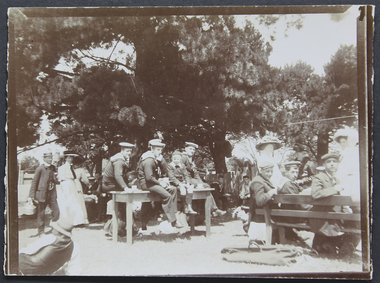
Photograph - Photograph, Sepia, Mr and Mrs Gurney Goldsmith, Picnic at Orchard House, Cup Day 1909, 2 Novembre 1909
... grass under the trees. Mrs. MacLeod, Mrs. Knight, Mrs. Simon Fraser, Mrs. H. B. Higgins, Mrs. Albert Keep, Miss Ethel Godfrey, the Misses Wollaston, and a number of other ladies assisted to wait on the "tars." One "Jack," from H.M.S. Cambrian, voted it the "nicest day he had had since leaving the Old Country." Hearty cheers for the kind hostesses closed the proceedings. The evening was spent at the Institutes of the Missions to Seamen on the Australian...grass under the trees. Mrs. MacLeod, Mrs. Knight, Mrs. Simon Fraser, Mrs. H. B. Higgins, Mrs. Albert Keep, Miss Ethel Godfrey, the Misses Wollaston, and a number of other ladies assisted to wait on the "tars." One "Jack," from H.M.S. Cambrian, voted it the "nicest day he had had since leaving the Old Country." Hearty cheers for the kind hostesses closed the proceedings. The evening was spent at the Institutes of the Missions to Seamen on the Australian ...This photograph depicts a picnic for Cup Day (Tuesday 2 November 1909) organised by the Mission and the LHLG members at Orchard House. The property belongs to Mr George Higgins, engineer and his wife, Beatrice who was the LHLG Malvern branch secretary. Beatrice nee Shuter was the daughter of Charles Shuter. In the Punch published on 11 November 1909, we could read: "The pretty garden of "Orchard House," and the paddock adjoining (kindly lent by Mr. and Mrs. Singleton), was the scene on Cup Day of a most successful sailors' picnic, when Mr. and Mrs. George Higgins and the Malvern members of the Ladies' Harbour Lights Guild entertained some 110 sailors from the Royal Navy and Merchant Service. A football match, sports, and "costume" races were indulged in by the more active members of the party, while others enjoyed the unusual pleasure of sitting on the green grass under the trees. Mrs. MacLeod, Mrs. Knight, Mrs. Simon Fraser, Mrs. H. B. Higgins, Mrs. Albert Keep, Miss Ethel Godfrey, the Misses Wollaston, and a number of other ladies assisted to wait on the "tars." One "Jack," from H.M.S. Cambrian, voted it the "nicest day he had had since leaving the Old Country." Hearty cheers for the kind hostesses closed the proceedings. The evening was spent at the Institutes of the Missions to Seamen on the Australian Wharf and at Port Melbourne respectively, where prizes were distributed to the successful competitors. "Small monochrome photograph1909, malvern, cup day, mr george higgins, mce, beatrice elizabeth higgins (nee shuter), h.m.s. cambrian, ethel augusta godfrey, orchard house, ina higgins, rica godfrey, rita godfrey, reverend alfred gurney goldsmith, picnics, social events, frederica godfrey, entertainments, sailors, seafarers, seamen, goldsmith album -
Federation University Historical Collection
Document - Handwritten document, Frank Wright, Handwritten reminiscences of London County Council entertainments by Frank Wright, 1966s
... The Frank Wright Medal at the Royal South Street competition is awarded to an individual recognized as making an outstanding contribution to brass music in Australia. frank wright composer conductor bands London County Council Entertainments All handwritten Handwritten notes by Frank Wright totalling 19 pages broken into 1). Introduction 1b). Bands 2). Concert Parties 3). Holidays at home during the war years 4). Open air dancing 5). Children's shows 6). Crystal Palace 7). The grass ...Frank Wright was a renown resident of Smeaton, where he was born in 1901. He lived at Laura Villa, and attended Smeaton State School. His father William was a gold miner and his mother's name was Sarah. Their family won many singing and instrumental awards. Frank was tutored by Percy Code and was awarded a gold medal for the highest marks in the ALCM examinations in the British Colonies at the age of seventeen years. He became the Australian Open Cornet Champion by the age of eighteen. A year later, Frank conducted the City of Ballarat Band, and later the Ballarat Soldiers’ Memorial Band. He formed the Frank Wright Frisco Band and Frank Wright and his Coliseum Orchestra. These bands won many South Street awards, and Frank as conductor won many awards in the Australian Band Championship contest. In 1933 Frank Wright sailed to England to conduct the famous St Hilda’s Band and was later appointed Musical Director of the London County Council, where he organized many amazing concerts in parks, in and around the London district. He was made Professor of Brass and Military Band Scoring and conducted at the Guildhall of Music and Drama. Frank was often invited to adjudicate Brass Band Championships around Europe, in Australia, including South Street and in New Zealand. The Frank Wright Medal at the Royal South Street competition is awarded to an individual recognized as making an outstanding contribution to brass music in Australia.Handwritten notes by Frank Wright totalling 19 pages broken into 1). Introduction 1b). Bands 2). Concert Parties 3). Holidays at home during the war years 4). Open air dancing 5). Children's shows 6). Crystal Palace 7). The grass theatres 8). Iveagh Bequest 9). Open air Symphony ConcertsAll handwritten frank wright, composer, conductor, bands, london county council entertainments -
 The Beechworth Burke Museum
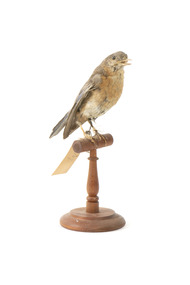
Animal specimen - Bluebird
... grass from a distance of over 45 meters. The Bluebird is commonly identified in numerous cultures as being symbolic as a harbinger of happiness. Often in Russian fairytales, the Bluebird is used as a symbol of hope. This specimen is part of a collection of almost 200 animal specimens that were originally acquired as skins from various institutions across Australia, including the Australian Museum in Sydney and the National Museum of Victoria (known as Museums Victoria since 1983), as well as individuals such as amateur anthropologist Reynell Eveleigh Johns between 1860-1880. ...grass from a distance of over 45 meters. The Bluebird is commonly identified in numerous cultures as being symbolic as a harbinger of happiness. Often in Russian fairytales, the Bluebird is used as a symbol of hope. This specimen is part of a collection of almost 200 animal specimens that were originally acquired as skins from various institutions across Australia, including the Australian Museum in Sydney and the National Museum of Victoria (known as Museums Victoria since 1983), as well as individuals such as amateur anthropologist Reynell Eveleigh Johns between 1860-1880. ...Eastern bluebirds are well-known song birds that live in eastern North America. They are sexually dimorphic, easily recognised by the male's bright royal blue upper plumage, chest of reddish brown and white abdomen. The females is duller in colour than the male, with greyer upperparts and blue tinges to her wings. These Bluebirds, the European variety, are the most common of the three Bluebird species. When not nesting, these birds fly in small flocks around the countryside. Bluebirds feed on small insects including moths, termites and mosquitoes. They also eat grasshoppers, crickets and caterpillars. The Bluebird can spot caterpillars and other insects in tall grass from a distance of over 45 meters. The Bluebird is commonly identified in numerous cultures as being symbolic as a harbinger of happiness. Often in Russian fairytales, the Bluebird is used as a symbol of hope. This specimen is part of a collection of almost 200 animal specimens that were originally acquired as skins from various institutions across Australia, including the Australian Museum in Sydney and the National Museum of Victoria (known as Museums Victoria since 1983), as well as individuals such as amateur anthropologist Reynell Eveleigh Johns between 1860-1880. These skins were then mounted by members of the Burke Museum Committee and put-on display in the formal space of the Museum’s original exhibition hall where they continue to be on display. This display of taxidermy mounts initially served to instruct visitors to the Burke Museum of the natural world around them, today it serves as an insight into the collecting habits of the 19th century.This specimen is part of a significant and rare taxidermy mount collection in the Burke Museum. This collection is scientifically and culturally important for reminding us of how science continues to shape our understanding of the modern world. They demonstrate a capacity to hold evidence of how Australia’s fauna history existed in the past and are potentially important for future environmental research. This collection continues to be on display in the Museum and has become a key part to interpreting the collecting habits of the 19th century.This female bluebird (likely Eastern) has a medium brown head and back, a rufous breast, and a cream belly. The bird has blue-tinged wing and tail feathers. The bill is short and has been stylized with the bill partly open to provide the illusion that the bird is making a call. This specimen stands upon a wooden mount and has an identification tag tied around its leg. The bird's plumage has faded since it was first preserved; females generally have duller colouring than their male counterparts but the colour of this particular specimen is paler than it would have been.Label: 122a. Blue-Bird / Catalogue Page 29. / Metal tag: 107taxidermy mount, taxidermy, animalia, burke museum, beechworth, australian museum, skin, reynell eveleigh johns, bird, american birds, bluebird -
 The Beechworth Burke Museum
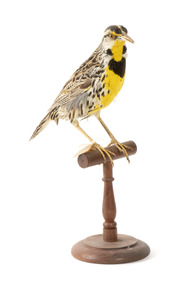
Animal specimen - Eastern Meadowlark, Trustees of the Australian Museum, 1860-1880
... grasses. When in flight or perching, they reveal bright-yellow breasts and bellies, and a striking black chevron across the chest. The Eastern Meadowlark has a diet which consists of mainly insects and seeds. These birds forage by walking on the ground and taking insects and seeds from the ground and from low plants. In winter, these birds may choose to forage in flocks. This specimen is part of a collection of almost 200 animal specimens that were originally acquired as skins from various institutions across Australia...grasses. When in flight or perching, they reveal bright-yellow breasts and bellies, and a striking black chevron across the chest. The Eastern Meadowlark has a diet which consists of mainly insects and seeds. These birds forage by walking on the ground and taking insects and seeds from the ground and from low plants. In winter, these birds may choose to forage in flocks. This specimen is part of a collection of almost 200 animal specimens that were originally acquired as skins from various institutions across Australia ...Eastern Meadowlarks live throughout the grasslands and farms in eastern North America. On the ground, their brown-and-black dappled upperparts camouflage the birds among dirt clods and dry grasses. When in flight or perching, they reveal bright-yellow breasts and bellies, and a striking black chevron across the chest. The Eastern Meadowlark has a diet which consists of mainly insects and seeds. These birds forage by walking on the ground and taking insects and seeds from the ground and from low plants. In winter, these birds may choose to forage in flocks. This specimen is part of a collection of almost 200 animal specimens that were originally acquired as skins from various institutions across Australia, including the Australian Museum in Sydney and the National Museum of Victoria (known as Museums Victoria since 1983), as well as individuals such as amateur anthropologist Reynell Eveleigh Johns between 1860-1880. These skins were then mounted by members of the Burke Museum Committee and put-on display in the formal space of the Museum’s original exhibition hall where they continue to be on display. This display of taxidermy mounts initially served to instruct visitors to the Burke Museum of the natural world around them, today it serves as an insight into the collecting habits of the 19th century.This specimen is part of a significant and rare taxidermy mount collection in the Burke Museum. This collection is scientifically and culturally important for reminding us of how science continues to shape our understanding of the modern world. They demonstrate a capacity to hold evidence of how Australia’s fauna history existed in the past and are potentially important for future environmental research. This collection continues to be on display in the Museum and has become a key part to interpreting the collecting habits of the 19th century. This Eastern Meadowlark has a yellow breast and throat with black plumage in the shape of a 'V' on it's throat. This particular specimen has a long pointed bill which is in the shape of a spear. The crown of the bird is a dark brown and it also has lighter brown/yellow stripes on the brow. The back, wings, and tail are light brown with dark brown mottling. This specimen stands upon a wooden platform and has an identification tag tied around its leg. The legs are long and the specimen has been styalised in an upright position.Label: [illegible] Ant-Eating Thrush / Catalogue, Page 66. /taxidermy mount, taxidermy, animalia, burke museum, beechworth, australian museum, skin, reynell eveleigh johns, bird, american birds, eastern meadowlark, meadowlark -
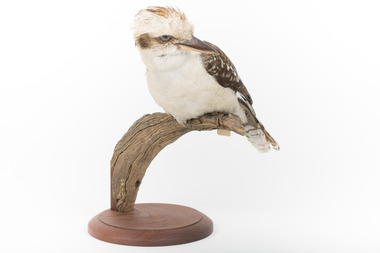 The Beechworth Burke Museum
Animal specimen - Kookaburra, Trustees of the Australian Museum, 1860-1880
... This species reside in woodlands and open forests, however they can be seen in parks, wetlands, farms and any other space that is open with grass. This native Australian bird can mainly be found across the eastern Australia, however they have been introduced Tasmania, South-west Western Australia and New Zealand. ...This species reside in woodlands and open forests, however they can be seen in parks, wetlands, farms and any other space that is open with grass. This native Australian bird can mainly be found across the eastern Australia, however they have been introduced Tasmania, South-west Western Australia and New Zealand. ...The Kookaburra is a sociable bird commonly seen in small flocks. These flocks mainly consist of family members. If not in flocks, these birds are commonly seen in pairs. They have a distinct appearance with brown wings, back and brown around the eyes, with majority of the plumage being white. This species reside in woodlands and open forests, however they can be seen in parks, wetlands, farms and any other space that is open with grass. This native Australian bird can mainly be found across the eastern Australia, however they have been introduced Tasmania, South-west Western Australia and New Zealand. Although this is a taxidermy mount, it looks exactly like a Kookaburra in real life. This specimen is part of a collection of almost 200 animal specimens that were originally acquired as skins from various institutions across Australia, including the Australian Museum in Sydney and the National Museum of Victoria (known as Museums Victoria since 1983), as well as individuals such as amateur anthropologist Reynell Eveleigh Johns between 1860-1880. These skins were then mounted by members of the Burke Museum Committee and put-on display in the formal space of the Museum’s original exhibition hall where they continue to be on display. This display of taxidermy mounts initially served to instruct visitors to the Burke Museum of the natural world around them, today it serves as an insight into the collecting habits of the 19th century.This specimen is part of a significant and rare taxidermy mount collection in the Burke Museum. This collection is scientifically and culturally important for reminding us of how science continues to shape our understanding of the modern world. They demonstrate a capacity to hold evidence of how Australia’s fauna history existed in the past and are potentially important for future environmental research. This collection continues to be on display in the Museum and has become a key part to interpreting the collecting habits of the 19th century.This Kookaburra has a predominantly white body. The back, wings and tail are a light shade of brown. There is a strip of brown going across the eyes. This specimen stands upon a wooden branch and has an identification tag ties around its leg. This bird is stout in shape and has a medium length tail and a broad bill. This bill is darker on top and lighter in colour on the bottom.W8083 / taxidermy mount, taxidermy, animalia, burke museum, beechworth, australian museum, skin, reynell eveleigh johns, bird, kookaburra, australian birds, laughing kookaburra
