
Showing 55 items matching "australian inventors"
-
 Federation University Historical Collection
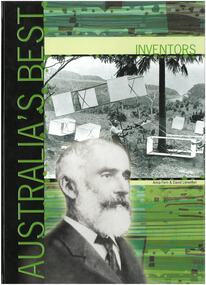
Book, Harcourt Education Australia, Australia's Best Inventors, 2004, 2004
... australian inventors...Hard copy green cover with black over spine, about Australian inventors, 32 pages with index, includes; Maria Skyllas Kazocos Richard Smith James Harrison Henry Sutton Hugh MacKay Lawrence Hargrave Walter Hume David Unaipon Arthur Bishop Mervyn Richardson David Henshaw Ralph Sarich Ben Lexon Alan Walsh...The photograph of Henry Sutton used in this book was provided by Federation University Historical Collection. australian inventors maria skyllas kazocos richard smith james harrison henry sutton hugh mackay lawrence hargrave walter hume david unaipon arthur bishop mervyn richardson david henshaw ralph sarich ben lexon alan walsh Hard copy green cover with black over spine, about Australian inventors, 32 pages with index, includes; Maria Skyllas Kazocos Richard Smith James Harrison Henry Sutton Hugh MacKay Lawrence Hargrave Walter Hume David Unaipon Arthur Bishop Mervyn Richardson David Henshaw Ralph Sarich Ben Lexon Alan Walsh Australia's Best Inventors, 2004 Book Book Harcourt Education Australia ...The photograph of Henry Sutton used in this book was provided by Federation University Historical Collection.Hard copy green cover with black over spine, about Australian inventors, 32 pages with index, includes; Maria Skyllas Kazocos Richard Smith James Harrison Henry Sutton Hugh MacKay Lawrence Hargrave Walter Hume David Unaipon Arthur Bishop Mervyn Richardson David Henshaw Ralph Sarich Ben Lexon Alan Walshaustralian inventors, maria skyllas kazocos, richard smith, james harrison, henry sutton, hugh mackay, lawrence hargrave, walter hume, david unaipon, arthur bishop, mervyn richardson, david henshaw, ralph sarich, ben lexon, alan walsh -
 Federation University Historical Collection
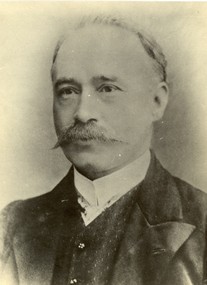
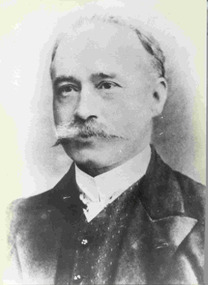
Photograph - Photograph - Black and White, Portrait of Henry Sutton, c1890
... A rare portrait of Australian inventor Henry Sutton. ...He died on 28 July 1912 at Brighton, Victoria. henry sutton invention telephone sutton inventor electricity staffmember A rare portrait of Australian inventor Henry Sutton. Portrait of Henry Sutton Photograph Photograph - Black and White Australia Victoria ...Henry Sutton was born at Ballarat on 03 September 1856. He taught Electricity and Magnetism at the Ballarat School of Mines between 1883 and 1887. Sutton was an incredible inventor. He died on 28 July 1912 at Brighton, Victoria. A rare portrait of Australian inventor Henry Sutton. henry sutton, invention, telephone, sutton, inventor, electricity, staffmember -
 Federation University Historical Collection
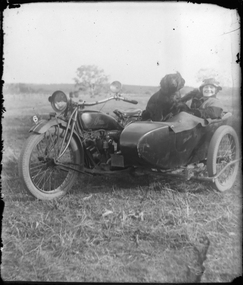
Photograph - Glass Plate, Woman and Dog in a Sidecar by Henry Sutton
... He is known as an important Australian inventor. ...He is known as an important Australian inventor. Henry sutton glass plates photography motorcycle sidecar Image of a woman and dog in a sidecar. ...Henry Sutton was born in Ballarat into the musical Sutton Family. He is known as an important Australian inventor. Image of a woman and dog in a sidecar.henry sutton, glass plates, photography, motorcycle, sidecar -
 Federation University Historical Collection
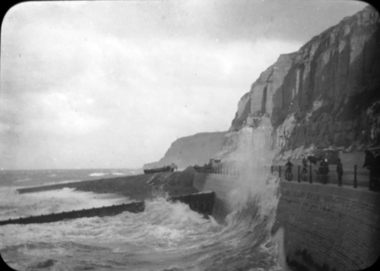
Photograph - Glass Plate, Henry Sutton, Hastings by Henry Sutton, c1891
... He is known as an important Australian inventor. ...He is known as an important Australian inventor. Henry sutton glass plates photography coastal scene sea Photograph of Hastings.. ...Henry Sutton was born in Ballarat into the musical Sutton Family. He is known as an important Australian inventor. Photograph of Hastings..henry sutton, glass plates, photography, coastal scene, sea -
 Victorian Interpretive Projects Inc.
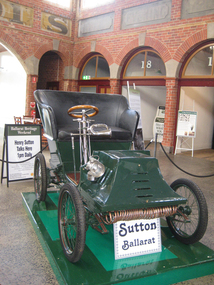
Photograph - colour, Clare Kathleen Gervasoni, Henry Sutton's Ballarat Car, 2011
... He became one of Australia's greatest inventors. The Ballarat Car is the oldest privately owned car in Australia. ...He became one of Australia's greatest inventors. The Ballarat Car is the oldest privately owned car in Australia. ...Henry Sutton was born in Ballarat. He became one of Australia's greatest inventors. The Ballarat Car is the oldest privately owned car in Australia. It was designed and built in Ballarat around 1900.Colour photograph's showing Henry Sutton's Ballarat Car on display in the Ballarat Mining exchange during the Ballarat Heritage Festival in 2011. henry sutton, sutton, ballarat car, automobile, ballarat mining exchange -
![Front cover of 'The insul-cot handbook Mark 1' [ca.1950's] Laver & Campbell](/media/collectors/50187a8f023fd7201471f198/items/6a152ce38a79ffb97438ec7e/item-media/6a169cf1e625583bca8d5b29/item-fit-380x285.jpg?cb=6) Alfred Hospital Nurses League - Nursing History Collection
Alfred Hospital Nurses League - Nursing History CollectionManual - Instruction manual, Dr J C Laver et al, The insul-cot handbook Mark 1, [ca.1950's]
... The Insul-cot Mark 1 is a historically significant, early portable infant incubator designed by South Australian engineer and inventor Edward Thomas (Ted) Both and his broher Donald in the 1950s. ...The Insul-cot Mark 1 is a historically significant, early portable infant incubator designed by South Australian engineer and inventor Edward Thomas (Ted) Both and his broher Donald in the 1950s. ...The Insul-cot Mark 1 is a historically significant, early portable infant incubator designed by South Australian engineer and inventor Edward Thomas (Ted) Both and his broher Donald in the 1950s. It was engineered to overcome high premature infant mortality rates in Australian hospitals by providing a clean, temperature-controlled environment while allowing easy access to the baby. This manual provided instructions for its useAn Australian inventionStapled illustrated booklet with green cover. Black print on front cover detais title and publisher. There is also an illustration of three humicribs [black print on white background]. Name hand written at top right [blue ink], red pencil mark in centre, previous catalogue number On front cover there is a name hand written at top right [blue ink], red pencil mark in centre, previous catalogue number is printed on a small white sticker at bottom left. On contents page previous catalogue number handwritten at top right [black ink] underneath this 'Patricia J ?' [hand written blue ink] At the bottom of this page is a printed black and white donation sticker: black Maltese cross in circle, "This book was donated to Alfred Archival Association Nursing Division by" Patricia Armstrong-Grant [handwritten black ink}neonatal care, humicribs, isolettes -
 Federation University Historical Collection
Document, Anne Beggs Sunter, Henry Sutton the Eureka Man, 2005
... Henry Sutton was an Australian born, self-taught inventor. He invented 23 different types of telephone, a proto-type helicopter, the world's first portable wireless radio, a colour-printing process and a carbon-filament light built just 16 days after Edison. ...Henry Sutton was an Australian born, self-taught inventor. He invented 23 different types of telephone, a proto-type helicopter, the world's first portable wireless radio, a colour-printing process and a carbon-filament light built just 16 days after Edison. ...Henry Sutton was an Australian born, self-taught inventor. He invented 23 different types of telephone, a proto-type helicopter, the world's first portable wireless radio, a colour-printing process and a carbon-filament light built just 16 days after Edison. Sutton built and drove the first motor car in Australia and conceived and built what is thought to be the world's first four-wheel drive. Anne Beggs Sunter is an historian who lectures in Australian History and Heritage at the University of BallaratThree page article on Henry Sutton from Australian Heritage Nov 05 (http://www.heritageaustralia.com.au/pdfs/Heritage1105_Henry%20Sutton.pdf) The article includes a picture of the Sutton Autocar, the Telephane System, Illuminated Address present to Henry Sutton by the Citizens of Ballarat and his grave in the Brighton Cemetery. henry sutton, sutton, beggs sunter, autocar, telephane, balllarat. sutton music, richard sutton, mary sutton, -
 Flagstaff Hill Maritime Museum and Village
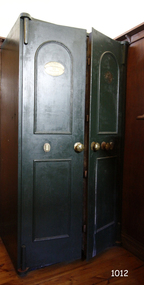
Functional object - Safe, W. Marr, Circa 1855
... inventor of a way to make a strong box fireproof, then patented his secure safe. This invention indicates that security of money was of great importance in the mid-1800s as it continues to be today. The secure safe would have given much comfort to those with investments and savings, as well as to the bank itself, the custodian of other people's money. This safe was made in London and exported to colonial Australia ...This strong, heavy bank safe was made by W. Marr in London. It was formerly owned by the ANZ Bank in Portland, Victoria. Portland’s ANZ Bank was originally a branch of the Bank of Australasia, which first came to Australia in 1835, opening in Sydney. Portland’s Bank of Australasia began in a bluestone building built on the north corner of Julia and Bentinck Streets by stonemason William Robb in 1855, around the time of Australia’s Gold Rush. Eventually, in 1951, the Bank of Australasia merged with the Union Bank to become the Australia & New Zealand Bank, known as the ANZ. Portland’s branch of the Bank of Australasia then moved into the old Union Bank building at 44 Percy Streets; both bank buildings were built around the same. The maker of this safe, W. (William) Marr, obtained a patent in 1834 for what is believed to be the first fire-retarding patent, building this into the lining of strong boxes. Others made further design improvements such as hardening the metal plates used to make the boxes. In about 1840 Thomas Milner, a Sheffield tinsmith, made the earliest safes that could safely protect their contents from a surrounding fire. This was achieved by including tubes of a substance between the inner and outer walls of the safe that would react to the heat and the contents would put the fire out. In 1851 an Exhibition at London’s Crystal Palace included fire-proof safes from different vendors. William Marr was listed under Fireproof Box Makers in the 1842 London Trades Directory, at 33 Broad Street, and 52 Cheapside. William Marr & Son were appointed to supply Her Majesty’s National Debt Office and other departments in 1860, with the address 9 Walbrook, Vulcan Safe Works, Skin Yard, Bankside, Southwark, London. 1n 1870 the address for William Marr listed under Safe Makers and Agents in the London Trades Directory was 67 Cannon Street. The manufacturer, W Marr, is significant as an inventor of a way to make a strong box fireproof, then patented his secure safe. This invention indicates that security of money was of great importance in the mid-1800s as it continues to be today. The secure safe would have given much comfort to those with investments and savings, as well as to the bank itself, the custodian of other people's money. This safe was made in London and exported to colonial Australia, giving significance to the safe as an item that was high in the list of the needs of the early Australians and their businesses. The safe has local historical significance as it was used by the original Bank of Australasia in Portland, which was built in 1855 and went on to become the ANZ Bank, still in operation today. The bank was an integral part of the establishment and growth of commerce in Colonial Victoria.Safe; heavy metal bank safe, painted green. Double doors each have top and bottom external hinges, and two front panels; the top panels are arched. The thick doors have five sliding locks. Inside is a fixed metal compartment with a locked sliding metal drawer, and several fitted shelves plus some temporary removable shelving. Both doors have a decorative brass knob near the centre opening. Left door has an oval artificial keyhole and a space where another fitting has been attached. The right door has a second brass knob and an oval keyhole. The top panels of the left door has an oval plaque with an inscription; the right door has evidence that there was an oval attachment. Made by W. Marr, London.Text embossed on plaque: "W. MARR / PATENTEE & MANUFACTURER / 52 / /CHEAPSIDE / LONDON" flagstaff hill, warrnambool, shipwreck coast, flagstaff hill maritime museum, flagstaff hill maritime village, maritime museum, great ocean road, shipwreck artefact, safe, bank safe, vault, security, finances, anz bank, portland bank, w marr, william w marr, financial institution, savings, gold exchange, loans, investments, safety, safe maker, lock maker, iron box, strong-room -
 Flagstaff Hill Maritime Museum and Village
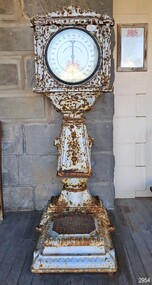
Instrument - Scale, Weighing Machine, G. Salter & Co, 1884-1909
... inventor of the world’s first slot machine, with the renowned maker of scales, G. Salter & Co., which began operating in 1760, and also with the Australasian Automatic Weighing Scale Co., which imported and widely distributed the scales throughout Australia from the early-to-mid 20th century. ...This ornate, Victorian-era automatic weighing machine was made in England around 1884-1909, by George Salter and Co. of West Bromwich, UK, makers of scales since 1760. It is protected by Queen Victoria’s Royal Letters Patent, signed in 1900. The scale stood outside the Warrnambool Post Office in Timor Street from around 1909 to 1966, as shown on postcards and photographs held at the State Library of Victoria. The scale is identified by the Serial Number '665', and was installed by the distributors, the Australasian Automatic Weighing Machine Co. Ltd.. The scale’s weight measurements were in Imperial stones and pounds up to 20 stone (127 kg). The scale’s face included charts of average weights, for men, women, boys and girls, by various heights, in feet and inches. The coin slot and its face were converted to metric measurements by the Eastern Scale Company Pty. Ltd; that firm was registered on October 2, 1974. The Australasian Automatic Weighing Machine Co. Ltd was a large supplier of weighing scales in Australia and held the Royal Letters patent for their machines, distributing them in prominent locations. In 1902, the firm was listed under the Import Entries Passed at His Majesty’s Customs, importing into Sydney, NSW, eight cases of scales. In 1911, the company asked permission from the Port Pirie Corporation to install a machine in Alexander Street. In 1913, the company applied to the City of Sydney to install machines around the city, including at the tram depot. One application mentions “… three machines in three places for three pounds per year”. In 1923, the firm tendered for the right to place Automatic Weighing Machines on railway and tram premises throughout New South Wales, subsequently for five-year terms, in return for a fixed payment per machine and a portion of the revenue to the NSW Government. In 1928, the Sydney Harbour Trust gave the firm the right to place the weighing machines on various ferry jetties. The firm was still operating in 1941, advertising for two boys aged 14-16 for the workshop and messages, at the Rialto building, 497 Collins St., Melbourne. On December 21, 1946, the Commonwealth government invited offers to tender for the right to place automatic weighing machines on postal premises throughout the six states; the successful company then made arrangements with the federal Postmaster General's Department to place machines outside post offices across the country. A few years later, on September 11, 1950, the firm's Adelaide branch ceased trading. From 11th July 1950, the Australian and Eastern Engineering Company Pty. Ltd took over at the same premises, at 179 Pirie Street, Adelaide. The Perth branch ceased business in WA on July 6th, 1950. Percival Everitt invented and patented the automatic, coin-operated personal scale design. Everitt was a Norfolk-born engineer and regarded as the father of the coin-operated industry. As a young man in 1877, he invented a hay and corn pitcher, a turnip thinner in 1878 and an Automatic Travelling Anchor in 1880. But his fame came in 1883 with the first postcard-vending machine, over a hundred of which he distributed around London. In 1884, he patented one of his many inventions, the coin-operated scales for use in public places; for many people, it was their first exposure to coin-operated machines. His success prompted the formation of the Weighing Machine Company in 1885. Further inventions followed: a blow tester in 1887, the machine for testing a person's grip in 1888, and in 1889, the dispensing machine for hiring out opera glasses, and a device for shutting down the coin entry slot if the machine was empty. In 1890, he invented a fortune-telling machine. Everitt sadly did not make his fortune; he died suddenly in February 1893, in his late forties, with £71 to his name. George Salter & Co., West Bromwich, England, produced automatic weighing scale machines from Everitt’s patented design, and advertised them as suitable for hotels, pleasure gardens, theatres, exhibition halls, clubs, baths and places of public resort. The company was established in 1760 by brothers Richard and William Salter, and manufactured springs and pocket steelyards (spring balances). After several generations, the company was taken over in 1855 by a nephew, George, and renamed George Salter & Co. In 1884, Salter registered the trademark of a Staffordshire knot pierced by an arrow. The company's expanded range of products included the first coin-operated public weighing machines in the 1880s and, in 1895, the first English-made typewriter. In 1915, Salter became a limited company, Geo. Salter & Co. Ltd. When the last George Salter died in 1917, the company passed into the hands of other relatives, but continued to grow before being bought out by Staveley Industries in 1973. Despite several subsequent mergers, the Salter name continues to be seen on household products such as digital scales. This patented, coin-operated weight machine is significant for its association with Percival Everitt, the inventor of the world’s first slot machine, with the renowned maker of scales, G. Salter & Co., which began operating in 1760, and also with the Australasian Automatic Weighing Scale Co., which imported and widely distributed the scales throughout Australia from the early-to-mid 20th century. It is a rare example of an early vending machine used in public places from the late 19th through to the mid-20th century. These machines were the early step in the evolution of coin-in-the-slot machines, which are still used today. The scales give a glimpse into our history; they became quickly popular with the public, which, until then, had little access to weight scales apart from those at medical services. They also provided inexpensive entertainment for families, especially while waiting for trains or visiting the post office. The machines were also attractive and lucrative to the distributors; once installed, they required very little maintenance, and their low cost to customers kept the money coming in. This automatic weighing machine is also significant for its decades of service to the local and regional community of Warrnambool, for personal and commercial purposes. A public coin-operated weighing scale, also called a penny scale. It is a large, silver-painted cast metal stand with a square top on a pedestal that flares outwards to join a rectangular platform base with posts on the side and corners that may have had fitted wheels. The round, white face on top has red and black measurements and inscriptions. A slim indicator with a point at one end and an arc at the other is attached to the face’s centre. The coin slot is above the face, on the left, and the scale’s identification number is engraved on an oval plate on the right. Moulded motifs decorate the pedestal’s front and are repeated on its sides; they depict a tall, narrow urn with a bowl on top and fancy scrolls on either side. There is a decorative panel across the front top of the stand. The top of the pedestal has a small keyhole. The size of the coin slot fitted a penny coin, and the weight measurements on the face were in Imperial stones and pounds. Quite some time after 1966, when Australia introduced new decimal weights, measurements and currency, the scale was updated; the coin slot size was changed, and a new face with metric measurements was installed. The scale now accepts a $1 coin (one dollar) and the scale measures weight in kilograms and grams, from 0 to 125 kg.. The rear of the scale has a small, rectangular metal plate with printed text. The scale was made by G Salter & Co. of West Bromwich, UK, distributed by the Australasian Automatic Weighing Platform Co., and updated to metric measurements by Eastern Scale Co. Pty Ltd. It was previously installed at the Warrnambool Post Office. Engraved on an oval plate on the right: "665" Top centre of the face, in red: "$1 coin" Top of face: "EASTERN SCALE CO. PTY LTD" Base of face, in red: "[Royal Coat of Arms of Britain]" with words, below in red: "BY ROYAL LETTERS PATENT" Around the face, in black: "[numbers 0 to 125, in increments 5, and makes between the numbers for each 500g]" "kg" Below the face, moulded letters within a shield: "AUSTRALASIAN AUTOMATIC WEIGHING MACHINES CO. LTD." At the back of the weighing platform: "G SALTER & CO. / WEST BROMWICH", remnants of logo “[Staffordshire knot pierced by an arrow]” Plate on rear: THIS SCALE REMAINS THE PROPERTY OF EASTERN SCALE CO. PTY. LTD., 8 GEORGE COURT, GREENSBOROUGH, VIC, 3088. PHONE (03 ) _ 34 _ _ 33” (434 9333 ?_flagstaff hill, warrnambool, maritime village, maritime museum, flagstaff hill maritime museum and village, shipwreck coast, great ocean road, scale, weighing scale, salter, australasian, 1 dollar, $1 coin, 1p, 1 penny coin, penny scale, coin in slot scale, eastern scale co. pty. ltd., british royal coat of arms, royal letters patent, letters patent, health, ending machine, coin-operated machine, percival everett, weighing machine co., george salter & co., g salter & co, west bromwich, vending machine, weights & balances, measurements, slot machine, coin operated machine, penny-in-the-slot, coin fed, coin op scale, weights & measures, australasian automatic weighing machine co. ltd., warrnambool post office, machine 665, no. 665, blalnce technology, scales and weights, weights and measures, penny weight scales, vintage, weighing machine, coin in the slot, coin operated, public scale, public weighing machine, penny-weighing machines, penny weighing machines, penny scales, coin operated weighing machine, scale weighing machine -
 Federation University Historical Collection
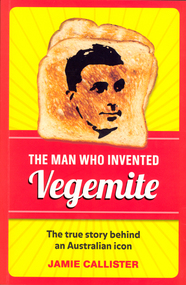
Book, Jamie Callister, The Man Who Invented Vegemite, 2012
... inventor of the well known spread 'Vegemite'. A Ballarat School of Mines (SMB) student around 1910, Callister then went to Melbourne University where he obtained his B.Sc. in 1914, M.Sc. in 1917 and D.Sc. in 1931. With Sir David Rivett in 1931 he secured the royal charter for the Royal Australian...inventor of the well known spread 'Vegemite'. A Ballarat School of Mines (SMB) student around 1910, Callister then went to Melbourne University where he obtained his B.Sc. in 1914, M.Sc. in 1917 and D.Sc. in 1931. With Sir David Rivett in 1931 he secured the royal charter for the Royal Australian ...Cyril Percy Callister, a chemist by training, became a food technologist and the inventor of the well known spread 'Vegemite'. A Ballarat School of Mines (SMB) student around 1910, Callister then went to Melbourne University where he obtained his B.Sc. in 1914, M.Sc. in 1917 and D.Sc. in 1931. With Sir David Rivett in 1931 he secured the royal charter for the Royal Australian Chemical Institute, becoming president of the Society of Chemical Industry of Victoria in 1935-36. Vegemite, a yeast based spread, and perhaps one of most famous trademarks in Australia, was discovered around 1922 by Cyril Percy Callister. He was hired by the Fred Walker Company (a Melbourne based manufacturer later known as Kraft) as a laboratory assistant to develop a yeast extract spread. It took some years but by 1954 the special Vegemite song 'Happy Little Vegemites' demonstrated the popularity of the spread. Callister was also known for packing cheese in a can to preserve it and developing Kraft processed cheese. he son of a school teacher and postmaster he was born at Chute on 16 February 1893 and died on 5 October 1949. His brother Reginald Clive Callister (1889-1971) was also a student of SMB. (http://www.ballarat.edu.au/about-ub/history/art-and-historical-collection/ub-honour-roll/c/cyril-callister-1893-1949)Red and yellow soft covered book of 208 pages relating to Cyril Callister who invented Vegemite. On Frontispage signed "11th Oct 2012 James Callister"ballarat school of mines, callister, cyril callister, vegemite, william callister -
 Mission to Seafarers Victoria
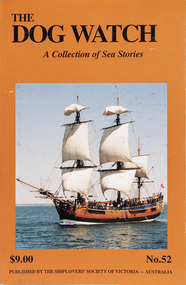
Journal (item) - Periodicals-Annual, Shiplovers' Society of Victoria, The Annual Dog Watch
... Australians return to the Phillipines - W.S. McUtchen - 35 Sunbathing is good for the eyes - Capt. R. Hart - 49 William Thomas, The Liverpool Shipowner & the Holyhead — wrecked on Point Lonsdale - G.I. Hawkes - 50 “Seahorses” - G.M. Naug - 56 Henry Greathead 1757-1813 Inventor...Australians return to the Phillipines - W.S. McUtchen - 35 Sunbathing is good for the eyes - Capt. R. Hart - 49 William Thomas, The Liverpool Shipowner & the Holyhead — wrecked on Point Lonsdale - G.I. Hawkes - 50 “Seahorses” - G.M. Naug - 56 Henry Greathead 1757-1813 Inventor ...This journal provides the reader with glimpses of the adventures and hardships of a seaman's life. Many of the stories are of sailing ships.Contributes to our knowledge of the importance of shipping and places on record those stories of the sea which would otherwise be lost.Contents Editorial - - 5 Adelaide to Sydney on the Endeavour - P. Kelly - 7 A tribute to Capt. G.A. Molyneux - T.E. Goldfinch - 27 The Bos’n’s Chair - R.N. Thiele - 29 A Gallant Steward - B. Springthrope - 33 The Australians return to the Phillipines - W.S. McUtchen - 35 Sunbathing is good for the eyes - Capt. R. Hart - 49 William Thomas, The Liverpool Shipowner & the Holyhead — wrecked on Point Lonsdale - G.I. Hawkes - 50 “Seahorses” - G.M. Naug - 56 Henry Greathead 1757-1813 Inventor of the Lifeboat - B.M. Morris - 57 The Milag Book - K. Shewan - 63 Life & Death of a Shipyard - E. Pennell - 65 A Donkey’s Breakfast & Parish Rig - W.P. Shemmeld - 69 The Indian Rope Trick — witnessed - R.A. Bloom - 74 MV Otaio, Training for the Sea at Sea - J. Giles - 77 “Sailorman” - N. Smith - 85 Can you solve the mystery? K.S. - 87 A Norwegian apprentice in the 1930s - Capt. G. Skomedal - 88 Snippets from the papers of Alexander McLennan — Sailmaker - J. McLennan - 103 A Mother’s Letter - B.M. Morris - 106 The Carrick ex City of Adelaide - R.C. Shepherd - 108 Book Reviews - - 111sailing ships, steamships, shipping, seafaring life, shiplovers' society of victoria, dog watch -
 Federation University Historical Collection
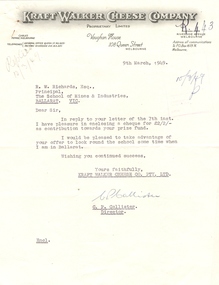
Letter, Correspondence from Cyril Callister on Kraft Walker Letterhead, 09/03/1949
... Vegemite inventor Cyril Callister was an alumni of the Ballarat School of Mines, a predecessor institution of Federation University Australia. ...Vegemite inventor Cyril Callister was an alumni of the Ballarat School of Mines, a predecessor institution of Federation University Australia. ...Vegemite inventor Cyril Callister was an alumni of the Ballarat School of Mines, a predecessor institution of Federation University Australia. Working from the details of a James L. Kraft patent, Callister was successful in producing processed cheese. The Walker Company negotiated a deal for the rights to manufacture the product, and in 1926, the Kraft Walker Cheese Co. was established. Callister was appointed chief scientist and production superintendent of the new company.(Wikipedia)Correspondence from Cyril Callister on Kraft Walker Cheese Co letterhead. The letter was concerning donating to the Ballarat School of Mines prize fund and was signed by Cyril Callister. Kraft Walker Cheese Company Propriety Limited Vaughan House 108 Queen Street Melbourne 9th March, 1949 R.W. Richards, Esq., Principal, The School of Mines and Industries, BALLARAT, VIC. Dear Sir, In reply to your letter of the 7th inst. I have pleasure in enclosing a cheque for two guineas as contribution towards your prize fund. I would be pleased to take advantage of your offer to look round the school some time when I am in Ballarat. Wishing you continued success, Yours faithfully Hraft Walker Cheese Co, Pty. Ltd. C.P Callister (signed) C.P. Callister Register Encl.vegemite, cyril callister, kraft walker, letterhead, ballarat school of mines prize night, alumni, c.p. callister, kraft walker cheese company, donation -
 Federation University Historical Collection
Magazine, Various car magazines
... inventor with inventions relating to the telephone, photography, wireless, cars, motorcycles, and bicycles as well as many more inventions. Henry was also one of four brothers that ran the Sutton's Music Store after the death of their Father Richard Sutton. Henry Sutton taught Applied Electricity at the Ballarat School of Mines in 1883 to 1886. Australian ...Various car magazines with articles relating to the Sutton Car..1 Green covered The Australian Cyclist and tourist traveller July 1899 .2 Tan covered Austral Wheel cycling magazine May 1898 .3 Early Australian Motor Cars - Restored Cars Jan/Feb 1974 .4 Ballarat Swap 1990 - Restored Cars .5 Bicycles to Motorcars The Australian Way - Restored Cars Jan-Feb 1976 .6 The Veteran Car Club Gazettenon-fictionVarious car magazines with articles relating to the Sutton Car.australian cyclist, electra, mr h. sutton and his work, austral wheel, messrs. sutton motorcycle, early australian motor cars, restored cars, sutton eco, ballarat swap 1990, the inventive genius of henry sutton, max gregory, sutton tandem motor-bicycle, suttons cycle agency, bicycles to motorcars, the australian way -
 Federation University Historical Collection
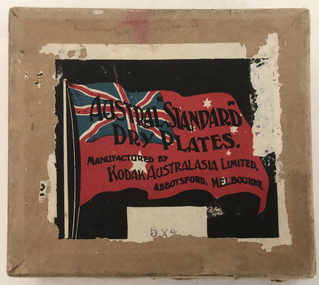
Unknown - Ephemera, Box from Austral Standard Dry Plates - manufactured by Kodak Australasia Limited
... inventor with inventions relating to the telephone, photography, wireless, cars, motorcycles, and bicycles as well as many more inventions. Henry was also one of four brothers that ran the Sutton's Music Store after the death of their Father Richard Sutton. Henry Sutton taught Applied Electricity at the Ballarat School of Mines in 1883 to 1886. Austral Standard Dry Plate Box Kodak Henry Sutton Kodak Australasia Limited developing formulae Smal cardboard box with coloured label on the front and black and white instructions label on the back. Box from Austral Standard Dry Plates - manufactured by Kodak Australasia Limited Unknown Ephemera Australia ...Henry Sutton is a talented world-wide accepted inventor with inventions relating to the telephone, photography, wireless, cars, motorcycles, and bicycles as well as many more inventions. Henry was also one of four brothers that ran the Sutton's Music Store after the death of their Father Richard Sutton. Henry Sutton taught Applied Electricity at the Ballarat School of Mines in 1883 to 1886.Smal cardboard box with coloured label on the front and black and white instructions label on the back.austral standard dry plate box, kodak, henry sutton, kodak australasia limited, developing formulae -
Federation University Historical Collection
Album, Folder containing information on Guglielmo Marconi
... inventor with inventions relating to the telephone, photography, wireless, cars, motorcycles, and bicycles as well as many more inventions. Henry was also one of four brothers that ran the Sutton's Music Store after the death of their Father Richard Sutton. Henry Sutton taught Applied Electricity at the Ballarat School of Mines in 1883 to 1886. Henry Sutton Marconi Australian ...Henry Sutton is a talented world-wide accepted inventor with inventions relating to the telephone, photography, wireless, cars, motorcycles, and bicycles as well as many more inventions. Henry was also one of four brothers that ran the Sutton's Music Store after the death of their Father Richard Sutton. Henry Sutton taught Applied Electricity at the Ballarat School of Mines in 1883 to 1886.Red A4 folder containing information about Guglielmo Marconi henry sutton, marconi, australian wireless history, the wireless institute of australia, australian politicians -
Federation University Historical Collection
Album, Folder containing information on National Archive research done by Lorayne Branch
... inventor with inventions relating to the telephone, photography, wireless, cars, motorcycles, and bicycles as well as many more inventions. Henry was also one of four brothers that ran the Sutton's Music Store after the death of their Father Richard Sutton. Henry Sutton taught Applied Electricity at the Ballarat School of Mines in 1883 to 1886. Henry Sutton Lorayne Branch national archives of australia ...Henry Sutton is a talented world-wide accepted inventor with inventions relating to the telephone, photography, wireless, cars, motorcycles, and bicycles as well as many more inventions. Henry was also one of four brothers that ran the Sutton's Music Store after the death of their Father Richard Sutton. Henry Sutton taught Applied Electricity at the Ballarat School of Mines in 1883 to 1886.Black Cardboad A4 Folder containing information on National Archive research done by Lorayne Branchhenry sutton, lorayne branch, national archives of australia, research -
Federation University Historical Collection
Album, Folder containing information on Henry Sutton's investigations of flight
... inventor with inventions relating to the telephone, photography, wireless, cars, motorcycles, and bicycles as well as many more inventions. Henry was also one of four brothers that ran the Sutton's Music Store after the death of their Father Richard Sutton. Henry Sutton taught Applied Electricity at the Ballarat School of Mines in 1883 to 1886. Henry Sutton Flight Flight Research Australian ...Henry Sutton is a talented world-wide accepted inventor with inventions relating to the telephone, photography, wireless, cars, motorcycles, and bicycles as well as many more inventions. Henry was also one of four brothers that ran the Sutton's Music Store after the death of their Father Richard Sutton. Henry Sutton taught Applied Electricity at the Ballarat School of Mines in 1883 to 1886.Red A4 Folder containing information on Henry Sutton's investigations of flighthenry sutton, flight, flight research, australian aeronautical society -
Federation University Historical Collection
Album, Prime Minister's Office et al, Folder with letters and envelopes addressed to Henry Sutton regarding minerals for wireless transmission, 1911
... inventor with inventions relating to the telephone, photography, wireless, cars, motorcycles, and bicycles as well as many more inventions. Henry was also one of four brothers that ran the Sutton's Music Store after the death of their Father Richard Sutton. Henry Sutton taught Applied Electricity at the Ballarat School of Mines in 1883 to 1886. Minerals Wireless transmission Commonwealth of Australia ...Henry Sutton is a talented world-wide accepted inventor with inventions relating to the telephone, photography, wireless, cars, motorcycles, and bicycles as well as many more inventions. Henry was also one of four brothers that ran the Sutton's Music Store after the death of their Father Richard Sutton. Henry Sutton taught Applied Electricity at the Ballarat School of Mines in 1883 to 1886.Folder containing typed letters and handwritten envelopes addressed to Henry Sutton regarding minerals for wireless transmission.Postage stamps minerals, wireless transmission, commonwealth of australia, henry sutton, prime minister, argus, post master general, justinian oxenham, w. forster woods, charles e. bright, hon. andrew fisher, malcolm shepherd, letterhead, peter g. tait -
Federation University Historical Collection
Album, Folder with information on Early World Wireless Experimenters and other information
... inventor with inventions relating to the telephone, photography, wireless, cars, motorcycles, and bicycles as well as many more inventions. Henry was also one of four brothers that ran the Sutton's Music Store after the death of their Father Richard Sutton. Henry Sutton taught Applied Electricity at the Ballarat School of Mines in 1883 to 1886. Wireless Experimenters Henry Sutton Crystal Detectors Ernest Fisk Transistor Folder with information on Early World Wireless Experimenters and other information including Australian ...Henry Sutton is a talented world-wide accepted inventor with inventions relating to the telephone, photography, wireless, cars, motorcycles, and bicycles as well as many more inventions. Henry was also one of four brothers that ran the Sutton's Music Store after the death of their Father Richard Sutton. Henry Sutton taught Applied Electricity at the Ballarat School of Mines in 1883 to 1886.Folder with information on Early World Wireless Experimenters and other information including Australian Navy and Defense Force wireless, experimenters, henry sutton, crystal detectors, ernest fisk, transistor -
Federation University Historical Collection
Book - Book - Scrapbook, Ballarat College of Advanced Education: Scrapbook of newspaper cutting, Book 9; March 1981 to September 1981
... australia...lectures for industry...bill rofe...zig plavina...careers in sciences seminar...fitness for volunteers...study of walnuts a hit...siddons plan solar heating thrust...william charters inventor...Many items are dedicated to the opening of Founder's Hall. . employment advertisements application for enrolment outline of courses wind power at bcae cash outlook gloomy concert to celebrate hall opening grim look for teachers opening of founder's hall conferring of degrees at founder's hall bhp chief at degree conferring way to economic growth education mission from china library award to bcae student helen hately 50 years on college enrolments climb ronald potter winner of a e stohr medal of the institution of engineers stop college cuts political bias denied protest at education cuts graduate tom honeyman at bcae college water supply bcae field trip to western australia lectures for industry bill rofe zig plavina careers in sciences seminar fitness for volunteers study of walnuts a hit siddons plan solar heating thrust william charters inventor jobs that go begging shortage of engineers careers seminar at bcae morgan john retires prints by students on show pam dethridge hard work pays off labor pledge on education unemployment in ballarat bcae student dinner advanced learning program for secondary students first exhibition for eric collins 30 escape bus crash mining cadetship awarded to tom devries bcae open day technology week getting the facts at bcae memorial lecture prof weston bate tertiary education disadvantaged goldrush miners relied on luck more tafe funding 'not enough' equus ready for stage mineral exports vital Book with grey cover, front. ...Newspaper cuttings relating to Ballarat College of Advanced Education. These are from various newspapers and include The Age, Ballarat Courier, The Australian, The Herald. The cuttings cover the period from 12 March 1981 to 1 September 1981. Many items are dedicated to the opening of Founder's Hall. . Book with grey cover, front. Image of draught horses. Spiral bound.employment advertisements, application for enrolment, outline of courses, wind power at bcae, cash outlook gloomy, concert to celebrate hall opening, grim look for teachers, opening of founder's hall, conferring of degrees at founder's hall, bhp chief at degree conferring, way to economic growth, education mission from china, library award to bcae student, helen hately, 50 years on, college enrolments climb, ronald potter winner of a e stohr medal of the institution of engineers, stop college cuts, political bias denied, protest at education cuts, graduate tom honeyman at bcae, college water supply, bcae field trip to western australia, lectures for industry, bill rofe, zig plavina, careers in sciences seminar, fitness for volunteers, study of walnuts a hit, siddons plan solar heating thrust, william charters inventor, jobs that go begging, shortage of engineers, careers seminar at bcae, morgan john retires, prints by students on show, pam dethridge, hard work pays off, labor pledge on education, unemployment in ballarat, bcae student dinner, advanced learning program for secondary students, first exhibition for eric collins, 30 escape bus crash, mining cadetship awarded to tom devries, bcae open day, technology week, getting the facts at bcae, memorial lecture, prof weston bate, tertiary education disadvantaged, goldrush miners relied on luck, more tafe funding 'not enough', equus ready for stage, mineral exports vital -
Marysville & District Historical Society
THE TRIANGLE NEWS-VOL 34 NO 18-MAY 25 2007
... australia...viewers choice vote...eco-switch...local inventor...marysville victoria australia viewers choice vote eco-switch local inventor wins competition dairy dates deadline advertising rates buxton progress assocn results anzac appeal for r.s.l. disclaimer murrindindi shire council ceo visiting schedule fire calls thanks for volunteering bpa update church notices mops dedication of christ church window christ church marysville ladies' guild annual luncheon vacation bible school holiday programme women of hope village hall marysville wilbur the pig at marysville market charlotte's web star pig edgar's mission farm open garden success advertisements mayor's chair opening el kanah work for the dole scheme project nominated for award prime minister's work for the dole achievement award community health services outreach services property numbering squash business opportunity health & wellbeing mental illness & good mental health mystic mountains tourism newsletter bookkeeper alexandra cinema youth night at kooringa wild dog control access to inclusion plan payment of rate installment restaurant advertisements aluminium cans for cash buxton hotel cottage to rent advert/public notice bendigo bank yarra track stopping places marysville medical clinic THE TRIANGLE NEWS-VOL 34 NO 18-MAY 25 2007 ...marysville, victoria, australia, viewers choice vote, eco-switch, local inventor wins competition, dairy dates, deadline, advertising rates, buxton progress assocn, results anzac appeal for r.s.l., disclaimer, murrindindi shire council, ceo visiting schedule, fire calls, thanks for volunteering, bpa update, church notices, mops, dedication of christ church window, christ church marysville ladies' guild annual luncheon, vacation bible school holiday programme, women of hope, village hall marysville, wilbur the pig at marysville market, charlotte's web star pig, edgar's mission farm, open garden success, advertisements, mayor's chair, opening el kanah work for the dole scheme, project nominated for award, prime minister's work for the dole achievement award, community health services, outreach services, property numbering, squash, business opportunity, health & wellbeing, mental illness & good mental health, mystic mountains tourism newsletter, bookkeeper, alexandra cinema, youth night at kooringa, wild dog control, access to inclusion plan, payment of rate installment, restaurant advertisements, aluminium cans for cash, buxton hotel, cottage to rent, advert/public notice, bendigo bank, yarra track stopping places, marysville medical clinic -
Federation University Historical Collection
Book, Henry Sutton The Innovative Man: Australian Inventor, Scientist and Engineer, 2018, 2018
... Gift of Lorayne Branch (author) Henry Sutton The Innovative Man: Australian Inventor, Scientist and Engineer, 2018 Book Book ...Nikola Tesla once said “Let the future tell the truth and evaluate each one according to his work and accomplishments” In his lifetime Henry Sutton not only helped shape Ballarat’s history but also that of Australia and the world. Very few people have crossed as many scientific fields as Henry Sutton. His life’s work spanned all avenues of science and engineering and he stands alone in history as one of Australia’s first true men of science and innovation. Based on previously unavailable personal papers as well as articles and letters published in journals worldwide, this book captures the personal triumphs and tragedies of this remarkable Australian. By age 26 Henry Sutton had won world acclaim and graced the world stage among the giants of the scientific world. Henry Sutton stood as an equal alongside such men as Alexander Graham Bell, Nikola Tesla and Thomas Edison. Although applauded around the world in his day for his remarkable achievements, Henry Sutton went largely unnoticed in Australia by his peers and the public. It is not until you begin to document, in one place, his enormous body of work that you start to gain the true picture and depth of his remarkable achievements. It is a national travesty that these achievements have slipped largely unrecognised between the pages of Australian scientific history for over a century. Henry Sutton’s inventions and contribution to science has been a part of the evolution of many inventions, including the light globe, telephone, battery, television and wireless technology all of which are now part of our everyday lives. Henry Sutton’s contribution to Australian and world innovation has been methodically researched and documented in this book and is the first fully documented account of this forgotten and unrecognised extraordinary Australian.Hardcovered book of 397 pages. The cover features a black and white image of Henry Sutton. Gift of Lorayne Branch (author)lorayne branch, henry sutton, ballarat school of mines, former sutton's music store, innovation, inventions, scientist, microscopy, cycle agency, automobile club of victoria, wireless telegraphy, anne tattie, anne sutton, sutton autocar, photography -
 Flagstaff Hill Maritime Museum and Village
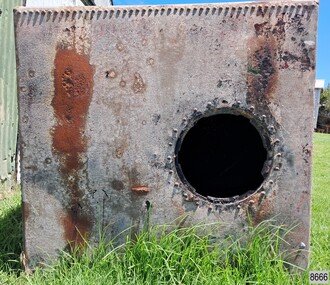
Container - Ship Tank, Early 20th century
... Australia. Wilsonson’s Promontory Lightstation has the lid from a ship tank that was used on site for the storage of water. Some have been repurposed as domestic water tanks and dog kennels, others for eucalyptus distilleries. Flagstaff Hill has two ship tanks. The Campaspe Port at Echuca, once a bustling river port, has a ship tank beside the locomotive yard. The lids of ship tanks are collectible items. Richard Trevithick (1771-1833): - Trevithick was born in 1771 in Cornwall, England. He was a famous British engineer and inventor...Australia. Wilsonson’s Promontory Lightstation has the lid from a ship tank that was used on site for the storage of water. Some have been repurposed as domestic water tanks and dog kennels, others for eucalyptus distilleries. Flagstaff Hill has two ship tanks. The Campaspe Port at Echuca, once a bustling river port, has a ship tank beside the locomotive yard. The lids of ship tanks are collectible items. Richard Trevithick (1771-1833): - Trevithick was born in 1771 in Cornwall, England. He was a famous British engineer and inventor ...Cubed iron ship tanks were invented by Richard Trevithich in 1808, in partnership with Robert Dickson, and the design was patented that year. The invention eventually replaced the wooden casks or barrels used at the time, as the ship tanks were more secure and their shape was much more economical in storage space. The robust metal tanks were originally made to transport water, but their preserving quality enabled them to transport perishable dry goods such as grain on long voyages, as well as other forms of liquid and solid cargo. The first ship tanks were made from sheets of iron, and later mild steel sheets, with double riveted edges and corners. A round cast iron lid with handle grips was fitted snugly into the top opening, providing an air-tight and water-tight seal. Brass taps were often fitted into the base, which could have been the case with this tank, but it now has a wooden bung in the hole. Sailing ships began using the new ship tanks on Australian voyages from around the 1830s, storing food and water for those on board, and filling them with other cargo. A large number of the ship tanks were repurposed in 1838 for the Victoria Settlement at Port Essington, N.T., as they were able to protect the food, clothing and other stores from termite and insect damage. Other ‘recycled’ ship tanks were cut in half and used as washing tubs or cookers. A 1929 catalogue from Hudson’s Tank Stores advertised square tanks that contained around 600 litres – 160 gallons – which equals an internal measurement of 33.25 inches – 84.5 centimetres – per side ship tanks are still made and sold in 1952 by the Globe Tank and Foundry in Wolverhampton, England, which was incorporated in 1922. Today, ship tanks can be seen around Australia. Wilsonson’s Promontory Lightstation has the lid from a ship tank that was used on site for the storage of water. Some have been repurposed as domestic water tanks and dog kennels, others for eucalyptus distilleries. Flagstaff Hill has two ship tanks. The Campaspe Port at Echuca, once a bustling river port, has a ship tank beside the locomotive yard. The lids of ship tanks are collectible items. Richard Trevithick (1771-1833): - Trevithick was born in 1771 in Cornwall, England. He was a famous British engineer and inventor during the Industrial Revolution, known for his invention of the first full-scale working railway, the high-pressure steam locomotive, which he demonstrated hauling a railway train in 1804. He set up a small workshop in 1808 at 72 Fore Street, Limehouse, London, to make iron ship tanks, and this invention was instrumental in replacing the wooden casks formerly used for storage on ships. He was involved with mining technology, iron foundry and ship equipment. Ship tanks changed the way that cargo was transported on ships and other vehicles from the 1830s and were used into the mid-20th century. The ship tanks’ advantages were that they could store more content, lasted longer, were waterproof and airtight, stackable and could be repurposed for many uses other than water, such as fuel, dry goods and domestic cargo. They have even been used aa dog kennels and cookers. Ship tanks were part of the evolving methos to transport water, food and cargo, which changed in 1956 when Malcolm McLean invented the large, rectangular shipping containers that are in use today; they speed up the process of loading on and off the ships, saving time and money. Ship tank: a cubed iron container with an offset hole on one side. The hole has cutouts for securely attaching a lid. This tank is on its side on the ground with the opening facing sideways. The side facing upwards has a wooden bung in a round hole. The ship tank is made from six square, thick iron sheets, rolled and riveted along the edges. The inside has a black sticky coating, possibly bitumen, and a strong creosote odour. There are small remnants of green paint on the outer surface.flagstaff hill, flagstaff hill maritime museum and village, warrnambool, maritime museum, maritime village, great ocean road, shipwreck coast, iron cube, water tank, shipping container, ship tank, ship's tank, ship tanks, marine container, richard trevithich, 1808, robert dickson, water transport, water storage, iron foundry, steel sheets, iron sheets, revets, victoria settlement, port essington, globe tank and foundry, wolverhampton, british engineer, british inventor, wooden casks -
 Flagstaff Hill Maritime Museum and Village
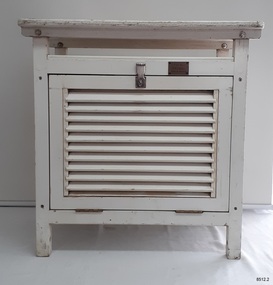
Equipment - Stevenson Screen, Thomas Stevenson, ca. 1910
... Once the Bureau of Meteorology was established (around 1908 to 1910) the department installed Stevenson screens throughout Australia, many at lighthouses and light stations, and the measuring instruments were standardised. The Stevenson Screen was named after its inventor, Scottish Civil Engineer Thomas Stevenson (1818-1887) who was also the father of Robert Louis Stevenson, author. ...Once the Bureau of Meteorology was established (around 1908 to 1910) the department installed Stevenson screens throughout Australia, many at lighthouses and light stations, and the measuring instruments were standardised. The Stevenson Screen was named after its inventor, Scottish Civil Engineer Thomas Stevenson (1818-1887) who was also the father of Robert Louis Stevenson, author. ...Stevenson screens were first introduced in Australia in the 1880s and were widely installed by 1910. The screens have been used to shelter and protect thermometers and other meteorological instruments from rain and direct heat while the holes and double-louvre walls allowed air to flow around them. Sometimes other meteorological instruments were included in the weather stations, so there were different Stevenson Screen sizes. This authentic, original Stevenson screen was previously owned by the Australian Bureau of Meteorology and was used for many years for weather readings at the Cape Otway Light Station in southwest Victoria. The Lighthouse Keepers recorded the readings for minimum and maximum temperatures at 9 a.m. every day from January 1865 until April 1994. The equipment was sheltered in a Stevenson Screen from 1902 until April 15 1994, when the mercury thermometer was replaced by a platinum resistance probe within an Automatic Weather Station (AWS). This Stevenson screen is one of the two screens that then became redundant. The other Stevenson screen was kept to display to visitors. Lightkeepers were no longer required at the Cape Otway Light station either, due to the automated system. The meteorological instruments donated with the screen were used for measuring temperature and humidity. They are mounted on a metal bracket that fits across the screw holes on the screen’s internal frame. The glass-covered Relative Humidity (RH) sensor was made by the renowned precision instrument maker, Rotronic AG of Switzerland, which was founded in 1965. The firm made its first electronic temperature and humidity instrument in 1967. Meteorological records have been collected in Australia from the 1800s. The records were collated, published and used as a basis for weather forecasts. Many sectors, such as maritime and agriculture industries, have relied on these figures for making important decisions. The quality and placement of the meteorological instruments used to measure temperature and humidity are of utmost importance for accuracy. In early colonial times, there were no national standards for meteorological instruments that would allow for accurate figures and comparisons. Once the Bureau of Meteorology was established (around 1908 to 1910) the department installed Stevenson screens throughout Australia, many at lighthouses and light stations, and the measuring instruments were standardised. The Stevenson Screen was named after its inventor, Scottish Civil Engineer Thomas Stevenson (1818-1887) who was also the father of Robert Louis Stevenson, author. Stevenson developed the small thermometer screen around 1867. It had double-louvred walls around the sides and a top of two asbestos sheets with an air space between them and was thickly painted with a white coating that reflected the sun’s rays. This design was modified in 1884 by Edward Mawley of the Royal Meteorological Society. Standards were set for the locations of the screens and instruments, including their distance above ground level and the direction the door faced.Stevenson screens played a significant part in providing a standardised shelter for all meteorological instruments used by the Australian Bureau of Meteorology from about 1910 until 1994. The readings from the instruments gave the meteorological statistics on which weather forecasts throughout Australia were based. This Stevenson screen was used locally at Cape Otway, along the Great Ocean Road in southwest Victoria, so contributed towards our local forecasts and weather warnings.Stevenson screen, original, from the Australian Bureau of Meteorology’s weather station at the Cape Otway Lighthouse. The screen is a white wooden cupboard with a slanted cover raised above the top. The top has ten drilled ventilation holes, and the sides and door are made of downward-slanting double louvres. Two brass hinges join the door to the lower edge of the screen and a metal fitting at the top edge allows for a padlock closure. The screen is supported on four short legs, each with a hole drilled from side to side for fitting to a frame. Inside the screen are two wooden frames fitted with hooks and screws. The floor has three boards; one across the back and one across the front at the same level, and a board wider than the space between these boards is fitted higher, overlapping them slightly. Inside the screen, a pair of electronic instruments with short electric cables is mounted on a metal bracket with drilled holes in it. One of the instruments is a Relative Humidity (RH) probe. It is 26 cm long and is a glass tube with a filter on one end and an electrical connection on the other. It has inscriptions on its label, showing that was made by Rotronic AG, Switzerland. The other instrument is a Resistance Temperature Device (RTD) thermometer. It is 22.5 cm long and has a narrow metal probe joined to a hexagonal metal fitting. A brass plate on the front of the screen has impressed inscriptions. The screen is Serial Number 01/C0032, Catalogue Number 235862.Stamped into brass plate "CAT. NO. / 253862 / SERIAL NO. 01/C0032" On instrument’s electrical fitting; “CD2” [within oval ‘+’ above S] “Serie693 op65 / 220/380V~16A” On instrument’s glass; “rotronic ag” “SWISS MADE” “CE / CH-8303 / Bassersdorf” Symbol for [BARCODE] “ART NO MP 101A_T4-W4W” “POWER 4.8.30VDC“ “OP. RANGE: 0-100%RH/-40+60° C” “OUT H 0-100% 0-1V” “OUT T -40+60°C -0.4..+0.6V” “SERIE NO 19522 009”flagstaff hill maritime museum and village, warrnambool, maritime museum, maritime village, great ocean road, shipwreck coast, cotton region shelter, instrument shelter, thermometer shelter, thermoscreen, thermometer screen, measuring instruments, meteorological instrument, weather recording, weather station, lighthouse equipment, light station equipment, stevenson screen, marine instruments, mercury thermometer, platinum resistance probe, aws, automatic weather station, rotronic ag, swiss made, meteorological device, weather forecast, weather prediction, weather records, meteorological forecast, meteorological record, australian bureau of meteorology, bureau of meteorology, bureau, bom, relative humidity, rh, relative humidity probe, resistance temperature device, rtd, thermometer, temperature, humidity, cape otway, cape otway lighthouse, cape otway light station, rotronic, switzerland, swiss instrument, thomas stevenson, double-louvered walls, edward mawley, royal meteorological society, 01/c0032, serial number, cat. no. 235862, serial no. 01/c00323 -
 Orbost & District Historical Society
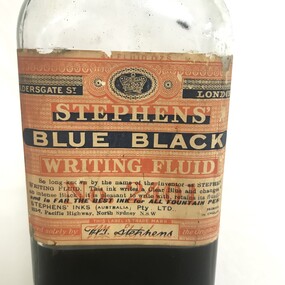
Equipment - bottle of ink, Stephens' Inks (Australia) Pty Ltd, 1900 - 1960s
... Inventor as STEPHENS' WRITING FLUID. This ink writes a clear Blue and changes to an intense Black. It is pleasant to write with, retains its fluidity and is FAR THE BEST INK for ALL FOUNTAIN PENS. STEPHENS' INKS (Australia...This item is significant because of its rarity and because it was such an important part of the equipment used in schools in Australia until c.1960s. education ink pens Label with STEPHENS' BLUE BLACK WRITING FLUID No. 2401 Other words on the label: So long known by the name of the Inventor as STEPHENS' WRITING FLUID. ...This ink was used in Australian schools until the 1960s. It contains 40 ozs. of blue/black ink (writing fluid). It was used for dipping pens. At the beginning of each day, an ink monitor (student) had the job of filling the small containers which were inserted into the student desks. This item is significant because of its rarity and because it was such an important part of the equipment used in schools in Australia until c.1960s. A large clear glass bottle, square shape and with a cork stopper. The top of the bottle has a small lip for pouring the liquid. This bottle is half-full with blue/black liquid. The paper label is coloured orange with black and white printing. The bottle top (attached to the cork) is coloured black and appears to be made of plastic. It has the name Stephens' on the bottle top. At the bottom sides of the bottle are the words THIS BOTTLE IS THE PROPERTY OF STEPHENS' INKS (AUST PTY LTD)Label with STEPHENS' BLUE BLACK WRITING FLUID No. 2401 Other words on the label: So long known by the name of the Inventor as STEPHENS' WRITING FLUID. This ink writes a clear Blue and changes to an intense Black. It is pleasant to write with, retains its fluidity and is FAR THE BEST INK for ALL FOUNTAIN PENS. STEPHENS' INKS (Australia) Pty Ltd. 231-7 Pacific Highway, North Sydney NSW Printed in Englandeducation, ink pens -
Glen Eira Historical Society
Article - Warren, David Ronald de Mey
... Inventor... Black Box... Aviation... Glen Huntly... McKinnon... Carnegie... Caulfield South... Aircraft... Order of Australia...Warren David Inventor Black Box Aviation Glen Huntly McKinnon Carnegie Caulfield South Aircraft Order of Australia Warren Hubert Warren Ellie Article Warren, David Ronald de Mey ...This file contains two items. Article from CAULFIELD/PORT PHILLIP LEADER August 10 2010. David Warren inventor of the Black Box flight recorder Obituary from THE AGE c. July 2010 of David Warren, scientist and inventor.warren david, inventor, black box, aviation, glen huntly, mckinnon, carnegie, caulfield south, aircraft, order of australia, warren hubert, warren ellie -
 Monbulk RSL Sub Branch
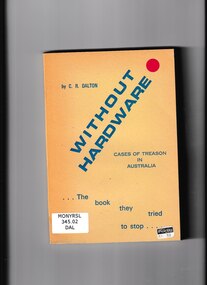
Book, Catherine Dalton, Without hardware: Cases of treason in Australia, 1970
... dr clifford dalton - human rights - australia espionage - australia A brief account of how although slandered by Australian security the widow of Dr Clifford Dalton, inventor of the first fast breeder reactor, eventually succeeded in winning herself the protection of Australian law. ...A brief account of how although slandered by Australian security the widow of Dr Clifford Dalton, inventor of the first fast breeder reactor, eventually succeeded in winning herself the protection of Australian law.Documents quoted, p.219.non-fictionA brief account of how although slandered by Australian security the widow of Dr Clifford Dalton, inventor of the first fast breeder reactor, eventually succeeded in winning herself the protection of Australian law.dr clifford dalton -, human rights - australia, espionage - australia -
 Monbulk RSL Sub Branch
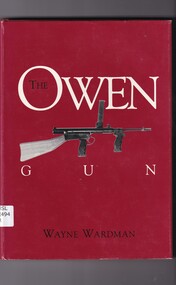
Book, Wayne Wardman, The Owen gun, 1991
... submachine guns owen submachine gun The Owen gun had a great influence on Australia's role on world war two. This book explains its evolution and the role of Evelyn Owen, its inventor. ...The Owen gun had a great influence on Australia's role on world war two. This book explains its evolution and the role of Evelyn Owen, its inventor.Index. bibliography, ill (b/w) p.193.non-fictionThe Owen gun had a great influence on Australia's role on world war two. This book explains its evolution and the role of Evelyn Owen, its inventor.submachine guns, owen submachine gun -
 Bendigo Historical Society Inc.
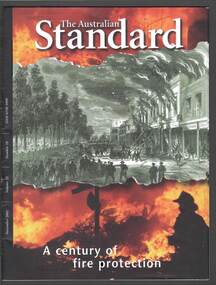
Magazine - THE AUSTRALIAN STANDARD NOVEMBER 2002 VOL 23 NO 10
... Australian Standards, publications and projects. Front cover has a part sketch of the Beehive Building, home of the Bendigo Stock Exchange, in Sandhurst (now Bendigo). Above and below the sketch is a part coloured picture of a fireman at a fire. An article mentions that on 25 August 1871, 18 year old Edward Hope Kirkby, watched the burning of the Beehive Building, home of the Bendigo Stock Exchange, this may have been his motivation to become one of the most prolific inventors of communication apparatus and fire protection equipment in Australia. ...Australian Standards, publications and projects. Front cover has a part sketch of the Beehive Building, home of the Bendigo Stock Exchange, in Sandhurst (now Bendigo). Above and below the sketch is a part coloured picture of a fireman at a fire. An article mentions that on 25 August 1871, 18 year old Edward Hope Kirkby, watched the burning of the Beehive Building, home of the Bendigo Stock Exchange, this may have been his motivation to become one of the most prolific inventors of communication apparatus and fire protection equipment in Australia. ...Magazine titled 'The Australian Standard'. Dated November 2002 Volume 23 Number 10. Contains new and revised Australian Standards, publications and projects. Front cover has a part sketch of the Beehive Building, home of the Bendigo Stock Exchange, in Sandhurst (now Bendigo). Above and below the sketch is a part coloured picture of a fireman at a fire. An article mentions that on 25 August 1871, 18 year old Edward Hope Kirkby, watched the burning of the Beehive Building, home of the Bendigo Stock Exchange, this may have been his motivation to become one of the most prolific inventors of communication apparatus and fire protection equipment in Australia. Has a small full picture of the Burning of the Beehive Stores and Chambers, Sandhurst and picture of the E H kirkby Fire Alarm System.magazine, organization, standards australia, the australian standard november 2002 volume 23 number 10, felicity pontoni, tom godfrey, mark elder, pmp print, beehive building, bendigo stock exchange, edward hope kirkby, la trobe picture collection, state library of victoria, barry lee oam, brian kirkby, david michel -
 Victorian Interpretive Projects Inc.
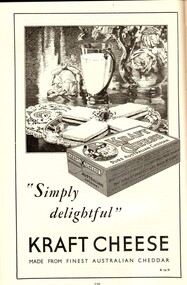
Advertisement, Kraft Processed Cheese, 1934, c1934
... In 1926 Kraft (USA) licenced Kraft Walker Cheese Company to produce processed cheddar cheese in Australia. At that time Cyril Callister, the inventor of Vegemite, was working for the Walker Company in Australia. ...In 1926 Kraft (USA) licenced Kraft Walker Cheese Company to produce processed cheddar cheese in Australia. At that time Cyril Callister, the inventor of Vegemite, was working for the Walker Company in Australia. kraft cheese callister j.k. craft cheese co. kraft walker cheese company A line drawing of a table setting that includes a block of Kraft Cheese Kraft Processed Cheese, 1934 Advertisement ...Kraft Processed Cheddar Cheese was invented in USA by JK Kraft Cheese Co. A world-wide patent was taken out on the product. In 1926 Kraft (USA) licenced Kraft Walker Cheese Company to produce processed cheddar cheese in Australia. At that time Cyril Callister, the inventor of Vegemite, was working for the Walker Company in Australia. A line drawing of a table setting that includes a block of Kraft Cheesekraft, cheese, callister, j.k. craft cheese co., kraft walker cheese company
