
Showing 101 items matching "australian merchant navy"
-
 Ballarat RSL Sub-Branch Inc.
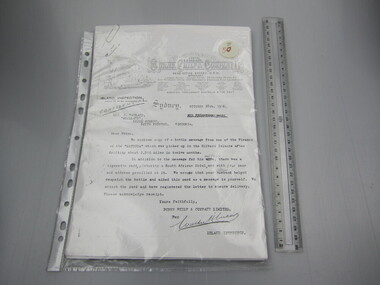
Information Sheet - "The Australian Merchant Navy - About The Ships"
... Information Sheet - "The Australian Merchant Navy - About The Ships"...His next of kin is Pearl WAYLAND (Wife) First World War (WW1) 1914 - 1918 Literature Ballarat RSL Ballarat Re Burns, Philp & Co Ltd Information Sheet - "The Australian Merchant Navy - About The Ships" ...This object relates to James Henry WAYLAND. He was born on 14/10/1883 in Collingwood, VIC. James Henry served in the AMF AN&MEF (306) enlisting on, 14/12/1914 in Collingwood, VIC before being discharged from duties with the 2nd AN&MEF as a AN&MEF Non-Commissioned Sergeant (SGT) on 21/07/1919. James Henry WAYLAND was a prisoner of war. His next of kin is Pearl WAYLAND (Wife)Re Burns, Philp & Co Ltdfirst world war (ww1), 1914 - 1918, literature, ballarat rsl, ballarat -
 Mission to Seafarers Victoria
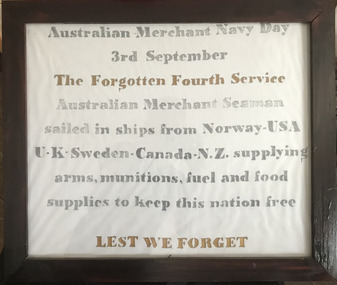
Artwork, other - Screenprint, P.J. Murphy, Australian Merchant Navy Day, c. 2014
... Australian Merchant Navy Day...September 3rd is the day chosen to honour all those seafarers who sailed, and died, in commercial vessels in times of war in memory of September 3rd, 1939 when the transatlantic passenger liner, Athenia, was torpedoed and sank just hours after World War II was declared. merchant navy day lest we forget ww2 ww1 Written in ink on verso: "Rachel / SOLD Y" Framed artwork printed on textile Australian Merchant Navy Day Artwork, other Screenprint P.J. ...September 3rd is the day chosen to honour all those seafarers who sailed, and died, in commercial vessels in times of war in memory of September 3rd, 1939 when the transatlantic passenger liner, Athenia, was torpedoed and sank just hours after World War II was declared.Framed artwork printed on textileWritten in ink on verso: "Rachel / SOLD Y"merchant navy day, lest we forget, ww2, ww1 -
 Bendigo Military Museum
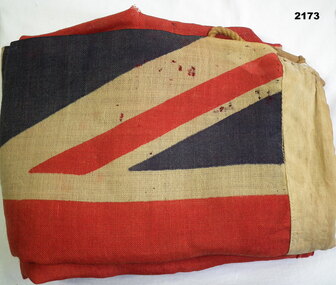
Flag - MERCHANT NAVY ENSIGN, c.1939 - 1945
... Australian Merchant Navy Red Ensign with rope binding & wooden peg....May have come from the Bendigo City Council offices. flags - maritime Merchant Australian Merchant Navy Red Ensign with rope binding & wooden peg. ...May have come from the Bendigo City Council offices.Australian Merchant Navy Red Ensign with rope binding & wooden peg.flags - maritime, merchant -
 Flagstaff Hill Maritime Museum and Village
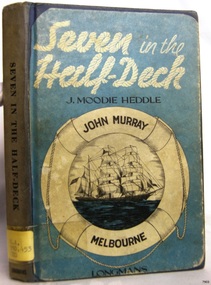
Book - Literary Work, John F. Moodie Heddle, Seven In the Half-Deck, 1949
... Australia trade...dynamite cargo...petroleum cargo...Maldon Island reef...1909-1917...1910...1918...23rd Premier of Victoria...Warrnambool Member of Parliament...Koroit...juvenile delinquent training...Navy training...Royal Australian Navy...Merchant...Australia from 1877 to 1909. In 1909 the Loch Ryan was purchased by the Defence Department of Victoria, refitted at Williamstown as a training vessel and renamed ‘John Murray’. It was commissioned from 1910 to 1917 for reforming juvenile offenders as seamen for the Navy and Merchant Navy. ...Australia, with goods collected from other countries along the way. The book has an important connection to Victoria's training ship John Murray, which aimed at reforming delinquent juveniles to be suitable as seamen for Australia's Navy or Merchant Navy. ...This book is a true account of the experiences of seven Australian boys beginning their career as seamen on the last voyage of the ‘John Murray’ when they became stranded on a South Pacific Island. The author John F. Moodie Heddle was an apprentice on board at that time. The publisher firm of Longmans, Green & Co. was founded in 1724 in London by Thomas Longman under the name Longman. In August of that year, he bought the two shops and goods of William Taylor and set up his publishing house there at 39 Paternoster Row. The shops were called Black Swan and Ship, and it is said that the 'ship' sign was the inspiration for Longman's Logo. After many changes of name and management, including the name Longman, Green, Longman and Roberts from 1859 to 1862, the firm was incorporated in 1926 as Longmans, Green & Co. Pty Ltd. The firm was acquired by Pearson in 1968 and was known as Pearson Longman or Pearson PLC. The three-masted iron baque 'John Murray' was built and registered in Glasgow, UK, in 1877 as a general cargo vessel maned the 'Loch Ryan'. It traded between the UK and Australia from 1877 to 1909. In 1909 the Loch Ryan was purchased by the Defence Department of Victoria, refitted at Williamstown as a training vessel and renamed ‘John Murray’. It was commissioned from 1910 to 1917 for reforming juvenile offenders as seamen for the Navy and Merchant Navy. The training project ceased after reports of the treatment of the boys. Although 411 did their training under this scheme, the success rate of them qualifying to serve on other vessels was less than twenty per cent. The ship was named after John (Jack) Murray (1851-1916), who was born near Koroit. He was the 23rd Premier of Victoria (1909-1912), and a Warrnambool Member of Parliament for twenty years. In 1917 the John Murray was sold to the Government of Australia to serve during the Great War, World War I. The ship was loaded with a cargo of dynamite and petroleum at San Francisco then departed for Melbourne when, during its passage, it was wrecked at Malden Island reef in the mid-Pacific Ocean on May 29th, 1918.The book gives us a first-hand account of the wrecking of the sailing ship John Murray, named after a past Warrnambool Member of Parliament for twenty years and the 23rd Premier of Victoria, born locally, near Koroit. The book is significant for its association with the vessel John Murray, which was formerly the 'Loch Ryan' of the Loch Line General Shipping Company of Glasgow. The same company owned the Loch Ard, which was wrecked and tragically lost 52 lives. The book is significant as a record of one of the many clipper ships that traded between the United Kingdom and Australia, with goods collected from other countries along the way. The book has an important connection to Victoria's training ship John Murray, which aimed at reforming delinquent juveniles to be suitable as seamen for Australia's Navy or Merchant Navy.Seven In The Half-Deck: An account of the wreck of the Barque John Murray Author: John F. Moodie Heddle Publisher: Longmans Green & Co Date: 1949 Beige cloth hardcover book with colour sleeve pasted to front cover, depicting a lifebuoy with a sailing ship in the centre. Some words of the title are in rope-inspired writing. There are inscriptions on a label on the spine, a sticker on the front loose endpaper, and the image on the cover.. Label; typed text "RA 910.453 HED" Inside front loose endpaper has sticker "Warrnambool Children's Library" On lifebuoy: "JOHN MURRAY" "MELBOURNE"flagstaff hill, flagstaff hill maritime museum and village, warrnambool, maritime museum, maritime village, great ocean road, shipwreck coast, seven in the half-dec, true story, wreck of the barque john murray, shipwreck, john murray, barque, wreck, john f. moodie heddle, j f moodie heddle, longmans green & co, j moodie heddle, warrnambool children’s library, 1949, melbourne, the john murray, loch ryan, loch line, general shipping company, government of victoria, training ship, juvenile reformation, delinquent boys, james & george thomson, iron barque, three-masted ship, clipper ship, uk to australia trade, dynamite cargo, petroleum cargo, maldon island reef, 1909-1917, 1910, 1918, 23rd premier of victoria, warrnambool member of parliament, koroit, juvenile delinquent training, navy training, royal australian navy, merchant navy, first-hand account of a shipwreck -
 Running Rabbits Military Museum operated by the Upwey Belgrave RSL Sub Branch
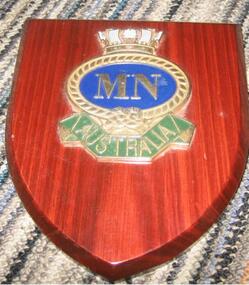
Plaque Merchant Navy - Australia
... Plaque Merchant Navy - Australia...Merchant Navy - Australia...Plaque current RAN Merchant Navy - Australia Plaque Merchant Navy - Australia ...Merchant Navy - Australiaplaque, current, ran -
 Mission to Seafarers Victoria
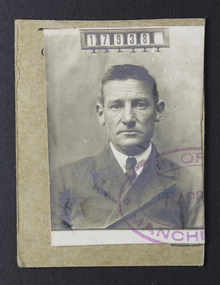
Photograph - Photograph, ID, c. 1925
... ...royal australian navy...ran...merchant...arthur oswald dixon manchester england seafarers sailors seamen officers royal australian navy ran merchant navy Behind are printed words and written is: "thur Oswald", "2nd Officer", "Ex Master" Glued black and white ID photograph of Arthur Oswald Dixon, cut from an official document. ...Glued black and white ID photograph of Arthur Oswald Dixon, cut from an official document.Behind are printed words and written is: "thur Oswald", "2nd Officer", "Ex Master"arthur oswald dixon, manchester, england, seafarers, sailors, seamen, officers, royal australian navy, ran, merchant navy -
 Port Melbourne Historical & Preservation Society
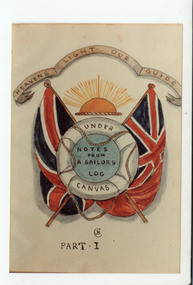
Photograph - Title page drawing from James Conder Journal Part I
... Royal Australian Naval College...Merchant Navy...navy veteran, 1872 - 1954. In 1889 he served in the Merchant Marine Service sailing on the ships ‘Ellora’ and ‘Avenger’. in 1891, aged 19, he joined the Royal Navy in Australia serving on the flagship of the Australian Station, ‘HMS Orlando’, when it escorted ships of the new Australasian Auxiliary Squadron in coastal voyages. ...Armed Services - Navy Transport - Shipping James Bryance CONDER RAN - Royal Australian Navy Victorian Colonial Navy Royal Australian Naval College Merchant Navy Royal Naval Squadron Colour digital photograph of the title page handdrawn by James GONDER from ‘Notes from a Sailors Log - Under Canvas - Part I The Merchant Service’ (Cat No 2700.01). ...James Bryance CONDER (aka James Brycanne CONDER) Artist, poet and four-navy veteran, 1872 - 1954. In 1889 he served in the Merchant Marine Service sailing on the ships ‘Ellora’ and ‘Avenger’. in 1891, aged 19, he joined the Royal Navy in Australia serving on the flagship of the Australian Station, ‘HMS Orlando’, when it escorted ships of the new Australasian Auxiliary Squadron in coastal voyages. After serving 6 months he returned to family in Melbourne rather than sign on for 12 years. Instead he joined the Victorian Colonial Navy and was posted, in succession, to the ‘HMVS Cerberus’, ‘HMVS Nelson’ and the gunboat ‘HMVS Albert’. In 1896 he left the navy, married Victoria Agnes NIHILL and joined the Victorian Police Force. In 1904 CONDOR returned to the sea as part of the Commonwealth Naval Forces, an amalgamation of the colonial navies formed after federation and later becoming the Royal Australian Navy. On his first ship, ‘HMS Katoomba’, as bosun yeoman, he helped train new recruits. He later served on ‘HMS Challenger’ and ‘HMS Psyche’ which included voyages to Fiji, the New Hebrides, Singapore and New Zealand as well as regular cruises to Australian ports. In 1909, CONDER left the Navy and undertook shored-based civilian work until 1913 when he joined the Royal Australian Naval College at Osborne House in Geelong. He remained with the Naval College until 1937 through its moves to Jervis Bay, NSW and then to Crib Point, Victoria training midshipmen according to the practices of the Royal Navy. In later life, CONDER produced two handwritten journals for his family illustrated with his own paintings and drawings. Two original sets were made. One remains in the family while the other is held by the Australian National Maritime Museum in Sydney. PMHPS hold several items relating to James CONDER including photocopies of his journals ‘Notes from a Sailors Log - Under Canvas - Part I The Merchant Service’ (Cat No 2700.01) and ‘Notes from a Sailors Log - Under Steam - Part II The Navy’ (Cat No 2700.02), a photocopy of his Certificate of Service (Cat No 2700.03), a booklet of his life story (Cat No 2700.04) and several digital items (Cat No 2476.01 - 2476.09).Colour digital photograph of the title page handdrawn by James GONDER from ‘Notes from a Sailors Log - Under Canvas - Part I The Merchant Service’ (Cat No 2700.01).armed services - navy, transport - shipping, james bryance conder, ran - royal australian navy, victorian colonial navy, royal australian naval college, merchant navy, royal naval squadron -
 Port Melbourne Historical & Preservation Society
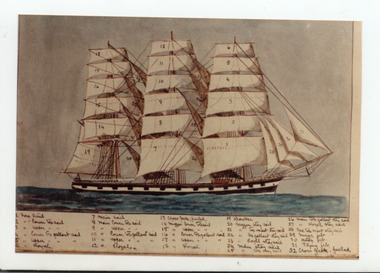
Photograph - Sailing ship showing sail configuration
... Royal Australian Naval College...Merchant Navy...navy veteran, 1872 - 1954. In 1889 he served in the Merchant Marine Service sailing on the ships ‘Ellora’ and ‘Avenger’. in 1891, aged 19, he joined the Royal Navy in Australia serving on the flagship of the Australian Station, ‘HMS Orlando’, when it escorted ships of the new Australasian Auxiliary Squadron in coastal voyages. ...Armed Services - Navy Transport - Shipping James Bryance CONDER RAN - Royal Australian Navy Victorian Colonial Navy Royal Australian Naval College Merchant Navy Royal Naval Squadron Colour digital photograph of a drawing by James CONDER showing the sail configuration for a sailing ship. ...James Bryance CONDER (aka James Brycanne CONDER) Artist, poet and four-navy veteran, 1872 - 1954. In 1889 he served in the Merchant Marine Service sailing on the ships ‘Ellora’ and ‘Avenger’. in 1891, aged 19, he joined the Royal Navy in Australia serving on the flagship of the Australian Station, ‘HMS Orlando’, when it escorted ships of the new Australasian Auxiliary Squadron in coastal voyages. After serving 6 months he returned to family in Melbourne rather than sign on for 12 years. Instead he joined the Victorian Colonial Navy and was posted, in succession, to the ‘HMVS Cerberus’, ‘HMVS Nelson’ and the gunboat ‘HMVS Albert’. In 1896 he left the navy, married Victoria Agnes NIHILL and joined the Victorian Police Force. In 1904 CONDOR returned to the sea as part of the Commonwealth Naval Forces, an amalgamation of the colonial navies formed after federation and later becoming the Royal Australian Navy. On his first ship, ‘HMS Katoomba’, as bosun yeoman, he helped train new recruits. He later served on ‘HMS Challenger’ and ‘HMS Psyche’ which included voyages to Fiji, the New Hebrides, Singapore and New Zealand as well as regular cruises to Australian ports. In 1909, CONDER left the Navy and undertook shored-based civilian work until 1913 when he joined the Royal Australian Naval College at Osborne House in Geelong. He remained with the Naval College until 1937 through its moves to Jervis Bay, NSW and then to Crib Point, Victoria training midshipmen according to the practices of the Royal Navy. In later life, CONDER produced two handwritten journals for his family illustrated with his own paintings and drawings. Two original sets were made. One remains in the family while the other is held by the Australian National Maritime Museum in Sydney. PMHPS hold several items relating to James CONDER including photocopies of his journals ‘Notes from a Sailors Log - Under Canvas - Part I The Merchant Service’ (Cat No 2700.01) and ‘Notes from a Sailors Log - Under Steam - Part II The Navy’ (Cat No 2700.02), a photocopy of his Certificate of Service (Cat No 2700.03), a booklet of his life story (Cat No 2700.04) and several digital items (Cat No 2476.01 - 2476.09).Colour digital photograph of a drawing by James CONDER showing the sail configuration for a sailing ship.armed services - navy, transport - shipping, james bryance conder, ran - royal australian navy, victorian colonial navy, royal australian naval college, merchant navy, royal naval squadron -
 Port Melbourne Historical & Preservation Society
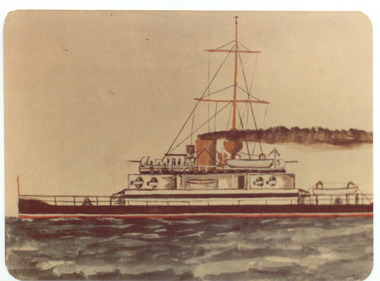
Photograph - HMVS Cerberus by James CONDER
... Royal Australian Naval College...Merchant Navy...navy veteran, 1872 - 1954. In 1889 he served in the Merchant Marine Service sailing on the ships ‘Ellora’ and ‘Avenger’. in 1891, aged 19, he joined the Royal Navy in Australia serving on the flagship of the Australian Station, ‘HMS Orlando’, when it escorted ships of the new Australasian Auxiliary Squadron in coastal voyages. ...Armed Services - Navy Transport - Shipping James Bryance CONDER RAN - Royal Australian Navy Victorian Colonial Navy Royal Australian Naval College Merchant Navy HMVS Cerberus Royal Naval Squadron Colour digital photograph of a drawing of HMVS Cerberus by James CONDER. ...James Bryance CONDER (aka James Brycanne CONDER) Artist, poet and four-navy veteran, 1872 - 1954. In 1889 he served in the Merchant Marine Service sailing on the ships ‘Ellora’ and ‘Avenger’. in 1891, aged 19, he joined the Royal Navy in Australia serving on the flagship of the Australian Station, ‘HMS Orlando’, when it escorted ships of the new Australasian Auxiliary Squadron in coastal voyages. After serving 6 months he returned to family in Melbourne rather than sign on for 12 years. Instead he joined the Victorian Colonial Navy and was posted, in succession, to the ‘HMVS Cerberus’, ‘HMVS Nelson’ and the gunboat ‘HMVS Albert’. In 1896 he left the navy, married Victoria Agnes NIHILL and joined the Victorian Police Force. In 1904 CONDOR returned to the sea as part of the Commonwealth Naval Forces, an amalgamation of the colonial navies formed after federation and later becoming the Royal Australian Navy. On his first ship, ‘HMS Katoomba’, as bosun yeoman, he helped train new recruits. He later served on ‘HMS Challenger’ and ‘HMS Psyche’ which included voyages to Fiji, the New Hebrides, Singapore and New Zealand as well as regular cruises to Australian ports. In 1909, CONDER left the Navy and undertook shored-based civilian work until 1913 when he joined the Royal Australian Naval College at Osborne House in Geelong. He remained with the Naval College until 1937 through its moves to Jervis Bay, NSW and then to Crib Point, Victoria training midshipmen according to the practices of the Royal Navy. In later life, CONDER produced two handwritten journals for his family illustrated with his own paintings and drawings. Two original sets were made. One remains in the family while the other is held by the Australian National Maritime Museum in Sydney. PMHPS hold several items relating to James CONDER including photocopies of his journals ‘Notes from a Sailors Log - Under Canvas - Part I The Merchant Service’ (Cat No 2700.01) and ‘Notes from a Sailors Log - Under Steam - Part II The Navy’ (Cat No 2700.02), a photocopy of his Certificate of Service (Cat No 2700.03), a booklet of his life story (Cat No 2700.04) and several digital items (Cat No 2476.01 - 2476.09).Colour digital photograph of a drawing of HMVS Cerberus by James CONDER.armed services - navy, transport - shipping, james bryance conder, ran - royal australian navy, victorian colonial navy, royal australian naval college, merchant navy, hmvs cerberus, royal naval squadron -
 Mission to Seafarers Victoria
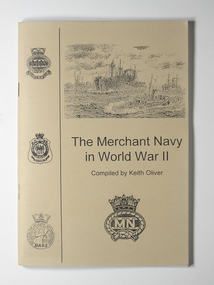
Booklet, Keith Oliver, The Merchant Navy in WWII, 1997
... Front cover has a sketch of merchant navy vessel/s on the high seas, along with the insignias of the Merchant Navy Australia, Returned Services League and Battle of the Atlantic 50th Anniversary (BA93)....merchant navy sailor. He married and lived in Melbourne. The victorian branch of the Merchant Navy RSL used to meet on Tuesday, noon. Flying Angel, Mission to Seafarers, Flinders Street, Melbourne. Keith Oliver was the contact for the branch. (at least until 2006). He donated many books to the Mission in 2018. merchant navy ww2 keith oliver Title: "The Merchant Navy in World War II" "Compiled by Keith Oliver" Booklet, thin beige cardboard cover (x2). Front cover has a sketch of merchant navy vessel/s on the high seas, along with the insignias of the Merchant Navy Australia ...Booklet, thin beige cardboard cover (x2). Front cover has a sketch of merchant navy vessel/s on the high seas, along with the insignias of the Merchant Navy Australia, Returned Services League and Battle of the Atlantic 50th Anniversary (BA93).non-fictionmerchant navy, ww2, keith oliver -
 Mission to Seafarers Victoria
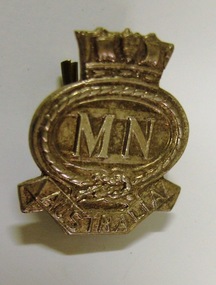
Badge, Wallace Bishop, MN Australia, circa 1940
... merchant navy...commonwealth government 1940...badge...war service...australia...WW2 Merchant Navy Australia, issued by the Commonwealth Government 1940 MN War Service officially-numbered silver lapel badge. ...WW2 Merchant Navy war service solid (silver) badge. Initials ‘MN’ enclosed by oval rope motif with crown above. The word ‘Australia...WW2 Merchant Navy Australia, issued by the Commonwealth Government 1940 MN War Service officially-numbered silver lapel badge. ...WW2 Merchant Navy Australia, issued by the Commonwealth Government 1940 MN War Service officially-numbered silver lapel badge. A company called Bishop also manufactured badges in Melbourne .Intended as a form of service badge for Australian Merchant Seafarers especially those perhaps serving on the newly armed civilian craft. The term Merchant Navy was coined by King George V in 1919, as recognition of the sacrifice made by merchant seafarers during the First World War.WW2 Merchant Navy war service solid (silver) badge. Initials ‘MN’ enclosed by oval rope motif with crown above. The word ‘Australia’ (UC) displayed beneath. Retains original two-loop lapel fixtures. Officially-numbered 10910 on the back. Inscribed "issued by the Commonwealth Government 1940". "Wallace-Bishop Brisbane".ww2, merchant navy, commonwealth government 1940, badge, war service, australia, mn -
 Flagstaff Hill Maritime Museum and Village
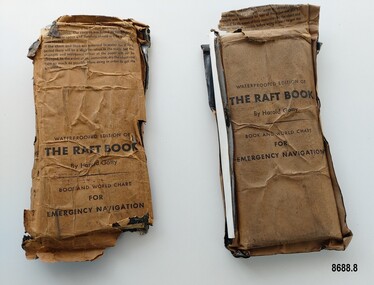
Booklet - Book and World Chart for Emergency Navigation, George Grady Press, The Raft Book, 1943
... W. 1 he joined the Australian Merchant Navy where he learned the constellations while standing night watch and became an expert in celestial navigation while serving on many ships sailing between Australia and California. ...W. 1 he joined the Australian Merchant Navy where he learned the constellations while standing night watch and became an expert in celestial navigation while serving on many ships sailing between Australia and California. ...Harold Gatty was born on January 5th, 1903 in Campbell Town, Tasmania. He was a navigator and aviation pioneer. He began his career learning navigation at the age of 14 as a midshipman at the Royal Australian Naval College but withdrew after three years and became an apprenticed ship's officer with the Patrick Steamship Company of Sydney. After W. W. 1 he joined the Australian Merchant Navy where he learned the constellations while standing night watch and became an expert in celestial navigation while serving on many ships sailing between Australia and California. In 1927 he moved to California and opened a navigation school and also a laboratory repairing navigational equipment. At this time he became very interested in air navigation and was aware of the limitations of existing methods and instruments for aerial navigation. He began researching ways of improving aerial navigation. Two early inventions of his were his air sextant and a ground speed and drift indicator which formed the basis of the automatic pilot which later came to be standard equipment on most aircraft. He worked with several record breaking pilots including Ann Morrow Lindbergh (who went on to serve as a navigator for her husband Charles Lindbergh), helped Wiley Post break the world record circumnavigating the Earth, invented a new method of "dead reckoning" that revolutionised the ability to fly safely through cloudy conditions without drifting off course and famously navigated a small plane (whilst trying to cross the Pacific) over 1900 km through fog (with no radio) and using only his dead reckoning techniques, back to their starting point in Japan after they developed fuel problems. In 1932 Gatty received the Distinguished Flying Cross from President Hoover. In 1934 Gatty formed the South Seas Commercial Company with Donald Douglas with the aim to deliver air services to the islands of the South Pacific. The Company was sold to Pan Am but he continued to work for them. In 1935 he went on a sailing expedition investigating several small islands in the South Pacific and was briefly marooned on Baker Island. He was able to use his extensive knowledge of seabird habits to save the crew. He was also very interested in the ability of the Polynesians to navigate using the stars. During the Second World War Gatty was given the honorary rank of Group Captain in the Royal Australian Air Force (RAAF) and worked for the U. S. Army Air Forces (USAAF) in the South Pacific. In 1943 he moved to Washington where he developed a survival book (The Raft Book) specifically for boat crews or air crews flying over the Pacific to help them survive and navigate their life rafts in remote areas of the ocean. The original book was 152 pages long however a condensed version was made which consisted of a 64 page booklet, combined map and star chart and calendar strip enclosed in a waterproof slipcase, to be placed in life rafts for emergency use. The booklet included navigational advice and ideas such as ocean currents, estimation of distance, using a compass, measurement of angles, recognising and steering by the stars, land indications from sea birds, migration of sea birds and insects, sounds from the land, the scent of the land and ocean currents and the colour of the sea etc. After W.W.2 Gatty moved to Fiji and formed Fiji Airways (which later became Air Pacific). Harold Gatty died in August 1957.The two copies of "The Raft Book" are significant as they are a written summary of the many methods of sea navigation (both modern and historical) that existed in the 1940's. They are also a record of Harold Gatty, who played a significant role in the development of modern day aerial navigation using his understanding of different sea navigational techniques.Two rectangular brown packets with waterproof coverings (oiled paper) titled "The Raft Book" by Harold Gatty. Each packet contains a folded 64 page paper booklet with detailed instructions for navigating a small craft in open seas, a folded chart (with a map of the world and oceans, well known constellations, latitude and longitude charts, Greenwich time and a scale for string lengths and Harp scale) and a long folded paper calendar strip.Front of package - "WATERPROOFED EDITION OF/ THE RAFT BOOK / By Harold Gatty / BOOK AND WORLD CHART / FOR / EMERGENCY NAVIGATION / To open envelope tear along above line. If the envelope is used again fold the flap to keep contents dry. 1. This envelope contains a book, chart and tape for emergency navigation. The contents are folded to take up the least possible space and therefore should not be removed until needed. 2. if the chart and tape are immersed in water for a long period, there will be a slight variation in the scale but the strength and resistence to tear of the paper will not be changed. In the event of long immersion, dry the chart and tape as much as possible before using in order to in order to get the greatest accuracy in scale. Front of booklet - THE RAFT BOOK / LORE OF THE SEA AND SKY /By Harold Gatty IMPORTANT FOR YOUR SECURITY/Upon abandoning ship you may have to be your own navigator. Take the following pre/cautions for your own safety:/ Carry a good type of pocket watch / keep it wound and have it running on Greenwich (England) / Time, which you can get from the navigating officer. / Keep track of the date at Greenwich; and on a 24-hour basis, / know whether the time is, say, 6 hours (6 A.M.) showing on / your watch, or 18 hours (6P.M.) Greenwich. / PROECT YOUR WATCH. GET A RUBBER SACK FOR IT (OBTAIN FROM PHARMACIST) AND KEEP IT DRY / KEEP A PENCIL IN YOUR POCKET/ POSITION OF SHIP WHEN ABANDONED PRINTED IN UNITED STATES OF AMERICA GEORGE GRADY PRESS, NEW YORK/COPYRIGHT, 1943, BY HAROLD AND FENNA GATTYflagstaff hill maritime museum and village, shipwreck coast, warrnambool, the raft book, harold gatty, book and world chart for emergency navigation, ww 2, ww ii, navigation, air navigation, aerial navigation, lindbergh, wiley post, dead reckoning, south seas commercial company, u.s. army airforce, usaaf, survival book, life rafts, sea navigation, emergency navigation, fiji airways, harp scale -
 Dandenong/Cranbourne RSL Sub Branch
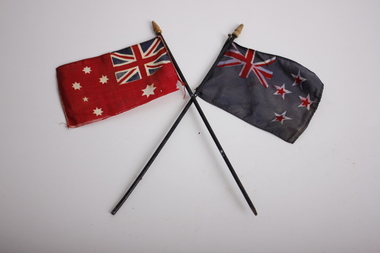
Flag - The Australian Red Ensign Flag and New Zealand Flag, unknown
... Since 2008, 3 September has been officially commemorated as both Australian National Flag/Merchant Navy Day which allows the Australian Red Ensign to be flown on land for the occasion as a matter of protocol. ...Since 2008, 3 September has been officially commemorated as both Australian National Flag/Merchant Navy Day which allows the Australian Red Ensign to be flown on land for the occasion as a matter of protocol. ...Likely from WWIPair of miniature flags on small black flag poles with wooden caps. The Australian Red Ensign, or the Australian Civil Ensign, is simply a red version of the Australian National flag. It is for use only at sea and officially never on land, but can be used by private citizens. At sea, it is the only flag allowable for merchant ships registered in Australia under the Navigation and Shipping Act 1912 and The Shipping Registration Act 1981. Pleasure craft, however, may fly either the Red Ensign or the National Flag. The history of the Red Ensign is intertwined with the history of the Australian National flag. From 1901 to 1954 the Red Ensign was used as the National Flag by State and Local Governments, private organisations and individuals. The Blue Ensign was for Government use only, reflecting British practice with its ensigns. The design of the Australian Red Ensign was always kept in step with the Blue Ensign (i.e. with respect to the number of points on the stars, etc.) but there was often public confusion about which was the `correct′ flag to fly. Many thought the choice was merely one of fashion or preference. In 1941, Australia′s Prime Minister Robert Menzies stated that there should be no restrictions on private citizens using the Blue Ensign on land and, in 1947, Prime Minister Ben Chifley reaffirmed this position but it wasn’t until the passage of the Flags Act 1953 that the restriction on civilians flying the Blue Ensign was lifted after which, use of the Red Ensign on land became a rarity. Since 2008, 3 September has been officially commemorated as both Australian National Flag/Merchant Navy Day which allows the Australian Red Ensign to be flown on land for the occasion as a matter of protocol. The blue flag is the New Zealand National Flag.flag, ensign, anzac, new zealand, navy, naval -
 Mission to Seafarers Victoria
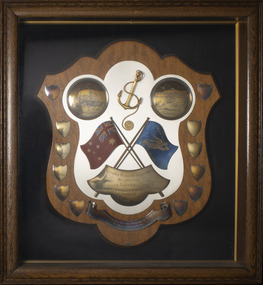
Award - Shield, Soccer Football Shield For Annual Competition by Crews of Merchant Ships, c. 1936
... merchant ships presented by Wally Nancarrow, Sydney Wooden shield featuring two circular disk silver plaques one on each side at the top. One with the engraving of a ship and the other with the engraving of a footballer. At the top in the centre is an anchor in relief gilded with a rope attached, falling across the front of it and coiling at the bottom of the anchor. Two flags crossing over in the middle of the shield; one the Australian Navy ...Football matches were a popular onshore activity and Annual reports note Reverend Weller in the 1920s managed to establish a temporary pitch and a change room facility near Port Melbourne. The donor, Wally Nancarrow, was a tailor in the Queen Victoria Building in Sydney (from Nov. 1927- Aug. 1935 on Trove) so the relation with the Melbourne Mission is unclear. The shield can be seen hanging above the canteen on item 1713 (dated c. 1950) and in the Celia Little Room. The Annual Report 1936 mentions a shield (p11) seen on page 15: "Football: The competition has been extended this year, and in the future is to include all matches played in Australian ports. The Victorian Missions to Seamen Shield is the present trophy, and the Assistant-Chaplain has been appointed Organiser and Honorary Secretary." The shield may have been done after the one mentioned in the annual report and we can only speculate nothing was ever engraved because of WW2.The collection holds many historic and later contemporary colour photos of crew football teams posed onshore and on decks. Sports and games were an essential part of the welfare services offered by the Mission when seamen had long shore leave.Wooden shield featuring two circular disk silver plaques one on each side at the top. One with the engraving of a ship and the other with the engraving of a footballer. At the top in the centre is an anchor in relief gilded with a rope attached, falling across the front of it and coiling at the bottom of the anchor. Two flags crossing over in the middle of the shield; one the Australian Navy flag and the other the Mission to Seamen flag. Laying over the top of the poles of the flags is a brass banner with the competition description engraved on it. At the bottom is a brass scroll with an inscription about who presented it and where. The shield has 12 smaller, blank silver shields along the sides. The shield is kept inside a wooden display cabinet with a glass front and navy material back ground.engraved on brass banner: For annual competition by crew of merchant ships presented by Wally Nancarrow, Sydneyshield, soccer, football, anchor, brass, silver, wally nancarrow, mission to seafarers victoria, walter james nancarrow (1885 - 1961) -
 Mission to Seafarers Victoria
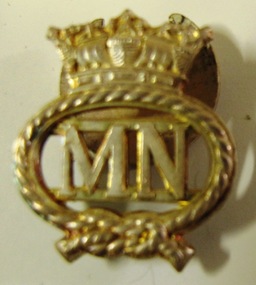
Badge, MN, circa 1940
... merchant navy...official issue war service...australia...Merchant Navy Officers and Men as a form of identity and to fulfil the role of a National Service Badge. This badge has been designated as a scarce example (AMSA) of a WW2 Merchant Navy Official issue MN War Service silver badge The term Merchant Navy was coined by King George V in 1919, as recognition of the sacrifice made by merchant seafarers during the First World War. Before the term "mercantile navy" was used. badge ww2 merchant navy official issue war service australia ...Badge officially issued, from January 1940, to all Merchant Navy Officers and Men as a form of identity and to fulfil the role of a National Service Badge. This badge has been designated as a scarce example (AMSA) of a WW2 Merchant Navy Official issue MN War Service silver badge The term Merchant Navy was coined by King George V in 1919, as recognition of the sacrifice made by merchant seafarers during the First World War. Before the term "mercantile navy" was used.WW2 Merchant Navy official issue war service 'silver' badge. Initial ‘MN’ enclosed by oval rope motif with crown above. Retains original buttonhole fitting. badge, ww2, merchant navy, official issue war service, australia, mn -
 Mission to Seafarers Victoria
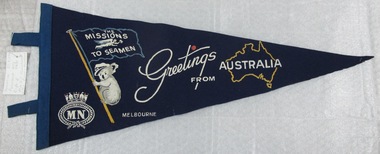
Flag - Pennant, The Missions to Seamen - Greetings From Australia, 1940-1949
... A triangular felted, dark blue pennant with printed cursive inscription and motifs including: the Mission to Seamen Flying Angel flag, an outline of Australia; a Koala wearing a captain's hat; an insignia emblem for the Merchant Navy. ...Similar flags were made in other countries depicting an animal (kiwi bird in New Zealand, springbox in South Africa) and other Australian towns. pennant flags koala flying angel club merchant navy d. june muirhead marketing caretaker cottage bert richardson june muirhead nee richardson edna richardson ww2 The printed inscription reads: Greetings from Australia. ...This pennant was donated to the Mission by June Muirhead (nee Richardson) who visited the Mission on two occasions: on the 13 November 2014 and then in 2016. She lived from age 3 to 8, with her parents, Cuthbert (Bert) Richardson and Jane (Jenny) Richardson, and her sister, Edna, in the Cottage at 717 Flinders Street. Her father, was the caretaker of the Flinders Street building between 1943-1949. . In 1943 her father was hired to work at the Mission as a caretaker. The family moved from Wonthaggi. When she lived in the Mission, she would sometimes sneak into the club to look at books and pictures. Some seafarers would give her badges, tokens. One of them gave her this felt pennant. In 1949, the family moved back to Wonthaggi and June started year 5 over there.A number of souvenir gifts and small boxes were apparently available through the Mission To Seamen in the 1940s. This acquisition adds to the small collection of items from the period which could be used to form the core of an informative exhibition. Similar flags were made in other countries depicting an animal (kiwi bird in New Zealand, springbox in South Africa) and other Australian towns.A triangular felted, dark blue pennant with printed cursive inscription and motifs including: the Mission to Seamen Flying Angel flag, an outline of Australia; a Koala wearing a captain's hat; an insignia emblem for the Merchant Navy. A looped cotton binding along left edge of the triangle to thread the flag on a stick or cord support. The printed inscription reads: Greetings from Australia.pennant, flags, koala, flying angel club, merchant navy, d. june muirhead, marketing, caretaker, cottage, bert richardson, june muirhead nee richardson, edna richardson, ww2 -
 Mission to Seafarers Victoria
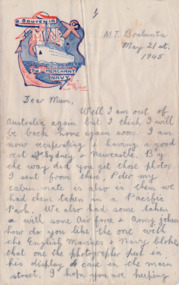
Letter - Correspondance, Phil, 21 October 1945
... ...merchant navy...mn...australia...Rare letter of a seaman to his mother telling about his time and activities while on shore leave. mt bralanta phil merchant navy mn australia sydney newcastle v.e. day ww2 luna park shore leave 2 pages letter handwritthen in pencil on a thin japanese paper with logo "A Souvenir/ MN / the Merchant Navy" Letter Correspondance Phil ...Handwritten letter of unknown merchant seaman called Phil to his mum in 1945. Phil was a seaman on the MT Bralanta.Rare letter of a seaman to his mother telling about his time and activities while on shore leave.2 pages letter handwritthen in pencil on a thin japanese paper with logo "A Souvenir/ MN / the Merchant Navy"mt bralanta, phil, merchant navy, mn, australia, sydney, newcastle, v.e. day, ww2, luna park, shore leave -
 Mission to Seafarers Victoria
Book (Item) - Logbook, Captain George Garrett Kitching (1926 - 2005), Trienza, Rough Abstract Log, G.G. Kitching 2/0, 1946
... The British Phosphate Commissioners (BPC) was a board of Australian, British, and New Zealand representatives who managed extraction of phosphate from Christmas Island, Nauru, and Banaba (Ocean Island) from 1920 until 1981. Captain S.G. Ellams Walter Harbord (Wal or Wally) (b.1923 in Brisbane-d.), master mariner in the Merchant Navy...The British Phosphate Commissioners (BPC) was a board of Australian, British, and New Zealand representatives who managed extraction of phosphate from Christmas Island, Nauru, and Banaba (Ocean Island) from 1920 until 1981. Captain S.G. Ellams Walter Harbord (Wal or Wally) (b.1923 in Brisbane-d.), master mariner in the Merchant Navy ...The British Phosphate Commissioners (BPC) was a board of Australian, British, and New Zealand representatives who managed extraction of phosphate from Christmas Island, Nauru, and Banaba (Ocean Island) from 1920 until 1981. Captain S.G. Ellams Walter Harbord (Wal or Wally) (b.1923 in Brisbane-d.), master mariner in the Merchant Navy on British Phosphate Commission ships. George Garrett Kitching (1926 - 2005) was second mate on the following ships onboard which he records the events: MV Gorgon : 5-12-46 to16-1-48 SS Titan: 25-1-49 to 16-6-49 MV Orestes: 5-8-49 to 22-9-50 MV Astyanax: 28-4-51 to 7-5-51 (Coasting) MV Trienza: 8-4-53 to 9-10-53Walter was interviewed by the Australian at War Film Archive in 2003. He served on these ships: SS Corinda SS Macumba SS Mildura SS Nellor SS Ormiston SS Reynellaanne rennie collection, wal harbord, merchant navy, seamen, seafarers, ww2, battle of the atlantic, walter harbord, navigation, m.v. trienza, s.s. titan, captain s.g. ellams, bpc, ship log, captain g.g. kitching, m.v. orestes, m.v gorgon, m.v. astyanax, denis ryan, dinny ryan, dennis william ryan -
 Mission to Seafarers Victoria
Book (Item) - Logbook, Captain George Garrett Kitching (1926 - 2005), Master's Log - Captain G.G. Kitching, 1956
... The British Phosphate Commissioners (BPC) was a board of Australian, British, and New Zealand representatives who managed extraction of phosphate from Christmas Island, Nauru, and Banaba (Ocean Island) from 1920 until 1981. Walter Harbord (Wal or Wally) (b.1923 in Brisbane-d.), master mariner in the Merchant Navy on British Phosphate Commission ships....The British Phosphate Commissioners (BPC) was a board of Australian, British, and New Zealand representatives who managed extraction of phosphate from Christmas Island, Nauru, and Banaba (Ocean Island) from 1920 until 1981. Walter Harbord (Wal or Wally) (b.1923 in Brisbane-d.), master mariner in the Merchant Navy on British Phosphate Commission ships. ...The British Phosphate Commissioners (BPC) was a board of Australian, British, and New Zealand representatives who managed extraction of phosphate from Christmas Island, Nauru, and Banaba (Ocean Island) from 1920 until 1981. Walter Harbord (Wal or Wally) (b.1923 in Brisbane-d.), master mariner in the Merchant Navy on British Phosphate Commission ships.Walter was interviewed by the Australian at War Film Archive in 2003. He served on these ships: SS Corinda SS Macumba SS Mildura SS Nellor SS Ormiston SS Reynellaanne rennie collection, wal harbord, merchant navy, seamen, seafarers, ww2, battle of the atlantic, walter harbord, hezzanith, sextant, nautical instrument, navigation, captain g.g. kitching, m.v. trienza, m.v. triaster, m.v. triellis, bpc, ship log, radiogram, phosphate, nauru -
 Mission to Seafarers Victoria
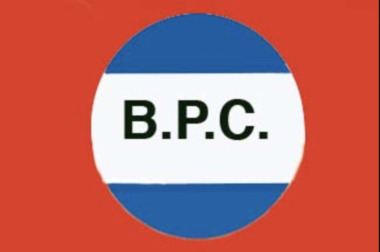
Flag - House flag, BPC, 1945
... The British Phosphate Commissioners (BPC) was a board of Australian, British, and New Zealand representatives who managed extraction of phosphate from Christmas Island, Nauru, and Banaba (Ocean Island) from 1920 until 1981. Walter Harbord (Wal or Wally) (b.1923 in Brisbane-d.), master mariner in the Merchant Navy on British Phosphate Commission ships....The British Phosphate Commissioners (BPC) was a board of Australian, British, and New Zealand representatives who managed extraction of phosphate from Christmas Island, Nauru, and Banaba (Ocean Island) from 1920 until 1981. Walter Harbord (Wal or Wally) (b.1923 in Brisbane-d.), master mariner in the Merchant Navy on British Phosphate Commission ships. ...The British Phosphate Commissioners (BPC) was a board of Australian, British, and New Zealand representatives who managed extraction of phosphate from Christmas Island, Nauru, and Banaba (Ocean Island) from 1920 until 1981. Walter Harbord (Wal or Wally) (b.1923 in Brisbane-d.), master mariner in the Merchant Navy on British Phosphate Commission ships.Walter was interviewed by the Australian at War Film Archive in 2003. He served on these ships: SS Corinda SS Macumba SS Mildura SS Nellor SS Ormiston SS Reynellaanne rennie collection, wal harbord, merchant navy, seamen, seafarers, ww2, battle of the atlantic, walter harbord, hezzanith, sextant, nautical instrument, navigation, captain g.g. kitching, m.v. trienza, m.v. triaster, bpc -
 Mission to Seafarers Victoria
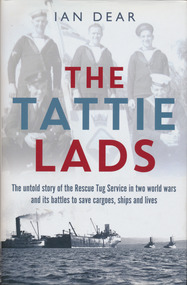
Book, Ian Dear, The Tattie Lads, The untold story of the Rescue Tug Service in two world wars and its battles to save cargoes, ships and lives, 2016
... merchant navy...second world war...australia...sailors ww2 world war 2 merchant navy second world war australia gunner tug boat wwi first world war great war The Tattie Lads, The untold story of the Rescue Tug Service in two world wars and its battles to save cargoes, ships and lives Book Ian Dear ...non-fictionsailors, ww2, world war 2, merchant navy, second world war, australia, gunner, tug boat, wwi, first world war, great war -
 Mission to Seafarers Victoria
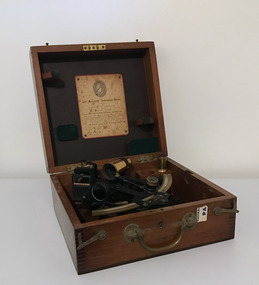
Instrument - Sextant in box, Heath & Co, 1945
... Sextant belonging to Walter Harbord (Wal or Wally) (b.1923 in Brisbane-d.), master mariner in the Merchant Navy on British Phosphate Commission ships. Walter was interviewed by the Australian at War Film Archive in 2003. ...Sextant belonging to Walter Harbord (Wal or Wally) (b.1923 in Brisbane-d.), master mariner in the Merchant Navy on British Phosphate Commission ships.Walter was interviewed by the Australian at War Film Archive in 2003. He served on these ships: SS Corinda SS Macumba SS Mildura SS Nellor SS Ormiston SS ReynellaSextant in wooden boxanne rennie collection, wal harbord, merchant navy, seamen, seafarers, ww2, battle of the atlantic, walter harbord, hezzanith, sextant, nautical instrument, navigation -
 Mission to Seafarers Victoria
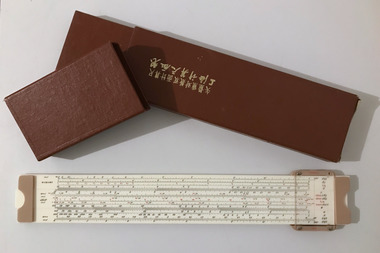
Instrument - Slide Rule in box, Shanghai Slide Rule Factory, 1978
... Merchant Navy on British Phosphate Commission ships. According to the website SLide Rule Museum this is the Flying Fish 1017 Chemical V2 Walter was interviewed by the Australian at War Film Archive in 2003. ...Sextant belonging to Walter Harbord (Wal or Wally) (b.1923 in Brisbane-d.), master mariner in the Merchant Navy on British Phosphate Commission ships. According to the website SLide Rule Museum this is the Flying Fish 1017 Chemical V2 Walter was interviewed by the Australian at War Film Archive in 2003. He served on these ships: SS Corinda SS Macumba SS Mildura SS Nellor SS Ormiston SS ReynellaSextant in wooden boxInscription in Chinese on the boxanne rennie collection, wal harbord, merchant navy, seamen, seafarers, ww2, battle of the atlantic, walter harbord, nautical instrument, navigation, slide rule, flying fish 1017 -
 Mission to Seafarers Victoria
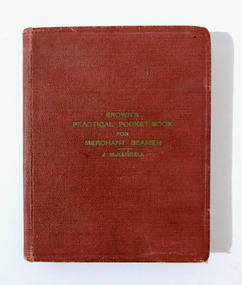
Book - Manual, J. McKerrell, Brown's Practical Pocket-Book for Merchant Seamen, 1946
... Book belonging to Walter Harbord (Wal or Wally) (b.1923 in Brisbane-d.), master mariner in the Merchant Navy on British Phosphate Commission ships. Walter was interviewed by the Australian at War Film Archive in 2003. ...Pocket book with red cover; 292 pagesnon-fictionanne rennie collection, wal harbord, merchant navy, seamen, seafarers, ww2, battle of the atlantic, walter harbord, navigation -
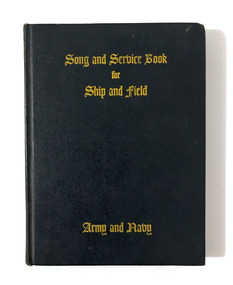 Mission to Seafarers Victoria
Book - Prayer Book, Ivan Loveridge Bennett, Song and Service Book for Ship and Field - Army and Navy, 1942
... Merchant Navy on British Phosphate Commission ships. The Song and Service Book for Ship and Field, Army and Navy, edited by Ivan Loveridge Bennett, features prayers, hymns, and patriotic songs used in various military ceremonies and religious services. Walter was interviewed by the Australian ...Small book with black cover; 195 pagesnon-fictionanne rennie collection, wal harbord, merchant navy, seamen, seafarers, ww2, battle of the atlantic, walter harbord, navigation, prayers, army, navy, soldiers, balikpapan, borneo, indonesia, battle of balikpapan, lt d. bacon -
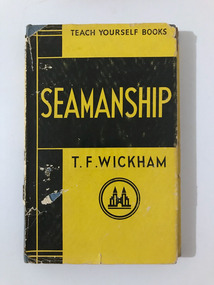 Mission to Seafarers Victoria
Book - Manual, Thomas Frederick Wickham, Seamanship, 1954
... Book belonging to Walter Harbord (Wal or Wally) (b.1923 in Brisbane-d.), master mariner in the Merchant Navy on British Phosphate Commission ships. Walter was interviewed by the Australian at War Film Archive in 2003. ...Small book with blue cover and damaged yellow and black dust jacket; 194 pagesnon-fictionanne rennie collection, wal harbord, merchant navy, seamen, seafarers, ww2, battle of the atlantic, walter harbord, navigation -
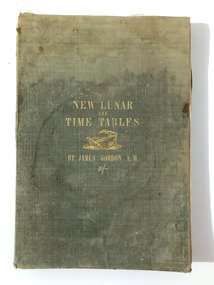 Mission to Seafarers Victoria
Book - Manual, James Gordon, AM, New Lunar and Time Tables, 1849
... Book belonging to Walter Harbord (Wal or Wally) (b.1923 in Brisbane-d.), master mariner in the Merchant Navy on British Phosphate Commission ships. Walter was interviewed by the Australian at War Film Archive in 2003. ...Large book with green cloth cover ;222 pagesnon-fictionanne rennie collection, wal harbord, merchant navy, seamen, seafarers, ww2, battle of the atlantic, walter harbord, navigation -
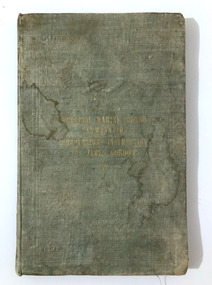 Mission to Seafarers Victoria
Book - Manual, James Gordon, AM, Nautical Marine Board Examination-Preparatory Instruction, 1849
... Book belonging to Walter Harbord (Wal or Wally) (b.1923 in Brisbane-d.), master mariner in the Merchant Navy on British Phosphate Commission ships. Walter was interviewed by the Australian at War Film Archive in 2003. ...Small book with green cloth cover; 100 pagesnon-fictionanne rennie collection, wal harbord, merchant navy, seamen, seafarers, ww2, battle of the atlantic, walter harbord, navigation -
 Mission to Seafarers Victoria
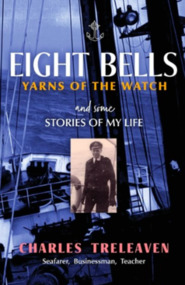
Book - Biography, Silverbird Publishing, Eight Bells, Yarns of the Watch and some Stories of my Life, 2021
... merchant navy cosmodome maritime heritage association of victoria mhav starlab blitz saint gregory interest group There's no doubt that Charles has had an interesting life. Born in England during the Depression, he experienced the Blitz on London, the Flying Bombs, and then the V2 rockets. From the age of sixteen Charles spent the next 24 years travelling the world aboard British, New Zealand, Fijian, and Australian ...There's no doubt that Charles has had an interesting life. Born in England during the Depression, he experienced the Blitz on London, the Flying Bombs, and then the V2 rockets. From the age of sixteen Charles spent the next 24 years travelling the world aboard British, New Zealand, Fijian, and Australian ships, then settled ashore in Melbourne to start his own packaging business. He was later asked to work with the U.N. in Jordan, based in Amman for some time. On his return to Melbourne, he was appointed CEO for the continued restoration of the award winning sailing ship Polly Woodside, now the pride of our City. Whilst there, Charles initiated the construction of the ship "Enterprize" replica. Finally, he used his knowledge as a navigator to excite over 800,000 Victorian school children with the basics of Science and Astronomy. Charles decided to retire after teaching for 23 years, at the tender age of 82. It is quite a Lifetime. It is quite a story !Photograph of Charles Treleaven ob the cover, 372 pagesnon-fictionThere's no doubt that Charles has had an interesting life. Born in England during the Depression, he experienced the Blitz on London, the Flying Bombs, and then the V2 rockets. From the age of sixteen Charles spent the next 24 years travelling the world aboard British, New Zealand, Fijian, and Australian ships, then settled ashore in Melbourne to start his own packaging business. He was later asked to work with the U.N. in Jordan, based in Amman for some time. On his return to Melbourne, he was appointed CEO for the continued restoration of the award winning sailing ship Polly Woodside, now the pride of our City. Whilst there, Charles initiated the construction of the ship "Enterprize" replica. Finally, he used his knowledge as a navigator to excite over 800,000 Victorian school children with the basics of Science and Astronomy. Charles decided to retire after teaching for 23 years, at the tender age of 82. It is quite a Lifetime. It is quite a story !charles treleaven, polly woodside, seamen, ww2, entreprize, melbourne, britain, merchant navy, cosmodome, maritime heritage association of victoria, mhav, starlab, blitz, saint gregory, interest group -
 Mission to Seafarers Victoria
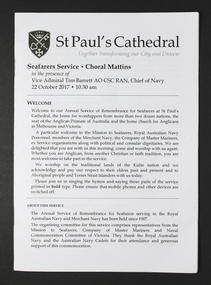
Programme - Service, Seafarers Service - Choral Mattins, 2017
... Australia. Representatives come from the Royal and Merchant Navies, the commercial world, shipping companies, mission and philanthropic societies, veterans’ associations, labour unions, youth and leisure organisations, but anyone is welcome to attend. seafarers service 2017 st paul's cathedral melbourne battle of trafalgar trafalgar day horatio nelson Two fold paper booklet printed in black ink Seafarers Service - Choral Mattins Programme Service ...Seafarers Service 22 October 2017 The first Seafarers Service was held on 23 October 1905 in the St Paul's Cathedral in London to celebrate the Centenary of the Battle of Trafalgar and the death of Vice-Admiral Horatio Nelson on 21 October 1805. Reverend Alfred Gurney Goldsmith launched the first Seafarers Service two years later and the first service was held on Sunday 10 November 1907. The service continues to reflect the full range of the maritime activities in Australia. Representatives come from the Royal and Merchant Navies, the commercial world, shipping companies, mission and philanthropic societies, veterans’ associations, labour unions, youth and leisure organisations, but anyone is welcome to attend.Two fold paper booklet printed in black inkseafarers service, 2017, st paul's cathedral, melbourne, battle of trafalgar, trafalgar day, horatio nelson
