
Showing 11 items matching "australian penny 1940"
-
 Tatura Irrigation & Wartime Camps Museum
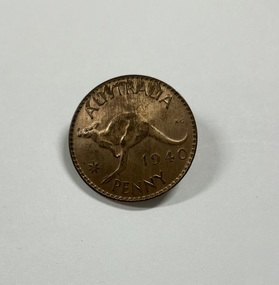
Decorative object - Penny Brooch, 1940's
... Made from an Australian penny, 1940, by Adolf Woolf at Camp 3...Kangaroo brooch, circular, copper colour with wire pin fastener at back. Australia Penny 1940. Small raised star on left and raised impression of Kangaroo in flight....Australia Penny 1940. Small raised star on left and raised impression of Kangaroo in flight. ...Made from an Australian penny, 1940, by Adolf Woolf at Camp 3Kangaroo brooch, circular, copper colour with wire pin fastener at back. Australia Penny 1940. Small raised star on left and raised impression of Kangaroo in flight.brooch, kangaroo, woolf a, glockemann b, camp 3, ww2 camp 3, jewellery -
 Tatura Irrigation & Wartime Camps Museum
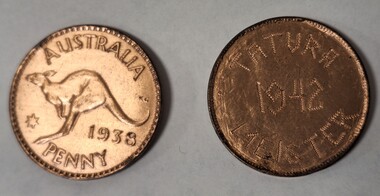
Souvenir - Coins, Australian Pennies, 1938 and 1940
... ...Australian penny 1940...2 Australian pennies, 1938 and 1940. Kings head on one side has been erased and "Tatura Meister 1942" (Tatura Master 1942) has been stamped or etched on it. ...He was interned in Camp 1, aged 22 years. wilhelm Eckels Woolbuyers Australian penny 1940 Australian penny 1938 Tatura Meister as above 2 Australian pennies, 1938 and 1940. ...These coins belonged to Wilhelm Eckels who was a wool buyer in Sydney when war broke out. He was interned in Camp 1, aged 22 years.2 Australian pennies, 1938 and 1940. Kings head on one side has been erased and "Tatura Meister 1942" (Tatura Master 1942) has been stamped or etched on it. Australian Penny on other side.as abovewilhelm eckels, woolbuyers, australian penny 1940, australian penny 1938, tatura meister -
 Bendigo Historical Society Inc.
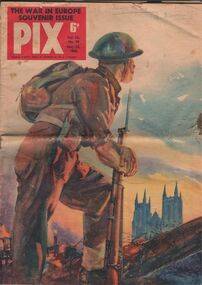
Magazine - AILEEN AND JOHN ELLISON COLLECTION: PIX, THE WAR IN EUROPE SOUVENIR ISSUE 1945
... pennies. Features in this issue: Britain faced Hitler alone in 1940 - Many races united against common enemy - Allied leaders' words inspired their nations - Color maps reveal changing face of Europe - Picture diary shows five year pattern of war - Jardine paints second front landing in colors - Rise and fall of fascism - Women shared role in fight for freedom - Danger of armistice in Europe - War closes in on Japan, Pacific color map - Proud records of Australia's fighting men - Four great powers shared burden of struggle - World found time too laugh at war - Famous pictures epitomised war's tragedy....pennies. Features in this issue: Britain faced Hitler alone in 1940 - Many races united against common enemy - Allied leaders' words inspired their nations - Color maps reveal changing face of Europe - Picture diary shows five year pattern of war - Jardine paints second front landing in colors - Rise and fall of fascism - Women shared role in fight for freedom - Danger of armistice in Europe - War closes in on Japan, Pacific color map - Proud records of Australia's fighting men - Four great powers shared burden of struggle - World found time too laugh at war - Famous pictures epitomised war's tragedy. ...Pix magazine volume 15 no. 19 May 12, 1945. The war in Europe souvenir issue. The magazine has 31 pages, price 6 pennies. Features in this issue: Britain faced Hitler alone in 1940 - Many races united against common enemy - Allied leaders' words inspired their nations - Color maps reveal changing face of Europe - Picture diary shows five year pattern of war - Jardine paints second front landing in colors - Rise and fall of fascism - Women shared role in fight for freedom - Danger of armistice in Europe - War closes in on Japan, Pacific color map - Proud records of Australia's fighting men - Four great powers shared burden of struggle - World found time too laugh at war - Famous pictures epitomised war's tragedy.books, magazines, war in europe -
 Tatura Irrigation & Wartime Camps Museum
Decorative object - Brooch, Metal, 1943-1945
... 1940-1945. The penny-brooch is an example of the ingenuity of the internees in making use of anything at hand & repurposing it for much more than originally intended. Else's daughter, Else-Lore Hukins donated the item. Says Else-Lore of the brooch: "Jewellery was made out of available metals. Pennies made a bright brooch and especially interesting if it featured the current year it was given". tatura ww2 camp 3 internment internee camps numismatics coins costume accessory jewellery Brooch fashioned from Australian 1943 penny. ...Else Oertel was a German internee in Camp 3A from 1940-1945. The penny-brooch is an example of the ingenuity of the internees in making use of anything at hand & repurposing it for much more than originally intended. Else's daughter, Else-Lore Hukins donated the item. Says Else-Lore of the brooch: "Jewellery was made out of available metals. Pennies made a bright brooch and especially interesting if it featured the current year it was given".Brooch fashioned from Australian 1943 penny. Penny has a safety pin soldered to the reverse, for use as a brooch.tatura, ww2, camp 3, internment, internee camps, numismatics, coins, costume, accessory, jewellery -
Tatura Irrigation & Wartime Camps Museum
Darner, Wooden, 1941
... 1940-1945. Woodworking was popular amongst the internees and Werner Dehnel, another internee in camp 3, made the darning mushroom for Else-Lore, for darning socks. tatura ww2 camp 3 internment internee camps domestic items sewing handcrafts woodwork Underside of mushroom top: Else/ Love von Onkel Werner. TATURA 1939/41|Attached tag: Fur Else-Lore. Von Onkel Werner. Wooden darning mushroom. Darker wood at top. Base (stalk) is of lighter wood. Both possibly varnished. Stalk has bevelled lines where it meets top. Base has 1939 Australian penny ...Else-Lore Oertel was a German internee in Camp 3A as a child, with her mother from 1940-1945. Woodworking was popular amongst the internees and Werner Dehnel, another internee in camp 3, made the darning mushroom for Else-Lore, for darning socks.Wooden darning mushroom. Darker wood at top. Base (stalk) is of lighter wood. Both possibly varnished. Stalk has bevelled lines where it meets top. Base has 1939 Australian penny underside. Attached by (ribbon?) to stalk is a cardboard gift tag.Underside of mushroom top: Else/ Love von Onkel Werner. TATURA 1939/41|Attached tag: Fur Else-Lore. Von Onkel Werner.tatura, ww2, camp 3, internment, internee camps, domestic, items, sewing, handcrafts, woodwork -
 Tatura Irrigation & Wartime Camps Museum
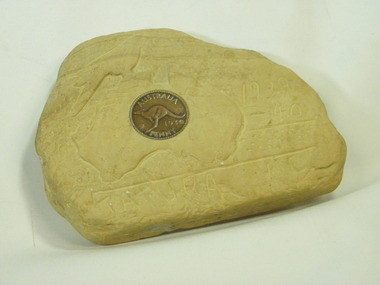
Carving, sandstone, 1940
... Australia/Bird. Sandstone piece with carved map of Austraiia, Tatura 1939-1940, and a 1939 penny inserted in the stone. ...Item carved by a German Internee who was held in Camp 1 in WW2. Came into the possession of one of the guards, whose nephew donated it to Tatura MuseumSandstone piece with carved map of Austraiia, Tatura 1939-1940, and a 1939 penny inserted in the stone."Tatura Vic.1939-40." Map of Australia/Bird.internment camp 1, tatura, german internee.. -
Tatura Irrigation & Wartime Camps Museum
Sculpture - Sandstone Maps of Australia, 1940
... Tatura 1940 2. 1940 Tatura 2x hand carved sandstone maps of Australia with space for penny in one & metal kangaroo in other. 1. ...2x hand carved sandstone maps of Australia with space for penny in one & metal kangaroo in other. 1. Space for penny in centre. Markings for state boundaries. Creamy coloured stone. 2. Metal (copper?) kangaroo in centre. Pink tinged stone.1. Tatura 1940 2. 1940 Taturatatura;, handcrafts, carving -
 Tatura Irrigation & Wartime Camps Museum
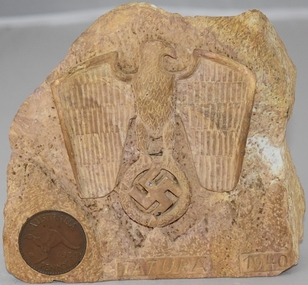
Decorative object - Bas relief stone Carving, 1940
... Local stone was used by P.O.W at Camp 13 to carve the plaque. camp 13 murchison plaque Tatura 1940 Hand-Carved stone plaque featuring German eagle and swastika with Australian 1939 penny inset. ...Local stone was used by P.O.W at Camp 13 to carve the plaque.Hand-Carved stone plaque featuring German eagle and swastika with Australian 1939 penny inset.Tatura 1940camp 13, murchison, plaque -
Tatura Irrigation & Wartime Camps Museum
Map - Plaster Cast, Map of Australia, 1940's
... Map of Australia, plaster cast, bell shaped, in which is a copper penny and a rosella atop Cape York. Dated 1940...Made by POW at Dhurringile Internment Camp plaster caste map of australia layton family dhurringile camp tatura camp ornament plaster 1940 Tatura- Dhurringile intern Camp Map of Australia, plaster cast, bell shaped, in which is a copper penny and a rosella atop Cape York. ...Made by POW at Dhurringile Internment CampMap of Australia, plaster cast, bell shaped, in which is a copper penny and a rosella atop Cape York. Dated 1940 words "Tatura Vic" below map of Australia1940 Tatura- Dhurringile intern Campplaster caste, map of australia, layton family, dhurringile camp, tatura, camp, ornament, plaster -
 Ballarat RSL Sub-Branch Inc.
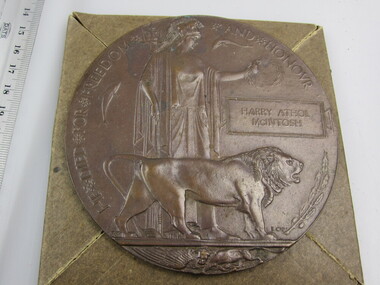
Dead Man's Penny (In cardboard cover)
... 1940 in Mount Egerton, VIC before being discharged from duties with the 3 LIGHT ANTI AIRCRAFT REG RAA as a Army Non-Commissioned Gunner (GNR) on 29/05/1941. Edward LE MARSHALL was not a prisoner of war. His next of kin is Ernest LE MARSHALL. Edward LE MARSHALL was awarded the 1939-1945 Star, Africa Star, Australia Service Medal 1939-1946, War Medal 1939-1945. First World War (WW1) 1914 - 1918 Collectables Ballarat RSL Ballarat Dead Man's Penny ...This object relates to Edward LE MARSHALL. He was born on 16/09/1914 in Steiglitz, VIC. Edward served in the Army (VX28243) enlisting on, 18/06/1940 in Mount Egerton, VIC before being discharged from duties with the 3 LIGHT ANTI AIRCRAFT REG RAA as a Army Non-Commissioned Gunner (GNR) on 29/05/1941. Edward LE MARSHALL was not a prisoner of war. His next of kin is Ernest LE MARSHALL. Edward LE MARSHALL was awarded the 1939-1945 Star, Africa Star, Australia Service Medal 1939-1946, War Medal 1939-1945.first world war (ww1), 1914 - 1918, collectables, ballarat rsl, ballarat -
 City of Melbourne Libraries
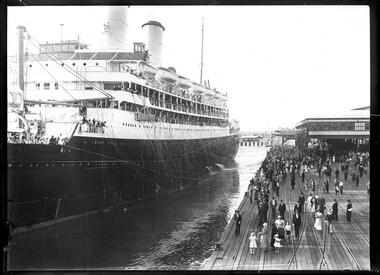
Photograph, Bull, Hugh Jones, 1897-1993, RMS Orford departing from Station Pier, Port Melbourne
... penny a mile. . In 1936, the Orford embarked the exiled Emperor of Ethiopia, Haile Selassie at Gibraltar on his way to the UK. In 1939, she was requisitioned for Australian government service and on 7/1/1940 she conveyed the first Australian troops to Egypt and was then used to carry French troops from Tamatave, Madagascar to Marseilles. ...penny a mile. . In 1936, the Orford embarked the exiled Emperor of Ethiopia, Haile Selassie at Gibraltar on his way to the UK. In 1939, she was requisitioned for Australian government service and on 7/1/1940 she conveyed the first Australian troops to Egypt and was then used to carry French troops from Tamatave, Madagascar to Marseilles. ...Published: 21 March 1934 The Age p11 Published title: CROWDED TOURIST SHIP WILL CARRY TEST AND DAVIS CUP TEAMS. Published caption: Carrying an exceptionally large number of tourists, business men and prominent sporting personalities, R.M.S. Orford sailed for London yesterday. Over two hundred passengers embarked at Melbourne, and on leaving the Australian coast there will be two thousand persons on board. The Australian Test team will join the vessel at Fremantle and the remaining two Davis Cup representatives will embark at Adelaide. A picture of the Orford taken just as she moved out from Station Pier, Port Melbourne, under her own steam. Trove article identifier: http://nla.gov.au/nla.news-article203826897 Description: Passenger ship about to depart Station Pier, Port Melbourne. Research by project volunteer, Fiona Collyer: The RMS Orford was built by Vickers-Armstrong Shipyard Barrow-in-Furness, Cumbria, England and launched in 1927 by Lady Ryrie, the wife of Sir Granville Ryrie, the Australian Ambassador to the UK. The Orford was owned by the Orient Steam Navigation Ltd and was designed for the mail and passenger service between England and Australia. She was 20,000 tons, 658 ft long, 75 ft across and 80 ft high from water-line to deck. She had eight decks, a swimming pool and cost more than £1,000,000. She could travel at 20 knots – 480 miles a day, a 5 week voyage between Australia and England. There were enough lifeboats to accommodate every person on board. Promoted as a ship of comfort, luxury, speed and grace with spacious, beautifully decorated lounges, smoking-rooms and writing rooms, the SMH 23/11/1928 review said “sitting-rooms where the furniture recreates the air of quiet, exquisite, safe luxury; suites where you may retire from other people, and on a sea voyage other people, even the most charming other people, often begin to resemble one’s worst enemies towards the end of several weeks sea voyaging together”. “Travel like a human being. This is what the great liners give you today. The Orford dining room is enormous (it seated 350 people) the walls sweep up to a white, cool roof supported on decorative pillars. Panels of grey scagliola and carved designs remove the bleak, comfortless air which used to cling to dining-rooms of ships. Everything about them was so wretchedly temporary that you could not enter them without wishing that you stayed at home. They gave you the creeps and indigestion. This room is gay, bright, sunlit, like a luxurious café overlooking the sea.” “You really feel in here that you are a human being and not a piece of cargo endowed with sensation.” The Orford had the punkah louvre system of ventilation which forced draughts through every part of the ship, ensuring “No Ship Smells!!” and avoiding - “… a mayonnaise of all the unpleasant odours generated under heaven. From the hot oil of the engines, from those overheated, bottomless pits below the water-line, from new paint and food, from people perspiring at work, from rope and tar and grease and fruit and wet clothes and tobacco, rises a deplorable incense that lingers unsettlingly in the nostril long after one has left the ship. Those dreadful odours will never rise to torture the senses of passengers who feel that all is over with them.” The modern electric kitchen had a roll making machine capable of producing 2000 rolls for the table an hour and a bread and butter machine which cut the bread into slices and spread the butter in one operation. (The Week – Brisbane 30/11/1928) On 13/10/1928, the Orford made its first voyage to Australia with 520 first class and 1100 3rd class passengers. The name of the passengers embarking and disembarking and their reason for visiting were published in newspapers and the number of migrants for the New Settlers Scheme and the Dreadnought Boys Co program to promote and assist the migration of British youths willing to become farm workers in Australia 1911-1939 were noted too. On the 19th March 1932, RMS Orford featured in the “Parade of Ships” celebrating the official opening of the Sydney Harbour Bridge. Only country people were allowed to book a ticket as a guest on board. The Post Office issued commemorative postage stamps showing the Orford sailing under the bridge. In March 1934, the Orford sailed from Australia to London, via Colombo, Aden, Port Said, Naples, Villefranche, Toulon, Parma, Gibraltar and Channel Port. Amongst the 2000 passengers on board was the Davis Cup Tennis team, tennis champions Joan Hartigan and Nell Hopman, the Australian Test cricket team and British champion swimmer Joyce Cooper. Every day tennis player Harry Hopman and an Australian Press Association reporter radioed through reports on their activities, which included – - Test cricket batsman Len Darling having spend 4 days in his cabin after straining his groin when he slipped over while playing ball tennis in his slippers. - Batsman Bill Brown dancing the fox-trot, displaying footwork similar to the grace he showed at the wicket. - Alluding to the seasickness of Don Bradman and Stan McCabe and how they were making up for meals lost on the Great (very choppy) Australian Bight. - Miss Joan Hartigan discarding her bright blue shorts for brighter blue bathers and being first into the pool. - Bowler Bill O’Reilly being tripped by a passenger on the deck and spending the voyage with bandaged wrists with daily updates of his progress in the press. - Wicketkeeper Ben Barnett’s conjuring tricks and constant whirring movie camera. - Results of the quoits, ball tennis and bridge tournaments. A fancy dress ball was held one night and the cricketers dressed as sheiks and sang “The Riff Song” from the pre-code 1929 operetta film “The Desert Song” starring John Bates as the Red Shadow and Myrna Lay as a native dancing girl. Alan Kippax’s beard blew overboard! Joan Hartigan dressed as Burlington Bertie from the music hall song and Nell Hopman a doll in a box wearing a crinkled paper dress. On arrival at Southampton, while they waited for the gangway to be lowered, Bradman entertained the team at the piano playing popular tunes while the cricketers sang. . In 1935, RMS Orford’s third class accommodation was converted to tourist class. Her passenger capacity was now 468 First Class, 515 tourist class and 440 crew. First saloon from Sydney fares cost for single £76, £82, £88 and Third Class fares were £21, £23, £25. Less than a penny a mile. . In 1936, the Orford embarked the exiled Emperor of Ethiopia, Haile Selassie at Gibraltar on his way to the UK. In 1939, she was requisitioned for Australian government service and on 7/1/1940 she conveyed the first Australian troops to Egypt and was then used to carry French troops from Tamatave, Madagascar to Marseilles. On 1/6/1940 RMS Orford was bombed and set on fire at Marseilles by German aircraft. 14 crew were killed, 25 wounded. In 1947, the wreck was re-floated and broken up at Savona. . . References: R.M.S. ORFORD. (1928, November 23). The Sydney Morning Herald (NSW : 1842 - 1954), p. 14. Retrieved September 15, 2023, from http://nla.gov.au/nla.news-article16511535 ARRIVAL OF THE ORFORD (1928, November 30). The Week (Brisbane, Qld. : 1876 - 1934), p. 21. Retrieved September 15, 2023, from http://nla.gov.au/nla.news-article181126802 CROWDED TOURIST SHIP WILL CARRY TEST AND DAVIS CUP TEAMS. (1934, March 21). The Age (Melbourne, Vic. : 1854 - 1954), p. 11. Retrieved October 5, 2023, from http://nla.gov.au/nla.news-article203826897 Photographer notations on slide: "B19".tennis, ships
