
Showing 12 items matching "australian reinforcing company"
-
 Sunshine and District Historical Society Incorporated
Photograph - Australian Reinforcing Company (ARC) Photos, 1974 - 2016
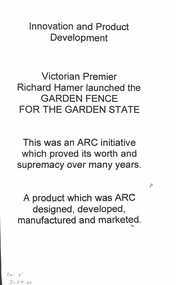
... Australian Reinforcing Company (ARC) Photos...Australian Reinforcing Company...Australian Reinforcing Company ARC Ballarat Road Albion 2024.01 - ARC - Garden Fence For Garden State Promotion 1978 Information Card 2024.01 - ARC - Garden Fence For Garden State With Garden Fence Promotion 1978 With Richard 'Dick' Hamer At Fence Photograph 2024.01 - ARC - Garden Fence For Garden State With Garden Fence Promotion 1978 With Richard 'Dick' Hamer At Table Photograph 2024.01 - ARC -Garden Fence For Garden State With Garden Fence Promotion 1978 With Richard 'Dick' Hamer At Mircophone 2024.02 - ARC - C1974 to 1980 Photographs K. ...2024.01 - ARC - Garden Fence For Garden State Promotion 1978 Information Card 2024.01 - ARC - Garden Fence For Garden State With Garden Fence Promotion 1978 With Richard 'Dick' Hamer At Fence Photograph 2024.01 - ARC - Garden Fence For Garden State With Garden Fence Promotion 1978 With Richard 'Dick' Hamer At Table Photograph 2024.01 - ARC -Garden Fence For Garden State With Garden Fence Promotion 1978 With Richard 'Dick' Hamer At Mircophone 2024.02 - ARC - C1974 to 1980 Photographs K. J. Laidlaw Photo 09 2024.02 - ARC - C1974 to 1980 Photographs Photo 01 2024.02 - ARC - C1974 to 1980 Photographs Photo 02 2024.02 - ARC - C1974 to 1980 Photographs Photo 03 2024.02 - ARC - C1974 to 1980 Photographs Photo 04 2024.02 - ARC - C1974 to 1980 Photographs Photo 05 2024.02 - ARC - C1974 to 1980 Photographs Photo 06 2024.02 - ARC - C1974 to 1980 Photographs Photo 07 2024.02 - ARC - C1974 to 1980 Photographs Photo 08 2024.02 - ARC - C1974 to 1980 Photographs Photo 10 2024.03 - ARC - Canteen Ladies 2024.03 - ARC - Grand Final BBQ 2024.03 - ARC - Ladies Night Out 2024.04 - ARC - Marie & John Stevenson 2024.04 - ARC - Yarra River BBQ Photo 01 2024.04 - ARC - Yarra River BBQ Photo 02 2024.05 - ARC - Saving The Memories ARC Sunshine Reunion 22nd May 2016 Reunion 2024.06 - ARC - Employees In Front Of Buildingaustralian reinforcing company, arc, ballarat road, albion -
 Sunshine and District Historical Society Incorporated
Booklet - Australian Reinforcing Company (ARC) Booklets, 1920 - 2010
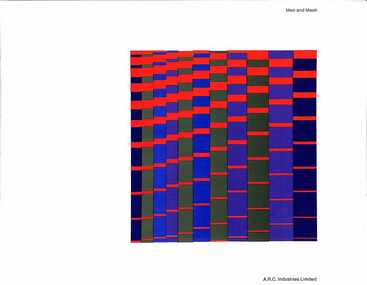
... Australian Reinforcing Company (ARC) Booklets...Australian Reinforcing Company...Booklet Australian Reinforcing Company (ARC) Booklets ...2025.01 - ARC - Men And Mesh 2025.02 - ARC - BRC Fabric April 1977 2025.02 - ARC - BRC Fabric Dec 1976 2025.03 - ARC - 30th Annual Report And Notice Of Annual General Meeting 1980 2025.03 - ARC - 30th Annual Report And Notice Of Annual General Meeting 1981 2025.04 - ARC - OVAWELD Welded Reinforcing Fabric 2025.05 - ARC - Australian Military Forces ARC Mesh Technical Instructions 2025.06 - ARC - Smorgan ARC A Guide To Using Fabric Reinforcement 2025.07 - ARC - Smorgan ARC The Reinforcement Handbook 2025.08 - ARC - HUMES ARC Design Tables For One-way Suspended Slabs 2025.09 - ARC - CW 60 Reinforcing Bar 2025.10 - ARC - Manufacturers' Bulletin Special Edition Metric Conversion Tables 2025.11 - ARC - We Always Go To Extraordinary Lengths ARC 90th Anniversaryaustralian reinforcing company, arc, ballarat road, albion -
 Sunshine and District Historical Society Incorporated
Archive - Australian Reinforcing Company (ARC) Documents, 1971 - 2016
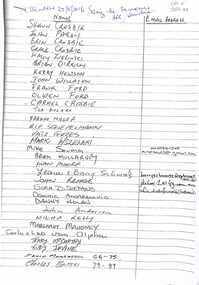
... Australian Reinforcing Company (ARC) Documents...Australian Reinforcing Company...Australian Reinforcing Company ARC Ballarat Road Albion 2026.01 - ARC - Attendees Saving The Memories ARC Sunshine 22nd May 2016 2026.02 - ARC - Memories Of ARC By Shaun Crosbie 2026.02 - ARC - Memories Of ARC By Shaun Crosbie Page 1 2026.02 - ARC - Memories Of ARC By Shaun Crosbie Page 2 2026.03 - ARC - Jeff Wright My Time At ARC From 1979 - 2005 2026.04 - ARC - 75th Anniversary Celebration A Night At The Races 2026.04 - ARC - 75th Anniversary Celebration A Night At The Races Menu 2026.04 - ARC - 75th Anniversary Celebration Invite To Silvia & Angelo Cavarra 2026.05 - ARC - Long Service Awards Presentation 3rd October 1980 2026.05 - ARC - Long Service Awards Presentation 3rd October 1980 Names & Menu 2026.06 - ARC - Reinforcement Data Card Sept 1985 2026.07 - ARC - ARC Overseas Activities 2026.08 - ARC - Internal Telephone Listing By Department 2026.09 - ARC - Smorgan ARC Sunshine Internal Telephone Listing November 1994 2026.10 - ARC - ARC Sunshine Personnel plus Service Departments 2026.11 - ARC - Australia Wide Personel And Their Departments 2026.12 - ARC - Sales Engineering & Works Accounting Conferences 25th January 1974 2026.13 - ARC - Business Interest In Papua New Guinea Various documents pertaining to the ARC factory and its business and employees, including social events Archive Australian Reinforcing Company (ARC) Documents ...2026.01 - ARC - Attendees Saving The Memories ARC Sunshine 22nd May 2016 2026.02 - ARC - Memories Of ARC By Shaun Crosbie 2026.02 - ARC - Memories Of ARC By Shaun Crosbie Page 1 2026.02 - ARC - Memories Of ARC By Shaun Crosbie Page 2 2026.03 - ARC - Jeff Wright My Time At ARC From 1979 - 2005 2026.04 - ARC - 75th Anniversary Celebration A Night At The Races 2026.04 - ARC - 75th Anniversary Celebration A Night At The Races Menu 2026.04 - ARC - 75th Anniversary Celebration Invite To Silvia & Angelo Cavarra 2026.05 - ARC - Long Service Awards Presentation 3rd October 1980 2026.05 - ARC - Long Service Awards Presentation 3rd October 1980 Names & Menu 2026.06 - ARC - Reinforcement Data Card Sept 1985 2026.07 - ARC - ARC Overseas Activities 2026.08 - ARC - Internal Telephone Listing By Department 2026.09 - ARC - Smorgan ARC Sunshine Internal Telephone Listing November 1994 2026.10 - ARC - ARC Sunshine Personnel plus Service Departments 2026.11 - ARC - Australia Wide Personel And Their Departments 2026.12 - ARC - Sales Engineering & Works Accounting Conferences 25th January 1974 2026.13 - ARC - Business Interest In Papua New Guineaaustralian reinforcing company, arc, ballarat road, albion -
 Geelong RSL Sub Branch
Photograph, 2/4th Independent Company, circa 1943
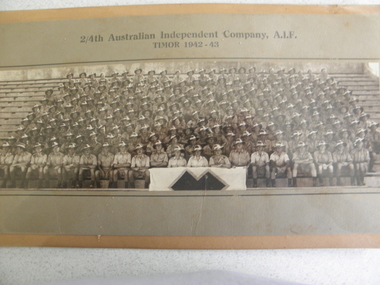
... In September the Company moved to Darwin and boarded the destroyer HMAS Voyager and travelled to East Timor (then Portuguese Timor) to reinforce 2/2nd Independent Company. This photograph is the 2/4th Independent Company Members that served in East Timor 1942-43. east timor a.i.f. 2/4th independent company. 1942-43. 2/4th Australian Independent Company, A.I.F. ...This photograph is of 2/4th Independent Company A.I.F Timor 1942-43.This Company was formed in December and posted to Katherine, NT, in March 1942. The Company was deployed to areas between McArthur and Ord Rivers and in August moved to Adelaide River. In September the Company moved to Darwin and boarded the destroyer HMAS Voyager and travelled to East Timor (then Portuguese Timor) to reinforce 2/2nd Independent Company.This photograph is the 2/4th Independent Company Members that served in East Timor 1942-43.A photograph attached to cardboard in a metal frame. The Photograph is covered by perspex instead of glass.2/4th Australian Independent Company, A.I.F. Timor 1942-43.east timor, a.i.f. 2/4th independent company. 1942-43. -
 Australian Commando Association - Victoria
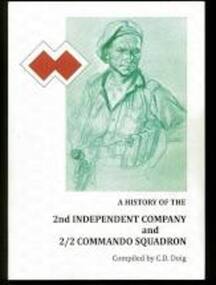
Book, A history of the 2nd Independent Company and 2/2nd Commando Squadron
... company’s signallers were able to build a wireless transmitter, nicknamed ‘Winnie the War Winner’, and on 18/19 April were able to contact Darwin. At the end of May RAN vessels began landing supplies for the Australians on the south coast of east Timor. These supply runs were very dangerous but they allowed the Australians on Timor to continue fighting. In September the guerillas were reinforced...company’s signallers were able to build a wireless transmitter, nicknamed ‘Winnie the War Winner’, and on 18/19 April were able to contact Darwin. At the end of May RAN vessels began landing supplies for the Australians on the south coast of east Timor. These supply runs were very dangerous but they allowed the Australians on Timor to continue fighting. In September the guerillas were reinforced ...The history of the No. 2 Independent Commando Company and 2/2 Commando Squadron during World War II – scarce as a 1st edition dated 1986. Having completed its training at Foster, on Wilson’s Promontory, Victoria, the 2nd Independent Company was raised and travelled north to Katherine, in the Northern Territory. However, following Japan’s entry into the war, as with the other independent companies that were sent to the islands off Australia, the 2nd was sent to Timor, where it joined the 2/40th Battalion and the rest of Sparrow Force. Sparrow Force divided itself between west Timor, part of the Netherlands East Indies, and east Timor, which belonged to Portugal. The 2/40th Battalion defended the capital of west Timor, Koepang, and the airfield at Penfui. Most of the independent company moved to the airfield at Dili, in east Timor, and the nearby mountains. Portugal was opposed to the stationing of a Dutch or Australian garrison in case this provoked the Japanese, but despite this opposition, on 17 December 1941, elements of the 2nd Independent Company and Dutch troops landed near Dili. On 20 February 1942 the Japanese invaded the island, attacking east and west Timor simultaneously. The 2/40th Battalion held out for three days, but were overrun and were killed or captured. Similarly, the 2nd could not hold the airfield and were also driven back. But they were not captured and instead retreated to the mountains where they conducted a very successful and pursued a guerrilla war against the Japanese which lasted for over a year. Following the capture of Timor, the 2nd occupation the company was listed as “missing”, the company’s signallers were able to build a wireless transmitter, nicknamed ‘Winnie the War Winner’, and on 18/19 April were able to contact Darwin. At the end of May RAN vessels began landing supplies for the Australians on the south coast of east Timor. These supply runs were very dangerous but they allowed the Australians on Timor to continue fighting. In September the guerillas were reinforced with the 2/4th Independent Company. However, this could not go on indefinitely. In August the Japanese lunched a major offensive against the guerrillas and Japanese reprisals against the civilian population of east Timor reduced their support for the Australians. The 2nd (now named the 2/2nd Independent Company) and 2/4th were withdrawn in December and January 1943 respectively. Although the 2/2nd Independent Company is best known for its time on Timor, it also saw extensive service in New Guinea and New Britain. The independent company reformed at the army’s training centre at Canungra, Queensland, where it was reinforced and reequipped. The company then moved to the Atherton Tableland, where it briefly became part of the 2/6th Cavalry (Commando) Regiment. Due to this reorganisation, in October, the 2/2nd Independent Company was renamed the 2/2nd Cavalry (Commando) Squadron. This name was later simplified to just commando squadron. When this happened though, the 2/2nd was back in action. In June 1943 the 2/2nd sailed from Townsville for Port Moresby and was subsequently flown to Bena Bena, in the Bismark Range in New Guinea’s highlands. Here they supported the 2/7th Independent Company in patrolling the Ramu River area. In the second week of July the 2/2nd moved into position, with its headquarters at Bena Bena and with its platoons’ occupying neighbouring positions. By the end of the month their patrols were skirmishing with the Japanese. The 2/2nd remained in New Guinea until October 1944. After 90 days leave, the squadron reformed at Strathpine in Queensland before sailing to New Britain in April 1945. The 2/2nd landed at Jacquinot Bay on 17 April. The squadron then moved to Wide Bay, in order to support the 13th Brigade of the 5th Division, and was based at Lamarien. Following Japan’s surrender and the end of the war, the ranks of the squadron thinned quickly as men were discharged or transferred to other units. For those who were left, they returned to Australia and in early 1946 the 2/2nd Commando Squadron was disbanded. Includes Nominal Roll Soft Cover without Dust Jacket – 270 pages -
 Flagstaff Hill Maritime Museum and Village
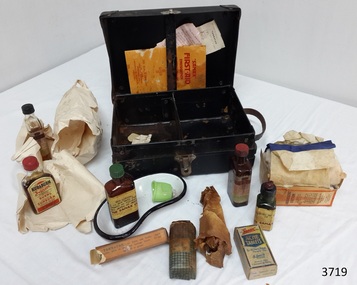
Equipment - First Aid Case, Thomas Urquhart & Son Pty Ltd (Thos. Urquhart), 1930-1939
... Company Fitzroy Melbourne Burroughs Wellcome & Co. (Australia) Ltd Thos. Urquhart & Son Pty. Ltd. Melbourne Sanax first aid case Sanax First-Aid Emergency Instructions Part 1 Victorian Factories Regulations Tabloid medical supplies Printed in gold on lid of case “SANAX” FIRST AID CASE. Most of the contents, as well as the case, show the “SANAX” brand. Some contents are inscribed Burroughs Wellcome & Co. (Australia) Ltd., First Aid Case, portable, Sanax First Aid Case. First Aid kit in strong black cardboard carry case with metal reinforced ...This small, portable 1930s Sanax First Aid Case has been strongly constructed, with corners reinforced with metal to take knocks and bumps, so it could be quickly transported to the site of an emergency. Having these supplies organised into a kit made them easily accessible and reduces time to take them to the site of the accident. It was possibly designed for use in factories because the booklet in the case states that the kit complies with “Part 1, Victorian Factories Regulations”. The text of the printed brand “Sanax First Aid Case” is right-way up when the case stands vertically on its hinged side. In modern times people are well aware of the importance of quick treatment when accident and injury occur. However, before the first commercial First Aid Kit was made by Johnson & Johnson in 1888, people had little knowledge about treating injuries and lacked information about suitable supplies to keep on hand for emergencies. They were often unaware of how to help in that critical time before the doctor or other assistance arrived, a particularly important time for the many people living in remote areas. A quote from Johnson’s & Johnson’s 1888 price list explains “It is a fact, which is everywhere being recognized, that many lives are lost and much suffering entailed in such accidents on account of the lack of the simple but necessary articles required to afford prompt assistance to the wounded.” One example of the value of First Aid assistance to community groups is shown in an article from the Weekly Times, 29th November 1930. It records a report from the Annuello Branch of the Younger Set (a Country Women’s Organisation), telling that on Armistice Day their president Mrs Jamieson, presented the Annuello School with the gift of a Sanax Red Cross First Aid outfit, which was accepted as being “of great practical use to the scholars.” (Annuello is a remote wheat growing area in the Mallee region of North Western Victoria, which became a soldier settlement area after World War I. There is a strain of wheat named ‘Annuello’ due to its suitability for that area. ) The Sanax Case in our Collection contains instructions, equipment and medical items suitable for use in emergency situations. The Case was one of 42 patterns available from Sanax that conformed to ‘Part 1, Victorian Factories Regulations’. It includes items made by Sanax Company and by Burroughs Wellcome & Co. (Australia) Ltd., Sydney, NSW. A quote at the back of the First Aid Emergency Instructions booklet says: “Sanax products are made in Australia by or under the supervision of qualified chemists, from the highest quality materials. They are dependable for the purposes written on labels.” BOOKLET included in First Aid Case: “SANAX” First-Aid Emergency Instructions has orange cover and white pages, joined in the centre by two staples. Booklet contains First Aid Instructions for general events listed in alphabetical order. It also contains an indexed sections headed “Poisoning, and what to do” written by S.A. Burrows, Ph.C., Vuc and N.Z. There are instructions and diagrams on how to perform Artificial Respiration. There are advertisement for Sanax products throughout the booklet that include; - Sanax Ambulance Stretcher for timber mills, mines, ships and quarries - Saw dust masks (porous rubber) for workers in dust, paint or duco sprayers Inside cover lists Sanax’s Australian made products including - tablets and powders for headaches, neuralgia, influenza, colds - snuff for Catarrh that is “quite harmless” - First Aid Cases that come in a range of 42 patterns - sunburn preventatives and treatments - healing salve for carbuncles, pock, pimples, boils, varicose ulcers etc. - snake bite outfits and kits LEAFLETS included in First Aid Case: (1) Tannafax Tannic Acid Jelly. Tannafax should be kept at hand in every home. It should be applied direct from the tube and used with neither oil nor grease. Where a large area has to be covered the clamped end may be torn or cut off to give a wider mouth to the tube. Collapsible tubes of different sizes. Made in Australia. Burroughs Wellcome & Co. (Australia) Ltd. (Incorporated in England). Sydney, NSW. Assorted Houses, London, New York, Montreal, Cape Town, Milan, Bombay, Shanghai, Buenos Aires. Copyright A. 1817, J. 9463 (2) Tabloid. The strong thing is the just - - . Tabloid marks the wor - - Burroughs Wellcome & Comp. The use of the word is to enab – the prescriber, dispenser and patient to get the right thing with one short word, instead of the firm’s long name. If another maker apply the word to his product, the act is unlawful. Tabloid is our trade mark and brand. If a vendor disregard it in dispensing or selling, the act is unlawful for the same reason. We prosecute both offenders rigorously, in the interest of prescribers, dispensers, patients and the owners of the trade mark. Please inform us of any instance of either offence. Burroughs Wellcome & Co. (Australia) Ltd. (Incorporated in England). Telephone Number - M 4184 (4 lines) All communications to G.P.O. Box No. 1185 DD. Copyright Sy. 20. & J 9894. Medicines and Equipment included in First Aid Case: - Absorbent Cotton, Sanax, for absorbing blood or drying a wound. As a swab for washing wounds; to place above a compress to keep the heat in: or as a pad to protect wounds or fractures. The Sanax Co. Manuf. Chemists, Melbourne. Regd. Office: 5 Brunswick St, Fitzroy. N.6. - ACHE tablets, Sanax, for all aches, pains, fevers etc. Dose: 2 to 3 tablets with a draught of water, every 3 hours. Children in proportion. For influenza or colds, take the bedtime dose with a hot lemon drink or toddy. Recommended for Headaches, Colds, Influenza, Fevers, Neuralgia, Rheumatism, Nerve Pains, Sleeplessness, and Seasickness. Three Sanax Ache tablets equals one Sanax Ache powder. Each tablet contains 1.75grs. each Phenacotinum and Acety acSzilcyl, and .75grs Ammon Brom. Etc.. Sanax brand specialties are prepared by highly qualified pharmaceutical chemists and may be accepted as safe and effective for the purpose indicated on the label. The Sanax Co. Melbourne - Eye lotion, Sanax, “in eye bath full strength or diluted with equal parts of water. Sanax Co. Brunswich St, Fitzroy, Melbourne. - Iodine, Sanax, POISON, with instructions for what to do if swallowed. - Kuraburn, Sanax, Applied to the burn and allowed to dry, the pain and heat instantly disappear, and blistering is prevented. If necessary, apply again in an hours. To safeguard against burning when sunbathing, apply before exposure to the sun. If already sunburnet, use Kuraburn as directions above. Safe and harmless. Sole makers, The Sanax Co. Brunswick St. - - Vic. - Sal Volatile, Sanax, - - stimulant for - - nervous aches - - or as smelling salts Dose - - - - Solution of A- - - 5%, . The Sanax Co. Brunswick St, Melbourne. - Tannafax, Burroughs Wellcome & Co. Australia Ltd. Sydney, N.S.W., 20gm. Approx., Tannic Acid Jelly, (Tannic Acid with 0.5% Phenol in a water-soluble base) for burns and scalds. A.N. 15050, p188, logo of a unicorn. Apply lightly, allow to dry, and bandage loosely. Do not apply oil or grease. - bottle wrapped in brown paper, unknown contents, paper adhered to bottle. - dish, kidney shaped, metal, white enamel with black rim - eye bath, green, plastic or Bakelite SANAX COMPANY The Sanax Company was at the address of 5 Brunswick Street, Fitzroy [Melbourne] at least as early as November 1924, as shown by its advertisement of Ache Powder in the Weekly Times, 8th November 1924. It was still at this address in September 1951, when it advertised First Aid outfits and components in the Post Master General’s section of the Commonwealth of Australia Gazette. REFERENCES: Annuello, Victoria; Wikipedia, https://en.wikipedia.org/wiki/Annuello,_Victoria Annuello Younger Set, Branch Activities and Local Reports, Country Women’s Organisations, Weekly Times, 29 November 1930, Trove http://trove.nla.gov.au/newspaper/article/224921009?searchTerm=%22sanax%22%20and%20%22melbourne%22&searchLimits=# Commonwealth of Australia Gazette, Issue 32, 24th April 1915, https://www.legislation.gov.au/file/1915GN32 [Johnson & Johnson Price List, September 1, 1888, p. 20. From our archives], Celebrating the 125th Birthday of the First Aid Kit , The Story of Johnson & Johnson, , http://www.kilmerhouse.com/2013/06/from-1888-to-2013-celebrating-the-125th-birthday-of-the-first-aid-kit/ Post Master General’s section of the Commonwealth of Australia Gazette, Issue No. 73, Thursday 27th September 1951 http://trove.nla.gov.au/newspaper/article/232185299?searchTerm=%22sanax%22%20and%20%22fitzroy%22&searchLimits= Sanax First Aid Emergency Instructions, by S.A. Burrows, publisher Sanax Ltd. Fitzroy, Victoria, 1930-1939 English, book, Illustrated edition, Trove http://trove.nla.gov.au/version/40948895 Access to emergency medical help in early settlement days of Victoria could take quite some time, especially in remote areas. From 1888 First Aid Kits and instructions became available for work sites, offices, community groups and individuals, helping to bridge the gap between the accident and the arrival of medical assistance. This portable Sanax First Aid Case is an example of portable medical equipment made in Melbourne, Australia, in the 1930’s and available to the public. It contains a range of items plus information to be used in a variety of injuries and emergencies in in factories, households, businesses and local communities, and instructions on their use. First Aid Case, portable, Sanax First Aid Case. First Aid kit in strong black cardboard carry case with metal reinforced corners, metal hinges on lid, metal catch and leather carry handle. Inside lid is a vertical strap with narrow gap behind it. Base is divided into two compartments. Manufactured by Sanax, Fitzroy, Melbourne, C. 1930-1939 Contents include "Sanax" First Aid instructions booklet, 2 leaflets, metal kidney dish enamelled in white with black trim on edge, green plastic or Bakelite eye bath, eye lotion, Tannafax tannic acid jelly, Sal Volitile, Kuraburn, Iodine, Argyrol, ACHE tablets, absorbent cotton in cardboard box, gauze bandage, and UNKNOWN wrapped bottle. Printed in gold on lid of case “SANAX” FIRST AID CASE. Most of the contents, as well as the case, show the “SANAX” brand. Some contents are inscribed Burroughs Wellcome & Co. (Australia) Ltd., flagstaff hill, warrnambool, shipwrecked coast, flagstaff hill maritime museum, maritime museum, shipwreck coast, flagstaff hill maritime village, great ocean road, first aid items, first aid kit, emergency first aid, medical emergency kit, home emergency kit, industrial emergency kit, sanax company fitzroy melbourne, burroughs wellcome & co. (australia) ltd, thos. urquhart & son pty. ltd. melbourne, sanax first aid case, sanax first-aid emergency instructions, part 1 victorian factories regulations, tabloid medical supplies -
 Flagstaff Hill Maritime Museum and Village
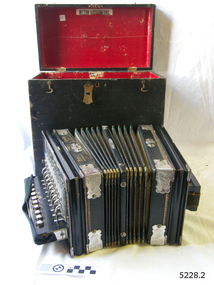
Instrument - Accordion, International Accordion Company, 1930's
... Australia by a Melbourne retailer. Music was a part of family and social life, associated with dances, song and general fun. flagstaff hill warrnambool shipwrecked coast flagstaff hill maritime museum maritime museum shipwreck coast flagstaff hill maritime village great ocean road mezon accordion lyons made in saxony t h betts betts mezon squeeze box musical instrument button accordion germany michael lyons International Accordion Company Ernest Deines circle enclosing D E D E E D german accordion Printed on label “MEZON ACCORDEONS.” Impressed in metal corners and reinforcing ...This MEZON brand button accordion was made specifically for Lyons, Musical Instrument Importer, 207 Bourke Street Melbourne, as can be seen on the embossed lettering on the top of the accordion. The hand inscribed nameplate indicates that the owner was T H Betts. On August 19th, 1903, Michael Edward Lyons applied to the Trade Mark’s Office of Sydney for registration of “The Invented word “MEZON” to be applied to musical instruments. In 1908 he was advertising himself as sole agents for MEZON accordions. He had been at that address for 15 years (since 1893) and was moving to larger premises at 256 Bourke Street, Melbourne. Still at this address in 1925, Lyons advertises MEZON accordions as “The ideal Xmas present, Maker your friends happy, This Xmas let the Present be a MEZON”. There was a choice of three styles: The Organ, The Wonder and The Grand Organ. They came with a Fibre Case with Lock and Key and a Leather Handle. The promise was “They Give Satisfaction”. They were obtainable at all stores or from Sole Distributors in Australia. In 1927 the MEZON was sold by Albert & Sons in Western Australia, Victoria, New South Wales and Queensland as well as by Lyons in Melbourne. The favoured German accordion brands were Monarch and Sterling, which were made by the International Accordion Company in Leipzig, Saxony, Germany. The company was founded in 1871 by Ernest Deines and made a variety of musical instruments. The company closed business in 1834. The International Accordion Company’s accordion range made the International brand and others such as MEZON, Globe, and Dienst. Australia imported the MEZON brand. American companies imported a range of the popular German branded accordions until World War II, when they were no longer available. In general, accordions produced after the war were not as high a quality and not loud enough to be heard over the electronic guitars and the drum kit of the bands. This accordion represents the type of musical instruments used in the late 19h and early 20th century, locally and Australia wide. In colonial Australia musical instruments like this one were imported from Germany as well as other countries. At that time, German made instruments represented good quality. This accordion is significant for being especially imported into Australia by a Melbourne retailer. Music was a part of family and social life, associated with dances, song and general fun.Button accordion with case. Accordion with steel reeds, three bass valves and ten treble valves. It is coloured black with very dark green trim, decorative silver metal reinforcing on main corners, gold reinforcing on corners of the bellows and delicate printed, gold printed patterned trims. Hand support for buttons is made of fabric. Folds of the bellows are light coloured with fine dark pattern. It has a nameplate on the front. Black wooden case has red lining, two brass hinges, two brass hook and eye catches and a swivel brass lock. The base of the case has a loose brass fitting. The top has a thin metal handle. Inscription on hand inscribed name on front, label inside case lid, silver reinforcing, leather on bellows top, and frame of accordion. Manufactured with the brand MEZON in Saxony, Germany, for Lyons of Melbourne. Once the property of T H Betts.Printed on label “MEZON ACCORDEONS.” Impressed in metal corners and reinforcing “MEZON” with logo [circle enclosing entwined capital D and E] “MADE IN SAXONY” Embossed in gold on frame “Made in Saxony”, “MEZON Accordion/ manufactured for LYONS / MELBOURNE, Bourke Street” Name inscribed by hand “T H Betts”flagstaff hill, warrnambool, shipwrecked coast, flagstaff hill maritime museum, maritime museum, shipwreck coast, flagstaff hill maritime village, great ocean road, mezon accordion, lyons, made in saxony, t h betts, betts, mezon, squeeze box, musical instrument, button accordion, germany, michael lyons, international accordion company, ernest deines, circle enclosing d e, d e, e d, german accordion -
 Eltham District Historical Society Inc
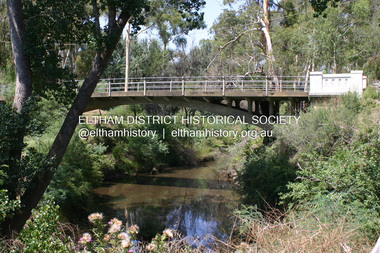
Photograph - Digital Photograph, Alan King, Monash Bridge, Hurstbridge, 23 January 2008
... .; p117 Monash Bridge is considered the Shire’s finest engineered bridge and was constructed by the engineering company of that great Australian, Sir John Monash.1 The bridge spans Diamond Creek on the Hurstbridge-Arthurs Creek Road, linking Hurstbridge with Yarrambat and Arthurs Creek. Monash Bridge, also called Hurst’s Bridge, was built in 1917, by the Reinforced....; p117 Monash Bridge is considered the Shire’s finest engineered bridge and was constructed by the engineering company of that great Australian, Sir John Monash.1 The bridge spans Diamond Creek on the Hurstbridge-Arthurs Creek Road, linking Hurstbridge with Yarrambat and Arthurs Creek. Monash Bridge, also called Hurst’s Bridge, was built in 1917, by the Reinforced ...Monash Bridge spans the Diamond Creek at Hurstbridge. It was built in 1917 for the Shires of Heidelberg, Eltham and Whittlesea. It is considered Nillumbik Shire's finest engineered bridge and was construced by the engineering company of Sir John Monash. Covered under Heritage Overlay, Nillumbik Planning Scheme. Published: Nillumbik Now and Then / Marguerite Marshall 2008; photographs Alan King with Marguerite Marshall.; p117 Monash Bridge is considered the Shire’s finest engineered bridge and was constructed by the engineering company of that great Australian, Sir John Monash.1 The bridge spans Diamond Creek on the Hurstbridge-Arthurs Creek Road, linking Hurstbridge with Yarrambat and Arthurs Creek. Monash Bridge, also called Hurst’s Bridge, was built in 1917, by the Reinforced Concrete and Monier Pipe Construction Company Pty Ltd, for the Shires of Heidelberg, Eltham and Whittlesea. Although Monash was probably in action overseas during World War One when the bridge was designed and constructed, he evolved the basic design in the 1900s and it was a standard design for the firm. However J A Laing, a designer at the firm, was probably the designer, as his initials are on bridge drawings held by the Eltham District Historical Society.2 The bridge is an excellent early Australian example of an open spandrel reinforced concrete arch bridge and has a single span of 29 metres. It is unusual in Victoria, but similar to many reinforced concrete arch bridges in Europe and America, built from the late 19th century. In Victoria, Monash pioneered the use of reinforced concrete – then a revolutionary construction material. His company, Monash & Anderson, had the exclusive licence for the Monier patent for the system of reinforced concrete construction for Victoria and New South Wales. A well-known example of the Monier arch bridge is the Morell Bridge in South Yarra. The sweeping arch of the Monash Bridge combines grace and utility and blends with the surrounding rural landscape. Its design and construction have allowed it to carry increasing volumes of heavy traffic, but in modern times the one lane is considered by some to prevent easy passage through Hurstbridge. However others consider this an asset to deter too much more traffic, which would diminish Hurstbridge’s charming rural character.3 This is the third bridge across the Diamond Creek at this site. The original bridge was a log bridge upstream, constructed in the 1850s by early settler, Henry Hurst, after whom Hurstbridge was named. The bridge spanned the creek, where it divided his family’s property. In the 1880s a timber bridge replaced it, known as Hurst’s Bridge. However a more permanent bridge was considered necessary when the new railway arrived in 1912, bringing with it expectations of growth in the town and the surrounding fruit-growing district. Monash Bridge’s official opening on November 3, 1917 was a gala occasion, which took place before about 1000 spectators. Two who attended the opening had a particularly sound knowledge of the locality. One was Fred Hurst, Henry’s brother, who used to ford the creek at or near the bridge’s site more than 50 years before. The other was John McDonald of Arthurs Creek, who had built the old wooden bridge over the creek about 40 years earlier.4 Although John Monash was a fine engineer, his fame came from his brilliant war career, rather than from his engineering or his many other achievements. Monash was Corps Commander of the Australian Forces. His brilliance was recognised with his awards: Knight Grand Cross of the Order of St. Michael and St. George, and Knight Commander of the Bath. Monash was also decorated by the French, Belgian, and American Governments.5 After the war, Monash worked in many prominent civilian positions, the most notable as head of the Victorian State Electricity Commission. He was a leading and loved public figure, involved in many public and private organisations. He was president of the Australian Zionist Federation and involved in the Boy Scouts. Monash University is named after him. By the 1920s Monash was probably regarded as the greatest living Australian.6 Despite most of his life working as an administrator and leader, rather than a fighting soldier, he became integral to the ANZAC legend. Monash died in 1931.This collection of almost 130 photos about places and people within the Shire of Nillumbik, an urban and rural municipality in Melbourne's north, contributes to an understanding of the history of the Shire. Published in 2008 immediately prior to the Black Saturday bushfires of February 7, 2009, it documents sites that were impacted, and in some cases destroyed by the fires. It includes photographs taken especially for the publication, creating a unique time capsule representing the Shire in the early 21st century. It remains the most recent comprehenesive publication devoted to the Shire's history connecting local residents to the past. nillumbik now and then (marshall-king) collection, hurstbridge, monash bridge -
 Waverley RSL Sub Branch
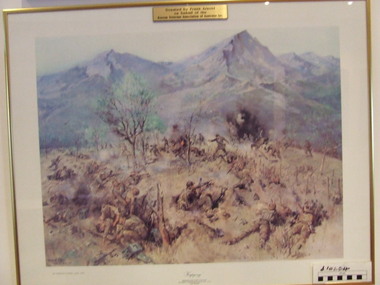
Print Kapyong, Kapyong
... Australian positions, attacking in waves over their own dead and wounded. At dawn, A Company, under the command of Major Bernard "Ben" O'Dowd, found that the Chinese had infiltrated its position, but a counter-attack was able to eject them. Meanwhile B Company, which had spent the night on a hill near the riiver, discovered Chinese occupying some old bunkers on a small knoll. Hand-to-hand fighting ensued with grenades and bayonets. C Company, under the command of Captain Reg Saunders, was in position to reinforce...Australian positions, attacking in waves over their own dead and wounded. At dawn, A Company, under the command of Major Bernard "Ben" O'Dowd, found that the Chinese had infiltrated its position, but a counter-attack was able to eject them. Meanwhile B Company, which had spent the night on a hill near the riiver, discovered Chinese occupying some old bunkers on a small knoll. Hand-to-hand fighting ensued with grenades and bayonets. C Company, under the command of Captain Reg Saunders, was in position to reinforce ...On 23 April, the 3rd Battalion, Royal Australian Regiment (3 RAR), under the command of Lieutenant Colonel Bruce Ferguson, and the 2nd Battalion, Princess Patricia's Canadian Light Infantry, occupied prominent hills on either side of the seven-kilometre-wide valley, where a small tributary joined the Kapyong River. Also forward were headquarters units, tanks and artillery. The 1st Battalion, Middlesex Regiment, were to the rear. Early in the evening, retreating South Koreans streamed past the Commonwealth position, with Chinese forces closely intermingled. Soon afterwards a platoon of American tanks supporting 3 RAR was overrun. The Kapyong valley was too large an area to defend with the forces available, and the brigade was spread very thinly. Throughout the night the Chinese repeatedly pressed the Australian positions, attacking in waves over their own dead and wounded. At dawn, A Company, under the command of Major Bernard "Ben" O'Dowd, found that the Chinese had infiltrated its position, but a counter-attack was able to eject them. Meanwhile B Company, which had spent the night on a hill near the riiver, discovered Chinese occupying some old bunkers on a small knoll. Hand-to-hand fighting ensued with grenades and bayonets. C Company, under the command of Captain Reg Saunders, was in position to reinforce both A and B Companies. "Major O'Dowd then directed the radio operator to contact anyone. The American 1st Marine Division answered but their operator refused to believe who our operator was speaking for. Major O'Dowd took the phone and demanded to speak to the commanding officer. The general in charge of the [Marine] division came on the phone and told O'Dowd we didn't exist as we had been wiped out the night before. Major O'Dowd said, 'I've got news for you, we are still here and we are staying here.'" Private Patrick Knowles, 3 RAR, on the morning of 24 April 1951 Fighting continued throughout the day with the Australians holding their positions, and the Chinese also engaging D Company. But late on 24 April, with their position now untenable, the Australians were forced into a fighting withdrawal down a ridge to the valley, where they rejoined the brigade. Their withdrawal was supported by New Zealand artillery from the 16th Field Regiment. Having found the Canadian position unassailable, the Chinese made no further attacks. By the afternoon of 25 April the road through to the Canadians had been cleared of Chinese and 2 PPCLI was relieved by US Army units. On Anzac Day 1951, the Australians rested after a long fight. Thirty-two Australians were killed and 53 were wounded for their part in stalling the Chinese advance and preventing Seoul from falling into enemy hands. Lieutenant Colonel Bruce Ferguson was awarded the Distinguished Service Order for his skilful leadership, and the Australian and Canadian battalions both received United States Presidential Distinguished Unit Citations for their part in the battle. http://www.awm.gov.au/exhibitions/korea/operations/kapyong/Print of painting of action in Kapyong Korea in wooden frame under glassDonated by Frank Arnold on behalf of Korean Veterans Association of Australia inc.korea, kapyong, 3rar -
 Sir Reginald Ansett Transport Museum
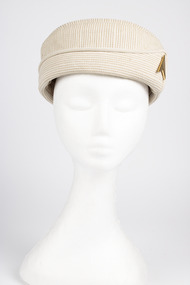
Headwear - Hat, Pillbox, 1969-1972
... company. beige hostess 1970's flight attendants ansett airlines of australia stewardess pillbox shirley boles 1969-1972 " by Nivek Headwear Reg. Melb" on label inside. Red ink numeral 21 & 1/2 handwritten on label. Possibly size 21 inch hat. Beige pillbox hat, with a flat crown and straight, upright sides.Turned up brim, featuring peaked detail on one side. Piped edging. Heavy duty cotton fabric with reinforcing ...This hat complements the stewardess uniform designed for Ansett Airlines of Australia between 1969 to 1972. It was donated by Shirley Boles, to Sir Reginald Ansett Transport Museum. Shirley Boles was an air hostess with ANA in the early days of Ansett. Shirley has made a considerable contribution of items to the Sir Reginald Ansett Transport Museum. She was a popular staff member who worked for many years with the company.Beige pillbox hat, with a flat crown and straight, upright sides.Turned up brim, featuring peaked detail on one side. Piped edging. Heavy duty cotton fabric with reinforcing stitches. Fawn grosgrain ribbon interfacing inside. Cream Bem silk lining. Gold coloured badge features 1968-1981 Ansett logo: A Delta" by Nivek Headwear Reg. Melb" on label inside. Red ink numeral 21 & 1/2 handwritten on label. Possibly size 21 inch hat. beige, hostess, 1970's, flight attendants, ansett airlines of australia, stewardess, pillbox, shirley boles, 1969-1972 -
 Bendigo Historical Society Inc.
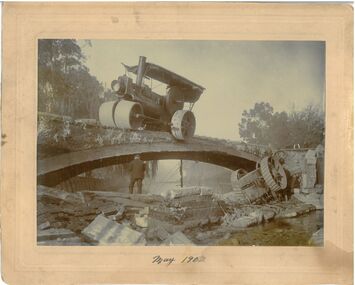
Photograph - Monier Bridge Collapse, May, 1902
... In 1873 this process was extended to iron reinforced bridges with the first bridge built in 1875. In Australia, Sir John Monash of Monash and Anderson company, originally built 8 Monier bridges in Bendigo all single arch except Weeroona Ave., which was a double arch. ...In 1873 this process was extended to iron reinforced bridges with the first bridge built in 1875. In Australia, Sir John Monash of Monash and Anderson company, originally built 8 Monier bridges in Bendigo all single arch except Weeroona Ave., which was a double arch. ...In 1867 Frenchman, Joseph Monier patented reinforced concrete horticultural troughs. In 1873 this process was extended to iron reinforced bridges with the first bridge built in 1875. In Australia, Sir John Monash of Monash and Anderson company, originally built 8 Monier bridges in Bendigo all single arch except Weeroona Ave., which was a double arch. Six of these remain.Black and white photograph. Steam rollers appears to have collapsed from a Monier bridge with men investigating amidst the rubble with one steam roller remaining on the bridge, and another resting in a creek underneath. Photograph by W. H. Robinson. Photograph mounted on cream-coloured card.Written on the front in black ink 'May 1902.'monier bridges, bendigo creek, accidents -
 Sunshine and District Historical Society Incorporated
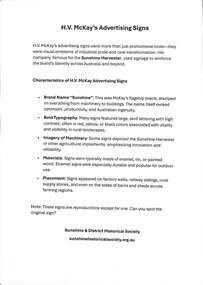
Archive - Sunshine And District Historical Society H.V. McKay's Advertising Signs Exhibition
... His company, famous for the Sunshine Harvester, used signage to reinforce the brand’s identity across Australia and beyond. ...His company, famous for the Sunshine Harvester, used signage to reinforce the brand’s identity across Australia and beyond. ...H.V. McKay’s Advertising Signs H.V. McKay’s advertising signs were more than just promotional tools—they were visual emblems of industrial pride and rural transformation. His company, famous for the Sunshine Harvester, used signage to reinforce the brand’s identity across Australia and beyond. Characteristics of H.V. McKay Advertising Signs • Brand Name “Sunshine”: This was McKay’s flagship brand, stamped on everything from machinery to buildings. The name itself evoked optimism, productivity, and Australian ingenuity. • Bold Typography: Many signs featured large, serif lettering with high contrast, often in red, yellow, or black colors associated with vitality and visibility in rural landscapes. • Imagery of Machinery: Some signs depicted the Sunshine Harvester or other agricultural implements, emphasizing innovation and reliability. • Materials: Signs were typically made of enamel, tin, or painted wood. Enamel signs were especially durable and popular for outdoor use. • Placement: Signs appeared on factory walls, railway sidings, rural supply stores, and even on the sides of barns and sheds across farming regions. Sunshine’s Historical Context • The H.V. McKay Pty Ltd, commonly referred to as the Sunshine Harvester Works, in Braybrook Junction (later renamed Sunshine) was located on this site. The factory became a hub of local industrial activity, and signage played a key role in branding the town itself. • By the 1920s, the H.V. McKay Harvester Factory had become the largest manufacturing enterprise in the Southern Hemisphere. • The Sunshine Harvester Works employed thousands of people from both Sunshine and the surrounding suburbs. • In 1930, the company merged with the Australian arm of the Canadian manufacturer Massey Harris, forming H.V. McKay Massey Harris Pty Ltd. • In 1953, Massey-Harris merges with Harry Ferguson Ltd, forming Massey-Harris-Ferguson Ltd and in 1958 renamed to Massey Ferguson Ltd • The Massey Ferguson Factory closed in the 1980’s and the demolition of the site started in 1988. • The site today is the home of the Sunshine Market Place, Brimbank Council Offices, Visy Cares Hub, Sunshine Police Station, Sunshine Magistrates' Court and a number of other shops and offices. • The only building remaining of the original factory is the Bulk Store, now the Visy Cares Hub. Note: These signs are reproductions except for one. Can you spot the original sign? 5684.01 - H.V. McKay's Advertising Signs Exhibition.jpg 5684.02 - H.V. McKay's Advertising Signs Exhibition.jpg 1013.01 - H.V. McKay Advertising Sign.jpg 1013.02 - H.V. McKay Advertising Sign.jpg 1013.03 - H.V. McKay Advertising Sign.jpg 1013.04 - H.V. McKay Advertising Sign.jpg 1013.05 - H.V. McKay Advertising Sign.jpg 2897 - Massey Ferguson Gate Sign.jpg 3041 - Sunshine Farm Machinery and Tractors Sign.jpgh.v. mckay
