
Showing 102 items matching "australian special forces"
-
 Australian Commando Association - Victoria
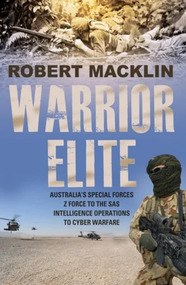
Book, Warrior Elite
... australian special forces...Warrior Elite is a unique and compelling account of Australia's special forces and intelligence operations - ranging from the early special forces of World War II to the establishment and development of the SAS and Commando Regiments as the elite fighters of today, and from the Australian Security Intelligence Service to the Australian Signals Directorate and ASIO. ...Warrior Elite is a unique and compelling account of Australia's special forces and intelligence operations - ranging from the early special forces of World War II to the establishment and development of the SAS and Commando Regiments as the elite fighters of today, and from the Australian Security Intelligence Service to the Australian Signals Directorate and ASIO. ...Warrior Elite is a unique and compelling account of Australia's special forces and intelligence operations - ranging from the early special forces of World War II to the establishment and development of the SAS and Commando Regiments as the elite fighters of today, and from the Australian Security Intelligence Service to the Australian Signals Directorate and ASIO. It is an authoritative, gripping and thoroughly up-to-date account of both the history and current state of our special forces and intelligence bodies - and gives a unique glimpse into the warfare of the future. Our future. Robert Macklin has conducted dozens of exclusive interviews and uncovered incredible, daring and sometimes heartbreaking stories of the elite troops that guard our nation and engage in secret operations around the world. He has had significant cooperation from numerous sources within the special forces and the various intelligence agencies. Both thoroughly researched and colourfully written, Warrior Elite will attract the reader of action memoirs as well as those interested in broader military history and espionage. australian special forces, australian army, commandos, military history -
 Australian Commando Association - Victoria
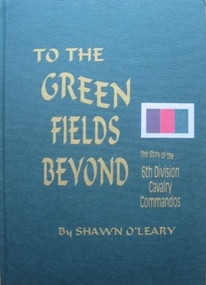
Book - 6th Div, Shawn OLeary, To The Green Fields Beyond:The story of the 6th Division Cavalry Commandos
... ...australian special forces...ww2 australian commandos australian special forces world war 2 The comprehensive history of the 6th Australian Division Cavalry Commandos – a (now out of print) reprint of one of the rarer Armoured unit history books. ...The comprehensive history of the 6th Australian Division Cavalry Commandos – a (now out of print) reprint of one of the rarer Armoured unit history books. This is the story of one of Australia’s most famous fighting regiments during World War II. As an armoured cavalry unit it fought the Italians and Germans in the sands of the African desert and the Vichy French in the mountains of Syria. Later as a dismounted commando unit it fought the Japanese in the terrifying jungles of New Guinea. The heroism of the men in its ranks and the actions in which they engaged are portrayed in a way which makes battle deeds leap realistically from the pages. “To The Green Fields Beyond” is a documented and detailed book which is of value to everyone who is interested in Australia’s story. Seldom before has such a contribution been made to record of our national history. The book has been approved and sponsored by the Australian War Memorial. The 6th Division Cavalry Regiment was formed in November 1939 and, just two months later, was sent overseas to the Middle East in January 1940. Arriving in Egypt, the regiment immediately went to Palestine, where it joined the rest of the 6th Division and trained using machine-gun carriers and, from October, six old Vickers light tanks. At the end of the year the regiment moved into the Western Desert, where it joined British forces ready for the major offensive to commence on 9 December. Two days later the regiment became the first unit of the 2nd Australian Imperial Force (AIF) to go into action when one of its squadron fought a sharp action against the Italians holding Garn el Grein and Fort Maddalina on 11 and 12 December. By 21 December British forces had captured Sidi Barrrani and the desert was now open for the 6th Division’s advance along the Libyan coast. On 3 January 1941 the division attacked and captured the Italian fort of Bardia. The regiment’s A Squadron, under the command of Major Denzil Macarthur-Onslow, who went on to command the 4th Armoured Brigade, supported the attack. Tobruk was the next Italian fort to be captured, with the regiment again in support and covering the 19th Brigade’s advance. The regiment, though, was under-equipped and without its full compliment of vehicles, using only machine gun carriers. To compensate for this, A Squadron was parity re-equipped with captured Italian light tanks, which had large kangaroos painted on the hulls and turrets to distinguish them from enemy vehicles. After Tobruk, the regiment was used as part of the advance guard in the capture of Derna and then Benghazi. In April the unit moved to Helwan, where it was equipped with Vickers light tanks and machine-gun carriers, and operated with British troops in capturing Sollum. Towards the end of May the regiment moved to Palestine, where it came under the command of the 7th Division for the imminent invasion of Syria. The regiment experienced its heaviest fighting during the Syrian campaign, which began on 7 June. A Squadron was attached to the 21st Brigade and advanced along the coast, where the rugged hills made it difficult to manoeuvre the tanks and carriers. The squadron was relieved by one of the 9th Division Cavalry Regiment’s squadrons on 13 and 14 June. C Squadron, meanwhile, was with the 25th Brigade, and advanced along the Rosh Pinna road, engaging strong enemy defences at Fort Khirbe. C Squadron was relieved by B Squadron, which was later attacked by Vichy French tanks that were supported by heavy artillery and machine-gun fire, which forced the Australians to withdrawal. Always willing or needing to improvise during the campaign, A and B Squadrons both operated three captured French R35 Renault light tanks, while C Squadron provided personnel for a horse troop, quickly nicknamed the “Kelly Gang”, to patrol the high, rugged hills near the Mardjayoun–Banis Road. The regiment remained in Syria as part of the occupation force and returned to Australia in March 1942. It was sent to the Adelaide River, in the Northern Territory, and then later to Murgon, in Queensland. In 1943 and 1944 divisional cavalry regiments were reorganised into cavalry (commando) regiments. In January 1944 the 6th Division Cavalry Regiment became the 2/6th Cavalry (Commando) Regiment. The regiment lost its vehicles and became the administrative headquarters for the 2/7th, 2/9th, and 2/10th Commando Squadrons. The regiment remained with the 6th Division and participated in the Aitpae–Wewak campaign, in New Guinea, during 1945. Includes Nominal Rollnon-fictionThe comprehensive history of the 6th Australian Division Cavalry Commandos – a (now out of print) reprint of one of the rarer Armoured unit history books. This is the story of one of Australia’s most famous fighting regiments during World War II. As an armoured cavalry unit it fought the Italians and Germans in the sands of the African desert and the Vichy French in the mountains of Syria. Later as a dismounted commando unit it fought the Japanese in the terrifying jungles of New Guinea. The heroism of the men in its ranks and the actions in which they engaged are portrayed in a way which makes battle deeds leap realistically from the pages. “To The Green Fields Beyond” is a documented and detailed book which is of value to everyone who is interested in Australia’s story. Seldom before has such a contribution been made to record of our national history. The book has been approved and sponsored by the Australian War Memorial. The 6th Division Cavalry Regiment was formed in November 1939 and, just two months later, was sent overseas to the Middle East in January 1940. Arriving in Egypt, the regiment immediately went to Palestine, where it joined the rest of the 6th Division and trained using machine-gun carriers and, from October, six old Vickers light tanks. At the end of the year the regiment moved into the Western Desert, where it joined British forces ready for the major offensive to commence on 9 December. Two days later the regiment became the first unit of the 2nd Australian Imperial Force (AIF) to go into action when one of its squadron fought a sharp action against the Italians holding Garn el Grein and Fort Maddalina on 11 and 12 December. By 21 December British forces had captured Sidi Barrrani and the desert was now open for the 6th Division’s advance along the Libyan coast. On 3 January 1941 the division attacked and captured the Italian fort of Bardia. The regiment’s A Squadron, under the command of Major Denzil Macarthur-Onslow, who went on to command the 4th Armoured Brigade, supported the attack. Tobruk was the next Italian fort to be captured, with the regiment again in support and covering the 19th Brigade’s advance. The regiment, though, was under-equipped and without its full compliment of vehicles, using only machine gun carriers. To compensate for this, A Squadron was parity re-equipped with captured Italian light tanks, which had large kangaroos painted on the hulls and turrets to distinguish them from enemy vehicles. After Tobruk, the regiment was used as part of the advance guard in the capture of Derna and then Benghazi. In April the unit moved to Helwan, where it was equipped with Vickers light tanks and machine-gun carriers, and operated with British troops in capturing Sollum. Towards the end of May the regiment moved to Palestine, where it came under the command of the 7th Division for the imminent invasion of Syria. The regiment experienced its heaviest fighting during the Syrian campaign, which began on 7 June. A Squadron was attached to the 21st Brigade and advanced along the coast, where the rugged hills made it difficult to manoeuvre the tanks and carriers. The squadron was relieved by one of the 9th Division Cavalry Regiment’s squadrons on 13 and 14 June. C Squadron, meanwhile, was with the 25th Brigade, and advanced along the Rosh Pinna road, engaging strong enemy defences at Fort Khirbe. C Squadron was relieved by B Squadron, which was later attacked by Vichy French tanks that were supported by heavy artillery and machine-gun fire, which forced the Australians to withdrawal. Always willing or needing to improvise during the campaign, A and B Squadrons both operated three captured French R35 Renault light tanks, while C Squadron provided personnel for a horse troop, quickly nicknamed the “Kelly Gang”, to patrol the high, rugged hills near the Mardjayoun–Banis Road. The regiment remained in Syria as part of the occupation force and returned to Australia in March 1942. It was sent to the Adelaide River, in the Northern Territory, and then later to Murgon, in Queensland. In 1943 and 1944 divisional cavalry regiments were reorganised into cavalry (commando) regiments. In January 1944 the 6th Division Cavalry Regiment became the 2/6th Cavalry (Commando) Regiment. The regiment lost its vehicles and became the administrative headquarters for the 2/7th, 2/9th, and 2/10th Commando Squadrons. The regiment remained with the 6th Division and participated in the Aitpae–Wewak campaign, in New Guinea, during 1945. Includes Nominal Rollww2, australian commandos, australian special forces, world war 2 -
 Australian Commando Association - Victoria
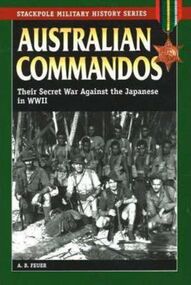
Book, A.B.Feure, Australian Commando: Their Secret War against the Japanese in World War II
... Australian special operations...Australian special forces...Australia's elite M/Z commando teams conducted daring rescue, sabotage, and intelligence missions during World War II. While M Unit secretly set up coast-watching posts to monitor Japanese shipping movements and bombing flights, operatives of Special Operations Australia also known as the Allied Intelligence Bureau were inserted deep behind enemy lines, where they attacked Japanese targets in brutal terrain and where capture meant death by beheading. Theirs was a lonely war, but Australian commandos made crucial contributions to Allied victory in the Pacific. WW2 Australian Commandos Australian special operations Australian special forces ...non-fictionww2, australian commandos, australian special operations, australian special forces, world war ii -
 Australian Commando Association - Victoria
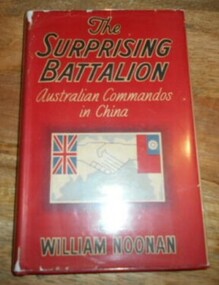
Book, The Surprising Battalion – Australian Commandos in China
... ...australian special forces...They were allocated to Brigadier Orde Wingate’s force but were recalled whilst on leave and returned to Australia after two years in the tropics. world war ii ww2 australian commando australian special forces australian special operations world war ii australian operations in china Hard cover first edition The Surprising Battalion – Australian Commandos in China Book ...The detailed account of Australian Commandos in China during World War Two. This, the story of Australia’s first Commandos, is an epic of the war. Here is hardship and adventure, pathos and humour, suffering and excitement. It tells of the men who went to Malaya with the 22nd Brigade, then sailed to Burma to train under Britain’s finest Commando leaders. Escaping from the Japanese, they journeyed the length of the tortuous Burma Road, crossing China almost to the coast. Here they trained the Surprising Battalions, some of China’s crack guerrillas, and operated with them in war torn provinces. The became famous as the “Lost Legion of the AIF” – the boys of Mission 204. After almost a year of guerrilla existence, the survivors were withdrawn to Kunming and flew to India. They were allocated to Brigadier Orde Wingate’s force but were recalled whilst on leave and returned to Australia after two years in the tropics.Hard cover first edition world war ii, ww2, australian commando, australian special forces, australian special operations, world war ii australian operations in china -
 Australian Commando Association - Victoria
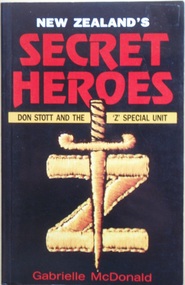
New Zealand's Secret Hero's: Don Stott and Z Special Unit
... Australian Special Operations...Australian Special forces...The incredible tale of ‘Z’ Special Unit – a group of mainly New Zealand and Australian commandos and saboteurs who parachuted into enemy-occupied territory to fight the war, sometimes single-handedly.The story begins in Greece, with the extraordinary sabotage feats of Don Stott and his friend Bob Morton. Stott’s success in blowing up the strategically crucial Asopos Viaduct was one of the greatest such exploits of World War II and changed the course of the war in Greece”. WW2 Australian Special Operations Australian Special forces ...The incredible tale of ‘Z’ Special Unit – a group of mainly New Zealand and Australian commandos and saboteurs who parachuted into enemy-occupied territory to fight the war, sometimes single-handedly.The story begins in Greece, with the extraordinary sabotage feats of Don Stott and his friend Bob Morton. Stott’s success in blowing up the strategically crucial Asopos Viaduct was one of the greatest such exploits of World War II and changed the course of the war in Greece”.Soft cover 168 pagesww2, australian special operations, australian special forces, australian commandos, new zealand commandos -
 Australian Commando Association - Victoria
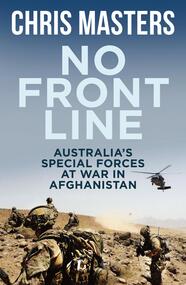
Book, No Front Lines-Australia Special Forces at War in Afghanistan
... No Front Lines-Australia Special Forces at War in Afghanistan...australian special forces...Australia’s foremost investigative journalist. His descriptions of battle are some of the most powerful reporting from that war. No Front Line takes this story even further, to the heart of Special Forces and its war in Afghanistan, a war the Australian public know very little about. ...Special Forces, Chris gives voice to these soldiers. He takes us right into the centre of some of the fiercest combat, opens up the story of the relationship between the Australians and their US partners and provides the most intimate examination of what it is like to be a member of this country’s elite fighting forces. australian special forces afghanistan commandos No Front Lines-Australia Special Forces at War in Afghanistan Book ...Chris Masters is Australia’s foremost investigative journalist. His descriptions of battle are some of the most powerful reporting from that war. No Front Line takes this story even further, to the heart of Special Forces and its war in Afghanistan, a war the Australian public know very little about. Implicitly trusted by Special Forces, Chris gives voice to these soldiers. He takes us right into the centre of some of the fiercest combat, opens up the story of the relationship between the Australians and their US partners and provides the most intimate examination of what it is like to be a member of this country’s elite fighting forces. australian special forces, afghanistan, commandos -
 Australian Commando Association - Victoria
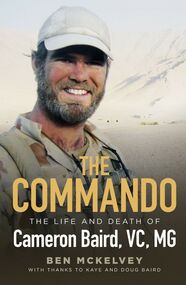
Book, The Commando: The Life and Death of Cameron Baird, VC, MG
... Australian special forces...On 22 June 2013, Corporal Cameron Baird was a 2nd Commando Regiment Special Forces soldier when he led his platoon into a known Taliban stronghold to back-up another Australian unit under heavy fire. ...Cameron's story and that of 4RAR and 2nd Commando personifies the courage and character of the men and women who go to war and will show us the good man we have lost. Australian special forces Commandos Afghanistan 2nd Commando Regiment The Commando: The Life and Death of Cameron Baird, VC, MG Book ...On 22 June 2013, Corporal Cameron Baird was a 2nd Commando Regiment Special Forces soldier when he led his platoon into a known Taliban stronghold to back-up another Australian unit under heavy fire. In the prolonged firefight, Cameron was mortally wounded. In 2014, Cameron's bravery and courage under fire saw him posthumously awarded the 100th Victoria Cross, our highest award possible for bravery in the presence of the enemy. Cameron Baird died how he lived - at the front, giving it his all, without any indecision. He will forever be remembered by his mates and the soldiers he served with in the 2nd Commando Regiment. THE COMMANDO reveals Cameron's life, from young boy and aspiring AFL player, who only missed out on being drafted because of injury, to exemplary soldier and leader. Cameron's story and that of 4RAR and 2nd Commando personifies the courage and character of the men and women who go to war and will show us the good man we have lost. australian special forces, commandos, afghanistan, 2nd commando regiment -
 Australian Commando Association - Victoria
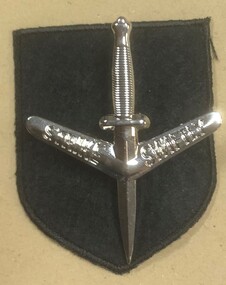
Badge - 1st Commando Regiment Silver Badge Annual Award for Best Commando
... ...Australian special forces...Australian commando Special operations Australian special forces Inscribed with number 49 Badge 1st Commando Regiment Silver Badge Annual Award for Best Commando ...Yearly award for the best commando within a commando companyLimited production of regimental hat badges has been coloured silver for presentation as an annual award to the best commando within a commando company.Inscribed with number 49australian commando, special operations, australian special forces -
 Australian Commando Association - Victoria
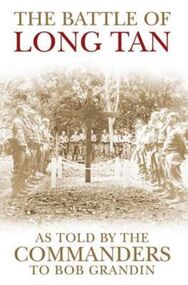
Book, The Battle of Long Tan- as told by the ommanders to Bob Grandon
... ...Australian special forces...Several members who participated in this battle were former commandos and members of 2 commando Company Find by Australian commandos Vietnam war Australian special forces Inscribed presentation by Harry Smith dated June 2012 Softcover 332 page The Battle of Long Tan- as told by the ommanders to Bob Grandon Book ...Several members who participated in this battle were former commandos and members of 2 commando CompanyFind bySoftcover 332 pageInscribed presentation by Harry Smith dated June 2012australian commandos, vietnam war, australian special forces -
 Australian Commando Association - Victoria
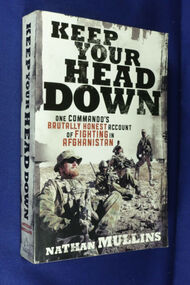
Book, Keep Your Head Down by Nathan Mullins
... Australian special forces...Australia doing in Afghanistan? What would winning that war look like? What makes a man leave his family to go to war when he doesn't have to? Can there be such a thing as a just war? Nathan Mullins isn't a typical Special Forces...In his day job he is the International Program Manager for Australian Aid International, a humanitarian organisation that responds to disasters and emergencies around the globe. Australian special forces Australian commando Afghanistan soft cover book Keep Your Head Down by Nathan Mullins Book ...Nathan Mullins deployed to Afghanistan as a Special Forces Commando. Spearheading Australia's Special Operations troops, he and other Australians like him sought the Taliban in the valleys and hills of Uruzgan through Afghanistan's harsh winter while at the same time attempting to bring a human face to the villagers caught in the middle of the fighting. They lived with the daily threat of roadside bombs, ambush and firefights, where survival meant learning to read the signs to determine friend from foe. And they did what they could to relieve the awful effects of war on the men, women and children of the civilian population caught in the crossfire. But these were not your regular soldiers. Sure, they had trained for years for the role but these were citizen soldiers, reservists who had put aside their usual jobs as salesmen, farmers, scientists, lawyers and students to fight Australia's 'war on terror'. Keep Your Head Down is a brutally honest, first-hand account that takes you into the centre of the action and asks some tough questions. What is Australia doing in Afghanistan? What would winning that war look like? What makes a man leave his family to go to war when he doesn't have to? Can there be such a thing as a just war? Nathan Mullins isn't a typical Special Forces soldier. In his day job he is the International Program Manager for Australian Aid International, a humanitarian organisation that responds to disasters and emergencies around the globe.soft cover bookaustralian special forces, australian commando, afghanistan -
 Australian Commando Association - Victoria
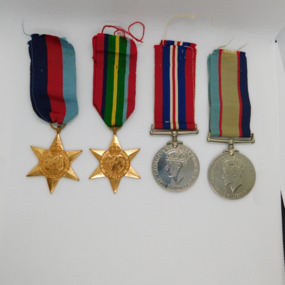
Memorabilia - WW2 Set of 4 medals- Norman Ernest Baxter 2nd Independent Company
... ...australian special forces...A reinforcement to 2nd Independent Company. ww2 independent company australian commando timor australian special forces australian special operations world war ii Memorabilia WW2 Set of 4 medals- Norman Ernest Baxter 2nd Independent Company. ...Medals issued to Norman Ernest Baxter VX63211. A reinforcement to 2nd Independent Company. ww2, independent company, australian commando, timor, australian special forces, australian special operations, world war ii -
 Australian Commando Association - Victoria
Film, Australian Commando Association et al, Double Diamond Commandos, 2019
... ...australian special forces...Tidal River is the birth place of Australian and New Zealand Commandos and later Special Operations personnel. ww2 world war 2 independent company commando australian special forces tidal river wilsons promontory Short documentary film Double Diamond Commandos Film Australian Commando Association Tim Gurry Dr Richard Reid Kevin Manning Ryebuck Media ...A 2019 produced history of the initial training at Wilsons Promontory, Victoria of Australian and New Zealand Independent Companies later renamed Commandos and their activities during WW2 and post war development. Tidal River is the birth place of Australian and New Zealand Commandos and later Special Operations personnel.Short documentary film ww2, world war 2, independent company, commando, australian special forces, tidal river, wilsons promontory -
Australian Commando Association - Victoria
Mixed media - From Tidal River to Timbered Knoll, Education Package - From Tidal River to Timbered Knoll
... ...australian special forces...Using original World War II footage, supplemented by later official record data this video and training package provides unique material regarding the history of Australian special operations during World War II. ww2 world war ii independent companies commando companies australian special forces tidal river Education Package - From Tidal River to Timbered Knoll Mixed media From Tidal River to Timbered Knoll ...This training package was produced by AVA Vic for use within the Victorian educational curriculum for years 10 to 12. It is particularly focused on those students who are attending Wilsons Promontory National Park and undertaking educational activities through the Parks Victoria Education Centre. The eight module program and teachers notes provides a historical workbook for students to gain a better understanding of the role of Tidal River as the initial training location for Australian and New Zealand commandos during World War II and the later military operations that were undertaken by commandos during World War II.Using original World War II footage, supplemented by later official record data this video and training package provides unique material regarding the history of Australian special operations during World War II.ww2, world war ii, independent companies, commando companies, australian special forces, tidal river -
 Australian Commando Association - Victoria
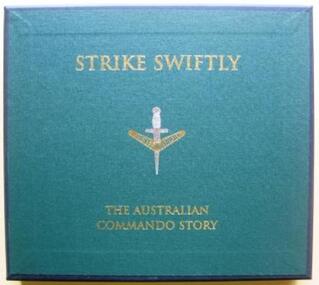
Book, Strike Swiftly- the Australian Commando Story
... ...Australian Army...Special Forces...australian commando Australian Army Special Forces Copy number 180 of 350 limited edition print. ...Hard Cover with Dust Jacket – 336 pagesCopy number 180 of 350 limited edition print.australian commando, australian army, special forces -
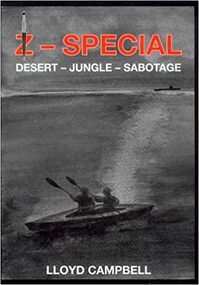 Australian Commando Association - Victoria
Book, Z Special- Desert-Jungle- Sabotage
... The Australian special operations...Special forces...Z Special Unit—also known as Special Operations Executive (SOE), Special Operations Australia (SOA) or the Services Reconnaissance Department (SRD)—was a joint Allied special forces unit formed during the Second World War to operate behind Japanese lines in South East Asia. ...pp. 274, illusts, maps ww2 The Australian special operations Special forces Z Special Unit Z Special- Desert-Jungle- Sabotage Book ...When Lloyd Campbell joined the AIF, he was underage and went to the Middle East with 2/17 Battalion. Later in New Guinea he made a major career change and volunteered for an unknown unit and special operations. What he had joined was the SRD – known as Z-Special Unit. Z Special Unit—also known as Special Operations Executive (SOE), Special Operations Australia (SOA) or the Services Reconnaissance Department (SRD)—was a joint Allied special forces unit formed during the Second World War to operate behind Japanese lines in South East Asia. Predominantly Australian, Z Special Unit was a specialist reconnaissance and sabotage unit that included British, Dutch, New Zealand, Timorese and Indonesian members, predominantly operating on Borneo and the islands of the former Netherlands East Indies. The unit carried out a total of 81 covert operations in the South West Pacific theatre, with parties inserted by parachute or submarine to provide intelligence and conduct guerrilla warfare. The best known of these missions were Operation Jaywick and Operation Rimau, both of which involved raids on Japanese shipping in Singapore Harbour; the latter of which resulted in the deaths of 23 commandos either in action or by execution after capture. Although the unit was disbanded after the war, many of the training techniques and operational procedures employed were later used during the formation of other Australian Army special forces units and they remain a model for guerrilla operations to this day. pp. 274, illusts, maps ww2, the australian special operations, special forces, z special unit -
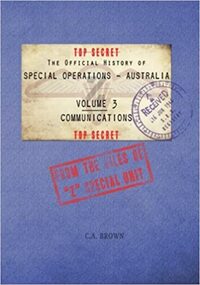 Australian Commando Association - Victoria
Book, The Official History of Special Operations Australia Vol. 3- Communications
... Australian special operations...Special forces...Radio and Special Forces enthusiasts will be agog at the appendices in this volume, which not only include copies of the actual operating instructions and technical manuals for much of the specialist SOE communications hardware used by "Z" during the war, but also the once-top secret SOE ciphers and codes used by Z parties in the field. The Official History of Special Operations Australia...Australian special operations Special forces World War II The Official History of Special Operations Australia Vol. 3- Communications Book ...Popularly known today as Z Special Unit, or by the wartime cover names of Inter-Allied Services Department (ISD) and Services Reconnaissance Department (SRD), Special Operations Australia (SOA) was the Special Operations component of the US-led Allied Intelligence Bureau in the Pacific Theatre during the Second World War. From the secret files of Z Special Unit, and the third in a set of five volumes, Volume 3 - Communications describes the communications links and equipment which were the lifeline for "Z" Operatives in the field. From "Z's" early days relying on Dutch military communications stations in Melbourne and Darwin to the establishment of dedicated "Z" communications stations in Darwin, Morotai and Labuan, Vol 3 provides the only comprehensive history of these sites ever committed to paper. Radio and Special Forces enthusiasts will be agog at the appendices in this volume, which not only include copies of the actual operating instructions and technical manuals for much of the specialist SOE communications hardware used by "Z" during the war, but also the once-top secret SOE ciphers and codes used by Z parties in the field. The Official History of Special Operations Australia, Volume 3 - Communications is a unique record of one of the most important aspects of Second World War Special Operations.australian special operations, special forces, world war ii -
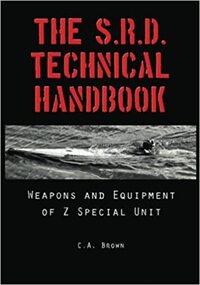 Australian Commando Association - Victoria
The Official History of Special Operations Australia SRD Technical Handbook
... Australian special operations...Special forces...Australian special operations Special forces Commandos World War II The Official History of Special Operations Australia SRD Technical Handbook ...This book reproduces the SRD Technical Handbook, which was a top secret equipment supply catalogue published for internal use within SRD in February, 1945. While many of the items in the handbook are British SOE “special stores” shipped over from London, a great deal of developmental and experimental work was done by SRD’s Technical Directorate at its technical research station at Mount Martha on Victoria’s Mornington Peninsula. A flick through these pages will show unusual items such as folding midget motorbikes, silenced pistols and machine guns, knuckle-knives, mini-submarines, booby trap devices and more. In fact, it contains just about everything a WWII-era commando or a spy required to successfully complete a secret mission. Lavishly illustrated with original wartime photographs, plans and diagrams, many never before seen publicly, the S.R.D. Technical Handbook is timely evidence that mankind is never as ingenious as he is during time of war.australian special operations, special forces, commandos, world war ii -
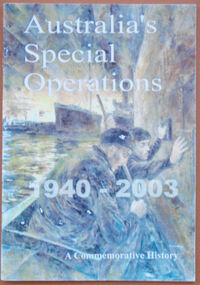 Australian Commando Association - Victoria
Australia's Special Operations 1940-2003. A Commemorative History
... A detailed history of Australian Special Forces operations during World War Two by the commandos of the Allied Intelligence Bureau and the Independent Companies/Commando Squadrons and through to operations in Vietnam and later conflicts. ...A detailed history of Australian Special Forces operations during World War Two by the commandos of the Allied Intelligence Bureau and the Independent Companies/Commando Squadrons and through to operations in Vietnam and later conflicts. ...A detailed history of Australian Special Forces operations during World War Two by the commandos of the Allied Intelligence Bureau and the Independent Companies/Commando Squadrons and through to operations in Vietnam and later conflicts. Compiled by two of Australia’s most famous military historians for the 60th anniversary of Operation JAYWICK in 2003. -
 Australian Commando Association - Victoria
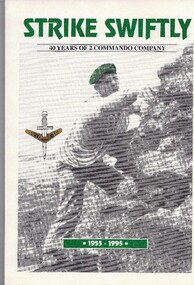
Book, Strike Swiftly - 40 years of 2 Commando Company - 1955 -1995, Printed January 1995
... 40th anniversary- 2 commando company- 2 commando association-40th anniversary-officer commanding- founding oc-australia special forces...It has 3 chapters describing the development of Australia's Special Forces....It has 3 chapters describing the development of Australia's Special Forces. Written to mark the 40th anniversary of 2 Commando Company, and presented to all 2 Commando Association members and friends who attended the 40th anniversary dinner in February 1995. ...It gives a concise history of 2 Commando Company, from 1955 when it was formed, to 1995, giving details of its Officers Commanding, including its founding OC, their philosophies, and general and significant Company events and personnel over the 50 years. It has 3 chapters describing the development of Australia's Special Forces.Written to mark the 40th anniversary of 2 Commando Company, and presented to all 2 Commando Association members and friends who attended the 40th anniversary dinner in February 1995. Gives a 40 year history of the Company. Soft cover; White cover, green main title. Contains chronological concise history of the Unit, also with themed chapters, with limited photographs. Cover photo of Commando rock climbing, wearing green beret.NLA ISBN 0 646 22208 2. Copyright 1995.40th anniversary- 2 commando company- 2 commando association-40th anniversary-officer commanding- founding oc-australia special forces -
 Australian Commando Association - Victoria
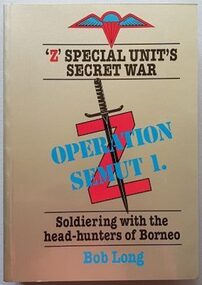
Book, Z Special Units' Secret War- Operations SEMUT 1, 1989
... The author’s personal experiences with Australian Special Forces (Services Reconnaissance Department) which involved guerrilla soldiering with the head-hunters of Japanese held Borneo during World War 2. ...The author’s personal experiences with Australian Special Forces (Services Reconnaissance Department) which involved guerrilla soldiering with the head-hunters of Japanese held Borneo during World War 2. ...An account of the operations of The Allied Intelligence Bureau (AIB) better known as ‘Z’ Special Unit. Now a scarce and highly sought after title. The author’s personal experiences with Australian Special Forces (Services Reconnaissance Department) which involved guerrilla soldiering with the head-hunters of Japanese held Borneo during World War 2. Z Special Unit an administrative support unit of (also known as Special Operations Australia (SOA) or the Services Reconnaissance Department (SRD)) was a joint Allied special forces unit formed during the Second World War to operate behind Japanese lines in South East Asia. Predominantly Australian, SRD was a specialist reconnaissance and sabotage unit that included British, Dutch, New Zealand, Timorese and Indonesian members, predominantly operating on Borneo and the islands of the former Netherlands East Indies. The unit carried out a total of 81 covert operations in the South West Pacific theatre, with parties inserted by parachute or submarine to provide intelligence and conduct guerrilla warfare. The best known of these missions were Operation Jaywick and Operation RIMAU, both of which involved raids on Japanese shipping in Singapore Harbour; the latter of which resulted in the deaths of twenty-three commandos either in action or by execution after capture. Although the unit was disbanded after the war, many of the training techniques and operational procedures employed were later used during the formation of other Australian Army special forces units and they remain a model for guerrilla operations to this day.Hard Cover with Dust Jacket – 608 pagesInscribed by author-Bob Long AK223 SEMUT 1 Borneo 1945 -
 Rye RSL Sub Branch
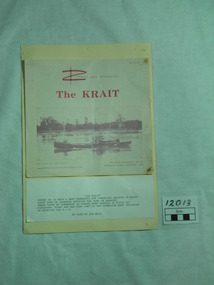
Newsletter, Commando Association, MV Krait, After 1966
... One of the most important and successful attacks on merchant ships inside an enemy harbour during world war two by English and Australian Commandoes or Special Unit Forces, launched from Australia. ...One of the most important and successful attacks on merchant ships inside an enemy harbour during world war two by English and Australian Commandoes or Special Unit Forces, launched from Australia. ...One of the most important and successful attacks on merchant ships inside an enemy harbour during world war two by English and Australian Commandoes or Special Unit Forces, launched from Australia. Nil deaths by the Commandoes were recorded, and 40000 tons of enemy ships were damaged or destroyed. To enlighten RSL Members and the public, the history of the MV Krait and the importance of our Military History. The newsletter has a typed story and pictures of members of M and Z Special Force. Krait took a small force on one of its missions and they sank about 38,000 tons of Japanese shipping in Singapore Harbour in 1943. The newsletters front page has pink large writng on a white background. The word Krait and a photo of it on the Brisbane River. The newsletter is 4 pages with a photo of the men on board on page 2. Page 3 has another photo of the Krait. It is on loan from Mr.Jim Muir, world war two, pamphlet, short story, mv krait, motor vessel, singapore, singapore harbour, 1943 -
 Australian Commando Association - Victoria
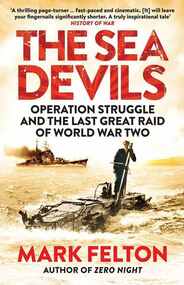
The Sea Devils. Operation STRUGGLE and the last great raid of World War II
... Eighteen young British, Australian and New Zealand special forces from a top-secret underwater warfare unit prepare to undertake three audacious missions against the Japanese. ...Eighteen young British, Australian and New Zealand special forces from a top-secret underwater warfare unit prepare to undertake three audacious missions against the Japanese. ...July 1945. Eighteen young British, Australian and New Zealand special forces from a top-secret underwater warfare unit prepare to undertake three audacious missions against the Japanese. Using XE-craft midget submarines, the raiders will creep deep behind Japanese lines to sink two huge warships off Singapore and sever two vitally important undersea communications cables. Success will hasten ultimate victory over Japan; but if any of the men are captured they can expect a gruesome execution. Can the Sea Devils overcome Japanese defences, mechanical failures, oxygen poisoning and submarine disasters to fulfill their missions? Mark Felton tells the true story of a band of young men living on raw courage, nerves and Adrenalin as they attempt to pull off what could be the last great raid of World War Two.ww2, special operations, submarine operations -
 Frankston RSL Sub Branch
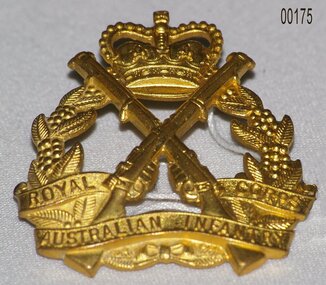
Badge
... Major components of the RA Inf include the various battalions of the Royal Australian Regiment and the six state-based Reserve infantry regiments, such as the Royal New South Wales Regiment. The various Regional Force Surveillance and Special Forces units of the Army are also part of the corps. ...Major components of the RA Inf include the various battalions of the Royal Australian Regiment and the six state-based Reserve infantry regiments, such as the Royal New South Wales Regiment. The various Regional Force Surveillance and Special Forces units of the Army are also part of the corps. ...The Royal Australian Infantry Corps (RA Inf) is the parent corps for all infantry regiments of the Australian Army. It was established on 14 December 1948, with its Royal Corps status being conferred by His Majesty King George VI. At her coronation in 1953, Queen Elizabeth II became Colonel-in-Chief of the corps. Major components of the RA Inf include the various battalions of the Royal Australian Regiment and the six state-based Reserve infantry regiments, such as the Royal New South Wales Regiment. The various Regional Force Surveillance and Special Forces units of the Army are also part of the corps. The Infantry School is located at Singleton, New South Wales.Pressed metal cap badge for the Royal Australian Infantry Corp. This badge is brass alloy with two pins at rear for securing to the cap when worn."Royal Australian Infantry Corps" -
 Lara RSL Sub Branch
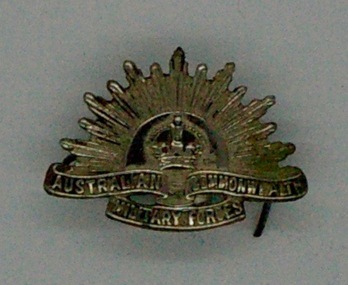
Australian Commonwealth Military Forces Rising Sun Badge
... The Rising Sun badge carried a scroll inscribed with the words ‘Australian Commonwealth Military Forces’ and was worn throughout both World Wars. There were, however, a number of variations of the badge; a special version was struck for the coronation of King Edward VII in 1902 and there were badges of the Commonwealth Horse and the Australian Instructional Corps, each with its respective title on the scrolls. ...The Rising Sun badge, also known as the General Service Badge or the Australian Army Badge, is the official insignia of the Australian Army. The badge is readily identified with the spirit of ANZAC, the legend of the Australian soldier, and the esprit de corps of the Army itself, due to its association with the landings at Gallipoli in 1915. The Rising Sun badge carried a scroll inscribed with the words ‘Australian Commonwealth Military Forces’ and was worn throughout both World Wars. There were, however, a number of variations of the badge; a special version was struck for the coronation of King Edward VII in 1902 and there were badges of the Commonwealth Horse and the Australian Instructional Corps, each with its respective title on the scrolls. This pattern badge formed the template for all subsequent General Service badges.Australian Rising sun badge, anodised silver on the front and two eyelets on the back. Australian Commonwealth Military Forces.rising sun badge, lara r.s.l. badges, australian army badges. -
 Lara RSL Sub Branch
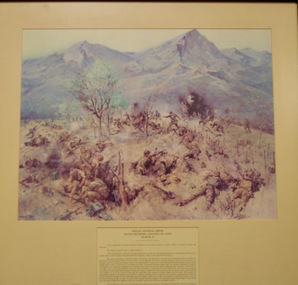
Special General Order.Battle Honours-Citation Of Units,28th June 1951, Circa 1970
... The battles of Kapyong (23–24 April 1951) and Maryang San (2–8 October 1951) were significant confrontations with a numerically superior enemy force, and saw 3 RAR win the first honours for the newly formed Royal Australian Regiment. prints framed paintings korea lara r.s.l. korean war battle honours special general orders citation of units Detailed description of the Special General Order,Battle Honours-Citation of Units. 28th June 1951 General Mathew B Ridgeway, Supreme Commander UNITED NATIONS FORCES Framed Glass covered Print,Rectangular in Shape showing a painting of Australian soldiers fighting the enemy near Kapyong,Korea,in 1951,with a description underneath. ...During 1951, the 3rd Battalion, The Royal Australian Regiment (3 RAR), fighting as part of a British Commonwealth Brigade in Korea, was engaged in the two most significant and commemorated battles of the Australian Army’s deployment to the three-year Korean War.The battles of Kapyong (23–24 April 1951) and Maryang San (2–8 October 1951) were significant confrontations with a numerically superior enemy force, and saw 3 RAR win the first honours for the newly formed Royal Australian Regiment.Framed Glass covered Print,Rectangular in Shape showing a painting of Australian soldiers fighting the enemy near Kapyong,Korea,in 1951,with a description underneath. Detailed description of the Special General Order,Battle Honours-Citation of Units. 28th June 1951 General Mathew B Ridgeway, Supreme Commander UNITED NATIONS FORCES prints, framed paintings, korea, lara r.s.l., korean war, battle honours, special general orders, citation of units -
 Flagstaff Hill Maritime Museum and Village
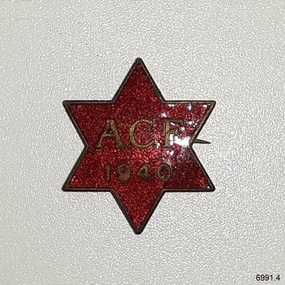
Badge - ACF Australian Comforts Fund badge, P J King Pty Ltd, 1940
... Australian Military Forces. The ACF raised funds to purchase goods, pack them and send them overseas. One of their fund-raising activities was 'button days' where buttons such as this one were given to those who gave donations. The ACF closed down after World War I but was re-formed at the start of World War II. Items that the ACF sent to the troops included personal toiletry items such as toothbrushes and toothpaste, magazines, pyjamas, singlets and socks. They also provided sporting equipment, recreational music, writing materials and postcards. Special...Australian Military Forces. The ACF raised funds to purchase goods, pack them and send them overseas. One of their fund-raising activities was 'button days' where buttons such as this one were given to those who gave donations. The ACF closed down after World War I but was re-formed at the start of World War II. Items that the ACF sent to the troops included personal toiletry items such as toothbrushes and toothpaste, magazines, pyjamas, singlets and socks. They also provided sporting equipment, recreational music, writing materials and postcards. Special ...This Australian Comforts Fund badge is part of a set of eleven badges collected from the 1920s to the 1940s by Dr W. R. Angus. The badge was sold by the ACF in 1940 to raise funds for gifts to send to the Australian troops serving overseas. The badge is one of a set of badges that represents various organisations that he had interests in. The Australian Comforts Fund was a mostly female, volunteer-run organisation officially recognised by the Government. It began in 1916 as an amalgamation of groups of people who wanted to support the Australian troops abroad with Items of comfort to supplement the essential items provided by the Australian Military Forces. The ACF raised funds to purchase goods, pack them and send them overseas. One of their fund-raising activities was 'button days' where buttons such as this one were given to those who gave donations. The ACF closed down after World War I but was re-formed at the start of World War II. Items that the ACF sent to the troops included personal toiletry items such as toothbrushes and toothpaste, magazines, pyjamas, singlets and socks. They also provided sporting equipment, recreational music, writing materials and postcards. Special hampers were sent to the troops at Christmas time. The maker, P J King, (Percy John King), originally established his engraving and ie casting business in Russell Street, Melbourne in 1893 in partnership with Charles Walder Bridgland, continuing on his own from 1899. Percy and his son John Howard King set up a new business P J King Pty Ltd in 1928 making uniform buttons. In the late 1980s, it merged with two other companies that then became J J Cash, now known as Cash's Australia. The set of badges was donated to Flagstaff Hill Maritime Village by the family of Doctor Angus, Surgeon and Oculist. It is part of the “W.R. Angus Collection” which includes historical medical equipment, surgical instruments and material belonging to Dr Edward Ryan and Dr Thomas Francis Ryan, (both of Nhill, Victoria) and Dr Angus’ own belongings. The Collection’s history spans the medical practices of the two Doctors Ryan, from 1885-1926 plus that of Dr Angus, up until 1969. The W.R. Angus Collection: - The W.R. Angus Collection includes historical medical equipment, surgical instruments and material belonging to Dr Edward Ryan and Dr Thomas Francis Ryan, (both of Nhill, Victoria) and Dr Angus’ own belongings. The Collection’s history spans the medical practices of the two Doctors Ryan, from 1885-1926 plus that of Dr Angus, up until 1969. It includes historical medical and surgical equipment and instruments from the doctors Edward and Thomas Ryan of Nhill, Victoria. Dr Angus married Gladys in 1927 at Ballarat, the nearest big city to Nhill where he began as a Medical Assistant. He was also Acting House surgeon at the Nhill hospital where their two daughters were born. During World War II He served as a Military Doctor in the Australian Defence Force. Dr Angus and his family moved to Warrnambool in 1939, where Dr Angus operated his own medical practice. He later added the part-time Port Medical Officer responsibility and was the last person appointed to that position. Dr Angus and his wife were very involved in the local community, including the planning stages of the new Flagstaff Hill and the layout of the gardens there. Dr Angus passed away in March 1970.This badge represents the efforts of the women volunteers in Australia to support the Australian troops overseas in WWI and WWII. This badge is one of a set of significant badges that connects Doctor Angus with Australian organisations of the early-to-mid 20th century, including those relating to military service support. The W.R. Angus Collection is significant for still being located at the site it is connected with, Doctor Angus being the last Port Medical Officer in Warrnambool. The Collection includes historical medical objects that date back to the late 1800s.The ACF Badge is a star-shaped, gold, glittered red enamel and metal badge. The star has six points. The enamel surface is textured. The border and front inscription of the badge is gold. It is the badge of the Australian Comfort Fund, made by P.J. King and dated 1940. This badge is part of a set of badges collected by Dr W R Angus. the set represents organisations that he was involved in, and is part of the W.R. Angus Collection.Front: “ACF / 1940” Reverse embossed “P.J. KING”flagstaff hill, warrnambool, maritime museum, maritime village, great ocean road, shipwreck coast, metal badges, enamel badges, organisation badges, acf, presbyterian brotherhood, oikumene, w.r. angus, flagstaff hill maritime museum and village, australian comforts fund, button day, volunteer, australian military forces, christmas hamper, 1940 acf badge, fund-raising, p j king pty ltd, percy john king, donor's badge, world war ii, 1939-1945, australians at war, voluntary work, volunteers, home front, w.r. angus collection -
 City of Moorabbin Historical Society (Operating the Box Cottage Museum)
Uniform - World War 1 1914-1918, Hat Badge Rising Sun, c1914
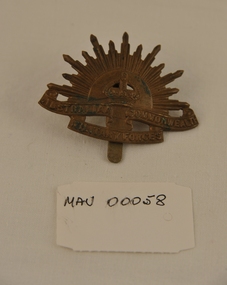
... May 1904 The third pattern Rising Sun badge carried a scroll inscribed with the words ‘Australian Commonwealth Military Forces’ and was worn throughout both World Wars. There were, however, a number of variations of the badge; a special version was struck for the coronation of King Edward VII in 1902 and there were badges of the Commonwealth Horse and the Australian Instructional Corps, each with its respective title on the scrolls. ...May 1904 The third pattern Rising Sun badge carried a scroll inscribed with the words ‘Australian Commonwealth Military Forces’ and was worn throughout both World Wars. There were, however, a number of variations of the badge; a special version was struck for the coronation of King Edward VII in 1902 and there were badges of the Commonwealth Horse and the Australian Instructional Corps, each with its respective title on the scrolls. ...Proudly worn by soldiers of the 1st and 2nd Australian Imperial Force in both World Wars, the 'Rising Sun' badge has become an integral part of the digger tradition. The distinctive shape of the badge, worn on the upturned side of a slouch hat, is commonly identified with the spirit of ANZAC formed at the Gallipoli landings 1915 There are seven patterns of the Rising Sun. 1902 - 1991. The Rising Sun has evolved over time and today Australian Army soldiers wear the seventh pattern Rising Sun. The Third Pattern Rising Sun Badge. May 1904 The third pattern Rising Sun badge carried a scroll inscribed with the words ‘Australian Commonwealth Military Forces’ and was worn throughout both World Wars. There were, however, a number of variations of the badge; a special version was struck for the coronation of King Edward VII in 1902 and there were badges of the Commonwealth Horse and the Australian Instructional Corps, each with its respective title on the scrolls. This pattern badge formed the template for all subsequent General Service badges. The most widely accepted version of the origin of this badge is the one that attributes the selection of its design, c1902, to a British Officer, Major General Sir Edward Hutton, the newly appointed Commander-in-Chief of the Australian Forces. Hutton had earlier received as a gift from Brigadier General Joseph Gordon, a military acquaintance of long standing, a ‘Trophy-of-Arms’ composed of mounted cut and thrust swords and triangular Martini-Henry bayonets that were arranged in a semi-circle around the Crown. To General Hutton, the shield was symbolic of the cooperation between the naval and military forces of the Empire. This Third Pattern Rising Sun Badge.- May 1904 - was worn on the Slouch hats of soldiers serving in the Australian Commonwealth Military Forces during World War 1 1914-1918World War1 1914-1918, soldier’s, rising sun hat badge, made of oxidised copperRising Sun with central Crown AUSTRALIAN COMMONWEALTH / MILITARY FORCES australian military uniforms, military insignia, badges, city of moorabbin, bentleigh, cheltenham, major general sir edward hutton, anzac, gallipoli, australian imperial forces, ww1 1914-1918 -
 Geelong RSL Sub Branch
Service Records VX 110629 Sig F T Purcell, Mid 20th Century
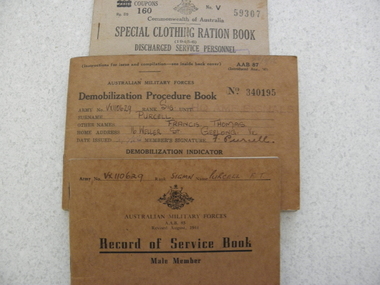
... The documents belong to VX 110629 Sig F T Purcell who served in the Australian Miliraty Forces from 18 April 1941 to 27 March 1946 These are the original Documents belonging to VX 110629 Sig F T Purcell documents records service book australia military VX 110629 Sig F T Purcell Record of Service Book AAB 83 VX110629 Sig F T Purcell Demobilization Proceedure Book AAB 87 V 59307 Special Clothing Ration Book Discharged Setrvice Personnel Certificate of Discharge VX 110629 Sig Francis Thomas Purcell Form WF 88 Final State of Account - Discharged Member Mr F T Purcell VX 110629 Dog Tags - one tag round VX110629, RC, Purcell FT, one tag octagional VX110629, RC, Purcell FT 3 x Oblong Books, 1 x Quarto Size Certificate of Discharge, 1 x Final Statement of Final Account - Discharged Member, set of Dog Tags Service Records VX 110629 Sig F T Purcell Various ...The documents belong to VX 110629 Sig F T Purcell who served in the Australian Miliraty Forces from 18 April 1941 to 27 March 1946These are the original Documents belonging to VX 110629 Sig F T Purcell3 x Oblong Books, 1 x Quarto Size Certificate of Discharge, 1 x Final Statement of Final Account - Discharged Member, set of Dog TagsVX 110629 Sig F T Purcell Record of Service Book AAB 83 VX110629 Sig F T Purcell Demobilization Proceedure Book AAB 87 V 59307 Special Clothing Ration Book Discharged Setrvice Personnel Certificate of Discharge VX 110629 Sig Francis Thomas Purcell Form WF 88 Final State of Account - Discharged Member Mr F T Purcell VX 110629 Dog Tags - one tag round VX110629, RC, Purcell FT, one tag octagional VX110629, RC, Purcell FTdocuments, records service, book, australia military -
 Learmonth and District Historical Society Inc.
Peace 1919 Medal, Medal Peace 1919, 1919
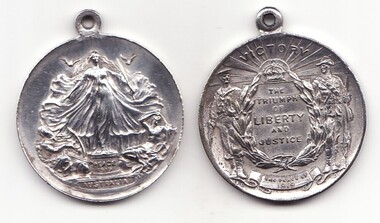
... Australia aged 0-14 years (and aged up to 16 if parents were in the armed forces). The medal was designed by Charles Douglas Richardson, better known for his work as a sculptor. Time constraints as well as pressure from the production of other victory medals meant that no single manufacturer could make the 1,670,000 medals. Six were therefore selected: Amor, Stokes, Schlank, Parkes, Angus & Coote (who later withdrew) and Platers. The medals were silvered bronze, with silver issues for special...Australia aged 0-14 years (and aged up to 16 if parents were in the armed forces). The medal was designed by Charles Douglas Richardson, better known for his work as a sculptor. Time constraints as well as pressure from the production of other victory medals meant that no single manufacturer could make the 1,670,000 medals. Six were therefore selected: Amor, Stokes, Schlank, Parkes, Angus & Coote (who later withdrew) and Platers. The medals were silvered bronze, with silver issues for special ...Awarded to: School Children of the Commonwealth of Australia Other Details: Of the commemorative medals issued to mark the end of the First World War, the most common was the so-called 'Peace' or 'Victory' medal issued to every child in Australia aged 0-14 years (and aged up to 16 if parents were in the armed forces). The medal was designed by Charles Douglas Richardson, better known for his work as a sculptor. Time constraints as well as pressure from the production of other victory medals meant that no single manufacturer could make the 1,670,000 medals. Six were therefore selected: Amor, Stokes, Schlank, Parkes, Angus & Coote (who later withdrew) and Platers. The medals were silvered bronze, with silver issues for special presentations. The Defence Department supplied a red, white and blue striped ribbon and pin. Distribution began in March 1919. Victorian school children received their medals on Friday 18 July and on 'Peace Day' on Saturday 19 July.To commemorate the end of World War 1.Round white metal medals issued to mark the end of WW1. On the front "PEACE 1919", and on the reverse, "VICTORY", middle of the medal "THE TRIUMPH OF LIBERTY AND JUSTICE". on the bottom "THE PEACE OF 1919". With a plain edge.Peace with two flying doves on pedestal inscribed, PEACE / 1919 below AUSTRALIA; figure in chains on left and another entangled in bush to right (obverse) Australian sailor and soldier support wreath; above, VICTORY; within, THE / TRIUMPH / OF / LIBERTY / AND / JUSTICE; below on plaque, THE PEACE OF 1919(reverse)world war 1, peace, victory medal australia -
 Australian Commando Association - Victoria
Photograph, Major Peter Seddon, circa 1950s
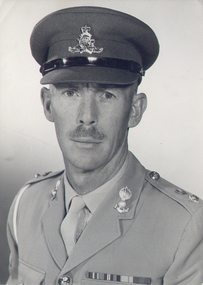
... I and 2 Commando Companies, in Sydney and Melbourne, were the first of the post-WW2 Commando and Special Forces units raised in Australia since the disbanding of the WW2 Commando units. major peter seddon - founding officer commanding - 2 commando company - post-ww2 commando - special forces units "Peter Seddon" Donated by Peter Seddon.The first Officer Commanding 2 Commando Company. ...Major Peter Seddon was the founding Officer Commanding of 2 Commando Company when it was first raised in Melbourne in 1955.I and 2 Commando Companies, in Sydney and Melbourne, were the first of the post-WW2 Commando and Special Forces units raised in Australia since the disbanding of the WW2 Commando units. Rectangular black and white glossy head and shoulders photograph of subject."Peter Seddon" Donated by Peter Seddon.The first Officer Commanding 2 Commando Company.major peter seddon - founding officer commanding - 2 commando company - post-ww2 commando - special forces units
