
Showing 218 items matching "australian wool museum"
-
 Whitehorse Historical Society Inc.
Article, History off the sheep's back, 22/02/1989 12:00:00 AM
... ...Australian Wool Museum...She established the National Wool Museum in Geelong, the Children's Museum in the Museum of Victoria. Was first female vice-master of Ormond College. Museums Faggetter Rachel Australian ...A graduate degree in Chinese enabled Mrs Faggetter to work for 2 years in China teaching English to Chinese scientists.A graduate degree in Chinese enabled Mrs Faggetter to work for 2 years in China teaching English to Chinese scientists. She established the National Wool Museum in Geelong, the Children's Museum in the Museum of Victoria. Was first female vice-master of Ormond College.A graduate degree in Chinese enabled Mrs Faggetter to work for 2 years in China teaching English to Chinese scientists. museums, faggetter, rachel, australian wool museum, geelong, ormond college, cuttler, bob, children's museum -
 Geelong RSL Sub Branch
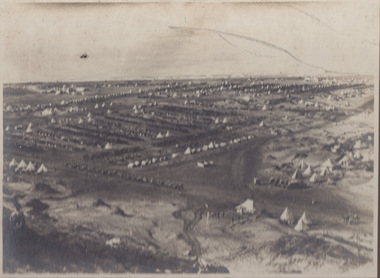
Photograph - 3rd Light Horse Brigade, Brigade Camp Tripoli, Early 20th Century
... On the front - 3rd L H Brg Camp Tripoli On the back - B813 Australian Official Photo No, purchased from Australian War Museum Wool Exchange , King Street, Melbourne. ...WW1 3rd Light Horse Brigade 3rd Light Horse BrigadeTripoli Syria December 1918 On the front - 3rd L H Brg Camp Tripoli On the back - B813 Australian Official Photo No, purchased from Australian War Museum Wool Exchange , King Street, Melbourne. ...The 3rd Light Horse Brigade was a mounted infantry brigade of the 1st AIF and served in the Middle East during WW1.This photograph is of the the 3rd Light Horse Brigade camp at Tripoli, Syria circa December 1918.Sepia coloured photograph on a charcoal coloured matt backing.On the front - 3rd L H Brg Camp Tripoli On the back - B813 Australian Official Photo No, purchased from Australian War Museum Wool Exchange , King Street, Melbourne. Copyright ww1, 3rd light horse brigade, 3rd light horse brigadetripoli, syria, december 1918 -
 Bendigo Military Museum
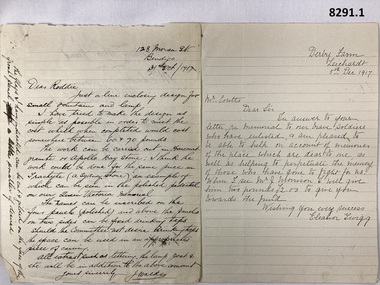
Mixed media - KANGAROO FLAT SOLDIERS MEMORIAL 1917 - 1921
... From the Australian War Museum - Wool Exchange King Street Melbourne. ...From the Australian War Museum - Wool Exchange King Street Melbourne. ...The Cat No 8290 pre this is the Minute book related to "The Kangaroo Flat Soldiers Memorial fund project". These letters, documents, name lists, sketches, quotes all revolve around the project to build a Memorial. They are dated from 31.10.1917 to 12.4.1921. This also includes documentation to have a "War Trophy(s)" on the site. At this time in history Kangaroo Flat was part of the Marong Shire not Bendigo. .1) 1917. These two letters are addressed to Roderick Coutts who was the Secretary of the Memorial Committee. .2) 1918.These letters & documents are broken up into 14 groups (a - n) all re the Kangaroo Flat Memorial. (a) Shire of Marong x two dated 7.6.1918 & 4.10.1918. (b) J.B. Wilson Monumental Sculptures x three dated 2.5.1918 to 9.10.1918. (c) J. Harris Monumental and General Masons dated 6.5.1918. (d) P Finn & Co General Masons dated 21.5.1918. (e) W & R Quinn General Masons dated 21.5.1918. (f) A. M. Irwin Builder & Contractors x two dated 10.11.1918 & 18.11.1918. (g) Herbert Keck & Sons Nurseryman and Orchardist dated 18.9.1918. (h) Department of Public Works x three dated 13.5.1918 - 24.9.1918 - 27.9.1918. (i) Education Department Melbourne x six re State School No 981 Kangaroo Flat dated 6 .3.1918 to 29.8. 1918. (j) Letters x two re R Coutts dated 6.2.1918 & 4.3.1918. (k) Kangaroo Flat & District Soldiers Memorial Fund x one Coutts to Okey. (l) McColl, Rankin & Stanistreet Legal Managers & Accountants x one dated 5.12.1918. (m) Snowden, Neave & Demaine Solicitors & Co x two dated 24.1.1918 & 7.8.1918. (n) Auditors report x one dated 16.12.1918. .3) 1919. Letters x two from "Myr - Nong" Elsternwick to Mr Okey dated 19.3.1919 & 31.3.1919. .4) 1920. Letters x two from the "Prime Ministers Department & Australian Military Forces 3rd Military District" dated 4.3.1920 & 8.3.1920. .5) Six miscellaneous items, only one has a date. (a) Short note re a donation to the Memorial. (b)Price list for Soldiers Memorial works. (c) Sketch in pencil re "Cyclone Spring coil". (d) Letter in Pencil, has a date "Wed April 10th" regarding the final site of the Memorial either, a block of ground in front of the Methodist Church or a block of ground in front of State School. Both fronted the Main Road. Mrs Allen donated the block in front of the School, this offer was accepted. (e) Sketch plan in pencil and red ink showing a proposal of how the site would look with the Memorial on. (f) Two sections of paper pinned together, one in ink, one in pencil. The ink piece is name listed 1 - 65 and some names have notations written next to and is double sided. The notations are "Returned or Killed". The pencil listing has a list of 18 names with "Killed" next to. The other part has 45 names. On the rear of this one is some pencil notes, a sketch and re a meeting on "June 5th". .6) Newspaper cuttings x 2. one relates the site chosen for the Kangaroo Flat Soldiers Memorial being the block in front of the school and donated by Mrs Allen. The other relates to the Repatriation Commission and the costing of local Memorials. .7) War trophy documents & correspondence. (a & b) Dated 10th & 17th December 1918 re application for War trophies replied by the State Parliament House Melbourne. (c) Dated 24 the October 1919. From the Australian War Museum - Wool Exchange King Street Melbourne. (d & e) Dated 22.10.1919 & 8.10.1920. From the Victorian State Trophy Committee and State Parliament. (f) Dated 17th April 1921. From the Victorian State Trophy Committee re allotment of a War trophy. (g) Double sided correspondence with "V98a" at top details the process of allotting War trophies, the Committee, conditions, town size and what is allotted per size. Stamped in purple is "One Machinegun". .1) 1917.Two letters, white paper, ruled lines with black ink hand writing, dated 31.10.1917 & 5.12.1917, the October letter has pencil notes on the rear. .2) 1918. Twenty six letters, documents, quotes either hand written in black pen, pencil, black & purple typed, Business names re letter heads some with images dating from 24.1.1918 ot 30.12.1918. .3) 1919. Two letters all in black pen, one has two pages, both letters have same heading stamp at the top in purple. Dated 19.3.1919 & 31.3.1919. .4) 1920. Two letters typed in black, both have a letter head, dated 4.3.1920 & 8.3.1920. .5) Items. Six miscellaneous items, letter, lists, prices, sketches of the proposed memorial site. .6) Articles. Two Newspaper clippings, yellowed black print, one has been found being 18.4.1918. .7) War trophies. Seven letters and documents, six have a date relating to "War Trophies", black and purple print, dates are 17.2.1918 to 12.4.1921. Sizes vary from note pad size to Foolscap.brsl, smirsl, kfsmf, letters -
 Flagstaff Hill Maritime Museum and Village
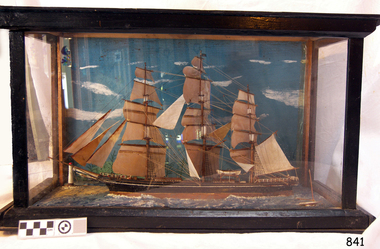
Craft - Ship Model, Cutty Sark
... Flagstaff Hill Warrnambool Flagstaff Hill Maritime Museum Shipwreck Coast Flagstaff Hill Maritime Village Maritime Museum Great Ocean Road Cutty sark historic sailing ship tea clipper sail training vessel cadet training ship commercial trading vessel cargo sail vessel Ferreria 1869 tea cargo tea trade China tea wool export Australian export Australian wool export Cornwall training ship Greenwich British Museum ship model craft hobby ship model Cutty Sark model making "Cutty Sark" Ship model: the clipper ship Cutty Sark in full ship rig with raised poop deck, deck house, three boats on deck (one has fallen). ...THE CUTTY SARK: - The Cutty Sark was built in Britain in 1869 and was one of the last great sailing ships. At first, it carried tea from China. Later, it was used to transport wool from Australia. It became famous for its speed and held the record for the fastest voyage from Australia to Britain for ten years. Later, a Portuguese company bought the ship and renamed it Ferreira. After that, a retired sea captain purchased it to use as a training ship in Cornwall. When the captain died, the ship was given to a training college in Greenwich in 1938. In 1954, it was placed in dry dock at Greenwich, where it remains on display. The Cutty Sark is a special ship because it carried wool from Australia to other parts of the world. Models like this one help us imagine what sea travel was like before steam-powered ships were common, and they show us how trade, travel and migration changed over time. The Cutty Sark is also famous for being very fast. It set a record for the journey from Australia to Britain and kept that title for ten years. Today, people still recognise its importance because it has been carefully preserved and is on display at the British Maritime Museum in Greenwich. Its story has also made it a favorite subject for people who enjoy building ship models. Ship model: the clipper ship Cutty Sark in full ship rig with raised poop deck, deck house, three boats on deck (one has fallen). It has a two-toned black and tan hull and three jibs. The model is set in a diorama of a blue sea, a lighthouse and another small yacht. It is housed in a glass-sided case with a dark grey painted structure. The bow has an inscription."Cutty Sark"flagstaff hill, warrnambool, flagstaff hill maritime museum, shipwreck coast, flagstaff hill maritime village, maritime museum, great ocean road, cutty sark, historic sailing ship, tea clipper, sail training vessel, cadet training ship, commercial trading vessel, cargo sail vessel, ferreria, 1869, tea cargo, tea trade, china tea, wool export, australian export, australian wool export, cornwall, training ship, greenwich, british museum, ship model, craft, hobby, ship model cutty sark, model making -
 Flagstaff Hill Maritime Museum and Village
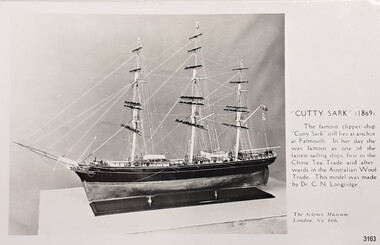
Postcard - Vessel, Sailing Ship, B Matthews (photo printer), Cutty Sark, 20t century
... Australian Wool Trade. This model was made by Dr C.N. Longridge." "The Science Museum, London. ...Australian Wool Trade. This model was made by Dr C.N. Longridge." "The Science Museum, London. ...The maker of the ship model on the postcard was Dr C Nelson Longridge (1876–1952), an English surgeon, maritime author, and builder of detailed ship models. Other models include the SS Marioness and the steam yacht Asia. He also wrote the books 'Cutty Sark' and 'The Anatomy of Nelson's Ships'. The postcard was printed by B Matthews, Bradford, England, incorporated in 1970 as B. Matthews (Photo Printers) Limited. Collections of B Matthews' photo prints of famous painted portraits are held at The National Portrait Gallery of London. Copies of B Matthews postcards are today sought after by collectors. THE CUTTY SARK: - The Cutty Sark was built in Britain in 1869 and was one of the last great sailing ships. At first, it carried tea from China. Later, it was used to transport wool from Australia. It became famous for its speed and held the record for the fastest voyage from Australia to Britain for ten years. Later, a Portuguese company bought the ship and renamed it Ferreira. After that, a retired sea captain purchased it to use as a training ship in Cornwall. When the captain died, the ship was given to a training college in Greenwich in 1938. In 1954, it was placed in dry dock at Greenwich, where it remains on display. This postcard features a photograph of a model of the sailing ship Cutty Sark, making it significant because of its connection to this well-known vessel. The famous tea clipper transported wool from Australia to markets around the world. Models such as this one help us understand what sea travel was like before steam-powered ships became widespread, while also illustrating how trade, travel and migration developed over time. Cutty Sark was also celebrated for its speed. It broke records on the voyage from Australia to Britain and held this distinction for ten years. Its importance is still recognised today, as the ship has been carefully preserved and is now displayed at the British Maritime Museum in Greenwich. Its remarkable history has also made it a popular subject for model ship enthusiasts. The postcard is also valuable because it shows a model of Cutty Sark built by the renowned C. N. Longridge, who was not only a respected surgeon but also a skilled model maker and author of detailed maritime works. A further connection is found in the printer, B Matthews, who photographed and printed collections featuring famous people, model ships and maritime scenes, adding another layer of historical interest to the postcard. Postcard, black and white, showing a model of the sailing ship Cutty Sark. Printed details are provided on both the front and back of the postcard. Inscriptions include a brief description of the Cutty Sark, the location and maker of the model, and the printer's contact information. The postcard was printed in Great Britain.FRONT: " "CUTTY SARK" (1869) The famous clipper ship "Cutty Sark" still lies at anchor at Falmouth. In her day, she was famous as one of the fastest sailing ships, first in the China Tea Trade, and afterwards in the Australian Wool Trade. This model was made by Dr C.N. Longridge." "The Science Museum, London. No. 166." REVERSE: "POSTCARD" "COMMUNICATION" "ADDRESS" "Printed by B Matthews, Bradford, England"flagstaff hill, warrnambool, flagstaff hill maritime museum, shipwreck coast, flagstaff hill maritime village, maritime museum, great ocean road, cutty sark, historic sailing ship, tea clipper, sail training vessel, cadet training ship, commercial trading vessel, cargo sail vessel, clipper races, scott and linton of dunbarton scottland, race record, ferreria, 1869, tea cargo, tea trade, china tea, wool export, australian export, australian wool export, china tea trade, cornwall, training ship, greenwich, british museum, ship model, craft, hobby, ship model cutty sark, model making, postcard, c nelson longridge, charles nelson longridge, b matthews, photo printer, b matthews bradford england, b matthews (photo printer ) ltd. -
 Flagstaff Hill Maritime Museum and Village
Postcard - Vessel, Sailing Ship, Jack Spurling (John Robert Charles Spurling), marine artist, circa 19th century
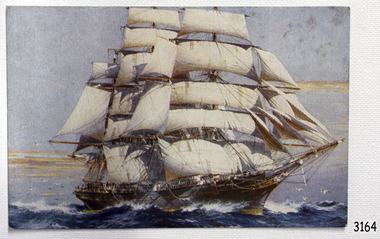
... Flagstaff Hill Warrnambool Flagstaff Hill Maritime Museum Shipwreck Coast Flagstaff Hill Maritime Village Maritime Museum Great Ocean Road Cutty sark historic sailing ship tea clipper sail training vessel cadet training ship commercial trading vessel cargo sail vessel clipper races Scott and Linton of Dunbarton Scottland race record Ferreria 1869 tea cargo tea trade China tea wool export Australian export Australian wool export China tea trade Cornwall training ship Greenwich British Museum postcard coloured postcard postcard of a painting Jack Spurling British maritime artist ship portraits John 'Jack' Robert Charles Spurling Coloured postcard of the Cutty Sark. ...The postcard is a copy of a painting by the renowned British maritime artist Jack Spurling (John (Jack) Robert Charles Spurling 1870-1933). Spurling's love for the sea was fulfilled as a teenager when he worked as an apprentice, eventually gaining a Second Mate certificate and going on to join the Blue Anchor Line as a junior officer. His love for the sea shows in his detailed paintings of ship portraits. THE CUTTY SARK: - The Cutty Sark was built in Britain in 1869 and was one of the last great sailing ships. At first, it carried tea from China. Later, it was used to transport wool from Australia. It became famous for its speed and held the record for the fastest voyage from Australia to Britain for ten years. Later, a Portuguese company bought the ship and renamed it Ferreira. After that, a retired sea captain purchased it to use as a training ship in Cornwall. When the captain died, the ship was given to a training college in Greenwich in 1938. In 1954, it was placed in dry dock at Greenwich, where it remains on display. The postcard depicts the clipper, Cutty Sark, which was a special ship because it carried wool from Australia to other parts of the world. Postcards like this one help us imagine what sea travel was like before steam-powered ships became common, and they show us how trade, travel, and migration evolved. The Cutty Sark is also famous for its speed. It set a record for the journey from Australia to Britain and kept that title for ten years. Today, people still recognise its importance because it has been carefully preserved and is on display at the British Maritime Museum in Greenwich. Its story has also made it a favourite subject for people who enjoy building ship models. The picture is a copy of a painting by renowned maritime artist Jack Spurling, who was famous for his ship portraits.Coloured postcard of the Cutty Sark. Photograph of a painting by J Spurling. flagstaff hill, warrnambool, flagstaff hill maritime museum, shipwreck coast, flagstaff hill maritime village, maritime museum, great ocean road, cutty sark, historic sailing ship, tea clipper, sail training vessel, cadet training ship, commercial trading vessel, cargo sail vessel, clipper races, scott and linton of dunbarton scottland, race record, ferreria, 1869, tea cargo, tea trade, china tea, wool export, australian export, australian wool export, china tea trade, cornwall, training ship, greenwich, british museum, postcard, coloured postcard, postcard of a painting, jack spurling, british maritime artist, ship portraits, john 'jack' robert charles spurling -
 Flagstaff Hill Maritime Museum and Village
Postcard - Vessel, Sailing Ship, Cutty Sark in Sydney Harbour, After August 1891
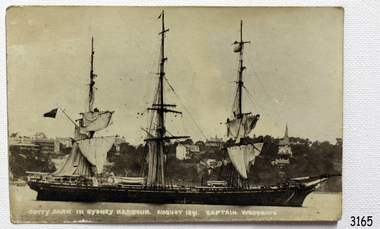
... Australian history, as it shows the Cutty Sark at Sydney on one of its voyages, in the command of Captain Richard Woodget, a respected mariner and master of sailing ships. Flagstaff Hill Warrnambool Flagstaff Hill Maritime Museum Shipwreck Coast Flagstaff Hill Maritime Village Maritime Museum Great Ocean Road Cutty sark historic sailing ship tea clipper sail training vessel cadet training ship commercial trading vessel cargo sail vessel clipper races Scott and Linton of Dunbarton Scottland race record transportation Ferreria 1869 tea cargo tea trade China tea wool export Australian export Australian wool export China tea trade Cornwall training ship Greenwich British Museum Captain Richard Woodget Captain Woodget "CUTTY SARK IN SYDNEY HARBOUR. ...Captain Richard Woodget (1845-1928) was renowned for his successful command of the Cutty Sark. He began his maritime career in 1861 as an apprentice seaman at almost 15 years old and received his Master Certificate in 1871. In 1881, aged 35, he took his first command on the vessel Coldstream. His sailing skill and careful financial management earned him the command of the Cutty Sark for ten of its voyages. For another year, he commanded the Coldingham, then retired from life as a mariner in 1896. The Cutty Sark was built in Britain in 1869 and was one of the last great sailing ships. At first, it carried tea from China. Later, it was used to transport wool from Australia. It became famous for its speed and held the record for the fastest voyage from Australia to Britain for ten years. Later, a Portuguese company bought the ship and renamed it Ferreira. After that, a retired sea captain purchased it to use as a training ship in Cornwall. When the captain died, the ship was given to a training college in Greenwich in 1938. In 1954, it was placed in dry dock at Greenwich, where it remains on display. The postcard is important for is connection with the vessel, Cutty Sark, a special ship because it carried wool from Australia to other parts of the world. Postcards like this one help us imagine what sea travel was like before steam-powered ships were common, and they show us how trade, travel and migration changed over time. The Cutty Sark is also famous for being very fast. It set a record for the journey from Australia to Britain and kept that title for ten years. Today, people still recognise its importance because it has been carefully preserved and is on display at the British Maritime Museum in Greenwich. Its story has also made it a favourite subject for people who enjoy building ship models. The postcard is important to Australian history, as it shows the Cutty Sark at Sydney on one of its voyages, in the command of Captain Richard Woodget, a respected mariner and master of sailing ships.Postcard: Black and white postcard of a photographed image of a 3-masted sailing ship, sails half-lowered. Behind the vessel is a hill with buildings on it. A white handwritten inscription is along the base of the postcard. The vessel is the Cutty Sark in Sydney Harbour in August 1891. Its master was Captain Woodget."CUTTY SARK IN SYDNEY HARBOUR. AUGUST 1891. CAPTAIN WOODGATE."flagstaff hill, warrnambool, flagstaff hill maritime museum, shipwreck coast, flagstaff hill maritime village, maritime museum, great ocean road, cutty sark, historic sailing ship, tea clipper, sail training vessel, cadet training ship, commercial trading vessel, cargo sail vessel, clipper races, scott and linton of dunbarton scottland, race record, transportation, ferreria, 1869, tea cargo, tea trade, china tea, wool export, australian export, australian wool export, china tea trade, cornwall, training ship, greenwich, british museum, captain richard woodget, captain woodget -
 Flagstaff Hill Maritime Museum and Village
Photograph - Vessel, Sailing Ship, Jack Spurling (John Robert Charles Spurling), marine artist, circa 19th century
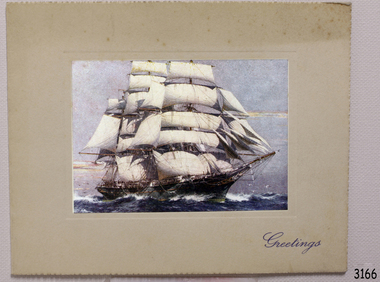
... Flagstaff Hill Warrnambool Flagstaff Hill Maritime Museum Shipwreck Coast Flagstaff Hill Maritime Village Maritime Museum Great Ocean Road Cutty sark historic sailing ship tea clipper sail training vessel cadet training ship commercial trading vessel cargo sail vessel clipper races Scott and Linton of Dunbarton Scottland race record Ferreria 1869 tea cargo tea trade China tea wool export Australian export Australian wool export China tea trade Cornwall training ship Greenwich British Museum postcard coloured postcard postcard of a painting Jack Spurling British maritime artist ship portraits John 'Jack' Robert Charles Spurling "Greetings" Photograph: coloured image of the sailing ship Cutty Sark by artist J Spurling. ...The card is a copy of a painting by the renowned British maritime artist Jack Spurling (John (Jack) Robert Charles Spurling 1870-1933). Spurling's love for the sea was fulfilled as a teenager when he worked as an apprentice, eventually gaining a Second Mate certificate and going on to join the Blue Anchor Line as a junior officer. His love for the sea shows in his detailed paintings of ship portraits. THE CUTTY SARK: - The Cutty Sark was built in Britain in 1869 and was one of the last great sailing ships. At first, it carried tea from China. Later, it was used to transport wool from Australia. It became famous for its speed and held the record for the fastest voyage from Australia to Britain for ten years. Later, a Portuguese company bought the ship and renamed it Ferreira. After that, a retired sea captain purchased it to use as a training ship in Cornwall. When the captain died, the ship was given to a training college in Greenwich in 1938. In 1954, it was placed in dry dock at Greenwich, where it remains on display.The card depicts the clipper, Cutty Sark, which was a special ship because it carried wool from Australia to other parts of the world. Cards like this one help us imagine what sea travel was like before steam-powered ships became common, and they show us how trade, travel, and migration evolved. The Cutty Sark is also famous for its speed. It set a record for the journey from Australia to Britain and kept that title for ten years. Today, people still recognise its importance because it has been carefully preserved and is on display at the British Maritime Museum in Greenwich. The picture is a copy of a painting by renowned maritime artist Jack Spurling, who was famous for his ship portraits.Photograph: coloured image of the sailing ship Cutty Sark by artist J Spurling. The image is mounted on a card used as a greeting card. It has a printed inscription. "Greetings"flagstaff hill, warrnambool, flagstaff hill maritime museum, shipwreck coast, flagstaff hill maritime village, maritime museum, great ocean road, cutty sark, historic sailing ship, tea clipper, sail training vessel, cadet training ship, commercial trading vessel, cargo sail vessel, clipper races, scott and linton of dunbarton scottland, race record, ferreria, 1869, tea cargo, tea trade, china tea, wool export, australian export, australian wool export, china tea trade, cornwall, training ship, greenwich, british museum, postcard, coloured postcard, postcard of a painting, jack spurling, british maritime artist, ship portraits, john 'jack' robert charles spurling -
 Flagstaff Hill Maritime Museum and Village
Wood Sample, c. 1854
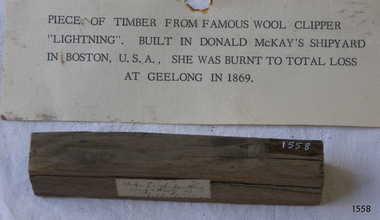
... It spent its whole career carrying cargo and immigrants from England to Australia. flagstaff hill warrnambool shipwrecked-coast flagstaff-hill flagstaff-hill-maritime-museum maritime-museum shipwreck-coast flagstaff-hill-maritime-village sailing ship lightning extreme clipper ship american clipper ship record breaking clipper ship james baines black ball line donald mckay shipbuilder captain ‘bully’ forbes australian immigration liverpool to melbourne migration captain enright captain byrne captain henry jones lightning shoals geelong rabbits introduced to australia wood sample from lightning Card, typewritten, "PIECE OF TIMBER FROM FAMOUS WOOL CLIPPER / "LIGHTNING". ...This piece of wood is from the American clipper ship LIGHTNING was a 3 masted, fully rigged extreme clipper ship. She was commissioned by James Baines, of the Black Ball Line in Liverpool, England, during the time of the Australian Gold Rush for the trade of passengers and cargo between England and Australia. Her cargo listed early consignments of livestock and animals, including rabbits sent to Thomas Austin of Barwon Park, Winchelsea, Victoria. The LIGHTNING was built in 1854 by shipbuilder Donald McKay, of East Boston, USA. She was described as spacious and comfortable, and one of the smartest ships known. The LIGHTNING set many speed records for her sea crossings, and became one of the most famous of the racing clippers and one of the fastest ever launched. In 1854, with Captain ‘Bully’ Forbes and Mate ‘Bully’ Bragg, LIGHTNING made the return trip from Melbourne to Liverpool in only 64 days, 3 hours and 10 minutes; a record for all time. Captain Enright became the new Master of LIGHTNING soon afterwards. He has been described as one of the finest mariners in the Australian trade. One of Captain Enright’s innovations was to publish a ship’s paper called The Lightning Gazette. (Captain Forbes had left to captain the SCHOMBERG.) In January 1855 Capt. Enright sailed the LIGHTNING from Liverpool with over 700 passengers and returned home carrying gold as her cargo. In 1857, for a very brief time under Capt. Byrne the LIGHTNING was used as a troop ship, taking British officers and soldiers, stores and ammunition, to fight in India. In 1859 she then returned to her run between Liverpool and Melbourne, apart from 1867 when she made a special trip between Melbourne and Port Chalmers in New Zealand. In 1869 the LIGHTNING was sold to Thomas Harrison of Liverpool, and she continued to sail for the Black Ball Line. Master of LIGHTNING, Captain Henry Jones, sailed her to Geelong in October 1869, and whilst docked, he had her loaded with a cargo of wool, copper, wire, tallow and other goods. At about 1am on 31st October 1869, whilst still docked and fully laden, a fire was noticed on the LIGHTNING. Efforts to extinguished the fire were unsuccessful, so she was towed to the shoals in Corio Bay, where she eventually sank, losing all cargo but no lives. The area is now known as Lightning Shoals. The LIGHTNING is listed on the Victorian Heritage Register VHR S415. She is historically significant for being one of the fastest wooden ships ever built, the first clipper built in the USA for British owners and being the worst shipping disaster in Geelong's history. It spent its whole career carrying cargo and immigrants from England to Australia.Sample of wood from the wool clipper LIGHTNING, 1854-1869, The sample has a label and a card with information about the ship and a person. Card, typewritten, "PIECE OF TIMBER FROM FAMOUS WOOL CLIPPER / "LIGHTNING". BUILD IN DONALD McKAY'S SHIPYARD / IN BOSTON, U.S.A.. SHE WAS BURNT TO TOTAL LOSS / IN GEELONG IN 1869"flagstaff hill, warrnambool, shipwrecked-coast, flagstaff-hill, flagstaff-hill-maritime-museum, maritime-museum, shipwreck-coast, flagstaff-hill-maritime-village, sailing ship lightning, extreme clipper ship, american clipper ship, record breaking clipper ship, james baines, black ball line, donald mckay shipbuilder, captain ‘bully’ forbes, australian immigration, liverpool to melbourne migration, captain enright, captain byrne, captain henry jones, lightning shoals geelong, rabbits introduced to australia, wood sample from lightning -
 Flagstaff Hill Maritime Museum and Village
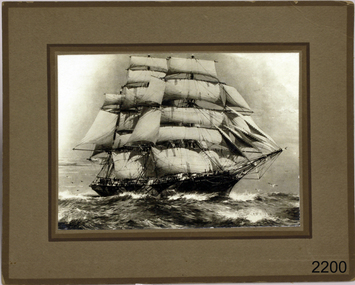
Photograph - Vessel, Sailing Ship, Cutty Sark, Between c.1869-1895
... wool from Australia to other parts of the world. The photograph helps us imagine what sea travel was like before steam-powered ships were common, and they show us how trade, travel and migration changed over time. The Cutty Sark is famous for being very fast. It set a record for the journey from Australia to Britain and kept that title for ten years. Today, people still recognise its importance because it has been carefully preserved and is on display at the British Maritime Museum ...THE CUTTY SARK: The ship Cutty Sark was built expressly for the China Tea Trade and was involved in the famous tea clipper races between 1859 and 1872. It was designed and built by Scott and Linton of Dunbarton, Scotland. Cutty Sark holds the record with 363 knots done more than once. On one occasion, it managed speeds of 362 and 363 knots on two consecutive days. In 1872, it had the misfortune of losing its rudder while racing the "Thermopylae" but was able to continue the race after repairs.The photograph of the Cutty Sark is significant for showing a special ship which carried wool from Australia to other parts of the world. The photograph helps us imagine what sea travel was like before steam-powered ships were common, and they show us how trade, travel and migration changed over time. The Cutty Sark is famous for being very fast. It set a record for the journey from Australia to Britain and kept that title for ten years. Today, people still recognise its importance because it has been carefully preserved and is on display at the British Maritime Museum in Greenwich. Photograph framed black and white photograph behind glass, depicting the tall ship "Cutty Sark" in full rig. Figures are on deck. flagstaff hill, warrnambool, flagstaff hill maritime museum, shipwreck coast, flagstaff hill maritime village, maritime museum, great ocean road, cutty sark, historic sailing ship, tea clipper, sail training vessel, cadet training ship, commercial trading vessel, cargo sail vessel, clipper races, scott and linton of dunbarton scottland, race record, ferreria, 1869, tea cargo, tea trade, china tea, wool export, australian export, australian wool export, china tea trade, thermopylae -
Federation University Historical Collection
Book - Report, Ballarat School of Mines Conservation Management Plan, 2016, 2016
... The Ballarat School of Mines was the first school of mines in Australasia, and is a predecessor institution of Federation University Australia. david rowe wendy jacobs ballarat school of mines conservation management plan ballarat school of mines buildings wesleyan church reserve former ballarat gaol court of mines circuit courthouse gal culvert ballarat school of mines museum ballarat technical art school x-rays ballarat junior technical school motor mechanics wool classing former governor's quarters library flecknoe building former supreme court architects henry richards caselli figgis molloy and smith public work department architects ballarat school of mines botanic garden former ballarat junior technical school commemorative gardem w.j. gribble building old chemistry building amenities building former warden's quarters courthouse theatre a.w. steane building old plumbing building unistyle hairdressing building former ballarat post office post office gallery former ballarat government offices CMP Conservation management plan Ballarat School of Mines Campus SMB Campus CD-ROM of the SMB Campus Conservation Management plan, and a printout of the 390 page Draft report on the Federation University SMB Campus. ...The Ballarat School of Mines was the first school of mines in Australasia, and is a predecessor institution of Federation University Australia.CD-ROM of the SMB Campus Conservation Management plan, and a printout of the 390 page Draft report on the Federation University SMB Campus. Contents include: Establishment of the Wesleyan church Reserve Selection of a Site for the Ballarat Gaol and Court House Building the Court of Mines The Gaol Culvert The Ballarat School of Mines Establishment Ballarat iron Workers' Association Ballarat Technical Art School Ballarat School of Mines Museum Acquisition of Lewin's Land The Ballarat School of Mines site in c1970 Master Planning Flecknoe Biulding The Ballarat School of Mines in 1988 Architectects Caselli, Figgus, Molloy and Smith. Public Work Department Architects Ballarat School of Mines Botanical Garden Former Ballarat Junior Technical School Administration Building - Building A W.J. Gribble Building (Ballarat Technical Art School) - Building B Old Chemistry Building Building C Amenities Building, Governor's Quarters, Gaol Gatehouse and Watch Tower and Gaol Walls - Building D Courthouse Theatre (Former Ballarat Supreme Court) - Building F A.W. Steane Building (Former Ballarat Junior Technical School) - Building J Flecknoe Building and E.J. Barker Building (Building N) Old Plumbing Building - Builidng ) Unistyle Haridressing Building (Formerly Ballarat School of Mines Museum and Wesleyan Church) - Building P david rowe, wendy jacobs, ballarat school of mines conservation management plan, ballarat school of mines, buildings, wesleyan church reserve, former ballarat gaol, court of mines, circuit courthouse, gal culvert, ballarat school of mines museum, ballarat technical art school, x-rays, ballarat junior technical school, motor mechanics, wool classing, former governor's quarters, library, flecknoe building, former supreme court, architects, henry richards caselli, figgis, molloy and smith, public work department architects, ballarat school of mines botanic garden, former ballarat junior technical school commemorative gardem, w.j. gribble building, old chemistry building, amenities building, former warden's quarters, courthouse theatre, a.w. steane building, old plumbing building, unistyle hairdressing building, former ballarat post office, post office gallery, former ballarat government offices, cmp, conservation management plan, ballarat school of mines campus, smb campus -
 Federation University Historical Collection
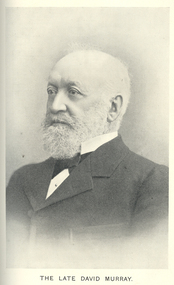
Booklet, South Australian School of Mines and Technological Museum Annual Report, 1909, 1909
... museum...e.a. roberts...e.w. van senden...hon. sir j. langdon bonython...hon. sir f.w. holder...hon. d.m. charleston...professor w.h. bragg...j.g. bice...w.h. matthews)...the school...plans of the metallurgical and chemical laboratories...physics students...assaying furnace room...david murray...noyes electrical engineering laboratory...model scouring plant at the angas wool laboratory...sir george ruthven le hunte...wet assay laboratory. electro-technical room....h. adams...j. langdon bonython...f.w. holder...d.m. charlston...w.h. bragg...j. tho scherk...l. grayson...ruthven le hunte...south australia...Australian School of MInes and Technological Museum Annual Report for 1908 and Prospectus for 1909. Includes images of the School Council (H. Adams, E.A. Roberts, E.W. Van Senden, Hon. Sir J. Langdon Bonython, Hon. Sir F.W. Holder, Hon. D.M. Charleston, Professor W.H. Bragg, J. Theo Scherk. L. Grayson, J.G. Bice, W.H. Matthews), The School, Plans of the Metallurgical and Chemical Laboratories, Physics Students, Assaying Furnace Room, David Murray, Museum, Noyes Electrical Engineering Laboratory, Model Scouring Plant at the Angas Wool...south australian school of mines museum e.a. roberts e.w. van senden hon. sir j. langdon bonython hon. sir f.w. holder hon. d.m. charleston professor w.h. bragg j.g. bice w.h. matthews) the school plans of the metallurgical and chemical laboratories physics students assaying furnace room david murray noyes electrical engineering laboratory model scouring plant at the angas wool laboratory sir george ruthven le hunte wet assay laboratory. electro-technical room. h. adams j. langdon bonython f.w. holder d.m. charlston w.h. bragg j. tho scherk l. grayson ruthven le hunte south australia Schools of mines .3) South Australian School of MInes and Technological Museum Annual Report for 1908 and Prospectus for 1909. ....3) South Australian School of MInes and Technological Museum Annual Report for 1908 and Prospectus for 1909. Includes images of the School Council (H. Adams, E.A. Roberts, E.W. Van Senden, Hon. Sir J. Langdon Bonython, Hon. Sir F.W. Holder, Hon. D.M. Charleston, Professor W.H. Bragg, J. Theo Scherk. L. Grayson, J.G. Bice, W.H. Matthews), The School, Plans of the Metallurgical and Chemical Laboratories, Physics Students, Assaying Furnace Room, David Murray, Museum, Noyes Electrical Engineering Laboratory, Model Scouring Plant at the Angas Wool laboratory, Sir George Ruthven Le Hunte, Wet Assay Laboratory. Electro-Technical Room.south australian school of mines, museum, e.a. roberts, e.w. van senden, hon. sir j. langdon bonython, hon. sir f.w. holder, hon. d.m. charleston, professor w.h. bragg, j.g. bice, w.h. matthews), the school, plans of the metallurgical and chemical laboratories, physics students, assaying furnace room, david murray, noyes electrical engineering laboratory, model scouring plant at the angas wool laboratory, sir george ruthven le hunte, wet assay laboratory. electro-technical room., h. adams, j. langdon bonython, f.w. holder, d.m. charlston, w.h. bragg, j. tho scherk, l. grayson, ruthven le hunte, south australia, schools of mines -
 Flagstaff Hill Maritime Museum and Village
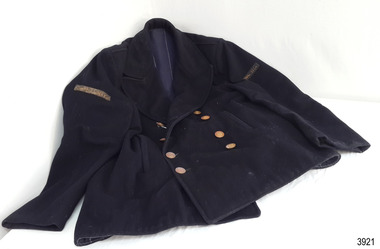
Uniform - Jacket, 19th-20th Century
... Australia. This maritime jacket is significant for its connection with Warrnambool and to maritime service. Its high quality wool suggests that it was made for a senior ranking person. This jacket could have been used by a seaman in the merchant navy, which provided the essential service of transportation of goods and passengers between the ports of south-eastern Australia, including the Port of Warrnambool. Flagstaff Hill Warrnambool Maritime Village Maritime Museum ...This jacket appears to be part of the uniform, connected to Warrnambool through its sleeve labels, and to the sea, through its anchor and chain buttons. It may have been worn in the merchant navy by a senior seaman, due to the good quality of fabric and the double-breasted design, or to life saving at sea, such as a member of the Life Saving Rescue Crew, or even a Harbour Master. This jacket has been used for display on the ketch 'Reginald M', built in 1922 in South Australia and spending the final years of its life at Flagstaff Hill Maritime Village from 1975-2016. The vessel spent much of its working life as a coastal trader along the south-eastern coast of Australia.This maritime jacket is significant for its connection with Warrnambool and to maritime service. Its high quality wool suggests that it was made for a senior ranking person. This jacket could have been used by a seaman in the merchant navy, which provided the essential service of transportation of goods and passengers between the ports of south-eastern Australia, including the Port of Warrnambool.Uniform jacket or coat, maritime. Heavy duty navy-coloured woollen jacket lined with light-weight woollen lining coloured blue with thin white stripe. Double-breasted front with eight buttons with the motif of anchor and chain. Two waist pockets on the outside, two breast pockets on the inside, closed with composition buttons on the lap, plus one spare button. Dark felt fabric labels were stitched to each sleeve just below the shoulder, with gold embroidered letters. Embroidered sleeve labels "WARRNAMBOOL" Embossed on eight buttons, symbol [chain joined to top of anchor and entwined around it, with text on anchor's crossbar]flagstaff hill, warrnambool, maritime village, maritime museum, flagstaff hill maritime museum & village, shipwreck coast, great ocean road, meritime uniform, men's jacket, woollen jacket, double-breasted jacket, merchant navy, maritime uniform jacket, anchor and chain buttons -
 Flagstaff Hill Maritime Museum and Village
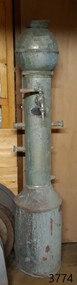
Functional object - Water Boiler, Jackson Boilers Ltd, 1920s
... Australia that included guano, barley, wool, horses, cattle, timber, explosives, potatoes, shell grit, and gypsum. It passed through numerous owners over the years and primarily maintained its purpose as a cargo vessel. In 1975, the decommissioned Reginald M was purchased by Flagstaff Hill Maritime Museum...Australia that included guano, barley, wool, horses, cattle, timber, explosives, potatoes, shell grit, and gypsum. It passed through numerous owners over the years and primarily maintained its purpose as a cargo vessel. In 1975, the decommissioned Reginald M was purchased by Flagstaff Hill Maritime Museum ...Jackson Boilers Ltd., brass founders, electro platers and sheet metal works made this tube water boiler. It was a fitting in the vessel Reginald M, a small cargo ship built at Port Adelaide in 1922 and named after her builder and first owner, John Murch. The Reginald M was launched at Largs Bay, South Australia, in 1922 to carry cargo around South Australia that included guano, barley, wool, horses, cattle, timber, explosives, potatoes, shell grit, and gypsum. It passed through numerous owners over the years and primarily maintained its purpose as a cargo vessel. In 1975, the decommissioned Reginald M was purchased by Flagstaff Hill Maritime Museum as an attraction. Although restoration efforts were undertaken and maintained for the craft above the water line, deterioration occurred below the surface and resulted in the ship being unsafe for visitors to board. It was broken up and removed from Flagstaff Hill in 2018, but items such as the historical boiler remain in Flagstaff Hill’s Collection. JACKSON BOILERS LTD.: - In 1911, Henry Jackson was the Managing Director at Jackson Boilers Ltd. He had gained around 30 years’ experience as a tin plate worker, plumber and gas fitter at Ilkey in 1881, then at Leeds by 1901. By 1921, he had changed employment from Jackson Boilers to Managing Director of Patent Water Boilers. During World War I, Jackson Boilers Ltd of Leeds performed war work like many other manufacturers at that time. The firm made cases for the explosive picric acid and electroplated fuse hole plugs. In 1918, the firm employed 15 males and 19 females. Jacksons Boilers became very successful throughout the first half of the twentieth century with showrooms and sales offices in Scotland, the Midlands and Southern England. It also had an office in Dublin, Ireland. In the post-war 1920s, the firm’s production included instantaneous water boilers and coffee machines for cafes, restaurants and canteens. Jackson Boilers also began to supply shipping lines with catering water boilers for their ships. The firm applied for a USA patent for the tube boiler in 1930, for the design which appears to have been invented in 1926. A 1971 advertisement adds the credentials, Members of the Catering Equipment Manufacturers’ Association. The tube water boiler was designed specifically for use in a ship's restaurant or dining area and patented by Jackson Boilers Ltd. of Leeds. The boiler is significant as a patented design, illustrating the evolution of maritime, commercial and domestic water boilers that have led to many innervations and improvements in today's boilers that are used in heating and in producing hot water for domestic and catering use. It is also significant as it is one of the earlier boilers the Jackson company made in the early 1920s before they applied for a US patent on their revised design in 1926.Water boiler, free standing Jackson's Tube boiler. A tall metal cylindrical stand with a metal sphere on top and several pipe fittings on the sides. A brass tap with a lever handle is connected to the front. A plaque with maker's details is attached under the tap. Details are also impressed into the cylinder above the tap.Jackson Boilers Leeds Ltd. "JACKSON'S PATENT" . Other details indecipherable. flagstaff hill maritime museum and village, flagstaff hill maritime museum, flagstaff hill, maritime museum, maritime village, warrnambool, great ocean road, leeds, jackson boilers ltd, jackson boilers, henry jackson, brass founders, electro platers, sheet metal works, patent water boilers, leeds manufacturer, tube water boiler, domestic boiler, tube domestic boiler, tube boiler, water heaters, water boilers, self-feeding water boilers, sheet metal work instantaneous water heaters, engineering, allied trades, metal workers, metal trade, food machinery, hospitality equipment, ship equipment, ship water boiler, ship heater, catering boilers, café boiler, restaurant boiler, canteen boiler, catering equipment manufacturers’ association, cema, kitchen equipment, kitchen appliance, war work, world war i, wwi, picric acid, picric acid cases, fuse hole plugs, electro plated fuse hole plugs, reginald m, cargo ship, port adelaide, 1922, john murch -
 Flagstaff Hill Maritime Museum and Village
Functional object - Cotton Wool Roll, Johnson & Johnson, Early 20th century
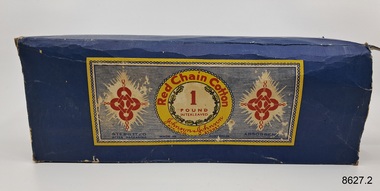
... Flagstaff Hill Maritime Museum and Village Great Ocean Road Shipwreck Coast Cotton Wool Medical Johnson & Johnson Red Chain Cotton W.R. Angus 'Red Chain Cotton. 1 Pound Interleaved. Johnson & Johnson Pty Ltd, Sydney. Sterilized after packaging. Made in Australia ...This cotton wool, used by Dr.William Roy Angus, Surgeon and Oculist, was donated to Flagstaff Hill Maritime Village by his daughter, Bernice McDade. It is part of the “W.R. Angus Collection” that includes historical medical equipment, surgical instruments and material once belonging to Dr Edward Ryan and Dr Thomas Francis Ryan, (both of Nhill, Victoria) as well as Dr Angus’ own belongings. The Collection’s history spans the medical practices of the two Doctors Ryan, from 1885-1926 plus that of Dr Angus, up until 1969. ABOUT THE “W.R.ANGUS COLLECTION” Doctor William Roy Angus M.B., B.S., Adel., 1923, F.R.C.S. Edin.,1928 (also known as Dr Roy Angus) was born in Murrumbeena, Victoria in 1901 and lived until 1970. He qualified as a doctor in 1923 at University of Adelaide, was Resident Medical Officer at the Royal Adelaide Hospital in 1924 and for a period was house surgeon to Sir (then Mr.) Henry Simpson Newland. Dr Angus was briefly an Assistant to Dr Riddell of Kapunda, then commenced private practice at Curramulka, Yorke Peninsula, SA, where he was physician, surgeon and chemist. In 1926, he was appointed as new Medical Assistant to Dr Thomas Francis Ryan (T.F. Ryan, or Tom), in Nhill, Victoria, where his experiences included radiology and pharmacy. In 1927 he was Acting House Surgeon in Dr Tom Ryan’s absence. Dr Angus had become engaged to Gladys Forsyth and they decided he would take time to further his studies overseas in the UK in 1927. He studied at London University College Hospital and at Edinburgh Royal Infirmary and in 1928, was awarded FRCS (Fellow from the Royal College of Surgeons), Edinburgh. He worked his passage back to Australia as a Ship’s Surgeon on the on the Australian Commonwealth Line’s T.S.S. Largs Bay. Dr Angus married Gladys in 1929, in Ballarat. (They went on to have one son (Graham 1932, born in SA) and two daughters (Helen (died 12/07/1996) and Berenice (Berry), both born at Mira, Nhill ) Dr Angus was a ‘flying doctor’ for the A.I.M. (Australian Inland Ministry) Aerial Medical Service in 1928 . The organisation began in South Australia through the Presbyterian Church in that year, with its first station being in the remote town of Oodnadatta, where Dr Angus was stationed. He was locum tenens there on North-South Railway at 21 Mile Camp. He took up this ‘flying doctor’ position in response to a call from Dr John Flynn; the organisation was later known as the Flying Doctor Service, then the Royal Flying Doctor Service. A lot of his work during this time involved dental surgery also. Between 1928-1932 he was surgeon at the Curramulka Hospital, Yorke Peninsula, South Australia. In 1933 Dr Angus returned to Nhill where he’d previously worked as Medical Assistant and purchased a share of the Nelson Street practice and Mira hospital from Dr Les Middleton one of the Middleton Brothers, the current owners of what was once Dr Tom Ryan’s practice. Dr L Middleton was House Surgeon to the Nhill Hospital 1926-1933, when he resigned. [Dr Tom Ryan’s practice had originally belonged to his older brother Dr Edward Ryan, who came to Nhill in 1885. Dr Edward saw patients at his rooms, firstly in Victoria Street and in 1886 in Nelson Street, until 1901. The Nelson Street practice also had a 2 bed ward, called Mira Private Hospital ). Dr Edward Ryan was House Surgeon at the Nhill Hospital 1884-1902 . He also had occasions where he successfully performed veterinary surgery for the local farmers too. Dr Tom Ryan then purchased the practice from his brother in 1901. Both Dr Edward and Dr Tom Ryan work as surgeons included eye surgery. Dr Tom Ryan performed many of his operations in the Mira private hospital on his premises. He too was House Surgeon at the Nhill Hospital 1902-1926. Dr Tom Ryan had one of the only two pieces of radiology equipment in Victoria during his practicing years – The Royal Melbourne Hospital had the other one. Over the years Dr Tom Ryan gradually set up what was effectively a training school for country general-practitioner-surgeons. Each patient was carefully examined, including using the X-ray machine, and any surgery was discussed and planned with Dr Ryan’s assistants several days in advance. Dr Angus gained experience in using the X-ray machine there during his time as assistant to Dr Ryan. Dr Tom Ryan moved from Nhill in 1926. He became a Fellow of the Royal Australasian College of Surgeons in 1927, soon after its formation, a rare accolade for a doctor outside any of the major cities. He remained a bachelor and died suddenly on 7th Dec 1955, aged 91, at his home in Ararat. Scholarships and prizes are still awarded to medical students in the honour of Dr T.F. Ryan and his father, Dr Michael Ryan, and brother, John Patrick Ryan. ] When Dr Angus bought into the Nelson Street premises in Nhill he was also appointed as the Nhill Hospital’s Honorary House Surgeon 1933-1938. His practitioner’s plate from his Nhill surgery states “HOURS Daily, except Tuesdays, Fridays and Saturday afternoons, 9-10am, 2-4pm, 7-8pm. Sundays by appointment”. This plate is now mounted on the doorway to the Port Medical Office at Flagstaff Hill Maritime Village, Warrnambool. Dr Edward Ryan and Dr Tom Ryan had an extensive collection of historical medical equipment and materials spanning 1884-1926 and when Dr Angus took up practice in their old premises he obtained this collection, a large part of which is now on display at the Port Medical Office at Flagstaff Hill Maritime Village in Warrnambool. During his time in Nhill Dr Angus was involved in the merging of the Mira Hospital and Nhill Public Hospital into one public hospital and the property titles passed on to Nhill Hospital in 1939. In 1939 Dr Angus and his family moved to Warrnambool where he purchased “Birchwood,” the 1852 home and medical practice of Dr John Hunter Henderson, at 214 Koroit Street. (This property was sold in1965 to the State Government and is now the site of the Warrnambool Police Station. ). The Angus family was able to afford gardeners, cooks and maids; their home was a popular place for visiting dignitaries to stay whilst visiting Warrnambool. Dr Angus had his own silk worm farm at home in a Mulberry tree. His young daughter used his centrifuge for spinning the silk. Dr Angus was appointed on a part-time basis as Port Medical Officer (Health Officer) in Warrnambool and held this position until the 1940’s when the government no longer required the service of a Port Medical Officer in Warrnambool; he was thus Warrnambool’s last serving Port Medical Officer. (The duties of a Port Medical Officer were outlined by the Colonial Secretary on 21st June, 1839 under the terms of the Quarantine Act. Masters of immigrant ships arriving in port reported incidents of diseases, illness and death and the Port Medical Officer made a decision on whether the ship required Quarantine and for how long, in this way preventing contagious illness from spreading from new immigrants to the residents already in the colony.) Dr Angus was a member of the Australian Medical Association, for 35 years and surgeon at the Warrnambool Base Hospital 1939-1942, He served as a Surgeon Captain during WWII1942-45, in Ballarat, Victoria, and in Bonegilla, N.S.W., completing his service just before the end of the war due to suffering from a heart attack. During his convalescence he carved an intricate and ‘most artistic’ chess set from the material that dentures were made from. He then studied ophthalmology at the Royal Melbourne Eye and Ear Hospital and created cosmetically superior artificial eyes by pioneering using the intrascleral cartilage. Angus received accolades from the Ophthalmological Society of Australasia for this work. He returned to Warrnambool to commence practice as an ophthalmologist, pioneering in artificial eye improvements. He was Honorary Consultant Ophthalmologist to Warrnambool Base Hospital for 31 years. He made monthly visits to Portland as a visiting surgeon, to perform eye surgery. He represented the Victorian South-West subdivision of the Australian Medical Association as its secretary between 1949 and 1956 and as chairman from 1956 to 1958. In 1968 Dr Angus was elected member of Spain’s Barraquer Institute of Barcelona after his research work in Intrasclearal cartilage grafting, becoming one of the few Australian ophthalmologists to receive this honour, and in the following year presented his final paper on Living Intrasclearal Cartilage Implants at the Inaugural Meeting of the Australian College of Ophthalmologists in Melbourne In his personal life Dr Angus was a Presbyterian and treated Sunday as a Sabbath, a day of rest. He would visit 3 or 4 country patients on a Sunday, taking his children along ‘for the ride’ and to visit with him. Sunday evenings he would play the pianola and sing Scottish songs to his family. One of Dr Angus’ patients was Margaret MacKenzie, author of a book on local shipwrecks that she’d seen as an eye witness from the late 1880’s in Peterborough, Victoria. In the early 1950’s Dr Angus, painted a picture of a shipwreck for the cover jacket of Margaret’s book, Shipwrecks and More Shipwrecks. She was blind in later life and her daughter wrote the actual book for her. Dr Angus and his wife Gladys were very involved in Warrnambool’s society with a strong interest in civic affairs. Their interests included organisations such as Red Cross, Rostrum, Warrnambool and District Historical Society (founding members), Wine and Food Society, Steering Committee for Tertiary Education in Warrnambool, Local National Trust, Good Neighbour Council, Housing Commission Advisory Board, United Services Institute, Legion of Ex-Servicemen, Olympic Pool Committee, Food for Britain Organisation, Warrnambool Hospital, Anti-Cancer Council, Boys’ Club, Charitable Council, National Fitness Council and Air Raid Precautions Group. He was also a member of the Steam Preservation Society and derived much pleasure from a steam traction engine on his farm. He had an interest in people and the community He and his wife Gladys were both involved in the creation of Flagstaff Hill, including the layout of the gardens. After his death (28th March 1970) his family requested his practitioner’s plate, medical instruments and some personal belongings be displayed in the Port Medical Office surgery at Flagstaff Hill Maritime Village, and be called the “W. R. Angus Collection”.The W.R. Angus Collection is significant for still being located at the site it is connected with, Doctor Angus being the last Port Medical Officer in Warrnambool. The collection of medical instruments and other items and equipment is culturally significant, being an historical example of medicine from late 19th to mid-20th century. Dr Angus assisted Dr Tom Ryan, a pioneer in the use of X-rays and in ocular surgery.Box of cotton wool. The cotton wool sheet is covered in blue tissue paper that has been rooled tightly and stored within a rectangular blue cardboard box. The box has white printed text on one side and a coloured paper label on another side. The text includes instructions for use. Made by Johnson & Johnson Pty Ltd, Sydney. The object is part of the W.R. Angus Collection.'Red Chain Cotton. 1 Pound Interleaved. Johnson & Johnson Pty Ltd, Sydney. Sterilized after packaging. Made in Australia. Absorbent.' 'To open, cut along the perforation. To close tuck-in flap. This cotton is of superior grade specially made for wound and surgical purposes. It will also be found useful in the household, office or factory and as a general toilet accessory.'flagstaff hill maritime museum and village, great ocean road, shipwreck coast, cotton wool, medical, johnson & johnson, red chain cotton, w.r. angus -
 Flagstaff Hill Maritime Museum and Village
Document - Permit, Miner's Right - Collins, 1888
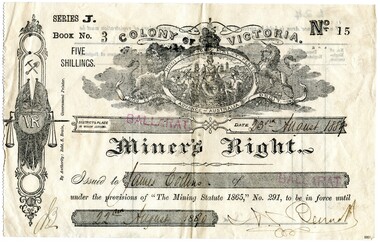
... Although the southwest region found it's source of wealth in other industries from whaling and fishing, wool and other agricultural pursuits. flagstaff hill warrnambool shipwrecked coast flagstaff hill maritime museum maritime museum shipwreck coast flagstaff hill maritime village great ocean road James Collins Australian Goldfields Miner's Rights the history of ballarat Gold Rush "Series J. ...This Miner’s Right, one of a pair of two in our collection, was issued post the rush of the 1850s-60s but is testament to the ongoing interest in gold although the great rush had dwindled. Local papers continued to report on findings and hopes of success, including syndicates and explorations across the south-west district of Victoria and Otways. The Warrnambool correspondent of the “Hamilton Spectator”, 31/1/1878, p4 attest to the price of a good season of potatoes comparing “favourably with the unsteady returns of any precarious gold-bearing quartz reefs in the colony.” A James Collins (1842-1918) is listed in the Pioneers’ Register, Warrnambool, Township and Shire 1839-1900, Volume One, A.I.G.S Warrnambool Branch, 2004, p137. As are numerous other Collins pioneer families of the district. This item is significant in that it illustrates that people associated with the region were interested in taking their chances in prospecting for gold similar to many others. A lure that is still present for some today. Although the southwest region found it's source of wealth in other industries from whaling and fishing, wool and other agricultural pursuits. Miner's Rights permit, one of two, This is a top to bottom upright image of a Miner’s Right. It is a buff coloured document printed in black ink. It was issued in “BALLARAT” and rubber stamped twice in red ink. The issue to “James Collins”, is dated “23rd August 1889” to “22nd August 1890”. The signature of the authority could be Bennet. All handwriting is script style in black ink. Looking from the front the lefthand side has a serrated edge. The back is printed in black ink and there are no “particulars of registration”. The Miner’s Right is from “Series J, Book No. 3, ticket “No. 15”. A “Colony of Victoria” coat of arms is displayed at the top of the document. An insignia runs along the lefthand side of the license featuring coat of arms with a kangaroo and emu, then a miner’s pick and shovel, two crossed Union Jack flags sit behind a monogram “VR” with a hanging set of scales supported by a sword. "By Authority Robt. S. Brain, Government Printer.""Series J. Book No. 3 Five Shillings. No. 15. Colony of Victoria. Miner's Right"flagstaff hill, warrnambool, shipwrecked coast, flagstaff hill maritime museum, maritime museum, shipwreck coast, flagstaff hill maritime village, great ocean road, james collins, australian goldfields, miner's rights, the history of ballarat, gold rush -
 Flagstaff Hill Maritime Museum and Village
Document - Permit, Miner's Right, 1888
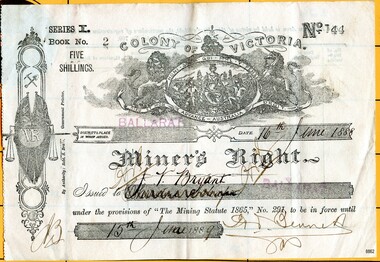
... Although the southwest region found it's source of wealth in other industries from whaling and fishing, wool and other agricultural pursuits. flagstaff hill warrnambool shipwrecked coast flagstaff hill maritime museum maritime museum shipwreck coast flagstaff hill maritime village great ocean road James Collins Australian Goldfields Miner's Rights the history of ballarat Gold Rush Bryant Series I. ...This Miner’s Right was issued post the rush of the 1850s-60s but is testament to the ongoing interest in gold although the great rush had dwindled. Local papers continued to report on findings and hopes of success, including syndicates and explorations across the south-west district of Victoria and Otway Region, Victoria. The Warrnambool correspondent of the “Hamilton Spectator”, 31/1/1878, p4 attest to the price of a good season of potatoes comparing “favourably with the unsteady returns of any precarious gold-bearing quartz reefs in the colony.” The Miner's Wright is issued to -- Bryant. While it cannot be found who this Bryant is, the name Bryant is historical to the town of Warrnambool which has a street named after William Bryant the first head teacher of the Jamieson Street Primary School from 1876 to 1894. Numerous newspapers of the day reported the movement of local residents moving to other regions with varying success of gold prospecting. This item is significant in that it illustrates that people associated with the region were interested in taking their chances in prospecting for gold similar to many others. A lure that is still present for some today. Although the southwest region found it's source of wealth in other industries from whaling and fishing, wool and other agricultural pursuits.Top to bottom upright Miner’s Right. “Series I. Book No. 2. Five Shillings. No. 144. Colony of Victoria” Issued in Ballarat, date 16th June 1888 to “[looks like] J. V. Bryant”. A previous name is scribbled through and looks like Christine, second name not deciphered. The document is in force until “15th June 1889”. “The Mining Statute 1865”. Authorised signature last name Bennet. The paper is buff and has some slight ink markings and finger smudges. A coat of arms appears at the top centre. Another insignia related to mining with a pick and shovel, set of scales and the initial “VR” goes down the lefthand side of the page. This page has a serrated edge. The ink on the page is black, and the words “BALLARAT” are stamped in red ink, now faded. All hand writing is black script. There are no “particulars of registration” given in the spaces provided on the back of the document. Series I. Book No. 2. No. 144. Ballarat. 16th Jume 1888 to 15th June 1889. Colony of Victoria "The Mining Statue 1865, No. 291.flagstaff hill, warrnambool, shipwrecked coast, flagstaff hill maritime museum, maritime museum, shipwreck coast, flagstaff hill maritime village, great ocean road, james collins, australian goldfields, miner's rights, the history of ballarat, gold rush, bryant -
 Flagstaff Hill Maritime Museum and Village
Book - Reference Book/History/Social History, George William Rusden, History of Australia Vol 2, 1883
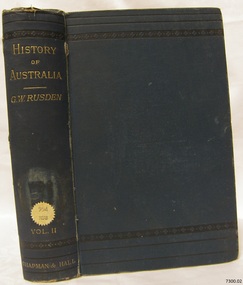
... (For more information on the Pattison Collection see item 3678 Flagstaff Hill collections) https://victoriancollections.net.au/items/5580c7e72162f114d8b758db warrnambool shipwrecked-coast flagstaff-hill flagstaff-hill-maritime-museum maritime-museum shipwreck-coast flagstaff-hill-maritime-village shipwrecked-artefact great ocean road book warrnambool library warrnambool mechanics’ institute mechanics’ institute library victorian library board warrnambool books and records warrnambool children’s library warrnambool public library History of Australia Vol 2 G W Rusden Volume 2 of G.W. Rusden's History of Australia continues the narrative from early colonial governance, examining governors after Arthur Phillip up through the mid 19th century. It covers expansions in New South Wales, the establishment of Van Diemen's Land (Tasmania), and Moreton Bay (Queensland), including key events like the Macarthur wool ...Volume 2 of G.W. Rusden's History of Australia continues the narrative from early colonial governance, examining governors after Arthur Phillip up through the mid 19th century. It covers expansions in New South Wales, the establishment of Van Diemen's Land (Tasmania), and Moreton Bay (Queensland), including key events like the Macarthur wool industry rise, convict management under governors like Lachlan Macquarie, and inter colonial tensions.Hard cover book History of Australia in three Volumes Author: George William Rusden Publisher: Chapman & Hall Ltd London, Melbourne and Sydney Date: 1883 Dark blue hardcover with a blue matching spine, the spine has a label with an inscription. (These volumes are first editions)non-fictionVolume 2 of G.W. Rusden's History of Australia continues the narrative from early colonial governance, examining governors after Arthur Phillip up through the mid 19th century. It covers expansions in New South Wales, the establishment of Van Diemen's Land (Tasmania), and Moreton Bay (Queensland), including key events like the Macarthur wool industry rise, convict management under governors like Lachlan Macquarie, and inter colonial tensions.warrnambool, shipwrecked-coast, flagstaff-hill, flagstaff-hill-maritime-museum, maritime-museum, shipwreck-coast, flagstaff-hill-maritime-village, shipwrecked-artefact, great ocean road, book, warrnambool library, warrnambool mechanics’ institute, mechanics’ institute library, victorian library board, warrnambool books and records, warrnambool children’s library, warrnambool public library, history of australia vol 2, g w rusden -
 Flagstaff Hill Maritime Museum and Village
Box and glass tube, about 1912
... Dr Angus assisted Dr Tom Ryan, a pioneer in the use of X-rays and in ocular surgery. flagstaff hill warrnambool shipwrecked coast flagstaff hill maritime museum maritime museum shipwreck coast flagstaff hill maritime village great ocean road wellcome & burroughs vichy tabloid wellcome & burroughs dr w r angus dr t f ryan nhill hospital nhill medical treatment dental treatment flagstaff hill warrnambool shipwrecked coast flagstaff hill maritime museum maritime museum shipwreck coast flagstaff hill maritime village great ocean road wellcome & burroughs vichy tabloid wellcome & burroughs dr w r angus dr t f ryan nhill hospital nhill medical treatment dental treatment On label of box “Vichy Salt (Artificial) Effervescent”, 25 compressed tablets, made by Burroughs, Wellcome & Co. Australia Ltd, Sydney, NSW. “ ” “KEEP WELL CORKED AND IN A COOL DRY PLACE” A rectangular box of Tabloid brand 'Vichy Salt (Artificial Effervescent), medication from Dr T.F. Ryan's medical practice. Inside is a glass tube with rounded base and a cork stopper. The tube contains a cotton wool ...Wellcome & Burroughs pharmaceutical company was founded in London in 1880 by American pharmacists. The first overseas branch opened in Sydney, Australia, in 1898 and by 1912 another 7 branches had opened. The box lists all of the 9 branches on it. Vichy Effervescent Salts are an antacid mixture in a tablet form. Wellcome & Burroughs company invented the name “Tabloid” to describe the process of compacting powders in measured doses to form a tablet. The label attached around the glass tube lists the same information as on the box, and also gives directions “One powdered and dissolved in wineglassful (about two ounces) of water represents an equal quantity of Vichy Water (Grand Grille Spring) in all its essential constituents and may be taken when required, as ordered by the physician.” “KEEP WELL CORKED AND IN A COOL DRY PLACE” The mineral spring waters from Vichy, France, have been used through the ages as a natural therapy, including aiding the digestive system. The Vichy tablets are made from chemicals that have similar properties. This box once containing Vichy Effervescent Salts was donated to Flagstaff Hill Maritime Village by the family of Doctor William Roy Angus, Surgeon and Oculist. It is part of the “W.R. Angus Collection” that includes historical medical equipment, surgical instruments and material once belonging to Dr Edward Ryan and Dr Thomas Francis Ryan, (both of Nhill, Victoria) as well as Dr Angus’ own belongings. The Collection’s history spans the medical practices of the two Doctors Ryan, from 1885-1926 plus that of Dr Angus, up until 1969. ABOUT THE “W.R.ANGUS COLLECTION” Doctor William Roy Angus M.B., B.S., Adel., 1923, F.R.C.S. Edin.,1928 (also known as Dr Roy Angus) was born in Murrumbeena, Victoria in 1901 and lived until 1970. He qualified as a doctor in 1923 at University of Adelaide, was Resident Medical Officer at the Royal Adelaide Hospital in 1924 and for a period was house surgeon to Sir (then Mr.) Henry Simpson Newland. Dr Angus was briefly an Assistant to Dr Riddell of Kapunda, then commenced private practice at Curramulka, Yorke Peninsula, SA, where he was physician, surgeon and chemist. In 1926, he was appointed as new Medical Assistant to Dr Thomas Francis Ryan (T.F. Ryan, or Tom), in Nhill, Victoria, where his experiences included radiology and pharmacy. In 1927 he was Acting House Surgeon in Dr Tom Ryan’s absence. Dr Angus had become engaged to Gladys Forsyth and they decided he would take time to further his studies overseas in the UK in 1927. He studied at London University College Hospital and at Edinburgh Royal Infirmary and in 1928, was awarded FRCS (Fellow from the Royal College of Surgeons), Edinburgh. He worked his passage back to Australia as a Ship’s Surgeon on the on the Australian Commonwealth Line’s T.S.S. Largs Bay. Dr Angus married Gladys in 1929, in Ballarat. (They went on to have one son (Graham 1932, born in SA) and two daughters (Helen (died 12/07/1996) and Berenice (Berry), both born at Mira, Nhill ) Dr Angus was a ‘flying doctor’ for the A.I.M. (Australian Inland Ministry) Aerial Medical Service in 1928 . The organisation began in South Australia through the Presbyterian Church in that year, with its first station being in the remote town of Oodnadatta, where Dr Angus was stationed. He was locum tenens there on North-South Railway at 21 Mile Camp. He took up this ‘flying doctor’ position in response to a call from Dr John Flynn; the organisation was later known as the Flying Doctor Service, then the Royal Flying Doctor Service. A lot of his work during this time involved dental surgery also. Between 1928-1932 he was surgeon at the Curramulka Hospital, Yorke Peninsula, South Australia. In 1933 Dr Angus returned to Nhill where he’d previously worked as Medical Assistant and purchased a share of the Nelson Street practice and Mira hospital from Dr Les Middleton one of the Middleton Brothers, the current owners of what was once Dr Tom Ryan’s practice. Dr L Middleton was House Surgeon to the Nhill Hospital 1926-1933, when he resigned. [Dr Tom Ryan’s practice had originally belonged to his older brother Dr Edward Ryan, who came to Nhill in 1885. Dr Edward saw patients at his rooms, firstly in Victoria Street and in 1886 in Nelson Street, until 1901. The Nelson Street practice also had a 2 bed ward, called Mira Private Hospital ). Dr Edward Ryan was House Surgeon at the Nhill Hospital 1884-1902 . He also had occasions where he successfully performed veterinary surgery for the local farmers too. Dr Tom Ryan then purchased the practice from his brother in 1901. Both Dr Edward and Dr Tom Ryan work as surgeons included eye surgery. Dr Tom Ryan performed many of his operations in the Mira private hospital on his premises. He too was House Surgeon at the Nhill Hospital 1902-1926. Dr Tom Ryan had one of the only two pieces of radiology equipment in Victoria during his practicing years – The Royal Melbourne Hospital had the other one. Over the years Dr Tom Ryan gradually set up what was effectively a training school for country general-practitioner-surgeons. Each patient was carefully examined, including using the X-ray machine, and any surgery was discussed and planned with Dr Ryan’s assistants several days in advance. Dr Angus gained experience in using the X-ray machine there during his time as assistant to Dr Ryan. Dr Tom Ryan moved from Nhill in 1926. He became a Fellow of the Royal Australasian College of Surgeons in 1927, soon after its formation, a rare accolade for a doctor outside any of the major cities. He remained a bachelor and died suddenly on 7th Dec 1955, aged 91, at his home in Ararat. Scholarships and prizes are still awarded to medical students in the honour of Dr T.F. Ryan and his father, Dr Michael Ryan, and brother, John Patrick Ryan. ] When Dr Angus bought into the Nelson Street premises in Nhill he was also appointed as the Nhill Hospital’s Honorary House Surgeon 1933-1938. His practitioner’s plate from his Nhill surgery states “HOURS Daily, except Tuesdays, Fridays and Saturday afternoons, 9-10am, 2-4pm, 7-8pm. Sundays by appointment”. This plate is now mounted on the doorway to the Port Medical Office at Flagstaff Hill Maritime Village, Warrnambool. Dr Edward Ryan and Dr Tom Ryan had an extensive collection of historical medical equipment and materials spanning 1884-1926 and when Dr Angus took up practice in their old premises he obtained this collection, a large part of which is now on display at the Port Medical Office at Flagstaff Hill Maritime Village in Warrnambool. During his time in Nhill Dr Angus was involved in the merging of the Mira Hospital and Nhill Public Hospital into one public hospital and the property titles passed on to Nhill Hospital in 1939. In 1939 Dr Angus and his family moved to Warrnambool where he purchased “Birchwood,” the 1852 home and medical practice of Dr John Hunter Henderson, at 214 Koroit Street. (This property was sold in1965 to the State Government and is now the site of the Warrnambool Police Station. ). The Angus family was able to afford gardeners, cooks and maids; their home was a popular place for visiting dignitaries to stay whilst visiting Warrnambool. Dr Angus had his own silk worm farm at home in a Mulberry tree. His young daughter used his centrifuge for spinning the silk. Dr Angus was appointed on a part-time basis as Port Medical Officer (Health Officer) in Warrnambool and held this position until the 1940’s when the government no longer required the service of a Port Medical Officer in Warrnambool; he was thus Warrnambool’s last serving Port Medical Officer. (The duties of a Port Medical Officer were outlined by the Colonial Secretary on 21st June, 1839 under the terms of the Quarantine Act. Masters of immigrant ships arriving in port reported incidents of diseases, illness and death and the Port Medical Officer made a decision on whether the ship required Quarantine and for how long, in this way preventing contagious illness from spreading from new immigrants to the residents already in the colony.) Dr Angus was a member of the Australian Medical Association, for 35 years and surgeon at the Warrnambool Base Hospital 1939-1942, He served as a Surgeon Captain during WWII1942-45, in Ballarat, Victoria, and in Bonegilla, N.S.W., completing his service just before the end of the war due to suffering from a heart attack. During his convalescence he carved an intricate and ‘most artistic’ chess set from the material that dentures were made from. He then studied ophthalmology at the Royal Melbourne Eye and Ear Hospital and created cosmetically superior artificial eyes by pioneering using the intrascleral cartilage. Angus received accolades from the Ophthalmological Society of Australasia for this work. He returned to Warrnambool to commence practice as an ophthalmologist, pioneering in artificial eye improvements. He was Honorary Consultant Ophthalmologist to Warrnambool Base Hospital for 31 years. He made monthly visits to Portland as a visiting surgeon, to perform eye surgery. He represented the Victorian South-West subdivision of the Australian Medical Association as its secretary between 1949 and 1956 and as chairman from 1956 to 1958. In 1968 Dr Angus was elected member of Spain’s Barraquer Institute of Barcelona after his research work in Intrasclearal cartilage grafting, becoming one of the few Australian ophthalmologists to receive this honour, and in the following year presented his final paper on Living Intrasclearal Cartilage Implants at the Inaugural Meeting of the Australian College of Ophthalmologists in Melbourne In his personal life Dr Angus was a Presbyterian and treated Sunday as a Sabbath, a day of rest. He would visit 3 or 4 country patients on a Sunday, taking his children along ‘for the ride’ and to visit with him. Sunday evenings he would play the pianola and sing Scottish songs to his family. One of Dr Angus’ patients was Margaret MacKenzie, author of a book on local shipwrecks that she’d seen as an eye witness from the late 1880’s in Peterborough, Victoria. In the early 1950’s Dr Angus, painted a picture of a shipwreck for the cover jacket of Margaret’s book, Shipwrecks and More Shipwrecks. She was blind in later life and her daughter wrote the actual book for her. Dr Angus and his wife Gladys were very involved in Warrnambool’s society with a strong interest in civic affairs. Their interests included organisations such as Red Cross, Rostrum, Warrnambool and District Historical Society (founding members), Wine and Food Society, Steering Committee for Tertiary Education in Warrnambool, Local National Trust, Good Neighbour Council, Housing Commission Advisory Board, United Services Institute, Legion of Ex-Servicemen, Olympic Pool Committee, Food for Britain Organisation, Warrnambool Hospital, Anti-Cancer Council, Boys’ Club, Charitable Council, National Fitness Council and Air Raid Precautions Group. He was also a member of the Steam Preservation Society and derived much pleasure from a steam traction engine on his farm. He had an interest in people and the community He and his wife Gladys were both involved in the creation of Flagstaff Hill, including the layout of the gardens. After his death (28th March 1970) his family requested his practitioner’s plate, medical instruments and some personal belongings be displayed in the Port Medical Office surgery at Flagstaff Hill Maritime Village, and be called the “W. R. Angus Collection”. The W.R. Angus Collection is significant for still being located at the site it is connected with, Doctor Angus being the last Port Medical Officer in Warrnambool. The collection of medical instruments and other equipment is culturally significant, being an historical example of medicine from late 19th to mid-20th century. Dr Angus assisted Dr Tom Ryan, a pioneer in the use of X-rays and in ocular surgery. A rectangular box of Tabloid brand 'Vichy Salt (Artificial Effervescent), medication from Dr T.F. Ryan's medical practice. Inside is a glass tube with rounded base and a cork stopper. The tube contains a cotton wool swab. Around the tube is a paper label listing the same information as per box label. Box is lined with white corrugated cardboard. (part of the W.R. Angus Collection)On label of box “Vichy Salt (Artificial) Effervescent”, 25 compressed tablets, made by Burroughs, Wellcome & Co. Australia Ltd, Sydney, NSW. “ ” “KEEP WELL CORKED AND IN A COOL DRY PLACE”flagstaff hill, warrnambool, shipwrecked coast, flagstaff hill maritime museum, maritime museum, shipwreck coast, flagstaff hill maritime village, great ocean road, wellcome & burroughs, vichy, tabloid, wellcome & burroughs, dr w r angus, dr t f ryan, nhill hospital, nhill, medical treatment, dental treatment, flagstaff hill, warrnambool, shipwrecked coast, flagstaff hill maritime museum, maritime museum, shipwreck coast, flagstaff hill maritime village, great ocean road, wellcome & burroughs, vichy, tabloid, wellcome & burroughs, dr w r angus, dr t f ryan, nhill hospital, nhill, medical treatment, dental treatment -
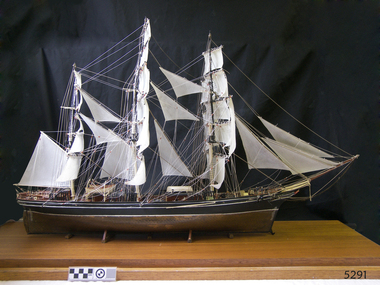 Flagstaff Hill Maritime Museum and Village
Craft - Ship model, Cutty Sark, 20th century
... wool industry. It held the record sailing speed from Australia to Britain for ten years! Later, a Portuguese company bought her as a cargo ship and then renamed it FERREIRA. Later, it was purchased by a returned sea captain for use as a training ship in Cornwall. After the captain’s death, the ship was transferred to a training college in Greenwich in 1938. In 1954, the sailing ship was placed permanently in dry dock at Greenwich for display. The sailing ship CUTTY SARK carried export cargos of wool from the Australian wool industry. Flagstaff Hill Warrnambool Shipwrecked coast Flagstaff Hill Maritime Museum ...ABOUT THE CUTTY SARK The CUTTY SARK, built in Britain in 1869, was one of the last historic sailing ships. The vessel traded in tea from China for a few years, then began trading with Australia in the wool industry. It held the record sailing speed from Australia to Britain for ten years! Later, a Portuguese company bought her as a cargo ship and then renamed it FERREIRA. Later, it was purchased by a returned sea captain for use as a training ship in Cornwall. After the captain’s death, the ship was transferred to a training college in Greenwich in 1938. In 1954, the sailing ship was placed permanently in dry dock at Greenwich for display.The sailing ship CUTTY SARK carried export cargos of wool from the Australian wool industry.Model of the sailing ship, CUTTY SARK, in full rig, with a lifeboat on deck. A black stripe with thin, white boarders is around the ship. The model is mounted on a timber plinth. flagstaff hill, warrnambool, shipwrecked coast, flagstaff hill maritime museum, maritime museum, shipwreck coast, flagstaff hill maritime village, great ocean road, cutty sark, historic sailing ship, tea clipper, sail training vessel, cadet training ship, commercial trading vessel, cargo sail vessel, ship model cutty sark, australian wool export -
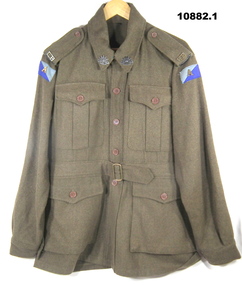 Bendigo Military Museum
Uniform - REPLICA, LIGHTHORSE, WW1, Unknown
... Museum displays and Bendigo RSL Commemorative Services. Uniform Replica Light Horse WW1 Replica Uniform, Lighthorse WW1. Jacket, Breeches with braces, Shirt, Leggings and Light Horse leather accessories. 1. Jacket, khaki wool fabric. Collar with metal look plastic "Rising Sun" Badge. Shoulder epaulettes with buttons, two metal look plastic "AUSTRALIA ...Replica 4th Light Horse AIF Uniform, WW1, used for Museum displays and Bendigo RSL Commemorative Services.Replica Uniform, Lighthorse WW1. Jacket, Breeches with braces, Shirt, Leggings and Light Horse leather accessories. 1. Jacket, khaki wool fabric. Collar with metal look plastic "Rising Sun" Badge. Shoulder epaulettes with buttons, two metal look plastic "AUSTRALIA" badges and two silver plastic Light Horse rectangular badge - an unofficial shoulder title. Front four patch pockets with button down flap. Sleeves with cuff and button colour patch. rectangular light blue/ mid blue on diagonal top left to bottom right. Brass metal look plastic "A" for ANZAC". No rank stripes - Private. Pleated back and attached half belt with metal slide buckle. Brown plastic buttons. 2. Breeches (fabric as above), ankle length close fitting trousers, snug fit below the knees with side opening and metal eyelets and ribbon laces. Five pockets - money pocket, two inset on an angle and back two inset. Numerous khaki plastic buttons at waist for braces, five button fly. 3. Shirt - grey wool flannel fabric with white cotton mandarin collar and 1/4 waistband. Half opening with three black plastic buttons. Long sleeves with cuff and three buttons. Shirt tails. 4. Braces - set of beige coloured cotton twill webbing with brown leatgher attachments for breeches. 5. Waist belt. 6. Bandolier, brown leather, brass studs and metal buckles. Waist belt with bayonet frog and four pouches and attached bandolier has nine pouches. 7. & 8. Leggings, one pair, L & R, brown leather with two leather straps and brass metal buckles.uniform, replica, light horse, ww1 -
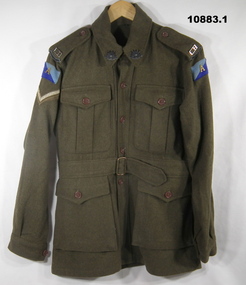 Bendigo Military Museum
Uniform - REPLICA, LIGHTHORSE, WW1, Unknown
... Museum displays and Bendigo RSL Commemorative Services. Uniform Replica Light Horse WW1 Replica Uniform, Lighthorse WW1. Jacket, Breeches with braces, Shirt, Leggings and Light Horse leather accessories. 1. Jacket, khaki wool fabric. Collar with metal look plastic "Rising Sun" Badge. Shoulder epaulettes with buttons, two metal look plastic "AUSTRALIA ...Replica 4th Light Horse AIF Uniform, WW1. Used for Museum displays and Bendigo RSL Commemorative Services.Replica Uniform, Lighthorse WW1. Jacket, Breeches with braces, Shirt, Leggings and Light Horse leather accessories. 1. Jacket, khaki wool fabric. Collar with metal look plastic "Rising Sun" Badge. Shoulder epaulettes with buttons, two metal look plastic "AUSTRALIA" badges and two silver plastic Light Horse rectangular badge - an unofficial shoulder title. Front four patch pockets with button down flap. Sleeves with cuff and button colour patch. rectangular light blue/ mid blue on diagonal top left to bottom right. Brass metal look plastic "A" for ANZAC". One rank stripe - Lance Corporal. Pleated back and attached half belt with metal slide buckle. Brown plastic buttons. 2. Breeches (fabric as above), ankle length close fitting trousers, snug fit below the knees with side opening and metal eyelets and ribbon laces. Five pockets - money pocket, two inset on an angle and back two inset. Numerous khaki plastic buttons at waist for braces, five button fly. 3. Shirt - grey wool flannel fabric with white cotton mandarin collar and 1/4 waistband. Half opening with three black plastic buttons. Long sleeves with cuff and three buttons. Shirt tails. 4. Braces - set of beige coloured cotton twill webbing with brown leatgher attachments for breeches. 5. Waist belt. 6. Bandolier, brown leather, brass studs and metal buckles. Waist belt with bayonet frog and four pouches and attached bandolier has nine pouches. 7. & 8. Leggings, one pair, L & R, brown leather with two leather straps and brass metal buckles.uniform, replica, light horse, ww1 -
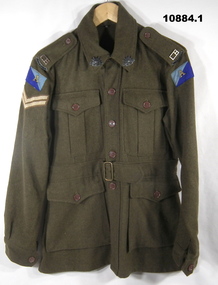 Bendigo Military Museum
Uniform - REPLICA, LIGHTHORSE, WW1, Unknown
... Museum Displays and Bendigo RSL Commemorative Services. Uniform Replica Light Horse WW1 Replica Uniform, Lighthorse WW1. Jacket, Breeches with braces, Shirt, Leggings and Light Horse leather accessories. 1. Jacket, khaki wool fabric. Collar with metal look plastic "Rising Sun" Badge. Shoulder epaulettes with buttons, two metal look plastic "AUSTRALIA ...Replica 4th Light Horse AIF Uniform, WW1. Used for Museum Displays and Bendigo RSL Commemorative Services.Replica Uniform, Lighthorse WW1. Jacket, Breeches with braces, Shirt, Leggings and Light Horse leather accessories. 1. Jacket, khaki wool fabric. Collar with metal look plastic "Rising Sun" Badge. Shoulder epaulettes with buttons, two metal look plastic "AUSTRALIA" badges and two silver plastic Light Horse rectangular badge - an unofficial shoulder title. Front four patch pockets with button down flap. Sleeves with cuff and button colour patch. rectangular light blue/ mid blue on diagonal top left to bottom right. Brass metal look plastic "A" for ANZAC". Two rank stripes - Corporal. Pleated back and attached half belt with metal slide buckle. Brown plastic buttons. 2. Breeches (fabric as above), ankle length close fitting trousers, snug fit below the knees with side opening and metal eyelets and ribbon laces. Five pockets - money pocket, two inset on an angle and back two inset. Numerous khaki plastic buttons at waist for braces, five button fly. 3. Shirt - grey wool flannel fabric with white cotton mandarin collar and 1/4 waistband. Half opening with three black plastic buttons. Long sleeves with cuff and three buttons. Shirt tails. 4. Braces - set of beige coloured cotton twill webbing with brown leather attachments for breeches. 5. Waist belt. 6. Bandolier, brown leather, brass studs and metal buckles. Waist belt with bayonet frog and four pouches and attached bandolier has nine pouches. 7. & 8. Leggings, one pair, L & R, brown leather with two leather straps and brass metal buckles.uniform, replica, light horse, ww1 -
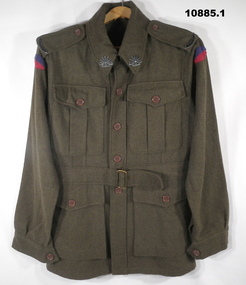 Bendigo Military Museum
Uniform - REPLICA, ARMY, WW1, Unknown
... Museum displays and Bendigo RSL Commemorative Services. Uniform Replica 38th Battalion AIF WW1 Replica Uniform, Light Horse WW1. Jacket, Breeches with braces, Shirt, Puttees and Army leather accessories and boots. 1. Jacket, khaki wool fabric. Collar with metal look plastic "Rising Sun" Badge. Shoulder epaulettes with buttons, two metal look plastic "AUSTRALIA ...Replica 38th Battalion AIF Uniform, WW1, used for Museum displays and Bendigo RSL Commemorative Services.Replica Uniform, Light Horse WW1. Jacket, Breeches with braces, Shirt, Puttees and Army leather accessories and boots. 1. Jacket, khaki wool fabric. Collar with metal look plastic "Rising Sun" Badge. Shoulder epaulettes with buttons, two metal look plastic "AUSTRALIA" badges and two silver plastic Light Horse rectangular badge - an unofficial shoulder title. Front four patch pockets with button down flap. Sleeves with cuff and button colour patch, oval shape , purple over maroon, 38th Battalion AIF. Five front buttons - brown coloured plastic. No rank stripes - Private. Pleated back and attached half belt with metal slide buckle. Brown plastic buttons. 2. Breeches (fabric as above), ankle length close fitting trousers, snug fit below the knees with side opening and metal eyelets and ribbon laces. Five pockets - money pocket, two inset on an angle and back two inset. Numerous khaki plastic buttons at waist for braces, five button fly. 3. Shirt - grey wool flannel fabric with white cotton mandarin collar and 1/4 waistband. Half opening with three black plastic buttons. Long sleeves with cuff and three buttons. Shirt tails. 4. Braces - set of beige and green coloured cotton twill webbing with brown leather attachments for breeches. 5. Waist belt. Brown coloured leather with brass studs and metal buckle. Bayonet frog on belt. 6. & 7. Puttees - pair of khaki coloured long strips of woven wool fabric which are wrapped spirally around the lowe leg, ankle to knee. Ribbon tape on end. 8. & 9. Boots - pair of brown/tan coloured leather, above ankle height, boots with eight metal eyelets per side and brown leather laces. No size on leather sole, heel with metal plate.uniform, replica, 38th battalion, aif, ww1 -
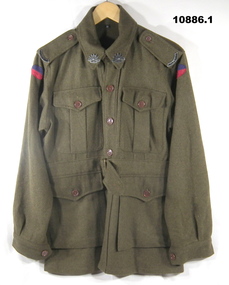 Bendigo Military Museum
Uniform - REPLICA, ARMY, WW1, Unknown
... Museum Displays and Bendigo RSL Commemorative Services. Uniform Replica 38th Battalion AIF WW1 8. 9. Boots - handwritten - black ink pen. On sole "Walko". Replica Uniform, Army WW1. Jacket, Breeches with braces, Shirt, Puttees and Army leather accessories and boots. 1. Jacket, khaki wool fabric. Collar with metal look plastic "Rising Sun" Badge. Shoulder epaulettes with buttons, two metal look plastic "AUSTRALIA ...Replica 38th Battalion AIF Uniform, WW1 used for Museum Displays and Bendigo RSL Commemorative Services.Replica Uniform, Army WW1. Jacket, Breeches with braces, Shirt, Puttees and Army leather accessories and boots. 1. Jacket, khaki wool fabric. Collar with metal look plastic "Rising Sun" Badge. Shoulder epaulettes with buttons, two metal look plastic "AUSTRALIA" badges and two silver plastic Light Horse rectangular badge - an unofficial shoulder title. Front four patch pockets with button down flap. Sleeves with cuff and button colour patch, oval shape , purple over maroon, 38th Battalion AIF. Five front buttons - brown coloured plastic. No rank stripes - Private. Pleated back and attached half belt with metal slide buckle. Brown plastic buttons. 2. Breeches (fabric as above), ankle length close fitting trousers, snug fit below the knees with side opening and metal eyelets and ribbon laces. Five pockets - money pocket, two inset on an angle and back two inset. Numerous khaki plastic buttons at waist for braces, five button fly. 3. Shirt - grey wool flannel fabric with white cotton mandarin collar and 1/4 waistband. Half opening with three black plastic buttons. Long sleeves with cuff and three buttons. Shirt tails. 4. Braces - set of beige and green coloured cotton twill webbing with brown leather attachments for breeches. 5. Waist belt. Brown coloured leather with brass studs and metal buckle. Bayonet frog on belt. 6. & 7. Puttees - pair of khaki coloured long strips of woven wool fabric which are wrapped spirally around the lowe leg, ankle to knee. Ribbon tape on end. 8. & 9. Boots - pair of brown/tan coloured leather, above ankle height, boots with eight metal eyelets per side and brown leather laces. No size on leather sole, heel with metal plate. Handwritten owner's name on sole.8. 9. Boots - handwritten - black ink pen. On sole "Walko".uniform, replica, 38th battalion, aif, ww1 -
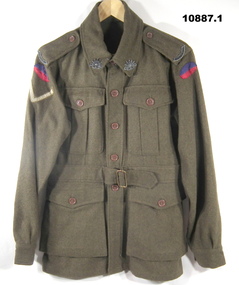 Bendigo Military Museum
Uniform - REPLICA, ARMY, WW1, Unknown
... Museum displays and Bendigo RSL Commemorative Services. Uniform Replica 38th Battalion AIF WW1 Replica Uniform, Army WW1. Jacket, Breeches with braces, Shirt, Puttees and Army leather accessories and boots. 1. Jacket, khaki wool fabric. Collar with metal look plastic "Rising Sun" Badge. Shoulder epaulettes with buttons, two metal look plastic "AUSTRALIA ...Replica 38th Battalion AIF uniform, WW1, used for Museum displays and Bendigo RSL Commemorative Services.Replica Uniform, Army WW1. Jacket, Breeches with braces, Shirt, Puttees and Army leather accessories and boots. 1. Jacket, khaki wool fabric. Collar with metal look plastic "Rising Sun" Badge. Shoulder epaulettes with buttons, two metal look plastic "AUSTRALIA" badges and two silver plastic Light Horse rectangular badge - an unofficial shoulder title. Front four patch pockets with button down flap. Sleeves with cuff and button colour patch, oval shape , purple over maroon, 38th Battalion AIF. Five front buttons - brown coloured plastic. One rank stripe - Lance Corporal. Pleated back and attached half belt with metal slide buckle. Brown plastic buttons. 2. Breeches (fabric as above), ankle length close fitting trousers, snug fit below the knees with side opening and metal eyelets and ribbon laces. Five pockets - money pocket, two inset on an angle and back two inset. Numerous khaki plastic buttons at waist for braces, five button fly. 3. Shirt - grey wool flannel fabric with white cotton mandarin collar and 1/4 waistband. Half opening with three black plastic buttons. Long sleeves with cuff and three buttons. Shirt tails. 4. Braces - set of beige and green coloured cotton twill webbing with brown leather attachments for breeches. 5. Waist belt. Brown coloured leather with brass studs and metal buckle. Bayonet frog on belt. 6. & 7. Puttees - pair of khaki coloured long strips of woven wool fabric which are wrapped spirally around the lowe leg, ankle to knee. Ribbon tape on end. 8. & 9. Boots - pair of brown/tan coloured leather, above ankle height, boots with eight metal eyelets per side and brown leather laces. Size 11 on leather sole, heel with metal plate. uniform, replica, 38th battalion, aif, ww1 -
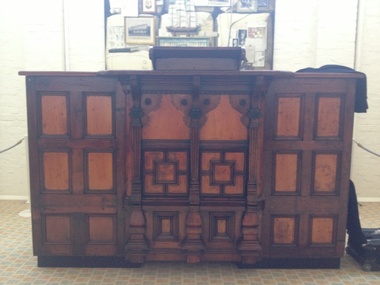 Victorian Interpretive Projects Inc.
Photograph - colour, Auction Room Lectern at National Wool Museum
... This photograph on an iPhone 4 during the Museums Australia (Vic) Conference at the National Wool Museum, Geelong. ...This photograph on an iPhone 4 during the Museums Australia (Vic) Conference at the National Wool Museum, Geelong. ...This photograph on an iPhone 4 during the Museums Australia (Vic) Conference at the National Wool Museum, Geelong. Since the arrival of sheep with the First Fleet in 1788, the wool industry has dominated our economy, our agriculture and our reputation as a quality wool-growing nation throughout the world. Geelong is a city synonymous with wool and the wool industry – sheep farming began here in 1835 and the first of many woollen mills opened here in 1868. For many years the city was known as the 'wool centre of the world'. Two hundred years later, in 1988, the National Wool Museum was established as Australia’s only comprehensive museum of wool. (Since the arrival of sheep with the First Fleet in 1788, the wool industry has dominated our economy, our agriculture and our reputation as a quality wool-growing nation throughout the world. Geelong is a city synonymous with wool and the wool industry – sheep farming began here in 1835 and the first of many woollen mills opened here in 1868. For many years the city was known as the 'wool centre of the world'. Two hundred years later, in 1988, the National Wool Museum was established as Australia’s only comprehensive museum of wool. (Since the arrival of sheep with the First Fleet in 1788, the wool industry has dominated our economy, our agriculture and our reputation as a quality wool-growing nation throughout the world. Geelong is a city synonymous with wool and the wool industry – sheep farming began here in 1835 and the first of many woollen mills opened here in 1868. For many years the city was known as the 'wool centre of the world'. Two hundred years later, in 1988, the National Wool Museum was established as Australia’s only comprehensive museum of wool. (http://www.geelongaustralia.com.au/nwm/about/article/item/8cbcc313afa77a5.aspx)Photograph of a timber lectern used to auction wool in Geelong. It is found in the auction room on the top floor of Geelong's national wool museum.wool, geelong, auction, auction room, national wool museum -
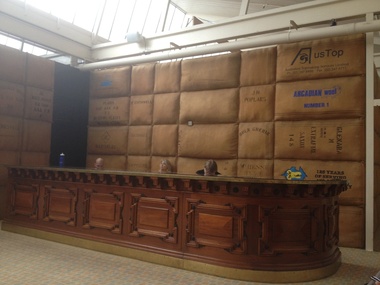 Victorian Interpretive Projects Inc.
photograph - Colour, Viewing the National Wool Museum's auction room
... This photograph on an iPhone 4 during the Museums Australia (Vic) Conference at the National Wool Museum, Geelong. ...This photograph on an iPhone 4 during the Museums Australia (Vic) Conference at the National Wool Museum, Geelong. ...This photograph on an iPhone 4 during the Museums Australia (Vic) Conference at the National Wool Museum, Geelong. Since the arrival of sheep with the First Fleet in 1788, the wool industry has dominated our economy, our agriculture and our reputation as a quality wool-growing nation throughout the world. Geelong is a city synonymous with wool and the wool industry – sheep farming began here in 1835 and the first of many woollen mills opened here in 1868. For many years the city was known as the 'wool centre of the world'. Two hundred years later, in 1988, the National Wool Museum was established as Australia’s only comprehensive museum of wool. (Since the arrival of sheep with the First Fleet in 1788, the wool industry has dominated our economy, our agriculture and our reputation as a quality wool-growing nation throughout the world. Geelong is a city synonymous with wool and the wool industry – sheep farming began here in 1835 and the first of many woollen mills opened here in 1868. For many years the city was known as the 'wool centre of the world'. Two hundred years later, in 1988, the National Wool Museum was established as Australia’s only comprehensive museum of wool. (Since the arrival of sheep with the First Fleet in 1788, the wool industry has dominated our economy, our agriculture and our reputation as a quality wool-growing nation throughout the world. Geelong is a city synonymous with wool and the wool industry – sheep farming began here in 1835 and the first of many woollen mills opened here in 1868. For many years the city was known as the 'wool centre of the world'. Two hundred years later, in 1988, the National Wool Museum was established as Australia’s only comprehensive museum of wool. (http://www.geelongaustralia.com.au/nwm/about/article/item/8cbcc313afa77a5.aspx)display of wool ales at the National Wool Museum. Steel girders holding up the roof were made by Dorman Long & Co. Middlesborough, England. In the foreground is a timber counter with brass kick rail and upper edge. Names on wool bales include Austop, Arcadian Wool, Buln Gherin, Mt Hesse, Melrose, Avondale Hills, Kerrsville, Kooringa, Merryville Yass, Sherra Park, Wurrock, Hazeldean, Buanogor Parkwool, geelong, wool bail, auction room, national wool museum -
 Bendigo Historical Society Inc.
Postcard - NATIONAL MUSEUM OF AUSTRALIA POSTCARDS
... Wool press Cobb & Co Ben Chifley Mutoscope Austral wash machine Herman House & Co Australia 2 Heidelberg Unemployed Bureau Sunlight soap Waterside Worker's Union Boomerang Spirit figures Dugout canoe Ayer's Rock Bark painting Delaunay Belville car Phar Lap's Heart A set of 18 colour postcards from the National Museum of Australia in Canberra showing various items and objects relating to Australia's history, manufacturing and culture. ...A set of 18 colour postcards from the National Museum of Australia in Canberra showing various items and objects relating to Australia's history, manufacturing and culture. (see list under references)wool press, cobb & co, ben chifley, mutoscope, austral wash machine, herman house & co, australia 2, heidelberg unemployed bureau, sunlight soap, waterside worker's union, boomerang, spirit figures, dugout canoe, ayer's rock, bark painting, delaunay belville car, phar lap's heart -
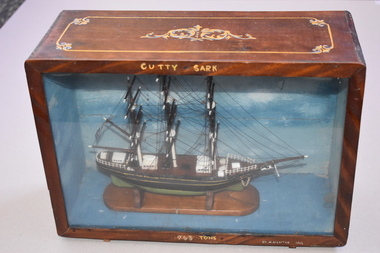 Warrnambool and District Historical Society Inc.
Model Boat, H. Richter, Cutty Sark, 1964
... wool from Australia to England and held many records for speed during that time. Since 1954 the ship has been on display at Greenwich, England. The model has an etched inscription indicating that it was made by Herman Richter and so it is presumed that he was the maker of this model. A model of the Cutty Sark was made by his father, Edward Richter using wood from the Enterprise wrecked in Lady Bay and that model was in the old Warrnambool Museum...wool from Australia to England and held many records for speed during that time. Since 1954 the ship has been on display at Greenwich, England. The model has an etched inscription indicating that it was made by Herman Richter and so it is presumed that he was the maker of this model. A model of the Cutty Sark was made by his father, Edward Richter using wood from the Enterprise wrecked in Lady Bay and that model was in the old Warrnambool Museum ...The Cutty Sark sailing ship was a popular model-making ship. It was a British clipper ship built originally for the China- England tea trade and was one of the last and fastest tea clippers. From 1883 to 1895 it was used to carry wool from Australia to England and held many records for speed during that time. Since 1954 the ship has been on display at Greenwich, England. The model has an etched inscription indicating that it was made by Herman Richter and so it is presumed that he was the maker of this model. A model of the Cutty Sark was made by his father, Edward Richter using wood from the Enterprise wrecked in Lady Bay and that model was in the old Warrnambool Museum. This information was in a newspaper article at the time of Edward Richter’s death. This Herman Richter model may be a copy of his father’s model. The Richters have been prominent in Warrnambool’s history, beginning with Henry Richter who came to Warrambool in the 1850s and worked in the Western Brewery and was licensee of the Royal Archer Hotel. His son Edward who died in 1937 was a prominent Warrnambool resident for 78 years. Herman, the son of Susan and Edward Richter was well-known as a model boat maker and maker of model boats in bottles.This model boat is of great interest because the ‘Cutty Sark’ was a well-known sailing ship and was important in Australia’s maritime history as a carrier to London of Australian wool in the 1880s and 90s. It is also of interest as it was made by a member of the Richter family, a prominent one in Warrnambool’s history with both Edward and his son Herman Richter producing many artefacts connected to Warrnambool’s history – model ships, violin-making, maritime paintings etc. This is the model of a three-masted ship with a hull painted in green and black with gold bands. The ship is mounted on a wooden stand and enclosed in a wooden box with a glass front. The box is varnished and has ornamental patterns in gold and blue on the top and sides. The inside of the box is painted blue and white to represent the sea and the sky.‘Cutty Sark 963Tons by H Richter 1964’richter family, warrnambool, model boat building
