
Showing 528 items matching "austrian"
-
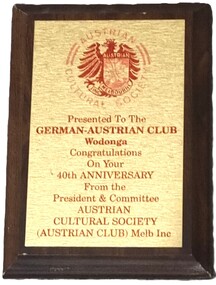 Wodonga & District Historical Society Inc
Plaque - German-Austrian Club Wodonga 40th Anniversary, 2000
... German-Austrian Club Wodonga 40th Anniversary...They were Kurt Mueller, Willi Klimt, Toni Krischa and Erwin Klein from Germany and Manfred Teissl from Austria. On the 16th July 1960, after advertising in the Border Morning Mail the German Austrian Club in Wodonga was born. ...It includes the insignia of the Austrian Cultural Society of Melbourne....Presented To The GERMAN-AUSTRIAN CLUB Wodonga Congratulations On Your 40th ANNIVERSARY From the President & Committee AUSTRIAN CULTURAL SOCIETY (AUSTRIAN CLUB) Melb Inc...It includes the insignia of the Austrian Cultural Society of Melbourne. German-Austrian Club Wodonga 40th Anniversary Plaque German-Austrian Club Wodonga 40th Anniversary ...Thousands of German migrants started a new life at Bonegilla, Victoria in the 1950s. Among them were five men who met each other in Wodonga, became friends and decided to form a German Austrian Club, where they could enjoy the company of likeminded individuals. They were Kurt Mueller, Willi Klimt, Toni Krischa and Erwin Klein from Germany and Manfred Teissl from Austria. On the 16th July 1960, after advertising in the Border Morning Mail the German Austrian Club in Wodonga was born. Office bearers were Paul Peters as President. Gerhard Ziermann as Secretary and Günter Schmehl as Treasurer. Their aim was "To promote the upkeep of the German language in written and spoken form and to promote good German fellowship, while enjoying functions of a cultural and entertaining nature". By 1963 the Club boasted 40 members, holding meetings at the RSL Clubrooms and other suitable locations before they found a house in Hovell Street, Wodonga. It was used for meetings, Skat meetings, film nights and Sonnabendschule” or Saturday school where children of members could continue to learn German. The Committee organised a wide range of activities and functions in their small rooms but dreamed of having a bigger home. This became reality in July 1979, when the Committee purchased land from the Albury Wodonga Development Corporation at 5 McFarland Road, Wodonga. The first brick was laid on the Club's land in May 1980, and the double-story brick building was completed within 12 months voluntarily by Club members. At the same time members supported other organisations and charities in the Wodonga and wider community. The first Oktoberfest in Wodonga was held in 1975, drawing 4,000 attendees. The event was organized to promote German culture, and the profits from the first year were donated to the Wodonga District Hospital, raising $20,000. In 2001 the German Austrian Club was presented with the Certificate of Meritorious Service by the Government of Victoria for Community Works in Wodonga and district. The Club raised $23,000 for the Wodonga Hospital, had numerous fundraisers to assist in bushfires and drought situations and was involved in the Red Cross Calling campaign for many years. After much fundraising, hard work and making their way through extensive government red tape, the Club moved to its new premises in McFarland Road on 1st August 1981. The members continued to make necessary internal adjustments and sought an alcohol licence. The building was officially opened in May 1983. The Club prospered and had 300 members, making it necessary for new applicants to be put on a waiting list to be accepted as members. Interest groups formed consisted of Competition Air Rifle Shooting Group, a Skat (German Card game) Group, Folk Dancing Group, Ladies Group, Table Tennis Group, Darts Group, Chess Group and the Billiard Group. In later years, as so many Australians became members, the Club’s name was changed to the German Austrian Australian Club. Over recent years patronage and interest in the Club and its activities changed. Children of the original members had become “real Aussies” and did not always want to carry on traditions. Aging membership and lack of volunteers forced the Club to disband in 2025. The Club building has been gifted to the Albury Wodonga Theatre Company.This item is significant because it is representative of an important cultural organisation which operated in Wodonga for over 60 years.A small metal plaque on a wooden backing with red text. It includes the insignia of the Austrian Cultural Society of Melbourne.Presented To The GERMAN-AUSTRIAN CLUB Wodonga Congratulations On Your 40th ANNIVERSARY From the President & Committee AUSTRIAN CULTURAL SOCIETY (AUSTRIAN CLUB) Melb Incgerman austrian australian club, german migrants wodonga -
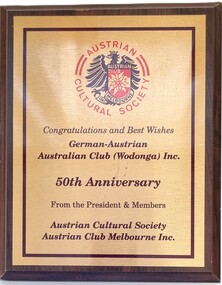 Wodonga & District Historical Society Inc
Plaque - German-Austrian Club Wodonga 50th Anniversary, 2010
... German-Austrian Club Wodonga 50th Anniversary...They were Kurt Mueller, Willi Klimt, Toni Krischa and Erwin Klein from Germany and Manfred Teissl from Austria. On the 16th July 1960, after advertising in the Border Morning Mail the German Austrian Club in Wodonga was born. ...It includes the insignia of the Austrian Cultural Society of Melbourne....Congratulations and Best Wishes German-Austrian Australian Club (Wodonga) Inc. 50th Anniversary From the President & Members Austrian Cultural Society Austrian Club Melbourne Inc....It includes the insignia of the Austrian Cultural Society of Melbourne. German-Austrian Club Wodonga 50th Anniversary Plaque German-Austrian Club Wodonga 50th Anniversary ...Thousands of German migrants started a new life at Bonegilla, Victoria in the 1950s. Among them were five men who met each other in Wodonga, became friends and decided to form a German Austrian Club, where they could enjoy the company of likeminded individuals. They were Kurt Mueller, Willi Klimt, Toni Krischa and Erwin Klein from Germany and Manfred Teissl from Austria. On the 16th July 1960, after advertising in the Border Morning Mail the German Austrian Club in Wodonga was born. Office bearers were Paul Peters as President. Gerhard Ziermann as Secretary and Günter Schmehl as Treasurer. Their aim was "To promote the upkeep of the German language in written and spoken form and to promote good German fellowship, while enjoying functions of a cultural and entertaining nature". By 1963 the Club boasted 40 members, holding meetings at the RSL Clubrooms and other suitable locations before they found a house in Hovell Street, Wodonga. It was used for meetings, Skat meetings, film nights and Sonnabendschule” or Saturday school where children of members could continue to learn German. The Committee organised a wide range of activities and functions in their small rooms but dreamed of having a bigger home. This became reality in July 1979, when the Committee purchased land from the Albury Wodonga Development Corporation at 5 McFarland Road, Wodonga. The first brick was laid on the Club's land in May 1980, and the double-story brick building was completed within 12 months voluntarily by Club members. At the same time members supported other organisations and charities in the Wodonga and wider community. The first Oktoberfest in Wodonga was held in 1975, drawing 4,000 attendees. The event was organized to promote German culture, and the profits from the first year were donated to the Wodonga District Hospital, raising $20,000. In 2001 the German Austrian Club was presented with the Certificate of Meritorious Service by the Government of Victoria for Community Works in Wodonga and district. The Club raised $23,000 for the Wodonga Hospital, had numerous fundraisers to assist in bushfires and drought situations and was involved in the Red Cross Calling campaign for many years. After much fundraising, hard work and making their way through extensive government red tape, the Club moved to its new premises in McFarland Road on 1st August 1981. The members continued to make necessary internal adjustments and sought an alcohol licence. The building was officially opened in May 1983. The Club prospered and had 300 members, making it necessary for new applicants to be put on a waiting list to be accepted as members. Interest groups formed consisted of Competition Air Rifle Shooting Group, a Skat (German Card game) Group, Folk Dancing Group, Ladies Group, Table Tennis Group, Darts Group, Chess Group and the Billiard Group. In later years, as so many Australians became members, the Club’s name was changed to the German Austrian Australian Club. Over recent years patronage and interest in the Club and its activities changed. Children of the original members had become “real Aussies” and did not always want to carry on traditions. Aging membership and lack of volunteers forced the Club to disband in 2025. The Club building has been gifted to the Albury Wodonga Theatre Company.This item is significant because it is representative of an important cultural organisation which operated in Wodonga for over 60 years.A small metal plaque on a wooden backing with red text. It includes the insignia of the Austrian Cultural Society of Melbourne.Congratulations and Best Wishes German-Austrian Australian Club (Wodonga) Inc. 50th Anniversary From the President & Members Austrian Cultural Society Austrian Club Melbourne Inc.german austrian australian club, german migrants wodonga -
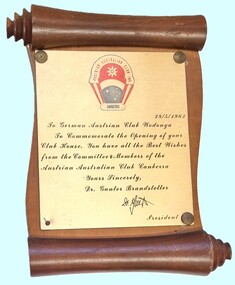 Wodonga & District Historical Society Inc
Plaque - German-Austrian Club Wodonga Opening, 1983
... German-Austrian Club Wodonga Opening...They were Kurt Mueller, Willi Klimt, Toni Krischa and Erwin Klein from Germany and Manfred Teissl from Austria. On the 16th July 1960, after advertising in the Border Morning Mail the German Austrian Club in Wodonga was born. ...Emblem of the Austrian - Australian Clubs Inc. Canberra 28/5/1983 To German Austrian Club Wodonga To Commemorate the Opening of your Club House. ...The text is in the form of a letter. German-Austrian Club Wodonga Opening Plaque German-Austrian Club Wodonga Opening ...Thousands of German migrants started a new life at Bonegilla, Victoria in the 1950s. Among them were five men who met each other in Wodonga, became friends and decided to form a German Austrian Club, where they could enjoy the company of likeminded individuals. They were Kurt Mueller, Willi Klimt, Toni Krischa and Erwin Klein from Germany and Manfred Teissl from Austria. On the 16th July 1960, after advertising in the Border Morning Mail the German Austrian Club in Wodonga was born. Office bearers were Paul Peters as President. Gerhard Ziermann as Secretary and Günter Schmehl as Treasurer. Their aim was "To promote the upkeep of the German language in written and spoken form and to promote good German fellowship, while enjoying functions of a cultural and entertaining nature". By 1963 the Club boasted 40 members, holding meetings at the RSL Clubrooms and other suitable locations before they found a house in Hovell Street, Wodonga. It was used for meetings, Skat meetings, film nights and Sonnabendschule” or Saturday school where children of members could continue to learn German. The Committee organised a wide range of activities and functions in their small rooms but dreamed of having a bigger home. This became reality in July 1979, when the Committee purchased land from the Albury Wodonga Development Corporation at 5 McFarland Road, Wodonga. The first brick was laid on the Club's land in May 1980, and the double-story brick building was completed within 12 months voluntarily by Club members. At the same time members supported other organisations and charities in the Wodonga and wider community. The first Oktoberfest in Wodonga was held in 1975, drawing 4,000 attendees. The event was organized to promote German culture, and the profits from the first year were donated to the Wodonga District Hospital, raising $20,000. In 2001 the German Austrian Club was presented with the Certificate of Meritorious Service by the Government of Victoria for Community Works in Wodonga and district. The Club raised $23,000 for the Wodonga Hospital, had numerous fundraisers to assist in bushfires and drought situations and was involved in the Red Cross Calling campaign for many years. After much fundraising, hard work and making their way through extensive government red tape, the Club moved to its new premises in McFarland Road on 1st August 1981. The members continued to make necessary internal adjustments and sought an alcohol licence. The building was officially opened in May 1983. The Club prospered and had 300 members, making it necessary for new applicants to be put on a waiting list to be accepted as members. Interest groups formed consisted of Competition Air Rifle Shooting Group, a Skat (German Card game) Group, Folk Dancing Group, Ladies Group, Table Tennis Group, Darts Group, Chess Group and the Billiard Group. In later years, as so many Australians became members, the Club’s name was changed to the German Austrian Australian Club. Over recent years patronage and interest in the Club and its activities changed. Children of the original members had become “real Aussies” and did not always want to carry on traditions. Aging membership and lack of volunteers forced the Club to disband in 2025. The Club building has been gifted to the Albury Wodonga Theatre Company. These items are significant because they are representative of an important cultural organisation which operated in Wodonga for over 60 years.A metal plaque attached to a wooden backing shaped like a scroll. The text is in the form of a letter.Emblem of the Austrian - Australian Clubs Inc. Canberra 28/5/1983 To German Austrian Club Wodonga To Commemorate the Opening of your Club House. You have all the Best Wishes from the Committee & Members of the Austrian Australian Club Canberra Yours Sincerely, Dr. Gunter Brandstetter Presidentgerman austrian australian club, german migrants wodonga -
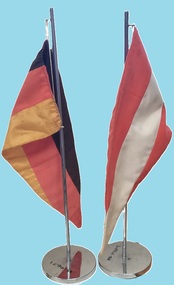 Wodonga & District Historical Society Inc
Memorabilia - German and Austrian miniature flags, Unknown
... German and Austrian miniature flags...They were Kurt Mueller, Willi Klimt, Toni Krischa and Erwin Klein from Germany and Manfred Teissl from Austria. On the 16th July 1960, after advertising in the Border Morning Mail, the German Austrian Club in Wodonga was born. ...Two small flags of Germany and Austria attached to metal stands with string. ..."Lufthansa" is inscribed on the base. German and Austrian miniature flags Memorabilia German and Austrian miniature flags ...Thousands of German migrants started a new life at Bonegilla, Victoria in the 1950s. Among them were five men who met each other in Wodonga, became friends and decided to form a German Austrian Club, where they could enjoy the company of likeminded individuals. They were Kurt Mueller, Willi Klimt, Toni Krischa and Erwin Klein from Germany and Manfred Teissl from Austria. On the 16th July 1960, after advertising in the Border Morning Mail, the German Austrian Club in Wodonga was born. Office bearers were Paul Peters as President. Gerhard Ziermann as Secretary and Günter Schmehl as Treasurer. Their aim was "To promote the upkeep of the German language in written and spoken form and to promote good German fellowship, while enjoying functions of a cultural and entertaining nature". By 1963 the Club boasted 40 members, holding meetings at the RSL Clubrooms and other suitable locations before they found a house in Hovell Street, Wodonga. It was used for meetings, Skat meetings, film nights and "Sonnabendschule” or Saturday school where children of members could continue to learn German. The Committee organised a wide range of activities and functions in their small rooms but dreamed of having a bigger home. This became reality in July 1979, when the Committee purchased land from the Albury Wodonga Development Corporation at 5 McFarland Road, Wodonga. The first brick was laid on the Club's land in May 1980, and the double-storey brick building was completed within 12 months voluntarily by Club members. At the same time members supported other organisations and charities in the Wodonga and wider community. The first Oktoberfest in Wodonga was held in 1975, drawing 4,000 attendees. The event was organized to promote German culture, and the profits from the first year were donated to the Wodonga District Hospital, raising $20,000. In 2001 the German Austrian Club was presented with the Certificate of Meritorious Service by the Government of Victoria for Community Works in Wodonga and district. The Club raised $23,000 for the Wodonga Hospital, had numerous fundraisers to assist in bushfires and drought situations and was involved in the Red Cross Calling campaign for many years. After much fundraising, hard work and making their way through extensive government red tape, the Club moved to its new premises in McFarland Road on 1st August 1981. The members continued to make necessary internal adjustments and sought an alcohol licence. The building was officially opened in May 1983. The Club prospered and had 300 members, making it necessary for new applicants to be put on a waiting list to be accepted as members. Interest groups consisted of Competition Air Rifle Shooting Group, a Skat (German Card game) Group, Folk Dancing Group, Ladies Group, Table Tennis Group, Darts Group, Chess Group and the Billiard Group. In later years, as so many Australians became members, the Club’s name was changed to the German Austrian Australian Club. Over recent years patronage and interest in the Club and its activities changed. Children of the original members had become “real Aussies” and did not always want to carry on traditions. Aging membership and lack of volunteers forced the Club to disband in 2025. The Club building has been gifted to the Albury Wodonga Theatre Company.These items are significant because they are representative of an important cultural organisation which operated in Wodonga for over 60 years.Two small flags of Germany and Austria attached to metal stands with string. Each stand has a metal circular base. "Lufthansa" is inscribed on the base.On base: Lufthansagerman austrian australian club, german austrian club -
 Wodonga & District Historical Society Inc
Plaque - German-Austrian Club Wodonga 30th Anniversary, 1990
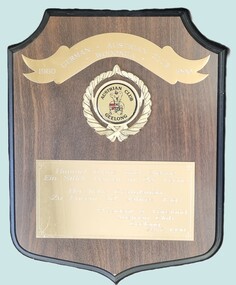
... German-Austrian Club Wodonga 30th Anniversary...They were Kurt Mueller, Willi Klimt, Toni Krischa and Erwin Klein from Germany and Manfred Teissl from Austria. On the 16th July 1960, after advertising in the Border Morning Mail the German Austrian Club in Wodonga was born. ...This plaque was presented by the German Austrian Club of Geelong on the occasion of the 30th Anniversary of the Wodonga Club and bears its insignia....German-Austrian Club Wodonga 30th Anniversary Plaque German-Austrian Club Wodonga 30th Anniversary ...Thousands of German migrants started a new life at Bonegilla, Victoria in the 1950s. Among them were five men who met each other in Wodonga, became friends and decided to form a German Austrian Club, where they could enjoy the company of likeminded individuals. They were Kurt Mueller, Willi Klimt, Toni Krischa and Erwin Klein from Germany and Manfred Teissl from Austria. On the 16th July 1960, after advertising in the Border Morning Mail the German Austrian Club in Wodonga was born. Office bearers were Paul Peters as President. Gerhard Ziermann as Secretary and Günter Schmehl as Treasurer. Their aim was "To promote the upkeep of the German language in written and spoken form and to promote good German fellowship, while enjoying functions of a cultural and entertaining nature". By 1963 the Club boasted 40 members, holding meetings at the RSL Clubrooms and other suitable locations before they found a house in Hovell Street, Wodonga. It was used for meetings, Skat meetings, film nights and Sonnabendschule” or Saturday school where children of members could continue to learn German. The Committee organised a wide range of activities and functions in their small rooms but dreamed of having a bigger home. This became reality in July 1979, when the Committee purchased land from the Albury Wodonga Development Corporation at 5 McFarland Road, Wodonga. The first brick was laid on the Club's land in May 1980, and the double-story brick building was completed within 12 months voluntarily by Club members. At the same time members supported other organisations and charities in the Wodonga and wider community. The first Oktoberfest in Wodonga was held in 1975, drawing 4,000 attendees. The event was organized to promote German culture, and the profits from the first year were donated to the Wodonga District Hospital, raising $20,000. In 2001 the German Austrian Club was presented with the Certificate of Meritorious Service by the Government of Victoria for Community Works in Wodonga and district. The Club raised $23,000 for the Wodonga Hospital, had numerous fundraisers to assist in bushfires and drought situations and was involved in the Red Cross Calling campaign for many years. After much fundraising, hard work and making their way through extensive government red tape, the Club moved to its new premises in McFarland Road on 1st August 1981. The members continued to make necessary internal adjustments and sought an alcohol licence. The building was officially opened in May 1983. The Club prospered and had 300 members, making it necessary for new applicants to be put on a waiting list to be accepted as members. Interest groups formed consisted of Competition Air Rifle Shooting Group, a Skat (German Card game) Group, Folk Dancing Group, Ladies Group, Table Tennis Group, Darts Group, Chess Group and the Billiard Group. In later years, as so many Australians became members, the Club’s name was changed to the German Austrian Australian Club. Over recent years patronage and interest in the Club and its activities changed. Children of the original members had become “real Aussies” and did not always want to carry on traditions. Aging membership and lack of volunteers forced the Club to disband in 2025. The Club building has been gifted to the Albury Wodonga Theatre Company.This item is significant because it is representative of an important cultural organisation which operated in Wodonga for over 60 years.A wooden plaque with metal insignia and a plate with text in German. This plaque was presented by the German Austrian Club of Geelong on the occasion of the 30th Anniversary of the Wodonga Club and bears its insignia.Himmel Glanz und Sterne Ein Stuck Heimat in Der Fern Herzliche Gratulation Zu Eurem 30 Jahres Tag President and Vorstand Translation Sky, splendour and stars A piece of home away from home Congratulations On your 30th anniversary President and Board of Directorsgerman austrian australian club, german migrants wodonga -
 Falls Creek Historical Society
Flyer - Austrian National Team Flyer
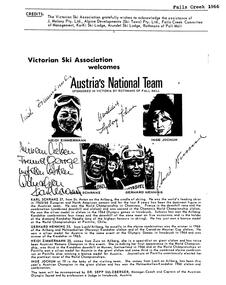
... Austrian National Team Flyer...It records the visit of the Austrian National Ski team to Falls Creek in 1966. ...A flyer welcoming the Austrian National Ski Team to Falls Creek in 1966. ...George Shirling Koki Lodge Austrian National Ski Team 1966 A flyer welcoming the Austrian National Ski Team to Falls Creek in 1966. ...This item is from the private collection of George Shirling of Red Onion, Falls Creek. It records the visit of the Austrian National Ski team to Falls Creek in 1966. The first paragraph includes thanks from the Victorian Skiing Association to those who have supported the visit including J. Molony Pty. Ltd., Alpine Developments (Ski Tows) Pty. Ltd., Falls Creek Committee of Management, Ko-Ki Ski Lodge, Arundel Ski Lodge and Rothmans of Pall Mall. George Shirling arrived in Falls Creek in 1962. He engaged Phil Nowell to build the original Koki Alpine Lodge which opened in 1965 with 14 beds. George operated the lodge with Michael “Baldy” Blackwell as manager. He also graduated in sport psychology in 1981 and was invited to become team psychologist for the Australian Winter Olympic team which went to Albertville, France, in 1992. He later owned the Red Onion Chalet. George credited the success of Koki to “Baldy” Blackwell. “Baldy” and Phil Nowell started the Trackers Mountain Lodge in partnership during the 1980s. In 1971 George sold Koki Lodge to Sigi Doerr. In 2024 the renamed Koki Alpine resort remains a highly popular destination in Falls Creek. George Shirling passed away on 27th February 2023. He had remained actively involved in Falls Creek and was generous with his time and knowledge, always an amazing supporter of The Falls Creek Museum and Falls Creek Village.This item is significant because it documents an important visit by an international ski team to Falls Creek.A flyer welcoming the Austrian National Ski Team to Falls Creek in 1966. It includes profiles and images of the members of the team and has been autographed by them.george shirling, koki lodge, austrian national ski team 1966 -
 Falls Creek Historical Society
Photograph - George Shirling and members of the Austrian National Ski team
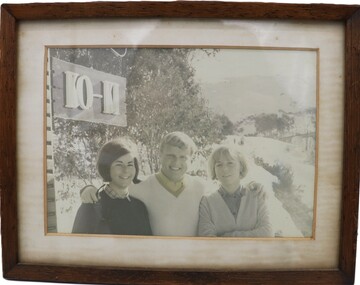
... George Shirling and members of the Austrian National Ski team...This image captures George Shirling and members of the Austrian team who stayed at Koki. George Shirling arrived in Falls Creek in 1962. ...A framed black and white image of George Shirling and two members of the Austrian ski team standing beneath the KO-KI sign. ...George Shirling and members of the Austrian National Ski team Photograph George Shirling and members of the Austrian National Ski team ...These items are from the private collection of George Shirling of Red Onion, Falls Creek. This image captures George Shirling and members of the Austrian team who stayed at Koki. George Shirling arrived in Falls Creek in 1962. He engaged Phil Nowell to build the original Koki Alpine Lodge which opened in 1965 with 14 beds. George operated the lodge with Michael “Baldy” Blackwell as manager. He also graduated in sport psychology in 1981 and was invited to become team psychologist for the Australian Winter Olympic team which went to Albertville, France, in 1992. He later owned the Red Onion Chalet. George credited the success of Koki to “Baldy” Blackwell. “Baldy” and Phil Nowell started the Trackers Mountain Lodge in partnership during the 1980s. In 1971 George sold Koki Lodge to Sigi Doerr. In 2024 the renamed Koki Alpine resort remains a highly popular destination in Falls Creek. George Shirling passed away on 27th February 2023. He had remained actively involved in Falls Creek and was generous with his time and knowledge, always an amazing supporter of The Falls Creek Museum and Falls Creek Village.This item is significant because it depicts George Shirling at Koki Lodge and the support he provided to international skiers.A framed black and white image of George Shirling and two members of the Austrian ski team standing beneath the KO-KI sign. A flyer with information about the team is included.george shirling, koki lodge, austrian national ski team 1966 -
 Falls Creek Historical Society
Article - George Shirling with Austrian Skiers 1966
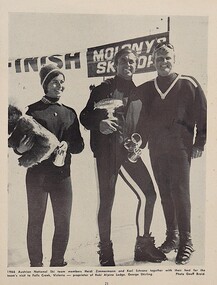
... George Shirling with Austrian Skiers 1966...It is from the Australian Ski Yearbook of 1967 reporting on the visit of the Austrian National Ski team to Falls Creek in winter of 1966. ...Under photo 1966 Austrian National Ski team members Heidi Zimmermann and Karl Schranz together with their host for the team's visit to Falls Creek, Victoria - proprietor of Koki Alpine Lodge, George Shirling. ...George Shirling with Austrian Skiers 1966 Article George Shirling with Austrian Skiers 1966 ...This item is from the private collection of George Shirling of Red Onion, Falls Creek. It is from the Australian Ski Yearbook of 1967 reporting on the visit of the Austrian National Ski team to Falls Creek in winter of 1966. George Shirling arrived in Falls Creek in 1962. He engaged Phil Nowell to build the original Koki Alpine Lodge which opened in 1965 with 14 beds. George operated the lodge with Michael “Baldy” Blackwell as manager. He also graduated in sport psychology in 1981 and was invited to become team psychologist for the Australian Winter Olympic team which went to Albertville, France, in 1992. He later owned the Red Onion Chalet. George credited the success of Koki to “Baldy” Blackwell. “Baldy” and Phil Nowell started the Trackers Mountain Lodge in partnership during the 1980s. In 1971 George sold Koki Lodge to Sigi Doerr. In 2024 the renamed Koki Alpine resort remains a highly popular destination in Falls Creek. George Shirling passed away on 27th February 2023. He had remained actively involved in Falls Creek and was generous with his time and knowledge, always an amazing supporter of The Falls Creek Museum and Falls Creek Village.This item is significant because it documents an important visit by an international ski team to Falls Creek.An article from Australian Ski Yearbook 1967 featuring a photograph of George Shirling and 2 skiers.Under photo 1966 Austrian National Ski team members Heidi Zimmermann and Karl Schranz together with their host for the team's visit to Falls Creek, Victoria - proprietor of Koki Alpine Lodge, George Shirling. Photo Geoff Braid. george shirling, koki lodge, austrian national ski team 1966 -
 Robin Boyd Foundation
Slide, Robin Boyd, 1950
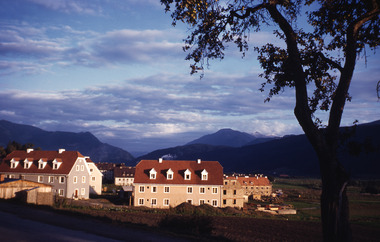
... For six months, they travelled extensively throughout Europe (predominantly driving themselves) - France, Italy, United Kingdom, Sweden, Denmark, Germany, Austria, Switzerland and Spain....Colour slide in a mount. Austrian Houses, Bad Aussee, Austria...Austria Houses (Handwritten) / Bad Aussee (Handwritten)...Austrian Houses, Bad Aussee, Austria Slide Robin Boyd ...Penleigh Boyd, Robin and Patricia Boyd's son, writes “Prior to 1950 Robin, like most other amateur or hobby photographers, took black and white printed photographs. The oldest slides date from 1950 when Robin and Patricia travelled to Europe on Robin’s Robert Haddon Travelling Scholarship.” In 1948 Robin Boyd was awarded ‘joint first place’ in the Robert Haddon competition for his design of Mildura art gallery. The scholarship helped fund their first overseas trip. Robin and Patricia were passengers on the Greek ship “Cyrenia” departing in May 1950, passing through the Suez Canal and landing in Genoa five weeks later. For six months, they travelled extensively throughout Europe (predominantly driving themselves) - France, Italy, United Kingdom, Sweden, Denmark, Germany, Austria, Switzerland and Spain.Colour slide in a mount. Austrian Houses, Bad Aussee, AustriaAustria Houses (Handwritten) / Bad Aussee (Handwritten)haddon travelling scholarship, haddon, robin boyd, slide -
 Robin Boyd Foundation
Slide, Robin Boyd, 1950
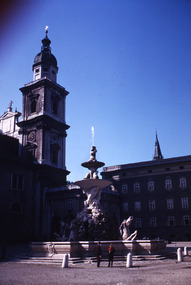
... For six months, they travelled extensively throughout Europe (predominantly driving themselves) - France, Italy, United Kingdom, Sweden, Denmark, Germany, Austria, Switzerland and Spain....Residenzplatz , Salzburg, Austria...Austria Salzburg (Handwritten) / Residenz Platz With Cathedral (Handwritten)...Residenzplatz , Salzburg, Austria Slide Robin Boyd ...Penleigh Boyd, Robin and Patricia Boyd's son, writes “Prior to 1950 Robin, like most other amateur or hobby photographers, took black and white printed photographs. The oldest slides date from 1950 when Robin and Patricia travelled to Europe on Robin’s Robert Haddon Travelling Scholarship.” In 1948 Robin Boyd was awarded ‘joint first place’ in the Robert Haddon competition for his design of Mildura art gallery. The scholarship helped fund their first overseas trip. Robin and Patricia were passengers on the Greek ship “Cyrenia” departing in May 1950, passing through the Suez Canal and landing in Genoa five weeks later. For six months, they travelled extensively throughout Europe (predominantly driving themselves) - France, Italy, United Kingdom, Sweden, Denmark, Germany, Austria, Switzerland and Spain.Colour slide in a mount. Residenzplatz , Salzburg, AustriaAustria Salzburg (Handwritten) / Residenz Platz With Cathedral (Handwritten)haddon travelling scholarship, haddon, robin boyd, slide -
 Robin Boyd Foundation
Slide, Robin Boyd, 1950
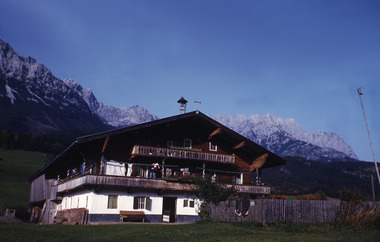
... For six months, they travelled extensively throughout Europe (predominantly driving themselves) - France, Italy, United Kingdom, Sweden, Denmark, Germany, Austria, Switzerland and Spain....Traditional House, Austria (Probably Tyrol)...Austria House (Handwritten) / Country House Turol (Handwritten)...Traditional House, Austria (Probably Tyrol) Slide Robin Boyd ...Penleigh Boyd, Robin and Patricia Boyd's son, writes “Prior to 1950 Robin, like most other amateur or hobby photographers, took black and white printed photographs. The oldest slides date from 1950 when Robin and Patricia travelled to Europe on Robin’s Robert Haddon Travelling Scholarship.” In 1948 Robin Boyd was awarded ‘joint first place’ in the Robert Haddon competition for his design of Mildura art gallery. The scholarship helped fund their first overseas trip. Robin and Patricia were passengers on the Greek ship “Cyrenia” departing in May 1950, passing through the Suez Canal and landing in Genoa five weeks later. For six months, they travelled extensively throughout Europe (predominantly driving themselves) - France, Italy, United Kingdom, Sweden, Denmark, Germany, Austria, Switzerland and Spain.Colour slide in a mount. Traditional House, Austria (Probably Tyrol)Austria House (Handwritten) / Country House Turol (Handwritten)haddon travelling scholarship, haddon, robin boyd, slide -
 Melbourne Legacy
Postcard - Document, postcard
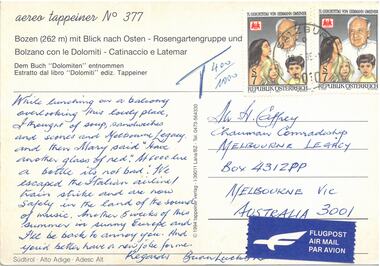
... A postcard to the Comradeship Committee when a Legatee was travelling in Austria. "Bozen mit Blick each Osten" which translates as "Bolzano with view to the east". ...Colour postcard from Austria....Printed "Bozen mit Blick each Osten". Two Austrian postages stamps and an Airmail sticker. ...Colour postcard from Austria. Postcard Document, postcard ...A postcard to the Comradeship Committee when a Legatee was travelling in Austria. "Bozen mit Blick each Osten" which translates as "Bolzano with view to the east". It is addressed to Mr H Caffrey, Chairman Comradeship at Melbourne Legacy. It is not dated and is signed Brian Lucky Luscombe. It says: "While lunching on a balcony overlooking this lovely place, I thought of soup, sandwiches and scones and Melbourne Legacy. And then Mary said "have another glass of red". At 6000 lire a bottle it's not too bad. We escaped the Italian airline/train strike and are now safely in the land of the Sound of Music. Another 5 weeks of this summer in sunny Europe and I'll be back to annoy you. And you'd better have a new job for me. Regards. Brian Lucky Luscombe.A record of a Legatee travelling and relating experiences back to his comrades in Melbourne.Colour postcard from Austria.Printed "Bozen mit Blick each Osten". Two Austrian postages stamps and an Airmail sticker. Handwritten text in blue pen.comradeship, legatee -
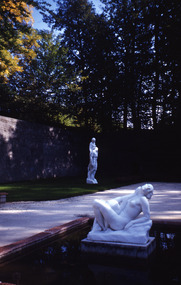 Robin Boyd Foundation
Slide, Robin Boyd, 1950
... For six months, they travelled extensively throughout Europe (predominantly driving themselves) - France, Italy, United Kingdom, Sweden, Denmark, Germany, Austria, Switzerland and Spain....Colour slide in a mount. Leda, by Austrian-German sculptor Josef Thorak...Austria Sculpture (Handwritten) / Open-air Scupture Exhibition (Handwritten) / Sculptor: Thoraz; LEDA (Handwritten)...Leda, by Austrian-German sculptor Josef Thorak Slide Robin Boyd ...Penleigh Boyd, Robin and Patricia Boyd's son, writes “Prior to 1950 Robin, like most other amateur or hobby photographers, took black and white printed photographs. The oldest slides date from 1950 when Robin and Patricia travelled to Europe on Robin’s Robert Haddon Travelling Scholarship.” In 1948 Robin Boyd was awarded ‘joint first place’ in the Robert Haddon competition for his design of Mildura art gallery. The scholarship helped fund their first overseas trip. Robin and Patricia were passengers on the Greek ship “Cyrenia” departing in May 1950, passing through the Suez Canal and landing in Genoa five weeks later. For six months, they travelled extensively throughout Europe (predominantly driving themselves) - France, Italy, United Kingdom, Sweden, Denmark, Germany, Austria, Switzerland and Spain.Colour slide in a mount. Leda, by Austrian-German sculptor Josef ThorakAustria Sculpture (Handwritten) / Open-air Scupture Exhibition (Handwritten) / Sculptor: Thoraz; LEDA (Handwritten)haddon travelling scholarship, haddon, robin boyd, slide -
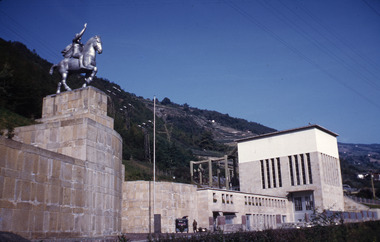 Robin Boyd Foundation
Slide, Robin Boyd, 1950
... For six months, they travelled extensively throughout Europe (predominantly driving themselves) - France, Italy, United Kingdom, Sweden, Denmark, Germany, Austria, Switzerland and Spain....Statue of Mussolini, Power Station neat Austrian border, Italy.... / El.P. St. Near Austrian Border / Mussolini (All Handwritten)...Statue of Mussolini, Power Station neat Austrian border, Italy Slide Robin Boyd ...Penleigh Boyd, Robin and Patricia Boyd's son, writes “Prior to 1950 Robin, like most other amateur or hobby photographers, took black and white printed photographs. The oldest slides date from 1950 when Robin and Patricia travelled to Europe on Robin’s Robert Haddon Travelling Scholarship.” In 1948 Robin Boyd was awarded ‘joint first place’ in the Robert Haddon competition for his design of Mildura art gallery. The scholarship helped fund their first overseas trip. Robin and Patricia were passengers on the Greek ship “Cyrenia” departing in May 1950, passing through the Suez Canal and landing in Genoa five weeks later. For six months, they travelled extensively throughout Europe (predominantly driving themselves) - France, Italy, United Kingdom, Sweden, Denmark, Germany, Austria, Switzerland and Spain.Colour slide in a mount. Statue of Mussolini, Power Station neat Austrian border, ItalyItaly / Power St. / El.P. St. Near Austrian Border / Mussolini (All Handwritten)haddon travelling scholarship, haddon, robin boyd, slide -
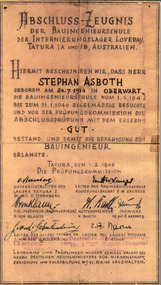 Tatura Irrigation & Wartime Camps Museum
Folio, Stefan Asboth, Austrian Internee
... Stefan Asboth, Austrian Internee....documents reports Black folder with original and photocopied documents in plastic sleeves. Stefan Asboth, Austrian Internee. Folio ...Black folder with original and photocopied documents in plastic sleeves.documents, reports -
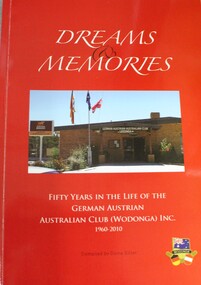 Wodonga & District Historical Society Inc
Book - DREAMS & MEMORIES : FIFTY YEARS IN LIFE OF GERMAN AUSTRIAN AUSTRALIAN CLUB (WODONGA) INC. 1960-2010, Doina Eitler, 2010
... DREAMS & MEMORIES : FIFTY YEARS IN LIFE OF GERMAN AUSTRIAN AUSTRALIAN CLUB (WODONGA) INC. 1960-2010...German Austrian Australian Club Wodonga clubs German immigration A history of The German Austrian Club which was founded on the 16th July 1960. ...A history of The German Austrian Club which was founded on the 16th July 1960. Migrants from Germany and Austria arrived in Bonegilla during the 50s and 60s and many were lonely and homesick. The Club became a meeting place for these people. This book follows the evolution of the club as a recognised social venue and contributor to the Wodonga community.non-fictionA history of The German Austrian Club which was founded on the 16th July 1960. Migrants from Germany and Austria arrived in Bonegilla during the 50s and 60s and many were lonely and homesick. The Club became a meeting place for these people. This book follows the evolution of the club as a recognised social venue and contributor to the Wodonga community.german austrian australian club, wodonga clubs, german immigration -
 Bendigo Military Museum
Badge - BADGE, BRITISH ARMY INSIGNIA, 1945
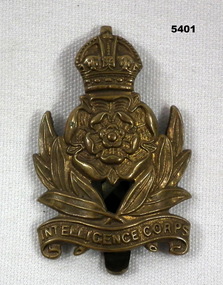
... Enlisted Worster (England) Ref 5400, 5402 Austria Occupational Forces...Badge, metal, brass insignia Austria Occupational Forces...Enlisted Worster (England) Ref 5400, 5402 Austria Occupational Forces Badge Military insignia intelligence corp Crown, Rose, Leaves Ïntelligence Corps" Badge, metal, brass insignia Austria Occupational Forces Badge BADGE, BRITISH ARMY INSIGNIA ...14972799, ASTON, Derg James Randell. Enlisted Worster (England) Ref 5400, 5402 Austria Occupational ForcesBadge, metal, brass insignia Austria Occupational ForcesCrown, Rose, Leaves Ïntelligence Corps"badge, military insignia, intelligence corp -
 Greensborough Historical Society
Photograph - Digital image, Charles Marshall et al, Prisoners taken at Ramleh, 1917_
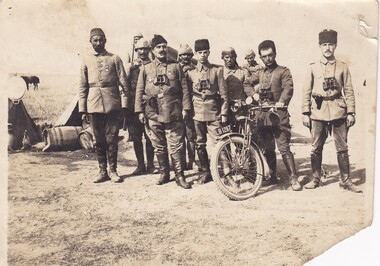
... This photograph shows prisoners of war, Turkish, German and Austrian officers, taken near Ramleh....Turkish, German and Austrian Officers"...Turkish, German and Austrian Officers" Digital copy of black and white photograph. ...This photograph shows prisoners of war, Turkish, German and Austrian officers, taken near Ramleh.Digital copy of black and white photograph. "Prisoners taken up near Ramleh. Turkish, German and Austrian Officers"charles marshall, world war 1 -
 National Wool Museum
Poster, Costumes of Europe in Wool- Austria
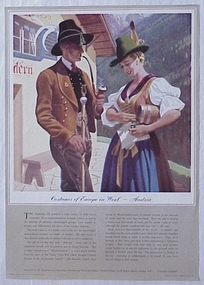
... Costumes of Europe in Wool- Austria..."Costumes of Europe in Wool- Austria" - Dept of Education, International Wool Secretariat, part of the "Costumes of Europe in Wool" Series...."Costumes of Europe in Wool- Austria" - Dept of Education, International Wool Secretariat, part of the "Costumes of Europe in Wool" Series....Costumes of Europe in Wool- Austria Poster ..."Costumes of Europe in Wool- Austria" - Dept of Education, International Wool Secretariat, part of the "Costumes of Europe in Wool" Series."Costumes of Europe in Wool- Austria" - Dept of Education, International Wool Secretariat, part of the "Costumes of Europe in Wool" Series.Prepared by the Department of Education, International Wool Secretariat, Dorland House, 18-20 Regent St Londonwool marketing, international wool secretariat, dept of education -
 Wodonga & District Historical Society Inc
Domestic object - Shaving Mug, Victoria Porcelain, c1918
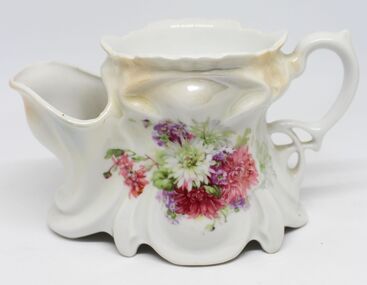
... In Bohemia, Austria. After 2 years the factory was sold to Franz Schmidt. ...Hallmark on bottom: A green crown with "VICTORIA" written above it and "AUSTRIA" beneath....In Bohemia, Austria. After 2 years the factory was sold to Franz Schmidt. ...This item is from a collection donated by descendants of John Francis Turner of Wodonga. Mr Turner was born on 6 June 1885. He completed all of his schooling at Scots Boarding School in Albury, New South Wales. On leaving school, he was employed at Dalgety’s, Albury as an auctioneer. In 1924 John was promoted to Manager of the Wodonga Branch of Dalgety’s. On 15/03/1900 he married Beatrice Neal (born 7/12/1887 and died 7/2/1953) from Collingwood, Victoria. They had four daughters – Frances (Nancy), Heather, Jessie and Mary. In 1920, the family moved from Albury to Wodonga, purchasing their family home “Locherbie” at 169 High Street, Wodonga. "Locherbie" still stands in Wodonga in 2022. The collection contains items used by the Turner family during their life in Wodonga. Victoria Porcelain - Victoria is the name of the leading porcelain producing company of Austria. It was founded 1883 by a company called Lazarus and Rosenfeld ltd. In Bohemia, Austria. After 2 years the factory was sold to Franz Schmidt. It was under his ownership that the Vitoria factor became the largest porcelain producing factory of its times. The Victoria Austria round green mark was used between 1904 and 1918.This item comes from a collection used by a prominent citizen of Wodonga. It is also an excellent example of Victoria Austria porcelain of the early 20th century.A porcelain shaving mug with floral design on one side. There is a space to hold a shaving brush and draining holes in the internal shelf.Hallmark on bottom: A green crown with "VICTORIA" written above it and "AUSTRIA" beneath.domestic items, silver cutlery -
 Tatura Irrigation & Wartime Camps Museum
Photograph, Camp 3 Families
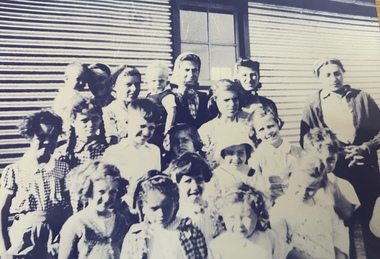
... Straits Settlement Refugee familes in Compound D, Camp 3 Tatura. German and Austrian Jewish families sought refuge in Malaya and Singapore in 1938. ...Black and white photograph of a group of German and Austrian children and parents. Standing in front of a Camp hunt in Camp 3, compound D...Straits Settlement Refugee familes in Compound D, Camp 3 Tatura. German and Austrian Jewish families sought refuge in Malaya and Singapore in 1938. ...Straits Settlement Refugee familes in Compound D, Camp 3 Tatura. German and Austrian Jewish families sought refuge in Malaya and Singapore in 1938. Interned in Singapore in 1940 and Transported to Australia in September 1940.Black and white photograph of a group of German and Austrian children and parents. Standing in front of a Camp hunt in Camp 3, compound Dsingapore, straits settlement, jewish refugees, camp 3, tatura -
 Robin Boyd Foundation
Slide, Robin Boyd, 1950
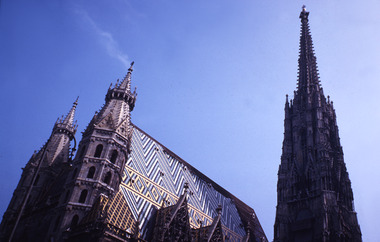
... For six months, they travelled extensively throughout Europe (predominantly driving themselves) - France, Italy, United Kingdom, Sweden, Denmark, Germany, Austria, Switzerland and Spain....Stephen's Church, Vienna, Austria...Stephen's Church, Vienna, Austria Slide Robin Boyd ...Penleigh Boyd, Robin and Patricia Boyd's son, writes “Prior to 1950 Robin, like most other amateur or hobby photographers, took black and white printed photographs. The oldest slides date from 1950 when Robin and Patricia travelled to Europe on Robin’s Robert Haddon Travelling Scholarship.” In 1948 Robin Boyd was awarded ‘joint first place’ in the Robert Haddon competition for his design of Mildura art gallery. The scholarship helped fund their first overseas trip. Robin and Patricia were passengers on the Greek ship “Cyrenia” departing in May 1950, passing through the Suez Canal and landing in Genoa five weeks later. For six months, they travelled extensively throughout Europe (predominantly driving themselves) - France, Italy, United Kingdom, Sweden, Denmark, Germany, Austria, Switzerland and Spain.Colour slide in a mount. St. Stephen's Church, Vienna, AustriaVienna Church (Handwritten) / St. Stephen's (Handwritten)haddon travelling scholarship, haddon, robin boyd, slide -
 Robin Boyd Foundation
Slide, Robin Boyd, 1950
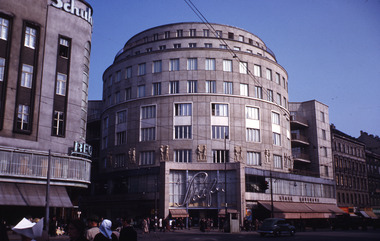
... For six months, they travelled extensively throughout Europe (predominantly driving themselves) - France, Italy, United Kingdom, Sweden, Denmark, Germany, Austria, Switzerland and Spain....Stafa Department Store, Vienna, Austria...Stafa Department Store, Vienna, Austria Slide Robin Boyd ...Penleigh Boyd, Robin and Patricia Boyd's son, writes “Prior to 1950 Robin, like most other amateur or hobby photographers, took black and white printed photographs. The oldest slides date from 1950 when Robin and Patricia travelled to Europe on Robin’s Robert Haddon Travelling Scholarship.” In 1948 Robin Boyd was awarded ‘joint first place’ in the Robert Haddon competition for his design of Mildura art gallery. The scholarship helped fund their first overseas trip. Robin and Patricia were passengers on the Greek ship “Cyrenia” departing in May 1950, passing through the Suez Canal and landing in Genoa five weeks later. For six months, they travelled extensively throughout Europe (predominantly driving themselves) - France, Italy, United Kingdom, Sweden, Denmark, Germany, Austria, Switzerland and Spain.Colour slide in a mount. Stafa Department Store, Vienna, AustriaVienna Shop (Handwritten) / Department Store / 1950 (Handwritten)haddon travelling scholarship, haddon, robin boyd, slide -
 Robin Boyd Foundation
Slide, Robin Boyd, 1950
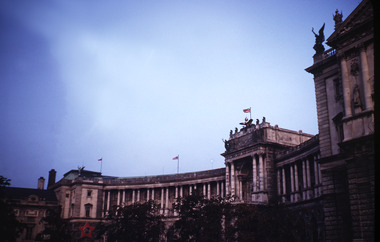
... For six months, they travelled extensively throughout Europe (predominantly driving themselves) - France, Italy, United Kingdom, Sweden, Denmark, Germany, Austria, Switzerland and Spain....Hofburg Imperial Palace, Vienna, Austria...Hofburg Imperial Palace, Vienna, Austria Slide Robin Boyd ...Penleigh Boyd, Robin and Patricia Boyd's son, writes “Prior to 1950 Robin, like most other amateur or hobby photographers, took black and white printed photographs. The oldest slides date from 1950 when Robin and Patricia travelled to Europe on Robin’s Robert Haddon Travelling Scholarship.” In 1948 Robin Boyd was awarded ‘joint first place’ in the Robert Haddon competition for his design of Mildura art gallery. The scholarship helped fund their first overseas trip. Robin and Patricia were passengers on the Greek ship “Cyrenia” departing in May 1950, passing through the Suez Canal and landing in Genoa five weeks later. For six months, they travelled extensively throughout Europe (predominantly driving themselves) - France, Italy, United Kingdom, Sweden, Denmark, Germany, Austria, Switzerland and Spain.Colour slide in a mount. Hofburg Imperial Palace, Vienna, AustriaVienna Palace (Handwritten) / Hoffburg Palace (Handwritten)haddon travelling scholarship, haddon, robin boyd, slide -
 Falls Creek Historical Society
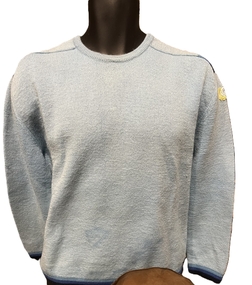
Clothing - Helmut Fendt's Sweater
... Many of the earliest instructors at Falls Creek came from Austria at that time. The Austrian-made sweater was made by Carlo Gruber. ...A pale blue wool knit sweater manufactured by Carlo Gruber of Austria. It has an embroidered logo on the upper left sleeve. ...Many of the earliest instructors at Falls Creek came from Austria at that time. The Austrian-made sweater was made by Carlo Gruber. ...Helmut Fendt was a ski instructor at Falls Creek in 1966. Many of the earliest instructors at Falls Creek came from Austria at that time. The Austrian-made sweater was made by Carlo Gruber. These sweaters became part of the uniform for the Falls Creek Ski School. Carlo Gruber was an Austrian designer who specialised in winter wool ski wear. He was a ski instructor and later teamed up with Adidas to develop a wide range of clothing items and snow boots. Many of his designs were reissued by Adidas in 2005.This item is significant because it was part of the Falls Creek Ski School uniform in the 1960s.A pale blue wool knit sweater manufactured by Carlo Gruber of Austria. It has an embroidered logo on the upper left sleeve. The cuffs and hemline have a two-toned blue striped edge.helmut fendt, falls creek ski school, snow apparel -
 Robin Boyd Foundation
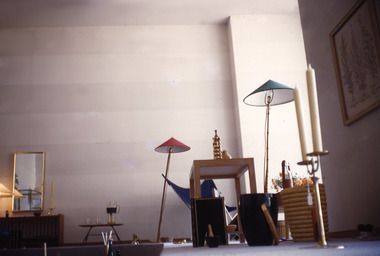
Slide, Robin Boyd, 1950
... For six months, they travelled extensively throughout Europe (predominantly driving themselves) - France, Italy, United Kingdom, Sweden, Denmark, Germany, Austria, Switzerland and Spain....Architect's Co-op Shop, Vienna, Austria...Architect's Co-op Shop, Vienna, Austria Slide Robin Boyd ...Penleigh Boyd, Robin and Patricia Boyd's son, writes “Prior to 1950 Robin, like most other amateur or hobby photographers, took black and white printed photographs. The oldest slides date from 1950 when Robin and Patricia travelled to Europe on Robin’s Robert Haddon Travelling Scholarship.” In 1948 Robin Boyd was awarded ‘joint first place’ in the Robert Haddon competition for his design of Mildura art gallery. The scholarship helped fund their first overseas trip. Robin and Patricia were passengers on the Greek ship “Cyrenia” departing in May 1950, passing through the Suez Canal and landing in Genoa five weeks later. For six months, they travelled extensively throughout Europe (predominantly driving themselves) - France, Italy, United Kingdom, Sweden, Denmark, Germany, Austria, Switzerland and Spain.Colour slide in a mount. Architect's Co-op Shop, Vienna, AustriaVienna Furniture (Handwritten) / Architect's Co-op Shop in Vienna / 1950 (Handwritten)haddon travelling scholarship, haddon, robin boyd, slide -
 Tatura Irrigation & Wartime Camps Museum
Document- Certificate, Adolf Lichtenstern
... Adolf Lichtenstern completed an Electrical Engineering degree in Austria. He was a German citizen, and along with his wife (Eugenia) and child (Kenneth) was resident in Singapore upon the beginning of WWII. ...Certificate awarded to Adolf Lichtenstern, 12th Sept 1921, on completion of his Electrical Engineers Course, Vienna, Austria....Vienna, Austria...Certificate awarded to Adolf Lichtenstern, 12th Sept 1921, on completion of his Electrical Engineers Course, Vienna, Austria. Adolf Lichtenstern Document- Certificate ...Adolf Lichtenstern completed an Electrical Engineering degree in Austria. He was a German citizen, and along with his wife (Eugenia) and child (Kenneth) was resident in Singapore upon the beginning of WWII. The family was transported to and interned in Camp 3, Tatura.Large copy of diploma in German. Certificate awarded to Adolf Lichtenstern, 12th Sept 1921, on completion of his Electrical Engineers Course, Vienna, Austria.tatura, internment camps, singapore, documents, certificates, education -
Whitehorse Historical Society Inc.
Article, The Pioneers, 17/06/1992 12:00:00 AM
... It is wrong in claiming that the Fankhauser family came from Germany instead of Austria according to Miss Norma Boyle....Item in the Nunawading Gazette publicising an exhibition of German memorabilia from early settlement of Doncaster and Nunawading is wrong in claiming that the Fankhauser family came from Germany instead of Austria according to Miss Norma Boyle....It is wrong in claiming that the Fankhauser family came from Germany instead of Austria according to Miss Norma Boyle. Fankhauser Claude Augustus Leopold Boyle Norma Pioneers Item in the Nunawading Gazette publicising an exhibition of German memorabilia from early settlement of Doncaster and Nunawading. ...Item in the Nunawading Gazette publicising an exhibition of German memorabilia from early settlement of Doncaster and Nunawading.Item in the Nunawading Gazette publicising an exhibition of German memorabilia from early settlement of Doncaster and Nunawading is wrong in claiming that the Fankhauser family came from Germany instead of Austria according to Miss Norma Boyle.Item in the Nunawading Gazette publicising an exhibition of German memorabilia from early settlement of Doncaster and Nunawading. fankhauser, claude augustus leopold, boyle, norma, pioneers -
 Mission to Seafarers Victoria
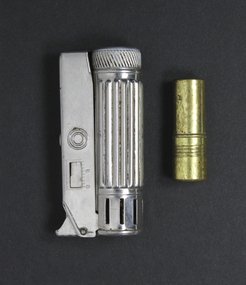
Functional object - Cigarette Lighter, c. 1950
... The origin of the lighters appears to be Austria and could have been acquired either during or post his war service. ...Lighter1: PATENT/BORA/EXTRA/MADE IN/AUSTRIA (stamped alongside body of lighter) Lighter2: PATENT/Made/in/Austria/902. ...Austria...The origin of the lighters appears to be Austria and could have been acquired either during or post his war service. ...Possibly acquired by seafarer Mr Arthur Dixon who served in WW2 merchant vessels. The origin of the lighters appears to be Austria and could have been acquired either during or post his war service. Initial research indicates an approximate date of 1950s for date of manufacture.See Donor details 1727-1737.2 Small, cylindrical, fluted, polished, stainless steel cigarette lighters, with flint action. Includes a flint gauge in the ignition unit. Runs on lighter fuel, with inbuilt wick. Accompanying bronze coloured metal case of flints. Manufacturer name embossed on body. Lid incised with cylindrical grip of 4 ridges. Lighter1: PATENT/BORA/EXTRA/MADE IN/AUSTRIA (stamped alongside body of lighter) Lighter2: PATENT/Made/in/Austria/902. At right angles at base of lighter, REL Flints: Thorens (stamped in brand name logo style on body at right angle to lid)cigarette lighters, smoking accessories, arthur dixon, bora cigarette lighter, arthur oswald dixon, sailors, seafarers, seamen, officers, smoking, lighters, bora -
 Whitehorse Historical Society Inc.
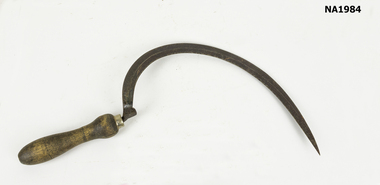
Tool - Sickle
... Austria...Austria...A lavender farm. rural industry agriculture Austria Large curved sharpened steel blade with a wooden handle. ...Type of sickle used by Mr. Slater at his property 'Mitcham Grove' North Blackburn. A lavender farm.Large curved sharpened steel blade with a wooden handle.Austriarural industry, agriculture
