
Showing 158 items matching "awas"
-
 Tatura Irrigation & Wartime Camps Museum
Photograph, Camp 13 AWAS girls
... Camp 13 AWAS girls...AWAS...AWAS girls, from Murchison Camp 13...Black and white photograph of 8 AWAS girls standing in front of hut....AWAS girls, from Murchison Camp 13 J AWAS Joyce Montgomery Camp 13 Murchison Black and white photograph of 8 AWAS girls standing in front of hut. ...AWAS girls, from Murchison Camp 13JBlack and white photograph of 8 AWAS girls standing in front of hut.awas, joyce montgomery, camp 13 murchison -
 Tatura Irrigation & Wartime Camps Museum
Photograph, AWAS Group Camp 13
... AWAS Group Camp 13...awas...The girls are members of the AWAS who were at Camp 13 Garrison during WW2. ...AWAS Group Camp 13 Photograph Photograph ...The girls are members of the AWAS who were at Camp 13 Garrison during WW2. Sepia photograph of 9 women, some in bathers, some in uniform, with huts in the background.awas, camp 13 murchison -
 Tatura Irrigation & Wartime Camps Museum
Photograph, AWAS Sisters
... AWAS Sisters......awas...AWAS sisters from Tatura Group internment camps. ...AWAS sisters from Tatura Group internment camps. ...AWAS sisters from Tatura Group internment camps. Rear: Sisters S O'Shannessy, M Morrison and E Chalmers. Seated: Sisters Robinson, D Evans, M Peck and Lorraine Danson.Black and white photograph of 7 nursing sisters, 3 standing, 4 seated, in uniform. Building behind them and a tree on the far right. Sister on right has a hat on.sister o'shannessy, sister morrison, sister chalmers, sister robinson, sister evans, sister peck, sister lorraine danson, awas -
 Bendigo Military Museum
Photograph - LHQ Cartographic Company AWAS Accommodation, Westend Hall, Bendigo, 1943
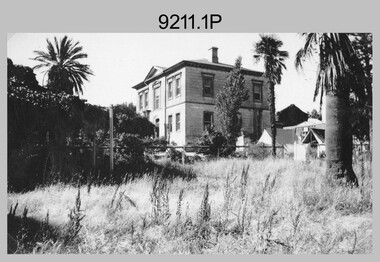
... LHQ Cartographic Company AWAS Accommodation, Westend Hall, Bendigo...Prior to the AWAS occupation the Army had used the spacious house as a camp hospital. ...This is a set of four photographs of AWAS Accommodation at ‘Westend Hall’, taken in 1943 during Army’s early years of occupation at Fortuna, Bendigo in WW2. ...LHQ Cartographic Company AWAS Accommodation, Westend Hall, Bendigo Photograph LHQ Cartographic Company AWAS Accommodation, Westend Hall, Bendigo Army Survey Regiment ...This is a set of 12 photographs taken during Army’s occupation at Fortuna, Bendigo in WW2. On 1 Feb 1941, a Cartographic Section was reformed as the Land Headquarters (LHQ) Cartographic Company. Deputy Chief of the General Staff, Major General Sidney Rowell instructed Its OC - Major William Sarll, in the interests of security of plant and to provide against possible damage of air attack, to investigate suitable safer inland accommodation for LHQ Cartographic Company. Major William Sarll inspected many properties before finding one that would meet the requirements of the Cartographic Company. In late 1941, he came to inspect Fortuna, a rambling old mansion dating back to the gold rush, with about fifteen acres of ground in central Bendigo. On 23 March 1942, the Commonwealth of Australia, under the provisions of the National Security Act of 1939, took possession of the house, the old battery buildings and the fifteen acres of grounds. LHQ Cartographic Company moved to Bendigo on 11 Jun 1942, from Mitchell House, Melbourne. The responsibilities of this unit were map compilation, fair drawing and lithographic reproduction, including printing the work of other Units as well as their own. A decision of War Cabinet on 13 August 1941 had authorised the formation of the Australian Women's Army Service (AWAS), in order to release men from certain military duties for employment with fighting units. Originally their employment was restricted to traditional female areas and numbers were strictly limited, but the outbreak of the Pacific War in 1942 led to a broadening of employment categories and an increase in numbers. The first AWAS arrived at Fortuna on 26 November 1942 and immediately became an integral part of the unit. Seventy-five AWAS served with the Cartographic Company during the war and Major Sarll paid them a special tribute for their 'untiring efforts' in the Company's war report. The AWAS could not be accommodated at Fortuna, and a nearby house, Westend Hall, on the corner of Lily and Barnard Streets, provided the first barracks with Warrant Officer Durack in charge. The building, designed by Vahland and Getzchmann in 1868, has been described as the 'grandest house on the goldfields with elegant Corinthian columns supporting a balustraded portico.' The building was conveniently situated close to the front gates of Fortuna. The women appreciated their pleasant surroundings as a magazine article written a year after their arrival reveals. 'It was a stroke of luck which gave us West End Hall with its gardens and large airy rooms; and it is to Miss Durack that we must give thanks for the bright furnishings, the good food and ... the splendid atmosphere of comradeship. But not all could be accommodated in the house; some slept in tents through the freezing Bendigo winters. Local girls like Gwen McGown were able to live at home, but had to report for the Monday morning parade after which the women would march to work. Saturday afternoon was designated sports afternoon for the women. They formed teams among themselves for competitions in basketball and softball. The women participated in an active way in the recreational activities of the Company, including athletics sports days, marching contests, concerts and dances. In the later years of the war, the barracks at West End Hall were too cramped and the AWAS were transferred to Lansellstowe, a beautiful old home in Barkly Terrace built originally for Leonard Vere Lansell, the third son of George Lansell. Prior to the AWAS occupation the Army had used the spacious house as a camp hospital. Refer to Item 6099.17P for photos taken in 1942, the first year of LHQ Cartographic Company’s occupation at Fortuna, Bendigo in WW2. The Survey Corps’ occupation of Fortuna during WW2 is covered in more detail with additional historic photographs, in pages 17 to 27 of Valerie Lovejoy’s book 'Mapmakers of Fortuna – A history of the Army Survey Regiment’ ISBN: 0-646-42120-4.Other items from Rosemary (Atkinson) Bowman are: 9209.12P, 9210.16P, 9212.6P, 9213.4P and 9214.12. This is a set of four photographs of AWAS Accommodation at ‘Westend Hall’, taken in 1943 during Army’s early years of occupation at Fortuna, Bendigo in WW2. The black and white photo, graphs are printed on photographic paper are contained in a photo album provided by the family of Rosemary (Atkinson) Bowman, a former member of RA Svy. The photographs were scanned at 600 dpi and are part of the Army Survey Regiment’s Collection. .1) - Photo, black & white, 1943. AWAS Accommodation, Westend Hall. .2) - Photo, black & white, 1943. At front steps of Westend Hall. L to R: Norma Lewis, Tiny Lewis, Billie Hyatt, Norma Jeffrey, Betty Eyval, Peggy Priest. .3) - Photo, black & white, 1943. Hall and stairway inside the old barracks - Westend Hall. .4) - Photo, black & white, 1943. Recreation room inside the old barracks - Westend Hall.Some personnel are identified with dates in the photo album.royal australian survey corps, rasvy, army survey regiment, asr, fortuna -
 Tatura Irrigation & Wartime Camps Museum
Photograph, AWAS Quarters Garden
... AWAS Quarters Garden...Photograph depicts the garden at the AWAS quarters at Camp 13 Murchison....Photograph depicts the garden at the AWAS quarters at Camp 13 Murchison. AWAS quarters Camp 13 Murchison POW camp Camp gardens Black and white photograph of a garden. ...Photograph depicts the garden at the AWAS quarters at Camp 13 Murchison.Black and white photograph of a garden. Stone wall at bottom of the picture, flowers and lawn behind. Huts to the right. Left of centre is a flag pole with a hedge behind. Trees in distance.awas quarters, camp 13, murchison pow camp, camp gardens -
 Kyneton RSL Sub Branch
Uniform, AWAS Hat
... AWAS Hat...This Australian Womens Army Services (AWAS) Hat belonged to Marion (Tib) Owler. Established in August 1941, the AWAS in consisted of 6000 women by January 1942. ...This Australian Womens Army Services (AWAS) Hat belonged to Marion (Tib) Owler. Established in August 1941, the AWAS in consisted of 6000 women by January 1942. ...This Australian Womens Army Services (AWAS) Hat belonged to Marion (Tib) Owler. Established in August 1941, the AWAS in consisted of 6000 women by January 1942. Some 20,000 were in service by the end of that same year. They worked in roles including administration, driving, catering, signals and intelligence, and were paid around two-thirds of their male counterparts. The item represents Australian women’s army uniform headdress from WW 2. The hat’s stylish design was an important aspect of the recruiting campaign for the women’s services of 1942.Fur felt brimmed hat. Band holds Rising Sun badge centre front, and a red & blue unit colour patch is also attached to the band on the side.tagged - kyn rsl 2012/3women's army services, women's uniform, ww2 uniform. -
 Melbourne Tram Museum
Poster, Australian Womens Army Service, "Release a man...join the AWAS", c1942
... "Release a man...join the AWAS"...Poster of the type that could have been placed in a tramcar or bus window advertising for women to joint the Australian Womens Army Service to release a man for other duties. Has the AWAS address of the Metropolitan Gas Co. at 196 Flinders St. ..."Release a man...join the AWAS" Poster Australian Womens Army Service ...Poster of the type that could have been placed in a tramcar or bus window advertising for women to joint the Australian Womens Army Service to release a man for other duties. Has the AWAS address of the Metropolitan Gas Co. at 196 Flinders St. Melbourne.Demonstrates a WW2 women recruiting poster.Poster - three colours printed on sheet paper which has then been glued to a sheet of brown paper.world war 2, poster, army, advertisements -
 Wodonga & District Historical Society Inc
Functional object - Haeusler Collection Mid 20th Century AWA Transistor Radio, Amalgamated Wireless Australasia Limited
... Haeusler Collection Mid 20th Century AWA Transistor Radio...This transistor radio was manufactured by Amalgamated Wireless Australasia Limited (AWA), Australia's largest and most prominent twentieth century producer of radios, televisions, audio and telecommunications equipment. ...A mid-century cream, blue and gold chrome portable transistor radio manufactured by AWA...logo on face of radio: "AWA". Numbers on circular tuning panel. ...A mid-century cream, blue and gold chrome portable transistor radio manufactured by AWA Haeusler Collection Mid 20th Century AWA Transistor Radio Functional object Haeusler Collection Mid 20th Century AWA Transistor Radio Amalgamated Wireless Australasia Limited ...The Wodonga Historical Society Haeusler Collection provides invaluable insight into life in late nineteenth and early twentieth century north east Victoria. The collection comprises manuscripts, personal artefacts used by the Haeusler family on their farm in Wodonga, and a set of glass negatives which offer a unique visual snapshot of the domestic and social lives of the Haeusler family and local Wodonga community. The Haeusler family migrated from Prussia (Germany) to South Australia in the 1840s and 1850s, before purchasing 100 acres of Crown Land made available under the Victorian Lands Act 1862 (also known as ‘Duffy’s Land Act’) in 1866 in what is now Wodonga West. The Haeusler family were one of several German families to migrate from South Australia to Wodonga in the 1860s. This transistor radio was manufactured by Amalgamated Wireless Australasia Limited (AWA), Australia's largest and most prominent twentieth century producer of radios, televisions, audio and telecommunications equipment. This item has well documented provenance and a known owner. It forms part of a significant and representative historical collection which reflects the local history of Wodonga. It contributes to our understanding of domestic and family life in early twentieth century Wodonga, as well as providing interpretative capacity for themes including local history and social history. A mid-century cream, blue and gold chrome portable transistor radio manufactured by AWAlogo on face of radio: "AWA". Numbers on circular tuning panel. radio, music, electronics, awa radios, haeusler collection, haeusler, wodonga -
 Tatura Irrigation & Wartime Camps Museum
Photograph, Sisters Trix Moore and Vi Elliott
... ...AWAS...Sisters Trix Moore and Vi Elliott were AWAS sisters at Tatura Internment Group during WW2....Black and white photograph of two AWAS Sisters, in uniform, standing together with a hut directly behind them. ...Sister Trix Moore Sister Vi Elliott AWAS Tatura Internment Group Black and white photograph of two AWAS Sisters, in uniform, standing together with a hut directly behind them. ...Sisters Trix Moore and Vi Elliott were AWAS sisters at Tatura Internment Group during WW2.Black and white photograph of two AWAS Sisters, in uniform, standing together with a hut directly behind them. sister trix moore, sister vi elliott, awas, tatura internment group -
 Bendigo Military Museum
Book, Ann Howard, You'll Be Sorry! Reflections of the AWAS from 1941-1945, 1990
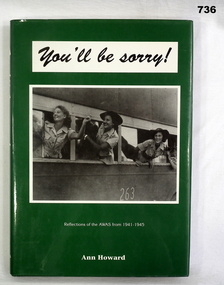
... Reflections of the AWAS from 1941-1945...Reflections of the AWAS from 1941-1945 Book BOOK Ann Howard Tarka Publishing ...Details the experiences of members of the Australian Women's Army Service during WWII. Green buckram hardcover with dust jacket. Book has title in gold on spine. Dust cover is green with black and white image of women leaning out of windows. 193 cut edged plain paper pages, with illustrations.On front end paper "Francis W Dean BEM"books, military history -
 Tatura Irrigation & Wartime Camps Museum
Folio, AWAS
... AWAS....documents reports Black flecked two ring folder containing photos and paper in plastic sleeves. AWAS. Folio ...Black flecked two ring folder containing photos and paper in plastic sleeves.documents, reports -
 Geelong RSL Sub Branch
Photograph Album - AWAS, Early 20th Century
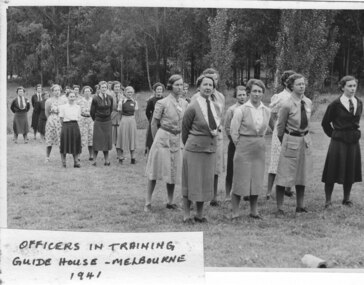
... The Australian Womens Army Service was raised on 13 August 1941, and in 1944 and 1945 AWAS served in Dutch and Australian New Guinea. ...At the rear of the album is a history of Sybil Irving who was the founder and controller of the AWAS...Photograph Album - AWAS ...The Australian Womens Army Service was raised on 13 August 1941, and in 1944 and 1945 AWAS served in Dutch and Australian New Guinea. In June 1947 all members of AWAS had been demobilised and in April 1951 the Women's Royal Army Corps (WRAAC) was formed.This album has photographs of AWAS in Training at Guide House in Melbourne, March Past's at Victoria Barracks Melbourne and near the Melbourne Shrine, AWAS in New Guinea and postings 'somewhere in Australia. The album also includes photographs of Annual Parades of ex AWAS.An oblong shaped photograph album hard cover with 14 pages of photographs.At the rear of the album is a history of Sybil Irving who was the founder and controller of the AWASww2, awas, wraac -
 Tatura Irrigation & Wartime Camps Museum
Photograph, Lt Horwood and Sisters Heaphy, Tootell and Castran, Original 1942, copy 1989
... WW2 internment camp 1, Tatura, Lieutenant Horwood, interpreter, with 3 of the AWAS Sisters (Heaphy, Tootell and Castran) on the steps of the quartermasters store, 1943...Army Lieutenant K. Horwood, three AWAS Sisters on steps of quarter masters store....Horwood, three AWAS Sisters on steps of quarter masters store. ...WW2 internment camp 1, Tatura, Lieutenant Horwood, interpreter, with 3 of the AWAS Sisters (Heaphy, Tootell and Castran) on the steps of the quartermasters store, 1943Army Lieutenant K. Horwood, three AWAS Sisters on steps of quarter masters store.internment camps, tatura internment camps, sister tootall, lieutenant horwood, sister heaphy, sister castran, quartermasters store -
 Bendigo Military Museum
Uniform - UNIFORM, AWAS, 1942/43
... ...AWAS...Mrs M E Cawthan AWAS...Mrs M E Cawthan AWAS Uniform AWAS 1. Jacket - wool, khaki, metal buttons. ...Mrs M E Cawthan AWAS1. Jacket - wool, khaki, metal buttons. Rising Sun on each lapel. 2. Dress - Cotton, light khaki, no buttons. 3. Belt - Wool, khaki, metal buckle.uniform, awas -
 Wodonga & District Historical Society Inc
Functional object - Transistor Radios, Sanyo Electric Co. Pty. Ltd, 1970s
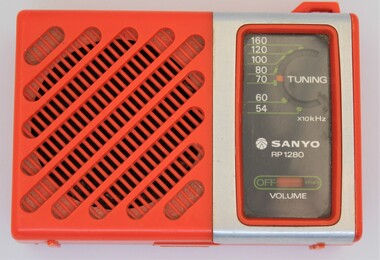
... Transistor 4 , the AWA transistor radio was manufactured by Amalgamated Wireless Australasia Limited (AWA), Australia's largest and most prominent twentieth century producer of radios, televisions, audio and telecommunications equipment. ...No2. is white bakelite No. 2 K--181 pocket transistor made by the Kmart Corporation c1975 and No. 3 is a Nation Brand AM Portable Receiver made in Hong Kong c1980. No. 4 Is an AWA Radiola B121 Solid State pocket transistor. ...HONG KONG" No. 3 AM Portable Receiver Nation Brand on front No 4. on the front: below dial - AWA Radiola B121 ad at bottom "SOLID STATE" On the back: AWA Thorn Consumer Products Pty. ...HONG KONG" No. 3 AM Portable Receiver Nation Brand on front No 4. on the front: below dial - AWA Radiola B121 ad at bottom "SOLID STATE" On the back: AWA Thorn Consumer Products Pty. ...The first transistor radio (the Regency TR-1) was produced by Regency Electronics in cooperation with Texas Instruments in 1954. Transistor 4 , the AWA transistor radio was manufactured by Amalgamated Wireless Australasia Limited (AWA), Australia's largest and most prominent twentieth century producer of radios, televisions, audio and telecommunications equipment. Transistor radios went on to become the most popular electronic communication device of the 1960s and 1970s. Billions of transistor radios are estimated to have been sold worldwide between the 1950s and 2012. They were exceptionally popular amongst young people in Australia due to their portability, allowing them to be taken wherever you wanted to gather with friends or, due to the headphone attachment, without disturbing those around you. These pocket radios are representative of technological developments which had a vast influence on social life and activities throughout Australia.4 pocket transistor radios of various brands. No. 1 orange Sanyo RP 1280 manufactured in 1979/1980. No2. is white bakelite No. 2 K--181 pocket transistor made by the Kmart Corporation c1975 and No. 3 is a Nation Brand AM Portable Receiver made in Hong Kong c1980. No. 4 Is an AWA Radiola B121 Solid State pocket transistor. All of them include a socket to plug in an ear piece.No. 1 on the front "SANYO RP 1280 and tuning dial. On the back: "SANYO MODEL RP 1280/ DC 3 V 2 x "AA" BATTERY/ SANYO ELECTRIC CO. LTD." No. 2 on the front "K-181" and tuning dial. On the back "Code 600-857/ AM POCKET RADIO/DC-3VC (UM-3x2)/ART 181. HONG KONG" No. 3 AM Portable Receiver Nation Brand on front No 4. on the front: below dial - AWA Radiola B121 ad at bottom "SOLID STATE" On the back: AWA Thorn Consumer Products Pty. Ltd./Model No. B121/Batteries 2 x UM-3 OR AA Cells/AM 520 -1620KHz/ Serial No. 75686/ Made in Hong Kong"radio communications, transistor radio -
 Bendigo Military Museum
Photograph - PHOTOGRAPH, FRAMED
... AWAS...Photo of female soldier as member of AWAS (Australian Women's Army Service), with head and shoulders view. ...Photo is of an unidentified female soldier from WW2 in uniform. AWAS Photo Photo of female soldier as member of AWAS (Australian Women's Army Service), with head and shoulders view. ...Photo is of an unidentified female soldier from WW2 in uniform.Photo of female soldier as member of AWAS (Australian Women's Army Service), with head and shoulders view. Photo stuck onto brown cardboard backing with a plastic film on top to protect it. On back is a grey metal backing with attached stand.awas, photo -
 Nhill Aviation Heritage Centre
Radio Receiver Type C55184, c1940
... AWA Radio Receiver, Grey colour has four control knobs six toggle switches one ear phone jack and metal tag holder for frequency setting card, ...Y5/13 Communications Receiver Type R20 Serial numbers 575, 118, 81, 591. Made by AWA Ltd...Y5/13 Communications Receiver Type R20 Serial numbers 575, 118, 81, 591. Made by AWA Ltd AWA Radio Receiver, Grey colour has four control knobs six toggle switches one ear phone jack and metal tag holder for frequency setting card, Radio Receiver Type C55184 ...Multiples of these receivers were set on different frequencies and mounted in the racks. Radio units of this type were used in the Aeradio buildingAWA Radio Receiver, Grey colour has four control knobs six toggle switches one ear phone jack and metal tag holder for frequency setting card, Department of Civil Aviation Commonwealth of Australia DCA indent No. Y5/13 Communications Receiver Type R20 Serial numbers 575, 118, 81, 591. Made by AWA Ltd -
 Tatura Irrigation & Wartime Camps Museum
Domestic object - Bottle
... ...AWAS...Bottle recovered from AWAS quarters, Camp 3. Used there as a scent bottle/container....Bottle recovered from AWAS quarters, Camp 3. Used there as a scent bottle/container. bottle camp 3 tatura AWAS 715 Flat-shaped glass bottle with screw top Bottle Domestic object Bottle ...Bottle recovered from AWAS quarters, Camp 3. Used there as a scent bottle/container.Flat-shaped glass bottle with screw top715bottle, camp 3, tatura, awas -
 Running Rabbits Military Museum operated by the Upwey Belgrave RSL Sub Branch
Hat - Slouch
... AWAS...Headgear AWAS Hat - Slouch ...AWASheadgear -
 Department of Energy, Environment and Climate Action
AWA Superheterodyne receiver
... AWA Receiver...Bushfire Radios Forests Commission Victoria (FCV) Type IC 9640 AWA Receiver AWA Superheterodyne receiver ...After the 1939 bushfires, the Forests Commission Victoria invested heavily in a radically new communications network. After suffering some inevitable delays due to the war, radio VL3AA switched into full operation in October 1945 proudly beaming out 200 watts across the State. But by today’s standards, the technology was primitive and the reception poor unless the user was on a high point somewhere. The radio signal was "line-of-sight" and bounced between fire towers and relay transmitters across the mountains back to the District offices. The advent of solid-state electronics in the 1960s replaced the more delicate valve sets which enabled greater use of vehicle mounted radios. The Commission continued to research, develop and build new radios at its many workshops around Victoria. The network was supported by a large team of skilled radio technicians. The more secure and versatile State Mobile Radio (SMR) digital trunk system came into operation in about 1995. Upgraded Tait Radios were purchased in 2014 after recommendations of the 2009 Bushfires Royal Commission. But it was the convergence of separate technologies such as 5G mobile phones, high-capacity and light-weight lithium batteries, Wi-Fi, the ever-expanding internet, cloud data storage, digital cameras, GPS, personal organisers and hundreds of supporting Apps into powerful smartphones and tablets which revolutionised bushfire communications from the mid-2000s. AWA ReceiverType IC 9640bushfire, radios, forests commission victoria (fcv) -
Tatura Irrigation & Wartime Camps Museum
Photograph, Appleby Collection
... ...AWAS...Australian Women's Army Service, AWAS. A.W.A.S. 4 Photos....Australian Women's Army Service, AWAS. A.W.A.S. 4 Photos. Appleby Camp 13 Garrison AWAS Australian Women's Army Service Norm Appleby Camp 13 Adjutant Appleby Collection Photograph Photograph ...Camp 13 Garrison. Appleby Collection. Australian Women's Army Service, AWAS. A.W.A.S. 4 Photos.appleby, camp 13 garrison, awas, australian women's army service, norm appleby, camp 13 adjutant -
 Whitehorse Historical Society Inc.
Audio - Portable Radio, 1960's (probably 1964)
... AWA Radiola...Designer was John Holt electrical technology appliances & accessories AWA Radiola Portable Radio A.W.A. Radiola in brown PVC case with handle. ...Designer was John HoltPortable Radio A.W.A. Radiola in brown PVC case with handle. H11cm x L21cm x D5cm. No 9 Battery. The radio will handle short and medium wave reception. AWA Radiolaelectrical technology, appliances & accessories -
 Running Rabbits Military Museum operated by the Upwey Belgrave RSL Sub Branch
Shoulder Titles
... AWAS Shoulder Bar...Accoutrements WW2 Army AWAS Shoulder Bar Shoulder Titles ...AWAS Shoulder Baraccoutrements, ww2, army -
 Running Rabbits Military Museum operated by the Upwey Belgrave RSL Sub Branch
Dress, Khaki
... AWAS tropical kit....Uniform WW2 Army AWAS tropical kit. Dress, Khaki ...AWAS tropical kit.uniform, ww2, army -
 Running Rabbits Military Museum operated by the Upwey Belgrave RSL Sub Branch
Jacket
... Army womens AWAS...Uniform 1940s Army Army womens AWAS Jacket ...Army womens AWASuniform, 1940s, army -
Tatura Irrigation & Wartime Camps Museum
Colour patch
... ...awas...Colour patch used by AWAS...Colour patch used by AWAS colour patch everett g towart g awas camp 13 tatura ww2 awas military history army Black oval felt colour patch with a green circle in the centre Colour patch ...Colour patch used by AWASBlack oval felt colour patch with a green circle in the centrecolour patch, everett g, towart g, awas, camp 13, tatura, ww2 awas, military, history, army -
 Department of Energy, Environment and Climate Action
AWA Transmitter / Receiver
... AWA Teleradio Transmitter / Receiver ...Bushfire Radios Forests Commission Victoria (FCV) Teleradio 5A AWA Teleradio Transmitter / Receiver AWA Transmitter / Receiver ...After the 1939 bushfires, the Forests Commission Victoria invested heavily in a radically new communications network. After suffering some inevitable delays due to the war, radio VL3AA switched into full operation in October 1945 proudly beaming out 200 watts across the State. But by today’s standards, the technology was primitive and the reception poor unless the user was on a high point somewhere. The radio signal was "line-of-sight" and bounced between fire towers and relay transmitters across the mountains back to the District offices. The advent of solid-state electronics in the 1960s replaced the more delicate valve sets which enabled greater use of vehicle mounted radios. The Commission continued to research, develop and build new radios at its many workshops around Victoria. The network was supported by a large team of skilled radio technicians. The more secure and versatile State Mobile Radio (SMR) digital trunk system came into operation in about 1995. Upgraded Tait Radios were purchased in 2014 after recommendations of the 2009 Bushfires Royal Commission. But it was the convergence of separate technologies such as 5G mobile phones, high-capacity and light-weight lithium batteries, Wi-Fi, the ever-expanding internet, cloud data storage, digital cameras, GPS, personal organisers and hundreds of supporting Apps into powerful smartphones and tablets which revolutionised bushfire communications from the mid-2000s. AWA Teleradio Transmitter / Receiver Teleradio 5Abushfire, radios, forests commission victoria (fcv) -
Running Rabbits Military Museum operated by the Upwey Belgrave RSL Sub Branch
Collection AWAS
... AWAS - Photos, Service sheets, notebook....Documents WW2 Army AWAS - Photos, Service sheets, notebook. Collection AWAS ...AWAS - Photos, Service sheets, notebook.documents, ww2, army -
Emerald Museum & Nobelius Heritage Park
Functional object - Wireless Radio
... Black cased wireless AWA brand....Black cased wireless AWA brand. Functional object Wireless Radio ...Black cased wireless AWA brand. -
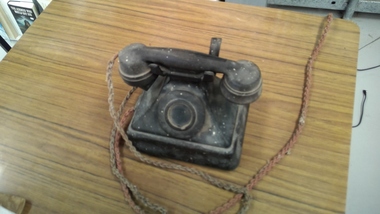 Nhill Aviation Heritage Centre
Telephone, c1940
... PMG AWA-36No. 162MAC...This phone was used by Gwen Mulhallen whilst serving as a WAAAF at the Nhill Air School Actual item retained from days of service at Nhill Air School PMG AWA-36No. 162MAC Bakerlite phone base and handset no dialer Telephone ...This phone was used by Gwen Mulhallen whilst serving as a WAAAF at the Nhill Air School Actual item retained from days of service at Nhill Air SchoolBakerlite phone base and handset no dialerPMG AWA-36No. 162MAC
