
Showing 14 items matching "baby petticoats"
-
 Flagstaff Hill Maritime Museum and Village
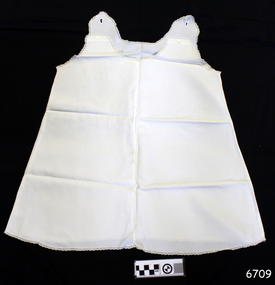
Babies Petticoat
... Babies Petticoat, a button on each shoulder strap...flagstaff hill warrnambool shipwrecked-coast flagstaff-hill flagstaff-hill-maritime-museum maritime-museum shipwreck-coast flagstaff-hill-maritime-village flagstaff hill warrnambool shipwrecked-coast flagstaff-hill flagstaff-hill-maritime-museum maritime-museum shipwreck-coast flagstaff-hill-maritime-village Babies Petticoat Babies Petticoat, a button on each shoulder strap Babies Petticoat ...Babies Petticoat, a button on each shoulder strapflagstaff hill, warrnambool, shipwrecked-coast, flagstaff-hill, flagstaff-hill-maritime-museum, maritime-museum, shipwreck-coast, flagstaff-hill-maritime-village, flagstaff hill, warrnambool, shipwrecked-coast, flagstaff-hill, flagstaff-hill-maritime-museum, maritime-museum, shipwreck-coast, flagstaff-hill-maritime-village, babies petticoat -
 Mont De Lancey
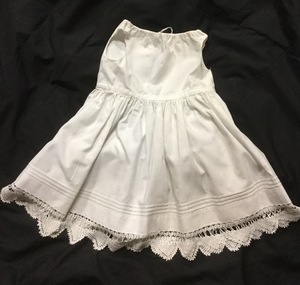
Child's petticoat
... baby petticoats...Sebire at age of approximately one year old in 1916, and made by his aunt Miss Lily Sebire. baby petticoats petticoats White child's petticoat with pleating and embroidery at hem. ...Worn by Edgar R. Sebire at age of approximately one year old in 1916, and made by his aunt Miss Lily Sebire.White child's petticoat with pleating and embroidery at hem.baby petticoats, petticoats -
 Whitehorse Historical Society Inc.
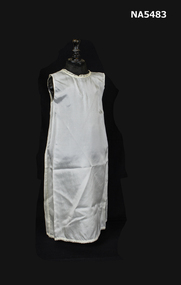
Clothing - Undergarment, Christening Petticoat, C 1990
... Cream nylon baby petticoat to accompany Christening gown. It has cotton lace trim, a back placket with pearl button to close the garment....Handmade by the donor to complement the christening gown (NA 5481) C1990 handmade christening petticoat to line the handmade christening gown. Baby clothing Christening Gown Handmade Nil Cream nylon baby petticoat to accompany Christening gown. ...Handmade by the donor to complement the christening gown (NA 5481)C1990 handmade christening petticoat to line the handmade christening gown.Cream nylon baby petticoat to accompany Christening gown. It has cotton lace trim, a back placket with pearl button to close the garment.Nilbaby clothing, christening gown, handmade -
 Bendigo Historical Society Inc.
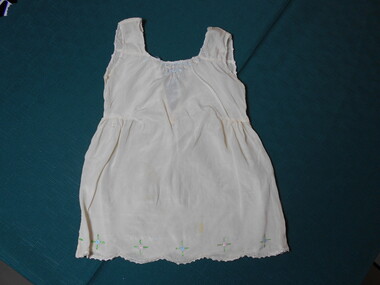
Clothing - HOSKING AND HUNKIN COLLECTION: BABY'S PETTICOAT
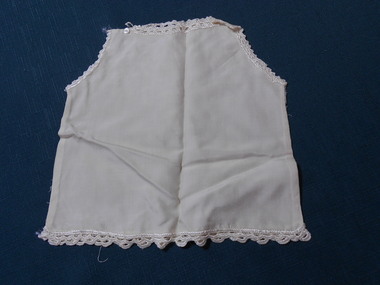
... Clothing, white cotton baby's petticoat. Shoulder openings, no fastenings. ...COSTUME Children's baby's petticoat Clothing, white cotton baby's petticoat. ...Clothing, white cotton baby's petticoat. Shoulder openings, no fastenings. Neckline and arm openings edged with 1cm scalloped lace.Lower edge has two horizontal tucks, a 1cm lace insert and the hem is edged with 1cm scalloped lace.costume, children's, baby's petticoat -
 Bendigo Historical Society Inc.
Clothing - BABY'S PETTICOAT
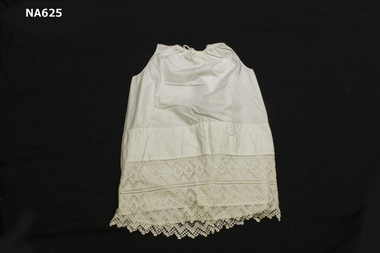
... Cream coloured fine cotton baby's petticoat. Cut in one piece with two side seams. ...COSTUME Children's baby's petticoat Cream coloured fine cotton baby's petticoat. ...Cream coloured fine cotton baby's petticoat. Cut in one piece with two side seams. No seam on shoulder. Slightly scooped neckline. Other shoulder fastened with one button. Hand crocheted trim on neckline, arm holes around hemline. Hand made.costume, children's, baby's petticoat -
 Whitehorse Historical Society Inc.
Clothing - Baby's Petticoat, 1909
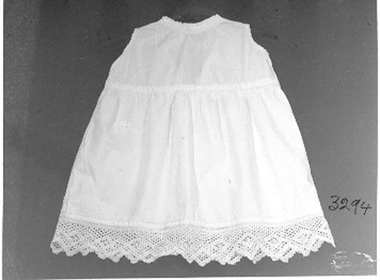
... Baby's white cotton petticoat with deep cotton crochet border. ...Fastened with drawstring at neck Clothing Baby's Petticoat ...Baby's white cotton petticoat with deep cotton crochet border. Fastened with drawstring at neckcostume, infants' -
 Whitehorse Historical Society Inc.
Clothing - Baby's underdress, c1927-1929
... White, lawn cotton baby's underdress/petticoat. Sleeveless, with drawstring at waist. ...Born 1927, died 2003. costume infants' White, lawn cotton baby's underdress/petticoat. Sleeveless, with drawstring at waist. ...Baby clothes worn by Una Reynolds, member of the Society. Born 1927, died 2003.White, lawn cotton baby's underdress/petticoat. Sleeveless, with drawstring at waist. Hand sewn white chain stitching and lace trimming at high neckline and armholes. Drawstring at back neck opening and one button and buttonhole halfway to lace. Skirt edged with double row of white chain stitching and crochet lace.costume, infants' -
 Flagstaff Hill Maritime Museum and Village
Textile - Petticoat, circa 1900
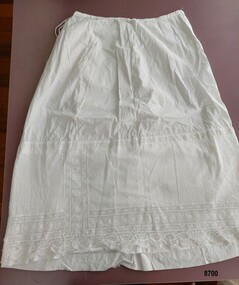
... baby Home. The Everards developed a close friendship with the Stephensons and were responsible for clearing out the house (and finding this clothing collection) after Lila died in 1977. A petticoat...baby Home. The Everards developed a close friendship with the Stephensons and were responsible for clearing out the house (and finding this clothing collection) after Lila died in 1977. A petticoat ...This item is one of a collection of clothing items that belonged to the Stephenson family who lived at 22 McCracken Street, Kensington, Melbourne. Matthew Stephenson (1861 – 1943) who had grown up on the Bendigo goldfields and shifted to Melbourne in the early 1900’s was a train driver and later, a fireman with the railways. His wife Elizabeth Jane (Betsy) Wigley (1865 – 1953) also grew up on the goldfields around Majorca and Bendigo. They married in 1885 in Bendigo. They had two daughters – Ethel Evelyn Stephenson (1886 – 1956) and Lillian or Lila (1891 – 1977) who were milliners and dressmakers and who continued to live in the family home after the death of their parents. The family are recorded as living at 22 McCracken Street, Kensington, as early as 1914. It is not known who made or owned the clothing that makes up this collection but as it appears to be from the late Victorian and early Edwardian era, the different pieces were probably made and worn by any of the three ladies of the house – Betsy, Ethel and/or Lila. During W.W.2, a local Warrnambool couple (Meryl and Tony Everard) boarded with them – Tony was in the airforce training paratroopers to jump into (and survive) enemy territory and his wife Meryl worked in the Methodist baby Home. The Everards developed a close friendship with the Stephensons and were responsible for clearing out the house (and finding this clothing collection) after Lila died in 1977. A petticoat is a lady's undergarment - worn under a skirt or dress. They provided warmth, modesty and shape to the dress. In the middle of the 19th century, petticoats were worn over hoops, bustles or in layers. Petticoats varied according to the style of the outside skirt or dress. Plain petticoats tended to be worn with everyday wear whilst better dresses (party dresses or silk gowns) were worn with petticoats that often had more trim and embellishments. Edwardian petticoats had less volume than Victorian era petticoats and they had a "dust ruffle" or lining under a lace flounce. The "dust ruffle" protected the lace flounce and gave the petticoat more flare at the bottom, greater freedom when walking as well as saving the flounce (which was often made of finer material) from everyday wear and tear. Tucks are another feature of Edwardian petticoats - when the lace at the bottom became worn, it could be cut off and the tucks released. This extended the life of the petticoat. This petticoat features an intricate trim of broderie anglaise. Although broderie anglaise was a lace that could be made by hand, it was very time consuming to make. St Gallen was a city in Switzerland that had become known for producing quality textiles. At the beginning of the 19th century, the first embroidery machines were developed in St Gallen. Factories used embroidery machines but people also had them in their homes. They were able to produce broderie anglaise for export. By the early 20th century, machine made lace, fabric, ribbons etc. were being sold in drapers shops all over England and Wales to women who were making clothes and furnishings for their families. It is highly likely that the lady who made this petticoat brought the lengths of broderie anglaise already made to embellish and personalise her petticoat.This item is an example of the needlework skills of women in the late 19th century - creating pintucks and adding lace to personalise and embellish a practical item of clothing. A lady's fine cotton and lace ankle length petticoat featuring a deep decorative hem made from sheer pinspot fabric and bands of eyelet lace. The top section of the petticoat is made from five sections of fine cotton sewn together with french seams and gathered with pleats and darts into the waistband. The waistband opening has two button holes and one button (the top button is missing) and a front section with a drawstring. The lace hem is lined with the same fine cotton as the top of the petticoat. There are three different lace bands - a narrow one featuring small flowers, a similar wider band with larger flowers and it is finished at the bottom with a broad band of lace with an intricate leaf design.flagstaff hill maritime museum and village, great ocean road, warrnambool, shipwreck coast, petticoat, lady's petticoat, broderie anglaise, decorative petticoat, draw string waist, machine sewn, dressmaker, stephenson family, pintucks, needlework -
 Flagstaff Hill Maritime Museum and Village
Textile - Petticoat, circa 1910
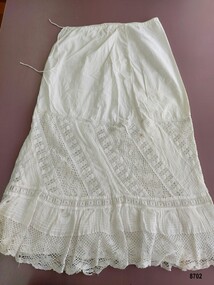
... baby Home. The Everards developed a close friendship with the Stephensons and were responsible for clearing out the house (and finding this clothing collection) after Lila died in 1977. A petticoat...baby Home. The Everards developed a close friendship with the Stephensons and were responsible for clearing out the house (and finding this clothing collection) after Lila died in 1977. A petticoat ...This item is one of a collection of clothing items that belonged to the Stephenson family who lived at 22 McCracken Street, Kensington, Melbourne. Matthew Stephenson (1861 – 1943) who had grown up on the Bendigo goldfields and shifted to Melbourne in the early 1900’s was a train driver and later, a fireman with the railways. His wife Elizabeth Jane (Betsy) Wigley (1865 – 1953) also grew up on the goldfields around Majorca and Bendigo. They married in 1885 in Bendigo. They had two daughters – Ethel Evelyn Stephenson (1886 – 1956) and Lillian or Lila (1891 – 1977) who were milliners and dressmakers and who continued to live in the family home after the death of their parents. The family are recorded as living at 22 McCracken Street, Kensington, as early as 1914. It is not known who made or owned the clothing that makes up this collection but as it appears to be from the late Victorian and early Edwardian era, the different pieces were probably made and worn by any of the three ladies of the house – Betsy, Ethel and/or Lila. During W.W.2, a local Warrnambool couple (Meryl and Tony Everard) boarded with them – Tony was in the airforce training paratroopers to jump into (and survive) enemy territory and his wife Meryl worked in the Methodist baby Home. The Everards developed a close friendship with the Stephensons and were responsible for clearing out the house (and finding this clothing collection) after Lila died in 1977. A petticoat is a lady's undergarment - worn under a skirt or dress. They provided warmth, modesty and shape to the dress. In the middle of the 19th century, petticoats were worn over hoops, bustles or in layers. Petticoats varied according to the style of the outside skirt or dress. Plain petticoats tended to be worn with everyday wear whilst better dresses (party dresses or silk gowns) were worn with petticoats that often had more trim and embellishments. Edwardian petticoats had less volume than Victorian era petticoats and they had a "dust ruffle" or lining under a lace flounce. The "dust ruffle" protected the lace flounce and gave the petticoat more flare at the bottom, greater freedom when walking as well as saving the flounce (which was often made of finer material) from everyday wear and tear. Tucks are another feature of Edwardian petticoats - when the lace at the bottom became worn, it could be cut off and the tucks released. This extended the life of the petticoat. This petticoat features an intricate trim of broderie anglaise. Although broderie anglaise was a lace that could be made by hand, it was very time consuming to make. St Gallen was a city in Switzerland that had become known for producing quality textiles. At the beginning of the 19th century, the first embroidery machines were developed in St Gallen. Factories used embroidery machines but people also had them in their homes. They were able to produce broderie anglaise for export. By the early 20th century, machine made lace, fabric, ribbons etc. were being sold in drapers shops all over England and Wales to women who were making clothes and furnishings for their families. It is highly likely that the lady who made this petticoat brought the lengths of broderie anglaise already made to embellish and personalise her petticoat.This item is an example of the needlework skills of women in the late 19th century - creating pintucks and adding lace to personalise and embellish a practical item of clothing.A lady's ankle length petticoat made in three sections. The top section is made from three rectangles of fine cotton (batiste) joined into a round with narrow french seams and inserted into a simple drawstring waistband with a small opening. The second section is made with rows of alternating strips of fine pin tucked lawn, white cotton cut work embroidery and a wider cotton lace design all joined in a diagonal pattern and lined with fine lawn. The bottom section of the petticoat has a horizontal strip of eyelet lace followed by a wider strip of fine pin tucked lawn and is finished with a deep hem of white cotton crocheted lace fabric and has the same lawn lining as the section above.flagstaff hill maritime museum and village, great ocean road, shipwreck coast, warrnambool, petticoat, lady's petticoat, needlework, sewing, broderie anglaise, stephenson family, drawstring waistband -
 City of Moorabbin Historical Society (Operating the Box Cottage Museum)
Clothing, Child yellow nylon dress & silk petticoat, c1960
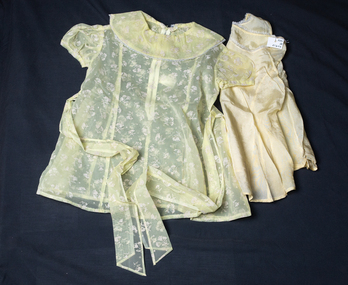
... petticoat was made by Mrs Sharp c1962 for her daughter. Machine embossed white flowers decorate the dress that has long waist ties, a boat collar and puff short sleeves. A metal zipper is inserted. Nylon became a very popular easy care material c 1960 so that women in City of Moorabbin, who were accomplished dressmakers, made very pretty clothes for their families. clothing, baby, nylon, machine pressed designs, layette, knitting,craftwork, wool, early settlers, city of moorabbin, bentleigh, ormond, moorabbin, post war settlers, world war 11 1939-40 sharp valma, Child's yellow nylon dress with jap silk petticoat Machine embossed white flowers decorate the dress that has long waist ties, a boat collar and puff short sleeves. ...This pretty yellow, Nylon dress with jap silk petticoat was made by Mrs Sharp c1962 for her daughter. Machine embossed white flowers decorate the dress that has long waist ties, a boat collar and puff short sleeves. A metal zipper is inserted. Nylon became a very popular easy care material c 1960 so that women in City of Moorabbin, who were accomplished dressmakers, made very pretty clothes for their families. Child's yellow nylon dress with jap silk petticoat Machine embossed white flowers decorate the dress that has long waist ties, a boat collar and puff short sleeves. A metal zipper is inserted. clothing, baby, nylon, machine pressed designs, layette, knitting,craftwork, wool, early settlers, city of moorabbin, bentleigh, ormond, moorabbin, post war settlers, world war 11 1939-40 sharp valma, -
 Bendigo Historical Society Inc.
Leisure object - DOLL COLLECTION: JD KESTNER HILDA PORCELAIN HEAD BABY DOLL, 1914-1938
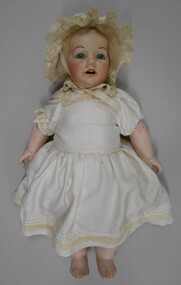
... baby doll with hard composite body, jointed arms and legs and porcelain head. She dates from post 1914. Her hair is short, blonde and 'frizzy'. She is wearing a cream pintucked linen dress trimmed with cream lace at the hem, sleeves and yoke. Underneath the dress is a cream cotton pintucked petticoat...baby doll with hard composite body, jointed arms and legs and porcelain head. She dates from post 1914. Her hair is short, blonde and 'frizzy'. She is wearing a cream pintucked linen dress trimmed with cream lace at the hem, sleeves and yoke. Underneath the dress is a cream cotton pintucked petticoat ...J D Kestner manufactured the Hilda doll from 1914. They ceased business in 1938.J D Krestner 'Hilda' baby doll with hard composite body, jointed arms and legs and porcelain head. She dates from post 1914. Her hair is short, blonde and 'frizzy'. She is wearing a cream pintucked linen dress trimmed with cream lace at the hem, sleeves and yoke. Underneath the dress is a cream cotton pintucked petticoat with a lace insert and lace trim at the hem. She has a yellow knitted singlet and knickers. On her head she is wearing a cream linen mob cap of the same material and trim as her dress.JDK 137 on back of headtoys, dolls, porcelain -
 Bendigo Historical Society Inc.
Leisure object - DOLL COLLECTION: KAMMER AND REINHARDT PORCELAIN DOLL, 1910-1914
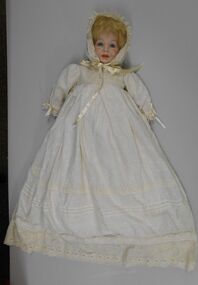
... baby doll mould number 116A circa 1912. She has a porcelain head, forearms and lower legs and feet. The rest of her body is a stuffed material calico. Her legs are jointed at the knees. She is dressed in a long sleeved, extended christening like robe of cream broderie anglaise. The robe has decorative pintucking and lace on the bodice, sleeves, cuffs and skirt with a contrasting broderie anglaise hem. Part of a lace insert has become unstitched at the front. Underneath is a full petticoat...baby doll mould number 116A circa 1912. She has a porcelain head, forearms and lower legs and feet. The rest of her body is a stuffed material calico. Her legs are jointed at the knees. She is dressed in a long sleeved, extended christening like robe of cream broderie anglaise. The robe has decorative pintucking and lace on the bodice, sleeves, cuffs and skirt with a contrasting broderie anglaise hem. Part of a lace insert has become unstitched at the front. Underneath is a full petticoat ...Doll maker Kammer and Reinhard bisque doll heads and bodies were designed by them, but most heads were manufactured by Simon & Halbig which is why heads bear both marks.Kammer and Reinhardt porcelain and cloth baby doll mould number 116A circa 1912. She has a porcelain head, forearms and lower legs and feet. The rest of her body is a stuffed material calico. Her legs are jointed at the knees. She is dressed in a long sleeved, extended christening like robe of cream broderie anglaise. The robe has decorative pintucking and lace on the bodice, sleeves, cuffs and skirt with a contrasting broderie anglaise hem. Part of a lace insert has become unstitched at the front. Underneath is a full petticoat of white cotton with pintucking and lace with a white broderie anglaise hem. Another full length petticoat of cream linen trimmed with lace is also underneath. She has a cream knitted singlet and knickers with cream knitted bootees. She has short blonde matted hair and wears a lace trimmed broderie anglaise bonnet with satin ribbons to match her robe.Initials K and R either side of a Star of David and the words Simon and Halbig below with the mould no 116/Atoys, dolls, porcelain -
 Bendigo Historical Society Inc.
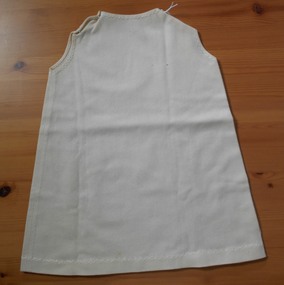
Textile - Charing Cross Baby Health Centre Petticoat
... Charing Cross Baby Health Centre Petticoat...Textile Charing Cross Baby Health Centre Petticoat ...In November 1921 the Bendigo Baby Health Centre was established in rooms at the Town Hall. By Dec. 1925, the council offered two rooms at the Commonwealth Chambers, Charing Cross to be used for the rapidly growing service. In October 1934, council proposed the need for a purpose built Centre and the site in Rosalind Park was chosen in December of that year. The new Centre opened 7/4/1936.Infant petticoat (or slip), press studs fastening at shoulders, hand embroidery, sleeveless and machine sewn.hand embriodery, baby wear -
 Embroiderers Guild, Victoria
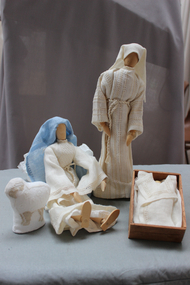
Decorative Object - Nativity Set, Lenore Bull, Late 20thC
... Baby Jesus lies in a wooden box, swathed in embroidered linen. There is also an embroidered lamb. Joseph has linen headpiece. Mary has silk petticoat...Baby Jesus lies in a wooden box, swathed in embroidered linen. There is also an embroidered lamb. Joseph has linen headpiece. Mary has silk petticoat ...Mary and Joseph are wooden artist models, dressed in cream linen pulled/drawn thread robes. Mary has a blue linen head shawl. Baby Jesus lies in a wooden box, swathed in embroidered linen. There is also an embroidered lamb. Joseph has linen headpiece. Mary has silk petticoat. Mary 30 cms Joseph 32 cms Baby Jesus 12.5 cms (box) Lamb 10cmsembroidery, pulled thread, drawn thread, nativity set, animals
