
Showing 162 items matching "banks d. a."
-
 Waverley RSL Sub Branch
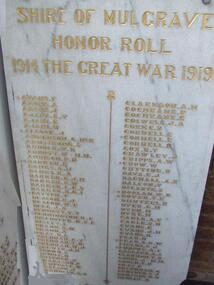
Honour Rolls, Shire of Mulgrave Honour Roll
... ...banks d. a....R. , * BARKER F. ,BANKS D. A. ,BARKER E. J. H. ,BARKER L. C. S. ,BARKER R. ...R. , * BARKER F. ,BANKS D. A. ,BARKER E. J. H. ,BARKER L. C. S. ,BARKER R. ...Set up by The Shire of Mulgrave. Later placed in front of the old RSL building at Glen Waverley. Now part of the Waverley RSL Memorabilia collection2 Marble Slabs erected by the Shire of Mulgrave to commemorate the men of the Shire who served in "The Great War"Shire of Mulgrave Honour Roll 1914 The Great War 1918 * Died in Service Plaque 1 ADAMS F., ADAMS A. , ADAMS. J, AJANI A. W. , AJANI E. ,ADJANI M., *ALCOCK J. ,ANDERSON G. McK. , ARMSTRONG S. ,ARNOLD W. R. ,ARNOTT W. –MM ,AURISCH F. R. , * BARKER F. ,BANKS D. A. ,BARKER E. J. H. ,BARKER L. C. S. ,BARKER R. C. I. , * BATTEN T. ,BEACON C. J. , BEACOM W. F. ,BEGS J. A. , BENNETT T. T. , BENNINGTON K. C. , BISCHOFFER K. S. E. ,BIZLEY L. ,BRAND A. M. , BRAND A. ,* BRAY R. L. , BRENNAN E. V. , BRENNAN W. J. , BREWER J. H. ,*BROWN S. , BRIDLE N. ,BUTCHER J. , BRABAZON F. , *CAMPBELL W. , CARLSON J. ,CHANDLER S. A. ,CLARKSON A. H. ,COCHRANE D. ,COLWELL E. ,*CORNELL C. ,CORNELL E. ,CORNELL R. ,COX B. T. ,CRAWLEY J. ,CRIPPS A. W. ,*CROW . , CUTTING R. ,DAYS E. J. ,DAGNALLA. E. , DALCOM T. ,DECARTE S. ,*DOOLAN W. E. ,*DOVER T. E. ,DUNTZELL R. ,DYER C. H. ,DYER H. ,DYKE H. ,EARLE A. F. , EVANS E. ,EVANS J. H. , FEAR H. ,*FEAR S. R. W. ,FIELDS C. J., *FURPHY A. F. ,GASCARD A. S. , GLENNON T. R. , GOBBI J. –MM ,GOULD T. D. , GRAY R. , GREENHAM A. ,GUNTHER C. J. ,GUNTHER H. V. , HENLEY A. , Plaque 2 HARRIS A. , HENLEY C. H. , HERRIOT S. T. ,*HERRIOT W. E. , HIND S. J. , HOLFORD J. S. S. , HORE H. R. ,*HORE S. C. , *HORNER C. S. C. ,HOURIGAN E. ,HOURIGAN F. ,HUNTER N. A. ,HURST W. K. , HUSSEY W. F. , JACKSON H. ,JAMES P. M. ,JANE R. W. –DCM, JOHNSON A. J. , *KELSALL W. J. ,KITCHEN J. H. ,KNIGHTS E. D. , LAITY J. E. ,LAITY F. C. , * LAW F. ,LAW J. ,LETCHE A. J. ,LECHTE D. W. ,MAILER D. ,MARKLE V. W. ,MARTIN W. E. ,MARWICK S. J. ,MAY J. ,MOORE A. J. ,MOYLAN P. , MUIR P. F. –MM , *MUNRO A. M. , MUNRO W. , MUNYARD W. ,MURPHY J. ,MUSTARD A. D. ,McGILL T. , McKELVIE F. W. ,McNALLY A. E. ,* McPHERSON A. P. ,OWENS H. C. ,OWENS O. , PARSONS G. ,PARSONS H. W. , PETERSON G. F. ,PEGG W. ,REEVE P. ,ROBBINS E. J. ,ROBBINS R. R. ,ROOKE W. L. ,SAWYER E. H. J. , SCAMMELL A. E. ,SHEPPARD H. ,SIM W. ,SIMMONS A. W. ,SMITH H. ,*SMITH N. , SMITH R. B. ,STEELE G. ,TURBER J. J. ,WATTS W. E. , WATTS W. E. ,* WHEELWRIGHT H. M. ,* WHITE D. C. ,WHITE S. G. S. ,WHITE W. ,WILLIAMS H. ,WILLIAMS L. ,WILLIAMS L. E. ,WILSON F. W. , WILSON H. R. ,WRIGHT W. ,WESTNEY P. E. –MM DCM , honour roll, great war, adams f., adams a., adams. j, ajani a. w., ajani e., adjani m., *alcock j., anderson g. mck., armstrong s., arnold w. r., arnott w. –mm, aurisch f. r., * barker f., banks d. a., barker e. j. h., barker l. c. s., barker r. c. i., * batten t., beacon c. j., beacom w. f., begs j. a., bennett t. t., bennington k. c., bischoffer k. s. e., bizley l., brand a. m., brand a., * bray r. l., brennan e. v., brennan w. j., brewer j. h., *brown s., bridle n., butcher j., brabazon f., *campbell w., carlson j., chandler s. a., clarkson a. h., cochrane d., colwell e., *cornell c., cornell e., cornell r., cox b. t., crawley j., cripps a. w., *crow ., cutting r., days e. j., dagnalla. e., dalcom t., decarte s., *doolan w. e., *dover t. e., duntzell r., dyer c. h., dyer h., dyke h., earle a. f., evans e., evans j. h., fear h., *fear s. r. w., fields c. j., *furphy a. f., gascard a. s., glennon t. r., gobbi j. –mm, gould t. d., gray r., greenham a., gunther c. j., gunther h. v., henley a., harris a., henley c. h., herriot s. t., *herriot w. e., hind s. j., holford j. s. s., hore h. r., *hore s. c., *horner c. s. c., hourigan e., hourigan f., hunter n. a., hurst w. k., hussey w. f., jackson h., james p. m., jane r. w. –dcm, johnson a. j., *kelsall w. j., kitchen j. h., knights e. d., laity j. e., laity f. c., * law f., law j., letche a. j., lechte d. w., mailer d., markle v. w., martin w. e., marwick s. j., may j., moore a. j., moylan p., muir p. f. –mm, *munro a. m., munro w., munyard w., murphy j., mustard a. d., mcgill t., mckelvie f. w., mcnally a. e., * mcpherson a. p., owens h. c., owens o., parsons g., parsons h. w., peterson g. f., pegg w., reeve p., robbins e. j., robbins r. r., rooke w. l., sawyer e. h. j., scammell a. e., sheppard h., sim w., simmons a. w., smith h., *smith n., smith r. b., steele g., turber j. j., watts w. e., * wheelwright h. m., * white d. c., white s. g. s., white w., williams h., williams l., williams l. e., wilson f. w., wilson h. r., wright w., westney p. e. –mm dcm, mulgrave -
 Port Melbourne Historical & Preservation Society
Photograph - Port Melbourne Third Eighteen football team, Lagoon Reserve, Port Melbourne, 1939
... H S King (President), George Fisher, J Foden, A Brown, B Rosewarne, R Banks, D Gleeson, H Eason, Mrs. O King (Secretary) MIDDLE ROW L - R C Edland (Assistant Secretary), J Erridge, Albert "Digger" Cosham, H Barnes (Captain & Coach), G Upton (Vice Captain), A Ambler, Jack "Splinter" Lowrie (Boundary Umpire) FRONT ROW L - R P Howard, C Nuttall, R Marshall, A "Bertie" Maskell. ...Sport - Australian Rules Football Lagoon Reserve Port Melbourne Football Club PMFC H S KING George FISHER J FODEN A BROWN B ROSEWARNE R BANKS D GLEESON H EASON Mrs O KING Colour lasercopy of black and white, colourised photo of Port Melbourne Third Eighteen football team 1939 (team colours have been added on jumpers and socks). ...Colour lasercopy of black and white, colourised photo of Port Melbourne Third Eighteen football team 1939 (team colours have been added on jumpers and socks). Taken outside rooms at Lagoon Reserve. BACK ROW L - R Mr. H S King (President), George Fisher, J Foden, A Brown, B Rosewarne, R Banks, D Gleeson, H Eason, Mrs. O King (Secretary) MIDDLE ROW L - R C Edland (Assistant Secretary), J Erridge, Albert "Digger" Cosham, H Barnes (Captain & Coach), G Upton (Vice Captain), A Ambler, Jack "Splinter" Lowrie (Boundary Umpire) FRONT ROW L - R P Howard, C Nuttall, R Marshall, A "Bertie" Maskell. E Johnstonsport - australian rules football, lagoon reserve, port melbourne football club, pmfc, h s king, george fisher, j foden, a brown, b rosewarne, r banks, d gleeson, h eason, mrs o king -
 Bendigo Historical Society Inc.
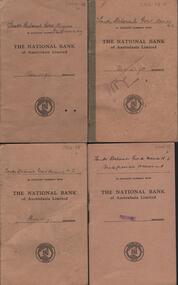
Document - MCCOLL, RANKIN AND STANISTREET COLLECTION: SOUTH DEBORAH GOLD MINES NL - NATIONAL BANK PASSBOOKS, 1946,1948,1949
... Documents: McColl, Rankin and Stanistreet: South Bendigo Gold Mines NL., four bank passbooks a - d Buff coloured books, on front written in blue pen ' South Deborah Gold Mines No Liability. ...ORGANIZATION Mining south deborah gold mines nl McColl Rankin and Stanistreet: South Bendigo Gold Mines NL gold mining National Bank National Bank Documents: McColl, Rankin and Stanistreet: South Bendigo Gold Mines NL., four bank passbooks a - d Buff coloured books, on front written in blue pen ' South Deborah Gold Mines No Liability. ...Documents: McColl, Rankin and Stanistreet: South Bendigo Gold Mines NL., four bank passbooks a - d Buff coloured books, on front written in blue pen ' South Deborah Gold Mines No Liability. In black print 'In account current with The National Bank of Australasia Limited, Bendigo Branch.National Bankorganization, mining, south deborah gold mines nl, mccoll, rankin and stanistreet:, south bendigo gold mines nl, gold mining, national bank -
![Award - Trophy, Thomastown Golf Club, Thomastown Golf Club. Susan Jones Memorial Trophy [for Junior Club Championship], 1979-2004](/media/collectors/4f729f5697f83e03086015b8/items/64bcb1e4e509fe2d058f423b/item-media/64bcb234e509fe2d058f5049/item-fit-380x285.jpg?cb=6) Greensborough Historical Society
Greensborough Historical SocietyAward - Trophy, Thomastown Golf Club, Thomastown Golf Club. Susan Jones Memorial Trophy [for Junior Club Championship], 1979-2004
... Gibson; 1992 and 1994 D. Banks; 1993 Not presented; 2001 S. Eldridge; 2002 G. ...Gibson; 1992 and 1994 D. Banks; 1993 Not presented; 2001 S. Eldridge; 2002 G. ...Golf trophy awarded by the Thomastown Golf Club. The Susan Jones Memorial Trophy was donated by Robert and Evelyn Jones in memory of their decesed daughter Susan. It was awarded to the Junior Club Champion. Winners as inscribed on this trophy: 1979-1982 Gene Forde; 1983-1985 D. Lindrea; 1988-1989 S. Gibson; 1991 P. Gibson; 1992 and 1994 D. Banks; 1993 Not presented; 2001 S. Eldridge; 2002 G. Catterall; 2003-2004 J. Livock.Thomastown Golf Club was a social club formed in 1976. This is part of the Robert (Bob) Jones collection of Club memorabilia.Golf trophy, plastic golfer and 4 gilt plastic angels on timber trophy on timber base."Thomastown Golf Club. Congratulations Bob Jones on playing 351 games and attending 400 games 3-12-1995" engraved on plaque.thomastown golf club, golf trophies, bob jones, evelyn jones, susan jones memorial trophy -
 Stawell Historical Society Inc
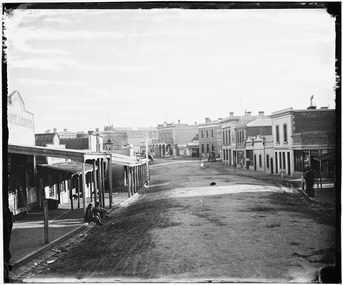
Photograph, Main Street Reefs Stawell looking West from Layzell Street 1874 -- 2 Photos
... Oriental Bank, Bank of Victoria, D Telford Produce and Grocer, Chadwick & Co Drapers & Outfitters / London House, Stawell Auction Market Auctioneer....Oriental Bank, Bank of Victoria, D Telford Produce and Grocer, Chadwick & Co Drapers & Outfitters / London House, Stawell Auction Market Auctioneer. ...Holtermann Photo 1874Main Street looking West from Layzell Street. On left Heide's European Hotel with Heide's two boys out front, David Nicholas Hotel. Foresters Hotel on corner of Patrick street, Fire damaged wall of Mechanics Institute. Top roofline of J. Allingham Drapers in distance. From right R.W. Dane Grocer on corner. Union Bank of Australia, Bennett & Bristow, A.B. Clemes, J. Punchard Furniture Mart, J. Punchard's Timber Yard. Oriental Bank, Bank of Victoria, D Telford Produce and Grocer, Chadwick & Co Drapers & Outfitters / London House, Stawell Auction Market Auctioneer.stawell -
 Stawell Historical Society Inc
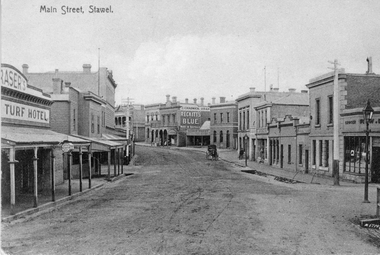
Photograph, Main Street Stawell looking West across Layzell Street intersection c 1900's
... D. Fern Hotel / Times Office, McKeller Building. Across Main street in distance is J Allingham Draper, New Union Bank, Chadwick Drapers / Liddiard's , D. ...D. Fern Hotel / Times Office, McKeller Building. Across Main street in distance is J Allingham Draper, New Union Bank, Chadwick Drapers / Liddiard's , D. ...Main Street Stawell looking West across Layzell Street intersection. J Chadwick Drapers sign visible in centre of photo. Patrick Street runs off to the left of the photo behind wooden building the Foresters Hotel . Turf Hotel on left of photo. Horse drawn buggy near centre of photo. Circa 1900's. Same as 6730-2 & 0539 Turf Hotel on left, Forester Hotel on corner of Patrick Street, verandah of D. Fern Hotel / Times Office, McKeller Building. Across Main street in distance is J Allingham Draper, New Union Bank, Chadwick Drapers / Liddiard's , D. Telford Produce, Bank of Victoria, Oriental Bank / O'Driscoll's, J. Punchard furniture, A.B. Clemes, Bennett & Briston, Union Bank Australia, R.W, Dane Grocer on corner of Layzell Street. Same as 6730-2 0539 PostcardMAIN STREET STAWELL - on front stawell businesses streetscape -
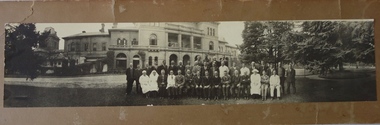 Kew Historical Society Inc
Photograph - Senior Staff, Kew Hospital for the Insane, c.1929
... Middle Row L to R - H HAMPSON (Store), S PATTERSON (***), D BANKS (Head Porter), F TAYLOR (***), J CARROLL (Engineer Machinery), A MEYER (Bootmaker), G HUME (Farm Manager), S STEPHENS (Soap), MATTHEW LYNCH (Senior Gardener), B GRAY (Tailor), F GALE (Carpenter), R **** (Painter), H JEWELL (Tinsmith), * JERRAM (Painter), T TAYLOR (Tailor), L MORAN (Farm), I SEVIN (Carpenter), E GOODWIN (Fireman), F WHEELER (Blacksmith). ...Middle Row L to R - H HAMPSON (Store), S PATTERSON (***), D BANKS (Head Porter), F TAYLOR (***), J CARROLL (Engineer Machinery), A MEYER (Bootmaker), G HUME (Farm Manager), S STEPHENS (Soap), MATTHEW LYNCH (Senior Gardener), B GRAY (Tailor), F GALE (Carpenter), R **** (Painter), H JEWELL (Tinsmith), * JERRAM (Painter), T TAYLOR (Tailor), L MORAN (Farm), I SEVIN (Carpenter), E GOODWIN (Fireman), F WHEELER (Blacksmith). ...The photograph in the Kew collection is undated and only three of the personnel identified. Based on information provided by Geoffrey Stephens, it is now possible to identify those present. His photograph belonged to his father who is pictured. The annotations include: Back Row L to R - E GOODYEAR (Farm), MATTHEW LYNCH (Junior Fireman), K DAVIS (Farm), C RICHARDS (Carpenter). Middle Row L to R - H HAMPSON (Store), S PATTERSON (***), D BANKS (Head Porter), F TAYLOR (***), J CARROLL (Engineer Machinery), A MEYER (Bootmaker), G HUME (Farm Manager), S STEPHENS (Soap), MATTHEW LYNCH (Senior Gardener), B GRAY (Tailor), F GALE (Carpenter), R **** (Painter), H JEWELL (Tinsmith), * JERRAM (Painter), T TAYLOR (Tailor), L MORAN (Farm), I SEVIN (Carpenter), E GOODWIN (Fireman), F WHEELER (Blacksmith). Front Row L to R - __ (Housekeeper MB), PUDDSPORT (Matron FB), J THOMPSON (Dispensary), Dr JOHNSON, Dr RYAN, Dr HOLLOW (Superintendent), G STUART (Secretary), W CHRISTIE (Chief Clerk), K PALMER (Clerk), K PALMER (Clerk), J BATHISCOMBE (Clerk), T FARRELL (Head Attendant MB), ? ELLIS (Head Attendant Children's Cottages), MOLLOY (Matron Children's Cottages), G AKERS (Upholsterer), G STEWART (Painter). It should be noted that it is sometimes difficult to read the handwriting. The names above have been verified through magnification but should be validated through research.A rare and historically significant photograph of the staff of the Kew Asylum in front of the main administration building. The photograph is one of a pair donated to the Kew Historical Society by Frances Dorothea Van Brummelen (1931-2011) in 1994. Following her graduation as a social worker, Fran Van Brummelen joined the staff of Kew Cottages in 1969, and became senior social worker there in 1971. She remained at the cottages until she retired in 1994. Earlier, In 1987, with psychiatrist Cliff Judge, she founded the Kew Cottages Historical Society becoming its president. In 2002, the pair collaborated on the book Kew Cottages: The World of Dolly Stainer, which was later commended in the Victorian Community History Awards. This photograph appears in the book.One of a pair of panoramic photographs donated by Fran Van Brummelen in 1994, and dating from c.1924. The photo is mounted on brown card and shows senior staff of the Kew Hospital for the Insane, posed in front of the main administration building. kew mental hospital, kew lunatic asylum, kew hospital for the insane, willsmere -
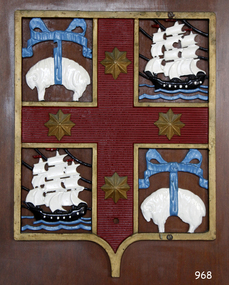 Flagstaff Hill Maritime Museum and Village
Plaque - Insignia, Bank of Australasia, 16-10-1980
... Bank...David Charters McArthur...D...Flagstaff Hill Warrnambool Shipwrecked coast Flagstaff Hill Maritime Museum Maritime Museum Shipwreck coast Flagstaff Hill Maritime Village Great Ocean Road Bank of Australasia BoA Union Bank Australia & New Zealand Bank ANZ Bank David Charters McArthur D C McArthur Currency Banknote Commerce Banking Heraldic Shield Insignia Samuel Hannaford Decals; ships, sheep, stars Insignia of the Bank of Australasia. ...This plaque displays the Bank of Australia's Coat of Arms and is significant because is ts the symbol printed on the Bank Notes of the Bank of Australasia. The bank of Australasia was incorporated by Royal Charter of England in March 1834. It had its Australian beginning on 14th December 1835, opening in Sydney. The Acting Superintendent of the bank at that time was David Charters McArthur. He was Superintendent from 1867-to 1876. The Melbourne branch opened on 28th August 1838 in a two-roomed brick cottage on the north side of Little Collins Street, where two huge mastiff dogs were used at night to guard the bank. The government also provided an armed military sentinel. Due to the bank's rapid growth, a new building for the Melbourne branch was opened in 1840 at 75 Collins Street West. By 1879 the bank had been upgraded to a magnificent two-storey building on the corners of Collins and Queens Streets, with the entry on Collins Street. In 1951 the Bank of Australasia amalgamated with the Union Bank to form the Australia and New Zealand Bank, now known as the ANZ. Then in 1970, the ANZ merged with both the ES&A and the London Bank of Australia to form the ANZ Banking Group Limited. The ANZ Banking Group Ltd kindly donated a variety of historic items from the Bank of Australasia. BANK of AUSTRALASIA, WARRNAMBOOL – In 1854 Warrnambool had two banks, the Union Bank and the Bank of Australasia. Later, completely different bank businesses opened; in 1867 the National Bank of Australasia, then in 1875 the Colonial Bank of Australasia. The original Warrnambool branch of the Bank of Australasia was established in July 1854, and operated from a leased cottage on Merri Street, close to Liebig Street. The bank next bought a stone building previously erected by drapers Cramond & Dickson on the corner of Timor and Gibson Streets. Samuel Hannaford was a teller and then Manager at the Warrnambool branch from 1855 to 1856 and the Warrnambool Council chose that bank for its dealings during 1856-57. In 1859 Roberts & Co. was awarded the contract to build the new Bank of Australasia branch for the sum of £3,000; the firm built the Warrnambool Post Office in 1856 and purchased land in Timor Street in 1858. The land was on a sand hill on the northeast corner of Timor and Kepler Streets and had been bought in 1855 from investor James Cust. The new building opened on May 21, 1860. The bank continued to operate there until 1951 when it merged with the Union Bank to form the ANZ Bank, which continued operating from its Liebig Street building. Warrnambool City Council purchased the former Bank of Australasia building in 1971 and renovated it, then on 3rd December 1973 it was officially opened as the Art Gallery by Cr. Harold Stephenson and Gallery Director John Welsh. The Gallery transferred to the purpose-built building in Liebig Street in 1986 and the old bank building is now the Gallery club. Staff at the Bank of Australasia in Warrnambool included the following men but others were also involved: Samuel Hannaford, Teller then Manager from 1855-1856; Hawkins, Manager in 1856, W H Palmer, Manager from January 1857 until November 1869 when the Teller Basil Spence was promoted to Manager; H B Chomley, Manager from April 1873 and still there in 1886; A Butt, Manager in 1895-1904; J R McCleary Accountant and Acting Manager for 12 months, until 1900; A Kirk, Manager 1904; J Moore, staff until his transfer to Bendigo in December 1908; J S Bath was Manager until 1915; C C Cox, Manager until April 1923; Richard C Stanley, Manager 1923 to April 1928. The plaque with the insignia has significance through its association with the Bank of Australasia. The early Australian bank was established in 1834 by Royal Charter and opened in Sydney, Australia, in Sydney in 1835. The bank had many Australian offices in November 1877, particularly on the east and south coasts. Victoria had 45 per cent of all Offices. The plaque is locally significant for its association with the Warrnambool Bank of Australasia, which was established in 1854. It was Warrnambool Council’s first bank. The bank continued to operate until the organisation's merger in 1951 when it became the ANZ Bank Group today. The Bank was an integral part of the growth of local commerce and the community.Insignia of the Bank of Australasia. Cast metal coat of arms within a gold, shield-shaped border, painted gold and red, with blue, black and white details. Decals in each corner; upper left and lower right have a white sheep suspended by a blue ribbon, upper right and lower left have a 3-masted, square-rigged sailing ship with a black hull and red flags flying on each mast, sailing on waves with storm clouds in the sky. Between the emblems are gold stars.Decals; ships, sheep, starsflagstaff hill, warrnambool, shipwrecked coast, flagstaff hill maritime museum, maritime museum, shipwreck coast, flagstaff hill maritime village, great ocean road, bank of australasia, boa, union bank, australia & new zealand bank, anz bank, david charters mcarthur, d c mcarthur, currency, banknote, commerce, banking, heraldic shield, insignia, samuel hannaford -
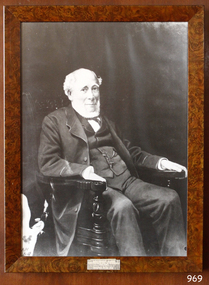 Flagstaff Hill Maritime Museum and Village
Photograph - Portrait, David Charles McArthur, Superintendent, Bank of Australasia 1867-1876
... Bank...David Charters McArthur...D...This period is symbolised by a photograph of McArthur, which represents the origins of Warrnambool's commercial history and its early financial infrastructure. flagstaff hill warrnambool shipwrecked-coast flagstaff-hill flagstaff-hill-maritime-museum maritime-museum shipwreck-coast flagstaff-hill-maritime-village bank of australasia david charteris mcarthur superintendent bank of australasia colonial commerce manager bank of australasia melbourne colonial bank warrnambool bank of australasia Shipwrecked coast Flagstaff Hill Maritime Museum Maritime Museum Shipwreck coast Flagstaff Hill Maritime Village Great Ocean Road BoA Union Bank Australia & New Zealand Bank ANZ Bank David Charters McArthur D C McArthur Lower left corner "A-H 1-9". ...The subject of this photograph, David Charteris McArthur, was the founding manager of the Bank of Australasia in Port Phillip (Melbourne). McArthur was born in 1808 in Gloucester, England, and educated in Scotland. He worked for an insurance firm in Edinburgh, where in 1835 he married Caroline, nee Wright. McArthur and his family party sailed from the U.K. to arrive in Sydney in October 1835, where he joined the Bank of Australasia when it opened in Sydney in December. McArthur sailed to Melbourne in August 1838 with 3000 pounds in coins, protected by armed guards and two bulldogs, to open the Melbourne branch of the Bank of Australasia. The branch grew quickly, servicing both private and government customers. He opened many branches in the goldfields during the 1850s. In 1862, he was appointed as general inspector of branches. He spent time with the bank in New Zealand. On his return to Melbourne, at age 57, he was put in charge of the entire bank. McArthur lived in the hills of Heidelberg, Melbourne. He was the first chairman of Associated Banks and was an advisor to politicians and merchants. He was retired in October 1876 by the London directors and given a free trip to London, an annuity and a seat on the bank’s Advisory Board. McArthur was active in the community, being a member of the Mechanics’ Institute, on the committee that advised Governor Hotham on the Colony’s finances, chairman of the Heidelberg Road Board, one of the original trustees of the Library of Victoria in 1853 and president of the trustees of the Public Library, Museums and National Gallery of Victoria in 1880-83. He was also on many other community organisations. He died in his home “Charterisville” in East Ivanhoe in 1887. He and Caroline had no children. The Melbourne branch of Australia and New Zealand Bank has a portrait of McArthur in its boardroom. St John's Church, Heidelberg, commemorates him with a stained-glass window entitled 'King David'. The McArthur Gallery in the National Gallery of Victoria is also named after him. (David's brother, Donald, moved from Sydney to Melbourne in 1836 with the first government survey team.) ABOUT THE BANK OF AUSTRALASIA In 1836 the Bank of Australasia was established in London by Royal Charter. In 1951 the bank merged with the Union Bank of Australia, to form ANZ Bank Limited. In 1970 it merged with the English, Scottish and Australian Bank to become Australia and New Zealand Banking Group Limited. Since that time the ANZ has acquired other banks and introduced Internet banking and mobile banking. BANK OF AUSTRALASIA IN WARRNAMBOOL The Bank of Australasia first opened in Warrnambool in July 1854 in a building on Merri Street. The manager was Mr Samuel Hannaford. The bank then purchased and moved to a stone building on the corner of Timor and Gibson Streets, previously owned by Cramond and Dickson and almost opposite the Examiner’s office. In January 1957 Mr W.H. Palmer became the new manager and was there until November 1869. The bank then built its own building on the corner of Timor and Kepler Streets in 1859. Mr Basil Spence, the teller, was appointed acting manager in 1869 and Mr H.B. Chomley was the next appointed manager, in April 1873 and was still manager in 1886. The municipality of Warrnambool first banked with the Bank of Australasia from 1856 to April 1857. David Charteris McArthur served as the founding manager of the Bank of Australasia. His leadership marked a significant chapter in Warrnambool's early commercial development. The municipality of Warrnambool relied on the Bank of Australasia as its official bank from 1856 until April 1857. This period is symbolised by a photograph of McArthur, which represents the origins of Warrnambool's commercial history and its early financial infrastructure.Photograph; portrait of David Charteris McArthur. Heavily retouched black and white print in plain brown varnished frame, behind glass, with plaque on lower edge and inscription lower left corner.Lower left corner "A-H 1-9". Engraved on plaque "DAVID CHARTERS MCARTHUR \ SUPERINTENDENT \ BANK OF AUSTRALASIA \ 1867-1876"flagstaff hill, warrnambool, shipwrecked-coast, flagstaff-hill, flagstaff-hill-maritime-museum, maritime-museum, shipwreck-coast, flagstaff-hill-maritime-village, bank of australasia, david charteris mcarthur, superintendent bank of australasia, colonial commerce, manager bank of australasia melbourne, colonial bank, warrnambool bank of australasia, shipwrecked coast, flagstaff hill maritime museum, maritime museum, shipwreck coast, flagstaff hill maritime village, great ocean road, boa, union bank, australia & new zealand bank, anz bank, david charters mcarthur, d c mcarthur -
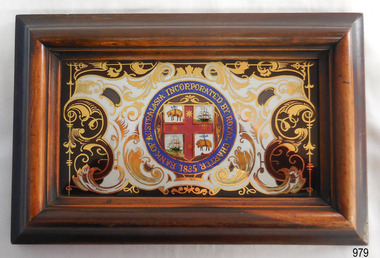 Flagstaff Hill Maritime Museum and Village
Plaque - Insignia, Bank of Australasia, 19th Century
... Bank...David Charters McArthur...D...Flagstaff Hill Warrnambool Shipwrecked coast Flagstaff Hill Maritime Museum Maritime Museum Shipwreck coast Flagstaff Hill Maritime Village Great Ocean Road commerce banking plaque insignia Bank of Australasia insignia on glass Union Bank Australia & New Zealand Bank ANZ Bank David Charters McArthur D C McArthur Sydney New South Wales Currency Banknote Legal tender Insignia: "BANK OF AUSTRALASIA INCORPORATED BY ROYAL CHARTER 1835" Label's red oval stamp with "AUSTRALIA AND NEW ZEALAND BANK UNITED ARCHIVES" Label's handwritten black letters "AM1" Plaque with insignia on glass in a rectangular varnished wooden frame. ...This decorative plaque displays the insignia of the Bank of Australasia, which was incorporated by the Royal Charter of England in March 1834. The bank began in Australia on 14th December 1835, opening in Sydney. The Acting Superintendent of the bank at that time was David Charters McArthur. He was Superintendent from 1867-to 1876. The Melbourne branch opened on 28th August 1838 in a two-roomed brick cottage on the north side of Little Collins Street, where two huge mastiff dogs were used at night to guard the bank. The government also provided an armed military sentinel. Due to the bank's rapid growth, a new building for the Melbourne branch was opened in 1840 at 75 Collins Street West. By 1879 the bank had been upgraded to a magnificent two-storey building on the corners of Collins and Queens Streets, with the entry on Collins Street. In 1951 the Bank of Australasia amalgamated with the Union Bank to form the Australia and New Zealand Bank, now known as the ANZ. Then in 1970, the ANZ merged with both the ES&A and the London Bank of Australia to form the ANZ Banking Group Limited. The ANZ Banking Group Ltd kindly donated a variety of historic items from the Bank of Australasia. BANK of AUSTRALASIA, WARRNAMBOOL – In 1854 Warrnambool had two banks, the Union Bank and the Bank of Australasia. Later, completely different bank businesses opened; in 1867 the National Bank of Australasia, then in 1875 the Colonial Bank of Australasia. The original Warrnambool branch of the Bank of Australasia was established in July 1854, and operated from a leased cottage on Merri Street, close to Liebig Street. The bank later bought a stone building previously erected by drapers Cramond & Dickson on the corner of Timor and Gibson Streets. Samuel Hannaford was a teller and then Manager at the Warrnambool branch from 1855 to 1856 and the Warrnambool Council chose that bank for its dealings during 1856-57. In 1859 Roberts & Co. was awarded the contract to build the new Bank of Australasia branch for the sum of £3,000. The land was on a sand hill on the northeast corner of Timor and Kepler Streets and had been bought in 1855 from investor James Cust. The new building opened on May 21, 1860. The bank continued to operate there until 1951 when it merged with the Union Bank to form the ANZ Bank, which continued operating from its Liebig Street building. Warrnambool City Council purchased the former Bank of Australasia building in 1971 and renovated it, then on 3rd December 1973 it was officially opened as the Art Gallery by Cr. Harold Stephenson and Gallery Director John Welsh. The Gallery transferred to the purpose-built building in Liebig Street in 1986 and the old bank building is now the Gallery club. Staff at the Bank of Australasia in Warrnambool included the following men but others were also involved: Samuel Hannaford, Teller then Manager from 1855-1856; W H Palmer, Manager from January 1857 until November 1869 when the Teller Basil Spence was promoted to Manager; H B Chomley, Manager from April 1873 and still there in 1886; A Butt, Manager in 1895-1904; J R McCleary Accountant and Acting Manager for 12 months, until 1900; A Kirk, Manager 1904; J Moore, staff until his transfer to Bendigo in December 1908; J S Bath was Manager until 1915; C C Cox, Manager until April 1923; Richard C Stanley, Manager 1923 to April 1928. The plaque has historical significance as it belonged to the Bank of Australasia which was established in Australia in 1835 by Royal Charter. The plaque is significant for its association with the Bank of Australasia in Warrnambool, the first bank in Warrnambool, established in 1854. The bank continued to operate until its merger in 1951 when it became the ANZ Bank, which is still in operation today. The Bank was an integral part of the establishment and growth of commerce in Colonial Warrnambool and throughout Australia.Plaque with insignia on glass in a rectangular varnished wooden frame. Insignia of the Bank of Australasia has been painted onto the glass in a mirror-like fashion. Insignia depicts a heraldic shield with sheep hung up by their waists and ships in full sail. Inscription on insignia. Stamp and handwritten inscription on the rectangular label with a blue border on the reverse.Insignia: "BANK OF AUSTRALASIA INCORPORATED BY ROYAL CHARTER 1835" Label's red oval stamp with "AUSTRALIA AND NEW ZEALAND BANK UNITED ARCHIVES" Label's handwritten black letters "AM1" flagstaff hill, warrnambool, shipwrecked coast, flagstaff hill maritime museum, maritime museum, shipwreck coast, flagstaff hill maritime village, great ocean road, commerce, banking, plaque, insignia, bank of australasia, insignia on glass, union bank, australia & new zealand bank, anz bank, david charters mcarthur, d c mcarthur, sydney, new south wales, currency, banknote, legal tender -
 Flagstaff Hill Maritime Museum and Village
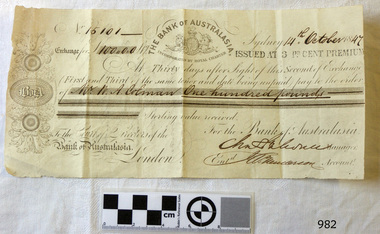
Currency - Bank exchange note, Perkins, Bacon and Perch, 14-10--1847
... Bank...David Charters McArthur...D...Flagstaff Hill Warrnambool Shipwrecked-coast Flagstaff-Hill Flagstaff-Hill-Maritime-Museum Maritime-Museum Shipwreck-coast Flagstaff-Hill-Maritime-Village banknote currency exchange note commerce banking finances Bank of Australasia N A Coleman 1847 Shipwrecked coast Flagstaff Hill Maritime Museum Maritime Museum Shipwreck coast Flagstaff Hill Maritime Village Great Ocean Road BoA Union Bank Australia & New Zealand Bank ANZ Bank David Charters McArthur D C McArthur Sydney New South Wales Legal tender Handwritten number "15101" "One hundred pounds" "14th October [18] 47" "Mr N A Coleman" Black stamp "ISSUED AT 3 PR CENT PREMIUM" Signatures of [Manager] and [Accountant]. ...This exchange note was issued by the Bank of Australasia to Mr N A Coleman for one hundred pounds paid n 14th October 1847 at the Sydney branch. The interest rate was three per cent. This exchange note displays the insignia of the Bank of Australasia, which was incorporated by Royal Charter of England in March 1834. The bank began in Australia on 14th December 1835, opening in Sydney. The Acting Superintendent of the bank at that time was David Charters McArthur. He was Superintendent from 1867-to 1876. The Melbourne branch opened on 28th August 1838 in a two-roomed brick cottage on the north side of Little Collins Street, where two huge mastiff dogs were used at night to guard the bank. The government also provided an armed military sentinel. Due to the bank's rapid growth, a new building for the Melbourne branch was opened in 1840 at 75 Collins Street West. By 1879 the bank had been upgraded to a magnificent two-storey building on the corners of Collins and Queens Streets, with the entry on Collins Street. In 1951 the Bank of Australasia amalgamated with the Union Bank to form the Australia and New Zealand Bank, now known as the ANZ. Then in 1970, the ANZ merged with both the ES&A and the London Bank of Australia to form the ANZ Banking Group Limited. The ANZ Banking Group Ltd kindly donated a variety of historic items from the Bank of Australasia. BANK of AUSTRALASIA, WARRNAMBOOL – In 1854 Warrnambool had two banks, the Union Bank and the Bank of Australasia. Later, completely different bank businesses opened; in 1867 the National Bank of Australasia, then in 1875 the Colonial Bank of Australasia. The original Warrnambool branch of the Bank of Australasia was established in July 1854, and operated from a leased cottage on Merri Street, close to Liebig Street. The bank next bought a stone building previously erected by drapers Cramond & Dickson on the corner of Timor and Gibson Streets. Samuel Hannaford was a teller and then Manager at the Warrnambool branch from 1855 to 1856 and the Warrnambool Council chose that bank for its dealings during 1856-57. In 1859 Roberts & Co. was awarded the contract to build the new Bank of Australasia branch for the sum of £3,000. The land was on a sand hill on the northeast corner of Timor and Kepler Streets and had been bought in 1855 from investor James Cust. The new building opened on May 21, 1860. The bank continued to operate there until 1951 when it merged with the Union Bank to form the ANZ Bank, which continued operating from its Liebig Street building. Warrnambool City Council purchased the former Bank of Australasia building in 1971 and renovated it, then on 3rd December 1973 it was officially opened as the Art Gallery by Cr. Harold Stephenson and Gallery Director John Welsh. The Gallery transferred to the purpose-built building in Liebig Street in 1986 and the old bank building is now the Gallery club. Staff at the Bank of Australasia in Warrnambool included the following men but others were also involved: Samuel Hannaford, Teller then Manager from 1855-1856; W H Palmer, Manager from January 1857 until November 1869 when the Teller Basil Spence was promoted to Manager; H B Chomley, Manager from April 1873 and still there in 1886; A Butt, Manager in 1895-1904; J R McCleary Accountant and Acting Manager for 12 months, until 1900; A Kirk, Manager 1904; J Moore, staff until his transfer to Bendigo in December 1908; J S Bath was Manager until 1915; C C Cox, Manager until April 1923; Richard C Stanley, Manager 1923 to April 1928. The bank exchange note has significance through its association with the Bank of Australasia. The early Australian bank was established in 1834 by Royal Charter and opened in Sydney, Australia, in Sydney in 1835. The bank had many Australian offices in November 1877, particularly on the east and south coasts. Victoria had 45 percent of all Offices. The object is locally significant for its association with the Warrnambool Bank of Australasia, which was established in 1854. It was Warrnambool Council’s first bank. The bank continued to operate until the organisation's merger in 1951 when it became the ANZ Bank Group today. The Bank was an integral part of the growth of local commerce and the community.Bank exchange note for the Bank of Australasia, Sydney, manufactured by Perkins, Bacon and Perch, printed in brown. Insignia depicts a heraldic shield with a lion and unicorn on either side and another insignia with "B of A". Exchange note paid on 14th October 1847. Issued for one hundred pounds and paid to Mr N A Coleman.. Inscriptions include the document number, the date, the amount paid, the receiving person, signatures and a stamp with the interest rate.Handwritten number "15101" "One hundred pounds" "14th October [18] 47" "Mr N A Coleman" Black stamp "ISSUED AT 3 PR CENT PREMIUM" Signatures of [Manager] and [Accountant].flagstaff hill, warrnambool, shipwrecked-coast, flagstaff-hill, flagstaff-hill-maritime-museum, maritime-museum, shipwreck-coast, flagstaff-hill-maritime-village, banknote, currency, exchange note, commerce, banking, finances, bank of australasia, n a coleman, 1847, shipwrecked coast, flagstaff hill maritime museum, maritime museum, shipwreck coast, flagstaff hill maritime village, great ocean road, boa, union bank, australia & new zealand bank, anz bank, david charters mcarthur, d c mcarthur, sydney, new south wales, legal tender -
 Flagstaff Hill Maritime Museum and Village
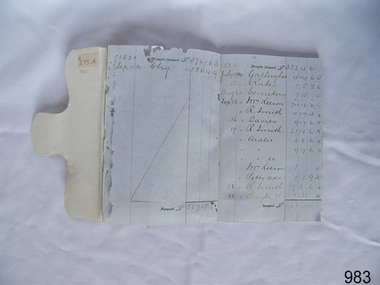
Financial record - Passbook, Bank of Australasia, 1880
... Bank...David Charters McArthur...D...Flagstaff Hill Warrnambool Shipwrecked coast Flagstaff Hill Maritime Museum Maritime Museum Shipwreck coast Flagstaff Hill Maritime Village Great Ocean Road Bank of Australasia BoA Union Bank Australia & New Zealand Bank ANZ Bank David Charters McArthur D C McArthur bank book pass book financial record commerce Thomas Smith Thos. ...This bank passbook originated from the Warrnambool branch of the Bank of Australasia with handwritten entries dating from 1880. Names written in the passbook are likely to be people local to Warrnambool. The book belonged to Thomas Smith and was handed over to his Executors. Thomas Smith operated his Gas Printers Works from Koroit Street, Warrnambool, and was a member of the Odd Fellows. In 1878, his son, aged about 12 years old, was carried across a tightrope forward and backwards, on the shoulders of the "Australian Blondon" Mr. L' Estrange, at a performance in Warrnambool. Royal Charter of England incorporated the Bank of Australasia in March 1834. It had its Australian beginning on 14th December 1835, opening in Sydney. The Acting Superintendent of the bank at that time was David Charters McArthur. He was Superintendent from 1867 to 1876. The Melbourne branch opened on 28th August 1838 in a two-roomed brick cottage on the north side of Little Collins Street, where two huge mastiff dogs were used at night to guard the bank. The government also provided an armed military sentinel. Due to the bank's rapid growth, a new building for the Melbourne branch was opened in 1840 at 75 Collins Street West. By 1879, the bank had been upgraded to a magnificent two-storey building on the corners of Collins and Queens Streets, with the entry on Collins Street. In 1951, the Bank of Australasia amalgamated with the Union Bank to form the Australia and New Zealand Bank, now known as the ANZ. Then in 1970, the ANZ merged with both the ES&A and the London Bank of Australia to form the ANZ Banking Group Limited. The ANZ Banking Group Ltd kindly donated a variety of historic items from the Bank of Australasia. BANK of AUSTRALASIA, WARRNAMBOOL – In 1854, Warrnambool had two banks, the Union Bank and the Bank of Australasia. Later, completely different bank businesses opened; in 1867, the National Bank of Australasia, and then in 1875, the Colonial Bank of Australasia. The original Warrnambool branch of the Bank of Australasia was established in July 1854 and operated from a leased cottage on Merri Street, close to Liebig Street. The bank next bought a stone building previously erected by drapers Cramond & Dickson on the corner of Timor and Gibson Streets. Samuel Hannaford was a teller and then Manager at the Warrnambool branch from 1855 to 1856, and the Warrnambool Council chose that bank for its dealings during 1856-57. In 1859, Roberts & Co. was awarded the contract to build the new Bank of Australasia branch for the sum of £3,000; the firm built the Warrnambool Post Office in 1856 and purchased land in Timor Street in 1858. The land was on a sand hill on the northeast corner of Timor and Kepler Streets and had been bought in 1855 from investor James Cust. The new building opened on May 21, 1860. The bank continued to operate there until 1951, when it merged with the Union Bank to form the ANZ Bank, which continued operating from its Liebig Street building. Warrnambool City Council purchased the former Bank of Australasia building in 1971 and renovated it, then on 3rd December 1973, it was officially opened as the Art Gallery by Cr. Harold Stephenson and Gallery Director John Welsh. The Gallery transferred to the purpose-built building in Liebig Street in 1986, and the old bank building is now the Gallery club. Staff at the Bank of Australasia in Warrnambool included the following men but others were also involved: Samuel Hannaford, Teller then Manager from 1855-1856; Hawkins, Manager in 1856, W H Palmer, Manager from January 1857 until November 1869 when the Teller Basil Spence was promoted to Manager; H B Chomley, Manager from April 1873 and still there in 1886; A Butt, Manager in 1895-1904; J R McCleary Accountant and Acting Manager for 12 months, until 1900; A Kirk, Manager 1904; J Moore, staff until his transfer to Bendigo in December 1908; J S Bath was Manager until 1915; C C Cox, Manager until April 1923; Richard C Stanley, Manager 1923 to April 1928. The bank passbook has significance through its association with the Bank of Australasia. The early Australian bank was established in 1834 by Royal Charter and opened in Sydney, Australia, in Sydney in 1835. The bank had many Australian offices in November 1877, particularly on the east and south coasts. Victoria had 45 per cent of all Offices. The passbook is locally significant for its association with the Warrnambool Bank of Australasia, which was established in 1854. It was Warrnambool Council’s first bank. The bank continued to operate until the organisation's merger in 1951 when it became the ANZ Bank Group today. The Bank was an integral part of the growth of local commerce and the community. It has local significance for its association with commercial Warrnambool in 1880, belonging to Thomas Smith, a prominent businessman with a printing works whose son of about 12 years age crossed a tightrope with the 'Australian Blondin', L' Estrange. Bank passbook, Bank of Australasia, Warrnambool branch. Bound with waxed, cream-coloured cardboard cover and tab closure. Pages have blue horizontal lines and red vertical lines. Black ink handwritten entries, with Date, Name and amount. Inscription was written inside and on a sticker inside the front cover. Passbook is dated 1880 and belonged to Thomas Smith.Marked "The Executors of the late Thomas Smith" "Stamped inside "Bank of Australasia, Warrnambool" Handwritten on sticker " R. 273 A" Sample of handwritten entries include "1880" Callaghan" "Rates" A Linch" "Davies" Bottom of page, balance "529 10 21" [529 pounds 10 shillings 21 pence]flagstaff hill, warrnambool, shipwrecked coast, flagstaff hill maritime museum, maritime museum, shipwreck coast, flagstaff hill maritime village, great ocean road, bank of australasia, boa, union bank, australia & new zealand bank, anz bank, david charters mcarthur, d c mcarthur, bank book, pass book, financial record, commerce, thomas smith, thos. smith, gas printing works, australian blondin, thomas smith's son, tightrope walker, odd fellows, l' estrange, passbook, bank passbook -
 Flagstaff Hill Maritime Museum and Village
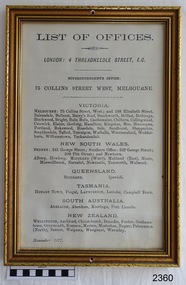
Document - Bank notice, List of Offices, ca Nov. 1877
... Bank...David Charters McArthur...D...The Bank was an integral part of the establishment and growth of commerce in Colonial Warrnambool and throughout Australia. flagstaff hill warrnambool Bank of Australasia 1877 Branches of Bank of Australasia 1877 Banks in Australia 1877 Commerce 1877 shipwreck-coast document bank document Flagstaff Hill Maritime Museum & Village Bank of Australasia 1877 Branches in Australia Bank of London Offices in Australia Offices in New Zealand Commerce Banking Finance Shipwrecked coast Flagstaff Hill Maritime Museum Maritime Museum Shipwreck coast Flagstaff Hill Maritime Village Great Ocean Road BoA Union Bank Australia & New Zealand Bank ANZ Bank David Charters McArthur D C McArthur Sydney New South Wales Currency Banknote Legal tender List of bank offices Text includes: "LONDON: 4 THREADNEEDLE STREET, E.C." ...The addresses given on the List for the London and Melbourne offices have connected the document to the Bank of Australasia. The List is dated November 1877 and shows the number and the location of all of the branches of the Bank at that point in time., a total of 77. - Victoria 35, New South Wales 14, Queensland 2, Tasmania 5, South Australia 5, New Zealand 16 Copies of the notice would have been displayed in all branches of the bank in both Australia and New Zealand to inform customers and perhaps impress them too with a large number of locations and the reference to the bank's connection with London. This document gives information on all bank offices throughout Australia and New Zealand. It refers to the Superintendent's Office address at 75 Collins Street West, Melbourne and is dated November 1877. This places the document at the time just before the new Melbourne office opened on the corner of Collins Street and Queen's Street in 1879. The Bank of Australasia was incorporated by Royal Charter of England in March 1834. It came to Australia on 14th December 1835, opening in Sydney. The Acting Superintendent of the Bank of Australasia in Sydney at that time was David Charters McArthur. He was Superintendent from 1867-to 1876. The Melbourne branch of the Bank of Australasia opened on 28th August 1838 in a two-roomed brick cottage on the north side of Little Collins Street. Two huge mastiff dogs were kept in the backyard and let loose at night to guard the bank. The government also provided an armed military sentinel. Due to the bank's rapid growth, a new building for the Melbourne branch was opened in 1840 at 75 Collins Street West. By 1879 the bank had been upgraded to a magnificent two-storey building on the corners of Collins and Queens Streets, with the entry on Collins Street. In 1951 the Bank of Australasia amalgamated with the Union Bank to form the Australia and New Zealand Bank, now known as the ANZ. Then in 1970, the ANZ merged with both the ES&A and the London Bank of Australia to form the ANZ Banking Group Limited. The ANZ Banking Group Ltd kindly donated a variety of historic items from the Bank of Australasia. BANK of AUSTRALASIA, WARRNAMBOOL – In 1854 Warrnambool had two banks, the Union Back and the Bank of Australasia. Later, completely different bank businesses opened; in 1867 the National Bank of Australasia, then in 1875 the Colonial Bank of Australasia. The original Bank of Australasia was established in Warrnambool in July 1854, and operated from a leased cottage on Merri Street, close to Liebig Street. The bank bought a stone building previously erected by drapers Cramond & Dickson on the corner of Timor and Gibson Streets. Samuel Hannaford was a teller and then Manager at the Warrnambool branch from 1855 to 1856. Warrnambool’s Council chose the Bank of Australasia as its bank 1856-57. In 1859 Roberts & Co. was awarded the contract to build the new Bank of Australasia branch for the sum of £3,000. The land was on a sand hill on the northeast corner of Timor and Kepler Streets and had been bought in 1855 from investor James Cust. The new building opened on May 21, 1860. The bank continued to operate there until 1951 when it merged with the Union Bank to form the ANZ Bank, which continued operating from its Liebig Street building. Warrnambool City Council purchased the former Bank of Australasia building in 1971 and renovated it, then on 3rd December 1973 it was officially opened as the Art Gallery by Cr. Harold Stephenson and Gallery Director John Welsh. The Gallery transferred to the purpose-built building in Liebig Street in 1986 and the old bank building is now the Gallery club. The List of Offices of the Bank of Australasia has early Australian historical significance through its association with the Bank, which was established in 1834 by Royal Charter and opened in Sydney, Australia, in Sydney in 1835. The List is significant for showing the number and location of all of the Offices of the Bank of Australia in November 1877. This shows that Victoria had 45 percent of all Offices. The framed document is locally significant for its association with the Bank of Australasia, Warrnambool's first bank, established in 1854. The bank continued to operate until the organisation's merger in 1951. It became the ANZ Bank, which is still in operation today. The Bank was an integral part of the establishment and growth of commerce in Colonial Warrnambool and throughout Australia.Document in a decorative gilt frame. Titled List of Bank Offices and dated November 1877, facsimile. Offices include London, and a variety of offices in Victoria, New South Wales, Queensland, Tasmania, South Australia and New Zealand. Round holes in the centre top and bottom of the frame. Text includes: "LONDON: 4 THREADNEEDLE STREET, E.C." "SUPERINTENDENT'S OFFICE: / 75 COLLINS STREET WEST, MELBOURNE" "Warrnambool" " November 1877" flagstaff hill, warrnambool, bank of australasia 1877, branches of bank of australasia 1877, banks in australia 1877, commerce 1877, shipwreck-coast, document, bank document, flagstaff hill maritime museum & village, bank of australasia, 1877, branches in australia, bank of london, offices in australia, offices in new zealand, commerce, banking, finance, shipwrecked coast, flagstaff hill maritime museum, maritime museum, shipwreck coast, flagstaff hill maritime village, great ocean road, boa, union bank, australia & new zealand bank, anz bank, david charters mcarthur, d c mcarthur, sydney, new south wales, currency, banknote, legal tender, list of bank offices -
 Flagstaff Hill Maritime Museum and Village
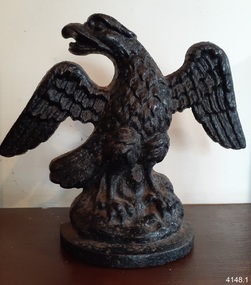
Decorative object - Bookends
... bank...Lewis Gilles...M. Connolly...F. D...Bank of Van Diemen’s Land. The Managing Director in 1834 was Lewis Gilles, previously a naval officer. Other directors were T. Williams, M. Connolly, F. D...Bank of Van Diemen’s Land. The Managing Director in 1834 was Lewis Gilles, previously a naval officer. Other directors were T. Williams, M. Connolly, F. D ...The individual eagles in this pair of Napoleonic Eagle bookends are made so that each eagle faces the opposite direction to the other, one left and one right. The Napoleonic Eagle is the name given to the eagle symbol used by Napoleon Bonaparte 1799-1815 and the French Regiments, mounted on a standard to represent the honour and pride of fighting French men. It is believed that the Napoleonic Eagle was chosen as a symbol for the Tamar Bank in Launceston, Tasmania, established in 1834. The bank was formed after the separation of one of the branches of the Bank of Van Diemen’s Land. The Managing Director in 1834 was Lewis Gilles, previously a naval officer. Other directors were T. Williams, M. Connolly, F. D. Wickham, and P. Oakden. The bank was dissolved in 1838 and became the basis of the Launceston branch of the British-founded Union Bank of Australia Limited, established in 1837 and had its own emblem. The Union Bank of Australia merged with the Bank of Australasia in 1951 and went on to eventually become part of the Australia and New Zealand (ANZ) Banking Group. The Bank of Australasia was incorporated by Royal Charter of England in March 1834. It had its Australian beginning on 14th December 1835, opening in Sydney. The Acting Superintendent of the bank at that time was David Charters McArthur. He was Superintendent from 1867 to 1876. The Melbourne branch opened on 28th August 1838 in a two-roomed brick cottage on the north side of Little Collins Street. By 1879 the bank had been upgraded to a magnificent two-storey building on the corners of Collins and Queens Streets, with the entry on Collins Street. In 1951 the Bank of Australasia amalgamated with the Union Bank to form the Australia and New Zealand Bank, now known as the ANZ. Then in 1970, the ANZ merged with the ES&A and the London Bank of Australia to form the ANZ Banking Group Limited. The ANZ Banking Group Ltd kindly donated to Flagstaff Hill various historic items from the Bank of Australasia. BANK of AUSTRALASIA, WARRNAMBOOL – In 1854 Warrnambool had two banks, the Union Bank and the Bank of Australasia. Later, completely different bank businesses opened; in 1867 the National Bank of Australasia, then in 1875 the Colonial Bank of Australasia. The original Warrnambool branch of the Bank of Australasia was established in July 1854, and operated from a leased cottage on Merri Street, close to Liebig Street. The bank next bought a stone building previously erected by drapers Cramond & Dickson on the corner of Timor and Gibson Streets. Samuel Hannaford was a teller and then Manager at the Warrnambool branch from 1855 to 1856 and the Warrnambool Council chose that bank for its dealings during 1856-57. In 1859 Roberts & Co. was awarded the contract to build the new Bank of Australasia branch for the sum of £3,000; the firm built the Warrnambool Post Office in 1856 and purchased land in Timor Street in 1858. The land was on a sand hill on the northeast corner of Timor and Kepler Streets and had been bought in 1855 by investor James Cust. The new building opened on May 21, 1860. The bank continued to operate there until 1951 when it merged with the Union Bank to form the ANZ Bank, which continued operating from its Liebig Street building. Warrnambool City Council purchased the former Bank of Australasia building in 1971 and renovated it, then on 3rd December 1973 it was officially opened as the Art Gallery by Cr. Harold Stephenson and Gallery Director John Welsh. The Gallery transferred to the purpose-built building on Liebig Street in 1986 and the old bank building is now the Gallery Club. Staff at the Bank of Australasia in Warrnambool included the following men but others were also involved: Samuel Hannaford, Teller then Manager from 1855-1856; Hawkins, Manager in 1856, W H Palmer, Manager from January 1857 until November 1869 when the Teller Basil Spence was promoted to Manager; H B Chomley, Manager from April 1873 and still there in 1886; A Butt, Manager in 1895-1904; J R McCleary Accountant and Acting Manager for 12 months, until 1900; A Kirk, Manager 1904; J Moore, staff until his transfer to Bendigo in December 1908; J S Bath was Manager until 1915; C C Cox, Manager until April 1923; Richard C Stanley, Manager 1923 to April 1928. This pair of Napoleonic Eagle bookends represents the type of ornaments appropriate for 19th and 20th-century business associated with finance and commerce. They symbolise strength, reliability and power. It is believed that the Napoleonic Eagle was the seal of the Tamar Bank, established in 1834 in Launceston, Tasmania. The Tamar bank was taken over by the Australia-wide Union Bank in 1838, which later merged with the Bank of Australasia, which had a branch in Warrnambool. In 1851 it became the Australia and New Zealand Bank, which is still active in Warrnambool in 2023. Bookends; two (2) black metal eagles, standing, beaks open, tail to the side, wings spread, claws open. The black figures are cast metal and the backs are hollow, with flat even edges. The front is textured and shiny. The eagles are facing opposite directions; one left, one right. The figures are commonly known as Napoleonic eagles.flagstaff hill maritime museum and village, warrnambool, great ocean road, shipwreck coast, bookends, eagle bookends, napoleonic eagles, tamar bank, launceston bank, bank of australasia, eagle symbol, 1834-1838, commerce, financial institution, colonial bank, lewis gilles, m. connolly, f. d. wickham, and p. oakden., t. williams, anz bank, australia and new zealand bank, union bank of australia -
 Federation University Historical Collection
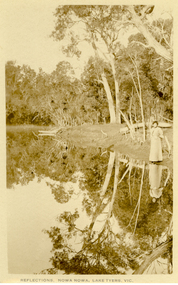
Postcard, Howard D. Bulmer, Reflections, Nowa Nowa, Lake Tyers, Victoria
... Nowa Nowa Lake Tyers trees river Black and white post card showing a lady in long skirt standing on the banks of a river with Australian eucalypts (gum tress) in the background and reflected in the water. Reflections, Nowa Nowa, Lake Tyers, Victoria Postcard Howard D. ...Nowa Nowa is located in Victoria on the Princes Highway between Lakes Entrance & Orbost. Tall eucalypts stand guard as you drive into this small village.The fresh waters of Boggy Creek and the tidal waters of Lake Tyers meet here. In the past its history was of logging. Black and white post card showing a lady in long skirt standing on the banks of a river with Australian eucalypts (gum tress) in the background and reflected in the water. nowa nowa, lake tyers, trees, river -
 Greensborough Historical Society
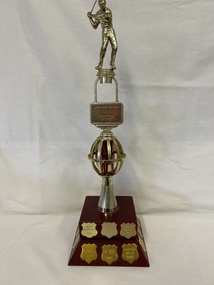
Award - Trophy, Thomastown Golf Club, Thomastown Golf Club. C Grade Perpetual Trophy 1980-1991, 1980-1991
... D. Graham; 1986 Gerorge Stewart; 1987 Graem McRobbie; 1989 Bruce Banks; 1991 Rodney McDonald....D. Graham; 1986 Gerorge Stewart; 1987 Graem McRobbie; 1989 Bruce Banks; 1991 Rodney McDonald. ...Golf trophy awarded by the Thomastown Golf Club. The C Grade Perpetual Trophy 1980-1991 was won by: 1980 D. Roberts; 1981 S. Sia; 1982 Darrell Mills; 1983 L Saw; 1984, 1988 and 1990 Bob Jones; 1985 D. Graham; 1986 Gerorge Stewart; 1987 Graem McRobbie; 1989 Bruce Banks; 1991 Rodney McDonald.Thomastown Golf Club was a social club formed in 1976. This is part of the Robert (Bob) Jones collection of Club memorabilia.Golf trophy, plastic golfer on plastic trophy on timber base."Thomastown Golf Club. C Grade Perpetual Trophy 1980-1991" engraved on plaque, winners' names on base.thomastown golf club, golf trophies, bob jones -
 Federation University Historical Collection
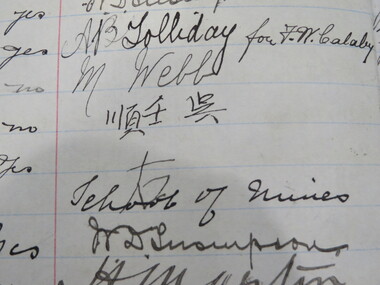
Book - Register, Berry Anderson & Co, Ballarat School of Mines Gold Entry Book. 1908-1976, 01/06/1908-01/12/1976
... bank...j. hutton-jones...golden duke mining syndicate, blackwood...d.e.j. grant, eganstown...linton gold mining company...mining...D...The Register of Gold Entry Book had to be kept by the Licensed Gold Buyer or Assayer under the Gold Buyers Act. ballarat school of mines model mine battery assay smelting gold robinson frederick martell r. callister a. garrard peter tong lee sue ah lung chinese f.w. calaby ah kit charlie ah lung ah sung ah chee dep choon charlie ah hing frederick greaves peter fong george ah ki ah hing william mong thomas bell and party, brown hill dentist amalgam albert sydney sergeant plumber plumbing george spence, plumber commonwealth bank j. hutton-jones golden duke mining syndicate, blackwood d.e.j. grant, eganstown linton gold mining company mining D. ...The Ballarat School of Mines had a model mine used by students, and to conduct assays for a fee. The Register of Gold Entry Book had to be kept by the Licensed Gold Buyer or Assayer under the Gold Buyers Act.Brown half leather bound register registering receipt of gold. Columns include date, nature of transaction (eg assaying/purchase), age, where employed, business (eg mining, fossicking, assayer, etc), Abode, Signature, Witness, Claim, Mining Division, District, Where Obtained, Character of Gold (eg alluvial, smelted, quartz, etc), Weight, Value, How Gold Treated, To whom delivered after assay or smelting, Date of Assayer's Certificate. ballarat school of mines, model mine, battery, assay, smelting, gold, robinson, frederick martell, r. callister, a. garrard, peter tong, lee sue, ah lung, chinese, f.w. calaby, ah kit, charlie ah lung, ah sung, ah chee, dep choon, charlie ah hing, frederick greaves, peter fong, george ah ki, ah hing, william mong, thomas bell and party, brown hill, dentist, amalgam, albert sydney sergeant, plumber, plumbing, george spence, plumber, commonwealth bank, j. hutton-jones, golden duke mining syndicate, blackwood, d.e.j. grant, eganstown, linton gold mining company, mining, d. bernard, g. peron, john page, david bernard, harry webb, ah fou, w.d. thompson, a.b. tolliday, m. webb -
 Federation University Historical Collection
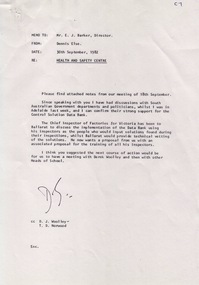
Document - Document - Proposal, VIOSH: Ballarat College of Advanced Education; Support for the Establishment of a Control Solution Data Bank, 1982
... He suggests a meeting with Derek Woolley, Head of Engineering and other Heads of School be held. viosh victorian institute of occupational safety and health dennis else e j barker ballarat college of advanced education health and safety centre ballarat chief inspector of factories data bank solutions to problems derek woolley D S (Dennis Else) Seven A4 pages, typed - some with hand written notations VIOSH: Ballarat College of Advanced Education; Support for the Establishment of a Control Solution Data Bank, 1982 Document Document - Proposal ...Victorian Institute of Occupational Safety and Health (VIOSH) Australia is the Asia-Pacific centre for teaching and research in occupational health and safety (OHS) and is known as one of Australia's leaders on the field. VIOSH has a global reputation for its innovative approach within the field of OHS management. VIOSH had its first intake of students in 1979. At that time the Institution was known as the Ballarat College of Advanced Education. In 1990 it became known as Ballarat University College, then in 1994 as University of Ballarat. It was 2014 that it became Federation University. VIOSH Australia students are safety managers, senior advisors and experienced OHS professionals. They come from all over Australia and industry. Students are taught active research and enquiry; rather than textbook learning and a one-size fits all approach. VIOSH accepts people into the Graduate Diploma of Occupational Hazard Management who have no undergraduate degree - on the basis of extensive work experience and knowledge Memo from Dennis Else to E J Barker, Director of BCAE outlining the support externally for a Health and Safety Centre in Ballarat. The Chief Inspector of Factories in Victoria has also discussed the implementation of a Data Bank to allow input of solutions to various problems discovered on inspections. A detailed document for the case for developing the centre at Ballarat prepared by Dr Dennis Else, Visiting Fellow. He suggests a meeting with Derek Woolley, Head of Engineering and other Heads of School be held.Seven A4 pages, typed - some with hand written notationsD S (Dennis Else)viosh, victorian institute of occupational safety and health, dennis else, e j barker, ballarat college of advanced education, health and safety centre ballarat, chief inspector of factories, data bank, solutions to problems, derek woolley -
 Federation University Historical Collection
Letter - Correspondence, Inwards correspondence to the Ballarat School of Mines, 1908, 07/01908
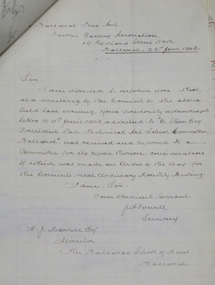
... bank of australia limited...bealiba...thomas r. lyle...jessie chalmers...signor steffani...arundel orchard...w.f. coltman...e.e. hobson...j.t. mooney...queanbeyan...p.e. marmion...willaim m. robertson...assay...e.e. brook...lloyd copper mines...h.b. silberberg & co....education department melbourne...c. james...w. west...haddon...warragul...bakers reef gold mning company...letterhead...victorian portland cement works...d...It is a predecessor institution of Federation University Australia. ballarat school of mines frederick martell ballarat fine art gallery j.a. powell art gallery of ballarat gallery association charles j. morris ballarat fine art public gallery association telegram c.h. clark l. ditchburn alumni examinations w.g. taylor london bank of australia limited bealiba thomas r. lyle jessie chalmers signor steffani arundel orchard w.f. coltman e.e. hobson j.t. mooney queanbeyan p.e. marmion willaim m. robertson assay e.e. brook lloyd copper mines h.b. silberberg & co. education department melbourne c. james w. west haddon warragul bakers reef gold mning company letterhead victorian portland cement works d. mitchell electric lighting and traction co. australia ltd austral otis engineering comapny ltd melbourne glass bottle works company cuming, smith & co. pty ltd excursions metropolitan gas company jaques bros manufacturing engineers victoria iron works a. victor leggo co leggo's metallurgical works melbourne hydraulic power company limited mount lyell mining and railway coy ltd victorian railways telegraph land surveying j. brittain g. fitzgerald hamilton cochran and co wynne-grant antimony reduction company mt egerton and gordons mining co e. hogan e.c. connell a.d. galoway metallurgy h.b. silberberg Specific Gravity Balance and Weights Union Bank of Australia (Ballarat) Bullarto Bush Inn, Bullarto W. ...The Ballarat School of Mines was the first school of Mines in Australasia, and was established in 1870. It is a predecessor institution of Federation University Australia.Correspondence to the Ballarat School of Mines for the month of July 1908. Letter 162 Ballarat Fine Art Public Gallery Association 19 Lydiard Street North Ballarat, 26th June 1908 Sir, I am directed to inform you that at a meeting of the Council of the above held last evening, your previously acknowledged letter of 11th June 1908, addressted to "E. [Stoer?] Esq, President Late Technical Art School Committee", was received and referred to a committee for its report thereon, cousi directions of which was made are the Order of the Day for the Councils next Ordinary Monthly Meeting. I am, Sir, Your Obedient Servant, J.A. Powell Secretary F.J. Martell Esq Director The Ballarat School of Mines Ballarat ballarat school of mines, frederick martell, ballarat fine art gallery, j.a. powell, art gallery of ballarat, gallery association, charles j. morris, ballarat fine art public gallery association, telegram, c.h. clark, l. ditchburn, alumni, examinations, w.g. taylor, london bank of australia limited, bealiba, thomas r. lyle, jessie chalmers, signor steffani, arundel orchard, w.f. coltman, e.e. hobson, j.t. mooney, queanbeyan, p.e. marmion, willaim m. robertson, assay, e.e. brook, lloyd copper mines, h.b. silberberg & co., education department melbourne, c. james, w. west, haddon, warragul, bakers reef gold mning company, letterhead, victorian portland cement works, d. mitchell, electric lighting and traction co. australia ltd, austral otis engineering comapny ltd, melbourne glass bottle works company, cuming, smith & co. pty ltd, excursions, metropolitan gas company, jaques bros manufacturing engineers, victoria iron works, a. victor leggo co, leggo's metallurgical works, melbourne hydraulic power company limited, mount lyell mining and railway coy ltd, victorian railways, telegraph, land surveying, j. brittain, g. fitzgerald, hamilton, cochran and co, wynne-grant antimony reduction company, mt egerton and gordons mining co, e. hogan, e.c. connell, a.d. galoway, metallurgy, h.b. silberberg, specific gravity balance and weights, union bank of australia (ballarat), bullarto, bush inn, bullarto, w. harrington, prospective student, book donaton from smithsonian institution, e. la t. armstrong, department of mines and forests, melbourne, snake valley, r. hall-jones, c. calaby, clementston, thomas ramsay, w.d. thompson, longmans, green and co, selwyn chase, missionary exhibition, aboriginal court of the missionary exhibition, examination results, leslie coulter, hnery j. saw, thomas ramsay, virgil tucker, leslie c. blick, thomas r. williams, oliver w. williams, thomas r. williams, leo m. seward, david w. bonar, louis w.g. buchner, leo m. seward, albert j. robin, james a. chambers, james d. brokenshire, william kingston, edgar c. hurdsfield, virgil tucker, oliver w. williams, william g. sides, herbert hawkesworth, colin c. corrie, henry j. saw, thomas h. trengrove, thomas r. prigdeon, harold b. herbert, viola p. jackson, lionel s. davies, stanley w. tompkins, arthur m. lilburne -
 Federation University Historical Collection
Slide, Welcome Stranger Monument, c1970
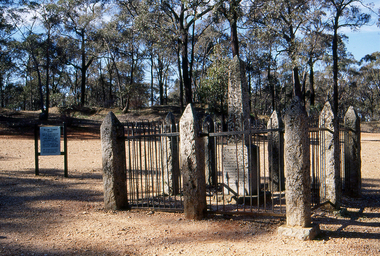
... The 61cm x 31cm nugget was taken to Dunolly to be measured on the bank’s scales, however at 69kg the gold needed to be broken on an anvil to actually fit on the scales. welcome nugget welcome nugget monument john deason richard oates Obelisk inscription Welcome Stranger Nugget On this spot the largest nugget of gold in the world was discovered on the 5th February 1869 by John Deason and Richard Oates. Weight 2316 oz, Value £9553 Erected by the Mines Department 1897 Henry Foster Minister of Mines, D ...The first recorded discovery of gold in Moliagul was in September 1852 and, before long, the area was flooded with over 4,000 miners. Two of those miners, John Deason and Richard Oates, had arrived in Bendigo in 1954 seeking their fortune. After eight years of little success, the friends moved to Moliagul and pegged a puddling claim. On 05 February 1869, Deason discovered a nugget near the roots of a tree, just 3cm beneath the soil. With the help of Oates, he uncovered the largest recorded alluvial gold nugget – known as the Welcome Stranger. The 61cm x 31cm nugget was taken to Dunolly to be measured on the bank’s scales, however at 69kg the gold needed to be broken on an anvil to actually fit on the scales.Photograph of the monument for the Welcome Nugget, a large gold nugget found by John Deason and Richard Oates at Moliagul.Obelisk inscription Welcome Stranger Nugget On this spot the largest nugget of gold in the world was discovered on the 5th February 1869 by John Deason and Richard Oates. Weight 2316 oz, Value £9553 Erected by the Mines Department 1897 Henry Foster Minister of Mines, D. J. Duggan M.L.A. Member for Dunollywelcome nugget, welcome nugget monument, john deason, richard oates -
 Flagstaff Hill Maritime Museum and Village
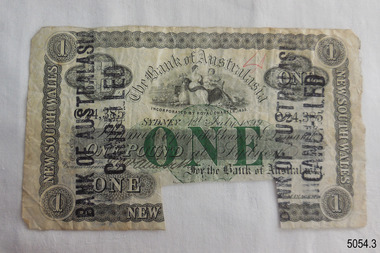
Currency - Banknote, Bank of Australasia, One-pound, 1st July 1903
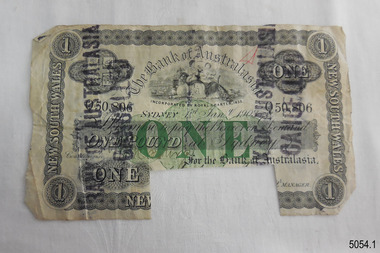
... Bank...David Charters McArthur...D...The banknotes also have a significant place in Australia’s history as two notes are just prior to Federation and two notes just after Federation. flagstaff hill warrnambool one pound note Bank of Australasia legal tender £1 banknote banknotes Flagstaff Hill Maritime Museum & Village Shipwreck Coast five poind note Australian currency Shipwrecked coast Flagstaff Hill Maritime Museum Maritime Museum Flagstaff Hill Maritime Village Great Ocean Road Union Bank Australia & New Zealand Bank ANZ Bank David Charters McArthur D C McArthur One-pound note Five-pound note £5 Sydney New South Wales Pre-Federation Post-Federation Currency banknote set Printed: (Serial Number) "Q50,806" "ONE POUND" "NEW SOUTH WALES" "1st July 1903" Stamped: "BANK OF AUSTRALASIA / CANCELLED" Handwritten in red pen: "undecipherable [initials]" Text in pencil "L24" One-pound note, one of a set of four (4) notes published by The Bank of Australasia, Sydney, New South Wales. ...This one-pound banknote is one of a set of four banknotes issued by the Bank of Australasia's Head Office in Sydney, New South Wales. Two banknotes are dated before the Federation of Australia on 1st January 1901 and two are dated just two years after Federation. Each of the banknotes in this set has a rectangular piece cut from it. This indicates that the banknote was cancelled when the note was exchanged for Australian dollars after Decimal Currency was introduced on 14th February 1966. The Bank of Australasia was established under the Royal Charter of England. It first came to Australia in 1835, opening in Sydney. The Bank of Australasia was the first bank in Warrnambool. It was established in 1854 and operated from leased buildings on Merri Street and then Timor Street. The bank opened its own building on May 21, 1860, on the northeast corner of Timor and Kepler Streets. In that year, the Acting Superintendent of the Bank of Australasia in Sydney was David Charters McArthur. He went on to become the Superintendent from 1867-to 1876. In 1951 the Bank of Australasia amalgamated with the Union Bank to form the Australia and New Zealand Bank, now known as the ANZ. Then in 1970 the ANZ merged with both the ES&A and the London Bank of Australia to form the ANZ Banking Group Limited. The ANZ Banking Group Ltd kindly donated a variety of historic items from the Bank of Australasia. This set of banknotes has historical significance as it was used by the Bank of Australasia, the first bank in Warrnambool. The bank was established in 1854 and continued until its merger, when it became the ANZ Bank in 1951 and is still in operation today. The bank was an integral part of the establishment and growth of commerce in Colonial Warrnambool, Victoria, and Australia. The banknotes also have a significant place in Australia’s history as two notes are just prior to Federation and two notes just after Federation.One-pound note, one of a set of four (4) notes published by The Bank of Australasia, Sydney, New South Wales. The obverse of the note is printed in black ink with the denomination and its round pound-coin symbol printed in green ink. There is no printing on the reverse. A black ink stamp is impressed twice on each side of the note, stating that the note is cancelled. Handwritten red ink text is on the note's obverse and pencil text on the reverse. A unique Serial number is printed twice on the obverse. The banknote has a rectangular cut-out notch on the lower edge. Printed: (Serial Number) "Q50,806" "ONE POUND" "NEW SOUTH WALES" "1st July 1903" Stamped: "BANK OF AUSTRALASIA / CANCELLED" Handwritten in red pen: "undecipherable [initials]" Text in pencil "L24"flagstaff hill, warrnambool, one pound note, bank of australasia, legal tender, £1, banknote, banknotes, flagstaff hill maritime museum & village, shipwreck coast, five poind note, australian currency, shipwrecked coast, flagstaff hill maritime museum, maritime museum, flagstaff hill maritime village, great ocean road, union bank, australia & new zealand bank, anz bank, david charters mcarthur, d c mcarthur, one-pound note, five-pound note, £5, sydney, new south wales, pre-federation, post-federation, currency, banknote set -
 Flagstaff Hill Maritime Museum and Village
Currency - Banknote, Bank of Australasia, One-pound, 1st July 1903
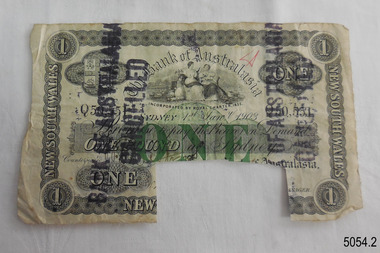
... Bank...David Charters McArthur...D...The banknotes also have a significant place in Australia’s history as two notes are just prior to the Federation of Australia and two notes just after. flagstaff hill warrnambool one pound note Bank of Australasia legal tender £1 banknote banknotes Flagstaff Hill Maritime Museum & Village Shipwreck Coast five poind note Australian currency Shipwrecked coast Flagstaff Hill Maritime Museum Maritime Museum Flagstaff Hill Maritime Village Great Ocean Road Union Bank Australia & New Zealand Bank ANZ Bank David Charters McArthur D C McArthur One-pound note Five-pound note £5 Sydney New South Wales Pre-Federation Post-Federation Currency Set of banknotes banknote set Printed (Serial Number) "O50 551" "ONE POUND" "NEW SOUTH WALES" "1st July 1903" Stamp "BANK OF AUSTRALASIA / CANCELLED" Handwritten in red pen: "undecipherable [initials]" Text in pencil "L24" One-pound note, one of a set of four (4) notes published by The Bank of Australasia, Sydney, New South Wales. ...One-pound note, one of a set of four (4) notes published by The Bank of Australasia, Sydney, New South Wales. The obverse of the note is printed in black ink with the denomination and its round pound-coin symbol printed in green ink. There is no printing on the reverse. A black ink stamp is impressed twice on each side of the note, stating that the note is cancelled. Handwritten red ink text is on the note's obverse and pencil text on the reverse. A unique Serial number is printed twice on the obverse. The banknote has a rectangular cut-out notch on the lower edge. The Bank of Australasia was established under the Royal Charter of England. It first came to Australia in 1835, opening in Sydney. The Bank of Australasia was the first bank in Warrnambool. It was established in 1854 and operated from leased buildings in Merri Street then Timor Street. The bank opened its own building on May 21, 1860, on the north-east corner of Timor and Kepler Streets. In that year, the Acting Superintendent of the Bank of Australasia in Sydney was David Charters McArthur. He went on to become the Superintendent 1867-1876. In 1951 the Bank of Australasia amalgamated with the Union Bank to form the Australia and New Zealand Bank, now known as the ANZ. Then in 1970 the ANZ merged with both the ES&A and the London Bank of Australia to form the ANZ Banking Group Limited. The ANZ Banking Group Ltd kindly donated a variety of historic items from the Bank of Australasia. This set of banknotes has historical significance as it was issued by the Bank of Australasia. The Bank of Australasia was the first bank in Warrnambool, established in 1854. The bank continued to operate until its merger in 1951 when it became the ANZ Bank, which is still in operation today. The Bank was an integral part of the establishment and growth of commerce in Colonial Warrnambool and throughout Australia. The banknotes also have a significant place in Australia’s history as two notes are just prior to the Federation of Australia and two notes just after.One-pound note, one of a set of four (4) notes published by The Bank of Australasia, Sydney, New South Wales. The obverse of the note is printed in black ink with the denomination and its round pound-coin symbol printed in green ink. There is no printing on the reverse. A black ink stamp is impressed twice on each side of the note, stating that the note is cancelled. Handwritten red ink text is on the note's obverse and pencil text on the reverse. A unique Serial number is printed twice on the obverse. The banknote has a rectangular cut-out notch on the lower edge.Printed (Serial Number) "O50 551" "ONE POUND" "NEW SOUTH WALES" "1st July 1903" Stamp "BANK OF AUSTRALASIA / CANCELLED" Handwritten in red pen: "undecipherable [initials]" Text in pencil "L24"flagstaff hill, warrnambool, one pound note, bank of australasia, legal tender, £1, banknote, banknotes, flagstaff hill maritime museum & village, shipwreck coast, five poind note, australian currency, shipwrecked coast, flagstaff hill maritime museum, maritime museum, flagstaff hill maritime village, great ocean road, union bank, australia & new zealand bank, anz bank, david charters mcarthur, d c mcarthur, one-pound note, five-pound note, £5, sydney, new south wales, pre-federation, post-federation, currency, set of banknotes, banknote set -
 Flagstaff Hill Maritime Museum and Village
Currency - Banknote, Bank of Australasia, One-pound, 1st July 1899
... Bank...David Charters McArthur...D...The banknotes also have a significant place in Australia’s history as two notes are just prior to the Federation of Australia and two notes just after. flagstaff hill warrnambool one pound note Bank of Australasia legal tender £1 banknote banknotes Flagstaff Hill Maritime Museum & Village Shipwreck Coast five poind note Australian currency Shipwrecked coast Flagstaff Hill Maritime Museum Maritime Museum Flagstaff Hill Maritime Village Great Ocean Road Union Bank Australia & New Zealand Bank ANZ Bank David Charters McArthur D C McArthur One-pound note Five-pound note £5 Sydney New South Wales Pre-Federation Post-Federation Currency Banknote set Printed: (Serial Number) "O24,385" "ONE POUND" "NEW SOUTH WALES" "1st July 1899" Stamp "BANK OF AUSTRALASIA / CANCELLED" Handwritten in red pen: "undecipherable [initials]" Text in pencil "L24" One-pound note, one of a set of four (4) notes published by The Bank of Australasia, Sydney, New South Wales. ...This set of banknotes was issued by the Bank of Australasia's Head Office in Sydney, New South Wales. Two banknotes are dated before the Federation of Australia on 1st January 1901 and two are dated just two years after Federation. Each of the banknotes in this set has a rectangular piece cut from it. This indicates that the banknote was cancelled when the note was exchanged for Australian dollars after Decimal Currency was introduced on 14th February 1966. The Bank of Australasia was established under the Royal Charter of England. It first came to Australia in 1835, opening in Sydney. The Bank of Australasia was the first bank in Warrnambool. It was established in 1854 and operated from leased buildings in Merri Street then Timor Street. The bank opened its own building on May 21, 1860, on the north-east corner of Timor and Kepler Streets. In that year, the Acting Superintendent of the Bank of Australasia in Sydney was David Charters McArthur. He went on to become the Superintendent 1867-1876. In 1951 the Bank of Australasia amalgamated with the Union Bank to form the Australia and New Zealand Bank, now known as the ANZ. Then in 1970 the ANZ merged with both the ES&A and the London Bank of Australia to form the ANZ Banking Group Limited. The ANZ Banking Group Ltd kindly donated a variety of historic items from the Bank of Australasia. This set of banknotes has historical significance as it was issued by the Bank of Australasia. The Bank of Australasia was the first bank in Warrnambool, established in 1854. The bank continued to operate until its merger in 1951 when it became the ANZ Bank, which is still in operation today. The Bank was an integral part of the establishment and growth of commerce in Colonial Warrnambool and throughout Australia. The banknotes also have a significant place in Australia’s history as two notes are just prior to the Federation of Australia and two notes just after.One-pound note, one of a set of four (4) notes published by The Bank of Australasia, Sydney, New South Wales. The obverse of the note is printed in black ink with the denomination and its round pound-coin symbol printed in green ink. There is no printing on the reverse. A black ink stamp is impressed twice on each side of the note, stating that the note is cancelled. Handwritten red ink text is on the note's obverse and pencil text on the reverse. A unique Serial number is printed twice on the obverse. The banknote has a rectangular cut-out notch on the lower edge.Printed: (Serial Number) "O24,385" "ONE POUND" "NEW SOUTH WALES" "1st July 1899" Stamp "BANK OF AUSTRALASIA / CANCELLED" Handwritten in red pen: "undecipherable [initials]" Text in pencil "L24"flagstaff hill, warrnambool, one pound note, bank of australasia, legal tender, £1, banknote, banknotes, flagstaff hill maritime museum & village, shipwreck coast, five poind note, australian currency, shipwrecked coast, flagstaff hill maritime museum, maritime museum, flagstaff hill maritime village, great ocean road, union bank, australia & new zealand bank, anz bank, david charters mcarthur, d c mcarthur, one-pound note, five-pound note, £5, sydney, new south wales, pre-federation, post-federation, currency, banknote set -
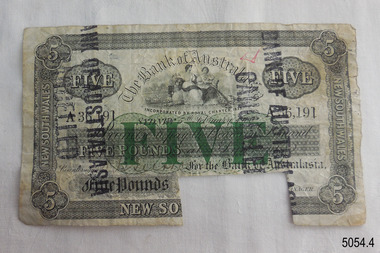 Flagstaff Hill Maritime Museum and Village
Currency - Banknote, Five-pound
... Bank...David Charters McArthur...D...The banknotes also have a significant place in Australia’s history as two notes are just prior to Federation and two notes just after Federation. flagstaff hill warrnambool one pound note Bank of Australasia legal tender £1 banknote banknotes Flagstaff Hill Maritime Museum & Village Shipwreck Coast five poind note Australian currency Shipwrecked coast Flagstaff Hill Maritime Museum Maritime Museum Flagstaff Hill Maritime Village Great Ocean Road Union Bank Australia & New Zealand Bank ANZ Bank David Charters McArthur D C McArthur One-pound note Five-pound note £5 Sydney New South Wales Pre-Federation Post-Federation Currency banknote set Printed: (Serial Number) "A36,191" "FIVE POUND" "NEW SOUTH WALES" "5th February 1900" Stamp "BANK OF AUSTRALASIA / CANCELLED" Image: (around border) "BANK OF AUSTRALASIA INCORPORATED BY ROYAL CHARTER" and (image on shield) [suspended sheep] in diagonal corners, and [sailing ships] in other diagonal corners, and four stars (or open flowers)" Handwritten in red pen: "undecipherable [initials]" Text in pencil "L24" Five-pound banknote, one of a set of four banknotes published by The Bank of Australasia, Sydney, New South Wales. ...This five-pound banknote is one of a set of four banknotes issued by the Bank of Australasia's Head Office in Sydney, New South Wales. Two banknotes are dated before the Federation of Australia on 1st January 1901 and two are dated just two years after Federation. Each of the banknotes in this set has a rectangular piece cut from it. This indicates that the banknote was cancelled when the note was exchanged for Australian dollars after Decimal Currency was introduced on 14th February 1966. The Bank of Australasia was established under the Royal Charter of England. It first came to Australia in 1835, opening in Sydney. The Bank of Australasia was the first bank in Warrnambool. It was established in 1854 and operated from leased buildings in Merri Street then Timor Street. The bank opened its own building on May 21, 1860, on the north-east corner of Timor and Kepler Streets. In that year, the Acting Superintendent of the Bank of Australasia in Sydney was David Charters McArthur. He went on to become the Superintendent 1867-1876. In 1951 the Bank of Australasia amalgamated with the Union Bank to form the Australia and New Zealand Bank, now known as the ANZ. Then in 1970 the ANZ merged with both the ES&A and the London Bank of Australia to form the ANZ Banking Group Limited. The ANZ Banking Group Ltd kindly donated a variety of historic items from the Bank of Australasia. This set of banknotes has historical significance as it was used by the Bank of Australasia, the first bank in Warrnambool. The bank was established in 1854 and continued until its merger, when it became the ANZ Bank in 1951 and is still in operation today. The bank was an integral part of the establishment and growth of commerce in Colonial Warrnambool, Victoria, and Australia. The banknotes also have a significant place in Australia’s history as two notes are just prior to Federation and two notes just after Federation.Five-pound banknote, one of a set of four banknotes published by The Bank of Australasia, Sydney, New South Wales. The obverse of the note is printed in black ink with the denomination and its round pound-coin symbols printed in green ink. The reverse has a decorative border and image with an inscription and shield. A black ink stamp was impressed twice on each side, stating that the note is cancelled. Handwritten red ink text is on the note's obverse and pencil text on the reverse. A unique Serial number is printed twice on the obverse. The banknote has a rectangular cut-out notch on the lower edge. Printed: (Serial Number) "A36,191" "FIVE POUND" "NEW SOUTH WALES" "5th February 1900" Stamp "BANK OF AUSTRALASIA / CANCELLED" Image: (around border) "BANK OF AUSTRALASIA INCORPORATED BY ROYAL CHARTER" and (image on shield) [suspended sheep] in diagonal corners, and [sailing ships] in other diagonal corners, and four stars (or open flowers)" Handwritten in red pen: "undecipherable [initials]" Text in pencil "L24"flagstaff hill, warrnambool, one pound note, bank of australasia, legal tender, £1, banknote, banknotes, flagstaff hill maritime museum & village, shipwreck coast, five poind note, australian currency, shipwrecked coast, flagstaff hill maritime museum, maritime museum, flagstaff hill maritime village, great ocean road, union bank, australia & new zealand bank, anz bank, david charters mcarthur, d c mcarthur, one-pound note, five-pound note, £5, sydney, new south wales, pre-federation, post-federation, currency, banknote set -
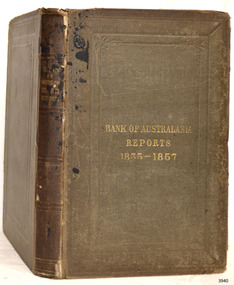 Flagstaff Hill Maritime Museum and Village
Book - Financial Reports, Bank of Australasia, Bank of Australasia Reports 1835-1857, 1857
... Bank...David Charters McArthur...D...Flagstaff Hill Warrnambool Shipwrecked coast Flagstaff Hill Maritime Museum Maritime Museum Shipwreck coast Flagstaff Hill Maritime Village Great Ocean Road commerce banking Bank of Australasia ANZ Bank David Charters McArthur D C McArthur Australia Bank reports 1835-1857 Financial reports Financial record "BANK OF AUSTRALASIA / REPORTS / 1835-1857" "NO. 4, THREADNEEDLE STREET, LONDON. / 1857." ...This book contains the Reports of the Bank of Australasia from 1835-1857 and was published in the Bank's head office in London in the year of the last report within the book. The Reports date from the incorporation of the Bank. The Bank of Australasia was incorporated by the Royal Charter of England in March 1834. The bank began in Australia on 14th December 1835, opening in Sydney. The Acting Superintendent of the bank at that time was David Charters McArthur. He was Superintendent from 1867-to 1876. The Melbourne branch opened on 28th August 1838 in a two-roomed brick cottage on the north side of Little Collins Street, where two huge mastiff dogs were used at night to guard the bank. The government also provided an armed military sentinel. Due to the bank's rapid growth, a new building for the Melbourne branch was opened in 1840 at 75 Collins Street West. By 1879 the bank had been upgraded to a magnificent two-storey building on the corners of Collins and Queens Streets, with the entry on Collins Street. In 1951 the Bank of Australasia amalgamated with the Union Bank to form the Australia and New Zealand Bank, now known as the ANZ. Then in 1970, the ANZ merged with both the ES&A and the London Bank of Australia to form the ANZ Banking Group Limited. The ANZ Banking Group Ltd kindly donated a variety of historic items from the Bank of Australasia. BANK of AUSTRALASIA, WARRNAMBOOL – In 1854 Warrnambool had two banks, the Union Bank and the Bank of Australasia. Later, completely different bank businesses opened; in 1867 the National Bank of Australasia, then in 1875 the Colonial Bank of Australasia. The original Warrnambool branch of the Bank of Australasia was established in July 1854, and operated from a leased cottage on Merri Street, close to Liebig Street. The bank later bought a stone building previously erected by drapers Cramond & Dickson on the corner of Timor and Gibson Streets. Samuel Hannaford was a teller and then Manager at the Warrnambool branch from 1855 to 1856 and the Warrnambool Council chose that bank for its dealings during 1856-57. In 1859 Roberts & Co. was awarded the contract to build the new Bank of Australasia branch for the sum of £3,000. The land was on a sand hill on the northeast corner of Timor and Kepler Streets and had been bought in 1855 from investor James Cust. The new building opened on May 21, 1860. The bank continued to operate there until 1951 when it merged with the Union Bank to form the ANZ Bank, which continued operating from its Liebig Street building. Warrnambool City Council purchased the former Bank of Australasia building in 1971 and renovated it, then on 3rd December 1973 it was officially opened as the Art Gallery by Cr. Harold Stephenson and Gallery Director John Welsh. The Gallery transferred to the purpose-built building in Liebig Street in 1986 and the old bank building is now the Gallery club. Staff at the Bank of Australasia in Warrnambool included the following men but others were also involved: Samuel Hannaford, Teller then Manager from 1855-1856; W H Palmer, Manager from January 1857 until November 1869 when the Teller Basil Spence was promoted to Manager; H B Chomley, Manager from April 1873 and still there in 1886; A Butt, Manager in 1895-1904; J R McCleary Accountant and Acting Manager for 12 months, until 1900; A Kirk, Manager 1904; J Moore, staff until his transfer to Bendigo in December 1908; J S Bath was Manager until 1915; C C Cox, Manager until April 1923; Richard C Stanley, Manager 1923 to April 1928. The book has historical significance as it is connected to the Bank of Australasia which was established in Australia in 1835 by Royal Charter during the early Colonial period of Australia's history. The reports within the book begin from the time the bank was established and include the time that the Warrnambool branch was in operation. The book is significant for its association with the Bank of Australasia in Warrnambool, the first bank in Warrnambool, established in 1854. The bank continued to operate until its merger in 1951 when it became the ANZ Bank, which is still in operation today. The Bank was an integral part of the establishment and growth of commerce in Colonial Warrnambool and throughout Australia.Book, brown fabric covered board covers with embossed borders front and back. The titles on the front and spine are embossed and gilt. The fly page includes the insignia of the Bank of Australasia. The book contains reports of the Bank of Australasia from 1835-1857. It was published by the Bank at its London address in 1857. Inscription in pencil. Date: 1857 Published by the Bank of Australasia."BANK OF AUSTRALASIA / REPORTS / 1835-1857" "NO. 4, THREADNEEDLE STREET, LONDON. / 1857." Pencil, handwritten "L32"flagstaff hill, warrnambool, shipwrecked coast, flagstaff hill maritime museum, maritime museum, shipwreck coast, flagstaff hill maritime village, great ocean road, commerce, banking, bank of australasia, anz bank, david charters mcarthur, d c mcarthur, australia, bank reports, 1835-1857, financial reports, financial record -
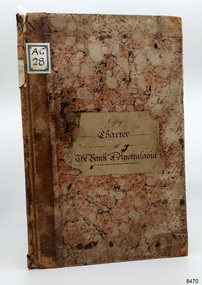 Flagstaff Hill Maritime Museum and Village
Legal record - Charter, Copy of Charter of Bank of Australasia, 01-10-1867
... Bank...David Charters McArthur...D...Flagstaff Hill Warrnambool Shipwrecked coast Flagstaff Hill Maritime Museum Maritime Museum Shipwreck coast Flagstaff Hill Maritime Village Great Ocean Road Bank of Australasia BoA Union Bank Australia & New Zealand Bank ANZ Bank David Charters McArthur D C McArthur Sydney New South Wales Currency Banknote Legal tender Commerce Banking Roberts & Co. ...This Copy of the Charter of the Bank of Australasia originated from the Bank of Australasia. The bank of Australasia was incorporated by Royal Charter of England in March 1834. It had its Australian beginning on 14th December 1835, opening in Sydney. The Acting Superintendent of the bank at that time was David Charters McArthur. He was Superintendent from 1867-to 1876. The Melbourne branch opened on 28th August 1838 in a two-roomed brick cottage on the north side of Little Collins Street, where two huge mastiff dogs were used at night to guard the bank. The government also provided an armed military sentinel. Due to the bank's rapid growth, a new building for the Melbourne branch was opened in 1840 at 75 Collins Street West. By 1879 the bank had been upgraded to a magnificent two-storey building on the corners of Collins and Queens Streets, with the entry on Collins Street. In 1951 the Bank of Australasia amalgamated with the Union Bank to form the Australia and New Zealand Bank, now known as the ANZ. Then in 1970, the ANZ merged with both the ES&A and the London Bank of Australia to form the ANZ Banking Group Limited. The ANZ Banking Group Ltd kindly donated a variety of historic items from the Bank of Australasia. BANK of AUSTRALASIA, WARRNAMBOOL – In 1854 Warrnambool had two banks, the Union Bank and the Bank of Australasia. Later, completely different bank businesses opened; in 1867 the National Bank of Australasia, then in 1875 the Colonial Bank of Australasia. The original Warrnambool branch of the Bank of Australasia was established in July 1854, and operated from a leased cottage on Merri Street, close to Liebig Street. The bank next bought a stone building previously erected by drapers Cramond & Dickson on the corner of Timor and Gibson Streets. Samuel Hannaford was a teller and then Manager at the Warrnambool branch from 1855 to 1856 and the Warrnambool Council chose that bank for its dealings during 1856-57. In 1859 Roberts & Co. was awarded the contract to build the new Bank of Australasia branch for the sum of £3,000; the firm built the Warrnambool Post Office in 1856 and purchased land in Timor Street in 1858. The land was on a sand hill on the northeast corner of Timor and Kepler Streets and had been bought in 1855 from investor James Cust. The new building opened on May 21, 1860. The bank continued to operate there until 1951 when it merged with the Union Bank to form the ANZ Bank, which continued operating from its Liebig Street building. Warrnambool City Council purchased the former Bank of Australasia building in 1971 and renovated it, then on 3rd December 1973 it was officially opened as the Art Gallery by Cr. Harold Stephenson and Gallery Director John Welsh. The Gallery transferred to the purpose-built building in Liebig Street in 1986 and the old bank building is now the Gallery club. Staff at the Bank of Australasia in Warrnambool included the following men but others were also involved: Samuel Hannaford, Teller then Manager from 1855-1856; Hawkins, Manager in 1856, W H Palmer, Manager from January 1857 until November 1869 when the Teller Basil Spence was promoted to Manager; H B Chomley, Manager from April 1873 and still there in 1886; A Butt, Manager in 1895-1904; J R McCleary Accountant and Acting Manager for 12 months, until 1900; A Kirk, Manager 1904; J Moore, staff until his transfer to Bendigo in December 1908; J S Bath was Manager until 1915; C C Cox, Manager until April 1923; Richard C Stanley, Manager 1923 to April 1928. The Copy of the Charter of the Bank of Australasia has significance through its association with the Bank of Australasia. The early Australian bank was established in 1834 by Royal Charter and opened in Sydney, Australia, in Sydney in 1835. The bank had many Australian offices in November 1877, particularly on the east and south coasts. Victoria had 45 per cent of all Offices. The Charter is locally significant for its association with the Warrnambool Bank of Australasia, which was established in 1854. It was Warrnambool Council’s first bank. The bank continued to operate until the organisation's merger in 1951 when it became the ANZ Bank Group today. The Bank was an integral part of the growth of local commerce and the community. Record book, hard cover, tan black and beige pebble-pattern on front and back, and tan reinforced strip on spine with decorative embossing. Handwritten title on cream paper is attached in centre of front cover. Cream paper pages are lined and have watermarks on each one. Pages are numbered up to the last written page, number 35. The last page is sealed in red with an official stamp and dated 1st October 1867. Inscriptions are on three labels. and on front end page, and red oval stamp inside front cover. It is an official copy of the Charter of the Bank of Australasia.Label with title, handwritten in pen "Copy / Charter / of / The Bank of Australasia" Label on spine, typewritten "COPY / CHARTER" Label on front cover, handwritten in pen "A G / 28" Front inside cover, red oval stamp "AUSTRALIA AND NEW ZEALAND BANK LIMITED - ARCHIVES - " and in the oval, in pen "A G / 28" Front end page, handwritten in pencil "Normal Copy 5 Dec No. 74" Front end page, in pencil "L 28"flagstaff hill, warrnambool, shipwrecked coast, flagstaff hill maritime museum, maritime museum, shipwreck coast, flagstaff hill maritime village, great ocean road, bank of australasia, boa, union bank, australia & new zealand bank, anz bank, david charters mcarthur, d c mcarthur, sydney, new south wales, currency, banknote, legal tender, commerce, banking, roberts & co., james cust, heraldic shield, insignia, samuel hannaford, w h palmer, basil spence, h b chomley, a butt, j r mccleary, a kirk, j moore, j s bath, c c cox, richard c stanley, charter of the bank of australasia -
 Flagstaff Hill Maritime Museum and Village
Legal record - Deed of Settlement, Copy Deed of Settlement 2/6/1834 Bank of Australasia, 02-06-1834
... Bank...David Charters McArthur...D...Flagstaff Hill Warrnambool Shipwrecked coast Flagstaff Hill Maritime Museum Maritime Museum Shipwreck coast Flagstaff Hill Maritime Village Great Ocean Road Bank of Australasia BoA Union Bank Australia & New Zealand Bank ANZ Bank David Charters McArthur D C McArthur Sydney New South Wales Currency Banknote Legal tender Commerce Banking Roberts & Co. ...This Copy of Deed of Settlement of the Bank of Australia originated from the Bank of Australasia. The bank of Australasia was incorporated by Royal Charter of England in March 1834. It had its Australian beginning on 14th December 1835, opening in Sydney. The Acting Superintendent of the bank at that time was David Charters McArthur. He was Superintendent from 1867-to 1876. The Melbourne branch opened on 28th August 1838 in a two-roomed brick cottage on the north side of Little Collins Street, where two huge mastiff dogs were used at night to guard the bank. The government also provided an armed military sentinel. Due to the bank's rapid growth, a new building for the Melbourne branch was opened in 1840 at 75 Collins Street West. By 1879 the bank had been upgraded to a magnificent two-storey building on the corners of Collins and Queens Streets, with the entry on Collins Street. In 1951 the Bank of Australasia amalgamated with the Union Bank to form the Australia and New Zealand Bank, now known as the ANZ. Then in 1970, the ANZ merged with both the ES&A and the London Bank of Australia to form the ANZ Banking Group Limited. The ANZ Banking Group Ltd kindly donated a variety of historic items from the Bank of Australasia. BANK of AUSTRALASIA, WARRNAMBOOL – In 1854 Warrnambool had two banks, the Union Bank and the Bank of Australasia. Later, completely different bank businesses opened; in 1867 the National Bank of Australasia, then in 1875 the Colonial Bank of Australasia. The original Warrnambool branch of the Bank of Australasia was established in July 1854, and operated from a leased cottage on Merri Street, close to Liebig Street. The bank next bought a stone building previously erected by drapers Cramond & Dickson on the corner of Timor and Gibson Streets. Samuel Hannaford was a teller and then Manager at the Warrnambool branch from 1855 to 1856 and the Warrnambool Council chose that bank for its dealings during 1856-57. In 1859 Roberts & Co. was awarded the contract to build the new Bank of Australasia branch for the sum of £3,000; the firm built the Warrnambool Post Office in 1856 and purchased land in Timor Street in 1858. The land was on a sand hill on the northeast corner of Timor and Kepler Streets and had been bought in 1855 from investor James Cust. The new building opened on May 21, 1860. The bank continued to operate there until 1951 when it merged with the Union Bank to form the ANZ Bank, which continued operating from its Liebig Street building. Warrnambool City Council purchased the former Bank of Australasia building in 1971 and renovated it, then on 3rd December 1973 it was officially opened as the Art Gallery by Cr. Harold Stephenson and Gallery Director John Welsh. The Gallery transferred to the purpose-built building in Liebig Street in 1986 and the old bank building is now the Gallery club. Staff at the Bank of Australasia in Warrnambool included the following men but others were also involved: Samuel Hannaford, Teller then Manager from 1855-1856; Hawkins, Manager in 1856, W H Palmer, Manager from January 1857 until November 1869 when the Teller Basil Spence was promoted to Manager; H B Chomley, Manager from April 1873 and still there in 1886; A Butt, Manager in 1895-1904; J R McCleary Accountant and Acting Manager for 12 months, until 1900; A Kirk, Manager 1904; J Moore, staff until his transfer to Bendigo in December 1908; J S Bath was Manager until 1915; C C Cox, Manager until April 1923; Richard C Stanley, Manager 1923 to April 1928. The Copy of Deed of Settlement of the Bank of Australasia has significance through its association with the Bank of Australasia. The early Australian bank was established in 1834 by Royal Charter and opened in Sydney, Australia, in Sydney in 1835. The bank had many Australian offices in November 1877, particularly on the east and south coasts. Victoria had 45 per cent of all Offices. The Deed of Settlement is locally significant for its association with the Warrnambool Bank of Australasia, which was established in 1854. It was Warrnambool Council’s first bank. The bank continued to operate until the organisation's merger in 1951 when it became the ANZ Bank Group today. The Bank was an integral part of the growth of local commerce and the community. Large hard covered record book, front and back covers with dark green, red and cream pebble pattern, spine and corners reinforced with black leather, edges of pages in red, green and cream pattern. Cream pages have watermarks, numbers and feint lines. the handwritten Deed begins at at page 66. Inscriptions on labels and on front end papers, and red oval stamp on front end paper. The book was made by Thomas & Co., of London. The Deed was dated 2/6/1834. The book contains a copy of the Deed of Settlement of the Bank of Australasia in London.Label on spine, handwritten "AG" with covering label "272 A" Label on front cover, in pen "Copy Deed of / Settlement 2/6/1834 / Bank of Australasia" Label on front cover, printed "THOMAS and Co. Stationers and Account Book Manufacturers, 20, CORNELL, LONDON" In pencil on front cover label "See page 66" Red oval stamp, stamped around oval "AUSTRALIA AND NEW ZEALAND BANK LIMITED - ARCHIVES -" and inside the oval in pen "AG 34" Front end paper in pencil "32/56" and [signature] and another front end paper in pencil "L 31" and in red pen "See page 66"flagstaff hill, warrnambool, shipwrecked coast, flagstaff hill maritime museum, maritime museum, shipwreck coast, flagstaff hill maritime village, great ocean road, bank of australasia, boa, union bank, australia & new zealand bank, anz bank, david charters mcarthur, d c mcarthur, sydney, new south wales, currency, banknote, legal tender, commerce, banking, roberts & co., james cust, heraldic shield, insignia, samuel hannaford, w h palmer, basil spence, h b chomley, a butt, j r mccleary, a kirk, j moore, j s bath, c c cox, richard c stanley, deed of settlement -
 Greensborough Historical Society
Article, Book, Heritage Publications, Greensborough history 1835, 1835o
... D. Medhurst refers to the probability of John Batman signing the treaty with indigenous inhabitants of the Melbourne area on the banks of the Plenty River at Greensborough....D. Medhurst refers to the probability of John Batman signing the treaty with indigenous inhabitants of the Melbourne area on the banks of the Plenty River at Greensborough. plenty river john batman aborigines - banyule Typescript, 6p. ...Transcription of part of 'A History of the Colony of Victoria' Vol.1 1797-1854; by Henry Gyles Turner; 1904; reprinted 1973. A reference from the Diary of D. Medhurst refers to the probability of John Batman signing the treaty with indigenous inhabitants of the Melbourne area on the banks of the Plenty River at Greensborough.Typescript, 6p.plenty river, john batman, aborigines - banyule -
Glenelg Shire Council Cultural Collection
Photograph - Sheet of 12 contact prints - Various Portland and local surrounds buildings and landmarks, c. 1970
... Sheet of 12 contact prints of rephotographed photographs: Identifying numbers 5721 a, b, c, d, e, f, g, h, i, j, k, l (a) Fishing party, flat rocks Bridgewater (b) Dutton Way (c) Julia Street (d) Steam train (e) Bentinck Street corner (f) Bridge across Salt Creek 'Kingsley' in background (g) Bentinck Street railway station from Customs House (h) Yankee Doodle corner (i) Picnic on banks of river (j) Henty Bay (k) Man holding two bikes Wellington Road/Bentinck Street (l) same as (h) - Bentinck Street railway station from Customs House...Sheet of 12 contact prints of rephotographed photographs: Identifying numbers 5721 a, b, c, d, e, f, g, h, i, j, k, l (a) Fishing party, flat rocks Bridgewater (b) Dutton Way (c) Julia Street (d) Steam train (e) Bentinck Street corner (f) Bridge across Salt Creek 'Kingsley' in background (g) Bentinck Street railway station from Customs House (h) Yankee Doodle corner (i) Picnic on banks of river (j) Henty Bay (k) Man holding two bikes Wellington Road/Bentinck Street (l) same as (h) - Bentinck Street railway station from Customs House Photograph Sheet of 12 contact prints - Various Portland and local surrounds buildings and landmarks ...Sheet of 12 contact prints of rephotographed photographs: Identifying numbers 5721 a, b, c, d, e, f, g, h, i, j, k, l (a) Fishing party, flat rocks Bridgewater (b) Dutton Way (c) Julia Street (d) Steam train (e) Bentinck Street corner (f) Bridge across Salt Creek 'Kingsley' in background (g) Bentinck Street railway station from Customs House (h) Yankee Doodle corner (i) Picnic on banks of river (j) Henty Bay (k) Man holding two bikes Wellington Road/Bentinck Street (l) same as (h) - Bentinck Street railway station from Customs House -
Glenelg Shire Council Cultural Collection
Photograph - Sheet of 12 contact prints - Various historic Portland buildings and Landmarks, c. 1970
... Identifying numbers 5711 a, b, c, d, e, f, g, h, i, j, k, l Measurements unframed (a, d, e, g, h, k, l)5 x 3.24.6 x 3 (b, c, f, i, j) Framed (d, g, h, k)5.3 x 3.65 x 3.5 (b, c, f, i, j) (a) All Saints Catholic Church (b) 'Blainslie' (c) Railway Line and Dutton's beach, towards Whalers Bluff (d) Lighthouse, Observatory Hill (e) North side Julia Sreet, looking west, Bank of Australasia (f) Fire station, C of E grounds (g) Julia Street from Percy Street intersection looking towards sea (h) Richmond House - W.M. ...Identifying numbers 5711 a, b, c, d, e, f, g, h, i, j, k, l Measurements unframed (a, d, e, g, h, k, l)5 x 3.24.6 x 3 (b, c, f, i, j) Framed (d, g, h, k)5.3 x 3.65 x 3.5 (b, c, f, i, j) (a) All Saints Catholic Church (b) 'Blainslie' (c) Railway Line and Dutton's beach, towards Whalers Bluff (d) Lighthouse, Observatory Hill (e) North side Julia Sreet, looking west, Bank of Australasia (f) Fire station, C of E grounds (g) Julia Street from Percy Street intersection looking towards sea (h) Richmond House - W.M. ...Sheet of 12 contact prints of rephotographed photographs. Identifying numbers 5711 a, b, c, d, e, f, g, h, i, j, k, l Measurements unframed (a, d, e, g, h, k, l)5 x 3.24.6 x 3 (b, c, f, i, j) Framed (d, g, h, k)5.3 x 3.65 x 3.5 (b, c, f, i, j) (a) All Saints Catholic Church (b) 'Blainslie' (c) Railway Line and Dutton's beach, towards Whalers Bluff (d) Lighthouse, Observatory Hill (e) North side Julia Sreet, looking west, Bank of Australasia (f) Fire station, C of E grounds (g) Julia Street from Percy Street intersection looking towards sea (h) Richmond House - W.M. Learmonth (i) London Inn (j) Julia Street. Hewly and Learmonth Woolstores, Bank of Australasia (k) View from Henty Beach - Old Town Hall (l) Annie Clark's ladies school
