
Showing 13 items matching "bathing ships"
-
 Williamstown Historical Society Inc
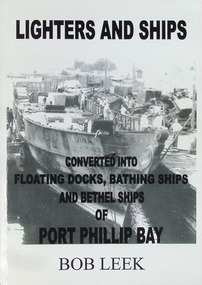
Book - Book - Lighters and Ships, Bob Leek and Peter Taylor, Lighters and Ships - Converted into Floating Docks, Bathing Ships and Bethel Ships of Port Phillip Bay, 2006
... Lighters and Ships - Converted into Floating Docks, Bathing Ships and Bethel Ships of Port Phillip Bay......Bathing Ships...Untold stories of lighters, floating docks, lightships, bathing ships, bethel ships. Authors Bob Leek and Peter Taylor. ...An untold part of Melbourne's and Victorias shipping history has never been covered as thoroughly as this volume. Untold stories of lighters, floating docks, lightships, bathing ships, bethel ships.Authors Bob Leek and Peter Taylor. Reprint of the 2006 original. 152 pages, b/w illustrations, 7 colour photos.non-fictionAn untold part of Melbourne's and Victorias shipping history has never been covered as thoroughly as this volume. Untold stories of lighters, floating docks, lightships, bathing ships, bethel ships.williamstown, bathing ships, floating docks, bethel ships, lightships, bob leek, peter taylor, floating churches, point gellibrand -
 St Kilda Historical Society
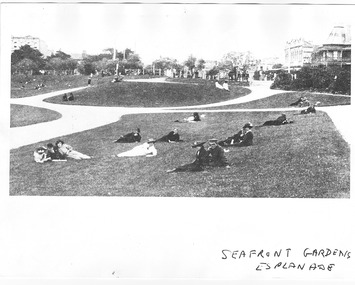
Photograph, Seafront Gardens, Esplanade, 1915-16
... Reclaimed from the Sea, Site of old Bathing Ship, c1915, foreground shows people relaxing on the lawns, background shows Fitzroy Street and part of Acland Street North, partial view of buildings in Fitzroy street, including 1 Fitzroy Street...Seafront Gardens, Esplanade, Melbourne suburbs St Kilda reclaimed from the sea - sight of the old bathing ship, St Kilda By the Sea Annual, page 59, National Library of Australia, Canberra...Reclaimed from the Sea, Site of old Bathing Ship, c1915, foreground shows people relaxing on the lawns, background shows Fitzroy Street and part of Acland Street North, partial view of buildings in Fitzroy street, including 1 Fitzroy Street Seafront Gardens, Esplanade, Melbourne suburbs St Kilda reclaimed from the sea - sight of the old bathing ship, St Kilda By the Sea Annual, page 59, National Library of Australia, Canberra black and white photograph, copy, fair condition Seafront Gardens, Esplanade Photograph St Kilda By the Sea Annual ...Reclaimed from the Sea, Site of old Bathing Ship, c1915, foreground shows people relaxing on the lawns, background shows Fitzroy Street and part of Acland Street North, partial view of buildings in Fitzroy street, including 1 Fitzroy Streetblack and white photograph, copy, fair conditionSeafront Gardens, Esplanade, Melbourne suburbs St Kilda reclaimed from the sea - sight of the old bathing ship, St Kilda By the Sea Annual, page 59, National Library of Australia, Canberra -
 St Kilda Historical Society
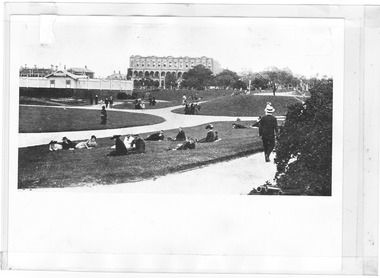
Photograph, West Beach and Catani Gardens, c. 1915-1916
... c1915, site of the old bathing ship...c1915, site of the old bathing ship Melbourne Suburbs St Kilda View of West Beach, improvement site of the Old Ship, St Kilda By the Sea Annual, p.63, season 1915-16, National Library of Australia black and white photograph, unmounted West Beach and Catani Gardens Photograph ...c1915, site of the old bathing ship black and white photograph, unmountedMelbourne Suburbs St Kilda View of West Beach, improvement site of the Old Ship, St Kilda By the Sea Annual, p.63, season 1915-16, National Library of Australia -
 Flagstaff Hill Maritime Museum and Village
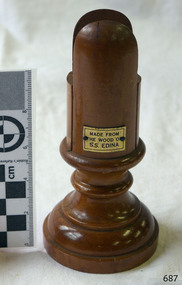
Domestic object - Card Holder, c. 1854 - 1957
... ship was extensively overhauled, radically changing its appearance. It returned to having two masts, and the funnel, bridge, engines, and promenade deck were upgraded, and the saloon reupholstered. By 1924, Edina had made over 12,000 journeys, carrying over one million travellers between Melbourne and Geelong. In 1937, Australian Steamships Pty Ltd advertised in The Argus its Bay Excursions on the SS Edina from Portarlington and Geelong; it promoted, “Splendid Beaches, Excellent Bathing...ship was extensively overhauled, radically changing its appearance. It returned to having two masts, and the funnel, bridge, engines, and promenade deck were upgraded, and the saloon reupholstered. By 1924, Edina had made over 12,000 journeys, carrying over one million travellers between Melbourne and Geelong. In 1937, Australian Steamships Pty Ltd advertised in The Argus its Bay Excursions on the SS Edina from Portarlington and Geelong; it promoted, “Splendid Beaches, Excellent Bathing ...This wooden cardholder was made from the wood of the screw steamer S.S. Edina, most probably after she was broken up in 1957, but could have been made after one of several renovations during her lifetime. The slotted design of the cardholder allows a card to stand vertically, and the base is made wider to stabilise the holder. It could be used for holding items such as place cards, menus, and table numbers. ABOUT THE SS EDINA: - The three-masted, iron-hulled screw steamer SS Edina was built in Glasgow, Scotland, in 1854 by Barclay and Curle and launched on the Clyde on May 4th, 1854. The 322-ton, three-masted ship was 171 feet long, 23 feet 6 inches broad, and 12 feet 7 inches deep (52.12 L x 7.16 B x 3.84 D metres). The traditional figurehead of Edina, the ‘fair maid of Judea’, adorned its bow. The Edina later became famous worldwide for being the longest-serving screw steamer. (The term screw steamer comes from being driven by a single propeller, sometimes called a screw, driven by a steam engine.) During its long working life, SS Edina had its accommodation enlarged for war service, was completely overhauled and serviced several times; boilers were replaced, masts were reduced to one, and later added then reduced, a Poop Deck, Forecastle and additional accommodation were added, the hull was gutted completely, new decks and bulwarks, saloon was redecorated and upgraded, and several changes of commander. The busy vessel also survived several mishaps at sea. SS Edina’s interesting history includes English Channel runs, carrying stores and horses to the Black Sea in the Crimean War as HMS Edina 1864-55. The vessel then sailed to Europe and the UK before being sold and used for further service in 1861 as a blockade runner in the American Civil War. The vessel later served as a coastal trader in the western district of Victoria and Queensland, then carried gold, currency, and gold prospectors from Australia to New Zealand. SS Edina was an escort vessel to H.R.H. the Duke of Edinburgh during his visit to Australia in 1867. SOME EVENTS in the life of SS EDINA: - The SS Edina had voyaged to Australia under sail. Owners Leith, Hull & Hamburg Steam Packet Co. sold the SS Edina in March 1863 at Port Phillip Bay, Melbourne, to Stephen Henty of Portland, Victoria; Edina was perfect for working the West Coast cargo and passenger run between Melbourne and Portland, via the Port of Warrnambool, and Port Fairy. It first visited Warrnambool on April 4, 1863. SS Edina briefly worked the run from Australia to New Zealand, then returned to the West Coast run; the cargo included bales of wool produced in the western district of Victoria. In 1867-68, Stephen Henty sold SS Edina to the Warrnambool Steam Packet Company to continue trading along the coast of western Victoria. Captain John Thompson was the commander, and John Davies was the Chief Engineer. In 1870, SS Edina was in Lady Bay, Warrnambool, when a gale sprang up and caused a collision with the iron screw steamer SS Dandenong. SS Edina’s figurehead was broken into pieces and was never replaced. The Edina was refitted that year for use as a coastal trader in Queensland for a period, named R.M.S. Edina. It then went to Melbourne and carried cargo and passengers between there and Geelong from 1880 to 1938, with modifications in 1917; the ship was extensively overhauled, radically changing its appearance. It returned to having two masts, and the funnel, bridge, engines, and promenade deck were upgraded, and the saloon reupholstered. By 1924, Edina had made over 12,000 journeys, carrying over one million travellers between Melbourne and Geelong. In 1937, Australian Steamships Pty Ltd advertised in The Argus its Bay Excursions on the SS Edina from Portarlington and Geelong; it promoted, “Splendid Beaches, Excellent Bathing Facilities, and Light Refreshments available on board”. After several collisions, the SS Edina was taken out of service in 1938 and sold by its owner, Howard Smith Ltd., to a Williamstown shipbreaker, Mr George Burton. The Melbourne Harbour Trust permitted Burton to strip the hull and sell all parts at auction. The fittings were sold by auctioneers J.W. Styles & Son, c. 1938, on site at the Port of Melbourne and became widely dispersed. Victorian Lighterage Pty Ltd. purchased the hull, removed the engine and superstructure, and repurposed it as a ‘lighter’ named Dinah. It was loaded with wool and general cargo, then towed behind small tugs around the bay between Melbourne and Geelong. In 1957, after 104 years of activity, the SS Edina was broken up on the banks of the Maribyrnong River, Footscray, Melbourne, and used as landfill. A piece of the hull with Victorian Heritage significance is buried in the river. This card holder is made from wood from the SS Edina and is significant for its association with that vessel. The SS Edina is heritage listed on the Victorian Heritage Database VHR S199. She had endeared herself to the people of Port Phillip Bay as a passenger ferry, part of their history and culture. She played a significant role in the Crimean War, the American Civil War and the gold rush in New Zealand. She also served Western Victoria for many years in her cargo and passenger runs. The SS Edina is famous for being the longest-serving screw steamer in the world. After spending her first nine years overseas, she arrived in Melbourne, and her work included running the essential service of transporting cargo and passengers between Melbourne and the western Victoria ports of Warrnambool, Port Fairy and Portland. The SS Edina was purchased in the late 1860s by local Warrnambool business, the Warrnambool Steam Packet Co. and continued trading from there as part of the local business community. The SS Edina’s original ‘fair maid of Judea’ figurehead was broken to pieces in a collision with another vessel (the SS Dandenong) in a gale off Warrnambool, Victoria, in 1870. Card holder, made from the wood from the SS Edina (screw steamer ship). Holder is cylindrical shape, wider turned wood base. Top is divided with a space in the centre tor inserting a card. Rectangular metal plaque, gold-coloured, has a printed inscription within black border. Made c. 1854 - 1957.Printed on plaque "MADE FROM / THE WOOD OF / S.S. EDINA"warrnambool, shipwrecked coast, flagstaff hill, flagstaff hill maritime museum, maritime museum, shipwreck coast, flagstaff hill maritime village, shipwrecked artefact, barclay & curle, figurehead 'fair maid of judea', centenary maritime exhibition 1934, a brief review of steam navigation in victoria, pleasure steamer edina, trade and travel late 19th and early 20th century, trade melbourne to geelong, screw steamer edina, coastal trader edina, lighter dinah, cargo carrying for cremean war, cargo carrying for american civil war, passenger and trade in western district of victoria, export gold and currency and gold diggers to new zealand, export vessel to h r h the duke of edinburgh, melbourne - warrnambool - port fairy - portland cargo run, warrnambool steam packet company, stephen henty, captain john thompson, chief engineer john davies, lady bay warrnambool, lighter edina, shipping victoria, port phillip bay steamers, steamship great britain, edina, vhr s199 victorian heritage database, card holder, menu holder, table number holder, souvenir of the ss edina -
 Flagstaff Hill Maritime Museum and Village
Photograph - Coastal Scene, 1930-1932
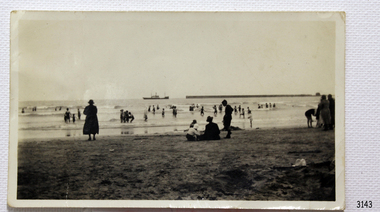
... Casino as a ship from the Belfast and Koroit Steam Navigation Company. The photograph shows an example of the Warrnambool community and family bathing and beach activities of the 1930s. ...The black and white photograph is a typical beach scene taken at Lady Bay, Warrnambool, between 1930 and 1932. In the background is the coastal trader, the steamship SS Casino. Adults and children are in the foreground, playing on the beach and in the water. The Warrnambool Breakwater is on the horizon. The S.S. Casino was a passenger and freight steamer built in Dundee, Scotland, in 1882 for the Newcastle and Hunter River Steam Navigation Company of N.S.W. The vessel weighed 425 tons gross with a length of 160.4 feet, a beam of 24.1 feet and a depth of 10.2 feet. Accommodation for 35 people was provided in the saloon, and 25 passengers in the fore-cabin, plus room for 300 tons of cargo. On May 30th 1882 the S.S. Casino called in at the Port of Warrnambool for coal, narrowly escaping being swept ashore in gale-force winds due to the pilot's quick action. At that time, still at anchor, the directors of the Belfast and Koroit Steam Navigation Company were so impressed that they bought the S S Casino immediately; being ideally suited for trade along the West Coast of Victoria; Belfast is the original name for Port Fairy, South West Victoria. The Belfast and Koroit Steam Navigation Company was first managed by Messers Saltau and Osburne, and after the passing of Mr Osburne, by produce merchants Messers H. Sautau and Sons, owners of a hay and corn store and shipping agency was on the corner of Liebig and Koroit Streets in Warrnambool. The S.S. Casino was named “the most famous steamer to operate in Victorian waters along the West Coast” by maritime author Jack Loney. Captain Boyd was her first Master, followed by Captain Chapman, who stayed with her from 1890 until 1924. Captain W. Robertson followed for a short term, and then Captain Middleton took command from 1925 to 1932. The S.S. Casino had several mishaps during her life. One was on 3rd January 1898 when the ship collided with the S.S. Flinders in Apollo Bay with minor damage. Another was on 24th October 1924 when the Casino was grounded on a reef at Point Hawdon near Grey River and most of her cargo of Christmas goods had to be dumped into the sea. Then in February 1929, the Casino was ‘holed’ when it struck a submerged object as it entered Lady Bay, Warrnambool. On the morning of 10th July 1932, after attempting to berth at Apollo Bay jetty in heavy seas, Captain Middleton decided to take S S Casino out into the bay and wait until the seas abated. It was not realised that the anchor that steadied the ship during a manoeuver had pierced its hull, and it sank as it headed for the beach. Captain Middleton and nine others lost their lives, but nine people were rescued including the two female passengers. Captain Middleton had been in charge of the S.S. Casino for seven years. He was the first ship’s Master to lose his life in a shipwreck in the West Coast trade. In the years following the turn of the century, the S.S. Casino remained the only regular trader with normal passenger accommodation along the West Coast. From 1882 it had made at least 2,500 voyages on the one run. Flagstaff Hill’s collection has a portrait photograph of Captain Chapman, a ship model of the S.S. Casino that shows both forms of power under which it sailed, steam and sail. The ship is painted green and flies three flags. The inscription across the case of the ship model, incorrectly dated, tells the sad story of the wreck of the ship and the loss of lives on July 10th 1932 at Apollo Bay. A print in the Collection shows S.S. Casino underway in the heavy sea off Point Lonsdale, another two photographs show it at the Port of Warrnambool, leaving from the Breakwater in Lady Bay, and another identifies the S.S. Casino as a ship from the Belfast and Koroit Steam Navigation Company.The photograph shows an example of the Warrnambool community and family bathing and beach activities of the 1930s. The photograph is significant because of its association with the coastal trader S.S. Casino 1882-1932 and its significance to cargo and passenger trade along Victoria's West Coast in the late 19th and early 20th centuries. The wreck of the S.S. Casino is considered an important part of Victorian and Australian cultural heritage and as such has been declared and protected as a Historic Shipwreck under State and Commonwealth Law in the Commonwealth Historic Shipwrecks Act (1976). Black and white photograph of steamship S.S Casino. Taken from the beach, adults and children on shore and in the water. Circa 1930-1932.newcastle and hunter river steam navigation company, belfast and koroit steam navigation company, h. sautau and sons, s.s. casino, west coast trader s.s. casino, victorian coastal trader, captain boyd, captain w. robertson, captain chapman, captain middleton, apollo bay shipwreck, lady bay warrnambool, saltau and osburne, port of warrnambool, warrnambool breakwater, beach, bathing, 1039, 1931, 1932, beach scene, swim -
 Flagstaff Hill Maritime Museum and Village
Photograph - Coastal Scene, 1930-1932
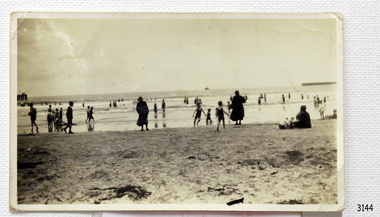
... Casino as a ship from the Belfast and Koroit Steam Navigation Company. The photograph shows an example of the Warrnambool community and family bathing and beach activities of the 1930s. ...The black and white photograph is a typical beach scene taken at Lady Bay, Warrnambool, between 1930 and 1932. In the background is the coastal trader, the steamship SS Casino. Adults and children are in the foreground, playing on the beach and in the water. The old jetty is on the left and the Warrnambool Breakwater is on the horizon. The S.S. Casino was a passenger and freight steamer built in Dundee, Scotland, in 1882 for the Newcastle and Hunter River Steam Navigation Company of N.S.W. The vessel weighed 425 tons gross with a length of 160.4 feet, a beam of 24.1 feet and a depth of 10.2 feet. Accommodation for 35 people was provided in the saloon, and 25 passengers in the fore-cabin, plus room for 300 tons of cargo. On May 30th 1882 the S.S. Casino called in at the Port of Warrnambool for coal, narrowly escaping being swept ashore in gale-force winds due to the pilot's quick action. At that time, still at anchor, the directors of the Belfast and Koroit Steam Navigation Company were so impressed that they bought the S S Casino immediately; being ideally suited for trade along the West Coast of Victoria; Belfast is the original name for Port Fairy, South West Victoria. The Belfast and Koroit Steam Navigation Company was first managed by Messers Saltau and Osburne, and after the passing of Mr Osburne, by produce merchants Messers H. Sautau and Sons, owners of a hay and corn store and shipping agency was on the corner of Liebig and Koroit Streets in Warrnambool. The S.S. Casino was named “the most famous steamer to operate in Victorian waters along the West Coast” by maritime author Jack Loney. Captain Boyd was her first Master, followed by Captain Chapman, who stayed with her from 1890 until 1924. Captain W. Robertson followed for a short term, and then Captain Middleton took command from 1925 to 1932. The S.S. Casino had several mishaps during her life. One was on 3rd January 1898 when the ship collided with the S.S. Flinders in Apollo Bay with minor damage. Another was on 24th October 1924 when the Casino was grounded on a reef at Point Hawdon near Grey River and most of her cargo of Christmas goods had to be dumped into the sea. Then in February 1929, the Casino was ‘holed’ when it struck a submerged object as it entered Lady Bay, Warrnambool. On the morning of 10th July 1932, after attempting to berth at Apollo Bay jetty in heavy seas, Captain Middleton decided to take S S Casino out into the bay and wait until the seas abated. It was not realised that the anchor that steadied the ship during a manoeuver had pierced its hull, and it sank as it headed for the beach. Captain Middleton and nine others lost their lives, but nine people were rescued including the two female passengers. Captain Middleton had been in charge of the S.S. Casino for seven years. He was the first ship’s Master to lose his life in a shipwreck in the West Coast trade. In the years following the turn of the century, the S.S. Casino remained the only regular trader with normal passenger accommodation along the West Coast. From 1882 it had made at least 2,500 voyages on the one run. Flagstaff Hill’s collection has a portrait photograph of Captain Chapman, a ship model of the S.S. Casino that shows both forms of power under which it sailed, steam and sail. The ship is painted green and flies three flags. The inscription across the case of the ship model, incorrectly dated, tells the sad story of the wreck of the ship and the loss of lives on July 10th 1932 at Apollo Bay. A print in the Collection shows S.S. Casino underway in the heavy sea off Point Lonsdale, another two photographs show it at the Port of Warrnambool, leaving from the Breakwater in Lady Bay, and another identifies the S.S. Casino as a ship from the Belfast and Koroit Steam Navigation Company.The photograph shows an example of the Warrnambool community and family bathing and beach activities of the 1930s. It also shows a point in time when the jetty and the Breakwater were in the Bay. The photograph is significant because of its association with the coastal trader S.S. Casino 1882-1932 and its significance to cargo and passenger trade along Victoria's West Coast in the late 19th and early 20th centuries. The wreck of the S.S. Casino is considered an important part of Victorian and Australian cultural heritage and as such has been declared and protected as a Historic Shipwreck under State and Commonwealth Law in the Commonwealth Historic Shipwrecks Act (1976).Black and white photograph of steamship S.S Casino leaving Warrnambool. Taken from the beach, adults and children on shore and in the water. There is a jetty on the left and and the Breakwater on the right. Circa 1930-1932.newcastle and hunter river steam navigation company, belfast and koroit steam navigation company, h. sautau and sons, s.s. casino, west coast trader s.s. casino, victorian coastal trader, captain boyd, captain w. robertson, captain chapman, captain middleton, apollo bay shipwreck, lady bay warrnambool, saltau and osburne, port of warrnambool, warrnambool breakwater, beach, bathing, 1039, 1931, 1932, beach scene, swim, warrnambool jetty -
 Flagstaff Hill Maritime Museum and Village
Functional object - Tap, mid-late 19th century
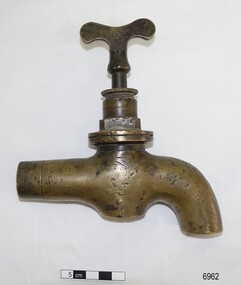
... It could have once been part of the plumbing from a ship, perhaps from one of the boilers used in the kitchen, for bathing or for laundry or cleaning. ...It could have once been part of the plumbing from a ship, perhaps from one of the boilers used in the kitchen, for bathing or for laundry or cleaning. ...This type of large, brass tap is typical of the plumbing fittings manufactured in the late 19th and early 20th centuries. The tap has encrustations and concretion inside, showing that it had been in the sea for quite some time. The pipe leading to the spout is squashed, nicked and appears to have been sawn or broken off. It could have once been part of the plumbing from a ship, perhaps from one of the boilers used in the kitchen, for bathing or for laundry or cleaning. The name “BEST” on the tap signifies that it could have been made by Robert Best who began his Birmingham brass foundry c. 1840, and even though The information from the donor is that tap was given to her father (1906-1982) who lived in the Warrnambool district. It was likely given by a cray fisherman or diver, who said that the tap came from the Loch Ard shipwreck, wrecked on Mutton Bird Island, east of Port Campbell, Victoria, on 1st June 1878. This could easily be the case but there is no provenance for it. ROBERT BEST, BRASS FOUNDRY Circa 1840 Robert Best founded his brass foundry business and was referred to as a Brass Chandelier of Birmingham”. In 1864 an advertisement in the Journal of Gas Lighting, Water Supply, & Sanitary Improvement announces Best and Hobson, late Robert Best, 100 Charlotte Street Birmingham, manufacturers of Chandeliers, Brass and iron fittings, Steam and Water-cocks etc. gas apparatus of every description, Plumber's brass foundry, with works at Birmingham and Great Bridge, Staffordshire. In 1867 Best & Lloyd was formed, after Best and Hobson went into liquidation, manufacturing at the Cambray Works of Wattville Road, Handsworth. It was a light industrial engineering works and one of the owners was Robert Dudley Best’s father. Robert Dudley Best (1892-1984) later took over the business of Best & Lloyd. The company is still in business at Downing Street, Smethwick, Birmingham. In 1878, brass ship furniture and bell fittings stamped “BEST” was made by William Udal & Co., who advertised as manufacturers of BEST cast and stamped brass foundry goods. This large brass tap is typical of industrial tapware of the mid-late 19th and 20th centuries. The location of the tap, when found, is associated with the Warrnambool district and could have easily been from a shipwreck due to the encrustation found inside the tap. Due to its design and manufacturer, the tap is associated with the mid-late 19th and early 20th-century manufacture of plumbing fittings. Tap, brass, heavy-duty, with butterfly handle. The design and style are typical of the plumbing of the late 1800s. Inscription pressed into the handle, within rectangular border "BEST". Encrustation and concretion are inside the tap spout. “BEST” on one side of the tap handle (Also, a label from the donor attached to the tap “from the wreckage of the LOCH ARD")flagstaff hill, warrnambool, shipwrecked coast, flagstaff hill maritime museum, maritime museum, shipwreck coast, flagstaff hill maritime village, great ocean road, robert best brass foundry, best and hobson, best & llyod, birmingham brass foundry, brass tap, best brand tap, heavy duty brass tap, industrial brass tap, boiler tap, 19th century plumbing, 19th century tapware, 19th century plumbing fitting, tap with butterfly handle, tap salvaged from shipwreck, brass fittings, steam engine fittings, water-cock fitting -
 Glenelg Shire Council Cultural Collection
Postcard - Postcard - Portland Harbour, Portland, Victoria, n.d
... 'Bathing' crossed out with black biro, 'Battery' written in black biro beneath Black and white photo postcard. View of Portland Harbour from Battery Point. Ocean pier, with ship ...Black and white photo postcard. View of Portland Harbour from Battery Point. Ocean pier, with ship berthed, railway pier and fishernen's breakwater, cannon in foreground.Front: 'Portland Harbour from Bathing Battery Point', white script bottom left. 'Bathing' crossed out with black biro, 'Battery' written in black biro beneath -
 Bendigo Historical Society Inc.
Postcard - WES HARRY COLLECTION: 7 POSTCARDS, 1904 - 08
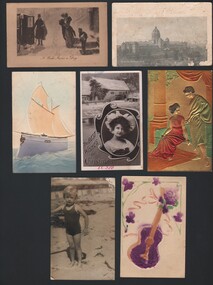
... ship... boy in bathing costume...(a) Christmas theme card depicting a water wheel and the actress Billie Burke., (b) embossed card with an guitar and flower theme., (c) Card with a faded photograph of the Exhibition Buildings , Melbourne., (d) Cartoon with The caption ' I wish I was a dog ' (e) Embossed card with a classical Roman or Greek theme., (f) embossed card depicting a sailing ship., (g) Photograph of a child, 5 or 6 years old , in a bathing costume....POSTCARD various themes Water wheel Billie Burke Guitar Exhibition Buildings Melbourne I wish I was a dog Roman theme sailing ship boy in bathing costume Seven assorted postcards addressed to Mrs. ...Seven assorted postcards addressed to Mrs. A. Stephens and having various themes. (a) Christmas theme card depicting a water wheel and the actress Billie Burke., (b) embossed card with an guitar and flower theme., (c) Card with a faded photograph of the Exhibition Buildings , Melbourne., (d) Cartoon with The caption ' I wish I was a dog ' (e) Embossed card with a classical Roman or Greek theme., (f) embossed card depicting a sailing ship., (g) Photograph of a child, 5 or 6 years old , in a bathing costume.postcard, various themes, water wheel , billie burke, guitar, exhibition buildings , melbourne, i wish i was a dog, roman theme, sailing ship, boy in bathing costume -
 St Kilda Historical Society
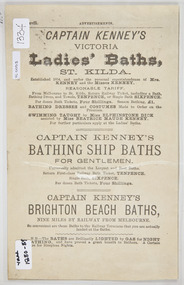
Poster - Advertisement, Captain Kenney's Victoria, 1880s
... ...St Kilda bathing ship...Captain Kenney St Kilda bathing ship Brighton Beach baths 19th century Laminated photocopy of printed advertisement for Kenny's Baths at St Kilda and Brighton Captain Kenney's Victoria Poster Advertisement ...Captain William Kenney pioneered swimming baths at St Kilda after arriving in Victoria in 1852. Later, he built baths at Brighton Beach.Laminated photocopy of printed advertisement for Kenny's Baths at St Kilda and Brightoncaptain kenney, st kilda bathing ship, brighton beach baths, 19th century -
 Bayside Gallery - Bayside City Council Art & Heritage Collection
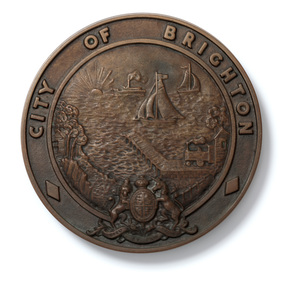
Plaque, City of Brighton plaque
... The central crest depicts the Brighton coastline in relief, with a pier extending to the water, sail boats and a ship in the distance, a train on the right of the pier, a bathing box and trees on the left....The central crest depicts the Brighton coastline in relief, with a pier extending to the water, sail boats and a ship in the distance, a train on the right of the pier, a bathing box and trees on the left. ...The design of this crest was used by the City of Brighton until 1970, when an official Coat of Arms was issued by the British College of Heraldry. Brighton was first incorporated as a borough on 18 January 1859. It became a town on 18 March 1887 and was proclaimed a city on 12 March 1919. Four circular cast bronze plaques with City of Brighton crest. The outer border surrounding the central crest includes CITY OF BRIGHTON lettering around the top half, two diamonds on the bottom left and right sides with the British Coat of arms at the bottom centre. The central crest depicts the Brighton coastline in relief, with a pier extending to the water, sail boats and a ship in the distance, a train on the right of the pier, a bathing box and trees on the left.plaque, city of brighton, brighton, crest, coat of arms, municipality, bayside -
 Bayside Gallery - Bayside City Council Art & Heritage Collection
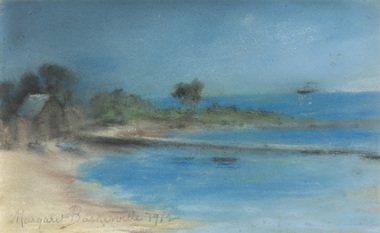
Work on paper - pastel, Margaret Baskerville, Bathing box by beach, 1912
... bathing box...margaret baskerville...bayside...port phillip bay...jetty...ship...beach coast bathing box margaret baskerville bayside port phillip bay jetty ship bush pastel Bathing box by beach Work on paper pastel Margaret Baskerville ...pastelbeach, coast, bathing box, margaret baskerville, bayside, port phillip bay, jetty, ship, bush -
 Lakes Entrance Historical Society
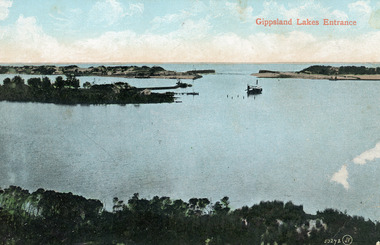
Photograph - The Entrance Lakes Entrance c1910
... Islands Ships and Shipping Topography Waterways Gippsland Lakes Entrance Colour tinted photograph of the entrance from Bass Strait to the Gippsland Lakes. It shows the small village on the hummocks, Bullock Island with bathing boxes at western end, machinery building groyne's from Bullock Island. ...Colour tinted photograph of the entrance from Bass Strait to the Gippsland Lakes. It shows the small village on the hummocks, Bullock Island with bathing boxes at western end, machinery building groyne's from Bullock Island. Boat in the water. Lakes Entrance VictoriaGippsland Lakes Entranceislands, ships and shipping, topography, waterways
