
Showing 12 items matching "battle begins"
-
 Whitehorse Historical Society Inc.
Article, Uni Bridge battle begins, 2015
... Uni Bridge battle begins...For more than a decade, Deakin University has tried to have a bridge built across Gardiners Creek Reserve to link its two campuses. Uni Bridge battle begins Article Article ...For more than a decade, Deakin University has tried to have a bridge built across Gardiners Creek Reserve to link its two campuses.For more than a decade, Deakin University has tried to have a bridge built across Gardiners Creek Reserve to link its two campuses.For more than a decade, Deakin University has tried to have a bridge built across Gardiners Creek Reserve to link its two campuses.city of whitehorse, deakin university, burwood campus, west of elgar residents' association, gardiners creek reserve -
Moorabbin Air Museum
Book - The Battle of Britain, The Narrow Margin
... ...Battle begins...The Battle of Britain Both sides prepare Battle begins The battle Comprehensive history of the Battle of Britain & the build up of military aviation prior, circa 1969 The Narrow Margin Book The Battle of Britain ...Comprehensive history of the Battle of Britain & the build up of military aviation prior, circa 1969non-fictionComprehensive history of the Battle of Britain & the build up of military aviation prior, circa 1969both sides prepare, battle begins, the battle -
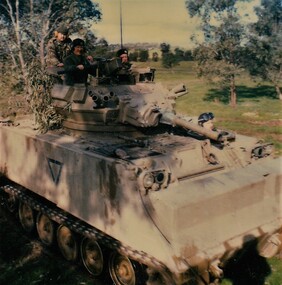 8th/13th Victorian Mounted Rifles Regimental Collection
Photograph - FSV Pucka 1986
... Colour photograph of M 113 A1 Fire Support Vehicle about to begin battle run during ' A ' squadron 8/13 Victorian Mounted Rifles Annual Camp 1986 at Puckapunyal....FSV VMR armour Puckapunyal training military Colour photograph of M 113 A1 Fire Support Vehicle about to begin battle run during ' A ' squadron 8/13 Victorian Mounted Rifles Annual Camp 1986 at Puckapunyal. ...Battle runs were a live firing exercise designed to test capability of all members of Fighting Vehicle crew.The 8th/13th Victorian Mounted Rifles was raised as a regiment of the Royal Australian Armoured Corps on 1 May 1948 with Headquarters in Melbourne and squadrons in Sale, Benalla/Wangaratta and Albury. In 1955 Regimental Headquarters moved to Wangaratta and a second squadron was located at Albury. The Sale squadron transferred to 4th/19th Prince of Wales’s Light Horse. In 1977 8/13 VMR Regiment was reduced to an independent squadron A Squadron 8th/13th Victorian Mounted Rifles and in 1991 was linked with 4th/19th Prince of Wales’s Light Horse forming the VMR Squadron of that regiment.Colour photograph of M 113 A1 Fire Support Vehicle about to begin battle run during ' A ' squadron 8/13 Victorian Mounted Rifles Annual Camp 1986 at Puckapunyal.fsv, vmr, armour, puckapunyal, training, military -
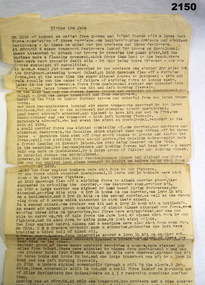 Bendigo Military Museum
Literary work - DIARY WW2, Post August 1942
... One page typed in black titled "Wiping the Japs". Begins on 18.8.42 with the sea battles around Gaudalcanal and finishing on 24th August. ...One page typed in black titled "Wiping the Japs". Begins on 18.8.42 with the sea battles around Gaudalcanal and finishing on 24th August. ...Arthur George Holley No 13556 RAN HMAS Hobart. This is the 4th part of diaries relating to Cat No2147. Refer also 2134 for service history also 2135.3, 2137.Diary, A.G.Holley RAN. One page typed in black titled "Wiping the Japs". Begins on 18.8.42 with the sea battles around Gaudalcanal and finishing on 24th August. diaries, literary work, ran -
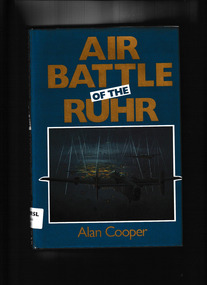 Monbulk RSL Sub Branch
Book, Wrens park publishing, Air Battle of the Ruhr : RAF Offensive March - July 1943, 2001
... The author begins by describing the role of Bomber Command and goes on to define the Ruhr area and its great importance in terms of industrial output to the Germans. The author provides the statistics for bombers dispatched, the number, which actually got to the targets and those, which never made it for one reason or another. Air Battle ...First published to acclaim in 1992, this book deals with the exploits of Bomber Command during their offensive against German Industry in the Ruhr during World War II. The author begins by describing the role of Bomber Command and goes on to define the Ruhr area and its great importance in terms of industrial output to the Germans. The author provides the statistics for bombers dispatched, the number, which actually got to the targets and those, which never made it for one reason or another. Air Battle of the Ruhr is a complete overview of a major aspect of the air war against mainland Germany.Index, ill, p.137.non-fictionFirst published to acclaim in 1992, this book deals with the exploits of Bomber Command during their offensive against German Industry in the Ruhr during World War II. The author begins by describing the role of Bomber Command and goes on to define the Ruhr area and its great importance in terms of industrial output to the Germans. The author provides the statistics for bombers dispatched, the number, which actually got to the targets and those, which never made it for one reason or another. Air Battle of the Ruhr is a complete overview of a major aspect of the air war against mainland Germany.bombimg - ruhr region - germany, world war 1939-1945 - aerial operations - britain -
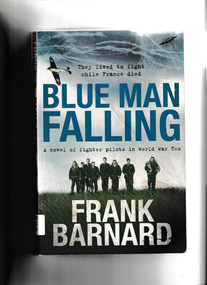 Monbulk RSL Sub Branch
Book, Frank Barnard, Blue man falling
... Then the offensive begins in earnest, the losses mount and the horror of the retreat to Dunkirk gives a whole new meaning to the concept of total war.Told through the experiences of an English pilot, Kit Curtis, who dreams of gallant deeds and personal glory, and a more battle hardened American, Ossie Wolf, this is 'Band of Brothers' for the RAF, a no-holds-barred, action packed war thriller. p.394. ...When war was declared on 3 September 1939, No. 1 Squadron was posted to France to help the BEF halt the German advance. The Squadron is hardy, intensely loyal, and at the beginning of the campaign, hugely successful in shooting down German planes when they are often outnumbered. Then the offensive begins in earnest, the losses mount and the horror of the retreat to Dunkirk gives a whole new meaning to the concept of total war.Told through the experiences of an English pilot, Kit Curtis, who dreams of gallant deeds and personal glory, and a more battle hardened American, Ossie Wolf, this is 'Band of Brothers' for the RAF, a no-holds-barred, action packed war thriller.p.394.fictionWhen war was declared on 3 September 1939, No. 1 Squadron was posted to France to help the BEF halt the German advance. The Squadron is hardy, intensely loyal, and at the beginning of the campaign, hugely successful in shooting down German planes when they are often outnumbered. Then the offensive begins in earnest, the losses mount and the horror of the retreat to Dunkirk gives a whole new meaning to the concept of total war.Told through the experiences of an English pilot, Kit Curtis, who dreams of gallant deeds and personal glory, and a more battle hardened American, Ossie Wolf, this is 'Band of Brothers' for the RAF, a no-holds-barred, action packed war thriller.world war 1939-1945 - britain - aerial operations - fiction, fighter pilots - fiction -
 Monbulk RSL Sub Branch
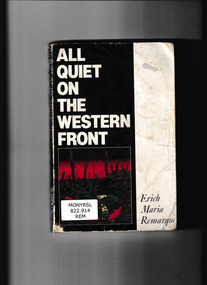
Book, Picador classic, All quiet on the western front, 1929
... He begins to feel disconnected from his past life: his family, his love of poetry, and his feelings. As the war progresses, Paul becomes increasingly lost in battle. p.192. ...A full-cast dramatisation of one of the greatest war novels of all time. First published as a novel in 1929, it tells the story of a group of young German soldiers who are enduring, and then coming to terms with, the realities of the First World War. At the age of 19, following the outbreak of the First World War, Paul Bäumer enlists in the German Army. He is deployed to the Western Front, where the experience of life and death in the trenches has an enormous effect on him. He begins to feel disconnected from his past life: his family, his love of poetry, and his feelings. As the war progresses, Paul becomes increasingly lost in battle.p.192.fictionA full-cast dramatisation of one of the greatest war novels of all time. First published as a novel in 1929, it tells the story of a group of young German soldiers who are enduring, and then coming to terms with, the realities of the First World War. At the age of 19, following the outbreak of the First World War, Paul Bäumer enlists in the German Army. He is deployed to the Western Front, where the experience of life and death in the trenches has an enormous effect on him. He begins to feel disconnected from his past life: his family, his love of poetry, and his feelings. As the war progresses, Paul becomes increasingly lost in battle. world war 1914-1918 - fiction, world war 1914-1918 - campaigns - france -
 Sunshine and District Historical Society Incorporated
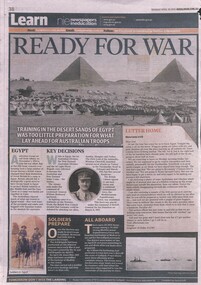
Article - Gallipoli 100 Year Anniversary The Legend Begin, 2015
... World War 1914 - 1918 ANZAC Gallipoli 2670.01 - Hearld Sun Learn 20th April 2015 - Ready For War 2670.02 - Hearld Sun Learn 20th April 2015 - The Landing 2670.03 - Hearld Sun Learn 20th April 2015 - The Campaign 2670.04 - Hearld Sun Learn 20th April 2015 - The Turks 2670.05 - Hearld Sun Learn 20th April 2015 - Nations Unite 2670.06 - Hearld Sun Learn 20th April 2015 - The Battles 2670.07 - Hearld Sun Learn 20th April 2015 - Evacuation 2670.08 - Hearld Sun Learn 20th April 2015 - Correspondents Of War Part collection of the Hearld Sun Supplement celbrating the 100th anniversary if the Galliploi landing Article Gallipoli 100 Year Anniversary The Legend Begin ...Part collection of the Hearld Sun Supplement celbrating the 100th anniversary if the Galliploi landingworld war 1914 - 1918, anzac, gallipoli -
Dandenong/Cranbourne RSL Sub Branch
Frame of "The Storey Begins", The Australian New Zealand Army Corps .....Lest We Forget
... -The Legend Begins -The Land and the Landing -The Chance of a Lifetime-Every Man A Volunteer -The Dardanelles -The Enemy Face- Johnny Turk -Making Do - Home Was Never Like This -An Informal Armistice -A new Landing - The Breakout -Dardanelles Committee -The Home Front -The New Enemy - Winter -Evacuation - The Great Deception -A.N.Z.A.C. Names and Places -Battle...-The Legend Begins -The Land and the Landing -The Chance of a Lifetime-Every Man A Volunteer -The Dardanelles -The Enemy Face- Johnny Turk -Making Do - Home Was Never Like This -An Informal Armistice -A new Landing - The Breakout -Dardanelles Committee -The Home Front -The New Enemy - Winter -Evacuation - The Great Deception -A.N.Z.A.C. Names and Places -Battle ...Gold painted wooden framed photograph of 'The Legend of Anzac" with 15 stories are displayed on a cut out on red background. -The Legend Begins -The Land and the Landing -The Chance of a Lifetime-Every Man A Volunteer -The Dardanelles -The Enemy Face- Johnny Turk -Making Do - Home Was Never Like This -An Informal Armistice -A new Landing - The Breakout -Dardanelles Committee -The Home Front -The New Enemy - Winter -Evacuation - The Great Deception -A.N.Z.A.C. Names and Places -Battle Honours, Flags, Drums and Medals -A.N.Z.A,C. … Lest WE Forget. Stating on the top left 2 Australian Medals Gallipoli Star Medal - Victory Medal (next) Rising Sun Badge NZ Expeditionary badge Victory Medal NZ Star Medal Australian Gallipoli Star Medal - The four medal star is bright bronze ensigned with a crown the obverse has cross gladius overlaid with oak wreath that is ensigned with the cypher of Ki ng George V. A scroll bearing the legend 1914-15 is centrally placed across the blades was authorised in 1918 and awarded for service in specified theatres of war between 5th Aug 1914 & 31st Dec 1915. Australian and New Zealand Victory medal is a United Kingdom and British First World War Campaign Medal. The award of a common allied campaign recommended in March 1919. The New Zealand Star Medal, designed R.K. Peacock, eight pointed star (representing NZ and the seven Territories of Australia) surrounding a silver disc with the words " Gallipoli 1914-15. -
 Clayton RSL Sub Branch
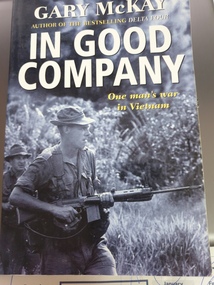
soft cover non-fiction book, In Good Company, 1987
... It begins with induction and selection for the officer academy for national servicemen at Scheyville, a six-month 'pressure cooker' course which produced second lieutenants ready to lead troops into action against the Viet Cong. It ends three and a half years later with a burst of NVA machine-gun fire during a battle...It begins with induction and selection for the officer academy for national servicemen at Scheyville, a six-month 'pressure cooker' course which produced second lieutenants ready to lead troops into action against the Viet Cong. It ends three and a half years later with a burst of NVA machine-gun fire during a battle ...Vietnam War veteran An enthralling account of an Australian infantryman and his companions in the Vietnam War. On Friday 8th March 1968, 20-year-old Gary McKay lost the lottery. He was conscripted. From a comfortable and carefree life of surfing and rugby football, he was drafted into the deadly serious preparation for war in the jungles of South Vietnam. In Good Company is his story told in his own words. It begins with induction and selection for the officer academy for national servicemen at Scheyville, a six-month 'pressure cooker' course which produced second lieutenants ready to lead troops into action against the Viet Cong. It ends three and a half years later with a burst of NVA machine-gun fire during a battle among enemy-held bunkers in the hills of Nui Le. Here is a grass-roots account of the blood, sweat and tears shared by a rifle platoon in jungle warfare, a straightforward story of the fears and the camaraderie which soldiers experience in combat. Gary McKay fashioned this account from his experience in action, leading his platoon. The detail is provided from the 80 letters he wrote to his wife while he served. He wrote his story for the reader who wants to know what the soldier on the ground went through - in the fetid jungle, in battle. Anyone who wants to understand what service in South Vietnam meant to those who were there should read this book. 'Reading In Good Company leaves a vivid and disconcerting impression of how the Vietnam War smelt, felt and sounded. One of the most honest and affecting war memoirs which Australians have so far published.' - Mark Thomas, Canberra Times 'An enthralling, accurate account of infantry soldiering in the Vietnam era. Very readable; a must for those who have never experienced combat and a vivid reminder for all veterans.' - Major General M. P. Blake, AM, MC, former CO 5th Battalion RARGary John McKay MC (born 1947) is a writer and former Australian Army officer. He was awarded the Military Cross while serving with the 4th Battalion, Royal Australian Regiment during the Vietnam War.[1] He later served as Commanding Officer of 8th/9th Battalion, Royal Australian Regiment between 1988 and 1990Soft cover non fiction book -
 Melbourne Legacy
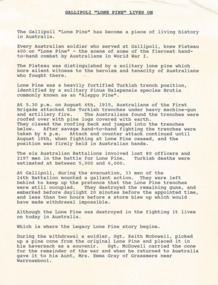
Document, Gallipoli's 'Lone Pine' Lives On
... battle for Lone Pine. Turkish deaths were estimated at between 5,000 and 6,000. At Gallipoli during the evacuation, 33 men of the 24th Battalion mounted a gallant action. They were left behind to keep up the pretence that the Lone Pine trenches were still occupied. They destroyed the remaining guns, and embarked before daylight 20 minutes before the appointed time, and less than two hours before a storm blew up which would have made withdrawal impossible. Although the Lone Pine was destroyed in the fighting it lives on today in Australia. Which is where the Legacy Lone Pine story begins...battle for Lone Pine. Turkish deaths were estimated at between 5,000 and 6,000. At Gallipoli during the evacuation, 33 men of the 24th Battalion mounted a gallant action. They were left behind to keep up the pretence that the Lone Pine trenches were still occupied. They destroyed the remaining guns, and embarked before daylight 20 minutes before the appointed time, and less than two hours before a storm blew up which would have made withdrawal impossible. Although the Lone Pine was destroyed in the fighting it lives on today in Australia. Which is where the Legacy Lone Pine story begins ...A detailed account of the story of Lone Pine in Gallipoli and how seedlings were grown from a pine cone brought back by Sgt. Keith McDowell. The author and date of this account is not known but was post 1989. The text says: " Gallipoli Lone Pine Lives On The Gallipoli Lone Pine has become a piece of living history in Australia. Every Australian solider who served at Gallipoli, knew Plateau 400 or ‘Lone Pine’ – the scene of some of the fiercest hand-to-hand combat by Australian in World War 1. The Plateau was distinguished by a solitary lone pine which bore silent witness to the heroism and tenacity of Australians who fought there. Lone Pine was a heavily fortified Turkish trench position, identified by a solitary Pinus Halepensis species commonly known as an ‘Aleppo Pine’. (** NB this has since been corrected and the species is not an 'Aleppo pine' but Pinus Brutia, commonly called Turkish pine) At 5.30 pm on August 6th, 1915, Australians of the First Brigade attacked the Turkish trenches under heavy machine-gun and artillery fire. The Australians found the trenches were roofed over with pine logs covered with earth. They clawed the roofing back and jumped into the trenches below. After savage hand-to-hand fighting the trenches were taken by 6 pm. Attack and counter attack continued until August 10, when fighting at Lone Pine ceased, and the position as firmly held in Australian hands. The six Australian Battalions involved lost 80 officers and 2197 men in the battle for Lone Pine. Turkish deaths were estimated at between 5,000 and 6,000. At Gallipoli during the evacuation, 33 men of the 24th Battalion mounted a gallant action. They were left behind to keep up the pretence that the Lone Pine trenches were still occupied. They destroyed the remaining guns, and embarked before daylight 20 minutes before the appointed time, and less than two hours before a storm blew up which would have made withdrawal impossible. Although the Lone Pine was destroyed in the fighting it lives on today in Australia. Which is where the Legacy Lone Pine story begins. During the withdrawal a soldier, Sgt. Keith McDowell, picked up a pine cone from the original Lone Pine and placed it in his haversack as a souvenir. Sgt. McDowell carried the cone for the remainder of the war and when he returned to Australia gave it to his Aunt, Mrs Emma Gray of Grassmere near Warrnambool. “Here Aunty, you’ve got a green thumb, see if you can grow something out of this”, the late Mrs Gray’s son, Alexander, recalled. But it wasn’t until some 12 years later that Mrs Gray planted the few seeds from the cone, five of which sprouted and grew into little trees. One of the pines eventually died but the remaining four survived. In May, 1933, one was planted in Wattle Park on the occasion of the Trooping of the Colour by the 24th Battalion. On the 11th June 1933, the second tree was planted with full military honours by S G Savige of the 24th Battalion, at the Shrine of Remembrance in Melbourne, where it now shades the well-loved statue of Simpson and his donkey. The late Lieutenant-General Sir Stanley Savige KBE, CB, DSO, MC, ED, was the founder of Melbourne Legacy. Formed in 1923, the Melbourne Legacy Club was the first such Club to be established. On the 18 June 1933 the third tree was planted at the Sisters, near Terang, just north east of Warrnambool. This is the area Mrs Gray’s family lived and the home of several Gallipoli veterans. The fourth tree was planted in the Warrnambool Gardens on 23 January 1934. In 1964 Legatee Tom Griffiths, then President of Warrnambool Legacy, put forward the idea that more seedlings should be raised in the Jubilee Year of Gallipoli from the established trees with the object of planting memorial trees throughout Australia in memory of those who fell in action at Lone Pine in 1915. The project was outlined in a paper presented to the Perth Conference in 1965 and was strongly supported. Two batches of cones were sent to Melbourne, one from the tree at ‘The Sisters’ and another from the tree at the Warrnambool Gardens, and the full cooperation of the (then) Forests Commission of Victoria, was guaranteed by the Chief Commissioner, Mr Benallack. Unfortunately, these cones had been gathered too late as the seeds had already been cast, and the few seeds that survived failed to germinate. However, Melbourne Legacy then undertook the propagation and distribution of seedlings. With the assistance of the Shrine of Remembrance Trustees, permission was granted by the Melbourne City Parks and gardens Curator to harvest a limited number of cones from the 24th Battalion tree at the Shrine and these were gathered by the Forest Commission and after the necessary preparatory treatment were planted in the Commission’s nursery at Macedon. Approximately 150 seedlings were raised from these cones by Dr Grose, Director and Silviculture. Melbourne Legacy’s Commemoration Committee was responsible for the collection, propagation, presentation and dedication of Lone Pines from the 24th Battalion tree at the Shrine of Remembrance. One the 14 September 1989 further cones were collected with the hope to raise 1000 trees from the seeds. This could not have been done without the invaluable assistance of the Department of Natural Resources and Dr Peter May at the Victorian College of Agriculture and Horticulture in Richmond, Victoria. Thus, Legacy is helping to keep the memory of the Gallipoli ‘Lone Pine’ alive – its spirit living on today. Presentations are made to schools, ex-service organisations and interested bodies by Legacy Clubs in the hope that they will be cherished as a symbol of Australian nationhood and of its just pride, devotion, courage, selflessness and sense of service to others. "The Legacy Lone Pine program helped promote the Anzac story throughout Australia.White A4 paper with black type x 3 pages recounting the story of Legacy's propagation of Lone Pine seedlings. lone pine, gallipoli -
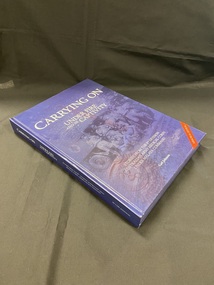 Returned Nurses RSL Sub-branch
Book, Carl Johnson, Carrying on under fire and in captivity: stories from the 8th Division Australian Army Medical Corps under Malaya command, 2009
... Battle Station Malaya 2. War in the Far East 3. The Withdrawal Begins 4. The Siege of Singapore 5. ...1. Battle Station Malaya 2. War in the Far East 3. The Withdrawal Begins 4. The Siege of Singapore 5. Nurses under Fire 6. The Last Five Days 7. Capitulation and Captivity 8. Work Parties 9. 'A' Force to Burma 10. Japan Parties 11. Adjusting to Captivity 12. 'B' and 'E' Force to Borneo 13. The Barracks Square Incident 14. POW Life in the Far East 15. 'F' Force Part One 16. 'F' Force Part Two: the Diary of Glenleigh Skewes 17. Other Work Forces on the Burma-Thailand Railway 18. The Show Goes On 19. Changi and Woodlands - 1945 20. The 'X3' party 21. Liberation 22. Reunions, Associations and Memorials. [From Trove record] 'This is the story of the eighteen hundred members of the Australian Army Medical Corps 8th Division serving with Malaya Command, who were forced to endure life as prisoners of war, following the fall of Singapore on 15th february 1942' [From back cover]Hardcover navy blue book with title, subheading and author in white print. There is a red strip across the bottom right corner that reads 'memorial edition'. The title information is printed over an image of six men in uniform posing in front of a vehicle , a list of names, and a symbol of the Australian Army Medical Corps.non-fiction1. Battle Station Malaya 2. War in the Far East 3. The Withdrawal Begins 4. The Siege of Singapore 5. Nurses under Fire 6. The Last Five Days 7. Capitulation and Captivity 8. Work Parties 9. 'A' Force to Burma 10. Japan Parties 11. Adjusting to Captivity 12. 'B' and 'E' Force to Borneo 13. The Barracks Square Incident 14. POW Life in the Far East 15. 'F' Force Part One 16. 'F' Force Part Two: the Diary of Glenleigh Skewes 17. Other Work Forces on the Burma-Thailand Railway 18. The Show Goes On 19. Changi and Woodlands - 1945 20. The 'X3' party 21. Liberation 22. Reunions, Associations and Memorials. [From Trove record] 'This is the story of the eighteen hundred members of the Australian Army Medical Corps 8th Division serving with Malaya Command, who were forced to endure life as prisoners of war, following the fall of Singapore on 15th february 1942' [From back cover] australian army medical corps, world war two medical care, malaya, singapore, burma, changi, kranji, prisoner of war, medical personnel, japan, 8th division army medical corps, burma-siam railroad
