
Showing 37 items matching "before departure"
-
 Moorabbin Air Museum
Book - Flying - behind the scenes, Behind the Flight Deck Door
... Before departure...Flying - behind the scenes Before departure During flight After landing Uniform Aircraft equipment Common questions asked of airline pilots , circa 2018 Behind the Flight Deck Door Book Flying - behind the scenes ...Common questions asked of airline pilots , circa 2018non-fictionCommon questions asked of airline pilots , circa 2018before departure, during flight, after landing, uniform, aircraft equipment -
 Uniting Church Archives - Synod of Victoria
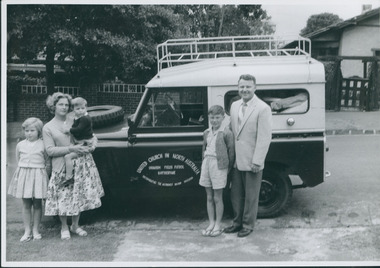
Photograph, Thomas Verrier & family, 1962
... Thomas Verrier and family before departure for Katherine....Thomas Verrier and family before departure for Katherine. Thomas Verrier and family standing alongside the Land Rover ready to depart for Uranium Fields Patrol Katherine. ...Thomas Verrier (ordained 1961): Sprent (Tas.) (HM) 1956–60; Katherine (NT) 1962–65; Nightcliff (Darwin) 1966–67; Bendigo North 1968–71; Burnie (Tas.) 1971–76; Bayswater & Wantirna 1977–?.Thomas Verrier and family standing alongside the Land Rover ready to depart for Uranium Fields Patrol Katherine.Rev. Thomas Verrier and family before departure for Katherine.verrier, thomas -
 Kew Historical Society Inc
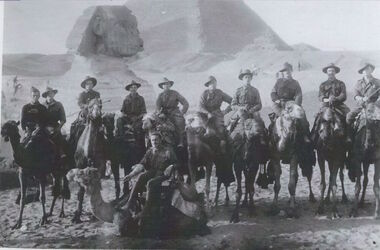
Photograph - Photograph [copy], Australian soldiers in Egypt, 1914, 1914
... Australian soldiers at the pyramids of Egypt before departure for Gallipoli. One of them is Charles Field Richardson, Regimental Number 341, 6th Battalion, Australian Imperial Forces. ...Together it forms the largest privately-donated collection within the archives of the Kew Historical Society. charles field richardson dorothy rogers world war 1 australian soldiers egypt pyramids sphinx gallipoli charles richardson camel Charles Richardson far left Australian soldiers at the pyramids of Egypt before departure for Gallipoli. One of them is Charles Field Richardson, Regimental Number 341, 6th Battalion, Australian Imperial Forces. ...Charles Field Richardson was the brother of Kew historian Dorothy Rogers. He died at Alexandria after being wounded at Gallipoli. This work forms part of the collection assembled by the historian Dorothy Rogers, that was donated to the Kew Historical Society by her son John Rogers in 2015. The manuscripts, photographs, maps, and documents were sourced by her from both family and local collections or produced as references for her print publications. Many were directly used by Rogers in writing ‘Lovely Old Homes of Kew’ (1961) and 'A History of Kew' (1973), or the numerous articles on local history that she produced for suburban newspapers. Most of the photographs in the collection include detailed annotations in her hand.The Rogers Collection provides a comprehensive insight into the working habits of a historian in the 1960s and 1970s. Together it forms the largest privately-donated collection within the archives of the Kew Historical Society.Australian soldiers at the pyramids of Egypt before departure for Gallipoli. One of them is Charles Field Richardson, Regimental Number 341, 6th Battalion, Australian Imperial Forces. Charles Richardson far leftcharles field richardson, dorothy rogers, world war 1, australian soldiers, egypt, pyramids, sphinx, gallipoli, charles richardson, camel -
 Bendigo Military Museum
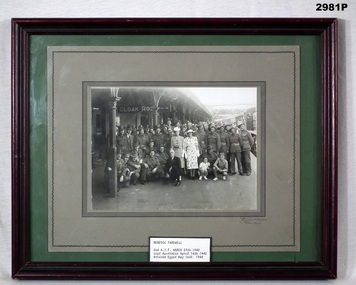
Photograph - PHOTOGRAPH WW2, FRAMED, Vincent Kelly, C. 1940
... Black & white photo of soldiers on station platform before departure overseas. Mahogany wooden frame, glass front, cardboard backing, hanging wire on rear. ...Arrived Egypt May 16th 1940” Black & white photo of soldiers on station platform before departure overseas. Mahogany wooden frame, glass front, cardboard backing, hanging wire on rear. ...Black & white photo of soldiers on station platform before departure overseas. Mahogany wooden frame, glass front, cardboard backing, hanging wire on rear. Photo has a grey border mounted on a green background. White label bottom centre: “Bendigo Farewell, 2nd AIF Soldiers March 27th 1940. Left Australia April 14th 1940. Arrived Egypt May 16th 1940”passchendaele barracks trust, 2nd aif, bendigo -
 8th/13th Victorian Mounted Rifles Regimental Collection
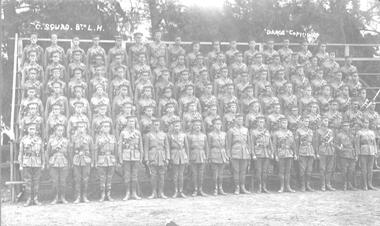
Photograph - 'C' Sqn 8LH 1915, 1914 circa
... Black and white photograph of 6 ranks of soldiers arranged in tiers being " C " Squadron 8th Light Horse, shortly before departure to the Middle East. Photograph is mounted on card.Soldiers are wearing bandoliers and peaked caps....3rd Top" Black and white photograph of 6 ranks of soldiers arranged in tiers being " C " Squadron 8th Light Horse, shortly before departure to the Middle East. Photograph is mounted on card.Soldiers are wearing bandoliers and peaked caps. ...The 8th Light Horse Regiment AIF was raised at Broadmeadows Victoria in September 1914 under the command of Lieutenant Colonel Alexander White and formed part of the 3rd Light Horse Brigade. The regiment served at Gallipoli where in a courageous, but ill-fated charge at the Nek on 7 August 1915, it suffered horrendous casualties including Lieutenant Colonel White. Rebuilt in Egypt under the command of Lieutenant Colonel Leslie Maygar VC the regiment went on the serve throughout the Middle East Campaign. Lieutenant Colonel Maygar died of wounds at Beersheba when the regiment was attacked by enemy aircraft while waiting to follow up the successful charge of the 4th LH Brigade on 30 October 1917. Returning to Australia after the war, the 8th Light Horse AIF was disbanded in 1921, but soon after re-raised as the 8th (Indi) Light Horse in the Citizen Military Forces.Rare professional photograph of a light horse squadron prior to their departure for overseas in 1914.Black and white photograph of 6 ranks of soldiers arranged in tiers being " C " Squadron 8th Light Horse, shortly before departure to the Middle East. Photograph is mounted on card.Soldiers are wearing bandoliers and peaked caps.On face of image - " 'C' Squad 8th Light Horse" and " Darge Copyright". On rear of mounting card " No.378/2nd Regx? 3rd Top"8th light horse regiment, world war one (1914-1918) -
 Bendigo Military Museum
Photograph - PHOTOGRAPHIC POSTCARD, c.1915
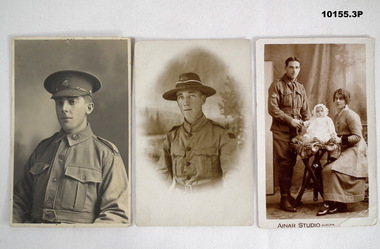
... Photos of soldiers taken before departure to the War and added to a postcard. ...Photos of soldiers taken before departure to the War and added to a postcard. ...Photos of soldiers taken before departure to the War and added to a postcard. Part of the collection of William (Bill) Thomason collection.Three photos of an Australian soldier. 1. Portrait photo of a soldier in uniform. Waist up, looking into the camera with neutral background. No message on back. 2. Sepia portrait photo, waist up, of soldier in uniform with a forest like screen in background. Brief message on back. 3. Portrait photo of a family. Soldier standing and a woman sitting with a young baby sitting on a coffee table in between. Comment on back written at bottom "Ainar Studio Auburn".1. Nil. 2. Message "To Dear Ethel, With Kindest Regards from Fred C” 3. Comment "48th Infantry Kooyong, Vict."collection of william (bill) thomason, photo postcards, ww1 -
 Port Melbourne Historical & Preservation Society
Photograph - Thomas Sinclair From the booklet "Four immigrant families and some of their descendants", Margaret Bride, Booklet completed 2019
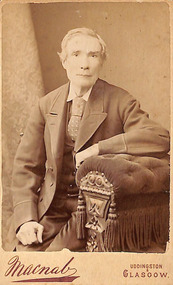
... Image taken in Glasgow in 1865 before departure to Australia....Image taken in Glasgow in 1865 before departure to Australia. Families Margaret BRIDE nee POLSON Ada POLSON nee BELLION Thomas SINCLAIR Elizabeth Weller BELLION William J BELLION Louisa BELLION Letitia SINCLAIR Mother FALKENREICH Ada Florence BELLION Lizzie SINCLAIR Four immigrant families and some of their descendants. ...Photos belonged to Ada POLSON (nee BELLION), Margaret BRIDE's mother. Image taken in Glasgow in 1865 before departure to Australia.Four immigrant families and some of their descendants. Small booklet of memoirs prepared by Margaret BRIDE of family members who had significant links to Port Melbourne. .02- Thomas SINCLAIR 1820-1868 Great Grandfather of booklet composer Margaret Bridefamilies, margaret bride nee polson, ada polson nee bellion, thomas sinclair, elizabeth weller bellion, william j bellion, louisa bellion, letitia sinclair, mother falkenreich, ada florence bellion, lizzie sinclair -
 Tatura Irrigation & Wartime Camps Museum
Photograph, Hogan Family
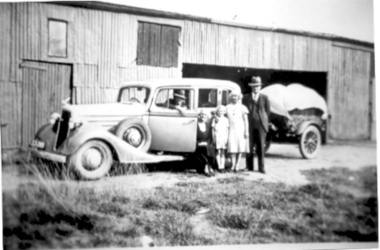
... |Family posing in front of loaded up trailor and car before a departure....|Family posing in front of loaded up trailor and car before a departure. Hogan Family Photograph ...L-R: George and Lucy Dick, Lucy Ranson (nee Hogan), Jean and John Hogan.|Family posing in front of loaded up trailor and car before a departure.tatura, john hogan family, costume, children, female, male, transport, motor, vehicles -
 Melbourne Legacy
Photograph, Somers Camp, 1940
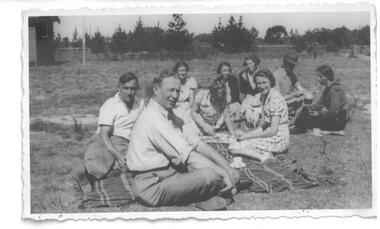
... "Norman Smith ILC" in blue pen and "Stan Savige at Somers Camp just before his departure with 17th Bde 1940" in pencil on reverse....A photograph of Stan Savige at Somers Camp. stan savige somers camp camp "Norman Smith ILC" in blue pen and "Stan Savige at Somers Camp just before his departure with 17th Bde 1940" in pencil on reverse. ...Photo of a group of people on a picnic rug at Somers Camp in 1940. Melbourne Legacy provide camps for junior legatees - the children of deceased servicemen. In the early years, Legacy organised outings to the property of Legacy founder, Legatee Stan Savige, who had a place in Balnarring/Somers, close to the beach. Permanent camp buildings were built in 1930. Legacy Somers Camps continued intermittently at Stan's property until it was decided in 1951 to make other arrangements for holidays. A photograph of Stan Savige at Somers Camp.Black and white photo of Stan Savige at Somers Camp 1940."Norman Smith ILC" in blue pen and "Stan Savige at Somers Camp just before his departure with 17th Bde 1940" in pencil on reverse.stan savige, somers camp, camp -
Port Melbourne Historical & Preservation Society
Painting - Painting, Public convenience, Sinclair Parade, Port Melbourne, Ray Johnstone, Ray Johnstone, 1998
... One of several Port Melbourne watercolours painted by Ray Johnstone just before his departure to France. ...One of several Port Melbourne watercolours painted by Ray Johnstone just before his departure to France. arts and entertainment - visual arts built environment - civic ray johnstone Port Melbourne Prints and Framing sticker on back Framed watercolour of public convenience in Sinclair Parade by Ray Johnstone, 1998 Painting Painting, Public convenience, Sinclair Parade, Port Melbourne, Ray Johnstone Ray Johnstone ...One of several Port Melbourne watercolours painted by Ray Johnstone just before his departure to France. Framed watercolour of public convenience in Sinclair Parade by Ray Johnstone, 1998Port Melbourne Prints and Framing sticker on backarts and entertainment - visual arts, built environment - civic, ray johnstone -
 Melbourne Athenaeum Archives
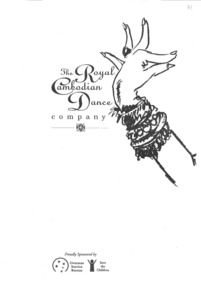
Theatre Program, The Royal Cambodian Dance Company, (dance) performed at Athenaeum Theatre 2, on 5 March 1994
... Only days before their departure to Australia the Royal Cambodian Dance Company's home and theatre was burnt to the ground....Only days before their departure to Australia the Royal Cambodian Dance Company's home and theatre was burnt to the ground. ...Only days before their departure to Australia the Royal Cambodian Dance Company's home and theatre was burnt to the ground.The Overseas Service Bureau along with the Royal Cambodian dance company are raising money for all the innocent people of Cambodia to have their basic needs provided for them.green and whitethe royal cambodian dance company, athenaeum theatre 2 -
![Photograph - Digital image, Charles Partington [Heywood], 1856_](/media/collectors/4f729f5697f83e03086015b8/items/5441f5592162f10c08213c48/item-media/5441f5822162f10c08214095/item-fit-380x285.jpg?cb=6) Greensborough Historical Society
Greensborough Historical SocietyPhotograph - Digital image, Charles Partington [Heywood], 1856_
... Photograph of Charles Partington probably taken in England before his departure (in 1856) for Melbourne. Charles Partington and family came to Melbourne in the 1857 and moved to Greensborough where they farmed along the Plenty River. ...Photograph of Charles Partington probably taken in England before his departure (in 1856) for Melbourne. Charles Partington and family came to Melbourne in the 1857 and moved to Greensborough where they farmed along the Plenty River. charles partington Digital copy of black and white studio photograph. ...Photograph of Charles Partington probably taken in England before his departure (in 1856) for Melbourne. Charles Partington and family came to Melbourne in the 1857 and moved to Greensborough where they farmed along the Plenty River. Digital copy of black and white studio photograph.charles partington -
 Wodonga & District Historical Society Inc
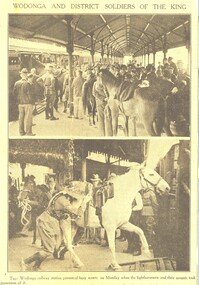
Article - Wodonga and District - Soldiers of the King
... Mc-Geoch (Wodonga), before the departure of the 8th Light Horse troop....Mc-Geoch (Wodonga), before the departure of the 8th Light Horse troop. ...The 8th Light Horse was initially raised from companies of the colonial Victorian Mounted Rifles located in North-east Victoria following Federation. In 1912 a major reorganisation of the Australian military forces resulted in the regiment being renumbered 16th Light Horse. The Regiment was disbanded in 1919 but soon after was re-raised as the 8th (Indi) Light Horse in the Citizen Military Forces, with the territorial title Indi Light Horse. The Indi Light Horse consisted of 3 squadrons. A squadron consisted of troops in Corryong, Walwa, Tallangatta, Eskdale and Wodonga. After an extensive recruiting campaign in January 1939 a new troop was raised in Bethanga, Victoria. In December 1941, the regiment converted from horse to mechanised, initially as 8th Reconnaissance Battalion then in July 1942 it became 8th Cavalry Regiment and served in Northern Territory. As Japanese threat to the mainland declined the regiment was disbanded.This article is significant because it depicts horses being loaded at the Wodonga Railway Station to despatch to the training camp at Broadmeadows. Two black and white images from the Border Morning Mail Friday March 10, 1939. One image shows horses being loaded on to trains in Wodonga to be sent to the base at Broadmeadows, Victoria. The second image depicts two leaders of the 8th Light Horse Regiment.Caption with Photo 1 WODONGA AND DISTRICT SOLDIERS OF THE KING Top: Wodonga railway station presented busy scenes on Monday when the lighthorsemen and their mounts took possession of it. Bottom- Although the men were jubilant at boarding the train for Broadmeadows the horses did not like the idea. This horse was no exception. Photo 2 TWO LIGHTHORSE LEADERS Lieutenant L. W. Welesmith, Tallangatta (left), discussing the entraining of horses for Broadmeadows at Wodonga, with Lieutenant J. A. Mc-Geoch (Wodonga), before the departure of the 8th Light Horse troop.australian light horse, peter frawley, light horse wodonga -
 Returned Nurses RSL Sub-branch
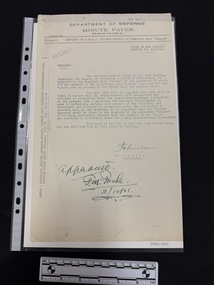
Document - Copy of Department of The Army Minute Paper, Department of the Army, Despatch of A.A.M.C Reinforcements by Hospital Ship "Oranje", 19411231
... Concern was raised and investigation being undertaken to ensure the 224 V.A.Ds. to be on board the Oranje would be protected under the Geneva International Convention before their intended departure in January of the following year....Concern was raised and investigation being undertaken to ensure the 224 V.A.Ds. to be on board the Oranje would be protected under the Geneva International Convention before their intended departure in January of the following year. ...Copy of file no. 38-422-418 from the National Archives of Australia being a despatch relating to 394 personnel departing on the Hospital Ship Oranje to serve in the Middle East. Concern was raised and investigation being undertaken to ensure the 224 V.A.Ds. to be on board the Oranje would be protected under the Geneva International Convention before their intended departure in January of the following year.Foolscap copy of a Department of the Army Minute Paper report with information on the source along the left hand edge.'38-422-418' [Blue ink on left hand side]wwii, ww2, world war 2, voluntary aid detachment, middle east -
 Williamstown Historical Society Inc
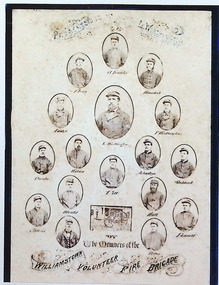
Photograph - Group portrait of the Williamstown Volunteer Fire Brigade
... This presentation photo collage was produced in 1887 by the members of the Williamstown Volunteer Fire Brigade to honor their leader, Superintendent Lawrence Worthington (shown in the large center oval), as a farewell gift before his departure for England in 1887. Lawrence Worthington served as a Captain of the Williamstown Volunteer Fire Brigade before being elevated to the higher rank of Superintendent. ...This presentation photo collage was produced in 1887 by the members of the Williamstown Volunteer Fire Brigade to honor their leader, Superintendent Lawrence Worthington (shown in the large center oval), as a farewell gift before his departure for England in 1887. Lawrence Worthington served as a Captain of the Williamstown Volunteer Fire Brigade before being elevated to the higher rank of Superintendent. ...The Williamstown Volunteer Fire Brigade which was inaugurated on the 28th February 1851. This presentation photo collage was produced in 1887 by the members of the Williamstown Volunteer Fire Brigade to honor their leader, Superintendent Lawrence Worthington (shown in the large center oval), as a farewell gift before his departure for England in 1887. Lawrence Worthington served as a Captain of the Williamstown Volunteer Fire Brigade before being elevated to the higher rank of Superintendent. The composite image features individual oval portraits of the brigade's active volunteer members at that time, framed around a central image of their manual hose reel cart. Names of Fireman shown include: Dandie, Pitt, Wilson, Mould, Bennett, Hall, Sheldrick, Johnstone, T. Worthington, L. Worthington, A. Knowles, J.E. Murdoch, Elsum, Lester, Lieutenant N.R. Wilson, J. Johnstone, Wallace williamstown volunteer fire brigade -
 Bendigo Military Museum
Photograph - Visit by Australian Major General Hughes and US General Keith to the Army Survey Regiment, Fortuna, Bendigo, c1984
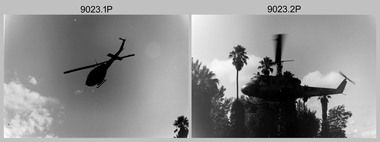
... MAJ GEN James Hughes AO DSO MC on the Army Survey Regiment’s parade ground before departure. .17) & .18) - Photo, black & white, c1984. ...MAJ GEN James Hughes AO DSO MC on the Army Survey Regiment’s parade ground before departure. .17) & .18) - Photo, black & white, c1984. ...Army Survey Regiment, Fortuna Villa, Bendigo circa 1984. As there are limited annotations with the photo set, the names of the aide de camp officer, guests and the media are unknown. The Australian Army’s MAJ GEN James Hughes AO DSO MC and the US Army’s GEN Keith are identified by their name tags. Given GEN Keith was a high ranking four-star General, it is likely they were attending a Five Nations Conference held at the Regiment. MAJ GEN James Hughes AO DSO MC held the position of Controller of Establishments from 1978 to 1984. The generals were accompanied by their wives and travelled by RAAF Iroquois helicopter.This is a set of 24 photographs taken on the occasion of Australian Army Major General Hughes and US General Keith visit to the Army Survey Regiment, Bendigo circa 1984. The black & white photographs are on 35mm negative film and are part of the Army Survey Regiment’s Collection. The photographs .1) to .18) were scanned at 96 dpi and photographs .19) to .24) were scanned at 300 dpi.. .1) to .5) - Photo, black & white, c1984. Royal Australian Air Force (RAAF) Iroquois Helicopter landing on the Army Survey Regiment’s parade ground. .6) - Photo, black & white, c1984. US Army’s GEN Keith departs from RAAF Iroquois Helicopter at Army Survey Regiment’s parade ground. RSM WO1 Bob Mason appears at far right. .7) to .9) - Photo, black & white, c1984. L to R: Army Survey Regiment’s 2IC MAJ Bob Roche greets MAJ GEN James Hughes AO DSO MC, US Army’s GEN Keith appears at far right. .10) & .11) - Photo, black & white, c1984. L to R: Army Survey Regiment’s 2IC MAJ Bob Roche, MAJ GEN James Hughes AO DSO MC, US Army’s GEN Keith at the front steps of Fortuna Villa. .12) - Photo, black & white, c1984. OC MAJ Graham Baker escorts the touring party along the pathway outside Air Survey Squadron. .13) & .14) - Photo, black & white, c1984. US Army’s GEN Keith being interviewed by the media. Air Survey Squadron’s OC MAJ Graham Baker appears at far right. .15) - Photo, black & white, c1984. Royal Australian Air Force (RAAF) Iroquois Helicopter in readiness for departure from the Army Survey Regiment’s parade ground. RSM WO1 Bob Mason appears at far right. .16) - Photo, black & white, c1984. MAJ GEN James Hughes AO DSO MC on the Army Survey Regiment’s parade ground before departure. .17) & .18) - Photo, black & white, c1984. Visiting dignitaries and their wives board the RAAF Iroquois Helicopter at the Army Survey Regiment’s parade ground. .19) & .20) - Photo, black & white, c1984. Visiting dignitaries and their wives alight from the RAAF Iroquois Helicopter at the Bendigo Airport. .21) & .22) - Photo, black & white, c1984. Royal Australian Air Force (RAAF) Iroquois Helicopter landing on the Army Survey Regiment’s parade ground. .23) - Photo, black & white, c1984. Royal Australian Air Force (RAAF) Iroquois Helicopter landing at the Bendigo Airport. .24) - Photo, black & white, c1984. US Army’s GEN Keith and Mrs Keith after alighting from the RAAF Iroquois Helicopter at the Bendigo Airport.The annotation ‘Gen Keith’s Visit’ is written on the cover sheet.royal australian survey corps, rasvy, army survey regiment, army svy regt, fortuna -
 Bendigo Military Museum
Photograph - Army Survey Regiment - CO's Parade, Awards, RSM Handover, Fortuna Bendigo, 1990
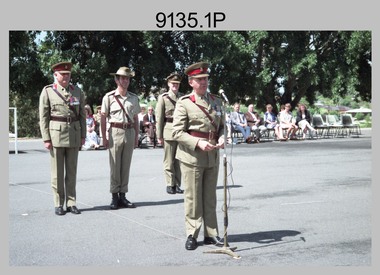
... Headquarters Squadron formed up in column of route before departure from the parade. L to R: Left marker – SPR Mark Bird, remainder unidentified. 2nd from right – CAPT Noel ‘Nesty’ Coulthard, at far right – OC MAJ John South....Headquarters Squadron formed up in column of route before departure from the parade. L to R: Left marker – SPR Mark Bird, remainder unidentified. 2nd from right – CAPT Noel ‘Nesty’ Coulthard, at far right – OC MAJ John South. ...This is a set of 15 photographs taken on a CO’s Parade held in December 1990 at the Army Survey Regiment, Fortuna, Bendigo. The Reviewing officer was the Commander of the 3rd Military District BRIG P. Davies AM ADC and the Parade Host was D-SVY COL Don Swiney MBE. The formalities performed at the parade were the presentation of a Warrant, presentation of the Defence Force Service Medal to two recipients, handover of the Regimental Sergeant-Major (RSM) appointment and promotions of four WO1’s to the rank of Captain. The four personnel commissioned as officers were CAPT Colin Cuskelly, CAPT Bill Griggs, CAPT Peter Warwick, and CAPT Neville Stone. See item 9134.39P for the set photos taken covering the Warrant presentation, Defence Force Service Medal presentations and the RSM handover.This is a set of 15 photographs taken on the occasion of a CO’s Parade at the Army Survey Regiment, Fortuna, Bendigo held in December 1990. The photographs are on 35mm negative film and were scanned at 2400 dpi. They are part of the Army Survey Regiment’s Collection. .1) - Photo, colour, 1990. The announcement of four Prescribed Officer Commissions (PSO). L to R: CO LTCOL Rene van den Tol, Parade Host D-SVY COL Don Swiney MBE, unidentified Aide-de-camp, Commander of the 3rd Military District BRIG P. Davies AM ADC. .2) - Photo, colour, 1990. PSO Promotion. L to R: COMD 3MD BRIG P. Davies AM ADC, WO1 Peter Warwick. Headquarters Squadron in background. .3) - Photo, colour, 1990. PSO Promotion. L to R: D-SVY COL Don Swiney MBE, CAPT Peter Warwick, COMD 3MD BRIG P. Davies AM ADC. .4) - Photo, colour, 1990. PSO Promotion. L to R: COMD 3MD BRIG P. Davies AM ADC, WO1 Bill Griggs. RSM Graham Ragless and Headquarters Squadron in background. .5) - Photo, colour, 1990. PSO Promotion. L to R: D-SVY COL Don Swiney MBE, CAPT Bill Griggs, COMD 3MD BRIG P. Davies AM ADC. .6) - Photo, colour, 1990. PSO Promotion. L to R: COMD 3MD BRIG P. Davies AM ADC, WO1 Neville Stone. Headquarters Squadron in background. .7) & .8) - Photo, colour, 1990. PSO Promotion. L to R: D-SVY COL Don Swiney MBE, CAPT Neville Stone, COMD 3MD BRIG P. Davies AM ADC. .9) - Photo, colour, 1990. PSO Promotion. L to R: COMD 3MD BRIG P. Davies AM ADC, WO1 Colin Cuskelly. RSM Graham Ragless and Headquarters Squadron in background. .10) - Photo, colour, 1990. PSO Promotion. L to R: D-SVY COL Don Swiney MBE, COMD 3MD BRIG P. Davies AM ADC, WO1 Colin Cuskelly. .11) - Photo, colour, 1990. PSO Promotion. L to R: COMD 3MD BRIG P. Davies AM ADC, CAPT Colin Cuskelly. .12) - Photo, colour, 1990. PSO Promotions. L to R: CAPT Colin Cuskelly, CAPT Bill Griggs, CAPT Peter Warwick, CAPT Neville Stone. .13) - Photo, colour, 1990. Departure of the Reviewing Officer. L to R: SPR Gordon Santo, Commander of the 3rd Military District BRIG P. Davies AM ADC, Parade Host D-SVY COL Don Swiney MBE. .14) - Photo, colour, 1990. Departure of the Parade Host. L to R: SPR Gordon Santo, D-SVY COL Don Swiney MBE, unidentified. .15) - Photo, colour, 1990. Headquarters Squadron formed up in column of route before departure from the parade. L to R: Left marker – SPR Mark Bird, remainder unidentified. 2nd from right – CAPT Noel ‘Nesty’ Coulthard, at far right – OC MAJ John South.No personnel are identified. ‘SSM Handover Parade & Commissioning of Officers. Dec 1990’ annotated on negative sleeve. ‘Note – it should have been annotated ‘RSM Handover, not SSM Handover.royal australian survey corps, rasvy, army survey regiment, army svy regt, fortuna -
 Australian Nursing & Midwifery Federation
Florence Nightingale note to Annie Miller, 1867
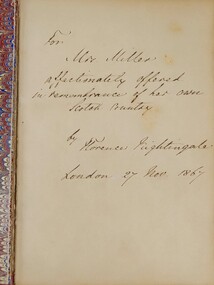
... She also had been reported to Miss Nightingale by both Lucy Osburn and Haldane Turriff for openly flirting with the Resident Physician, receiving flowers, embroidering slippers, playing with his watch chain and generally becoming the subject of gossip ... Before his departure from the hospital the doctor in question diagnosed Annie Miller as having an [abdominal] aneurism and she went into decline, mainly from the deprivation of his company, it was felt. ...She also had been reported to Miss Nightingale by both Lucy Osburn and Haldane Turriff for openly flirting with the Resident Physician, receiving flowers, embroidering slippers, playing with his watch chain and generally becoming the subject of gossip ... Before his departure from the hospital the doctor in question diagnosed Annie Miller as having an [abdominal] aneurism and she went into decline, mainly from the deprivation of his company, it was felt. ...'Miss Annie Miller, who had nursed Prince Alfred with Miss Turriff [Haldane, first matron of Alfred Hospital], also joined staff at the Alfred some time before 1876. During her time at the Sydney Infirmary, Annie Miller created something of a stir when, after her experience nursing Prince Alfred, she became selective about which areas of the hospital she would work, only willing to serve in Male Surgical and Accident. She also had been reported to Miss Nightingale by both Lucy Osburn and Haldane Turriff for openly flirting with the Resident Physician, receiving flowers, embroidering slippers, playing with his watch chain and generally becoming the subject of gossip ... Before his departure from the hospital the doctor in question diagnosed Annie Miller as having an [abdominal] aneurism and she went into decline, mainly from the deprivation of his company, it was felt. With the threat of her possibly being returned to England because of ill health, Miller went to Brisbane and Goodna (Queensland), subsequently to Melbourne, where she faded into obscurity. Her aneurism had apparently subsided.' From '5.30, nurse! : the story of the Alfred nurses' by Helen Paterson. History Books: Melbourne, 1996 p. 8 'Annie Miller was Scottish, single and claimed to be 34 years old (in Sydney, she was assumed to be ten years older); Wardroper [Sarah Elizabeth, first superintendent at the Nightingale School of Nursing at St Thomas's Hospital, London] had found her to be a good nurse, but 'proud and peculiarly sensitive'' (Burrows, 2018 p. 33). At the end of 1870 Annie resigned after the three-year term at Sydney Infirmary ended. She was appointed to the position of matron at Brisbane Hospital in February 1871. She resigned within a few months of her appointment after a dispute with the staff surgeon who refused to recognise her and her status. From 'Nurses of Australia : the illustrated history' by Deborah Burrows. NLA Publishing : Canberra, 2018 p. 41 'Annie Miller went from the [Sydney] Infirmary to Brisbane Hospital, she then joined Haldane Turriff at The Alfred Hospital, while Osburn thought that Miller had gone to nurse private patients. The two versions are not incompatible as hospitals hired out nurses to care for wealthier patients in their homes. Schultz records that Miller worked at the Hospital for the Insane at Goodna [Queensland] and died in the Melbourne Benevolent Asylum on 12 March 1907. The Victorian branch of the Australian Nursing Federation owns the book presented to Miller by Florence Nightingale in 1867.' From 'Lucy Osburn, a lady displaced : Florence Nightingale's envoy to Australia' by Judith Godden. Sydney University Press : Sydney, 2006 p. 315 'This betrayal of all that had been said to Tate [Henry, Alfred Hospital Secretary-Manager 1874-1876] was in keeping with Annie Miller's reputation (earned in Sydney) for being unreliable and a trouble-maker. Miss Miller was also an intimate of Miss Turriff's. Annie Miller is said to have had a brief term as matron in Brisbane after her resignation from the Sydney Infirmary in 1870 but the Brisbane Hospital authorities are unable to provide this one way of the other. Lucy Osburn thought that Miss Miller was in private nursing in Melbourne in 1873 and the Vagabond [alias of John Stanley James, Argus journalist] stated positively that she was working for Miss Turriff at the Alfred when he was there in 1876'. From 'The hospital south of the Yarra' by Ann Mitchell. Alfred Hospital : Melbourne, 1977 p. 242 'Annie Miller was appointed matron of the lunatic asylum at Woogaroo (Goodna) in Queensland in 1877, and remained there for ten years. When she left the medical superintendent, in his report for 1888, praised her for the work she had done in the female division of the asylum'. From 'A tapestry of service' by Bartz Schultz. Churchill Livingstone : South Melbourne, 1991 p.222Annie Miller was one of five Nightingale-trained nurses who come to Sydney in 1868 with Lucy Osburn, the newly appointed Superintendent and Chief Female Officer at the Sydney Infirmary. Florence Nightingale gave them all books before they sailed in December of that year. Annie worked in Sydney, Brisbane and Goodna, and in Melbourne. She died in 1907 and is buried at Boroondara cemetery. Annie was a member of the Royal Victorian Trained Nurses' Association. This note was written in Annie's book and this item is in the archive collection of the ANMF Vic Branch Library. The note was written on the front page of a book. We believe the item was donated to the Branch.Hand written note by Florence Nightingale to Annie Miller, upon her departure to Sydney with Lucy Osburn in 1868, written in ink on a blank page at the front of Walter Scott's 'Poetical works' (1866) [The poetical works of Sir Walter Scott]"For Mrs. Miller affectionately offered in remembrance of her own Scotch country by Florence Nightingale London 27 Nov. 1867"nursing history, nursing -
 Mission to Seafarers Victoria
Booklet - Manual, Sailing directions for Port Phillip, in the colony of Victoria including the ports of Melbourne and Geelong, 1854
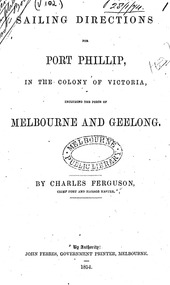
... However, certain misgivings in the mind of a medical gentleman, then in England, under whose care Captain Ferguson had at one time placed himself in Williamtown, led them to consider it judicious before departure to take the advice of some surgeon of eminence in London. ...However, certain misgivings in the mind of a medical gentleman, then in England, under whose care Captain Ferguson had at one time placed himself in Williamtown, led them to consider it judicious before departure to take the advice of some surgeon of eminence in London. ...Captain Charles Ferguson was born in Scotland in 1813. He was the Master of the "Rajah" from 1838 to 1850 on voyages from England to Australia and vice versa. He became the First Chief Harbour Master for the port of Melbourne in 1852 after being the first Harbour Master and Water Police Officer in Geelong for 12 months. On the 5th of April 1841, the Rajah sailed with James Donovan M.D. as Surgeon Superintendent, and the Rajah sailed from Woolwich with 180 female convicts. The Rajah arrived on the 19th of July in Hobart, with 179 females (one died during the voyage) and 10 children. Miss Kezia Elizabeth Hayter was the matron on board. On page 28 of the "Sailing directions for Port Phillip, in the colony of Victoria including the ports of Melbourne and Geelong", a mention is made of the Mariner's Hospital and Floating Church soon to be established. There were discussions to built the hospital in Williamstown but instead the Government decided to build it in Melbourne. The Harbour Master and a commiittee decided to use the water police hulk, Emily, left unsold in 1856, to create a floating church: the Bethel was open in July 1857 with Reverend Kerr Johnston as Chaplain. Latrobe wrote a letter to Captain Cole in 1869, a few months after learning his death : "To Captain George Ward Cole † [from a draft in another’s hand] Clapham House, Lewes, Sussex, January 28th, 1869. My dear Captain Cole, Last mail will have taken out the sad intelligence of the death of our excellent old friend, Captain Ferguson. This will have been a terrible blow to his children and to his friends in the colony, who may have held reason to expect his early return to his home, with a not unreasonable prospect of ultimate restoration to health and activity. In the course of last October I went up to town with one of my children, mainly with the purpose of finding my way to Pinner, where he and Mrs. Ferguson were staying with an intimate friend. I found him in excellent health and spirits, and enjoying the prospect of a speeding resumption of the service to which he had devoted his best days, and upon the furtherance of which his entire energy was still directed. A week or two later Captain and Mrs. Ferguson went to Dover for change of air, and being still under the impression received from the advisers by whom they had been guided during their residence at a hydropathic establishment at Matlock, felt encouraged to plan almost immediate return to the colony by the Jerusalem early in December. However, certain misgivings in the mind of a medical gentleman, then in England, under whose care Captain Ferguson had at one time placed himself in Williamtown, led them to consider it judicious before departure to take the advice of some surgeon of eminence in London. Accordingly they came up to town at the close of November. The first London practitioners they consulted shook their heads, and advised consultation with Sir Wm. Ferguson. The result was that amputation, without loss of time, was pronounced necessary. The rest is soon told. He received the painful intelligence with calmness and full resignation to God's will, and underwent the operation at King's College Hospital with exemplary firmness and Courage on the 28th of November. Perfect success seemingly attended it, and there seemed, humanly speaking, to be every prospect of a prompt cure and early convalescence; everything seemed in his favour. A few days later, however, all was clouded by symptoms of hospital fever (pyoe æm ia). This resisted all control, and finally carried him off on the 27th of December, just one month after the operation. He had lived a Christian life, and his death was the peaceful and resigned death of a Christian. It was a melancholy satisfaction to me to be able to join a few friends in following his remains to their resting place in one of the outlying London cemeteries on the last day of the year. You know Mrs Ferguson well, and will be prepared to hear me say that her whole conduct and demeanour throughout this period of suspense and bitter trial has been worthy of her high character and steadfast principle. Come what will, and happen what may, I have the fullest conviction that neither the widow nor the children will be forsaken, however doubtful and clouded the future may appear, in consequence of the irreparable loss which, they have sustained. And now, dear Captain Cole, it is possible that you may already have heard all this from other sources, but I have dictated it to you under strong impulse, for I feel assured that there is no member of the community in which you live who will more sincerely deplore the loss of Captain Ferguson on private grounds; at the same time that there is no one who, from long acquaintance with his official character and services, will be in a better position to estimate their real value or the loss which the colony has sustained. The circumstances in which Captain Ferguson's family are left not only demands the utmost display of sympathy and interest on the part of friends, but may call for decided and prompt action; therefore I cannot rest satisfied without discharging what I consider my duty, and seeking to strengthen your hands as far as I may in bringing the character of his long services before the existing colonial authorities. Of his private career previous to his entering the service of the Colonial Government in 1851 nothing need be said. Captain Ferguson was appointed as the Harbour Master at Geelong in April, 1851 – a few months before the separation of the colony from New South Wales. He there did excellent service in a variety of ways calculated to advance the interests of the port, and to introduce www.latrobesociety.org.au 27 order, where, from circumstances, but little order had hitherto prevailed. His was the first appointment of this class in that locality. The separation of the colony from New South Wales took place in the month of July following. Shortly after, the late Captain Bunbury resigned the Harbour Mastership of Port Phillip. Captain Ferguson was at once (February, 1852) appointed to succeed him, and from that time performed all duties of Chief Harbour Master of the colony. The previous year (May 1851) the first gold discoveries in New South Wales had taken place, and in the month of August those of our colony followed. At the time of Captain Ferguson’s taking charge of the Port of Melbourne their influence had begun to be fully felt, and in no department more seriously than in that of the Harbour Master. This is no place for statistical details, but they must bear me out in reminding you of a few facts connected with our late friend’s career. At the time of separation that department comprised only 30 individuals of all ranks, and when he took charge the number was much reduced. There were at that time, according to the returns, no fewer than 54 vessels, registering 26,785 tons, in Hobson’s Bay alone. The crews on arrival numbered 1,235 men. Of this number only 463 remained on board, 500 having deserted, and the rest having been discharged by arrangement or pure necessity. For the first six months after Captain Ferguson’s assumption of office as Harbour Master the duties of Police Magistrate and Chief of the Water Police were superadded, and how much labour they involved may be surmised from the fact that from 1st of April to the 31st July, 1852, four months only, no less than 236 marine cases were brought before the bench at Williamstown - sometimes as many as 30 in a day. A year later (March 1853) the returns show that the number of vessels in the harbour in Hobson’s Bay alone were 91, tonnage 43,754; and passing on to the still later returns of May, 1853, two years after Captain Ferguson’s assumption of office, we find from the records that the number of ships in port had increased to 129; tonnage, 63,292; crew on board on arrival, 2872, and at the date of report, 1628; the amount of desertions at that time having, however, proportionally diminished, in consequence of the abatement of the gold fever, caused by the non-success attendant upon the labours of thousands at the goldfields. The above numbers take no account of the large number of vessels and amount of tonnage lying at the wharves at Melbourne or elsewhere. From these figures alone it may be judged what must have been a struggle in which the Chief Harbour Master was engaged from the very outset to secure order, and answer the innumerable calls on every branch of his department, at the same time that there was for many months an almost complete impossibility of securing subordinate agency, such as boatmen, pilots, and police, at any price. But I may bear witness to the untiring diligence, energy, and self-devotion with which Captain Ferguson grappled with the difficulties of his position, and the seemingly insurmountable obstacles which stood in his way. Ashore and afloat he was always ready, showing the same directness of purpose, intelligence, and forgetfulness of self. He shunned no responsibility, and turned his hand from no work, whether within or beyond the ordinary scope of his duty, which the hard necessity of the times forced the Government to bring under his notice. Already in 1852, when the overflowing of our gaol and stockade rendered the adoption of other methods of restraint absolutely necessary, and addition to the existing buildings could not be thought of, it was Captain Ferguson who first suggested the employment of hulks; and it was with his personal assistance and supervision, and under his unflagging energy, that the three first of these – the Success, the President, and the Sacramento – were purchased, fitted up, and made available for the purpose in view, and the rules and regulations for the employment and safety of the men afloat and ashore prescribed and carried out. He carried the same energy into every branch of his department, and his influence was soon apparent. His subordinates of every class became actuated by his spirit. As time moved on, the range of his duties, both ordinary and extraordinary, increased. In the formation of the quarantine station at the heads, in the management if not the erection of lighthouses, sailing directions, port and wharf regulations, buoys, signal stations, www.latrobesociety.org.au 28 steam dredging &c., he was the main and most active agent. The whole pilot establishment and regulations, men, and vessels, were under his charge; and when I left the colony in May, 1854, the entire range of ports outside Port Phillip Heads from Point Lonsdale to Portland, as well as that of Geelong had felt the influence of his intelligent supervision and care. The entire department of Chief Harbour Master, which I have numbered at the period of separation about thirty individuals, then numbered 230. The character of Captain Ferguson’s unbroken service during the fourteen years which have elapsed since I left the colony must be well known to the Government and the people he has served so long and so faithfully. I confine myself to recalling to mind those earlier, and what must have been the hardest and most difficult, period – none can know how difficult but those who were in that fierce struggle for the maintenance of order under so many disadvantages; and on this subject I have spoken advisedly and with reason, for I may truly say he worked under my own eye. I had sincere regard for the man, and just pride in the qualities of his heart, head, and hand. Whatever mistakes may have been made by the Government of the colony in those hard and difficult times (and I am quite ready to admit that there were many, especially if the past is to be judged by the light of the present), I never have hesitated in believing that, in appointing Captain Ferguson to the office he has so long filled, it was the right man in the right place. I shall be heartily rejoiced to find that the Government and inhabitants of the colony admit that this has been the case, and to learn that they have not forgotten the strong claims of one who has served them so long and so faithfully, and who, removed by God’s providence, so to say, in the maturity of his powers, has left a widow and young family behind him. I have done, I leave you to make use of this communication, or any portion of it, which you may think judicious and called for. There may be among Ferguson’s friends those who may not be sorry to be reminded of facts. By-the-bye, I may mention as a proof how completely Captain Ferguson’s mind was engrossed by devotion to his public duty, that while in Dover, only ten days before the operation, he took an opportunity to drag himself up into the lantern of the S. Foreland Lighthouse, and made a most careful scrutiny of the whole apparatus and arrangement, with a view of the adoption of any hint for the perfection of those under his charge in the colony. And now, goodbye. I trust this will find you in good health, and in comparative vigour. Believe me ever, dear Captain Cole, Yours very truly, C. J. La Trobe"The attempt for a floating church was made as early as 1853 following similar examples in London like the Seamen's Hospital. Captain Ferguson was instrumental in the foundation of the Bethel Church.Digital copies of the 37 pages ; 22 cm.1854, hobsons bay, geelong, melbourne, williamstown, sandridge, mariner's hospital, floating church, seamen's hospital, captain charles ferguson (1813-1868), kezia elizabeth hayter (1818-1885), rajah quilt, prison hulks, water police, harbour master, harbor master, gaols -
 Flagstaff Hill Maritime Museum and Village
Plant specimen - Wood Sample, Herbst, 1759-1765
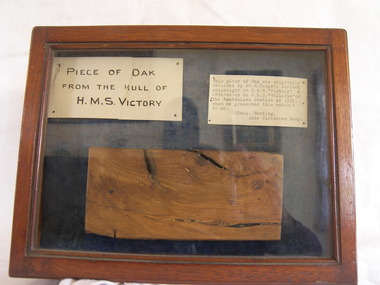
... departure from the prevailing naval tactical orthodoxy of the day. Conventional practice at the time was for opposing fleets to engage each other in single parallel lines, to facilitate signalling and disengagement, and to maximise fields of fire and target areas. Nelson instead arranged his ships into two columns to sail perpendicularly into the enemy fleet's line. During the battle, Nelson was shot by a French musketeer, and he died shortly before...departure from the prevailing naval tactical orthodoxy of the day. Conventional practice at the time was for opposing fleets to engage each other in single parallel lines, to facilitate signalling and disengagement, and to maximise fields of fire and target areas. Nelson instead arranged his ships into two columns to sail perpendicularly into the enemy fleet's line. During the battle, Nelson was shot by a French musketeer, and he died shortly before ...The piece of oak wood sample inside the case was obtained from Mr H. Cooper during the time he served as a shipwright for the British Royal Navy on Nelson’s flagship, HMS Victory, in 1891. By that time, the H.M.S. Victory was around 100 years old, having been built in 1765 and was currently in dry dock undergoing restoration. Cooper’s skills as a shipwright would have been well employed during this period. HMS Victory was, and still is, undergoing continuous restoration to preserve her for display as a museum ship, due to the vessel's significant naval history. It was during that early restoration period that Cooper obtained the piece of Oak from HMS Victory, believed to be from the ship's hull. Cooper was in Australia in September 1891 serving on the HMS Wallaroo, a British Auxiliary Squadron commissioned as part of the British Royal Navy contingent, to serve and operate in Australian waters. The photograph included with the donation of the wood sample is a portrait of Mr H Cooper taken in 1895 in Sydney. The inscription on the photograph describes him as a skilled shipwright from H.M.S. Wallaroo, depicting Cooper as a young man in Royal Navy uniform, with the emblem of a petty officer third class. While Cooper was stationed on the H.M.S. Wallaroo in Sydney, he presented the display case, containing the wood sample from H.M.S. Victory, as well as the exhibit labels, to Charles Harding ("Chas"), late of the Royal Australian Navy. Harding had been based at the H M Naval Torpedo Depot at Williamstown, Victoria. Although not mentioned, it is believed the two men met whilst serving together in Australia in their respective assignments. It could have been a retirement gift from Cooper to Harding, with the photograph of Cooper likely included with the case, and gifted to Harding in 1895, as the date on the photograph indicates. One of the exhibit's labels indicates that Harding had the item on display whilst serving at the Naval Torpedo Depot in Williamstown. The label indicates: "This piece of Oak is part of the hull of H.M.S. 'Victory', Lord Nelson’s renowned flagship, which took such a prominent part in the Battle of Trafalgar. 21st October 1805. Exhibited by Charles Harding, H.M.V. Naval Torpedo Depot, Williamstown.” After Charles Harding died in 1931, the case containing the sample of oak from H.M.S. Victory was donated by his son, Reg Harding, to Mr Murphy in 1962. The display case has since become a treasured item at Flagstaff Hill. A newspaper article dated 1905 included with the donation mentions that the city of Hamilton in Victoria was shortly expecting a mounted piece of the H.M.S. Victory to be included in the city’s commemoration of the centenary of the "Battle of Trafalgar". Battle of Trafalgar: On October 21, 1805, twenty-seven British ships of the line led by Admiral Lord Nelson aboard HMS Victory defeated thirty-three French and Spanish ships of the line under French Admiral Villeneuve. The battle took place in the Atlantic Ocean off the southwest coast of Spain, just west of Cape Trafalgar, near the town of Los Caños de Meca. The victory confirmed the naval supremacy Britain had established during the course of the eighteenth century, and it was achieved in part through Nelson's departure from the prevailing naval tactical orthodoxy of the day. Conventional practice at the time was for opposing fleets to engage each other in single parallel lines, to facilitate signalling and disengagement, and to maximise fields of fire and target areas. Nelson instead arranged his ships into two columns to sail perpendicularly into the enemy fleet's line. During the battle, Nelson was shot by a French musketeer, and he died shortly before the battle ended. Villeneuve was captured, along with his ship Bucentaure. He later attended Nelson's funeral while a captive on parole in Britain. Admiral Federico Gravina, the senior Spanish flag officer, escaped with the remnant of the fleet. He died five months later from wounds sustained during the battle. It was before this battle that Nelson had issued his now-famous final orders to his ships in 12 separate flag-hoists: “England expects that every man will do his duty”. This wood sample is historically significant for its association with Admiral Lord Nelson and the Battle of Trafalgar. Through Nelson’s leadership and unorthodox battle tactics, he secured not only a victory against the French and Spanish but also reaffirmed Britain's naval supremacy, opening the way for Britain to continue the policy of colonisation of many countries, including Australia.Wood sample adhered to the base of a hinged wood and glass display case. Wood is a sample of oak taken from the hull of Vice-Admiral Lord Nelson's flagship, the HMS Victory, built in 1765. The case also contain two exhibit labels pinned above the wood sample. Other items donated with the display case, and relating to the wood sample: an 1895 photograph, a 1905 newspaper clipping, a 1962 donor's letter (two pages), and a handwritten exhibit label with a border of red lines. Photograph Front: printed- "Herbst" "28 Oxford Street, Hyde Park, Sydney", handwritten - "Mr Cooper", "see back". Back: handwritten - "Mr H Cooper, skilled shipwright, H.M.S. Wallaroo 1895" Exhibit labels still in the case: Left: handwritten- “PIECE OF OAK FROM THE HULL OF H.M.S. VICTORY”, Right: typewritten- “This piece of Oak was originally obtained by Mr. H. Cooper, skilled shipwright on H.M.S. “Victory” & afterwards on H.M.S. “Wallaroo” on the Australian Station in 1895, when he presented this exhibit to me. Chas. Harding, Late Victorian Navy.”flagstaff hill, warrnambool, shipwrecked-coast, flagstaff-hill, flagstaff-hill-maritime-museum, maritime-museum, shipwreck-coast, flagstaff-hill-maritime-village, oak, hms victory, vice-admiral lord nelson, horatio nelson, lord nelson, oak piece, piece of oaknelson, battle of trafalgar, maritime technology, ship relics, 18th century warship, british royal navy, h cooper shipwright, hms wallaroo, herbst hyde park sydney, charles harding, hmv naval orpedo depot williamstown, sir home popham’s telegraphic code, admiralty official day signal book -
 Flagstaff Hill Maritime Museum and Village
Postcard - Vessel, Sailing Ship, after October 1805
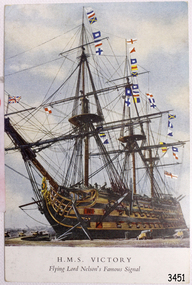
... departure from the prevailing naval tactical orthodoxy of the day. Conventional practice at the time was for opposing fleets to engage each other in single parallel lines, in order to facilitate signalling and disengagement and to maximise fields of fire and target areas. Nelson instead arranged his ships into two columns to sail perpendicularly into the enemy fleet's line. During the battle, Nelson was shot by a French musketeer and he died shortly before...departure from the prevailing naval tactical orthodoxy of the day. Conventional practice at the time was for opposing fleets to engage each other in single parallel lines, in order to facilitate signalling and disengagement and to maximise fields of fire and target areas. Nelson instead arranged his ships into two columns to sail perpendicularly into the enemy fleet's line. During the battle, Nelson was shot by a French musketeer and he died shortly before ...The British Royal Navy’s warship HMS Victory was once Lord Nelson’s flagship. The HMS Victory was built in 1765 and after serving active duty is now, in 2019, still a ship of the Royal Navy, in dry dock undergoing continuous restoration to preserve her for display as a museum ship, due to the vessel’s significant naval history. Battle of Trafalgar: On October 21, 1805, twenty-seven British ships of the line, led by Admiral Lord Nelson aboard HMS Victory, defeated thirty-three French and Spanish ships of the line under French Admiral Villeneuve. The battle took place in the Atlantic Ocean off the southwest coast of Spain, just west of Cape Trafalgar, near the town of Los Caños de Meca. The victory confirmed the naval supremacy Britain had established during the course of the eighteenth century and it was achieved in part through Nelson's departure from the prevailing naval tactical orthodoxy of the day. Conventional practice at the time was for opposing fleets to engage each other in single parallel lines, in order to facilitate signalling and disengagement and to maximise fields of fire and target areas. Nelson instead arranged his ships into two columns to sail perpendicularly into the enemy fleet's line. During the battle, Nelson was shot by a French musketeer and he died shortly before the battle ended. Villeneuve was captured, along with his ship Bucentaure. He later attended Nelson's funeral while a captive on parole in Britain. Admiral Federico Gravina, the senior Spanish flag officer, escaped with the remnant of the fleet. He died five months later from wounds sustained during the battle. It was prior to this battle that Nelson had issued his now-famous final orders to his ships in 12 separate flag-hoists “England expects that every man will do his duty”. This wood sample is historically significant for its association with Admiral Lord Nelson the Battle of Trafalgar. Through Nelson’s leadership and unorthodox battle tactics, he secured not only a victory against the French and Spanish but reaffirmed Britain's naval supremacy opening the way for Britain to continuing the policy of colonisation of many countries including Australia.A coloured postcard of a sailing ship, warship or battleship, deck cannons on the ship and in the foreground, many signal flags flying from the masts. Printed on the front "H.M.S. Victory Flying Lord Nelson Famous Signal". The signal was given by Lord Nelson in 1805.Printed on the front "H.M.S. Victory / Flying Lord Nelson Famous Signal"flagstaff hill, warrnambool, shipwrecked-coast, flagstaff-hill, flagstaff-hill-maritime-museum, maritime-museum, shipwreck-coast, flagstaff-hill-maritime-village, post card, postcard, sailing ship, vice-admiral lord nelson, horatio nelson, lord nelson, oak piece, piece of oak, nelson, battle of trafalgar, maritime technology, ship relics, 18th century warship, british royal navy, sir home popham’s telegraphic code, admiralty official day signal book, october 21, 1805, admiral lord nelson, french and spanish navies, nelson's famous signal, england expects that every man will do his duty, hms victory, nelson collection at lloyd's, lloyd’s of london, lloyd’s patriotic fund, napoleonic battles, british naval history, 18th century warship, 18th century battleship -
 Bendigo Historical Society Inc.
Book - SHIPPING ARRIVALS AND DEPARTURES VICTORIAN PORTS VOLUME 2 1846-1855, 1987
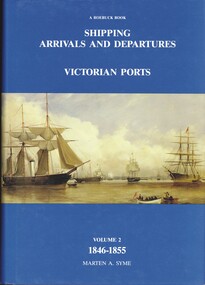
... Marten A Syme Compiled from newspaper reports, customs and other Government records and records of other Colonial ports, the list documents the arrival of vessels containing assisted and unassisted immigrants before and during the gold rush, the intra-colonial trading voyages, the growth in overseas trade from Melbourne and Geelong in wool, tallow skins and gold dust and the surge of activity flowing from the discovery of gold in Victoria in 1852. Book SHIPPING ARRIVALS AND DEPARTURES ...Compiled from newspaper reports, customs and other Government records and records of other Colonial ports, the list documents the arrival of vessels containing assisted and unassisted immigrants before and during the gold rush, the intra-colonial trading voyages, the growth in overseas trade from Melbourne and Geelong in wool, tallow skins and gold dust and the surge of activity flowing from the discovery of gold in Victoria in 1852.Marten A Symevictoria, history, shipping, shipping, transport, port phillip history, family history. -
 National Vietnam Veterans Museum (NVVM)
Photograph, Gibbons, Denis, Personal Trunk Weighed
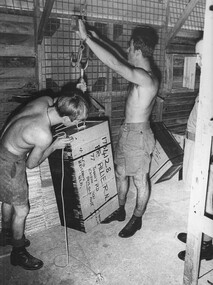
... before being flown out in late November 1970 after sustaining injuries. The images held within the National Vietnam Veterans Museum make up the Gibbons Collection. Photograph 1st Australian Field Hospital Medic Pte Ron Allie Gibbons Collection Catalogue Vung Tau Diggers Denis Gibbons A black and white photograph at the 1st Australian Field Hospital Medic, Private Ron Allie's personal trunk is weighed in preparation for return to Australia by stores personnel. The Diggers personal trunks were inspected and sealed under strict supervision prior to departure ...Denis Gibbons (1937 – 2011) Trained with the Australian Army, before travelling to Vietnam in January 1966, Denis stayed with the 1st Australian Task Force in Nui Dat working as a photographer. For almost five years Gibbons toured with nine Australian infantry battalions, posting compelling war images from within many combat zones before being flown out in late November 1970 after sustaining injuries. The images held within the National Vietnam Veterans Museum make up the Gibbons Collection. A black and white photograph at the 1st Australian Field Hospital Medic, Private Ron Allie's personal trunk is weighed in preparation for return to Australia by stores personnel. The Diggers personal trunks were inspected and sealed under strict supervision prior to departure.photograph, 1st australian field hospital, medic, pte ron allie, gibbons collection catalogue, vung tau, diggers, denis gibbons -
 Eltham District Historical Society Inc
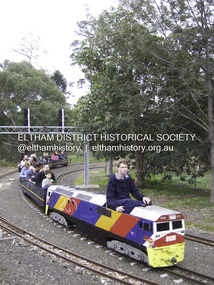
Photograph - Digital Photograph, Marguerite Marshall, Diamond Valley Railway, Eltham Lower Park, 7 September 2008
... On we go, past the original platform, along another route past busy Main Road through Pine Creek Station, over a bridge and through another tunnel with more screams of delight.Then a signal stops us before the ‘all clear’ to return to our original point of departure. The railway services its passengers – the largest number of any miniature railway in Australia – with a fleet including: six diesel locomotives, three steam locomotives, eight sets of passenger cars and one battery electric Dog Box set. ...On we go, past the original platform, along another route past busy Main Road through Pine Creek Station, over a bridge and through another tunnel with more screams of delight.Then a signal stops us before the ‘all clear’ to return to our original point of departure. The railway services its passengers – the largest number of any miniature railway in Australia – with a fleet including: six diesel locomotives, three steam locomotives, eight sets of passenger cars and one battery electric Dog Box set. ...Kids of all ages enjoy the Miniature Railway. Published: Nillumbik Now and Then / Marguerite Marshall 2008; photographs Alan King with Marguerite Marshall.; p163 On Sundays in Eltham thousands of children, mums, dads and grandparents can be seen travelling around Lower Eltham Park in tiny trains. They are among the two and half million passengers who have travelled on the Diamond Valley Railway since it officially began in 1961. The miniature railway originally operated from the 1940s at Chelsworth Park, Ivanhoe, until flooding caused it to be moved to the Eltham Lower Park in 1959. The railway is modelled on the 1920s era – the heyday of passenger rail travel – and the trains are built on a scale of two inches to the foot (1/6). Although not exact replicas, trains include models of the Spirit of Progress, Puffing Billy, The Overland, Dog Boxes, Vic Rail S class, G class and a NSW 81 Class. The three and a half kilometres of track is set amongst native plants and picnic areas. A friendly hoot or the clang of a bell occasionally punctuates the tranquillity as a train emerges from a treed bend with passengers excitedly waving to onlookers. For $3 the train takes you on a 13-minute two-kilometre ride. Passengers sit in single file in the narrow train, which clatters along tracks built to the scale of the Australian narrow gauge of three feet six inches (1.1m). These are used in Queensland, South Australia, Tasmania and Western Australia. Safety standards are stringently kept. Even before you buy a ticket notices tell you that you must wear closed shoes. You can even borrow these, and you are given a pair of socks for the ride! Blue-overalled volunteers check tickets, see you aboard, and drive the train. They are mainly retired men who can at last devote their time to what little boys dream of – playing with trains. Passengers are instructed in safe behaviour, then the station master waves a white flag and off we go. The guard sits at the back with his whistle and green flag at the ready. The winding track, fringed by native trees and bushes planted by volunteers, stands on crown land managed by Nillumbik Council. The train clatters along the track and crosses a bridge over a drain elevated by name to The Blow Fly Creek. We pass by Meadmore Junction at a speed of three kilometres an hour. Then on through a tunnel, accompanied by squeals of delight, and after a few moments of blackness, light glimmers at the end. On we go, past the original platform, along another route past busy Main Road through Pine Creek Station, over a bridge and through another tunnel with more screams of delight.Then a signal stops us before the ‘all clear’ to return to our original point of departure. The railway services its passengers – the largest number of any miniature railway in Australia – with a fleet including: six diesel locomotives, three steam locomotives, eight sets of passenger cars and one battery electric Dog Box set. Members also privately own 20 locomotives and powered carriage sets as well as four carriage sets.1 All the trains are stored on-site in workshops, sheds and a tunnel. The railway is entirely run by volunteers, so that all ticket money is used for maintenance and extensions, and some goes to local charities. Since 1991, the entire railway has been rebuilt, including an upgraded signalling system. About half of the 120 volunteer members are active with about 35 working each Sunday, and a dozen or so working every Wednesday. Members are trained to positions of station assistant, booking officer, train guard, train driver or signalman. Members construct new carriages and locomotives as well as maintaining track, signalling and rolling stock.This collection of almost 130 photos about places and people within the Shire of Nillumbik, an urban and rural municipality in Melbourne's north, contributes to an understanding of the history of the Shire. Published in 2008 immediately prior to the Black Saturday bushfires of February 7, 2009, it documents sites that were impacted, and in some cases destroyed by the fires. It includes photographs taken especially for the publication, creating a unique time capsule representing the Shire in the early 21st century. It remains the most recent comprehenesive publication devoted to the Shire's history connecting local residents to the past. nillumbik now and then (marshall-king) collection, diamond valley railway, eltham lower park -
 Ballarat Tramway Museum
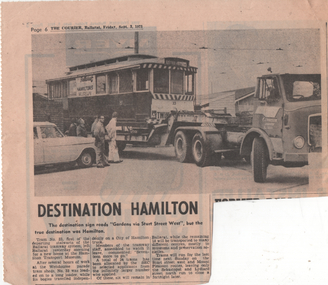
Newspaper, The Courier Ballarat, "Destination Hamilton", 3/9/1971
... Newspaper clipping and photograph about the departure of the first tram from Ballarat before closure on 2/9/1971. ...Newspaper clipping and photograph about the departure of the first tram from Ballarat before closure on 2/9/1971. ...Newspaper clipping and photograph about the departure of the first tram from Ballarat before closure on 2/9/1971. Details the loading, the separation of the 21E truck and transport to Hamilton. Notes that the remaining 18 will be transported to other locations while 6 will remain in Ballarat. See item 3768 for a print of the photograph. The tram returned to the BTPS in 1977. See reference.Yields information about the tramcars following the cessation of tram services in Ballarat - trams being sent to new homes and how this was done.Newspaper clipping from The Courier, 3/9/1971tramways, secv, tramcars, tram 33, transport, closure, hamilton, depot -
 Ballarat Tramway Museum
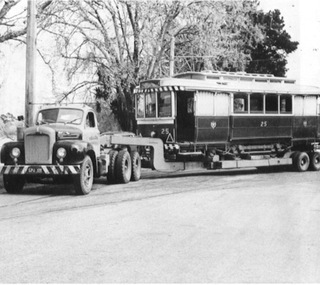
Photograph - Ballarat 25 leaving for Bendigo, Wal Jack, 6/10/1960
... departure of Ballarat No. 25 to Bendigo in 1960. Trams tramways Yellow Express Transporting Trams Moving trams Bendigo tram 25 1 - On the rear of the photograph in ink "SEC, Ballarat Loading No. 25 on Yellow Express Loader outside Wendouree Depot before leaving for Bendigo. 6-10-1960." and in top right-hand corner Wal Jack stamp with "Neg to Doug" written in. .2 - has Douglas A. ...Set of two photographs of Ballarat tram 25 loaded on a Yellow Express Mack prime mover GPU 328 leaving for Bendigo on 6/10/1960. The process of fitting the dash canopy lighting had commenced, with the small white stripe painted under the windows. The trolley pole base has been removed as well. See item 1478A for a Newsrail April 1984 article featuring this photograph, incorrectly credited to Doug Colquhoun. 1 - digital image from the Wal Jack album. Wal's notes gives the time of the photograph as 10.40am. See image 3 for Wal's notes and that he had sent the negative to Doug Colquhoun. 2 - print supplied to Alan Bradley by Doug Colquhoun with Doug's photo record stamp on the rear. See image 4 for the rear of the photograph. See Reg Items 1478, 5241, 5242, 7759 and 7766 for a series of 5 photos of this event.Yields information about the loading and departure of Ballarat No. 25 to Bendigo in 1960.Set of two black and white photographs.1 - On the rear of the photograph in ink "SEC, Ballarat Loading No. 25 on Yellow Express Loader outside Wendouree Depot before leaving for Bendigo. 6-10-1960." and in top right-hand corner Wal Jack stamp with "Neg to Doug" written in. .2 - has Douglas A. Colquhoun stamp on rear - with details - see image 4.trams, tramways, yellow express, transporting trams, moving trams, bendigo, tram 25 -
 Melbourne Tram Museum
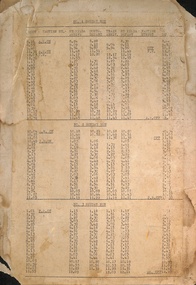
Document - Timetables - VR St Kilda - Depot - Sunday runs, Victorian Railways (VR), 1958
... Working Timetable for VR Trams that operated between St Kilda Railway Station and Elwood Depot before their closure for Sundays c1958. Lists the runs, times for the depot, the station, train arrival and departure times, and for the return trip to the depot. ...Working Timetable for VR Trams that operated between St Kilda Railway Station and Elwood Depot before their closure for Sundays c1958. Lists the runs, times for the depot, the station, train arrival and departure times, and for the return trip to the depot. ...Working Timetable for VR Trams that operated between St Kilda Railway Station and Elwood Depot before their closure for Sundays c1958. Lists the runs, times for the depot, the station, train arrival and departure times, and for the return trip to the depot. Lists three sets of runs. The sheets have been backed onto a Fares and Sections Poster that was provided in trams - probably dated 1955. See 8657, 8658 and 8659 for other similar items.Provides information about the timetables for VR Trams between St Kilda Station and Elwood Depot prior to closure.Typed sheets backed onto a card cut from a poster. Scans of the rear of the posters included in this record. vr, vr trams, st kilda - brighton, elwood depot, timetables -
 Melton City Libraries
Photograph, The Cairn- Jimmy Melrose's plane crash site, 1988
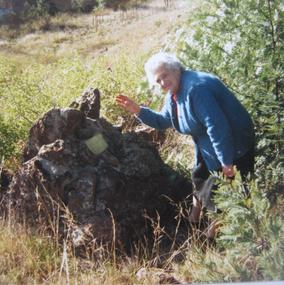
... before returning to Adelaide on the 13th May. During June Jimmy made some charter flights and early in July was engaged by Mr. A.J. Campbell a director of several mining companies from Melbourne to Darwin to commence at Essendon on the4th July. However on that day low cloud and steady rain caused the postponement. There was little improvement and Melrose was advised to delay the departure...before returning to Adelaide on the 13th May. During June Jimmy made some charter flights and early in July was engaged by Mr. A.J. Campbell a director of several mining companies from Melbourne to Darwin to commence at Essendon on the4th July. However on that day low cloud and steady rain caused the postponement. There was little improvement and Melrose was advised to delay the departure ...Edna Barrie at the cairn, photo received from Graeme Minns in 1988. The cairn marks the site of Jimmy Melrose's plane crash in Melton South. The accident which happened on July 5th 1936. In 1934 Melrose made headlines with a series of spectacular flights. In July of that year, he set around Australia record and in that year established a new solo Australia England record when he flew to England to compete in the MacRoberston race with a De Havilland Puss Moth VH- YQO. The only Australian and the only solo pilot to complete the course within the time limit. He was seventh in finishing order and third in the handicap section making news again during the race with a dramatic landing in Darwin with empty fuel tanks. Late in 1935 Melrose imported the Phoenix for his “Adelaide to Anywhere” Charter Service. The previous year the Heston Aircraft Company had taken over the interests of the well known Comper Aircraft Company, and the first production of the new firm was the Phoenix, a single-engined all wooden five seater machine of sesquiplane configuration. The forward half of the fuselage was a streamlined rectangular section and the rear portion was a monocogue shell; the whole was of plywood fabric covered. The wing was built up of spruce box spars and lattice ribs, ply covered from the leading edge to the front spar and the fabric covered over the remainder. The tail surfaces were of similar construction. The most notable feature of the design was the lower stub wing which ran right across the fuselage embodying two box spars, plywood covered it housed the main undercarriage wheels when retracted and provided a substantial anchorage for the Nu form wing struts. The Dowty undercarriage retracted inwards, operated manually by hydraulic packs, Dual control fitted, with side by side seating for the pilots and three passenger seats behind. Power was a 200 h.p. De Havilland Gipsy VI 6 cylinder inverted in-line air-cooled engine. Six Phoenix were built; five of them registered in Great Britain and one of those was later sold abroad the remaining four were impressed into the R.A.F. in 1940. Specifications were: 40 feet 4 inches length 30 ft 2 ins height, 9ft 7ins, wing area 270 sq ft, Tare weight 2,600lbs loaded weight 3,300lbs; cruising speed 360 m.p.h. landing 50mph ceiling 14,000 ft range 700 miles. Melrose’s machine the first production aircraft was built early in 1936 and test flown of the 24th March. Painted green it carries the words “South Australian Centenary 1936” in silver of the fuselage and the name “Billing on the engine cowling in honor of Melrose’s uncle Noel Pemberton Billing, pioneer designer and founder of the Supermarine Aviation Company. The delivery flight was planned as a goodwill mission to publicise the forthcoming South Australian Centenary celebrations. Melrose left Dympne on the 9th April 1936, and flying via Marseilles, Naples, Athens, Baghdad, Basra, Karachi, Jodphur, Calcutta, Akyab, Penang, Singapore, Lombok, Darwin, Newcastle Waters and Alice Springs reached Adelaide on the 25th of April. Continuing the goodwill flight to other States, he visited Melbourne, Sydney, Newcastle, Grafton, Brisbane, Coff’s Harbour, Sydney again, Launceston, Hobart and Mount Gambier before returning to Adelaide on the 13th May. During June Jimmy made some charter flights and early in July was engaged by Mr. A.J. Campbell a director of several mining companies from Melbourne to Darwin to commence at Essendon on the4th July. However on that day low cloud and steady rain caused the postponement. There was little improvement and Melrose was advised to delay the departure again. However he wished to reach Oodnadatta that night, and when he observed the break in the clouds decided to leave. He planned to climb above the cloud and fly to Adelaide at 3,000 feet. The aircraft was airborne about 8.10 a.m. and was last seen from Essendon climbing above the clouds. At 8.45 people at Melton (30 miles West of Melbourne) heard an approaching aircraft. The engine noise increased abnormally and eye witnesses saw the machine fall out of control from the cloud base about 800 feet and then disintegrate, fragments were scattered for 1½ miles and both occupants were killed. Hand written carbon copy by Edna Barrie.Typed by Wendy Barrie March 2014 Last Flight of Jimmy Melrose by John Burke Parade Magazine July 1972 Page 2 –4 This article gives the take off time of 7.50 am from Essendon Airport Eyewitness account at the time Maisie Arthur’s description. Newspaper article. Edna Barrie at the site of the 'Cairn'local identities, local significant events -
 Ballarat Heritage Services
Photograph - Photograph - Black and White, John Hogan Gervasoni and his parents Elizabeth Gervasoni and Gus Gervasoni, c1941
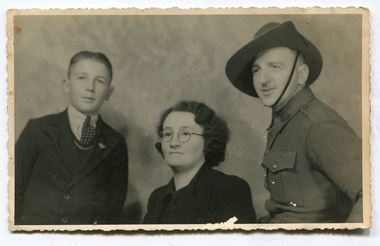
... This photograph was taken before his World War 2 departure. ...This photograph was taken before his World War 2 departure. John Hogan Gervasoni and his parents Elizabeth Gervasoni and Gus Gervasoni Photograph Photograph - Black and White Lisa Gervasoni ...Gis Gervasono served in Northern Australia and was in Darwin for the bombing.Black and white photograph of Gus Gervasoni in AIF Uniform, and his son and wife. This photograph was taken before his World War 2 departure. gus gervasoni, aif, world war two, chocco, chocolate soldier, conscript, john hogan gervasoni, elizabeth gervasoni, george gervasoni, elizabeth hogan -
 Ballarat Heritage Services
Photograph - Photograph - Black and White, Gus Gervasoni, c1941
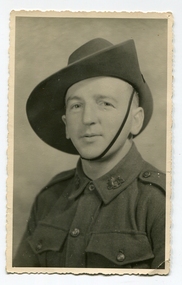
... This photograph was taken before his World War 2 departure. ...This photograph was taken before his World War 2 departure. Gus Gervasoni Photograph Photograph - Black and White Lisa Gervasoni ...Gis Gervasono served in Northern Australia and was in Darwin for the bombing.Black and white photograph of Gus Gervasoni in AIF Uniform. This photograph was taken before his World War 2 departure. gus gervasoni, aif, world war two, chocco, chocolate soldier, conscript
