
Showing 43 items matching "bendigo racecourse"
-
 Bendigo Historical Society Inc.
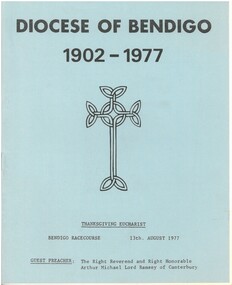
Document - AULSEBROOK COLLECTION: THANKSGIVING EUCHARIST PROGRAM, 1977
... ...Bendigo racecourse...Diocese of Bendigo 1902 - 1977: Thanksgiving Eucharist, 13th August 1977. Held at Bendigo Racecourse. -Order or service (music, prayers and lines for people taking the program)...Church of England Bendigo racecourse Aulsebrook Collection: Thanksgiving Eucharist program Blue Cover Pamphlet 1. ...Aulsebrook Collection: Thanksgiving Eucharist program Blue Cover Pamphlet 1. Diocese of Bendigo 1902 - 1977: Thanksgiving Eucharist, 13th August 1977. Held at Bendigo Racecourse. -Order or service (music, prayers and lines for people taking the program)church of england, bendigo racecourse -
 Bendigo Historical Society Inc.
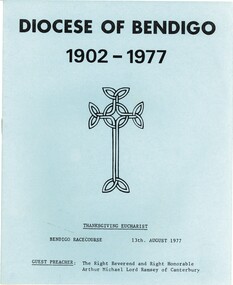
Book - DIOCESE OF BENDIGO 1902 - 1977, 1977
... DIOCESE OF BENDIGO 1902 - 1977 - Thanksgiving Eucharist, Bendigo Racecourse, 13th. August 1977. Guest speaker Arthur Michael Lord Ramsey of Canterbury....DIOCESE OF BENDIGO 1902 - 1977 - Thanksgiving Eucharist, Bendigo Racecourse, 13th. August 1977. Guest speaker Arthur Michael Lord Ramsey of Canterbury. ...DIOCESE OF BENDIGO 1902 - 1977 - Thanksgiving Eucharist, Bendigo Racecourse, 13th. August 1977. Guest speaker Arthur Michael Lord Ramsey of Canterbury.church, diocese of bendigo, thanksgiving eucharist, bendigo, diocese of bendigo. -
 Bendigo Historical Society Inc.
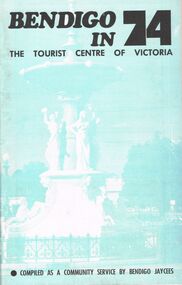
Book - BOOKLET: BENDIGO IN 74
... ... Bendigo Racecourse...BENDIGO Tourism guide 1974 Bendigo Jaycees Radio 3BO City Family Hotel Don Murray's Hotel Motel Cambrian Hotel Charlies Craft & Lifestyle Store Powneys Authorised Newsagent The Bendigo Trust White Hills Panel Works Bendigo Pottery Bendigo Racecourse Homestead Motor Inn Peter Wade The Persian Room Sandhurst Trading Co. ...48 paged booklet - ''Bendigo in 74 - The Tourist Centre of Victoria'' - compiled as a community service by Bendigo Jaycees. Comprehensive information about Bendigo and attractions - Index: Accommodation; Additional information; An introduction to Bendigo; Aquarium; Art Gallery; Bendigo Trust; Caravan parks; Dai Gum San; Directory; Eaglehawk Museum; Entertainment; Emergency services; Joss House; Lake Eppalock; National Trust classified buildings; Natural history; Map of Bendigo; Map of city centre; Pottery; Picnic areas; sporting facilities; 'Talking Trams'; Thanks; Tours; Tourist attractions; Victoria Hill; What's on in Bendigo.Bendigo Jaycees. Espress Printers Bendigo.bendigo, tourism, guide 1974, bendigo jaycees, radio 3bo, city family hotel, don murray's hotel motel, cambrian hotel, charlies craft & lifestyle store, powneys authorised newsagent, the bendigo trust, white hills panel works, bendigo pottery, bendigo racecourse, homestead motor inn, peter wade, the persian room, sandhurst trading co. pty. ltd., bendigo air services, bendigo sec, geo. r. innes & sons, cohns, the copper pot, sandhurst travel service. golden hills motel, welcome stranger motel, brian boru hotel, john lindsay's pharmacy & photographic centre, alf morris motors -
 Bendigo Historical Society Inc.
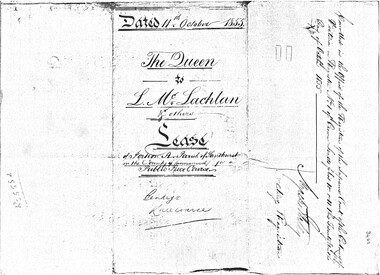
Document - LEASE DOCUMENT FOR FIRST SANDHURST RACECOURSE(PHOTOCOPY), 1855
... Bendigo Racecourse...Bendigo Racecourse Sandhurst Photocopy of the original lease for land for a public racecourse. ...Photocopy of the original lease for land for a public racecourse. Lease between the Queen and L. McLachlan and Others (Panton, Emmett, Bell, Ladbury and Tierney). Dated 11th October 1855. The photocopy was sent to Felicity Kingerlee with an undated letter from Harold Freeman.bendigo racecourse, sandhurst -
 Bendigo Historical Society Inc.
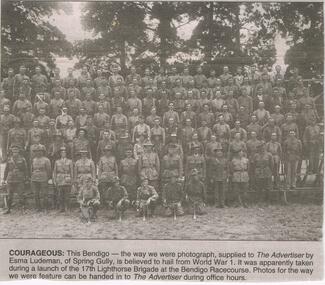
Newspaper - JENNY FOLEY COLLECTION: COURAGEOUS
... Courageous: This photo was apparently taken during a launch of the 17th Lighthouse Brigade at the Bendigo Racecourse....Courageous: This photo was apparently taken during a launch of the 17th Lighthouse Brigade at the Bendigo Racecourse. Newspaper JENNY FOLEY COLLECTION: COURAGEOUS ...Bendigo Advertiser "The way we were" from Monday, October 11, 2004. Courageous: This photo was apparently taken during a launch of the 17th Lighthouse Brigade at the Bendigo Racecourse.newspaper, bendigo advertiser, the way we were -
 Bendigo Historical Society Inc.
Document - Bendigo Plumpton Coursing Club Season ticket, 1897
... Greyhound Racing commenced in Bendigo in the 1920′s when field coursing (Plumpton) was conducted in the centre of the Bendigo racecourse at Epsom. The coursing continued until 1954 when the blue ribbon classic “The Victorian Waterloo Cup” was run at Bendigo over a three day carnival. ...Greyhound Racing commenced in Bendigo in the 1920′s when field coursing (Plumpton) was conducted in the centre of the Bendigo racecourse at Epsom. The coursing continued until 1954 when the blue ribbon classic “The Victorian Waterloo Cup” was run at Bendigo over a three day carnival. ...Greyhound Racing commenced in Bendigo in the 1920′s when field coursing (Plumpton) was conducted in the centre of the Bendigo racecourse at Epsom. The coursing continued until 1954 when the blue ribbon classic “The Victorian Waterloo Cup” was run at Bendigo over a three day carnival. For the final coursing meeting held at Bendigo, over 30 bookmakers field the card.Bendigo Plumpton Coursing Club Season ticket number 169; written on card is Mr R. and H. Abbott.history, bendigo, plumpton club, bendigo greyhound racing, r and h abbott -
 Bendigo Historical Society Inc.
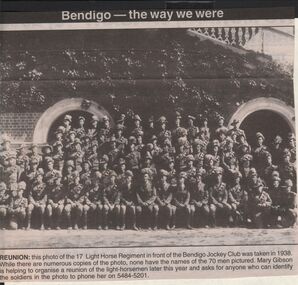
Newspaper - JENNY FOLEY COLLECTION: REUNION
... In 1936 the regiment, including 100 horses, camped at the Bendigo Racecourse so it is possible this photo was actually 1936.From Dec 1941 this regiment became the 17th Light Horse (Machine Gun) Regiment and was disbanded in April 1943. ...In 1936 the regiment, including 100 horses, camped at the Bendigo Racecourse so it is possible this photo was actually 1936.From Dec 1941 this regiment became the 17th Light Horse (Machine Gun) Regiment and was disbanded in April 1943. ...The 17th Light Horse was a militia unit between the wars. Members were drawn from Kyneton, Castlemaine and Bendigo areas. In 1936 the regiment, including 100 horses, camped at the Bendigo Racecourse so it is possible this photo was actually 1936.From Dec 1941 this regiment became the 17th Light Horse (Machine Gun) Regiment and was disbanded in April 1943. Members were absorbed into other units.Bendigo Advertiser ''The way we were'' from 2003. Reunion: this photo of the 17 Light horse regiment in front of the Bendigo jockey Club was taken in 1938. While there are numerous copies of the photo, none have the names of the 70 men pictured. The clip is in a folder.newspaper, bendigo advertiser, the way we were -
 Bendigo Military Museum
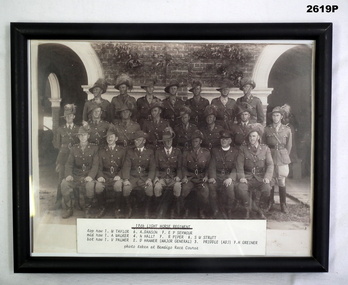
Photograph - PHOTOGRAPH, FRAMED, 1939
... List of names printed on card on photograph: 17th Light Horse Regiment Photograph taken at Bendigo Racecourse Top row: 1. W TAYLOR 6. A DANSON 7. ...List of names printed on card on photograph: 17th Light Horse Regiment Photograph taken at Bendigo Racecourse Top row: 1. W TAYLOR 6. A DANSON 7. ...List of names printed on card on photograph: 17th Light Horse Regiment Photograph taken at Bendigo Racecourse Top row: 1. W TAYLOR 6. A DANSON 7. E P SEYMOUR Mid row: 1. A WALKER 4. N HALL? 7. R PIPER 8. W STRUTT Bottom row: 1. V PALMER 2. D HAMMER (MAJOR GENERAL) 3. P RIDDLE 7. H GREINERPhotograph, black white colour, group portrait of 22 uniformed Officers of the 17th Light Horse Regiment. Wooden frame painted black. Label on photograph, black print on white cardboard showing list of names.On frame cardboard back in blue ink: “Passchendaele Barracks / Trust”photography-photographs, frame accessories, passchendaele barracks trust -
 Bendigo Military Museum
Photograph - PHOTOGRAPHS, LIGHT HORSE, Post WW1
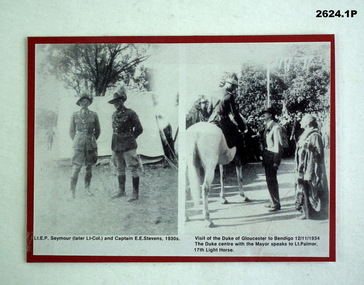
... Officer is LT A V PALMER (later LT COL) on Snow; Bottom: Officers of 17th Light Horse at Bendigo Racecourse 1937. Centre front: MAJOR GENERAL G T RANKINM DSO, VD. .3) Top: SGTS of 17th Light Horse winning Assault Course Broadmeadows Army Camp 1927; Bottom: Officers 17/19th Light Horse at Bendigo Racecourse Camp 1932. .4) Top: Horse Llines 17/19th Light Horse 1931; Bottom: Sgts Mess 17th Light Horse Broadmeadows Camp 1927. .5) Top: 17th Light Horsemen trucking horses Bendigo Railway Station 1931; Bottom: Cohuna Troop of 17th Light Horse at Bendigo Racecourse Camp 1932. ...Officer is LT A V PALMER (later LT COL) on Snow; Bottom: Officers of 17th Light Horse at Bendigo Racecourse 1937. Centre front: MAJOR GENERAL G T RANKINM DSO, VD. .3) Top: SGTS of 17th Light Horse winning Assault Course Broadmeadows Army Camp 1927; Bottom: Officers 17/19th Light Horse at Bendigo Racecourse Camp 1932. .4) Top: Horse Llines 17/19th Light Horse 1931; Bottom: Sgts Mess 17th Light Horse Broadmeadows Camp 1927. .5) Top: 17th Light Horsemen trucking horses Bendigo Railway Station 1931; Bottom: Cohuna Troop of 17th Light Horse at Bendigo Racecourse Camp 1932. ...Each photograph is captioned: .1) LHS: LT E P SEYMOUR (later LT COL) & CAPTAIN E E STEVENS, 1930's. RHS: Visit of the Duke of Gloucester to Bendigo 12.11.1934. The Duke centre with the Major speaks to LT PALMER, 17th Light Horse. .2) Top: Troopers of 17th Light Horse in Pall Mall in front of the Memorial Hall Bendigo. Officer is LT A V PALMER (later LT COL) on Snow; Bottom: Officers of 17th Light Horse at Bendigo Racecourse 1937. Centre front: MAJOR GENERAL G T RANKINM DSO, VD. .3) Top: SGTS of 17th Light Horse winning Assault Course Broadmeadows Army Camp 1927; Bottom: Officers 17/19th Light Horse at Bendigo Racecourse Camp 1932. .4) Top: Horse Llines 17/19th Light Horse 1931; Bottom: Sgts Mess 17th Light Horse Broadmeadows Camp 1927. .5) Top: 17th Light Horsemen trucking horses Bendigo Railway Station 1931; Bottom: Cohuna Troop of 17th Light Horse at Bendigo Racecourse Camp 1932. CAPT A V PALMER, CO centre rear. .6) Visit of Duke of Gloucester to Bendigo 1934, Escort official from 17th Light Horse Regiment in Mitchell Street. Duke & Major seated in rear of car; Bottom: 17th Light Horse Machine Gun Regiment with Vickers MG 1937. .7) 17th Light Horse as M G Regt Bendigo Camp 1937. LT A V PALMER, R SCHIER, A LEEDS with range finder; Bottom: 1939 Officers 17th Light Horse MG Regt at Bendigo. See also 2619P for larger named copy of this photograph..1) - .7) Collection of black & white photographs consisting of 2 photographs per card. Photographs are printed on red card. Copies of originals. .1) LHS: 2 Officers standing. RHS: Officer on horse speaking to 2 men on foot. .2) Top: Mounted troops; Bottom: Group of Officers standing. .3) Top: Mounted troops charging with swords drawn; Bottom: Group of Officers. .4) Top: Line of horses with 2 Troopers attending; Bottom: Group of Sergeants. .5) Top: Troopers loading horses into a railway truck; Bottom: Group of Troopers. .6) Top: Officer riding a white horse through a crowd; Bottom: Machine Gunners training. .7) Top: 3 Light Horsemen using a range finder; Bottom: Group of Officers.photography-photographs, military history - army, passchendaele barracks trust -
 Bendigo Military Museum
Photograph - PHOTOGRAPH WW2, FRAMED, c.WWII
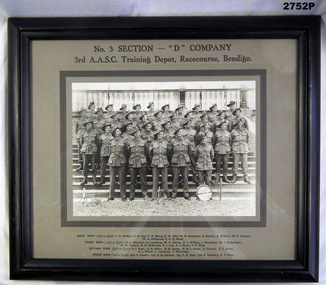
... "No 3 Section - D Company, 3rd AACS Training Depot Racecourse Bendigo" Imprint on left lower corner of photo: "Vincent Kenny, Bendigo"...photography-photographs, frame accessories military history "No 3 Section - D Company, 3rd AACS Training Depot Racecourse Bendigo" Imprint on left lower corner of photo: "Vincent Kenny, Bendigo" Black & white photo of soldiers in uniform taken outdoors on steps. ...Black & white photo of soldiers in uniform taken outdoors on steps. Musical drum in front of group - framed with glass & black wooden frame. Photo is framed with taupe coloured mat & black edging."No 3 Section - D Company, 3rd AACS Training Depot Racecourse Bendigo" Imprint on left lower corner of photo: "Vincent Kenny, Bendigo"photography-photographs, frame accessories, military history -
 Bendigo Historical Society Inc.
Document - BASIL WATSON COLLECTION: SMALL CARDS FOR EXHIBIT (RE BASIL WATSON), 1916
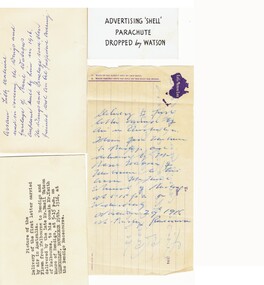
... Keith Munro of Bendigo, at 5.15 p.m. on Wednesday, November 29th. 1916, at the Bendigo racecourse. Envelope: handwritten on front of envelope 'Assam silk material used in covering the wings and fuselage of Basil Watson's airplane built by him in 1916. ...Keith Munro of Bendigo, at 5.15 p.m. on Wednesday, November 29th. 1916, at the Bendigo racecourse. Envelope: handwritten on front of envelope 'Assam silk material used in covering the wings and fuselage of Basil Watson's airplane built by him in 1916. ...12 small handwritten, interpretive labels for display (re Basil Watson) - presumably to accompany an exhibition of Basil Watson memorabilia (no date) Labels: fabric with monogram from original plane; finished plane; airmail envelopes 1929-30; Basil Watson Bendigo's first aviator,; first Australian to loop the loop; picture of the delivery of the first letter carried by air in Australia. Flown from Melbourne to Bendigo and delivered by the late Mr. Basil Watson of Melbourne, to his cousin Mr. Keith Munro of Bendigo, at 5.15 p.m. on Wednesday, November 29th. 1916, at the Bendigo racecourse. Envelope: handwritten on front of envelope 'Assam silk material used in covering the wings and fuselage of Basil Watson's airplane built by him in 1916. The wings and fuselage were then painted with an oil protective covering'person, individual, basil watson -
 Bendigo Historical Society Inc.
Document - BASIL WATSON COLLECTION: MAN AND AERIAL MACHINES NEWSLETTER ISSUE NO. 40 1994, 1994
... 'Castlemaine New Years Day Carnival' An advertisement for Basil Watson to give a demonstration at the Bendigo Racecourse Saturday 2nd December (weather permitting)...'Castlemaine New Years Day Carnival' An advertisement for Basil Watson to give a demonstration at the Bendigo Racecourse Saturday 2nd December (weather permitting) Document BASIL WATSON COLLECTION: MAN AND AERIAL MACHINES NEWSLETTER ISSUE NO. 40 1994 ...On the front page of Man and Aerial Machines a publication for those with a serious interest in the Aeronautical history of Australia. Issue No. 40 ISSN 1037-5120 January to February 1994 is a grey scale of Basil Watson and his Aircraft along with another man standing behind the Aircraft, both men are wearing hats. The biplane has a single propella and along the side of the plane is a ring of three different colours. Underneath is written 'Basil Waton's aircraft at an unknown location and R.A.A.F Museum via John Hopton. The newsletter covers a drawing of Short S.B.5 with 60deg wing sweep and a low set tail plane from Shorts Aircraft since 1900 by C.H. Bames. An article on Basil George Watson also 'The War Aloft, Experiences of Australian Aviator, the latest machines'. 'In his Homebuilt Biplane Aviator Loops and Dive's. 'Bendigo Aviator flies from Melbourne' 'Flight from Bendigo', 'The Aeroplane in War, some recent developments'. 'Castlemaine New Years Day Carnival' An advertisement for Basil Watson to give a demonstration at the Bendigo Racecourse Saturday 2nd December (weather permitting)person, individual, basil watson -
 Bendigo Historical Society Inc.
Ephemera - HOWARD AND VIOLET JOLLEY COLLECTION: NEWSPAPER CUTTINGS
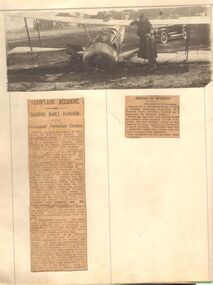
... First entry page 16 -17 contains photographs and newspaper cuttings relating to an air crash on Bendigo racecourse in May 1921. Jolley was involved in numerous air-crashes for the next ten years. ...First entry page 16 -17 contains photographs and newspaper cuttings relating to an air crash on Bendigo racecourse in May 1921. Jolley was involved in numerous air-crashes for the next ten years. ...A book titled 'Newspaper Cuttings' in gold leaf with black leather binding and corners on blue cloth covered cardboard cover. Stiff paper pages inside numbered top right -hand corners 1-90 in printed black ink. Poor condition overall. Pages 37 - 44 missing. Page 45-46 pertaining to Violet Jolley separately bagged. Entries mostly pertain to Mr Howard Jolley , an aviation field inspector of the Life Insurance Company of Australia. First entry page 16 -17 contains photographs and newspaper cuttings relating to an air crash on Bendigo racecourse in May 1921. Jolley was involved in numerous air-crashes for the next ten years. Photographs and newspaper cuttings related to these, along with dinner invitations, etc, are pasted into the book. Entry's into the book finish shortly before his death as a result of an air crash in 1931.Enclosed in pocket: copies of newspaper articles relating to the death of Howard Jolley in aircraft accident; donation form from Janice van der Spek, copy of advertisement Howard Jolley, touring Australia on life insurance business.bendigo, history, aviation 1920s. -
 Bendigo Military Museum
Administrative record - NOMINAL ROLL, 28 Jan 1942
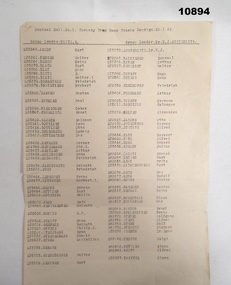
... The paper is headed at the top, “Nominal Roll No.1 Company Camp, Racecourse Bendigo, 26/1/42”. Both “Blitz & Austerlitz” enlisted in 8 Employment Company on 8.4 1942, Blitz V377350 was Jewish and 39 years old, he was listed as an Office Clerk currently working as a Fruit picker, Austerlitz V377644 was Jewish aged 30 years, he was listed as a Medical Practitioner on his records. ...The paper is headed at the top, “Nominal Roll No.1 Company Camp, Racecourse Bendigo, 26/1/42”. Both “Blitz & Austerlitz” enlisted in 8 Employment Company on 8.4 1942, Blitz V377350 was Jewish and 39 years old, he was listed as an Office Clerk currently working as a Fruit picker, Austerlitz V377644 was Jewish aged 30 years, he was listed as a Medical Practitioner on his records. ...The paper is headed at the top, “Nominal Roll No.1 Company Camp, Racecourse Bendigo, 26/1/42”. Both “Blitz & Austerlitz” enlisted in 8 Employment Company on 8.4 1942, Blitz V377350 was Jewish and 39 years old, he was listed as an Office Clerk currently working as a Fruit picker, Austerlitz V377644 was Jewish aged 30 years, he was listed as a Medical Practitioner on his records. Blitz was born in Vienna and Austerlitz in Berlin. Both their records are stamped “Alien”. 8 Employment Company was essentially “The DUNERA BOYS”. Sheet of foolscap size paper. Typed lists of numbers and names. They would appear to be foreign names possibly of German origin. Two columns of names. Left column title is Group Leader: "BLITZ E". Right column title is Group Leader "Dr. H.J. AUSTERLITZ". The columns are arranged in alphabetical order, all males, A-Z and A-Y. The numbers beside each name have the prefix E or Z.ww2, alien company -
 Bendigo Military Museum
Photograph - PHOTOGRAPH WW2, BENDIGO, c.1940
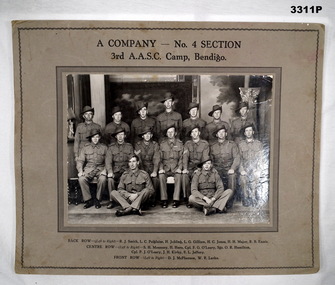
... Changed to 2/32 Training Battalion (a camp was opened at Showgrounds Bendigo but closed down later). 2/32 T Battalion became 2/22 Training Battalion, they marched out of Racecourse Bendigo to Puckapunyal and became 4th Anti Tank Regiment....Changed to 2/32 Training Battalion (a camp was opened at Showgrounds Bendigo but closed down later). 2/32 T Battalion became 2/22 Training Battalion, they marched out of Racecourse Bendigo to Puckapunyal and became 4th Anti Tank Regiment. ...Black & white photo of a group of 16 Australian Soldiers, taken in Bendigo. Black print identifies company & troops. Mounted on heavy fawn coloured cardboard.In black print above photo: “A COMPANY - NO 4 SECTION 3rd AASC, CAMP, BENDIGO” In black print below photo:BACK ROW L-R: R J Smith, L C Polgaise, H Jobling, L G Gilliam, H C Jones, H H Major, R B Ennis CENTRE ROW L-R: S H Mounsey, H Hore, Cpl F G O'Leary, Sgt O R Hamilton, Cpl P J O'Leary, J Kirby, F L Jeffery FRONT ROW L-R: D J McPherson, W R Larke” On back: Bill LARKE Murphy St Bendigo joined the Army Training Camp at Racecourse Bendigo in June 1940. Started as 3rd Australian Army Supply Service Corp. Changed to 2/32 Training Battalion (a camp was opened at Showgrounds Bendigo but closed down later). 2/32 T Battalion became 2/22 Training Battalion, they marched out of Racecourse Bendigo to Puckapunyal and became 4th Anti Tank Regiment.photography, aasc, bendigo -
 Bendigo Historical Society Inc.
Document - Jack Lockett Collection: Army Certificate of Discharge
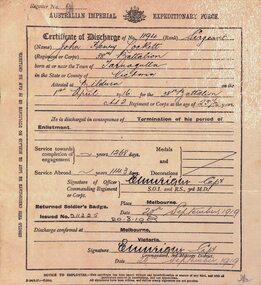
... Bendigo. He left school aged nine to work on a local farm. Later, he worked for his uncles in the Mallee. On 24 March 1916, he travelled to Mildura to enlist in the Australian Imperial Force. He served in France with the 38th Battalion, earning promotion to sergeant and was discharged on 20 September 1919. https://en.wikipedia.org/wiki/Jack_Lockett The 38th Battalion was formed on 1 March 1916 at a camp established on the Epsom Racecourse...Bendigo. He left school aged nine to work on a local farm. Later, he worked for his uncles in the Mallee. On 24 March 1916, he travelled to Mildura to enlist in the Australian Imperial Force. He served in France with the 38th Battalion, earning promotion to sergeant and was discharged on 20 September 1919. https://en.wikipedia.org/wiki/Jack_Lockett The 38th Battalion was formed on 1 March 1916 at a camp established on the Epsom Racecourse at Bendigo in Victoria. ...John Henry Lockett OAM (22 January 1891 – 25 May 2002) was the oldest man ever in Australia when he died aged 111 years, 123 days. As one of the last surviving veterans of World War I, he was acclaimed as a national hero during the last decade of his life. Lockett was born in the small Victorian town of Waanyarra, near Bendigo. He left school aged nine to work on a local farm. Later, he worked for his uncles in the Mallee. On 24 March 1916, he travelled to Mildura to enlist in the Australian Imperial Force. He served in France with the 38th Battalion, earning promotion to sergeant and was discharged on 20 September 1919. https://en.wikipedia.org/wiki/Jack_Lockett The 38th Battalion was formed on 1 March 1916 at a camp established on the Epsom Racecourse at Bendigo in Victoria. After training in both Australia and Britain, the 38th Battalion crossed to France in late November 1916 and moved into the trenches of the Western Front for the first time on 1 December.The 38th fought in its first major battle at Messines, in Belgium, between 7-9 June 1917. It fought in another two major attacks in this sector - the battle of Broodseinde on 4 October, and the battle of Passchendaele on 12 October. Belgium remained the focus of the 38th Battalion's activities for the next five months, until it was rushed south to France in late March 1918 to meet the German Army's Spring Offensive. The 38th participated in its last major action of the war between 29 September and 2 October 1918 as part of the Australian-American operation that breached the formidable defences of the Hindenburg Line along the St Quentin Canal. It was disbanded in April 1919. Source, Australian War Memorial https://www.awm.gov.au/collection/U51478 After the war, Jack returned to The Mallee and selected a 640 acres (260 ha) block of land in Linga, Victoria, deciding to make his living as a farmer. In 1923, he married Maybell Ingwerson and they had four children together. In 1963, the couple retired to Bendigo, leaving the farmland (which now covered more than 130,000 acres (53,000 ha), in the care of their children and grandchildren. An off-white coulored document with black print and black handwriting headed AUSTRALIAN IMPERIAL EXPEDITIONARY FORCE Certificate of Discharge No 1194 Sergeant John Henry Lockett 38th Battalion, born Tarnagulla Victoria Attested at Mildura 1st April 1916for the 38th Battalion at the age of 25 1/2 years Total service 1268 days Service abroad 1143 days Discharge confirmed at Melbourne Victoria 20th September 1919 On the reverse V/B 60883 No 177770 Description of the above named Soldier on discharge Age 28 1/2 years Height 5' 10", complexion Medium, Eyes Blue, Hair Brown, Trade Farmer, Intended place of Residence Ouyen P.O. Victoria Singed J H Lockett jack lockett, mabel ingwersen, 38th australian infantry battalion, w.w.1, mallee farming -
 Bendigo Historical Society Inc.
Document - Jack Lockett Collection: Copies of Army Service documents
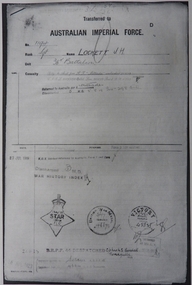
... Bendigo. He left school aged nine to work on a local farm. Later, he worked for his uncles in the Mallee. On 24 March 1916, he travelled to Mildura to enlist in the Australian Imperial Force. He served in France with the 38th Battalion, earning promotion to sergeant and was discharged on 20 September 1919. https://en.wikipedia.org/wiki/Jack_Lockett The 38th Battalion was formed on 1 March 1916 at a camp established on the Epsom Racecourse...Bendigo. He left school aged nine to work on a local farm. Later, he worked for his uncles in the Mallee. On 24 March 1916, he travelled to Mildura to enlist in the Australian Imperial Force. He served in France with the 38th Battalion, earning promotion to sergeant and was discharged on 20 September 1919. https://en.wikipedia.org/wiki/Jack_Lockett The 38th Battalion was formed on 1 March 1916 at a camp established on the Epsom Racecourse at Bendigo in Victoria. ...John Henry Lockett OAM (22 January 1891 – 25 May 2002) was the oldest man ever in Australia when he died aged 111 years, 123 days. As one of the last surviving veterans of World War I, he was acclaimed as a national hero during the last decade of his life. Lockett was born in the small Victorian town of Waanyarra, near Bendigo. He left school aged nine to work on a local farm. Later, he worked for his uncles in the Mallee. On 24 March 1916, he travelled to Mildura to enlist in the Australian Imperial Force. He served in France with the 38th Battalion, earning promotion to sergeant and was discharged on 20 September 1919. https://en.wikipedia.org/wiki/Jack_Lockett The 38th Battalion was formed on 1 March 1916 at a camp established on the Epsom Racecourse at Bendigo in Victoria. After training in both Australia and Britain, the 38th Battalion crossed to France in late November 1916 and moved into the trenches of the Western Front for the first time on 1 December.The 38th fought in its first major battle at Messines, in Belgium, between 7-9 June 1917. It fought in another two major attacks in this sector - the battle of Broodseinde on 4 October, and the battle of Passchendaele on 12 October. Belgium remained the focus of the 38th Battalion's activities for the next five months, until it was rushed south to France in late March 1918 to meet the German Army's Spring Offensive. The 38th participated in its last major action of the war between 29 September and 2 October 1918 as part of the Australian-American operation that breached the formidable defences of the Hindenburg Line along the St Quentin Canal. It was disbanded in April 1919. Source, Australian War Memorial https://www.awm.gov.au/collection/U51478 After the war, Jack returned to The Mallee and selected a 640 acres (260 ha) block of land in Linga, Victoria, deciding to make his living as a farmer. In 1923, he married Maybell Ingwerson and they had four children together. In 1963, the couple retired to Bendigo, leaving the farmland (which now covered more than 130,000 acres (53,000 ha), in the care of their children and grandchildren. Thirteen photocopies relating to Jack Lockett's service in the Australian Imperial Force jack lockett, mabel ingwersen, 38th australian infantry battalion, w.w.1, mallee farming -
 Bendigo Historical Society Inc.
Map - Jack Lockett Collection: Copies of two maps of WW1 Battles
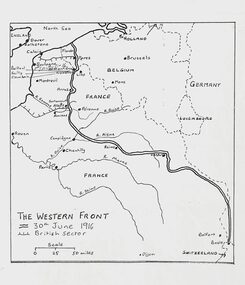
... Bendigo. He left school aged nine to work on a local farm. Later, he worked for his uncles in the Mallee. On 24 March 1916, he travelled to Mildura to enlist in the Australian Imperial Force. He served in France with the 38th Battalion, earning promotion to sergeant and was discharged on 20 September 1919. https://en.wikipedia.org/wiki/Jack_Lockett The 38th Battalion was formed on 1 March 1916 at a camp established on the Epsom Racecourse...Bendigo. He left school aged nine to work on a local farm. Later, he worked for his uncles in the Mallee. On 24 March 1916, he travelled to Mildura to enlist in the Australian Imperial Force. He served in France with the 38th Battalion, earning promotion to sergeant and was discharged on 20 September 1919. https://en.wikipedia.org/wiki/Jack_Lockett The 38th Battalion was formed on 1 March 1916 at a camp established on the Epsom Racecourse at Bendigo in Victoria. ...John Henry Lockett OAM (22 January 1891 – 25 May 2002) was the oldest man ever in Australia when he died aged 111 years, 123 days. As one of the last surviving veterans of World War I, he was acclaimed as a national hero during the last decade of his life. Lockett was born in the small Victorian town of Waanyarra, near Bendigo. He left school aged nine to work on a local farm. Later, he worked for his uncles in the Mallee. On 24 March 1916, he travelled to Mildura to enlist in the Australian Imperial Force. He served in France with the 38th Battalion, earning promotion to sergeant and was discharged on 20 September 1919. https://en.wikipedia.org/wiki/Jack_Lockett The 38th Battalion was formed on 1 March 1916 at a camp established on the Epsom Racecourse at Bendigo in Victoria. After training in both Australia and Britain, the 38th Battalion crossed to France in late November 1916 and moved into the trenches of the Western Front for the first time on 1 December.The 38th fought in its first major battle at Messines, in Belgium, between 7-9 June 1917. It fought in another two major attacks in this sector - the battle of Broodseinde on 4 October, and the battle of Passchendaele on 12 October. Belgium remained the focus of the 38th Battalion's activities for the next five months, until it was rushed south to France in late March 1918 to meet the German Army's Spring Offensive. The 38th participated in its last major action of the war between 29 September and 2 October 1918 as part of the Australian-American operation that breached the formidable defences of the Hindenburg Line along the St Quentin Canal. It was disbanded in April 1919. Source, Australian War Memorial https://www.awm.gov.au/collection/U51478 After the war, Jack returned to The Mallee and selected a 640 acres (260 ha) block of land in Linga, Victoria, deciding to make his living as a farmer. In 1923, he married Maybell Ingwerson and they had four children together. In 1963, the couple retired to Bendigo, leaving the farmland (which now covered more than 130,000 acres (53,000 ha), in the care of their children and grandchildren. Two photocopies of hand drawn maps on one A4 sheet of paper. One side labeled THE WESTERN FRONT 30th June 1916 British Sector Scale 1 inch to 50 miles. The Western Front spans from the North Sea to Switzerland. The other side is labeled POZIERES scale 1 inch to 500 yards. July to September 1916. There are numerous roads and trench lines. jack lockett, mabel ingwersen, 38th australian infantry battalion, w.w.1, mallee farming, pozieres 1916, the western front 1916 -
 Bendigo Historical Society Inc.
Postcard - Jack Lockett Collection:
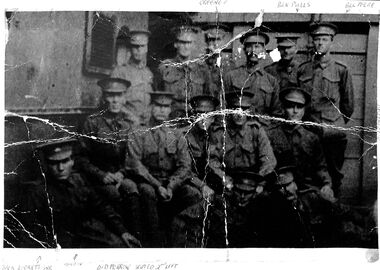
... Bendigo. He left school aged nine to work on a local farm. Later, he worked for his uncles in the Mallee. On 24 March 1916, he travelled to Mildura to enlist in the Australian Imperial Force. He served in France with the 38th Battalion, earning promotion to sergeant and was discharged on 20 September 1919. https://en.wikipedia.org/wiki/Jack_Lockett The 38th Battalion was formed on 1 March 1916 at a camp established on the Epsom Racecourse...Bendigo. He left school aged nine to work on a local farm. Later, he worked for his uncles in the Mallee. On 24 March 1916, he travelled to Mildura to enlist in the Australian Imperial Force. He served in France with the 38th Battalion, earning promotion to sergeant and was discharged on 20 September 1919. https://en.wikipedia.org/wiki/Jack_Lockett The 38th Battalion was formed on 1 March 1916 at a camp established on the Epsom Racecourse at Bendigo in Victoria. ...John Henry Lockett OAM (22 January 1891 – 25 May 2002) was the oldest man ever in Australia when he died aged 111 years, 123 days. As one of the last surviving veterans of World War I, he was acclaimed as a national hero during the last decade of his life. Lockett was born in the small Victorian town of Waanyarra, near Bendigo. He left school aged nine to work on a local farm. Later, he worked for his uncles in the Mallee. On 24 March 1916, he travelled to Mildura to enlist in the Australian Imperial Force. He served in France with the 38th Battalion, earning promotion to sergeant and was discharged on 20 September 1919. https://en.wikipedia.org/wiki/Jack_Lockett The 38th Battalion was formed on 1 March 1916 at a camp established on the Epsom Racecourse at Bendigo in Victoria. After training in both Australia and Britain, the 38th Battalion crossed to France in late November 1916 and moved into the trenches of the Western Front for the first time on 1 December.The 38th fought in its first major battle at Messines, in Belgium, between 7-9 June 1917. It fought in another two major attacks in this sector - the battle of Broodseinde on 4 October, and the battle of Passchendaele on 12 October. Belgium remained the focus of the 38th Battalion's activities for the next five months, until it was rushed south to France in late March 1918 to meet the German Army's Spring Offensive. The 38th participated in its last major action of the war between 29 September and 2 October 1918 as part of the Australian-American operation that breached the formidable defences of the Hindenburg Line along the St Quentin Canal. It was disbanded in April 1919. Source, Australian War Memorial https://www.awm.gov.au/collection/U51478 After the war, Jack returned to The Mallee and selected a 640 acres (260 ha) block of land in Linga, Victoria, deciding to make his living as a farmer. In 1923, he married Maybell Ingwerson and they had four children together. In 1963, the couple retired to Bendigo, leaving the farmland (which now covered more than 130,000 acres (53,000 ha), in the care of their children and grandchildren. An A4 size copy of a postcard with a black and white photograph of 14 men in army uniforms with some men identified - Greeno, Ben Pulls, Bill McCae, Jack Lockett Snr, Maldon, Dad Morrow. On the back there is a copy of the back of the postcard with handwriting - Dear Boys this a group of my cobbers No 1 section ............Dont loose it, Jack jack lockett, mabel ingwersen, 38th australian infantry battalion, w.w.1, mallee farming -
 Bendigo Historical Society Inc.
Memorabilia - Jack Lockett Collection: Boys from the Mallee 1916
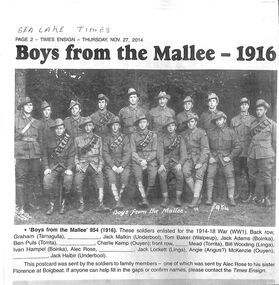
... Bendigo. He left school aged nine to work on a local farm. Later, he worked for his uncles in the Mallee. On 24 March 1916, he travelled to Mildura to enlist in the Australian Imperial Force. He served in France with the 38th Battalion, earning promotion to sergeant and was discharged on 20 September 1919. https://en.wikipedia.org/wiki/Jack_Lockett The 38th Battalion was formed on 1 March 1916 at a camp established on the Epsom Racecourse...Bendigo. He left school aged nine to work on a local farm. Later, he worked for his uncles in the Mallee. On 24 March 1916, he travelled to Mildura to enlist in the Australian Imperial Force. He served in France with the 38th Battalion, earning promotion to sergeant and was discharged on 20 September 1919. https://en.wikipedia.org/wiki/Jack_Lockett The 38th Battalion was formed on 1 March 1916 at a camp established on the Epsom Racecourse at Bendigo in Victoria. ...John Henry Lockett OAM (22 January 1891 – 25 May 2002) was the oldest man ever in Australia when he died aged 111 years, 123 days. As one of the last surviving veterans of World War I, he was acclaimed as a national hero during the last decade of his life. Lockett was born in the small Victorian town of Waanyarra, near Bendigo. He left school aged nine to work on a local farm. Later, he worked for his uncles in the Mallee. On 24 March 1916, he travelled to Mildura to enlist in the Australian Imperial Force. He served in France with the 38th Battalion, earning promotion to sergeant and was discharged on 20 September 1919. https://en.wikipedia.org/wiki/Jack_Lockett The 38th Battalion was formed on 1 March 1916 at a camp established on the Epsom Racecourse at Bendigo in Victoria. After training in both Australia and Britain, the 38th Battalion crossed to France in late November 1916 and moved into the trenches of the Western Front for the first time on 1 December.The 38th fought in its first major battle at Messines, in Belgium, between 7-9 June 1917. It fought in another two major attacks in this sector - the battle of Broodseinde on 4 October, and the battle of Passchendaele on 12 October. Belgium remained the focus of the 38th Battalion's activities for the next five months, until it was rushed south to France in late March 1918 to meet the German Army's Spring Offensive. The 38th participated in its last major action of the war between 29 September and 2 October 1918 as part of the Australian-American operation that breached the formidable defences of the Hindenburg Line along the St Quentin Canal. It was disbanded in April 1919. Source, Australian War Memorial https://www.awm.gov.au/collection/U51478 After the war, Jack returned to The Mallee and selected a 640 acres (260 ha) block of land in Linga, Victoria, deciding to make his living as a farmer. In 1923, he married Maybell Ingwerson and they had four children together. In 1963, the couple retired to Bendigo, leaving the farmland (which now covered more than 130,000 acres (53,000 ha), in the care of their children and grandchildren. A photocopy of an article and photograph headed - PAGE 2 TIMES ENSIGN - THURSDAY, NOV. 2014 (Sea Lake Times?) Boys from the Mallee- 1916. A photograph of a postcard of17 men in Australian Army Uniforms, 10 standing and seven sitting. Names listed Graham (Tarnagulla), Jack Malkin (Underbol), Tom Baker (Walpeup), Jack Adams (Binka), Ben Puls Torria), Charlie Kemp (Ouyen), Mead (Torrita), Bill Wooding (Linga), Ivan Hampel (Boinka), Alec Rose, Jack Locket (Linga) Angus McKenzie (Ouyen), Jack Halbir (Underbool) This postcard was sent by Alec Rose to his sister Florence. dge and Rheola. jack lockett, mabel ingwersen, 38th australian infantry battalion, w.w.1, mallee farming -
 Bendigo Historical Society Inc.
Photograph - Jack Lockett Collection: Five W.W.1 photographs
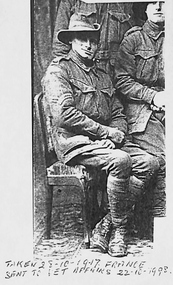
... Bendigo. He left school aged nine to work on a local farm. Later, he worked for his uncles in the Mallee. On 24 March 1916, he travelled to Mildura to enlist in the Australian Imperial Force. He served in France with the 38th Battalion, earning promotion to sergeant and was discharged on 20 September 1919. https://en.wikipedia.org/wiki/Jack_Lockett The 38th Battalion was formed on 1 March 1916 at a camp established on the Epsom Racecourse...Bendigo. He left school aged nine to work on a local farm. Later, he worked for his uncles in the Mallee. On 24 March 1916, he travelled to Mildura to enlist in the Australian Imperial Force. He served in France with the 38th Battalion, earning promotion to sergeant and was discharged on 20 September 1919. https://en.wikipedia.org/wiki/Jack_Lockett The 38th Battalion was formed on 1 March 1916 at a camp established on the Epsom Racecourse at Bendigo in Victoria. ...John Henry Lockett OAM (22 January 1891 – 25 May 2002) was the oldest man ever in Australia when he died aged 111 years, 123 days. As one of the last surviving veterans of World War I, he was acclaimed as a national hero during the last decade of his life. Lockett was born in the small Victorian town of Waanyarra, near Bendigo. He left school aged nine to work on a local farm. Later, he worked for his uncles in the Mallee. On 24 March 1916, he travelled to Mildura to enlist in the Australian Imperial Force. He served in France with the 38th Battalion, earning promotion to sergeant and was discharged on 20 September 1919. https://en.wikipedia.org/wiki/Jack_Lockett The 38th Battalion was formed on 1 March 1916 at a camp established on the Epsom Racecourse at Bendigo in Victoria. After training in both Australia and Britain, the 38th Battalion crossed to France in late November 1916 and moved into the trenches of the Western Front for the first time on 1 December.The 38th fought in its first major battle at Messines, in Belgium, between 7-9 June 1917. It fought in another two major attacks in this sector - the battle of Broodseinde on 4 October, and the battle of Passchendaele on 12 October. Belgium remained the focus of the 38th Battalion's activities for the next five months, until it was rushed south to France in late March 1918 to meet the German Army's Spring Offensive. The 38th participated in its last major action of the war between 29 September and 2 October 1918 as part of the Australian-American operation that breached the formidable defences of the Hindenburg Line along the St Quentin Canal. It was disbanded in April 1919. Source, Australian War Memorial https://www.awm.gov.au/collection/U51478 After the war, Jack returned to The Mallee and selected a 640 acres (260 ha) block of land in Linga, Victoria, deciding to make his living as a farmer. In 1923, he married Maybell Ingwerson and they had four children together. In 1963, the couple retired to Bendigo, leaving the farmland (which now covered more than 130,000 acres (53,000 ha), in the care of their children and grandchildren. Five photographs including Jack Lockett a. A photocopy of part of a group photograph, Jack sitting on a chair wearing an Australian Army Uniform. Written underneath - Teken 25-10-1917 France sent to Vet affairs 22-10-1998 b. A black and white photograph of a ship crowed with people on deck with printing - H.M.A.T. "RUNIC" (copyright) 20/6/16 written on the back in blue ink - Private Jack Locket No 1194 D Company 38th Battalion A.I.F. left Port Melbourne pier on Tues 20 June 1916 aboard H.M.A.T. RUNIC bound for England via South Africa. He was below deck peering out of a porthole when the boat pulled away from the pier, as he had the job of guarding some supplies. the arrived in England on (sic) Returning to Australia on Miltides on Mon 17th Feb 1919 as a Sargent Discharged 20 SEPT 1919 c. A very faded sepia tone photograph of four men in Army Uniforms without hats. three sitting and Jack Lockett lying on the man in the middle. Written on the back - JACK LOCKETT LYING ON ONE of His 3 MATES NAMES UNKNOWN FIRST AIF 1914 -1918 GREAT WAR d. A black and white postcard of Jack Lockett in an Australian Army Uniform sitting cross legged in a chair with an image of a forest behind him. Written on the back J H LOCKETT D COY 38 BATT 3DIV NO1194 1stAIF FRANCE e. c. A very faded sepia tone photograph of nine men in Army Uniforms wearing gas masks, six men standing, four men Kneeling in front. Behind them there is a corrugated-iron building. Written on the back - FIRST GAS MASKS W.W. 1 JACK LOCKET 2nd RIGHT STANDING jack lockett, mabel ingwersen, 38th australian infantry battalion, w.w.1, mallee farming, h.m.a.t. runic, gas masks -
 Bendigo Historical Society Inc.
Journal - Jack Lockett Collection: Brief handwritten 38th Battalion Histroy
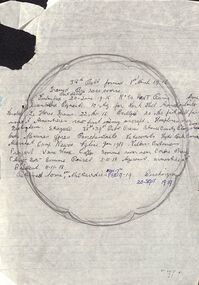
... Bendigo. He left school aged nine to work on a local farm. Later, he worked for his uncles in the Mallee. On 24 March 1916, he travelled to Mildura to enlist in the Australian Imperial Force. He served in France with the 38th Battalion, earning promotion to sergeant and was discharged on 20 September 1919. https://en.wikipedia.org/wiki/Jack_Lockett The 38th Battalion was formed on 1 March 1916 at a camp established on the Epsom Racecourse...Bendigo. He left school aged nine to work on a local farm. Later, he worked for his uncles in the Mallee. On 24 March 1916, he travelled to Mildura to enlist in the Australian Imperial Force. He served in France with the 38th Battalion, earning promotion to sergeant and was discharged on 20 September 1919. https://en.wikipedia.org/wiki/Jack_Lockett The 38th Battalion was formed on 1 March 1916 at a camp established on the Epsom Racecourse at Bendigo in Victoria. ...John Henry Lockett OAM (22 January 1891 – 25 May 2002) was the oldest man ever in Australia when he died aged 111 years, 123 days. As one of the last surviving veterans of World War I, he was acclaimed as a national hero during the last decade of his life. Lockett was born in the small Victorian town of Waanyarra, near Bendigo. He left school aged nine to work on a local farm. Later, he worked for his uncles in the Mallee. On 24 March 1916, he travelled to Mildura to enlist in the Australian Imperial Force. He served in France with the 38th Battalion, earning promotion to sergeant and was discharged on 20 September 1919. https://en.wikipedia.org/wiki/Jack_Lockett The 38th Battalion was formed on 1 March 1916 at a camp established on the Epsom Racecourse at Bendigo in Victoria. After training in both Australia and Britain, the 38th Battalion crossed to France in late November 1916 and moved into the trenches of the Western Front for the first time on 1 December.The 38th fought in its first major battle at Messines, in Belgium, between 7-9 June 1917. It fought in another two major attacks in this sector - the battle of Broodseinde on 4 October, and the battle of Passchendaele on 12 October. Belgium remained the focus of the 38th Battalion's activities for the next five months, until it was rushed south to France in late March 1918 to meet the German Army's Spring Offensive. The 38th participated in its last major action of the war between 29 September and 2 October 1918 as part of the Australian-American operation that breached the formidable defences of the Hindenburg Line along the St Quentin Canal. It was disbanded in April 1919. Source, Australian War Memorial https://www.awm.gov.au/collection/U51478 After the war, Jack returned to The Mallee and selected a 640 acres (260 ha) block of land in Linga, Victoria, deciding to make his living as a farmer. In 1923, he married Maybell Ingwerson and they had four children together. In 1963, the couple retired to Bendigo, leaving the farmland (which now covered more than 130,000 acres (53,000 ha), in the care of their children and grandchildren. An A blue-lined A4 page with black ink handwriting. A brief history of the 38th Battalion A.I.F. from when it was formed 1st March 1916 until returning home on 17th February 1919. A decorated circle is drawn with pencil over the handwriting jack lockett, mabel ingwersen, 38th australian infantry battalion, w.w.1, mallee farming, h.m.a.t. runic, gas masks -
 Bendigo Historical Society Inc.
Letter - Jack Lockett Collection: Letter Re Mission to France 1993
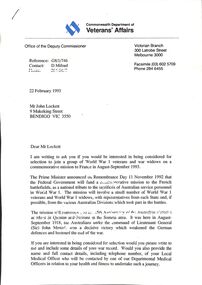
... Bendigo. He left school aged nine to work on a local farm. Later, he worked for his uncles in the Mallee. On 24 March 1916, he travelled to Mildura to enlist in the Australian Imperial Force. He served in France with the 38th Battalion, earning promotion to sergeant and was discharged on 20 September 1919. https://en.wikipedia.org/wiki/Jack_Lockett The 38th Battalion was formed on 1 March 1916 at a camp established on the Epsom Racecourse...Bendigo. He left school aged nine to work on a local farm. Later, he worked for his uncles in the Mallee. On 24 March 1916, he travelled to Mildura to enlist in the Australian Imperial Force. He served in France with the 38th Battalion, earning promotion to sergeant and was discharged on 20 September 1919. https://en.wikipedia.org/wiki/Jack_Lockett The 38th Battalion was formed on 1 March 1916 at a camp established on the Epsom Racecourse at Bendigo in Victoria. ...John Henry Lockett OAM (22 January 1891 – 25 May 2002) was the oldest man ever in Australia when he died aged 111 years, 123 days. As one of the last surviving veterans of World War I, he was acclaimed as a national hero during the last decade of his life. Lockett was born in the small Victorian town of Waanyarra, near Bendigo. He left school aged nine to work on a local farm. Later, he worked for his uncles in the Mallee. On 24 March 1916, he travelled to Mildura to enlist in the Australian Imperial Force. He served in France with the 38th Battalion, earning promotion to sergeant and was discharged on 20 September 1919. https://en.wikipedia.org/wiki/Jack_Lockett The 38th Battalion was formed on 1 March 1916 at a camp established on the Epsom Racecourse at Bendigo in Victoria. After training in both Australia and Britain, the 38th Battalion crossed to France in late November 1916 and moved into the trenches of the Western Front for the first time on 1 December.The 38th fought in its first major battle at Messines, in Belgium, between 7-9 June 1917. It fought in another two major attacks in this sector - the battle of Broodseinde on 4 October, and the battle of Passchendaele on 12 October. Belgium remained the focus of the 38th Battalion's activities for the next five months, until it was rushed south to France in late March 1918 to meet the German Army's Spring Offensive. The 38th participated in its last major action of the war between 29 September and 2 October 1918 as part of the Australian-American operation that breached the formidable defences of the Hindenburg Line along the St Quentin Canal. It was disbanded in April 1919. Source, Australian War Memorial https://www.awm.gov.au/collection/U51478 After the war, Jack returned to The Mallee and selected a 640 acres (260 ha) block of land in Linga, Victoria, deciding to make his living as a farmer. In 1923, he married Maybell Ingwerson and they had four children together. In 1963, the couple retired to Bendigo, leaving the farmland (which now covered more than 130,000 acres (53,000 ha), in the care of their children and grandchildren. A typed letter on two A4 pages to Jack Lockett Sent from the Commonwealth Department of Veterans Affairs, Office of the Deputy Commissioner, 22 February asking Jack if he wished to be considered for selection to join a commemorative mission to France in August - September 1993. Signed Brian Flynn DEPUTY COMMISSIONER jack lockett, mabel ingwersen, 38th australian infantry battalion, w.w.1, mallee farming, commemorative mission to france 1993, brian flynn -
 Bendigo Historical Society Inc.
Letter - Jack Lockett Collection: Letter Re Person profiles of W.W.1 veterans
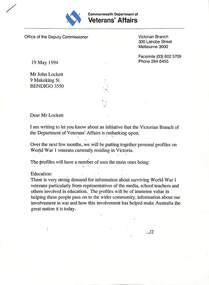
... Bendigo. He left school aged nine to work on a local farm. Later, he worked for his uncles in the Mallee. On 24 March 1916, he travelled to Mildura to enlist in the Australian Imperial Force. He served in France with the 38th Battalion, earning promotion to sergeant and was discharged on 20 September 1919. https://en.wikipedia.org/wiki/Jack_Lockett The 38th Battalion was formed on 1 March 1916 at a camp established on the Epsom Racecourse...Bendigo. He left school aged nine to work on a local farm. Later, he worked for his uncles in the Mallee. On 24 March 1916, he travelled to Mildura to enlist in the Australian Imperial Force. He served in France with the 38th Battalion, earning promotion to sergeant and was discharged on 20 September 1919. https://en.wikipedia.org/wiki/Jack_Lockett The 38th Battalion was formed on 1 March 1916 at a camp established on the Epsom Racecourse at Bendigo in Victoria. ...John Henry Lockett OAM (22 January 1891 – 25 May 2002) was the oldest man ever in Australia when he died aged 111 years, 123 days. As one of the last surviving veterans of World War I, he was acclaimed as a national hero during the last decade of his life. Lockett was born in the small Victorian town of Waanyarra, near Bendigo. He left school aged nine to work on a local farm. Later, he worked for his uncles in the Mallee. On 24 March 1916, he travelled to Mildura to enlist in the Australian Imperial Force. He served in France with the 38th Battalion, earning promotion to sergeant and was discharged on 20 September 1919. https://en.wikipedia.org/wiki/Jack_Lockett The 38th Battalion was formed on 1 March 1916 at a camp established on the Epsom Racecourse at Bendigo in Victoria. After training in both Australia and Britain, the 38th Battalion crossed to France in late November 1916 and moved into the trenches of the Western Front for the first time on 1 December.The 38th fought in its first major battle at Messines, in Belgium, between 7-9 June 1917. It fought in another two major attacks in this sector - the battle of Broodseinde on 4 October, and the battle of Passchendaele on 12 October. Belgium remained the focus of the 38th Battalion's activities for the next five months, until it was rushed south to France in late March 1918 to meet the German Army's Spring Offensive. The 38th participated in its last major action of the war between 29 September and 2 October 1918 as part of the Australian-American operation that breached the formidable defences of the Hindenburg Line along the St Quentin Canal. It was disbanded in April 1919. Source, Australian War Memorial https://www.awm.gov.au/collection/U51478 After the war, Jack returned to The Mallee and selected a 640 acres (260 ha) block of land in Linga, Victoria, deciding to make his living as a farmer. In 1923, he married Maybell Ingwerson and they had four children together. In 1963, the couple retired to Bendigo, leaving the farmland (which now covered more than 130,000 acres (53,000 ha), in the care of their children and grandchildren. A typed letter on two A4 pages to Jack Lockett sent from the Commonwealth Department of Veterans Affairs, Office of the Deputy Commissioner, 19 May 1994. It's asking if he would be part of program putting together personal profiles on World War 1 veterans currently residing in Victoria. Signed Brian Flynn, DEPUTY COMMISSIONER jack lockett, mabel ingwersen, 38th australian infantry battalion, w.w.1, mallee farming, profile of w.w.1 veterans, brian flynn -
 Bendigo Historical Society Inc.
Memorabilia - Jack Lockett Collection: Copy of Roll of Honor
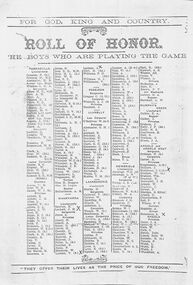
... Bendigo. He left school aged nine to work on a local farm. Later, he worked for his uncles in the Mallee. On 24 March 1916, he travelled to Mildura to enlist in the Australian Imperial Force. He served in France with the 38th Battalion, earning promotion to sergeant and was discharged on 20 September 1919. https://en.wikipedia.org/wiki/Jack_Lockett The 38th Battalion was formed on 1 March 1916 at a camp established on the Epsom Racecourse...Bendigo. He left school aged nine to work on a local farm. Later, he worked for his uncles in the Mallee. On 24 March 1916, he travelled to Mildura to enlist in the Australian Imperial Force. He served in France with the 38th Battalion, earning promotion to sergeant and was discharged on 20 September 1919. https://en.wikipedia.org/wiki/Jack_Lockett The 38th Battalion was formed on 1 March 1916 at a camp established on the Epsom Racecourse at Bendigo in Victoria. ...John Henry Lockett OAM (22 January 1891 – 25 May 2002) was the oldest man ever in Australia when he died aged 111 years, 123 days. As one of the last surviving veterans of World War I, he was acclaimed as a national hero during the last decade of his life. Lockett was born in the small Victorian town of Waanyarra, near Bendigo. He left school aged nine to work on a local farm. Later, he worked for his uncles in the Mallee. On 24 March 1916, he travelled to Mildura to enlist in the Australian Imperial Force. He served in France with the 38th Battalion, earning promotion to sergeant and was discharged on 20 September 1919. https://en.wikipedia.org/wiki/Jack_Lockett The 38th Battalion was formed on 1 March 1916 at a camp established on the Epsom Racecourse at Bendigo in Victoria. After training in both Australia and Britain, the 38th Battalion crossed to France in late November 1916 and moved into the trenches of the Western Front for the first time on 1 December.The 38th fought in its first major battle at Messines, in Belgium, between 7-9 June 1917. It fought in another two major attacks in this sector - the battle of Broodseinde on 4 October, and the battle of Passchendaele on 12 October. Belgium remained the focus of the 38th Battalion's activities for the next five months, until it was rushed south to France in late March 1918 to meet the German Army's Spring Offensive. The 38th participated in its last major action of the war between 29 September and 2 October 1918 as part of the Australian-American operation that breached the formidable defences of the Hindenburg Line along the St Quentin Canal. It was disbanded in April 1919. Source, Australian War Memorial https://www.awm.gov.au/collection/U51478 After the war, Jack returned to The Mallee and selected a 640 acres (260 ha) block of land in Linga, Victoria, deciding to make his living as a farmer. In 1923, he married Maybell Ingwerson and they had four children together. In 1963, the couple retired to Bendigo, leaving the farmland (which now covered more than 130,000 acres (53,000 ha), in the care of their children and grandchildren. An A4 photocopy of a ROLL OF HONOR for people who served in World War 1, with names from the towns of TARNAGULLA, WAANYARRA including (marked with a X) Lockett J.H., Lockett T., Lockett J., LLANELLY, LAAANECOORIE, NEWBRIDGE, MURPHY'S CREEK, ARNOLD and ARNOLD WEST including (marked with a X) Metelman J.C., Metelman A and RHEOLA jack lockett, mabel ingwersen, 38th australian infantry battalion, w.w.1, mallee farming -
 Bendigo Military Museum
Newspaper, The 2/22 Echo, C.1940
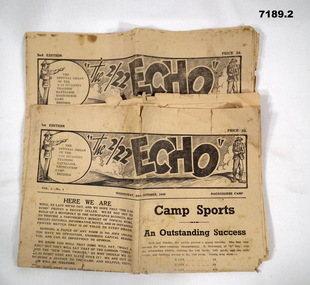
... The "Echo" was a small newspaper issued by the 2/22nd Infantry Training Battalion based at the racecourse camp at Epsom, Bendigo. Purpose of camp was to train new recruits and feed them into the Infantry Battalion itself. ...The "Echo" was a small newspaper issued by the 2/22nd Infantry Training Battalion based at the racecourse camp at Epsom, Bendigo. Purpose of camp was to train new recruits and feed them into the Infantry Battalion itself. ...The "Echo" was a small newspaper issued by the 2/22nd Infantry Training Battalion based at the racecourse camp at Epsom, Bendigo. Purpose of camp was to train new recruits and feed them into the Infantry Battalion itself. Aim of the newspaper would be as a conduit of official information and for local morale.News sheets issued by Training Battalion titled the 2/22 Echo. Content includes lots of advertisements, social occasions, Official Military business. Both are 8 pages long on yellowed paper and writing in black. 1: 1st Edition date Wed 22nd Oct 1940 with part of pages 6 & 7 missing. 2. 2nd Edition dated Thursday 7th Nov 1940.2/22 battalion, ww2, newspaper -
 Bendigo Historical Society Inc.
Certificate - IAN DYETT COLLECTION: Knighthood Certificate
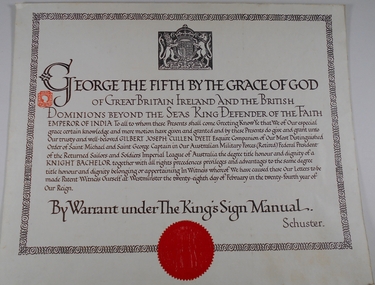
... Bendigo, at the age of 14 he started working for J H Curnow Real Estate and Auction rooms. In March 1915 he was commissioned as Lieutenant in the 7th Battalion and was badly wounded at Lone Pine, Gallipoli. After the war he was prominent in many organizations including Anzac Remembrance Appeal, Ocean Road Trust, Returned Services League, Australian War Memorial, Racecourse Licences Board of Victoria, Victoria Trotting and Racing Association (which was largely controlled by John Wren) He was caricatured as Captain Dwyer by Frank Hardy in his novel Power without Glory. ...Bendigo, at the age of 14 he started working for J H Curnow Real Estate and Auction rooms. In March 1915 he was commissioned as Lieutenant in the 7th Battalion and was badly wounded at Lone Pine, Gallipoli. After the war he was prominent in many organizations including Anzac Remembrance Appeal, Ocean Road Trust, Returned Services League, Australian War Memorial, Racecourse Licences Board of Victoria, Victoria Trotting and Racing Association (which was largely controlled by John Wren) He was caricatured as Captain Dwyer by Frank Hardy in his novel Power without Glory. ...Sir Gilbert Joseph Cullen Dyett (1891-1964) was born in Bendigo, at the age of 14 he started working for J H Curnow Real Estate and Auction rooms. In March 1915 he was commissioned as Lieutenant in the 7th Battalion and was badly wounded at Lone Pine, Gallipoli. After the war he was prominent in many organizations including Anzac Remembrance Appeal, Ocean Road Trust, Returned Services League, Australian War Memorial, Racecourse Licences Board of Victoria, Victoria Trotting and Racing Association (which was largely controlled by John Wren) He was caricatured as Captain Dwyer by Frank Hardy in his novel Power without Glory. HE was Knighted in 1934. Died in Fitzroy in1964 and is buried in Bendigo. Ref. Australian Dictionary of Biography. https://adb.anu.edu.au/biography/dyett-sir-gilbert-joseph-cullen-6071 Knighthood Certificate awarded to Gilbert Joseph Cullen Dyett. By Warrant under the King's Sign Manual. Handwritten in black ink on cream coloured light card and mounted on brown coloured card. Red seal of King George the Fifth centred on bottom edge. The back has marks around the edge indicating that that the mounted certificate has been removed from a frame.certificate, knighthood, gilbert dyett, george the fifth -
 Bendigo Historical Society Inc.
Ephemera - Guest Pass to Warrnambool Racing Club, 1999
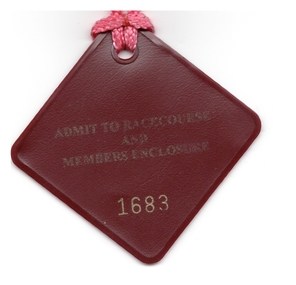
... Bendigo attached to a lanyard. On the front is "Warrnambool Racing Club Inc Guest 1989-2000." On the rear is "Admit to Racecourse and Member's Lounge 1683."...Bendigo attached to a lanyard. On the front is "Warrnambool Racing Club Inc Guest 1989-2000." On the rear is "Admit to Racecourse and Member's Lounge 1683." ...Barry Lyons owned and managed the Windemere Hotel in Kangaroo Flat along with his wife Betty. Barry was a long time member of the Lions Club of Kangaroo Flat. Barry served as a Bendigo City Councillor from 2008 to 2016, and as Mayor in 2013 - 2014. Plastic Guest Pass, collected and owned by Barry Lyons of Bendigo attached to a lanyard. On the front is "Warrnambool Racing Club Inc Guest 1989-2000." On the rear is "Admit to Racecourse and Member's Lounge 1683."bendigo, barry and betty lyons, windemere hotel kangaroo flat, lions club kangaroo flat, warrnambool racing club -
 Bendigo Historical Society Inc.
Newspaper - LONG GULLY HISTORY GROUP COLLECTION: BENDIGO'S CENTURY VOLUME FIVE: 1940 - 1949
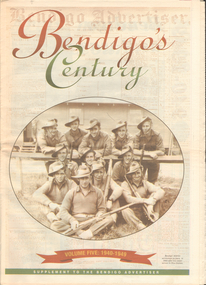
... Bendigo as it was. It has two photos of women wading through the 1949 Pall Mall flood waters and one of Miners in the crib room of the Central Deborah Mine. They are Jackie Lewis, Bob Johnson, W Landy, Ryga Yates and Les Johnson. 1940 - Army moves in to racecourse, 1941 - Devastating fire at pottery, 1942 - Forces expand, 1943 - Nation's eyes on Bendigo, 1944 - News dawns of D-day landing, 1945 - City cheers the end of the war, 1946 - Celebrations begin in city, 1947 - Gallery gets top paintings, 1948 - Water plan looks good and 1949 - Flood takes a toll on city....Bendigo as it was. It has two photos of women wading through the 1949 Pall Mall flood waters and one of Miners in the crib room of the Central Deborah Mine. They are Jackie Lewis, Bob Johnson, W Landy, Ryga Yates and Les Johnson. 1940 - Army moves in to racecourse, 1941 - Devastating fire at pottery, 1942 - Forces expand, 1943 - Nation's eyes on Bendigo, 1944 - News dawns of D-day landing, 1945 - City cheers the end of the war, 1946 - Celebrations begin in city, 1947 - Gallery gets top paintings, 1948 - Water plan looks good and 1949 - Flood takes a toll on city. ...Newspaper supplement titled Bendigo's Century Volume Five: 1940 - 1949. Each year has heading of Who's Who, Weather, Sport and Business. Front page is titled Bendigo's Century and has a photo of a group of soldiers in uniform and with rifles. They were district servicemen on leave in 1944. Each year has heading of Who's Who, Weather, Sport and Business. First years are 1940 - 1949 titled Bendigo as it was. It has two photos of women wading through the 1949 Pall Mall flood waters and one of Miners in the crib room of the Central Deborah Mine. They are Jackie Lewis, Bob Johnson, W Landy, Ryga Yates and Les Johnson. 1940 - Army moves in to racecourse, 1941 - Devastating fire at pottery, 1942 - Forces expand, 1943 - Nation's eyes on Bendigo, 1944 - News dawns of D-day landing, 1945 - City cheers the end of the war, 1946 - Celebrations begin in city, 1947 - Gallery gets top paintings, 1948 - Water plan looks good and 1949 - Flood takes a toll on city.bendigo, history, long gully history group, the long gully history group - bendigo's century - volume five: 1940 - 1949, bendigo advertiser, central deborah mine, jackie lewis, bob johnson, w landy, ryga yates, les johnson, central nell gwynne, department of defence, bendigo jockey club, 8th division, robert menzies, deborah mine, bendigo decentralisation vigilance committee, cr w h taylor, bendigo war funds organisation, the easter fair society, bendigo agricultural show committee, mr e g ham, mr j v fairbairn, cr a staples, the bendigo chamber of commerce, richard hartley smith abbott, captain harley abbott, bendigo art gallery, bill woodfull, bendigo high school, north deborah mine, boardwalk, toni riley pharmacy, windermere hotel, cr g a pethard, coliban system, north deborah mine, bendigo pottery, bendigo trades hall council, private lawrence burstall, major-general g j rankin mhr, andrew dunstan, ordnance factory, royal australian navy, hmas bendigo, sec offices, muioof, ymca, georger addlem, fred addlem, cr a j anderson, pauline buvhan thompson, leslie thompson, edward joseph leonski, bendigo football league, mr j dedman, william stephens, forest street methodist church, pte charles phillips, pte w e durward, pte t foley, william john stephens, central nell gwynne, air chief marshall sir arthur tedder, cr taylor, united nations, flying officer, r bruce tuff, flight lieutenant owens, royal air force, commonwealth war workers housing trust scheme, mr s mckinnon, bendigo decentralised vigilance committee, ravenswood estate, john lienhop mlc, margaret (peggy) brennan, strathfieldsaye shire council, school of mines, bendigo base hospital, william george ashman, ashman's tailors, bendigo jockey club, victorian football association, bendigo east swimming pool, deborah anticline, specimen hill methodist church, north deborah, adolf hitler, benito mussolini, australian 7th division, cr galvin, bendigo war funds organisation, hmas bendigo, lt-commander jackson, bendigo football league, central deborah mine, victoria day, cr truscott, bendigo gaol, lansellstowe, awas barracks, bendigo citizens committee, john cain snr, ordnance factory, bendigo agricultural society, the duke of gloucester, duchess of gloucester, bendigo tennis association, north deborah, gillies famous pies, aids & appliance shop, mrs georgina scott, dr j a neptune scott, alfred sisley, corot, daubigney, louis sonnenberg, gas employees' union, john lienhop, soldier settlement commission, burnewang estate, king george vi, princess elizabeth, lt philip mountbatten, mr e j w herbert, ansett airways, reg ansett, most rev, dr john mccarthy, dr bernard stewart, michael giudice, bendigo united breweries, bendigo lyric photo plays, bendigo sun newspaper, shamrock hotel, west bendigo progress association, alan mcdonald, south bendigo football club, albert collier, j t webbo, mervyn tresize, state rivers and water supply commission, eppalock reservoir, public works committee, bendigo rotary club, john edgar, bendigo base hospital, albert dunstan, benevolent home, magetti's wine hall, wallace reef wine hall, magetti family, albert magetti, lance galvin, bradford cotton spinnings (victoria) pty otd, arthur syer, stanley crossman, albert arthur dunstan, rev dr henry backhaus, city family hotel, lyric theatre, bank of australasia, city club hotelcolonial mutual building, r matchett & co, lansellstowe, leonard lansell, bendigo bas hospital, australian women's army service, mr hollway, kenworth (aust) ltd, foggitt jones's bacon factory, gordon sayers, sandhurst trustees, dr john drowley, alexander hislop, royal mint, north deborah mine, ironbark south mining company, central nell gwynne company, new chum syncline -
 Bendigo Historical Society Inc.
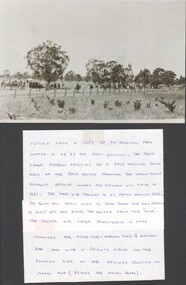
Document - Marong racecourse
... racecourse fronting the Loddon Valley Highway opposite where Mrs. Grimson was living in 1985. The photo was thought to be taken around 1920? The Swan Hill train used to slow down for race patrons to jump off and enter the course from the "rear". The course was later transferred to land fronting the Myers Flat - Marong Road & Williams Road and with a railway siding on the Bendigo...racecourse fronting the Loddon Valley Highway opposite where Mrs. Grimson was living in 1985. The photo was thought to be taken around 1920? The Swan Hill train used to slow down for race patrons to jump off and enter the course from the "rear". The course was later transferred to land fronting the Myers Flat - Marong Road & Williams Road and with a railway siding on the Bendigo ...Copied from a copy of an original photo loaned to me by Mrs. Jean Grimson. The photo shows patrons arriving at a race meeting being held at the racecourse fronting the Loddon Valley Highway opposite where Mrs. Grimson was living in 1985. The photo was thought to be taken around 1920? The Swan Hill train used to slow down for race patrons to jump off and enter the course from the "rear". The course was later transferred to land fronting the Myers Flat - Marong Road & Williams Road and with a railway siding on the Bendigo side of the railway crossing Myers flat (behind the Allies Hotel). Fron Q. C. Binks 29/01/2001.historic referenceHistoric photo circa 1920.race goers entering marong racecourse circa 1920, races
