



Historical information
John Henry Lockett OAM (22 January 1891 – 25 May 2002) was the oldest man ever in Australia when he died aged 111 years, 123 days. As one of the last surviving veterans of World War I, he was acclaimed as a national hero during the last decade of his life. Lockett was born in the small Victorian town of Waanyarra, near Bendigo. He left school aged nine to work on a local farm. Later, he worked for his uncles in the Mallee. On 24 March 1916, he travelled to Mildura to enlist in the Australian Imperial Force. He served in France with the 38th Battalion, earning promotion to sergeant and was discharged on 20 September 1919. https://en.wikipedia.org/wiki/Jack_Lockett
The 38th Battalion was formed on 1 March 1916 at a camp established on the Epsom Racecourse at Bendigo in Victoria. After training in both Australia and Britain, the 38th Battalion crossed to France in late November 1916 and moved into the trenches of the Western Front for the first time on 1 December.The 38th fought in its first major battle at Messines, in Belgium, between 7-9 June 1917. It fought in another two major attacks in this sector - the battle of Broodseinde on 4 October, and the battle of Passchendaele on 12 October. Belgium remained the focus of the 38th Battalion's activities for the next five months, until it was rushed south to France in late March 1918 to meet the German Army's Spring Offensive. The 38th participated in its last major action of the war between 29 September and 2 October 1918 as part of the Australian-American operation that breached the formidable defences of the Hindenburg Line along the St Quentin Canal. It was disbanded in April 1919.
Source, Australian War Memorial https://www.awm.gov.au/collection/U51478
After the war, Jack returned to The Mallee and selected a 640 acres (260 ha) block of land in Linga, Victoria, deciding to make his living as a farmer. In 1923, he married Maybell Ingwerson and they had four children together. In 1963, the couple retired to Bendigo, leaving the farmland (which now covered more than 130,000 acres (53,000 ha), in the care of their children and grandchildren.
Physical description
Five photographs including Jack Lockett
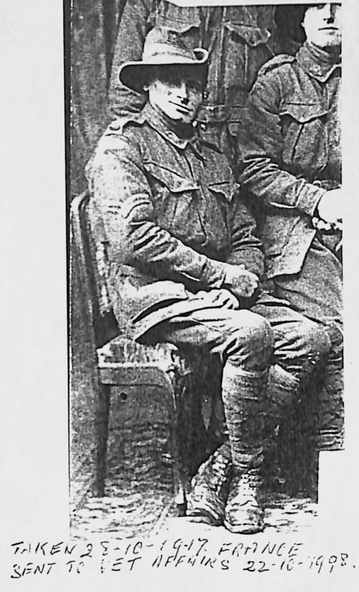
a. A photocopy of part of a group photograph, Jack sitting on a chair wearing an Australian Army Uniform. Written underneath - Teken 25-10-1917 France sent to Vet affairs 22-10-1998
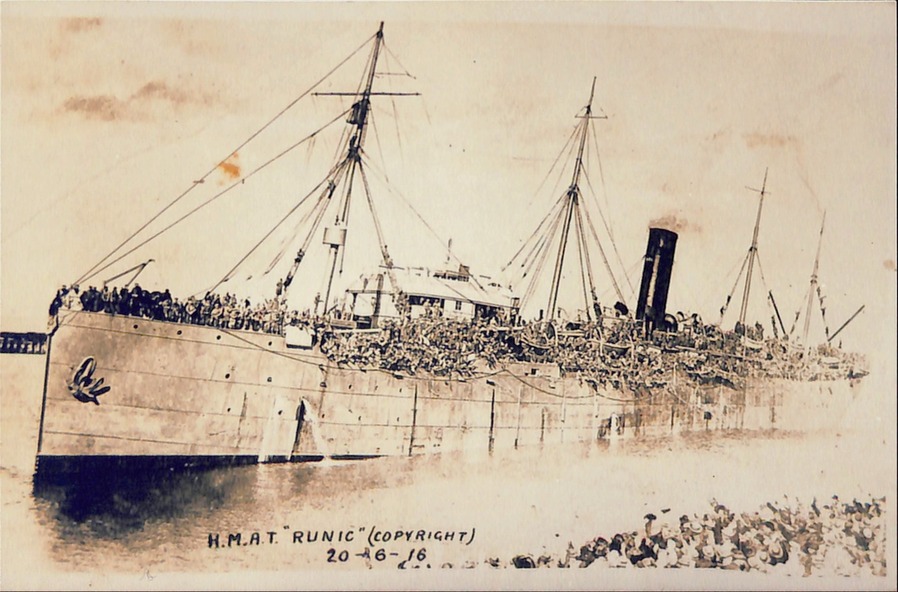
b. A black and white photograph of a ship crowed with people on deck with printing - H.M.A.T. "RUNIC" (copyright) 20/6/16 written on the back in blue ink - Private Jack Locket No 1194 D Company 38th Battalion A.I.F. left Port Melbourne pier on Tues 20 June 1916 aboard H.M.A.T. RUNIC bound for England via South Africa. He was below deck peering out of a porthole when the boat pulled away from the pier, as he had the job of guarding some supplies. the arrived in England on (sic)
Returning to Australia on Miltides on Mon 17th Feb 1919 as a Sargent Discharged 20 SEPT 1919
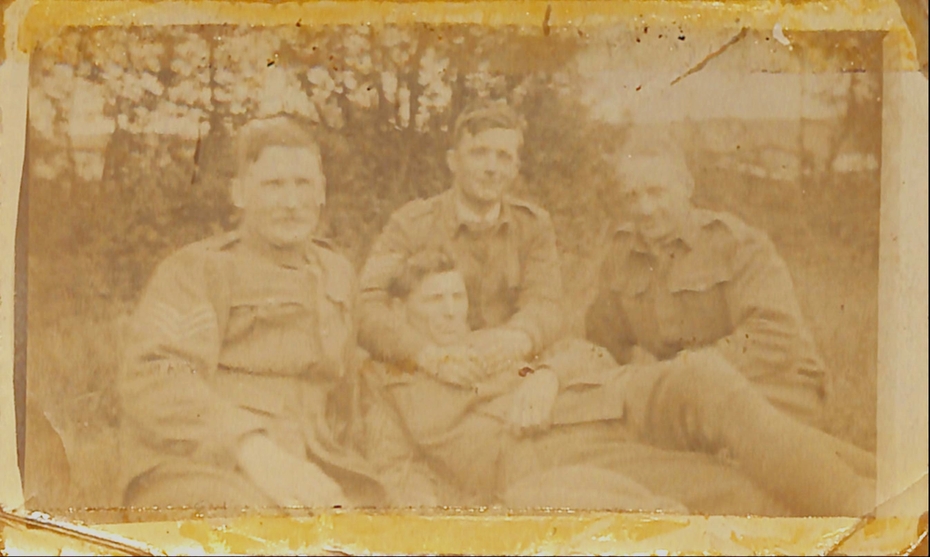
c. A very faded sepia tone photograph of four men in Army Uniforms without hats. three sitting and Jack Lockett lying on the man in the middle. Written on the back - JACK LOCKETT LYING ON ONE of His 3 MATES NAMES UNKNOWN FIRST AIF 1914 -1918 GREAT WAR
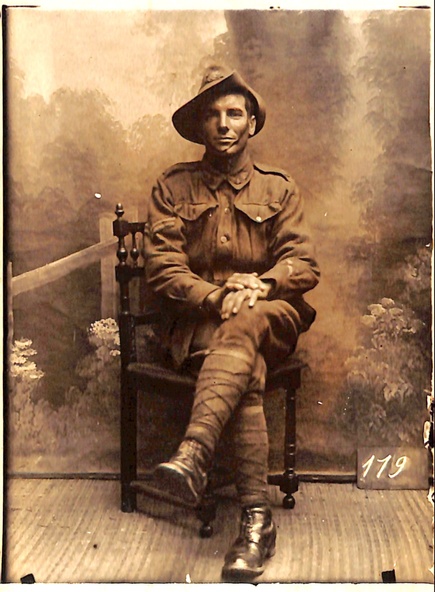
d. A black and white postcard of Jack Lockett in an Australian Army Uniform sitting cross legged in a chair with an image of a forest behind him. Written on the back J H LOCKETT D COY 38 BATT 3DIV NO1194 1stAIF FRANCE
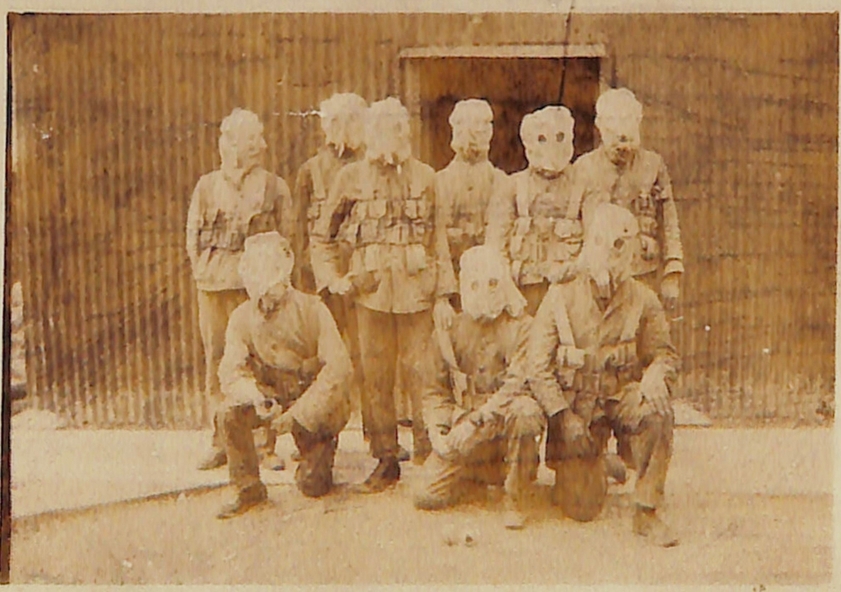
e. c. A very faded sepia tone photograph of nine men in Army Uniforms wearing gas masks, six men standing, four men Kneeling in front. Behind them there is a corrugated-iron building. Written on the back - FIRST GAS MASKS W.W. 1 JACK LOCKET 2nd RIGHT STANDING
