
Showing 5 items matching "bendigo town hall. historic buildings."
-
 Bendigo Historical Society Inc.
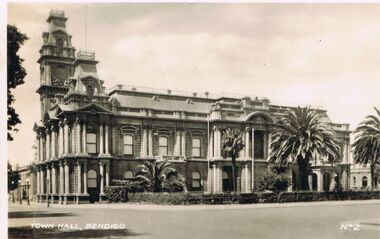
Photograph - VIEWS OF BENDIGO : NO. 2 : TOWN HALL, BENDIGO : UNDATED, 1900's
... town hall...Bendigo Town Hall. Historic buildings....BENDIGO Streetscape town hall Bendigo Town Hall. Historic buildings. Views of Bendigo. ...Views of Bendigo. No. 2 of a series of sixteen photographs of Bendigo. Nos. 6 and 7 in the series are missing. Black and white photograph, undated, of the Town Hall, Bendigo with the name written in the bottom left corner.bendigo, streetscape, town hall, bendigo town hall. historic buildings. -
 Bendigo Historical Society Inc.
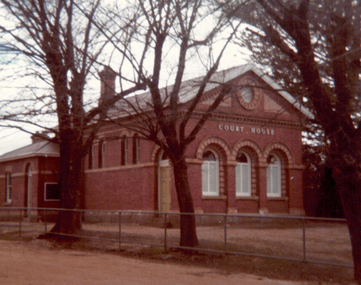
Document - National Trust Collection: Eaglehawk Court House and Mechanics Institute, 1977
... Bendigo. Much of Eaglehawk's historic built fabric has been retained history National Trust Bendigo Collection Eaglehawk Court House Eaglehawk Mechanics Institute Eaglehawk Post Office Eaglehawk Town Hall bendigo National Trust Identification Data Forms and Photos for the Eaglehawk Court House and Mechanics Institutes, July 1977. National Trust Survey. This item contains the following 10 documents: 3084.39a National Trust Survey form for the Eaglehawk Court House 1977; from the National Trust of Australia (Victoria) used to collect detailed historical and structural information about buildings ...Eaglehawk is a hilly district, eight kilometres beyond central Bendigo, with many quartz lodes. The origin of its name is uncertain. It may have been named by a shepherd who killed an eaglehawk which attacked sheep, or by an early goldminer who observed an eaglehawk. Gold was discovered at Bendigo (Sandhurst) in October, 1851, and the gold-bearing land extended several kilometres north-west of Bendigo beyond Eaglehawk. One well-known goldfield was Eaglehawk Gully, dating from 1852. The community at Eaglehawk soon began to develop. On 29 July 1862 the Borough of Eaglehawk formed and in 1865 a Town Hall opened. By 1871 the population of Eaglehawk was 6,590. In 1887, when George Willan was Mayor, the Borough issued medals for Queen Victoria's jubilee (NU 20204-5 ), and in 1897, when E.C. Brown was Mayor, it again issued medals for Queen Victoria's diamond jubilee (NU 20453). The same year moves began to build a new Town Hall, but it took until 1901 for funds to be raised and construction to be completed. Further growth occurred in both the community and social institutions, and by 1903 the the population was 8,130. By then Eaglehawk was connected to Bendigo by steam tramway, and boasted post and money order facilities, three banks and a telegraph office. It had 'numerous hotels', three state schools, two private schools, nine churches, a court of petty sessions, a police station, two mechanics institutes, several organised societies and a park 'hansomely laid out with flower beds and shrubs'. The 'model borough' had 1,862 houses, and streets lit partly with gas and partly with kerosene. By 1947 the decline in gold mining had caused the population to fall to 4,090. Bendigo became more dominant as an employment centre. However, Eaglehawk still had nine hotels and as well had acquired an electric tram and public baths. The population reached its turn-of-the-century level again in 1991. On 7 April 1994, the Borough of Eaglehawk was united with the City of Bendigo, the Shires of Huntly and Strathfieldsaye, and the Borough of Eaglehawk, parts of the Rural City of Marong, the Shires of McIvor and Metcalf to form the City of Greater Bendigo. By then the borough had become physically joined with suburban Bendigo. Much of Eaglehawk's historic built fabric has been retainedNational Trust Identification Data Forms and Photos for the Eaglehawk Court House and Mechanics Institutes, July 1977. National Trust Survey. This item contains the following 10 documents: 3084.39a National Trust Survey form for the Eaglehawk Court House 1977; from the National Trust of Australia (Victoria) used to collect detailed historical and structural information about buildings or properties. 3084.39b Photo of Eaglehawk Court House 1977 3084.39c Photo of Eaglehawk Court House 1977 3084.39d National Trust Survey form for the Eaglehawk Mechanics Institute 1977 3084.39e Photo of the Eaglehawk Mechanics Institute 1977 3084.39f Photo of the Eaglehawk Mechanics Institute 1977 3084.39g Photo of the Eaglehawk Mechanics Institute 1977 3084.39h Photo of the Eaglehawk Post Office 1977 3084.39i Photo of the Eaglehawk Post Office 1977 3084.39j Photo of the Eaglehawk Town Hall 1977history, national trust bendigo collection, eaglehawk court house, eaglehawk mechanics institute, eaglehawk post office, eaglehawk town hall, bendigo -
 Bendigo Historical Society Inc.
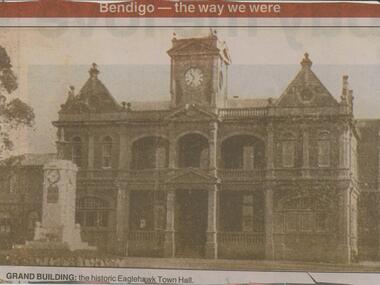
Newspaper - JENNY FOLEY COLLECTION: GRAND BUILDING
... Bendigo Advertiser ''The way we were'' from 2001. Grand building: the historic Eaglehawk Town Hall. ...NEWSPAPER Bendigo advertiser the way we were Bendigo Advertiser ''The way we were'' from 2001. Grand building: the historic Eaglehawk Town Hall. ...Bendigo Advertiser ''The way we were'' from 2001. Grand building: the historic Eaglehawk Town Hall. The clip is in a folder.newspaper, bendigo advertiser, the way we were -
 Bendigo Historical Society Inc.
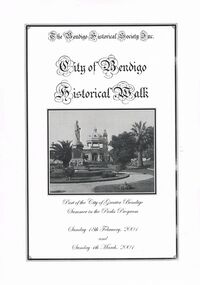
Book - CITY OF BENDIGO HISTORICAL WALK BOOK, 2001
... 'City of Bendigo Historical Walk' containing photographs of historic buildings to be seen on the walk. Front cover Queen Victorian Gardens, Town hall, Mechanics Institute/School Of Mines and Industry, H. ...Bendigo buildings historic Photocopy mock up of original booklet of The Bendigo Historical Society Inc. 'City of Bendigo Historical Walk' containing photographs of historic buildings to be seen on the walk. Front cover Queen Victorian Gardens, Town hall ...Photocopy mock up of original booklet of The Bendigo Historical Society Inc. 'City of Bendigo Historical Walk' containing photographs of historic buildings to be seen on the walk. Front cover Queen Victorian Gardens, Town hall, Mechanics Institute/School Of Mines and Industry, H. M. Prison Bendigo, Camp Hill Police Barracks, Sandhurst Corporate High School, Central State School No. 1976, The Cascades, District Lands Office (Dudley House), Masonic Temple and Hall, Sandhurst Volunteer Rifle Brigade Orderly Room, Bank of Victoria, Henry Jackson's Store View Point,Alexandra Fountain, Beehive Store/Mining Exchange, Colonial Bank. Hustlers Royal Reserve NO. 2/R.S.L. Memorial Hall, Post Office 3rd 4th and final, Bendigo Law Courts, Shamrock Hotel 2nd and another view. Important Bendigo Dates; 1851, April gold discovered at Golden Square by Margaret Kennedy,1851 Approx. 200,000Troy oz. of gold found in Bendigo, 1852 475,857 Troy oz. Gold for the year, 1853 November 31st Bendigo Hospital admits first patient,1853 December 9th Bendigo Advertiser first issue printed, 1854 First Land Sales and streets are surveyed and named for the first time, 1854 Census of Bendigo showed 15,480 residents plus 4,000 Chinese, 1855 Sandhurst Municipal District formed, 1861 Sandhurst Proclaimed a Town. 1862 Railway to Melbourne opened, 1867 Visit by His Royal Highness the Duke of Edinburgh, 1871 July 21st Sandhurst proclaimed a City, 1881 Population of Sandhurst 14,577 residents, 1882 First telephone communications introduced, 1890 Electric trams (battery) commenced running, 1891 May 18th City of Sandhurst changes its name to City of Bendigo.book, bendigo, buildings, historic -
 Bendigo Historical Society Inc.
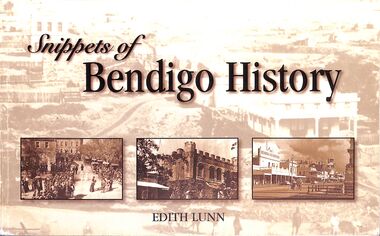
Book - "Snippets of Bendigo History", 2006
... The wealth generated during this period is reflected in Bendigo’s Victorian architecture, including the Town Hall and historic buildings. ...The wealth generated during this period is reflected in Bendigo’s Victorian architecture, including the Town Hall and historic buildings. ...Edith Lunn was born in Bendigo in July, 1907, and had lived all of her life in the city and its immediate environs. Edith was awarded the Order of Australia medal in 2002 for her services to, and interest in, Bendigo's history. This text records to history of Bendigo, as recalled and researched by Edith. Bendigo, formerly known as Sandhurst, grew from Indigenous lands to a major gold rush boomtown and is now a vibrant regional city with rich cultural heritage. The Bendigo region is the traditional land of the Dja Dja Wurrung (Djaara) people, who have lived in the area for thousands of years. They managed the land sustainably, utilizing the rich hunting grounds and waterways, and their cultural stories and knowledge remain deeply woven into the landscape today. European exploration began with Major Thomas Mitchell in 1836, followed by squatters establishing sheep runs in 1837. The arrival of settlers led to the displacement of the Dja Dja Wurrung people, with waves of settlement from the south in 1837 and from the north in 1845. Gold was discovered on Bendigo Creek in 1851 by Mrs. Margaret Kennedy and Mrs. Julia Farrell, sparking one of Australia’s largest gold rushes. By 1852, around 20,000 people had arrived from across the world, including Europe and China, transforming Bendigo into a booming gold-mining economy. The city was officially named Sandhurst from 1853 to 1891. The wealth generated during this period is reflected in Bendigo’s Victorian architecture, including the Town Hall and historic buildings. Gold mining continued into the early 20th century, but by 1954, mining had largely ceased. The city then shifted focus to manufacturing and regional services, experiencing renewed growth from the 1930s onward. Modern Bendigo has become a fast-growing regional centre, aided by infrastructure like the Calder Freeway linking it to Melbourne. Today, Bendigo preserves its history through museums, walking tours, and heritage sites. Key attractions include the Bendigo Art Gallery, Bendigo Joss House Temple, Central Deborah Gold Mine, and the Goldfields Track, which highlight both the gold rush era and the city’s cultural diversity. "Snippets of Bendigo History" written by Edith Lunn. Forward by Daryl McClure. Printed by Bendigo Modern Press. Soft cover book. Front and back covers are sepia with Bendigo street scene, and front cover has three inset sepia toned Bendigo scenes inserted. Title and author's name are in black text on front cover. Author's name and book title written in black on spine. Printed in Bendigo, Australia. 65 pp. This edition was 500 copies. Contents page on iv. Details about author on iii. Contains both text and black and white images. edith lunn, bendigo
