
Showing 228 items matching "bendigo-history-buildings-photographs"
-
 Bendigo Historical Society Inc.
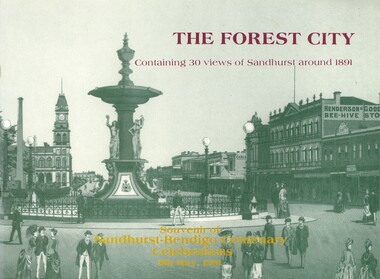
Book - THE FOREST CITY, 1991
... ...Bendigo-history-buildings-photographs...BOOK Bendigo photographs Bendigo-history-buildings-photographs Ken Arnold Soft covered book The Forest City containing 30 views of Sandhurst around 1891, souvenir of Sandhurst-Bendigo Centenary celebrations 8th May 1919, compiled and set up for printing by Ken Arnold, published by Crown Castleton , printed by D.G.Walker pty ltd. ...Soft covered book The Forest City containing 30 views of Sandhurst around 1891, souvenir of Sandhurst-Bendigo Centenary celebrations 8th May 1919, compiled and set up for printing by Ken Arnold, published by Crown Castleton , printed by D.G.Walker pty ltd. Signed by author inside front cover. 2 copies 5914.1 and 5914.2 kept in Box 13 Ken Arnold book, bendigo, photographs, bendigo-history-buildings-photographs -
 Bendigo Military Museum
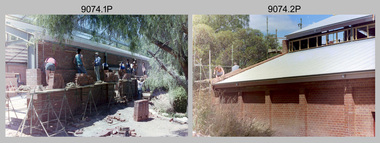
Photograph - New Printing Building Construction, Lithographic Squadron - Army Survey Regiment, Fortuna, Bendigo, 1989
... photographs of contractors constructing Lithographic Squadron’s new Printing Building at Fortuna, Bendigo December 1989. The building was purpose built to house a new computer-controlled Heidelberg Speedmaster five colour lithographic offset Printing Press. The print room was named Wayzgoose Hall after a medieval printing house festival. Wayzgoose Hall and the Speedmaster Press printing capability was commissioned by the Commander of the 3rd Military District BRIG P. Davies AM, ADC on Wednesday 27th June 1990. This occasion is covered in more detail in page 145 of Valerie Lovejoy’s book 'Mapmakers of Fortuna – A history...photographs of contractors constructing Lithographic Squadron’s new Printing Building at Fortuna, Bendigo December 1989. The building was purpose built to house a new computer-controlled Heidelberg Speedmaster five colour lithographic offset Printing Press. The print room was named Wayzgoose Hall after a medieval printing house festival. Wayzgoose Hall and the Speedmaster Press printing capability was commissioned by the Commander of the 3rd Military District BRIG P. Davies AM, ADC on Wednesday 27th June 1990. This occasion is covered in more detail in page 145 of Valerie Lovejoy’s book 'Mapmakers of Fortuna – A history ...This is a set of seven photographs of contractors constructing Lithographic Squadron’s new Printing Building at Fortuna, Bendigo December 1989. The building was purpose built to house a new computer-controlled Heidelberg Speedmaster five colour lithographic offset Printing Press. The print room was named Wayzgoose Hall after a medieval printing house festival. Wayzgoose Hall and the Speedmaster Press printing capability was commissioned by the Commander of the 3rd Military District BRIG P. Davies AM, ADC on Wednesday 27th June 1990. This occasion is covered in more detail in page 145 of Valerie Lovejoy’s book 'Mapmakers of Fortuna – A history of the Army Survey Regiment’ ISBN: 0-646-42120-4. See items 6131.18P, 6444.16P and 6448.12P for photos of earlier phases of the construction process. This is a set of seven photograph of the construction of Lithographic Squadron’s new Printing Building, Army Survey Regiment at Fortuna, Bendigo, December 1989. Colour photographs are on 35mm negative film and scanned at 96 dpi. They are part of the Army Survey Regiment’s Collection. .1) to .7) - Photo, colour 1989. Construction of new printing building. No personnel are identified. A Minute written by CPL T. King addressed to the Unit Historian CPL Ian Nelson at para 1a: describes the item: ‘frames 18 to 21 – New Print Room under construction Dec 89’ royal australian survey corps, rasvy, army survey regiment, army svy regt, fortuna, litho, printing -
 Bendigo Military Museum
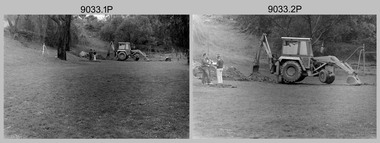
Photograph - New Printing Building Preparation, Lithographic Squadron - Army Survey Regiment, Fortuna, Bendigo, 1987
... history of the Army Survey Regiment’ ISBN: 0-646-42120-4. See item 6131.18P for more photos of preparation of foundations for the new print building. See item 6157.11P for more photos of construction of the new Lithographic Squadron building. Royal Australian Survey Corps RASvy Fortuna Army Survey Regiment Litho No personnel are identified This is a set of nine photograph of the foundations being prepared for Lithographic Squadron’s new Printing Building, Army Survey Regiment at Fortuna, Bendigo, October 1987. ...This is a set of 9 photographs of contractors preparing the foundations for the construction of Lithographic Squadron’s new Printing Building at Fortuna, Bendigo in October 1987. The building was purpose built to house a new computer-controlled Heidelberg Speedmaster five colour lithographic offset Printing Press. The print room was named Wayzgoose Hall after a medieval printing house festival. Wayzgoose Hall and the Speedmaster Press printing capability was commissioned by the Commander of the 3rd Military District BRIG P. Davies AM, ADC on Wednesday 27th June 1990. This occasion is covered in more detail in page 145 of Valerie Lovejoy’s book 'Mapmakers of Fortuna – A history of the Army Survey Regiment’ ISBN: 0-646-42120-4. See item 6131.18P for more photos of preparation of foundations for the new print building. See item 6157.11P for more photos of construction of the new Lithographic Squadron building. This is a set of nine photograph of the foundations being prepared for Lithographic Squadron’s new Printing Building, Army Survey Regiment at Fortuna, Bendigo, October 1987. The photographs are on 35mm negative film and scanned at 96 dpi. They are part of the Army Survey Regiment’s Collection. .1) to .8) - Photo, black & white, 1987. Foundations preparation. .9) - Photo, black & white, 1989. New Lithographic Squadron building construction. No personnel are identified royal australian survey corps, rasvy, fortuna, army survey regiment, litho -
 Bendigo Military Museum
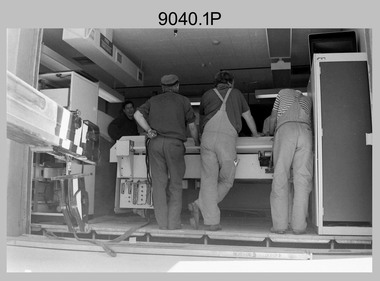
Photograph - Removal of AUTOMAP 1’s Gerber Optical Line Following (OLF) scanner from Army Survey Regiment, Fortuna, Bendigo, c1982-1983
... photographs, in pages 116-118 of Valerie Lovejoy’s book 'Mapmakers of Fortuna – A history of the Army Survey Regiment’ ISBN: 0-646-42120-4. See items 6122.20P, 6183.19P, and 6184.20P for additional photographs of AUTOMAP 1’s Gerber OLF in operation. Royal Australian Survey Corps RASvy Fortuna Army Survey Regiment automap 1 .1P to .8P – There are no annotations This is a set of eight photographs of the removal of AUTOMAP 1’s Gerber Optical Line Following (OLF) scanner Sub-System from Air Survey Squadron’s Building 16, at the Army Survey Regiment at Fortuna, Bendigo, circa 1982-1983. ...This collection of eight photos was most likely taken in circa 1982-1983, featuring the removal of AUTOMAP 1’s Gerber Optical Line Following (OLF) scanner Sub-System from Air Survey Squadron’s Building 16, in preparation for the installation of the replacement AUTOMAP 2 system. Introduced in 1975, the AUTOMAP 1 computer assisted cartography and mapping system was the first computer assisted cartography and mapping system utilised by the Survey Corps and the first system used by Australian mapping organisations. The Gerber OLF scanner was mainly used to digitise contours on a map sheet separation with individual lines at least 0.125 mm wide and no closer than 0.25 mm to the next line. The operator initiated the OLF by placing its light sensitive digitizing head on a contour line. The OLF could digitise up to 50 mm per second on straight lines and complete an average density contour sheet in approximately 8 hours. The operator occasionally intervened to restart the OLF to allow it to continue if it failed to correctly discriminate the contours. The history of the AUTOMAP 1 system is covered in more detail with additional historic photographs, in pages 116-118 of Valerie Lovejoy’s book 'Mapmakers of Fortuna – A history of the Army Survey Regiment’ ISBN: 0-646-42120-4. See items 6122.20P, 6183.19P, and 6184.20P for additional photographs of AUTOMAP 1’s Gerber OLF in operation. This is a set of eight photographs of the removal of AUTOMAP 1’s Gerber Optical Line Following (OLF) scanner Sub-System from Air Survey Squadron’s Building 16, at the Army Survey Regiment at Fortuna, Bendigo, circa 1982-1983. The photographs are on 35mm negative film and scanned at 96 dpi. They are part of the Army Survey Regiment’s Collection. .1) to .8) - Photo, black & white, c1982-1983, - Gerber Optical Line Follow (OLF) removal from Air Survey Squadron’s Building 16. .1P to .8P – There are no annotations royal australian survey corps, rasvy, fortuna, army survey regiment, automap 1 -
 Bendigo Military Museum
Photograph - Superseded AUTOMAP 1 Equipment, Army Survey Regiment, Fortuna, Bendigo, c1983
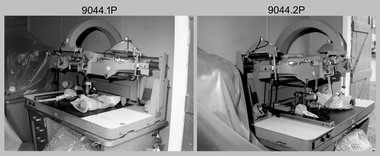
... photographs of superseded AUTOMAP 1 equipment was taken at the Army Survey Regiment, Fortuna, Bendigo, circa 1983. The photos were taken in one of the Q-store buildings. Introduced in 1975, the AUTOMAP 1 computer assisted cartography and mapping system was the first computer assisted cartography and mapping system utilised by the Survey Corps and the first system used by Australian mapping organisations. The replacement AUTOMAP 2 system achieved operational status in August 1983. The history...photographs of superseded AUTOMAP 1 equipment was taken at the Army Survey Regiment, Fortuna, Bendigo, circa 1983. The photos were taken in one of the Q-store buildings. Introduced in 1975, the AUTOMAP 1 computer assisted cartography and mapping system was the first computer assisted cartography and mapping system utilised by the Survey Corps and the first system used by Australian mapping organisations. The replacement AUTOMAP 2 system achieved operational status in August 1983. The history ...This set of eight photographs of superseded AUTOMAP 1 equipment was taken at the Army Survey Regiment, Fortuna, Bendigo, circa 1983. The photos were taken in one of the Q-store buildings. Introduced in 1975, the AUTOMAP 1 computer assisted cartography and mapping system was the first computer assisted cartography and mapping system utilised by the Survey Corps and the first system used by Australian mapping organisations. The replacement AUTOMAP 2 system achieved operational status in August 1983. The history of the AUTOMAP 1 system is covered in more detail with additional historic photographs, in pages 116-118 of Valerie Lovejoy’s book 'Mapmakers of Fortuna – A history of the Army Survey Regiment’ ISBN: 0-646-42120-4. See items 6122.20P, 6183.19P, and 6184.20P for additional photographs of AUTOMAP 1’s system and the B8 Stereoplotters in operation. This set of eight photographs of superseded AUTOMAP 1 Equipment was taken at the Army Survey Regiment, Fortuna, Bendigo, circa 1983. The photographs are on 35mm negative film and scanned at 96 dpi. They are part of the Army Survey Regiment’s Collection. .1) to .8) - Photo, black & white, c1983, superseded AUTOMAP 1 B8 Stereoplotters and equipment in storage awaiting disposal. .1P to .8P – There are no annotations royal australian survey corps, rasvy, fortuna, army survey regiment, automap 1 -
 Bendigo Military Museum
Photograph - FRAMED WW1 PHOTOGRAPH, Wayne Eels, C.2008/09
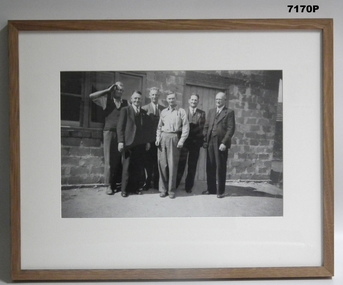
... Bendigo. Left to Right in photo; Jack Grinton, Fred Lehmann "MM", Dick Verso, Bert Grinton "DCM" , ..........Poppin. "Jack Grinton No. 1043, " 38th Battalion - Refer Cat No. 1280 for his service history. "Bert Grinton DCM, No. 5024" - Refer Cat No. 1320 for his service history. Framed Accessories Camera on the Somme WW1 38th Bn Grinton "Single photos Group 2 (end of show): 38th Battalion Reunion". Photograph - framed. Photograph - black and white photograph on paper depicts an informal group, full length portrait of six men. Background - wall of stone and timber building ...The Grinton Collection. Photo taken at a 38th Bn reunion at Bert Grintons Farm Myers Flat near Bendigo. Left to Right in photo; Jack Grinton, Fred Lehmann "MM", Dick Verso, Bert Grinton "DCM" , ..........Poppin. "Jack Grinton No. 1043, " 38th Battalion - Refer Cat No. 1280 for his service history. "Bert Grinton DCM, No. 5024" - Refer Cat No. 1320 for his service history. Photograph - framed. Photograph - black and white photograph on paper depicts an informal group, full length portrait of six men. Background - wall of stone and timber building. Frame - timber, light varnish finish, Perspex front, cardboard backing. "Single photos Group 2 (end of show): 38th Battalion Reunion". framed accessories, camera on the somme, ww1, 38th bn, grinton -
 Bendigo Military Museum
Photograph - PHOTOGRAPH AND LEGEND, Pre war - 1941-42
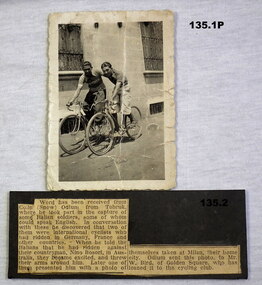
... Bendigo. Colin Odlum VX45898 2/23 Batt AIF. KIA 12.7.42. Refer 127.56, 128.2, 137.3P. Bettie Bird refer 136.2, Billy Bird 1601. documents historical notes photography photographs military history .1) On the rear faded writing re the two cyclists "POW's" .1) Photo, B & W of two Italian men on Racing Bikes with building in the background. .2) Original newspaper article re Italian POW's and Colin Odlum on a black background. ...The two cyclists were taken prisoner in North Africa. The prisoners gave the photo to Colin Odlum and the result was that the photo came back to Australia and given to William (Billy) Bird who loaned the photo to the Cycling Club in Bendigo. Colin Odlum VX45898 2/23 Batt AIF. KIA 12.7.42. Refer 127.56, 128.2, 137.3P. Bettie Bird refer 136.2, Billy Bird 1601. .1) Photo, B & W of two Italian men on Racing Bikes with building in the background. .2) Original newspaper article re Italian POW's and Colin Odlum on a black background. .1) On the rear faded writing re the two cyclists "POW's" documents, historical notes, photography, photographs, military history -
 Bendigo Military Museum
Book - BOOK WW1, Big Sky Publishing Pty Ltd, ANZAC Sons, 2014
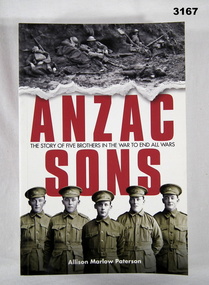
... This compelling true story was compiled by the grand daughter of a surviving brother. books-biography military history-army photography-photographs Anzac sons Front fly leaf handwritten in black ink: “The Bendigo RSL Museum.Thank you for the inspiring work you do to ensure future generations will always remember the great sacrifices of our forebears. Allison” Soft cardboard cover, red & black print on front, spine & back. Sepia photo of five soldiers in uniform on front cover together with black & white photo of a trench scene. Back cover has a black & white photo of soldiers & a building ...The story of Five brothers in the war to end all wars. ANZAC Sons is composed from a collection of over 5 hundred letters & postcards written by the brothers who served.. This compelling true story was compiled by the grand daughter of a surviving brother. Soft cardboard cover, red & black print on front, spine & back. Sepia photo of five soldiers in uniform on front cover together with black & white photo of a trench scene. Back cover has a black & white photo of soldiers & a building. 688 pages, cut plain paper, illustrated with black & white photos & maps. Collection of letters & postcards. Front fly leaf handwritten in black ink: “The Bendigo RSL Museum.Thank you for the inspiring work you do to ensure future generations will always remember the great sacrifices of our forebears. Allison” books-biography, military history-army, photography-photographs, anzac, sons -
 Bendigo Military Museum
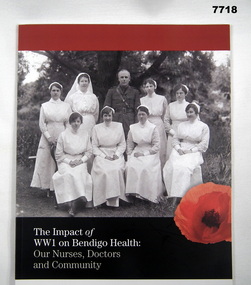
Book - BOOK, BENDIGO, WW1, Bendigo Health publications, THE IMPACT OF WW1 ON BENDIGO HEALTH: OUR NURSES, DOCTORS AND COMMUNITY, 2015
... Bendigo's doctors and nurses during the first World War". Books History WW1 Bendigo Soft cover book. Cover, cardboard with adhered paper cover. White and red print on front and back covers. Illustrated front - black and white group photograph of eight nurses in uniform and one Doctor in uniform, with red colour poppy flower middle right. Back - black and white photograph of 150 years sign on brick building ...Bendigo Health publication. "Commemoration booklet celebrating the contributions made by Bendigo's doctors and nurses during the first World War". Soft cover book. Cover, cardboard with adhered paper cover. White and red print on front and back covers. Illustrated front - black and white group photograph of eight nurses in uniform and one Doctor in uniform, with red colour poppy flower middle right. Back - black and white photograph of 150 years sign on brick building wall. 41 pages, cut, plain, white paper. Illustrated in black and white and colour, group photographs, awards, memorabilia and sketches. books, history, ww1, bendigo -
 Bendigo Military Museum
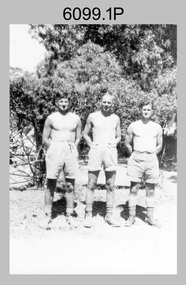
photograph - Fortuna - 1st Year of Army Occupation in Bendigo, 1942
... building program was still under way when the first officer, Lieutenant Ralph Westgarth, arrived in May 1942 with the advance party which received and positioned all equipment as it came up from Melbourne in semi-trailers. Once the equipment was installed the rest of the Cartographic Company completed its shift to Bendigo by 11th June 1942. The first year of the Survey Corps’ occupation of Fortuna is covered in more detail with additional historic photographs, in pages 17-22 of Valerie Lovejoy’s book 'Mapmakers of Fortuna – A history...building program was still under way when the first officer, Lieutenant Ralph Westgarth, arrived in May 1942 with the advance party which received and positioned all equipment as it came up from Melbourne in semi-trailers. Once the equipment was installed the rest of the Cartographic Company completed its shift to Bendigo by 11th June 1942. The first year of the Survey Corps’ occupation of Fortuna is covered in more detail with additional historic photographs, in pages 17-22 of Valerie Lovejoy’s book 'Mapmakers of Fortuna – A history ...This is a set of 17 photographs taken during the first year of Army occupation at Fortuna, Bendigo in 1942. The photos provide an insight into the preparatory work performed on the Fortuna Villa and surrounding buildings, by the Working Party 5th Army Troop and Ordnance Training Depot, before its occupation by personnel from LHQ Cartographic Company, Royal Australian Survey Corps. The annotation on the back of Photos .9P and .10P is misspelt. The correct spelling is ‘Nell Gwynne’. The poppet head of the Central Nell Gwynne mine is still an iconic landmark in Bendigo, lying just down the road from the poppet head lookout at Victoria Hill. The Central Nell Gwynne was the premier mine of Bendigo's 1930s mining revival and is of high historical value, due to the extensive and relatively intact features which remain at the site. The annotation on the back of Photo .17P is incorrect. The location of HQ 5th Army Troop was ‘Reynard St, Coburg.’ By late 1941 as Japan extended its control throughout Indo-China, resolving the accommodation problem of AHQ Cartographic Company located in Melbourne became more urgent. The steady Japanese advance made the bombing of Melbourne no longer a remote possibility, and in accordance with a general policy of dispersion, the Deputy Chief of the General Staff, Major General Sidney Rowell instructed Major William Sarll, in the interests of security of plant and to provide against possible damage of air attack, to investigate suitable safer inland accommodation for AHQ Cartographic Company. Major Sarll inspected many properties before finding one that would meet the requirements of the Cartographic Company. In late 1941, he came to inspect Fortuna, a rambling old mansion with about fifteen acres of ground in central Bendigo. Initially there was no intention to occupy the site beyond the end of the war, although Major Sarll's report to the Director of Survey noted many advantages in moving the Company to Bendigo. Major General Rowell quickly approved the selection of Fortuna before other authorities, which were investigating the evacuation of school children, could get in ahead of the Cartographic Company. On 23 March 1942, the Commonwealth of Australia, under the provisions of the National Security Act of 1939, took possession of the house, the old battery buildings and the fifteen acres of grounds. Under Warrant Officer J. Trist’s direction, over fifty Parks and Works tradesmen completed building works necessary to accommodate the Survey Corps’ military, map making and printing requirements. The building program was still under way when the first officer, Lieutenant Ralph Westgarth, arrived in May 1942 with the advance party which received and positioned all equipment as it came up from Melbourne in semi-trailers. Once the equipment was installed the rest of the Cartographic Company completed its shift to Bendigo by 11th June 1942. The first year of the Survey Corps’ occupation of Fortuna is covered in more detail with additional historic photographs, in pages 17-22 of Valerie Lovejoy’s book 'Mapmakers of Fortuna – A history of the Army Survey Regiment’ ISBN: 0-646-42120-4. This is a set of 17 photographs taken during the first year of Army Occupation at Fortuna, Bendigo in 1942. The black and white photographs were printed on photographic paper and are part of the Army Survey Regiment’s Collection. The photographs were scanned at 300 dpi. .1) - Photo, black & white, 1942. Bendigo Parks and Works tradesmen at Fortuna. L to R: Cliff Day, Ernie Arnold, Norm? .2) - Photo, black & white, 1942. “Don” - possibly SGT Don Sutcliffe. Fortuna, Bendigo. .3) - Photo, black & white, 1942. Parks and Works tradesmen in garden at Fortuna, Bendigo. L to R: Fred & Ernie. .4) - Photo, black & white, 1942. Benny Jack Williams at Fortuna, Bendigo. Accommodation tents were erected above the lake, which later became the parade ground. .5) - Photo, black & white, 1942. Working dress - Giggle suits. Parks and Works tradesmen at Fortuna, Bendigo. L to R: Cliff and Harry on big roof. .6) - Photo, black & white, 1942. Parks and Works tradesmen at Fortuna, Bendigo. Ted on big roof. .7) - Photo, black & white, 1942. Gold crusher battery just behind Fortuna. .8) - Photo, black & white, 1942. Scene of Bendigo from Fortuna. .9) - Photo, black & white, 1942. Nell Gwynne Mine from mullock heap at Victoria Hill near Fortuna, Bendigo. .10) - Photo, black & white, 1942. Nell Gwynne Mine and crusher near Fortuna, Bendigo. .11) - Photo, black & white, 1942. Sluicing for gold at Eaglehawk. .12) - Photo, black & white, 1942. Fortuna, Bendigo taken from the far side of tennis courts. .13) - Photo, black & white, 1942. Fortuna, Bendigo & its reflection from across the lake. .14) - Photo, black & white, 1942. Fortuna, Bendigo from the fishpond. .15) - Photo, black & white, 1942. Fortuna, Bendigo. .16) - Photo, black & white, 1942. First Fortuna Football Team at unknown location. L to R: 5th Bob Wright, 11th SGT Don Sutcliffe. .17) - Photo, black & white, 1942. Working Party from 5th Army Troop and Ordnance Training Depot at Fortuna, Bendigo. Some personnel are identified. Annotated with date within photos. .1) – Annotated on back ‘Cliff, Ernie, Norm, Dec ‘42. Cliff Day - dairy farmer, plasterers’ labourer. Ernie Arnold – hard plasterer. Norm? - QM Store for tools etc. QM Store was the Stables.’ .2) - Annotated on back ‘Don. Fortuna 1942’ .3) - Annotated on back ‘Fred & Ernie. Dec 1942. Carpenters. Note the state of the gardens.’ .4) - Annotated on back ‘Benny Jack Williams Fortuna Bendigo. Tents were erected where present day parade ground is above the lake.’ .5) - Annotated on back ‘Working dress - Giggle suits. June 42. Cliff and Harry on big roof. This photo was taken as the ventilating ridge was being installed on the building housing the printing machines. The machines were installed later by civilian labour when building was complete.’ .6) - Annotated on back ‘Ted on big roof Fortuna Bendigo.’ .7) - Annotated on back ‘Gold crusher battery – Bendigo for slay heap – 1942. 12 stamp battery. Just behind Fortuna. Was working at night when the “Army” came to Bendigo. Later removed to “Coolgardie - WA. Present site of Southern Cross TV.’ .8) - Annotated on back ‘Scene of Bendigo from Fortuna. June 1942.’ .9) - Annotated on back ‘Nell Gwyne Mine from mullock heap (Victoria Hill) Sept 1942.’ .10) - Annotated on back ‘Nell Gwyne Mine and crusher September 1942.’ .11) - Annotated on back ‘Sluicing for gold at Eaglehawk. August 1942.’ .12) - Annotated on back ‘Fortuna Bendigo 1942. Taken from far side of tennis courts.’ .13) - Annotated on back ‘ “Fortuna” across the lake & reflection.’ .14) - Annotated on back ‘Fortuna from fishpond June 1942.’ .15) - Annotated on back ‘Fortuna Dec 1942.’ .16) - Annotated on front ‘X’ x2. Annotated on back First Fortuna Football Team 1942‘Bob Wright’, ‘SGT Don Sutcliffe’. .17) - Annotated ‘Working Party at Fortuna before one of the drafts’, Working Party 5th Army Troop and Ordnance Training Depot Showgrounds, now the Sportsground Bendigo’, ‘HQ of 5th Army Troop was Reynards Rd, Coburg.’ royal australian survey corps, rasvy, army survey regiment, army svy regt, fortuna, asr -
 Bendigo Military Museum
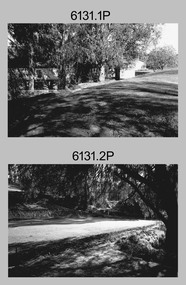
Photograph - New Printing Building foundation preparation, Lithographic Squadron - Army Survey Regiment, Fortuna, Bendigo, 1987
... history of the Army Survey Regiment’ ISBN: 0-646-42120-4. See items 6444.16P, 6448.12P and 9074.7P for more photos of the construction process. Royal Australian Survey Corps RASvy Army Survey Regiment Army Svy Regt Fortuna ASR litho printing No personnel are identified. Annotated with date on negative sleeve. This is a set of 18 photograph of the foundations being prepared for Lithographic Squadron’s new Printing Building, Army Survey Regiment at Fortuna, Bendigo ...This is a set of 18 photographs of contractors preparing the foundations for the construction of Lithographic Squadron’s new Printing Building at Fortuna, Bendigo on the 2nd of October 1987. The building was purpose built to house a new computer-controlled Heidelberg Speedmaster 102 five colour lithographic offset Printing Press. The print room was named Wayzgoose Hall after a medieval printing house festival. Wayzgoose Hall and the Speedmaster Press printing capability was commissioned by the Commander of the 3rd Military District BRIG P. Davies AM, ADC on Wednesday 27th June 1990. This occasion is covered in more detail in page 145 of Valerie Lovejoy’s book 'Mapmakers of Fortuna – A history of the Army Survey Regiment’ ISBN: 0-646-42120-4. See items 6444.16P, 6448.12P and 9074.7P for more photos of the construction process. This is a set of 18 photograph of the foundations being prepared for Lithographic Squadron’s new Printing Building, Army Survey Regiment at Fortuna, Bendigo, 2nd October 1987. Black and white photos .1P to .4P are on photographic paper and scanned at 300 dpi. Photographs .5P to.18P are on 35mm negative film and scanned at 96 dpi. They are part of the Army Survey Regiment’s Collection. .1) to .9) - Photo, black & white, 1987. Foundations preparation. .10) - Photo, black & white, 1987. Foundations preparation, Paul Baker. .11) - Photo, black & white, 1987. Foundations preparation, Gary Kerr .12) to .17) - Photo, black & white, 1987. Foundations preparation. .18) - Photo, black & white, 1987. Foundations preparation, Gary Kerr No personnel are identified. Annotated with date on negative sleeve. royal australian survey corps, rasvy, army survey regiment, army svy regt, fortuna, asr, litho, printing -
 Bendigo Military Museum
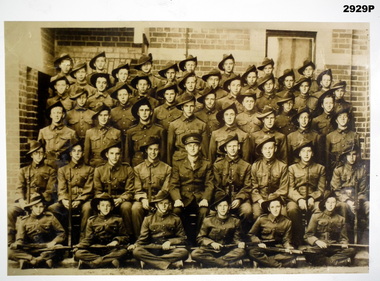
Photograph - PHOTOGRAPH, COLLEGE CADETS, 1943
... photography-photographs military history - army Marist college cadets Photograph, black & white, group of 52 soldiers in uniform in front of a brick building. Adhesive taped to back of the photo is a black & white photocopy of the photo with printed details: Bendigo - “The Waywe Were” “Attention! ...Photograph, black & white, group of 52 soldiers in uniform in front of a brick building. Adhesive taped to back of the photo is a black & white photocopy of the photo with printed details: Bendigo - “The Waywe Were” “Attention! Marist Brothers' College Cadets with Captain Kenneth Harris in 1943” The Cadet names are listed in rows. photography-photographs, military history - army, marist college, cadets -
 Bendigo Military Museum
Photograph - Lithographic Squadron Personnel and Equipment, Army Survey Regiment, Fortuna, Bendigo, Lithographic Squadron Personnel and Equipment, Army Survey Regiment, Fortuna, Bendigo, 1990
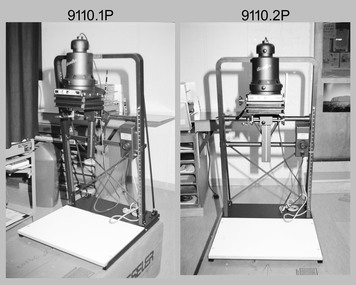
... building. All geodetic and survey records previously located at the Field Survey Squadrons and Survey Directorate were centralised at the Army Svy Regt in 1992. More information on the centralisation of RA Svy records is provided in page 157 of Valerie Lovejoy’s book 'Mapmakers of Fortuna – A history of the Army Survey Regiment’ ISBN: 0-646-42120-4. Royal Australian Survey Corps RASvy Army Survey Regiment Army Svy Regt Fortuna Litho Litho Sqn There are no personnel identified. This is a set of 13 photographs of Lithographic Squadron personnel and equipment taken at the Army Survey Regiment, Fortuna, Bendigo ...This is a set of 13 photographs of Lithographic personnel and equipment taken at the Army Survey Regiment, Fortuna, Bendigo in 1990. Photos .1P to .3P feature the Beseler Model 4SAF Autofocus Enlarger and accessories. This enlarger was used to enlarge photographic media from the late 1950s. The following description written by Myron Matzkin appeared in the now-defunct Modern Photography magazine in April 1959: Specifications: Beseler Model 4SAF Autofocus Enlarger. Negative size: 16mm to 4x5. Focusing: Autofocusing by parallelogram, wheel and cam system. Light source: 150-watt opal lamp. Construction: Steel and extruded aluminum with pyramid structure and obelisk frame. Other features: Single set of condensers for all lenses, concealed counterbalance for crank-controlled up and down movement, horizontal projection, glassless negative carriers and wheel-mounted variable contrast paper filters. Fire pump testing shown in photos .12P & .13P was performed on a regular basis by the unit firefighting team. The building under construction in photo .11P was built with climate controls to house a map library and digital data media building. All geodetic and survey records previously located at the Field Survey Squadrons and Survey Directorate were centralised at the Army Svy Regt in 1992. More information on the centralisation of RA Svy records is provided in page 157 of Valerie Lovejoy’s book 'Mapmakers of Fortuna – A history of the Army Survey Regiment’ ISBN: 0-646-42120-4. This is a set of 13 photographs of Lithographic Squadron personnel and equipment taken at the Army Survey Regiment, Fortuna, Bendigo in 1990. The photographs are on 35mm negative film and were scanned at 2400 dpi. They are part of the Army Survey Regiment’s Collection. .1) & .2) - Photo, black & white, 1990. Beseler Model 4SAF Autofocus Enlarger. .3) - Photo, black & white, 1990. Beseler Model 4SAF Autofocus Enlarger accessories. .4) - Photo, black & white, 1990. Photo Troop’s SPR Scott Cameron retouches a film negative. .5) - Photo, black & white, 1990. Print Troop’s SPR Syd Anstee. .6) - Photo, black & white, 1990. Photo Troop’s SPR Tony Purton. .7) - Photo, black & white, 1990. Photo Troop’s SPR Ivan Parsons. .8) & .9) - Photo, black & white, 1990. Photo Troop’s LCPL John Bragg. .10) - Photo, black & white, 1990. Print Troop’s SPR Ross Anza with a new haircut. .11) - Photo, black & white, 1990. Concrete floor leveling with a screed inside new Map Library building. .12) & .13) - Photo, black & white, 1990. Fire pump put to the test in Fortuna’s lake. There are no personnel identified. royal australian survey corps, rasvy, army survey regiment, army svy regt, fortuna, litho, litho sqn -
 Bendigo Historical Society Inc.
Photograph - Napoleon Reef Gold Mine Battery Site, 1936
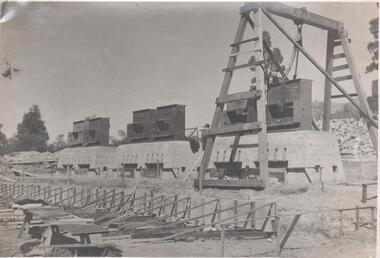
... building is proceeding. The design of engine room, change house and machine shops is now in hand and erection will proceed as soon as working plans and specifications are prepared.' The main shaft has been commenced at 3ft and advanced 10 ft. to 13 ft. https://trove.nla.gov.au/newspaper/article/10975478?searchTerm=napoleon%20bml (The Argus, 8th. September 1934, 'Mining' page 18) Significant to mining history of Bendigo. Napoleon Gold Mine Napoleon Reef Gold Mine Black and white photograph ...The Napoleon (BML) gold mine (1932) was located near McDougall Road, Golden Gully, between Martin and Hattam Street. It had a depth of 921 feet. It was one of the latest and most lavish of Bendigo's mines. Plant and equipment were electrically driven. The four-compartment shaft, extra large by goldfield's standards, measured 17 feet 6 inches by 5 feet 2 inches and was cement lined below 900 feet instead of being red gum boxed as was the usual practice. The workshop was equipped to carry out all repairs for the equally lavish BML mines on the Nell Gwynne and Carshalton reefs. (The Gold Mines of Bendigo, Book 2, Arthur Victor Palmer) 'Napoleon BML Mines No Liability have issued a report for the fortnight ended September 5, where it states that the development scheme has been formulated and necessary equipment is being ordered. The Napoleon main shaft, (about 1700 feet south of the old Napoleon shaft) will be a four compartment shaft (17ft 6 inches by ft 2 inches inside the timber). aLevels will be opened at approximately 100 ft vertical intervals and cross-cuts extended approximately 125 ft each side of centre country to explore a cross-section across the anticline opposite to the shaft. At every fifth level, main drives will be extended north to connect with the old Napoleon shaft and south approximately 1800 ft. At the latter point, another cross-section of the anticline will be explored by rising and cross-cutting. The old Napoleon will be unwatered and on the 500ft and 1000 ft levels main drives will be driven to connect with main levels from the Napoleon main shaft to the south as well as being driven north 1800 ft where another cross-section of the anticline will be explored. Cross-sections further north and south may be developed as desired and also at intermediate points if necessary. Clearing and grading of the main shaft site are now in progress and the erection of the office and store building is proceeding. The design of engine room, change house and machine shops is now in hand and erection will proceed as soon as working plans and specifications are prepared.' The main shaft has been commenced at 3ft and advanced 10 ft. to 13 ft. https://trove.nla.gov.au/newspaper/article/10975478?searchTerm=napoleon%20bml (The Argus, 8th. September 1934, 'Mining' page 18) Significant to mining history of Bendigo. Black and white photograph of a stamper head being lowered into position on the battery site of the Napoleon Reef Gold Mine. A wooden gantry supports the battery head as it being lowered. Three large concrete foundations are visible in immediate background, two of which have stampers already in position, the third stamper is being lowered onto the final foundation. In immediate foreground, 'boxing' is erected for future concrete pours. napoleon gold mine, napoleon reef gold mine -
 Bendigo Historical Society Inc.
Photograph - Napoleon Reef Gold Battery Winder Shed, 1936
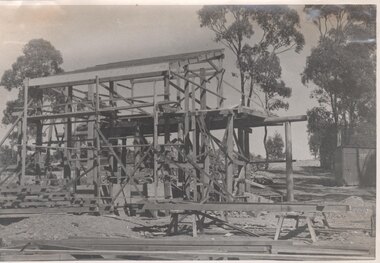
... history of Bendigo. Napoleon Gold Mine Napoleon Reef Gold Mine Written in pencil on back of photograph: ' ...winder shed 21/10/36' and 'cracker station building' Black and white photograph: large wooden frame for winder shed, carpenters' 'horses' in foreground. ...The Napoleon mine site was situated near Harvey Street and Union Street, Ironbark. It was registered under the Companies Act in 1940, with John Jepson Stanistreet as Manager. Article in Age newspaper: https://trove.nla.gov.au/newspaper/article/206767750?searchTerm=napoleon%20reef%20mine Significant to mining history of Bendigo. Black and white photograph: large wooden frame for winder shed, carpenters' 'horses' in foreground. Written in pencil on back of photograph: ' ...winder shed 21/10/36' and 'cracker station building' napoleon gold mine, napoleon reef gold mine -
 Bendigo Historical Society Inc.
Book - "Grasshoppers - A History of St Vincent's College, Bendigo", Peter Sweeney, 2025
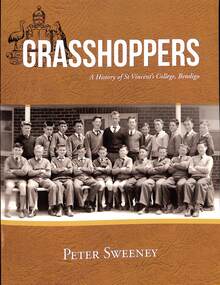
... photograph of the school building and the school logo. Includes motto "Omnia in Christo". Includes sepia, black and white, and coloured photographs. Includes year photos, student list, and staff list. Book "Grasshoppers - A History of St Vincent's College, Bendigo ...In 1944 Bishop John McCarthy of the Sandhuurst diocese approached the Vincentian Fathers with a request to open a boys' secondary boarding school in Bendigo. Permission for the building of the college was granted on 16 January 1945. In July 1951 the Junortoun site was purchased. Plans for the school building were finalized and on 17 February 1953 work began on the new college. The first stage of the college was opened on Sunday 17 October 1954. Author: Peter Sweeney. Soft cover book with 180 pages, with khaki green cover. The front cover has a class photograph of twenty two boys in uniform (1956 or 1957), and the College logo. The back cover has a photograph of the school building and the school logo. Includes motto "Omnia in Christo". Includes sepia, black and white, and coloured photographs. Includes year photos, student list, and staff list. st vincent's college, catherine mccauley college, junortoun, secondary college, education -
 Bendigo Historical Society Inc.
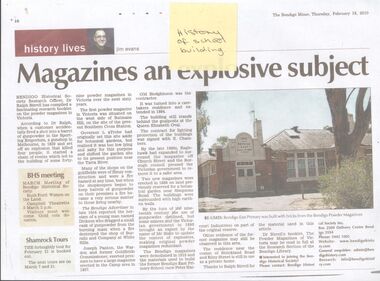
Article - 2010 Newspaper Article 'Magazines an Explosive Subject'
... Bendigo Miner', Thursday February 18, 2010 by Jim Evans. The article contains a coloured photograph of Bendigo East State School and describes how, in 1915, some of the material from the demolished Bendigo powder magazines were reused in the building of the state school. It talks about the history...Bendigo Miner', Thursday February 18, 2010 by Jim Evans. The article contains a coloured photograph of Bendigo East State School and describes how, in 1915, some of the material from the demolished Bendigo powder magazines were reused in the building of the state school. It talks about the history ...Article from 'The Bendigo Miner', Thursday February 18, 2010 by Jim Evans. The article contains a coloured photograph of Bendigo East State School and describes how, in 1915, some of the material from the demolished Bendigo powder magazines were reused in the building of the state school. It talks about the history of powder magazines in the Bendigo Area. gemma starr collection, bendigo east state school, bendigo powder magazines, powder magazines, ralph birrel, jim evans, bendigo historical society -
 Bendigo Historical Society Inc.
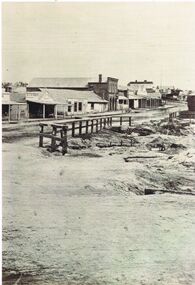
Photograph - LONG GULLY HISTORY GROUP COLLECTION: STREETSCAPE
... BENDIGO History long gully history group The Long Gully History Group - Streetscape Dr J W Sibley Commercial Hotel Black and white photograph of streetscape, various buildings on right hand side and a wooden fence on the right Photograph LONG GULLY HISTORY GROUP COLLECTION: STREETSCAPE ...Black and white photograph of streetscape, various buildings on right hand side and a wooden fence on the right bendigo, history, long gully history group, the long gully history group - streetscape, dr j w sibley, commercial hotel -
 Bendigo Historical Society Inc.
Slide - KEN HESSE COLLECTION: PHOTOGRAPHIC SLIDES OF BENDIGO
... SLIDE Bendigo buildings Ken Hesse Collection collection photographs Bendigo buildings history place streetscape A box of 28 photographic slides containing various views of Bendigo. ...A box of 28 photographic slides containing various views of Bendigo. Included are buildings and streetscapes. Item part of Mr. Ken Hesse Collection donated by Mr. James Lerk. slide, bendigo, buildings, ken hesse collection, collection, photographs, bendigo, buildings, history, place, streetscape -
 Bendigo Historical Society Inc.
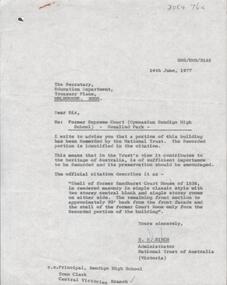
Document - National Trust Collection: Former Supreme Court (Gymnasium Bendigo High School), 1974 -1982
... Birch, Administrator National Trust of Australia B Undated Police Record - the Old Police Barracks, linked to the Old Court House, is now incorporated in the Bendigo High School C Undated - history of the Old Court House, after opening of the new Law Courts in Pall Mall, the Old Court House was used by the school (from Domestic Arts, Girl's High School, gymnasium for the BHS) D Undated Old Court House - Supreme Court; the Old Court House building in Georgian Style is now incorporated in the Bendigo High school complex now built across the road joining intact as part of the school and is used as a gymnasium. E B&W photograph...Birch, Administrator National Trust of Australia B Undated Police Record - the Old Police Barracks, linked to the Old Court House, is now incorporated in the Bendigo High School C Undated - history of the Old Court House, after opening of the new Law Courts in Pall Mall, the Old Court House was used by the school (from Domestic Arts, Girl's High School, gymnasium for the BHS) D Undated Old Court House - Supreme Court; the Old Court House building in Georgian Style is now incorporated in the Bendigo High school complex now built across the road joining intact as part of the school and is used as a gymnasium. E B&W photograph ...National Trust Collection: Former Supreme Court (Gymnasium Bendigo High School) A 3084.75A -14 June 1977 - to The Secretary Education Department from S.R. Birch, Administrator National Trust of Australia B Undated Police Record - the Old Police Barracks, linked to the Old Court House, is now incorporated in the Bendigo High School C Undated - history of the Old Court House, after opening of the new Law Courts in Pall Mall, the Old Court House was used by the school (from Domestic Arts, Girl's High School, gymnasium for the BHS) D Undated Old Court House - Supreme Court; the Old Court House building in Georgian Style is now incorporated in the Bendigo High school complex now built across the road joining intact as part of the school and is used as a gymnasium. E B&W photograph of old entry to the Old Court House, now part of BHS, circa 1958-60. F B&W photograph of old entry to the Old Court House, now part of BHS, circa 1958-60. old court house, bendigo high school gymnasium 1959-60 -
 Bendigo Historical Society Inc.
Document - National Trust Collection: Mechanics Institute - School of Mines - Technical College, & Royal Princess Hotel, 1977-1983
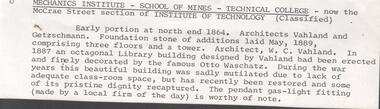
... building was sadly mutilated due to lack of adequate classroom space but has recently been restored and some of its pristine dignity recaptured. The pendant gas-light fitting (made by a local firm of the day) is worthy of note." 3084.77a UNDATED file note Mechanics Institute - School of Mines - Technical College - now the McCrae Street section of the Institute of Technology 3084.77b&c 20/12/1977 -Bendigo Institute of Technolgy - data sheet and photographs 3084.77d citation and history of buildings 3084.77e 2/08/1978 follow up request for data information 3084.77f handwritten request from David Collins for information of the de-licensed Princess Hotel on the corner of Mundt & Hargreaves Streets 3084.77g 1/02/1980 National Trust memo requesting a site plan to show the location of the Classified Library Building in relation to the McCrae Street buildings 3084.77h 10/06/1980 from NTofVic requesting information on the various alterations and improvements proposed to the Bendigo Institute of Technology 3084.77i 29/09/1980 from NTofVic Bendigo Branch referring to proposed alterations "the matter has been referred to the Government Buildings Advisory Committee, as the buildings are now included in their register" 3084.77j 10/03/1983 from BIT Principal "for advice in designing a suitable recognition of the Royal Princess Hotel on site .....of the building and its history" 3084.77ka-d 10/08/1971 correspondence on the future of the Town Hall 3084.77l-o 12/08/1980 fwd to NTofVic re the existing building on the corner of Mundy & Hargreaves Streets, Bendigo currently occupied by W.A. ...building was sadly mutilated due to lack of adequate classroom space but has recently been restored and some of its pristine dignity recaptured. The pendant gas-light fitting (made by a local firm of the day) is worthy of note." 3084.77a UNDATED file note Mechanics Institute - School of Mines - Technical College - now the McCrae Street section of the Institute of Technology 3084.77b&c 20/12/1977 -Bendigo Institute of Technolgy - data sheet and photographs 3084.77d citation and history of buildings 3084.77e 2/08/1978 follow up request for data information 3084.77f handwritten request from David Collins for information of the de-licensed Princess Hotel on the corner of Mundt & Hargreaves Streets 3084.77g 1/02/1980 National Trust memo requesting a site plan to show the location of the Classified Library Building in relation to the McCrae Street buildings 3084.77h 10/06/1980 from NTofVic requesting information on the various alterations and improvements proposed to the Bendigo Institute of Technology 3084.77i 29/09/1980 from NTofVic Bendigo Branch referring to proposed alterations "the matter has been referred to the Government Buildings Advisory Committee, as the buildings are now included in their register" 3084.77j 10/03/1983 from BIT Principal "for advice in designing a suitable recognition of the Royal Princess Hotel on site .....of the building and its history" 3084.77ka-d 10/08/1971 correspondence on the future of the Town Hall 3084.77l-o 12/08/1980 fwd to NTofVic re the existing building on the corner of Mundy & Hargreaves Streets, Bendigo currently occupied by W.A. ...National Trust Collection: Mechanics Institute - School of Mines - Technical College (the McCrae Street section of the Institute) A variety of correspondence from December 1977 to March 1983, between The National Trust and the Principal of the Bendigo Technical College, regarding the facade of the building, the Assay Laboratory, the Library. Various letterheaded correspondence, generally typed letters and information three site sketch plans of the buildings on the corner of Mundy and Hargreaves Streets (circa 1980). "Early portions at the northern end in 1984. Architects Vahland and Getzschmann. Foundation stone of additions laid in May 1889 comprising three floors and a tower. Architect W.C. Vahland. In 1887 an octagonal Library building designed by Vahland had been erected and finely decorated by the famous Otto Waschatz. During the war years this beautiful building was sadly mutilated due to lack of adequate classroom space but has recently been restored and some of its pristine dignity recaptured. The pendant gas-light fitting (made by a local firm of the day) is worthy of note." 3084.77a UNDATED file note Mechanics Institute - School of Mines - Technical College - now the McCrae Street section of the Institute of Technology 3084.77b&c 20/12/1977 -Bendigo Institute of Technolgy - data sheet and photographs 3084.77d citation and history of buildings 3084.77e 2/08/1978 follow up request for data information 3084.77f handwritten request from David Collins for information of the de-licensed Princess Hotel on the corner of Mundt & Hargreaves Streets 3084.77g 1/02/1980 National Trust memo requesting a site plan to show the location of the Classified Library Building in relation to the McCrae Street buildings 3084.77h 10/06/1980 from NTofVic requesting information on the various alterations and improvements proposed to the Bendigo Institute of Technology 3084.77i 29/09/1980 from NTofVic Bendigo Branch referring to proposed alterations "the matter has been referred to the Government Buildings Advisory Committee, as the buildings are now included in their register" 3084.77j 10/03/1983 from BIT Principal "for advice in designing a suitable recognition of the Royal Princess Hotel on site .....of the building and its history" 3084.77ka-d 10/08/1971 correspondence on the future of the Town Hall 3084.77l-o 12/08/1980 fwd to NTofVic re the existing building on the corner of Mundy & Hargreaves Streets, Bendigo currently occupied by W.A. Pulfer Motors Pty Ltd 3084.77p-r 12/08/1980 three sketches (site building details and street elevations) of the existing buildings on the corner of Mundy & Hargreaves Streets, Bendigo 3084.77s16/08/1980 Note advising the NTofVic of the T.A.F.E. proposal for redevelopment of the site north of Mundy Street, between McCrae and Hargreaves Sts. 3084.77t 19/08/1980 memo re: the T.A.F.E. proposal for redevelopment of the site north of Mundy Street, between McCrae and Hargreaves Sts. and existing reports 3084.77 u 11/09/1980 re: the T.A.F.E. proposal for redevelopment of the site north of Mundy Street, between McCrae and Hargreaves Sts.- local NTofVic advising "it would appear that the Urban Conservation Committee have unearthed possible options for the building so that it may be retained for its streetscape value" 3084.77va & vb 28/09/1981 from local NTofVic the Committee resolved to refer any further discussions on the Royal Princess Hoyel to the Building Committee in Central Administration.... as a result of conflicting engineering reports 3084.77wa-wd 30/10/1981 classification of the Bendigo Technical College 3084.77xa-ac 3/03/1982 from Loddon Regional TAFE Board requesting a copy of NTofVic correspondence concerning the building at the Bendigo Technology College and requesting support for the redevelopment plans for the BTC 3084.77ya-yc 14/10/1982 NTofVic urging the Government Buildings Advisory to "take action as quickly as possible" bendigo institue of technology, royal princess hotel -
 Bendigo Historical Society Inc.
Newspaper - Sandhurst Burial Ground, December 2020
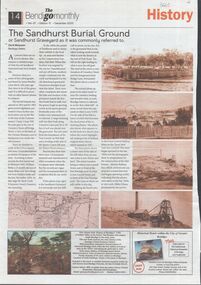
... Some of the 'fill' came from the building of the Law Courts in Pall Mall, Bendigo. ( David Mulqueen, Bendigo Art Gallery) Sandhurst burial ground cemetery Back Creek cemetery re-interred exhumed William Binks James Binks Ann Hodgson David Mulqueen One page article from the 'Bendigo Monthly', December 2020, on the history of the Sandhurst burial ground. Article contains three photographs ...The Sandhurst Burial ground was opened in 1852 and was used for three years. It was situated on the flat below the Commissioner's Camp at Camp Hill and is now part of the Tom Flood sports centre. There are records of 219 burials in the early burial ground. The first burial was in 1852, William Binks, a 23 month old son of James Binks and Ann Hodson from Paddy's Gully and the last in 1854. By this time, the Back Creek Cemetery, known now as the Bendigo Cemetery, was in operation. When the burial ground was no longer used it fell into disrepair, with people dumping rubbish on the site. Eventually, some of the bodies were exhumed and re-interred in other cemeteries; the site was covered with some 10 metres of soil. Some of the 'fill' came from the building of the Law Courts in Pall Mall, Bendigo. ( David Mulqueen, Bendigo Art Gallery) One page article from the 'Bendigo Monthly', December 2020, on the history of the Sandhurst burial ground. Article contains three photographs that are purported to be of the Sandhurst burial ground; one photograph of the Great Cental Railway Mine on the Tyson Reef Sink-line and one of a map of early Bendigo. On top of page: '14 The Bendigo Monthly, Vol 01, Edition 11, December 2020. The Sandhurst Burial Ground or Sandhurst Graveyard as it was commonly referred to'. Article written by David Mulqueen, Bendigo Art Gallery. sandhurst, burial ground, cemetery, back creek cemetery, re-interred, exhumed, william binks, james binks, ann hodgson, david mulqueen -
 Bendigo Historical Society Inc.
Document - National Trust Collection: Churches of Bendigo and Inglewood, Nov 7th 1965
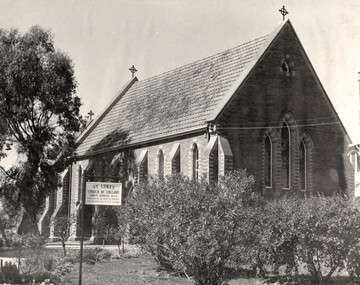
... photographs. It documents the present owner and occupant, including their addresses, the date of initial construction and supporting evidence for that date. 3084.36f Handwritten letter re history of St Johns Presbyterian Church Bendigo, 13th October 1980 - author unknown 3084.36g Typed notes - "Interesting information on the Sacred Heart Cathedral Bendigo", and hand-written notes on St Pauls Cathedral. 3084.36h Two pages of typed notes. Three main Congregational church buildings...photographs. It documents the present owner and occupant, including their addresses, the date of initial construction and supporting evidence for that date. 3084.36f Handwritten letter re history of St Johns Presbyterian Church Bendigo, 13th October 1980 - author unknown 3084.36g Typed notes - "Interesting information on the Sacred Heart Cathedral Bendigo", and hand-written notes on St Pauls Cathedral. 3084.36h Two pages of typed notes. Three main Congregational church buildings ...St LUKES ANGLICAN CHURCH BENDIGO In 1852, a party of Cornish miners, refusing to give up and having dug, by hand, down nearly 70 feet ‘got their reward. Suddenly, their picks sank into soft pipe-clay, white, satin-smooth and seemingly depthless. The men began tunnelling. Presently, the roof forming above them showered gold at their feet – the secret of Bendigo’s famous White Hills lay revealed.’ In the ‘wild rush’ that followed, when ‘the White Hills yielded enormously and some pretty piles were made’, a young Anglican priest, John Herbert Gregory, held the first Anglican church service at White Hills in 1853. The Hamlet of White Hills was surveyed and mapped in 1854 and, by 1863, St Luke’s Church in White Hills was opened on ‘an elevated site’ in a generously sized ‘church reserve’. St AUGUSTINE'S CHURCH MYERS FLAT Early diggers to this area were men named Myers and Nicholls, hence the name - Myers Flat and Myers Creek. 1857 saw the discovery of gold in the area and in less than one month 1000 ounces of gold per week resulted. The number of diggers in the Myers Creek or Burnt Gully totalled 4000 to 5000. Myers Creek consisted of several shops and buildings, two hotels, a race course and a lock-up built of logs. On November 6th, 1864, the opening of the new church of St Augustine' took place. The first mass was celebrated by the Reverand Dean Hayes, of St Killian's Sandhurst. The church of gothic design was built by a local contractor, and with bricks made from local clay. The church also has a fire place and is widely known as "The church with the Chimney. For many years it was also a Catholic school. St AUGUSTINE'S CHURCH INGLEWOOD The church features an Early English design from 1864 and Decorated Gothic extensions from 1884.Notable elements include the sanctuary with the Catto Memorial window and interior cusped arcading of the wainscot. Architectural attribution is given to Vahland and Getzschmann for one or both sections. St JOHNS CHURCH (PRESBYTERIAN) BENDIGO The church's architect was W C Vahland VIA, and the builder was N Langstaff. It was built in April 1890, and opened in Feb 1891. The tender price was 2,481 pounds. The church style was gothic, built by the Congregational Church to replace an earlier building built in 1858. St Johns bought the church in 1949 and made additions in 1951. THE SACRED HEART CATHEDRAL BENDIGO Originally designed in 1895 by Reed, Smart and Tappin of Melbourne, the first stage opened in September 1901; the second stage began in January 1954 and was expected to finish in late 1976. Skilled stonemasons were brought from overseas for the completion. The Exterior built from Geelong sandstone and Harcourt granite, matching the original materials for color consistency. The cathedral is designed in the early English Gothic style. It Features a tower and spire weighing several thousand tons, with the spire rising 282 ft. from the floor and topped by a 10 ft. cross.Interior. The original stained glass window, made in Birmingham, England, is above the main entrance on the west side. Marble for the floor was imported from Vincenzo and Via Reggio, Italy; Sicilian Pearl marble is used in the four chapels. Ceilings in the chapels feature Western red cedar and yellow pine timbers.The transept includes Australian blackwood paneling and 12 carved shields representing the apostles. The internal height from floor to ceiling is 80 ft.Artistic Elements. Two large tapestries, specially designed and crafted by Mrs. Carrington, hang in the sanctuary as a symbolic link to Bendigo. ST PAULS BENDIGO The nave was built in 1868 and the tower in 1873. The nave is notable for unusual ceiling with metal and timber overlay members. The tower notable for early brick and bold Gothic influenced design. The church was opened on 12th Nov 1868 and a new chancel sanctuary and Transepts were added on 22 Oct 1927. The architect was Robert A Love. CONGREGATIONAL CHURCHES IN BENDIGO Three main Congregational church buildings existed in Bendigo: at the corner of Forest and Mackenzie Streets (the original site), on Quarry Hill (corner of Russell and Gladstone Streets), and on Calvin Street (later the Lutheran Church). The Calvin Street church was named in honor of John Calvin, a notable figure who lived in the area. In June 1858, 1.5 acres of land were purchased at the Forest and Mackenzie Streets corner for £1200.The first church was built on this site in November 1858 and later enlarged in May 1867 to seat 500 people. A prefabricated parsonage stood nearby until about 1920, serving as a caretaker's cottage for several years. In 1890, foundation stones for a new church designed by W.C. Vahland were laid, featuring a tall tower and two gable crossings (reduced from three to save costs). The new church opened on February 26, 1890, costing £2483. The contractor was N. Longstaff. Some architectural elements, such as the chancel, were added later when St. John's Presbyterian took over the building. Congregational attendance declined, leading to the purchase and alteration of a brick school complex in Olinda Street to serve as their headquarters.The timber church on Russell Street and the Calvin Street property were sold.The valuable Forest Street property was eventually sold to a London sect and later became an investment for the Methodist Church. Historical information on seven denominational churches in Bendigo and Inglewood. This item contains the following items: 3084.36a Black and white photo of St Lukes Bendigo Church of England, Napier Street, White Hills. 3084.36b St Augustine's Church Myers Flat 100 years newsletter 1965. The newsletter's purpose is for a Commemorative afternoon mass in memory of the pioneers of Myers Flat and district.Celebration of the 101st anniversary of the first mass at St. Augustine's Church; on Sunday, November 7th, 1965, at 2:00 PM.Location: St. Augustine's Church, Myers Flat. The invitation is extended to the recipient and their friends. This invitation serves both as a memorial and a community gathering to honour local history. Also included is some hand-written history notes of the church - See the notes in the Historical Section above. 3084.36c This document is a formal letter dated 9th November 1970 from the National Trust of Australia (Victoria) to Bishop Bernard Stewart. St. Augustine's Church in Bendigo has been awarded a "D" classification by the National Trust's expert committee. The church is now officially "recorded" by the National Trust. The letter is addressed to Bishop Bernard Stewart, with copies sent to Father Louis McDonnell (Eaglehawk), A. J. Watts (Town Clerk, Bendigo), and Mrs. R. R. Adams (Secretary, Central Victorian Branch). 3084.36d This document is a formal letter from the National Trust of Australia (Victoria) to Miss L. Doble, Registrar of the Bendigo Church of England Diocese, dated March 20, 1973. St. Augustine's Church of England in Inglewood has been officially placed on the National Trust's Classified List. This classification recognizes the church as essential to Australia's heritage and emphasizes its preservation. The church features an Early English design from 1864 and Decorated Gothic extensions from 1884.Notable elements include the sanctuary with the Catto Memorial window and interior cusped arcading of the wainscot. Architectural attribution is given to Vahland and Getzschmann for one or both sections. The church is about to celebrate the centenary of its consecration on May 13, with the Archbishop expected to attend. 3084.36e This document is a survey form used by the National Trust of Australia (Victoria) to collect detailed information about St Augustine's Church at Myers Flat. It records the original purpose, present use, and current name of the building.Requires a precise address or location description for site visits.It captures special features or points of interest not visible in photographs. It documents the present owner and occupant, including their addresses, the date of initial construction and supporting evidence for that date. 3084.36f Handwritten letter re history of St Johns Presbyterian Church Bendigo, 13th October 1980 - author unknown 3084.36g Typed notes - "Interesting information on the Sacred Heart Cathedral Bendigo", and hand-written notes on St Pauls Cathedral. 3084.36h Two pages of typed notes. Three main Congregational church buildings existed in Bendigo: at the corner of Forest and Mackenzie Streets (the original site), on Quarry Hill (corner of Russell and Gladstone Streets), and on Calvin Street (later the Lutheran Church). 3084.36i Hand-written notes on St Pauls Cathedral. history, church, national trust bendigo collection, sacred heart cathedral bendigo, st augustine's church myers flat, st pauls church bendigo, st johns presbyterian church bendigo, congregational church bendigo -
 Bendigo Historical Society Inc.
Document - National Trust Collection: Fortuna Bendigo, 20/10/2008
... The property fell into disrepair before being leased by the Army in 1942 for wartime mapping and later purchased by the Commonwealth Government.It became the headquarters for the Army Survey Regiment, with parts of the building repurposed for administrative and mapping functions until the 1980s. history National Trust Bendigo Collection bendigo Fortuna George Lansell mining Classification Report and Notes on the history of Fortuna from the National Trust to the Bendigo Council 20th October 2008. This item contains the following documents: 3084.46a Tourist brochure for Fortuna; 16 pages - it includes photographs ...The Fortuna Villa is an expansive Victorian mansion built entirely on the profits of Bendigo's lucrative gold reefs. Established by the wealthy Ballerstedt family in the 1860s, it was purchased and expanded in the 1870s by George Lansell, who was to become one of Australia's wealthiest men. Fortuna villa and gardens were once occupied and cared for by the Australia Army Survey Regiments since 1942 for over thirty years. The tour guide informs us that Fortuna Villa was originally a modest two-story villa, acquired by George Lansell in 1871 along with the 180 Mine for £230,000.Lansell, known as the "Quartz King," made his fortune through deep reef gold mining in Bendigo, particularly with the New Chum Reef and other successful mines. The villa and its grounds expanded significantly as Lansell's wealth grew, incorporating architectural features inspired by his travels. The mansion is built over the New Chum Reef, with its lower floor penetrating the reef, resulting in three floors at the rear and two at the front.Notable features include the Italian water garden, tiered lakes (originally mine settling ponds), elaborate interiors (parquet floors, stained glass, marble baths), and a tunnel used for gold transport. The building underwent several phases of construction, including a reversal of its main entrance and the addition of a cupola stairwell and conservatory. Fortuna Villa hosted many notable guests, including governors and possibly the Prince of Wales.The house was lavishly furnished and decorated, reflecting Lansell's wealth and status. After Lansell's death in 1906, the villa remained in the family until 1934, then was sold and briefly used as a reception house. The property fell into disrepair before being leased by the Army in 1942 for wartime mapping and later purchased by the Commonwealth Government.It became the headquarters for the Army Survey Regiment, with parts of the building repurposed for administrative and mapping functions until the 1980s. Classification Report and Notes on the history of Fortuna from the National Trust to the Bendigo Council 20th October 2008. This item contains the following documents: 3084.46a Tourist brochure for Fortuna; 16 pages - it includes photographs and detailed history of George Lansell's involvement in the property and his mining history. 3084.45b Fortuna Bendigo re Clasification by the National Trust Detailed Letter to the Bendigo Council in 2008 contains an excellent 11 page summary of its history. history, national trust bendigo collection, bendigo, fortuna, george lansell, mining -
 Bendigo Historical Society Inc.
Book - WRITTEN IN STONE
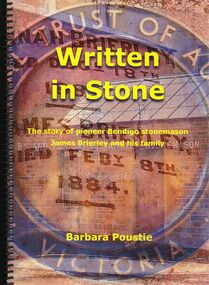
... BENDIGO History brierley Bendigo-History-Brierley-Buildings-Stonemason Barbara Poustie Written in Stone, the story of pioneer Bendigo stonemason James Brierley and his family, 217 pages with black and white photographs in a spring bound binder. ...Written in Stone, the story of pioneer Bendigo stonemason James Brierley and his family, 217 pages with black and white photographs in a spring bound binder. Barbara Poustie bendigo, history, brierley, bendigo-history-brierley-buildings-stonemason -
 Bendigo Historical Society Inc.
Book - THE LEGACY OF RICHARD HARTLEY SMITH
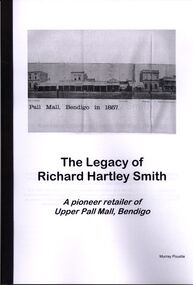
... BENDIGO History businesses Bendigo-history-retailers Murray Poustie The Legacy of Richard Hartley Smith, a pioneer retailer of Upper Pall Mall Bendigo, 44 pages with black and white photographs, the story of other pioneer retailers and developers who began their businesses and property investments with such energy and enthusiasm, leaving us some of the buildings that still face Pall Mall today. ...The Legacy of Richard Hartley Smith, a pioneer retailer of Upper Pall Mall Bendigo, 44 pages with black and white photographs, the story of other pioneer retailers and developers who began their businesses and property investments with such energy and enthusiasm, leaving us some of the buildings that still face Pall Mall today. The buildings include the remnants of the original shop owned by Richard Hartley Smith. Murray Poustie bendigo, history, businesses, bendigo-history-retailers -
 Bendigo Historical Society Inc.
Photograph - GREATER BENDIGO PHOTO COLLECTION: SACRED HEART CATHEDRAL, 1960-1970
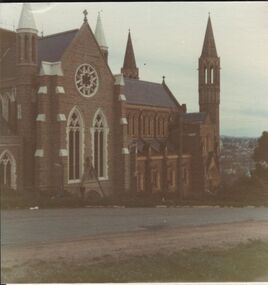
... BENDIGO Streetscape history buildings&infrastructure Photo of Sacred Heart Cathedral in Bendigo. Date unknown. Photograph ...Photo of Sacred Heart Cathedral in Bendigo. Date unknown. bendigo, streetscape, history buildings&infrastructure -
 Bendigo Historical Society Inc.
Administrative record - National Trust Collection: Bendigo Joss House, 1965
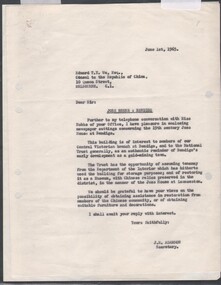
... Known popularly to the boat people as TIEN HOU, this Taoist deity ... and her temple was one of the last sights seen by hundreds of Cantonese who sailed to the new world from the old. 3218 IB - one page incomplete letter dated 4 June 1973, writer unknown; supplies for the Joss House 3218 IC - two page undated list of panels and hangings for the interiors of the Joss House and ten dot points on doing good painted in gold on a pair of large vertical panels. 3218 J - 15/03/1970 a single hand-written foolscap page, written by Albert Richardson; on the Chinese Joss House a description of the furnishing of the Joss House 3218K - a single page typed Building over two paragraphs for the Bendigo Joss House erected in the 1860s. 3218 L - 2/08/1985 four page notes for a talk on the Bendigo Joss House by Dr. Constant Wong 3218 M - four page from the NT of Australia (Victoria) research into the Bendigo Joss House, from the Crown Lands Department records, aerial photographs, local history and oral accounts. ...Known popularly to the boat people as TIEN HOU, this Taoist deity ... and her temple was one of the last sights seen by hundreds of Cantonese who sailed to the new world from the old. 3218 IB - one page incomplete letter dated 4 June 1973, writer unknown; supplies for the Joss House 3218 IC - two page undated list of panels and hangings for the interiors of the Joss House and ten dot points on doing good painted in gold on a pair of large vertical panels. 3218 J - 15/03/1970 a single hand-written foolscap page, written by Albert Richardson; on the Chinese Joss House a description of the furnishing of the Joss House 3218K - a single page typed Building over two paragraphs for the Bendigo Joss House erected in the 1860s. 3218 L - 2/08/1985 four page notes for a talk on the Bendigo Joss House by Dr. Constant Wong 3218 M - four page from the NT of Australia (Victoria) research into the Bendigo Joss House, from the Crown Lands Department records, aerial photographs, local history and oral accounts. ...Chinese society on Bendigo Goldfields Bendigo Joss House National Trust Collection: Bendigo Joss House 3218 A - 01 June 1965 letter to Consul of the Republic of China concerning the 19th Century Joss House, seeking assistance to restore of the building 3218 B - 30/06/1968 notes from the NT Victoria to Central Victorian Branch regarding various aspects of the Bendigo Joss House 3218 C - 06/01/1965 five dot points from the NT Central Victorian Branch Exec mtg confirming the Branch does not consider it viable to move the Joss House to a new site involving new fencing and funding of this proposal. 3218 CA - 22/06/1965 letter between NT Victoria from NT Central Victorian Branch, supporting the preservation and restoration of the Bendigo Joss House 3218 D - undated NT Central Victorian Branch Teacher's guide to using the Bendigo Joss House Education Kit 3218 E -- undated, three page extract from Hemisphere - Asian Australian Monthly, August 1970 - The Birth of Sun Loong, by Keith Dunstan 3218 FA - Annals of Bendigo 1859 impost of a £10 tax for every Chinaman coming to the colony, in addition to a residency tax of £4 per annum. The residency tax was later abolished. 3218 FB - undated four page typed document entitled The Chinese on the Goldfields. 3218 FC - undated Building Citation for the Chinese Masonic Hall erected in 1960's, it was worshipped in by the Chinese Masonic Society. The sheet describes the building as The Main Temple is in the centre with a portico entry and is flanked by the Ancestral Temple on the right and a caretaker's residence. 3218 G - Bendigo Advertiser 19 May 1856 - three page document entitled Opening of a Chinese Temple, A Chinese god and The Chinese. 3218 H - Sunday 2 April 1972 at 5:15 PM, an official invitation (to Mr. F J Randell) from the National Trust of Australia (Victoria) and the City of Bendigo to the Opening of the Bendigo Joss House, to be opened the Hon. R. J. Hamer Deputy Premier and Chief Secretary of Victoria. 3218 IA - NT of Victoria cites an extract from the "Macau Gazette" 15 June 1972: of the dozen or so alters, one will be dedicated to A MA, the founder in a spiritual sense of Macau. Known popularly to the boat people as TIEN HOU, this Taoist deity ... and her temple was one of the last sights seen by hundreds of Cantonese who sailed to the new world from the old. 3218 IB - one page incomplete letter dated 4 June 1973, writer unknown; supplies for the Joss House 3218 IC - two page undated list of panels and hangings for the interiors of the Joss House and ten dot points on doing good painted in gold on a pair of large vertical panels. 3218 J - 15/03/1970 a single hand-written foolscap page, written by Albert Richardson; on the Chinese Joss House a description of the furnishing of the Joss House 3218K - a single page typed Building over two paragraphs for the Bendigo Joss House erected in the 1860s. 3218 L - 2/08/1985 four page notes for a talk on the Bendigo Joss House by Dr. Constant Wong 3218 M - four page from the NT of Australia (Victoria) research into the Bendigo Joss House, from the Crown Lands Department records, aerial photographs, local history and oral accounts. Presented by C. Kellaway 1/08/1954. 3218 N - undated three foolscap page typed notes (with comments in blue) from the NT of Australia (Victoria) covering the history of Chinese Religion, Hunan Gung( the god worshipped at the Bendigo Joss House) the Chinese on the Bendigo Gold fields and projected cost of restoration of $3,430.00. 3218 O - undated three page typed notes (with comments in ink) from NT (Victoria) on Chung Jung Cultural Society bendigo joss house, chinese on the bendigo gold fields -
 Bendigo Historical Society Inc.
Book - "Snippets of Bendigo History", Edith Lunn, 2006
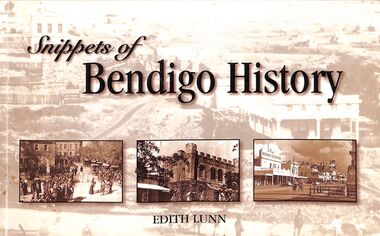
... Bendigo history. Bendigo Weekly Bendigo memories Written in pen on first page "To jenny, With every best Good wish + thanks for your interest. Edith Lunn 29/7/06". Light brown soft cover book. Three sepia photographs of Bendigo buildings ...Edith Lunn was born in Bendigo 0n 27.7.1907 and lived all her life in the city and its environs. Edith was awarded an OAM on January 26, 2002 for her contribution to the archives of Bendigo history. Light brown soft cover book. Three sepia photographs of Bendigo buildings on the front cover. Sepia photograph of Pall Mall buildings on the back cover. Includes black and white and colured photographs. 65 pp. Author Edith Lunn.. Published by Edith Lunn in 2008. Artwork and layout by Sally Giri. Printed by Bendigo Modern Press. A series of articles that appeared over several years in the Bendigo Weekly newspaper, published in book form. Written in pen on first page "To jenny, With every best Good wish + thanks for your interest. Edith Lunn 29/7/06". bendigo weekly, bendigo memories -
 Bendigo Historical Society Inc.
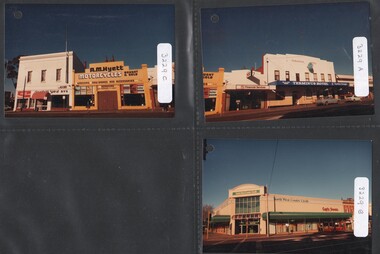
Photograph - National Trust Collection: 17 photographs of the frontage of properties fronting Mitchell Street, Bendigo, 1993
... Social history, Historic buildings Millewa Hall Some Mitchell Street property address numbers on the rear of photographs National Trust Collection: 17 colour photographs of buildings with frontage to Mitchell Street, Bendigo - circa 1970s. ...Social history, Historic buildings National Trust Collection: 17 colour photographs of buildings with frontage to Mitchell Street, Bendigo - circa 1970s. Photos have hole punched in upper LH corner. 3229 a - Terminus Hotel 3229 b - cnr Mitchell & Wills Streets 3229 c - R. M. Hyett Motorcycles, cnr Mitchell and Mollison Streets 3229 d - Mitchell Street and Lyttleton Terrace and Mollison Street intersection 3229 e - Mitchell and Lyttleton Terrace intersection 3229 f - Mitchell and Lyttleton Terrace intersection 3229 g - 76-84 Mitchell Street 3229 h - 31-43 Mitchell Street 3229 i - "Toi Shan" Chinese restaurant 3229 j - Mitchell Street, Pall Mall to Hargreaves Street 3229 k - 79-85 Mitchell Street 3229 l - Bar-b-que Galore store, Mitchell Street 3229 m - 65-77 Mitchell Street 3229 n - ?? Mitchell Street 3229 o - 12-24 Mitchell Street; Plaza Theatre and Backhaus Building. Hargreaves Street to Bath Lane 3229 p - 58-74 Mitchell Street; Queen Street towards station 3229 q - Mitchell & Queen Street intersection, 26& 28 Mitchell Street Some Mitchell Street property address numbers on the rear of photographs millewa hall
