
Showing 4 items matching "bert cadman"
-
 Wodonga & District Historical Society Inc
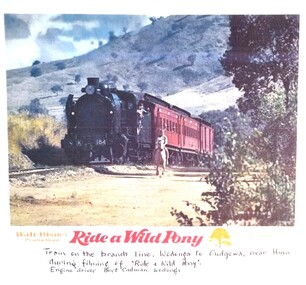
Poster - Advertising Still - Ride a Wild Pony, 1974
... Bert Cadman...The Engine Driver is Bert Cadman of Wodonga. ...The Engine Driver is Bert Cadman of Wodonga. These images are significant because they promote an early feature movie filmed in Northeast Victoria. ...The feature film “Ride A Wild Pony” was the first Walt Disney Production film made in Australia. It was based on the 1973 book “A Sporting Proposition” by James Aldridge and was filmed in 1974. The majority of filming took place in Chiltern, Victoria with Conness Street being transformed into the fictional town of ‘Barambogie’. Other film locations were in the hills around Beechworth and the school in Stanley as well as on the banks of the Murray River and along the railway track near the Huon Railway Siding. Filming was completed on 11th December 1974. It featured British actor Michael Craig as well as Australian actors John Meillon, Andrew McFarlane and Lorraine Bayly. The images in these posters were taken on the Branch Line, Wodonga to Cudgewa near Huon. The Engine Driver is Bert Cadman of Wodonga. These images are significant because they promote an early feature movie filmed in Northeast Victoria.Two coloured photographs of a steam locomotive on the Wodonga to Cudgewa Line at Huon and a boy on a white pony. The locomotive driver can be seen looking out of the cabin.Walt Disney Productions / Ride a Wild Pony / Technicolorbert cadman, wodonga to cudgewa branch line, “ride a wild pony” -
 Wodonga & District Historical Society Inc
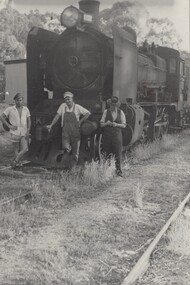
Photograph - Fred Rochow Railways Collection - Shunting at Shelley Station, 1961
... Left to Right: Fireman Bert Cadman, Driver Wally Riley, Guard Hugh Fraser. ...Railways Wodonga Fred Rochow Wodonga Railwaymen S Class Locomotive Left to Right: Fireman Bert Cadman, Driver Wally Riley, Guard Hugh Fraser. ...The Fred Rochow Railways Collection incorporates photos related to the operation of the Wodonga Railway Station including different types of trains and railways staff C. 1930 – 1990. It was donated to the Wodonga Historical Society by Fred Rochow, a railwayman who spent many years based in Wodonga. He joined the Victorian Railways on 17th June l947 and retired in 1988. For some time, he was a member of the Australian Federated Union of Locomotive Enginemen and served a term as a member of the Trades Hall Council. He had an extensive knowledge of the struggles that took place to achieve better conditions for railway workers. Fred worked for many years as a fireman and then worked his way up the ranks to driver, experiencing many changes from the days of steam locomotives through to diesel trains, locomotives and even the modern XPT train. He worked throughout Victoria at different stages of his career, with his final working years focused on the northeast of Victoria and the Albury to Melbourne line. After his retirement, Fred continued to share his love of steam miniature trains with the community. Shelley Railway Station - Shelley was once Victoria's highest railway station, located 781 metres above sea level. The Shelley Railway Station was opened in 1916 and closed in 1979. The railway was used early in its life to transport farmer’s livestock from the Upper Murray to Wodonga. From the 1950s the railway was used heavily to transport equipment and machinery from Wodonga to the Upper Murray to help build the Snowy Mountains Hydro Electric Scheme. The Snowy Hydro Scheme was completed in 1974 and after several years of low level use, the railway was closed. Some remnants of the Shelley Station passenger platform can still be seen today, along with some information boards. The Shelley Railway Station now forms part of the High Country Rail Trail.This collection has local and statewide significance as it captures images of trains, locomotives and personnel who operated the railway services in Wodonga and throughout Northeast Victoria. The railways played a critical role in opening up Victoria and connecting Australia for trade, business, social communication and transport.Left to Right: Fireman Bert Cadman, Driver Wally Riley, Guard Hugh Fraser. Locomotive S300 - the ‘Matthew Flinders’ The S class diesel locomotives were built by Clyde Engineering in 1957 for the Victorian Railways. Designed as premier express passenger diesels, they assumed the ‘S class’ title from a fleet of steam locomotives. They were also given names of famous Australians. The S300 took the name ‘Matthew Flinders’. In 1962, S300 was converted from the Victorian broad gauge of 5’3” to the New South Wales gauge of 4’8.5”, in order to operate the new Southern Aurora between Sydney & Melbourne. As the locomotive grew older it was removed from these duties and was sold to Chicago Freight Car Leasing Australia (CFCLA) in 2004. It is now owned by a private owner and is on loan to the Canberra Railway Museum.railways wodonga, fred rochow, wodonga railwaymen, s class locomotive -
 Wodonga & District Historical Society Inc
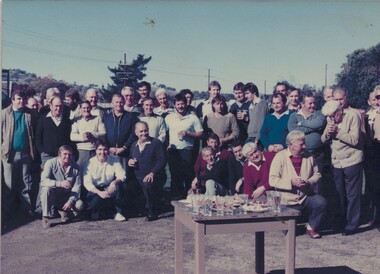
Photograph - Fred Rochow Railways Collection - Wally Riley and Tom Symonds send-off, 1987
... McIntosh, G. Robinson, Bert Cadman, J. Wise, K. Hill, Hugh Fraser, Frank Conway, Alan Smythe. ...McIntosh, G. Robinson, Bert Cadman, J. Wise, K. Hill, Hugh Fraser, Frank Conway, Alan Smythe. ...The Fred Rochow Railways Collection incorporates photos related to the operation of the Wodonga Railway Station including different types of trains and railways staff C. 1930 – 1990. It was donated to the Wodonga Historical Society by Fred Rochow, a railwayman who spent many years based in Wodonga. He joined the Victorian Railways on 17th June l947 and retired in 1988. For some time, he was a member of the Australian Federated Union of Locomotive Enginemen and served a term as a member of the Trades Hall Council. He had an extensive knowledge of the struggles that took place to achieve better conditions for railway workers. Fred worked for many years as a fireman and then worked his way up the ranks to driver, experiencing many changes from the days of steam locomotives through to diesel trains, locomotives and even the modern XPT train. He worked throughout Victoria at different stages of his career, with his final working years focused on the northeast of Victoria and the Albury to Melbourne line. After his retirement, Fred continued to share his love of steam miniature trains with the community.This collection has local and statewide significance as it captures images of trains, locomotives and personnel who operated the railway services in Wodonga and throughout Northeast Victoria. The railways played a critical role in opening up Victoria and connecting Australia for trade, business, social communication and transport.Group of railway men at send-off to Wally Riley and Tom Symonds in Wodonga in 1987.Back two rows L-R: R. Heathcote, J. Young, Rex McDonnell, Les Hallawell, Jack Dawe, Tom Symonds, Mick Seymour, M. Bergin, M. McGrath, R. McGrath, C. Symes, M. Matthews, M. Sandilands, S. Wishers, K. Ross, D. McIntosh, G. Robinson, Bert Cadman, J. Wise, K. Hill, Hugh Fraser, Frank Conway, Alan Smythe. Front row: K. Dainer, S. Rigby, Wally Riley, Doug West, Mick O’Brien, M. Steff, Leo Wilkinson, George Judge.railways wodonga, fred rochow, wodonga railway men, tom symonds, wally riley -
 Wodonga & District Historical Society Inc
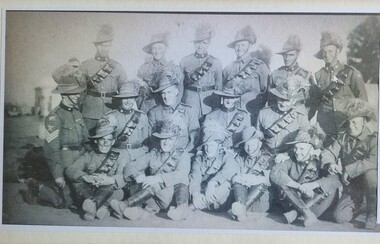
Photograph - Members of the Bethanga Light Horse Troop
... Back row (left to right), Troopers Keith Cadman, Arthur "Friday" Dower, Bert Sommer, Norm Martin, Andy Mitchell, Tom Pearce; Middle row (left to right). ...This photo represents a group of Bethanga men who committed to service during World War 2 Indi Light Horse Bethanga Light Horse troop Bethanga History Back row (left to right), Troopers Keith Cadman, Arthur "Friday" Dower, Bert Sommer, Norm Martin, Andy Mitchell, Tom Pearce; Middle row (left to right). ...The 8th Light Horse was initially raised from companies of the colonial Victorian Mounted Rifles located in North-east Victoria following Federation. In 1912 a major reorganisation of the Australian military forces resulted in the regiment being renumbered 16th Light Horse. The Regiment was disbanded in 1919 but soon after was re-raised as the 8th (Indi) Light Horse in the Citizen Military Forces, with the territorial title Indi Light Horse. The Indi Light Horse consisted of 3 squadrons. A squadron consisted of troops in Corryong, Walwa, Tallangatta, Eskdale and Wodonga. After an extensive recruiting campaign in January 1939 a new troop was raised in Bethanga, Victoria. In December 1941, the regiment converted from horse to mechanised, initially as 8th Reconnaissance Battalion then in July 1942 it became 8th Cavalry Regiment and served in Northern Territory. As Japanese threat to the mainland declined the regiment was disbanded.This photo represents a group of Bethanga men who committed to service during World War 2A framed Black and white photograph of Bethanga members of the Australian Light Horse in uniformBack row (left to right), Troopers Keith Cadman, Arthur "Friday" Dower, Bert Sommer, Norm Martin, Andy Mitchell, Tom Pearce; Middle row (left to right). Troop Leader Sergeant Edward "Ted"Davies, Troopers Jack Mortlock, Albert "Ab" Bohun, Aub Cadman, Les Freyer Front row (left to right), Troopers Henry Trenchard, A."Ed" Hertzog, Doug Dower, Nelson "Manny" Green, Eric Wheller, J. Parker.indi light horse, bethanga light horse troop, bethanga history
