
Showing 1652 items matching "between the wars"
-
 Greensborough Historical Society
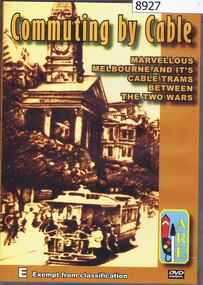
Film - DVD, John Reid, Commuting by cable: marvellous Melbourne and its cable trams between the two wars, 1988
... Commuting by cable: marvellous Melbourne and its cable trams between the two wars...Covers the period between the two world wars 1919-1939....Covers the period between the two world wars 1919-1939. trams c able trams melbourne DVD PAL Region 0 in plastic case with printed iunsert Commuting by cable: marvellous Melbourne and its cable trams between the two wars Film DVD John Reid Association of Railway Enthusiasts Ltd. ...Documentary on Melbourne's cable trams assembled from various sources. Covers the period between the two world wars 1919-1939.DVD PAL Region 0 in plastic case with printed iunserttrams, c able trams, melbourne -
 Warrnambool RSL Sub Branch
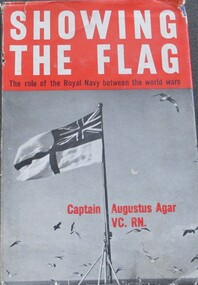
Book, BOOK: Showing the Flag - The Role of the Royal Navy between the world wars
... BOOK: Showing the Flag - The Role of the Royal Navy between the world wars....AUTHOR: Captain Agustus Agar VC RN PUBLISHER: Evans Brothers LTD. 1962 BOOK: Showing the Flag - The Role of the Royal Navy between the world wars. Book ... -
 Moorabbin Air Museum
Book - Aviation history, The Aeroplane An Historical Survey
... war 1...Between the wars 1919-1939...Aviation history Early ides of flight 1800 - 1903 The Wright brothers & the flight of 1903 Beginnings of aviation in Europe 1900 - 1908 Practical powered flight 1909-1914 World war 1 Between the wars 1919-1939 World war 2 Modern aviation The origins of the kite The origins of the rocket The origins of the parachute The origins of the aero engine The origins of the airscrew Overview of the origins & development of the airplane, circa 1960 The Aeroplane An Historical Survey Book Aviation history ...Overview of the origins & development of the airplane, circa 1960non-fictionOverview of the origins & development of the airplane, circa 1960early ides of flight 1800 - 1903, the wright brothers & the flight of 1903, beginnings of aviation in europe 1900 - 1908, practical powered flight 1909-1914, world war 1, between the wars 1919-1939, world war 2, modern aviation, the origins of the kite, the origins of the rocket, the origins of the parachute, the origins of the aero engine, the origins of the airscrew -
Moorabbin Air Museum
Book - Aircraft history, An Illustrated History of Aircraft
... war planes...Engines...Between...Aircraft history The concept of flight World War 1 The development of war planes Engines Between the wars World War 2 The jet engine The V bomber era Aviation today The helicopter The helicopter in military service History of aircraft from pre-Wright brothers to 1979. ...History of aircraft from pre-Wright brothers to 1979.non-fictionHistory of aircraft from pre-Wright brothers to 1979.the concept of flight, world war 1, the development of war planes, engines, between the wars, world war 2, the jet engine, the v bomber era, aviation today, the helicopter, the helicopter in military service -
 8th/13th Victorian Mounted Rifles Regimental Collection
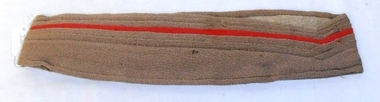
Uniform - puggaree, 1925 circa
... Different coloured bands denoting Corps were incorporated into the puggaree worn by militia units shortly before WWI and again in the period between the wars. The word puggaree comes from Hindi meaning turban and is thought to have referred to a piece of cloth worn on the British officer’s sun helmet to protect his neck from the sun....Seven fold puggaree with red band denoting Light Horse of the period between the wars....Good example of distinctive headwear worn by light horse soldiers. puggaree uniform headwear light horse Seven fold puggaree with red band denoting Light Horse of the period between the wars. Uniform puggaree ...A puggaree, usually of pleated cloth, has been worn on the Australian slouch hat since it was adopted in 1903. During WWI (1914-1918) it was frequently a plain woollen band often made from puttee material. Different coloured bands denoting Corps were incorporated into the puggaree worn by militia units shortly before WWI and again in the period between the wars. The word puggaree comes from Hindi meaning turban and is thought to have referred to a piece of cloth worn on the British officer’s sun helmet to protect his neck from the sun.Good example of distinctive headwear worn by light horse soldiers.Seven fold puggaree with red band denoting Light Horse of the period between the wars.puggaree, uniform, headwear, light horse -
 8th/13th Victorian Mounted Rifles Regimental Collection
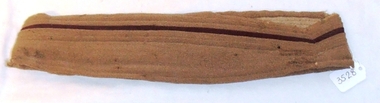
puggaree, 1925 circa
... Different coloured bands denoting Corps were incorporated into the puggaree worn by militia units shortly before WWI and again in the period between the wars. The word puggaree comes from Hindi meaning turban and is thought to have referred to a piece of cloth worn on the British officer’s sun helmet to protect his neck from the sun....Seven fold puggaree with deep maroon band denoting Light Horse or Veterinary Corps in the period between the wars....Good example of distinctive headwear worn by light horse or veterinary corps soldiers. puggaree uniform light horse headwear Seven fold puggaree with deep maroon band denoting Light Horse or Veterinary Corps in the period between the wars. puggaree ...A puggaree, usually of pleated cloth, has been worn on the Australian slouch hat since it was adopted in 1903. During WWI (1914-1918) it was frequently a plain woollen band often made from puttee material. Different coloured bands denoting Corps were incorporated into the puggaree worn by militia units shortly before WWI and again in the period between the wars. The word puggaree comes from Hindi meaning turban and is thought to have referred to a piece of cloth worn on the British officer’s sun helmet to protect his neck from the sun.Good example of distinctive headwear worn by light horse or veterinary corps soldiers.Seven fold puggaree with deep maroon band denoting Light Horse or Veterinary Corps in the period between the wars.puggaree, uniform, light horse, headwear -
Port Melbourne Historical & Preservation Society
Audio - PMHPS Meeting, Robin Grow, Art Deco, 26 Aug 2019
... Robin GROW discusses and illustrates changes to both Melbourne and Port Melbourne during the Art Deco era between the wars. PMHPS monthly meeting 26.08.2019 Duration 1:20:49 including meeting preliminaries....Art Deco Built Environment Robin GROW Robin GROW discusses and illustrates changes to both Melbourne and Port Melbourne during the Art Deco era between the wars. PMHPS monthly meeting 26.08.2019 Duration 1:20:49 including meeting preliminaries. ...Robin GROW discusses and illustrates changes to both Melbourne and Port Melbourne during the Art Deco era between the wars. PMHPS monthly meeting 26.08.2019 Duration 1:20:49 including meeting preliminaries.art deco, built environment, robin grow -
Whitehorse Historical Society Inc.
Document, Nunawading Historical Society - Australia Day Exhibition 1988, 1/01/1988 12:00:00 AM
... Headings: Tribal Meeting Place; Pioneers; Land Boomers and Orchardists; Between the Wars; Suburban Sprawl....Headings: Tribal Meeting Place; Pioneers; Land Boomers and Orchardists; Between the Wars; Suburban Sprawl. Nunawading Historical Society - Australia Day Exhibition 1988 Document Document ...Australia's Bicentennial Year, by the Nunawading Historical Society.Headings and information used for a display in the Nunawading arts centre on Australia Day 1988, Australia's Bicentennial Year, by the Nunawading Historical Society. Headings: Tribal Meeting Place; Pioneers; Land Boomers and Orchardists; Between the Wars; Suburban Sprawl.Australia's Bicentennial Year, by the Nunawading Historical Society.nunawading historical society, australia day, festivals and celebrations -
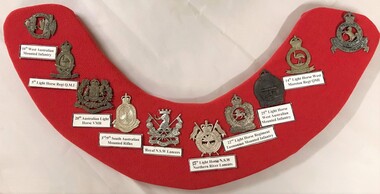 8th/13th Victorian Mounted Rifles Regimental Collection
Badge - CMF Light Horse badges
... Curved fabric backed display board with hat badges of 10 light horse regiments of the between the wars and post World War Two periods: 10th, 5th, 20th, 3/9th, RNSWL, 15th, 22nd, 25th, 14th and 21st Regiments....badge light horse Curved fabric backed display board with hat badges of 10 light horse regiments of the between the wars and post World War Two periods: 10th, 5th, 20th, 3/9th, RNSWL, 15th, 22nd, 25th, 14th and 21st Regiments. ...Curved fabric backed display board with hat badges of 10 light horse regiments of the between the wars and post World War Two periods: 10th, 5th, 20th, 3/9th, RNSWL, 15th, 22nd, 25th, 14th and 21st Regiments.badge, light horse -
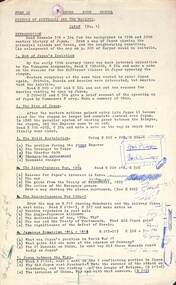 Ringwood and District Historical Society
Document, Ringwood High School - Form IV - 1967 - History of Australia and the Pacific Assignment- (Japan No. 1)
... The Russo-Japan War 1904-5. 6.Japanese Expansion 1914-1918. 7. Japan between the Wars....The Russo-Japan War 1904-5. 6.Japanese Expansion 1914-1918. 7. Japan between the Wars. One single sided foolscap sheet Ringwood High School - Form IV - 1967 - History of Australia and the Pacific Assignment- (Japan No. 1) Document ...One single sided foolscap sheet This paper consists of eight parts - Introduction. 1. End of Japan's Isolation. 2. The Rise of Japan. 3. The Meiji Restoration. 4. The Sino-Japanese War 1894. 5. The Russo-Japan War 1904-5. 6.Japanese Expansion 1914-1918. 7. Japan between the Wars. -
 Bendigo Military Museum
Photograph - PHOTOGRAPHS POST WW1, MOUNTED, 1920's - 1930's
... 38th Bn Between the Wars....38th Bn Between the Wars. Passchendaele barracks trust photographs In pencil on back: "9445T, 9445T, 9445T, 94456, 9445T, 9445T" Group of 6 black / white photos relating to Roy SHADFORTH. ...38th Bn Between the Wars.Group of 6 black / white photos relating to Roy SHADFORTH. Mounted on cardboard with brown border, white background.In pencil on back: "9445T, 9445T, 9445T, 94456, 9445T, 9445T"passchendaele barracks trust, photographs -
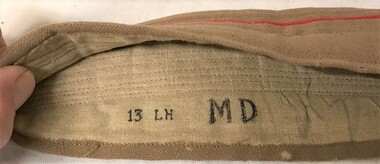 8th/13th Victorian Mounted Rifles Regimental Collection
Uniform - 13LH puggaree
... Worn in period between the Wars 1920--- 1940....Worn in period between the Wars 1920--- 1940. 13th light horse puggeree 13LH / M Khaki puggeree with red stripe. ...Coloured stripe on pugeree denoted different Corps. Red indicated Light Horse. Worn in period between the Wars 1920--- 1940.Khaki puggeree with red stripe. Stamped inside " 13LH " and other markings.13LH / M13th, light horse, puggeree -
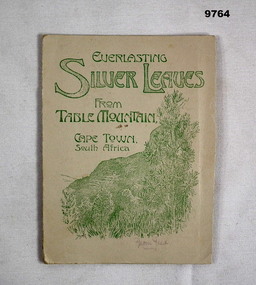 Bendigo Military Museum
Card - SOUTH AFRICAN CARD WW1, c.1918
... Inside written "Between 1916-18 (War). Message on back "With best wishes from here, trust all are well. ...Card WW1 Baxter MC Inside written "Between 1916-18 (War). Message on back "With best wishes from here, trust all are well. ...Card sent home from Sth Africa. Part of the collection of Capt Frederick Baxter MC & Bar. Refer Cat No. 4219.White folded over card with a photo image inside of the R.M. Steamer leaving docks in Cape Town. card is cream colour with picture of Table Mountain on the front in green. Photo inside and message on the back, Signed off by Fred.Inside written "Between 1916-18 (War). Message on back "With best wishes from here, trust all are well. We are enjoying the trip. the town is lovely - a delightful background ? Majestic. Goodbye Fred".card, ww1, baxter mc -
 Bendigo Military Museum
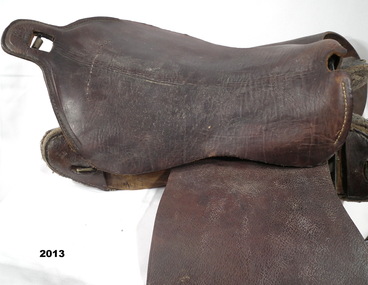
Equipment - SADDLE, c. 1915 to 1930
... Standard issue saddle used by the Australian Light Horse, artillery and transport units during WW1 and after (between the wars). The Universal Pattern saddles were designed to have interchangeable parts, making them easy to repair....Standard issue saddle used by the Australian Light Horse, artillery and transport units during WW1 and after (between the wars). The Universal Pattern saddles were designed to have interchangeable parts, making them easy to repair. australian light horse military equipment saddle transport Stamped on the rear of the seat: 'S (broad up arrow)' 1912 Universal Pattern steel arch brown leather saddle. ...Standard issue saddle used by the Australian Light Horse, artillery and transport units during WW1 and after (between the wars). The Universal Pattern saddles were designed to have interchangeable parts, making them easy to repair.1912 Universal Pattern steel arch brown leather saddle. Tree is made of wood with shredded cotton waste padding attached. Various brass rings are located on the saddle for attaching sundry equipment. No stirrups, stirrup leathers or girth. The leather seat covers the frame between the front and rear metal arches and is attached to them using linen webbing slings. Leather sweat flaps on each side.Stamped on the rear of the seat: 'S (broad up arrow)'australian light horse, military equipment, saddle, transport -
 Tatura Irrigation & Wartime Camps Museum
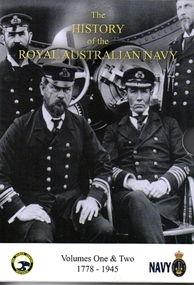
DVD (2 discs), Sea Power Centre - Australian Department of Defence, The History of the Royal Australian Navy, 2013
... Vol 1 - Episode 1 1788 -1918 Genesis Episode 2 - In all Respects Ready Vol 2 - 1919 - 1945 - Episode 1 - Between two wars, Episode 2 - The world ablaze, Episode 3 - Banzai...Vol 1 - Episode 1 1788 -1918 Genesis Episode 2 - In all Respects Ready Vol 2 - 1919 - 1945 - Episode 1 - Between two wars, Episode 2 - The world ablaze, Episode 3 - Banzai Australian Navy Volume 1 1778 - 1918 Volume 2 1919 - 1945 Plastic sleeves, with naval pictures on cover. ...Vol 1 - Episode 1 1788 -1918 Genesis Episode 2 - In all Respects Ready Vol 2 - 1919 - 1945 - Episode 1 - Between two wars, Episode 2 - The world ablaze, Episode 3 - Banzai Volume 1 1778 - 1918 Volume 2 1919 - 1945 Plastic sleeves, with naval pictures on cover.australian navy -
Whitehorse Historical Society Inc.
Article, Long medical history, n.d
... He also conducted a sanatorium where Whitefriars is now. Between the wars Dr Stanley Cochrane built the home incorporated into a surgery in 1929. ...He also conducted a sanatorium where Whitefriars is now. Between the wars Dr Stanley Cochrane built the home incorporated into a surgery in 1929. ...Article and advertisement for sale of 331 - 335 Mitcham Road, Mitcham, home of Dr Threlkeld. It is part of the land purchased by Dr Francis Drake 75 years ago, he built a surgery and was involved with a private hospital on the next door site where Mitcham R.S.L. is now. He also conducted a sanatorium where Whitefriars is now. Between the wars Dr Stanley Cochrane built the home incorporated into a surgery in 1929. Dr Threlked continued the medical practice, erecting separate consulting rooms on the adjoining land to the site now being sold.threlkeld, verner w., dr, drake, francis john, dr, cochrane, stanley, dr, auctions, mitcham road, mitcham., drake & co. -
 8th/13th Victorian Mounted Rifles Regimental Collection
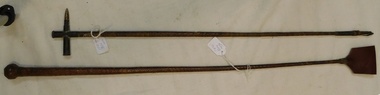
Memorabilia - Riding Crop, c.1918
... Riding crops favoured by Officers in First World War and between wars. Attraction declined with loss of horses and mechanization....Riding crops favoured by Officers in First World War and between wars. Attraction declined with loss of horses and mechanization. ...Riding crops favoured by Officers in First World War and between wars. Attraction declined with loss of horses and mechanization.Limited display valueTwo platted leather riding crops - one having two .303 rounds arrange as handle, however end flap is missing.saddlery, riding crops, leathercraft, horse riding equipment, bullet casings, wwi, 1914-1918, world war one, first world war, mounted soldiers -
 Bendigo Historical Society Inc.
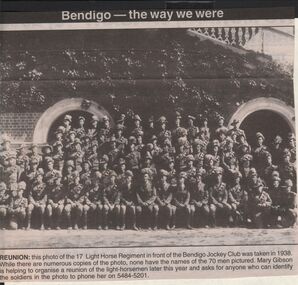
Newspaper - JENNY FOLEY COLLECTION: REUNION
... The 17th Light Horse was a militia unit between the wars. Members were drawn from Kyneton, Castlemaine and Bendigo areas. ...The 17th Light Horse was a militia unit between the wars. Members were drawn from Kyneton, Castlemaine and Bendigo areas. ...The 17th Light Horse was a militia unit between the wars. Members were drawn from Kyneton, Castlemaine and Bendigo areas. In 1936 the regiment, including 100 horses, camped at the Bendigo Racecourse so it is possible this photo was actually 1936.From Dec 1941 this regiment became the 17th Light Horse (Machine Gun) Regiment and was disbanded in April 1943. Members were absorbed into other units.Bendigo Advertiser ''The way we were'' from 2003. Reunion: this photo of the 17 Light horse regiment in front of the Bendigo jockey Club was taken in 1938. While there are numerous copies of the photo, none have the names of the 70 men pictured. The clip is in a folder.newspaper, bendigo advertiser, the way we were -
 Sunshine and District Historical Society Incorporated
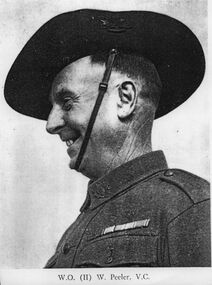
Photograph - Walter Peeler, n.d
... Photocopy of a photograph of WO II W Peeler VC World War I Signed up for World War II|Ancestry of Walter Peeler Victorian Coss Recipient|Extract from Anzac Centenary 2014 to 2018 Walter Peeler between the wars worked for the Department of Lands and at the Sunshine Harvester Works|Typed Report Walter Peeler 1887 to 1968 Family Background World War I Inter War Period World War II Post World War II Addresses Recreation Decorations The Victoria Cross Citation for Walter Peelers Victoria Cross The Victoria Cross for Australia Walters Childrens Service History Kenneth...Walter Peeler World War 1914 - 1918 World War 1939 - 1945 Photocopy of a photograph of WO II W Peeler VC World War I Signed up for World War II|Ancestry of Walter Peeler Victorian Coss Recipient|Extract from Anzac Centenary 2014 to 2018 Walter Peeler between the wars worked for the Department of Lands and at the Sunshine Harvester Works|Typed Report Walter Peeler 1887 to 1968 Family Background World War I Inter War Period World War II Post World War II Addresses Recreation Decorations The Victoria Cross Citation for Walter Peelers Victoria Cross The Victoria Cross for Australia Walters Childrens Service History Kenneth Walter Peeler Photograph Walter Peeler ...Photocopy of a photograph of WO II W Peeler VC World War I Signed up for World War II|Ancestry of Walter Peeler Victorian Coss Recipient|Extract from Anzac Centenary 2014 to 2018 Walter Peeler between the wars worked for the Department of Lands and at the Sunshine Harvester Works|Typed Report Walter Peeler 1887 to 1968 Family Background World War I Inter War Period World War II Post World War II Addresses Recreation Decorations The Victoria Cross Citation for Walter Peelers Victoria Cross The Victoria Cross for Australia Walters Childrens Service History Kennethwalter peeler, world war 1914 - 1918, world war 1939 - 1945 -
 Bendigo Military Museum
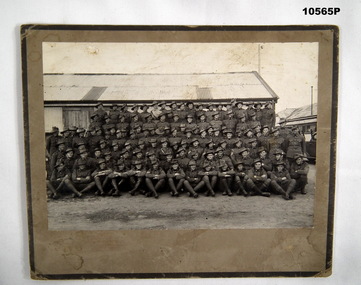
Photograph - GROUP PHOTOGRAPH, WW2, c.1999939
... Was re-established in between wars as a part time Military unit....Was re-established in between wars as a part time Military unit. 38th Battalion WW2 Photograph On back written "1936". ...38th Batt. was set up in WW1 as action regiment but disbanded in 1919. Was re-established in between wars as a part time Military unit.Black and white photo of soldiers of 38th Btn posed in 6 rows in front of a shed. All soldiers are in full uniform. Photo glued to a cardboard back board.On back written "1936".38th battalion, ww2, photograph -
 8th/13th Victorian Mounted Rifles Regimental Collection
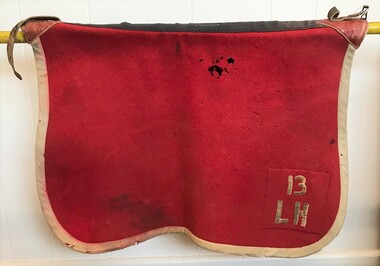
Functional object - Saddle cloth 13th Light Horse
... Saddle blankets matching regimental colour patch were used by light horse regiments in the period between the wars, 1920-1940. Following WWI (1914-1918) the 13th Light Horse (Gippsland) was raised as a Citizen Forces unit and trained as a cavalry regiment till August 1940, when it converted from horse to mechanised, initially as 13th Motor Regiment then 13th Armoured Regiment. ...Saddle blankets matching regimental colour patch were used by light horse regiments in the period between the wars, 1920-1940. Following WWI (1914-1918) the 13th Light Horse (Gippsland) was raised as a Citizen Forces unit and trained as a cavalry regiment till August 1940, when it converted from horse to mechanised, initially as 13th Motor Regiment then 13th Armoured Regiment. ...Saddle blankets matching regimental colour patch were used by light horse regiments in the period between the wars, 1920-1940. Following WWI (1914-1918) the 13th Light Horse (Gippsland) was raised as a Citizen Forces unit and trained as a cavalry regiment till August 1940, when it converted from horse to mechanised, initially as 13th Motor Regiment then 13th Armoured Regiment. It trained in Victoria and, as the Japanese threat to the mainland declined, was disbanded in October 1943 with men going to other units.Representative of the Light Horse in the period following WWI and the beginning of WWII.Red coloured saddle blanket with white piping and embroidered number '13' and letters 'LH' near lower right edge.military, horse, saddle, light horse, 13 light horse -
 Stawell Historical Society Inc
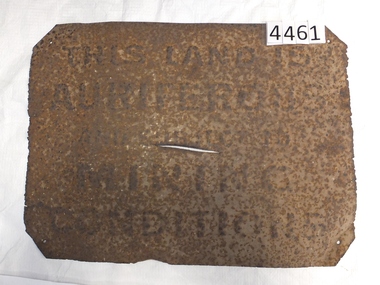
Memorabilia - Realia, 1850-1920's
... From 1850'c to between the two world wars. Found near Rhymney Hill Great Westernc1966...From 1850'c to between the two world wars. Found near Rhymney Hill Great Westernc1966 Memorabilia Realia ...Rusted Tin Sign – "THIS LAND IS AURIFEROUS AND SUBJECT TO MINING CONDITIONS" This sign was required to be displayed in the vicinity of gold mining sites. From 1850'c to between the two world wars. Found near Rhymney Hill Great Westernc1966stawell -
 8th/13th Victorian Mounted Rifles Regimental Collection
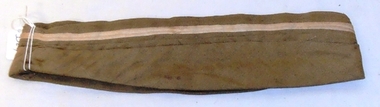
Uniform - puggaree, 1912 circa
... Different coloured bands denoting Corps were incorporated into the puggaree worn by militia units shortly before WWI and again in the period between the wars. The word puggaree comes from Hindi meaning turban and is thought to have referred to a piece of cloth worn on the British officer’s sun helmet to protect his neck from the sun....Different coloured bands denoting Corps were incorporated into the puggaree worn by militia units shortly before WWI and again in the period between the wars. The word puggaree comes from Hindi meaning turban and is thought to have referred to a piece of cloth worn on the British officer’s sun helmet to protect his neck from the sun. ...A puggaree, usually of pleated cloth, has been worn on the Australian slouch hat since it was adopted in 1903. During WWI (1914-1918) it was frequently a plain woollen band made from puttee material. Different coloured bands denoting Corps were incorporated into the puggaree worn by militia units shortly before WWI and again in the period between the wars. The word puggaree comes from Hindi meaning turban and is thought to have referred to a piece of cloth worn on the British officer’s sun helmet to protect his neck from the sun.Good example of distinctive headwear worn by light horse soldiers.Seven fold puggaree with white band denoting Light Horse of the pre WWI (1914-1918) period and possible for a time following the war until superseded by the red band.puggaree, headwear, light horse, uniform -
 Ithacan Historical Society
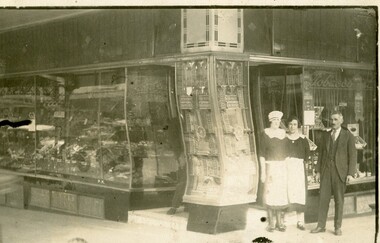
Photograph, Ithacan business, c1930s
... The confectionary shop was owned by an Ithacan family who settled in Melbourne between the two world wars....The confectionary shop was owned by an Ithacan family who settled in Melbourne between the two world wars. A sepia photograph of three people standing outside a shop which is on a corner of a street. ...The confectionary shop was owned by an Ithacan family who settled in Melbourne between the two world wars.A sepia photograph of three people standing outside a shop which is on a corner of a street. -
 Surrey Hills Historical Society Collection
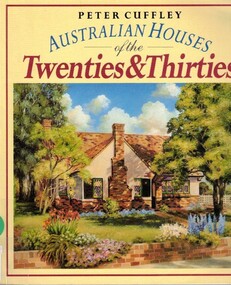
Book, Geoff Hocking, Australian Houses of the Twenties & Thirties, 1993
... Australian domestic architecture of the period between the two world wars is a fascinating and complex subject. ...Australian domestic architecture of the period between the two world wars is a fascinating and complex subject. ...Australian domestic architecture of the period between the two world wars is a fascinating and complex subject. ...Australian domestic architecture of the period between the two world wars is a fascinating and complex subject. Our preconceived notions are based on the more obvious styles and impressions, so that visions of bungalows set row upon row spring to mind quickly. Influences in the designs of Australian houses of the 1920s and 1930s were extraordinarily diverse. Apart from their obvious origins, they can be traced to India, Japan, Switzerland, Holland, Germany, Italy, Spain, Mexico and even the American backwoods. Australian architects travelled to England, Europe and North America bringing back ideas and influences.Includes: index, bibliography. Australian domestic architecture of the period between the two world wars is a fascinating and complex subject. Our preconceived notions are based on the more obvious styles and impressions, so that visions of bungalows set row upon row spring to mind quickly. Influences in the designs of Australian houses of the 1920s and 1930s were extraordinarily diverse. Apart from their obvious origins, they can be traced to India, Japan, Switzerland, Holland, Germany, Italy, Spain, Mexico and even the American backwoods. Australian architects travelled to England, Europe and North America bringing back ideas and influences.Front page: Sue Barnettarchitecture, (mr) peter cuffley, dwellings, interior decoration, 1919 - 1929, 1930 - 1939 -
Blacksmith's Cottage and Forge
Sampler-embroidery, 1920-1945
... Probably made by Katherine Whitlow (nee Booth) who was an aunt of the donor. Made between the two world wars....Probably made by Katherine Whitlow (nee Booth) who was an aunt of the donor. Made between the two world wars. Handicraft of the times embroidery sampler AUSTRALIA Linen embroidery withe Australian coat of Arms. ...Probably made by Katherine Whitlow (nee Booth) who was an aunt of the donor. Made between the two world wars.Handicraft of the timesLinen embroidery withe Australian coat of Arms. Kangaroo, shgield, emu, cross, crown, sheaves, star, eagle, swan, lion, AUSTRALIA. Stem stitchAUSTRALIAembroidery, sampler -
 RMIT Design Archives
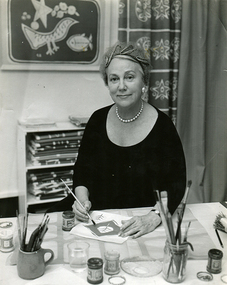
Photographs
... Burke established her textile business in 1937, developing it between the wars in a very challenging marketplace by capitalising on opportunities as they presented. ...Burke established her textile business in 1937, developing it between the wars in a very challenging marketplace by capitalising on opportunities as they presented. ...This photograph was reproduced on the cover of the magazine 'Housewife, Home and Family', in October, 1960 with the heading, 'Miss Frances Burke, Brilliant Australian Textile Designer'. The photograph contains interesting contradictions: Burke, wearing a cocktail hat whilst painting, was never a housewife, nor did she have children. Gladys Hain, editor of the magazine, exhorted women who did have children to get busy, start businesses and contribute to the economy! The image highlights Burke's ability to attract publicity and demonstrates her acute understanding of the power of PR and marketing. Burke established her textile business in 1937, developing it between the wars in a very challenging marketplace by capitalising on opportunities as they presented. Robyn Oswald-Jacobs, 2017Photograph featuring Frances Burke painting at desktextile design, studio, rmit design archives -
 Federation University Art Collection
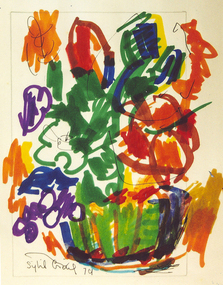
Drawing - Texta sketch, [Flower Bowl] by Sybil Craig, 1979
... However, her association with leading modernists between the wars led her to pursue her art in a deliberately experimental and spontaneous way. ...However, her association with leading modernists between the wars led her to pursue her art in a deliberately experimental and spontaneous way. ...Sybil CRAIG (18 November 1901-09 September 1989) Born London, England Arrived Australia 1902 The National Gallery School, Melbourne, gave Craig a sound training for her popular flower and portrait studies. However, her association with leading modernists between the wars led her to pursue her art in a deliberately experimental and spontaneous way. Sybil Craig was the third woman appointed by the Australian War Memorial as an official war artist. She was the first woman to paint women working in the munitions’ factories. The Castlemaine Art Gallery & Historical Museum, held the first retrospective exhibition of Sybil Craig's in 2006. The exhibition highlighted her wonderful use of colour and design in a diverse range of media, techniques and subject matter. This item is part of the Federation University Art Collection. The Art Collection features over 2000 works and was listed as a 'Ballarat Treasure' in 2007.ModernismDrawing in texta of a bright bowl of flowers.art, artwork, sybil craig, craig, texta, flowers -
 Federation University Art Collection
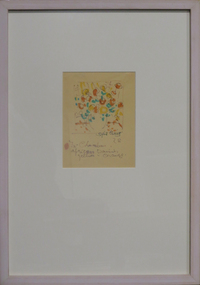
Drawing - Texta sketch, 'In Chamber African Daisies' by Sybil Craig', 1978
... However, her association with leading modernists between the wars led her to pursue her art in a deliberately experimental and spontaneous way. ...However, her association with leading modernists between the wars led her to pursue her art in a deliberately experimental and spontaneous way. ...Sybil CRAIG (18 November 1901-09 September 1989) Born London, England Arrived Australia 1902 The National Gallery School, Melbourne, gave Craig a sound training for her popular flower and portrait studies. However, her association with leading modernists between the wars led her to pursue her art in a deliberately experimental and spontaneous way. Sybil Craig was the third woman appointed by the Australian War Memorial as an official war artist. She was the first woman to paint women working in the munitions’ factories. The Castlemaine Art Gallery & Historical Museum, held the first retrospective exhibition of Sybil Craig's in 2006. The exhibition highlighted her wonderful use of colour and design in a diverse range of media, techniques and subject matter. This item is part of the Federation University Art Collection. The Art Collection features over 2000 works and was listed as a 'Ballarat Treasure' in 2007.ModernismFramed sketch of flowers undertaken in texta colour.art, artwork, sybil craig, craig, flora, texta, texta colour, available -
 Federation University Art Collection
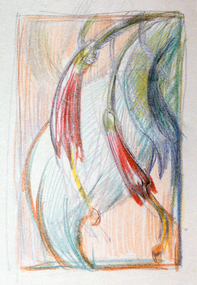
Drawing - Coloured pencil sketch, 'Untitled' by Sybil Craig
... However, her association with leading modernists between the wars led her to pursue her art in a deliberately experimental and spontaneous way. ...However, her association with leading modernists between the wars led her to pursue her art in a deliberately experimental and spontaneous way. ...Sybil CRAIG (18 November 1901-09 September 1989) Born London, England Arrived Australia 1902 The National Gallery School, Melbourne, gave Craig a sound training for her popular flower and portrait studies. However, her association with leading modernists between the wars led her to pursue her art in a deliberately experimental and spontaneous way. Sybil Craig was the third woman appointed by the Australian War Memorial as an official war artist. She was the first woman to paint women working in the munitions’ factories. The Castlemaine Art Gallery & Historical Museum, held the first retrospective exhibition of Sybil Craig's in 2006. The exhibition highlighted her wonderful use of colour and design in a diverse range of media, techniques and subject matter. This item is part of the Federation University Art Collection. The Art Collection features over 2000 works and was listed as a 'Ballarat Treasure' in 2007.Framed pencil drawing of a flower.art, artwork, sybil craig, craig, flowers, drawing
