
Showing 35 items matching "bird dog and bird"
-
 National Vietnam Veterans Museum (NVVM)
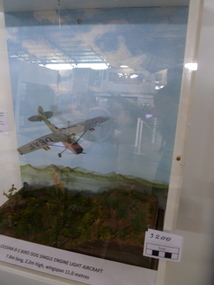
Model - Diorama, Cessna O-1 Bird Dog Single Engine Light Aircraft, 2017
... Cessna O-1 Bird Dog Single Engine Light Aircraft...Cessna O.1 Bird Dog...Model of a Cessna Bird Dog in the air over an enemy bunker. Two soldiers on the ground closing in. ...Cessna O-1 Bird Dog single engine light aircraft...Cessna O.1 Bird Dog Model Diorama Cessna O-1 Bird Dog single engine light aircraft Model of a Cessna Bird Dog in the air over an enemy bunker. ...Model of a Cessna Bird Dog in the air over an enemy bunker. Two soldiers on the ground closing in. Box is perspex with white frameCessna O-1 Bird Dog single engine light aircraftcessna o.1 bird dog, model, diorama -
 National Vietnam Veterans Museum (NVVM)
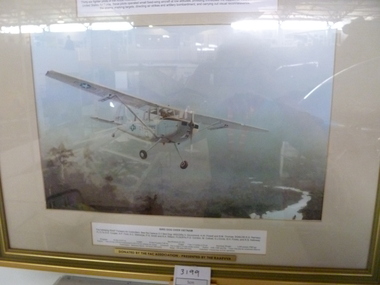
Print, Bird Dog Over Vietnam
... Bird Dog Over Vietnam...Cessna O.1 Bird Dog...Gold framed bone matt board colour print of a Cessna Bird Dog single engine light aircraft flying over jungle with mountains in the background and river below...Forward Air Controllers in Vietnam 1965 - 1971. Bird Dog Over Vietnam. Donated by the FAC Association - presented by the RAAFVVA...Cessna O.1 Bird Dog Framed Print Forward Air Controllers in Vietnam 1965 - 1971. ...Gold framed bone matt board colour print of a Cessna Bird Dog single engine light aircraft flying over jungle with mountains in the background and river belowForward Air Controllers in Vietnam 1965 - 1971. Bird Dog Over Vietnam. Donated by the FAC Association - presented by the RAAFVVAcessna o.1 bird dog, framed print -
 National Vietnam Veterans Museum (NVVM)
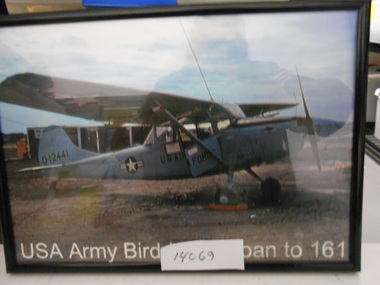
Photograph, US Army Bird Dog Aircraft
... US Army Bird Dog Aircraft......Cessna O.1 Bird Dog...Framed Coloured Photograph of US Army Bird Dog Aircraft on loan to 161 (INDEP) Recce Flt. ...Photograph Cessna O.1 Bird Dog 161 Reconnaissance Flight S/N O-12441, US Air Force logo Framed Coloured Photograph of US Army Bird Dog Aircraft on loan to 161 (INDEP) Recce Flt. ...Framed Coloured Photograph of US Army Bird Dog Aircraft on loan to 161 (INDEP) Recce Flt. Black frame.S/N O-12441, US Air Force logophotograph, cessna o.1 bird dog, 161 reconnaissance flight -
 Moorabbin Air Museum
Booklet - 0-1 Bird Dog in action, Al Adcock, 1988
... 0-1 Bird Dog in action...0-1 Bird Dog in action...0-1 Bird Dog in action Booklet 0-1 Bird Dog in action Al Adcock SQUADRON/SIGNAL PUBLICATIONS INC ... -
 Mission to Seafarers Victoria
Administrative record (Item) - Scrapbook, Edith E Hitchcock, Victoria Missions to Seamen, Spencer Street Railway Station, 1931-1943
... ...bird......bird...This scrapbook is significant because it makes reference to contemporaneous events related to the Mission to Seafarers. edith e. hitchcock scrapbooks c.b. pedersen hobbies ship models painting frank leslie oliver mv manunda captain robert sunter windvane rigault de genouilly french german california kakariki ship pegasus sydney harbour bridge sugar kota inten philip vanderhill lord somers reverend r. kerdell r.m.s. moldavia victoria dock ww2 pets bird dog cat gladys grant alphonse polo eugene emonin raoul gannson esperance bay g. gatty captain a. macwhirter frank simpson city of dieppe conway seymour orford a.j. kramer dutch moira bird oliver (nee good) mrs harold clapp caradale 3uz radio betty raymond l.l. elliott j.h. bustard merchant navy patriotic fund g.h. martin j.w. neill albert robertson beryl landrigan zealandic frans nobel milleeta british fame On the inside cover is the name Edith E. ...The scrapbook, compiled by Edith E Hitchcock, displays a variety of newspaper clippings with photographs relating to ships, sailors, their hobbies, Padre Oliver. Page 1 - Map of the British Empire Page 3 - Newspaper clipping with photographs: "Happy Sailors Lads" onboard the CB Pedersen C.1935 Page 5 - Photograph depicting three children watching of a ship at sea Page 7 - 1937: article: with photograph"Sea Captain and Artist": Captain A.C.G. Dreillek, Swedish ship Yngaren (similar photo published in 1937 in the Courier Mail Brisbane) Page 9 - 1935: "Reunited": Dog Patsy with ship Pegasus crew members / "Sydney Harbour Bridge": Phillip Vanderhill, Cook of the Kota Inter and its sitar creation Page 11: Mr G. Gatty and Tim, the cat from the Esperance Bay / Herbert the hen, pet on the ship King Arthur / Frank Simpson, quartermaster and painter from the ship City of Dieppe. Page 13: Conway Seymour and shipmate aboard the Orford. Page 15: 3 photographs of French sailors from the cruiser Rigault de Grenouilly in 1936. Page 16: Photograph of A.J. Kramer working on a ship model aboard the Dutch ship, Kota Inten. Page 17: 1936: Photographs of sailors from the French ship Rigault de Grenouilly and the American ship: California State berthed in Prince's Pier. (plus two large loose clippings with portraits of same sailors). Page 18: 1934: Ball on the Manunda to raise funds for the Mission: photograph of Captain Robert Sunter, Padre Oliver, Moira Oliver, Mrs Harold Clapp. Page 19: Photograph of French sailors from the Rigault de Grenouilly in a bus en route to the Dandenong Ranges. Page 21: Photographs of a shipwreck (probably Kakariki in 1938, see next page). Page 23: Aerial photograph of the shipwreck Kakariki in Hobson's Bay in 1937 Page 25: Photograph of the shipwreck Kakariki in Hobson's Bay in 1937. Page 26: Photograph of the shipwreck Kakariki in Hobson's Bay in 1937. Page 27: Photograph of the survivors from the shipwreck Kakariki in the Mission in 1937: A. Bunyard, W. Fisk, J. Greene, L. Tarlington, J. McInnes, G. Coote, G. Sugar. Page 28: Photograph of the survivors from the shipwreck Kakariki in the Caradale in 1937: W. Fisk, T.W. White. Page 29: Missioneers talk to Firemen: Padre Oliver and his assistant, L.V. Owen talking to ship's firemen.(the Argus, 24 July 1931) Page 31: 3 articles with photographs: American cadets from the California State / Governor's Surprise Visit: Lord Huntingfield visiting Padre Oliver in the Mission (the Argus, 19 May 1936) / Sea Scouts on Liner: Padre Oliver on the P&O Cathay (the Argus, 16 June 1936) Page 33: Harbour Lights: padre Oliver, Lord Somers and Rev. R. Kerdell / Visit of the Duchess to the Mission (the Argus, 26 february 1945). Page 34: Photograph titled "An old salt still yearns for the sea- 369 miles away". Page 35: two clippings : Presentation of cheques for Merchant Navy: Betty Raymond giving a cheque to Padre L.L. Elliott / A cheque for the Seamen's Mission: Photograph of Padre Oliver with a cheque. Page 37: 4 clippings with photographs: Padre Oliver playing the piano for the cadets of the C.B. Pedersen / Miss Gladys Grant with parcels (from the Age 10 November 1943) / All Nations' Dance / Christmas at the Flinders Street mission, Padre Oliver cutting the cake (The Age, 15 December 1942) Page 39: Unveiling of the Memorial window to Captain Robert Sunter in 1936. Page 41: 2 clippings: At the Seamen's Mission: photographs of J. W. Neill and Padre Oliver / Married: Albert Robertson and Beryl Landrigan / Postcard of the St Peter Chapel. Page 43: 2 postcards: The Cloisters / The Mission view from Flinders Street. Page 45: Postcard of the windvane. / clipping of Sailors from the Zealandic. Page 46: 2 clippings: Virtually a Man without a country: Frans Nobel on the ship Milleeta / Seaman, Soldier, Waiter, Singer, Cook Finds Peace (Frans Nobel).(1939) Page 47: That Land Looks Good: two seamen from the tanker British Fame Page 48: large clipping of the C.B. Pedersen "Like a page from the past".(april-May 1935) Page 49: Photograph of Padre Oliver in his army uniform.This scrapbook is significant because it makes reference to contemporaneous events related to the Mission to Seafarers. On the inside cover is the name Edith E. Hitchcock.edith e. hitchcock, scrapbooks, c.b. pedersen, hobbies, ship models, painting, frank leslie oliver, mv manunda, captain robert sunter, windvane, rigault de genouilly, french, german, california, kakariki, ship pegasus, sydney harbour bridge, sugar, kota inten, philip vanderhill, lord somers, reverend r. kerdell, r.m.s. moldavia, victoria dock, ww2, pets, bird, dog, cat, gladys grant, alphonse polo, eugene emonin, raoul gannson, esperance bay, g. gatty, captain a. macwhirter, frank simpson, city of dieppe, conway seymour, orford, a.j. kramer, dutch, moira bird oliver (nee good), mrs harold clapp, caradale, 3uz radio, betty raymond, l.l. elliott, j.h. bustard, merchant navy patriotic fund, g.h. martin, j.w. neill, albert robertson, beryl landrigan, zealandic, frans nobel, milleeta, british fame -
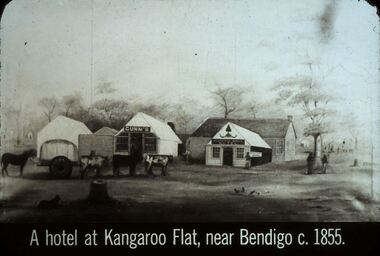 Bendigo Historical Society Inc.
Slide - DIGGERS & MINING. STORES AT THE DIGGINGS, c1855
... Tents in the background on the left, miners, horse, some oxen, a dog and birds. Markings: 43 994.LIF. 5. Used as a teaching aid....Tents in the background on the left, miners, horse, some oxen, a dog and birds. Markings: 43 994.LIF. 5. Used as a teaching aid. ...Diggers & Mining. Stores at the diggings. A hotel at Kangaroo Flat, near Bendigo c. 1855. Slide shows a Shop called Gunn's, and a hotel called Glascow Arms Hotel. Tents in the background on the left, miners, horse, some oxen, a dog and birds. Markings: 43 994.LIF. 5. Used as a teaching aid.hanimounteducation, tertiary, goldfields -
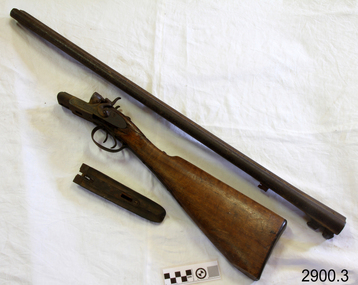 Flagstaff Hill Maritime Museum and Village
Weapon - Shotgun, Early 20th Century
... ...bird dog and bird...Raised inscription on butt has an image of "dog carrying a bird in his mouth" and another image of a "anchor and chain". ...This particular example is of a standard pattern for utilitarian use of which many were made. flagstaff hill warrnambool shipwrecked-coast flagstaff-hill flagstaff-hill-maritime-museum maritime-museum shipwreck-coast flagstaff-hill-maritime-village shotgun double barrel double barrel bird dog and bird anchor and chain webley & scott pin fire cartridge Philip webley Raised inscription on butt has an image of "dog carrying a bird in his mouth" and another image of a "anchor and chain". ...Philip Webley was born in 1813, he was the younger brother of James Webley who was born in 1807. Both were born in Birmingham. Towards the end of the 1800s, the firm claimed establishment in 1790, this must have been the date James and Philip's father or grandfather originally established a bullet or gun implement making business. It was not, as is often stated, the date William Davis established his business. Philip Webley was apprenticed in 1827 to Benjamin Watson. James Webley also seems to have been apprenticed but to who is not known. In 1834 James and Philip established their partnership as percussioners, lock filers and gun makers at 7 Weaman Street,Birmingham which was William Davis' old premises Davis, a gun implement maker, mould and toolmaker, died in 1831 and his wife Sarah inherited the business at 84 Weaman Street which she ran with her daughter, Caroline. On 5 January 1838 Philip Webley married Caroline. Philip was recorded at 84 Weaman Street from 1838 as a gun percussioner, lock filer and gun maker and this is when the partnership was last recorded, but the brothers apparently continued to co-operate until 1845 when Philip reportedly sold his interest to James and used the money to purchase Sarah Davis' business. Even then, they worked together particularly about the design and manufacture of percussion revolvers. Philip Webley was recorded in the 1851 census as a 38-year-old gun and pistol implement manufacturer living at 84 Weaman Street with his wife Caroline they had four sons and one daughter Thomas William, Emma, and Philip Jnr, and two other sons, James, and Henry and Philip's cousin, also lived with the family probably as a nurse, Sarah Haywood. On 4 February 1853 Philip Webley registered patent No. 335 for a hinged revolver and on 14 September 1853 he registered patent No. 2127 for improvement for the first muzzle-loading percussion cap and ball revolver which became known as the "Longspur". In 1859 Philips son Thomas William, aged 21, was made a partner in the firm, which then changed its name to P Webley & Son and described itself as "Gun and Pistol Makers and Patent Revolving Pistol Makers", probably exploiting Philip Webley's patent No. 305 of February 1853 for a revolver frame and lock, and its improvement under patent No. 2127 of September 1853. Thomas later went on to managed the shotgun side of the business. From about 1863 up to the First World War, the firm made rook rifles for Holland & Holland. From the 1890s they supplied magazine rifles. In 1863 and 1864 the firm's address was given as 83-84 Weaman Street, but from late 1864 to 1875 their address was 84 Weaman Street. By 1874 the firm had a showroom in London at an unknown address. In 1875 the firm expanded into 82-84 and 88-89 Weaman Street. The shotgun is not in very good condition is unusable as a firearm and is not very significant historically or valuable, although made by a well known and respected manufacturer of firearms there are many better examples of shotguns made by P Webley and Son in collections and for sale. This particular example is of a standard pattern for utilitarian use of which many were made. Pin fire double barrel cartridge loading shotgun, the stock is of varnished walnut, the shotgun is in a wooden box, box has hinged lid and dovetail joints. Raised inscription on butt has an image of "dog carrying a bird in his mouth" and another image of a "anchor and chain". Inscribed to both sides of the locks "P Webley and Son", Maker's mark and proof marks for black powder shotguns on undersides of both barrels. Proof marks used are for Birmingham. flagstaff hill, warrnambool, shipwrecked-coast, flagstaff-hill, flagstaff-hill-maritime-museum, maritime-museum, shipwreck-coast, flagstaff-hill-maritime-village, shotgun double barrel, double barrel, bird dog and bird, anchor and chain, webley & scott, pin fire, cartridge, philip webley -
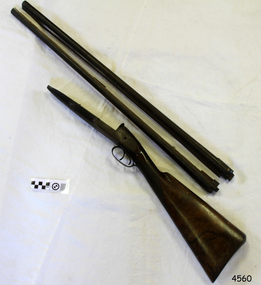 Flagstaff Hill Maritime Museum and Village
Weapon - Double Barrel Shotgun, Mid to late 19th Century
... Proof marks used are early metal parts have decorative engravings of a gun dog flushing a bird...Proof marks used are early metal parts have decorative engravings of a gun dog flushing a bird Shotgun, black powder, muzzle Loading, double barrel, percussion cap. ...Philip Webley was born in 1813, he was the younger brother of James Webley who was born in 1807. Both were born in Birmingham. Towards the end of the 1800s, the firm claimed establishment in 1790, this must have been the date James and Philip's father or grandfather originally established a bullet or gun implement making business. It was not, as is often stated, the date William Davis established his business. Philip Webley was apprenticed in 1827 to Benjamin Watson. James Webley also seems to have been apprenticed but to who is not known. In 1834 James and Philip established their partnership as percussioners, lock filers and gun makers at 7 Weaman Street,Birmingham which was William Davis' old premises Davis, a gun implement maker, mould and toolmaker, died in 1831 and his wife Sarah inherited the business at 84 Weaman Street which she ran with her daughter, Caroline. On 5 January 1838 Philip Webley married Caroline. Philip was recorded at 84 Weaman Street from 1838 as a gun percussioner, lock filer and gun maker and this is when the partnership was last recorded, but the brothers apparently continued to co-operate until 1845 when Philip reportedly sold his interest to James and used the money to purchase Sarah Davis' business. Even then, they worked together particularly about the design and manufacture of percussion revolvers. Philip Webley was recorded in the 1851 census as a 38-year-old gun and pistol implement manufacturer living at 84 Weaman Street with his wife Caroline they had four sons and one daughter Thomas William, Emma, and Philip Jnr, and two other sons, James, and Henry and Philip's cousin, also lived with the family probably as a nurse, Sarah Haywood. On 4 February 1853 Philip Webley registered patent No. 335 for a hinged revolver and on 14 September 1853 he registered patent No. 2127 for improvement for the first muzzle-loading percussion cap and ball revolver which became known as the "Longspur". In 1859 Philips son Thomas William, aged 21, was made a partner in the firm, which then changed its name to P Webley & Son and described itself as "Gun and Pistol Makers and Patent Revolving Pistol Makers", probably exploiting Philip Webley's patent No. 305 of February 1853 for a revolver frame and lock, and its improvement under patent No. 2127 of September 1853. Thomas later went on to managed the shotgun side of the business. From about 1863 up to the First World War, the firm made rook rifles for Holland & Holland. From the 1890s they supplied magazine rifles. In 1863 and 1864 the firm's address was given as 83-84 Weaman Street, but from late 1864 to 1875 their address was 84 Weaman Street. By 1874 the firm had a showroom in London at an unknown address. In 1875 the firm expanded into 82-84 and 88-89 Weaman Street. The item is an early muzzle loading sporting shotgun not in very good condition and is unusable as a firearm and not very significant historically or valuable, although made by a well known and respected manufacturer of firearms there are many better examples of shotguns made by P Webley and Son in collections and for sale. This particular example is of a standard pattern for utilitarian use of which many were made. Shotgun, black powder, muzzle Loading, double barrel, percussion cap. P Webley & Son maker on left and right lock and P Webley & Son James St London on top of barrel. Barrel split in two. Has 14 stamped under each barrel with Birmingham proof marks for black powder shotguns. on undersides of both barrels. Proof marks used are early metal parts have decorative engravings of a gun dog flushing a birdwarrnambool, shipwrecked-coast, flagstaff-hill, flagstaff-hill-maritime-museum, shipwreck-coast, flagstaff-hill-maritime-village, gun, shotgun, double-barrel shotgun, firearm, muzzel loading shotgun, philip webley, black powder, percussion cap, hunting weapon, birmingham gun manufactures, w & c scott & son -
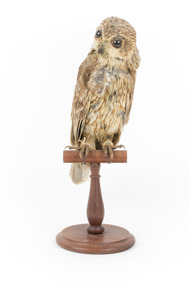 The Beechworth Burke Museum
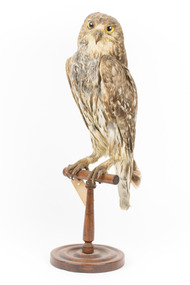
Animal specimen - Barking Owl (Female), Trustees of the Australian Museum, 1860-1880
... Barking Owls are a nocturnal, medium sized bird of prey native to Australia, parts of Papua New Guinea, and the Moluccas. ...Barking Owls are a nocturnal, medium sized bird of prey native to Australia, parts of Papua New Guinea, and the Moluccas. ...Barking Owls are a nocturnal, medium sized bird of prey native to Australia, parts of Papua New Guinea, and the Moluccas. Average size ranges between 390-440mm in length. Females are generally slightly smaller than males and they are only one of a small number of owl species that do not exhibit marked sexual dimorphism. Barking Owls have characteristic vocalisations, ranging from a 'woof woof' barking dog sound, to shrill, human-like screams, which reportedly alarmed early European settlers to Australia. The Barking Owl's shrill and explosive vocalisation is sometimes associated with Bunyip mythology or referred to as 'the screaming woman call'. The female call is slightly higher in pitch than the male, and males and females often duet, contrasting low and high pitches. Barking Owls may be vulnerable in some parts of Australia due to woodland habitat loss. This specimen is part of a collection of almost 200 animal specimens that were originally acquired as skins from various institutions across Australia, including the Australian Museum in Sydney and the National Museum of Victoria (known as Museums Victoria since 1983), as well as individuals such as amateur anthropologist Reynell Eveleigh Johns between 1860-1880. These skins were then mounted by members of the Burke Museum Committee and put-on display in the formal space of the Museum’s original exhibition hall where they continue to be on display. This display of taxidermy mounts initially served to instruct visitors to the Burke Museum of the natural world around them, today it serves as an insight into the collecting habits of the 19th century.This specimen is part of a significant and rare taxidermy mount collection in the Burke Museum. This collection is scientifically and culturally important for reminding us of how science continues to shape our understanding of the modern world. They demonstrate a capacity to hold evidence of how Australia’s fauna history existed in the past and are potentially important for future environmental research. This collection continues to be on display in the Museum and has become a key part to interpreting the collecting habits of the 19th century.This female Barking Owl is of an average size. It has brown, grey and white spots and vertical streaks. The face and breast are lighter in colour than the wings and the dorsal plumage. The glass eyes are large and dark in colour while the tarsi and toes are yellowish. This specimen stands on a wooden perch with identification tags attached to its leg. [torn] / 16. / Winking Owl / See catalogue Page, 4 /taxidermy mount, taxidermy, animalia, burke museum, beechworth, australian museum, skin, owls, barking owls, screaming woman call, yowing, woodland birds, birds of prey, australian owls, endangered, loss of habitat, woodland habitat, bunyip, australian early settler mythology -
 The Beechworth Burke Museum
Animal specimen - Barking Owl (Male), Trustees of the Australian Museum, 1860-1880
... The Barking Owl is a nocturnal, medium sized (390-440 mm) bird of prey native to Australia, parts of Papua New Guinea, and the Moluccas. ...The Barking Owl is a nocturnal, medium sized (390-440 mm) bird of prey native to Australia, parts of Papua New Guinea, and the Moluccas. ...The Barking Owl is a nocturnal, medium sized (390-440 mm) bird of prey native to Australia, parts of Papua New Guinea, and the Moluccas. Males are generally slightly larger by weight than females and they are only one of small number of owl species that do not exhibit marked sexual dimorphism. Barking Owls have characteristic vocalisations, ranging from 'a 'woof woof' barking dog sounds to shrill, human-like scream sounds, which reportedly alarmed early European settlers. The Barking Owl's shrill and explosive vocalisation is sometimes associated with Bunyip mythology or referred to as 'the screaming woman call'. The male call is slightly lower in pitch than the female, and males and females often duet, contrasting low and high pitches. The owls are brown-grey in colour with white spots on the wings and vertically streaked chest. Their eyes are large and yellow. Barking Owls may be vulnerable in some parts of Australia due to woodland habitat loss. This specimen is part of a collection of almost 200 animal specimens that were originally acquired as skins from various institutions across Australia, including the Australian Museum in Sydney and the National Museum of Victoria (known as Museums Victoria since 1983), as well as individuals such as amateur anthropologist Reynell Eveleigh Johns between 1860-1880. These skins were then mounted by members of the Burke Museum Committee and put-on display in the formal space of the Museum’s original exhibition hall where they continue to be on display. This display of taxidermy mounts initially served to instruct visitors to the Burke Museum of the natural world around them, today it serves as an insight into the collecting habits of the 19th century. This specimen is part of a significant and rare taxidermy mount collection in the Burke Museum. This collection is scientifically and culturally important for reminding us of how science continues to shape our understanding of the modern world. They demonstrate a capacity to hold evidence of how Australia’s fauna history existed in the past and are potentially important for future environmental research. This collection continues to be on display in the Museum and has become a key part to interpreting the collecting habits of the 19th century. This male Barking Owl is average sized with brown, grey and white spots and vertical chest streaks. The face and breast are lighter in colour than the wings and dorsal plumage. The eyes are large and dark and the legs and feet are yellowish. The eyes are large and yellow irises and the legs and feet are yellowish. The specimen stands on a wooden perch pedestal with identification tags attached to its leg. 17. / Bookook Owl / See catalogue page, 4 /taxidermy mount, taxidermy, animalia, burke museum, beechworth, australian museum, skin, owls, barking owls, screaming woman call, yowing, woodland birds, birds of prey, australian owls, endangered, loss of habitat, woodland habitat, bunyip, australian early settler mythology -
Marysville & District Historical Society
THE TRIANGLE NEWS-VOL 4 NO 25-10 AUGUST 1979
... marysville victoria australia shire elections police news wirreanda decorated float procession r.s.l. hall marysville community care centre lions dinner meeting christ church ladies guild l.a. meeting birthday greetings reminder triangle news publication m.i.w.a.p.s.a. roster drama group footy news marysville primary school mothers' club indoor bowls all organisations note presentation night bingo buxton red cross branch variety concert letter to marysville football club marysville & buxton district angling club country & western news for sale lost dog wanted lions code of ethics new salamander garments marysville birds THE TRIANGLE NEWS-VOL 4 NO 25-10 AUGUST 1979 ...marysville, victoria, australia, shire elections, police news, wirreanda decorated float procession, r.s.l. hall marysville, community care centre, lions dinner meeting, christ church ladies guild, l.a. meeting, birthday greetings, reminder triangle news publication, m.i.w.a.p.s.a. roster, drama group, footy news, marysville primary school mothers' club, indoor bowls, all organisations note presentation night, bingo, buxton red cross, branch variety concert, letter to marysville football club, marysville & buxton district angling club, country & western news, for sale, lost dog, wanted, lions code of ethics, new salamander garments, marysville birds -
 City of Moorabbin Historical Society (Operating the Box Cottage Museum)
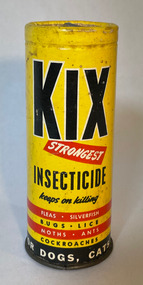
Equipment - 'KIX' Insecticide Powder, DAVID CHEMICALS PTY LTD, for dogs, cats and all animals, 20thC
... The head of the firm, Mr Clive Harrison Clark was know as a successful poultry farmer and exhibitor of prize birds, he was the secretary of the Brighton Poultry Society. ...Kix was first manufactured by Clark King & Co.after World War II. The offices were located in 237 Queen Street Melbourne. Clark, King &Co Pty Ltd started business in the early 1920's and were known as the poultry food specialist. The head of the firm, Mr Clive Harrison Clark was know as a successful poultry farmer and exhibitor of prize birds, he was the secretary of the Brighton Poultry Society.KIX was used by citizens of MoorabbinA yellow heavy cardboard container with metal swivel top containing a white powder. Front: KIX - STRONGEST - INSEDTICIDE - keeps on killing - FLEAS - SILVERFISH - BUGS - LICE - MOTHS - ANTS - COCKROACHES - FOR DOGS, CATS AND ALL ANIMALS BACK: DIRECTIONS Fleas and Lice. Kix keeps on killing fleas and lice for weeks. An occasional dusting will FLEA-PROFF dogs and cats. Dust Kix on the hair of dogs commencing at the neck and ru it in with the fingers. If the dog appears irritated after treatment, it will be due to the efforts of fleas to escape and indicates both the effectiveness of Kix and the necessity of treatment. Sprinkle Kix on the head and neck of cats and rub well in. Use Kix on poultry also. In personal hygiene against fleas Kix may may dusted on underwear socks etc. Use Kix also for head lice and body lice. Silverfish, cockroaches, Bugs, Ants. Duct Kix where necessary and it will remain effective for months. These pest take some hours to die, but death is certain. Active Constituents: 5% Para Para Dichlorodiphenyltrichloroethane, 2.5% Isobornly Thiocyanoacetate. DAVID CHEMICALS PTY LTD. Clayton, Victoria Contents 1½ ozskix, insecticide, ddt, pets, moorabbin, poultry -
 Orbost & District Historical Society
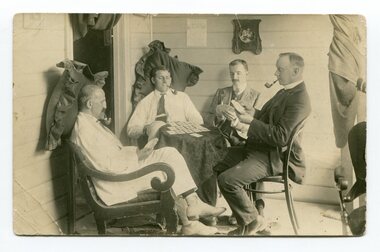
black and white photograph, early 20th century - 1910?
... Taken on the front porch at Illfracombe in 1908 after the four men had enjoyed a weekend fishing There appears to be a photo hanging on the wall in the background which looks like it could be of a young Marion Watt and the family's dog, a golden retriever In "The Gum Sucker at Home: Bound for Croajingolong 1908" by Nathan Spielvogel, published in Mary Gilbert's Personalities and Stories of the Early Orbost District, 3rd edition, p. 107-116, Spielvogel talks of his trip to Orbost, and fishing with Watt, Bruce and Young aboard Percy Watt's boat, the Maris Stella. Spielvogel's story says Young was the secretary at James & Birds...Taken on the front porch at Illfracombe in 1908 after the four men had enjoyed a weekend fishing There appears to be a photo hanging on the wall in the background which looks like it could be of a young Marion Watt and the family's dog, a golden retriever In "The Gum Sucker at Home: Bound for Croajingolong 1908" by Nathan Spielvogel, published in Mary Gilbert's Personalities and Stories of the Early Orbost District, 3rd edition, p. 107-116, Spielvogel talks of his trip to Orbost, and fishing with Watt, Bruce and Young aboard Percy Watt's boat, the Maris Stella. Spielvogel's story says Young was the secretary at James & Birds ...From L-R : Nathan Spielvogel, Hector Young, Percy Watt and George Holden. . Taken on the front porch at Illfracombe in 1908 after the four men had enjoyed a weekend fishing There appears to be a photo hanging on the wall in the background which looks like it could be of a young Marion Watt and the family's dog, a golden retriever In "The Gum Sucker at Home: Bound for Croajingolong 1908" by Nathan Spielvogel, published in Mary Gilbert's Personalities and Stories of the Early Orbost District, 3rd edition, p. 107-116, Spielvogel talks of his trip to Orbost, and fishing with Watt, Bruce and Young aboard Percy Watt's boat, the Maris Stella. Spielvogel's story says Young was the secretary at James & Birds auctioneers and "was one of the builders of the first foot bridge over the Backwater". It says George Holden was a Bank Manager at the Bank of Victoria. (info. from Campbell Watt) This photograph shows Mr Nathan Spielvogel on the left. He was a school teacher at the Orbost State School following Mr Rowe. Nathan Frederick Spielvogel (1874-1956), teacher, writer and historian, was born on 10 May 1874 at Ballarat, Victoria, son of Newman Frederick Spielvogel, pawnbroker, and his wife Hannah, née Cohen. As well as his stories he published a number of books about the history of Ballarat. Spielvogel taught at Orbost for at least a year Nathan Frederick Spielvogel (1874–1956) was a teacher, writer and historian. As a country schoolteacher, he traveled widely in the eastern Australian outback and also made a journey to London. Spielvogel gained distinction as one of the only Australian Jewish writers of his time. Many of his early books were best-sellers. He has an association with the history of Orbost having spent a year as a teacher at Orbost. The Watt family were early Marlo settlers.A black / white photograph / postcard of four men sitting around a small table playing cards. Two of the men have pillows behind their heads. Three are smoking pipes.on back - "On R - N. Spielvogel"spielvogel-nathan-orbost -
 Montmorency–Eltham RSL Sub Branch
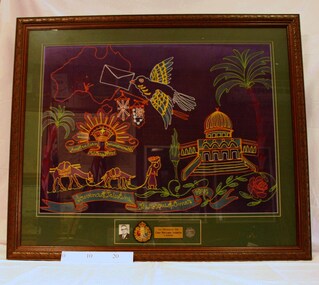
Souvenir - Framed World War 2 Embroidered Banner, WW2 Embroidered Souvenir, Estimated date 1941
... A multi-coloured map of Australia, a bird carrying a letter, an Australian military badge, camels and a mosque are depicted on a dark blue background. ...A multi-coloured map of Australia, a bird carrying a letter, an Australian military badge, camels and a mosque are depicted on a dark blue background. ...Framed embroidered banner – a souvenir of World War Two. A multi-coloured map of Australia, a bird carrying a letter, an Australian military badge, camels and a mosque are depicted on a dark blue background. At the bottom there is a photo, a 1939 associate badge, a dog tag and a brass plaque. 'In Honour of Corp Benjamin Ackroyd VX 5001. Souvenir of Palestine, The Mosque of Omar 1941.'world war two, embroidery, 1941, souvenir, palestine, mosque, omar -
 Flagstaff Hill Maritime Museum and Village
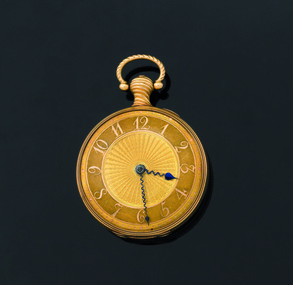
Instrument - Fob watch, 1814
... On the right of the base of the pot plant is a dog resting on its hind legs, body facing away from the plant and head twisted around to look at the birds. ...On the right of the base of the pot plant is a dog resting on its hind legs, body facing away from the plant and head twisted around to look at the birds. ...Watchmaker History: James McCabe was born in 1748. He was the son of Patrick McCabe, a notable watchmaker from Lurgan in County Armagh, Ireland. James McCabe immigrated to London in 1775 and established his business in Bells Building, Fleet Street, on 2nd April 1781. He was made an Honorary Freeman of the Clockmakers Company. The House of McCabe was renowned for the sheer variety of its designs, and the creativity and prestige of its manufacture were celebrated and revered by owners worldwide. These pieces remain highly collectable today and fetch increasingly higher prices at auction houses worldwide. Watch association with the Loch Ard: The watch was saved from the sea when discovered on the body of Mrs Rebecca Carmichael from Dublin and handed to Eva Carmichael, the only family member to survive the fatal wreck of the Loch Ard on 1st June 1878. Eva gifted the watch to her husband, Thomas Achilles Townsend when they married in 1884; his name is engraved on the rear movement cover. The watch was held by the family until 2011 when they decided to bring the watch, to Australia for auction. At this time the watch was in the possession of Eva Carmichael's grandson, Robert Townsend. Given its connection with the Loch Ard shipwreck, it was purchased at auction by Flagstaff Hill Maritime Village on 25th October 2011 to add to its Loch Ard collection and is currently referred to as the Carmichael watch. It is now on display alongside the Minton Peacock, which also survived the Loch Ard shipwreck, and other artefacts from the collection. James McCabe was originally a Belfast watchmaker who had moved his business to London. At the time James McCabe was much esteemed for producing fine watches and clocks, especially for export to India. Only the best watches were inscribed “James McCabe” and many with highly decorated cases were intended for the Indian market. Contemporary newspaper accounts of the watch's discovery echoed a Carmichael family tradition that the watch had been intended as a gift from the City of Dublin to King George IV to mark his planned visit to the city in 1821, however, there is no evidence to support this theory. Dr Evory Carmichael, according to some accounts, bought this watch from a nobleman for about £100 at some point and so it travelled with him on his final fateful journey to Australia. Today we can only guess at the actions of Mrs Carmichael in the chaos and darkness of the pre-dawn shipwreck. Perhaps the two items that were found on her body, the watch and a locket, were items that reminded her of those she held most dear, her husband and her family. When Mrs Carmichael's body was washed ashore the watch was found secreted in the waistband of her dress. In its own right the watch is of artistic and monetary value and is a rare and beautiful object depicting watch making in the early 19th century. It is a historically significant object in it’s own right and there is additional importance, surviving a significant event in the maritime history of Victoria. The wreck of the Loch Ard, Victoria's greatest maritime disaster has also been declared an event of National Significance because of its strong connection to Australia's immigration and maritime history. The watch, together with the Loch Ard Peacock, make up the two most significant shipwreck artefacts in Australia. Both of these items are of great social significance to not only local people but the wider Australian community. Funding for the watches purchase came from six local trusts and one anonymous citizen and is now on permanent display. Both these artefacts symbolise and helps to interpret the stories of survival along the Shipwreck Coast. Fob Watch, known as the "Carmichael Watch" or the "Loch Ard Watch". 1814 fob pocket watch belonging to the Carmichael family, recovered from the wreck of the Loch Ard. Fob watch (or pocket watch)and winding key, made by James McCabe and Son, of Cornhill, London. The watch is in excellent condition and its design is decorative and intricate. The gold face is covered by glass. The gold rear cover is hinged over a silver inner cover that includes the winding hole. The watch has a knob with a swinging ring from which it can be hung. The dial of the gold watch face is textured and has raised Arabic numerals and every minute is marked around the perimeter by a dot, with the 5-minute dots slightly larger. The numerals and dots are a different coloured gold than the rest of the face. The centre of the face has a wavy pattern fanning out to the base of the numerals. The hour and minute hands are of a dark colour. The stems of the hands are a wavy shape and finish with spade shaped tips; the tip of the hour hand is larger than that of the minute hand. The hour hand reaches to the base of the numerals and the minute hand is long enough to rest between the minute dots. The back of the watch is decorated with a detailed design on a textured gold background. The design is embossed in coloured metals; gold, silver, greenish-gold and pink. In the centre is a dove resting on leaves of a pot plant that sits on a silver circular base. Another dove is flying above it, and their beaks touch together. On the right of the base of the pot plant is a dog resting on its hind legs, body facing away from the plant and head twisted around to look at the birds. On the sides of this design and meeting at the base are sprigs of leaves and buds. Around this central design is a rope-like border. Around the perimeter of the case is a border of leaves and budding stems. The inside of this cover has embossed hallmarks, numbers and etched markings indicating that the watch is 18 carat gold, made by James McCabe, assayed in London in 1814 and the case may have been made by Daniel Willmott, case maker. The silver inner workings cover has a full name beautifully engraved on it. There is a winding hole that accesses a square-ended lever for the key to fit over. The handle of the watch is a twisted gold knob with a hollow ‘D’-shaped swinging ring attached to the end of it. This knob also has a hallmark.On the silver inner workings cover “Thomas Achilles Townshend” is engraved, underscored by a thin, delicately decorated line. On the gold handle is the logo of a crown with “18”’ next to it. Inside the gold rear case is stamped “DW’. Under that is etched “JAN 77 II”. Underneath this are 3 logos; a logo “leopard, crowned”’, a logo “ crown on top of 18”, and a logo “T”. Under these 3 symbols is part of a stamp that could possibly be “IMC”. Under this is “ ’ 5 9 4 ”. Other numbers, symbols and letters are etched into this case including “15001”, “2/5/19”. Others are difficult to read.warrnambool, shipwrecked coast, shipwreck coast, flagstaff hill, flagstaff hill maritime museum, flagstaff hill maritime village, maritime museum, shipwrecked artefact, shipwreck artefact, carmichael, townshend, townsend, carmichael watch, loch ard watch, pocket watch, loch ard, 1st june 1878, james mccabe, thomas walker, robert townshend, loch ard gorge, great ocean road, victoria., memorial headstone -
 Eltham District Historical Society Inc
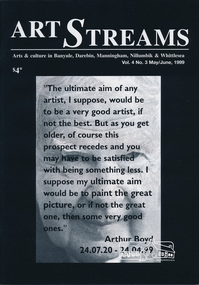
Journal, Peter Doughtery, ArtStreams: Arts & Culture in Banyule, Darebin, Manningham, Nillumbik & Whittlesea; Vol. 4, No. 3, May-Jun 1999, 1999
... Dog...Louis McManus...adams of north riding...Lovegroves of Cottles Bridge...Artspeak studio gallery...Peter Sculthorpe...Elizabeth Scarlett...Carmel Bird...." - Eltham District Historical Society Newsletter No. 161, March 2005 art streams Arthur Boyd Know & Grow Heidelberg Artists' Trail carlucci's Geoffrey dance VCE art Kasimir burgess clare james andrew kelly jason harris nichaud fitzgibbon noella clohesy willy wonka's ice cream gourmet food natalie troubnicova ellen mileo fergusons paddock cathy smith La Piazza Restaurant Bar & Cafe la mama theatre Comedy Festival Anne Delaney Jordie Albiston dymocks booksellers Dynamic Vegies Alison Lonsdale Montsalvat Sigmund Jorgensen Jacques reymond's restaurant Yarra Valley Country Club leslie Avril Caitlin Ogden geoff achison Neil Adam Judy Turner Wild Hill Dog Louis McManus adams of north riding Lovegroves of Cottles Bridge Artspeak studio gallery Peter Sculthorpe Elizabeth Scarlett Carmel Bird michelle lonsdale museum of modern art at heide st andrews hotel volumes Colour front and back cover with feature articles and literary pieces with photographs and advertisements printed in black and white. 36 pages, 30 cm. ...Vol. 4, No. 3, May-Jun 1999 CONTENTS HEIDELBERG SCHOOL REVISITED Artist's Trail extended 5 FROM JACKEROO TO ARTIST Geoffrey Dance interviewed 8 VCE TOPCATS 10 'ARTIN ABOUT 13 FERGUSON'S PADDOCK, HOME TO CHALLENGING NEW SCULPTURE 15 LA MAMA & THE COMEDY FESTIVAL 17 THE POETRY OF HISTORY The Hanging of Jean Lee 18 MUSEUM OF MODERN ART exhibitions and future plans 34 SHORT STORY High Voltage 22 DINING OUT WITH SIGMUND JORGENSEN 24 CD REVIEWS 26 BOOK REVIEWS 30 CAFE & RESTAURANT LISTINGS 32,33 "Peter Dougherty has been involved in the local art scene for many years. As publisher and editor of the arts magazine Artstreams, his comments on the various branches of the arts are widely respected. His "The Arts" column in the Diamond Valley Leader presents a brief summary for a much wider cross section of the local community. Peter also operates his own gallery and the Artstreams Cafe at the St Andrews market. Peter has a wealth of knowledge about present day and historical aspects of local art and artists." - Eltham District Historical Society Newsletter No. 161, March 2005Colour front and back cover with feature articles and literary pieces with photographs and advertisements printed in black and white. 36 pages, 30 cm. Vol. 1, no. 1 (Nov. 1996) - Vol. 10, no. 5 (summer ed. 2005/06) art streams, arthur boyd, know & grow, heidelberg artists' trail, carlucci's, geoffrey dance, vce art, kasimir burgess, clare james, andrew kelly, jason harris, nichaud fitzgibbon, noella clohesy, willy wonka's ice cream gourmet food, natalie troubnicova, ellen mileo, fergusons paddock, cathy smith, la piazza restaurant bar & cafe, la mama theatre, comedy festival, anne delaney, jordie albiston, dymocks booksellers, dynamic vegies, alison lonsdale, montsalvat, sigmund jorgensen, jacques reymond's restaurant, yarra valley country club, leslie avril, caitlin ogden, geoff achison, neil adam, judy turner, wild hill dog, louis mcmanus, adams of north riding, lovegroves of cottles bridge, artspeak studio gallery, peter sculthorpe, elizabeth scarlett, carmel bird, michelle lonsdale, museum of modern art at heide, st andrews hotel, volumes -
 Eltham District Historical Society Inc
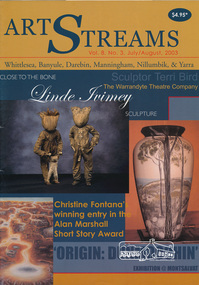
Journal, Peter Doughtery, ArtStreams: Whittlesea, Banyule, Darebin, Manningham, Nillumbik & Yarra; Vol. 8, No. 3, Jul-Aug 2003, 2003
... ...terri bird...Peter has a wealth of knowledge about present day and historical aspects of local art and artists." - Eltham District Historical Society Newsletter No. 161, March 2005 art streams Art masters Thompsons Amcal Pharmacy clemm christesen christine Fontana Corrina Tauschke terri bird willy wonka's ice cream gourmet food Nillumbik art in Public Places Award Eltham Wiregrass Gallery wild dog hill recording and project studio sushi wushi Eltham Fiona Sievers julian chapple Warrandyte Mechanics Institute Montsalvat Eltham Fullife pharmacy warrandyte cafe Northcote pottery Smiths Gully General Store Jenni Mitchell Scott Henley Marion Borgelt Zelij moroccan interiors st andrews hotel City of Whittlesea heritage program Hawkestowe Park Bundoora Homestead dunmoochin il primo restaurant carlton Hurstbridge Nursery bulleen art & garden centre eltham gourmet poultry & game bahnhof cafe manningham arts centre manningham gallery Arts on Burgundy bendigo bank Hurstbridge & Districts Community Bank Branch Alan Marshall Short Story Award Colour front and back cover with feature articles and literary pieces with photographs and advertisements printed in black and white. 36 pages, 30 cm. ...Vol. 8, No. 3, Jul-Aug 2003 CONTENTS Short Story by Christine Fontana 3 Corrina Taustche on Terri Bird 7 Barry Dickins on John Jenkins 10 Fiona Sievers on Jordie Albiston 11 Julian Chapple's tales from India 12 Justin Fitzpatrick on the Warrandyte Theatre 13 Sandy Jeffs' Poetry 16 Book Review - Barenboim and Said 19 CD Review by Betty Scarlett 20 Jenni Mitchell - 'To The Ice' 21 Scott Henley on Marion Borgelt Exhibition 22 'Wandering Whittlesea' 24 'Origin: Dunmoochin' at Montsalvat 25 Artin' About 26 Wining & Dining 30 "Peter Dougherty has been involved in the local art scene for many years. As publisher and editor of the arts magazine Artstreams, his comments on the various branches of the arts are widely respected. His "The Arts" column in the Diamond Valley Leader presents a brief summary for a much wider cross section of the local community. Peter also operates his own gallery and the Artstreams Cafe at the St Andrews market. Peter has a wealth of knowledge about present day and historical aspects of local art and artists." - Eltham District Historical Society Newsletter No. 161, March 2005Colour front and back cover with feature articles and literary pieces with photographs and advertisements printed in black and white. 36 pages, 30 cm. Vol. 1, no. 1 (Nov. 1996) - Vol. 10, no. 5 (summer ed. 2005/06) art streams, art masters, thompsons amcal pharmacy, clemm christesen, christine fontana, corrina tauschke, terri bird, willy wonka's ice cream gourmet food, nillumbik art in public places award, eltham wiregrass gallery, wild dog hill recording and project studio, sushi wushi eltham, fiona sievers, julian chapple, warrandyte mechanics institute, montsalvat, eltham fullife pharmacy, warrandyte cafe, northcote pottery, smiths gully general store, jenni mitchell, scott henley, marion borgelt, zelij moroccan interiors, st andrews hotel, city of whittlesea heritage program, hawkestowe park, bundoora homestead, dunmoochin, il primo restaurant carlton, hurstbridge nursery, bulleen art & garden centre, eltham gourmet poultry & game, bahnhof cafe, manningham arts centre, manningham gallery, arts on burgundy, bendigo bank, hurstbridge & districts community bank branch, alan marshall short story award -
 Eltham District Historical Society Inc
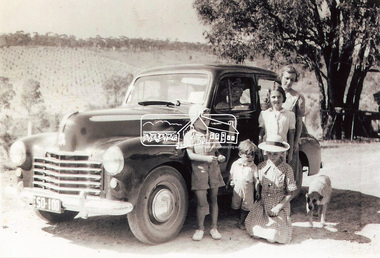
Photograph, Stokes family, Nyora Road, Eltham, c.1952, 1952c
... of Bird Orchard (bounded by Pitt Street, Eucalyptus Road and Wattle Grove) and they got talking over their common interest. ... of Bird Orchard (bounded by Pitt Street, Eucalyptus Road and Wattle Grove) and they got talking over their common interest. ...Taken from outside the family home on the southest corner of the intersection of Nyora Road and Pitt Street with Eucalyptus Road, looking northeast across the Stokes Orchard L-R: David, Howard, Beryl (kneeling), Dorothy and Gladys Stokes with Gladys's mother sitting in Gladys's father's car with Spot the dog, Nyora Road, Eltham, c.1952 Frank Stokes first traveled to the district by train in 1944 to find land with the intention to establish an orchard. By chance he met Arthur Bird of Bird Orchard (bounded by Pitt Street, Eucalyptus Road and Wattle Grove) and they got talking over their common interest. Arthur put Frank up for the night and pointed out the land, part of Crown Allotment 15, Section 5, Parish of Nillumbik (CA15) somewhat diagonally opposite Bird Orchard. Frank bought the land and for the next two years would travel by train from Melbourne to Eltham every weekend establishing Stokes Orchard and building a home for his family, which they eventually moved into in 1946. In the mid 1970s the Shire of Eltham divided the orchard up into numerous rate-able parcel lots, which became affordable for Frank. As a consequence Stokes Orchard was turned into a housing development by Macquarie Builders and marketed as the Stokes Orchard Estate in two stages; Stage 1 encompassing Scarlet Ash Court, Ironbark Close and Peppermint Grove bounded by Nyora and Eucalyptus roads c.1976 and Stage 2 encompassing Stokes Place, Orchard Way, The Crest and The Lookout bound by Nyora and Diosma roads c.1979. The development of Orchard Way, The Crest and The Lookout did not proceed as planned due to the lack of the sewer along Diosma Road and so many of the proposed lots were incorporated into five-acre parcels instead.Representative of the orchard growing areas of ElthamDigital file only - Digitised by EDHS from a scrapbook (containing commercially printed photos of digital scans) on loan from Beryl Bradbury (nee Stokes), daughter of Frank Stokes.1948-1951 vauxhall velox, 1948-1951 vauxhall wyvern, 1952, beryl bradbury (nee stokes), beryl bradbury (nee stokes) collection, david stokes, dorothy stokes, eltham, gladys stokes, nyora road, spot (dog), stokes orchard -
 Eltham District Historical Society Inc
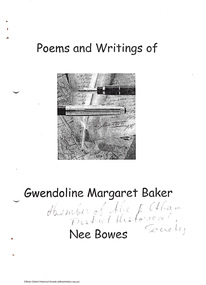
Document - Folder, Poems and writings of Gwendoline Margaret Baker, nee Bowes, 1997
... Of times of your of pleasant things and if the future has in store a place to be - a reason to exist. One hears a bird upon the roof scratching at his mate while in the distance a car goes by returning home quite late. ...Of times of your of pleasant things and if the future has in store a place to be - a reason to exist. One hears a bird upon the roof scratching at his mate while in the distance a car goes by returning home quite late. ...Various short pieces of writing, some dated, earliest 1971, latest in 1997. Gwen Baker (1928-2005) was a foundation member of EDHS. See Also Newsleter 162, May 2005 GWENDOLINE MARGARET BAKER NEE BOWES 1928- 2005 Gwen Baker as we knew her, often used her full name in her writings and even acknowledged her maiden family name as a means of reinforcing her own personal identity. Gwen died on 28 Februrary 2005 and has been buried at Arthurs Creek Cemetery in accordance with her wishes. It is typical of her humour that after visiting the site she wrote: "I have seen the Cemetery, so if I wake in sleep it has a nice view" Gwen was a foundation member of our Society. We remember her mainly for her contribution to our meetings, her witty comments or questions to our speakers and, of course, her collection of plants that she contributed to help the finances of our Society. Her friends in the Society also remember her cards and brief letters on a wide range of subjects. Gwen's wide range of interests included pottery, poetry and of course her gardening. She was an active member of many organizations including the Red Cross, Catholic Church, Nillumbik Garden Club and the former Eltham Arts Council. Her small self- published booklet of poems and writings starts with tins item written at 2am on Easter Sunday 1975. THOUGHT The seeming steady stillness of this quiet night has varied sound to one who sits and thinks of life. Of times of your of pleasant things and if the future has in store a place to be - a reason to exist. One hears a bird upon the roof scratching at his mate while in the distance a car goes by returning home quite late. A neighbours dog goes forth and bark! then stillness once again, like sunshine after rain. and so the thinker having heard and thought, carefully turns out the light and goes to bed. 41 pages (20 A4 pages cut in half). Folder 76 from Harry Gilham Collectionpoetry, creative writing, gwen baker -
 Bendigo Historical Society Inc.
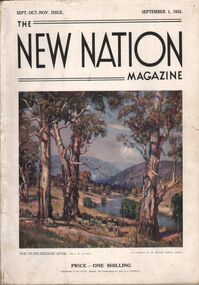
Magazine - AILEEN AND JOHN ELLISON COLLECTION: THE NEW NATION MAGAZINE
... dogger bank" (by T. Benetter)- The British commonwealth of Nations - Switzerland, land of lakes and mountains (by Hilary lofting) - Highways of the Syrian desert (by Francis Birtles) - Seven ages of the Australian aboriginal - The game of the empire, the approaching cricket test matches (by M. A. Noble) - Short story, the last run (by H. H. Cardinal) - "The hidden bird...dogger bank" (by T. Benetter)- The British commonwealth of Nations - Switzerland, land of lakes and mountains (by Hilary lofting) - Highways of the Syrian desert (by Francis Birtles) - Seven ages of the Australian aboriginal - The game of the empire, the approaching cricket test matches (by M. A. Noble) - Short story, the last run (by H. H. Cardinal) - "The hidden bird ...The New Nation Magazine Sept. Oct. Nov. Issue. September 1, 1932. On the front cover a painting "The Murrumbidgee River by J. R. Jackson. Price 1 shilling the magazine has 112 pages, the last two pages are ripped and the back cover is missing. Contents: Frontispiece "morning of the dogger bank" (by T. Benetter)- The British commonwealth of Nations - Switzerland, land of lakes and mountains (by Hilary lofting) - Highways of the Syrian desert (by Francis Birtles) - Seven ages of the Australian aboriginal - The game of the empire, the approaching cricket test matches (by M. A. Noble) - Short story, the last run (by H. H. Cardinal) - "The hidden bird" (by E. M. England) - North Australia trails ( by C. Price Conigrave) - Tales of the turf Fred Archer (by S. A. Marden) - The wide world round - Cape Horn (by J. Newman Barker) - "The home in the clearing" (by Sydney long) - Whitsunday passage (by Henry G. Lamond) - Old bridges (by J. L. Ranken) - The city of the longest drink (by A. C. Cummins) - The life of the cuckoo (by M. S.) - Radio - The world of music (by A. L. Kelly) - The world of women (by E. G. Manby Suttor) - Shopping from an easy chair - The Australian wool trade - Our verse farm - My wool clip (by H. W. Wright) - Windjammer days (by Gerald M. Moody) - Quarterly review of the stock and meat industry (by J. B. Cramsie) - New Zealand letter - At ye booksellers today - A number of things - The modern home - Portland cement - The good housewife (by E. G. Manby Suttor) - Cousin Shirley.book, magazine, the new nation -
 Bendigo Historical Society Inc.
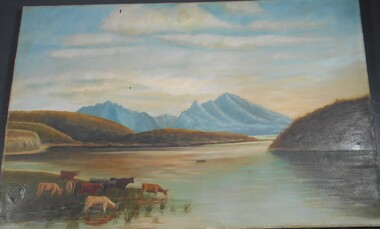
Painting - EDITH LANSELL OIL PAINTING, 1900
... Oil painting on canvas of 8 cattle drinking by the lake with man and dog. Boat on lake. White birds, mountains in distance. ...ARTWORK Oil painting cattle by lake E.Lansell ( local identity ) Oil painting on canvas of 8 cattle drinking by the lake with man and dog. Boat on lake. White birds, mountains in distance. Dated 1900. ...Edith was George Lansell’s second wife and she was born in Bendigo. Edith Lansell (née Bassford)Edith, from a respectable but financially struggling family, became Lansell's housekeeper and later his wife. Edith raised six children and managed George’s affairs with great success after his death.Oil painting on canvas of 8 cattle drinking by the lake with man and dog. Boat on lake. White birds, mountains in distance. Dated 1900. Gold embossed frame. Edith Lansell was the second wife of Bendigo mining magnate George Lansell.E.Lansell ( local identity )artwork, oil painting, cattle by lake -
 Bendigo Historical Society Inc.
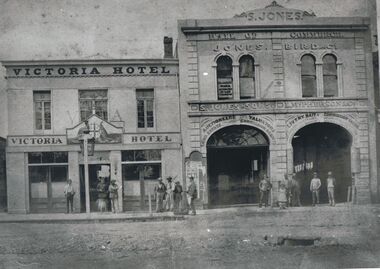
Photograph - VICTORIA HOTEL AND JONES BIRD & CO, BENDIGO, 1861
... Victoria Hotel and Jones Bird & Co., Pall Mall, Bendigo between Mitchell St. & Williamson St., Victoria Lane beside hotel. ...Victoria Hotel and Jones Bird & Co., Pall Mall, Bendigo between Mitchell St. & Williamson St., Victoria Lane beside hotel. ...Black and white copy: two buildings adjoining with assorted males grouped on footpath and doorways. Victoria Hotel and Jones Bird & Co., Pall Mall, Bendigo between Mitchell St. & Williamson St., Victoria Lane beside hotel. Victorian coat of arms on doorway. ( James Lerk 22.9.2000 ). On window 'Edward Francis/Ward/Attorney at Law/& solicitor' S. Jones and Sons, L. McPherson & Co. ' Auctioneers, Valuators/Land Estate Commission Agents' ' Livery Bait and Commission Yards ' ' Horses Carriages & Dog Carts…/ Horses Broken, Double and single harness '.Batchelderbuildings, commercial -
 National Vietnam Veterans Museum (NVVM)
Photograph, c1968
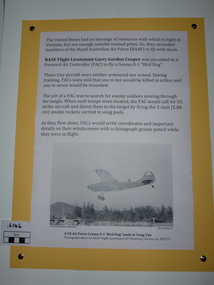
... ...Cessna O.1 Bird Dog...Air Force Cessna O.1 Bird Dog RAAF pilots on loan to U.S. Airforce due to not enough trained pilots in the U.S. ...B/w photo of U.S. Airforce, Cessna 0.1 'Birddog' landing at Vung Tau in Vietnam.RAAF pilots on loan to U.S. Airforce due to not enough trained pilots in the U.S.united states. air force, cessna o.1 bird dog -
 National Vietnam Veterans Museum (NVVM)
Photograph - Colour image, Bunny II
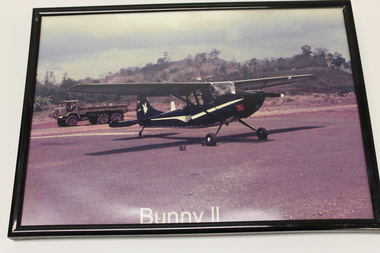
... ...bird dog...Dating back to the 1950s, the bunny design on the tail of an aircraft has come to represent the tradition and spirit of Naval Aviation. plane truck tarmac white bunny bunny 11 161 recce birddog cessna bird dog Navy aircraft Bunny 11/ 161/white bunny on tail. ...Bunny II was built by Australian Army air corps personnel from the 161 Possums using salvaged parts in Vung Tau, Vietnam, in 1970. Dating back to the 1950s, the bunny design on the tail of an aircraft has come to represent the tradition and spirit of Naval Aviation.Colored photograph in a black frame. In the foreground on the tarmac is a small black plane with 161 in red near the nose. There is a white strip down the side of the plane. Also has an image of a white bunny on the tail of the plane. The rotors also have a white tip on them. Behind the plane is a truck with a soldier in it. There is a small hill in the background. On the bottom of the photograph reads Bunny 11.Bunny 11/ 161/white bunny on tail. plane, truck, tarmac, white bunny, bunny 11, 161 recce, birddog, cessna, bird dog, navy aircraft -
 National Vietnam Veterans Museum (NVVM)
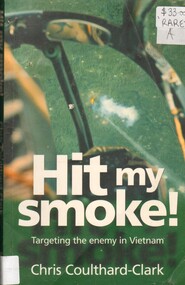
Book, Coulthard-Clark, Chris, Hit my smoke: Targeting the enemy in Vietnam. (Copy 1), 1997
... ...Bird dog...FAC Forward Air Controllers Bird dog Cessna At the height of the Vietnam War, allied tactical fighter aircraft flew over 700 missions every day against ground targets across the southern republic. ...At the height of the Vietnam War, allied tactical fighter aircraft flew over 700 missions every day against ground targets across the southern republic.At the height of the Vietnam War, allied tactical fighter aircraft flew over 700 missions every day against ground targets across the southern republic.vietnamese conflict, 1961-1975 - aerial operations - american, air pilots ., military - australia - personal narratives., fac, forward air controllers, bird dog, cessna -
 National Vietnam Veterans Museum (NVVM)
Document, Possums and Bird Dogs
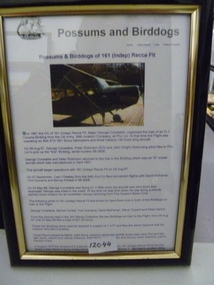
... Cessna O.1 Bird Dog...Cessna O.1 Bird Dog 161 Reconnaissance Flight 161 logo in top LH corner Framed document titled, "Possums and Bird Dogs of 161 (Indep) RECCE FLT." ...Framed document titled, "Possums and Bird Dogs of 161 (Indep) RECCE FLT." Document has a photo of an 0-1 Cessna Birddog aircraft and outlines the history of the aircraft in operations with 161 REECE FLT from 28/8/1967 to 23/5/1968.161 logo in top LH cornercessna o.1 bird dog, 161 reconnaissance flight -
 National Vietnam Veterans Museum (NVVM)
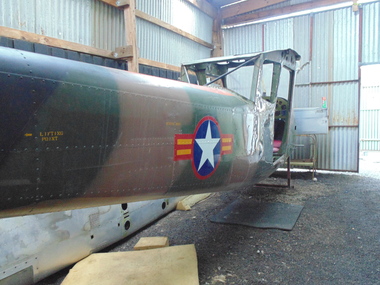
Vehicle - Cessna 0-1 L-19 Bird Dog Aircraft
... Cessna 0-1 L-19 Bird Dog Aircraft...Cessna O.1 Bird Dog...Cessna O.1 Bird Dog The shell is painted dark green & beige. ...The shell is painted dark green & beige. There is an insignia on the side with a navy blue circle with a white star in the middle. Two red squares with 2 yellow stripes on either side.cessna o.1 bird dog -
 Kiewa Valley Historical Society
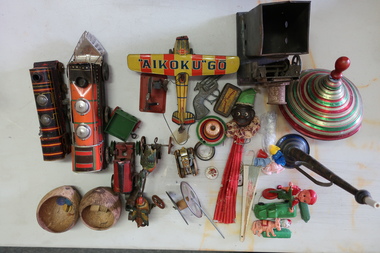
Collection of Toys - Antique
... Man using grinder - mechanical with key 4. Two birds with worm - mechanical with key 5. Green trailer - mechanical with key 6. ...Man using grinder - mechanical with key 4. Two birds with worm - mechanical with key 5. Green trailer - mechanical with key 6. ...Comprises a collection of metal, wooden and plastic toys which would possibly date back to the 1920s to 1940sThis collection came from the Warton / Baker families from Tawonga and Redbank in the Kiewa Valley.Collection of metal toys: 1. x2 Train Locomotives 2. Red tractor - mechanical with key 3. Man using grinder - mechanical with key 4. Two birds with worm - mechanical with key 5. Green trailer - mechanical with key 6. Small tank - mechanical with key 7. Aeroplane 8. Metal top 9. Home-made push-along wheels 10. Home made top 11. Cap gun 12. Cookie Cutters 13. Small tin puncture Kit - empty 14. Metal fox whistle 15. Tin trumpet 16. Large metal pump top 17. Plastic & metal mechancal toy in cardboard box- Jolly Skipper Other: 1. Monkey puppet with paper legs 2. Small plastic bells 3. Plastic boy on bike 4. Plastic green car 5. Plastic small trains 6. Soldier dog 8. Two half coconut shells (hollow) 9. Cylinder of wooden mechano tinker toy 10. Plastic Mr & Mrs Funny Face in box 11. Trip to New York game in box 12. Wooden Modelcraft - Build-ees in box 13. Wooden ring 14. Jig-saw toys, puzzles, wooden mechano, mechanical toys, recreation, children -
 Stawell Historical Society Inc
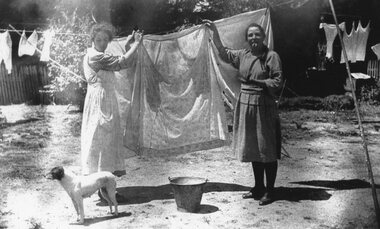
Photograph, Two sisters Bess Cragg on left and Marjorie Cragg on right hanging up washing. c1925
... Marjorie Cragg1900-1982 Schoolteacher in Melbourne. Married Henry Bird Jessie Cragg 1901-1998 School Teacher from 1922 of Smith Street (Skinny Miss Cragg) looked after Cragg household. ...Cragg Sisters Father William Grundy Cragg 1862-1938 a Cabinet Maker made the Honour Roll. Brother Henry also cabinetmaker. Mother Annie Cragg (ne Wearmouth) 1863-1948 married 1895. Elizabeth (Bess or Bessie) Cragg 1896-1985 of Smith Street in 1920 prepared WW1 Honour roll for shire while she was a part time student and part time instructor at the then School of Mines. Music teacher Annie (Nan) Cragg 1897-1984 Of Smith Street Stawell. School teacher from 1915. Taught at Watta Wella. (Fat Miss Cragg). Owned a car. Marjorie Cragg1900-1982 Schoolteacher in Melbourne. Married Henry Bird Jessie Cragg 1901-1998 School Teacher from 1922 of Smith Street (Skinny Miss Cragg) looked after Cragg household. Agnes Cragg 1903-1930 Schoolteacher in Melbourne Married cousin Lancelot Wearmouth D’Arcy Street. Agnes was murdered by her husband Lancelot. Two women hanging sheets on clothesline. Family dog and metal bucket in picture. Bess Cragg (Elizabeth) Marjorie Cragg -
Moorabbin Air Museum
Document (Item) - Drawings and design data for machine gun turrets and propellers also Cessna 0-1A bird dog article, Packet 48 turret and propellers
... Drawings and design data for machine gun turrets and propellers also Cessna 0-1A bird dog article...Packet 48 turret and propellers Document Drawings and design data for machine gun turrets and propellers also Cessna 0-1A bird dog article ...
