
Showing 69 items matching "bird series"
-
 Emerald Museum & Nobelius Heritage Park
Slide - Colour photographic slide, Ess-Vee Ee, Circa 1960s
... ...bird series...Stamped “ ”Ess-vee-ee” Colorslide. Bird Series. S1846 Penguins Parading at Night”...Transparency slide Ess-Vee-Ee Olive hamilton Penguins parading bird series Stamped “ ”Ess-vee-ee” Colorslide. ...The transparency is historically significant as it may have been used by Olive Hamilton.Colour photographic mounted transparency (slide) depicting Penguins Parading at Night probably at Phillip Island.Stamped “ ”Ess-vee-ee” Colorslide. Bird Series. S1846 Penguins Parading at Night”transparency, slide, ess-vee-ee, olive, hamilton, penguins, parading, bird series -
 Stawell Historical Society Inc
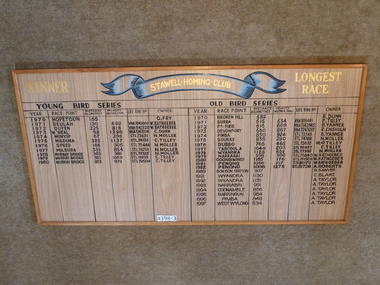
Memorabilia - Realia, 1970-1997
... Stawell Homing Club Honour Board, Young Bird Series, Old Bird Series...Stawell Stawell Homing Club Honour Board, Young Bird Series, Old Bird Series Memorabilia Realia ...Stawell Homing Club Honour Board, Young Bird Series, Old Bird Seriesstawell -
 Stawell Historical Society Inc
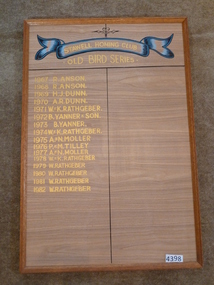
Memorabilia - Realia, 1967-1982
... Stawell Homing Club Honour Board, Old Bird Series...Stawell Stawell Homing Club Honour Board, Old Bird Series Memorabilia Realia ...Stawell Homing Club Honour Board, Old Bird Seriesstawell -
 Stawell Historical Society Inc
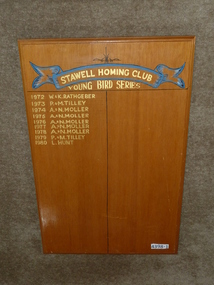
Memorabilia - Realia, 1972-1980
... Stawell Homing Club Honour Board, Young Bird Series...Stawell Stawell Homing Club Honour Board, Young Bird Series Memorabilia Realia ...Stawell Homing Club Honour Board, Young Bird Seriesstawell -
Whitehorse Historical Society Inc.
Article, Author returns to the old nest, 2006
... Author Alan Reid returned to Blackburn Lake Sanctuary to re-release his field guide series 'Birds of South-eastern Australia....Blackburn Lake Sanctuary Reid Alan Reid Wendy Birds Author Alan Reid returned to Blackburn Lake Sanctuary to re-release his field guide series 'Birds of South-eastern Australia. ...Author Alan Reid returned to Blackburn Lake Sanctuary to re-release his field guide series 'Birds of South-eastern Australia.Author Alan Reid returned to Blackburn Lake Sanctuary to re-release his field guide series 'Birds of South-eastern Australia.Author Alan Reid returned to Blackburn Lake Sanctuary to re-release his field guide series 'Birds of South-eastern Australia.blackburn lake sanctuary, reid, alan, reid, wendy, birds -
 Marysville & District Historical Society
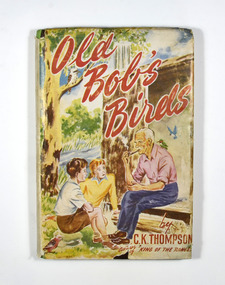
Book, Charles Kenneth Thompson, Old Bob's Birds, 1950
... series of Australian Nature Stories by C.K. Thompson that was from the Marysville State School library. A book from the Marysville State School library. australia nature birds c.k. thompson fiction old bob A book that is part of a series of Australian Nature Stories by C.K. ...A book that is part of a series of Australian Nature Stories by C.K. Thompson.On the front of the dust cover is an illustration of an old man sitting on a bench outside an aviary smoking a pipe and there is a bird sitting on his shoulder. He is talking to two children. On the back of the dust cover is the blurbs of two other novels written by C. K. Thompson.fictionA book that is part of a series of Australian Nature Stories by C.K. Thompson.australia, nature, birds, c.k. thompson, fiction, old bob -
 Marysville & District Historical Society
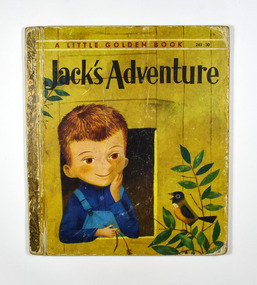
Book, Edith Thacher Hurd, Jack's Adventure, 1962
... bird sitting on a tree branch. A Little Golden Book 243 : 30 Back cover has a list of The Little Golden Library. Surrounding the list is a series...series of children's books that was founded in 1942. MARYSVILLE INFANT WELFARE &/ PRE-SCHOOL ASSOCIATION Stamp of the Marysville & District Historical Society Inc/ P.O. Box 22/ Marysville 3779 Front cover has a drawing depicting a small boy holding a piece of grass looking out of a window at a bird sitting on a tree branch. ...A book from the Little Golden Books series of children's books that was founded in 1942.Front cover has a drawing depicting a small boy holding a piece of grass looking out of a window at a bird sitting on a tree branch. A Little Golden Book 243 : 30 Back cover has a list of The Little Golden Library. Surrounding the list is a series of cartoon pictures of various characters from the books.fictionA book from the Little Golden Books series of children's books that was founded in 1942.little golden book, jack's adventure, edith thacher hurd, john p miller, golden press, fiction -
 Marysville & District Historical Society
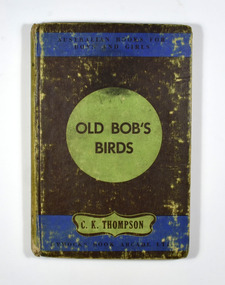
Book, Charles Kenneth Thompson, Old Bob's Birds, 1950
... Birds. There is no dust cover. Front cover shows the series name, the title of the book, the author's name and the publisher's name. ...This is a delightful book that will appeal to children of all ages, and especially those of the tenderer years. Old Bob the sundowner is a character who will endear himself to young readers. So will his two small friends, Roddy and Susan, to whom he imparts all the vast lore of the bush he has gained during a lifetime of wandering.There is no dust cover. Front cover shows the series name, the title of the book, the author's name and the publisher's name.fictionThis is a delightful book that will appeal to children of all ages, and especially those of the tenderer years. Old Bob the sundowner is a character who will endear himself to young readers. So will his two small friends, Roddy and Susan, to whom he imparts all the vast lore of the bush he has gained during a lifetime of wandering.australia, nature, birds, c.k. thompson, fiction, old bob -
 Flagstaff Hill Maritime Museum and Village
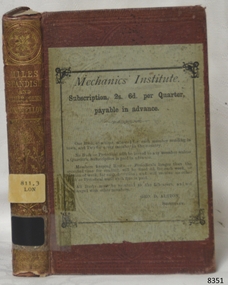
Book - Book of Poems, Henry Wadsworth Longfellow, The Courtship of Miles Standish and Other Poems By (Henry Wadsworth Longfellow), 1858
... The collection also includes shorter works like those from “Birds of Passage” (e.g., "The Lighthouse," "The Fire of Drift-Wood" and “The Seaside and the Fireside series”, blending nature imagery, sea voyages, and domestic scenes in Longfellow's rhythmic style. ...The collection also includes shorter works like those from “Birds of Passage” (e.g., "The Lighthouse," "The Fire of Drift-Wood" and “The Seaside and the Fireside series”, blending nature imagery, sea voyages, and domestic scenes in Longfellow's rhythmic style. ...The Courtship of Miles Standish and Other Poems (1858) by Henry Wadsworth Longfellow centers on the title narrative poem, a romantic tale set in 1621 Plymouth Colony amid tensions with Native Americans. It follows a love triangle with a gruff military captain Miles Standish who wants to marry young widow Priscilla Mullins but asks his friend and assistant John Alden to propose on his behalf, since Standish is too awkward with words.The Courtship of Miles Standish and Other Poems Author: H W Longfellow Publisher: W Kent & Co Date: 1858 fictionThe Courtship of Miles Standish and Other Poems (1858) by Henry Wadsworth Longfellow centers on the title narrative poem, a romantic tale set in 1621 Plymouth Colony amid tensions with Native Americans. It follows a love triangle with a gruff military captain Miles Standish who wants to marry young widow Priscilla Mullins but asks his friend and assistant John Alden to propose on his behalf, since Standish is too awkward with words. flagstaff hil, warrnambool, flagstaff hill maritime museum, shipwreck coast, great ocean road, book, pattison collection, warrnambool library, warrnambool mechanics’ institute, ralph eric pattison, corangamite regional library service, warrnambool city librarian, mechanics’ institute library, victorian library board, warrnambool books and records, the courtship of miles standish and other poems, h w longfellow, henry wadsworth longfellow -
 Flagstaff Hill Maritime Museum and Village
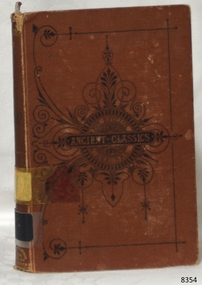
Book - Ancient plays, Rev. William Lucas Collins et al, Aristophanes, 1872
... series. The book takes the surviving comedies of Aristophanes such as The Knights, The Clouds, The Wasps, The Birds, and The Frogs and breaks them down. ...series. The book takes the surviving comedies of Aristophanes such as The Knights, The Clouds, The Wasps, The Birds, and The Frogs and breaks them down. ...This volume is part of a famous 19th-century educational initiative. It bridges Victorian England with the biting political satire of ancient Athens. This book is not a straightforward, cover-to-cover translation of ancient plays; instead, it is a scholarly introduction, summary, and analysis written for the general Victorian public.Aristophanes Edited by Rev W Lucas Collins Publisher: William Blackwood & Sons Date: 1872 Further Information: Ancient Classics for English Readers seriesfictionThis volume is part of a famous 19th-century educational initiative. It bridges Victorian England with the biting political satire of ancient Athens. This book is not a straightforward, cover-to-cover translation of ancient plays; instead, it is a scholarly introduction, summary, and analysis written for the general Victorian public.flagstaff hil, warrnambool, flagstaff hill maritime museum, maritime museum, shipwreck coast, flagstaff hill maritime village, great ocean road, book, pattison collection, warrnambool library, warrnambool mechanics’ institute, ralph eric pattison, corangamite regional library service, warrnambool city librarian, mechanics’ institute library, victorian library board, warrnambool books and records, warrnambool children’s library, aristophanes, rev w lucas collins -
 Flagstaff Hill Maritime Museum and Village
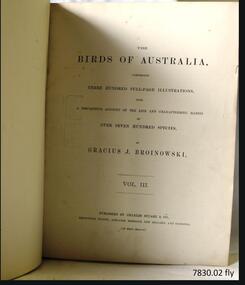
Book - Reference Book, Gracius J Broinowski, The Birds of Australia Vol 3-4, 1890-1891
... In the same period it was proposed to bring out a 'small popular edition of the late John Gould ornithologist (1804-1881) Birds and Mammals of Australia', but the project was abandoned. Broinowski had begun in 1887 to prepare a series of volumes entitled The Birds of Australia. ...In the same period it was proposed to bring out a 'small popular edition of the late John Gould ornithologist (1804-1881) Birds and Mammals of Australia', but the project was abandoned. Broinowski had begun in 1887 to prepare a series of volumes entitled The Birds of Australia. ...Gracius Joseph Broinowski was a Polish-born artist and ornithologist who became a key figure in documenting Australian wildlife. Born on 7 March 1837 near Wielun, Poland, he studied languages, classics, and art at Munich University before emigrating to Australia around 1857 to avoid conscription. Broinowski faced hardships in Europe and London before sailing to Australia. He initially worked rural jobs in Victoria, then joined a Melbourne publishing firm, traveling across Victoria, New South Wales, and Queensland to paint landscapes and sell art via "art unions."The Birds of Australia Vol 3-4 Author and Illustrator: Gracius J Broinowski Publisher: Charles Stuart & Co Date: 1890 - 1891non-fictionGracius Joseph Broinowski was a Polish-born artist and ornithologist who became a key figure in documenting Australian wildlife. Born on 7 March 1837 near Wielun, Poland, he studied languages, classics, and art at Munich University before emigrating to Australia around 1857 to avoid conscription. Broinowski faced hardships in Europe and London before sailing to Australia. He initially worked rural jobs in Victoria, then joined a Melbourne publishing firm, traveling across Victoria, New South Wales, and Queensland to paint landscapes and sell art via "art unions." the birds of australia vol 1-2, flagstaff hill, warrnambool, shipwrecked coast, flagstaff hill maritime museum, maritime museum, shipwreck coast, flagstaff hill maritime village, great ocean road, the birds of australia, gracius joseph broinowski, charles stuart & co, joseph archibald, warrnambool public museum, warrnambool museum, warrnambool library, warrnambool art gallery, warrnambool city librarian, pattison collection, ralph eric pattison, samuel hannaford, warrnambool mechanics’ institute and free library, mechanics’ institute library, victorian library board, warrnambool books and records, rare books, australian bird illustrations, australian bird text, australian natural history -
 Flagstaff Hill Maritime Museum and Village
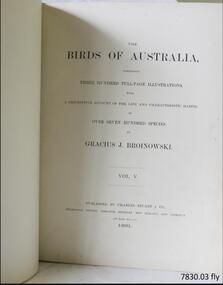
Book - Reference Book, Gracius J Broinowski, The Birds of Australia Vol 5-6, 1890-1891
... In the same period it was proposed to bring out a 'small popular edition of the late John Gould ornithologist (1804-1881) Birds and Mammals of Australia', but the project was abandoned. Broinowski had begun in 1887 to prepare a series of volumes entitled The Birds of Australia. ...In the same period it was proposed to bring out a 'small popular edition of the late John Gould ornithologist (1804-1881) Birds and Mammals of Australia', but the project was abandoned. Broinowski had begun in 1887 to prepare a series of volumes entitled The Birds of Australia. ...Gracius Joseph Broinowski was a Polish-born artist and ornithologist who became a key figure in documenting Australian wildlife. Born on 7 March 1837 near Wielun, Poland, he studied languages, classics, and art at Munich University before emigrating to Australia around 1857 to avoid conscription. Broinowski faced hardships in Europe and London before sailing to Australia. He initially worked rural jobs in Victoria, then joined a Melbourne publishing firm, traveling across Victoria, New South Wales, and Queensland to paint landscapes and sell art via "art unions."The Birds of Australia Vol 5-6 Author and Illustrator: Gracius J Broinowski Publisher: Charles Stuart & Co Date: 1890 - 1891non-fictionGracius Joseph Broinowski was a Polish-born artist and ornithologist who became a key figure in documenting Australian wildlife. Born on 7 March 1837 near Wielun, Poland, he studied languages, classics, and art at Munich University before emigrating to Australia around 1857 to avoid conscription. Broinowski faced hardships in Europe and London before sailing to Australia. He initially worked rural jobs in Victoria, then joined a Melbourne publishing firm, traveling across Victoria, New South Wales, and Queensland to paint landscapes and sell art via "art unions." the birds of australia vol 1-2, flagstaff hill, warrnambool, shipwrecked coast, flagstaff hill maritime museum, maritime museum, shipwreck coast, flagstaff hill maritime village, great ocean road, the birds of australia, gracius joseph broinowski, charles stuart & co, joseph archibald, warrnambool public museum, warrnambool museum, warrnambool library, warrnambool art gallery, warrnambool city librarian, pattison collection, ralph eric pattison, samuel hannaford, warrnambool mechanics’ institute and free library, mechanics’ institute library, victorian library board, warrnambool books and records, rare books, australian bird illustrations, australian bird text, australian natural history -
 Flagstaff Hill Maritime Museum and Village
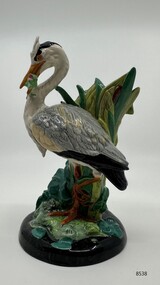
Decorative object - Minton Majolica model of a Grey Heron, 2001
... series produced this heron model in 2001. A limited edition of 1,793 pieces were made, and this heron is number 89. The heron is a scaled down model of the original life-size piece first produced by Paul Comolera, c. 1892, as a walking stick and umbrella stand. Comolera was a French artist and sculptor, renowned for dramatic naturalistic forms, and life-size renditions of birds...series produced this heron model in 2001. A limited edition of 1,793 pieces were made, and this heron is number 89. The heron is a scaled down model of the original life-size piece first produced by Paul Comolera, c. 1892, as a walking stick and umbrella stand. Comolera was a French artist and sculptor, renowned for dramatic naturalistic forms, and life-size renditions of birds ...Royal Doulton as part of the Minton Miniature series produced this heron model in 2001. A limited edition of 1,793 pieces were made, and this heron is number 89. The heron is a scaled down model of the original life-size piece first produced by Paul Comolera, c. 1892, as a walking stick and umbrella stand. Comolera was a French artist and sculptor, renowned for dramatic naturalistic forms, and life-size renditions of birds and animals that won him admiration in public and artistic circles. The Warrnambool Art Gallery (WAG) has a life-sized Heron in its collection. A rare miniature heron demonstrates the artistry and skill required to produce Majolica ware during the 19th century and the present.A miniature grey heron standing by bulrushes and holding a struggling fish in its beak, its plumage naturalistically coloured, on a circular base glazed in tones of grey and green and applied with further leaves and water lilies.Inscribed at the base Minton founded 1793, made in Englandminton & co., majolica, miniature model, flagstaff hill maritime museum, stoke upon trent, paul comolera, staffordshire -
Glenelg Shire Council Cultural Collection
Print - Linocut Admella Rescue Series No. 15, There was much celebration when the survivors were taken off the 'Lady Bird', 2009
... Admella shipwreck Portland Lifeboat Front: 'Linocut Bob Stone 2009 There was much celebration when the survivors were taken off the 'Lady Bird' - Hand written, black pen. Linocut. Fifteenth in a suit of 16 in the Admella Rescue Series. ...Part of suite of 16 Linocuts created for an exhibition at the Portland Arts centre for the Admella 150th Festival.Linocut. Fifteenth in a suit of 16 in the Admella Rescue Series. Printed in black on white archival paper. Depicts band playing in street, by standers each side.Front: 'Linocut Bob Stone 2009 There was much celebration when the survivors were taken off the 'Lady Bird' - Hand written, black pen.admella, shipwreck, portland lifeboat -
Glenelg Shire Council Cultural Collection
Print - Linocut - Admella Rescue Series No. 14, Bob Stone, on arrival at Lady Bird some 3 or 4 were in the last stage of existence 'Portland Guardian 15th August 1859', 2009
... Series. Printed in black on white archival paper Depicts a man with a rope around his chest and under his arm pits, being hauled up the side of the 'Lady Bird'. ...Bird some 3 or 4 were in the last stage of existance. Portland Guardian 15th August 1859' - hand written in black ink. Linocut. Fourteenth in a suite of 16 in Admella Rescue Series. ...Part of suite of 16 Linocuts created for an exhibition at the Portland Arts centre for the Admella 150th Festival.Linocut. Fourteenth in a suite of 16 in Admella Rescue Series. Printed in black on white archival paper Depicts a man with a rope around his chest and under his arm pits, being hauled up the side of the 'Lady Bird'. Two members of the Portland life boat also visible, watching procedure from lifeboat.Front: 'Linocut Bob Stone 2009 ... on arrival at Lady Bird some 3 or 4 were in the last stage of existance. Portland Guardian 15th August 1859' - hand written in black ink.admella, portland lifeboat, shipwreck -
 Phillip Island and District Historical Society Inc.
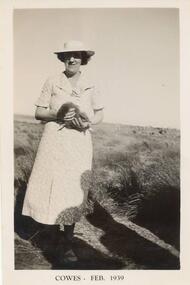
Photograph, Lady & Mutton Bird, Feb 1939
... Lady & Mutton Bird Photograph Photograph Photo Shop Series ...One of a collection of 18 photographs & postcards donated by Jill YeomanBlack & White photograph of a lady holding a Mutton Bird at Summerland, Phillip Island.Cowes Feb 1939mutton birds, wildlife - mutton birds, summerland beach phillip island, jill yeoman -
 Phillip Island and District Historical Society Inc.
Photograph - Post Card, 1950's
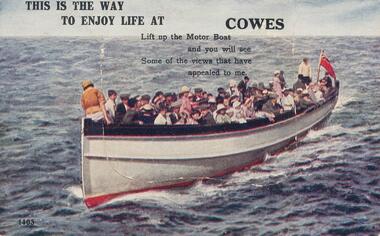
... Birds on the Island. Photograph - Post Card Valentine's Series ...Novelty Postcard with flap opening to two photos. Donated by Rhonda ParisNovelty Coloured postcard of motor boat loaded with passengers. Flap opens up to two Black & White photographs - 1. The Nobbies. 2. Birds on the Island."This is the way to enjoy life at Cowes" "Life up the Motor Boat and you will see some of the views that have appealed to me".the nobbies phillip island, wildlife - birds, nesting birds phillip island, rhonda paris, life boat -
 Phillip Island and District Historical Society Inc.
Photograph - Post Cards, A. J. Murray et al, c 1940
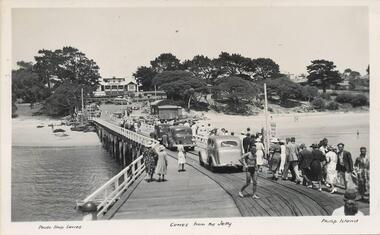
... Valentines Series. Photo 07. On Back: Mr West with Mutton bird at Phillip Island....Valentines Series. Photo 07. On Back: Mr West with Mutton bird at Phillip Island. ...A collection of 6 postcards and 1 photograph taken around Phillip Island. Donated by Julie Barnett.Photograph 228-01. Black & White photograph of the Cowes Pier with vehicles and pedestrians. Rail tracks on pier. Isle of Wight Hotel in background. Sheds at end. Photograph 228-02. Black & White aerial photograph of "Broadwater" Guesthouse, Cowes. Photograph 228-03. Black & White photograph of Cowes Pier with Steamer coming in. Shed at end of Jetty and Cenotaph in the foreground. Looking north. Photograph 228-04. Black & White photograph of a Koala and her young. Photograph 228-05. Black & White photograph looking over the Cowes shoreline near Lover's Walk. Photograph 228-06. Black & White photograph of a group of penguins coming home at dusk at the "Penguin Parade". Photograph 228-07. Black & White photograph of Bert West holding a Shearwater (Mutton Bird) with it's wings outstretched.Photo 01. "Photo Shop Series". "Cowes from the Jetty". Photo 02. Aerial view of "Broadwater" Cowes, Phillip Island. No. 146 Photo 03. "Photo Shop Series". The Jetty. Cowes. Photo 04. "Photo Shop Series". "Koala Bear". Phillip Island Photo 05. "The Rose Series P3416". "Near the Lovers' Walk, Cowes, Phillip Is., Vic. Photo 06. "Penguins, Phillip Island." No. 82. Valentines Series. Photo 07. On Back: Mr West with Mutton bird at Phillip Island.wildlife - koalas, wildlife - penguins, penguin parade, bert west, wildlife - mutton birds, mutton birds, shearwaters, cowes pier phillip island, cowes jetty, lover's walk cowes, broadwater guesthouse cowes phillip island, guesthouses cowes phillip island, julie barnett -
 Phillip Island and District Historical Society Inc.
Photographs, Early 20th Century
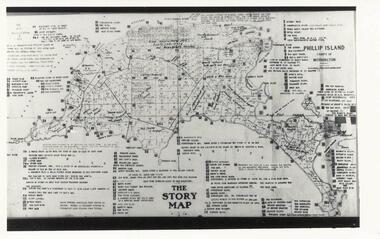
... Series No. 1. (Penguins) Phillip Island. Moulting Burrow on top of Cliff, Headland Rookery, which contained four birds. ...Series No. 1. (Penguins) Phillip Island. Moulting Burrow on top of Cliff, Headland Rookery, which contained four birds. ...Three photographs/postcards donated by J Gliddon234-01. Black & White photograph of The Story Map of Phillip Island with allotments shown and extremely detailed information typed on it by Vernon McHaffie. 234-02. Sepia postcard of the penguin rookery on "Little Nobby", Phillip Island. Man sitting on hill looking down at the rookery showing tracks & entrances to burrows. 234-03. Sepia postcard of two people sitting on top of cliff, Headland Rookery, with moulting penguins on their laps. 234-02. "Tom Tregellas" Nature Series No. 1. (Penguins) Phillip Island. Rookery on Little Nobby, showing tracks and entrances to burrows amongst the "pig-face" weed. 234-03. "Tom Tregellas" Nature Series No. 1. (Penguins) Phillip Island. Moulting Burrow on top of Cliff, Headland Rookery, which contained four birds. Note feathers outside burrow.phillip island map, phillip island allotments, vernon mchaffie, wildlife - penguins, penguins phillip island, penguin rookeries phillip island, j gliddon -
 Phillip Island and District Historical Society Inc.
Photograph - Post Card, Early 1900's
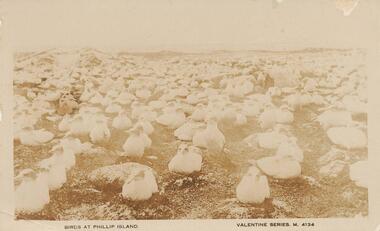
... "Birds at Phillip Island." "Valentine Series M. 4134"...Haywood. nesting birds phillip island wildlife - birds g haywood "Birds at Phillip Island." "Valentine Series M. 4134" Sepia postcard of nesting birds at Phillip Island. ...One of 5 Postcards donated by G. Haywood.Sepia postcard of nesting birds at Phillip Island."Birds at Phillip Island." "Valentine Series M. 4134"nesting birds phillip island, wildlife - birds, g haywood -
 Phillip Island and District Historical Society Inc.
Photograph - Post Card, 1920's
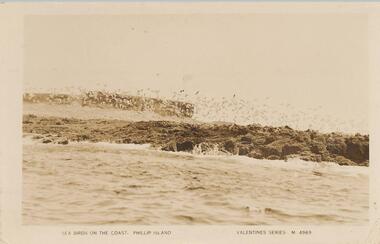
... "Sea Birds on the Coast, Phillip Island." "Valentines Series M 4969"...One of 17 postcard donated by Olive Blamey sea birds phillip island wildlife - sea birds phillip island coastline olive blamey "Sea Birds on the Coast, Phillip Island." "Valentines Series M 4969" Sepia postcard of Seabirds on the coast, Phillip Island. ...One of 17 postcard donated by Olive BlameySepia postcard of Seabirds on the coast, Phillip Island."Sea Birds on the Coast, Phillip Island." "Valentines Series M 4969"sea birds phillip island, wildlife - sea birds, phillip island coastline, olive blamey -
 Phillip Island and District Historical Society Inc.
Photograph, Mutton Bird Eggers' Camp Cape Woolamai
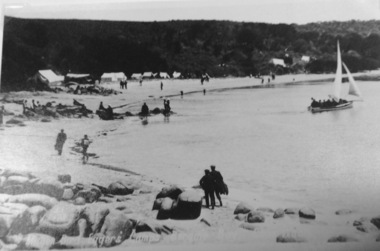
... series Post Cards. Copied by John Jansson local history photography photographs postcards black & white photograph phillip island mutton bird eggers camp cape woolamai Mutton bird eggers camps Cape Woolamai View on Cape Woolamai of Mutton Birders' Camps and their boats anchored in the bay. ...Part of a collection of Rose & Valentine series Post Cards. Copied by John JanssonView on Cape Woolamai of Mutton Birders' Camps and their boats anchored in the bay. Figures on beach and sitting around their tents.Mutton bird eggers camps Cape Woolamailocal history, photography, photographs, postcards, black & white photograph, phillip island, mutton bird eggers camp, cape woolamai -
 Phillip Island and District Historical Society Inc.
Photograph, Mutton Bird Eggers' Camps, Cape Woolamai
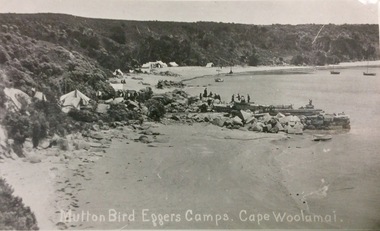
... series of Post Cards. Copied by John Jansson 1984 local history photography photographs postcards phillip island mutton bird eggers camp cape woolamai Mutton Bird eggers' camps Cape Woolamai. ...Part of a collection of 'Rose & Valentine' series of Post Cards. Copied by John Jansson 1984Mutton Bird eggers camps Cape Woolamai showing tent sites, boats in bay. Several figures standing on the old stone jetty built from red Woolamai granite. Part of the Granite Quarry.Mutton Bird eggers' camps Cape Woolamai.local history, photography, photographs, postcards, phillip island, mutton bird eggers camp, cape woolamai -
 Phillip Island and District Historical Society Inc.
Photograph, Seeking mutton bird eggs. Cape Woolamai
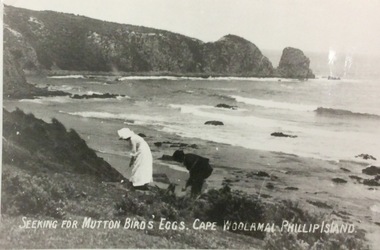
... series of Post Cards. Copied by John Jansson 1984 local history photography photographs postcards black & white photograph phillip island cape woolamai the pinnacles Seeking for Mutton Bird eggs Cape Woolamai Phillip Island Male & female looking for Mutton bird eggs on Cape Woolamai - western side - looking towards the "Pinnacles". ...Part of a collection of 'Rose & Valentine' series of Post Cards. Copied by John Jansson 1984Male & female looking for Mutton bird eggs on Cape Woolamai - western side - looking towards the "Pinnacles".Seeking for Mutton Bird eggs Cape Woolamai Phillip Islandlocal history, photography, photographs, postcards, black & white photograph, phillip island, cape woolamai, the pinnacles -
 Orbost & District Historical Society
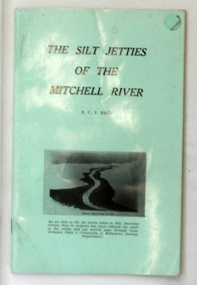
book, James Yeates & Sons (Printing) Pty Ltd, The Silk Jetties of the Mitchell river, 1972
... This booklet was the first of a series of scientific and historical studies of Gippsland to be published by the Bairnsdale Advertiser. The author, Eric Charles Frederick Bird was Principal Fellow, Department of Geography, University of Melbourne, Australia. ...This booklet was the first of a series of scientific and historical studies of Gippsland to be published by the Bairnsdale Advertiser. The author, Eric Charles Frederick Bird was Principal Fellow, Department of Geography, University of Melbourne, Australia. ...This booklet was the first of a series of scientific and historical studies of Gippsland to be published by the Bairnsdale Advertiser. The author, Eric Charles Frederick Bird was Principal Fellow, Department of Geography, University of Melbourne, Australia. The Mitchell River silt jetties are an unusually long, thin landform located in the Gippsland Lakes region. They have been formed over millions of years by sediment deposition from the Mitchell River during periods of low water flow and subsequent wash-through during periods of high water flow. The long narrow banks of silt extend more than eight kilometres east into Lake King. This item is a useful reference for the silt jetties of the Mitchell River.A 32 pp book with alight green cover. The title is in black print, " The Silk Jetties of the Mitchell River" and underneath the title there is a b/w photograph of the Mitchell River and silt jetties taken from above in 1931. It was written by E. C. F. Bird.silt-jetties mitchell-river paynesville bird-e.c.f. -
 Flagstaff Hill Maritime Museum and Village
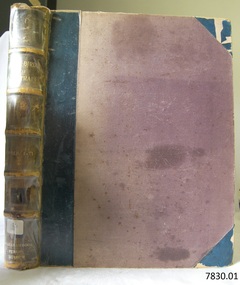
Book - Reference Book, Gracius J Broinowski, The Birds of Australia Vol 1-2, 1890-1891
... In the same period it was proposed to bring out a 'small popular edition of the late John Gould ornithologist (1804-1881) Birds and Mammals of Australia', but the project was abandoned. Broinowski had begun in 1887 to prepare a series of volumes entitled The Birds of Australia. ...In the same period it was proposed to bring out a 'small popular edition of the late John Gould ornithologist (1804-1881) Birds and Mammals of Australia', but the project was abandoned. Broinowski had begun in 1887 to prepare a series of volumes entitled The Birds of Australia. ...Gracius Joseph Broinowski was a Polish-born artist and ornithologist who became a key figure in documenting Australian wildlife. Born on 7 March 1837 near Wielun, Poland, he studied languages, classics, and art at Munich University before emigrating to Australia around 1857 to avoid conscription. Broinowski faced hardships in Europe and London before sailing to Australia. He initially worked rural jobs in Victoria, then joined a Melbourne publishing firm, traveling across Victoria, New South Wales, and Queensland to paint landscapes and sell art via "art unions."The Birds of Australia Vol 1-2 Author and Illustrator: Gracius J Broinowski Publisher: Charles Stuart & Co Date: 1890 - 1891non-fictionGracius Joseph Broinowski was a Polish-born artist and ornithologist who became a key figure in documenting Australian wildlife. Born on 7 March 1837 near Wielun, Poland, he studied languages, classics, and art at Munich University before emigrating to Australia around 1857 to avoid conscription. Broinowski faced hardships in Europe and London before sailing to Australia. He initially worked rural jobs in Victoria, then joined a Melbourne publishing firm, traveling across Victoria, New South Wales, and Queensland to paint landscapes and sell art via "art unions." the birds of australia vol 1-2, flagstaff hill, warrnambool, shipwrecked coast, flagstaff hill maritime museum, maritime museum, shipwreck coast, flagstaff hill maritime village, great ocean road, the birds of australia, gracius joseph broinowski, charles stuart & co, joseph archibald, warrnambool public museum, warrnambool museum, warrnambool library, warrnambool art gallery, warrnambool city librarian, pattison collection, ralph eric pattison, samuel hannaford, warrnambool mechanics’ institute and free library, mechanics’ institute library, victorian library board, warrnambool books and records, rare books, australian bird illustrations, australian bird text, australian natural history -
 Eltham District Historical Society Inc
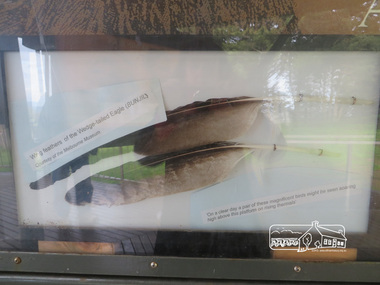
Photograph, Moor-Rul Viewing Platform Panel: Wing tailed feather of the Wedge-tailed Eagle (BUNJIL), 10 August 2016
... "On a clear day a pair of these magnificent birds might be seen soaring high above this platform on rising thermals" For the Wurundjeri people, Bunjil, the Eaglehawk was seen as being the all powerful Being of the Dreamtime, the all-father who created the centre world and its creatures. After the creation Bunjil with his wives and sons went up intothe “tharingbeik”, the sky, where he remains today as the star Attair. Souce: Document compiled by EDHS in 1997 for a series..."On a clear day a pair of these magnificent birds might be seen soaring high above this platform on rising thermals" For the Wurundjeri people, Bunjil, the Eaglehawk was seen as being the all powerful Being of the Dreamtime, the all-father who created the centre world and its creatures. After the creation Bunjil with his wives and sons went up intothe “tharingbeik”, the sky, where he remains today as the star Attair. Souce: Document compiled by EDHS in 1997 for a series ...One of eight double-sided interpretation panels on the Moor-rul viewing platform at the War memorial park in Kangaroo Ground highlight the area's indigenous history. Wing feathers of the wedge-tailed Eagle (BUNJIL) Courtesy of the Melbourne Museum. "On a clear day a pair of these magnificent birds might be seen soaring high above this platform on rising thermals" For the Wurundjeri people, Bunjil, the Eaglehawk was seen as being the all powerful Being of the Dreamtime, the all-father who created the centre world and its creatures. After the creation Bunjil with his wives and sons went up intothe “tharingbeik”, the sky, where he remains today as the star Attair. Souce: Document compiled by EDHS in 1997 for a series of historic items for Diamond Valley Public Radio. The Moor-Rul Viewing Platform, part of the Kangaroo Ground War Memorial Park opened in April 2007. Eight double-sided interpretation panels on the Moor-rul viewing platform highlight the area's Aboriginal and European history of the area and also details of local geology, flora and fauna. These panels feature high quality graphic design and professionally written text. The subjects covered are: ''Womin Je Ka" Welcome The Kulin Nation Singing, Dancing, Ceremony, Celebration This Country, My Home The Highland Taken Auld Lang Syne "Same Land Different Views" Working the Land Food from the Earth or "Earth's Harvest" Lest We Forget, "And with the going down of the Sun .... (3 panels) This Black Earth Those other indigenous inhabitants - Kangaroo Ground's Wildlife Silent Witnesses - Kangaroo Ground's White Manna Gums Belonging A Place of Reverence and A Tower of Strength Souce: EDHS Newsletter No 173 March 2007. As part of a program to acknowledge the Anzac Centenary Nillumbik Shire Council partnered with Yarra Plenty Regional Library to provide a bus tour with commentary of local sites of significance: Shire of Nillumbik World War One Memorials tour, 10 August 2016. These included Eltham township, the Shire of Eltham War Memorial at Kangaroo Ground, Christmas Hills war memorial, Hurstbridge memorial recreation park and finshed at Eltham Library to view the Writing the War exhibtion at Eltham Library Community Gallery. Born Digitalshire of nillumbik, kangaroo ground, moor-rul viewing platform, interpretative signage, eagle, feather, interpetation panel, dreamtime, bunjil -
 Eltham District Historical Society Inc
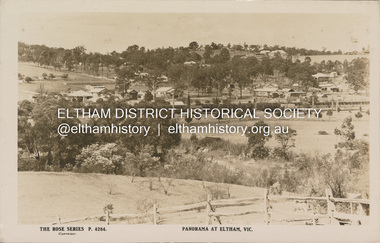
Postcard - Photograph postcard, Panorama at Eltham, Vic, c.1923
... Series Postcard...rose stereograph company...Tait Train...Velvet soap...Andrew Park...Bible Street...Bird...This is the section in front of Capewell's Butcher shop though it is difficult to fully make out from the photo michael aitken collection Eltham Postcards Arthur Street David Harbison Rest Home Electrine Candles Eltham Railway Station Eltham Shopping Centre Lloyd's General Store Red Rattler Rose Series Postcard rose stereograph company Tait Train Velvet soap Andrew Park Bible Street Bird Brothers Cash Grocer & Fruiterer Bird Brothers Cash Grocer and Fruiterer Butcher Diamond Street Dudley Street Eltham Hardware and Timber Eltham Hardware Store Eltham Mall Main Road Station Masters House Stationmaster's House Sunnybrook W.J. ...The Rose Series P. 4284 post card Taken from near what would be present day CLC car park looking southwest across Diamond Street, present-day Andrew Park to the railway station and developing Eltham shopping precinct. Arthur Street visible, Pryor and Luck Street not evident. Sunnybrook, the Taylor home is visible at the top of the hill in Bible Street. Only three residences visible in Arthur Street on the southern side, two of these are the David Harbison Rest Home at 10 and 12 Arthur Street (built and opened in November 1919), present day site of Eltham Mall. There are none on the north side of the street. Based on 1945 aerial view there are 8 buildings on the northern side between Main Road and Bible Street which and given the extent of commercial development on Main Road, it is estimated this image is circa 1925. Luther Haley was the first to build an open a baker and General Store in this location next to the railway station in 1902. However, it took nearly twenty years until the early to mid-1920s when a period of significant growth in the Eltham shopping centre happened with many businesses relocating their operations from the original town centre of Maria Street in Little Eltham as well as new businesses opening. Other stores/buildings noted (L-R) are: Stationmaster's House built circa 1910 Eltham Hardware Store opposite the railway station first opened on Main Road opposite the Railway Station around late 1922. An advertisement placed in the Hurstbridge Advertiser advised that the Hardware Store had just opened with a varied stock of Saws, Hammers, Nails, Shovels, Screw Drivers, and every article required in a house or on a farm. People were also encouraged to try their Jams, Pickles, Sauces, Cups and Saucers, etc. Newsagency with 'Leader' advertising on awning - E. J. Andrew opened his newsagency shop opposite the station in March 1923, advertising for sale stationery, school requisites and periodicals. Bird Brothers Cash Grocer & Fruiterer opposite the railway station offering summer drinks and confectionery a specialty with a full Stock of groceries of the best quality always on hand at city prices opened December 1921 William Capewell's Butcher shop at the corner of Dudley Street. Capewell previously had a small shop in front of the station opposite Luck Street. He enlisted in the AIF during WW1 and returned home in 1919. He re-applied for a slaughtering license in February 1920 and was advertising by October 1922 supplying all districts. Not visible (or not yet identified) but in business by October 1922 were: J.H. Fraser, Carpenter and Builder at Luck Street opposite the station George A. Danslow, Hairdresser and Tobacconist opposite the railway station Miss Barber's 'Blue Gum' Soda Fountain opened October 1922 opposite the railway station (hidden behind Stationmaster's House). It was so named due to its proximity to a tall Blue Gum tree G.H. McDonald Boot Repairer opposite the railway station In December 1923 the first portion of the main street to be formed from Dudley to Arthur streets was almost completed. This is the section in front of Capewell's Butcher shop though it is difficult to fully make out from the photoDigital file only Postcards scanned from the collection of Michael Aitken on loan to EDHS, 2 Sep. 2022michael aitken collection, eltham, postcards, arthur street, david harbison rest home, electrine candles, eltham railway station, eltham shopping centre, lloyd's general store, red rattler, rose series postcard, rose stereograph company, tait train, velvet soap, andrew park, bible street, bird brothers cash grocer & fruiterer, bird brothers cash grocer and fruiterer, butcher, diamond street, dudley street, eltham hardware and timber, eltham hardware store, eltham mall, main road, station masters house, stationmaster's house, sunnybrook, w.j. capewell, w.j. capewell butcher shop -
 Eltham District Historical Society Inc
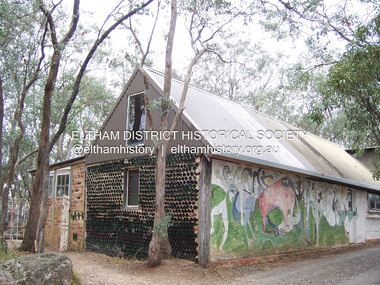
Photograph - Digital Photograph, Marguerite Marshall, Art Gallery at Clifton Pugh's Artists' Colony, Dunmoochin, Barreenong Road, Cottles Bridge, 5 February 2008
... bird life. Pugh encouraged these creatures to join him in the bush by creating, with Monash University, a holding station where the animals were raised. Dunmoochin inspired Pugh for such paintings as in a book on orchids and the Death of a Wombat series.1 But his love for the bush was accompanied by the fear that Europeans were destroying it and much of his painting illustrated this fear and his plea for its conservation.2 However it was his house rather than the surrounding bush that was to be destroyed. ...bird life. Pugh encouraged these creatures to join him in the bush by creating, with Monash University, a holding station where the animals were raised. Dunmoochin inspired Pugh for such paintings as in a book on orchids and the Death of a Wombat series.1 But his love for the bush was accompanied by the fear that Europeans were destroying it and much of his painting illustrated this fear and his plea for its conservation.2 However it was his house rather than the surrounding bush that was to be destroyed. ...Art Gallery with mural painted by Clifton Pugh (1924-1990) at his Artists' Colony, Dunmoochin, Barreenong Road, Cottles Bridge. Following military service in the second world war, Clifton Pugh studied under artist Sir William Dargie at the National Gallery School in Melbourne as well as Justus Jorgensen, founder of Montsalvat. For a while he lived on the dole but also worked packing eggs for the Belot family saving sufficient to purchase six acres (2.4 ha) of land at Barreenong Road, Cottles Bridge. He accumulated more land and persuaded several other artists and friends to buy land nearby, resulting in a property of approximately 200 acres, stablishing it as one of the first artistic communes in Australia alongside Montsalvat in Eltham. It was around 1951 that Pugh felt he had '"done moochin' around" and so the name of the property evolved. He bought timber from Alistair Knox to build his house on the crest of a hill. Inspired by local goldminer's huts, it was a one room wattle-and-daub structure with dirt floor. Over the years it expanded with thick adobe walls made from local clay, high ceilings and stone floors. All materials other than the local earth were sourced from second hand materials, most found at wreckers' yards. Artists from across the nation were drawn to Dunmoochin, with several setting up houses and shacks on the property, maintaining their independence but sharing their artistic zeal. Artists who worked or resided at Dunmoochin included Mirka Mora, John Perceval, Albert Tucker, Fred Williams, Charles Blackman, Arthur Boyd and John Olsen. In 2002, Pugh's house along with its treasure trove of art and a library of some 20,000 books was destroyed by fire. Traces of Pugh's home remain with the presence of the Victorian doorframe archway with leadlight of intricate design, procured from a demolished Melbourne mansion; and two bronze life-sized female statues created by Pugh and cast by Matcham Skipper. In place of Pugh's house rose two double-storey mud-brick artists' studios topped with corrugated iron rooves curved like the wings of a bird with accommodation for seven. The original studios, gallery and other buildings survived the fire. Covered under Heritage Overlay, Nillumbik Planning Scheme. Published: Nillumbik Now and Then / Marguerite Marshall 2008; photographs Alan King with Marguerite Marshall.; p153 It’s not surprising that artist Clifton Pugh was drawn to Cottles Bridge to establish his artists’ colony Dunmoochin. Undisturbed by the clamour of modern life at Barreenong Road, Pugh was surrounded by the Australian bush he loved, and where his ashes were later scattered. The 200 acres (81ha) of bushland, broken by glimpses of rolling hills, has more than 50 species of orchids and Pugh shared his property with native animals including kangaroos, emus, phascogales, wombats, and diverse bird life. Pugh encouraged these creatures to join him in the bush by creating, with Monash University, a holding station where the animals were raised. Dunmoochin inspired Pugh for such paintings as in a book on orchids and the Death of a Wombat series.1 But his love for the bush was accompanied by the fear that Europeans were destroying it and much of his painting illustrated this fear and his plea for its conservation.2 However it was his house rather than the surrounding bush that was to be destroyed. Tragically in 2002 Pugh’s house, with its treasure of art and library of 20,000 art books, was destroyed by fire. Traces of the beauty of Pugh’s home still remain, however, in the magnificent Victorian doorframe archway with leadlight of intricate design procured from a demolished Melbourne mansion; and two bronze life-sized female statues created by Pugh and cast by Matcham Skipper. Now in place of Pugh’s house, are two double-storey mud-brick artists’ studios topped with corrugated roofs curved like birds’ wings, with accommodation for seven. The original studios, gallery and other buildings remain.3 Pugh grew up on his parents’ hobby farm at Briar Hill and attended the Briar Hill Primary School, then Eltham High School and later Ivanhoe Grammar. At 15 he became a copy boy for the Radio Times newspaper, then worked as a junior in a drafting office. Pugh was to have three wives and two sons. After serving in World War Two in New Guinea and Japan, Pugh studied under artist Sir William Dargie, at the National Gallery School in Melbourne.4 Another of his teachers was Justus Jörgensen, founder of Montsalvat the Eltham Artists’ Colony. Pugh lived on the dole for a while and paid for his first six acres (2.4ha) at Barreenong Road by working as an egg packer for the Belot family. Pugh accumulated more land and persuaded several other artists and friends to buy land nearby, resulting in the 200 acre property. They, too, purchased their land from the Belot family by working with their chickens. Around 1951 Pugh felt he had ‘Done moochin’ around’ and so the name of his property was born. Pugh bought some used timber from architect Alistair Knox to build his house on the crest of a hill. Inspired by local goldminers’ huts it was a one-room wattle-and-daub structure with a dirt floor. It was so small that the only room he could find for his telephone was on the fork of a tree nearby.5 Over the years the mud-brick house grew to 120 squares in the style now synonymous with Eltham. It had thick adobe walls (sun-dried bricks) made from local clay, high ceilings and stone floors with the entire structure made of second-hand materials – most found at wreckers’ yards. Pugh’s first major show in Melbourne in 1957, established him as a distinctive new painter, breaking away from the European tradition ‘yet not closely allied to any particular school of Australian painting’.6 Pugh became internationally known and was awarded the Order of Australia. He won the Archibald Prize for portraiture three times, although he preferred painting the bush and native animals. In 1990 not long before he died, Pugh was named the Australian War Memorial’s official artist at the 75th anniversary of the landing at Gallipoli. Today one of Pugh’s legacies is the Dunmoochin Foundation, which gives seven individual artists or couples and environmental researchers the chance to work in beautiful and peaceful surroundings, usually for a year. By November 2007, more than 80 people had taken part, and the first disabled artist had been chosen to reside in a new studio with disabled access.1 In 1989, not long before Pugh died in 1990 of a heart attack at age 65, he established the Foundation with La Trobe University and the Victorian Conservation Trust now the Trust for Nature. Pugh’s gift to the Australian people – of around 14 hectares of bushland and buildings and about 550 art works – is run by a voluntary board of directors, headed by one of his sons, Shane Pugh. La Trobe University in Victoria stores and curates the art collection and organises its exhibition around Australia.2 The Foundation aims to protect and foster the natural environment and to provide residences, studios and community art facilities at a minimal cost for artists and environmental researchers. They reside at the non-profit organisation for a year at minimal cost. The buildings, some decorated with murals painted by Pugh and including a gallery, were constructed by Pugh, family and friends, with recycled as well as new materials and mud-bricks. The Foundation is inspired by the tradition begun by the Dunmoochin Artists’ Cooperative which formed in the late 1950s as one of the first artistic communes in Australia. Members bought the land collaboratively and built the seven dwellings so that none could overlook another. But, in the late 1960s, the land was split into private land holdings, which ended the cooperative. Dunmoochin attracted visits from the famous artists of the day including guitarists John Williams and Segovia; singer and comedian Rolf Harris; comedian Barry Humphries; and artists Charles Blackman, Arthur Boyd and Mirka Mora. A potters’ community, started by Peter and Helen Laycock with Alma Shanahan, held monthly exhibitions in the 1960s, attracting local, interstate and international visitors – with up to 500 attending at a time.3 Most artists sold their properties and moved away. But two of the original artists remained into the new millennium as did relative newcomer Heja Chong who built on Pugh’s property (now owned by the Dunmoochin Foundation). In 1984 Chong brought the 1000-year-old Japanese Bizan pottery method to Dunmoochin. She helped build (with potters from all over Australia) the distinctive Bizan-style kiln, which fires pottery from eight to 14 days in pine timber, to produce the Bizan unglazed and simple subdued style. The kiln, which is rare in Australia, is very large with adjoining interconnected ovens of different sizes, providing different temperatures and firing conditions. Frank Werther, who befriended Pugh as a fellow student at the National Gallery Art School in Melbourne, built his house off Barreenong Road in 1954. Werther is a painter of the abstract and colourist style and taught art for about 30 years. Like so many in the post-war years in Eltham Shire, as it was called then, Werther built his home in stages using mud-brick and second-hand materials. The L-shaped house is single-storey but two-storey in parts with a corrugated-iron pitched roof. The waterhole used by the Werthers for their water supply is thought to be a former goldmining shaft.4 Alma Shanahan at Barreenong Road was the first to join Pugh around 1953. They also met at the National Gallery Art School and Shanahan at first visited each weekend to work, mainly making mud-bricks. She shared Pugh’s love for the bush, but when their love affair ended, she designed and built her own house a few hundred yards (metres) away. The mud-brick and timber residence, made in stages with local materials, is rectangular, single-storey with a corrugated-iron roof. As a potter, Shanahan did not originally qualify as an official Cooperative member.This collection of almost 130 photos about places and people within the Shire of Nillumbik, an urban and rural municipality in Melbourne's north, contributes to an understanding of the history of the Shire. Published in 2008 immediately prior to the Black Saturday bushfires of February 7, 2009, it documents sites that were impacted, and in some cases destroyed by the fires. It includes photographs taken especially for the publication, creating a unique time capsule representing the Shire in the early 21st century. It remains the most recent comprehenesive publication devoted to the Shire's history connecting local residents to the past. nillumbik now and then (marshall-king) collection, art gallery, clifton pugh, dunmoochin, cottlesbridge, cottles bridge, barreenong road -
 Eltham District Historical Society Inc
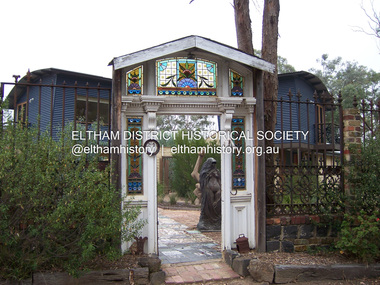
Photograph - Digital Photograph, Marguerite Marshall, Doorway of Clifton Pugh's former house at Dunmoochin, Barreenong Road, Cottles Bridge, 5 February 2008
... bird life. Pugh encouraged these creatures to join him in the bush by creating, with Monash University, a holding station where the animals were raised. Dunmoochin inspired Pugh for such paintings as in a book on orchids and the Death of a Wombat series.1 But his love for the bush was accompanied by the fear that Europeans were destroying it and much of his painting illustrated this fear and his plea for its conservation.2 However it was his house rather than the surrounding bush that was to be destroyed. ...bird life. Pugh encouraged these creatures to join him in the bush by creating, with Monash University, a holding station where the animals were raised. Dunmoochin inspired Pugh for such paintings as in a book on orchids and the Death of a Wombat series.1 But his love for the bush was accompanied by the fear that Europeans were destroying it and much of his painting illustrated this fear and his plea for its conservation.2 However it was his house rather than the surrounding bush that was to be destroyed. ...Following military service in the second world war, Clifton Pugh studied under artist Sir William Dargie at the National Gallery School in Melbourne as well as Justus Jorgensen, founder of Montsalvat. For a while he lived on the dole but also worked packing eggs for the Belot family saving sufficient to purchase six acres (2.4 ha) of land at Barreenong Road, Cottles Bridge. He accumulated more land and persuaded several other artists and friends to buy land nearby, resulting in a property of approximately 200 acres, stablishing it as one of the first artistic communes in Australia alongside Montsalvat in Eltham. It was around 1951 that Pugh felt he had '"done moochin' around" and so the name of the property evolved. He bought timber from Alistair Knox to build his house on the crest of a hill. Inspired by local goldminer's huts, it was a one room wattle-and-daub structure with dirt floor. Over the years it expanded with thick adobe walls made from local clay, high ceilings and stone floors. All materials other than the local earth were sourced from second hand materials, most found at wreckers' yards. Artists from across the nation were drawn to Dunmoochin, with several setting up houses and shacks on the property, maintaining their independence but sharing their artistic zeal. Artists who worked or resided at Dunmoochin included Mirka Mora, John Perceval, Albert Tucker, Fred Williams, Charles Blackman, Arthur Boyd and John Olsen. In 2002, Pugh's house along with its treasure trove of art and a library of some 20,000 books was destroyed by fire. Traces of Pugh's home remain with the presence of the Victorian doorframe archway with leadlight of intricate design, procured from a demolished Melbourne mansion; and two bronze life-sized female statues created by Pugh and cast by Matcham Skipper. In place of Pugh's house rose two double-storey mud-brick artists' studios topped with corrugated iron rooves curved like the wings of a bird with accommodation for seven. The original studios, gallery and other buildings survived the fire. Covered under Heritage Overlay, Nillumbik Planning Scheme. Published: Nillumbik Now and Then / Marguerite Marshall 2008; photographs Alan King with Marguerite Marshall.; p155 It’s not surprising that artist Clifton Pugh was drawn to Cottles Bridge to establish his artists’ colony Dunmoochin. Undisturbed by the clamour of modern life at Barreenong Road, Pugh was surrounded by the Australian bush he loved, and where his ashes were later scattered. The 200 acres (81ha) of bushland, broken by glimpses of rolling hills, has more than 50 species of orchids and Pugh shared his property with native animals including kangaroos, emus, phascogales, wombats, and diverse bird life. Pugh encouraged these creatures to join him in the bush by creating, with Monash University, a holding station where the animals were raised. Dunmoochin inspired Pugh for such paintings as in a book on orchids and the Death of a Wombat series.1 But his love for the bush was accompanied by the fear that Europeans were destroying it and much of his painting illustrated this fear and his plea for its conservation.2 However it was his house rather than the surrounding bush that was to be destroyed. Tragically in 2002 Pugh’s house, with its treasure of art and library of 20,000 art books, was destroyed by fire. Traces of the beauty of Pugh’s home still remain, however, in the magnificent Victorian doorframe archway with leadlight of intricate design procured from a demolished Melbourne mansion; and two bronze life-sized female statues created by Pugh and cast by Matcham Skipper. Now in place of Pugh’s house, are two double-storey mud-brick artists’ studios topped with corrugated roofs curved like birds’ wings, with accommodation for seven. The original studios, gallery and other buildings remain.3 Pugh grew up on his parents’ hobby farm at Briar Hill and attended the Briar Hill Primary School, then Eltham High School and later Ivanhoe Grammar. At 15 he became a copy boy for the Radio Times newspaper, then worked as a junior in a drafting office. Pugh was to have three wives and two sons. After serving in World War Two in New Guinea and Japan, Pugh studied under artist Sir William Dargie, at the National Gallery School in Melbourne.4 Another of his teachers was Justus Jörgensen, founder of Montsalvat the Eltham Artists’ Colony. Pugh lived on the dole for a while and paid for his first six acres (2.4ha) at Barreenong Road by working as an egg packer for the Belot family. Pugh accumulated more land and persuaded several other artists and friends to buy land nearby, resulting in the 200 acre property. They, too, purchased their land from the Belot family by working with their chickens. Around 1951 Pugh felt he had ‘Done moochin’ around’ and so the name of his property was born. Pugh bought some used timber from architect Alistair Knox to build his house on the crest of a hill. Inspired by local goldminers’ huts it was a one-room wattle-and-daub structure with a dirt floor. It was so small that the only room he could find for his telephone was on the fork of a tree nearby.5 Over the years the mud-brick house grew to 120 squares in the style now synonymous with Eltham. It had thick adobe walls (sun-dried bricks) made from local clay, high ceilings and stone floors with the entire structure made of second-hand materials – most found at wreckers’ yards. Pugh’s first major show in Melbourne in 1957, established him as a distinctive new painter, breaking away from the European tradition ‘yet not closely allied to any particular school of Australian painting’.6 Pugh became internationally known and was awarded the Order of Australia. He won the Archibald Prize for portraiture three times, although he preferred painting the bush and native animals. In 1990 not long before he died, Pugh was named the Australian War Memorial’s official artist at the 75th anniversary of the landing at Gallipoli. Today one of Pugh’s legacies is the Dunmoochin Foundation, which gives seven individual artists or couples and environmental researchers the chance to work in beautiful and peaceful surroundings, usually for a year. By November 2007, more than 80 people had taken part, and the first disabled artist had been chosen to reside in a new studio with disabled access.1 In 1989, not long before Pugh died in 1990 of a heart attack at age 65, he established the Foundation with La Trobe University and the Victorian Conservation Trust now the Trust for Nature. Pugh’s gift to the Australian people – of around 14 hectares of bushland and buildings and about 550 art works – is run by a voluntary board of directors, headed by one of his sons, Shane Pugh. La Trobe University in Victoria stores and curates the art collection and organises its exhibition around Australia.2 The Foundation aims to protect and foster the natural environment and to provide residences, studios and community art facilities at a minimal cost for artists and environmental researchers. They reside at the non-profit organisation for a year at minimal cost. The buildings, some decorated with murals painted by Pugh and including a gallery, were constructed by Pugh, family and friends, with recycled as well as new materials and mud-bricks. The Foundation is inspired by the tradition begun by the Dunmoochin Artists’ Cooperative which formed in the late 1950s as one of the first artistic communes in Australia. Members bought the land collaboratively and built the seven dwellings so that none could overlook another. But, in the late 1960s, the land was split into private land holdings, which ended the cooperative. Dunmoochin attracted visits from the famous artists of the day including guitarists John Williams and Segovia; singer and comedian Rolf Harris; comedian Barry Humphries; and artists Charles Blackman, Arthur Boyd and Mirka Mora. A potters’ community, started by Peter and Helen Laycock with Alma Shanahan, held monthly exhibitions in the 1960s, attracting local, interstate and international visitors – with up to 500 attending at a time.3 Most artists sold their properties and moved away. But two of the original artists remained into the new millennium as did relative newcomer Heja Chong who built on Pugh’s property (now owned by the Dunmoochin Foundation). In 1984 Chong brought the 1000-year-old Japanese Bizan pottery method to Dunmoochin. She helped build (with potters from all over Australia) the distinctive Bizan-style kiln, which fires pottery from eight to 14 days in pine timber, to produce the Bizan unglazed and simple subdued style. The kiln, which is rare in Australia, is very large with adjoining interconnected ovens of different sizes, providing different temperatures and firing conditions. Frank Werther, who befriended Pugh as a fellow student at the National Gallery Art School in Melbourne, built his house off Barreenong Road in 1954. Werther is a painter of the abstract and colourist style and taught art for about 30 years. Like so many in the post-war years in Eltham Shire, as it was called then, Werther built his home in stages using mud-brick and second-hand materials. The L-shaped house is single-storey but two-storey in parts with a corrugated-iron pitched roof. The waterhole used by the Werthers for their water supply is thought to be a former goldmining shaft.4 Alma Shanahan at Barreenong Road was the first to join Pugh around 1953. They also met at the National Gallery Art School and Shanahan at first visited each weekend to work, mainly making mud-bricks. She shared Pugh’s love for the bush, but when their love affair ended, she designed and built her own house a few hundred yards (metres) away. The mud-brick and timber residence, made in stages with local materials, is rectangular, single-storey with a corrugated-iron roof. As a potter, Shanahan did not originally qualify as an official Cooperative member.This collection of almost 130 photos about places and people within the Shire of Nillumbik, an urban and rural municipality in Melbourne's north, contributes to an understanding of the history of the Shire. Published in 2008 immediately prior to the Black Saturday bushfires of February 7, 2009, it documents sites that were impacted, and in some cases destroyed by the fires. It includes photographs taken especially for the publication, creating a unique time capsule representing the Shire in the early 21st century. It remains the most recent comprehenesive publication devoted to the Shire's history connecting local residents to the past. nillumbik now and then (marshall-king) collection, art gallery, clifton pugh, dunmoochin, cottlesbridge, cottles bridge, barreenong road
