
Showing 68 items matching "bishop's house"
-
 Hymettus Cottage & Garden Ballarat
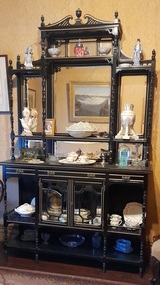
Furniture - Cabinet, Parlour Cabinet
... Bishop's House...Originally purchased for the Catholic Bishop's House or Palace at Ballarat it was purchased at the sale of the palace in 1996 to replace the original cabinet of similar proportions at Hymettus that was sold from there in the 1940s....Originally purchased for the Catholic Bishop's House or Palace at Ballarat it was purchased at the sale of the palace in 1996 to replace the original cabinet of similar proportions at Hymettus that was sold from there in the 1940s. ...Originally purchased for the Catholic Bishop's House or Palace at Ballarat it was purchased at the sale of the palace in 1996 to replace the original cabinet of similar proportions at Hymettus that was sold from there in the 1940s.A large example of a parlour cabinet from the late nineteenth century. This mahogany cabinet is an example of ebonised chinoiserie decoration and while its label has been lost it was labelled as being French. bishop's house, palace, ballarat, parlour cabinet, display cabinet -
 Embroiderers Guild, Victoria
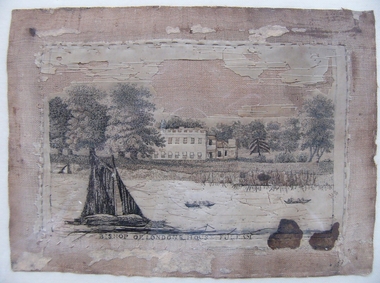
Artwork, other - Silk and Hair Embroidered Picture, c. 1790
... Bishop of London's house, Fulham, River Thames and rural setting. ...Bishop of London's House, Fulham...Embroidery Creative Pictures 18th Century England Bishop of London's House, Fulham Bishop of London's house, Fulham, River Thames and rural setting. ...Made by a member of the Dearing family about 1790.Bishop of London's house, Fulham, River Thames and rural setting. Boats and sailing ship in fore ground. These pictures are stitched in silk(?) and hair, very fine, on silk in beiges and black.Bishop of London's House, Fulhamembroidery, creative, pictures, 18th century, england -
 Royal Australian and New Zealand College of Obstetricians & Gynaecologists (RANZCOG)
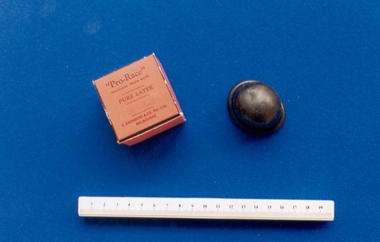
"Pro-Race" contraceptive cervical cap associated with Dr Geoff Bishop, A. Saunders & Co P/L, Melbourne
... This pessary came from Professor Geoff Bishop's rooms, Mollison House, 386 Albert Street, East Melbourne. ...This pessary came from Professor Geoff Bishop's rooms, Mollison House, 386 Albert Street, East Melbourne. ...The Pro Race cervical cap was used in the early 1960s. This pessary came from Professor Geoff Bishop's rooms, Mollison House, 386 Albert Street, East Melbourne. The pamphlet associated with this item says that this device was mentioned by Marie Stopes in her book, 'Contraception'.Before birth control pills, the cervical cap was used as a barrier method of contraception for women. The cervical cap is hormone-free and creates a physical barrier over the cervix to prevent sperm from reaching the uterus. The cervical cap is first filled with spermicide before insertion which kills any sperm that may enter the cap. There were many complaints about how difficult it was to remove and it also does not prevent STDs; however, it could be worn for longer (48 hours) than a diaphragm. Cervical cap made of black latex rubber with rolled rim. With original manufacturer's box. Box is pink cardboard and printed with the text '"Pro-Race"/ REGISTERED TRADE MARK/ PURE LATEX/A.SAUNDERS & CO PTY. LTD./ MELBOURNE". Object also includes a paper instruction sheet detailing product information and method of use - the instructions include diagrams.contraception, pessary, marie stopes, intrauterine device -
 Royal Australian and New Zealand College of Obstetricians & Gynaecologists (RANZCOG)
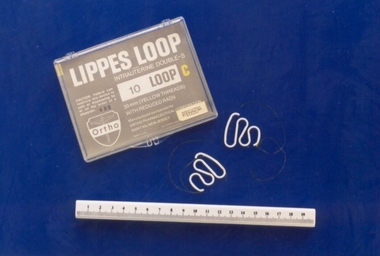
Lippes Loop intrauterine devices with container associated with Professor Geoff Bishop, Ortho Pharmaceutical Corporation
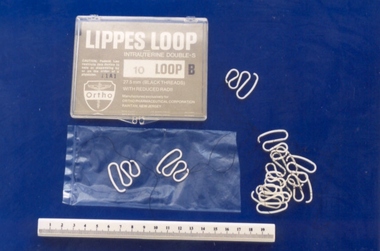
... This item came from Geoff Bishop's rooms at Mollison House, 386 Albert Street, East Melbourne. ...This item came from Geoff Bishop's rooms at Mollison House, 386 Albert Street, East Melbourne. ...This item came from Geoff Bishop's rooms at Mollison House, 386 Albert Street, East Melbourne. Distributed by Ethnor P/L Sydney, these bulk purchase packs pre-dated the individually sterile packaged products with disposable applicators.Two white, plastic Lippes Loop IUDs [.1 and .2], with yellow string attached to one end of each. Double S-shape intrauterine devices. Also includes "LIPPES LOOP" product information label [.3], and a clear hinged plastic case with adhesive sticker [.4].intrauterine device, contraception -
 Royal Australian and New Zealand College of Obstetricians & Gynaecologists (RANZCOG)
Ten Lippes Loop intrauterine devices, with container, associated with Professor Geoff Bishop, Ortho Pharmaceutical Corporation
... This item came from Geoff Bishop's rooms at Mollison House, 386 Albert Street, East Melbourne. ...This item came from Geoff Bishop's rooms at Mollison House, 386 Albert Street, East Melbourne. ...This item came from Geoff Bishop's rooms at Mollison House, 386 Albert Street, East Melbourne. Distributed by Ethnor P/L Sydney, these bulk purchase packs pre-dated the individually sterile packaged products with disposable applicators.Ten Lippes Loop IUDs [29.1-29.10], Size B. Made of white plastic with black threads attached at one end of each. Double S shape intrauterine device. With clear plastic bag [.11], clear plastic hinged container [.12] and paper product information sheet [.13].intrauterine device, contraception -
 Royal Australian and New Zealand College of Obstetricians & Gynaecologists (RANZCOG)
Ring pessary associated with Dr Geoff Bishop, c. 1977, Portex Ltd, England, c1977
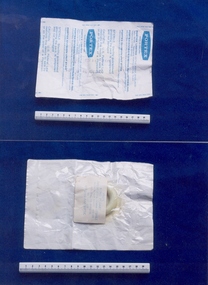
... This pessary came from Professor Geoff Bishop's rooms, Mollison House, 386 Albert Street, East Melbourne. ...This pessary came from Professor Geoff Bishop's rooms, Mollison House, 386 Albert Street, East Melbourne. ...This pessary came from Professor Geoff Bishop's rooms, Mollison House, 386 Albert Street, East Melbourne. As well as the UK, Portex had divisions in the USA and Canada. The pessary was originally regarded as an instrument and made from cork, ivory, hard rubber or gum-elastic. In later times, they were made from black vulcanite, flexible tin, soft copper wire covered with Indian rubber, and celluloid. The form of the pessary was and still is variable -either round, oval, or moulded in some cases combining three or four curves depending on the size of the pessary. In ancient times, medicated pessaries were made from emollient. astringent and aperient. Several of these are still used, but in more modem times are called vaginal suppositories. Anal suppositories are still used to suppress the pain of haemorrhoids. Portex brand ring pessary in original packaging. Consists of circular ring of cream vinyl, in sterile sealed pouch with transparent plastic at back. Stamped on pouch "PORTEX ENGLAND", and the text "USE BY FEB 77" and "CONTROL No F/1 505". The ring is size 700/300/056 - 56mm. A sticker on the back of pouch gives instruction for cleaning the pessary.pessary, intrauterine device -
 Royal Australian and New Zealand College of Obstetricians & Gynaecologists (RANZCOG)
Ring pessary associated with Dr Geoff Bishop, c. 1977, Portex Ltd, England, before 1977
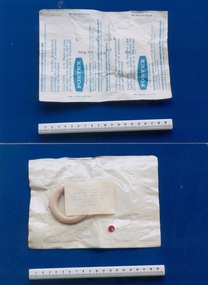
... This pessary came from Professor Geoff Bishop's rooms, Mollison House, 386 Albert Street, East Melbourne. ...This pessary came from Professor Geoff Bishop's rooms, Mollison House, 386 Albert Street, East Melbourne. ...This pessary came from Professor Geoff Bishop's rooms, Mollison House, 386 Albert Street, East Melbourne. As well as the UK, Portex had divisions in the USA and Canada. The pessary was originally regarded as an instrument and made from cork, ivory, hard rubber or gum-elastic. In later times, they were made from black vulcanite, flexible tin, soft copper wire covered with Indian rubber, and celluloid. The form of the pessary was and still is variable -either round, oval, or moulded in some cases combining three or four curves depending on the size of the pessary. In ancient time, medicated pessaries were made from emollient. astringent and aperient. Several of these are still used, but in more modem times are called vaginal suppositories. Anal suppositories are still used to suppress the pain of haemorrhoids.Portex brand ring pessary in original packaging. Consists of circular ring of cream vinyl, in sterile sealed pouch with transparent plastic at back. Stamped on pouch "PORTEX/MADE IN ENGLAND", and the text "USE BY JAN 77" and "CONTROL No 06 88". The ring is size 700/300/065 - 65mm. A sticker on the back of pouch gives instruction for cleaning the pessary. A red dot is also stuck to the back of the pouch.pessary, intrauterine device -
 Flagstaff Hill Maritime Museum and Village
Plan - Ship Plan, Orient Steam Navigation Company, Orient Line, RMS Orion, ca. 1934
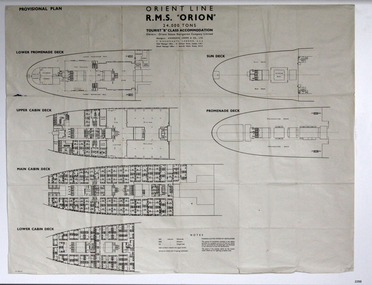
... LTD" "7 BISHOPS GATE, LONDON, E.C.2" "Chief Passenger Office : 14 Cockspur Street, London, S.W.1" "Branch Passenger Office : 1 Australia House, Strand, W.C.2" "notices"...LTD" "7 BISHOPS GATE, LONDON, E.C.2" "Chief Passenger Office : 14 Cockspur Street, London, S.W.1" "Branch Passenger Office : 1 Australia House, Strand, W.C.2" "notices" Plan: printed provisional line drawing of the Orient line vessel "R.M.S. ...The Orient Steam Navigation Company Limited launched the Ocean Liner RMS Orion in 1934 and it remained in operation until 1963. The twin screw steamship was built to carry first class and tourist class passengers, over 1100 in all, plus almost 500 crew from Europe to Australia in comfort. The ship had a single funnel and a single mast. During WWII the vessel served as a troop carrier. The ventilation system noted on the plan, Punkah Louvre System, was designed for heating fresh air ventilation in buildings, ships and railroads. The system originated from Thermotank in Glasgow, Scotland. The ship plan for the RMS Orion is significant for its connection with the vessel. The ship was a leader, with several 'firsts'; the first Orient Line ship to be built with a single funnel since 1902, and the first to be painted in the Orient Line's livery, with a corn-coloured hull. It was the first liner to use chromium and bakelite materials for the surfaces throughout the ship, which provided greater resistance to the sea. It was also the first British ship to be fitted with air conditioning.Plan: printed provisional line drawing of the Orient line vessel "R.M.S. Orion". Inscriptions are printed on the plan. There are diagrams of six decks included in the plan. The ship is built for tourist "B" accommodation. The plan's Notices include details of the cabins including wardrobes, drawers, hinged seats, mattresses and bunk numbers. It also notes that there is a Punkah-Louvre System of Ventilation.Printed on the plan: "PROVISIONAL PLAN" "LOWER PROMENADE DECK" "UPPER CABIN DECK" "MAIN CABIN DECK" "LOWER CABIN DECK" "SUN DECK" "PROMENADE DECK" "ORIENT LINE / R.M.S. "ORION" / 24,000 TONS / TOURIST "B" CLASS ACCOMMODATION" "Owners: Orient Steam Navigation Company Limited"' "Managers : ANDERSON, GREEN & CO. LTD" "7 BISHOPS GATE, LONDON, E.C.2" "Chief Passenger Office : 14 Cockspur Street, London, S.W.1" "Branch Passenger Office : 1 Australia House, Strand, W.C.2" "notices"flagstaff hill, flagstaff hill maritime museum and village, warrnambool, maritime museum, maritime village, great ocean road, shipwreck coast, rms orion, plan, ship plan, provisional plan, orient line, orient ship, vissel orion, class b passenger accommodation, punkah louvre system of ventilation, deck plan, ship ventilation, ship floor plan, orient steam navigation company limited, anderson green & co ltd, steamship, ocean liner, war ship, troop carrier -
 Flagstaff Hill Maritime Museum and Village
Book - Reference, The Elements of Euclid
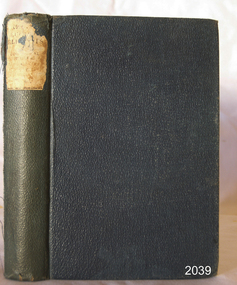
... Bishop of Natal, South Africa. The publisher firm, Longmans, Green & Co., was originally founded in 1724 in London by Thomas Longman under the name Longman. In August of that year, he bought the two shops and goods of William Taylor and set up his publishing house there at 39 Paternoster Row. ...Bishop of Natal, South Africa. The publisher firm, Longmans, Green & Co., was originally founded in 1724 in London by Thomas Longman under the name Longman. In August of that year, he bought the two shops and goods of William Taylor and set up his publishing house there at 39 Paternoster Row. ...Author John William Colenso (1814-1883) was a mathematician, missionary and renowned clergyman in the Anglican Church. In 1853 he became the first Bishop of Natal, South Africa. The publisher firm, Longmans, Green & Co., was originally founded in 1724 in London by Thomas Longman under the name Longman. In August of that year, he bought the two shops and goods of William Taylor and set up his publishing house there at 39 Paternoster Row. The shops were called Black Swan and Ship, and it is said that the 'ship' sign was the inspiration for Longman's Logo. After many changes of name and management, the firm was incorporated in 1926 as Longmans, Green & Co. Pty Ltd. The firm was acquired by Pearson in 1968 and was known as Pearson Longman or Pearson PLC. The printer, Spottiswoode and Co,, was established in 1738 by William Strahan, with premises in New Street Square, London. The growing firm advertised as Printers, Lithographers, Stationers, Electrotypers, Publishers, and Booksellers and by 1914 there were 1,000 employees. The book is significant for its connection to 19th-century author John William Colenso, was a mathematician and Anglican clergyman who had several works published. The publisher and printer of this book are also significant in their roles for being established in the early 18th century, contributing to the education of the studies of the scholars of the day. The book is also significant for its connection to the publisher Longmans, Green and Co., of London, and printer Spottiswoode & Co., firms that have been established for around two centuries, renowned for publishing and printing reference works that contributed to the education of scholars over many years.The Elements of Euclid by John William Colenso, D.D. (new edition) [The Elements of Euclid (the parts read in the University of Cambridge) from the text of Dr Robert Simson with Geometrical Examples by John William Colenso, D.D., Lord Bishop of Natal} Date: 1846 Publisher: Longmans Green and Co, London Printer: Spottiswoode and Co, New Street Navy blue textured hardcover on the book, with title on a label on the spine.Text on spineflagstaff hill, flagstaff hill maritime museum and village, warrnambool, maritime museum, maritime village, great ocean road, shipwreck coast, longmans green and co., thomas longman, paternoster row london, john william colenso, 19th-century british mathematician, missionary, spottiswoode & co., the elements of euclid -
 Mission to Seafarers Victoria
Photograph - Reproduction, Jay Miller, 6 June 2019
... house their labor is hut lost'that build it." The Archdeacon expressed thanks to the Primate for attending the cere mony, and regretted that the Arch bishop was unable to attend. ...house their labor is hut lost'that build it." The Archdeacon expressed thanks to the Primate for attending the cere mony, and regretted that the Arch bishop was unable to attend. ...This photograph was published in the Geelong Advertiser on Friday 23 November 1906, page 4 with this article: "Owing to the generosity of an anonymous donor, the Victorian Missions to Seamen has been supplied with a long felt want in the shape of a modern motor launch to facilitate and render more efficient the work among the vessels in the Yarra and Hobson's Bay. The order for the construction of the boat, was placed with Mr. Chas. Blunt, of the Eastern Beach, and complimentary references were made to her graceful line- as she rode in light .trim after the launching on Wednesday afternoon. She is 31ft. long. Oft. beam, and has a depth of 3ft. The frame is of jarrah and ben* blackwood. and inch kauri planking has been used in building Iter. A neat deck-house with Oft. headroom is situat ed-umidsliip*. and a short mast is pro vided to carry the well-known blue flag of the -.fission. The launch motors will develop a speed of between nine and ten miles an hour: The finishing touches have yet to be given her. and she will afterwards be row«l to have her engines fitted in. -The launch will he ready for service for the busy wheat season com mencing at- the end of the year. The launching ceremony took place at 6 p.m. on Wednesday at the builder's yards, in the .presence of njarge gather ing of spectators. The Archdeacon of Geelong. the Rev. O. P. C'ros-.ley. ecu ducted a short dedication service, and the other clergymen who took part in the service were the Primate of Aus tralia. the Right Rev. Dr. Sauiuarcz Smith: the Rev. A. Giirney Goldsmith, the Missions chaplain: and the Rev. H. Kelly. The Bishop of Newcastle, Dr. Stretch, and the chaplain of the New castle Mission, the Rev. AYnddy. and Canon Nash were also present. The Primpte. addressing the gar boring as "My good friends of Geelong." said be had never been in sight of the hay before. bill had'gladly accepted the in vitation to say a few words in connec tion with the dedication of tiro launch. He had always been interested in mis sions of all sorts, as they ali as Christian men and women 110 doubt- were, and lie was particularly interested in Missions to Seamen, because in the Society at' borne, with which this Society was con nected, he had a son-in-law who was mission chaplain in the Medway. He therefore know something about a launch for the purpose of a mission like this, and also knew 'something about missions to seamen. In Sydney for some time past it had been doing good work—work which he was sure they would all feel was of the widest possible value. This year he was at the annual meeting of the Missions to Seamen in London presided over by the Bishop o-f Stcphney. -He (the Primate) at that meeting remarked that the Mission in it, value was personal, local and Im perial. It was of personal value to thee who came under the ministra tions of the church, and in the social as pect : it was local because where the Mission existed the feelings of the lo cality were thrown out. in sympathy with j tlie -Mission, and the people themselves thus benefited. It was also a matter of Imperial interest because it- was really i a world-wide Mission, inasmuch as the | sailors as they" went from one part of the world to another were in themselves j missionaries either for evil or for good, i Thev might he missionaries with a mcs i sago which might degrade and "work ail I evil influence amongst, men, and with i conduct which might reflect a reproach !' upon Christian profession. On the other hand, they might be Chrisian men endeavoring more and more to show the .example of the Christian life in the J midst of very big difficulties and tempta tions. • -Ho came to show liis sympathy with tlio appropriately-named '"'Southern Cross," and from what lie had boon told he believed she was a good boat, a good gift, and launched for a good purpose. They should be thankful that it was a good boat and .thankful because it was a good gift by an anonymous donor, whom he congratulated on doing such a useful thing." The idea of the launch ing ceremony was to ask the blessing of God because ".Except the Lord hless'the house their labor is hut lost'that build it." The Archdeacon expressed thanks to the Primate for attending the cere mony, and regretted that the Arch bishop was unable to attend. They dc- | sired that the boat- should always be as sociated with the.Church Congress 1906. I The opening hymn was "For those in j peril on the sea," followed hv Psalm I 107, "'They'that, go down to the sea in 1 Ships." Tlio prayers included an ap peal foiUDirine blessing on .the launch, and for tho preservation of those who may travel in her. ' Xlio Benediction was pronounced by the Primate, and the christening cere mony performed by Hiss Connibere. From the bow there was suspended a bottle of pure water covered with red, white and blue streamers and roses. Dashing the bottle in,fragments against the launch's bow. Miss Connibere named her the "Southern Cross." Cheers were given for the launch/and as she travell ed down the slip further cheers were given. She carried the Mission flag at tho masthead, and between Union Jacks at tho bow and stern, a long string of flags fluttered gaily* in the breeze. The collection was in aid of the Mis sions to Seamen and the Geelong Sailors' Rest.Reproduction of a photograph from a newspaper.Fujifilm / Quality Dry Photo papersouthern cross, motor boat, mission to seamen, seamen's mission, charles blunt, blunt boatbuilders, geelong -
 Greensborough Historical Society
Photograph - Digital image, Jasmin Burge, Chapel interior, Loyola College 2012, 19/06/2012
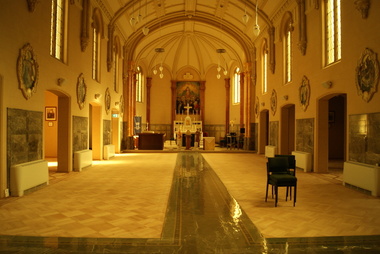
... Inscription on plaque: "This Chapel was dedicated on Wednesday 1st August 1934 by Most Reverend Bishop McCarthy DD, Bishop of Sandhurst (Bendigo) for the House of Studies, Novitiate and Retreat Centre of the Society of Jesus (1934-1974) and after sale to the State Government was deconsecrated. ...Inscription on plaque: "This Chapel was dedicated on Wednesday 1st August 1934 by Most Reverend Bishop McCarthy DD, Bishop of Sandhurst (Bendigo) for the House of Studies, Novitiate and Retreat Centre of the Society of Jesus (1934-1974) and after sale to the State Government was deconsecrated. ...Chapel interior and plaque, Loyola College 2012. Inscription on plaque: "This Chapel was dedicated on Wednesday 1st August 1934 by Most Reverend Bishop McCarthy DD, Bishop of Sandhurst (Bendigo) for the House of Studies, Novitiate and Retreat Centre of the Society of Jesus (1934-1974) and after sale to the State Government was deconsecrated. It was returned to the catholic community in 2002." Part of a collection of photographs of Loyola College, Grimshaw Street Watsonia, established 1980 on the site of the Loyola Seminary. The College purchased the original building in 2002. These photographs of the original building and grounds were taken by GHS member Jazz Burge in June 2012.Digital copy of colour photograph.loyola college -
City of Moorabbin Historical Society (Operating the Box Cottage Museum)
Newsletter - CMHS Moorabbin Mirror Issue 13 February 2018, CMHS Moorabbin Mirror Newsletter Issue 13 February 2018, 2018
... House is that?'; Sands & McDougal 1860-1974 digitized by State Library Vic.;Alan Clarke donated in 2016 handwritten S&M copies of residents ; 1818 1st Australia Day Gvnr. Lachlan Macquarie;1858 Foundation Stone St Patrick's Cathedral laid by Bishop...House is that?'; Sands & McDougal 1860-1974 digitized by State Library Vic.;Alan Clarke donated in 2016 handwritten S&M copies of residents ; 1818 1st Australia Day Gvnr. Lachlan Macquarie;1858 Foundation Stone St Patrick's Cathedral laid by Bishop ...This is Issue 13 of the Moorabbin Mirror produced by CMHS members Fran & Holger Bader , Geoffrey Paterson, February 2018 The Moorabbin Mirror reflects the history and heritage of the former City of Moorabbin — derived from Mooroobin, ‘a resting place’ in the Bunurrung spoken language. In 1994, the City of Moorabbin was integrated into the Cities of Bayside, Glen Eira, Kingston and Monash. Topics: Vale Mr Laurie Lewis; Street Names Files; KCC Tribute for Dr G Whitehead 20years ; Local heritage 'What House is that?'; Sands & McDougal 1860-1974 digitized by State Library Vic.;Alan Clarke donated in 2016 handwritten S&M copies of residents ; 1818 1st Australia Day Gvnr. Lachlan Macquarie;1858 Foundation Stone St Patrick's Cathedral laid by Bishop J.A. Goold; 1882 Assassination attempt on A/Bishop Goold in Brighton; 1948 UN Declaration of Human Rights; Census Victoria 2016 results; Plateways by Phil Rickard Light Rail HS;Flooding at BCM Dec./Jan. ; August Rietman Exhibition Report & Photos; This is Issue 13 of the Moorabbin Mirror, Newsletter of CMHS February 2018A4 x 3 paper folded to A5 x 6pp printed both sides with colour photographs. Moorabbin / Mirror / Newsletter City of Moorabbin Historical Society Inc. A0020543 (CMHS) / operating Box Cottage Museum (BCM) / ISSUE 13 FEBRUARY 2018moorabbin mirror, bader fran, bader holger, patterson geoffrey, lewis laurie;street name files; whitehead dr g.; sands and mcdougal; clark a; archbishop gool j.a.; st. patrick's cathedral melbourne; governor macquarie l.; plateways; rickard phil.; ohm 2017; reitman august, rietman stefanie; rietman william; lone digger memorials wwi; -
 Orbost & District Historical Society
plans, July 1949
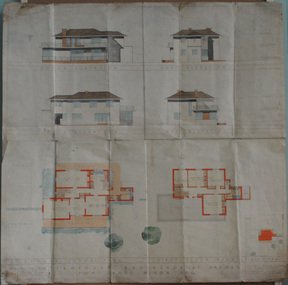
... Nixon-James house-plans architecture Architectural plans for a two-storey house with 4 bedrooms to be built on the corner of Gladstone and Tennyson Streets in Orbost. On a white background with coloured drawings ( water colour). plans Bishop, Lloyd J. ...These house plans were drawn up for James Nixon. James Nixon was born in Orbost on 15.11.1912. He married Joyce May Thompson on 2.2.1937. He was a well known Orbost identity, serving a record 47 years as a Commissioner on the Snowy River improvement Trust, as well a director of Snowy River Seed and th Bean Board. He died on 21.12.2002.James Nixon, a third generation Nixon, father of Peter Nixon A.O., was an involved and respected Orbost identity. This item is a significant research tool.Architectural plans for a two-storey house with 4 bedrooms to be built on the corner of Gladstone and Tennyson Streets in Orbost. On a white background with coloured drawings ( water colour).nixon-james house-plans architecture -
 Flagstaff Hill Maritime Museum and Village
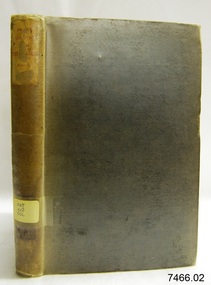
Book - Religious Book, John William Colenso, author, The Pentateuch and Book of Joshua Part 1, 1863
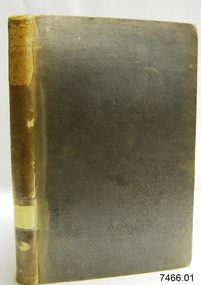
... Bishop of Natal, South Africa. The publisher firm, Longman Green Longman Roberts & Green was originally founded in 1724 in London by Thomas Longman under the name Longman. In August of that year, he bought the two shops and goods of William Taylor and set up his publishing house there at 39 Paternoster Row. ...Bishop of Natal, South Africa. The publisher firm, Longman Green Longman Roberts & Green was originally founded in 1724 in London by Thomas Longman under the name Longman. In August of that year, he bought the two shops and goods of William Taylor and set up his publishing house there at 39 Paternoster Row. ...This item is from the ‘Pattison Collection’, a collection of books and records that was originally owned by the Warrnambool Mechanics’ Institute, which was founded in Warrnambool in 1853. Author John William Colenso (1814-1883) was a mathematician, missionary and renowned clergyman in the Anglican Church. In 1853 he became the first Bishop of Natal, South Africa. The publisher firm, Longman Green Longman Roberts & Green was originally founded in 1724 in London by Thomas Longman under the name Longman. In August of that year, he bought the two shops and goods of William Taylor and set up his publishing house there at 39 Paternoster Row. The shops were called Black Swan and Ship, and it is said that the 'ship' sign was the inspiration for Longman's Logo. After many changes of name and management, the firm was incorporated in 1926 as Longmans, Green & Co. Pty Ltd. The firm was acquired by Pearson in 1968 and was known as Pearson Longman or Pearson PLC.The book is significant for its connection to 19th-century author John William Colenso, who was a mathematician and Anglican clergyman who had several works published. The publisher of this book, Longman Green Longman Roberts & Green, is also significant for being established in the early 18th century, contributing to the education of the studies of the scholars of the day. The book has additional importance for its connection to the Pattison Collection, which, along with other items at Flagstaff Hill Maritime Village, was originally part of the Warrnambool Mechanics' Institutes’ Collection. The Warrnambool Mechanics’ Institute book collection has historical and social significance for its strong association with the Mechanics Institute movement and the important role it played in the intellectual, cultural and social development of people throughout the latter part of the nineteenth century and the early twentieth century. The collection of books is a rare example of an early lending library and its significance is enhanced by the survival of an original collection of many volumes. The Warrnambool Mechanics' Institute’s publication collection is of both local and state significance.The Pentateuch and Book of Joshua Part 1 Author: John William Colenso Publisher: Longman, Green, Longman, Roberts & Green Date: 1863 This book is one of a three-part series by this author. Textured hardcover book with labels attached to the spine, oval stamp and handwritten inscription on fly pagy. Part of the Pattison Colleciton.Label with the typed text: "PAT 222 COL" Handwritten on Fly page: "T 7" Stamped on the Pastedown end page, within an oval: "Warrnambool Mechanics Institute" Sticker on Front loose endpaper: "Corangamite Regional Library Service"flagstaff hill, flagstaff hill maritime museum and village, warrnambool, maritime museum, maritime village, great ocean road, shipwreck coast, thomas longman, paternoster row london, pattison collection, ralph eric pattison, warrnambool mechanics’ institute, mechanics’ institute library, warrnambool library, free library, corangamite regional library service, the pentateuch and book of joshua, john william colenso, 19th-century british mathematician, missionary, anglican bishop, napal, longman green longman roberts & green -
 Flagstaff Hill Maritime Museum and Village
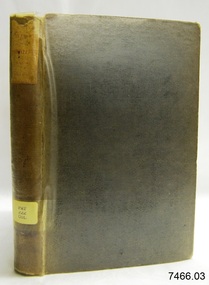
Badge - Religious Book, John William Colenso, author, The Pentateuch and Book of Joshua Part 2, 1863
... Bishop of Natal, South Africa. The publisher firm, Longman Green Longman Roberts & Green was originally founded in 1724 in London by Thomas Longman under the name Longman. In August of that year, he bought the two shops and goods of William Taylor and set up his publishing house there at 39 Paternoster Row. ...Bishop of Natal, South Africa. The publisher firm, Longman Green Longman Roberts & Green was originally founded in 1724 in London by Thomas Longman under the name Longman. In August of that year, he bought the two shops and goods of William Taylor and set up his publishing house there at 39 Paternoster Row. ...This item is from the ‘Pattison Collection’, a collection of books and records that was originally owned by the Warrnambool Mechanics’ Institute, which was founded in Warrnambool in 1853. Author John William Colenso (1814-1883) was a mathematician, missionary and renowned clergyman in the Anglican Church. In 1853 he became the first Bishop of Natal, South Africa. The publisher firm, Longman Green Longman Roberts & Green was originally founded in 1724 in London by Thomas Longman under the name Longman. In August of that year, he bought the two shops and goods of William Taylor and set up his publishing house there at 39 Paternoster Row. The shops were called Black Swan and Ship, and it is said that the 'ship' sign was the inspiration for Longman's Logo. After many changes of name and management, the firm was incorporated in 1926 as Longmans, Green & Co. Pty Ltd. The firm was acquired by Pearson in 1968 and was known as Pearson Longman or Pearson PLC.The book is significant for its connection to 19th-century author John William Colenso, who was a mathematician and Anglican clergyman who had several works published. The publisher of this book, Longman Green Longman Roberts & Green, is also significant for being established in the early 18th century, contributing to the education of the studies of the scholars of the day. The book has additional importance for its connection to the Pattison Collection, which, along with other items at Flagstaff Hill Maritime Village, was originally part of the Warrnambool Mechanics' Institutes’ Collection. The Warrnambool Mechanics’ Institute book collection has historical and social significance for its strong association with the Mechanics Institute movement and the important role it played in the intellectual, cultural and social development of people throughout the latter part of the nineteenth century and the early twentieth century. The collection of books is a rare example of an early lending library and its significance is enhanced by the survival of an original collection of many volumes. The Warrnambool Mechanics' Institute’s publication collection is of both local and state significance.The Pentateuch and Book of Joshua Part 2 Author: John William Colenso Publisher: Longman, Green, Longman, Roberts and Green Date: 1863 This book is one of a three-part series by this author. Textured hardcover book with labels attached to the spine and an oval stamp fly page. Part of the Pattison Colleciton.Label with the typed text: "PAT 222 COL" Stamped on the Pastedown end page, within an oval: "Warrnambool Mechanics Institute" Sticker on Front loose endpaper: "Corangamite Regional Library Service"flagstaff hill, flagstaff hill maritime museum and village, warrnambool, maritime museum, maritime village, great ocean road, shipwreck coast, thomas longman, paternoster row london, pattison collection, ralph eric pattison, warrnambool mechanics’ institute, mechanics’ institute library, warrnambool library, free library, corangamite regional library service, the pentateuch and book of joshua, john william colenso, 19th-century british mathematician, missionary, anglican bishop, napal, longman green longman roberts & green -
 Flagstaff Hill Maritime Museum and Village
Book - Religious Book, John William Colenso, author, The Pentateuch and Book of Joshua Part 3, 1863
... Bishop of Natal, South Africa. The publisher firm Longman Green Longman Roberts & Green, was originally founded in 1724 in London by Thomas Longman under the name Longman. In August of that year, he bought the two shops and goods of William Taylor and set up his publishing house there at 39 Paternoster Row. ...Bishop of Natal, South Africa. The publisher firm Longman Green Longman Roberts & Green, was originally founded in 1724 in London by Thomas Longman under the name Longman. In August of that year, he bought the two shops and goods of William Taylor and set up his publishing house there at 39 Paternoster Row. ...Author John William Colenso (1814-1883) was a mathematician, missionary and renowned clergyman in the Anglican Church. In 1853 he became the first Bishop of Natal, South Africa. The publisher firm Longman Green Longman Roberts & Green, was originally founded in 1724 in London by Thomas Longman under the name Longman. In August of that year, he bought the two shops and goods of William Taylor and set up his publishing house there at 39 Paternoster Row. The shops were called Black Swan and Ship, and it is said that the 'ship' sign was the inspiration for Longman's Logo. After many changes of name and management, the firm was incorporated in 1926 as Longmans, Green & Co. Pty Ltd. The firm was acquired by Pearson in 1968 and was known as Pearson Longman or Pearson PLC.The book is significant for its connection to 19th-century author John William Colenso, who was a mathematician and Anglican clergyman who had several works published. The publisher of this book, Longman Green Longman Roberts & Green, is also significant for being established in the early 18th century, contributing to the education of the studies of the scholars of the day. The book has additional importance for its connection to the Pattison Collection, which, along with other items at Flagstaff Hill Maritime Village, was originally part of the Warrnambool Mechanics' Institutes’ Collection. The Warrnambool Mechanics’ Institute book collection has historical and social significance for its strong association with the Mechanics Institute movement and the important role it played in the intellectual, cultural and social development of people throughout the latter part of the nineteenth century and the early twentieth century. The collection of books is a rare example of an early lending library and its significance is enhanced by the survival of an original collection of many volumes. The Warrnambool Mechanics' Institute’s publication collection is of both local and state significance.The Pentateuch and Book of Joshua Part 3 Author: John William Colenso Publisher: Longman, Green, Longman, Roberts & Green Date: 1863 This book is one of a three-part series by this author. It is part of the Pattison Collection.Label on spine "PAT 222 COL" Handwritten text on fly: "T 9" Pastedown papers; Oval stamp "Warrnambool Mechanics Institute" "Corangamite Regional Library Service"flagstaff hill, flagstaff hill maritime museum and village, warrnambool, maritime museum, maritime village, great ocean road, shipwreck coast, longman green longman roberts & green, thomas longman, paternoster row london, pattison collection, ralph eric pattison, warrnambool mechanics’ institute, mechanics’ institute library, warrnambool library, free library, corangamite regional library service, the pentateuch and book of joshua, john william colenso, 19th-century british mathematician, missionary, anglican bishop, napal -
 Halls Gap & Grampians Historical Society
Photograph - B/W, C 1934
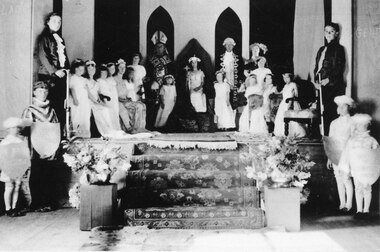
... House, The Cricket Club and the Grampians Mountains. When the long awaited evening came each Queen and her attendants paraded through the hall, the results were announced and the winner (who this year was Valerie Evans) took her place on a throne erected in the middle of the stage. The other Queens made their way to thrones on either side of her. The audience were treated to a right royal display as the "Bishop...House, The Cricket Club and the Grampians Mountains. When the long awaited evening came each Queen and her attendants paraded through the hall, the results were announced and the winner (who this year was Valerie Evans) took her place on a throne erected in the middle of the stage. The other Queens made their way to thrones on either side of her. The audience were treated to a right royal display as the "Bishop ...This is a photo of the "Queen Competition", probably the best remembered entertainment of the 1930's. Four local lasses were chosen to represent the following: Bellfield Hotel, Grampians House, The Cricket Club and the Grampians Mountains. When the long awaited evening came each Queen and her attendants paraded through the hall, the results were announced and the winner (who this year was Valerie Evans) took her place on a throne erected in the middle of the stage. The other Queens made their way to thrones on either side of her. The audience were treated to a right royal display as the "Bishop" placed a crown on the winner's head. Much merriment followed including a play, with students dressed as Minnie and Mickey Mouse and other Disney characters. For the names of the people in the photo refer to "Bridging the Gap" by Ida Stanton, p.88. A group of 23 people, all in costume, arranged on and below a stage. A woman dressed as royalty sits on a throne in the middle of the stage, flanked by a man dressed as a bishop on the left and a man dressed as a courtier on the right. There are two young girls in long white dresses wearing flowered bands in their hair standing in front of the men. There are more girls in white dresses and flower bands along both sides of the central throne. Two youths wearing ruffle fronted shirts and holding batons/walking sticks(?) at the front of each row of girls. Carpeted steps lead down from the stage and Flower arrangements flank the foot of the stairs. On either side of the stage at floor level are boys dressed as pages, two on the right and one on the left.recreation, entertainment -
 Flagstaff Hill Maritime Museum and Village
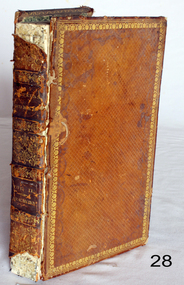
Literary work - Book, G. Sidney, Book of sermons by The Right Reverend Beilby Porteus Vol 2. Additional notes on authors life by Rev. Robert Hodgson, A.M.F.R.S, 1811 Published
... Bishop of London of whom Hodgson wrote a biography of Porteus. On his mother's side, he was a descendant of Augustine Warner Jnr., who presided as the Speaker of the Virginia House of Burgesses during the time of Bacon's Rebellion (Warner served before the Rebellion in 1676, and after the Rebellion in 1677.) ...Bishop of London of whom Hodgson wrote a biography of Porteus. On his mother's side, he was a descendant of Augustine Warner Jnr., who presided as the Speaker of the Virginia House of Burgesses during the time of Bacon's Rebellion (Warner served before the Rebellion in 1676, and after the Rebellion in 1677.) ...Rev Robert Hodgson: His father was Robert Hodgson Snr, of Congleton, and Mildred (née Porteus) in early 1773. He was baptised on 22 September 1773 at St Peter's Church, Congleton. Hodgson was a close relative (by marriage on his father's side and by blood on his mother's side) of Beilby Porteus, Bishop of London of whom Hodgson wrote a biography of Porteus. On his mother's side, he was a descendant of Augustine Warner Jnr., who presided as the Speaker of the Virginia House of Burgesses during the time of Bacon's Rebellion (Warner served before the Rebellion in 1676, and after the Rebellion in 1677.) Hodgson was educated at Macclesfield School and Peterhouse, Cambridge, where he graduated with a BA as 14th Wrangler in 1795. He was appointed rector of St George's, Hanover Square for over forty years, from 1803 until his death in 1844. Bishop Beilby Porteus: Beilby Porteus 8 May 1731 – 13 May 1809), successively Bishop of Chester and London was a Church of England reformer and a leading abolitionist in England. He was the first Anglican in a position of authority to seriously challenge the Church's position on slavery. Porteus was born in York on 8 May 1731, the youngest of the 19 children of Elizabeth Jennings and Robert Porteus ( 1758/9), a planter. Although the family was of Scottish ancestry, his parents were Virginian planters who had returned to England in 1720 as a result of the economic difficulties in the province and for the sake of his father's health. Educated at York and Ripon Grammar School, he was a classics scholar at Christ's College, Cambridge, becoming a fellow in 1752. In 1759 he won the Seatonian Prize for his poem Death: A Poetical Essay, a work for which he is still remembered. He was ordained as a priest in 1757, and in 1762 was appointed as domestic chaplain to Thomas Secker, Archbishop of Canterbury, acting as his assistant at Lambeth Palace for six years. It was during these years that it is thought he became more aware of the conditions of the enslaved Africans in the American colonies and the British West Indies. He corresponded with clergy and missionaries, receiving reports on the appalling conditions facing the slaves from Rev James Ramsay in the West Indies and from Granville Sharp, the English lawyer who had supported the cases of freed slaves in England. In 1769 Beilby Porteus was appointed as chaplain to King George III. He was also Rector of Lambeth (a living shared between the Archbishop of Canterbury and the Crown) from 1767 to 1777, and later Master of St Cross, Winchester (1776–77). He was concerned about trends within the Church of England towards what he regarded as the watering-down of the truth of Scripture and stood for doctrinal purity. He was, however, happy to work with Methodists and dissenters and recognised their major contributions in evangelism and education. In 1776, Porteus was nominated as Bishop of Chester, taking up the appointment in 1777. He was Renowned as a scholar and a popular preacher, it was in 1783 that the young bishop was to first come to national attention by preaching his most famous and influential sermon. In 1787, Porteus was translated to the bishopric of London on the advice of Prime Minister William Pitt, a position he held until his death in 1809. As is customary, he was also appointed to the Privy Council, and Dean of the Chapel Royal. In 1788, he supported Sir William Dolben's Slave Trade Bill from the bench of bishops, and over the next quarter-century, he became the leading advocate within the Church of England for the abolition of slavery, lending support to such men as Wilberforce, Granville Sharp, Henry Thornton, and Zachary Macaulay to secure the eventual passage of the Slave Trade Act in 1807.Beilby Porteus was one of the most significant, albeit under-rated church figures of the 18th century. His sermons continued to be read by many, and his legacy as a foremost abolitionist was such that his name was almost as well known in the early 19th century as those of Wilberforce and Thomas Clarkson but 100 years later he had become one of the 'forgotten abolitionists', and today his role has largely been ignored and his name has been consigned to the footnotes of history. His primary claim to fame in the 21st century is for his poem on Death and, possibly unfairly, as the supposed prototype for the pompous Mr. Collins in Jane Austen's novel ”Pride and Prejudice”. But, ironically, Porteus' most lasting contribution was one for which he is little-known, the Sunday Observance Act of 1781 (a response to what he saw as the moral decay of England), which legislated how the public were allowed to spend their recreation time at weekends these laws continued for the following 200 years until the passing of the Sunday Trading Act of 1994.Book of sermons cover is brown with gold border and decoration Beilby Porteus (or Porteous; 8 May 1731 – 13 May 1809), successively Bishop of Chester and of London, was a Church of England reformer and a leading abolitionist in England. He was the first Anglican in a position of authority to seriously challenge the Church's position on slavery. The Works of The Right Reverend Beilby Porteus Vol 2” . Spine has “Porteus’ Works, Vol. II Sermons”. The works of the Right Reverend Beilby Porteus, D.D., late Bishop of London; with his life, by the Rev. Robert Hodgson, A.M.F.R.S. and one of the Chaplains in Ordinary to His Majesty. A New Edition in Six Volumes. Vol. II – Sermons. Published in 1811 for T. Cadell and W., Davies, in The Strand, London. Printed by G. Sidney, Northumberland-street. flagstaff hill, warrnambool, shipwrecked coast, flagstaff hill maritime museum, maritime museum, shipwreck coast, flagstaff hill maritime village, great ocean road, right reverend beilby porteous, sermons, london reverend -
 Eltham District Historical Society Inc
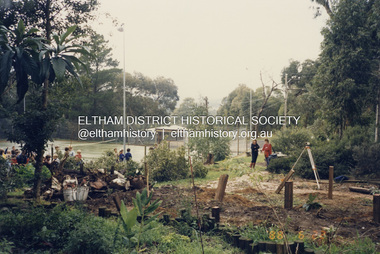
Photograph - Colour Print, Installation of pre-fab buildings at Living and Learning Nillumbik (Panton Hill), 18 Bishops Road, Panton Hill, 22 June 1988
... Batch 4113 Bishops Road Construction Living and Learning Centre Living and Learning Nillumbik (Panton Hill) Panton Hill 11 Colour print 10 x 15 cm Originally housed in a 34.5 x 36 x 2.5 cm expandable album with padded cream covers and gold accents; 18 page inserts with clear pocket inserts holding 6 photos per side, total capacity 216 10 x 15 cm photo prints; showing yellowing with age Installation of pre-fab buildings at Living and Learning Nillumbik (Panton Hill), 18 Bishops Road, Panton Hill Photograph Colour Print ...batch 4113, bishops road, construction, living and learning centre, living and learning nillumbik (panton hill), panton hill -
 Eltham District Historical Society Inc
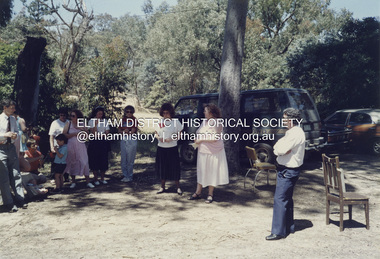
Photograph - Colour Print, Opening function of the updated Living and Learning Nillumbik (Panton Hill) facility, 18 Bishops Road, Panton Hill, 1988
... Bishops Road Cr. Mary Grant Living and Learning Centre Living and Learning Nillumbik (Panton Hill) Opening Ceremony Panton Hill 21 Colour print 10 x 15 cm Originally housed in a 34.5 x 36 x 2.5 cm expandable album with padded cream covers and gold accents; 18 page inserts with clear pocket inserts holding 6 photos per side, total capacity 216 10 x 15 cm photo prints; showing yellowing with age Opening function of the updated Living and Learning Nillumbik (Panton Hill) facility, 18 Bishops Road, Panton Hill Photograph Colour Print ...Opened by Eltham Shire President, Cr. Mary Grantbatch 354, bishops road, cr. mary grant, living and learning centre, living and learning nillumbik (panton hill), opening ceremony, panton hill -
 Eltham District Historical Society Inc
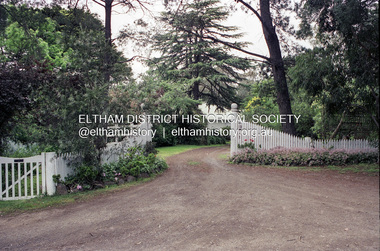
Negative - Photograph, Russell Yeoman, Stanhope, 10 Peter Street, Eltham, c.Sep. 2000
... house. In 1919 Mr Theo. Handfield bought the property from Mrs Longstaff. On New Year 's Day 1924 most of the estate (eighty blocks) was auctioned. Bishop...house. In 1919 Mr Theo. Handfield bought the property from Mrs Longstaff. On New Year 's Day 1924 most of the estate (eighty blocks) was auctioned. Bishop ...Clem Christesen wrote a brief history of "Stanhope" which was reproduced in EDHS Newsletter No. 162 May 2005. STANHOPE HOUSE is situated on the crest of Stanhope Hill about ten minutes' walk westward from the Eltham railway station and is bounded by Peter, Fay and Stanhope Streets. The original property, comprising 15 ½ acres with a frontage on Diamond Creek, was bought in about 1900 by Will Longstaff (b. 1878, d London 1953), official war artist during World War I, who became famous for his painting 'The Ghosts of Menin Gate', France which is now in the Australian War Memorial, Canberra. The main residence, designed by Desbrowe Annear, was built of jarrah, with stucco walls and floors of Tasmanian hardwood The rooms were panelled with Californian redwood (sequoia). Away from house was a cottage (used as a studio), and stables, dairy and meat house. In 1919 Mr Theo. Handfield bought the property from Mrs Longstaff. On New Year 's Day 1924 most of the estate (eighty blocks) was auctioned. Bishop Reginald Stephen, Warden of Trinity College and distinguished scholar, bought the house and five acres in 1928. Dr and Mrs C.B. Christesen became the new owners in 1946 and subsequently extended the house on the north and south sides. 'Stanhope 'has had many very interesting art and literary associations. When Will Longstaff occupied it - he was a cousin of another well-known painter, Sir John Longstaff- various leading artists of the period, including Walter Withers who lived nearby, were frequent visitors. A son of Mr and Mrs Handfield, John, became a journalist and author, and now lives with his wife Esta at Homestead Road, Eltham. Bishop Stephen was related to Sir Leslie Stephen (1832-1904), one of the great representative minds of Victorian Britain, first editor of the monumental Dictionary of National Biography and father of the famous novelist and essayist Virginia Woolf. John Harcourt, novelist and music critic, rented 'Stanhope 'while he and his wife Fay were building 'Clay Nuneham' (mudbrick) at the foot of Stanhope Hill near the creek. Nina Christesen, academic and founding editor of Melbourne Slavonic Studies, was Head of the Department of Russian Language and Literature, University of Melbourne, from 1946 to 1977. Clem Christesen, poet, short story writer and painter, founded Australia's leading literary journal Meanjin Quarterly in 1940 and remained editor until 1975. Very many distinguished Australian and foreign writers, artists and academics-from Nobel prize-winning novelist Patrick White to the world's leading cellist Mstislav Rostropovich - have visited 'Stanhope ' over the years. The extensive garden is said to be one of the loveliest in Eltham. The main entrance is by way of Diamond and Peter Streets. film - kodak gc 400-6, russell yeoman collection, scan - 35mm negative, bishop stephen, clem christesen, eltham, nina mikhailovna christesen, peter street, stanhope, theo handfield, will longstaff -
 Eltham District Historical Society Inc
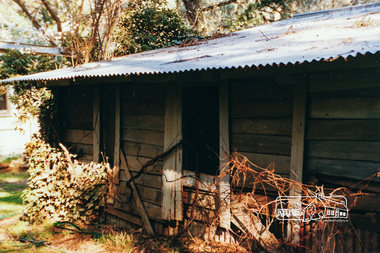
Photograph, Stanhope, Peter Street, Eltham
... Escape for Bishop eltham peter street stanhope houses Colour photograph Stanhope, Peter Street, Eltham Photograph ...Escape for BishopColour photographeltham, peter street, stanhope, houses -
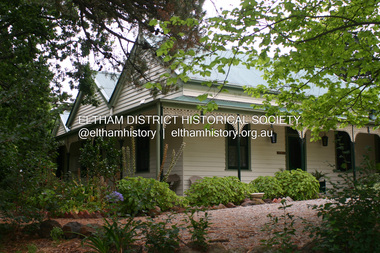 Eltham District Historical Society Inc
Photograph - Digital Photograph, Alan King, Pigeon Bank, Kangaroo Ground-Warrandyte Road, Kangaroo Ground, 6 February 2008
... In 1968 the house again returned to the Cameron family, when Vera Jackson, a grand-daughter of Ewen Cameron, and her husband, bought the property. The Bishop...In 1968 the house again returned to the Cameron family, when Vera Jackson, a grand-daughter of Ewen Cameron, and her husband, bought the property. The Bishop ...In 1848, Francis Rogerson form Dumfriesshire, Scotland purchased 80 acres of land at Kangaroo Ground on which he built a two-roomed bark hut. He named the property afterr the many Bronzewings and Wonga Pigeons in the area. Ewen Hugh Cameron moved to Pigeon Bank the same year he was elected to Parliament as the Member for Evelyn. At the time he moved in, Pigeon Bank had six rooms and the present water well. He made further extensive additions and lived there until his death in 1915. Covered under Heritage Overlay, Nillumbik Planning Scheme. Published: Nillumbik Now and Then / Marguerite Marshall 2008; photographs Alan King with Marguerite Marshall.; p27 Pigeon Bank, on the Kangaroo Ground – Warrandyte Road, Kangaroo Ground, is one of the Shire’s oldest farm dwellings, and has been home to some of the district’s earliest and most distinguished families. Although close to the road, the white weatherboard Victorian farmhouse is ensured privacy by the trees and hedges around it. On 4.8 hectares of farmland, Pigeon Bank is surrounded by rolling hills, farmland and bush, the peace of which is punctuated by an occasional birdcall. Pigeon Bank’s first owner was Francis Rogerson, from Dumfriesshire, Scotland, who bought 80 acres (32.4ha) of land in 1848 on which he built a two-roomed bark hut. Today this is the centre piece of the 14-room home.1 Rogerson lined the rooms with tongue-and-groove boards and roofed them with wooden shingles and sapling frames, which remain under the present green corrugated iron roof. He named Pigeon Bank after the many forest bronzewing and Wonga Pigeons in the area at the time, and the name Bank was commonly used in Scotland. Rogerson was united with one of the oldest families in the area when his sister Janet married John Bell, son of William, the original Bell settler. When Ewen Cameron moved to Pigeon Bank in 1874 it had six rooms and the present water well. He made extensive additions to the house and farm buildings and lived at Pigeon Bank until his death in 1915. Cameron, who had arrived in Melbourne from Scotland in 1853, contributed an enormous amount to the community. He worked as a builder, as a miner at Andersons Creek, a storekeeper at Queenstown2 and as the first postmaster at Warrandyte. In 1867 he married Agnes Bell, daughter of local farmer, John Bell. Cameron was a member of the Eltham Road Board (which preceded the Shire Council) and for more than 50 years, from 1863, he was an Eltham Shire Councillor, being President three times. Cameron was the Member for Evelyn for 40 years from 1874. In the 1880s he became the Government Whip, in 1902 the Minister for Mines and Water Supply, and in 1904, the Minister for Health, Cameron was also an outstanding farmer, whose farm won the Agricultural Department prize for the finest in the district, three consecutive times. Not surprisingly Pigeon Bank became the centre of district life. Every New Year’s Eve, Cameron hired a highland piper, who marched from the Kangaroo Ground school house to Pigeon Bank playing his pipes.3 Distinguished visitors included opera singer, Dame Nellie Melba, Victorian Premier, Thomas Bent, Governor, Lord Hopetoun and artist, Longstaff. Following Cameron’s death, the property changed hands several times, then returned to the family in 1919 when bought by Gordon Cameron. As the car took over from the horse, Pigeon Bank entered difficult times because the farm had produced chaff and oats and bred Clydesdales and harness ponies. In 1926 Mr Matthews bought the property and made many alterations including pulling down the kitchen, which had been separate from the main house. The property again changed hands several times. One owner was Senator James F Guthrie, who added a sunroom. In 1968 the house again returned to the Cameron family, when Vera Jackson, a grand-daughter of Ewen Cameron, and her husband, bought the property. The Bishop family, who were sixth and seventh generation Bells and also descended from the Camerons, restored the house in the 1980s. Today tongue-and-groove boards still line part of the hall (which retains two fine arches), the breakfast room, and Ewen Cameron’s former room. Five original fireplaces in the bed and living rooms are still in working order. The wide veranda with a curved iron roof and ornate iron lace work bounds three sides of the house, and nearby a windmill stands beside the water well. Sue and Ron James, who bought the property in 2001, made extensive improvements to the homestead and meticulously restored the grounds to their original state.This collection of almost 130 photos about places and people within the Shire of Nillumbik, an urban and rural municipality in Melbourne's north, contributes to an understanding of the history of the Shire. Published in 2008 immediately prior to the Black Saturday bushfires of February 7, 2009, it documents sites that were impacted, and in some cases destroyed by the fires. It includes photographs taken especially for the publication, creating a unique time capsule representing the Shire in the early 21st century. It remains the most recent comprehenesive publication devoted to the Shire's history connecting local residents to the past. nillumbik now and then (marshall-king) collection, ewen hugh cameron, francis rogerson, kangaroo ground, kangaroo ground-warrandyte road, pigeon bank -
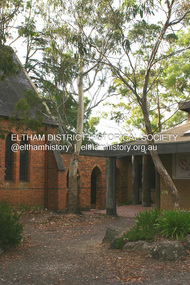 Eltham District Historical Society Inc
Photograph - Digital Photograph, Alan King, St Margaret's Anglican Church, Pitt Street, Eltham, 30 January 2008
... House after him. The Eltham settlers were unusual in initiating the establishment of a church. Usually in Victoria a vicar was appointed to a parish and then a permanent church was constructed. But then, the nearest church was at Heidelberg, which was a tedious and time-consuming journey. St Margaret’s builder was a local, George Stebbing, who also constructed the former Methodist, later Uniting, Church at John Street and the Shillinglaw Cottage near Eltham’s Central Park. It is believed the first Anglican Bishop...House after him. The Eltham settlers were unusual in initiating the establishment of a church. Usually in Victoria a vicar was appointed to a parish and then a permanent church was constructed. But then, the nearest church was at Heidelberg, which was a tedious and time-consuming journey. St Margaret’s builder was a local, George Stebbing, who also constructed the former Methodist, later Uniting, Church at John Street and the Shillinglaw Cottage near Eltham’s Central Park. It is believed the first Anglican Bishop ...St Margaret’s Church of England was officially opened on December 12, 1861. It is the oldest intact church building in Eltham. At the time it was known as Christ Church until its consecration in 1871, when it was completely free of debt (£1,700 for the church and parsonage) despite the district’s poverty. This was largely due to the free labour and materials, including locally made bricks donated by local artisans and others. The church is historically significant because it is the oldest church in the former Shire of Eltham and has associations with the philanthropist and founder of Brighton, Henry Dendy (who donated the land on which the church is built), the architect Nathaniel Billing and the prominent local builder, George Stebbing. The church is architecturally and aesthetically significant because it is constructed in the Gothic Revival style with several stained-glass windows of various dates and is also a very early use of polychromatic brickwork in Victoria. Billing was one of the first Melbourne architects to employ polychromatic brickwork and an important early architect. The rear wall was intended to be temporary. A major feature of the design is the large buttresses with long, steeply graded upper faces. The overall design is well proportioned with the surface brick patterns relieving an otherwise austere design. The church is spiritually and socially significant because it has been an important place of worship for the people of Eltham for almost 150 years. The land on which the buildings stand was donated by Henry Dendy. Dendy arrived in Melbourne in 1841 after purchasing in England eight square miles at Brighton under the system of "special surveys". After this land passed out of his hands, Dendy moved about Victoria, visited England, then returned to settle in Eltham where he purchased a flour mill. Dendy chaired the meeting held in 1860 “for the purpose of devising such means as may be expedient for the establishment of a Church of England in the township of Eltham”. He became chairman and treasurer of the church committee. Unlike the establishment of many early churches in Victoria where a vicar was appointed to a parish and later a permanent church was constructed, the population at Eltham initiated action to build a church. The nearest church at that time was at Heidelberg and the Eltham settlement was part of the parish of St Johns Heidelberg. Isolation and the tedious, time consuming journey between Heidelberg and Eltham resulted in the Eltham community taking its own action. The original vicarage (Dendy House) at the rear of the church is also an important part of the cultural significance of this place because it is connected to the church and the development of the Eltham area. Together, the church and the vicarage are aesthetically significant because they form a significant streetscape feature. The mud-brick community hall designed by Robert Marshall was added in 1978. In 2014 the original temporary rear wall was removed as part of a modern extension designed by Architects Atelier Wagner and constructed by Conrad Construction and Management. Covered under Heritage Overlay, Nillumbik Planning Scheme. National Trust of Australia (Victoria) State significance Victorian Heritage Published: Nillumbik Now and Then / Marguerite Marshall 2008; photographs Alan King with Marguerite Marshall.; p67 St Margaret’s Anglican Church in Pitt Street, Eltham, which officially opened on December 12, 1861, is the oldest intact church building in Eltham.1 With the nearby courthouse and police station, it was one of the first permanent community buildings in the district. The church and vicarage are on the Register of the Heritage Council of Victoria and the National Trust of Australia – Victoria. The church is important as an early example of polychrome brickwork by the notable architect Nathaniel Billings. It is also notable for its historic associations with the early settlement of the Shire of Eltham and its connection with Henry Dendy, Brighton’s founder.2 Henry Dendy, who lived in Eltham much longer than at Brighton, chaired the original meeting which planned the church, and he donated the half-acre (0.2ha) site. Dendy had arrived in Melbourne in 1841 after buying eight square miles (20.7sq km) at Brighton while in England. After this land passed out of his hands, he eventually settled in Eltham where he bought a flour mill, west from the corner of Main Road and Pitt Street (then called Brewery Lane). The vicarage was named Dendy House after him. The Eltham settlers were unusual in initiating the establishment of a church. Usually in Victoria a vicar was appointed to a parish and then a permanent church was constructed. But then, the nearest church was at Heidelberg, which was a tedious and time-consuming journey. St Margaret’s builder was a local, George Stebbing, who also constructed the former Methodist, later Uniting, Church at John Street and the Shillinglaw Cottage near Eltham’s Central Park. It is believed the first Anglican Bishop of Melbourne, Bishop Perry, dedicated the church. After the ceremony he joined in the festivities at the nearby pub and a bill was sent to the parish for teas taken there by the bishop with other participants. The first vicar was the Reverend Robert Mackie from 1864 to1866. St Margaret’s Church was originally called Christ Church until its consecration in 1871, when it was completely free of debt (£1700 pounds for the church and parsonage) despite the district’s poverty. This was largely due to the free labour and materials, including local bricks, donated by local artisans and others. St Margaret’s Church is in the Gothic Revival tradition with a buttressed nave, paired lancet windows, porch and bell-cote. It was the first polychromatic brick church in Australia, using softly contrasting coloured brickwork.3 Billing was one of the first architects to introduce polychrome brickwork into Melbourne. His original drawings for St Margaret’s survive in a folio of his architectural work. However the church’s brickwork is more subdued than in his drawings. About half the windows – those in clear glass with gold borders – are original. The stained glass windows were made much later, but the one behind the altar is thought to be the oldest in the Diamond Valley. It was to be temporary until the congregation could afford to extend the church. In the early 1960s the original cedar pews were replaced by blonde timber pews and the originals were sold to restaurants and to private individuals. Eminent local sculptor Matcham Skipper created a crucifix for the church. A major addition was made in 1978, when the weatherboard hall was replaced by a mud-brick hall. Made of local material, it was designed by local architect and a former shire president Robert Marshall. The mud-brick hall reflects the style of building in Eltham of the late 1970s and for which Eltham is well-known. Perhaps because its earthy tones blend with the surrounding environment, the hall sits well with the church building. St Margaret’s membership has included economist and ABC chairman, Richard Downing; political commentator, diplomat and academic, William Macmahon Ball; Eltham civic leader, Charles Wingrove; artist, Peter Glass; and Eltham’s first postmaster, Frederick Falkiner.This collection of almost 130 photos about places and people within the Shire of Nillumbik, an urban and rural municipality in Melbourne's north, contributes to an understanding of the history of the Shire. Published in 2008 immediately prior to the Black Saturday bushfires of February 7, 2009, it documents sites that were impacted, and in some cases destroyed by the fires. It includes photographs taken especially for the publication, creating a unique time capsule representing the Shire in the early 21st century. It remains the most recent comprehenesive publication devoted to the Shire's history connecting local residents to the past. nillumbik now and then (marshall-king) collection, eltham, st margaret's anglican church, st margaret's church, st margarets church hall, christ church -
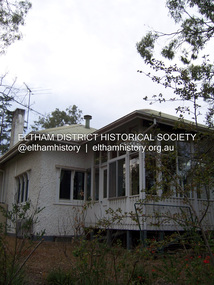 Eltham District Historical Society Inc
Photograph - Digital Photograph, Alan King, Stanhope, Peter Street, Eltham, 15 March 2008
... Bishop Reginald Stephen, Warden of Trinity College, bought the house and five acres (2 ha) in 1928. ...Bishop Reginald Stephen, Warden of Trinity College, bought the house and five acres (2 ha) in 1928. ...On the crest of Stanhope Hill at Peter Street, Eltham, stands the former home of a couple, Clem and Nina Christensen who had a major influence on the literary development of post World War 2 Australia. Covered under Heritage Overlay, Nillumbik Planning Scheme. Published: Nillumbik Now and Then / Marguerite Marshall 2008; photographs Alan King with Marguerite Marshall.; p109 On the crest of Stanhope Hill at Peter Street, Eltham, stands the former home of a couple, who had a major influence on the literary development of post World War Two Australia. In 1946, Clem and Nina Christensen bought the house, which had been designed by Harold Desbrowe Annear, considered to be one of Australia’s most innovative architects in the first quarter of the 20th century.1 That year the stucco building with a metal roof, built in 1910, was extended to the north and south. The main residence was built of jarrah, with stucco walls, floors of Tasmanian hardwood and rooms panelled with Californian redwood (sequoia). The property included a cottage, former stables, a dairy and meat-house. From its beginnings the property has attracted artists and intellectuals. Official World War One artist, Will Longstaff, bought the property – then 15½ acres (6ha) around 1900. Famous for his painting The Ghosts of Menin Gate, now in the Australian War Memorial Canberra, Longstaff was the cousin of another well-known painter, Sir John Longstaff. Several leading artists visited Longstaff at Stanhope including Walter Withers of the Heidelberg School, who lived in Brougham Street, Eltham. In 1919, Theo Handfield, father of author and journalist John Handfield, bought the property from Mrs Longstaff. Then in 1924 the land was subdivided and most of the estate (80 blocks) was auctioned. The next owner was related to novelist Virginia Woolf. Bishop Reginald Stephen, Warden of Trinity College, bought the house and five acres (2 ha) in 1928. He was related to Sir Leslie Stephen, the first editor of the Dictionary of National Biography and Woolf’s father. Novelist and music critic John Harcourt, was the next tenant, while he and his wife Fay, built their mud-brick house Clay Nuneham, at the foot of Stanhope Hill. Dr Clem and Mrs Nina Christensen, lived in the house until their deaths. Clem Christensen – who died aged 91 in 2003 – was a poet, short story writer and painter. However, he is most noted for founding Australia’s foremost literary journal2 Meanjin (originally Meanjin Papers), which he described as ‘democratic left of centre’, in Brisbane in 1940. Clem brought Meanjin to Melbourne in 1945 and remained editor until 1975. Enormously influential, Meanjin spawned and encouraged many of Australia’s best literary talents and it had an international reputation. Meanjin was the first to publish such writers as Judith Wright and David Malouf and it encouraged writers like Patrick White and Peter Carey. Nina Christensen – who died aged 89 in 2001 – was founding Editor of the Melbourne Slavonic Studies Journal and pioneered the study of Russian in Australia. In 1946 she established the Department of Russian Language and Literature at The University of Melbourne, which she led until 1977. Nina’s graduates largely staffed subsequent departments, in other Australian universities.3 However Nina’s Russian heritage and Clem’s outspoken views caused problems. They were forced to defend themselves in the Petrov inspired Royal Commission on Espionage in the 1950s, but were exonerated. The Christensens attracted and hosted many distinguished Australian and foreign writers, artists and academics, including Nobel prize-winning novelist, Patrick White and the world’s then leading cellist, Mstislav Rostropovich.4 Other writers and intellectuals who visited Stanhope were: Vance Palmer, Alan Marshall, A D Hope, Xavier Herbert, Nevil Shute, Geoffrey Dutton, Martin Boyd, Judah Waten, Bruce Grant, Dorothy Hewett and Sir Herbert Read. Painters included: Danila Vassilieff, Arthur Boyd, Albert Tucker, Justus Jörgensen, Robert Hughes and Clifton Pugh. Academics included: Manning Clark, Geoffrey Blainey, W Macmahon Ball, Richard Downing, Geoffrey Serle and scientist Tim Marshall. Politicians included: Jim Cairns, Pauline Toner, Lance Barnard, Sir Paul Hasluck, Sheryl Garbutt and performance artists included: film star Olivia Newton-John, members of the Bolshoi ballet and the Russian State Ballet of Siberia.5 Nina Christensen was honoured in 2006 at the Eltham Living and Learning Centre with the building of an amphitheatre designed by V Sverdlin.This collection of almost 130 photos about places and people within the Shire of Nillumbik, an urban and rural municipality in Melbourne's north, contributes to an understanding of the history of the Shire. Published in 2008 immediately prior to the Black Saturday bushfires of February 7, 2009, it documents sites that were impacted, and in some cases destroyed by the fires. It includes photographs taken especially for the publication, creating a unique time capsule representing the Shire in the early 21st century. It remains the most recent comprehenesive publication devoted to the Shire's history connecting local residents to the past. nillumbik now and then (marshall-king) collection, clem christesen, eltham, nina christesen, peter street, stanhope -
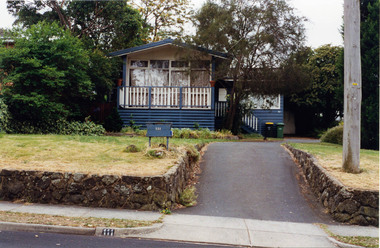 Eltham District Historical Society Inc
Photograph, Margaret Ball, 111 Pitt Street, Eltham, c. June 1999, 1999
... Owner 1970s-1980s: Daniel John Bishop and Beverley Joan Bishop (Norman Joseph Bishop and Mary O'Shea Bishop lived at No. 102). The Margaret Ball (Pre 1960s Houses) Collection was a personal project initiated to mark the year 2000 and arose as a result of the disappearance of many pre-1960s parts of Eltham due to development. ...Owner 1970s-1980s: Daniel John Bishop and Beverley Joan Bishop (Norman Joseph Bishop and Mary O'Shea Bishop lived at No. 102).The Margaret Ball (Pre 1960s Houses) Collection was a personal project initiated to mark the year 2000 and arose as a result of the disappearance of many pre-1960s parts of Eltham due to development. Approximately 200 pre-1960s style houses that were left in Eltham between Main Road and east to Bible Street, between Cecil Street to the north and south to Dalton Street were photographed in late 1999. Not all of the houses could be photographed; some because the garden or trees blocked the view of the house, others because of rubbish or cars were in the way, some because people were working on the house or in the gardens at the time.Colour photographic print eltham, houses, streets, margaret ball (pre 1960s houses) collection, pitt street -
 Eltham District Historical Society Inc
Folder, John Handfield
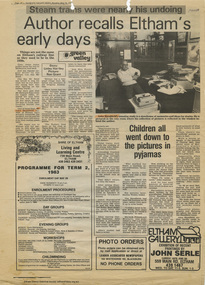
... House...Anne Hunniford...Dave Lyon...Esta Handfield...Mechanics Insitute...Mr Bond...Rechabite Hall...Robin Boyd...Rutter Family...Bishop...house designed by friend Robin Boyd and built 1961. At the time of the letter John and Esta Handfield had been the only owners. 3. Note from John Handfield to Ron Smith about a proposed talk (to the Historical Society?) to tell the story about the writing of Friends and Brothers. Proposed title of talk "You Never Know What's Around The Corner" plus several copies of book reviews • Photocopy of news clipping; The rector who created a vision; Review by Bishop...house designed by friend Robin Boyd and built 1961. At the time of the letter John and Esta Handfield had been the only owners. 3. Note from John Handfield to Ron Smith about a proposed talk (to the Historical Society?) to tell the story about the writing of Friends and Brothers. Proposed title of talk "You Never Know What's Around The Corner" plus several copies of book reviews • Photocopy of news clipping; The rector who created a vision; Review by Bishop ...1. News clipping: Author recalls Eltham's early days; story by Linley Hartley, photo by Ron Grant; Diamond Valley News, Thursday, May 24, 1983, p26 (On reverse side, p25, "A pot for every purpose" about potter Joan Armfield with references to artis Davd Armfield) 2. Three pages typed copy of John Handfield's original letter to Blanche Shallard (of the Shire of Eltham Historical Society), 16 May 1989 detailing the Handfield family's life in Eltham and various personalities between their arrival in 1919 and departure in 1928. With a postscript that John Handfield returned in 1961 to a house designed by friend Robin Boyd and built 1961. At the time of the letter John and Esta Handfield had been the only owners. 3. Note from John Handfield to Ron Smith about a proposed talk (to the Historical Society?) to tell the story about the writing of Friends and Brothers. Proposed title of talk "You Never Know What's Around The Corner" plus several copies of book reviews • Photocopy of news clipping; The rector who created a vision; Review by Bishop Holland; Newcastle Morning Herald, c.1980 - Book review of FRIENDS AND BROTHERS, The Life of Father Tucker, Founder of the Brotherhood of St Laurence and Community Aid Abroad, by John Handfield, Hyland House Publishing Pty Ltd • Photocopy of news clipping; The clergyman whose monuments continue to do good; Review by Geoffrey Hutton; Publication unknown, c.1980 - Book review of FRIENDS AND BROTHERS, The Life of Father Tucker, Founder of the Brotherhood of St Laurence and Community Aid Abroad, by John Handfield, Hyland House Publishing Pty Ltd • Photocopy of news clipping; Helper of the defeated; Review by Sandy Murray; Publication unknown, c.1980 - Book review of FRIENDS AND BROTHERS, The Life of Father Tucker, Founder of the Brotherhood of St Laurence and Community Aid Abroad, by John Handfield, Hyland House Publishing Pty Ltd • Photocopy of news clipping; Friends and Brothers by John Handfield; Review by Bishop James Grant; Publication unknown, c.1980 - Book review of FRIENDS AND BROTHERS, The Life of Father Tucker, Founder of the Brotherhood of St Laurence and Community Aid Abroad, by John Handfield, Hyland House Publishing Pty Ltd • Photocopy of news clipping; Off and running on his third career by Stuart Sayers; Writers & Readers, The Age, Saturday 17 January 1981 • Photocopy of news clipping; Determined to succeed; Review by Roy Cassin; The West Australian, n.d. - Book review of FRIENDS AND BROTHERS, The Life of Father Tucker, Founder of the Brotherhood of St Laurence and Community Aid Abroad, by John Handfield, Hyland House Publishing Pty LtdFolder of information on John Handfield, author, Elthamjohn handfield, joan armfield, david armfield, handfield family, eltham, 16 homestead road, handfield house, anne hunniford, dave lyon, esta handfield, mechanics insitute, mr bond, rechabite hall, robin boyd, rutter family, bishop reginald stephen, clem christesen, desmond annear, dr kent hughes, ethel boake, handfield street, john harcourt, kooringoorama, lady longstaff, nina christesen, peter street, shillinglaw farm, sir john longstaff, stanhope, yarra braes, a. copeland, alf baker, baker's cottage, ballakian, belackian, beulah alice rutter, bill withers, bird brothers cash grocer and fruiterer, blacksmith, burgoyne grocery store, butcher, david rutter, donald rutter, e. copeland, edward gadd, ernest james andrew, fanny withers (nee flinn), hubert rutter, jack baker, jack ryan, june rutter, margery withers, newsagency, oakley, ronnie baker, silver street bridge, tessie baker, walter withers, burke and wills, father g k tucker, frederick oliver handfield, friends and brothers (book), muriel elizabeth handfield (nee cochran), ss victoria, st laurence and community aid abroad, stanhope house, theodore louis hopton handfield, book review -
 Bendigo Historical Society Inc.
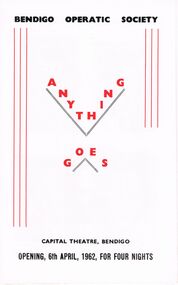
Programme - BENDIGO OPERATIC SOCIETY ''ANYTHING GOES''
... House. In memory Of Norman Lee Society's Founder and Producer Passed away 06/01/1962. Cast in Order of Appearance: Denis Cremen as Bartender - John Stephens as Elisha J. Whitney - Ferd Lorenz as Bill Crocker - Heather Lindhe as Reno Lagrange - Margery Reed as Girl Reporter - Lenn Carr as Cameraman - Fred Trewarne as Sir Evelyn Oakleigh, Bart - Carol McKenzie as Hope Harcourt - Bernice Boromeo as Mrs. Wadsworth T. Harcourt - Max Beckwith as Bishop...House. In memory Of Norman Lee Society's Founder and Producer Passed away 06/01/1962. Cast in Order of Appearance: Denis Cremen as Bartender - John Stephens as Elisha J. Whitney - Ferd Lorenz as Bill Crocker - Heather Lindhe as Reno Lagrange - Margery Reed as Girl Reporter - Lenn Carr as Cameraman - Fred Trewarne as Sir Evelyn Oakleigh, Bart - Carol McKenzie as Hope Harcourt - Bernice Boromeo as Mrs. Wadsworth T. Harcourt - Max Beckwith as Bishop ...Program Bendigo Operatic Society '' Anything Goes'' Capital Theatre Bendigo Opening 6th April 1962 for Four Nights. Producer: Beatrice Oakley -Musical Director: Max O'Loghlen - Ballet Mistress: Madge Welch - Society Pianist Phyllis House. In memory Of Norman Lee Society's Founder and Producer Passed away 06/01/1962. Cast in Order of Appearance: Denis Cremen as Bartender - John Stephens as Elisha J. Whitney - Ferd Lorenz as Bill Crocker - Heather Lindhe as Reno Lagrange - Margery Reed as Girl Reporter - Lenn Carr as Cameraman - Fred Trewarne as Sir Evelyn Oakleigh, Bart - Carol McKenzie as Hope Harcourt - Bernice Boromeo as Mrs. Wadsworth T. Harcourt - Max Beckwith as Bishop Dobson - Peter Unmack as Ching - Daryl Walker as Ling - Victor White as Purser - Roger Sprawson as Steward - Roy Cronin as 1st Detective - George Steele as 2nd Detective - Joan Crane as Mrs. Wentworth - Joan Heard as Mrs. Frick - Alfred Annison as Dr. Moon - Kath Alexander as Bonnie le Tour - Denis Cremen as Ship's Drunk - Reginald Boromeo as Captain - Ray Austin as Junior - Peter Houston as William Oakleigh (Sir Evelyn's Uncle).program, theatre, bendigo operatic society -
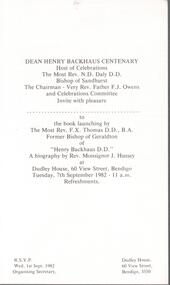 Bendigo Historical Society Inc.
Document - ROYAL HISTORICAL SOCIETY OF VICTORIA COLLECTION: DEAN BACKHAUS CENTENARY
... B.A. formmer Bishop of Geraldton of ''Henry Backhaus D.D.'' A Biography by Rev monsignor J. Hussey at Dudley House, 60 view Street, Bendigo Tuesday, 7th September 1982 - 11am. ...B.A. formmer Bishop of Geraldton of ''Henry Backhaus D.D.'' A Biography by Rev monsignor J. Hussey at Dudley House, 60 view Street, Bendigo Tuesday, 7th September 1982 - 11am. ...Dean Henry Backhaus Centenary. Host of celebrations The most Rev. N.D. Daly D.D. Bishop of Sandhurst. The Chairman - Very rev Father F.J. Owens and Celebrations Committee Invite with pleasure to the book launching by The Most Rev F.X. Thomas D.D. B.A. formmer Bishop of Geraldton of ''Henry Backhaus D.D.'' A Biography by Rev monsignor J. Hussey at Dudley House, 60 view Street, Bendigo Tuesday, 7th September 1982 - 11am. Refreshments.event, social, book launch -
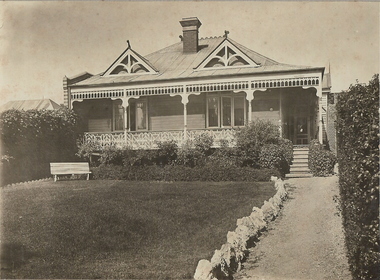 Bendigo Historical Society Inc.
Photograph - T C WATTS & SON COLLECTION: 25 WEBSTER STREET, BENDIGO, 1929
... house in Rowan Street, which was called 'Ottawa' Thomas started his real estate business in the early 1900s in a shop in View Street. His daughter Edna was the book keeper and typist, Stewart Watson was the salesman and Stanley Phipps (Edith Lunn's father) was the property manager and valuer. When Thomas Watts died in 1914, his daughter took over the running of the business. She married Stewart Watson in 1918. Eventually the name of the business was changed to Bishop...Bishop, Miss. June Parry, Secretary of the BHS was a member of staff. June rescued all the photos of properties listed for sale from the office and placed them into the custody of the BHS.' PLACE Building residential Frank A. Jeffree Photo Bendigo Black and white original photograph mounted on grey cardboard. Weatherboard house ...Thomas Crouch Watts was born on March 7th. 1865, to Joseph and Susan Watts. Before the real estate business commenced, Thomas and his brother were in partnership as booksellers and stationers in a shop at View Point. Thomas lived in a fine house in Rowan Street, which was called 'Ottawa' Thomas started his real estate business in the early 1900s in a shop in View Street. His daughter Edna was the book keeper and typist, Stewart Watson was the salesman and Stanley Phipps (Edith Lunn's father) was the property manager and valuer. When Thomas Watts died in 1914, his daughter took over the running of the business. She married Stewart Watson in 1918. Eventually the name of the business was changed to Bishop and Earl. From a letter from Edith Lunn re T.C. Watts & Son. 'The firm of T.C. Watts & Son later became Bishop and Earl. When the firm of Bishop and Earl ceased to operate after the death of Edith Lunn's father, S.P. Bishop, Miss. June Parry, Secretary of the BHS was a member of staff. June rescued all the photos of properties listed for sale from the office and placed them into the custody of the BHS.' Black and white original photograph mounted on grey cardboard. Weatherboard house, corrugated iron roof. Return verandah with wooden decoration. 1 chimney. 2 decorative gables above windows. Garden with lawn, shrubs and garden seat. Written on back of image 'H. Liddall, Webster Street. Terms £500 bal 61/2 %. £775 on 30.1.41 £250 deposit, low interest to be arranged. 25 Webster Street. White sticker attached to bottom of photo board ' December 1927 Pyke Street - Bendigo £1150' 2012 photo of house attached to record.Frank A. Jeffree Photo Bendigoplace, building, residential
