
Showing 26 items matching "blacksmith’s anvil"
-
 Bendigo Historical Society Inc.
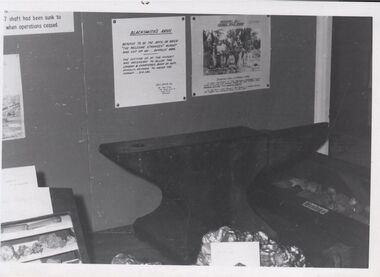
Photograph - GOLDEN DAYS HISTORICAL EXHIBITION COLLECITON: BLACKSMITH'S ANVIL
... GOLDEN DAYS HISTORICAL EXHIBITION COLLECITON: BLACKSMITH'S ANVIL...Black and white photograph: blacksmith's anvil. Written on back of photo in blue pen 'Golden Days Historical Exhibition' 12 to 17 August, 1960. ...Photograph GOLDEN DAYS HISTORICAL EXHIBITION COLLECITON: BLACKSMITH'S ANVIL ...Black and white photograph: blacksmith's anvil. Written on back of photo in blue pen 'Golden Days Historical Exhibition' 12 to 17 August, 1960. Reputed to be the anvil on which The Welcome Stranger (210 lbs) nugget was cut up on Dunolly 1869. Present owned (1960) Mr. Noel Gray, Backhaus Street, Long Gully, Bgo.bendigo, history, golden days historical exhibition -
 Parks Victoria - Wilsons Promontory Lightstation
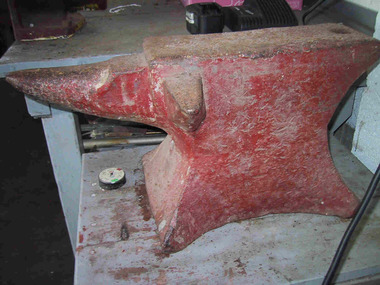
Anvil
... As a lightstation manager Chris Richter used the anvil to manufacture pulley blocks for sash windows, repair brass door hinges & sharpen cold chisels, crowbars and picks and other lightkeepers have used this anvil for many fabricating jobs such as manufacturing ducting for the generator room ventilation system."The lightship only came in every three months with supplies and there would have been repairs to do between visits from a blacksmith - who would have had to travel on the ship. ...Red painted blacksmith's anvil....Red painted blacksmith's anvil. Anvil ...As quoted from Wikipedia, ‘An anvil is a block with a hard surface on which another object is, struck. The block is as massive as it is practical, because the higher the inertia of the anvil, the more efficiently it causes the energy of the striking tool to be transferred to the work piece’. The lightstation’s anvil is a red-painted iron block with a conical beak or horn at one end that was used for hammering curved pieces of metal. It would have stood on a heavy free-standing pedestal, such as a large tree stump, to allow complete access to the item being hammered. Some anvils display the manufacturer’s name in the metal on the side, but this is not the case here, and its age, although unknown appears to be quite old, perhaps c.1900. It appears to have had a lot of use, and although no record of this survives, it is presumed that a forge operated on site for hammering, cutting, shaping and repairing tools such as bolts, nails, hooks, chain segments, pulley blocks, hinges, crow bars, picks, chisels, horseshoes and harness hardware. A hames hook (which forms part of the collar worn by a draught horse) survives at the lightstation as do many other heavy metal tools and pieces of equipment. The anvil is an example of the necessary resourcefulness and self sufficiency practiced by lightkeepers working and living in a remotely located workplace and home, and many of the iron items in the collection may have been repaired or even made on its working surface. As a lightstation manager Chris Richter used the anvil to manufacture pulley blocks for sash windows, repair brass door hinges & sharpen cold chisels, crowbars and picks and other lightkeepers have used this anvil for many fabricating jobs such as manufacturing ducting for the generator room ventilation system."The lightship only came in every three months with supplies and there would have been repairs to do between visits from a blacksmith - who would have had to travel on the ship. Also, the ship was only anchored in the bay long enough to unload supplies and collect and deliver lightkeeping staff – probably not enough time to get much smithy work done – especially if the weather packed it in and the ship had to depart. Lightkeepers in our time had to be self sufficient, resourceful and innovative and I imagine that would have been the case in the past." It has second level contributory significance.Red painted blacksmith's anvil. -
 Flagstaff Hill Maritime Museum and Village
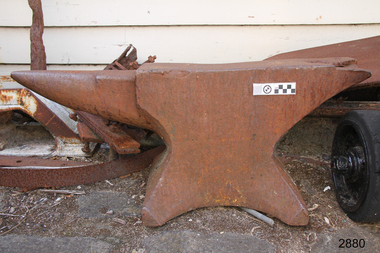
Anvil, early to mid-1900s
... ...Blacksmith’s anvil...This anvil once belonged to Goodall and Sons, who were blacksmiths in Terang. ...Anvil, single horn, used as a tool by blacksmiths and metalworkers. ...Newton nee Goodall Trade tools Blacksmith tools Metalworking tool Forging tool Terang 1900s Warrnambool district 1900s Anvil Blacksmith’s anvil Single horn anvil Anvil, single horn, used as a tool by blacksmiths and metalworkers. ...This anvil once belonged to Goodall and Sons, who were blacksmiths in Terang. The smith was called upon to do a variety of work. In the early 1900s he was often the nearest person to be able to perform an engineer’s services for many miles around. An anvil is used by blacksmiths to forge and shape his work pieces. The conical horn is used for hammering curved work pieces. The anvil is a common tool of the blacksmiths (‘smithies’) and other metalworkers. There has been very little change in the basic design of the anvil since Greek and Roman times. Henry Goodall (1870-1936) Henry Goodall was proprietor of garages as H. Goodall & Sons Pty. Ltd., at both Terang (McKinnon and High Streets) and Mortlake (Dunlop Street). His business was in operation in at least in 1916 and perhaps well before, considering the date of the tyre bender and its use for wagons with wooden wheels. It was still in operation in 1953, chasing up debtors in Mount Gambier Court. Amongst the employees of H. Goodall & Sons Pty. Ltd. was Ernie Entwistle, a blacksmith (a soldier who died in 1916 ) and Alfred Hodgetts, radio expert (killed in a fatal accident in 1943, when he was in his early 30s ). Henry Goodall was involved in the community as a Justice of Peace, a deputy coroner, President of the Mortlake Hospital, trustee of the Soldiers’ Memorial Hall, and as a prominent Freemason. He and his wife had two sons (Charles and John) and one daughter (Mrs. Chas. Newton, of Skipton). The anvil is locally significant as it was used by a local company in Terang and Mortlake in their blacksmith, wheelwright and garage business. It is an example of the tools of the blacksmiths’ trade in Victoria in the early to mid-1900s. Anvil, single horn, used as a tool by blacksmiths and metalworkers. Large block of metal with a flat top face, a conical horn on one side and a ‘v’ shape on the other. The anvil’s base has a squat stand and sides that are a variety of shapes. This anvil once belonged to Harry Goodall & Sons, blacksmiths of Terang. C. early to mid-1900s.flagstaff hill, warrnambool, shipwrecked-coast, flagstaff-hill, flagstaff-hill-maritime-museum, maritime-museum, shipwreck-coast, flagstaff-hill-maritime-village, h. goodall & sons of terang, terang blacksmith, h. goodall & sons pty ltd, mortlake, ernie entwistle blacksmith, alfred hodgetts radio expert, charles goodall, john goodall, mrs. chas. newton nee goodall, trade tools, blacksmith tools, metalworking tool, forging tool, terang 1900s, warrnambool district 1900s, anvil, blacksmith’s anvil, single horn anvil -
 Glenelg Shire Council Cultural Collection
Tool - Anvil, Bradford and Kendall, n.d
... anvil... blacksmith...Metal blacksmiths anvil. An anvil is used by blacksmiths to forge and shape his work pieces. ...Port of Portland anvil blacksmith industry BK anvil Bradken Brandford and Kendall Front: 'BK SYDNEY AUST. 5CWT' Back: - Metal blacksmiths anvil. ...Port of Portland Collection Bradken, originally Bradford and Kendall, began as a steel foundry in Sydney in 1920 and produced BK anvils at its factories in Alexandria and Mascot NSW. Leslie Bradford (General Manager) and Jim Kendall (Chief Mechanical Engineer), two BHP steelworks employees, got lucky at the races one day in 1920 and pledged their £15,000 winnings to start a steel foundry business. The horse they backed, ‘Jack Findlay’ completed a remarkable sequence of five wins during 1919 and 1920. With each win Leslie Bradford, Jim Kendall and a group of friends rolled-over their bets. By January 24, 1920 they had won a small fortune. On April 28 1920, the group used their winnings to establish the Alloy Steel Syndicate and build a steel foundry in Alexandria, Sydney to take advantage of what they saw as an untapped potential for industrial growth. Bradford Kendall Ltd was incorporated on 20th March 1922.Metal blacksmiths anvil. An anvil is used by blacksmiths to forge and shape his work pieces. The conical horn is used for hammering curved work pieces. The anvil is a common tool of the blacksmiths (‘smithies’) and other metalworkers. There has been very little change in the basic design of the anvil since Greek and Roman times. Blacksmith anvil, 5CWT, iron BK Sydney Australia.Front: 'BK SYDNEY AUST. 5CWT' Back: -port of portland, anvil, blacksmith, industry, bk anvil, bradken, brandford and kendall -
 Orbost & District Historical Society
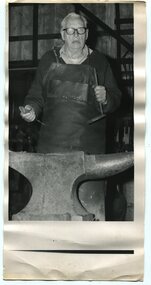
Photograph - black and white photograph, unknown
... B/White photograph of a man wearing a leather apron and glasses and standing in front of an anvil. Holding blacksmiths tools. The photo is a copy, not an original. ...blacksmiths operating until 1991. B/White photograph of a man wearing a leather apron and glasses and standing in front of an anvil. ...Mr Wehner's family was a prominent family in Orbost from the late 19th C. Hermann Wehner founded Wehner's blacksmiths at Orbost in 1889. Oswald began working with his father in 1910. In 1947, Ossie's son Tom started blacksmithing, retiring in 1991 and closing the business. The building remains in Nicholson Street, Orbost. A photograph is significant because it is of one of Orbost's blacksmiths. The Wehner family of blacksmiths (1889-1991) worked in Orbost and were the last blacksmiths operating until 1991. B/White photograph of a man wearing a leather apron and glasses and standing in front of an anvil. Holding blacksmiths tools. The photo is a copy, not an original. -
 Stawell Historical Society Inc
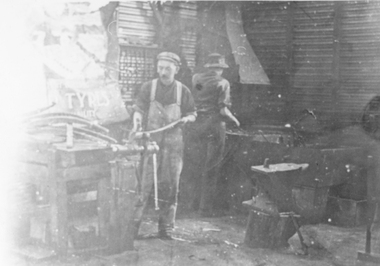
Photograph, Mr Percy Ledger on the left at the Blacksmith shop with Forge Anvil and Vice
... Mr Percy Ledger on the left at the Blacksmith shop with Forge Anvil and Vice...Two workmen in a blacksmith shop with Forge Anvil and vice. Male on left Percy Ledger. ...Two workmen in a blacksmith shop with Forge Anvil and vice. Male on left Percy Ledger. ...Workshop scene. Two workmen in a blacksmith shop with Forge Anvil and vice. Male on left Percy Ledger. Part of a set of photos of Wimmera Motor Works.Two males working in a blacksmiths shop.stawell industry -
 Coal Creek Community Park & Museum
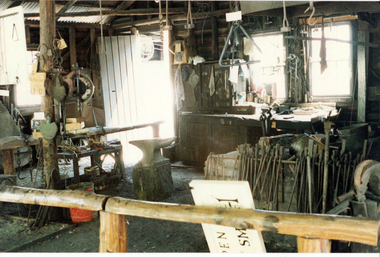
Photograph (item) - Blacksmith's Forge, Interior
... The interior of the blacksmith's forge was designed to replicate what a forge may have looked like in a small country town circa 1890s. The image shows many objects dating to the period including vices, grips and anvils. ...The interior of the blacksmith's forge was designed to replicate what a forge may have looked like in a small country town circa 1890s. The image shows many objects dating to the period including vices, grips and anvils. ...The interior of the blacksmith's forge was designed to replicate what a forge may have looked like in a small country town circa 1890s. The image shows many objects dating to the period including vices, grips and anvils. The blacksmith was an essential member of the community in settlement towns, providing horse shoes, basic machinery repairs and any ironmonger needs. pencilled on the reverse 'A7' and 'scanned 1/3/11. there is a printer's code 'SQPIX 00420 NNNAA' -
 Flagstaff Hill Maritime Museum and Village
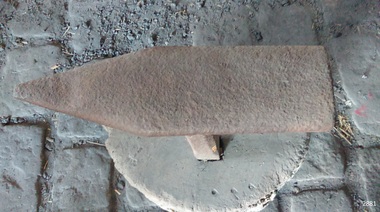
Anvil
... This anvil was once the property of Warrnambool Ports and Harbours. It is associated with the shipping trade and wold have been used by a blacksmith or tinsmith for forging and shaping metal. ...Anvil, small, for use by blacksmiths and tinsmiths.It was once the property of the Warrnambool Ports and Harbours.... and tinsmiths, which are rare trades today. flagstaff hill warrnambool shipwrecked-coast flagstaff-hill flagstaff-hill-maritime-museum maritime-museum shipwreck-coast flagstaff-hill-maritime-village anvil blacksmiths tinsmith tools trades Warrnambool Ports and Harbours Anvil, small, for use by blacksmiths and tinsmiths.It was once the property of the Warrnambool Ports and Harbours. ...This anvil was once the property of Warrnambool Ports and Harbours. It is associated with the shipping trade and wold have been used by a blacksmith or tinsmith for forging and shaping metal. According to Pliny, the anvil is supposed to be invented by Cinyra of Cyprus, but it was probably much older. There has been very little change in the basic design of the anvil since Greek and Roman times. This anvil is significant for its association with the local government body of Warrnambool Ports and Harbours, which is of local historic significance. It is also significant for its association with blacksmiths and tinsmiths, which are rare trades today.Anvil, small, for use by blacksmiths and tinsmiths.It was once the property of the Warrnambool Ports and Harbours.flagstaff hill, warrnambool, shipwrecked-coast, flagstaff-hill, flagstaff-hill-maritime-museum, maritime-museum, shipwreck-coast, flagstaff-hill-maritime-village, anvil, blacksmiths, tinsmith, tools, trades, warrnambool ports and harbours -
 Flagstaff Hill Maritime Museum and Village
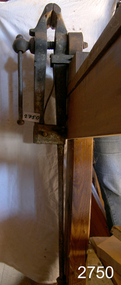
Tool - Leg Vice, Mid 19th Century
... anvil manufacturing plants such as "Mousehole Forge" and "Peter Wright" in England and "Fisher-Norris" and others in North America. The design of these vises right down to the last chamfer seems to have been perfected in the 1600s and remained more or less the same until the 20th century. The bodies are forged wrought iron or mild steel and they have hard steel surfaces welded into the jaws. The jaws have little or very shallow serrations which are generally worn off.Around the turn of the 20th Century during the hey-day of the blacksmith...anvil manufacturing plants such as "Mousehole Forge" and "Peter Wright" in England and "Fisher-Norris" and others in North America. The design of these vises right down to the last chamfer seems to have been perfected in the 1600s and remained more or less the same until the 20th century. The bodies are forged wrought iron or mild steel and they have hard steel surfaces welded into the jaws. The jaws have little or very shallow serrations which are generally worn off.Around the turn of the 20th Century during the hey-day of the blacksmith ...The blacksmith leg vise is also called the "solid box vise" and is one of the most important tools in the blacksmith's shop. It firmly holds hot iron while it is hammered, chiseled, or twisted. These are the only vises that are designed to take this kind of use day in and day out. A small 30-pound blacksmith's vise can survive pounding that would wreck a much heavier cast iron bench model. Three things make a blacksmith's vice special. One is that they are forgings, not cast iron or ductile iron. The second is the leg that provides support to the floor or from a sunken post. The last is the hinge, while not a perfect way to construct a vice the pin joint is durable and can take a considerable beating. If sheared it is easy to replace. These things all combine into a tool that can take decades of heavy use and abuse. Most in use is one to two hundred years old.Some of these vises were made by specialists such as Atwood of Stourbridge England, Steel City and Columbian in the U.S. and others were made in anvil manufacturing plants such as "Mousehole Forge" and "Peter Wright" in England and "Fisher-Norris" and others in North America. The design of these vises right down to the last chamfer seems to have been perfected in the 1600s and remained more or less the same until the 20th century. The bodies are forged wrought iron or mild steel and they have hard steel surfaces welded into the jaws. The jaws have little or very shallow serrations which are generally worn off.Around the turn of the 20th Century during the hey-day of the blacksmith shop in North America, these tools were considered so standard a commodity that they were sold without reference to the manufacturer. Very few were even marked with the maker's name. Size is best defined by weight as there is some variation in jaw size from manufacturer to manufacturer. They were sold by the pound and are still best judged by the pound.A vintage tool used in a Blacksmiths shop during the early 19th century to the beginning of the 20th century. Regarded as a significant into social history of the time.Leg Vice attached with screws to bench via a block of wood. Has large metal pole which practically reaches the floor. Also has a metal device to either tighten or slacken vice.flagstaff hill, warrnambool, shipwrecked-coast, flagstaff-hill, flagstaff-hill-maritime-museum, maritime-museum, shipwreck-coast, flagstaff-hill-maritime-village -
 Federation University Historical Collection
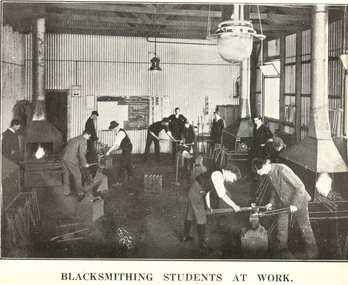
Image (printed photograph), Ballarat School of Mines Blacksmithing Students at Work, c1900
... blacksmith...forge...anvil...A number of men train on three blacksmith forges at the Ballarat School of Mines. The men are working in pairs on anvils and appear to have two supervisors ...This image was reproduced in the 1914 Ballarat School of Mines Annual Report. students ballarat school of mines blacksmith forge anvil blacksmithing students ballarat school of mines blacksmith forge anvil blacksmithing A number of men train on three blacksmith forges at the Ballarat School of Mines. ...Blacksmithing was a subject taught at the Ballarat School of Mines. This image was reproduced in the 1914 Ballarat School of Mines Annual Report.A number of men train on three blacksmith forges at the Ballarat School of Mines. The men are working in pairs on anvils and appear to have two supervisors students, ballarat school of mines, blacksmith, forge, anvil, blacksmithing, students, ballarat school of mines, blacksmith, forge, anvil, blacksmithing -
 City of Moorabbin Historical Society (Operating the Box Cottage Museum)
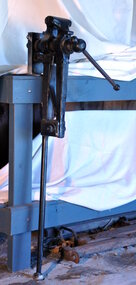
Tool - Tools, Blacksmith's leg vice, c1900
... A Blacksmith was an essential person for the maintenance and making of farm and household equipment, and shoeing horses, in the pioneer settlements of Brighton, Moorabbin, Cheltenham c1900 blacksmith vise moorabbin bentleigh brighton market gardeners forges tools early settlers pioneers ploughs carts horse-drawn anvils Blacksmith's 'leg' vice. ...The Blacksmith could take this portable 'leg vice' and make repairs away from his forge.He could mend wheel bands, tools, farm equipment and also fine tune generic sized horseshoes on site. He would build a fire and secure his leg vice to a stable point thus allowing him to work on any heated metal as required. A Blacksmith was an essential person for the maintenance and making of farm and household equipment, and shoeing horses, in the pioneer settlements of Brighton, Moorabbin, Cheltenham c1900Blacksmith's 'leg' vice. Sturdy blacksmith leg, post (vice). 15cm jawsblacksmith, vise, moorabbin, bentleigh, brighton, market gardeners, forges, tools, early settlers, pioneers, ploughs, carts horse-drawn, anvils -
 City of Moorabbin Historical Society (Operating the Box Cottage Museum)
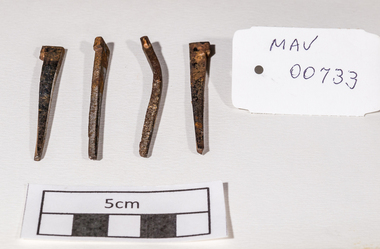
Building Equipment, original hand made nails Box Cottage c 1850, c1850
... Theses 4 iron nails were hand made by an early settler c1850, using iron, forge and anvil, for the construction of the original Box Cottage box william box elizabeth brighton henry dendy special survey 1841 early settlers pioneers moorabbin box cottage museum nails building equuipment forges anvils blacksmiths 4 hand made iron nails c1850 used in building the original pioneer cottage now known as Box Cottage Museum Building Equipment, original hand made nails Box Cottage c 1850 Pioneer ...The original small, pioneer cottage was built in the late 1840s to early1850s, by an unknown pioneer. It was located on part of a 30 Acre allotment that was originally part of Henry Dendy’s Special Survey granted in 1841. The doors and window sashes, (made of red deal joinery timber), as well as the brass locks and fittings, are from the original cottage, and were imported from England.The fire-place bricks are from the original cottage, and are sun-dried, (not kiln fired), and are hand-made. Convict marks can be seen on two bricks.There is a small display of external cladding shingles from the original pioneer cottage. These shingles were hand-split, and most likely made from locally collected timber The nails included in this display were used to fasten the shingles on the original cottage, and are also hand-made. The enamel nameplate, “Colonial”, on the wall of the cottage, was the name chosen for the original pioneer cottage when a later owner, Mr August Rietman and wife Frieda leased the property in around 1917. August purchased the property 1935 for 1200 Pounds approximately and resided there until 1953. In 1974 Mr Lewis, a timber specialist, found the dilapidated building on property he had recently purchased in Jasper Rd and suggested it be reconstructed and relocated. Moorabbin Council agreed and the Cottage was rebuilt just about 250 metres from its original site. The cost of the rebuild was met by 'Victoria's 150th Committee', plus a small grant from the City of Moorabbin, and Mr Laurie Lewis donated much of the timber for the reconstruction. Theses 4 iron nails were hand made by an early settler c1850, using iron, forge and anvil, for the construction of the original Box Cottage 4 hand made iron nails c1850 used in building the original pioneer cottage now known as Box Cottage Museumbox william, box elizabeth, brighton, henry dendy special survey 1841, early settlers, pioneers, moorabbin, box cottage museum, nails, building equuipment, forges, anvils, blacksmiths -
 City of Moorabbin Historical Society (Operating the Box Cottage Museum)
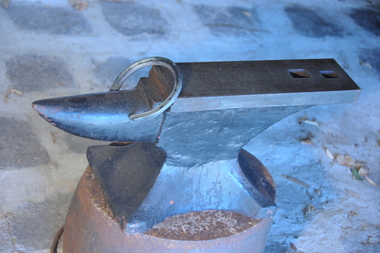
Tool - Blacksmith Anvil
... Blacksmith Anvil...This anvil is typical of the type used by Blacksmiths in Moorabbin Shire c1850 - 20thC Blacksmith were needed to make machinery, tools, farm and household equipment, wheels and wagons, horseshoes and saddle irons....This anvil is an example of the type used by blacksmiths in Moorabbin Shire 1840- 20thC as early settlers developed the land. built homes, shops and schools market gardeners early settlers moorabbin shire dendy special survey 1841 bentleigh moorabbin cheltenham tools anvils steel horses wagons washing pots cooking pots blacksmiths county of bourke Solid steel single horn shaped block used by a Blacksmith to make tools, horseshoes, kitchenware, farm equipment, wagon wheels Tool Blacksmith Anvil ...This anvil is typical of the type used by Blacksmiths in Moorabbin Shire c1850 - 20thC Blacksmith were needed to make machinery, tools, farm and household equipment, wheels and wagons, horseshoes and saddle irons.This anvil is an example of the type used by blacksmiths in Moorabbin Shire 1840- 20thC as early settlers developed the land. built homes, shops and schoolsSolid steel single horn shaped block used by a Blacksmith to make tools, horseshoes, kitchenware, farm equipment, wagon wheelsmarket gardeners, early settlers, moorabbin shire, dendy special survey 1841, bentleigh, moorabbin, cheltenham, tools, anvils, steel, horses, wagons, washing pots, cooking pots, blacksmiths, county of bourke -
 Orbost & District Historical Society
branding iron, late 19th -mid 20th century
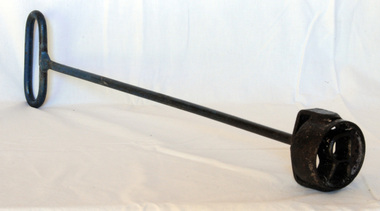
... The irons were typically forged by blacksmiths using a toolset that included hammers, anvils and chisels. ...The irons were typically forged by blacksmiths using a toolset that included hammers, anvils and chisels. ...Branding irons are used to print a burn an identifying marker on the hide of horses or cattle so that they may be later identified if they become lost or escape from their pasture. The irons were typically forged by blacksmiths using a toolset that included hammers, anvils and chisels. The branding irons were used by heating the end bearing the owner’s initials to a very high temperature in a furnace, and then burnishing it against the skin of the cow. Brands were registered with state governments as unique marks. This allowed for a state registry to be maintained. This is an example of an implement used locally in the livestock industry.A branding iron with letter R on circular end. Handle loop is oval shaped. It has been painted blue to half way.branding-iron rural-industry -
 Orbost & District Historical Society
branding iron, Late 19th -mid 20th century
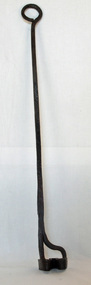
... The irons were typically forged by blacksmiths using a toolset that included hammers, anvils and chisels. ...The irons were typically forged by blacksmiths using a toolset that included hammers, anvils and chisels. ...Branding irons are used to print a burn an identifying marker on the hide of horses or cattle so that they may be later identified if they become lost or escape from their pasture. The irons were typically forged by blacksmiths using a toolset that included hammers, anvils and chisels. The branding irons were used by heating the end bearing the owner’s initials to a very high temperature in a furnace, and then burnishing it against the skin of the cow. Brands were registered with state governments as unique marks. This allowed for a state registry to be maintained. This item was used in Orbost in the livestock industry.This item is an example of an implement once used in the livestock industry in Orbost.A branding iron with the letter W on the end. It has a long iron handle with a ring grip at the top.branding-iron rural-industry -
 Orbost & District Historical Society
branding iron, late 19th -mid 20th century
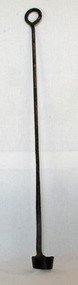
... The irons were typically forged by blacksmiths using a toolset that included hammers, anvils and chisels. ...The irons were typically forged by blacksmiths using a toolset that included hammers, anvils and chisels. ...Branding irons are used to print a burn an identifying marker on the hide of horses or cattle so that they may be later identified if they become lost or escape from their pasture. The irons were typically forged by blacksmiths using a toolset that included hammers, anvils and chisels. The branding irons were used by heating the end bearing the owner’s initials to a very high temperature in a furnace, and then burnishing it against the skin of the cow. Brands were registered with state governments as unique marks. This allowed for a state registry to be maintained. This item was used in Orbost in the livestock industry.This item is an example of a common implement used in rural industry in Orbost.A branding iron with the letter J on the end. It has a long handle with a ring grip at the top.branding-iron livestock-industry rural-industry -
 Orbost & District Historical Society
branding iron
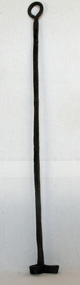
... The irons were typically forged by blacksmiths using a toolset that included hammers, anvils and chisels. ...The irons were typically forged by blacksmiths using a toolset that included hammers, anvils and chisels. ...Branding irons are used to print a burn an identifying marker on the hide of horses or cattle so that they may be later identified if they become lost or escape from their pasture. The irons were typically forged by blacksmiths using a toolset that included hammers, anvils and chisels. The branding irons were used by heating the end bearing the owner’s initials to a very high temperature in a furnace, and then burnishing it against the skin of the cow. Brands were registered with state governments as unique marks. This allowed for a state registry to be maintained. This item is an example of a common implement used in the livestock industry in Orbodt.A long-handled branding iron with an S or 2 on the end. There is a loop at the top for hanging.branding-iron rural livestock-industry -
 Orbost & District Historical Society
branding iron, Late 19th century - mid 20th century
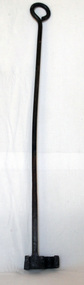
... The irons were typically forged by blacksmiths using a toolset that included hammers, anvils and chisels. ...The irons were typically forged by blacksmiths using a toolset that included hammers, anvils and chisels. ...Branding irons are used to print a burn an identifying marker on the hide of horses or cattle so that they may be later identified if they become lost or escape from their pasture. The irons were typically forged by blacksmiths using a toolset that included hammers, anvils and chisels. The branding irons were used by heating the end bearing the owner’s initials to a very high temperature in a furnace, and then burnishing it against the skin of the cow. Brands were registered with state governments as unique marks. This allowed for a state registry to be maintained. This branding iron was used in Orbost. This item is an example of an implement commonly used in the livestock industry in Orbost.A long-handled branding iron with J H at the end. There is a hanging loop at the top.branding-iron rural livestock-industry -
 City of Moorabbin Historical Society (Operating the Box Cottage Museum)
Newsletter - City of Moorabbin Historical Society Apr 2012, April 2012
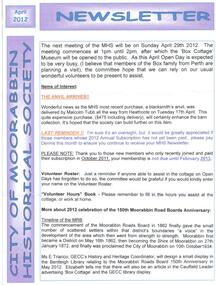
... anvil...blacksmith...The Newsletter is an important record of the activities of the CMHS. city of moorabbin historical society stanley helen melbourne moorabbin brighton cheltenham ormond bentleigh market gardeners pioneers early settlers the moorabbin roads board 1862 city of glen eira city of kingston moorabbin shire parish of moorabbin brighton east south brighton bent tommy mair william anvil blacksmith mitchell robert mitchell charles mitchell catherine bicycle penny-farthing bicycle races smith frank grocer centre road bentleigh foucaucourt france somme france world war 1 1914-1918 anzac CITY of MOORABBIN HISTORICAL SOCIETY / APRIL 2012 NEWSLETTER 5 x A4 paper printed on 1 side Issue 26 of the bi-monthly, City of Moorabbin Historical Society Newsletter produced by Society member and Secretary, Mrs Helen Stanley in April 2012. ...The City of Moorabbin Historical Society was formed c 1960 by a group of Moorabbin area residents who were concerned that the history of the area should be preserved. A good response to a call for items related to the historical area of Moorabbin Shire brought donations of a wide variety of artefacts which are now preserved by the current members of CMHS at Box Cottage Museum . Helen Stanley, Secretary of CMHS, began producing a Newsletter for members in April 2007 to provide current information and well researched items of historical interestHelen Stanley has produced a bi-monthly Newsletter, 2007 - 2013, for the members of the City of Moorabbin Historical Society that contains well researched interesting historical items, notification of upcoming events, current advice from Royal Australian Historical Society , Museums Australia Victoria and activities of Local Historical Societies. The Newsletter is an important record of the activities of the CMHS. 5 x A4 paper printed on 1 side Issue 26 of the bi-monthly, City of Moorabbin Historical Society Newsletter produced by Society member and Secretary, Mrs Helen Stanley in April 2012. Notice for meeting April 29th , expected visit by Box family descendants 29th, reminder that subscriptions are due, and proposed Open Days June 16th and 17th to celebrate Moorabbin Roads Board 150th Anniversary. The Anvil was delivered from Heathcote on April 17th and it will enhance the Barn display. Helen recalls the story of Private Robert Mitchell, one of the 17 ‘Bentleigh Boys’ who died during World War 1, with 6 photocopied photographs CITY of MOORABBIN HISTORICAL SOCIETY / APRIL 2012 NEWSLETTERcity of moorabbin historical society, stanley helen, melbourne, moorabbin, brighton, cheltenham, ormond, bentleigh, market gardeners, pioneers, early settlers, the moorabbin roads board 1862, city of glen eira, city of kingston, moorabbin shire, parish of moorabbin, brighton east, south brighton, bent tommy, mair william, anvil, blacksmith, mitchell robert, mitchell charles, mitchell catherine, bicycle penny-farthing, bicycle races, smith frank, grocer, centre road bentleigh, foucaucourt france, somme france, world war 1 1914-1918, anzac, -
 Orbost & District Historical Society
nails on board, 1885
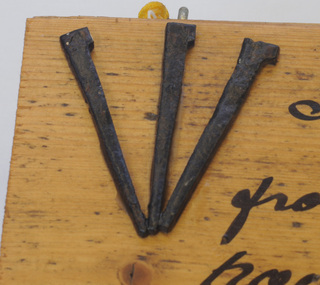
... These three iron nails were hand made by an early Orbost settler or blacksmith in the 1880's, using iron, forge and anvil. They are examples of the types of nails used in the 19th century. ...These nails were made for Walter John Mundy (1868-1944). Often imported nails made for the softer English and North American timbers bent when hammered against the harder colonial woods and so The Mundy family were farmers / settlers in the Snowy River area since c. 1880s. The original Mundy family moved to a land "selection" at Betebolong in the early 1880's from Buchan. It's only over the past century or so that the mass-produced nail has become an inexpensive and common way to join materials. These three iron nails were hand made by an early Orbost settler or blacksmith in the 1880's, using iron, forge and anvil. They are examples of the types of nails used in the 19th century. A rectangular, wooden(athel pine?) board with three hand-made nails glued in fan design to top left corner of section of floorboard. There is a short length of yellow cord attached for hanging. To the right of the nails is hand-written text in black. the nails have irregular shanks and hammer marks on both shanks and heads.right of nails - " Flooring & nails from Walter Mundy's house at Jarrahmond built C.1885. Still in use to this day."mundy-walter hand-made-nails -
 Eltham District Historical Society Inc
Document - Folder, Alan Marshall (1902-1984), Correspondence from Alan Marshall to Gwenda Sanderson, 1979-1983
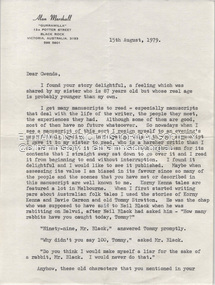
... Blacksmith...Mary Turner-Shaw...On Mount Emu Creek (book)...Wooiwyrite...Western District Victoria...Merrilyn Sanderson...Mortlake...The Land (poem)...Collected Verse (book)...Austin family...Hammers over the Anvil...Korny Kenna Folk tales Australian Folk Tales Davie Carson Tommy Stratton Neil Black Black Emily Noorat Purnim encampment Pompey Austin Aboriginal characters John Manifold John Hooker Collins Publishers Eltham history Alan Marshall (Pioneers and Painters) James Bonwick Mount Shadwell Mount Noorat John Smith Blacksmith Mary Turner-Shaw On Mount Emu Creek (book) Wooiwyrite Western District Victoria Merrilyn Sanderson Mortlake The Land (poem) Collected Verse (book) Austin family Hammers over the Anvil (book) Eeyeuk Dennis family Peg Dennis Noorat Church Jim Smith Miss Dennis Mrs Polly Mrs Angus Gillies Mental health Frank Smith Country Life (English paper) Field (English paper) Peter McLeod Bill Beechey Angus Gillies Mag Dennis East Driscoll Camperdown Bill White Alec Irvine Jack Irvine Staughton's stable Cumming family Jallalabad Miss Baird Private Catholic School Jack Peoples Shaw's Weatherley Miss Ann Gordon Ballangeich Writer Author Sun (newspaper) William Collins (Aust.) ...Alan Marshall AM, (2 May 1902 – 21 January 1984) was an Australian writer, story teller, humanist and social documenter. Personal correspondence between Gwenda Sanderson and Alan Marshall, dated between 1979 and 1983. There are 21 letters in all, the last 3 of which were dictated from the Hurlingham Nursing Home in Brighton. Background information for the letters (daugher Merrilyn Sanderson 10 October 2025): My mother, Gwenda Sanderson ( nee White ) grew up in the western district and knew Alan Marshall's sister. Gwenda was an aspiring author, and reached out to Alan for support and advice regarding her writing. Alan proved to be a generous and inspiring mentor and as you will see, they established a rapport. In 1966 Gwenda moved from Mortlake to Montmorency (quite a culture shock!) and around 1983 she and her husband, Stan moved to Diamond Creek. Letters: 1. Alan Marshall to Gwenda Sanderson, 15 August 1979 2. Alan Marshall to Gwenda Sanderson, 22 August 1979 3. Alan Marshall to Gwenda Sanderson, 28 August 1979 4. Alan Marshall to Gwenda Sanderson, 7 September 1979 5. Alan Marshall to Gwenda Sanderson, 19 September 1979 6. Alan Marshall to Gwenda Sanderson, 11 October 1979 7. Alan Marshall to Gwenda Sanderson, 18 October 1979 8. Alan Marshall to Gwenda Sanderson, 1 November 1979 9. Alan Marshall to Gwenda Sanderson, 10 January 1980 10. Alan Marshall to Gwenda Sanderson, 24 January 1980 11. Alan Marshall to Gwenda Sanderson, 15 February 1980 12. Gwen Hardisty on behalf of Alan Marshall to Gwenda Sanderson, 27 May 1980 13. Alan Marshall to Gwenda Sanderson, 17 June 1980 14. Alan Marshall to Gwenda Sanderson, 29 July 1980 15. Alan Marshall to Gwenda Sanderson, 4 August 1980 16. Alan Marshall to Gwenda Sanderson, 22 August 1980 17. Alan Marshall to Gwenda Sanderson, 5 February 1981 18. Alan Marshall to Gwenda Sanderson, 5 August 1981 19. Gwen Hardisty on behalf of Alan Marshall to Gwenda Sanderson, 11 May 1982 20. Alan Marshall to Gwenda Sanderson, 27 Octopber 1982 21. Alan Marshall to Gwenda Sanderson, 21 February 1983 alan marshall, gwenda sanderson, gurrawilla, elsie louise mcconnell, black rock (vic.), korny kenna, folk tales, australian folk tales, davie carson, tommy stratton, neil black, black emily, noorat, purnim encampment, pompey austin, aboriginal characters, john manifold, john hooker, collins publishers, eltham history, alan marshall (pioneers and painters), james bonwick, mount shadwell, mount noorat, john smith, blacksmith, mary turner-shaw, on mount emu creek (book), wooiwyrite, western district victoria, merrilyn sanderson, mortlake, the land (poem), collected verse (book), austin family, hammers over the anvil (book), eeyeuk, dennis family, peg dennis, noorat church, jim smith, miss dennis, mrs polly, mrs angus gillies, mental health, frank smith, country life (english paper), field (english paper), peter mcleod, bill beechey, angus gillies, mag dennis, east driscoll, camperdown, bill white, alec irvine, jack irvine, staughton's stable, cumming family, jallalabad, miss baird, private catholic school, jack peoples, shaw's, weatherley, miss ann gordon, ballangeich, writer, author, sun (newspaper), william collins (aust.) ltd, chatsworth homestead, russia, i can jump puddles (book), nat gould, race horses, ethell dell, gertrude page, geoffrey farnell, east driscoll (story), shamrock smith, the catholic ball (story), lance skuthorpe, the blood of johnny meagher (story), winter-irving, sarah midgeley, richard skilbeck, miss edith (story), sun competition, mandeville hall, hampden council, alan marshall commemorative plaque noorat, russian theatrical troupe, noorat show, eliza sturgess, sam johnson the baker, elsie johnson, crupper, martingale, a.j. black, shaw women, miss laura, squatter, duke of edinburgh, royal family, 'texas' green, member for kalgoorlie, duke of gloucestor, the girl in pink, prince of wales, may creedie (story), mrs scott of mortlake, smouldering fires (book), lindsay russell, mary murray of our valley (book), the fellowship of australian writers, jim hamilton, journey to aboriginal victoria (book), mary gilmore, peter mcallum institute, may creedie (book), gwen hardisty, heart attack, bulletin (magazine), stephenson, gloria swanson, jennifer marshall, daniel (grandson), cathy (daughter), sandringham hospithal, east brighton nursing home, alan marshall writes alone (review) -
 Bendigo Historical Society Inc.
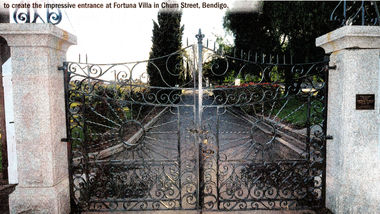
Newspaper - Fortuna Articles - "Ironwork to test the mettle", Sept 25 2009
... This article by James Lerk provides a historical overview of blacksmithing in Bendigo, focusing on Thomas Pearce's life and contributions: Blacksmiths worked with iron and steel, shaping metal using heat, anvils, and various tools to create both practical and decorative items. ...This article by James Lerk provides a historical overview of blacksmithing in Bendigo, focusing on Thomas Pearce's life and contributions: Blacksmiths worked with iron and steel, shaping metal using heat, anvils, and various tools to create both practical and decorative items. ...This article by James Lerk provides a historical overview of blacksmithing in Bendigo, focusing on Thomas Pearce's life and contributions: Blacksmiths worked with iron and steel, shaping metal using heat, anvils, and various tools to create both practical and decorative items. The process involved heating metal to a bright cherry red and shaping it on an anvil, which included features like a flat table and a horn for different shaping needs. Thomas Pearce was born in Cornwall in 1850, the son of a blacksmith, and married Mary Sobey in 1871. He also ran the Five Pilchards Inn, according to the Cornish Census. Like many Cornish people in the late 19th century, Pearce migrated for mining opportunities, arriving in Bendigo in 1889. Pearce worked as a blacksmith at various mines in Bendigo upon arrival.In 1898, he became the blacksmith at Fortuna, a prominent estate owned by George Lansell. Pearce is best known for creating the ornate iron entry gates at Fortuna, showcasing his skill and creativity.It is noted that he began crafting the gates without formal drawings, relying on his vision and expertise. Pearce retired from Fortuna in 1923 at age 73.He and his wife celebrated their diamond wedding anniversary in 1931, marking a long and accomplished life.Fortuna Articles - "Ironwork to test the mettle" Sept 25 2009 The Bendigo Weekly Discover Bendigo by James Lerk This item contains the following: 11217.48a Black and white photo of the Fortuna metal gate in Chum Street 11217.48b Black and white photo of Thomas Pearce , blacksmith, in 1931 at the time of his diamond wedding 11217.48c Part of Page 18 - Fortuna Articles - "Ironwork to test the mettle"non-fictionbendigo, fortuna, george lansell, james lerk, thomas pearce blacksmith -
 Sunshine and District Historical Society Incorporated
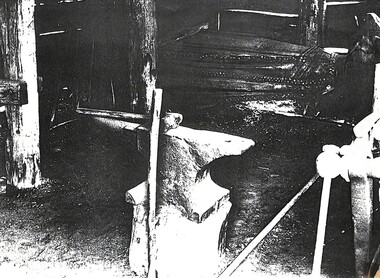
Photograph - Anvil in HV McKays blacksmiths shop
... Anvil in HV McKays blacksmiths shop...Photograph of blacksmiths forge complete with large bellows anvil and vice Sledge hammer and block and tackle on the right hand side This was the original anvil in HV McKays blacksmiths shop now in the Victorian State Museum collection The large bellows were used to pump air to service the fire of the blacksmiths forge...McKays Sunshine Harvester Works Blackmsith Photograph of blacksmiths forge complete with large bellows anvil and vice Sledge hammer and block and tackle on the right hand side This was the original anvil in HV McKays blacksmiths shop now in the Victorian State Museum collection The large bellows were used to pump air to service the fire of the blacksmiths forge Anvil in HV McKays blacksmiths shop Photograph Anvil in HV McKays blacksmiths shop ...Photograph of blacksmiths forge complete with large bellows anvil and vice Sledge hammer and block and tackle on the right hand side This was the original anvil in HV McKays blacksmiths shop now in the Victorian State Museum collection The large bellows were used to pump air to service the fire of the blacksmiths forgeh.v. mckays, sunshine harvester works, blackmsith -
 Sunshine and District Historical Society Incorporated
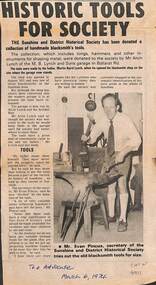
Article - Martin Baird Lynch Blacksmith Tools, The Advocate, 6th March 1974
... blacksmith & farrier shop, prior it becoming a car garage and service station. The site is now a Seven Eleven Store Martin Baird Lynch Tool Historic Tools For Society Newspaper Article The Advocate 6th March 1974 - Historic Tools For Society. It has a picture of the Sunshine & District Historical Society Secretary Mr Evan Pincus using a hammer while standing at an anvil ...M. B. Lynch and Sons Garage was located on the corner of Ballarat Road and Hampshire Road Sunshine. In the early days it was a blacksmith & farrier shop, prior it becoming a car garage and service station. The site is now a Seven Eleven StoreHistoric Tools For Societymartin baird lynch, tool -
Clunes Museum
Book, M T RICHARDSON, PRACTICAL BLACKSMITHING, 1905-1909
... TREMBATCH CAMP PARADE CLUNES VIC AND 4 VOLS 21/- WRITTEN IN LEAD PENCIL .2 STICKER AFFIXED TO FLY PAGE TYPED IN PURPLE INK "T TREMBATH CAMP PARADE CLUNES VIC " .3 STICKER AFFIXED TO FLY PAGE TYPED IN PURPLE INK "T TREMBATH CAMP PARADE CLUNES VIC " SMALL SQUARE WHITE STICKER WITH E W COLE BOOK ARCADE MELBOURNE SYDNEY & ADELAIDE ON REVERSE OF FRONT COVER TOP LEFT HAND CORNER .4 STICKER AFFIXED TO FLY PAGE TYPED IN PURPLE INK "T TREMBATH CAMP PARADE CLUNES VIC " SMALL SQUARE WHITE STICKER WITH E W COLE BOOK ARCADE MELBOURNE SYDNEY & ADELAIDE ON REVERSE OF FRONT COVER TOP LEFT HAND CORNER . .1 VOLUME 1 BOOK WITH HANDSEWN BLACK FABRIC COVER .2 VOLUME 2 BOOK WITH HANDSEWN BLACK FABRIC COVER .3 VOLUME 3 BOOK WITH TAN FABRIC COVER IMAGE OF AN ANVIL AND TITLE OF THE BOOK IN BLACK PRINT .4 VOLUME 4 BOOK WITH TAN FABRIC COVER IMAGE OF AN ANVIL AND TITLE OF THE BOOK IN BLACK PRINT PRACTICAL BLACKSMITHING Book BOOK M T RICHARDSON ...A COLLECTION OF ARTICLES CONTRIBUTED AT DIFFERENT TIMES BY SKILLED WORKMENT TO THE COLUMNS OF "THE BLACKSMITH AND WHEELWRIGHT: AND COVERING NEARLY THE WHOLE RANGE OF BLACKSMITHING FROM THE SIMPLEST OJOB OF WORK TO SOME OF THE MOST COMPLEX FORGINGS.1 VOLUME 1 BOOK WITH HANDSEWN BLACK FABRIC COVER .2 VOLUME 2 BOOK WITH HANDSEWN BLACK FABRIC COVER .3 VOLUME 3 BOOK WITH TAN FABRIC COVER IMAGE OF AN ANVIL AND TITLE OF THE BOOK IN BLACK PRINT .4 VOLUME 4 BOOK WITH TAN FABRIC COVER IMAGE OF AN ANVIL AND TITLE OF THE BOOK IN BLACK PRINTA COLLECTION OF ARTICLES CONTRIBUTED AT DIFFERENT TIMES BY SKILLED WORKMENT TO THE COLUMNS OF "THE BLACKSMITH AND WHEELWRIGHT: AND COVERING NEARLY THE WHOLE RANGE OF BLACKSMITHING FROM THE SIMPLEST OJOB OF WORK TO SOME OF THE MOST COMPLEX FORGINGSblacksmithing, forging -
 Whitehorse Historical Society Inc.
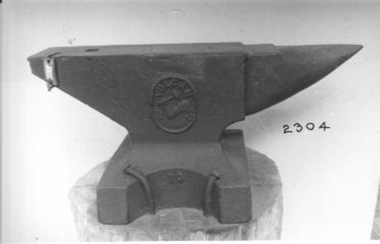
Tool - Anvil, c1920
... Anvil - made from forged steel and used by the blacksmith as a table to hand forge hot steel etc....See NA2323 for history of donor and photo. rural industry farm machinery trades blacksmithing Anvil - made from forged steel and used by the blacksmith as a table to hand forge hot steel etc. ...See NA2323 for history of donor and photo.Anvil - made from forged steel and used by the blacksmith as a table to hand forge hot steel etc.rural industry, farm machinery, trades, blacksmithing
