
Showing 13 items matching "blood stained"
-
 National Vietnam Veterans Museum (NVVM)
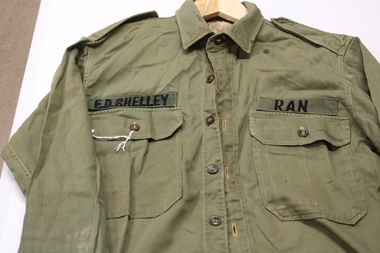
Uniform - Shirt with blood
... ...blood stained...Holes near collar at back and blood stains....Holes near collar at back and blood stains. Uniform Shirt with blood ...Shirt worn by Leading Air Mechanic Airframes Engines, Errol Desmond Shelley No:R59338 when he was hit by shrapnel. He was driving a motor pool truck back to US Bearcat Base near Bien Hoa on 22 December 1969, after a trip to Vung Tau to send flowers to the wife of a fellow serviceman to celebrate the birth of a child. An enemy rocket propelled grenade (RPG) landed 20 metres to the right of the vehicle Errol was driving, and while the passengers were able to duck for cover, as driver, Errol could not. So, when a second RPG landed behind them, Errol was hit by two pieces of shrapnel. Errol served on the HMAS Melbourne from May - Jun 1965, and then with RAN Helicopter Flight Vietnam from Sept 1969 - Oct 1970. SEE PHOTOS FOR THE STORY IN ERROL'S WORDSKhaki long-sleeved shirt with button-down front, two pockets with embroidered name on right side and service name on other. Handwritten names and signatures on the back. Holes near collar at back and blood stains.E D Shelley in black thread on RHS RAN in black thread on LHS Signatures on back in inkshelley, ed shelley, shrapnel wound, blood stained, wounded, ran, hfv, bearcat -
 Waverley RSL Sub Branch
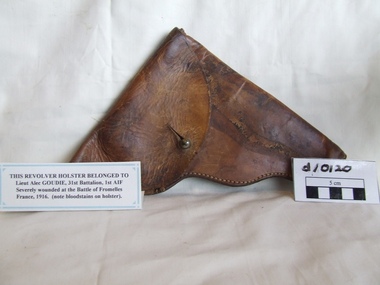
Revolver Holster
... Brown leather revolver holster with brass clip The holster showing blood stains ...st A.I.F. when he was wounded in Fromelles in 1916 Brown leather revolver holster with brass clip The holster showing blood stains Revolver Holster ...This holster was worn by Lt. Alec Goudie 31st Btn. !st A.I.F. when he was wounded in Fromelles in 1916Brown leather revolver holster with brass clip The holster showing blood stains -
 8th/13th Victorian Mounted Rifles Regimental Collection
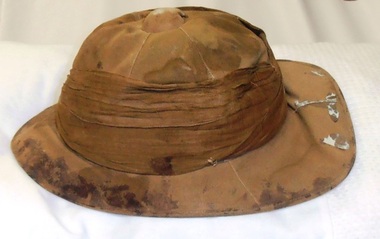
Helmet, 1914 circa
... Stains on brim are purported to be blood stains....Stains on brim are purported to be blood stains. Helmet ...This helmet was worn by Regt No 529 Trooper Alexander Hay Borthwick 8th Light Horse Regiment in the charge at the Nek, Gallipoli, on 7 August 1915. Borthwick was wounded in the charge but remained on duty. Following Gallipoli, Borthwick went on to serve with the 8th Light Horse in Sinai. He was wounded on a second occasion and lost his right arm.A rare object, well provenance, and of major significance to Australian Armoured Corps in general and 4th/19th Prince of Wales's Light Horse Regiment in particular, being the custodian of the traditions of the 8th Light Horse Regiment through its linking with 8th/13th Victorian Mounted Rifles. The helmet is displayed at the annual Nek Dinner held by the 4th/19 PWLH Regiment.Stiffened khaki coloured cloth helmet with folded puggaree. Stains on brim are purported to be blood stains."529 / Borthwick" written in ink on inside lining of hat.gallipoli, helmet, borthwick alexander hay, 8th light horse regiment, nek -
 National Vietnam Veterans Museum (NVVM)
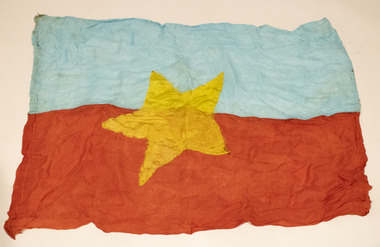
Flag - Viet Cong flag
... Silk Viet Cong flag for placement over the body of North Vietnamese soldier. Flag is blood stained. Top half is blue, bottom half red, with a yellow 5-pointed star sewn in at the centre....Silk Viet Cong flag for placement over the body of North Vietnamese soldier. Flag is blood stained. Top half is blue, bottom half red, with a yellow 5-pointed star sewn in at the centre. ...Mike Wells (donor of this item) told the museum that he took this flag from "the body of a bandit who got in the way of bullets". This is part of a collection donated by Captain Michael Wells (Service no: 2243275) who served with the Royal Australian Infantry Corps. Captain Wells served in Vietnam from May 1966 to January 1967 with the Australian Army Training Team Vietnam (AATTV).He was Operations Advisor at Phuoc Thuy.Silk Viet Cong flag for placement over the body of North Vietnamese soldier. Flag is blood stained. Top half is blue, bottom half red, with a yellow 5-pointed star sewn in at the centre.'Wells' is a name imprinted on hem.north vietnam flag, flag, mike wells, australian army training team vietnam (aattv), 2243275, capt mike wells, the mike wells collection, viet cong, vc -
 National Vietnam Veterans Museum (NVVM)
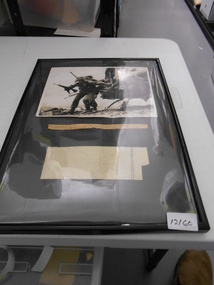
Photograph, 1/05/1969 12:00:00 AM
... U.S trooper of the "Sky Cavalry" charge from a helicopter under heavy fire near the 3,000ft blood stained peak of Hamburger Hill. The Red fortress was captured after heavy losses in June last year....Soldiers U.S trooper of the "Sky Cavalry" charge from a helicopter under heavy fire near the 3,000ft blood stained peak of Hamburger Hill. The Red fortress was captured after heavy losses in June last year. ...A black and white photograph of U.S. soldiers charging from a helicopter under heavy fire at 3,000 feet on Hamburger Hill.U.S trooper of the "Sky Cavalry" charge from a helicopter under heavy fire near the 3,000ft blood stained peak of Hamburger Hill. The Red fortress was captured after heavy losses in June last year.photograph, helicopter, u.s. soldiers -
 Mission to Seafarers Victoria
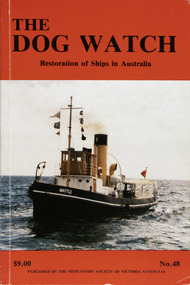
Journal (item) - Periodicals-Annual, Shiplovers' Society of Victoria, The Annual Dog Watch, 1991
... Williams - 103 When Blood Stained the Wattle - Late D. McLennan - 107 Book Reviews - - 112...Williams - 103 When Blood Stained the Wattle - Late D. McLennan - 107 Book Reviews - - 112 The Annual Dog Watch Journal Periodicals-Annual Shiplovers' Society of Victoria ...This journal provides the reader with glimpses of the adventures and hardships of a seaman's life. Many of the stories are of sailing ships.Contributes to our knowledge of the importance of shipping and places on record those stories of the sea which would otherwise be lost.Contents Foreword - - 5 Editorial - - 9 Steam Tug Wattle - G.C. Hogben - 11 The Legend of the Marco Polo Pride of all New Brunswick - Sponsors of the Marco Polo Restoration Project - 17 Yarra Mud Re-visited - Harrow Morgan - 21 Abandon Ship (in Dry Dock) - T. E. Goldfinch - 33 The Golden Plover Lives Again - Alison Forte - 37 San Pedro Offshore - P.H. Lewis - 41 White Sails in Australian Waters - Late D. McLennan - 45 Barque Polly Woodside - - 52 The Edwin Fox Restoration Picton, New Zealand - - 55 A Gulf Trader - R.N. Thiele - 57 The Great Britain (Poem) - C.E. Bonwick - 65 Singapore for Orders - - 67 Memories of a Master Under Sail The China Coast - Late Captain William Phillip - 71 Junior Marine Radio Officer on the S.S. Iron Flinders - Ellery Teare - 75 Australia’s Oldest Vessel — The Portland Lifeboat - Reprinted from the Journal of Portland Smelter Services Pty. Ltd. - 79 Any port in a Storm - W.P. Shemmeld - 81 A Happy Introduction to Sail - Captain George Molyneux - 87 Restored Ships in Sydney Harbour - Jean Barrie - 89 The Voyage of the Jane Richardson — 1889 Part II - Late E. Binham - 99 Preservation of HMAS Castlemaine. - Peter J. Williams - 103 When Blood Stained the Wattle - Late D. McLennan - 107 Book Reviews - - 112sailing ships, steamships, shipping, seafaring life, shiplovers' society of victoria, dog watch, wattle tug, tug boat -
 Mission to Seafarers Victoria
Article, A Woman's Melbourne Letter
... Sometimes, I seem to see Leper's Island yet, with its lavish tropical vegetation and the gorgeous sunsets which stained all the water with blood. Then, too" - here the voice deepened - "there was an English girl - a leper - there. ...Sometimes, I seem to see Leper's Island yet, with its lavish tropical vegetation and the gorgeous sunsets which stained all the water with blood. Then, too" - here the voice deepened - "there was an English girl - a leper - there. ...A detailed description of the Mission and its activities written by a woman: Western Mail (Perth, WA : 1885 - 1954), Friday 13 December 1918, page 34 A WOMAN'S MELBOURNE LETTER. Melbourne, Dec. 4. There is an idea abroad, which as regards Melbourne, at any rate, is quite erroneous, that our sailors are not as well looked after as our soldiers, and that the noble men of the Mercantile Marine are much neglected ! For once, perhaps, my readers will pardon a letter dealing with only one subject, but the steady, unostentatious work done by the Ladies' Harbour Light Guild, in connection with the mission to seamen in Melbourne could not be adequately explained if dismissed in the usual short paragraph. Some of the most prominent names in Melbourne are associated with this guild and with the Mission Chaplain, and Mrs. Gurney Goldsmith, the members have made the Seamen's Institute a real home for those sailors of the Mercantile Marine, who touch our port. What we as a community owe to those men by their heroism in recent hostilities is certainly more understood by this band of enthusiastic workers than by the community generally. By using their unflagging energies, and influence on the sailor's behalf they endeavour to discharge a debt to which in some way or other we could and should all contribute. Even the most casual person can, if he thinks at all, sum up a few of the things our sailors - other than those belonging to our glorious navy - have done for us. On the spur of the moment we remember that those of the Mercantile Marine, are the men who manned our transports, who carried our wheat and wool, to oversea markets; who kept us in touch with our loved ones abroad; who kept the fires going in the furnaces of the great leviathans, bringing our wounded soldiers home again; who never flinched when self-sacrifice was demanded; who cared, with that tenderness, innate in all sailors, for the women and children, when the passenger ships were struck a dastardly blow by the wicked enemy; who, mocking death, gave up life with a heroism all the more heroic because it was always taken as a matter of course! Is it any wonder, then, that the members of the Ladies' Harbour Light Guild make it their business to provide a bright, homelike, spot in Melbourne, where the sailors are always certain of a cherry welcome ashore? The members of the guild are admirably drafted! The 360 non-workers each pay £1 1s. per annum. The workers, of whom there are between 700 and 800, donate 2s. 6d. and school members - it is confidently hoped that gradually all the schools will take an active interest in the mission - 1s. a year. The knights of the guild - as the men members are designated - are responsible for any sum they wish to name, from 5s. a year upwards. Everything is paid for out of these revenues, with the exception of a small grant from the Home Mission Fund - and such is the organisation, and management, that the entire concern is quite free from debt. The Seamen's Church and Institute, where the "Harbour Lights" gleam so brightly, is situated right in the midst of all the bustle and turmoil of the wharves, at the end of Flinders-street. The building, comprising chapel, and institute under the one red tiled roof, is grey stuccoed, with a small tower, from which flaunts the flag of 'The Flying Angel" - the badge of the guild. A visit to the institute makes one fully appreciate the boon the place must be to the voyage worn, weary, sailor. The atmosphere is eminently social in its best sense. While the architecture imparts an elegance, and quiet dignity which soothes by the very subtlety of its charm. With its comfortable furniture, its wealth of flowers, and the happy, wholesome, feminine influence which prevails everywhere, the quality which stands for the magic word "home" abounds. The Chaplain in the course of conversation said: -"We try to make this really a free club for sailors." But the habitues would probably tell you it was far more than that to them. The Institute is excellently appointed, and every little corner seems to have its particular history. It was built after the model of one of the old mission churches in California, and retains something of the old world attraction, while yet it combines all the advantages of modern, practical, conveniences. On entering the door the first thing, one notices is a huge compass, inlaid upon the floor, evidently to indicate one's proper bearings for it points due north - to the chapel! Only one other seamen's mission in the world boasts such a compass. As the sailor swings through the entrance he finds the office on his right, and there is, here, always a smiling face to welcome the shy, or timid, new comer. Quite a real post office is staffed by members of the guild, and all the letters received are listed alphabetically. Therefore, the expectant sailor has just to run his eye down the list, and he can immediately see whether there is a letter for him or not. If he is fortunate, he comes up to the member in charge, who unlocks the box, and produces the longed for missive. The boys are always encouraged to answer letters - and to write them. Often a few words about their mother, and their own home, will provoke a sleeping memory into activity. The writing room is well stocked with paper, envelopes, pens, and ink. The tables are so divided to ensure the utmost privacy, and through a calculated chain of circumstances, many an anxious mother receives a letter from her sailor lad, who, perhaps, might not have written but for these kindly inducements. The central hall - where social evenings are held every other night besides two special concerts a week - is inviting in the extreme. A handsome piano affords opportunity for those musically inclined. The tables are strewn with papers. The walls are bright with pictures, and here, and there, is a carved model, of a ship. One, of especial interest, is a model of "The Roon" carved, and presented by a French sailor. This German vessel will always be remembered in Australia. For it was across her bows that the first hostile shot was ever fired in Australian waters. In the corner is the canteen. It was fitted up entirely from the proceeds of a quotation calendar compiled by one of the members. The sailors may at any time, get a teapot of tea, or a tray of eatables, at a nominal cost. Before the canteen was in existence they had to go out for refreshments! - and sometimes they did not come back! Groups of sailors sit chatting at the tables. Half a dozen Swedes laugh and talk among themselves, for the simple reason they know no other language than their own. Several British sailors cluster about a dark-eyed Welsh lad - a perfect Celtic type - who, although only about twenty years of age, has been the victim of the Hun five times. Mines and torpedoes sank the ships he was in, either in the Channel or off the English coast, four times; and it is to his fifth experience, when the Inverness was wrecked, that everyone is eagerly listening. "We were in the boats eight days," he was saying, "I was pretty well mangled when they picked me up. The sufferings we endured were awful. At last we managed to reach Rapa, a Hawaiian island. The natives thought we were Germans, and came at us with spears. When they found we were British, they were awfully good to us. They even cried when we left, and the day before the rescue boat arrived they begged us to go into the hills and hide." At another table a Canadian lad - once a sailor - then a soldier, who trained at the Broadmeadows camp - was telling his experiences : - "The voyage which will always stick in my memory," he said, "was to a place which must be nameless. We left the United States not knowing whether we were bound, or what we were going to do. After some weeks we sighted a group of wonderfully beautiful islands, and we headed for the most remote and most lovely of them all. Then, and only then, we learned our mission from the skipper. We were taking their year's supply to a leprosy station! Oh no! I don't blame the skipper for not telling us ! Someone has to do these things, you know. A naval guard saw they didn't come near - and we all got sixty dollars extra. When the job was over we were quarantined on another island for two months, and one little chap - the baby of the crew, not eighteen - developed leprosy, and died before we left. Yes! I'll never forget that voyage, mates! Sometimes, I seem to see Leper's Island yet, with its lavish tropical vegetation and the gorgeous sunsets which stained all the water with blood. Then, too" - here the voice deepened - "there was an English girl - a leper - there. We heard she used to be an actress, and she contracted the disease somehow or other. She was always alone, and always watching us. In the distance we could see her come to the water's edge, and from there she would watch. Just watch . .. . watch . . .watch. ..." "Here come a couple of North Sea chaps," broke in an elderly man after pause. "One of them wounded, too, poor lad." It is not strange that all the sailors flock to the Institute. It is so comfortable, and essentially inviting, besides being full of human interest. The men's quarters comprise reading, writing and dressing rooms - hot and cold baths are always available - billiard room, and a special baggage room, where any sailor may leave his kit for as long as he likes. The payment of 3d. covers its complete insurance. Upstairs are the officers' quarters. These also have their own billiard room, writing and reading rooms, bath and dressing rooms. Just close are the apprentices' quarters - "The Half Deck," as popular parlance has it! The lads also have a billiard room of their own, and indulge in an easy armchair - amongst others - which was a donation from the Milverton School branch of the Guild. It is hoped by the committee to some day utilise the huge empty rooms, which run the length of the whole building. Their ultimate intention is to fit them up as cubicles, or "cabins," as they are to be called. They trust these "cabins" will be donated, either in memory, or in honour, of someone dear to the donor. Another forward movement soon to be put in hand, now that materials are available, is the establishment of "Norla Gymnasium." In a sailors' club such facility for exercise is absolutely essential. The men both need, and miss, exertion. As one boy, who had been backsliding, once said pathetically : -"If only there was something to do to get me into a good sweat, I would be all right." Soon such an one will be helped to swing from the trapese of the Norla Gymnasium into the right track! Sunday is always a fete day at the Institute, for 40 or 50 sailors generally come into tea. The up-to-date kitchen, which is fitted with every labour-saving appliance - all paid for out of working members' half crowns - is then a hive of animation, and methodical order. A formidable row of teapots await filling. Mrs. Goldsmith -, the chaplain's wife - rightly thinks it is far more homely to pour out the tea from a pot, than to serve it straight from the urns. So tea is poured out by a member, who sits at the head of a table gay with flowers, and chats to the guests. These latter are of all nationalities. But the French, the Spanish, Scandinavian, Norwegian - or any other sailor is equally welcome with the British. Two enthusiasts belonging to the Guild actually learnt Norwegian, so that men of this nation would have someone to talk to, and so be less lonely when they reached this, to them, foreign port ! The members of the Guild have their own private suite where they arrange the flow-err and do other necessary odds and ends undisturbed. No one appreciates flowers like a sailor, and the earliest and most beautiful may always be seen adorning the tables and rooms. Teas are served and lectures are held in the "Celia Little Hall," one of the most beautiful portions of the institute. It was erected by the chaplain in memory of his aunt from whom the hall takes its name. The Gothic windows open upon the cloisters, where, in the hot weather, the sailors enjoy their meals out of doors. The cloisters, indeed, form an exquisite spot. They are between a series of sweeping arches which lead to the chapel, and are sheltered by the open balcony of the chaplain's quarters. Grace of contour marks the architecture on every turn. Just around the corner is the chaplain's garden - a patch of green and colour, transformed from a desert waste, by a well-known woman horticulturist. The book room is a department especially valued by the sailors. There are two secretaries, one for home and the other for foreign literature. Books in French, English, Spanish, Scandinavian, Norwegian, and German may be found on the shelves. Each week about 36 convenient parcels of reading stuff are made up. These contain illustrated papers, books in various languages, and magazines. These parcels are eagerly accepted by the sailor with a long monotonous voyage before him. But complete as is every corner of the institute, no part is so well equipped as the memorial chapel erected by the Ladies' Harbour Light Guild, in memory of the officers and men, who have lost their lives during the war. St Peter's - for it is called after the sailor's patron saint - with its hallowed gentle dignity is a veritable sanctuary of peace, perhaps all the more so because it sprang out of war. The fittings are entirely of Australian wood. The pews, given in memory of some loved one by one of the members, are of Tasmanian hardwood. The reredos and altar chairs of carved blackwood. The rich carpet was provided by the members' magical half-crowns. Already this chapel holds memorials of peculiar historical interest. The altar lectern was given in memory of Commander Elwell, who, it will be remembered, was killed at Rabaul, in the early part of the war. The font commemorates two heroes - Nigel Hockley and Fred Hyde, who lost their lives at the hands of the Germans, although they survived the actual torpedoing of their ships, the Galgorn Castle off the coast of Ireland. The mother of one of them wrote out that her son had died as an Englishman should - fighting for the right. This noble sentiment is suitably paraphrased upon the inscription engraved upon the font. Practically every-hing enshrined in the chapel has its own sentimental value. The alms salver of beaten copper, studded with agate, is fragrant with the memory of a saintly woman.The eye of the sailor is caught and held by the pulpit, which is fashioned like a ship's hull and only a twist of rope guides the chaplain up the steps. For the last 13 years the Rev. A. Gurney Goldsmith, M.A., has acted as chaplain to the Seamen's Mission in Melbourne. Before that he and his wife worked in China. Mr Goldsmith visits all the boats and gets in touch personally with the sailor, over whom he has great influence. He is not only their chaplain and friend, but, amongst a wide range of other things, their banker besides. An exchange system exists between the various Missions, and the sailor who has "banked" his money with the chaplain, upon going away, receives a cheque which is cashed - minus exchange - by the chaplain of the next port. Mr. Goldsmith will tell you he has a soft spot in his heart for on old sailor he calls "Paddy." This ancient mariner has been wrecked ten times. It was a long time before the chaplain prevailed upon "Paddy" to partake of the spiritual and secular advantages afforded by the institute. He would not come, he said, until he could do so "with a good heart." Finally he frankly admitted that he had no "friends like those of 'the Flying Angel,' " and that he eventually proved his own "good heart" will be shown in this story. One day he came in to the chaplain and said bluffly, "Well, sir, I've been payin' off some old scores up Carlton way, an' I tells yer, plain, sir, not one of 'em would have seen a penny of their money but for the Mission." The Ladies' Harbour Light Guild has over thirty working suburban branches, and the excellent results achieved at the Institute now will no doubt be considerably augmented in the future. The practical actions of the members do more than anything else to convey the subtle meaning of the name of the Guild. To the visiting sailors the word "ladies" signifies the bread givers; "harbour" safety ; "lights" welcome; "guild" the welding of fraternity, and they one and all tell you the ideals thus embodied are unselfishly carried out by all the ladies who have banded together to care for the sailors' welfare.The article describes the Mission and the use of several spaces a year after its opening and gives details about the daily activities.Digital copy of an article published in the Western Mail on the 13th of December 1918. 717 flinders street, seamen's mission, norla dome, lhlg, reverend alfred gurney goldsmith, celia little room, garden, frederica godfrey -
 Eltham District Historical Society Inc
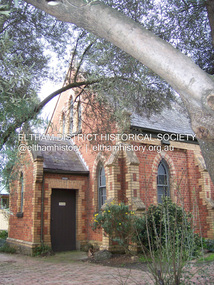
Photograph - Digital Photograph, Marguerite Marshall, Uniting Church, Main Road, Eltham, 19 August 2008
... stained-glass windows commemorate tragic events. A dove representing the Holy Spirit and Comforter marked the death in 1936 of member Effie Lowerson from scarlet fever at 14 years. The other depicting the Biblical story A sower went forth to sow, commemorates Ross Gangell, who died in 1961 at 23 years of a rare blood condition. ...stained-glass windows commemorate tragic events. A dove representing the Holy Spirit and Comforter marked the death in 1936 of member Effie Lowerson from scarlet fever at 14 years. The other depicting the Biblical story A sower went forth to sow, commemorates Ross Gangell, who died in 1961 at 23 years of a rare blood condition. ...Eltham's original Wesleyan Methodist Church Covered under Heritage Overlay, Nillumbik Planning Scheme. Published: Nillumbik Now and Then / Marguerite Marshall 2008; photographs Alan King with Marguerite Marshall.; p97 The pretty Uniting Church building at the corner of John and Main Roads Eltham has served the community since 1881.1 Originally called the Eltham Wesleyan Church, the church became the Eltham Methodist Church in 1902, the year it united with the Primitive Methodists.2 As the church community developed, influencing and being influenced by the wider community, its buildings changed accordingly. Eltham Wesleyans first worshiped together in 1850 at the home of William and Mary Crozier on 24 acres (9.7ha) bounded by Mount Pleasant Road and Pitt Street. From 1855 the Wesleyans worshipped in a slab-and-bark hut; then in 1858 in a chapel on Henry Street close to Maria Street (now Main Road). Meanwhile, in 1860, the Primitive Methodists opened a brick chapel at the corner of Susan and Bridge Streets. The John Street building – in the Early English Gothic style with biochrome brick window frames, buttress heads and pinnacle – was designed by architects Crouch and Wilson. Church member George Stebbing built the church as he did Eltham’s St Margaret’s Anglican Church and Shillinglaw Cottage. The Church Honour Roll is a poignant reminder of how church members have served the wider community: 27 members enlisted and 11 died in World War One. Despite the Great Depression, 1931 was a time of expansion for the church. Its red-brick hall was opened by prominent Methodist and philanthropist F J Cato of the Moran and Cato Grocery chain. The hall enabled the church to attract people from outside through activities like its gymnasium – with 40 boys and youth participating – and the girls’ callisthenics club, which competed at the Ballarat South Street Competitions. The church also held concerts, bazaars, picnics and sports, with badminton and tennis played on the church court at 23 John Street. Two stained-glass windows commemorate tragic events. A dove representing the Holy Spirit and Comforter marked the death in 1936 of member Effie Lowerson from scarlet fever at 14 years. The other depicting the Biblical story A sower went forth to sow, commemorates Ross Gangell, who died in 1961 at 23 years of a rare blood condition. Eltham’s population expanson resulted in the growth of the church and an extension in 1971, designed by member and architect Colin Jones. The church was linked to the hall and additions included a foyer, vestry, meeting room and toilets. The design reflected the Eltham style of the time, with its simplicity, extensive clear glass, reused baked clay-bricks from the 1881 church, heavy ceiling beams and solomite (compressed straw) ceiling. On June 26, 1977 the church became part of the new Uniting Church in Australia consisting of the former Methodist and Congregational and most of the Presbyterian Churches. In 1981 membership peaked at 159 – about 20 years after most Protestant churches – and continued to reach out to the wider community.3 In 1987, 147 children attended Selihoo, the weekly after-school program organised with St Margaret’s Anglican Church. From 1993, the church with other local churches, participated in LINC (Love in the Name of Christ), helping the wider community in various ways including babysitting, transport, gardening and visiting. Despite such initiatives, church numbers declined, and on June 23, 1996, the church merged with the Montmorency Uniting Church.4 However, the church continued to proclaim its message of love in community service and strong social justice action, such as in Jubilee 2000, supporting debt relief to the world’s 45 poorest countries. Some of the many church members who have had an outstanding impact on the wider community include Philip Shillinglaw, farmer and poet, and Arthur Bird (after whom the Arthur Bird Reserve is named), a pioneer orchardist and the Sunday School Superintendent for 33 years. Others were: the Rev Dr Cliff Wright, who established the Methodist Youth Fellowship and was prominent in the World Council of Churches, the Rev Brian Howe, who became Deputy Prime Minister and Tim Marshall, awarded the Order of Australia in 2000 for his work on salinity.This collection of almost 130 photos about places and people within the Shire of Nillumbik, an urban and rural municipality in Melbourne's north, contributes to an understanding of the history of the Shire. Published in 2008 immediately prior to the Black Saturday bushfires of February 7, 2009, it documents sites that were impacted, and in some cases destroyed by the fires. It includes photographs taken especially for the publication, creating a unique time capsule representing the Shire in the early 21st century. It remains the most recent comprehenesive publication devoted to the Shire's history connecting local residents to the past. nillumbik now and then (marshall-king) collection, eltham uniting church, eltham methodist church -
 Victoria Police Museum
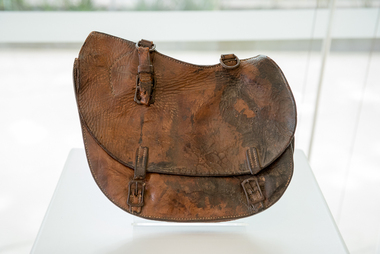
Cartridge bag (Ned Kelly)
... Sergeant Steele stated that the dark stain on the bag is Ned Kelly's blood: "That is Ned Kelly's cartridge bag. ...Sergeant Steele stated that the dark stain on the bag is Ned Kelly's blood: "That is Ned Kelly's cartridge bag. ...This cartridge bag was taken from Ned Kelly by Sergeant Steele, when he was finally apprehended in the famous shootout with police at Glenrowan, some two years after the Stringybark Creek murders. Sergeant Steele stated that the dark stain on the bag is Ned Kelly's blood: "That is Ned Kelly's cartridge bag. That is the one he was wearing at Glenrowan. I took it off him, with the other things, when he fell. And that stain is his blood. He was wounded in several places, and bled a good deal. Yes it is a grim relic - not at all pretty". (Sergeant Steel) Cartridge bags such as these were worn slung over the shoulder (the strap for this one is missing). They were used to carry ammunition.Bag, saddle, leather with flap and two metal buckles with straps broken. Metal loop and larger metal buckle attached at top. edward kelly, ned kelly, kelly gang, arthur steele, glenrowan -
 Ambulance Victoria Museum
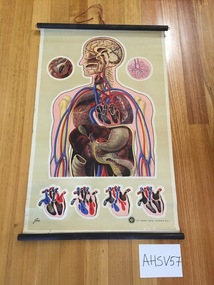
Chart, medical, human body, blood circulation, J. Teck
... Rectangular medical chart showing the upper part of the human body, skeleton, organs and blood circulation.The chart is made from printed paper on a fabric (?cotton) base and is attached with metal tacks to timber batons at each end . The timber batons are stained...Rectangular medical chart showing the upper part of the human body, skeleton, organs and blood circulation.The chart is made from printed paper on a fabric (?cotton) base and is attached with metal tacks to timber batons at each end . The timber batons are stained ...Rectangular medical chart showing the upper part of the human body, skeleton, organs and blood circulation.The chart is made from printed paper on a fabric (?cotton) base and is attached with metal tacks to timber batons at each end . The timber batons are stained black. A strip of red cotton tape is attached to the mid-part of the upper baton and has been used to secure the chart when it is rolled up. Metal ring eyelets are screwed into either end of the upper baton and were used to hang the chart.The artists name 'J.Teck' is included on the lower edge on the front of the chart (LHS). The logo of the St John's Ambulance Association and the words 'ST JOHN'S GATE, LONDON E.C. 1' are printed on the lower edge of the chart (on the front of the chart at RHS). The words 'BLOOD CIRCULATION' are written in blue ink on the top margin of the chart on the reverse side.medical chart, human body, blood circulation, j. teck -
 Ambulance Victoria Museum
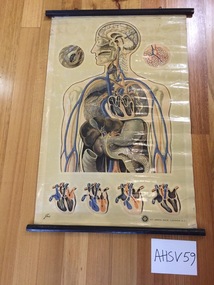
Chart, medical, blood circulation and heart, J. Teck
... blood circulation. The chart is attached to two wooden batons with small metal tacks. The top baton is moulded while the lower baton is circular in cross-section. Both batons are stained...blood circulation. The chart is attached to two wooden batons with small metal tacks. The top baton is moulded while the lower baton is circular in cross-section. Both batons are stained ...Rectangular medical chart made from printed and coated paper laid on white fabric (?cotton) and showing the upper part of the human body, with skeleton, organs and blood circulation. The chart is attached to two wooden batons with small metal tacks. The top baton is moulded while the lower baton is circular in cross-section. Both batons are stained black. There are two screwed metal eyelets attached to the upper baton used for hanging the chart. A short length of red cotton tape is attached to the mid point of the upper baton with a metal tack and is used for securing the chart when it is rolled up. There is the remnant of a printed paper label adhered on the reverse side of the chart at the top edge, but unable to read the writing.The artists name (J. Teck) is printed at the bottom LHS of the chart . The logo of the St John's Ambulance Association is printed on the RHS of the lower edge of the chart, along with the words 'St JOHN'S GATE, LONDON, E.C.1'medical chart, blood circulation -
 Woodend RSL
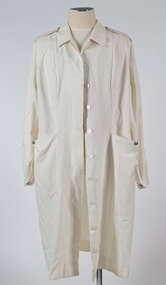
Coat, Late 20th Century
... It also has some areas of staining which could have been coused by contact with blood. This could potentially be useful for scientific research purposes. military coat st johns brigade uniform ambulance st johns brigade ambulance st johns Off white knee length coat with long sleeves. ...This coat would have been part of a St Johns Brigade ambulance uniform. The buttons were made by A J Parkes, who manufactured buttons for the Australian Defence force. A J Parkes began manufacturing plastic injection moulded buttons from the early 1980's which suggests that the coat would have been made and worn during the late 20th century.This item is representative of a particular piece of uniform that would have been worn by a member of the St Johns Ambulance Brigade. It has historic significance as an item dating to the late 20th century which may have been used in the service of wounded military personnel. It also has some areas of staining which could have been coused by contact with blood. This could potentially be useful for scientific research purposes.Off white knee length coat with long sleeves. There is an epoulette on each shoulder and pointed collars. There is a deep waist pocket on either side of the coat. There is one silver plastic button at the top of each pocket. These have the St John Ambulance symbol on the front, which consists of an eight pointed cross, with two very small lions and two very small unicorns nestled in the corners of the cross. These motifs are surrounded by the words "THE ST JOHN AMBULANCE BRIGADE". The epoulettes are fastened with one identical button each. Underneath each epoulette there is also a clear plastic button attached the shoulder seam. Each sleeve has a 36mm long cuff which is fastened with one St John Ambulance Brigade button each. There are 10 clear plastic buttons that fasten the entire front of the coat. The back has two pleats commencing near the nape of the neck. The back of the collar on the interior seam has a label which has been cut and shows only a small amount of detail. Printed in faded blue on the label is: "E.R. TIMMINS".military, coat, st johns brigade, uniform, ambulance, st johns brigade ambulance, st johns -
 Greensborough Historical Society
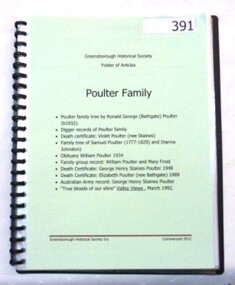
Document - Folder, Poulter Family, 1777o
... Contents: Poulter family tree; Digger records for Poulter family; Death Certificate Violet Poulter (nee Staines); family tree of Samuel Poulter and Dianna Johnston; Obituary William Poulter; Family group record William Poulter and Mary Frost; Death Certificate George Henry Staines Poulter 1949; Death certificate Elizabeth Poulter (nee Bathgate) 1989; Australian Army record of George Henry Staines Poulter; Newspaper article "True bloods of our shire"1992....Contents: Poulter family tree; Digger records for Poulter family; Death Certificate Violet Poulter (nee Staines); family tree of Samuel Poulter and Dianna Johnston; Obituary William Poulter; Family group record William Poulter and Mary Frost; Death Certificate George Henry Staines Poulter 1949; Death certificate Elizabeth Poulter (nee Bathgate) 1989; Australian Army record of George Henry Staines Poulter; Newspaper article "True bloods of our shire"1992. ...Contents: Poulter family tree; Digger records for Poulter family; Death Certificate Violet Poulter (nee Staines); family tree of Samuel Poulter and Dianna Johnston; Obituary William Poulter; Family group record William Poulter and Mary Frost; Death Certificate George Henry Staines Poulter 1949; Death certificate Elizabeth Poulter (nee Bathgate) 1989; Australian Army record of George Henry Staines Poulter; Newspaper article "True bloods of our shire"1992.History of the origins of this Greensborough family.20-page plastic binder, spiral bound, clear cover. Contains documents relating to the Poulter family.poulter family, violet poulter, george henry staines poulter, samuel poulter, william poulter
