
Showing 33 items matching "bob saw"
-
 Port Melbourne Historical & Preservation Society
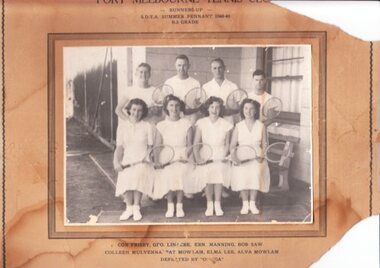
Photograph - PMTC Runners Up, SDTA Summer Pennant B3 Grade 1948-49, 1949
... ...Bob SAW...Men L-R: Con FRISBY, George LINACRE, Ern MANNING, Bob SAW Women L-R: Coleen MULVENNA, Pat MOWLAM, Elma LEE, Alva MOWLAM...Men L-R: Con FRISBY, George LINACRE, Ern MANNING, Bob SAW Women L-R: Coleen MULVENNA, Pat MOWLAM, Elma LEE, Alva MOWLAM Photograph PMTC Runners Up, SDTA Summer Pennant B3 Grade 1948-49 ...From a collection of 50 digital photographs and 1 short video relating to Port Melbourne Tennis Club. Information relating to individual images has been obtained from the image itself and/or the file name it has been given. The folder structure for the images has been maintained. One folder is called Opening with a sub-folder called EnTousCas which presumably refers to new court surface shown under construction and completed in some of the photos. This is one of an eclectic mix of 32 images in a sub-folder named "EnTousCas" under "Opening". This is one of a seemingly unrelated set of 12 images named ETC01 to ETC12 in the "EnTousCas" sub-folder under "Opening". Digital copy of a mounted B&W photograph of Port Melbourne Tennis Club team, runners up Southern Districts Tennis Association (SDTA) Summer Pennant B3 Grade 1948-49. The photograph has four men standing behind four seated women, all in tennis whites and holding racquets. The caption includes names. Men L-R: Con FRISBY, George LINACRE, Ern MANNING, Bob SAW Women L-R: Coleen MULVENNA, Pat MOWLAM, Elma LEE, Alva MOWLAMport melbourne tennis club, sport - tennis, con frisby, george linacre, ern manning, bob saw, coleen mulvenna, pat mowlam, elma lee, alva mowlam -
 Port Melbourne Historical & Preservation Society
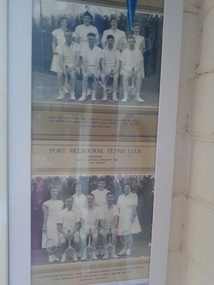
Photograph - PMTC Historic Photographs, 1940s
... ...Bob SAW...Women L-R: Emma LEE, Thel LINACRE, Peg ROBERTSON, Colleen MULVENNA (Emergency) Men L-R: Ern MANNING (Emergency), Keith RUSDEN (Captain), Bob SAW, George LINACRE The bottom photograph has four women standing behind three seated men, all in tennis whites and holding racquets. ...Women L-R: Emma LEE, Thel LINACRE, Peg ROBERTSON, Colleen MULVENNA (Emergency) Men L-R: Ern MANNING (Emergency), Keith RUSDEN (Captain), Bob SAW, George LINACRE The bottom photograph has four women standing behind three seated men, all in tennis whites and holding racquets. ...From a collection of 50 digital photographs and 1 short video relating to Port Melbourne Tennis Club. Information relating to individual images has been obtained from the image itself and/or the file name it has been given. The folder structure for the images has been maintained. One folder is called Opening with a sub-folder called EnTousCas which presumably refers to new court surface shown under construction and completed in some of the photos. This is one of an eclectic mix of 32 images in a sub-folder named "EnTousCas" under "Opening". This is one of a seemingly unrelated set of 12 images named ETC01 to ETC12 in the "EnTousCas" sub-folder under "Opening". Digital copy of two mounted B&W photographs of Port Melbourne Tennis Club teams. The mount at the top has been cropped from the photograph but it seems these are PMTC premiership teams in the Southern Districts Tennis Association (SDTA) in the 1940s. The top photograph has four women standing behind four seated men, all in tennis whites and holding racquets. The caption includes names and that they defeated Kooyong Road. Women L-R: Emma LEE, Thel LINACRE, Peg ROBERTSON, Colleen MULVENNA (Emergency) Men L-R: Ern MANNING (Emergency), Keith RUSDEN (Captain), Bob SAW, George LINACRE The bottom photograph has four women standing behind three seated men, all in tennis whites and holding racquets. The heading indicates they were Premiers, SDTA Winter Pennant 1948, AR3 Grade. The caption includes names and that they defeated Randall. Women L-R: Pat MOWLAM (Emergency), June WILKINSON, Thelma LINACRE, Ruby WILKINSON Men L-R: Alby MOWLAM, Alby WILKINSON (Captain), Keith HALLAMport melbourne tennis club, sport - tennis, peg robertson, colleen mulvenna, ern manning, keith rusden, bob saw, george linacre, pat mowlam, june wilkinson, thelma linacre, ruby wilkinson, alby mowlam, alby wilkinson, keith hallam, elma lee -
 Federation University Historical Collection
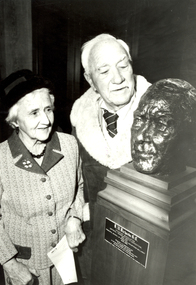
Photograph - Photograph - Black and White, Ballarat Courier, Dick Richards and his sister, Mrs V.S. Greenhalgh with the Bust of Dick Richards, 06/1983
... saw a ship on the horizon. It was 'The Aurora'. Picking up the relieved survivors 'The Aurora' arrived in New Zealand on 9 February 1917 to a hero's welcome. Joyce, Wild, Hayward and Richards later won the Albert Medal for their heroic devotion to duty. Later an inlet on the Antartic continent was named after Richards. Dick Richards wrote the following years after the ordeal "To me no undertaking carried through to conclusion is for nothing. And so I don't think of our struggle as futile. It was something the human spirit accomplished." Prime Minister Bob...saw a ship on the horizon. It was 'The Aurora'. Picking up the relieved survivors 'The Aurora' arrived in New Zealand on 9 February 1917 to a hero's welcome. Joyce, Wild, Hayward and Richards later won the Albert Medal for their heroic devotion to duty. Later an inlet on the Antartic continent was named after Richards. Dick Richards wrote the following years after the ordeal "To me no undertaking carried through to conclusion is for nothing. And so I don't think of our struggle as futile. It was something the human spirit accomplished." Prime Minister Bob ...Dick Richards joined the Ballarat School of Mines in 1914, and soon afterwards was granted leave to join an expedition to Antartica. In 1915 he sailed from Australia with the Antartic Exploraton Expedition, led by Sir Ernest Shackleton. Most Antarctic enthusiasts know of Ernest Shackleton's attempt to cross the continent, only to be thwarted by the sinking of the ship 'Endurance'. Dick Richards was the physicist and sled manager for Shackleton's Ross Sea Party - with the task to meet Shackleton on the other side of the continent. When Shackleton planned his transcontinental crossing he decided to use supply depots as loads of supplies were too heavy to pull. The depots would enable Shackleton's party to carry just enough to reach the Pole, relying on the depots which were to be left by the Aurora's crew every 60 miles, stowed in 2 sledge journeys in 1915 and 1916. Dick Richards spent 3 freezing years in Antarctica between 1914 and 1917. Richards' worst experience was when his ship Aurora, tethered offshore, was blown away in a gale leaving Richards marooned for two years with nine other men on the ice floe. The expedition, consisting of two teams, were attempting to cross Antarctica from opposite sides, linking up somewhere near the middle. "That was with pretty poor equipment by today's standards, and we did not make it." (Dick Richards) The Ross Sea Party arrived in McMurdo Sound aboard the Aurora in January 1915. The men planned to make two sledging trips to leave supply depots every 60 nautical miles to Mount Hope about 400 miles away. The going was tough as the sledges were overloaded. Temperatures were as low as minus 68F. In June 1916 the party crossed on foot to Cape Evans, occupied Scott's Hut (from his Terra Nova Expedition, erected in January 1911) in May 1915, for two months. On 10 January 1917 Richards was hunting for seals when he saw a ship on the horizon. It was 'The Aurora'. Picking up the relieved survivors 'The Aurora' arrived in New Zealand on 9 February 1917 to a hero's welcome. Joyce, Wild, Hayward and Richards later won the Albert Medal for their heroic devotion to duty. Later an inlet on the Antartic continent was named after Richards. Dick Richards wrote the following years after the ordeal "To me no undertaking carried through to conclusion is for nothing. And so I don't think of our struggle as futile. It was something the human spirit accomplished." Prime Minister Bob Hawke wrote in 1984 'Your incredible journey of almost 2000 miles across the Antarctic Wastelands - involving some 9 months in the field with makeshift equipment - and you're adherence to duty in the face of enormous difficulty, suffering from scurvy, and the death of comrades, will; be an inspiration to your countrymen of the future as it is to us today." After returning to Australia Dick Richards resumed his work at SMB as Lecturer in Physics and Mathematics, and developed many pieces of experimental equipment. During World War Two he acted as a scientific adviser in the production of optical apparatus in Australia. In 1946 he was appointed Principal and twelve years later he retired after a total of 44 years service. Dick Richards has been honoured through the naming of a Ballarat School of Mines prize - The R.W. Richards Medal. This medal later became a University of Ballarat prize. It has been awarded annually since 1959 to the Bachelor of Applied Science graduate considered to have achieved the most outstanding academic performance of their course. (See http://guerin.ballarat.edu.au/aasp/is/library/collections/art_history/honour-roll/honourroll_Richards,Dick.shtml )A man and lady inspect a bust of Richard (Dick) Richards by sculptor Victor Greenhalgh. The scultpure is at the Ballarat School of Mines. The man is Dick Richards, and the woman is his sister and wife of sculptor Victor Greenhalgh. Both Dick Richards and Victor Greenhalgh were former students and teachers at the Ballarat School of Mines. The bust of Dick Richards was Victor Greenhalgh's last work and was cast in bronze after his death. The bust was presented to the Ballarat School of Mines by Mrs V.S. Greenhalgh (widow of the sculptor and sister of the subject). At the presentation Victor Greenhagh's son said "the two men had been friends as well as brothers-in-law, were of similar age, both enjoyed red wine, beer and cricket and both were educationalists, one an artist the other a mathematician."dick richards, r.w. richards, richards, richard w. richards, victor greenhalgh, bust, sculpture, ballarat school of mines, antarctica, ross shore -
 Greensborough Historical Society
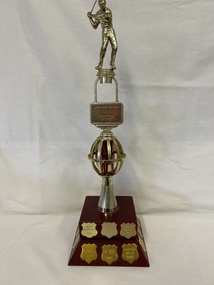
Award - Trophy, Thomastown Golf Club, Thomastown Golf Club. C Grade Perpetual Trophy 1980-1991, 1980-1991
... Sia; 1982 Darrell Mills; 1983 L Saw; 1984, 1988 and 1990 Bob Jones; 1985 D. Graham; 1986 Gerorge Stewart; 1987 Graem McRobbie; 1989 Bruce Banks; 1991 Rodney McDonald....Sia; 1982 Darrell Mills; 1983 L Saw; 1984, 1988 and 1990 Bob Jones; 1985 D. Graham; 1986 Gerorge Stewart; 1987 Graem McRobbie; 1989 Bruce Banks; 1991 Rodney McDonald. ...Golf trophy awarded by the Thomastown Golf Club. The C Grade Perpetual Trophy 1980-1991 was won by: 1980 D. Roberts; 1981 S. Sia; 1982 Darrell Mills; 1983 L Saw; 1984, 1988 and 1990 Bob Jones; 1985 D. Graham; 1986 Gerorge Stewart; 1987 Graem McRobbie; 1989 Bruce Banks; 1991 Rodney McDonald.Thomastown Golf Club was a social club formed in 1976. This is part of the Robert (Bob) Jones collection of Club memorabilia.Golf trophy, plastic golfer on plastic trophy on timber base."Thomastown Golf Club. C Grade Perpetual Trophy 1980-1991" engraved on plaque, winners' names on base.thomastown golf club, golf trophies, bob jones -
 The Beechworth Burke Museum
Photograph, 1936
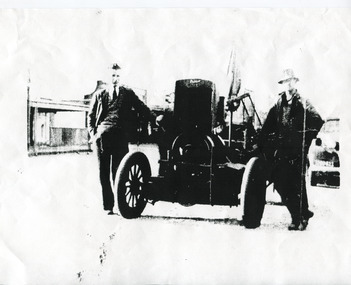
... Bob Pyle...Robert Pyle...R J Pyle...Clarrie Howell...Howell...Pyle...Invention...patent...sawmill...saw...This automotive circular saw was designed to allow trees to be sawn into planks at the site they were felled, rather than requiring them to be carted to a lumber mill first. It was invented by Robert John (Bob...What was special about Bob’s new invention was that it not only allowed a circular saw to be portable and set up at a logging site, but that it allowed the circular saw to be run using the car motor, and that the saw could be detached, allowing the car to be used for carting or other purposes. ...This automotive circular saw was designed to allow trees to be sawn into planks at the site they were felled, rather than requiring them to be carted to a lumber mill first. It was invented by Robert John (Bob) Pyle in 1936 and patented in 1937 (serial number 101975). This picture depicts Clarrie Howell (left) and Bob Pyle (right), standing with the sawbench between them. What was special about Bob’s new invention was that it not only allowed a circular saw to be portable and set up at a logging site, but that it allowed the circular saw to be run using the car motor, and that the saw could be detached, allowing the car to be used for carting or other purposes. This photograph is significant because it shows an early instance of an emerging technology, portable sawmills, and is evidence to the innovations that the people of Beechworth have achieved throughout history, as well Black and White rectangular photograph printed on matte photographic paper. Incription on cream paper stapled to bottom left of photographObverse: On left Clarrie Howell / Right Bob Pyle / with sawbench built by Bob Pyle / Patent 1936 / Rosalie Pyle has the original / [redacted]bob pyle, robert pyle, r j pyle, clarrie howell, howell, pyle, invention, patent, sawmill, saw, sawbench, wood, timber, forestry, automobile, car, 1930s, 1930s beechworth, industry, wooden, convenience, innovation -
 Flagstaff Hill Maritime Museum and Village
Postcard - Local Postcards, Joseph Jordan Photographic Studio, Nov 1908 - early 1909
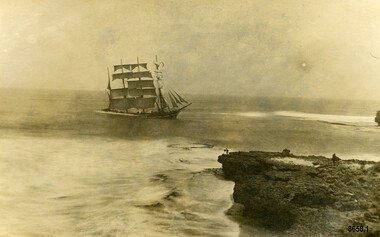
... Saw (Saul)? on Thursday at Peterborough / He is having a grand holiday / Expecting letter on /Tuesday Fondest Love / "Bob" Front of postcard 8658.3 - "Falls of Halladale. ...Saw (Saul)? on Thursday at Peterborough / He is having a grand holiday / Expecting letter on /Tuesday Fondest Love / "Bob" Front of postcard 8658.3 - "Falls of Halladale. ...ABOUT THE ‘FALLS OF HALLADALE’ (1886 - 1908) Built: in1886 by Russell & Co., Greenock shipyards, River Clyde, Scotland, UK. The company was founded in 1870 (or 1873) as a partnership between Joseph Russell (1834-1917), Anderson Rodger and William Todd Lithgow. During the period 1882-92 Russell & Co., they standardised designs, which sped up their building process so much that they were able to build 271 ships over that time. In 1886 they introduced a 3000 ton class of sailing vessel with auxiliary engines and brace halyard winches. In 1890 they broke the world output record. Owner: Falls Line, Wright, Breakenridge & Co, 111 Union Street, Glasgow, Scotland. Configuration: Four masted sailing ship; iron-hulled barque; iron masts, wire rigging, fore & aft lifting bridges. Size: Length 83.87m x Breadth 12.6m x Depth 7.23m, Gross tonnage 2085 ton Wrecked: the night of 14th November 1908, Curdies Inlet, Peterborough southwest Victoria Crew: 29 The Falls of Halladale was a four-masted sailing ship built-in 1886 in Glasgow, Scotland, for the long-distance cargo trade and was mostly used for Pacific grain trade. She was owned by Wright, Breakenridge & Co of Glasgow and was one of several Falls Line ships, all of which were named after waterfalls in Scotland. The lines flag was of red, blue and white vertical stripes. The Falls of Halladale had a sturdy construction built to carry maximum cargo and able to maintain full sail in heavy gales, one of the last of the ‘windjammers’ that sailed the Trade Route. She and her sister ship, the Falls of Garry, were the first ships in the world to include fore and aft lifting bridges. Previous to this, heavily loaded vessels could have heavy seas break along the full length of the deck, causing serious injury or even death to those on deck. The new, raised catwalk-type decking allowed the crew to move above the deck stormy conditions. This idea is still used today in the most modern tankers and cargo vessels and has proved to be an important step forward in the safety of men at sea. On 4th August 1908, with new sails, 29 crew, and 2800 tons of cargo, the Falls of Halladale left New York, bound for Melbourne and Sydney via the Cape of Good Hope. The cargo on board was valued at £35,000 and included 56,763 tiles of American slate roofing tiles (roof slates), 5,673 coils of barbed wire, 600 stoves, 500 sewing machines, 6,500 gallons of oil, 14,400 gallons of benzene, plumbing iron, 117 cases of crockery and glassware and many other manufactured items. The Falls of Halladale had been at sail for 102 days when, at 3 am on the night of 14th November 1908, under full sail in calm seas with a six knots breeze behind and misleading fog along the coast, the great vessel rose upon an ocean swell and settled on top of a submerged reef near Peterborough on south-west Victoria’s coast. The ship was jammed on the rocks and began filling with water. The crew launched the two lifeboats and all 29 crew landed safely on the beach over 4 miles away at the Bay of Islands. The postmistress at Peterborough, who kept a watch for vessels in distress, saw the stranding and sent out an alert to the local people. A rescue party went to the aid of the sailors and the Port Campbell rocket crew was dispatched, but the crew had all managed to reach shore safely by the time help arrived. The ship stayed in full sail on the rocky shelf for nearly two months, attracting hundreds of sightseers who watched her slowly disintegrate until the pounding seas and dynamiting by salvagers finally broke her back, and her remains disappeared back into deeper water. The valuable cargo was largely lost, despite two salvage attempts in 1908-09 and 1910. Further salvage operations were made from 1974-1986, during which time 22,000 slate tiles were recovered with the help of 14 oil drums to float them, plus personal artefacts, ship fittings, reams of paper and other items. The Court of Marine Inquiry in Melbourne ruled that the foundering of the ship was entirely due to Captain David Wood Thomson’s navigational error, not too technical failure of the Clyde-built ship. The shipwreck is a popular site for divers, about 300m offshore and in 3 – 15m of water. Some of the original cargo can be seen at the site, including pieces of roof slate and coils of barbed wire. These 5 postcards have photographic images taken while the Falls of Halladale was stuck on the reef near Peterborough. They are not stamped or dated but four of the images show the ship still in fairly good condition with her stern very low in the water so can be dated to around late November 1908 to January 1909 and the fifth image shows the ship beginning to disintegrate soon after. The image on Postcard 8658.3 was taken by Joseph Jordan (a well-known Warrnambool photographer who had his own studio in Liebig Street, Warrnambool). The other four images were supposedly taken by the sender (Bob) and converted to postcards. Amateur photography in Australia in the early 1900's was becoming very popular (and accessible) to the average person. Many newspapers published advertisements and articles about photography and photographic supplies. In 1903 in America, George Eastman designed and marketed the "Model 3A Folding Pocket Kodak" which used postcard-size negatives and provided the average person with a camera with which to make real photo postcards. As they became popular, George Eastman was able to develop and market a wide range of supplies for the amateur photographer to develop and print their own photographs onto a postcard backing at home. Four of the postcards were addressed to "Miss M. Kerr, Leura, Camperdown". Mary Agnes Kerr (1888 - 1943) was the daughter of William and Mary Ann Kerr (nee Spence) who owned "Leura Farm" at Camperdown. Mary Agnes Kerr went on to marry James Young Caldwell (a local tailor and mercer) in 1917. James Yong Caldwell came to Camperdown around 1908 and was employed as a draper. The postcards were signed "Bob". On postcard 5658.2 he has written his name with quotation marks around it - suggesting "Bob" is a nickname. He writes about the weather, meeting a friend, sending fish to Mary Agnes' family and the cargo expected to be washed up on the beach. On postcard 8658.4 he wrote about being busy after the wreck and supplying the shipwrecked crew with boots and pants which suggests "Bob" may be James Caldwell (the mercer and tailor).The Falls of Halladale shipwreck is listed on the Victorian Heritage Register (No. S255). She was one of the last ships to sail the Trade Routes. She is one of the first vessels to have fore and aft lifting bridges. She is an example of the remains of an International Cargo Ship and also represents aspects of Victoria’s shipping industry. The wreck is protected as a Historic Shipwreck under the Commonwealth Historic Shipwrecks Act (1976). These postcards are significant as examples of the continued interest the locals around the district of Peterborough showed towards the Falls of Halladale wreck and its disintegration during the next few months. Four of the postcards are also significant examples of the new hobby of photography that was available to the average person during the beginning of the 20th century.Set of 5 postcards showing different images of the Falls of Halladale sailing ship after it became stuck on a reef near Peterborough. None of the postcards are dated or stamped. Postcard 8658.1 has a sepia toned image of the Falls of Halladale, with its stern sitting very low in the water. It has many of its sails unfurled and there is a rocky headland in the foreground. A very small figure appears to be on the edge of the cliff. The back of the postcard has a handwritten message addressed to "Miss M Kerr, Leura, Camperdown" and is signed "Love Bob". Postcard 8658.2 has a sepia image of the Falls of Halladale taken some months after it had been stuck on the reef. Its sails are missing and only two broken masts remain. A large rock is visible in the front right hand side of the photo. There is a handwritten message on the back signed by "Bob". Postcard 8658.3 has a black and white image of the Falls of Halladale showing her almost side on with her stern very low in the water and still in full sail. The words "Falls of Halladale. No 1" are printed on the lower left side of the image. The back is labelled "Jordan Series". There is no message written on the back. Postcard 8658.4 has a sepia toned image of the Falls of Halladale facing two rocky headlands. She is showing full sail and the sea appears calm. There is a handwritten note on the back addressed to "Miss M Kerr" from "Bob". Postcard 8658.5 has a sepia image of a side view of the Falls of Halladale with her stern very low in the water and her sails are all up. The sea is calm and a rocky reef can be seen in the foreground. It has a handwritten note on the back from "Bob" to "Miss M Kerr" of Leura, Camperdown.Back of postcard 8658.1- "POST" "EMPIRE" "CARD" "FOR CORRESPONDENCE" "FOR ADDRESS ONLY" "STAMP" "Miss M Kerr / Leura / Camperdown" "Looking forward to letter today" "Hope fish arrived / allright. Don't / know for sure / what day I will / be going to Town / to buy. Some day / this week / Love Bob Back of postcard 8658.2 - "POST CARD"/ "CORRESPONDENCE" "ADDRESS ONLY" "93"/ "Friday / This is a contrast to the first/ I sent you. Having glorious weather / Saw Saw (Saul)? on Thursday at Peterborough / He is having a grand holiday / Expecting letter on /Tuesday Fondest Love / "Bob" Front of postcard 8658.3 - "Falls of Halladale. No 1" Back of postcard 8658.3 -"Post" "Card"/ Printed in Great Britain" /"This space may be used for Communication" "The Address to be written / here" "Jordan Series" Back of postcard 8658.4 -"POST" "EMPIRE" "CARD"/ "FOR CORRESPONDENCE" "FOR ADDRESS ONLY" / "STAMP" "Miss M Kerr/ Leura / Camperdown"/ "We are/ very busy. The / wreck is about / 11/2 other side of / Peterborough./ Fondest Love, Bob "Had to supply sailors with Boots Pants etc/ 25 pairs Boots, good order ah!" Back of postcard 8658.5 - "POST" "EMPIRE" "CARD" / "FOR CORRESPONDENCE" "FOR ADDRESS ONLY" / "STAMP"/ "Miss M Kerr / Leura / Camperdown" "Tuesday / Her estimated / value cargo included/ is (pounds)100,000. When / she breaks up the coast / will be strewn with / wreckage as the cargo / includes Rolls Paper./all sorts machinery thousands / cases Benzine etc/ love Bob flagstaff hill maritime museum and village, warrnambool, peterborough, great ocean road, falls of halladale, shipwreck, postcards, photographic images, mary agnes kerr, leura farm, camperdown, jordan series, handwritten notes, photographs, george eastman, 3a folding pocket kodak camera -
 City of Moorabbin Historical Society (Operating the Box Cottage Museum)
Newsletter - City of Moorabbin Historical Society Aug 2007, August 2007
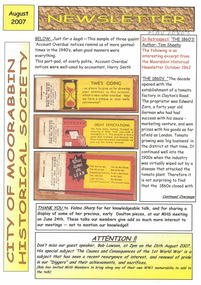
... saw ‘the establishment of Edward Zorn’s Tomato factory in Clayton’s Road in 1862 and then Henry Comport’s Sauce factory in Cheltenham. ‘New settlers’ arriving in the area were William Highett , near Hampton, Mr McKinnon , an Oakleigh farmer, and Mr Stephen Tuck and wife to Cheltenham while Mr John Kingston was looking for land.. 60 children were enrolled at St Stephen’s Common School on Tucker Road. George Higginbotham., William Highett and Tommy Bent were confident of the years ahead.’ Upcoming events at CMHS were August 26th Mr Bob...bob lawson nan kelleher bryan comport henry zorn edward highett william bent tommy higginbotham george kingston john le roy tracy pty.ltd sydney tomato sauce factory CITY of MOORABBIN HISTORICAL SOCIETY / AUGUST 2007 NEWSLETTER A4 paper printed both sides x1. Issue 3 of the bi-monthly, City of Moorabbin Historical Society Newsletter produced by Society member and Secretary, Mrs Helen Stanley in August 2007. Members of the CMHS are shown 3 photocopies of ‘quaint Account Overdue ‘ notices c 1940,. An excerpt from the 1962 Moorabbin Historical Society Newsletter, edited by the President Tom Sheehy, describing the 1860’s decade that saw ...The City of Moorabbin Historical Society was formed c 1960 by a group of Moorabbin residents who were concerned that the history of the area should be preserved. A good response to a call for items related to the historical area of Moorabbin Shire brought donations of a wide variety of artefacts which are now preserved by the current members of CMHS at Box Cottage Museum . Helen Stanley, Secretary of CMHS, began producing a Newsletter for members in April 2007 to provide current information and well researched items of historical interest.Helen Stanley has produced a bi-monthly Newsletter, 2007 - 2013, for the members of the City of Moorabbin Historical Society that contains well researched interesting historical items, notification of upcoming events, current advice from Royal Australian Historical Society , Museums Australia Victoria and activities of Local Historical Societies. The Newsletter is an important record of the activities of the CMHS. Tom Sheehy, a past President of CMHS, was an Historian and Author of ‘Battlers tamed the Sandbelt’, the Lawson family were early settlers, Dr Graham Whitehead, is Historian for Kingston CC and the Henry Lawson Society promotes the Poet’s works.A4 paper printed both sides x1. Issue 3 of the bi-monthly, City of Moorabbin Historical Society Newsletter produced by Society member and Secretary, Mrs Helen Stanley in August 2007. Members of the CMHS are shown 3 photocopies of ‘quaint Account Overdue ‘ notices c 1940,. An excerpt from the 1962 Moorabbin Historical Society Newsletter, edited by the President Tom Sheehy, describing the 1860’s decade that saw ‘the establishment of Edward Zorn’s Tomato factory in Clayton’s Road in 1862 and then Henry Comport’s Sauce factory in Cheltenham. ‘New settlers’ arriving in the area were William Highett , near Hampton, Mr McKinnon , an Oakleigh farmer, and Mr Stephen Tuck and wife to Cheltenham while Mr John Kingston was looking for land.. 60 children were enrolled at St Stephen’s Common School on Tucker Road. George Higginbotham., William Highett and Tommy Bent were confident of the years ahead.’ Upcoming events at CMHS were August 26th Mr Bob Lawson will talk about World War 1, on October 28th a talk by Dr G Whitehead titled ‘Murder’, and at the last meeting for year November 25th Frank Thatcher, CMHS, will welcome the Henry Lawson Society and Australian Natives Association who will again come to Box Cottage to celebrate their Bryan Kelleher Memorial Picnic Day. CITY of MOORABBIN HISTORICAL SOCIETY / AUGUST 2007 NEWSLETTERcity of moorabbin historical society, stanley helen, melbourne, moorabbin, brighton, cheltenham, ormond, bentleigh, oakleigh, kingston, highett, hampton, clayton, market gardeners, pioneers, early settlers, moorabbin shire, sheehy tom, thatcher frank, tucker road, st stephen’s common school, henry lawson society, australian natives association, whitehead dr graham, lawson bob, lawson nan, kelleher bryan, comport henry, zorn edward, highett william, bent tommy, higginbotham george, kingston john, le roy tracy pty.ltd, sydney, tomato sauce factory -
 Greensborough Historical Society
Photograph - Photograph Collection, Alison Lendoudis et al, White brand tenon saw at Briar Hill Timber 1996, 1996
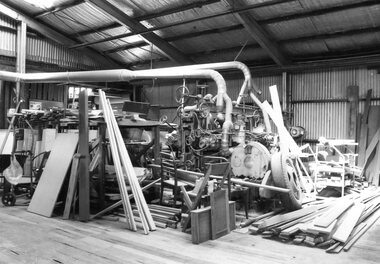
... saw extensively used in the 1970s for component manufacture. The Briar Hill Timber and Trading Company was active during the 1930s - 1950s during the development of the local area with many houses being built by owner-builders who used the company for their needs. briar hill timber and trading company briar hill timber alison lendoudis bob manuell sherbourne road briar hill squire family saws A group of 2 black and white photographs White brand tenon saw at Briar Hill Timber 1996 Photograph Photograph Collection Alison Lendoudis Bob Manuell ...'White’ brand double ended tenon saw extensively used in the 1970s for component manufacture.The Briar Hill Timber and Trading Company was active during the 1930s - 1950s during the development of the local area with many houses being built by owner-builders who used the company for their needs. A group of 2 black and white photographsbriar hill timber and trading company, briar hill timber, alison lendoudis, bob manuell, sherbourne road briar hill, squire family, saws -
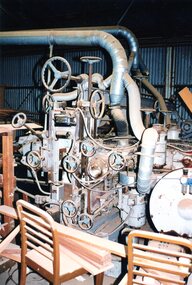 Greensborough Historical Society
Photograph - Photograph Collection, Alison Lendoudis et al, Double ended tenon saw at Briar Hill Timber 1996, 1996
... saw at Briar Hill Timber was used to make doors, windows and stretchers for artists’ canvas. The Briar Hill Timber and Trading Company was active during the 1930s - 1950s during the development of the local area with many houses being built by owner-builders who used the company for their needs. briar hill timber and trading company briar hill timber alison lendoudis bob manuell sherbourne road briar hill squire family saws A group of 17 black and white or colour photographs Double ended tenon saw at Briar Hill Timber 1996 Photograph Photograph Collection Alison Lendoudis Bob Manuell ...The double ended tenon saw at Briar Hill Timber was used to make doors, windows and stretchers for artists’ canvas.The Briar Hill Timber and Trading Company was active during the 1930s - 1950s during the development of the local area with many houses being built by owner-builders who used the company for their needs. A group of 17 black and white or colour photographsbriar hill timber and trading company, briar hill timber, alison lendoudis, bob manuell, sherbourne road briar hill, squire family, saws -
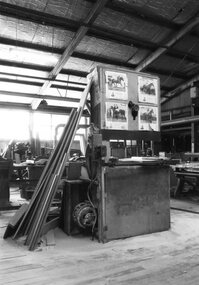 Greensborough Historical Society
Photograph - Photograph Collection, Alison Lendoudis et al, Band saw at Briar Hill Timber 1996, 1996
... Band saw at Briar Hill Timber 1996 The Briar Hill Timber and Trading Company was active during the 1930s - 1950s during the development of the local area with many houses being built by owner-builders who used the company for their needs. briar hill timber and trading company briar hill timber alison lendoudis bob manuell sherbourne road briar hill squire family saws A group of 4 black and white photographs Band saw at Briar Hill Timber 1996 Photograph Photograph Collection Alison Lendoudis Bob Manuell ...Band saw at Briar Hill Timber 1996The Briar Hill Timber and Trading Company was active during the 1930s - 1950s during the development of the local area with many houses being built by owner-builders who used the company for their needs. A group of 4 black and white photographsbriar hill timber and trading company, briar hill timber, alison lendoudis, bob manuell, sherbourne road briar hill, squire family, saws -
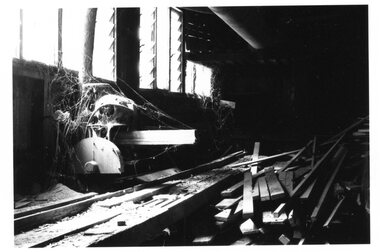 Greensborough Historical Society
Photograph - Photograph Collection, Alison Lendoudis et al, 'Nylex' docking saw at Briar Hill Timber 1996, 1996
... 'Nylex' docking saw from the 1950s at Briar Hill Timber 1996 The Briar Hill Timber and Trading Company was active during the 1930s - 1950s during the development of the local area with many houses being built by owner-builders who used the company for their needs. briar hill timber and trading company briar hill timber alison lendoudis bob manuell sherbourne road briar hill squire family saws A group of 10 black and white photographs 'Nylex' docking saw at Briar Hill Timber 1996 Photograph Photograph Collection Alison Lendoudis Bob Manuell ...'Nylex' docking saw from the 1950s at Briar Hill Timber 1996The Briar Hill Timber and Trading Company was active during the 1930s - 1950s during the development of the local area with many houses being built by owner-builders who used the company for their needs. A group of 10 black and white photographsbriar hill timber and trading company, briar hill timber, alison lendoudis, bob manuell, sherbourne road briar hill, squire family, saws -
 Greensborough Historical Society
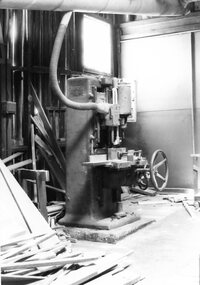
Photograph - Photograph Collection, Alison Lendoudis et al, Pickles morticer at Briar Hill Timber 1996, 1996
... The Briar Hill Timber and Trading Company was active during the 1930s - 1950s during the development of the local area with many houses being built by owner-builders who used the company for their needs. briar hill timber and trading company briar hill timber alison lendoudis bob manuell sherbourne road briar hill squire family saws A group of 4 black and white photographs Pickles morticer at Briar Hill Timber 1996 Photograph Photograph Collection Alison Lendoudis Bob Manuell ...Pickles morticer at Briar Hill Timber 1996. It was used extensively in the 1950s and 1960s for the manufacture of containers and pallets for air force and army contracts.The Briar Hill Timber and Trading Company was active during the 1930s - 1950s during the development of the local area with many houses being built by owner-builders who used the company for their needs. A group of 4 black and white photographsbriar hill timber and trading company, briar hill timber, alison lendoudis, bob manuell, sherbourne road briar hill, squire family, saws -
 Orbost & District Historical Society
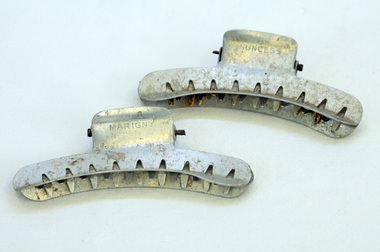
hair clips, 1930's
... The 1920's and 30's saw new simple hairstyles. The hair was often short and cut into a bob shape and then curled or more commonly ornamented with fingerwaves. the children came in. ...The 1920's and 30's saw new simple hairstyles. The hair was often short and cut into a bob shape and then curled or more commonly ornamented with fingerwaves. the children came in. ...This clip was not made to be worn in the hair, it was made to create fingercurls, a style of hairdo very popular in the 1920's and 1930's. The 1920's and 30's saw new simple hairstyles. The hair was often short and cut into a bob shape and then curled or more commonly ornamented with fingerwaves. the children came in. These hairclips were used to hold the curl in place as the hair dried.These items are examples of women's hair accessories commonly used in the mid 20th century.Two metal butterfly clips for waving hair. They are spring hinged and probably made of aluminium.hair-accessories hair-clips -
 Warrnambool RSL Sub Branch
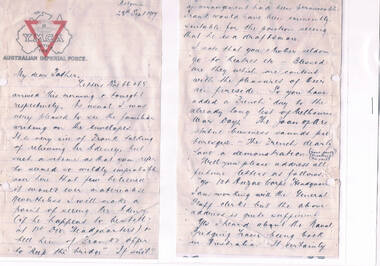
MUSIC, Bob's passion. He always carried his favourite music scores in his kit, including some hard cover grand operas. On leave, he saw as many operas as he could, taking the score along to each performance, keeping one eye on the show and the other on the music. On 29 November, 1916, while stationed at Vignacourt, Bob was given permission to play the church pipe organ for an hour or so (3 recent photos, courtesy Isabelle Godard, see attached). One day in September 1917, somewhere in Flanders, whilst visiting 2nd Division HQ, Bob had a chance meeting with the decorated infantry officer, Captain Rupert 'Sos' Wertheim (whose interrogation of German POWs crucially affected the Allies preparation for the Battle of Menin Road). He was the son of the German Jewish emigré who set up the famous Richmond-based Wertheim piano-factory in the early 1900s. Captain Wertheim asked Bob to play all the operatic pieces he could remember. (A few days later, a stray German shell hit the 2nd Div. HQ killing a number of officers)
... On leave, he saw as many operas as he could, taking the score along to each performance, keeping one eye on the show and the other on the music. On 29 November, 1916, while stationed at Vignacourt, Bob was given permission to play the church pipe organ for an hour or so (3 recent photos, courtesy Isabelle Godard, see attached). ...Bob's passion. He always carried his favourite music scores in his kit, including some hard cover grand operas. On leave, he saw ...snape collection -
 Wycheproof & District Historical Society Inc.
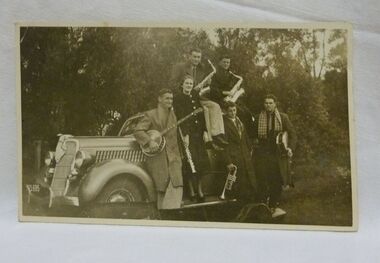
Photograph, Harrington, The Storey Dance Orchestra, (estimated); 1937/38
... Bob and Ben. Later, their mother, also Jean, an accomplished pianist and supporter of the orchestra, filled the pianist role after Jean left home to further her career. The car in the photograph was paid for with orchestra earnings. Their music involvement enabled a large family to sustain the farm during the 1920s and 1930s. World-War-Two intervened, this saw...Bob and Ben. Later, their mother, also Jean, an accomplished pianist and supporter of the orchestra, filled the pianist role after Jean left home to further her career. The car in the photograph was paid for with orchestra earnings. Their music involvement enabled a large family to sustain the farm during the 1920s and 1930s. World-War-Two intervened, this saw ...The Storey Dance Orchestra was formed in the 1920s by Arthur Storey, playing voilin & banjo, sister Rita-saxaphone,Jean and brothers Bob and Ben. Later, their mother, also Jean, an accomplished pianist and supporter of the orchestra, filled the pianist role after Jean left home to further her career. The car in the photograph was paid for with orchestra earnings. Their music involvement enabled a large family to sustain the farm during the 1920s and 1930s. World-War-Two intervened, this saw the Storey Orchestra disperse, Bob joined Jean in Melbourne, where they continued their musical careers. Ben joined the war effort, leaving Arthur on the farm. Con Taylor played on with a local Dance Band.The photograph tells of the important part that music played in the social structure of families and the wider community, and provided another means of income in the depression years of the 1930s.B&W print of the Storey-Dance-Orchestra, 1937/38, Ben Storey-banjo, Jean Storey-piano, Bob Storey-saxaphone-clarinet, Con Taylor-saxaphone, Keith Baker-trumpet, Jack Proctor-drums. The car,a Ford Rego.No Vic 21695 Noneclothing, musical instruments, storey, men women, dance orchestra, 1937 38, motor vehicles -
 The Ed Muirhead Physics Museum
Photograph, Optical Munitions, with Bob Caldwell
... Black and white photo of Bob Caldwell cutting through glass “sandwich” using a diamond saw....Black and white photo of Bob Caldwell cutting through glass “sandwich” using a diamond saw. Photograph, Optical Munitions, with Bob Caldwell ...Part of a series entitled “Optical Munitions - School of Natural Philosophy, 1942-1945”. Black and white photo of Bob Caldwell cutting through glass “sandwich” using a diamond saw.In ink on lower left hand corner : “26”. -
The Ed Muirhead Physics Museum
Photograph, Optical Munitions with R. Caldwell
... Black and white photo shows Bob Caldwell cutting with a diamond saw through a sandwich of optical glass . ...Black and white photo shows Bob Caldwell cutting with a diamond saw through a sandwich of optical glass . ...Part of a series of optical munition snapshots 1940-1947. Refer to Cat No 146 for full details. Black and white photo shows Bob Caldwell cutting with a diamond saw through a sandwich of optical glass . Duplicate copy of Cat no 146; in OMP Album Vol 2 #26. In ink on lower left hand corner : “26”. Inscribed on back in pencil: “No. 26 ROBERT CALDWELL” -
 Bendigo Military Museum
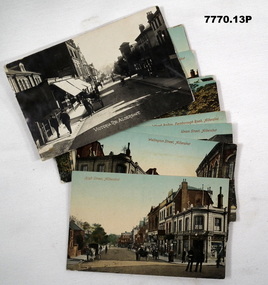
Postcard - POSTCARD, ALDERSHOT, UK, Valentine's Series, c 1914 - 1918
... Bob'. 9. Cambridge Hospital, Aldershot. Handwritten on back in black ink "This is a fine place!". 10. Hospital Hill, Aldershot. 11. Smith Dorrien Home, Aldershot. Handwritten on back in black ink. 'I was all over Aldershot with Uncle. I have saw...Bob'. 9. Cambridge Hospital, Aldershot. Handwritten on back in black ink "This is a fine place!". 10. Hospital Hill, Aldershot. 11. Smith Dorrien Home, Aldershot. Handwritten on back in black ink. 'I was all over Aldershot with Uncle. I have saw ...R..H. Baron took leave from Herdcott Camp between 4.10.19918 and 8.10.1918 to visit Aldershot. See Catalogue No. 7743 for leave pass details. Relatives lived in the Aldershot area. Part of the 'Robert H. Baron', No.3596 and Cooper Collections. See Catalogue No. 19819 for details of Baron's service.1. Coloured street scene with buildings, groups of people and horse drawn transport. 2. Coloured street scene with buildings, groups of people and horse drawn transport. 3. Coloured street scene with buildings, groups of people. 4. Coloured scene features a canal with boat, tow path, bridge and house. 5. Coloured, Band marching down a street. Spectators lining the road. Church in background. 6. Coloured Group of soldiers in uniform marching along the road. Spectators, church in background. 7. Coloured statue of a man on a horse. Statue located on a hill 8. Coloured scene of gardens surrounded by buildings and a church. Groups of women. 9. Coloured - Large building with a clock tower. 10. Coloured column of uniformed soldiers on horseback. Buildings lining road. Horse drawn transport sharing road. 11. Coloured street scene with red brick building and pedestrians. 12. Coloured Monument with inscription. Buildings in background. 13. Black and wgite street scene. Street lined with buildings. Horse drawn transport. Pedestrians.1. High Street, Aldershot. 2. Wellington Street, Aldershot. 3. Union Street, Aldershot. Handwritten in black ink on back: (Notice how narrow the streets are). 4. Wharf Bridge, Farnborough Road, Aldershot. Handwritten in black ink on back: "I was all over these places with Uncle. I had a good time in Aldershot, Bob. 5. Wellington Avenue (Church Parade), Aldershot. Handwritten in black ink: 'One of the Aldershot bands', R.H. Baron.' 6. Queens Avenue and St. George's Church, Aldershot. Handwritten in black ink on back: 'Soldiers going to church". 7. Wellington Monumental, Aldershot. Handwritten on back in black ink: 'I was right up around this place!' 8. Municipal Gardens, Aldershot. Handwritten on back in black ink: 'This place is very pretty, Bob'. 9. Cambridge Hospital, Aldershot. Handwritten on back in black ink "This is a fine place!". 10. Hospital Hill, Aldershot. 11. Smith Dorrien Home, Aldershot. Handwritten on back in black ink. 'I was all over Aldershot with Uncle. I have saw all these places. Bob.' 12. R.A.M.C. Memorial, Aldershot. 13. Victoria Rd, Aldershot.robert h. baron, cooper collection, aldershot uk, postcards -
 Bendigo Military Museum
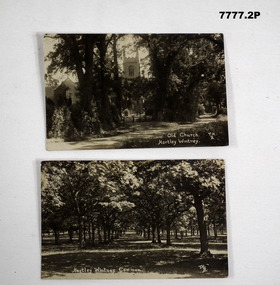
Postcard - POSTCARD, HARTLEY, WINTNEY, UK, c.WW1
... Bob'. 2. Hartley Wintney, Common, Handwritten in black ink on back: 'I have saw the place Maggie was born in, Bob'....Bob'. 2. Hartley Wintney, Common, Handwritten in black ink on back: 'I have saw the place Maggie was born in, Bob'. 1. ...Letters on postcards mention Maggie who according to R.H. Baron was a relative of Uncle Will.1. Black and White photograph of a church surrounded by trees. 2. Black and White photograph of a grove of trees planted in rows.1. Old Church, Hartley Wintney: 'Handwritten in black ink on back: 'These are a few places I went to see while I was on leave. Hartley, Wintney is a great place for Uncle Will's relations. Maggie lives here. Bob'. 2. Hartley Wintney, Common, Handwritten in black ink on back: 'I have saw the place Maggie was born in, Bob'.robert h. baron, cooper collection, postcard, hartley wintney, uk -
 Sunshine and District Historical Society Incorporated
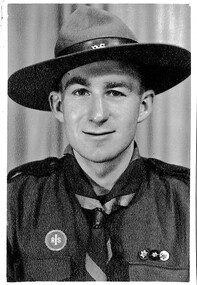
Photograph - 1st Sunshine Scouts Christmas 1947, 1919 - 1957
... Photograph Jim Learmonth 1st Sunshine Group Scout Master He married a Guide and had 3 children who became Cubs Brownies Guides and Scouts|Photograph Roy Paton Tich Stephens Bill Rohner Don Gray Ian Tighe Jim Learmonth Peter Learmonth The Long Haul First Sunshine Scouts Christmas 1947 Big Pats Creek Camp site on the McLean Property at the bridge|Photograph 1st Sunshine Scouts Back row Ron Doubleday Kevin Harvey Ian Bell Front row Chas Stonehouse Jim Learmonth RL Bill Morris John Drewer|Photograph 1st Sunshine Scouts Jim Learmonth|Photograph Madame Tussards London Jim Learmonth Next to the Scouts founder Lord Baden Powell of Galwell|Photographs of McLean's Haven after the great flood and the one that didnt get away|Photographs Parents Day Big Pats Creek and Scouts own Sunshine Gardens|The only photograph of the original Sunshine Scouts behind Bushy Thompsons one Satuday 1919 to 1920 Top Row Jack Emslie Unknown Peter Barlett C Drewerman Jim Garde 2nd Row Lance Clemson Fred Imple Glyn Gleneson Allan McRae Mousey Hill Unknown 3rd Row Unknown Jim Caithness Unknown John Souter Bob Andews Bill Butcher Thomas 4th row P McKay Reg Bult 5th Row F Bennett Bill Hebb Unknown Unknown Original scoutmasters Charlie Saws Arch Mounsey Arch Snaith?...Scouts Scouting Learmonth Photograph Jim Learmonth 1st Sunshine Group Scout Master He married a Guide and had 3 children who became Cubs Brownies Guides and Scouts|Photograph Roy Paton Tich Stephens Bill Rohner Don Gray Ian Tighe Jim Learmonth Peter Learmonth The Long Haul First Sunshine Scouts Christmas 1947 Big Pats Creek Camp site on the McLean Property at the bridge|Photograph 1st Sunshine Scouts Back row Ron Doubleday Kevin Harvey Ian Bell Front row Chas Stonehouse Jim Learmonth RL Bill Morris John Drewer|Photograph 1st Sunshine Scouts Jim Learmonth|Photograph Madame Tussards London Jim Learmonth Next to the Scouts founder Lord Baden Powell of Galwell|Photographs of McLean's Haven after the great flood and the one that didnt get away|Photographs Parents Day Big Pats Creek and Scouts own Sunshine Gardens|The only photograph of the original Sunshine Scouts behind Bushy Thompsons one Satuday 1919 to 1920 Top Row Jack Emslie Unknown Peter Barlett C Drewerman Jim Garde 2nd Row Lance Clemson Fred Imple Glyn Gleneson Allan McRae Mousey Hill Unknown 3rd Row Unknown Jim Caithness Unknown John Souter Bob Andews Bill Butcher Thomas 4th row P McKay Reg Bult 5th Row F Bennett Bill Hebb Unknown Unknown Original scoutmasters Charlie Saws Arch Mounsey Arch Snaith? ...Photograph Jim Learmonth 1st Sunshine Group Scout Master He married a Guide and had 3 children who became Cubs Brownies Guides and Scouts|Photograph Roy Paton Tich Stephens Bill Rohner Don Gray Ian Tighe Jim Learmonth Peter Learmonth The Long Haul First Sunshine Scouts Christmas 1947 Big Pats Creek Camp site on the McLean Property at the bridge|Photograph 1st Sunshine Scouts Back row Ron Doubleday Kevin Harvey Ian Bell Front row Chas Stonehouse Jim Learmonth RL Bill Morris John Drewer|Photograph 1st Sunshine Scouts Jim Learmonth|Photograph Madame Tussards London Jim Learmonth Next to the Scouts founder Lord Baden Powell of Galwell|Photographs of McLean's Haven after the great flood and the one that didnt get away|Photographs Parents Day Big Pats Creek and Scouts own Sunshine Gardens|The only photograph of the original Sunshine Scouts behind Bushy Thompsons one Satuday 1919 to 1920 Top Row Jack Emslie Unknown Peter Barlett C Drewerman Jim Garde 2nd Row Lance Clemson Fred Imple Glyn Gleneson Allan McRae Mousey Hill Unknown 3rd Row Unknown Jim Caithness Unknown John Souter Bob Andews Bill Butcher Thomas 4th row P McKay Reg Bult 5th Row F Bennett Bill Hebb Unknown Unknown Original scoutmasters Charlie Saws Arch Mounsey Arch Snaith?|Photographs Kim District Commissioner Sir Edmund Herrings presentation of the Silver Wolf bush Scene Warburton Bike Hike Melton Bruce Smith with Bill Morris Building Rover Chalet Warburton Where we slept|Photographs A close shave Boys of the old brigade Group photograph Gaooubess at Big Pats Creek Camp site Big Pats Creek 4 group photographs no descriptionsscouts, scouting, learmonth -
 Ballarat Tramway Museum
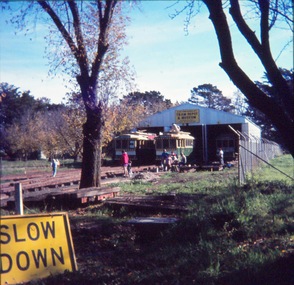
Slide - 35mm slide/s - set of 8, John Theodore, 1972 - 1974
... Set of 8 AGFA blue and white plastic mount 27mm sq slides of various works at the BTPS depot during 1972 / 1974. .1 - View looking from roadway showing depot, and various works at the depot - 26 and 27 out front. .2 - Sawing timber sleepers to length - Noel Forster, Barry McCandlish, Bill Kingsley .3 - Ballasting the access track - Rolf Jinks and Clyde Croft .4 - working on the roof of 27 - Geoff Cargeeg and others. .5 - break time. .6 - Bob Prentice and Geoff Cargeeg? ...Set of 8 AGFA blue and white plastic mount 27mm sq slides of various works at the BTPS depot during 1972 / 1974. .1 - View looking from roadway showing depot, and various works at the depot - 26 and 27 out front. .2 - Sawing timber sleepers to length - Noel Forster, Barry McCandlish, Bill Kingsley .3 - Ballasting the access track - Rolf Jinks and Clyde Croft .4 - working on the roof of 27 - Geoff Cargeeg and others. .5 - break time. .6 - Bob Prentice and Geoff Cargeeg? ...Yields information about depot activities of the BTPS in building the depot fan and access track.Set of 8 AGFA blue and white plastic mount 27mm sq slides of various works at the BTPS depot during 1972 / 1974. .1 - View looking from roadway showing depot, and various works at the depot - 26 and 27 out front. .2 - Sawing timber sleepers to length - Noel Forster, Barry McCandlish, Bill Kingsley .3 - Ballasting the access track - Rolf Jinks and Clyde Croft .4 - working on the roof of 27 - Geoff Cargeeg and others. .5 - break time. .6 - Bob Prentice and Geoff Cargeeg? on roof of 27 .7 - ditto .8 - Interior photo of 27Various notations by John as to the slide number and the trams in pencil and ink.tramways, trams, btps, depot, track construction, trolley poles, interiors, tram 26, tram 27 -
 Dandenong & District Historical Society
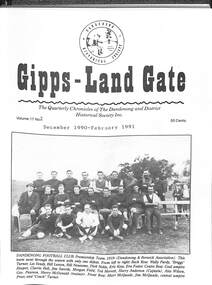
Journal, Dandenong & District Historical Society, Gipps-Land Gate Vol.17 No.2, 1991
... Keeping Posted As A Roving Historian Saw Dandenong in 1930 Harking Back 75 Years Ago In The Days Of Lerbside Pumps - And Petrol At 1/- A Gallon Wood Beilby Bobs Up Again The Ross's Of "The Grange" Dandenong ...Keeping Posted As A Roving Historian Saw Dandenong in 1930 Harking Back 75 Years Ago In The Days Of Lerbside Pumps - And Petrol At 1/- A Gallon Wood Beilby Bobs Up Again The Ross's Of "The Grange" Dandenong Gipps-Land Gate Vol.17 No.2 Journal Dandenong & District Historical Society ...An interesting group of Early Dandenong Personalities, Places and EventsA5 size publication of the Gipps-Land Gate, December 1990 - February 1991 featuring an old picture of Dandenong on the cover. Keeping Posted As A Roving Historian Saw Dandenong in 1930 Harking Back 75 Years Ago In The Days Of Lerbside Pumps - And Petrol At 1/- A Gallon Wood Beilby Bobs Up Again The Ross's Of "The Grange" Dandenong An interesting group of Early Dandenong Personalities, Places and Eventshotel history, early education in dandenong, interesting milestones, family histories -
 8th/13th Victorian Mounted Rifles Regimental Collection
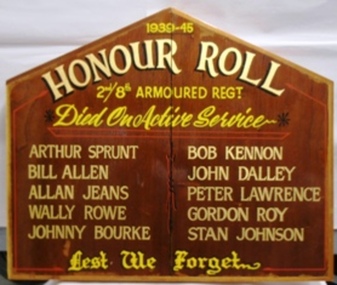
Honour Board, 1947 circa
... 2/8the Armoured Regiment, 2nd AIF, was raised in 1941; saw service in New Guinea in 1943-44; returned to Australia and disbanded to form Nos 41, 42, 43 Landing Craft Companies RAE which saw service in South West Pacific 1944-45. military honour board 2/8 armourned regiment Honour Board 2nd/8th Armoured Regiment 'Died on Active Service.' Timber board finished with gloss varnish. Lettering is in gold paint with red paint lines. Names listed are: Arthur Sprunt, Bill Allen, Wally Rowe, Johnny Bourke, Bob ...2/8the Armoured Regiment, 2nd AIF, was raised in 1941; saw service in New Guinea in 1943-44; returned to Australia and disbanded to form Nos 41, 42, 43 Landing Craft Companies RAE which saw service in South West Pacific 1944-45.Honour Board 2nd/8th Armoured Regiment 'Died on Active Service.' Timber board finished with gloss varnish. Lettering is in gold paint with red paint lines. Names listed are: Arthur Sprunt, Bill Allen, Wally Rowe, Johnny Bourke, Bob Kennon, John Dalley, Peter Lawrence, Gordon Roy and Stan Johnson.military, honour board, 2/8 armourned regiment -
 Melbourne Tram Museum
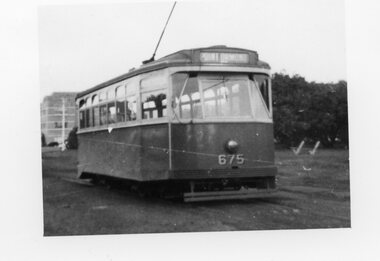
Photograph - X2 675 at Point Ormond, Bob Lilburn, 1960
... saw the withdrawal and scrapping of this small 4 wheeler trams. Yields information about X2 675 at Point Ormond terminus tramways transport X2 class tram 675 Point Ormond Photo of X2 675 at Point Ormond - actual photo 55x72mm on larger sheet 120x166mm Photograph X2 675 at Point Ormond Bob Lilburn ...The Point Ormond line closed on 22/10/1960. The closure of the Footscray lines in 1962 saw the withdrawal and scrapping of this small 4 wheeler trams.Yields information about X2 675 at Point Ormond terminusPhoto of X2 675 at Point Ormond - actual photo 55x72mm on larger sheet 120x166mmtramways, transport, x2 class, tram 675, point ormond -
 Merri-bek City Council
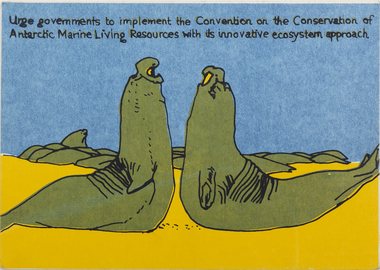
Work on paper - Screen print, Wendy Black, Declare Antarctica a World Park - Weddell Seals, 1982
... saw a rise in campaigns for Antarctica to be designated a World Park. Black’s screenprints celebrate the creatures of the continent, however invocations such as ‘protect Antarctica from all mineral and oil exploration and exploitation’ remind the viewer that these creatures are in peril. Black printed 500 of these postcards (described as ‘Antarcticards’) at the Redletter Press in Brunswick and they were distributed around the world, reaching as far as Macquarie and Heard Islands. The campaigning was successful, with Australian Prime Minister Bob...saw a rise in campaigns for Antarctica to be designated a World Park. Black’s screenprints celebrate the creatures of the continent, however invocations such as ‘protect Antarctica from all mineral and oil exploration and exploitation’ remind the viewer that these creatures are in peril. Black printed 500 of these postcards (described as ‘Antarcticards’) at the Redletter Press in Brunswick and they were distributed around the world, reaching as far as Macquarie and Heard Islands. The campaigning was successful, with Australian Prime Minister Bob ...The 1980s saw a rise in campaigns for Antarctica to be designated a World Park. Black’s screenprints celebrate the creatures of the continent, however invocations such as ‘protect Antarctica from all mineral and oil exploration and exploitation’ remind the viewer that these creatures are in peril. Black printed 500 of these postcards (described as ‘Antarcticards’) at the Redletter Press in Brunswick and they were distributed around the world, reaching as far as Macquarie and Heard Islands. The campaigning was successful, with Australian Prime Minister Bob Hawke announcing that Australia would not support an agreement that would open the Australian Antarctic Territory up to mining and oil drilling.Donated by the artist8 prints in total -
 Merri-bek City Council
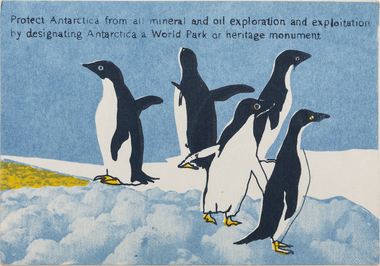
Work on paper - Screen print, Wendy Black, Declare Antarctica a World Park - Adelie, 1982
... saw a rise in campaigns for Antarctica to be designated a World Park. Black’s screenprints celebrate the creatures of the continent, however invocations such as ‘protect Antarctica from all mineral and oil exploration and exploitation’ remind the viewer that these creatures are in peril. Black printed 500 of these postcards (described as ‘Antarcticards’) at the Redletter Press in Brunswick and they were distributed around the world, reaching as far as Macquarie and Heard Islands. The campaigning was successful, with Australian Prime Minister Bob...saw a rise in campaigns for Antarctica to be designated a World Park. Black’s screenprints celebrate the creatures of the continent, however invocations such as ‘protect Antarctica from all mineral and oil exploration and exploitation’ remind the viewer that these creatures are in peril. Black printed 500 of these postcards (described as ‘Antarcticards’) at the Redletter Press in Brunswick and they were distributed around the world, reaching as far as Macquarie and Heard Islands. The campaigning was successful, with Australian Prime Minister Bob ...The 1980s saw a rise in campaigns for Antarctica to be designated a World Park. Black’s screenprints celebrate the creatures of the continent, however invocations such as ‘protect Antarctica from all mineral and oil exploration and exploitation’ remind the viewer that these creatures are in peril. Black printed 500 of these postcards (described as ‘Antarcticards’) at the Redletter Press in Brunswick and they were distributed around the world, reaching as far as Macquarie and Heard Islands. The campaigning was successful, with Australian Prime Minister Bob Hawke announcing that Australia would not support an agreement that would open the Australian Antarctic Territory up to mining and oil drilling.Donated by the artist8 prints in total -
 Merri-bek City Council
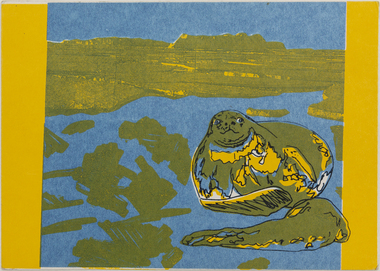
Work on paper - Screen print, Wendy Black, Declare Antarctica a World Park - Elephant Seal, 1982
... saw a rise in campaigns for Antarctica to be designated a World Park. Black’s screenprints celebrate the creatures of the continent, however invocations such as ‘protect Antarctica from all mineral and oil exploration and exploitation’ remind the viewer that these creatures are in peril. Black printed 500 of these postcards (described as ‘Antarcticards’) at the Redletter Press in Brunswick and they were distributed around the world, reaching as far as Macquarie and Heard Islands. The campaigning was successful, with Australian Prime Minister Bob...saw a rise in campaigns for Antarctica to be designated a World Park. Black’s screenprints celebrate the creatures of the continent, however invocations such as ‘protect Antarctica from all mineral and oil exploration and exploitation’ remind the viewer that these creatures are in peril. Black printed 500 of these postcards (described as ‘Antarcticards’) at the Redletter Press in Brunswick and they were distributed around the world, reaching as far as Macquarie and Heard Islands. The campaigning was successful, with Australian Prime Minister Bob ...The 1980s saw a rise in campaigns for Antarctica to be designated a World Park. Black’s screenprints celebrate the creatures of the continent, however invocations such as ‘protect Antarctica from all mineral and oil exploration and exploitation’ remind the viewer that these creatures are in peril. Black printed 500 of these postcards (described as ‘Antarcticards’) at the Redletter Press in Brunswick and they were distributed around the world, reaching as far as Macquarie and Heard Islands. The campaigning was successful, with Australian Prime Minister Bob Hawke announcing that Australia would not support an agreement that would open the Australian Antarctic Territory up to mining and oil drilling.Donated by the artist8 prints in total -
 Merri-bek City Council
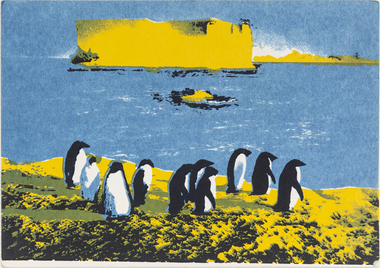
Work on paper - Screen print, Wendy Black, Declare Antarctica a World Park - Penguin, 1982
... saw a rise in campaigns for Antarctica to be designated a World Park. Black’s screenprints celebrate the creatures of the continent, however invocations such as ‘protect Antarctica from all mineral and oil exploration and exploitation’ remind the viewer that these creatures are in peril. Black printed 500 of these postcards (described as ‘Antarcticards’) at the Redletter Press in Brunswick and they were distributed around the world, reaching as far as Macquarie and Heard Islands. The campaigning was successful, with Australian Prime Minister Bob...saw a rise in campaigns for Antarctica to be designated a World Park. Black’s screenprints celebrate the creatures of the continent, however invocations such as ‘protect Antarctica from all mineral and oil exploration and exploitation’ remind the viewer that these creatures are in peril. Black printed 500 of these postcards (described as ‘Antarcticards’) at the Redletter Press in Brunswick and they were distributed around the world, reaching as far as Macquarie and Heard Islands. The campaigning was successful, with Australian Prime Minister Bob ...The 1980s saw a rise in campaigns for Antarctica to be designated a World Park. Black’s screenprints celebrate the creatures of the continent, however invocations such as ‘protect Antarctica from all mineral and oil exploration and exploitation’ remind the viewer that these creatures are in peril. Black printed 500 of these postcards (described as ‘Antarcticards’) at the Redletter Press in Brunswick and they were distributed around the world, reaching as far as Macquarie and Heard Islands. The campaigning was successful, with Australian Prime Minister Bob Hawke announcing that Australia would not support an agreement that would open the Australian Antarctic Territory up to mining and oil drilling.Donated by the artist8 prints in total -
 Merri-bek City Council
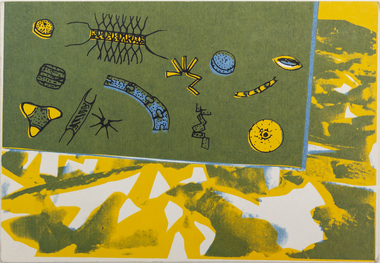
Work on paper - Screen print, Wendy Black, Declare Antarctica a World Park - Phytoplankton, 1982
... saw a rise in campaigns for Antarctica to be designated a World Park. Black’s screenprints celebrate the creatures of the continent, however invocations such as ‘protect Antarctica from all mineral and oil exploration and exploitation’ remind the viewer that these creatures are in peril. Black printed 500 of these postcards (described as ‘Antarcticards’) at the Redletter Press in Brunswick and they were distributed around the world, reaching as far as Macquarie and Heard Islands. The campaigning was successful, with Australian Prime Minister Bob...saw a rise in campaigns for Antarctica to be designated a World Park. Black’s screenprints celebrate the creatures of the continent, however invocations such as ‘protect Antarctica from all mineral and oil exploration and exploitation’ remind the viewer that these creatures are in peril. Black printed 500 of these postcards (described as ‘Antarcticards’) at the Redletter Press in Brunswick and they were distributed around the world, reaching as far as Macquarie and Heard Islands. The campaigning was successful, with Australian Prime Minister Bob ...The 1980s saw a rise in campaigns for Antarctica to be designated a World Park. Black’s screenprints celebrate the creatures of the continent, however invocations such as ‘protect Antarctica from all mineral and oil exploration and exploitation’ remind the viewer that these creatures are in peril. Black printed 500 of these postcards (described as ‘Antarcticards’) at the Redletter Press in Brunswick and they were distributed around the world, reaching as far as Macquarie and Heard Islands. The campaigning was successful, with Australian Prime Minister Bob Hawke announcing that Australia would not support an agreement that would open the Australian Antarctic Territory up to mining and oil drilling.Donated by the artist8 prints in total -
 Merri-bek City Council
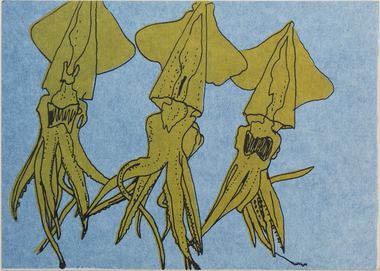
Work on paper - Screen print, Wendy Black, Declare Antarctica a World Park - Squid (1982), 1982
... saw a rise in campaigns for Antarctica to be designated a World Park. Black’s screenprints celebrate the creatures of the continent, however invocations such as ‘protect Antarctica from all mineral and oil exploration and exploitation’ remind the viewer that these creatures are in peril. Black printed 500 of these postcards (described as ‘Antarcticards’) at the Redletter Press in Brunswick and they were distributed around the world, reaching as far as Macquarie and Heard Islands. The campaigning was successful, with Australian Prime Minister Bob...saw a rise in campaigns for Antarctica to be designated a World Park. Black’s screenprints celebrate the creatures of the continent, however invocations such as ‘protect Antarctica from all mineral and oil exploration and exploitation’ remind the viewer that these creatures are in peril. Black printed 500 of these postcards (described as ‘Antarcticards’) at the Redletter Press in Brunswick and they were distributed around the world, reaching as far as Macquarie and Heard Islands. The campaigning was successful, with Australian Prime Minister Bob ...The 1980s saw a rise in campaigns for Antarctica to be designated a World Park. Black’s screenprints celebrate the creatures of the continent, however invocations such as ‘protect Antarctica from all mineral and oil exploration and exploitation’ remind the viewer that these creatures are in peril. Black printed 500 of these postcards (described as ‘Antarcticards’) at the Redletter Press in Brunswick and they were distributed around the world, reaching as far as Macquarie and Heard Islands. The campaigning was successful, with Australian Prime Minister Bob Hawke announcing that Australia would not support an agreement that would open the Australian Antarctic Territory up to mining and oil drilling.Donated by the artist8 prints in total
