
Showing 11 items matching "boiler inspector"
-
 Federation University Historical Collection
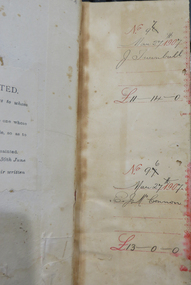
Book, Ballarat School of Mines Stubb Book (relating to payments to staff), 1907, 1907
... ...boiler inspector...ballarat school of mines salary wages w. cornell t.s. hart alfred mica smith g.j. dawbarn frederick j. martell daniel walker j.f. usher h.j. hall a.e. kerr h.r. murphy j.m. sutherland a.g. garrard c. deane j.b. robinson b. whitington r. nevett j. turnbull d. don h. eklund v. anderson c. mctaggart c. garrard f.w. hawkins h. galopin n. buley e.j. mcconnon d. cameron w. kingston reginald callister s.b. white s. baker l. blick g. sides s. bowman r. ramsay t. thusrdfield w. adams l.a. vail j.h. trotman j. ross & son j.e. white and sons w. heath h. troon berry anderson & co broadbent brothers h. rehfisch a.d. gilchrist c.e. campbell c. stevenson r. leckie h. markwald w.h. gordon trahar brothers j.w. scott h.h. smith f. beaumont w.m. williams h. tulloch w. skewes boiler inspector a.w. stea. s.c. barber g. wightman j.a. wright f. foster j.a. powell t.h. trengrove e. burgoyne Hard covered stubb book with bluecover and red tape spine. ...Hard covered stubb book with bluecover and red tape spine. Lists Ballarat School of Mines staffmembers, and the amount of wages they were paid. ballarat school of mines, salary, wages, w. cornell, t.s. hart, alfred mica smith, g.j. dawbarn, frederick j. martell, daniel walker, j.f. usher, h.j. hall, a.e. kerr, h.r. murphy, j.m. sutherland, a.g. garrard, c. deane, j.b. robinson, b. whitington, r. nevett, j. turnbull, d. don, h. eklund, v. anderson, c. mctaggart, c. garrard, f.w. hawkins, h. galopin, n. buley, e.j. mcconnon, d. cameron, w. kingston, reginald callister, s.b. white, s. baker, l. blick, g. sides, s. bowman, r. ramsay, t. thusrdfield, w. adams, l.a. vail, j.h. trotman, j. ross & son, j.e. white and sons, w. heath, h. troon, berry anderson & co, broadbent brothers, h. rehfisch, a.d. gilchrist, c.e. campbell, c. stevenson, r. leckie, h. markwald, w.h. gordon, trahar brothers, j.w. scott, h.h. smith, f. beaumont, w.m. williams, h. tulloch, w. skewes, boiler inspector, a.w. stea., s.c. barber, g. wightman, j.a. wright, f. foster, j.a. powell, t.h. trengrove, e. burgoyne -
 Bendigo Historical Society Inc.
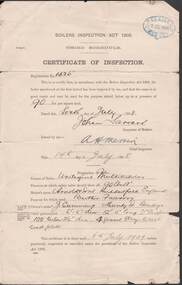
Document - CERTIFICATE OF INSPECTION : BOILER : BENDIGO BUTTER FACTORY : 6 JULY 1908, 7th July, 1908
... boiler at the Bendigo Butter Factory. Registration no. 1425. Dated 6 July 1908 and signed by Johan Sarvaas, Inspector of Boilers), and A. ...boiler at the Bendigo Butter Factory. Registration no. 1425. Dated 6 July 1908 and signed by Johan Sarvaas, Inspector of Boilers), and A. ...Certificate of inspection of a under fired multitubular boiler at the Bendigo Butter Factory. Registration no. 1425. Dated 6 July 1908 and signed by Johan Sarvaas, Inspector of Boilers), and A. Merrin (Chief Inspector). The owner is given as J. Cumming, Mundy St, Bendigo. The document states that the boiler can be used up to a pressure of 90 lbs. Information includes particulars of the boiler. There is a 'date received' stamp on the top right-hand corner dated 7 July 1908.bendigo, industry, bendigo butter factory, bendigo butter factory. boilers. johan savaas. a. merrin. -
 Bendigo Historical Society Inc.
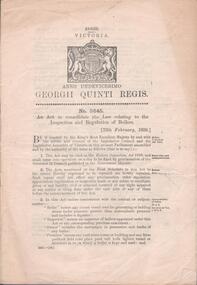
Document - MINING REPORTS - BOILERS INSPECTION ACT 1928
... Printed document Inspection and Regulation of Boilers, dated 12th February 1929, No 3645 which sets out rules and regulations for the ownership and use of boilers. Items mentioned are: Inspectors, Registration of Boilers, Inspection of Boilers, Certificate of Inspection, Powers and Duties of Inspectors, Necessity for Certificate, Notice f Alterations, Duties and Liabilities of Owners of Boilers and Others, Explosions and Accidents and Miscellaneous. ...DOCUMENT Mining Reports Boilers Inspection Act 1928 T Rider Printed document Inspection and Regulation of Boilers, dated 12th February 1929, No 3645 which sets out rules and regulations for the ownership and use of boilers. Items mentioned are: Inspectors, Registration of Boilers, Inspection of Boilers, Certificate of Inspection, Powers and Duties of Inspectors, Necessity for Certificate, Notice f Alterations, Duties and Liabilities of Owners of Boilers and Others, Explosions and Accidents and Miscellaneous. ...Printed document Inspection and Regulation of Boilers, dated 12th February 1929, No 3645 which sets out rules and regulations for the ownership and use of boilers. Items mentioned are: Inspectors, Registration of Boilers, Inspection of Boilers, Certificate of Inspection, Powers and Duties of Inspectors, Necessity for Certificate, Notice f Alterations, Duties and Liabilities of Owners of Boilers and Others, Explosions and Accidents and Miscellaneous. Also Schedules. First Schedule is the Number and Title of Act, Second Schedule is Notice of Registration, Third Schedule is Certificate of Inspection, Fourth Schedule is certificate stating the number of lbs. per square inch the safety valve blows off, Fifth Schedule is Notice to Owner that Boiler is Dangerous and Sixth Schedule is a Report with regard to Explosion of or Accident causing damage or injury to a Steam Boiler. Document is part of the Albert Richardson Collection. document, mining reports, boilers inspection act 1928, t rider -
 Ringwood and District Historical Society
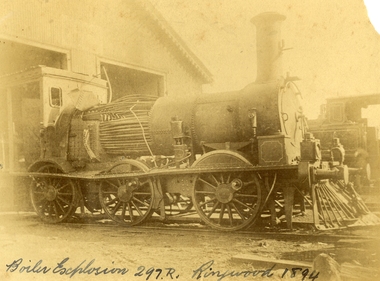
Photograph, Boiler explosion at Ringwood station 20th June 1894 for engine 297R. "Heard in Box Hill"
... boilers. He reports to us and we note what he points out. Alfred Thompson, locomotive inspector of the eastern section, said he knew this engine, 297R. ...boilers. He reports to us and we note what he points out. Alfred Thompson, locomotive inspector of the eastern section, said he knew this engine, 297R. ...Black and white photographs - 2 copiesTyped below photograph, "Boiler explosion at Ringwood station 20/6/1894. Heard in Box Hill". Article from newspapers:- Weekly Times (Melbourne, Vic. : 1869 - 1954), Saturday 27 January 1894, page 21 Official enquiry. The Board of Enquiry appointed by the Railway Commissioners to enquire into the causes of the boiler explosion which shattered the locomotive at Ringwood on Saturday night, assembled at the Railway department on Wednesday to commence its deliberations, The board consisted of Mr R. Fulton, engineer, C. W. McLean; engineer to the Marine Board, and Mr Mephan Ferguson, iron-founder. There is some difficulty at the outset about the constitution of the board; It was suggested that the Apt of Parliament contemplated that boards of experts, after the manner of the present one, needed, to have their appointments confirmed by the Governor-in-Council. The point, however, was not considered sufficiently important to prevent the board from proceeding with evidence. Robert Greyford, stationmaster at Ringwood, was the first witness. He said he saw the explosion on Saturday night at about twenty minutes to 8. There was a rush to the engine to see what had happened, and the driver and fireman were both found on the platform of the engine. The driver seemed badly hurt, but the fireman, to all appearances, was not so badly injured. They were both attended to and sent up to Melbourne by the last suburban train. Witness had a look at the engine and found the dome and all the plates round the boiler blown clean, away. The springs were also blown clean away. The Chairman (Mr Fulton) : Did you measure the distance ? Witness: Yes; one of the plates was 209 yards away. A piece from the top of the boiler 15 pounds in weight he found driven into the hard beaten track 410 yards away. Several pieces of boiler plate were found scattered at various distances. The buildings roundabout were injured. The Chairman; Did you notice anything peculiar about either of the driver or the fireman ? — No ; nothing wrong, with either of them. If the engine was blowing off at all, it must have been very light. In your opinion, were they perfectly sober ? — Perfectly. In approaching the station, is there a down or an up grade? — A very slight down grade. How is the road from Healesville ? — Up and down all the way. It is down, grade for about 200 yards coming into Ringwood station. They shut off ; steam about a quarter of a mile away, and come in at a good pace. They generally put on 15 pounds of steam while they are in the station. Mr Ferguson : Had the driver the usual load on ? — Yes ; about the usual load. Witness added that he had known the driver personally for about 10 years, and he had always been a careful, steady, sober man. He did not know the fireman so well. John Palmer, porter at Ringwood station, also saw the explosion. He was attending to the train on its arrival. He was knocked down by the force of the explosion. When he got up he saw the engine driver being carried into the office covered in blood. He noticed nothing peculiar about the driver and fireman, nor about the engine. Mr McLean : How far were you from the engine when you were knocked down ? — From ten to fifteen yards. William Paul, the guard of the train to which the injured locomotive Was attached, said he was looking at the engine at the very moment the explosion occurred. It seemed to come from exactly under the dome. The force of it took him off his feet. He was about 15 yards from the tender. When he rose he tried to reach the engine, but could not do so on account of the steam and coal dust. He called out to know whether any of the passengers were injured, and got no response, so that he concluded they were all right. All the lamps but about half dozen were extinguished by the force of the explosion, although the glass was not broken. He could testify most distinctly that the driver and fireman were both sober. The driver was a man who never drank. The steam started to blow off about a minute and a half before the explosion took place. The last place at which the engine took water was Healesville. The Chairman : Do yon know anything of the quality of the water there ? Is it creek water ? — Yes ; it comes from the Graceburn River. You never heard of its quality ?— No. How long have you known this engine on the road— About 13 months. Hew long have you known the driver on this line ? — About six weeks. I have known the fireman several years. The driver was a strict teetotaller, and I never saw the fireman take anything to drink in his life. Mr T. H, Woodroffe, chief mechanical engineer of the Victorian Railways, produced a report he had written to the secretary, about this explosion. The document gave facts concerning the engine and the explosion. It stated that the rapture seemed to have occurred at the rim of the plates adjoining the fire box. The engine was built at the Phoenix Foundry, Ballarat, in 1883. It was repaired at various times, the last time being in July of last year when it was sent to the Port Melbourne shops, and was then tested to a cold water pressure of 195 and found all right. It was the custom to overhaul all locomotives about every five years. The Chairman : There were no very heavy repairs in July, 1893; were there? — Not to the boilers. The shop manager's report says that the plug and safety tap holes were repaired, five new copper studs put in firebox, ash-pan door repaired, tender cleaned and overhauled, and studs re-rivetted, and boiler tested to pressure of 195, cold water. Mr Woodroffe read the report of the repairs effected to the boiler in December, 1888. That would be the time the plate was put in the boiler. On that occasion three new plates were put in the bottom and the boiler tested up to 195. The Chairman: Do you keep a record of the water used ?— Yes, the water in this case, I think, came from the Maroondah scheme. Mr Woodroffe said boilers were examined front time to time in the running sheds. In his opinion every possible care had been taken to keep the engine in proper care. There might, however, be lessons learnt from this. The Chairman: No doubt. From his examination of the plates [the] witness did not think the state of them could have been detected from the outside. There were no signs of leakage or sweating or anything of that sort. The next witness- was Walter Stinton, workshop manager at Newport and he said that the injured engine had been repeatedly repaired under his charge. He gave a technical account of the repairs effected on various occasions. The testing of locomotives was under his special notice. They had a high pressure pipe running; round the works, and a pump set at 2001b. When the boiler was pumped full of water the pressure when applied up to 1951b. The board appointed by the department to inquire into the Ringwood locomotive boiler explosion sat again at Spencer street on 25th inst. Mr R. Fulton presided and the other members of the board were. Mr Mephan Ferguson and Mr C. W. McLean. Charles Grubb, foreman of the boiler-makers at the Newport workshops, said he had inspected the pieces of plate that had been blown out of the engine, and after examining them, pointed out to the Chief Mechanical Engineer the portion where the plate had started to burst. It was under the lap, on the right hand side of the boiler. The grooving might be accounted for by bad water. During the past twenty years he had examined all the boilers that came into the Williamstown workshops, and while some were hardly marked at all, others were very badly eaten away. The practice was to cut out the defective portions. In this case the boiler was repaired in a similar manner. The Chairman : Can you suggest any other way of repairing so as to prevent accident ? — No, unless by taking out a plate on one side from the joint, and carrying it further up so as to avoid the joints meeting, or by taking out the plate altogether. What would.be the cost .of putting in a new " plate I—Perhaps about double the price; but I wouldn't recommend that course. It would be putting a new plate against plates that have been in use ten years or so and that would not be advisable. I think the present system better. I consider the present system of repairing the best. This is the first we have had so bad like that, to my knowledge. You attributed this to bad water. Is there no other probable cause ? — Well; unless the iron be bad. This was Lowmoor iron. I think this accident was caused by the eating away of plates. This one was the worst I have seen, for the short time it had been running. We use three classes of iron — Lowmoor, Monkbridge and Bowling. By Mr Woodroffe (Chief Mechanical Engineer) ; There are engines still running that were repaired at the same time as this one, in 1888, and. in the same way. These are engines 339 and 333. They have been recently examined and are in splendid order. What in your experience, is the age of a boiler on the Victorian railways? — From 17 to 20 years our earlier boilers stood. The later boilers don't stand so well. How is that? — There is difference in construction, and the material is lighter. The old boilers had thicker plates. Have you been asked in any way to curtail boiler affairs? — No, sir; nor in any way. You have never hesitated to carry out any necessary repairs? — Never. Our orders have been to exercise every care in examining, repairing and renewing boilers. Witness said that his practice was when an engine came into the workshop to find out how long she had been running. If over five years, he informed the workshop manager, and they thought it necessary the tubes were taken nut. If everything was in good order witness reported to the manager. The cost of taking out the tubes and putting them in again was about L20. Mr Woodroffe : Have you ever hesitated to repair a boiler on the score of expense ? — No, never. Mr McLean : Hew do yon ascertain whether a boiler requires repairs?— I keep a record of every boiler examined. From every boiler that comes in I have the dome covers taken off, and when it is practical I get inside. l can almost tell from the top of a boiler what the bottom is like. If there is any doubt about it I have the tubes taken out. If I have suspicion of defective plate I cause to have bored a triangle in the plate at the point where there is the most wear. There is a travelling inspector who visits all the running sheds of the colony except Port Melbourne and tests the boilers. He reports to us and we note what he points out. Alfred Thompson, locomotive inspector of the eastern section, said he knew this engine, 297R. He read a list of her repairs. He heard of the accident on Saturday night and went up to Ringwood. The Chairman : Did you ever notice anything peculiar about the engine? — No, I considered her A1 and would not have hesitated to have put on 140lb pressure owing to the repairs she had undergone. Witness considered that the explosion was caused by the expansion and contraction of the plates ; and, no doubt, the plate had been eaten away through bad water. The other side of the boiler showed: signs of corrosion: By Mr Woodroffe ; Is every care taken with the boilers ? — Yes, every possible care is taken for the safety of boilers, Weekly Times (Melbourne, Vic. : 1869 - 1954), Saturday 27 January 1894, page 7 EXPLOSION OF A LOCOMOTIVE BOILER, NARROW ESACPE FROM FATALITIES. THE DAMAGED ENGINE. [See drawing of loco – saved in “Railways” folder] The explosion of a locomotive boiler at Ringwood on Saturday evening, formed the subject of much discussion in railway circles on Monday. The Minister arrived at the office at an unusually early hour and immediately entered into a consultation with the acting chairman, Mr Kibble, and Mr Commissioner Murray. As the result of the interview it was resolved to ask three gentlemen of acknowledged engineering experience to sib as a board with the . object of inquiring into the cause of the accident and furnishing a report. Mr Richardson and the Commissioners are tally seized of the importance of having a searching investigation into the accident, and, with Mr Murray, the former went to Ringwood to inspect the scene of the disaster. They will he accompanied by Mr Woodroffe. During the morning no official report had come to hand from the driver or fireman of the engine in reference to the accident, but that is thought to be due to the circumstance that they have not sufficiently recovered to be able to give a circumstantial account of what occurred. The engine was one of the old R's, and, Mr Kibble pronounced them to be about the best class of engines used. So far nothing can be said as to the probable cause of the accident, as the broken plating of the engine has not been submitted to the inspection of experts. Weekly Times (Melbourne, Vic. : 1869 - 1954), Saturday 27 January 1894, page 7 STATEMENT BY THE FIREMAN. This morning Thomas Miles, fireman on the engine the boiler of which exploded on Saturday night, is suffering from an injury to the spine, as well as a very severe shaking to the system. He states that he was fireman on the engine attached to the train which left Healesville on Saturday evening, at ten minutes to 8. Everything went all right until Ringwood was reached, when, .just as the train was about to continue its journey, a load explosion took place and Miles remembers nothing more until he was picked np on the platform ; and found himself suffering from a pain in the back, and an injury to his arm. He cannot think of any reason which could have caused the explosion, as there was plenty of water in the boiler, and everything seemed working all right. Mr R. Fulton, consulting engineer, of Queen street; Mr McLean, a member of the Marine Board ; and Mr Mephan Ferguson, engineer, have consented to act as a board to inquire into the cause of the engine boiler explosion at Ringwood on Saturday evening. The board has been appointed under section 117 of Act 1135, which provides that the Governor-in-Council may direct the taking of a such a step. Mr1 Fulton will act as chairman of the board, which met for the first time at the railway offices, Spencer street, this forenoon. Before separating the members of the Board paid a visit to the Prince's Bridge locomotive sheds in company with Mr Woodroffe, the chief mechanical engineer, for the purpose of inspecting the shattered boiler. It has been stated that the explosion is known to have been caused by a flaw in a plate which was put on the boiler about four years ago, but enquiries have tailed to elicit anything in support of that view. The engineers connected with the department are not inclined to say anything on the subject. Weekly Times (Melbourne, Vic. : 1869 - 1954), Saturday 14 April 1894, page 20 The Ringwood Boiler Explosion, The Minister of Railways has received the supplementary report of the board appointed by him to investigate the circumstances connected with the explosion of a locomotive boiler at Ringwood. In their first report the board did not attach blame to anyone. Mr Richardson felt satisfied that the responsibility of having the engines properly inspected and overhauled periodically could be fixed if the inquiry were extended. He therefore referred the matter again to the Board, who took further evidence. In the report now furnished, the Board hold Loco. Inspector Thompson blameable, but point out as a mitigating circumstance that he had not received "written instructions" respecting inspections and overhauls. Weekly Times (Melbourne, Vic. : 1869 - 1954), Saturday 7 July 1894, page 32 The Ringwood Boiler Explosion. The Minister of Railways takes exception to the tone of a paragraph appearing in a morning contemporary respecting the Ringwood boiler explosion. It makes it appear that Mr Richardson has referred the report of the board which considered the facts connected with the explosion to the Crown solicitor simply because he differed from the finding of the board. The Minister explains that when he received the report he found that the responsibility for having boilers properly inspected and overhauled had not been clearly fixed. He personally obtained farther evidence on that point, and arrived at a conclusion, from which the commissioners differed. As he did not like to take upon himself the responsibility of deciding upon the effect of the evidence, he submitted the matter to the Crown Solicitor, but that officer did not furnish him with the information sought. He has, therefore, referred the question to the Attorney-General, together with the draft of a regulation respecting boiler inspections and overhauls in the future. Mr Richardson says that his whole aim is to have the responsibility positively fixed. Weekly Times (Melbourne, Vic. : 1869 - 1954), Saturday 28 April 1894, page 23 The Minister of Railways has completed his consideration of the supplementary report received by him from the Ringwood Boiler Explosion Board. The report, it will be remembered, held Loco-Inspector Thompson blameable for the non-inspection of the boiler, but considered there was extenuating circumstances. There was a certain amount of doubt as to the absolute instructions given for overhauling engines periodically. Mr. Richardson is sending the report on to the Commissioners with instructions that the responsibility respecting inspection of boilers shall be made clear for the future. -
 Eltham District Historical Society Inc
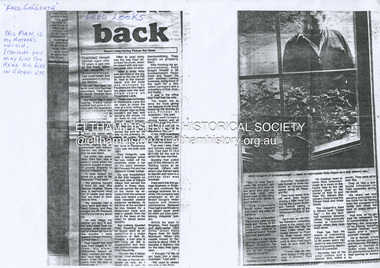
Document - Photocopy, Diamond Valley News, Newspaper article: Fred looks back by Linley Hartley, Diamond Valley News, c.1985
... boilers. While he was in Brighton, Fred bought an eight-seater 1925 Silver Ghost Rolls Royce from Sir Keith Murdoch. When the couple moved to Rosanna in about 1943, it became a delivery van for the dairy they operated. “I thought I’d like to get back into a dairy business” Fred said. “We used to deliver the milk in the Rolls. “But it was hard work. We couldn’t get the labour and we’d drive to the farm and pick up the milk cans, take them back to the dairy, cool the milk, bottle it and deliver it. The inspectors...boilers. While he was in Brighton, Fred bought an eight-seater 1925 Silver Ghost Rolls Royce from Sir Keith Murdoch. When the couple moved to Rosanna in about 1943, it became a delivery van for the dairy they operated. “I thought I’d like to get back into a dairy business” Fred said. “We used to deliver the milk in the Rolls. “But it was hard work. We couldn’t get the labour and we’d drive to the farm and pick up the milk cans, take them back to the dairy, cool the milk, bottle it and deliver it. The inspectors ...Fred looks back; Report: Linley Hartley, Picture: Ron Grant Teaching himself German again after 70 years is just one of the many tasks Fred Golgerth, of Greensborough, has undertaken and succeeded in during his lifetime. As the two year old tenth child of a German descendent, Fred learnt to speak German from an Aunt. But World War 1 was raging. Fred’s older brother had gone to Europe with the Australian forces, changing his name … to ….. to sound less German. “I used to get my bottom slapped for speaking German at home,” Fred said. Even his name was changed from Otto to the more anglicised Frederick. Fred claims his involvement with Eltham started two years before he was born! His sister, two years older than him, was a babe in arms when his parents bought a piece of grazing property in Mount Pleasant Rd. “It was about 24 acres on a spur of Mt Pleasant,” Fred said. “My parents bought it from Mr and Mrs Hughes. There was a two-room mud hut in wattle and daub that we lived in from time to time. “My parents had a dairy farm and dairy in West Coburg, and they bought the Mt Pleasant land to put the dry stock on. “At one stage my mother got very ill and my older sister took my younger sister and myself to Eltham for four or five months. I went down to Eltham Primary School then.” That wasn’t the only time Fred stayed in Eltham. His sister, Wilhemina, known as Willa, married Jim Watson who had the Eltham hotel for some years from the end of World War 1. Pillar to post living was the way Fred described his youth, when he stayed with one married sister after another. “After a while Will and Jim lived in the big house at the top of Pitt St, next to the Council depot, and the hotel was managed by Fitzsimmons who had a big place near the river down there on Fitzsimons Lane. There was no bridge in Fitzsimons Lane but we used to cross the river at a ford, rolling up our trouser legs so they wouldn’t get wet, and carrying our shoes. I’d o down to visit some friends I had in Templestowe. And sometimes Jim Watson took his horse drawn lorry across the ford on his way to the brewery, instead of going don through Heidelberg.” “The bridge across the Yarra in Fitzsimons was not built until 1961.” Fred Golgerth, was only a teenager when he was rolled off his pushbike under a car on the bend between Mt Pleasant Rd and the Diamond Creek bridge. He was hospitalised in the little hospital on the east side of Eltham village that served the district in those days. He still carries the scars of the burns he received from the exhaust pipe and recent x-rays have revealed several broken vertebrae. At the time of the accident he was treated for a dislocated neck and was in plaster from his hip to the base of his head for about seven months. But nothing daunted Fred. Bouncing back he began work as an apprentice to a motor mechanic in Bell St, Preston, a man who is still living (at 90) in Queensland and who still communicates with Fred frequently. “He was like a father to me,” Fred declared. He was a marine engineer as well, so I …. that as well as blacksmithing. They taught us properly then.” After finishing his apprenticeship, Fred bought himself a 30 hundredweight Fargo truck and began his own contract carting business, doing most of the work for a firm called Carnegie’s and a subsidiary of that, Howard Radio. It was in the office Fred met his wife. “He taught me to drive the truck giving me lessons in my lunch hours up the Bourke St and Flinders St extension,” she said. “After work I’d have a driving lesson and all the girls from the Howard Radio would pile in the back to get a lift to Richmond Station.” In the 1939 bushfires, the Mt Pleasant Rd property was burnt out and the hut raised. Two years later, Fred and Dorothy were married. Fred paid £7.15.0 ($15.50) for the suit in which he was married. Dorothy had pulled out of the Women’s Air Training Corps to be married. Others with whom she trained went to Darwin and were in a convoy that was bombed. Fred went into the garage business in Brighton and continued his cartage business for a while. His company was employed to do all Brown Gouge’s motor repairs and factory maintenance. Because Fred had a certificate to do steam repair work he often got jobs maintaining industrial boilers. While he was in Brighton, Fred bought an eight-seater 1925 Silver Ghost Rolls Royce from Sir Keith Murdoch. When the couple moved to Rosanna in about 1943, it became a delivery van for the dairy they operated. “I thought I’d like to get back into a dairy business” Fred said. “We used to deliver the milk in the Rolls. “But it was hard work. We couldn’t get the labour and we’d drive to the farm and pick up the milk cans, take them back to the dairy, cool the milk, bottle it and deliver it. The inspectors would come regularly and the walls for bacteria.” Fred was exhausted. The couple gave up the dairy and moved to Eltham to live on the old property where a weatherboard house had now been built. It wasn’t a big house and the glassed in Rolls Royce limousine became the daytime nursery for the Golgerth’s second daughter. We’d put her in there to sleep during the day.” “Dorothy Golgerth was known to drive the Rolls at breakneck speed along Mt Pleasant Rd. Fred took some time off work then began driving a little local bus run by the Lyon Brothers before taking a maintenance job at the Athenaeum Club in the city. He’d ride an old Harley-Davidson to the station and travel into the city by train. Later, when the family moved to Pryor St. (their house stood where McEwans car park is now) Fred could walk to and from the station. “There was no resident doctor in the early days of Eltham,” Fred said. “Dr Cordner used to come from Greensborough to a room in the old house next to the old grocery shop on the corner of York St and Main Rd, Eltham (the grocery shop is now the Eltham Feed and Grain Store). The Golgerths lived in Eltham until “Dollar Day” – the day decimal currency became official. They eventually moved to Greensborough, when they have lived since. Fred has had his share of interesting jobs since then, retiring at 65 seven years ago when he was working in the engineering department at Larundel. Recently, two of his older sisters and a brother died, within a month. They were all in their 80s. They all had a profound influence on Fred, especially during his youth. His sharp wit and amusing anecdotes are the richer for his having been the youngest of a family that made the best of every circumstance. And now, as he enjoys his retirement, he is concentrating on relearning the language of his infancy; teaching himself German from tapes and a ‘teach yourself’ manual. He is fiercely proud of his German ancestry and treasures the diary, written in German in Gothic script, kept by his grandparents during their journey to Australia. On the inside in blue pen: "To Sadie, Wal Margaret & Elizabeth with lots & lots of love & best wishes from Mother"marg ball collection, eltham hotel, herbert james watson, otto (fred) golgerth, wilhemina watson (nee golgerth) -
 Bendigo Historical Society Inc.
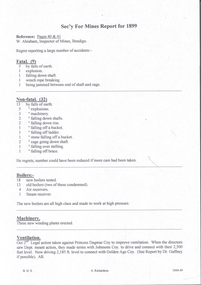
Document - MINING REPORTS - SEC'Y FOR MINES REPORT FOR 1899
... Inspector of Mines, Bendigo. Report lists nine fatal accidents, thirty-two non-fatal accidents, boilers, machinery and ventilation....Inspector of Mines, Bendigo. Report lists nine fatal accidents, thirty-two non-fatal accidents, boilers, machinery and ventilation. ...Handwritten notes from Sec'y for Mines Report for 1899. W. Abraham, Inspector of Mines, Bendigo. Report lists nine fatal accidents, thirty-two non-fatal accidents, boilers, machinery and ventilation.document, gold, mining reports, sec'y for mines report for 1899, w abraham, accidents, princess dagmar coy, johnsons coy, golden age coy, dr gaffney -
 Bendigo Historical Society Inc.
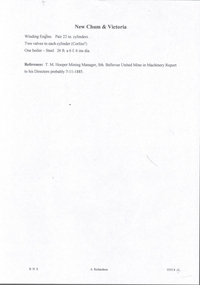
Document - NEW CHUM & VICTORIA LINES OF REEF - NOTES ON NEW CHUM & VICTORIA
... boiler - steel. 26 ft x 6 ft 6 ins diameter. Reference: T. M. Hooper, Mining Manager, Sth Bellevie United Mine in machinery. Report to His Directors probably 7 /11/1885. On the back with scribble over it, are some notes re Bendigo was making its own winding engines, air compressors and crushing machinery so efficiently that the Senior Inspector of Mines, Mr. ...boiler - steel. 26 ft x 6 ft 6 ins diameter. Reference: T. M. Hooper, Mining Manager, Sth Bellevie United Mine in machinery. Report to His Directors probably 7 /11/1885. On the back with scribble over it, are some notes re Bendigo was making its own winding engines, air compressors and crushing machinery so efficiently that the Senior Inspector of Mines, Mr. ...Handwritten notes on New Chum & Victoria. Winding Engine Pair 22 in cylinders. Two valves to each cylinder (Corliss?). One boiler - steel. 26 ft x 6 ft 6 ins diameter. Reference: T. M. Hooper, Mining Manager, Sth Bellevie United Mine in machinery. Report to His Directors probably 7 /11/1885. On the back with scribble over it, are some notes re Bendigo was making its own winding engines, air compressors and crushing machinery so efficiently that the Senior Inspector of Mines, Mr. E. R. Neekison in a report to the Secretary for Mines in 1884 was emphatic that the best batteries, winding engines and gear have all been made in Sandhurst. Machinery made in Sandhurst was superior to any others in the colony for this class of work.document, gold, new chum & victoria lines of reef, notes on new chum & victoria, t m hooper, sth bellevu united mine, mr e r meekison, new chum, garden gully, hustler's, sheepshead line -
 Bendigo Historical Society Inc.
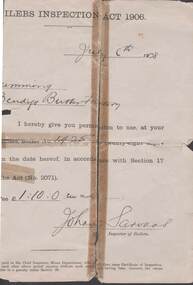
Document - BOILER INSPECTION CERTIFICATE: BENDIGO BUTTER FACTORY, 16th July 1908
... Johan Sarvaas. Inspector of Boilers. A part (half?) of a small form, split in two, dated and signed by Johan Sarvaas which gives permission for the boiler at the Bendigo Butter Factory to be used, and specifies a fee of 1 pound. ...A part (half?) of a small form, split in two, dated and signed by Johan Sarvaas which gives permission for the boiler at the Bendigo Butter Factory to be used, and specifies a fee of 1 pound.bendigo, industry, bendigo butter factory, bendigo butter factory. johan sarvaas. inspector of boilers. -
 Bendigo Historical Society Inc.
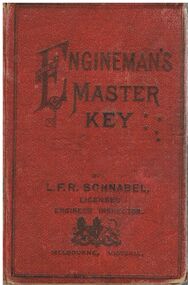
Document - BADHAM COLLECTION: ENGINEMAN’S MASTER'S KEY - BOOK BY L.F.R. SCHNABEL
... Inspector Melbourne, Victoria. Printed at the L.F.R Schnabel Engineering Institute, 443 Bourke St, Melbourne C 1903. Pans and specifications executed for Steam engines. Boilers...Schnabel - Licensed Inspector Melbourne Victoria printed at The L.F.R Schnabel Engineering Institute 443 bourke st Melbourne. Plans and specifications executed for Steam engines Boilers and Power Plants. ...Engineman’s Master's Key by L.F.R. Schnabel Licensed Inspector Melbourne, Victoria. Printed at the L.F.R Schnabel Engineering Institute, 443 Bourke St, Melbourne C 1903. Pans and specifications executed for Steam engines. Boilers and Power Plants, hard covered book worn.document, memo, railway, engineman’s master's key - book by l.f.r. schnabel - licensed inspector melbourne victoria, printed at the l.f.r schnabel engineering institute , 443 bourke st melbourne. plans and specifications executed for steam engines, boilers and power plants. -
 Bendigo Historical Society Inc.
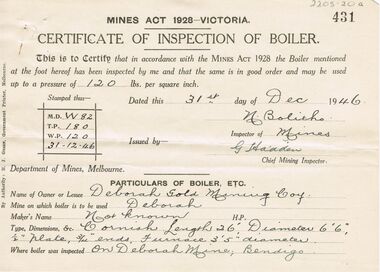
Document - MCCOLL, RANKIN AND STANISTREET COLLECTION: CERTIFICATE OF INSPECTION OF BOILER, 1946
... Two certificates, pinned in LH top corner, for inspection of boilers at Deborah Gold Mining Company. Dated 31st Dec. 1946. Signed G. Hadden, Chief Mining Inspector....Two certificates, pinned in LH top corner, for inspection of boilers at Deborah Gold Mining Company. Dated 31st Dec. 1946. Signed G. Hadden, Chief Mining Inspector. ...Document: Mines Act 1928, certificate of inspection of boiler. Two certificates, pinned in LH top corner, for inspection of boilers at Deborah Gold Mining Company. Dated 31st Dec. 1946. Signed G. Hadden, Chief Mining Inspector.Department of Mines, Melbournemining, deborah mines nl, gold mining, boilers, boiler, g. hadden, mccoll rnkin & stanistreet -
 Bendigo Historical Society Inc.
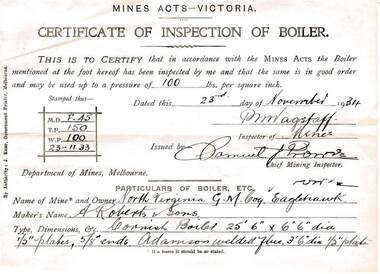
Document - MCCOLL, RANKIN AND STANISTREET COLLECTION: NORTH VIRGINIA GM CO NL, CERTIFICATE OF BOILER INSPECTION, 1934
... Certificate that boiler is in good order and may be use up to a pressure of 100 lbs. per square inch. Dated: 23/11/1934. Signed: P Wagstaff, Inspector of Mines Issued by Signature: Samuel ? ...Certificate that boiler is in good order and may be use up to a pressure of 100 lbs. per square inch. Dated: 23/11/1934. Signed: P Wagstaff, Inspector of Mines Issued by Signature: Samuel ? ...McColl Rankin & Stanistreet, North Virginia GM Co NL, Certificate of Boiler Inspection. Certificate that boiler is in good order and may be use up to a pressure of 100 lbs. per square inch. Dated: 23/11/1934. Signed: P Wagstaff, Inspector of Mines Issued by Signature: Samuel ? ?? Makers name A Roberts & Sons. Type Cornish Boiler 25' 6'' x 6' 6'' dia 1/2 plates, 5/8'' ends. Adamson welded flue. 3' 6'' dia 1/2'' plateorganization, business, gold mine, mccoll rankin & stanistreet, north virginia gm co nl, certificate of boiler inspection mines act victoria
