
Showing 5 items matching "bomber command 1941"
-
 Lara RSL Sub Branch
Book, Australia in the War of 1939-1945 - Air War Against Germany and Italy 1939-1943. AIR Author John Herington, First published 1954
... ...bomber command 1941...Historical record of the AIR effort 1939-1943 germany italy the battle of britain syria western desert fighter squadrons in 1941 bomber command 1941 radar bombing air war tunisia pathfinder raids invasion of sicily night fighters Australian War Memorial Australia in the War of 1939-1945 - Air War Against Germany and Italy 1939-1943 Illustrations, Maps, Diagrams and Graphs, Maps Australia in the War of 1939-1945 - Air War Against Germany and Italy 1939-1943. ...Australian contribution to air fighting against Germany and Italy with Australia being a small force against the larger, stronger air forces. The smaller Australian Airmen were merged into the Royal Air Force.Historical record of the AIR effort 1939-1943Australia in the War of 1939-1945 - Air War Against Germany and Italy 1939-1943 Illustrations, Maps, Diagrams and Graphs, MapsAustralian War Memorialgermany, italy, the battle of britain, syria, western desert, fighter squadrons in 1941, bomber command 1941, radar bombing, air war, tunisia, pathfinder raids, invasion of sicily, night fighters -
 B-24 Liberator Memorial Restoration Australia Inc
Oral History, My RAAF Experience by Keith R.E. Johnston, 1980's
... Johnston was in the RAAF from September 1941 until December 1945 and was a B-24 Liberator pilot between 1942 and December 1945. He was attached to Fifth Bomber Command USAF the 12 Squadron RAAF....Johnston was in the RAAF from September 1941 until December 1945 and was a B-24 Liberator pilot between 1942 and December 1945. He was attached to Fifth Bomber Command USAF the 12 Squadron RAAF. ...K. Johnston was in the RAAF from September 1941 until December 1945 and was a B-24 Liberator pilot between 1942 and December 1945. He was attached to Fifth Bomber Command USAF the 12 Squadron RAAF.This oral history of Keith Johnston is of historical significance because it provides a first hand account of this individual's experiences during World War II as a member of the RAAF who trained at Bradfield Park Sydney and Bundaberg and saw active service during the Pacific conflict flying B-24 Liberator aircraft in New Guinea and Darwin.A4 paper printed transcript, stapled in cornerMy RAAF Experience by R.E.Johnston, photo of 12 Squadron RAAF badge, Flight Lieutenant 12 Squadron RAAForal history raaf world war ii -
 Monbulk RSL Sub Branch
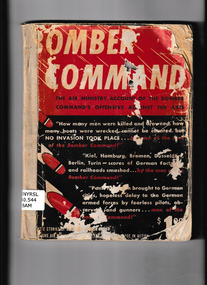
Book, H.M. Stationery Office, Bomber Command : the Air Ministry account of Bomber Command's offensive against the Axis, September, 1939-July, 1941, 1941
... Bomber Command : the Air Ministry account of Bomber Command's offensive against the Axis, September, 1939-July, 1941....World war 1939-1945 - Aerial operations - British Royal Air Force - Bomber Command An account of Bomber Commands operations in the first years of the war Ill, maps, p.120. Bomber Command : the Air Ministry account of Bomber Command's offensive against the Axis, September, 1939-July, 1941. ...An account of Bomber Commands operations in the first years of the warIll, maps, p.120.non-fictionAn account of Bomber Commands operations in the first years of the warworld war 1939-1945 - aerial operations - british, royal air force - bomber command -
Moorabbin Air Museum
Book (Item) - Flying With Lady Luck
... Description: Air Ministry Account of Bomber Command Offensive Against the Axis Sept 1939-July 1941 AAP Date: 1941 Author: Amended to AL Publisher: His Majesty's Stationery Office Pages: 125 (2copies) Binding: Book Content/Keywords: Level of Importance: . ...Description: Air Ministry Account of Bomber Command Offensive Against the Axis Sept 1939-July 1941 AAP Date: 1941 Author: Amended to AL Publisher: His Majesty's Stationery Office Pages: 125 (2copies) Binding: Book Content/Keywords: Level of Importance: . ...Description: Air Ministry Account of Bomber Command Offensive Against the Axis Sept 1939-July 1941 AAP Date: 1941 Author: Amended to AL Publisher: His Majesty's Stationery Office Pages: 125 (2copies) Binding: Book Content/Keywords: Level of Importance: . -
 Bendigo Historical Society Inc.
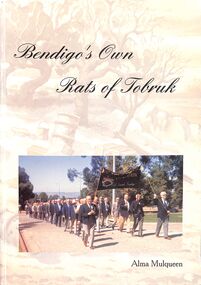
Book - "Bendigo's Own Rates of Tobruk", 1995
... commanded by Generalleutnant Erwin Rommel, to rescue his beleaguered Italian ally. Rommel launched Operation Sonnenblume (6 February – 25 May 1941), driving the Allies back across Libya to the Egyptian border. However, Tobruk held out, depriving Rommel of a supply port closer to the Egyptian–Libyan border than Benghazi, 560 mi (900 km) west of the Egyptian frontier. The Axis siege of Tobruk began on 10 April and continued despite two failed Allied relief attempts: Operation Brevity (15–16 May) and Operation Battleaxe (15–17 June). The garrison repulsed several Axis attacks. The port was frequently bombarded by artillery, dive-bombers...commanded by Generalleutnant Erwin Rommel, to rescue his beleaguered Italian ally. Rommel launched Operation Sonnenblume (6 February – 25 May 1941), driving the Allies back across Libya to the Egyptian border. However, Tobruk held out, depriving Rommel of a supply port closer to the Egyptian–Libyan border than Benghazi, 560 mi (900 km) west of the Egyptian frontier. The Axis siege of Tobruk began on 10 April and continued despite two failed Allied relief attempts: Operation Brevity (15–16 May) and Operation Battleaxe (15–17 June). The garrison repulsed several Axis attacks. The port was frequently bombarded by artillery, dive-bombers ...The siege of Tobruk (/təˈbrʊk, toʊ-/) took place between 10 April and 27 November 1941, during the Western Desert campaign (1940–1943) of the Second World War. An Allied force, consisting mostly of the 9th Australian Division, commanded by Lieutenant-General Leslie Morshead, was besieged in the North African port of Tobruk by German and Italian forces. The tenacious defenders quickly became known as the Rats of Tobruk. After 231 days, they were finally relieved by the British Eighth Army. In late 1940, the Allies had defeated the Italian 10th Army during Operation Compass (9 December 1940 – 9 February 1941) and trapped the remnants at Beda Fomm. On 22 January 1941, Tobruk's Italian garrison surrendered. But in early 1941, much of the British Western Desert Force was sent to the Greek and Syria–Lebanon campaigns, leaving only a skeleton force short of equipment and supplies. Adolf Hitler felt compelled to send reinforcements, commanded by Generalleutnant Erwin Rommel, to rescue his beleaguered Italian ally. Rommel launched Operation Sonnenblume (6 February – 25 May 1941), driving the Allies back across Libya to the Egyptian border. However, Tobruk held out, depriving Rommel of a supply port closer to the Egyptian–Libyan border than Benghazi, 560 mi (900 km) west of the Egyptian frontier. The Axis siege of Tobruk began on 10 April and continued despite two failed Allied relief attempts: Operation Brevity (15–16 May) and Operation Battleaxe (15–17 June). The garrison repulsed several Axis attacks. The port was frequently bombarded by artillery, dive-bombers and medium bombers, while the Royal Air Force flew defensive sorties from airfields far away in Egypt. Allied naval forces, such as the British Mediterranean Fleet (including the Inshore Squadron) ran the blockade, carrying reinforcements and supplies in and the wounded and prisoners out. Finally, Operation Crusader (18 November – 30 December) succeeded in raising the siege. Bendigo formed its own 'Assoociation of Rats of Tobruk' in 1949. "Bendigo's Own Rates of Tobruk" by Alma Mulqueen. Soft cover. Front and back covers have feint painted image of fig tree taken from Tobruk Barracks, Puckapunyal. Rats of Tobruk Association logo on back cover, and group of past servicemen marching inset on front cover. Book title written in black on front cover. 172 pages. Black and white images through out. Index of records/service people towards front of book. Contains images of soldiers and a brief summary of their service. rats of tobruk, world war 2, soldiers, bendigo
