
Showing 24 items matching "bomber types"
-
 Moorabbin Air Museum
Book - RAF in World War II, Experiences of War The British Airman
... ...Bomber types...RAF in World War II Sprogs The drill Oppos The line Bomber types Fighter types Coastal Air Command Transport The Mediterranean Ground crew & other back up. ...Overview of RAF experience in WWII, through eyes of participants. Circa 1989non-fictionOverview of RAF experience in WWII, through eyes of participants. Circa 1989sprogs, the drill, oppos, the line, bomber types, fighter types, coastal air command, transport, the mediterranean, ground crew & other back up., ve day & demob -
 Melbourne Legacy
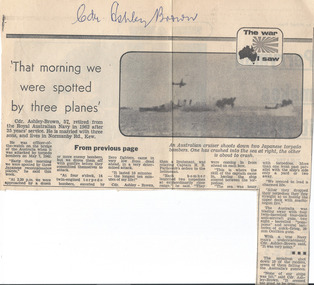
Newspaper - Document, newspaper article, The War I saw: That morning we were spotted by three planes
... Newsprint article, black and white photo of a cruiser shooting at Japanese torpedo bombers, black type....Newsprint article, black and white photo of a cruiser shooting at Japanese torpedo bombers, black type. The War I saw: That morning we were spotted by three planes. ...Story by Cdr Ashley Brown, officer of the watch about an attack by Japanese aircraft on the HMAS Austrlia May 7, 1942. Also an account of an accidental bombing of the ship by the United States Airforce. It was part of a series of articles called 'The War I saw' published in the Herald Sun newspaper. Date unknown. This document was from a file of information about guest speakers (see also 00812-00822 and 00830-00837). So it is assumed that Cdr Ashley-Brown was approached to speak at a Legacy function. Legatees met regularly and had guest speakers to entertain and inform on different subjects at their Tuesday Luncheons. The Programme Committee was responsible for organising the speakers.A record that the speakers at legacy functions came from a wide variety of backgrounds and the subjects spoken on were varied. An eyewitness account of how lucky you can be.Newsprint article, black and white photo of a cruiser shooting at Japanese torpedo bombers, black type.Handwritten Cdr Ashley Brown in blue pen.speakers, world war two -
Frankston RSL Sub Branch
Recorder, Camera
... bomber aerial The recorder enclosure is inscribed with the Department of Defence mark and the following, "14A/3629, G.G.S., RECORDER, Mk2, 24V., XX 12012". There are small controls on the narrow side of the recorder which are marked "START, 0, 5, 10, 15, END" and "DULL, S.S. BRIGHT". The recorder magazine is inscribed with the Department of Defence mark and the following "14A/4008, G.G.S., RECORDER, MAGAZINE, MKII". This is a Camera Gun Recorder used in conjunction with a Gyro Gun Sight type ...This is a Camera Gun Recorder used in conjunction with a Gyro Gun Sight type 14A, G. G. S. Recorder Mk2 contained in a wooden box with hinged lid and retaining catch. The recorder consists of a metal enclosure with an electrical power supply cable fitted with a three pole female plug connector. A small access cover in the enclosure can be opened to replace the Recorder Magazine. There is a transparent aperture window on the underside of the enclosure.The recorder enclosure is inscribed with the Department of Defence mark and the following, "14A/3629, G.G.S., RECORDER, Mk2, 24V., XX 12012". There are small controls on the narrow side of the recorder which are marked "START, 0, 5, 10, 15, END" and "DULL, S.S. BRIGHT". The recorder magazine is inscribed with the Department of Defence mark and the following "14A/4008, G.G.S., RECORDER, MAGAZINE, MKII". raaf, royal australian air force, gun, fighter, photography, ww2, world war 2, camera, aircraft, bomber, aerial -
 Lara RSL Sub Branch
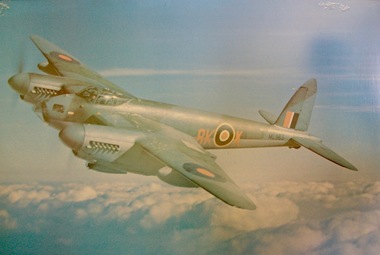
Framed photo print of Mosquito fighter plane
... bomber, became one of the war's most potent fighters. More than this, indeed, it was probably the most successfully versatile of any twin-engined type built between 1939 and 1945. ...The de Havilland DH.98 Mosquito is a British twin-engine shoulder-winged multi-role combat aircraft. The crew of two, pilot and navigator, sat side by side. It served during and after the Second World War. It was one of few operational front-line aircraft of the era whose frame was constructed almost entirely of wood and was nicknamed The Wooden Wonder. https://en.wikipedia.org/wiki/De_Havilland_MosquitoIt is one of the paradoxes of aircraft development that some of the world's greatest aeroplanes have achieved their fame doing jobs other than the one they were originally designed for. No better example of this could be found than the Mosquito, which, conceived as a bomber, became one of the war's most potent fighters. More than this, indeed, it was probably the most successfully versatile of any twin-engined type built between 1939 and 1945. It excelled in all the widely varied roles. Its duties included the duties of low-level and high-attack day and night bomber, long-range photo-reconnaissance, mine layer, pathfinder, high-speed military transport, long-range day and night fighter, and fighter-bomber. It served in Europe, the Middle and Far East and on the Russian front. In fact, the ubiquitous Mosquito reigned supreme among General Purpose types. Of the grand total of 7,781 Mosquitos built, 6,710 were delivered during the war years. www.aviation-history.com/dehavilland/mosquito.html Rectangular shaped picture frame showing Mosquito fighter plane.fighter planes, ww2, british aircraft, mosquito fighter planes, lara r.s.l. -
 Bendigo Military Museum
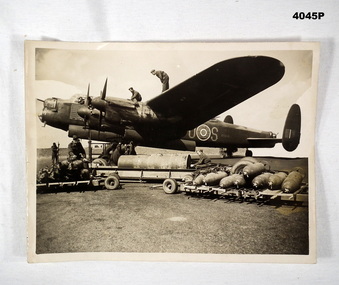
Photograph - PHOTOGRAPH, LANCASTER, Central Press Photos Ltd, c. WWII
... Photograph depicts the type of Lancaster bomber flown by F. G. Davey. Part of Frederick Gardner Davey DFC No.410533 RAAF Collection. ...Photograph depicts the type of Lancaster bomber flown by F. G. Davey. Part of Frederick Gardner Davey DFC No.410533 RAAF Collection. ...Photograph depicts the type of Lancaster bomber flown by F. G. Davey. Part of Frederick Gardner Davey DFC No.410533 RAAF Collection. See Cat. No. 3536P for his service record. Photo - Black & white, depicting a Lancaster heavy bomber being loaded with bombs. Ten personnel engaged in various tasks.On back handwritten in pencil: "Lancaster with bombs. Crosses denote number of missions". On back stamped in blue ink: "Supplied by Central Press Photos Ltd. Incorporating Central News Illustrations Service. 119 Fleet Street London E.C.4"lancasters, raaf -
 Bendigo Military Museum
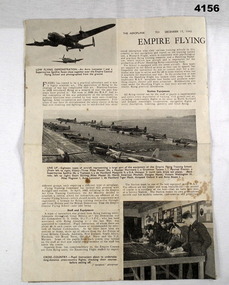
Magazine - MAGAZINE PAGES, December 1943
... bomber. Part of the collection of Frederick Gardner Davey DFC No 410533 RAAF. Refer Cat No 3536P for his service details. Magazines Lancaster Four printed pages with black type and black & white photographs. ...Pages numbered 697 - 700 removed from “The Aeroplane” dated 17 December 1943. Pages 698 - 699 feature photos of the Avro Lancaster II bomber. Part of the collection of Frederick Gardner Davey DFC No 410533 RAAF. Refer Cat No 3536P for his service details.Four printed pages with black type and black & white photographs. The pages have been removed from a magazine.magazines, lancaster -
 Bendigo Military Museum
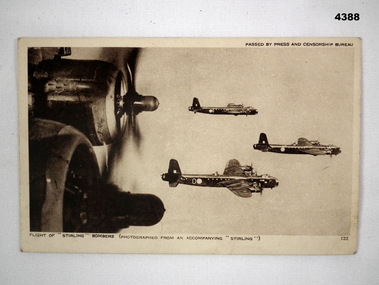
Postcard - SOUVENIR POSTCARD, Photochrom Co Ltd
... Postcards Bombers WW2 Aircraft Postcard, rectangular shape featuring a sepia tone photograph of 4 Aeroplanes in flight, photo has a white border with captions top and bottom in black print, rear has details of the photograph printed in black type with space allocated for correspondence and a stamp. ...The photo features a flight of four Stirling Bombers taken c WW2 and passed by the press and censorship Bureau in the U.K. Part of the Frederick Gardner Davey DFC RAAF collection. Refer Cat No 3536P for his service record.Postcard, rectangular shape featuring a sepia tone photograph of 4 Aeroplanes in flight, photo has a white border with captions top and bottom in black print, rear has details of the photograph printed in black type with space allocated for correspondence and a stamp.postcards, bombers, ww2, aircraft -
 Bendigo Military Museum
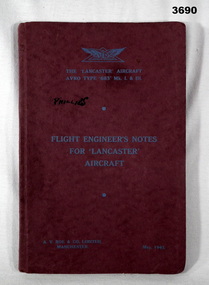
Manual - FLIGHT ENGINEERS NOTES, LANCASTER, 5.1943
... Bomber. Item re Frederick Gardner DAVEY DFC No 410533 RAAF. Refer Reg No 3536P for his service details. Lancaster Flight Enginners manuals Handwritten in black ink on left of front cover: PHILLIPS On title page details of the holder in black ink: K.T. COOPER 132023. HUT AY, No 2 (T) WING, R.A.F. ST ATHAN, GLAMORGAN, S WALES. 78. 4.6.643 Opposite List of Contents page handwritten directives for use under the heading AMENDMENTS. Maroon, soft card, cover. Pages bound & glued to cover. Title on front in light blue type ...Contains detailed diagrams of the Lancaster Bomber. Item re Frederick Gardner DAVEY DFC No 410533 RAAF. Refer Reg No 3536P for his service details.Maroon, soft card, cover. Pages bound & glued to cover. Title on front in light blue type, pages not numbered. 11 foldout black / white diagrams attached after the final printed page.Handwritten in black ink on left of front cover: PHILLIPS On title page details of the holder in black ink: K.T. COOPER 132023. HUT AY, No 2 (T) WING, R.A.F. ST ATHAN, GLAMORGAN, S WALES. 78. 4.6.643 Opposite List of Contents page handwritten directives for use under the heading AMENDMENTS. lancaster, flight enginners, manuals, -
 Bendigo Military Museum
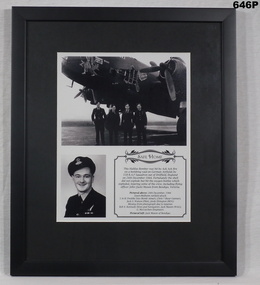
Photograph - PHOTOGRAPHS FRAMED RAAF, SAFE HOME, C.1944 - 45
... type. A montage of 2 black and white photos and a description. Large photo shows 4 crew members standing in front of a damaged Halifax bomber. ...type. A montage of 2 black and white photos and a description. Large photo shows 4 crew members standing in front of a damaged Halifax bomber. ...John Joseph MASON No 418670 Wireless Air Gunner (WAG) (born Bendigo, enlisted Melbourne) in the RAAF on 29.5.1942 age 19 years. After 5 Training postings he embarked for Canada on 15.1.1943 arriving 31.1.1943. He then did Training in Edmonton, Calgary and Mossank before embarking to England 21.10.1943 arriving 30.6.1943. After more Training at several postings he was finally posted to No 158 SQD RAF flying Halifax Bombers and commenced operational flying on 5.11.1944. He rose through the ranks to Flt Sgt on 31.12.1944 and then granted a Commission as F/O on 12.3.1945. He transferred to 466 SQD RAAF on 26.5.1945. His records are a bit sketchy but it appears he flew 11 Operational Sorties. His Commission was terminated on 19.3.1946. His brother Hugh who was also in the RAAF and home at the time told the story that when the aircraft was hit his mother new something had happened to Jack.Photograph, framed. Safe home. The frame is black smooth wooden type. A montage of 2 black and white photos and a description. Large photo shows 4 crew members standing in front of a damaged Halifax bomber. Small photo is of air crewman flying officer JACK MASON (WAG) of Bendigo. The story covers the raid that aircraft was on, how the side exploded out, and the crew members names.Rear has "From HUGH MASON and the MASON family"photography - photographs, raaf ww2, 158 sqd -
 Bendigo Military Museum
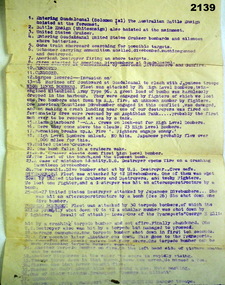
Administrative record - DOCUMENT, NAVAL, Est late 1942
... Typed sheet in purple listing points 1-41 re brief description of the retaking of Gaudalcanal in 1942. There are 3 underlined headings, "High level bombers, Dive bombers, Torpedoe bombers". ...Documents Naval plans Typed sheet in purple listing points 1-41 re brief description of the retaking of Gaudalcanal in 1942. There are 3 underlined headings, "High level bombers, Dive bombers, Torpedoe bombers". ...Item belonged to Arthur George Holley No 13556 RAN, HMAS Hobart. Refer 2134 for service history also 2137, 2147. Typed sheet in purple listing points 1-41 re brief description of the retaking of Gaudalcanal in 1942. There are 3 underlined headings, "High level bombers, Dive bombers, Torpedoe bombers". HMAS Hobart and Australia were involved. documents, naval, plans -
 B-24 Liberator Memorial Restoration Australia Inc
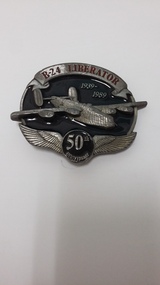
Accessory - Belt Buckle
... B-24 LIBERATOR Origin: Consolidated Vultee Aircraft Co Type: Long-range bomber with normal crew of 10 History: First flight(xb 24) December 29 1939 Withdraw from service 1955-56 It was built in bigger numbers than any other American aircraft in history and served on every front in WW11 and with15 allied nations....B-24 LIBERATOR Origin: Consolidated Vultee Aircraft Co Type: Long-range bomber with normal crew of 10 History: First flight(xb 24) December 29 1939 Withdraw from service 1955-56 It was built in bigger numbers than any other American aircraft in history and served on every front in WW11 and with15 allied nations. ...Large Forged Iron embossed belt buckle.B-24 LIBERATOR, 1939-1989, 50th ANNIVERSARY (on front) LIMITED EDITION 50th ANNIVERSARY ISSUE,B-24 LIBERATOR, 1989 BUCKLE CONNECTION, SERIAL 0612 OF 1939. B-24 LIBERATOR Origin: Consolidated Vultee Aircraft Co Type: Long-range bomber with normal crew of 10 History: First flight(xb 24) December 29 1939 Withdraw from service 1955-56 It was built in bigger numbers than any other American aircraft in history and served on every front in WW11 and with15 allied nations. -
Port Melbourne Historical & Preservation Society
Document - Coffee/Tea order form, Port Melbourne Council meetings, City of Port Melbourne, 1986
... Local Government - City of Port Melbourne Frederick Robert WINDUSS Russell GRIFFITHS Phillip LANG Perce McGuire WHITE Perce WHITE James Malcolm (Jim) MITCHELL Chris RAEBURN Raymond Frank JULIER Barry 'Bomber' MITCHELL Josef (Jo) SZWARC One copy annotated in pencil by cataloguer with full names of those listed Blank forms typed on city A5 letterhead and photocopied (3 copies): used to note tea and coffee orders for Port Melbourne Council meetings. ...Blank forms typed on city A5 letterhead and photocopied (3 copies): used to note tea and coffee orders for Port Melbourne Council meetings. Initials of councillors and chief officers included.One copy annotated in pencil by cataloguer with full names of those listedlocal government - city of port melbourne, frederick robert winduss, russell griffiths, phillip lang, perce mcguire white, perce white, james malcolm (jim) mitchell, chris raeburn, raymond frank julier, barry 'bomber' mitchell, josef (jo) szwarc -
 Eltham District Historical Society Inc
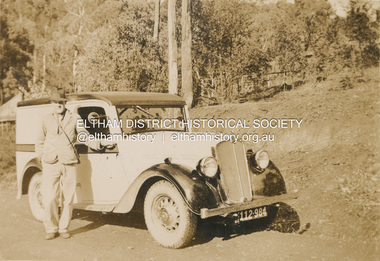
Photograph, Lester Neil Ingram with his Morris Ten Series II delivery van, c.1942
... bomber, N.1374. The airframe had run 1,127 hours. A full moon was just rising. The flight was non-operational, its purpose a dual conversion on type mission flown by a student pilot with almost two hours completed at night on similar flights. ...bomber, N.1374. The airframe had run 1,127 hours. A full moon was just rising. The flight was non-operational, its purpose a dual conversion on type mission flown by a student pilot with almost two hours completed at night on similar flights. ...The van is a Morris Ten Series II which was manufactured 1935-1937. The numeral only Victorian Registration plate 112-984 was part of the sequence of numeral only plates issued 1910-1939. Lester Neil Ingram was born at Kew, 8 November 1911, the son of John and Ada (Key) Ingram of Research. According to Electoral Roll records, in 1903, John Ingram was a farmer at Lancefield, his wife Ada, a milliner. By 1906, John Ingram was a baker at Research and from about 1912, an orchardist. The family moved to Anglesea River sometime between 1937 and 1942. A sheet metal worker by trade, Lester had run the bakery business for 14 years, his father retired, and was working as a baker at Anglesea when he enlisted in the R.A.A.F. on 5 December 1941 at Melbourne. Previously he had worked as a baker at Research (1937). He undertook training as Aircrew at No. 4 Initial Training School at Victor Harbour, South Australia, followed by No. 1 Wireless Air Gunners School at Ballarat, Victoria, and No. 3 Bombing and Gunnery School, West Sale, Victoria. On October 15, 1942 Lester qualified as an Air Gunner, promoted to Sergeant, and was posted to 1 Embarkation Depot at Ascot Vale, Victoria, and attached to R.A.F. UK. Lester embarked from Australia December 2, 1942 and arrived at 11 Personnel Despatch and Reception Depot on January 13, 1943. On March 9 he was transferred to 10 Operational Training Unit, Group No. 91, Bomber Command, R.A.F. Lester’s service file reveals that on the evening of 22 April 1943, Lester was a member of the aircrew of Whitley V bomber, N.1374. The airframe had run 1,127 hours. A full moon was just rising. The flight was non-operational, its purpose a dual conversion on type mission flown by a student pilot with almost two hours completed at night on similar flights. They had just changed aircraft as their previous aircraft had become unserviceable. The pilot had accepted the aircraft, which was technically unserviceable as the NCO in charge of flight had not completed the inspection paperwork correctly. The aircraft had undergone a major engine repair the day before. The aircraft took off at 2348 hours from R.A.F. Abington. It was reported that the aircraft take-off was quite normal and after climbing to 800 feet it passed out of view of the ground observers. A few seconds later the aircraft crashed, and it was reported that the sound of the engines seemed to become desynchronised. The crash occurred one and a half miles northwest of Longworth, Berkshire and the aircraft destroyed by fire. It carried a crew of five. Lester is commemorated on the Eltham Roll of Honour Board, which was commissioned by the Eltham War Memorial Trust to be hung in the Eltham Infant Welfare Centre, part of complex of buildings that form the Eltham War Memorial. The Honour Roll is presently (2023) hanging in the Eltham Library Community Gallery space. Lester was remembered with the following notices published in The Argus newspaper, Saturday 22 April 1944, p2: INGRAM. —In treasured memories you are with me still. Sgt. Lester Neil Ingram, killed, aircraft accident, England, April 22, 1943. (Mother and father.) INGRAM. —In proud and ever loving memory of Lester, 410236, Sgt. L. N. Ingram, R.A.A.F., air crash England, April 22, 1943. —Per ardua ad astra. (Ellen Peake and family.) [“Per ardua ad astra” is a Latin phrase meaning “through adversity to the stars” or “through struggle to the stars” which was the motto of the Royal Air Force and other Commonwealth air forces such as the Royal Australian Air Force.] And from his fiancé Ellen, in The Argus, Wednesday, 5 May 1943, p2: INGRAM. —On April 22 (result of aircraft accident near Lodgeworth Village, Berks, England), Sgt. Lester Neil Ingram, R.A.A.F., fiance of Ellen. -Treasured memories till we meet again. Lester is buried at Brookwood Military Cemetery, Surrey, United Kingdom, Grave 4. 1. 11. INGRAM, Flt. Sgt. LESTER NEIL, 410236. R.A.A.F. 22nd April 1943. Age 31. Son of John and Ada Ingram, of Anglesea, Victoria, Australia. He gave his life For freedom’s cause ◊ ◊ ◊ LEST WE FORGET “They shall grow not old, as we that are left grow old; Age shall not weary them, nor the years condemn. At the going down of the sun and in the morning We will remember them.”On reverse "Lester Ingram"112-984 (victorian registration), lester neil ingram, morris ten series ii, bakery, delivery van, pam thoonen (nee ingram) collection -
 Eltham District Historical Society Inc
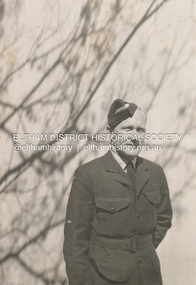
Photograph, Leading Aircraftsman, Lester Neil Ingram, RAAF, c.1943
... bomber, N.1374. The airframe had run 1,127 hours. A full moon was just rising. The flight was non-operational, its purpose a dual conversion on type mission flown by a student pilot with almost two hours completed at night on similar flights. ...bomber, N.1374. The airframe had run 1,127 hours. A full moon was just rising. The flight was non-operational, its purpose a dual conversion on type mission flown by a student pilot with almost two hours completed at night on similar flights. ...Lester Neil Ingram was born at Kew, 8 November 1911, the son of John and Ada (Key) Ingram of Research. According to Electoral Roll records, in 1903, John Ingram was a farmer at Lancefield, his wife Ada, a milliner. By 1906, John Ingram was a baker at Research and from about 1912, an orchardist. The family moved to Anglesea River sometime between 1943 and 1949. A sheet metal worker by trade, Lester had run the bakery business for 14 years, his father retired, and was working as a baker at Anglesea when he enlisted in the R.A.A.F. on 5 December 1941 at Melbourne. Previously he had worked as a baker at Research (1937). He undertook training as Aircrew at No. 4 Initial Training School at Victor Harbour, South Australia, followed by No. 1 Wireless Air Gunners School at Ballarat, Victoria, and No. 3 Bombing and Gunnery School, West Sale, Victoria. On October 15, 1942 Lester qualified as an Air Gunner, promoted to Sergeant, and was posted to 1 Embarkation Depot at Ascot Vale, Victoria, and attached to R.A.F. UK. Lester embarked from Australia December 2, 1942 and arrived at 11 Personnel Despatch and Reception Depot on January 13, 1943. On March 9 he was transferred to 10 Operational Training Unit, Group No. 91, Bomber Command, R.A.F. Lester’s service file reveals that on the evening of 22 April 1943, Lester was a member of the aircrew of Whitley V bomber, N.1374. The airframe had run 1,127 hours. A full moon was just rising. The flight was non-operational, its purpose a dual conversion on type mission flown by a student pilot with almost two hours completed at night on similar flights. They had just changed aircraft as their previous aircraft had become unserviceable. The pilot had accepted the aircraft, which was technically unserviceable as the NCO in charge of flight had not completed the inspection paperwork correctly. The aircraft had undergone a major engine repair the day before. The aircraft took off at 2348 hours from R.A.F. Abington. It was reported that the aircraft take-off was quite normal and after climbing to 800 feet it passed out of view of the ground observers. A few seconds later the aircraft crashed, and it was reported that the sound of the engines seemed to become desynchronised. The crash occurred one and a half miles northwest of Longworth, Berkshire and the aircraft destroyed by fire. It carried a crew of five. Lester is commemorated on the Eltham Roll of Honour Board, which was commissioned by the Eltham War Memorial Trust to be hung in the Eltham Infant Welfare Centre, part of complex of buildings that form the Eltham War Memorial. The Honour Roll is presently (2023) hanging in the Eltham Library Community Gallery space. Lester was remembered with the following notices published in The Argus newspaper, Saturday 22 April 1944, p2: INGRAM. —In treasured memories you are with me still. Sgt. Lester Neil Ingram, killed, aircraft accident, England, April 22, 1943. (Mother and father.) INGRAM. —In proud and ever loving memory of Lester, 410236, Sgt. L. N. Ingram, R.A.A.F., air crash England, April 22, 1943. —Per ardua ad astra. (Ellen Peake and family.) [“Per ardua ad astra” is a Latin phrase meaning “through adversity to the stars” or “through struggle to the stars” which was the motto of the Royal Air Force and other Commonwealth air forces such as the Royal Australian Air Force.] And from his fiancé Ellen, in The Argus, Wednesday, 5 May 1943, p2: INGRAM. —On April 22 (result of aircraft accident near Lodgeworth Village, Berks, England), Sgt. Lester Neil Ingram, R.A.A.F., fiance of Ellen. -Treasured memories till we meet again. Lester is buried at Brookwood Military Cemetery, Surrey, United Kingdom, Grave 4. 1. 11. INGRAM, Flt. Sgt. LESTER NEIL, 410236. R.A.A.F. 22nd April 1943. Age 31. Son of John and Ada Ingram, of Anglesea, Victoria, Australia. He gave his life For freedom’s cause ◊ ◊ ◊ LEST WE FORGET “They shall grow not old, as we that are left grow old; Age shall not weary them, nor the years condemn. At the going down of the sun and in the morning We will remember them.”On reverse "Lester Ingram"lester neil ingram, baker, eltham, honour board, raaf, research (vic.), roll of honour, pam thoonen (nee ingram) collection -
 Eltham District Historical Society Inc
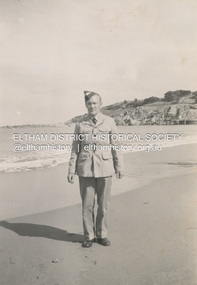
Photograph, Leading Aircraftsman, Lester Neil Ingram, RAAF, c.1943
... bomber, N.1374. The airframe had run 1,127 hours. A full moon was just rising. The flight was non-operational, its purpose a dual conversion on type mission flown by a student pilot with almost two hours completed at night on similar flights. ...bomber, N.1374. The airframe had run 1,127 hours. A full moon was just rising. The flight was non-operational, its purpose a dual conversion on type mission flown by a student pilot with almost two hours completed at night on similar flights. ...Lester Neil Ingram was born at Kew, 8 November 1911, the son of John and Ada (Key) Ingram of Research. According to Electoral Roll records, in 1903, John Ingram was a farmer at Lancefield, his wife Ada, a milliner. By 1906, John Ingram was a baker at Research and from about 1912, an orchardist. The family moved to Anglesea River sometime between 1943 and 1949. A sheet metal worker by trade, Lester had run the bakery business for 14 years, his father retired, and was working as a baker at Anglesea when he enlisted in the R.A.A.F. on 5 December 1941 at Melbourne. Previously he had worked as a baker at Research (1937). He undertook training as Aircrew at No. 4 Initial Training School at Victor Harbour, South Australia, followed by No. 1 Wireless Air Gunners School at Ballarat, Victoria, and No. 3 Bombing and Gunnery School, West Sale, Victoria. On October 15, 1942 Lester qualified as an Air Gunner, promoted to Sergeant, and was posted to 1 Embarkation Depot at Ascot Vale, Victoria, and attached to R.A.F. UK. Lester embarked from Australia December 2, 1942 and arrived at 11 Personnel Despatch and Reception Depot on January 13, 1943. On March 9 he was transferred to 10 Operational Training Unit, Group No. 91, Bomber Command, R.A.F. Lester’s service file reveals that on the evening of 22 April 1943, Lester was a member of the aircrew of Whitley V bomber, N.1374. The airframe had run 1,127 hours. A full moon was just rising. The flight was non-operational, its purpose a dual conversion on type mission flown by a student pilot with almost two hours completed at night on similar flights. They had just changed aircraft as their previous aircraft had become unserviceable. The pilot had accepted the aircraft, which was technically unserviceable as the NCO in charge of flight had not completed the inspection paperwork correctly. The aircraft had undergone a major engine repair the day before. The aircraft took off at 2348 hours from R.A.F. Abington. It was reported that the aircraft take-off was quite normal and after climbing to 800 feet it passed out of view of the ground observers. A few seconds later the aircraft crashed, and it was reported that the sound of the engines seemed to become desynchronised. The crash occurred one and a half miles northwest of Longworth, Berkshire and the aircraft destroyed by fire. It carried a crew of five. Lester is commemorated on the Eltham Roll of Honour Board, which was commissioned by the Eltham War Memorial Trust to be hung in the Eltham Infant Welfare Centre, part of complex of buildings that form the Eltham War Memorial. The Honour Roll is presently (2023) hanging in the Eltham Library Community Gallery space. Lester was remembered with the following notices published in The Argus newspaper, Saturday 22 April 1944, p2: INGRAM. —In treasured memories you are with me still. Sgt. Lester Neil Ingram, killed, aircraft accident, England, April 22, 1943. (Mother and father.) INGRAM. —In proud and ever loving memory of Lester, 410236, Sgt. L. N. Ingram, R.A.A.F., air crash England, April 22, 1943. —Per ardua ad astra. (Ellen Peake and family.) [“Per ardua ad astra” is a Latin phrase meaning “through adversity to the stars” or “through struggle to the stars” which was the motto of the Royal Air Force and other Commonwealth air forces such as the Royal Australian Air Force.] And from his fiancé Ellen, in The Argus, Wednesday, 5 May 1943, p2: INGRAM. —On April 22 (result of aircraft accident near Lodgeworth Village, Berks, England), Sgt. Lester Neil Ingram, R.A.A.F., fiance of Ellen. -Treasured memories till we meet again. Lester is buried at Brookwood Military Cemetery, Surrey, United Kingdom, Grave 4. 1. 11. INGRAM, Flt. Sgt. LESTER NEIL, 410236. R.A.A.F. 22nd April 1943. Age 31. Son of John and Ada Ingram, of Anglesea, Victoria, Australia. He gave his life For freedom’s cause ◊ ◊ ◊ LEST WE FORGET “They shall grow not old, as we that are left grow old; Age shall not weary them, nor the years condemn. At the going down of the sun and in the morning We will remember them.”On reverse "Lester Ingram"lester neil ingram, baker, eltham, honour board, raaf, research (vic.), roll of honour, pam thoonen (nee ingram) collection -
 Eltham District Historical Society Inc
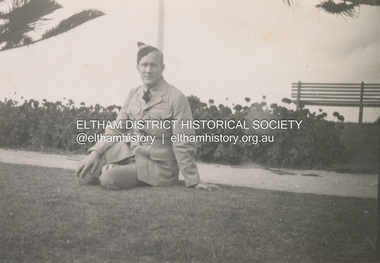
Photograph, Leading Aircraftsman, Lester Neil Ingram, RAAF, c.1943
... bomber, N.1374. The airframe had run 1,127 hours. A full moon was just rising. The flight was non-operational, its purpose a dual conversion on type mission flown by a student pilot with almost two hours completed at night on similar flights. ...bomber, N.1374. The airframe had run 1,127 hours. A full moon was just rising. The flight was non-operational, its purpose a dual conversion on type mission flown by a student pilot with almost two hours completed at night on similar flights. ...Lester Neil Ingram was born at Kew, 8 November 1911, the son of John and Ada (Key) Ingram of Research. According to Electoral Roll records, in 1903, John Ingram was a farmer at Lancefield, his wife Ada, a milliner. By 1906, John Ingram was a baker at Research and from about 1912, an orchardist. The family moved to Anglesea River sometime between 1943 and 1949. A sheet metal worker by trade, Lester had run the bakery business for 14 years, his father retired, and was working as a baker at Anglesea when he enlisted in the R.A.A.F. on 5 December 1941 at Melbourne. Previously he had worked as a baker at Research (1937). He undertook training as Aircrew at No. 4 Initial Training School at Victor Harbour, South Australia, followed by No. 1 Wireless Air Gunners School at Ballarat, Victoria, and No. 3 Bombing and Gunnery School, West Sale, Victoria. On October 15, 1942 Lester qualified as an Air Gunner, promoted to Sergeant, and was posted to 1 Embarkation Depot at Ascot Vale, Victoria, and attached to R.A.F. UK. Lester embarked from Australia December 2, 1942 and arrived at 11 Personnel Despatch and Reception Depot on January 13, 1943. On March 9 he was transferred to 10 Operational Training Unit, Group No. 91, Bomber Command, R.A.F. Lester’s service file reveals that on the evening of 22 April 1943, Lester was a member of the aircrew of Whitley V bomber, N.1374. The airframe had run 1,127 hours. A full moon was just rising. The flight was non-operational, its purpose a dual conversion on type mission flown by a student pilot with almost two hours completed at night on similar flights. They had just changed aircraft as their previous aircraft had become unserviceable. The pilot had accepted the aircraft, which was technically unserviceable as the NCO in charge of flight had not completed the inspection paperwork correctly. The aircraft had undergone a major engine repair the day before. The aircraft took off at 2348 hours from R.A.F. Abington. It was reported that the aircraft take-off was quite normal and after climbing to 800 feet it passed out of view of the ground observers. A few seconds later the aircraft crashed, and it was reported that the sound of the engines seemed to become desynchronised. The crash occurred one and a half miles northwest of Longworth, Berkshire and the aircraft destroyed by fire. It carried a crew of five. Lester is commemorated on the Eltham Roll of Honour Board, which was commissioned by the Eltham War Memorial Trust to be hung in the Eltham Infant Welfare Centre, part of complex of buildings that form the Eltham War Memorial. The Honour Roll is presently (2023) hanging in the Eltham Library Community Gallery space. Lester was remembered with the following notices published in The Argus newspaper, Saturday 22 April 1944, p2: INGRAM. —In treasured memories you are with me still. Sgt. Lester Neil Ingram, killed, aircraft accident, England, April 22, 1943. (Mother and father.) INGRAM. —In proud and ever loving memory of Lester, 410236, Sgt. L. N. Ingram, R.A.A.F., air crash England, April 22, 1943. —Per ardua ad astra. (Ellen Peake and family.) [“Per ardua ad astra” is a Latin phrase meaning “through adversity to the stars” or “through struggle to the stars” which was the motto of the Royal Air Force and other Commonwealth air forces such as the Royal Australian Air Force.] And from his fiancé Ellen, in The Argus, Wednesday, 5 May 1943, p2: INGRAM. —On April 22 (result of aircraft accident near Lodgeworth Village, Berks, England), Sgt. Lester Neil Ingram, R.A.A.F., fiance of Ellen. -Treasured memories till we meet again. Lester is buried at Brookwood Military Cemetery, Surrey, United Kingdom, Grave 4. 1. 11. INGRAM, Flt. Sgt. LESTER NEIL, 410236. R.A.A.F. 22nd April 1943. Age 31. Son of John and Ada Ingram, of Anglesea, Victoria, Australia. He gave his life For freedom’s cause ◊ ◊ ◊ LEST WE FORGET “They shall grow not old, as we that are left grow old; Age shall not weary them, nor the years condemn. At the going down of the sun and in the morning We will remember them.”On reverse "Lester Ingram"lester neil ingram, baker, eltham, honour board, raaf, research (vic.), roll of honour, pam thoonen (nee ingram) collection -
 National Vietnam Veterans Museum (NVVM)
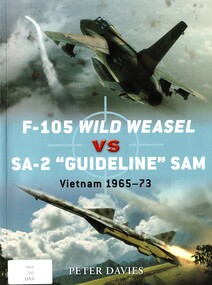
Book, Davies, Peter, F-105 Wild Weasel vs SA-2 "Guideline" SAM, Vietnam 1965 - 73, 2011
... Vietnam War 1961-1975 -- Aerial operations American F-105 Wild Weasel SA-2 "Guideline" Sam The Vietnam War saw the first extensive use of surface-to-air anti-aircraft missiles, heralding an entirely new type of aerial combat that pitted America's top fighter-bomber, the F-105 Wild Weasel, against the North Vietnamese SA-2 Sam supplied and initially manned by the Soviets. ...The Vietnam War saw the first extensive use of surface-to-air anti-aircraft missiles, heralding an entirely new type of aerial combat that pitted America's top fighter-bomber, the F-105 Wild Weasel, against the North Vietnamese SA-2 Sam supplied and initially manned by the Soviets.The Vietnam War saw the first extensive use of surface-to-air anti-aircraft missiles, heralding an entirely new type of aerial combat that pitted America's top fighter-bomber, the F-105 Wild Weasel, against the North Vietnamese SA-2 Sam supplied and initially manned by the Soviets.vietnam war, 1961-1975 -- aerial operations, american, f-105 wild weasel, sa-2 "guideline" sam -
Moorabbin Air Museum
Equipment (item) - Graviscope for Lincoln (Australian) RAAF Ident No G6C/3972, Graviscope for Lincoln
... bomber. The Lincoln was used by both the RAAF and the Royal Air Force in operations against Malayan Communist terrorists during the Malayan Emergency, 1948-1960. This graviscope is of the type...bomber. The Lincoln was used by both the RAAF and the Royal Air Force in operations against Malayan Communist terrorists during the Malayan Emergency, 1948-1960. This graviscope is of the type ...Description White plastic doubled sided Graviscope stored in protective leather carry case. Case is fitted with pair of press studs, pocket in front for holding instructions and is stamped "Graviscope / for / Lincoln / (Australian) / Manufactured by / Melb > W & G < Aust / R.A.A.F / Ident. No G6C/3972". Plastic graviscope consists of a 277mm white disc, printed on both sides, overlaid on one side by a 224mm disc and the other side by a 175mm disc. All discs located by central screw, to which is attached a 160mm long x 25mm wide clear celluloid strip. History / Summary The graviscope is a computing device, which in aircraft was used for measuring the centre of gravity in an aircraft. This would vary depending on crew, bomb load, fuel and stores carried. It was used in the British designed but Australian manufactured, Government Aircraft Factory (GAF) Lincoln heavy bomber, which was operated by the Royal Australian Air Force (RAAF) in the years following the Second World War. This aircraft was originally a derivative of the famous Avro Lancaster bomber. The Lincoln was used by both the RAAF and the Royal Air Force in operations against Malayan Communist terrorists during the Malayan Emergency, 1948-1960. This graviscope is of the type designed for and used by RAAF and RAF aircrew who operated this aircraft.Many by W and G Australia -
Moorabbin Air Museum
Manual (Item) - Description of various types, Twin otter fire bombers
... Twin otter fire bombers Manual Description of various types ... -
 Australian Gliding Museum
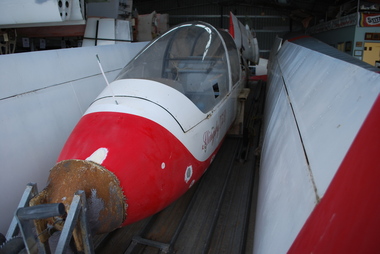
Machine - Glider – Sailplane, 1967
... type “B” model. It bears serial number 1686 and was manufactured in 1967. It was registered in Australia as VH-GUB in name of Boonah Gliding Club, Boonah, which is about 90 kilometres south west of Brisbane in Queensland. Locally it was called “the Bomber...type “B” model. It bears serial number 1686 and was manufactured in 1967. It was registered in Australia as VH-GUB in name of Boonah Gliding Club, Boonah, which is about 90 kilometres south west of Brisbane in Queensland. Locally it was called “the Bomber ...The Slingsby T53 glider was designed by J. Sellars in the 1960s as an easily maintained two seat trainer suitable for RAF Air Training Corp use and for sale in the USA and Australian markets where wooden gliders were becoming less popular. The Slingsby T53 prototype first flew in 1967. The T53B version has a conventional fixed tailplane with elevator instead of the all-moving tailplane of the original type. The “B” version also has ailerons of narrower chord and lacks wing flaps. Further changes were made to the fin (extended above the tailplane) for the final “C” version. Production of the T53 at Slingsby was disrupted by a fire at the factory in 1968. As a consequence the contract to supply 40 of the type to the RAF was cancelled and only a relatively small number (possibly 27) were made by Slingsby before the project was discontinued. The rights were later sold to Yorkshire Sailplanes. It designated the glider as the YS53 Sovereign – only a few were produced (possibly 3). The Australian Gliding Museum’s example is a type “B” model. It bears serial number 1686 and was manufactured in 1967. It was registered in Australia as VH-GUB in name of Boonah Gliding Club, Boonah, which is about 90 kilometres south west of Brisbane in Queensland. Locally it was called “the Bomber”! This exhibit is a representative example of the Slingsby T53 sailplane type. It is a rarity in Australia.All metal twin seat glider / sailplane, painted white with red tips and markings.“Slingsby T53B” on each side of fuselage below cockpit opening; Registration VH-GUB on each side of fuselage at rear.australian gliding, glider, sailplane, slingsby, t53, sellars, boonah gliding club, slocombe, boyle -
 Wangaratta RSL Sub Branch
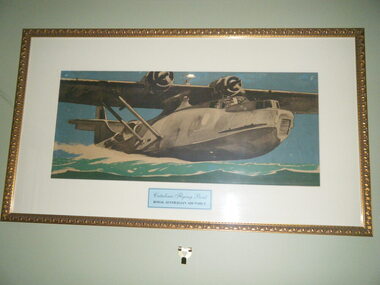
Print - Framed print, Catalina Flying Boat
... In the Royal Australian Air Force, PBYs and PB2Bs (a variant built by Boeing in Canada) served as multi role bombers and scouts, the type eventually earning great renown among Australian aircrews. ...Watercolour painting of Catalina Flying Boat - Attached to rear of frame is a short history of the Catalina Flying Boat together with the service history of Owen and and his younger brother Roy MORTIMER who both served in the Royal Australian Air Force in the South West Pacific area during WW2 Developed as a naval patrol aircraft, the Consolidated PBY Catalina was a widely exported flying boat during World War II. Over the course of the conflict it served with a number of different nations in a variety of roles. In the Royal Australian Air Force, PBYs and PB2Bs (a variant built by Boeing in Canada) served as multi role bombers and scouts, the type eventually earning great renown among Australian aircrews. The motto of the Catalina squadrons was "The First and Furthest." Gold painted embossed metal frame with cream coloured mount containing watercolour painting of plane on waterCatalina Flying Boat Royal Australian Air Force catalina flying boat, raaf, mortimer, ww2 -
Moorabbin Air Museum
Document (item) - Schematics of various items including RAAF aircraft camouflage Lycoming T55 turbine jet Allison T56 turbo prop flares smoke bombs MkIXC bomb sight Bombing teacher MkIII Bomb carriers 303 rifle hispano cannon colt smith and Wesson Thompson sub machine gun Lewis gun Vickers machine gun Cannon shells Bullets Depth charge various types of bombs Schematics of : Avro Lancaster Mosquito Empire flying boat Boulton Paul Sidestrand MkII P29 day bomber biplane Boeing 727 cockpit Westland wyvern Mk4, Schematics of various aircraft guns engines
... Schematics of various aircraft guns engines Document Schematics of various items including RAAF aircraft camouflage Lycoming T55 turbine jet Allison T56 turbo prop flares smoke bombs MkIXC bomb sight Bombing teacher MkIII Bomb carriers 303 rifle hispano cannon colt smith and Wesson Thompson sub machine gun Lewis gun Vickers machine gun Cannon shells Bullets Depth charge various types of bombs Schematics of : Avro Lancaster Mosquito Empire flying boat Boulton Paul Sidestrand MkII P29 day bomber biplane Boeing 727 cockpit Westland wyvern Mk4 ... -
 Rutherglen RSL Sub-Branch
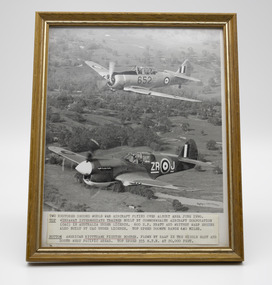
Photograph - Black and white, framed, c. 1990
... Typed label at the bottom of the frame reads: "Two restored second world war aircraft flying over Albury area June 1990. Top: Wirraway Intermediate Trainer, built by Commonwealth Aircraft Corporation (CAC) in Australia under licence. 600 H.P. Pratt and Whitney wasp engine also built by CAC under licence. Top speed 200mph range 640 miles. Bottom: American Kittyhawk Fighter Bomber...kittyhawk bombers aircraft pilots world war 2 Framed black and white photograph of two restored WWII aircraft. Typed ...Framed black and white photograph of two restored WWII aircraft. Typed label at the bottom of the frame reads: "Two restored second world war aircraft flying over Albury area June 1990. Top: Wirraway Intermediate Trainer, built by Commonwealth Aircraft Corporation (CAC) in Australia under licence. 600 H.P. Pratt and Whitney wasp engine also built by CAC under licence. Top speed 200mph range 640 miles. Bottom: American Kittyhawk Fighter Bomber. Flown by RAAF in the Middle East and South West Pacific Areas. Top speed 355m.p.h. at 20,000 feet."kittyhawk, bombers, aircraft, pilots, world war 2 -
 Hymettus Cottage & Garden Ballarat
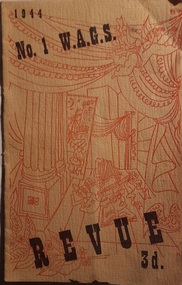
Work on paper - Programme, No 1 WAGS Review
... bombers. Although an ephemeral item, this programme recalls the importance and types of entertainment sought and performed by those in the services during World War II. ...A Programme listing drama, music, singing and comedy performed by members of the RAAF radio gunnery school Ballarat in WW2.A bi-fold programme stapled into a heavier illustrated card cover.non-fictionA Programme listing drama, music, singing and comedy performed by members of the RAAF radio gunnery school Ballarat in WW2.raaf, wags, ballarat, world war ii, air force, australia, entertainment, wireless air gunners' school, air training scheme
