
Showing 131 items matching "books - correspondence"
-
 Stawell Historical Society Inc
Archive, Records of Stawell Sheep Breeders Assn – Minutes Books Correspondence Show Entries Programs Schedules Show Results 50th Anniversary Ribbons & Sashes, 1957 - 2006
... Records of Stawell Sheep Breeders Assn – Minutes Books Correspondence Show Entries Programs Schedules Show Results 50th Anniversary Ribbons & Sashes...Minute Books - Correspondence - Show Entries - Programs etc all in Bags Stored in Filing Cabinet...Stawell Agriculture Minute Books - Correspondence - Show Entries - Programs etc all in Bags Stored in Filing Cabinet Records of Stawell Sheep Breeders Assn – Minutes Books Correspondence Show Entries Programs Schedules Show Results 50th Anniversary Ribbons & Sashes Archive ...Minute Books - Correspondence - Show Entries - Programs etc all in Bags Stored in Filing Cabinetstawell, agriculture -
 NMIT (Northern Melbourne Institute of TAFE)
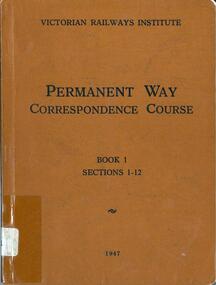
Books: Permanent way correspondence course Book 1 and Book 2 1947-1948
... Books: Permanent way correspondence course Book 1 and Book 2 1947-1948....Books: Permanent way correspondence course Book 1 and Book 2 1947-1948....Two books Permanent way correspondence course published by Victorian Railways Institute. ...Book Victorian Railways Institute Two books Permanent way correspondence course published by Victorian Railways Institute. ...Two books Permanent way correspondence course published by Victorian Railways Institute. Book 1 was published in 1947 and consists of 179 pages and covers Sections 1-12. Book 2 continues pagination from page 280 to page 701 and covers sections 13-20 and was published in 1948.book, victorian railways institute -
 Bendigo Historical Society Inc.
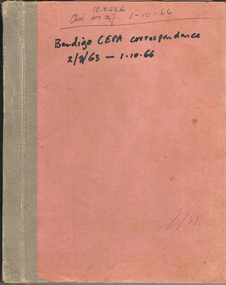
Book - CEPA COLLECTION: THREE CORRESPONDENCE BOOKS, September 8th 1975
... CEPA COLLECTION: THREE CORRESPONDENCE BOOKS...The Commercial Egg Producers' Association of Victoria Collection - Correspondence Books 2/8/63 - 1/10/66...Book CEPA COLLECTION: THREE CORRESPONDENCE BOOKS ...Three light brown duplicate correspondence book with green tape spine containing handwritten copies of letters to various people, Government Departments and Politicians. Pages are pink numbered duplicate page and white lined pages with Commercial Egg Producers Association letterhead. Dates written on the front cover are: 2/08/63 - 1/10/66 8/10/66 - 20/09/75 8/09/75 - 20/09/83. Sheet of blue carbon paper in the book.business, retail, the commercial egg producers' assoc, the commercial egg producers' association of victoria collection - correspondence books 2/8/63 - 1/10/66, 8/10/66 - 20/9/75 & 8/9/75 - 20/9/83. -
 Orbost & District Historical Society
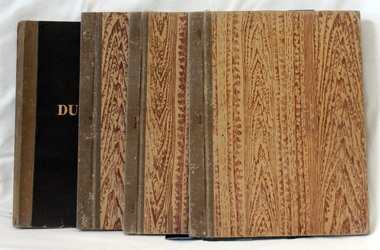
correspondence books, 10.12.1955 - 20.9.1977
... correspondence books...These books were used by the Orbost Rifle Club to record correspondence. The Orbost Rifle Club existed in the early 20th century. ...Four duplicate Correspondence books. All are brown with a brown cloth spine. 1359.1, 1359.2 and 1359.3 have marbled covers and 1359.4 has a dark brown soft cover with "TUDOR DUPLICATE BOOK" in paler print. ...Four duplicate Correspondence books. All are brown with a brown cloth spine. 1359.1, 1359.2 and 1359.3 have marbled covers and 1359.4 has a dark brown soft cover with "TUDOR DUPLICATE BOOK" in paler print. correspondence books Orbost Rifle Club ...These books were used by the Orbost Rifle Club to record correspondence. The Orbost Rifle Club existed in the early 20th century. (There are records from 1900). It folded in the late 1970's.Target shooting is one of the oldest organised sports in Australia. Records date back to the British Marines at Sydney Cove in 1788. The Victorian Rifle Association (VRA) was formed in 1860. One of the most important adjuncts to the militia system from 1903 to the re-organisation of 1912 was the role played by the Rifle Club movement in Australia. At the time, these clubs were seen as the reservoir of manpower for a potential guerrilla force should any invasion occur. For Australia, the invasion fear was uppermost in the minds of the population. So important were the rifle clubs for the defence of Australia that the Commonwealth provided the training staff, rifles and ammunition so the clubs could function. Members were drilled, wore uniforms and practised all the basic skills of soldiering as well as target shooting. The Orbost Rifle Club was active during this period.Four duplicate Correspondence books. All are brown with a brown cloth spine. 1359.1, 1359.2 and 1359.3 have marbled covers and 1359.4 has a dark brown soft cover with "TUDOR DUPLICATE BOOK" in paler print. -
 Orbost & District Historical Society
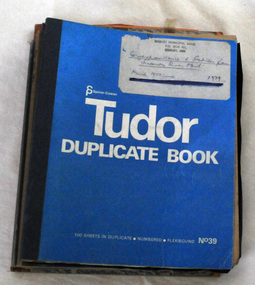
correspondence books, 1965 - 1979
... correspondence books...Five correspondence books with carbon pages. They contain outward correspondence related to the Orbost Municipal Band. 803.1 is dated March 1962 - May 1965. 803.2 is dated September 1972 - May 1974. 803.3 is dated February 1973 - July 1975. 803.4 is dated august 1975 - March 1977. 803.5 is dated March 1977 - 79. ...The books are "TUDOR DUPLICATE BOOK"s with blue covers and white print. correspondence books Orbost Municipal Band ...Orbost Town Band amalgamated in 1913 to form the Orbost Municipal Band under the conductorship of Mr Charles Spink. The Orbost Municipal Orbost Band played a major role in the Orbost community activities. Charles Spink made sure each soldier returning home from the 1914 to 1918 war was welcomed home in front of the Shire Hall to the music of the Orbost Municipal Band. The band played in the main street on most Friday nights. The various Orbost bands over the years played a major role in community activities providing entertainment and musical experiences for the many members.Five correspondence books with carbon pages. They contain outward correspondence related to the Orbost Municipal Band. 803.1 is dated March 1962 - May 1965. 803.2 is dated September 1972 - May 1974. 803.3 is dated February 1973 - July 1975. 803.4 is dated august 1975 - March 1977. 803.5 is dated March 1977 - 79. The books are "TUDOR DUPLICATE BOOK"s with blue covers and white print.labels on front covers with datesorbost-municipal-band -
Emerald Museum & Nobelius Heritage Park
Administrative record - Accounts Books
... Miscellaneous account books reports and correspondence relating to Emerald and District Churches 1946 - 1963....Miscellaneous account books reports and correspondence...Miscellaneous account books reports and correspondence relating to Emerald and District Churches 1946 - 1963. ...Miscellaneous account books reports and correspondence relating to Emerald and District Churches 1946 - 1963.Miscellaneous account books reports and correspondence -
Ringwood and District Historical Society
Container, Carton awaiting cataloguing: Greenwood Park Building Committee - correspondence, minute books
... Carton awaiting cataloguing: Greenwood Park Building Committee - correspondence, minute books....Carton awaiting cataloguing: Greenwood Park Building Committee - correspondence, minute books. Container ... -
 Orbost & District Historical Society
correspondence books, 1963 - 1979
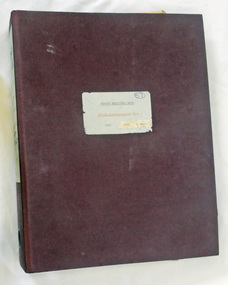
... correspondence books...The various Orbost bands over the years played a major role in community activities providing entertainment and musical experiences for the many members. orbost-municipal-band Three A4 folders containing inward correspondence related to the Orbost Municipal Band. 802.1 has a maroon cover and is dated from 1963 -1977. 802.2 has a grey cover and is dated from 1978 - 1979. 802.3 has a grey cover and is dated 1974 - 1975 . correspondence books Orbost Municipal Band ...Orbost Town Band amalgamated in 1913 to form the Orbost Municipal Band under the conductorship of Mr Charles Spink. The Orbost Municipal Band played a major role in the Orbost community activities. Charles Spink made sure each soldier returning home from the 1914 to 1918 war was welcomed home in front of the Shire Hall to the music of the Orbost Municipal Band. The band played in the main street on most Friday nights. The various Orbost bands over the years played a major role in community activities providing entertainment and musical experiences for the many members.Three A4 folders containing inward correspondence related to the Orbost Municipal Band. 802.1 has a maroon cover and is dated from 1963 -1977. 802.2 has a grey cover and is dated from 1978 - 1979. 802.3 has a grey cover and is dated 1974 - 1975 .orbost-municipal-band -
Stawell Historical Society Inc
Archive, Stawell Cultural Society & Debating & Discussion Club, 1950 - 1962
... Meeting Minute Books and Correspondence...Stawell Clubs Meeting Minute Books and Correspondence Stawell Cultural Society & Debating & Discussion Club Archive ...Meeting Minute Books and Correspondencestawell, clubs -
Stawell Historical Society Inc
Archive, Pleasant Creek House Restoration Committee Records, 1973
... 2 Minute Books plus Correspondence and Receipts...Stawell Pleasant Creek Court House 2 Minute Books plus Correspondence and Receipts Pleasant Creek House Restoration Committee Records Archive ...2 Minute Books plus Correspondence and Receiptsstawell, pleasant creek court house -
 Bendigo Military Museum
Book - BOOK WW1, CAROL CAMPBELL - Author, My Dearest Chatty, 2014
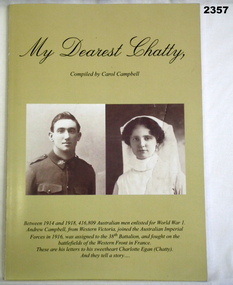
... books - correspondence...WIA 4.3.1917 GSW’s Back and left forearm, return to Australia records stating SW’s left Thorax, left arm, hand and Buttock, discharged from the AIF 21.3.1918. books - correspondence military history - army Cardboard cover in light green with 2 inset photographs, Andrew Campbell & Charlotte Egan. ...Andrew Campbell No 2053 enlisted in the 3rd reinforcements 38th Batt on 24.3.1916 age 25 years 3 months. Embark for England 25.9.1916, embark for 20.12.1916. WIA 4.3.1917 GSW’s Back and left forearm, return to Australia records stating SW’s left Thorax, left arm, hand and Buttock, discharged from the AIF 21.3.1918.Cardboard cover in light green with 2 inset photographs, Andrew Campbell & Charlotte Egan. The book is re the letters Andrew wrote to his sweetheart Charlotte (Chatty). The book is accompanied by photograph's document, etc.books - correspondence, military history - army -
Clunes Museum
Document (Collection) - DOCUMENTS, CLUNES TOURIST DEVELOPMENT ASSOCIATION MINUTES AND PAPERS, 1971
... book minute books correspondence...CTDA WAS FORMED IN 1971 AND FOLDED IN 2024 local history document reports c.t.d.a. book minute books correspondence COLLECTION OF MINUTES (NOT COMPLETE) 1971-2024, CORRESPONDENCE/DOCUMENTS OF HISTORICAL SIGNIFICANCE CLUNES TOURIST DEVELOPMENT ASSOCIATION MINUTES & DOCUMENTS (DEFUNCT AUGUST 2024) CLUNES TOURIST DEVELOPMENT ASSOCIATION MINUTES AND PAPERS Document DOCUMENTS CLUNES TOURIST AND DEVELOPMENT ASSOCIATION AND NEIGHBOURHOOD HOUSE ...MINUTES 1971-1992, 1996-2000, 2005-2019, 2021-2024. (NOT COMPLETE WITH MISSING YEARS) INCLUDES OTHER CORRESPONDENCE, PHOTOS AND DOCUMENTS AS DONATED AFTER THE CTDA CLOSED IN AUGUST 2024 ALSO INCLUDES A MODERN WOODEN HAMMER AND GAVEL CIRCA 2000local history, document, reports, c.t.d.a., book minute books correspondencelocal history, document, reports, c.t.d.a., book minute books correspondence -
Lakes Entrance Historical Society
Administrative Record - Documents, Community Heritage Plan Steering Committee 1992, 1992
... Books Correspondence...Books Correspondence White two ring binder containing various documentation relating to East Gippsland Heritage Plan, 1992 to 1999 Community Heritage Plan Steering Committee 1992 Administrative Record Documents ...White two ring binder containing various documentation relating to East Gippsland Heritage Plan, 1992 to 1999books correspondence -
 Whitehorse Historical Society Inc.
Book - Fowler Vacola Instruction Book, September 1926
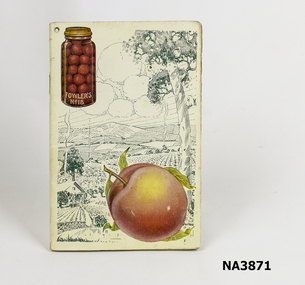
... books...correspondence...books correspondence Fowlers Proprietary Limited. Factory and showroom 257 Burwood Road, Hawthorn, Vic. ...Fowler Vacola Instruction book. Small book with coloured cover and some coloured illustrations inside. 82 pagesFowlers Proprietary Limited. Factory and showroom 257 Burwood Road, Hawthorn, Vic. Austbooks, correspondence -
 Orbost & District Historical Society
documents, 1950's -1970's
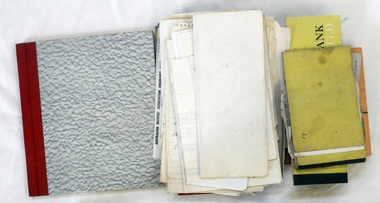
... Documents include receipts, cheque books, correspondence, cards, rules and an unused match record book....Documents include receipts, cheque books, correspondence, cards, rules and an unused match record book. documents ...These documents were used by the Orbost Rifle Club.The Orbost Rifle Club existed in the early 20th century. (There are records from 1900). It folded in the late 1970's. It had a substantial membership.A large plastic envelope containing miscellaneous documents and books from the Orbost Rifle Club. Documents include receipts, cheque books, correspondence, cards, rules and an unused match record book.documents orbost-rifle-club match-records -
 Eltham District Historical Society Inc
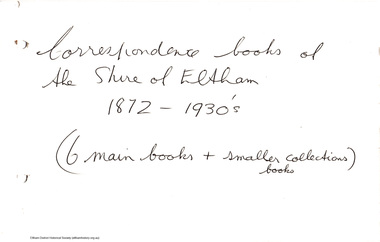
Document - Folder, Notes from Shire of Eltham Correspondence 1912-1979, 1999
... ...correspondence books...Handwritten notes by H.G. taken from Shire of Eltham Correspondence books, also includes listing of folders at Eltham Library (history cabinet) and notes on photos known as the Shire of Eltham Pioneer and Photograph collection held in partnership between EDHS and Yarra Plenty Regional Library (Eltham Library) Folder 85 of the Harry Gilham Colletion...Handwritten notes by H.G. taken from Shire of Eltham Correspondence books, also includes listing of folders at Eltham Library (history cabinet) and notes on photos known as the Shire of Eltham Pioneer and Photograph collection held in partnership between EDHS and Yarra Plenty Regional Library (Eltham Library) Folder 85 of the Harry Gilham Colletion harry gilham collection correspondence books shire of eltham chronology 6 pages Notes from Shire of Eltham Correspondence 1912-1979 Document Folder Tarcoola Press ...Handwritten notes by H.G. taken from Shire of Eltham Correspondence books, also includes listing of folders at Eltham Library (history cabinet) and notes on photos known as the Shire of Eltham Pioneer and Photograph collection held in partnership between EDHS and Yarra Plenty Regional Library (Eltham Library) Folder 85 of the Harry Gilham Colletion6 pagesharry gilham collection, correspondence books, shire of eltham, chronology -
 Bendigo Military Museum
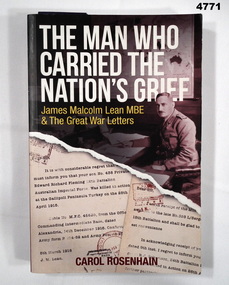
Book - BOOK of Correspondence of WW1, Big Sky Publishing Pty Ltd, "The Man Who Carried the Nation's Grief", 2016
... Books...WW1...Correspondence...Collection of lettters from distressed families during WW1 to "Base Records" and the correspondence in reply signed by J.M. Lean. Books WW1 Correspondence Biography Collection of lettters from distressed families during WW1 to "Base Records" and the correspondence in reply signed by J.M. ...Collection of lettters from distressed families during WW1 to "Base Records" and the correspondence in reply signed by J.M. Lean.Soft cover book. Soft cover, cardboard: white, yellow and black print on front, spine and back. Front cover, background illustration montage of portrait photograph of a soldier in uniform and 2 typewritten letters in sepia tones. Back cover: sepia tones, photograph of a number of women working on typewriters. 440 pages, cut, plain, white paper. Illustrated black and white photographs.Collection of lettters from distressed families during WW1 to "Base Records" and the correspondence in reply signed by J.M. Lean.books, ww1, correspondence, biography -
Tatura Irrigation & Wartime Camps Museum
Box, Red Cross - Harston, Tatura East and Toolamba West, 2010
... Minute, Treasurers and Correspondence books of Harston, Tatura East and Toolamba West Red Cross Branches prior to ceasing to operate....Minute, Treasurers and Correspondence books of Harston, Tatura East and Toolamba West Red Cross Branches prior to ceasing to operate. red cross harston tatura east toolamba west Brown and beige archive box. ...Minute, Treasurers and Correspondence books of Harston, Tatura East and Toolamba West Red Cross Branches prior to ceasing to operate.Brown and beige archive box.red cross, harston, tatura east, toolamba west -
 Yarrawonga and Mulwala Pioneer Museum
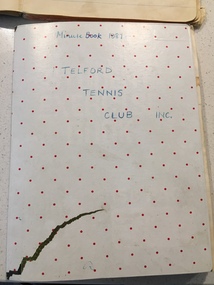
Telford Tennis Club minute books and records, 1920's to 2019
... Consumer Affairs returns, Incorporation papers, receipt books, some correspondence (later years)...Consumer Affairs returns, Incorporation papers, receipt books, some correspondence (later years) Telford Tennis Club minute books and records ...Telford Tennis courts were situated on the Telford Yarrawonga Road, west of the railway line, Telford station and silos. A thriving club existed from early 1920's with players from surrounding areas in early times. balls and tournaments were held as fundraisers. Prominent family names included Stevenson, Chappell, Mulquiney, Thom, Inchbold, Connell. Quinn. There were three teams during the 1960's playing in the Wilby and District Tennis Association ( WDTA) competition. Opponents included Wilby, Almonds, St Mary's, Bundalong, Savernake, Rennie, Roseneath, Burramine. Being in a low lying area the Telford dirt courts were often flooded. At the beginning of the season working bees were held to remove the weeds. mow the surrounds and line the courts During the early 1980's the courts were abandoned and home matches were played at the Yarrawonga Lawn Tennis courts. The club still has a team in the WDTA in 2019. A number of B grade Premierships have been won over the years however A grade premierships have been non existent. The club has always encouraged juniors to play and now the players mostly originate from Yarrawonga. Current President (2019) is Richard Inchbold, Secretary/Treasurer Joan Thom. The Bank account is held at the CMCU. The club is no longer IncorporatedCountry tennis teams provided a social outlet from the farming pursuits of the districtall enclosed in a cardboard box. Minute books 1927 to 2014 (not all complete). Includes photos, paper cuttings, Wilby and District Tennis Association draws, subs books, list of names of those who have played for Telford. Consumer Affairs returns, Incorporation papers, receipt books, some correspondence (later years)see photos -
 Kiewa Valley Historical Society
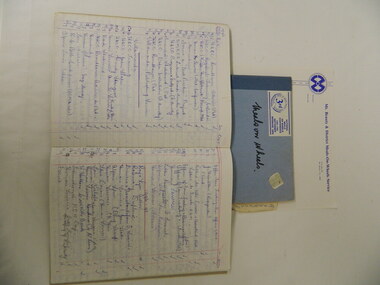
Paper Records for Mt Beauty & District Meals On Wheels, 1960s - 2003
... Paper records for the Mt Beauty Meals On Wheels Program includes photos, newspaper cuttings, committee documents, roster, petrol book, minute books 1983 - 1998, correspondence book, stationary and a brief history of the first delivery in 1968....Meals on Wheels; Mt Beauty; Tawonga District Hospital; Paper records for the Mt Beauty Meals On Wheels Program includes photos, newspaper cuttings, committee documents, roster, petrol book, minute books 1983 - 1998, correspondence book, stationary and a brief history of the first delivery in 1968. ...Mt Beauty & District Meals on Wheels committee was formed on 6th Dec. 1967, possibly under the Elderly Citizens Welfare Council News (or Senior Citizens Mt Beauty) with service commencing on 16th July 1968. Volunteers transported meals from the Hospital Kitchen to the elderly and sick members of the community each day including weekends. Eventually the Shire managed the meals and roster until recent times when, in 2016, Alpine Health took over. Members of the Mt Beauty community recognised the need for meals to be delivered to the elderly and sick. They formed a committee and organised the means (rules, meals, containers, roster ) by which they could achieve their goal with volunteers and the Tawonga District Hospital. The first delivery was recorded by the press and was on film by AMV 4 Albury TV station for their local news. The official party included - local member, Tom Mitchell, Shire representatives, Alec McCullough and Dr Jean Hutching who joined the volunteers for a luncheon at the Mt Beauty Chalet.Paper records for the Mt Beauty Meals On Wheels Program includes photos, newspaper cuttings, committee documents, roster, petrol book, minute books 1983 - 1998, correspondence book, stationary and a brief history of the first delivery in 1968.meals on wheels; mt beauty; tawonga district hospital; -
 Sunshine and District Historical Society Incorporated
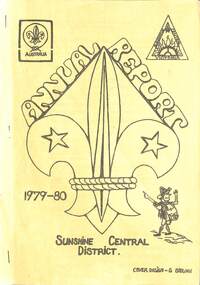
Administrative record - Sunshine District Boy Scout Association, 1964 - 1995
... Two official year books 1964 and 1966. Correspondence between Alan Dash and various other persons including Sunshine Councillors. ...Two official year books 1964 and 1966. Correspondence between Alan Dash and various other persons including Sunshine Councillors. ...1879.01 - Sunshine District Boy Scout Association - Sunshine Central District Annual Report 1979- 1980 1879.02 - Sunshine District Boy Scout Association - Sunshine District Annual Report 1983 1879.03 - Sunshine District Boy Scout Association - Sunshine Central Annual Meeting 1984 1879.04 - Sunshine District Boy Scout Association - Sunshine District Annual Report 1984 - 1985 1879.05 - Sunshine District Boy Scout Association - Hoadley Area 41st Annual Report 1984 - 1985 1879.06 - Sunshine District Boy Scout Association - Hoadley Area 42nd Annual Report 1985 - 1986 1879.07 - Sunshine District Boy Scout Association - Sunshine District Annual Report 1985 - 1986 1879.08 - Sunshine District Boy Scout Association - Hoadley Area 43rd Annual Report 1986 - 1987 1879.09 - Sunshine District Boy Scout Association - Sunshine District Annual Report 1987 1879.10 - Sunshine District Boy Scout Association - Sunshine District Annual Report 1988 1879.11 - Sunshine District Boy Scout Association - Sunshine District Annual Report 1993 1879.12 - Sunshine District Boy Scout Association - Sunshine District Annual Report 1993 - 1994 1879.13 - Sunshine District Boy Scout Association - Sunshine District Annnual Report 1995 1879.14 - Sunshine District Boy Scout Association - Official Year Book 1964 - 1965 1879.15 - Sunshine District Boy Scout Association - Official Year Book 1966 - 1967 1879.16 - Sunshine District Boy Scout Association - Hoadley Area Directory 1994 1879.17 - Sunshine District Boy Scout Association - Cheque Booksunshine district boy scout association, scouts, scouting -
Emerald Museum & Nobelius Heritage Park
Document - Emerald Progress Assocation Records, Emerald Progress Association, 1950-1972
... Archives of the association include; 1 notebook, 3 cheque books, 5 cashbooks, correspondence (1950-1961) + (1969-1972) in 4 archival files. ...Includes notes about general meetings and annual reports. 4 pages only, two of which are detached from notebook. 3x cheque books 5x cash receipt books 4x archival satchels containing loose leaf paper correspondence, documents, newspaper clippings, invoices etc....Archives of the association include; 1 notebook, 3 cheque books, 5 cashbooks, correspondence (1950-1961) + (1969-1972) in 4 archival files. ...Documents relating to Emerald Progress Association, including 3 sheets dating back to early 1900s when C.A. Nobelius chaired the association. Archives of the association include; 1 notebook, 3 cheque books, 5 cashbooks, correspondence (1950-1961) + (1969-1972) in 4 archival files. Topics relate to town planning, telephone services, fire services events at Emerald Community Hall, Emerald Lake Park and proposed caravan park, proposal and request to Department of Education to have a co-educational school in Emerald.; Dandenong Ranges Preservation (1950)Documents attributed to the Emerald Progress Association between 1950 and 1978. Contains information about community organisations, plans, and fundraising activities. Also contains 3 documents dated between 1908 and 1909. 1x notebook containing handwritten notes from 1966. Includes notes about general meetings and annual reports. 4 pages only, two of which are detached from notebook. 3x cheque books 5x cash receipt books 4x archival satchels containing loose leaf paper correspondence, documents, newspaper clippings, invoices etc.clubs, associations, societies, emerald, victoria, australia, resident action, schools and colleges, dandenong ranges, victoria, australia, conservation of natural resources, emerald progress association, emerald mechanics institute, emerald hall, emerald reserve, c.a. nobelius, emerald lake park, emerald caravan park -
Northern District School of Nursing. Managed by Bendigo Historical Society Inc.
Letter - Northern District School of Nursing Graduates Association - History and Archives, 14 Oct 1988
... All records (student files, correspondence, minute books) should be kept intact and organized. ...All records (student files, correspondence, minute books) should be kept intact and organized. ...The Northern District School of Nursing in Victoria, Australia Graduates Association: This document is a letter from the Post Graduates Association President Joan O'Shea outlining efforts to preserve the Northern District School of Nursing (NDSN) memorabilia and proposing the establishment of a museum at Lister House. Cataloguing and recording of all NDSN memorabilia has begun.Various organizations and individuals have been contacted to support preservation.The importance of NDSN in nursing history is emphasized, highlighting the need for preservation for future generations and researchers. Inventory of equipment is completed; cataloguing is ongoing. All records (student files, correspondence, minute books) should be kept intact and organized. Proper storage and insurance are necessary to prevent deterioration. A suitable display area is needed, with regular updates as per museum standards. Bendigo currently lacks a museum; converting Lister House would provide a permanent home for NDSN memorabilia and other local artifacts. Lister House's central location makes it a practical choice.The Association has contacted the Bendigo City Council for feedback on this proposal. Temporary storage has been offered, but a permanent solution is urgently needed to prevent loss or damage. There is concern about the memorabilia being split up or placed in inaccessible archives. The Association, comprised of trained nurses without curatorial expertise, seeks assistance and support for the museum proposal.They request an opportunity to discuss the matter with the Committee of Management.Northern District School of Nursing Graduates Association - History and Archives - Letter from Joan O'Shea (President) to Mr Humhreys or Mr McKean re Lister House as a possible museum This item contains the following document: 3792.8a Letter from Joan O'Shea (President) to Mr Humhreys or Mr McKean re Lister House as a possible museum - 2 typed sheetsnurse training, lister house, history, joan o'shea -
 Sunshine and District Historical Society Incorporated
Archive - Sunshine Railway Disaster
... |Typed Tender for Railway Works Report of the Professional Board appointed to examine and compare the tenders submitted for the Proposed Raiilway Works|Handwritten notes Melbourne to St Albans construction|Continuous paper Report Staff at Sunshine Railway Station Historical|Photograph of Mural at Tin Shed St Albans taken by thomastowns leading photographer Hans Jobe Roysted 20 April 2000|Typed Report Taken from the Secretary for Railways Correspondence Books Series 422|Typed Report Sunshine Rail Disaster Unveiling of the Plaque Sunshine Station 15 November 1998 10:00am|Typed Report Press Release by Tom Rigg 20 April Sunshine Historical Society placed a Wreath on the plaque on the Melbourne side of the Sunshine Railway Platform. ...|Typed Tender for Railway Works Report of the Professional Board appointed to examine and compare the tenders submitted for the Proposed Raiilway Works|Handwritten notes Melbourne to St Albans construction|Continuous paper Report Staff at Sunshine Railway Station Historical|Photograph of Mural at Tin Shed St Albans taken by thomastowns leading photographer Hans Jobe Roysted 20 April 2000|Typed Report Taken from the Secretary for Railways Correspondence Books Series 422|Typed Report Sunshine Rail Disaster Unveiling of the Plaque Sunshine Station 15 November 1998 10:00am|Typed Report Press Release by Tom Rigg 20 April Sunshine Historical Society placed a Wreath on the plaque on the Melbourne side of the Sunshine Railway Platform. ...Typed Report on the Sunshine Station Smash Inquest began 4 May 1908|Typed Report The Sunshine Station Smash Easter Monday 20th April 1908|Typed Report Sunshine Railway Station Part 3 Railway Disaster by Tom Rigg|Typed Report Sunshine Railway Disaster by Tom Rigg|Typed Report Sunshine Railway Disaster 20th April 1908 Some Highlights|Typed Report The Sunshine Station Smash|Typed Report Names of People killed in the Sunshine Accident Easter Monday 20th April 1908|Photocopy of An Act to authorize the construction of certain lines of Railway by the State 29 December 1880. Fifteenth Schedule Footscray to Bacchus Marsh Railway Construction.|Typed Tender for Railway Works Report of the Professional Board appointed to examine and compare the tenders submitted for the Proposed Raiilway Works|Handwritten notes Melbourne to St Albans construction|Continuous paper Report Staff at Sunshine Railway Station Historical|Photograph of Mural at Tin Shed St Albans taken by thomastowns leading photographer Hans Jobe Roysted 20 April 2000|Typed Report Taken from the Secretary for Railways Correspondence Books Series 422|Typed Report Sunshine Rail Disaster Unveiling of the Plaque Sunshine Station 15 November 1998 10:00am|Typed Report Press Release by Tom Rigg 20 April Sunshine Historical Society placed a Wreath on the plaque on the Melbourne side of the Sunshine Railway Platform. It is now 95 years since the accident.|Typed Timetable Victorian Railways December 1865|Typed Booklet The Sunshine Railway Disaster by John Buckland Easter Monday 20 April 1908|Newspaper Article Move on disaser Advocate 27 March 2001|Typed Poem In Memory of the Sunshine Railwa Disaster composed and written by Patrick Hassett|Newspaper Article The Age 21 April 1908 Terrible Railway Disaster|Newsletter Newsrail June 1998 Sunshine Station Disaster Memorial|Newspaper Article Brimbank Messenger 8 September 1998 Technology signaling new rail era|Brochure St Albans to Sydenham Rail Electrification Project Bulletin 3 December 2001|Map Railway Map of Victoria 1908|Newspaper Article Brimbank Independent 10 November 1998 Memorial to mark rail crash disaster|Newspaper Article Brimbank Messenger 21 April 1998 Horror Smash recalled|Newspaper Article The Advocate 18 November 1998 Moving tribute|Newspaper Article The Advocate 20 March 2001 Crash tragedy haunts station|Typed Report Sunshine Rail Disaster 20 April 1908 List of Person killed and injured. Addresses included. Research by Jan Withers 1990|Typed Report Sunshine Rail Disaster Commemoration Service Monday 10:30pm 20 April 1998 90th Anniversary program Compiled by Tom Rigg|Typed Report of Names of People Killed in the Sunshine Accident Easter Monday 20 April 1908 and where they are buried|Photocopy Death certicates of the 44 people killed in the Sunshine Rail Disaster on Easter Monday 20 April 1908|Artwork of Newspaper Article Terrible Railway disaster|Flyer Official unveiling of a plaque laid in memory of 44 people who died in the Sunshine Rail Disaster Easter Monday 20 April 1908 occurring Suunday 15 November 1998|Photocopy of Report of Coroners Inquest 18 May 1908|Book The Sunshine Railway Disastersunshine railway disaster, sunshine railway station, railway, sunshine -
 Flagstaff Hill Maritime Museum and Village
Letter - William Ferrier, 14th November 1905
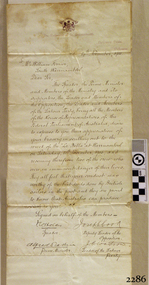
... Her record books, ship logs, correspondence and supporting papers are still available. ...Her record books, ship logs, correspondence and supporting papers are still available. ...The letter to William Ferrier of South Warrnambool from the Prime Minister and the Parliament of the Commonwealth recognised the significance of William’s brave and courageous lifesaving act to the people of Australia; “They all feel that your conduct was worthy of the best deeds done by British sailors in the past and they are proud to know that Australia can produce such as you.” The story of that brave rescue follows on below … The ship from which the sailors were rescued was the three-masted, iron and steel barquentine the La Bella, built in Norway in 1893. She was one of two iron and steel ships by Johan Smith, The company was one of the leading shipping families in Tvedestrand, Norway. She was significant to Norwegian shipping, being one of only 27 iron and steel ships ever built in Norway. She was registered in New Zealand and engaged from 1902 in inter-colonial trading of timber in the Pacific, between New Zealand and Australia and was often in Port Phillip Bay, Victoria. On 5th October 1905, the twelve-year-old La Bella left Lyttleton, New Zealand carrying a cargo of timber bound for Warrnambool, Australia. She was manned by a crew of twelve: the Master, (Captain Mylius, previously 1st Mate of La Bella, appointed Captain to La Bella on 6th February 1903) 2 Mates, Cook, six able seamen, one ordinary seaman and a boy. Bad weather en route caused her to shelter at Burnie on Tasmania's North West coast. On November 10th, the 37th day of her journey, La Bella approached Warrnambool. Captain Mylius steered her towards Lady Bay Channel in heavy south-west seas and evening mist. He ordered the helmsman to steer for the light. As the ship came round, a tremendous sea struck her on the port quarter, causing her to breach broadside in a north-westerly direction into breakers. The helm was brought round twice more, but each time heavy seas broke over her, the third time throwing the La Bella on to a submerged reef in Lady Bay now known as La Bella Reef (about 100 yards from the Warrnambool breakwater). The sea was so rough that it even wrenched a one-and-a-half ton anchor from its fastenings and into the sea. As Captain Mylius headed to the steel wheelhouse, intending to send up a rocket flare, a huge sea slammed the steel door into him (resulting in massive bruising front and back) Despite his injuries he still managed to set off a blue light, which he held up in his hands. La Bella’s lifeboats were filled with seawater and broke up on their chocks. The blue light was the first indication to people on the shore that there was a ship in distress. The Harbour Master, Captain Roe (who lived in the Harbour Master’s House opposite Flagstaff Hill), organised a group of volunteers to crew the lifeboat because the trained crew was unavailable; the crewmen were working on a steamer in Port Fairy at the time. He then poured oil onto the water to try and smooth the sea. At around 11 pm three of the crew took shelter in the steel forecastle but the sea crashed into it and broke it up. While the rest of the crew and onlookers watched helplessly in the moonlight the bodies were washed away into the sea, never to be seen again. Some of the crew lashed themselves to the weather rail to keep from being washed away. Watson, the ordinary seaman, became tangled in the rigging lines and was too weak to move, so the 2nd Mate, Robertson, put a line onto him so that he wouldn’t wash off. Around 11 pm three of the crew were unconscious from exhaustion. The situation on La Bella was becoming dangerous. The 2nd Mate moved to the ‘house’ and soon afterwards the ship slipped in the heavy sea. The lashings of the 1st Mate and the ‘boy’ Denham had kept them safe until about 2 am when they were washed overboard; no one was able to help. One by one, the exhausted crew were being washed overboard, too weak to hold on any longer. During the night the La Bella had broken into two and the deckhouse ran out towards the sea. Two more men drowned when trying to reach the lifeboat. By sunrise, the only survivors of the twelve were the Master, 2nd Mate and three seamen. Early in the morning, Captain Roe used the rocket apparatus on shore to try and shoot a line to the ship for a safer rescue but each attempt fell short of the target. Several attempts were made by the lifeboat to rescue the stricken sailors, but the rough conditions made this difficult for the boat to get close enough to the ship and the lifeboat had to return to shore. During a final attempt to reach the ship Captain Mylius ordered his men to jump into the sea. Leonard Robertson, 2nd mate, jumped and swam towards the lifeboat, taking hold of the boat hook offered to him. Oscar Rosenholme managed to reach the boat floating on a piece of timber from the ship’s load and a third survivor, Noake, also made the boat. Along with the lifeboat rescue crew, 25-year-old William Ferrier rowed his small dingy through the heavy seas and managed to rescue the Captain, whom he landed on the breakwater. Ferrier then returned to the ship to attempt a final rescue, losing his oars and rowlocks into the high sea. Using just a spare paddle he skulled towards the La Bella, reaching her stern in time to cut loose the lone surviving sailor, Payne, from the lashing that held him to the ship; the terrified sailor dropped from the ship and into the dingy. Shortly after the last man was rescued, the La Bella was lifted by a huge wave and crashed back down on the reef; she broke up and sank. The ordeal had lasted ten hours. The survivors were taken to the nearby Bay View Hotel and gratefully received warm food and clothing, medical attention and a place to sleep. In the following days, an unidentified body of a young person has washed ashore; it was either Watson or Denham. The body was buried in the Warrnambool cemetery with an appropriate gravestone and inscription. William Ferrier became a national hero as news of the daring rescue spread. In recognition of his bravery in the two daring rescues, he was awarded the Silver Medal for Bravery by the Royal Humane Society and was honoured in the letter from the Prime Minister and the Parliament of the Commonwealth, telegrams and a cheque for £20 from the Governor-General, over £150 subscribed by the public, including Warrnambool and district and readers of The Argus, and a gold medal from the Glenelg Dinghy Club of South Australia. Ferrier’s rescue efforts are one of the most heroic in Victoria’s shipwreck history. (William Ferrier’s son, Frank, received a similar award almost fifty years later when he helped rescue four members of the crew on the yacht Merlan after it ran on to a reef near the Point Lonsdale Lighthouse. ) The wreck of La Bella now lies on her port side in 13 metres of sheltered water inside the reef she struck. The bow section is relatively intact and part of the stern has drifted north-easterly towards the mouth of the Hopkins River. The reef the La Bella struck now bears its name. Those five rescued from the La Bella were Captain George Mylius, Leonard Robertson (2nd Mate, 21 years old), R. Payne, Oscar Rosenholme and Jack Noake. Those seven who lost their lives were Mr Coulson (1st mate), Charles Jackman (cook) Gustave Johnson, Pierre Johann and Robert Gent (all able seamen), Harry Watson (ordinary seaman) and Jack Denham (ship’s boy), Captain Mylius was found guilty of careless navigation; he had sailed into the bay without the services of a pilot. His Master Certificate was suspended for twelve months. Later he was also charged with the manslaughter of one of the crew who had died when the La Bella was wrecked but found not guilty. The event’s adverse publicity and damage to his career took a toll on his health and he died of a heart attack six months after the wreck; he was only thirty-seven. His body was buried in the Melbourne General Cemetery. The La Bella was “the best documented of all sailing ships owned in New Zealand”. Her record books, ship logs, correspondence and supporting papers are still available. At the time of the tragedy, she was owned by Messers David C.Turnbull and Co. of Timaru, New Zealand timber merchants and shipping agents, who had purchased her on 13th December 1901. A detailed account of the last journey of La Bella can be read in “Leonard Robertson, the Whangaroa & La Bella” written by Jack Churchouse, published in 1982 by Millwood Press Ltd, Wellington, NZ. As well as this letter, Flagstaff Hill’s La Bella Collection includes a photograph of the wrecked La Bella, a brass rail holder and a postcard of William Ferrier with four of the survivors. Some 15 – 17 ships are believed to have sunk in Lady Bay, but only two have been discovered on the seafloor; the “La Bella” and the “Edinburgh Castle”. Both wrecks are popular diving sites and are preserved as significant historical marine and marine archaeological sites. This original congratulatory letter sent to William Ferrier by the Prime Minister and Government of Australia demonstrates the importance attached to his efforts for Victoria and to Australia. The letter is part of the La Bella Collection and is significant at both a local and state level. Its connection to the La Bella shipwreck and the rescue of five survivors highlights the dangers of Victoria’s Shipwreck Coast. The letter to William Ferrier from the Australian Government acknowledges the bravery of ordinary Australians who risked their lives to save victims of shipwrecks along the coast. The letter is significant to the history of Warrnambool as it honours William Ferrier, a local fisherman whose descendants continue to live in the area. It highlights the way of life of people who lived in coastal towns in 19th century Victoria and the effects of shipwrecks upon them. The letter connects to the postcard of William Ferrier with four of the five rescued crew, the photograph of the wreck of the La Bella and the artefact from the wreck, the rail holder. This letter is significant because of its association with the sailing ship “La Bella”. The “La Bella” is of local and state and national significance. It is one of the only two shipwrecks discovered in Lady Bay, Warrnambool, out of the 15-17 shipwrecks in the bay. Letter to William Ferrier of South Warrnambool from the Prime Minister and Members of Parliament commending him on his bravery. The printed letterhead includes a coat of arms in the top centre and the official address. The letter is very neatly hand written in black pen and includes 4 signatures of Members of Parliament. The rectangular paper is cream coloured with some yellow/brown discolouring. It has the letterhead on the right hand side of it and the written letter begins below the letterhead. The paper has been folded so that the right side becomes the cover page of the letter. The writing is continued onto the inside right hand page of the folded paper and the writing ends here. There is more recent writing on the bottom right hand corner of the back page. The paper has been officially folded in half a total 3 times and there is heavy discolouration on the sections that form the front and back of the folded letter. There is a 4th fold line that is less pronounced that the other folds and would make the paper the size to fit into a pocket. At several fold creases the paper has worn through. The edges of the paper have minor tears. The printed coat of arms is that of the House of Representatives. Underneath is printed “The Parliament of the Commonwealth, / Parliament House / Melbourne”. The hand written, letter is dated “14th November, 1905” and addressed to “Mr. William Ferrier / South Warrnambool” The letter begins “The Speaker, the Prime Minister and Members of the Ministry and its supporters, the Leader and Members of the Opposition, the Leader and Members of the Labour Party, being all the Members of the House of Representatives of the Federal Parliament of Australia” … It continues “desire to express to you their appreciation of your bravery in skulling out to the wreck of the “La Bella” at Warrnambool on Saturday, 11th November, 1905, and recovering therefrom two of the crew who were in imminent danger of their lives. They all feel that your conduct was worthy of the best deeds done by British sailors in the past and they are proud to know that Australia can produce such as you.” The letter is “Signed on behalf of the Members – Speaker (Frederick Holder ), Deputy Leader of the Opposition (Joseph Cook ), Prime Minister (Alfred Deakin), Leader of the Labour Party ( J.C. Watson)” On the back of the letter is blue ink handwriting “OWNER / G. FERRIER / TO. BE. PHOTOGRAPHED / 27-4-76”la bella, william ferrier, bill ferrier, lady bay, 1905, 10th november 1905, 11th november 1905, parliament of the commonwealth, prime minister, australian government, new zealand, flagstaff hill, warrnambool, shipwrecked coast, flagstaff hill maritime museum, maritime museum, shipwreck coast, flagstaff hill maritime village -
 Flagstaff Hill Maritime Museum and Village
Functional object - Rail holder, About 1893, when the ship was made
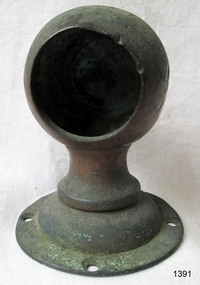
... Her record books, ship logs, correspondence and supporting papers are still available. ...Her record books, ship logs, correspondence and supporting papers are still available. ...This brass rail holder fixture would have been used to hold the end of a rail in place. There is no information as to where the fitting or rail would have been placed on the ship; sailing ships had many brass fittings. It was recovered from the wreck of the La Bella, which lies at the bottom of the Warrnambool Harbour. Some 15 ships are believed to have been wrecked in Lady Bay, but only two have been discovered on the sea floor; the La Bella and the Edinburgh Castle. Both wrecks are popular diving sites and are preserved as significant historical marine and marine archaeological sites. The story of the final voyage of the La Bella is summarised as follows … The ship from which the sailors were rescued was the three-masted, iron and steel barquentine the La Bella, built in Norway in 1893. She was one of two iron and steel ships by Johan Smith, the company being one of the leading shipping families in Tvedestrand, Norway. She was significant to Norwegian shipping, being one of only 27 iron and steel ships ever built in Norway. She was registered in New Zealand and engaged from 1902 in inter-colonial trading of timber in the pacific, between New Zealand and Australia and was often in Port Phillip Bay, Victoria. On 5th October, 1905, the twelve year old La Bella left Lyttleton, New Zealand carrying a cargo of timber bound for Warrnambool, Australia . She was manned by a crew of twelve: the Master, (Captain Mylius, previously 1st Mate of La Bella, appointed Captain to La Bella on 6th February 1903) 2 Mates, Cook, six able seamen, one ordinary seaman and a boy. . Bad weather en route caused her to shelter at Burnie on Tasmania's North West coast. On November 10th, the 37th day of her journey, La Bella approached Warrnambool. Captain Mylius steered her towards Lady Bay Channel in heavy south-west seas and evening mist. He ordered the helmsman to steer for the light. As the ship came round, a tremendous sea struck her on the port quarter, causing her to breach broadside in a north-westerly direction into breakers. The helm was brought round twice more, but each time heavy seas broke over her, the third time throwing the La Bella on to a submerged reef in Lady Bay now known as La Bella Reef (about 100 yards from the Warrnambool breakwater). The sea was so rough that it even wrenched a one-and-a-half ton anchor from its fastenings and into the sea. As Captain Mylius headed to the steel wheelhouse, intending to send up a rocket flare, a huge sea slammed the steel door into him (resulting in massive bruising front and back) Despite his injuries he still managed to set off a blue light, which he held up in his hands. La Bella’s lifeboats were filled with sea water and broke up on their chocks. The blue light was the first indication to people on shore that there was a ship in distress. The Harbour Master, Captain Roe (who lived in the Harbour Master’s House opposite Flagstaff Hill), organised a group of volunteers to crew the lifeboat because the trained crew was unavailable; the crewmen were working on a steamer in Port Fairy at the time. He then poured oil onto the water to try and smooth the sea. At around 11pm three of the crew took shelter in the steel forecastle but the sea crashed into it and broke it up. While the rest of the crew and onlookers watched helplessly in the moonlight the bodies were washed away into the sea, never to be seen again. Some of the crew lashed themselves to the weather rail to keep from being washed away. Watson, the ordinary seaman, became tangled in the rigging lines and was too weak to move, so the 2nd Mate, Robertson, put a line onto him so that he wouldn’t wash off. Around 11pm three of the crew were unconscious from exhaustion. The situation on La Bella was becoming dangerous. The 2nd Mate moved to the ‘house’ and soon afterwards the ship slipped in the heavy sea. The lashings of the 1st Mate and the ‘boy’ Denham had kept them safe until about 2am when they were washed overboard; no one was able to help. One by one, the exhausted crew were being washed overboard, too weak to hold on any longer. During the night the La Bella had broken into two and the deckhouse ran out towards the sea. Two more men drowned when trying to reach the lifeboat. By sunrise the only survivors of the twelve were the Master, 2nd Mate and three seamen. Early in the morning Captain Roe used the rocket apparatus on shore to try and shoot a line to the ship for a safer rescue but each attempt fell short of the target. Several attempts were made by the lifeboat to rescue the stricken sailors, but the rough conditions made this difficult for the boat to get close enough to the ship and the lifeboat had to return to shore. During a final attempt to reach the ship Captain Mylius ordered his men to jump into the sea. Leonard Robertson, 2nd mate, jumped and swam towards the lifeboat, taking hold of the boat hook offered to him. Oscar Rosenholme managed to reach the boat floating on a piece of timber from the ship’s load and a third survivor, Noake, also made the boat. Along with the lifeboat rescue crew, 25 year old William Ferrier rowed his small dingy through the heavy seas and managed to rescue the Captain, whom he landed on the breakwater. Ferrier then returned to the ship to attempt a final rescue, losing his oars and rowlocks into the high sea. Using just a spare paddle he skulled towards the La Bella, reaching her stern in time to cut loose the lone surviving sailor, Payne, from the lashing that held him to the ship; the terrified sailor dropped from the ship and into the dingy. Shortly after the last man was rescued, the La Bella was lifted by a huge wave and crashed back down on the reef; she broke up and sank. The ordeal had lasted ten hours. The survivors were taken to the nearby Bay View Hotel and gratefully received warm food and clothing, medical attention and a place to sleep. In the following days an unidentified body of a young person was washed ashore; it was either Watson or Denham. The body was buried in the Warrnambool cemetery with an appropriate gravestone and inscription. William Ferrier became a national hero as news of the daring rescue spread. In recognition of his bravery in the two daring rescues he was awarded the Silver Medal for Bravery by the Royal Humane Society and was honoured in the letter from the Prime Minister and the Parliament of the Commonwealth, telegrams and a cheque for £20 from the Governor General, over £150 subscribed by the public, including Warrnambool and district and readers of The Argus, and a gold medal from the Glenelg Dinghy Club of South Australia. Ferrier’s rescue efforts are one of the most heroic in Victoria’s shipwreck history. (William Ferrier’s son, Frank, received a similar award almost fifty years later, when he helped rescue four members of the crew on the yacht Merlan, after it ran on to a reef near the Point Lonsdale Lighthouse. ) The wreck of La Bella now lies on her port side in 13 metres of sheltered water inside the reef she struck. The bow section is relatively intact and part of the stern has drifted north-easterly towards the mouth of the Hopkins River. The reef the La Bella struck now bears its name. Those five rescued from the La Bella were Captain George Mylius, Leonard Robertson (2nd Mate, 21 years old), R. Payne, Oscar Rosenholme and Jack Noake. Those seven who lost their lives were Mr Coulson (1st mate), Charles Jackman (cook) Gustave Johnson, Pierre Johann and Robert Gent (all able seamen), Harry Watson (ordinary seaman) and Jack Denham (ship’s boy), Captain Mylius was found guilty of careless navigation; he had sailed into the bay without the services of a pilot. His Master Certificate was suspended for twelve months. Later he was also charged with manslaughter of one of the crew who had died when the La Bella was wrecked, but found not guilty. The event’s adverse publicity and damage to his career took a toll on his health and he died of a heart attack six months after the wreck; he was only thirty-seven. His body was buried in the Melbourne General Cemetery. The La Bella was “the best documented of all sailing ships owned in New Zealand”. Her record books, ship logs, correspondence and supporting papers are still available. At the time of the tragedy, she was owned by Messers David C.Turnbull and Co. of Timaru, New Zealand timber merchants and shipping agents, who had purchased her on 13th December 1901. A detailed account of the last journey of La Bella can be read in “Leonard Robertson, the Whangaroa & La Bella” written by Jack Churchouse, published in 1982 by Millwood Press Ltd, Wellington, NZ. Some 15 – 17 ships are believed to have sunk in Lady Bay, but only two have been discovered on the seafloor; the “La Bella” and the “Edinburgh Castle”. Both wrecks are popular diving sites and are preserved as significant historical marine and marine archaeological sites. As well as this letter, Flagstaff Hill’s La Bella Collection includes a photograph of the wrecked La Bella, a brass rail holder and a postcard of William Ferrier with four of the survivors. This original congratulatory letter sent to William Ferrier by the Prime Minister and Government of Australia demonstrates the importance attached to his efforts for Victoria and to Australia. The letter is part of the La Bella Collection and is significant at both a local and state level. Its connection to the La Bella shipwreck and the rescue of five survivors highlights the dangers of Victoria’s Shipwreck Coast. The letter to William Ferrier from the Australian Government acknowledges the bravery of ordinary Australians who risked their lives to save victims of shipwrecks along the coast. The letter is significant to the history of Warrnambool as it honours William Ferrier, a local fisherman whose descendants continue to live in the area. It highlights the way of life of people who lived in coastal towns in 19th century Victoria and the effects of shipwrecks upon them. The letter connects to the postcard of William Ferrier with four of the five rescued crew, the photograph of the wreck of the La Bella and the artefact from the wreck, the rail holder. This item is significant because of its association with the sailing ship “La Bella” . the “La Bella” is of local and state and national significance. It is one of the only two shipwrecks discovered in Lady Bay, Warrnambool, out of the 15-17 shipwrecks in the bay. Brass rail holder from the wreck "La Bella". This rail holder would have been used as a fitting for the end of a rail. It is made up of two parts and looks a little like a goblet in shape. The top is a hollow spherical shape with a circular hole cut out on one side, into which the end of a round rail would fit. There are two gouge marks close to each other on one side of the hole, about one centimetre apart, at 1 and 2 o’clock position. The sphere has a hollow pipe-like stem with a screw thread turned into the outside of the lower section and the bottom of the stem has been flared out after having the base fitted. The base is round and has a mound in the centre. The edge has four evenly spaced fixture holes around its edge. The metal shows signs of pitting and has mild encrustation. The fitting of the base is loose, allowing it to swivel in a complete circle. The top of the sphere is rough and has a dent in it. Underneath the base there is verdigris; some has flaked off and reveals a bright golden colour underneath. rail holder, brass rail holder, la bella, lady bay, norway, 1893, new zealand, captain mylius, william ferrier, flagstaff hill, warrnambool, shipwrecked coast, flagstaff hill maritime museum, maritime museum, shipwreck coast, flagstaff hill maritime village -
 Flagstaff Hill Maritime Museum and Village
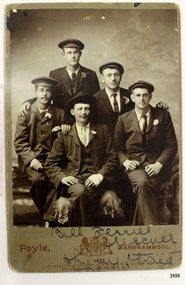
Postcard - People, Bill Ferrier - rescuer, 11th November, 1905
... Her record books, ship logs, correspondence and supporting papers are still available. ...Her record books, ship logs, correspondence and supporting papers are still available. ...The postcard shows a photograph of William Ferrier, the 25-year-old Warrnambool fisherman from South Warrnambool whose rescue of two sailors from the wrecked La Bella made him an overnight National hero, quoted as “one of the most heroic rescues in Victoria’s shipwreck history”. The La Bella was wrecked on 10th November 1905 and the photograph was taken on the next day. In the photograph, William Ferrier is seated in the centre, with four of the five survivors beside him: (from left to right) Leonard Robertson, R. Payne, Oscar Rosenholme and Jack Noake. The photograph was taken by Foyle Photography Studio in Warrnambool, originally owned by James Charles Foyle. He previously had a photographic studio in Melbourne 1882 1887, then opened “Foyle’s Photo Card Studios” in Liebig St, Warrnambool. James Foyle died on 13th July 1905 and his son and daughter, Charles and Lilian Foyle continued on with the business until 1945. This photograph was most likely taken by either Charles or Lilian Foyle. The story of William Ferrier’s brave act follows on below … The ship from which the sailors were rescued was the three-masted, iron and steel barquentine the La Bella, built in Norway in 1893. She was one of two iron and steel ships by Johan Smith, the company was one of the leading shipping families in Tvedestrand, Norway. She was significant to Norwegian shipping, being one of only 27 iron and steel ships ever built in Norway. She was registered in New Zealand and engaged from 1902 in inter-colonial trading of timber in the Pacific, between New Zealand and Australia and was often in Port Phillip Bay, Victoria. On 5th October 1905, the twelve-year-old La Bella left Lyttleton, New Zealand carrying a cargo of timber bound for Warrnambool, Australia. She was manned by a crew of twelve: the Master, (Captain Mylius, previously 1st Mate of La Bella, appointed Captain to La Bella on 6th February 1903) 2 Mates, Cook, six able seamen, one ordinary seaman and a boy. Bad weather en route caused her to shelter at Burnie on Tasmania's North West coast. On November 10th, the 37th day of her journey, La Bella approached Warrnambool. Captain Mylius steered her towards Lady Bay Channel in heavy south-west seas and evening mist. He ordered the helmsman to steer for the light. As the ship came round, a tremendous sea struck her on the port quarter, causing her to breach broadside in a northwesterly direction into breakers. The helm was brought round twice more, but each time heavy seas broke over her, the third time throwing the La Bella on to a submerged reef in Lady Bay now known as La Bella Reef (about 100 yards from the Warrnambool breakwater). The sea was so rough that it even wrenched a one-and-a-half ton anchor from its fastenings and into the sea. As Captain Mylius headed to the steel wheelhouse, intending to send up a rocket flare, a huge sea slammed the steel door into him (resulting in massive bruising front and back) Despite his injuries he still managed to set off a blue light, which he held up in his hands. La Bella’s lifeboats were filled with seawater and broke up on their chocks. The blue light was the first indication to people on the shore that there was a ship in distress. The Harbour Master, Captain Roe (who lived in the Harbour Master’s House opposite Flagstaff Hill), organised a group of volunteers to crew the lifeboat because the trained crew was unavailable; the crewmen were working on a steamer in Port Fairy at the time. He then poured oil onto the water to try and smooth the sea. At around 11 pm three of the crew took shelter in the steel forecastle but the sea crashed into it and broke it up. While the rest of the crew and onlookers watched helplessly in the moonlight the bodies were washed away into the sea, never to be seen again. Some of the crew lashed themselves to the weather rail to keep from being washed away. Watson, the ordinary seaman, became tangled in the rigging lines and was too weak to move, so the 2nd Mate, Robertson, put a line onto him so that he wouldn’t wash off. Around 11 pm three of the crew were unconscious from exhaustion. The situation on La Bella was becoming dangerous. The 2nd Mate moved to the ‘house’ and soon afterwards the ship slipped in the heavy sea. The lashings of the 1st Mate and the ‘boy’ Denham had kept them safe until about 2 am when they were washed overboard; no one was able to help. One by one, the exhausted crew were being washed overboard, too weak to hold on any longer. During the night the La Bella had broken into two and the deckhouse ran out towards the sea. Two more men drowned when trying to reach the lifeboat. By sunrise, the only survivors of the twelve were the Master, 2nd Mate and three seamen. Early in the morning, Captain Roe used the rocket apparatus on shore to try and shoot a line to the ship for a safer rescue but each attempt fell short of the target. Several attempts were made by the lifeboat to rescue the stricken sailors, but the rough conditions made this difficult for the boat to get close enough to the ship and the lifeboat had to return to shore. During a final attempt to reach the ship Captain Mylius ordered his men to jump into the sea. Leonard Robertson, 2nd mate, jumped and swam towards the lifeboat, taking hold of the boat hook offered to him. Oscar Rosenholme managed to reach the boat floating on a piece of timber from the ship’s load and a third survivor, Noake, also made the boat. Along with the lifeboat rescue crew, 25-year-old William Ferrier rowed his small dingy through the heavy seas and managed to rescue the Captain, whom he landed on the breakwater. Ferrier then returned to the ship to attempt a final rescue, losing his oars and rowlocks into the high sea. Using just a spare paddle he skulled towards the La Bella, reaching her stern in time to cut loose the lone surviving sailor, Payne, from the lashing that held him to the ship; the terrified sailor dropped from the ship and into the dingy. Shortly after the last man was rescued, the La Bella was lifted by a huge wave and crashed back down on the reef; she broke up and sank. The ordeal had lasted ten hours. The survivors were taken to the nearby Bay View Hotel and gratefully received warm food and clothing, medical attention and a place to sleep. In the following days, an unidentified body of a young person had washed ashore; it was either Watson or Denham. The body was buried in the Warrnambool cemetery with an appropriate gravestone and inscription. William Ferrier became a national hero as news of the daring rescue spread. In recognition of his bravery in the two daring rescues, he was awarded the Silver Medal for Bravery by the Royal Humane Society and was honoured in the letter from the Prime Minister and the Parliament of the Commonwealth, telegrams and a cheque for £20 from the Governor-General, over £150 subscribed by the public, including Warrnambool and district and readers of The Argus, and a gold medal from the Glenelg Dinghy Club of South Australia. Ferrier’s rescue efforts are one of the most heroic in Victoria’s shipwreck history. (William Ferrier’s son, Frank, received a similar award almost fifty years later when he helped rescue four members of the crew on the yacht Merlan after it ran on to a reef near the Point Lonsdale Lighthouse. ) The wreck of La Bella now lies on her port side in 13 metres of sheltered water inside the reef she struck. The bow section is relatively intact and part of the stern has drifted north-easterly towards the mouth of the Hopkins River. The reef the La Bella struck now bears its name. Those five rescued from the La Bella were Captain George Mylius, Leonard Robertson (2nd Mate, 21 years old), R. Payne, Oscar Rosenholme and Jack Noake. Those seven who lost their lives were Mr Coulson (1st mate), Charles Jackman (cook) Gustave Johnson, Pierre Johann and Robert Gent (all able seamen), Harry Watson (ordinary seaman) and Jack Denham (ship’s boy), Captain Mylius was found guilty of careless navigation; he had sailed into the bay without the services of a pilot. His Master Certificate was suspended for twelve months. Later he was also charged with manslaughter of one of the crew who had died when the La Bella was wrecked but found not guilty. The event’s adverse publicity and damage to his career took a toll on his health and he died of a heart attack six months after the wreck; he was only thirty-seven. His body was buried in the Melbourne General Cemetery. The La Bella was “the best documented of all sailing ships owned in New Zealand”. Her record books, ship logs, correspondence and supporting papers are still available. At the time of the tragedy, she was owned by Messers David C.Turnbull and Co. of Timaru, New Zealand timber merchants and shipping agents, who had purchased her on 13th December 1901. A detailed account of the last journey of La Bella can be read in “Leonard Robertson, the Whangaroa & La Bella” written by Jack Churchouse, published in 1982 by Millwood Press Ltd, Wellington, NZ. As well as this postcard, Flagstaff Hill’s La Bella Collection includes a photograph of the wrecked La Bella, a brass rail holder and the letter from the Prime Minister and other Members of Parliament that was sent to William Ferrier to commend him for his bravery. Some 15 – 17 ships are believed to have sunk in Lady Bay, but only two have been discovered on the seafloor; the “La Bella” and the “Edinburgh Castle”. Both wrecks are popular diving sites and are preserved as significant historical marine and marine archaeological sites. This postcard is part of the La Bella Collection and is significant at both a local and state level. Its connection to the La Bella shipwreck and the rescue of five survivors highlights the dangers of Victoria’s Shipwreck Coast. The photograph of William Ferrier and four of the five survivors demonstrates the bravery of ordinary Australians who risked their lives to save victims of shipwrecks along the coast. The postcard is significant to the history of Warrnambool as it portrays William Ferrier, a local fisherman whose descendants continue to live in the area. It highlights the way of life of people who lived in coastal towns in 19th century Victoria and the effects of shipwrecks upon them. The postcard connects to the congratulatory letter which was sent to William Ferrier by the Prime Minister and Government of Australia and demonstrates the importance they attached to his efforts for Victoria and to Australia. The postcard is also an example of the photography of Foyle Photographers who were in the town of Warrnambool from the late 1800’s. Charles and Lillian Foyle took over the business when their father James died in 1905. Lillian Foyle is significant as the first woman photographer in Warrnambool. It is not known whether Charles of Lillian took this photograph. This postcard is significant because of its association with the sailing ship “La Bella”. The “La Bella” is of local and state and national significance. It is one of the only two shipwrecks discovered in Lady Bay, Warrnambool, out of the 15-17 shipwrecks in the bay. Sepia photograph of William (Bill) Ferrier (seated in the middle), heroic rescuer of two crew members of the La Bella, wrecked at Warrnambool. The photograph is a postcard and shows five men dressed formally in suits and hats. Printed below the photograph are the name and place of the photographer, a royal crest and the details of two patrons of the photographer. Also below the photograph are some handwritten words in black pen. On the back of the postcard is a handwritten message in the same writing as the front.Printed on the front of the card is “Foyle, WARRNAMBOOL” “PATRONS: / HIS ROYAL HIGHNESS THE DUKE OF CORNWALL & YORK. / HIS EXCELLENCY LORD BRAS_ EY, R.O.B.” Handwritten on the front of the card is “Bill Ferrier / rescuer / Oh my hero _ _ _ “ Handwritten on the back of the card is a message. “La Bella” Wrecked off W.Bool Breakwater Nov. 1906 (_ _ _ _ show night) Payne Noake Rosenholme Robertson and Capt Mylius (saved) (moonlight bright) Watson (_ _ _ _ boy) Richwoud [possibly Richmond] drowned” and signed “Desdewoua [possibly Desdemona] Slogos”la bella, foyle, william ferrier, bill ferrier, lady bay, 1905, 10th november 1905, 11th november 1905, parliament of the commonwealth, royal humane society medal, flagstaff hill, warrnambool, shipwrecked coast, flagstaff hill maritime museum, maritime museum, shipwreck coast, flagstaff hill maritime village -
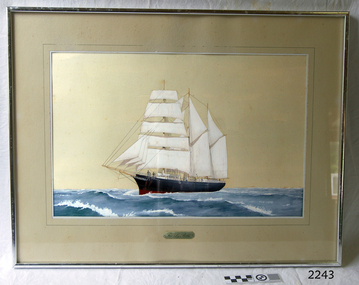 Flagstaff Hill Maritime Museum and Village
Painting - Maritime painting, The La Bella, 1980s
... Her record books, ship logs, correspondence and supporting papers are still available. ...Her record books, ship logs, correspondence and supporting papers are still available. ...This painting of the “La Bella” is associated with Flagstaff Hill’s collection of artefacts from the wreck of the “La Bella”. It was painted around the 1980s by maritime artist Philip J. Gray. Some 15 – 17 ships are believed to have sunk in Lady Bay, but only two have been discovered on the seafloor; the “La Bella” and the “Edinburgh Castle”. Both wrecks are popular diving sites and are preserved as significant historical marine and marine archaeological sites. The Kosnar Picture Framing and Mirrors Shop identified the "GRAY 3135, Y04/111" as their job number for the framing and said that the label "ANOTHER KOSNAR FEATURE" was last used before about 1990. About artist Philip J. Gray “Philip is one of Australia’s leading maritime artists and his meticulous research and social commentary paintings of ships, such as, the Loch Ard and Schomberg form an important part of Warrnambool’s Flagstaff Hill Maritime Museum.” [Dr Marion Manifold, Artist and Art Historian, 2014] Philip James Gray was born in London but has lived most of his life in Australia. He graduated from a London school of art as an illustrator, specialising in technical and scientific illustration as well as other commercial and applied art. He was also a student for a time of Fyffe Christie - British figurative artist, mural painter and humanitarian – who had a great influence on his career. Philip has always worked as a professional artist and illustrator. Many publications on maritime history have featured his work. His paintings have been released and sold all over the world as limited edition prints. The State Library of Victoria’s ‘Latrobe Collection’ holds two of his paintings. His street painting of ‘The Ashes Contest’ decorates the brick wall of Old Bakery Laneway in Sunbury and a Sunbury café owner commissioned him to paint the ‘Sunbury Pop Festival’ as a remembrance of local history. Philip has been an active member of the Sunbury Art Society in Victoria for several years, serving on the committee for some of that time and being involved in exhibitions. He enjoys helping new artists and sharing his skills and experience. About the “La Bella” The wreck of the La Bella lies at the bottom of the Warrnambool Harbour in Lady Bay. Some 15 ships are believed to have been wrecked there but only two have been discovered on the sea floor; the La Bella and the Edinburgh Castle. Both wrecks are popular diving sites and are preserved as significant historical marine and marine archaeological sites. The story of the final voyage of the La Bella is summarised as follows … The ship from which the sailors were rescued was the three-masted, iron and steel barquentine the La Bella, built in Norway in 1893. She was one of two iron and steel ships by Johan Smith, the company being one of the leading shipping families in Tvedestrand, Norway. She was significant to Norwegian shipping, being one of only 27 iron and steel ships ever built in Norway. La Bella was registered in New Zealand and engaged from 1902 in inter-colonial trading of timber in the pacific, between New Zealand and Australia and was often in Port Phillip Bay, Victoria. On 5th October 1905 the twelve year old La Bella left Lyttleton, New Zealand carrying a cargo of timber bound for Warrnambool, Australia . She was manned by a crew of twelve: the Master, (Captain Mylius, previously 1st Mate of La Bella, appointed Captain to La Bella on 6th February 1903) 2 Mates, Cook, six able seamen, one ordinary seaman and a boy. Bad weather en-route caused her to shelter at Burnie on Tasmania's North West coast. On November 10th, the 37th day of her journey, La Bella approached Warrnambool. Captain Mylius steered her towards Lady Bay Channel in heavy south-west seas and evening mist. He ordered the helmsman to steer for the light. As the ship came round, a tremendous sea struck her on the port quarter, causing her to breach broadside in a north-westerly direction into breakers. The helm was brought round twice more, but each time heavy seas broke over her, the third time throwing the La Bella on to a submerged reef in Lady Bay now known as La Bella Reef (about 100 yards from the Warrnambool breakwater). The sea was so rough that it even wrenched a one-and-a-half ton anchor from its fastenings and into the sea. As Captain Mylius headed to the steel wheelhouse, intending to send up a rocket flare, a huge sea slammed the steel door into him (resulting in massive bruising front and back) Despite his injuries he still managed to set off a blue light, which he held up in his hands. La Bella’s lifeboats were filled with sea water and broke up on their chocks. The blue light was the first indication to people on shore that there was a ship in distress. The Harbour Master, Captain Roe (who lived in the Harbour Master’s House opposite Flagstaff Hill), organised a group of volunteers to crew the lifeboat because the trained crew was unavailable; the crewmen were working on a steamer in Port Fairy at the time. He then poured oil onto the water to try and smooth the sea. At around 11pm three of the crew took shelter in the steel forecastle but the sea crashed into it and broke it up. While the rest of the crew and onlookers watched helplessly in the moonlight the bodies were washed away into the sea, never to be seen again. Some of the crew lashed themselves to the weather rail to keep from being washed away. Watson, the ordinary seaman, became tangled in the rigging lines and was too weak to move, so the 2nd Mate, Robertson, put a line onto him so that he wouldn’t wash off. Around 11pm three of the crew were unconscious from exhaustion. The situation on La Bella was becoming dangerous. The 2nd Mate moved to the ‘house’ and soon afterwards the ship slipped in the heavy sea. The lashings of the 1st Mate and the ‘boy’ Denham had kept them safe until about 2am when they were washed overboard; no one was able to help. One by one, the exhausted crew were being washed overboard, too weak to hold on any longer. During the night the La Bella had broken into two and the deckhouse ran out towards the sea. Two more men drowned when trying to reach the lifeboat. By sunrise the only survivors of the twelve were the Master, 2nd Mate and three seamen. Early in the morning Captain Roe used the rocket apparatus on shore to try and shoot a line to the ship for a safer rescue but each attempt fell short of the target. Several attempts were made by the lifeboat to rescue the stricken sailors, but the rough conditions made this difficult for the boat to get close enough to the ship and the lifeboat had to return to shore. During a final attempt to reach the ship Captain Mylius ordered his men to jump into the sea. Leonard Robertson, 2nd mate, jumped and swam towards the lifeboat, taking hold of the boat hook offered to him. Oscar Rosenholme managed to reach the boat floating on a piece of timber from the ship’s load and a third survivor, Noake, also made the boat. Along with the lifeboat rescue crew, 25 year old William Ferrier rowed his small dingy through the heavy seas and managed to rescue the Captain, whom he landed on the breakwater. Ferrier then returned to the ship to attempt a final rescue, losing his oars and rowlocks into the high sea. Using just a spare paddle he skulled towards the La Bella, reaching her stern in time to cut loose the lone surviving sailor, Payne, from the lashing that held him to the ship; the terrified sailor dropped from the ship and into the dingy. Shortly after the last man was rescued, the La Bella was lifted by a huge wave and crashed back down on the reef; she broke up and sank. The ordeal had lasted ten hours. The survivors were taken to the nearby Bay View Hotel and gratefully received warm food and clothing, medical attention and a place to sleep. In the following days an unidentified body of a young person was washed ashore; it was either Watson or Denham. The body was buried in the Warrnambool cemetery with an appropriate gravestone and inscription. William Ferrier became a national hero as news of the daring rescue spread. In recognition of his bravery in the two daring rescues he was awarded the Silver Medal for Bravery by the Royal Humane Society and was honoured in the letter from the Prime Minister and the Parliament of the Commonwealth, telegrams and a cheque for £20 from the Governor General, over £150 subscribed by the public, including Warrnambool and district and readers of The Argus, and a gold medal from the Glenelg Dinghy Club of South Australia. Ferrier’s rescue efforts are one of the most heroic in Victoria’s shipwreck history. (William Ferrier’s son, Frank, received a similar award almost fifty years later, when he helped rescue four members of the crew on the yacht Merlan, after it ran on to a reef near the Point Lonsdale Lighthouse. ) The wreck of La Bella now lies on her port side in 13 metres of sheltered water inside the reef she struck. The bow section is relatively intact and part of the stern has drifted north-easterly towards the mouth of the Hopkins River. The reef the La Bella struck now bears its name. Those five rescued from the La Bella were Captain George Mylius, Leonard Robertson (2nd Mate, 21 years old), R. Payne, Oscar Rosenholme and Jack Noake. Those seven who lost their lives were Mr Coulson (1st mate), Charles Jackman (cook) Gustave Johnson, Pierre Johann and Robert Gent (all able seamen), Harry Watson (ordinary seaman) and Jack Denham (ship’s boy). Captain Mylius was found guilty of careless navigation; he had sailed into the bay without the services of a pilot. His Master Certificate was suspended for twelve months. Later he was also charged with manslaughter of one of the crew who had died when the La Bella was wrecked, but found not guilty. The event’s adverse publicity and damage to his career took a toll on his health and he died of a heart attack six months after the wreck; he was only thirty-seven. His body was buried in the Melbourne General Cemetery. The La Bella was “the best documented of all sailing ships owned in New Zealand”. Her record books, ship logs, correspondence and supporting papers are still available. At the time of the tragedy she was owned by Messers David C.Turnbull and Co. of Timaru, New Zealand timber merchants and shipping agents, who had purchased her on 13th December 1901. A detailed account of the last journey of La Bella can be read in “Leonard Robertson, the Whangaroa & La Bella” written by Jack Churchouse, published in 1982 by Millwood Press Ltd, Wellington, NZ.This painting of the La Bella by Philip J. Gray is part of the La Bella Collection and is significant at both a local and state level. Its connection to the La Bella shipwreck and the rescue of five survivors highlights the dangers of Victoria’s Shipwreck Coast. The painting connects with other objects and artefacts associated with the wreck of the La Bella. This painting is significant because of its association with the sailing ship “La Bella” . the “La Bella” is of local and state and national significance. It is one of the only two shipwrecks discovered in Lady Bay, Warrnambool, out of the 15-17 shipwrecks in the bay. Large framed painting of the three masted barquentine "La Bella" fully rigged. Painted by Phillip J Gray. A fine printed line squares off the painting. Beneath painting and line is a gold plate with black copper plate designating "La Bella" is encased in glass, surrounded by a silver-metal frame. Yellow and brown paper label is adhered to back of painting. Picture framed by Kosnar in Melbourne."The La Bella" on gold plaque Logo of "K" inside a brown square. "GRAY 3135, Y04/111", "ANOTHER KOSNAR FEATURE" flagstaff hill, warrnambool, shipwrecked-coast, flagstaff-hill, flagstaff-hill-maritime-museum, maritime-museum, shipwreck-coast, flagstaff-hill-maritime-village, painting, la bella, artist phillip j gray, maritime painting, lady bay warrnambool -
 Federation University Historical Collection
CD-ROM, Big Cats sightings in Victoria, 2012
... correspondence sent 'Big Cats Victoria and Simon Townsend and JohnTurner. Their website states: Big Cats Victoria Southern Australia, including south western West Australia, has a history of reports of ‘panther’ like predators dating back to the later half of the 19th century. The animals were usually described as being of black or tan colouration and with the proportions of a medium sized big-cat such as a Leopard or Puma. The records can be found in newspaper, radio and television archives, Government reports, a very few books...correspondence sent 'Big Cats Victoria and Simon Townsend and JohnTurner. Their website states: Big Cats Victoria Southern Australia, including south western West Australia, has a history of reports of ‘panther’ like predators dating back to the later half of the 19th century. The animals were usually described as being of black or tan colouration and with the proportions of a medium sized big-cat such as a Leopard or Puma. The records can be found in newspaper, radio and television archives, Government reports, a very few books ...The CD-Rom includes a range of electronic correspondence sent 'Big Cats Victoria and Simon Townsend and JohnTurner. Their website states: Big Cats Victoria Southern Australia, including south western West Australia, has a history of reports of ‘panther’ like predators dating back to the later half of the 19th century. The animals were usually described as being of black or tan colouration and with the proportions of a medium sized big-cat such as a Leopard or Puma. The records can be found in newspaper, radio and television archives, Government reports, a very few books and on the internet. The historical material is based on anecdotal reportage and has contributed to the mythification of the subject. Some Government agencies at both State and Local levels (in New South Wales), have collected records of sightings or investigated stock deaths purported to be associated with so called ‘panther’ kills. They remain understandably non committal due to the lack of a specimen of such a predator of undeniable authenticity. While other types of unknown predator have been reported in various parts of Australia they are not the concern of this website. For purposes of economy we, John Turner and Simon Townsend, confine our investigations to western Victoria and south eastern South Australia. (http://bigcatsvic.com.au/) A CD-ROM of multiple emails and image attachments relating to assorted sightings, footprints, killings, etc from big cats in the Otways of Victoria. The electronic mail was sent to 'Big Cats Victoria' Images include: This item is part of the Australian Animal Folklore Collectionaustralian animal folklore collection, ja sharp, simon townsend, neville bayley, st kilda, peter stefanis, toolangi, puma, tom daniel, footprint, pawprint, cryptozoology, rex gilroy, lancefield tiger, anglesea, berringa, matthew charles, jutin fitzclarence, harry carlin, patty smith, johannes beach, nerida, stirling ranges, daryl hardy, brook kelly, carl rose, ashley hall, jonathan smith, sally ballieu, lorraine balck, wayne bower, ian riordon, aleda turna, john turner, dave moyle, ben rayner, stewart leach, colin boord, sheryl mahoney, beech forest, otways, tooborac, geoff black, panther, brad blake, priscilla prescott, beau kapitiany, ramsay hosn, clare jones, darren guthrie, tallarook, josh fairway, linda wescon, lithgow, john turner, southern grampians -
Greensborough Historical Society
Administrative record - Minutes, Australian Red Cross Society. Greensborough Unit, 1958-2017
... 5 Minute books and 2 ring binders containing Minutes and correspondence....Entries are handwritten from 1958 until 2006, then replaced with typed and printed minutes and includes correspondence from later years. australian red cross red cross greensborough unit community groups "Red Cross" and other identifiers, handwritten. 5 Minute books and 2 ring binders containing Minutes and correspondence. ...Set of minutes from Australian Red Cross Greensborough Unit from the first meeting in 1958 through to 2017. Contains Committee decisions and activities for this period. Entries are handwritten from 1958 until 2006, then replaced with typed and printed minutes and includes correspondence from later years.5 Minute books and 2 ring binders containing Minutes and correspondence."Red Cross" and other identifiers, handwritten.australian red cross, red cross greensborough unit, community groups
