
Showing 16 items matching "bookstall"
-
 NMIT (Northern Melbourne Institute of TAFE)
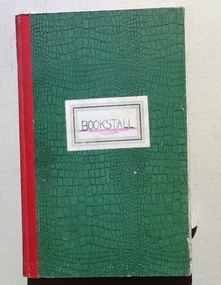
Account Book - CTS, Bookstall accounts 1949-1951, 1949-1951
... Bookstall accounts 1949-1951.......bookstall...Includes all income and expenditure from the Collingwood Technical School Bookstall....Label pasted on front cover, written in black: "BOOKSTALL"....Includes all income and expenditure from the Collingwood Technical School Bookstall. Original financial records of the Bookstall at Collingwood Technical School at this time. ...A record of accounts from September 1949 to December 1951. Includes all income and expenditure from the Collingwood Technical School Bookstall.Original financial records of the Bookstall at Collingwood Technical School at this time.Green covered ledger book. Handwritten accounts throughout.Label pasted on front cover, written in black: "BOOKSTALL".collingwood technical school, cts, accounts, bookstall, account books, nmit, -
 The Adam Lindsay Gordon Commemorative Committee Inc.
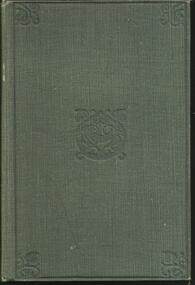
Book, Poems of Adam Lindsay Gordon- NSW Bookstall Company- Sydney- 1918
... Poems of Adam Lindsay Gordon- NSW Bookstall Company- Sydney- 1918...Poems of Adam Lindsay Gordon- NSW Bookstall Company- Sydney- 1918 Book ... -
 The Adam Lindsay Gordon Commemorative Committee Inc.
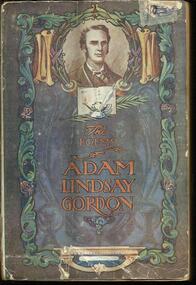
Book, The Poems of Adam Lindsay Gordon- NSW Bookstall Company- Sydney- 1921
... The Poems of Adam Lindsay Gordon- NSW Bookstall Company- Sydney- 1921...The Poems of Adam Lindsay Gordon- NSW Bookstall Company- Sydney- 1921 Book ... -
 Lara RSL Sub Branch
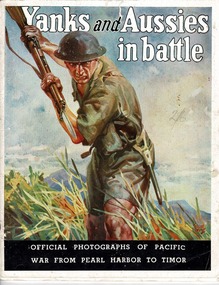
Magazine, N.S.W. BOOKSTALL CO. PTY. LTD, Yanks and Aussies in battle
... N.S.W. BOOKSTALL CO. PTY. LTD....Magazine N.S.W. BOOKSTALL CO. PTY. LTD. ...rectangular shaped magazine.Yanks and Aussies in battle OFFICIAL PHOTOGRAPHS OF PACIFIC WAR FROM PEARL HARBOUR TO TIMORmagazines, books, pacific war, pearl harbour, timor, ww2, lara r.s.l. -
 Orbost & District Historical Society
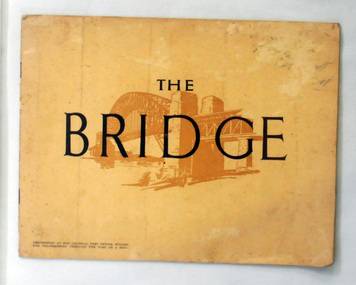
book, The Bridge, 1930's
... Bookstall Company Ltd...The Bridge book Bookstall Company Ltd ...This book was written by Dr J. J. C. Bradfield, (John Job Crew), 1867-1943. Dr JJC Bradfield was a visionary Australian engineer who worked with enormous energy and vision to build the infrastructure which he foresaw that Sydney would need as it grew. As early as 1903 Bradfield was making the case for the Sydney Harbour Bridge, in his presidential address as President of the Sydney University Engineering Society. Bradfield’s proposal — at that stage for a cantilever bridge between Dawes Point and Milsons Point — won the committee’s support and they recommended it be accepted. However, the First World War put a stop to these plans. While a bill to authorise the project passed the lower house of the NSW parliament in 1916, it failed to pass the upper house, on the grounds that funds should not be diverted from the war effort. With the war over, in 1922 the Sydney Harbour Bridge Act was passed by the NSW Parliament. The Sydney Harbour Bridge was officially opened in 1932 after Museum and St James railway stations were built. This book was written from the story broadcast by Dr. J.J.C. Bradfield. This item is a useful reference tool.A staple soft cover 16 pp booklet with a buff coloured cover. It has a sketch of the Sydney Harbour Bridge behind the title "The Bridge" in dark brown print. It contains information and photographs of the history and construction of Sydney Harbour Bridge.sydney-harbour-bridge bradfield-dr-j-j-c -
 Mrs Aeneas Gunn Memorial Library
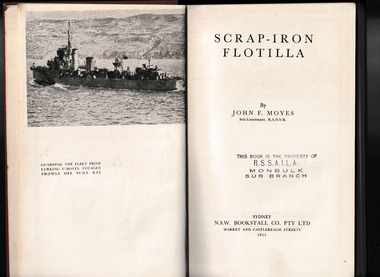
Book, NSW Bookstall Pty Ltd, Scrap Iron Flotilla, 1944
... NSW Bookstall Pty Ltd,...Scrap Iron Flotilla Book NSW Bookstall Pty Ltd, John F Moyes ...An account of the older ships(The Scrap Iron Flotilla) of the Australian Navy in the Second World WarIll, p.197.non-fictionAn account of the older ships(The Scrap Iron Flotilla) of the Australian Navy in the Second World Warworld war 1939-1945 - naval operations - australia, royal australian navy - history -
 Linton Mechanics Institute and Free Library Collection
Book - Novel, Ford, Effie Marie, Princes Terrace, 1934
... ...N.S.W. Bookstall Company...Princes Terrace Book Novel Ford, Effie Marie N.S.W. Bookstall Company Halstead Printing Company ...272 p. : Red cover with black text.fictionfiction, effie marie ford -
 Linton Mechanics Institute and Free Library Collection
Book - Novel, Littlejohn, Linda (Emma Linda Palmer Littlejohn), Life and Lucille, 1933
... ...N.S.W. Bookstall Company.... : plain red cover Life and Lucille Book Novel Littlejohn, Linda (Emma Linda Palmer Littlejohn) N.S.W. Bookstall Company Halstead Printing Company ...280 p. : plain red coverfictionlinda littlejohn, fiction, romance -
 Kilmore Historical Society
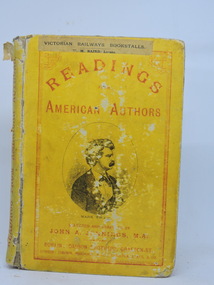
Readings From American Authors, 1884
... label on front cover, 'VICTORIAN RAILWAYS BOOKSTALLS./W.M.BAIRD Lessee'. Inside front cover, '1134' underlined....American Literature label on front cover, 'VICTORIAN RAILWAYS BOOKSTALLS./W.M.BAIRD Lessee'. Inside front cover, '1134' underlined. ...Selected readings from American authors., "humorous and pathetic".Yellow board cover, worn, loss of colour, torn spine. Foxing throughout. 256 pp. plus advertisements. Fair condition.label on front cover, 'VICTORIAN RAILWAYS BOOKSTALLS./W.M.BAIRD Lessee'. Inside front cover, '1134' underlined.american literature -
Port Melbourne Historical & Preservation Society
Photograph - PMHPS's Back to Port, Port Melbourne Community Festival, Ann Smallpage, 24 Mar 2002
... One of 3 colour photos taken by Ann Smallpage at the PMH&PS's 2002 Back to Port, PM Community Festival: Lorraine Hall and Heather Wale at the bookstall...celebrations fetes and exhibitions lorraine hall heather wale port melbourne historical & preservation society pmhps Dated on back '23/3/02' One of 3 colour photos taken by Ann Smallpage at the PMH&PS's 2002 Back to Port, PM Community Festival: Lorraine Hall and Heather Wale at the bookstall Photograph PMHPS's Back to Port, Port Melbourne Community Festival Ann Smallpage ...One of 3 colour photos taken by Ann Smallpage at the PMH&PS's 2002 Back to Port, PM Community Festival: Lorraine Hall and Heather Wale at the bookstallDated on back '23/3/02'celebrations fetes and exhibitions, lorraine hall, heather wale, port melbourne historical & preservation society, pmhps -
 NMIT (Northern Melbourne Institute of TAFE)
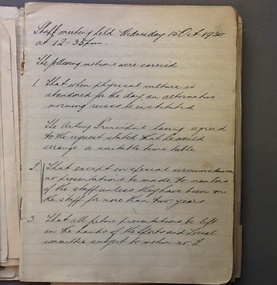
Minutes - CTS, Minutes of Council of School Activities. Collingwood Technical School. 1930-1941, 1930-1941
... The Council of School Activities dealt with matters pertaining to student welfare, from physical culture to the running of the bookstall....The Council of School Activities dealt with matters pertaining to student welfare, from physical culture to the running of the bookstall. Details the activities within the school, including those teachers who were involved. ...The Council of School Activities dealt with matters pertaining to student welfare, from physical culture to the running of the bookstall.Details the activities within the school, including those teachers who were involved.Black exercise book with brown paper spine binding. Some loose documents are interleaved.All entries are handwritten.collingwood technical school, cts, council of school activities, school council, council minutes, nmit, -
 Bendigo Historical Society Inc.
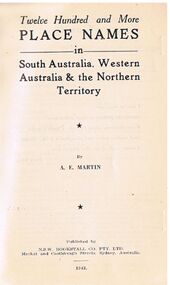
Book - ALEC H CHISHOLM COLLECTION: BOOK ''1,250 PLACE NAMES'' BY A.E.MARTIN
... Published in 1943 by NSW Bookstall Co. Pty Ltd, Sydney. Printed by Whitmarks Pty Ltd., Sydney. ...Published in 1943 by NSW Bookstall Co. Pty Ltd, Sydney. Printed by Whitmarks Pty Ltd., Sydney. ...Booklet. ALEC H CHISHOLM COLLECTION. Softcover booklet on the origin of 1,250+ place names in South Australia, West Australia and the Northern Territory, by A. E. Martin. Published in 1943 by NSW Bookstall Co. Pty Ltd, Sydney. Printed by Whitmarks Pty Ltd., Sydney. Catalogue sticker ''2227MAR'' on front coverA. E. Martinbooks, collections, place names, alec h chisholm collection, place names, a.e.martin -
 Bendigo Historical Society Inc.
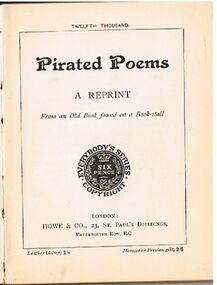
Book - ALEC H CHISHOLM COLLECTION: BOOK ''PIRATED POEMS''
... A reprint from an old book found on a bookstall. Author(s) unknown. Published in 1890 by Howe & Co., London. ...A reprint from an old book found on a bookstall. Author(s) unknown. Published in 1890 by Howe & Co., London. ...Book. ALEC H CHISHOLM COLLECTION. 70 page small ''Everybody's Series'' book of verse. A reprint from an old book found on a bookstall. Author(s) unknown. Published in 1890 by Howe & Co., London. Catalogue sticker ''2104 ANO'' on spine. Handwritten in ink on page before title page ''Edilti Anderson 1890''.Unknownbooks, collections, poetry, alec h chisholm collection, everybody's series, poetry -
 Bendigo Historical Society Inc.
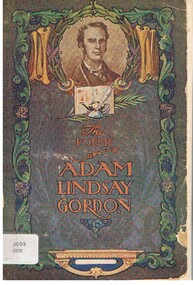
Book - ALEC H CHISHOLM COLLECTION: BOOK ''THE POEMS OF ADAM LINDSAY GORDON''
... Published in 1918 by N.S.W. Bookstall Co. Ltd, Sydney. Printed by John Sands Ltd, Sydney. ...Published in 1918 by N.S.W. Bookstall Co. Ltd, Sydney. Printed by John Sands Ltd, Sydney. ...Book. ALEC H CHISHOLM COLLECTION. 225 page paperback collection of by Adam Lindsay Gordon with a prefatory sketch of his life. Published in 1918 by N.S.W. Bookstall Co. Ltd, Sydney. Printed by John Sands Ltd, Sydney. Sketch portrait of A. L. Gordon on front cover and a Sunlight Soap advert on back cover. Catalogue sticker ''2059 GOR'' on front cover.Adam Lindsay Gordonbooks, collections, poetry, alec h chisholm collection, adam lindsay gordon, poetry -
 Bendigo Historical Society Inc.
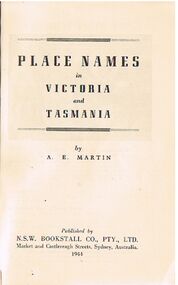
Book - ALEC H CHISHOLM COLLECTION: BOOK ''PLACE NAMES IN VICTORIA & TASMANIA'' BY A.E.MARTIN
... Published in 1944 BT NSW Bookstall Co Pty Ltd, Sydney and printed by NSW Printing Co. ...Published in 1944 BT NSW Bookstall Co Pty Ltd, Sydney and printed by NSW Printing Co. ...Book. ALEC H CHISHOLM COLLECTION. 107 page paperback of Place Names in Victoria and Tasmania by A. E. Martin. [2 copies, (a) and (b)]. Published in 1944 BT NSW Bookstall Co Pty Ltd, Sydney and printed by NSW Printing Co. Catalogue stickers ''2225.1 MAR'' and ''2225.2 MAR'' on front covers. Handwritten in ink on a separate piece of paper inside front cover of copy (a) ''This book was prepared by me and trust it will prove of value to you. Bill Burrell''A. E. Martinbooks, collections, place names, alec h chisholm collection, a.e.martin, place names, victoria, tasmania, bill burrell -
 Uniting Church Archives - Synod of Victoria
BW photo, Undated
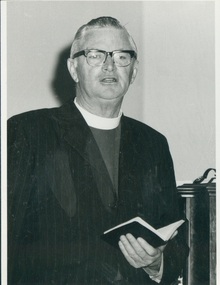
... It had begun in his Nairobi days with a small church bookstall, this had developed into a major book-shop in the heart of the city. ...It had begun in his Nairobi days with a small church bookstall, this had developed into a major book-shop in the heart of the city. ...STANWAY, ALFRED (b. 9 Sept 1908; d. Melbourne, Vic, 27 June 1989). Anglican bishop, missionary. Stanway grew up in the Wimmera district of western Victoria, and left school when 14 years old. He found work in Melbourne, trained as an accountant, and at the age of 20, held a responsible position with a publishing company. This background, allied with an uncommon flair for figures and finance, was to stand him in good stead throughout his life. But he had little knowledge and no experience of the grace of God until 29 July 1928. At the Evening Service in the parish church of Fairfield on 29 July, he heard the Rev C H Nash (q.v.) preach a sermon which led to his conversion. Within two years he made up his mind to become a missionary and began night studies in order to matriculate. He entered Ridley College in March 1932 to prepare for ordination undertaking week-end duties as a catechist at Deer Park and St Albans. He joined the CMS League of Youth, became chairman, and gathered a fine band of young people many of whom were to become missionaries. He was closely involved with the Belgrave Heights Convention (then at Upwey) and established a League of Youth camp on the site. All his energies were thrown into the task of building up its members in personal holiness and vigorous evangelism. Stanway was ordained in St Paul's Cathedral, Melbourne on St Thomas Day 1934 and was placed in charge of the Old Mission Church of St James and St John, Melbourne. The duties were light enough to allow him to enrol in the Melbourne Teachers College and to complete the Diploma in Teaching. On 26 January 1937, he sailed for Africa to become a missionary in the Anglican Diocese of Mombasa, which at that time embraced the whole of Kenya. He was sent to the hot coastal town of Kaloleni as principal of a Secondary Boys School. Before he left Melbourne, he had become engaged to Marjory Harrison: she followed him to Africa and their marriage took place in Mombasa Cathedral in June 1939. He remained at Kaloleni until 1944 when he was transferred to the inland station of Maseno where all his gifts were to be deployed as rural dean of Nyanza. His oversight of some 500 village churches as well as a widespread primary school system was so efficient that in 1948 he was appointed archdeacon of Kenya with his home and office in Nairobi. As secretary of the African Church Council and of the African Education Board, he was responsible for all African work in the diocese. His contacts with government ministers and public servants were of first class significance at the time when the cry of Uhuru and the demand for independence was travelling throughout the colonial world. On 2 Feb 1951, Alfred Stanway was consecrated in Westminster Abbey as the third Anglican Bp of Central Tanganyika. This Diocese was the special sphere of the CMS Australia, and he already knew most of the missionary personnel. He brought with him the understanding and experience of one who had fully shared the lot and problems of a district missionary, but he came to the diocese at a time when it had yet to recover from its losses in personnel and finance as a result of the war. His immediate task was to provide the impetus of fresh leadership and a long-term overall policy. His aim from-the outset was to build up a strong autonomous church with its own indigenous pastorate. With the whole-hearted confidence of the home base, he was able to enlist the service of new missionaries. He saw a great increase in the number of African clergy and he encouraged village evangelists to open new fields of work. Simple structures were built as new churches at the rate of two a week, week in and week out, year by year. He worked hard to meet the need for Christian literature, bookshops, adult literacy and theological training. He opened Bible schools for village evangelists and sent suitable clergy overseas for further studies. He encouraged initiative in others, helped them to find and use their talents, and gave them his unstinted confidence and support. Fresh finance was required for new ventures. This led him to travel widely in Germany and America, where he raised large funds for these projects. Mackay House was built in Dodoma as the central administrative base for the diocese, hospitals such as those at Mvumi and Hombolo were modernised or established, schools were built and upgraded. In keeping with his vision for ultimate leadership by African personnel, he consecrated Yohana Omari in 1955 as his assistant, he was the first national to become a bp in East Africa. Bp Stanway then set on foot the long and complicated process for the division of his sprawling diocese. In 1963, the diocese of Victoria Nyanza came into being; in 1965, that of Morogoro; in 1966, that of Western Tanganyika. Yet in 1971, his own diocese of Central Tanganyika, though greatly reduced in size, had more churches and more clergy than in its undivided state in 195 l. Stanway then played a leading part in the formation of the Province of Tanzania in 1970, with an African abp as metropolitan. A year later, after 35 years in East Africa and 20 years as bishop of Central Tanganyika, he resigned. His leadership and achievements throughout those years had placed him in the front rank as a great missionary statesman. Stanway had returned to Melbourne at the time when his resignation took effect in August 1971. His early love for Ridley College reasserted itself and he went into residence as deputy principal under the Rev Dr Leon Morris. He was put in charge of chapel worship and the pastoral oversight of the students. All his gifts and experience were called into play as he sought to guide and encourage those who were on the threshold of their ministry. The whole bent of his heart was to foster the spiritual life and missionary calling of those whose hearts the Lord had touched. It was during those years that his life-long zeal for the spread of the gospel through Christian literature had its ultimate flowering. It had begun in his Nairobi days with a small church bookstall, this had developed into a major book-shop in the heart of the city. Then in Dodoma he had established the Central Tanganyika Press in order to promote the publication and distribution of Christian literature at all levels. He had marked out Kevin Engel, trained him, and launched him on the international scene. Hence it was natural that in Melbourne he and Kevin Engel should found the Australian Christian Literature Society. But his time at Ridley College was not to last. Unknown to him, the Rev J R W Stott had put his name forward as that of a person who could head a new school of theology in the United States to provide a sound training for evangelical ordinands. Such a task would have been formidable enough for a younger man who had grown up in America. How could an Australian who had spent half his life in Africa hope to succeed in a venture of that kind in America? How could one who had been a missionary, not a theologian, found a new school to train men for ordination? Nevertheless he rose to the challenge. In Sept 1975, he and Mrs Stanway left Melbourne for Sewickly, an outer suburb of Pittsburg, with the promise of three years' service. He had to start from scratch. He found a house to live in, but there was no land for the school, no funds in hand, no staff yet appointed, no students, and no buildings. His drive, his infections enthusiasm, and his flair for practical enterprise carried the day. One by one, obstacles were overcome and support grew in volume and strength. Twelve months after his arrival, in Sept 1976, the Trinity Episcopal School for Ministry was opened with three staff members, seventeen students, and the goodwill of the whole American Episcopal Church to win. During the next two years, the school took shape and was firmly established. Bp Stanway left an indelible stamp on every aspect of its life and work, its spiritual tone and ideals, its financial and administrative principles. He had inspired widespread support among evangelical episcopalians and had imparted a strong sense of divine guidance and purpose. The council would gladly have extended his term in office beyond three years, but at 75 years of age he knew that his health had begun to fail. When he finally relinquished his office in Nov 1978, he could look back on those three years as the crown of his ministry. It is not too much to say that his name was even more highly honoured and revered in the Trinity School of Ministry than in his own dearly loved Africa. His return to Melbourne led to quiet retirement at Mount Waverley where he settled down to a long battle with the ever worsening effects of Parkinson's Disease. The slow loss of physical capacity and the ultimate failure in powers of speech were a great trial, but he never complained. His faith was summed up in his brief reply when he was asked why he had not prayed for healing: 'What God allows, I accept'. That acceptance was without reserve; his testimony was never brighter. His mental powers were undiminished and his spiritual concerns were as wide as ever. He kept in touch with CMS, he went to church, he met with missionaries, he led Bible studies in his home as long as he was able. Africa was always in his heart, news from Sewickly always gave him great pleasure. He had left a mark for God on three great continents and his death left sad but thankful hearts in them all. It was the close of a life in which he had felt that he could never do enough for God who had done so much for him. One of Bp Stanway's sayings was 'when the Holy Spirit takes hold of you, anything can happen'. So it was in his case. He was very human, with his full share of human foibles and frailties. He had a great zest for life and an endless fund of stories drawn from his own experience. He was himself the subject of many stories, some true, others legendary. His vibrant personality always seemed to fill the house where he was, his presence could not be overlooked. His own home was one in which Mrs Stanway had a paramount influence. She was a trained teacher, a skilled artist, a born hostess and a first-class linguist. They had no children of their own, but were devoted Godparents and always deeply interested in the children of missionaries. Home life allowed him to relax in a serene and contented atmosphere and to exercise his gifts for friendship and hospitality. He was always on the watch for souls, a person-to-person evangelist par excellence. He was a man of faith and prayer who dared to believe in the God of the impossible. His love for Africa, his total dedication as a missionary; his gifts as a soulwinner; his genius for finance; his shrewd practical initiatives, and his statesmanlike vision were outstanding characteristics. But great or small, all his gifts were laid out in the service of the gospel, and that service marked him out as one of the most remarkable Australian missionaries of his generation. M L Loane, Men to Remember (Sydney, 1987) Rev. Alfred Stanway is standing with open book in hand, dressed in clerical garb.Bishop Alfred Stanwaybishop alfred stanway
