
Showing 49 items matching "bottle collectors"
-
 Bendigo Historical Society Inc.
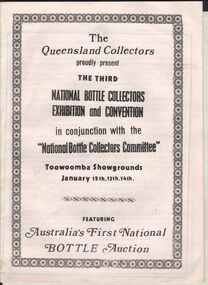
Document - JAMES LERK COLLECTION: NATIONAL BOTTLE COLLECTORS EXHIBITION AND CONVENTION BOOKLET
... JAMES LERK COLLECTION: NATIONAL BOTTLE COLLECTORS EXHIBITION AND CONVENTION BOOKLET......Bottle Collectors Exhibition...The Queensland collectors proudly present the third National bottle collectors exhibition and convention in conjunction with the National collectors committee. ...EVENT Exhibition Bottle Collectors Exhibition A ten pages booklet. ...A ten pages booklet. The Queensland collectors proudly present the third National bottle collectors exhibition and convention in conjunction with the National collectors committee. Toowoomba Showgrounds, January 12th,13th,14th. Featuring Australia's First National Bottle Auction.event, exhibition, bottle collectors exhibition -
 City of Moorabbin Historical Society (Operating the Box Cottage Museum)
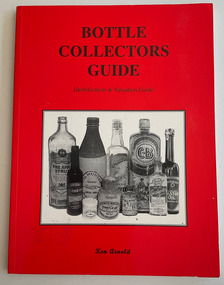
Book, Arnold, Ken, Bottle collectors guide : Identification & Valuation Guide, 1997
... Bottle collectors guide : Identification & Valuation Guide...bottles identification Identification and valuation of bottles 128 p. : ill. Bottle collectors guide : Identification & Valuation Guide Book Arnold, Ken ...Identification and valuation of bottles128 p. : ill. non-fictionIdentification and valuation of bottlesbottles, identification -
 Otway Districts Historical Society
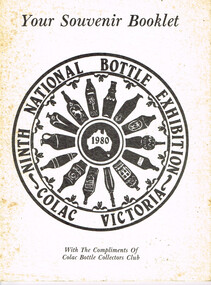
Book, Ninth National Bottle Exhibition, Colac, Victoria
... This national exhibition, the ninth Australian exhibition, is conducted by the Colac Bottle Collectors Club in 1980 to foster the collection, study and preservation of old bottles. ...Your souvenir booklet. Colac Bottle Collectors Club; Colac (Vic); 1980. 36 p.; illus. ...Your souvenir booklet. Colac Bottle Collectors Club; Colac (Vic); 1980. 36 p.; illus. ...From the 18th Century museums and individuals have collected man's manufacturing work, the bottle. In Australia some collections have been in existence for over 60 years although most collections stem from the mid- to late 1960s. This national exhibition, the ninth Australian exhibition, is conducted by the Colac Bottle Collectors Club in 1980 to foster the collection, study and preservation of old bottles. The majority of bottle shows are run on competitive lines with the host club setting the categories and judged by collectors considered to have wide knowledge and experience. Ninth National Bottle Exhibition, Colac, Victoria. Your souvenir booklet. Colac Bottle Collectors Club; Colac (Vic); 1980. 36 p.; illus. Soft cover.colac; bottles; collectors; history; glass; ceramics; -
 Bendigo Historical Society Inc.
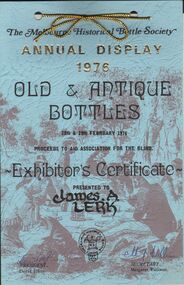
Document - JAMES LERK COLLECTION: ANNUAL DISPLAY 1976
... ...Bottle Collectors Exhibition...EVENT Exhibition Bottle Collectors Exhibition The Melbourne Historical Bottle Society - Annual Display 1976 - Old and Antique Bottles. 28th/29th February 1976. ...The Melbourne Historical Bottle Society - Annual Display 1976 - Old and Antique Bottles. 28th/29th February 1976. Proceeds to aid Association for the Blind. Exhibitor Certificate presented to James Lerk signed by the President: David Johns and the Secretary: Margaret Willison.event, exhibition, bottle collectors exhibition -
 Bendigo Historical Society Inc.
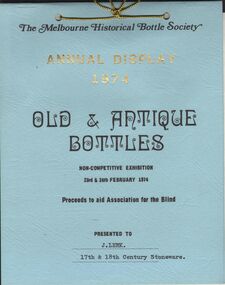
Document - JAMES LERK COLLECTION: ANNUAL DISPLAY 1974
... ...Bottle Collectors Exhibition...EVENT Exhibition Bottle Collectors Exhibition The Melbourne Historical Bottle Society - Annual display 1974 - non competitive exhibition 23rd/24th February 1974. ...The Melbourne Historical Bottle Society - Annual display 1974 - non competitive exhibition 23rd/24th February 1974. Proceeds to aid Association of the Blind. Certificate presented to James Lerk (17th and 18th Century Stoneware).event, exhibition, bottle collectors exhibition -
 Bendigo Historical Society Inc.
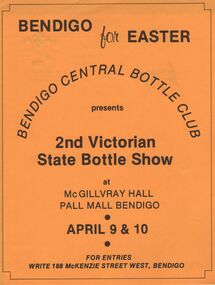
Document - JAMES LERK COLLECTION: PRINTED PROGRAMME FOR 2ND VIC. STATE BOTTLE SHOW
... ...Bottle Collectors Exhibition...EVENT Exhibition Bottle Collectors Exhibition Printed programme for 2nd Vic. ...Printed programme for 2nd Vic. State Bottle Show, April 9 & 10, 1977 - James Lerk Collection. Held at Mc Gillvray Hall, Pall Mall, Bendigo.Includes list of bottle categories for awards; Entry Form and Conditions of Entry - with loose sheet (advertising promo).event, exhibition, bottle collectors exhibition -
 Bendigo Historical Society Inc.
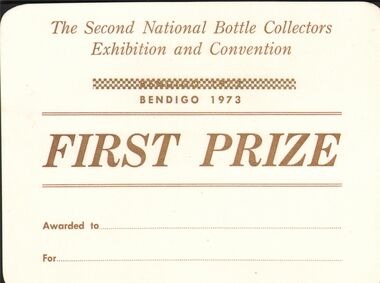
Document - JAMES LERK COLLECTION: AWARD CARD SECOND NATIONAL BOTTLE COLLECTIONS EXHIBITION
... ...Bottle Collectors Exhibition...EVENT Exhibition Bottle Collectors Exhibition Award Cards for Second National Bottle Collections Exhibition and Convention, Bendigo1973. ...Award Cards for Second National Bottle Collections Exhibition and Convention, Bendigo1973. Cards are for 'First Prize',Second Prize and Honourable Mention and are blank (ie unused).event, exhibition, bottle collectors exhibition -
 Bendigo Historical Society Inc.
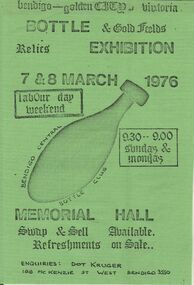
Document - JAMES LERK COLLECTION: FLYER FOR EXHIBITION MARCH 1976
... ...Bottle Collectors Exhibition...EVENT Exhibition Bottle Collectors Exhibition James Lerk Collection - Flyer for Exhibition March 7/8 1976 Memorial Hall. ...James Lerk Collection - Flyer for Exhibition March 7/8 1976 Memorial Hall.event, exhibition, bottle collectors exhibition -
 Bendigo Historical Society Inc.
Document - JAMES LERK COLLECTION: MINUTES OF BOTTLE CLUB MEETINGS
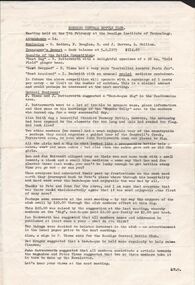
... ...bottle collectors...CLUBS Social bottle collectors James Lerk Collection - a. Minutes of Bottle Club Meeting 2/10/1974 (headed as Bendigo Central Bottle Club Newsletter b. ...James Lerk Collection - a. Minutes of Bottle Club Meeting 2/10/1974 (headed as Bendigo Central Bottle Club Newsletter b. Minutes of Meeting 5/2/1975 - Reference to some Castlemaine breweries - Fitzgerald Brewery, Standard Brewery, Joseph Young and Co.clubs, social, bottle collectors -
 Bendigo Historical Society Inc.
Document - JAMES LERK COLLECTION: ENTRY INFORMATION FOR NATIONAL BOTTLE EXHIBITION 1975
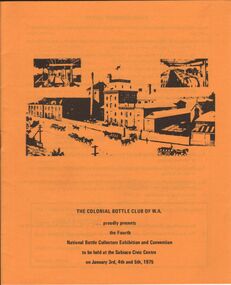
... ...Bottle Collectors Exhibition...EVENT Exhibition Bottle Collectors Exhibition James Lerk Collection - Entry information for National Bottle Exhibition 1975, Subiaco, WA. ...James Lerk Collection - Entry information for National Bottle Exhibition 1975, Subiaco, WA.event, exhibition, bottle collectors exhibition -
 Bendigo Historical Society Inc.
Document - JAMES LERK COLLECTION: PROGRAM FOR ANTIQUE BOTTLE SHOW MARCH 7/8 1981
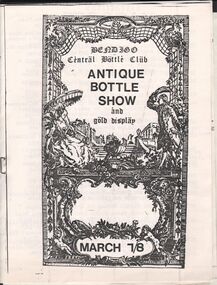
... ...Bottle Collectors Exhibition...EVENT Exhibition Bottle Collectors Exhibition James Lerk Collection - Bendigo Central Bottle Club. ...James Lerk Collection - Bendigo Central Bottle Club. Program for Antique Bottle Show March7/8 1981 (and Gold Display). Details of categories, rules etc.event, exhibition, bottle collectors exhibition -
 Bendigo Historical Society Inc.
Textile - JAMES LERK COLLECTION: ASSORTED SHOW RIBBONS
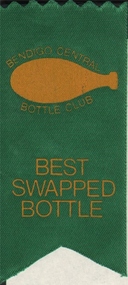
... ...Bottle Collectors Exhibition...EVENT Exhibition Bottle Collectors Exhibition Assorted show ribbons (5) - James Lerk Collection. ...Assorted show ribbons (5) - James Lerk Collection. These ribbons not necessarily associated with an entry of James Lerk. Three small ribbons of the Bendigo Central Bottle Club - best swapped bottle, the ribbons are green with yellow letters, one has a pin attached. One purple with the word judge in gold. One is white with green letters and a picture of a bottle, NSW antique bottle show, Canberra 1973, Judge.event, exhibition, bottle collectors exhibition -
 Bendigo Historical Society Inc.
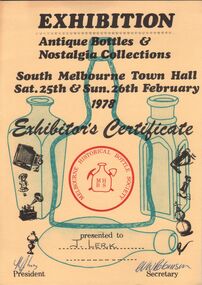
Document - JAMES LERK COLLECTION: EXHIBITOR'S CERTIFICATE 1978
... ...Bottle Collectors Exhibition...EVENT Exhibition Bottle Collectors Exhibition Antique Bottles and Nostalgia Collections. ...Antique Bottles and Nostalgia Collections. South Melbourne Town Hall, Saturday 25th and Sunday 26th February, 1978. Exhibitor's Certificate presented to James Lerk. A red stamp of the Melbourne Historical Bottles Society is at the centre.event, exhibition, bottle collectors exhibition -
 Bendigo Historical Society Inc.
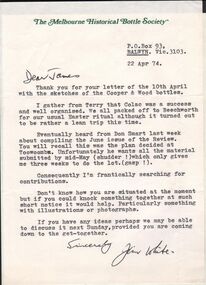
Document - JAMES LERK COLLECTION: LETTER FROM MELBOURNE HISTORICAL BOTTLE SOCIETY
... ...bottle collectors...CLUBS Social bottle collectors A letter from the Melbourne Historical Bottle Society dated 22/April/1974 addressed to James Lerk. ...A letter from the Melbourne Historical Bottle Society dated 22/April/1974 addressed to James Lerk.clubs, social, bottle collectors -
 Bendigo Historical Society Inc.
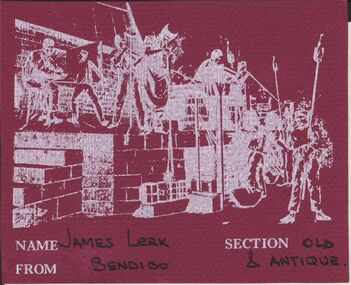
Document - JAMES LERK COLLECTION: FOUR ENTRY CARDS TO EXHIBITION
... ...Bottle Collectors Exhibition...EVENT Exhibition Bottle Collectors Exhibition Four cards for entry display in some exhibition, no date or location. ...Four cards for entry display in some exhibition, no date or location. The first has the name: James Lerk, from: Bendigo, Section: Old and Antique. The second name James Lerk from Golden Square and no section. The third name: Len Wilson, from: Eaglehawk and no section. The last one is blank. On the back of all four cards the name James A. Lerk stamped.event, exhibition, bottle collectors exhibition -
 Bendigo Historical Society Inc.
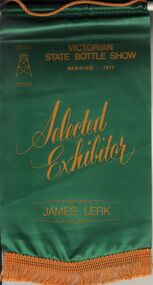
Textile - JAMES LERK COLLECTION: VICTORIAN STATE BOTTLE SHOW BANNER
... ...Bottle Collectors Exhibition...EVENT Exhibition Bottle Collectors Exhibition Green and gold banner: Victorian State Bottle Show. ...Green and gold banner: Victorian State Bottle Show. Bendigo 1977. Selected exhibitor: James Lerk.event, exhibition, bottle collectors exhibition -
 Bendigo Historical Society Inc.
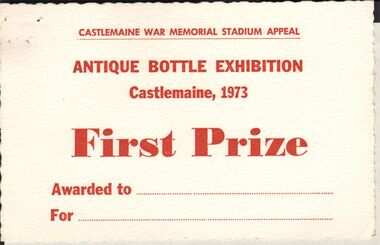
Document - JAMES LERK COLLECTIION: ANTIQUE BOTTLE EXHIBITION CASTLEMAINE, 1973
... ...Bottle Collectors Exhibition...EVENT Exhibition Bottle Collectors Exhibition Four cards Castlemaine war memorial stadium appeal. ...Four cards Castlemaine war memorial stadium appeal. Antique Bottle Exhibition Castlemaine, 1973. First prize - Third prize (it has a green ribbon attached) - Honourable Mention (Orange ribbon attached) - Best bottle on display (purple ribbon attached). The space for awarded to and for are left blank.event, exhibition, bottle collectors exhibition -
 Bendigo Historical Society Inc.
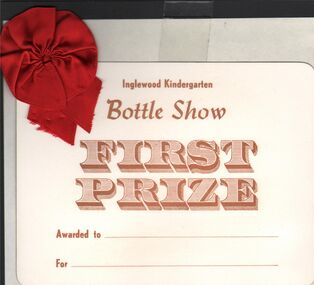
Document - JAMES LERK COLLECTION: INGLEWOOD BOTTLE SHOW
... ...Bottle Collectors Exhibition...EVENT Exhibition Bottle Collectors Exhibition Two cards. Inglewood kindergarten. ...Two cards. Inglewood kindergarten. Bottle show. The one for first prize has a red ribbon attached, the one for second prize has a blue ribbon attached. The space Awarded to and For is blank.event, exhibition, bottle collectors exhibition -
 Bendigo Historical Society Inc.
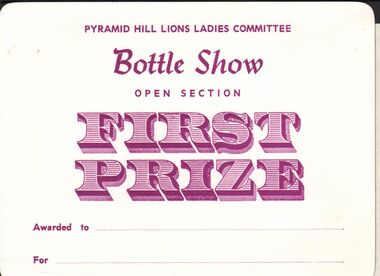
Document - JAMES LERK COLLECTION: PYRAMID HILL BOTTLE SHOW
... ...Bottle Collectors Exhibition...EVENT Exhibition Bottle Collectors Exhibition Card for Pyramid Hill lions Ladies committee. ...Card for Pyramid Hill lions Ladies committee. Bottle show, open section, First Prize. The Awarded to and For section are blank.event, exhibition, bottle collectors exhibition -
 Lakes Entrance Historical Society
Book, Vader, John and Murray, Brian, Antique Bottle Collecting in Australia, 1975
... Guide to bottle identification, glass makers, household uses, exhibitions, for bottle collectors in Australia....Antiques Collections Guide to bottle identification, glass makers, household uses, exhibitions, for bottle collectors in Australia. Antique Bottle Collecting in Australia Book Vader, John and Murray, Brian ...Guide to bottle identification, glass makers, household uses, exhibitions, for bottle collectors in Australia.antiques, collections -
 Bendigo Historical Society Inc.
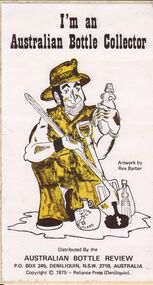
Ephemera - JAMES LERK COLLECTION: AUSTRALIAN BOTTLE COLLECTOR STICKER
... JAMES LERK COLLECTION: AUSTRALIAN BOTTLE COLLECTOR STICKER...At the top the words: I'm an Australian Bottle Collector. At the bottom: distributed by the Australian Bottle Review, PO Box 245, Deniliquin NSW 2710, Australia. ...Ephemera JAMES LERK COLLECTION: AUSTRALIAN BOTTLE COLLECTOR STICKER ...A sticker with the picture of a man with a spade and a pitchfork, holding a bottle at his feet three more bottles. At the top the words: I'm an Australian Bottle Collector. At the bottom: distributed by the Australian Bottle Review, PO Box 245, Deniliquin NSW 2710, Australia. at the side artwork by Rex Barber.magazine, club, australian bottle review -
 Kiewa Valley Historical Society
Bottle - Cream, Pre 1966
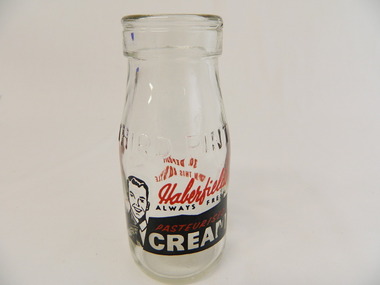
... To encourage the return of bottles, collectors were given 3d (pence) per bottle. ...To encourage the return of bottles, collectors were given 3d (pence) per bottle. ...Cream was stored and sold in bottles and bought at a local store. History of Haberfield's. The measurement of liquids was in pints and money in pence (d) pre 1966. Bottles were returned to the manufacturer who reused the bottle. To encourage the return of bottles, collectors were given 3d (pence) per bottle. Historical: Dairy farmers living in the Kiewa Valley, sent their milk to be separated into cream by a Dairy company and then sold to the public. Aesthetic: Display showing variations of shape, embossing and stencillingSmall clear glass bottle containing one third of a pint and used to carry cream. it tapers to a lip at the neck. On one side and the base it is heavily embossed. Under the embossing on the side it is stencilled in red and black words and outline of a picture of a happy man wearing a tie pointing to the writing.Base: Common Seal with 'A' and 'G' and 'M' inside the 'A'. under which is '91/6' under which is' ISM - 707' Side: embossed: Third Pint Side: stencilled: Haberfield's (red) / always red (black) / Pasteurised (red on black) / Cream (white on black) Opposite side: stencilled: 3d Deposit / On This Bottle (all in red)dairy, farmers, haberfield's, cream -
 Kiewa Valley Historical Society
Bottle - Milk, 1950's - 1960's
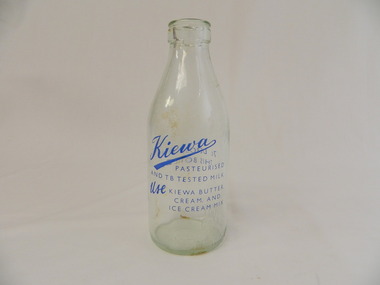
... To encourage the return of bottles, collectors were given 7 pence per bottle. ...To encourage the return of bottles, collectors were given 7 pence per bottle. ...Bottles of milk were bought at a local store. The measurement of liquid was in pints and money in pence pre 1966. Bottles were returned to the manufacturer who reused the bottle. To encourage the return of bottles, collectors were given 7 pence per bottle. TB was tested in the milk at this time and the milk was pasteurised. History of the Kiewa Company.Historical: Dairy farmers lived in the Kiewa Valley and sent their milk to the Kiewa Factory to be pasteurised and TB tested. The bottles and tops changed colour & design regularly. Aesthetic: Display showing variations of shape, embossing, and stencil.Narrow necked clear glass bottle used to carry one imperial pint of milk. Embossed on bottom near base and on base. Blue stencilled writing / print on opposite sides of the bottle.Side: Embossed: Inside embossed circle is '6' above '19'. and underneath this: One Imperial pint. Base: Embossed: Common Seal - 'A' with 'G' and 'M' inside the A and in the middle 'ISM 229' and below that '2' Stencil on side: 'Kiewa' signature and underneath printed 'Pasturised / And TB Tested Milk' / 'Use' (written) and then printed 'Kiewa Butter / Cream and / Ice cream Mix' Stencil on the opposite side: '7d Deposit On / This Bottle'kiewa, dairy, milk, butter, cream, ice-cream, farmers -
 Flagstaff Hill Maritime Museum and Village
Container - Bottle, Pre 1974
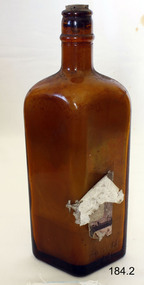
... In 1872 the American Medical Association also made recommendations -- namely that poison bottles be made of colored glass, and also have a rough surface on one side -- making them identifiable even in the dark -- and the word "poison" visible on the other (the skull and crossbones wasn't quite as ubiquitous as those movies led us to believe). However, passing these laws was not easy, and the manufacturers were essentially left to do as they wished. For collectors...In 1872 the American Medical Association also made recommendations -- namely that poison bottles be made of colored glass, and also have a rough surface on one side -- making them identifiable even in the dark -- and the word "poison" visible on the other (the skull and crossbones wasn't quite as ubiquitous as those movies led us to believe). However, passing these laws was not easy, and the manufacturers were essentially left to do as they wished. For collectors ...Phenyle has been used for decades as a cleaner and disinfectant. It is well know for its use for cleaning outdoor toilets and easily identified by its strong odour. The brown glass bottle is immediately recognised as containing a poison. We've all seen them in a hundred different mystery movie scenes. The medicine cabinet opens and there, sitting on a shelf, is the incriminating object -- the ominous dark bottle with the skull and crossbones on the label. In off-screen reality, however, poison bottles have quite a different identity -- they are distinctive, varied, colorful -- and definitely collectible. Obviously, the one thing that sets the poison bottle apart from all other bottles is the need for prominent and immediate identification as a receptacle for toxic material, and this was achieved in a number of ways, including shape, color, embossing and labeling. Poisons were commonly found in the home for the purpose of controlling rodents and other pests, and were sold by grocers and druggists. For consumer protection, as far back as 1829, New York State made mandatory the marking of the bottles with the word "poison" in large letters. Then, in the middle of the 19th century, the American Pharmaceutical Association recommended legislation regarding identification of all poison bottles. In 1872 the American Medical Association also made recommendations -- namely that poison bottles be made of colored glass, and also have a rough surface on one side -- making them identifiable even in the dark -- and the word "poison" visible on the other (the skull and crossbones wasn't quite as ubiquitous as those movies led us to believe). However, passing these laws was not easy, and the manufacturers were essentially left to do as they wished. For collectors, the high point of poison bottle manufacturing was the period ranging roughly from the 1870s to the 1930s. At that time some, of the bottles were distinguished by particularly bright colors, such as cobalt blue (the most common) and emerald green. Others, particularly rare and collectible, had unusual -- and appropriate -- shapes, including skulls, leg bones and coffins. In order to better identify these lethal vessels by feel (not forgetting that there were many people in this period who could not read) when groping for them in the dark, they had such elaborate tactile patterns as quilted diamonds, lattices, hobnails and prominent vertical or horizontal ribbing, as well as spiky knobs and ridges. In addition, many had sharp points on top for the same precautionary purpose. Further efforts to distinguish poison bottles from others included uncommon multisided and triangular shapes, and unusual, hard-to-open tops, the predecessors of the modern child-proof openings. https://www.southcoasttoday.com/story/lifestyle/2001/08/19/poison-bottles-steeped-in-history/50352280007/The recognition and awareness of bottles containing poisonpous substances is extremely important for safety reasons.Bottle, brown glass, diamond shaped. "Bright Star" phenyle. Paper label attached, but peeling off and badly damaged. Corked with contents. Text moulded into glass, some with a border of stars. Poisonous contents, not to be taken. Registered Number 2140. Volume is 20 fluid ounces. Printed label "Bright Star". Text is moulded in the glass in raised lettering: "PHENYLE" outlined and decorated with star border. "POISONOUS", "NOT TO BE TAKEN" "V / DM / A" within oval, "REGD NO. 2140" (D and O are smaller and underlined) . Base is marked "F190".flagstaff hill, warrnambool, shipwrecked-coast, flagstaff-hill, flagstaff-hill-maritime-museum, maritime-museum, shipwreck-coast, flagstaff-hill-maritime-village, bright star, phenyl, cleaning and disinfecting chemical, poison, bottles -
 Flagstaff Hill Maritime Museum and Village
Domestic object - Wooden Rolling Pin, First half of 20th Century
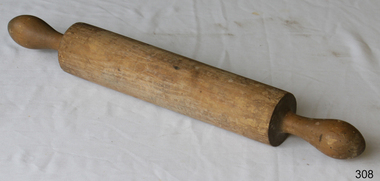
... bottle), and cork or plastic stoppers cap the ends. Designs for most rolling pins follow long-established practices, although some unusual styles and materials are made and used. Within the family of wooden rolling pins, long and short versions are made as well as those that are solid cylinders (one-piece rolling pins) instead of the familiar style with handles. Very short pins called mini rolling pins make use of short lengths of wood and are useful for one-handed rolling and popular with children and collectors...bottle), and cork or plastic stoppers cap the ends. Designs for most rolling pins follow long-established practices, although some unusual styles and materials are made and used. Within the family of wooden rolling pins, long and short versions are made as well as those that are solid cylinders (one-piece rolling pins) instead of the familiar style with handles. Very short pins called mini rolling pins make use of short lengths of wood and are useful for one-handed rolling and popular with children and collectors ...A rolling pin is a simple tool used to flatten dough. The first civilisation known to have used the rolling pin was the Etruscans. Their advanced farming ability, along with a tendency to cultivate many plants and animals never before used as food and turn them into sophisticated recipes, were passed to invading Greeks, Romans, and Western Europeans. Thanks to the Etruscans, these cultures are associated with gourmet cooking. To prepare their inventive foods, the Etruscans also developed a wide range of cooking tools, including the rolling pin. Although written recipes did not exist until the fourth century B.C., the Etruscans documented their love of food and its preparation in murals, on vases, and on the walls of their tombs. Cooking wares are displayed with pride; rolling pins appear to have been used first to thin-roll pasta that was shaped with cutting wheels. They also used rolling pins to make bread (which they called puls) from the large number of grains they grew. Natives of the Americas used more primitive bread-making tools that are favoured and unchanged in many villages. Chefs who try to use genuine methods to preserve recipes are also interested in both materials and tools. Hands are used as "rolling pins" for flattening dough against a surface, but also for tossing soft dough between the cook's two hands until it enlarges and thins by handling and gravity. Tortillas are probably the most familiar bread made this way. Over the centuries, rolling pins have been made of many different materials, including long cylinders of baked clay, smooth branches with the bark removed, and glass bottles. As the development of breads and pastries spread from Southern to Western and Northern Europe, wood from local forests was cut and finished for use as rolling pins. The French perfected the solid hardwood pin with tapered ends to roll pastry that is thick in the middle; its weight makes rolling easier. The French also use marble rolling pins for buttery dough worked on a marble slab. Glass is still popular; in Italy, full wine bottles that have been chilled make ideal rolling pins because they are heavy and cool the dough. Countries known for their ceramics make porcelain rolling pins with beautiful decorations painted on the rolling surface; their hollow centres can be filled with cold water (the same principle as the wine bottle), and cork or plastic stoppers cap the ends. Designs for most rolling pins follow long-established practices, although some unusual styles and materials are made and used. Within the family of wooden rolling pins, long and short versions are made as well as those that are solid cylinders (one-piece rolling pins) instead of the familiar style with handles. Very short pins called mini rolling pins make use of short lengths of wood and are useful for one-handed rolling and popular with children and collectors. Mini pins ranging from 5 to 7 in (12.7-17.8 cm) in length are called texturing tools and are produced to create steam holes and decorations in pastry and pie crusts; crafters also use them to imprint clay for art projects. These mini pins are made of hardwoods (usually maple) or plastic. Wood handles are supplied for both wood and plastic tools, however. Blown glass rolling pins are made with straight walls and are solid or hollow. Ceramic rolling pins are also produced in hollow form, and glass and ceramic models can be filled with water and plugged with stoppers. Tapered glass rolling pins with stoppers were made for many centuries when salt imports and exports were prohibited or heavily taxed. The rolling pin containers disguised the true contents. The straight-sided cylinder is a more recent development, although tapered glass pins are still common craft projects made by cutting two wine bottles in half and sealing the two ends together so that the necks serve as handles at each end.Tiny rolling pins are also twisted into shape using formed wire. The pins will not flatten and smooth pastry, and the handles do not turn. The metal pins are popular as kitchen decorations and also to hang pots, pans, and potholders. https://www.encyclopedia.com/sports-and-everyday-life/food-and-drink/food-and-cooking/rolling-pinThe use of the rolling pin to make thin pastry or pasta.Wooden rolling pin with some damage on cylinder section.None.flagstaff hill, warrnambool, shipwrecked-coast, flagstaff-hill, flagstaff-hill-maritime-museum, maritime-museum, shipwreck-coast, flagstaff-hill-maritime-village, rolling pin, cooking, pastry -
 City of Moorabbin Historical Society (Operating the Box Cottage Museum)
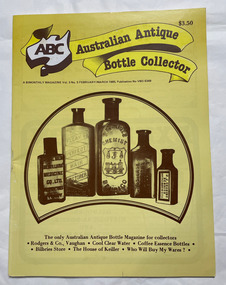
Magazine, Arnold, Ken, Australian Antique Bottle Collector, 1985
... Australian Antique Bottle Collector...Yellow cover with photos of amber glass chemist bottles Australian Antique Bottle Collector Magazine Arnold, Ken Crown Castleton Publishers ...An Australian bi-monthly magazine for collectors of Antique Bottles.Yellow cover with photos of amber glass chemist bottles An Australian bi-monthly magazine for collectors of Antique Bottles.antique bottles, collections -
 Greensborough Historical Society
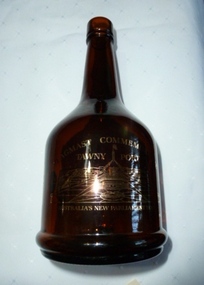
Bottle, Flagmast Commemorative Tawny Port: Australia's new Parliament House, 1988_
... Released to commemorate the completion of New Parliament House in May 1988. A collector's edition port bottle. flagmast port 1988 parliament house bottles port Brown glass port bottle. ...Released to commemorate the completion of New Parliament House in May 1988. A collector's edition port bottle.Brown glass port bottle. Gilt printing on front and back. Front has a drawing of 'new' Parliament House and the caption :' Flagmast Commemorative Tawny Port: Australia's new Parliament House. ' flagmast port, 1988, parliament house, bottles, port -
 Kiewa Valley Historical Society
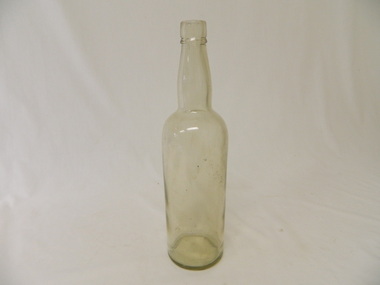
Bottle - Spirits, Late 1920's to early 1930's
... Collected by bottle collectors. Aesthetic: Display showing embossing and the shape especially when in good condition. bottle spirits whisky Base: A.G.M. ...Spirits came in bottles sold at licensed premises either locally or in larger cities visited during shopping expeditions. The shape of bottles varied and were re cycled remaining the property of the manufacturer who paid for their return.Historical: Change of bottles - shape, glass, embossing. Collected by bottle collectors. Aesthetic: Display showing embossing and the shape especially when in good condition.Clear glass bottle used for whisky. Straight sides 190 mm high then a sharp taper to the neck which bulges a little and is 100 mm high. It had a cork stopper. It is embossed on the base.Base: A.G.M. A 6bottle, spirits, whisky -
 Kiewa Valley Historical Society
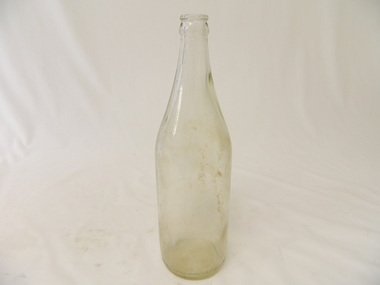
Bottle - Beer, 1950s - 1960s
... Collected by bottle collectors. Aesthetic: Display showing embossing & shape especially if in good condition. bottle beer richmond brewery drink richmond Bottom sides: 'The property of Richmond N.S. ...Beer came in bottles sold at licensed premises either locally or in larger cities visited during shopping expeditions.The shape of the bottles changed. The bottles were re cycled remaining the property of the manufacturer who paid for them. History of the Richmond Brewery, Richmond.Historical: Change of bottles - shape, glass, embossing. Collected by bottle collectors. Aesthetic: Display showing embossing & shape especially if in good condition.Clear glass bottle used for beer. Bottom half has straight sides. The top half tapers to the opening where a metal crimp fits. It has a crown seal. The glass is joined on two sides longitudinally. It is heavily embossed, in capital letters, around the base of the side around its circumference and at the base.Bottom sides: 'The property of Richmond N.S. Brewing Co. Pty. Ltd.' Base: 'R.B.' and underneath these letters 'R.'. and in between and much smaller S.3.bottle, beer, richmond brewery, drink, richmond -
 Kiewa Valley Historical Society
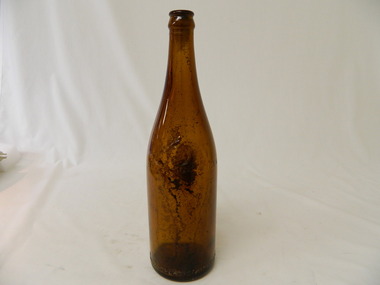
Bottle - Beer, 1930s
... Collected by bottle collectors. Aesthetic: Display showing embossing & shape especially if in good condition. beer drink bottle richmond brewery richmond Sides: R.B. and underneath this R. with a head of a tiger. ...Beer came in bottles sold at licensed premises either locally or in larger cities visited during shopping expeditions. The shape of the bottles changed. Bottles were recycled remaining the property of the manufacturer who paid for their return. History of the Richmond Brewery.Historical: Change of bottles - shape, glass, embossing. Collected by bottle collectors. Aesthetic: Display showing embossing & shape especially if in good condition.Clear brown bottle with heavy embossing. The bottom half has straight sides. The top tapers to the opening. Half way up the sides it is heavily embossed with R.B. and underneath these letters R. The face of a tiger features in heavy embossing on the side of the bottle. At the bottom around the circumference and on the base is embossing. There is a broken cork sealing the bottle. Sides: R.B. and underneath this R. with a head of a tiger. Bottom around the circumference: 'The property of Richmond N.S. Brewing Co. Pty. Ltd.' Base: '650'beer, drink, bottle, richmond brewery, richmond
